Hallowe’en: the Village, Valdemort, and a Video

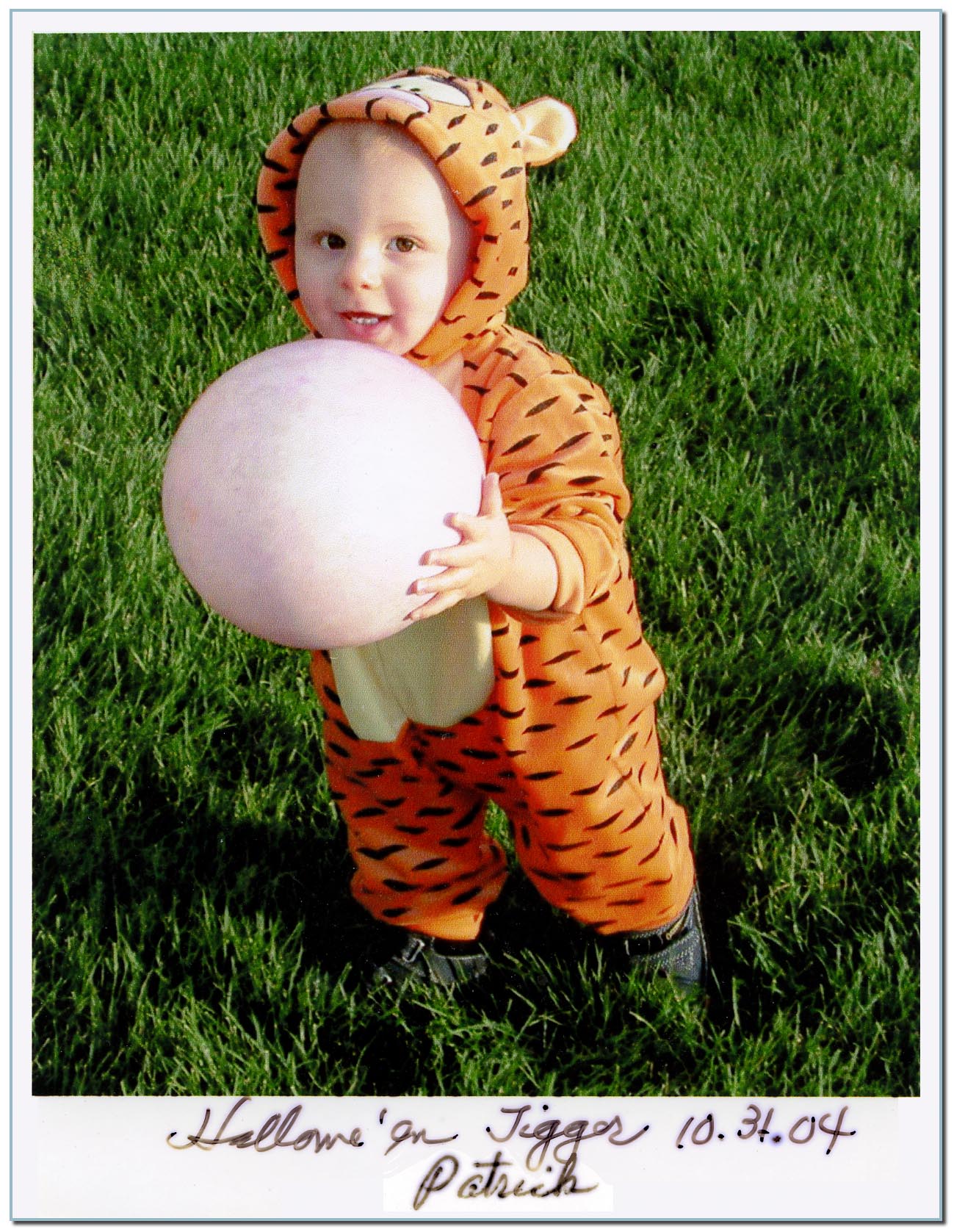
Ten years ago grandsons Patrick and Curtis were one-year-olds at Hallowe’en. In October 2004 they lived far away from us in Chicago. Fortunately, their parents captured snapshots of them in costume, Curtis a pumpkin and Patrick, Tigger, both in store-bought outfits, unlike my own get-ups, which were always homemade as shown in my Hallowe’en post last year.
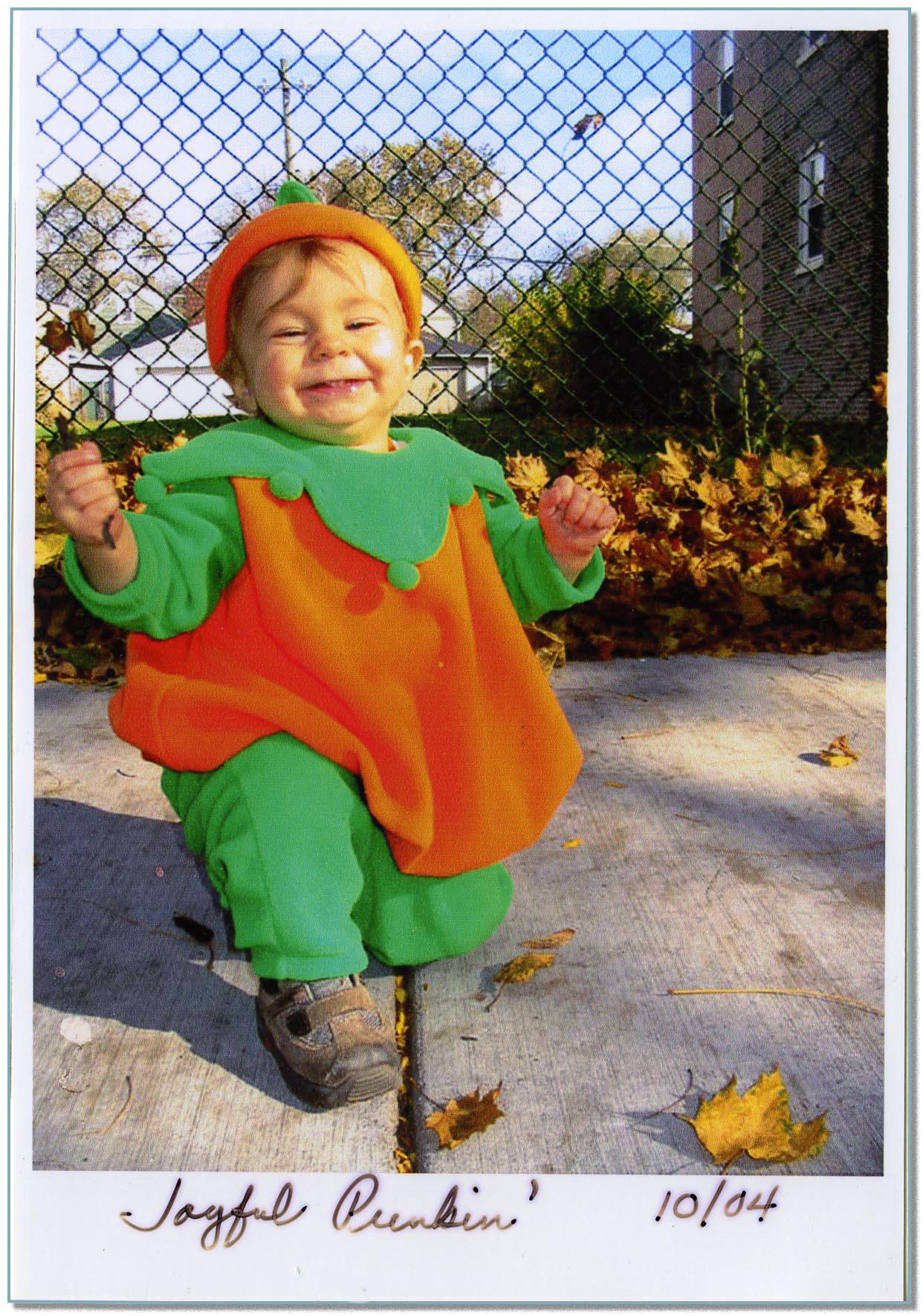
Curtis as pumpkin_2004_1000

Patrick_Halloween Tigger_2004_1031

Last weekend, among the children dressed as Muggles, Dumbledores, or Valdemort, Patrick and Curtis  chose to attend the “Harry Potter” Sunday Symphony sans costume. Only Curtis wielded a wand, which caused a wee bit of trouble amidst the spider webs.
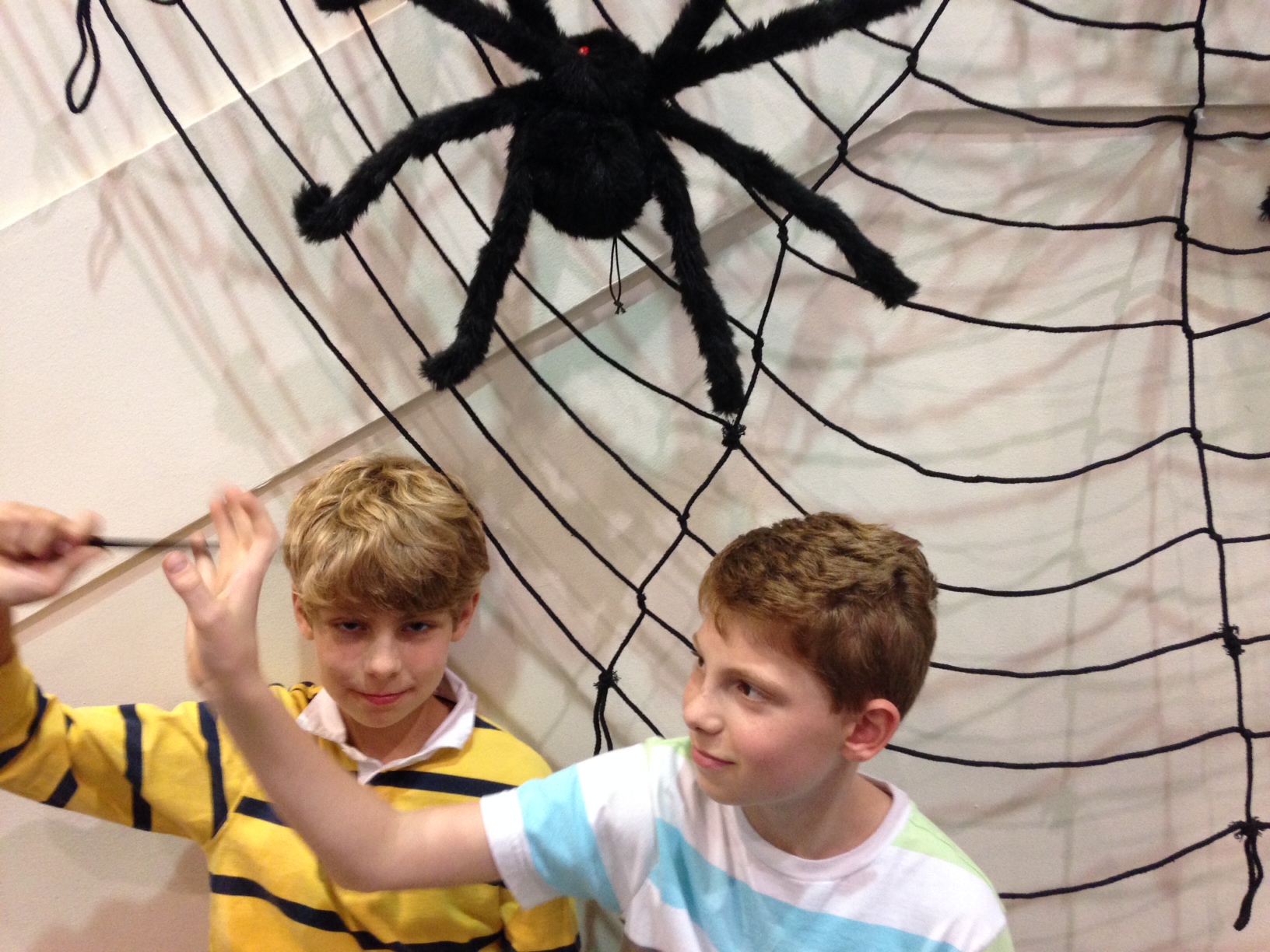
 PatCurtPotterSymphony

*  *  *

Students at Rheems Elementary School grades 1 – 8, though familiar with Washington Irving’s “The Legend of Ichabod Crane” and perhaps Poe’s “The Tell-Tale Heart” could not have anticipated J. R. R. Rowlings’ Harry Potter series.

Though Rheems was no School for Hogwarts, our village school had its own version of The Sorcerer’s Stone and the Goblet of Fire in the Deathly Hallows of the school’s basement, made ghoulish by the upper grades who created scary events with “eye” grapes in bowls, ghostly recorded voices among the hay-bales, and an illuminated skeleton.

Students raided closets and attics to conjure up costumes for the Hallowe’en parade, the culmination of visits to the House of Horrors in the basement of the school. My Mennonite aunt, also my teacher Miss Longenecker, initiated much of the fanfare that marked all the holidays, both the sacred and the secular. Here she has recorded our annual Hallowe’en parade, including the stumbles and falls!

Quote of the week by Erma Bombeck:

A grandmother pretends she doesn’t know who you are on Halloween.

Your Hallowe’en memories — a scary tale? a memorable outfit? The conversation starts here.

Coming next: What’s for Dinner: Dried Beef Gravy and . . .
Mom’s Accessories: Bonnets, Hankies, Pins and More

My Mother Ruth Landis Metzler was a simple girl who grew up on a farm near Lititz, Pennsylvania and attended Erb’s Mennonite Church. As a young woman, she wore plain clothing and never cut her hair. Her adornment was of the biblical kind as the Apostle Paul admonishes:

I also want the women to dress modestly, with decency and propriety, adorning themselves, not with elaborate hairstyles or gold or pearls or expensive clothes . . .
I Timothy 2:9 NIV

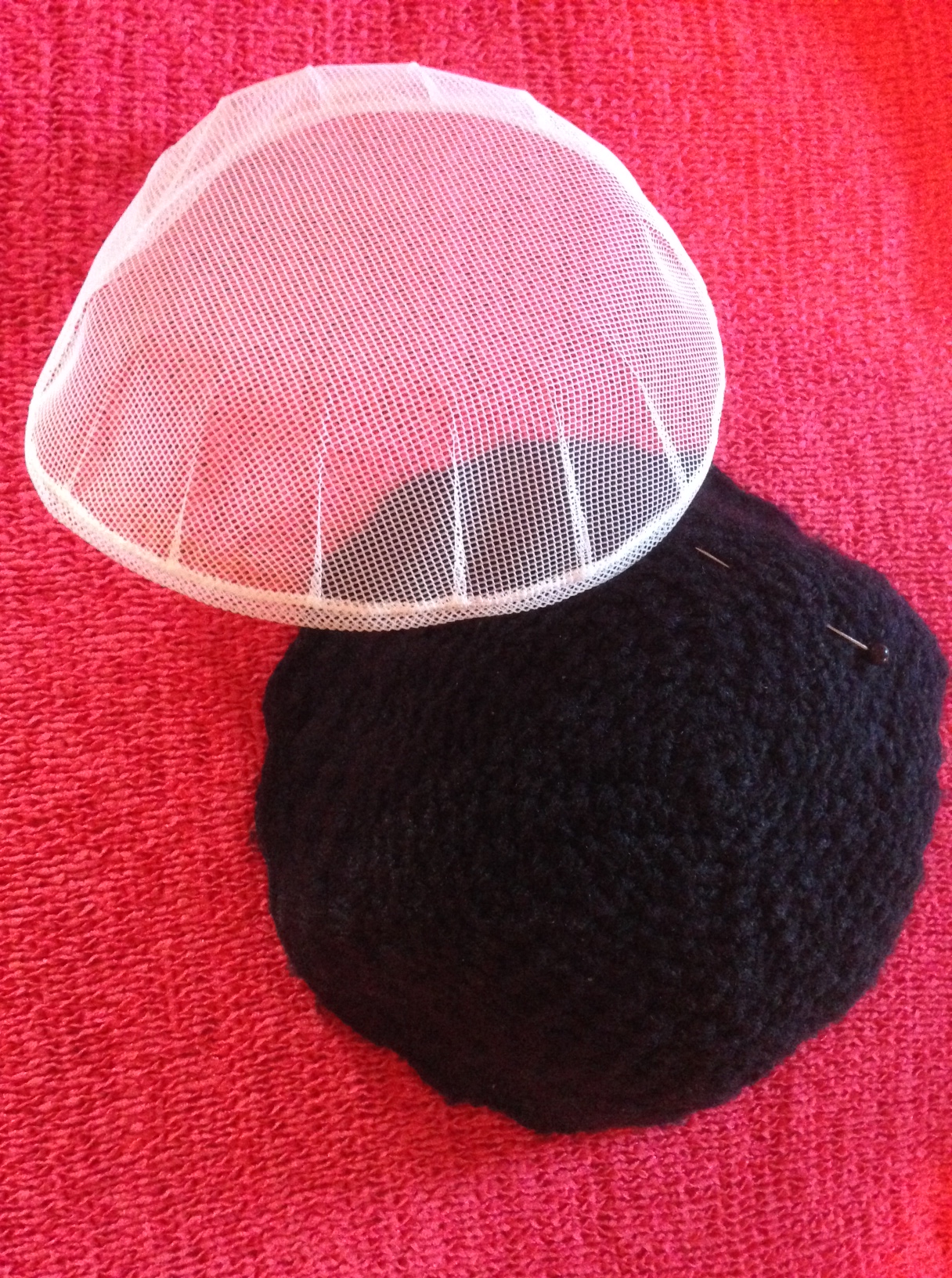
As we sorted through her personal effects recently, we found two prayer coverings and three bonnets, all miniature versions of those large sizes (jumbo, actually) she wore during her girlhood and all through the years we children lived at home.

BonnetCoveringOn the clipboard in her kitchen, we found the business card to the Sue’s Covering Shop in Lititz where she bought her most recent headgear, the black bonnet now rivaling the size of a Jewish yarmulke and fastened with a shiny black-tipped hat pin.

 CoveringShopSue2

Size mattered among the various congregations in the Lancaster Mennonite Conference in all the years my mother wore prayer coverings. Handwritten on Sue’s Covering Shop business card was Mother’s latest size: D – 19 1/2. When I called Sue’s, the clerk said that D indicates the pattern number, the higher the number (okay, it’s a letter) the larger the size. And 19 1/2 describes the inches around the circumference of her covering.

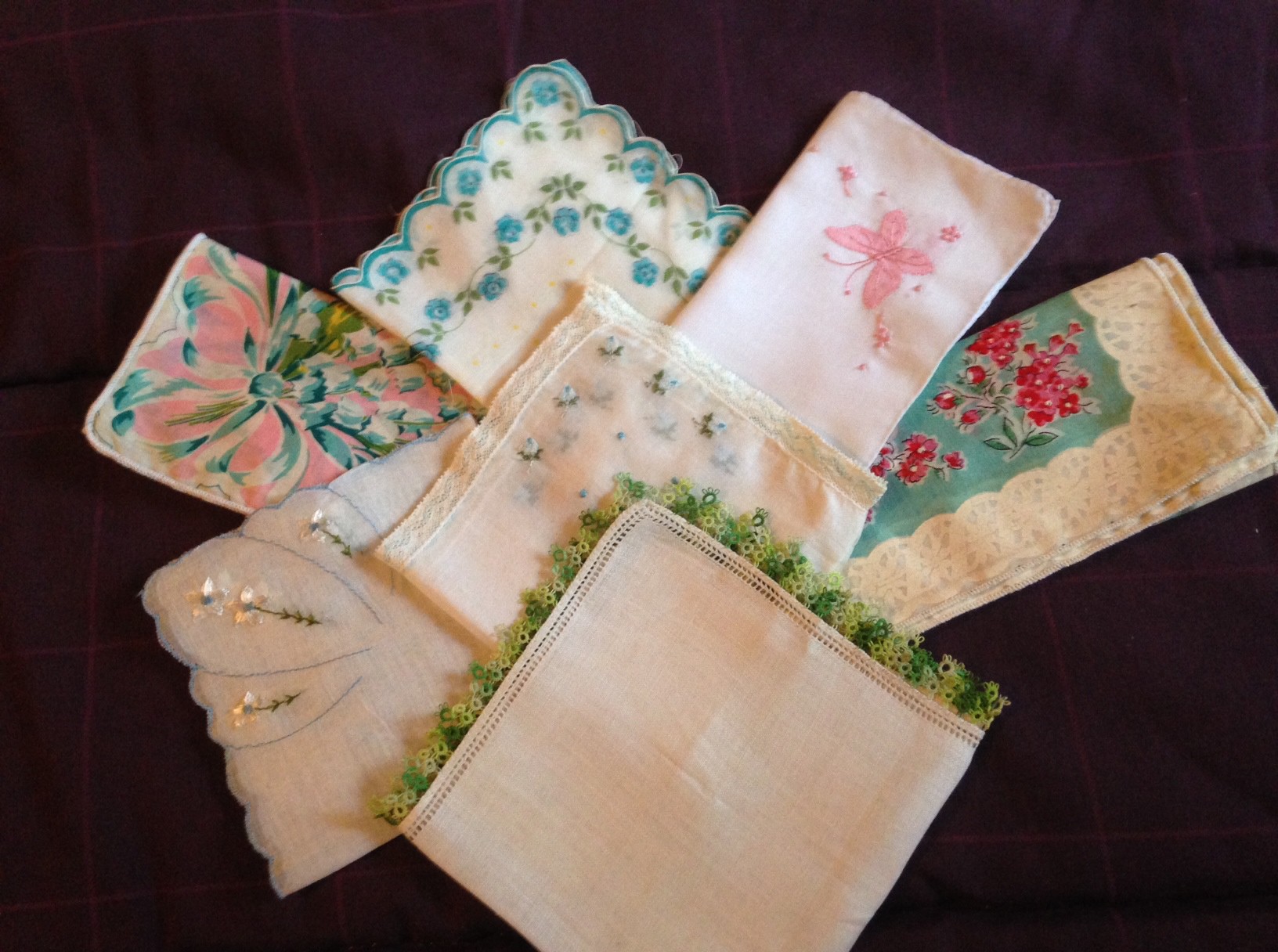
Hankies, now replaced by Kleenex, were once a part of every woman’s wardrobe. As a young child, my offering (a penny as a toddler, and later a nickel as I grew older) was tied into one corner of my white handkerchief, so I could untie the knot and put the coin into the tin box my teacher passed around during the Sunday School class. Surprisingly, Mother’s hankies were fancy, some even gaudily so, and one even boasts green tatting.

HankiesMom

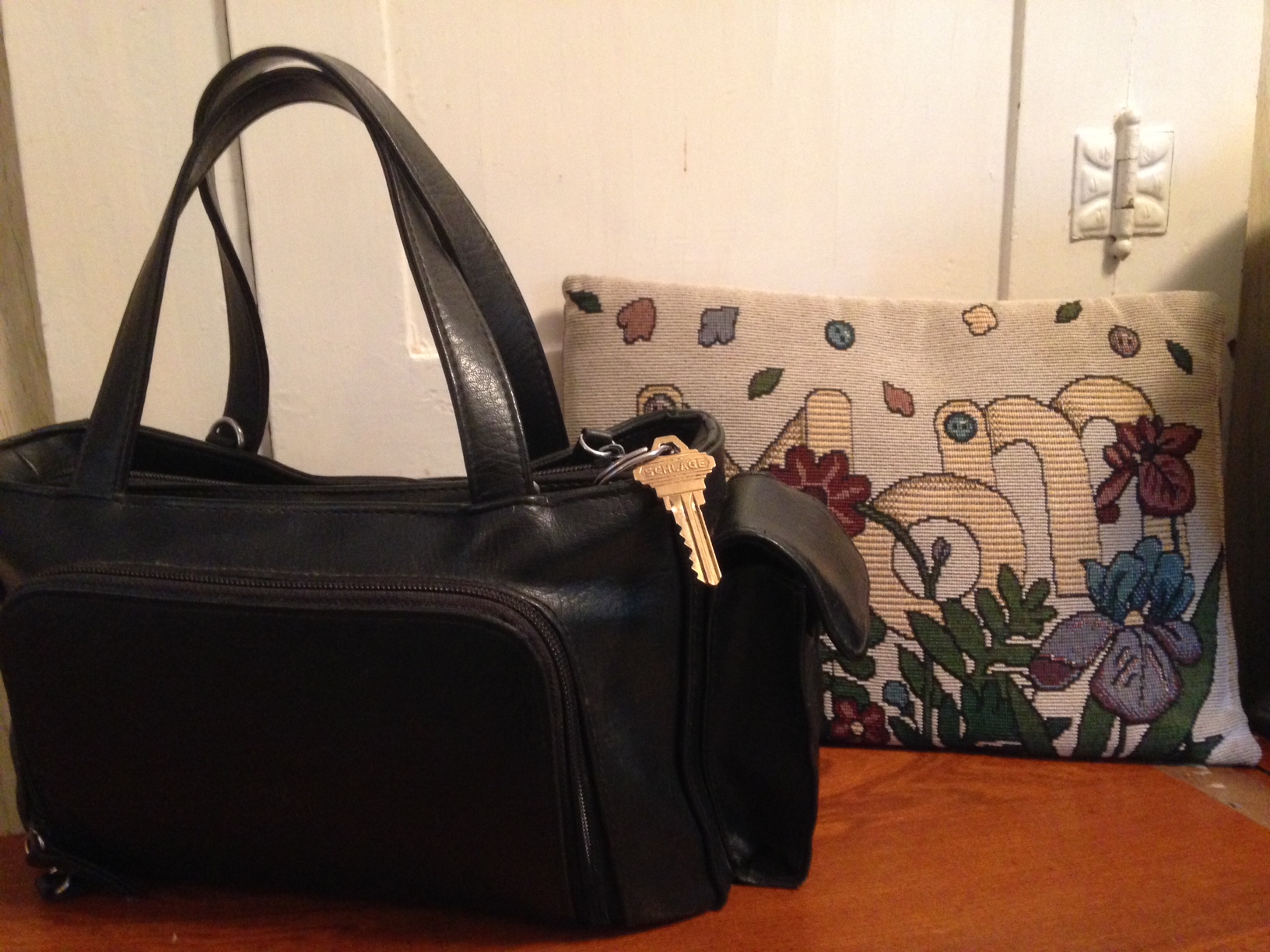
Mom’s purses have usually been black and serviceable though we found set aside a hand-tooled leather purse and remember a lacquered basket-weave popular in the 1950s and 60s. In the October 2014 issue of Guideposts, Malinda Bertels takes stock of her Grandma’s purse and finds in it tissues for applying rouge, a vial of holy water and a faded inscription on a small wooden cross which provides insight and courage to move forward. Mom’s purse contained none of those things, only the bare essentials.

PurseMom

The very last purse she ever carried had a zippered compartment on the outside and all the pockets she liked on the inside for her cards and such. Most important was the pouch on one side, probably designed for a cellphone, but which held her house and car keys. The house key remains, but the car keys have been passed on to a friend from church.

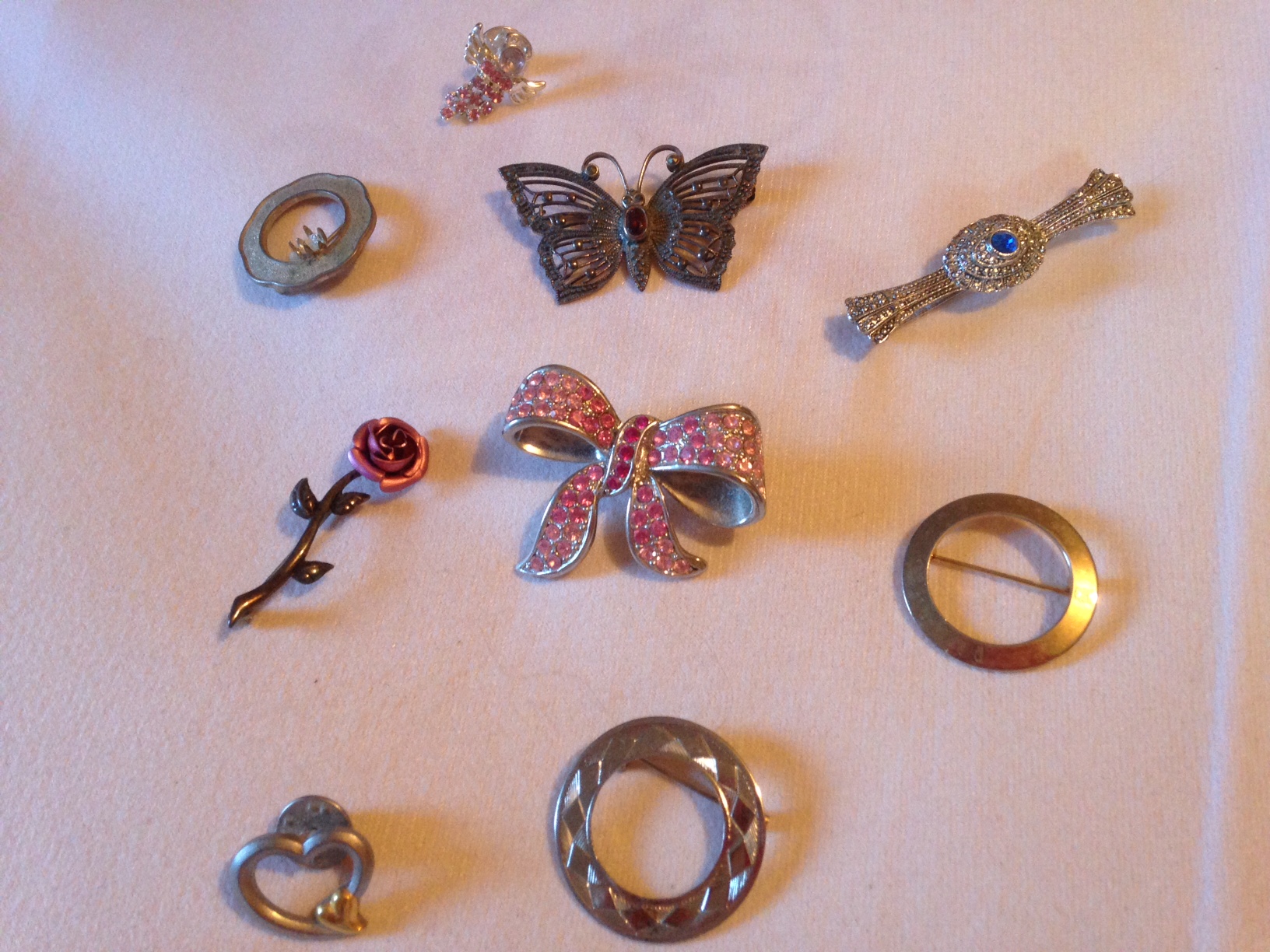
Mother never wore any jewelry except a wrist-watch, but friends bought cute little pins for her anyway. They were never all in one spot, but when we gathered them together, they numbered nine. The only one I ever remember her wearing was the round silver-faceted one, probably to her grandson Austin’s wedding.

PinsMom

Plain and fancy, her wardrobe included the gamut. A plain woman with fancy edges, that was Mom!

*  *  *

HoneymoomPillow

A souvenir of their honeymoon, this pillow was found among Mother’s treasures, obviously a gift from Dad, revealing his softer side.

Was/Is your mom plain or fancy?  Are you similar or different in fashion sense? 

Moments of Discovery # 2: Dad’s 1921 Report Card & Mom’s 1989 Car

The bustle in a house

The morning after death

Is solemnest of industries

Enacted upon earth, —

The sweeping up the heart,

And putting love away

We shall not want to use again

Until eternity.

Emily Dickinson was referring to the morning after the death of a loved one, but such hustle could also refer to what happens weeks or months after a loved one dies, and the bereaved are required to sift through that loved one’s possessions.

There is no shortage of articles on how to tackle this bittersweet task. Sara Davidson in a piece in The New York Times asks, “What to do with Mother’s stuff?” which in her case too involved dispatching with a car, furnishings, and memorabilia. Following Joan Didion’s rule, she tried to follow the principle of touching an object only once, making a decision and moving on.

The most emotional aspect of cleaning out a house is sorting the belongings, says Elizabeth Weintraub in an article “Cleaning Out the House After a Death.” She suggests sorting items into three piles or tagging them with color-coded stickers: Items to keep, items to donate or sell, items to throw away. Wendy Schuman outlines “9 Tips for Cleaning Out Your Late Parent’s Home.” She remarks, “Consider the cleaning-out job a labor of love. As hard as it was, clearing out my mother’s home was the last important service I could render her . . . .”  

Recently, my sisters and I said our goodbyes again and again as we sorted, reminisced, cried, but forged ahead, emptying drawers, closets, and eventually rooms.

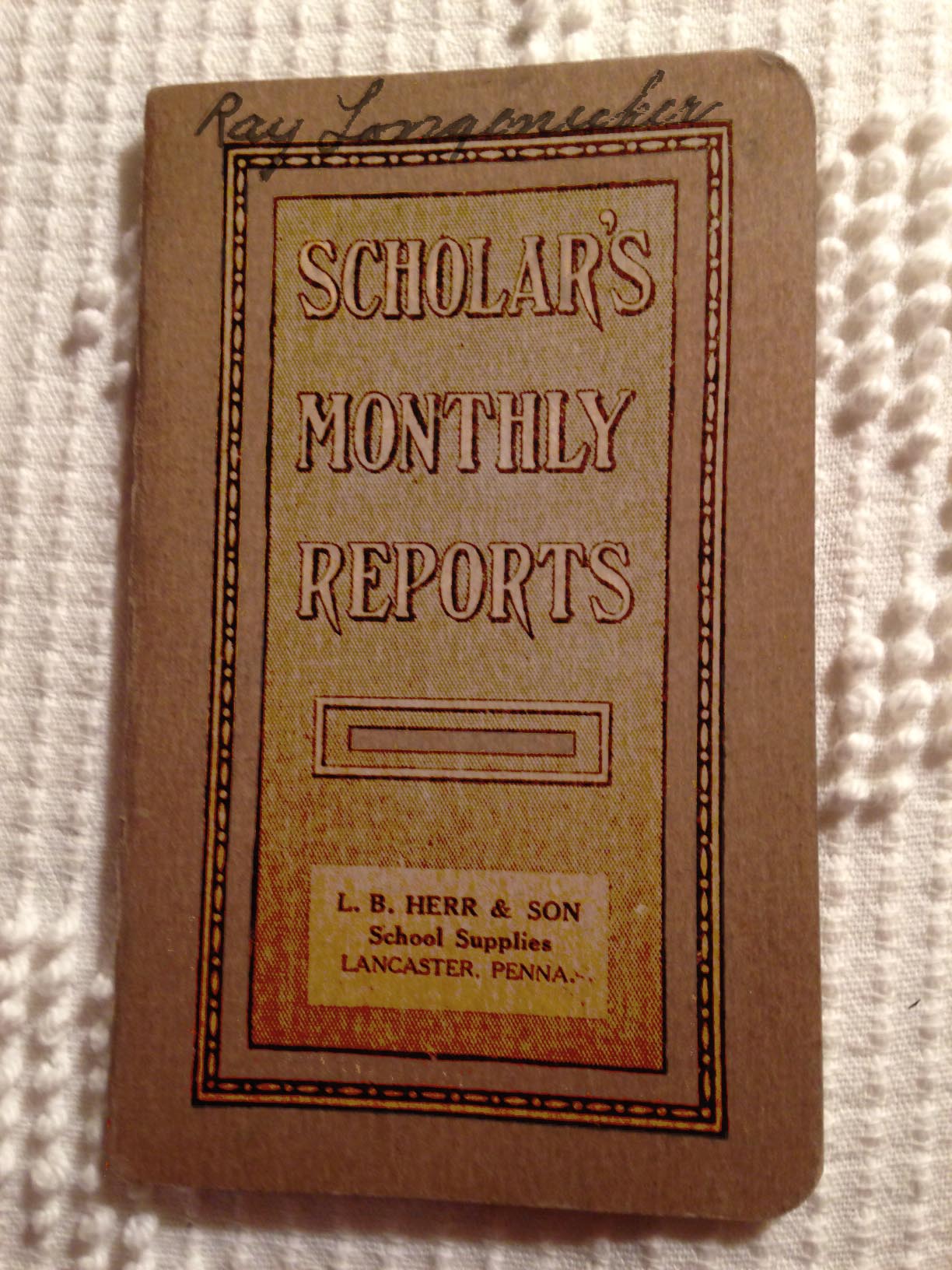
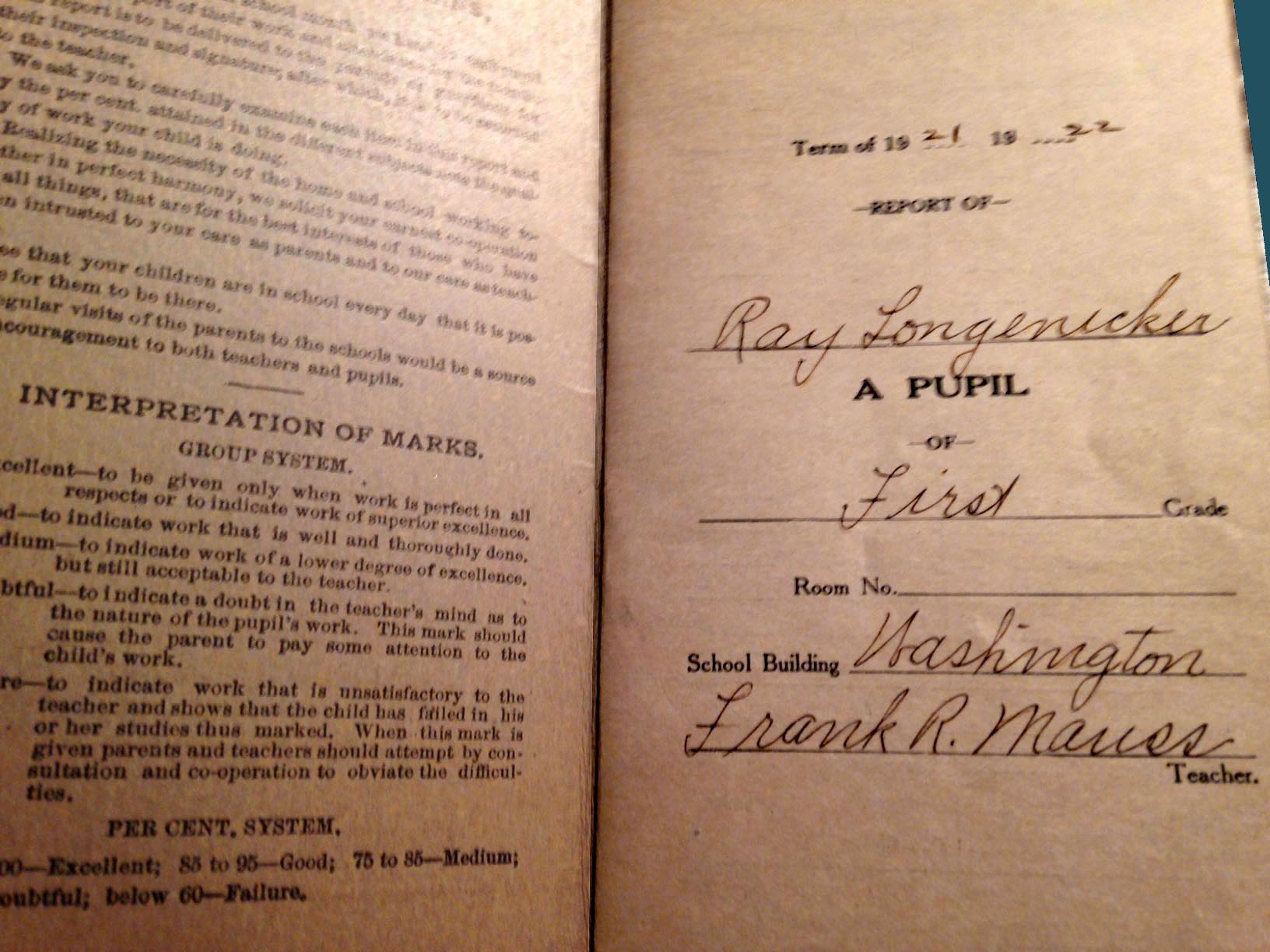
Some discoveries are hidden. Out of sight. Others are hidden in plain view. Last week we uncovered my dad’s first grade report card from 1921-22 in a box on the upper shelf of the closet. It’s a document, really, a fancy booklet with flowing cursive penmanship. The opening page announces the teacher’s name and school, Frank R. Mauss at Washington School, like many schools of the era on the same grounds as the church, in this case Bossler’s Mennonite Church.

Ray Longeneckter_1st gr report card_4x5_300Ray Longenecker_report card1_inside_5x3_300

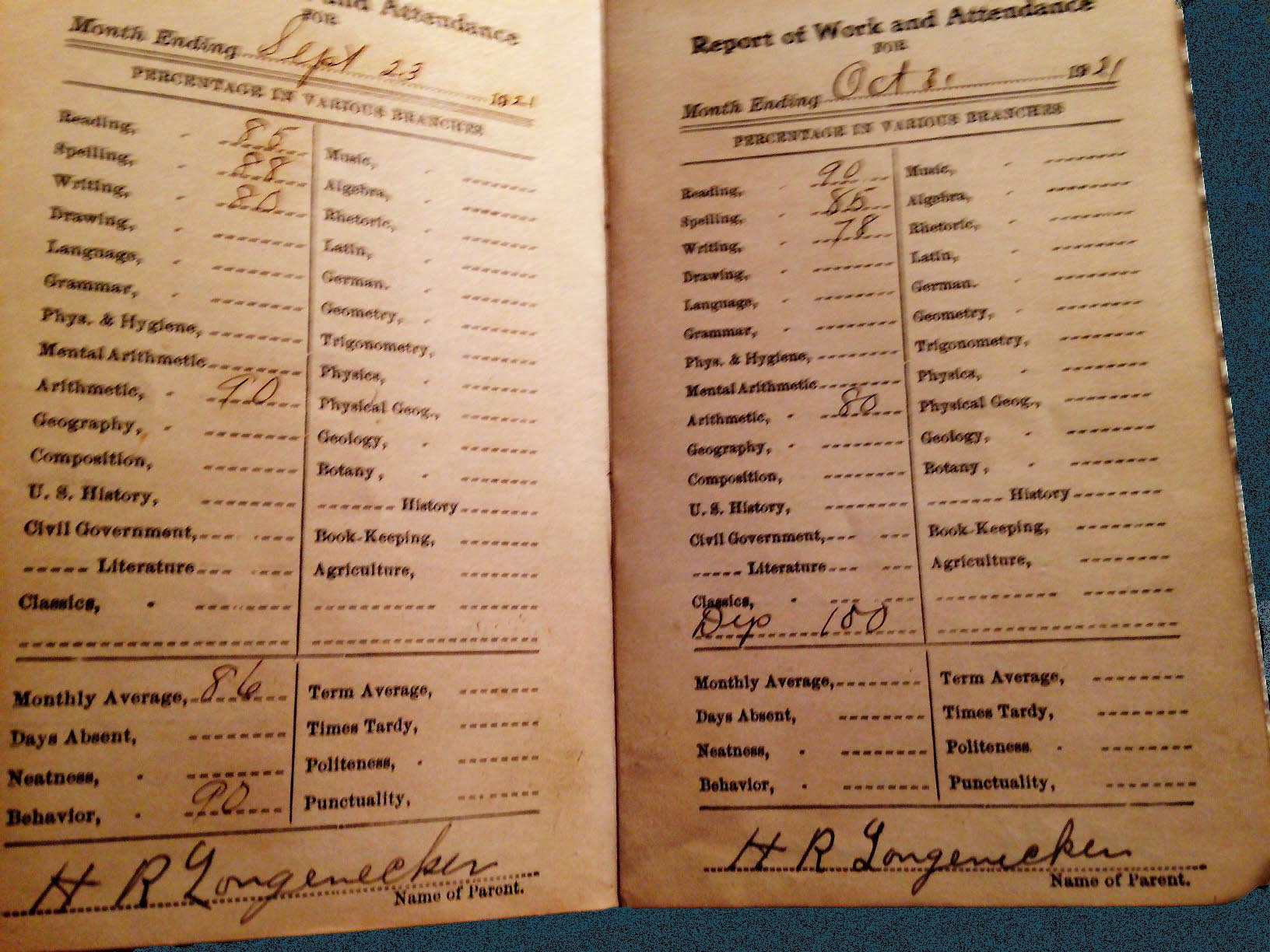
There are no vague S’s or U’s for satisfactory or unsatisfactory. Not even an A, B, or C. No, the grades are recorded precisely as percentages: 86% average for the first reporting period. And a 90% for behavior, not quite the teacher’s pet!

Ray Longenecker_report card2_inside_5x3_300

*  *  *

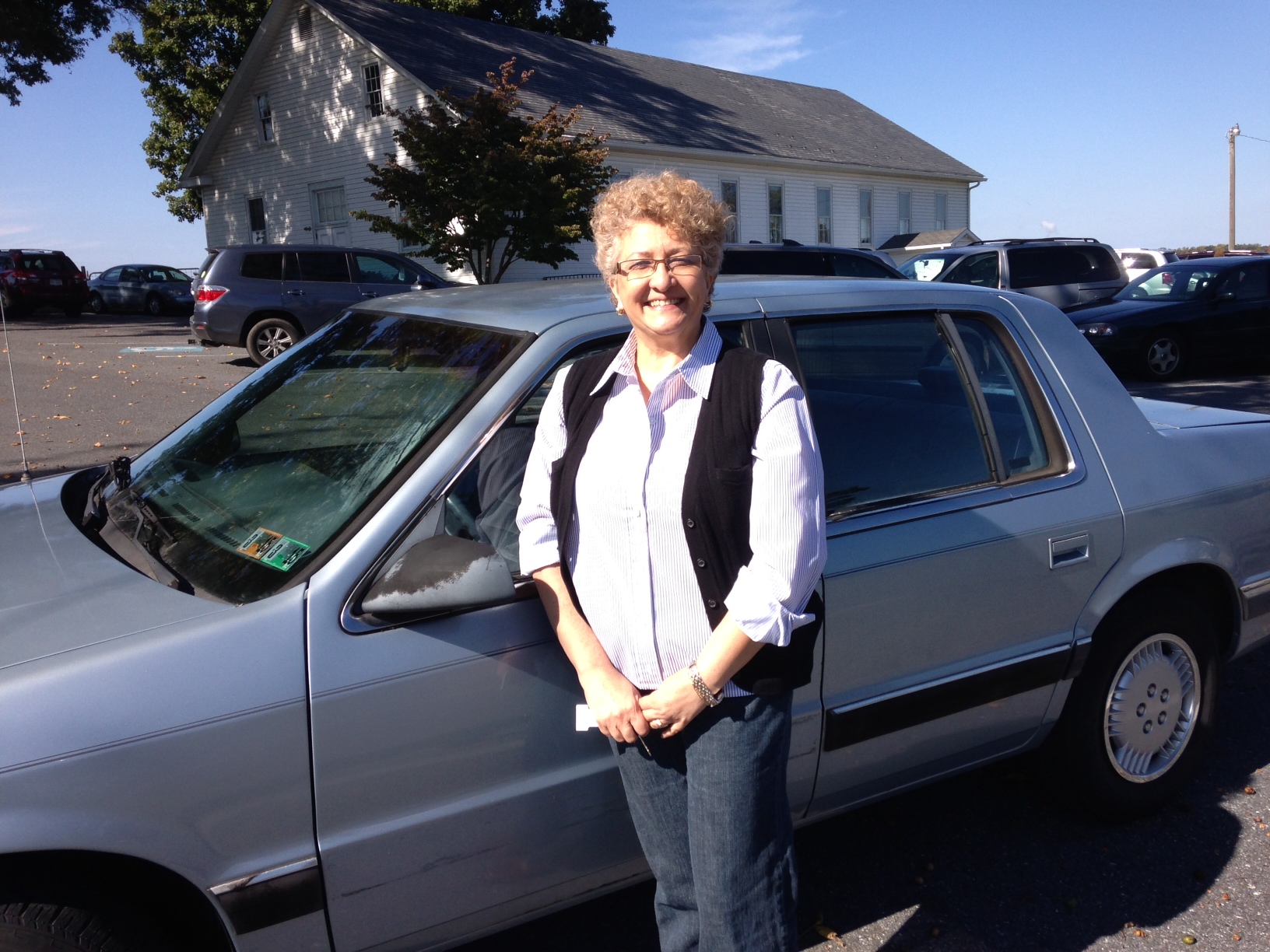
And, yes, other discoveries are hidden in plain view, like Mother’s Dodge Spirit. With 98,000 miles it’s been around the block more than once, but certainly not worthy of an antique license tag. What to do with it? After some deliberation, our sister Jean suggested we offer it to our friend Edda, a member of Bosslers’ Mennonite Church. A first-generation immigrant from Colombia, Edda is getting a foot-hold on a new life in the USA while enabling her son to get a college education. She is tickled pink with our recycled gift. A bonus for us: We get to see Mom’s car parked at church when we visit on Sundays.

EddaCar

Cards and cars – both have a second life, one an artifact to hold – the other, providing a pathway to the next step in adventure for a brave woman.

Valuing the past and the present, both solemn acts, both borne of love. As Wendy Schuman concludes, As I sorted through her things, I felt surrounded by her presence. In a way, it helped me say my final goodbye.”

Have you had to say goodbye to someone or something you have cherished?

How have you learned to say “Goodbye”?

Coming next: Mom’s Accessories: Bonnets, Hankies, Pins, and More

Train Lovers, Welcome Aboard

3 Snapshots from Memory

  • Aunt Ruthie Longenecker takes us to Philadelphia, my first recollection of a train trip. I feel the rocking motion of the Pennsylvania Rail Road train car we occupy, the clickety-clack of the wheels on the rails, and the prize of the big city zoo at the end of the trip: lions and tigers and elephants, oh my!
  • When I pick raspberries with Grandma Longenecker, I hear the train’s clatter-clack over segments of track speeding from Lancaster to Harrisburg. With our round aluminum kettles laden with berries and handles that cut into the palms of our hands, we stand just 50 yards from the track, feeling the vibration of the passing train through our shoes, gazing in awe.
  • Years later, the young Beaman family bridges the gap between Florida and Pennsylvania via Amtrak’s Silver Meteor. The miles disappear behind us effortlessly. Parents and children eat, read, stretch our legs as some passengers wonder “Who’s that little kid running in the aisle?”

Train Trips Engage the Senses:

  1. Rocking motion as the train speeds along
  2. Sound of the wheels on the rails
  3. Smells of warm exhaust, food in the dining car,
  4. Surprising views as train wends its way through towns, countryside
  5. Spontaneous, easy conversation sometimes with strangers

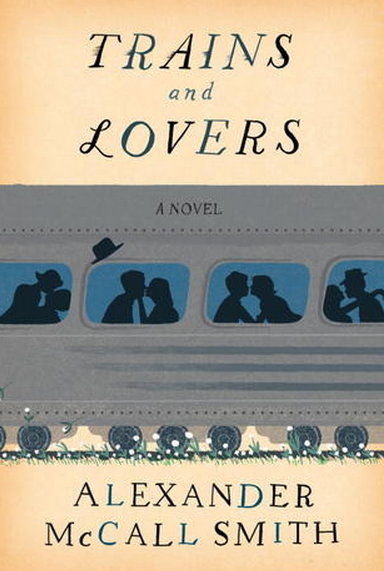
Alexander McCall Smith, known for his light mysteries that kindly expose the foibles of his characters, describes the mystique of train travel in his recent novel Trains and Lovers (2012):

Screen Shot 2014-10-02 at 6.30.12 PM

“I’m thinking that’s a fishing boat.”

It was. He saw it from the train, but not for more than a minute or two, as the line followed that bit of coastline only for a short time before it suddenly swerved off, as railway lines will do. The view of the North Sea was lost, and trees closed in; there was the blue of the sea one moment and then the blurred green of foliage rapidly passing the window; there was slanting morning sun, like an intermittent signal flashed through the tree.”

Train Poetry

Of course, nostalgic verse has been written about train travel, Sara Teasdale hearing and seeing from In the Train the “restless rumble,” the “drowsy people” and the “steel blue twilight in the world (1915).

Edna St. Vincent Millay reflects on viewing the distant steam locomotive in Travel (1921)

The railroad track is miles away,

And the day is loud with voices speaking,

Yet there isn’t a train goes by all day

But I hear its whistle shrieking.

All night there isn’t a train goes by,

Though the night is still for sleep and dreaming,

But I see its cinders red on the sky,

And hear its engine steaming.

My heart is warm with friends I make,

And better friends I’ll not be knowing;

Yet there isn’t a train I wouldn’t take,

    No matter where it’s going.

You can hear the rocking rhythm of the train in W. H. Auden’s lines from Night Mail – This is the night mail crossing the Border / Bringing the cheque and the postal order.

The Destination

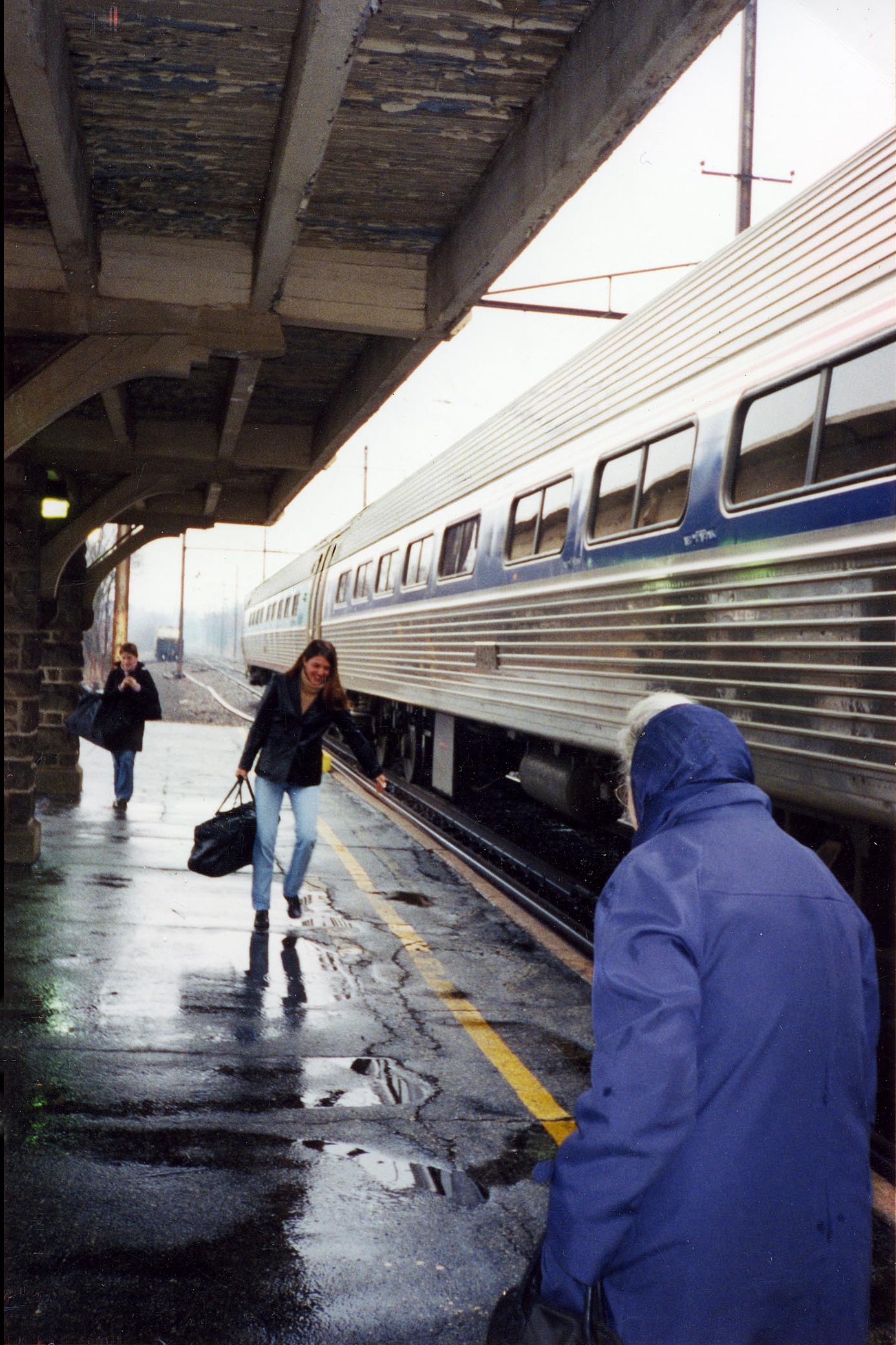
Arriving in Pennsylvania from Philadephia more than ten years ago, grand-niece Heidi runs to meet Aunt Ruthie at the tiny Amtrak terminal in Elizabethtown – exchanging cold, wet weather for a warm, welcoming hug.

Aunt Ruthie meeting Heidi_2002-_300

Your experience with train travel . . . tell us about it.

A response to the anecdotes or poetry here? All replies welcome.

Coming next:

Moments of Discovery #2 – Daddy’s 1912 Report Card & Mother’s 1989 Dodge Spirit

Purple Passages and a Teddy Bear

 LEAVES

Autumn is a second spring when every leaf is a flower.   – Albert Camus

Autumn carries more gold in its pocket than all the other seasons.   – Jim Bishop

Original Photo: Autumn in Pennsylvania

Quotation, noun: The act of repeating erroneously the words of another.      – Ambrose Bierce

(In September’s Purple Passages, I published one of Bierce’s quotes on photography. The one above was contributed later by photographer son Joel.)


CAREBEAR

A bear grows more alive with age. No one with one ounce of sensitivity could ever consign a bear to the dustbin.    – Johnnie Hague

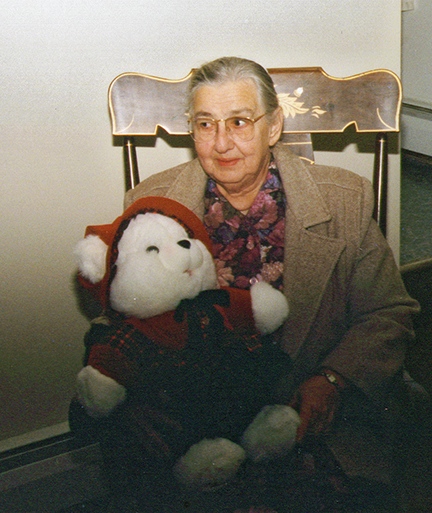
Mom with sheepish look holding teddy bear   1992
Mom with sheepish look holding teddy bear   1992


“Piglet sidled up to Pooh from behind. “Pooh?” he whispered.

“Yes, Piglet?”

“Nothing,” said Piglet, taking Pooh’s hand. “I just wanted to be sure of you.”

― A.A. Milne, Winnie the Pooh.


The cell phone has become the adult’s transitional object, replacing the toddler’s teddy bear for comfort and a sense of belonging.    – Margaret Heffernan

People go to the zoo and they like the lion because it’s scary. And the bear because it’s intense, but the monkey makes people laugh.    – Lorne Michaels


HUMOR

A person without a sense of humor is like a wagon without springs. It’s jolted by every pebble on the road.   – Henry Ward Beecher   (Contributed by blog reader Carolyn Stoner)

It is bad to suppress laughter. It goes back down and spreads to your hips.    – Fred Allen

*  *  *

Your opinion please: the quote about the teddy bear and cellphone.  A comment on something else? Obviously, I like to chat too.

Coming next: Train Lovers, Welcome Aboard

Secrets in My Hatbox

Just behind my desk, a wicker table holds three hat-boxes: One is floral, another has a repeating Tuscan scene and the third is transparent, the contents held taut by pale blue gossamer fabric. All are chock full of memorabilia from days gone by. All three, a type of journal-in-the-making.

Hatboxes

Depending on your style, your journal may be traditional with words and lists. Maybe you even paint or use colored pencils to amuse yourself or record an image. If you are tech savvy, you may have a photo journal, an audio or video journal. Maybe you are even into scrap-booking.

A hat-box is a type of scrapbook, really, a place to keep ticket stubs, magazine and newspaper clippings, programs, and fliers. You don’t actually have to write anything, unless you are into marginal notes, underlining and highlighting like me.

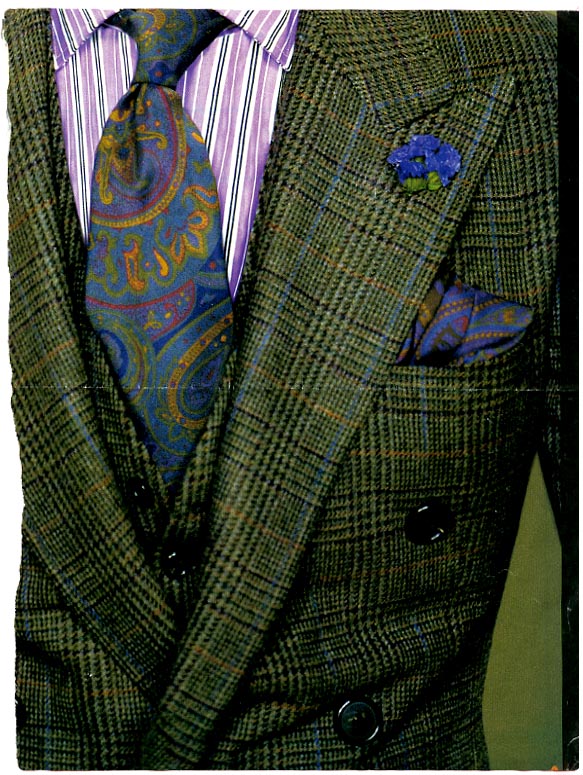
A few weeks ago, I opened one of my hat-boxes and found an article on the sexuality of corn that I may use on a blog post next spring. A page of a man’s outfit I thought natty also surfaced along with an article about videotaping I must have liked back in the May 7, 2007 issue of Newsweek.

Camcorder article

Suit magazine page

I like the irony of a Mennonite girl keeping clippings in a hat-box, hats forbidden in my teen years when fancy hats were then popular. But just like my youth, hat-boxes don’t contain the end of my story but seed kernels of what is yet to be.


Do you have a container, odd or simply utilitarian, for memorable “stuff”?

What does it look like? What do you keep inside?  Inquiring minds want to know . . . .

Moments of Discovery # 1: How Do You Furnish a House?

According to The Huffington Post, the median home price in the United States (2014) is $ 188,900.00. Even adjusted for inflation over the years, housing prices have increased enormously since the 1940s.

My parents were married in 1940. Until they bought their first home in 1941, they lived for a few months with my father’s parents, Henry and Fanny Longenecker, and then with a relative, “Uncle” Elmer Longenecker in the village of Rheems, Pennsylvania. The newlyweds’ first home of about 1240 square feet cost $ 5000.00.

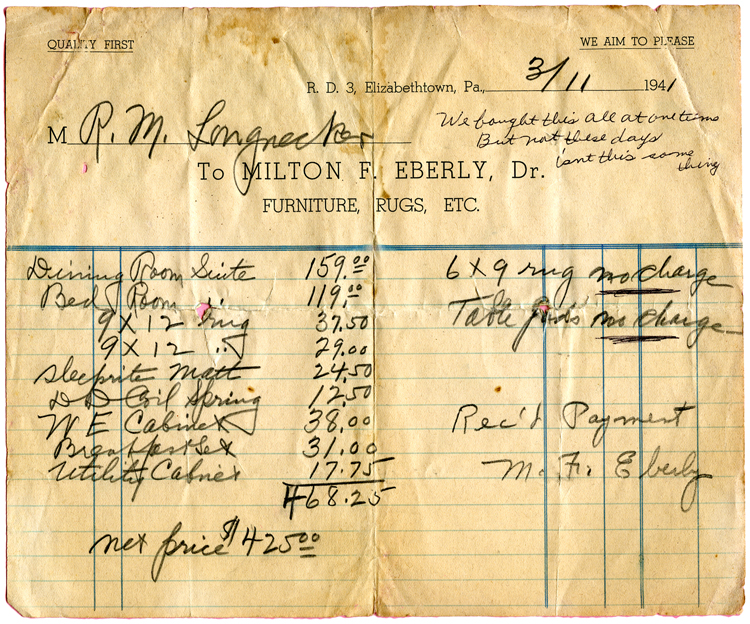
Just as astonishing as the price of the house was the bill for their home furnishings from Eberly Furniture Store just above Elizabethtown. They outfitted this home for $ 425.00 including a dining room and bedroom suites with a mattress and box springs, a kitchen table, rugs and two utility cabinets.

Eberly Furniture receipt_150

Please note that table pads for the dining room and a third, smaller rug were apparently thrown in as a bonus. Milton was a happy man the day Ray and Ruth Longenecker walked through the door of his store. And the feeling was mutual. My Mother’s comment on the receipt says it all: “We bought this all at one time, but not these days. Isn’t this something.”

The Art Deco bedroom suite has been replaced with something more contemporary but not nearly as beautiful to my taste. What is left of the original purchase: the kitchen table and chairs and the Duncan Phyfe dining room suite.

BuffetMomChinaCabinet

Isn’t that something?

The “Moments of Discovery” series is Part One of a continuing series that will unfold as we sort through the contents of the house on Anchor Road. It joins other series on this blog: Purple Passages, Moments of Extreme Emotion, and 10 Tips/Secrets.

How do you furnish a house – traditional, contemporary, eclectic? 

Coming next: Secrets in My Hatbox

Family Dinners: Keeping the Spark Alive

Are family dinners important? What about empty nesters? Families of one? Do family dinners protect against the effects of teen drug use and cyberbullying? Writer Melodie Miller Davis in her recent blog post “How do you keep family dinner?” got me thinking about recent research on the topic.

In her post, she refers to Columbia Casa Family Day, a national initiative to remind parents that they have the “power to help keep their kids substance free.” Cornell University researchers also have discovered that shared meals may help prevent eating disorders. An article in Time asserts that teens benefit from interaction with their families and find security in the shared, predictable ritual of family mealtime possibly preventing early drug use and the effects of cyber-bullying. However, there is also research that claims such effects are overstated or not verifiable.

Whatever the case may be, the faster the pace of our lives and the more insane world events become, the more I long for the sweet spaces of serenity that sharing family meals can provide.

The Longeneckers and the Metzlers, two strands of my family line were oblivious of any such research but carried on the ritual of family meal time together. Here is a post from the Metzler gatherings, often picnic style.

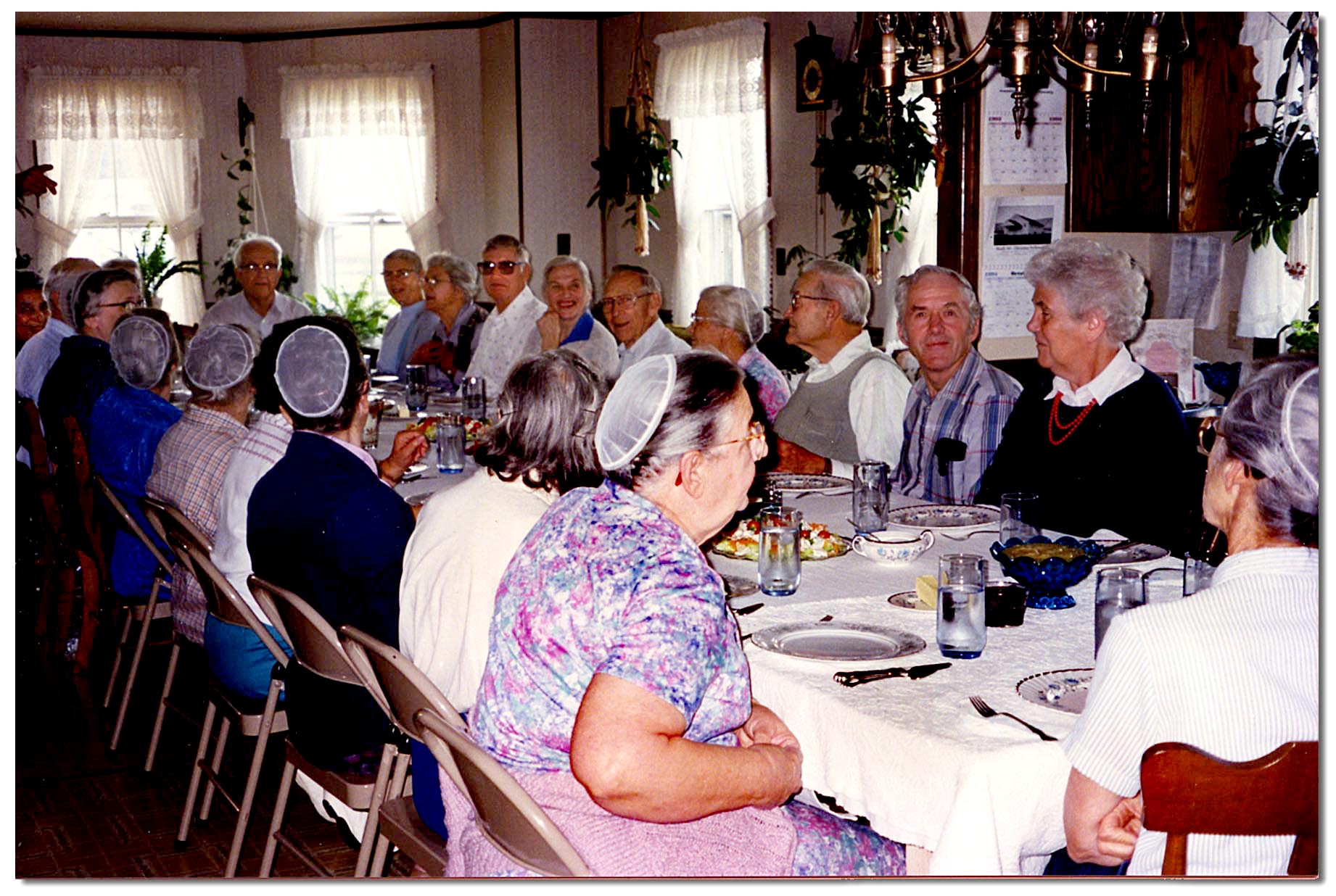
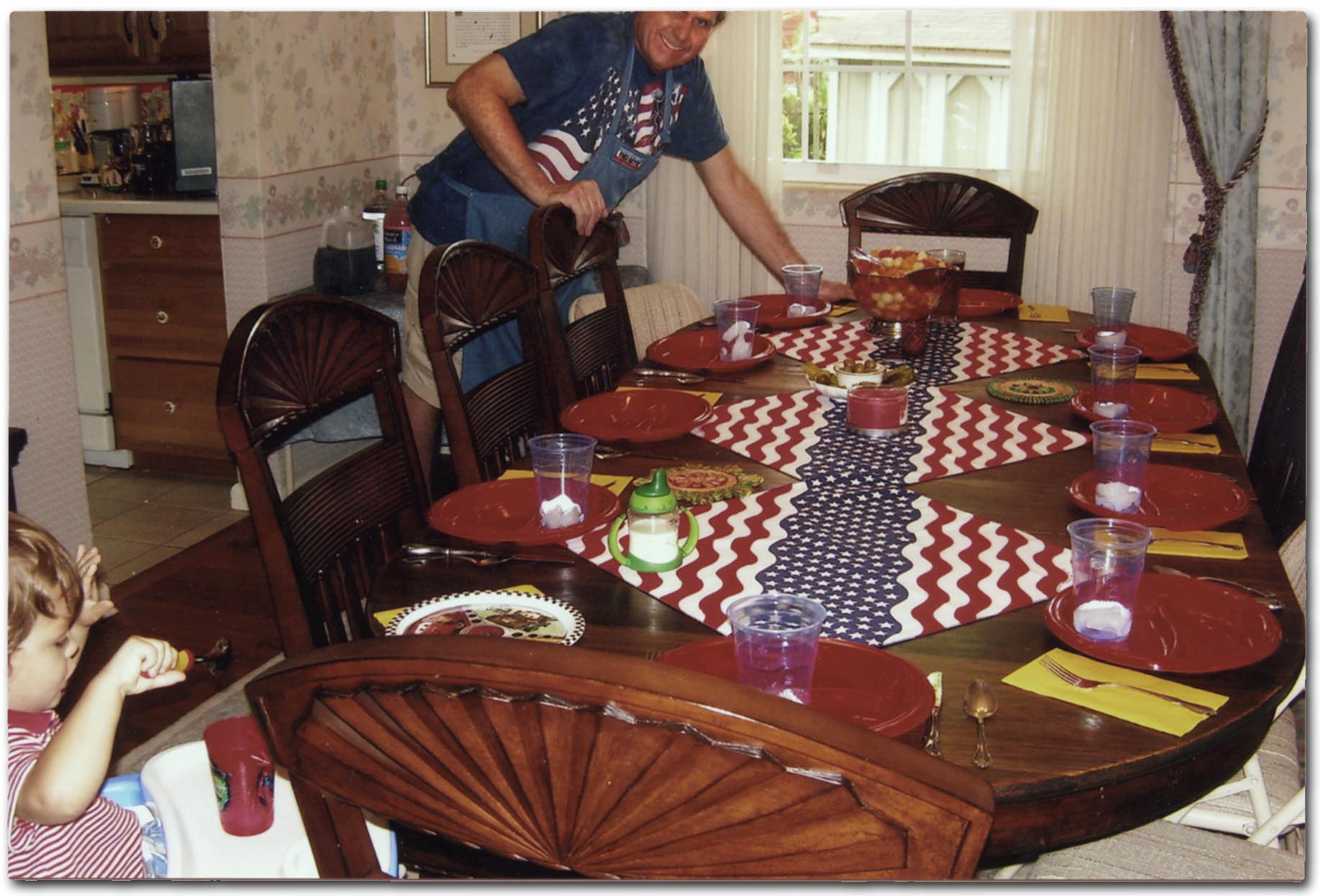
Family dinners can be very large as seen here in Grandma and Aunt Ruthie’s house with twenty, mostly Bossler Mennonite Church friends, gathered around their huge dining table.

Mother L_Bossler eating_at Ruthies

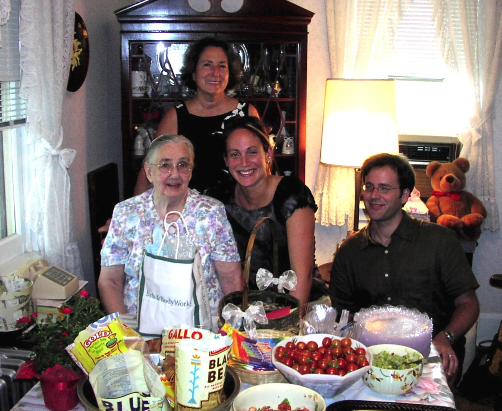
Whether large or small, indoors or out, dinners require preparation. My sister Jean and her family provide some of the “raw material” from a shared meal at Mother’s house.

Mom&FairfieldsREV

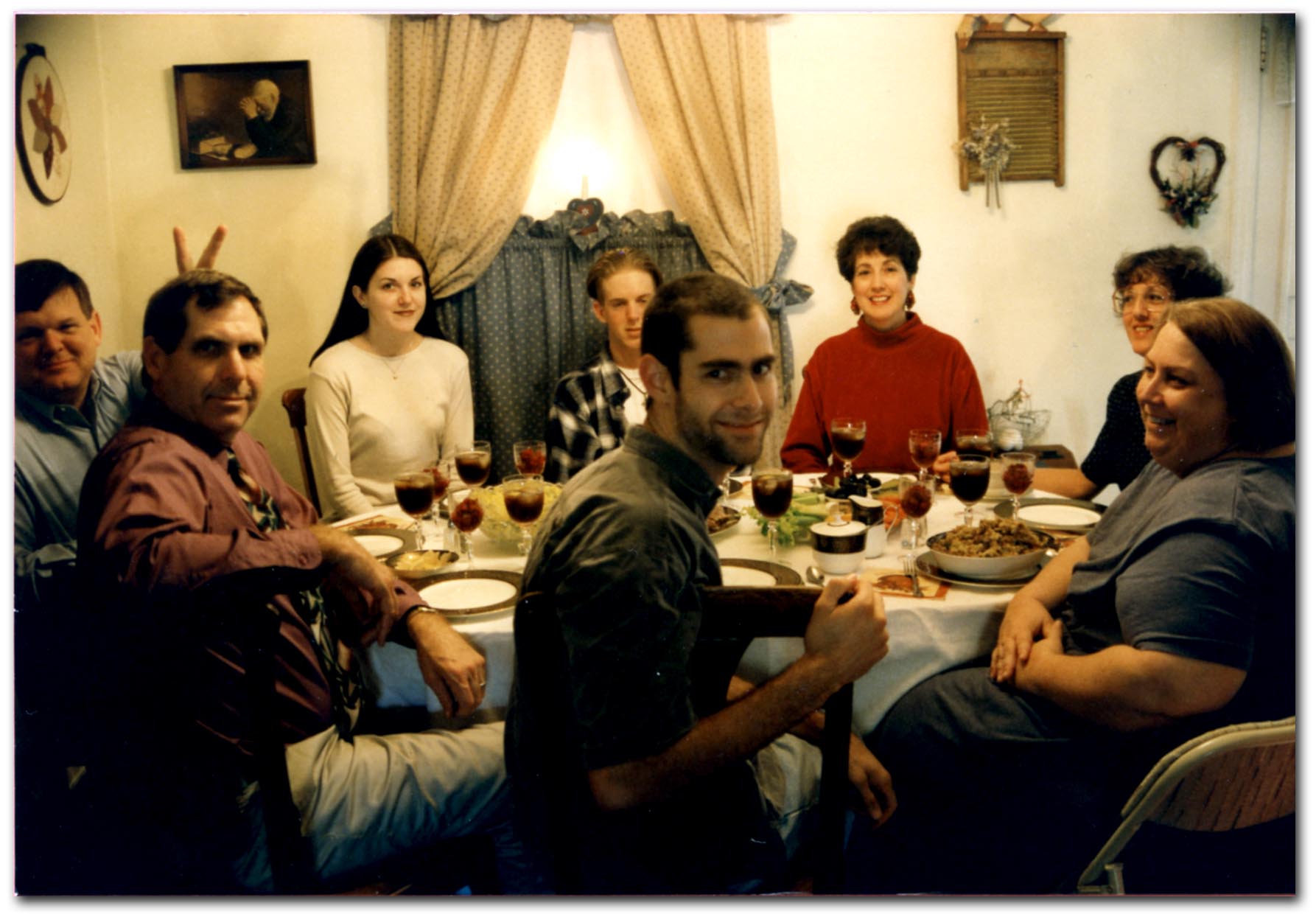
Years ago if we didn’t visit Pennsylvania, I shared holiday meal making with my sister Janice, who lives just 2 ½ miles from us.

There's one in every crowd - even in family!
There’s a joker in every crowd – even in family!

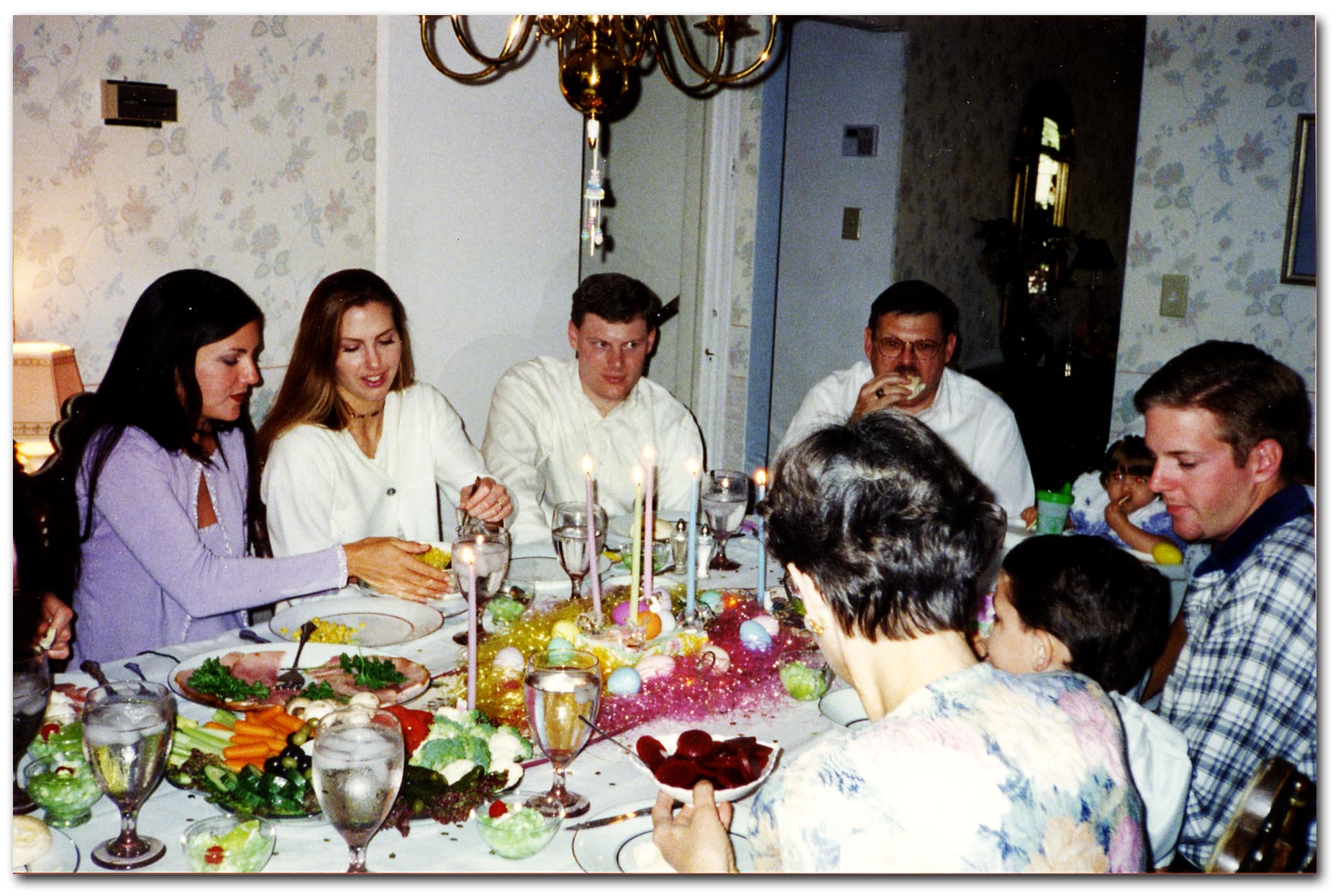
03_meal_Easter_1999

And then the over-flow table with the kids . . .

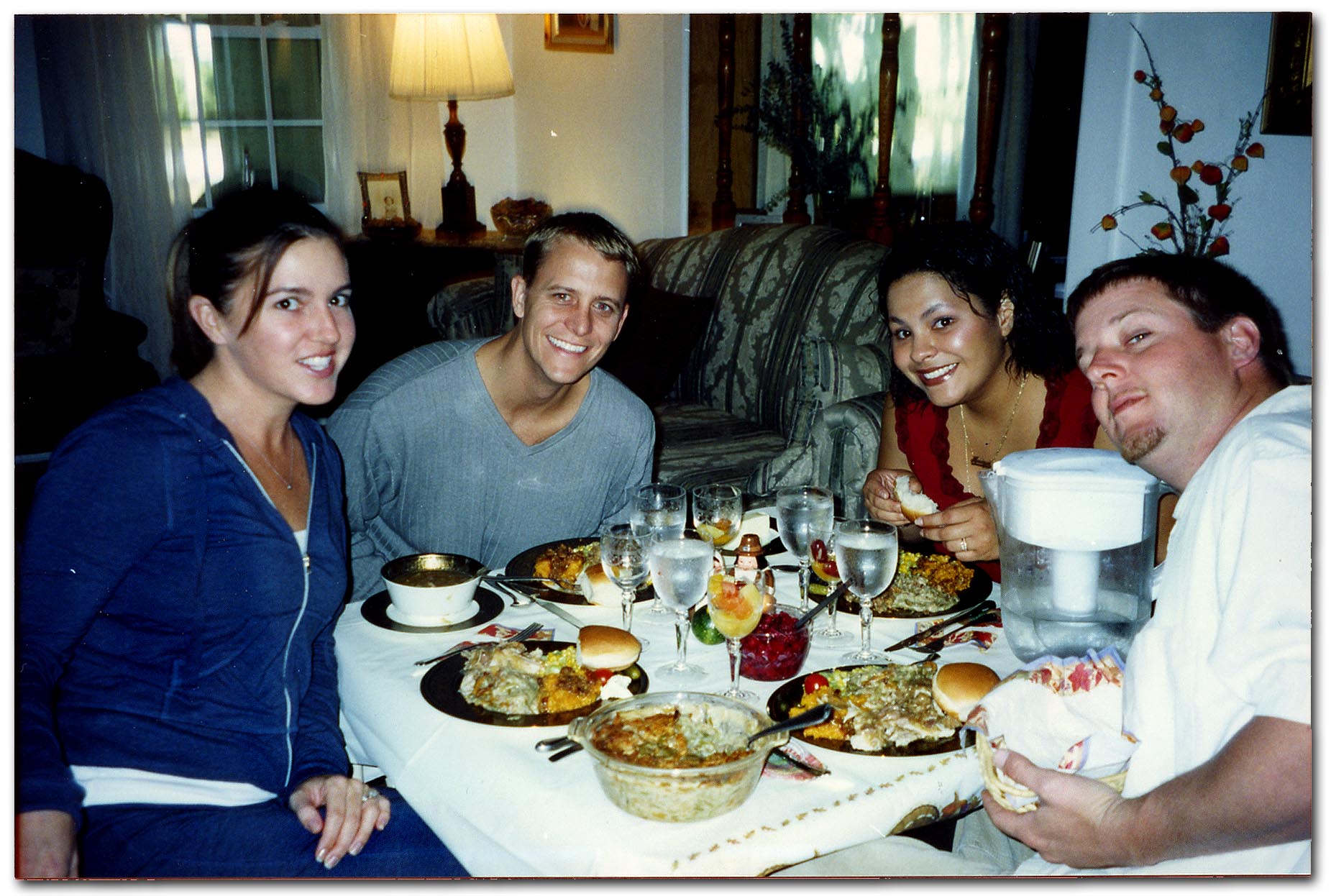
04_meal_Thanksgiving_2005

After awhile, our children began entertaining us, first in Chicago where all four worked, earned graduate degrees and started a family.

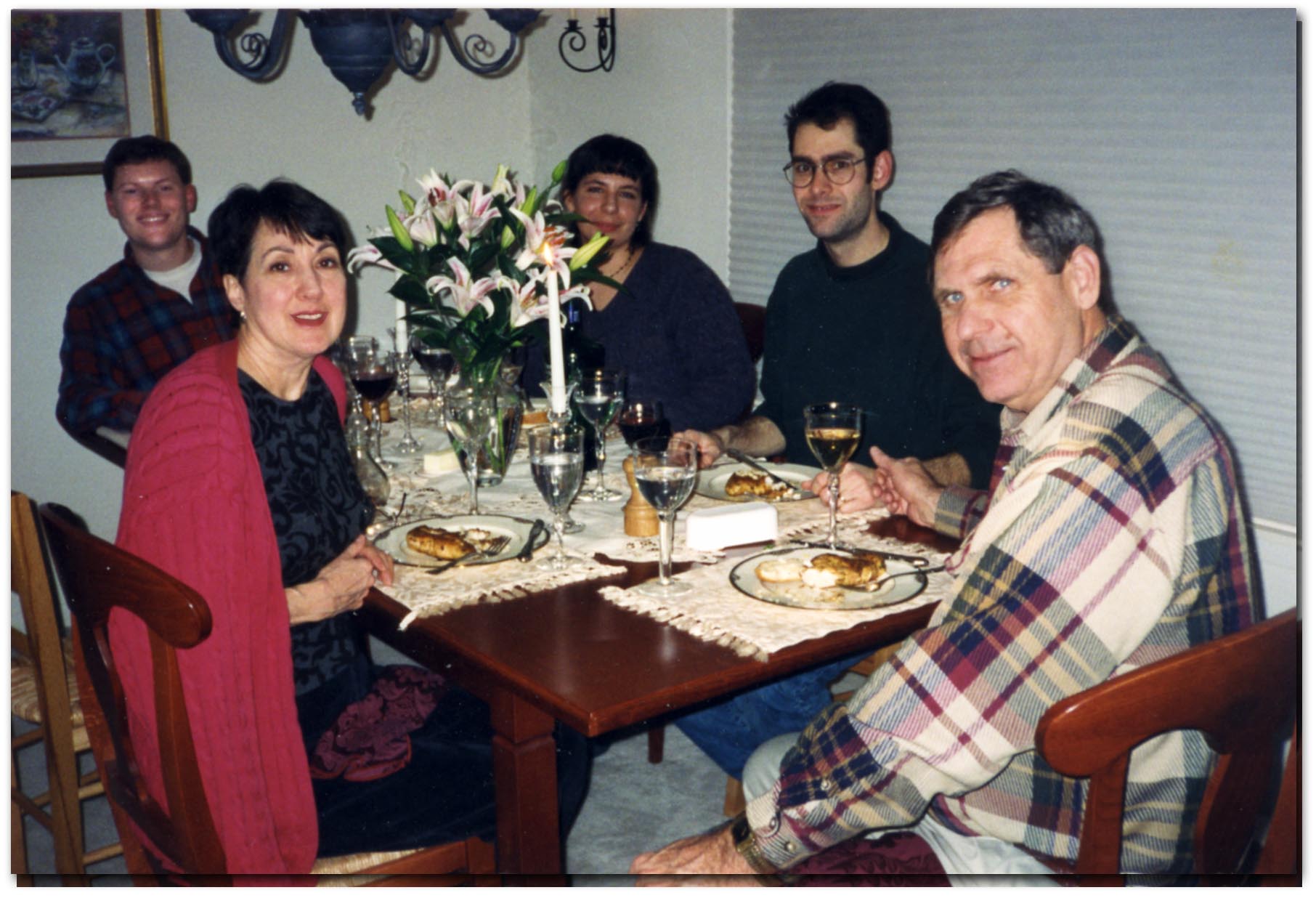
05_meal_Grayslake_1999

Then when they moved to Florida, two years apart, their meal making continued with Fourth of July at Joel’s house . . .

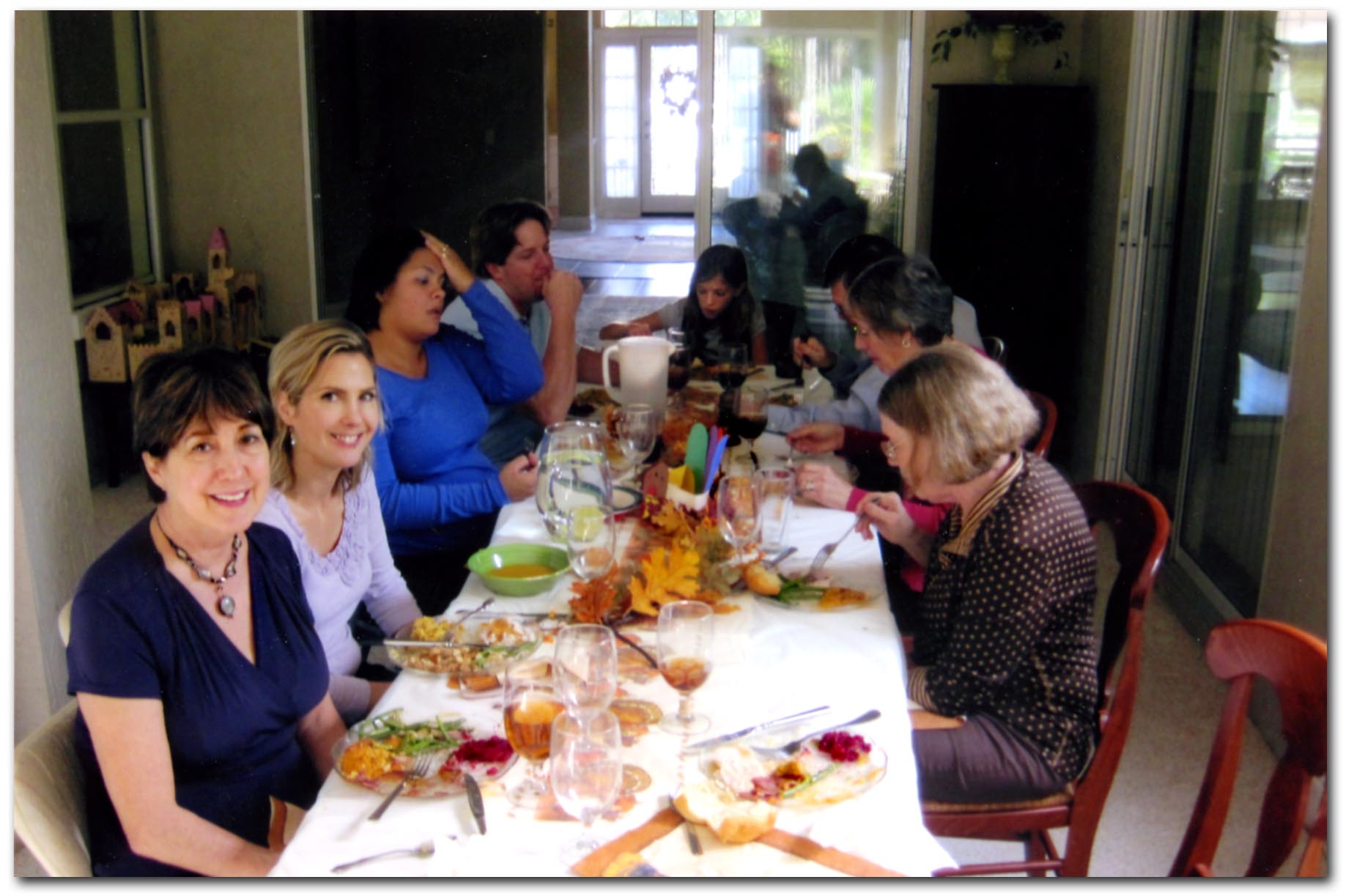
06_meal_Thanksgiving_Cristas_2009

. . . and Thanksgiving at Crista’s house in her bright sun room.

Any excuse for a party! Besides birthdays, Fourth of July can be a cause for celebration too.

07_meal_Memorial Day_2009

One of us, who loved everything about entertaining from meal preparation to talking and eating around the table, will be missing this holiday season and every meal in between, our Mother Ruth Longenecker, hostess extraordinaire.

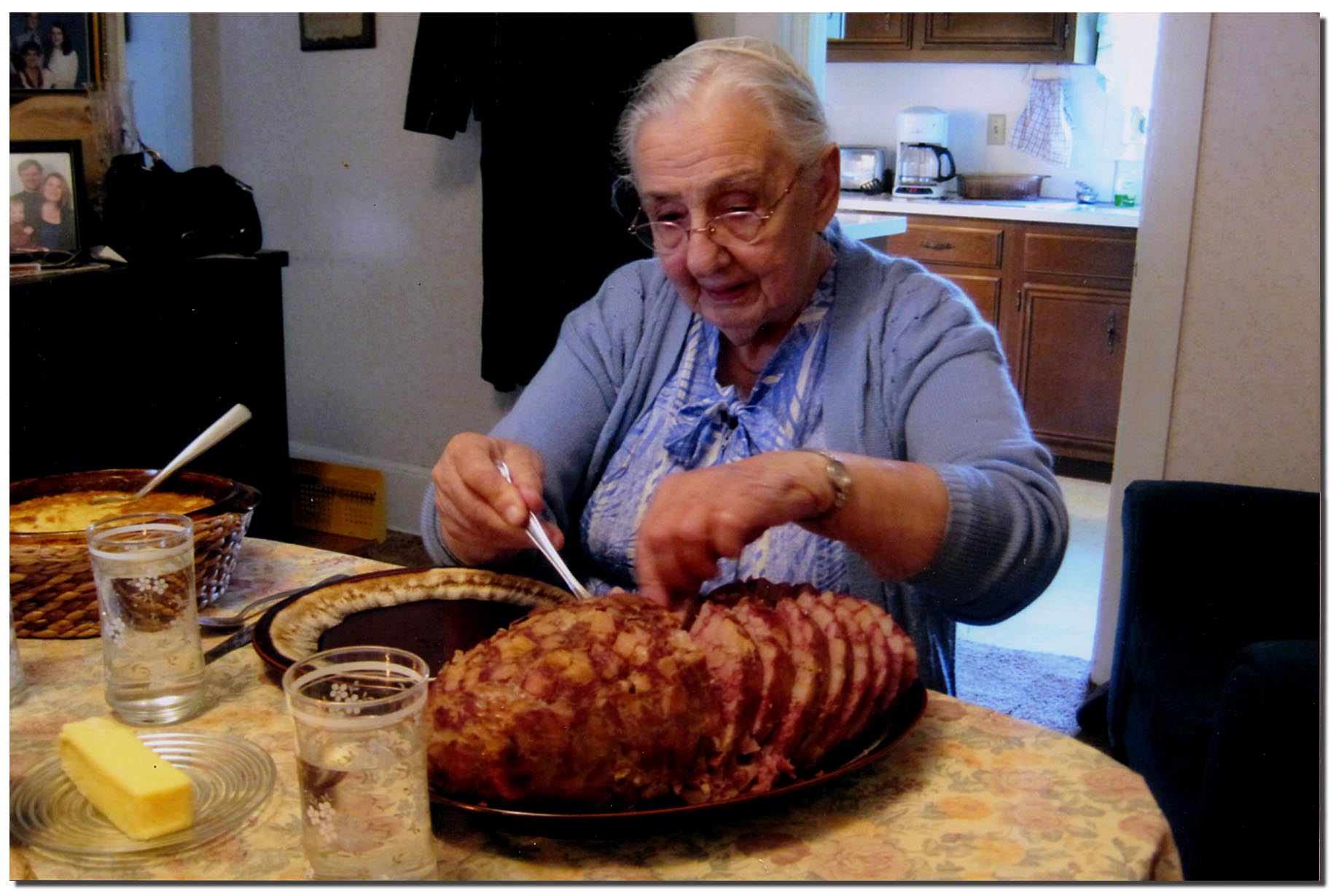
Mother slicing pig stomach with baked corn and a stick of butter close by
Mother slicing pig stomach with baked corn casserole and a stick of butter close by

 How have family dinners marked your family history?

Coming next: # 1 in a series “Moments of Discovery”

Way Back in the Day…

Did Granny or Mom make clothes out of feed-sacks? Did you wear outfits with rickrack or smocking? Blog friend/author S. K. Nicholls reminisces in this recent post.

S.K. Nicholls's avatarS.K. Nicholls

My grandmother never bought her clothes. She made most everything she wore. Sometimes her sister in Montgomery, Alabama, would send her store bought dresses.  That was a time when the sewing machine (and the piano) was the most prized piece of furniture in the house.

She baked her own bread, biscuits, cornbread, hoecakes, white bread, and pancakes. The flour and meal came in big fifty pound fabric bags. The feed sacks and flour sacks came in pretty floral prints and stripes, bright calicoes and solids.

cutting-the-pattern-out-pioneer-dress-300x225She would wash and dry the fabric and lay it out on the dining table, pin a pattern in place, trace it and cut it out. We would have to stand for what seemed like hours while she pinned the hems. She made all of our clothes that way. We literally wore flour sacks to school.

Here’s a picture that made it in the local…

View original post 187 more words

The Million Dollar Baby: Ian’s Miracle Birth

Since my mother’s death in July, I have written several posts of her home-going including A Grief Observed: Missing Mother and Crossing the Bar.

This time I’m focusing on a birth, our grandson Ian’s miraculous birth seven years ago this week. According to the doctor’s calculations, he was scheduled to arrive on January 9, his Grandpa Beaman’s birthday. Instead he made his appearance on his mother Sarah’s birthday, October 5.

All births are miraculous, really, the tiny embryo maturing into a marvelous baby with millions of synapses making connections within the brain, a sense of rhythm and an ability to breathe and suckle at the same time. One study mentioned that babies can pick out the gender of other babies even when they are cross-dressed, something adults cannot do.

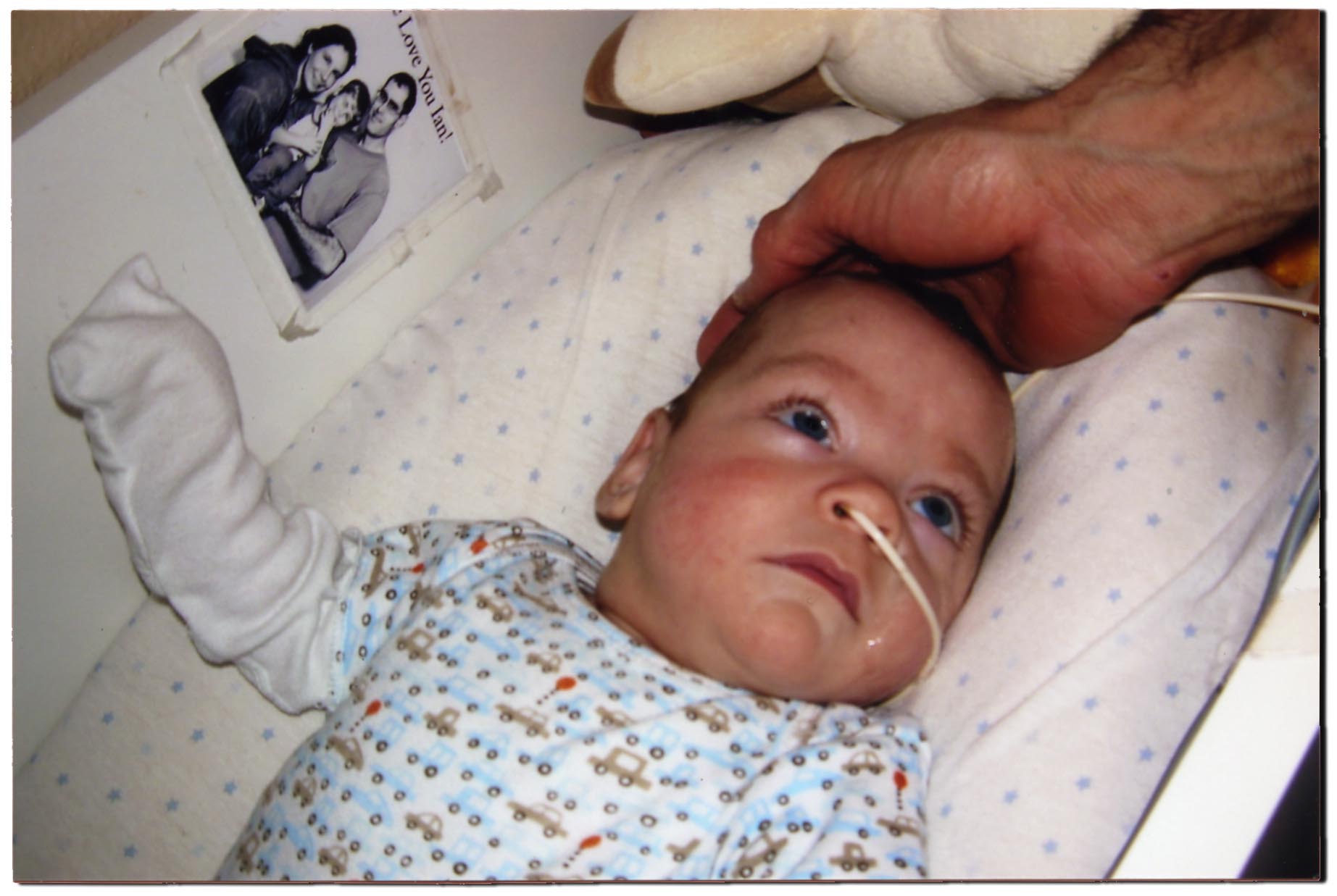
But Ian’s birth at 26 weeks gestation weighing a mere 2 pounds, 5 ounces meant many un-connected synapses and a severely undeveloped breathing apparatus. For weeks it was touch-and-go, and we weren’t certain that we would be bringing him home from the NIC Unit at Wolfson Children’s Hospital. Aside from the frightening awareness that Ian had a hole in his heart, we were introduced to a whole new vocabulary of problems: bradycardia, retinopathy, hip dysplasia. Translation: Slow, interrupted heartbeat requiring a nose cannula, undeveloped blood vessels in retina, and an immature hip ball and sock requiring a harness to hold legs in a frog-like fashion. Here is his photo-story:

Ian_02_NIC Unit_112707

Hello, world!
Hello, world!

My journal records that on November 29, 2007 Ian weighs 4 pounds, 3 ounces and is taking three bottles a day. He is also employing the services of a speech therapist and an occupational therapist along with physical therapy.

How would a speech therapist help a premature baby who can’t speak or an occupational therapist assist a child whose main job was trying to survive? Speech therapy facilitated the transition from tube feeding to bottle feeding and the occupational therapy improved the range of motion inhibited by hip dysplasia.

"Did you finally bring me home?" asks Ian.
“Did you finally bring me home?” asks Ian.

After a 14-week stay in the hospital, Ian is brought home. Glory, hallelujah! Though still on a breathing apparatus, he resumes a more normal life with his family, under the watchful eye of his brother.

"Ian, here's my advice," says Dr. Curtis.
“Ian, here’s my advice,” says Dr. Curtis.

Praise God – At age seven, Ian is now at the 98 percentile in height and weight for his age and is taking an advanced course of study in first grade at his school. There are delays in behavioral development though, possibly attributable to his prematurity. But who can be sure whether it’s prematurity or personality.

IanGrade1BrainsBrawn

*  *  *

I wrote a letter to each of my grand-children before their first birthday and sent it to their home address so it would have a post-mark. In Ian’s case, I waited until the one-year mark to write and send his letter. Call it a welcome-to-the-world, a blessing from Grandma/NaNa in writing. Here is a copy of the letter he received:

IanLetter1

IanLetter2

Ian has not opened this letter yet though he is able to read. In fact, none of the grand-children have opened and read their letters and I’m wondering at what age they should be read. It seems the opening and reading calls for some special occasion. What do you think? I welcome your suggestions!

For you created my inmost being;

you knit me together in my mother’s womb.

  I praise you because I am fearfully and wonderfully made;

your works are wonderful . . . .

Psalm 139: 13, 14   NIRV

Your advice on letter reading welcome. Other comments or suggestions from your own experience. You will always get a reply from me and maybe from other readers. Thank you!

“Every child is a story yet to be told.”   Sesame Street