Now you are probably thinking . . . age 72 is a long way off, or it’s just around the corner. Either way, it’s a question worth pondering.
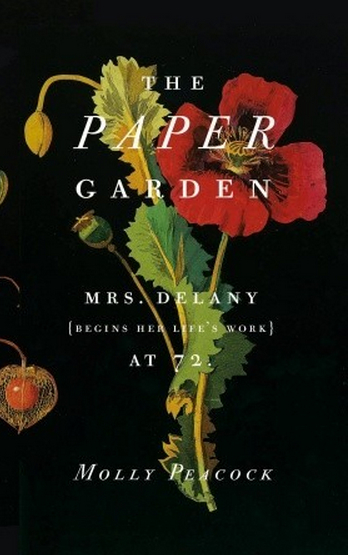
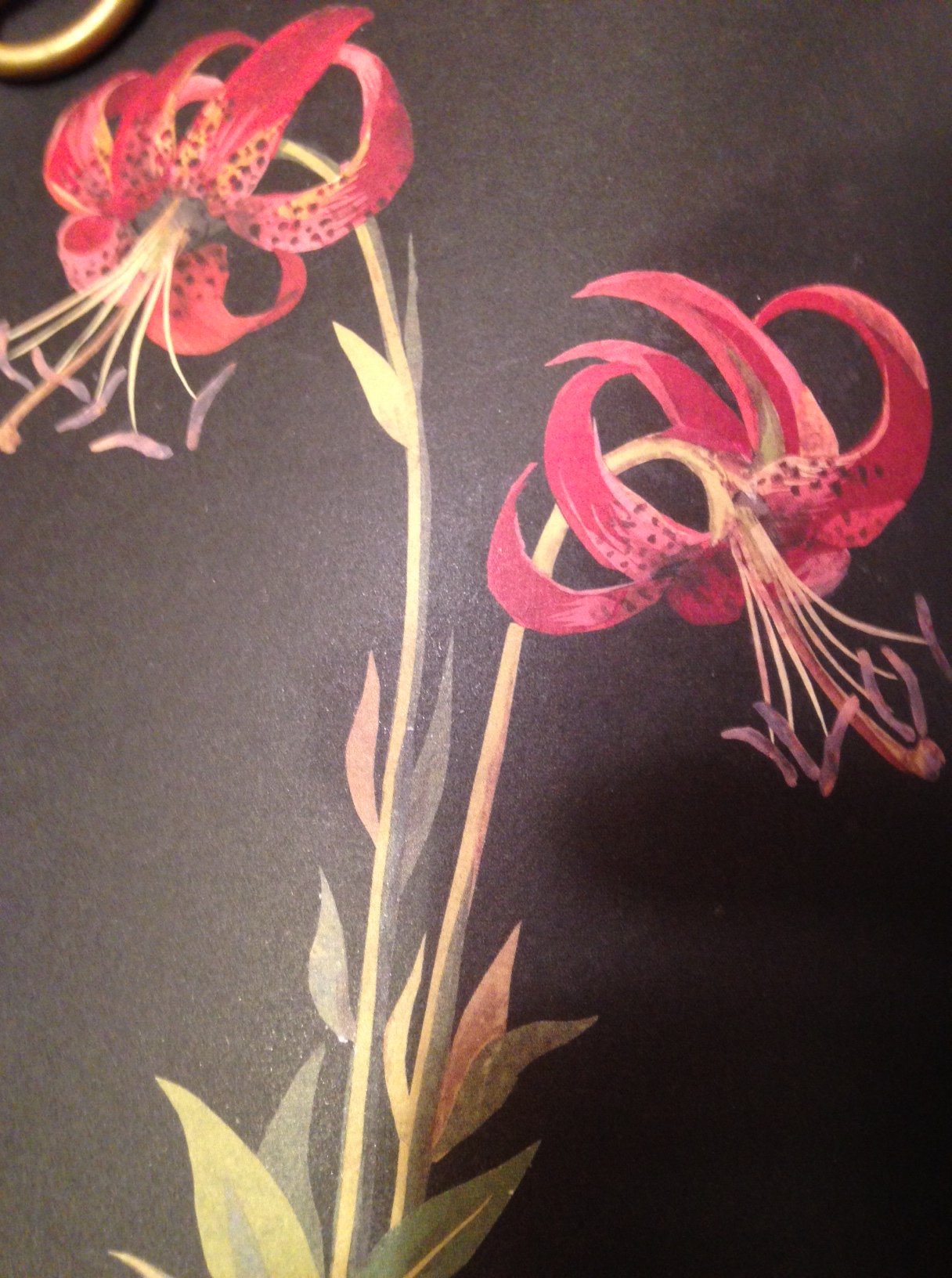
In 1700 the average life expectancy was 37. In fact, 40 would be pushing it. Yet, in that very year Mary Granville Pendarves Delany was born and lived to be 88. More impressive is the fact that at age 72 she invented mixed media collage and eventually created “an astonishing 985 botanically correct, breathtaking cut-paper flowers, now housed in the British Museum and referred to as the Botanica Delanica.”
Image: Courtesy of Good Reads
Poet Molly Peacock, author of The Paper Garden: Mrs. Delany begins her life work at 72, recreates the “Aha!” moment for Mary Delany early in the book:
One afternoon in 1772 [the recently widowed Mary Delany] noticed how a piece of colored paper matched the dropped petal of a geranium. After making that vital . . . connection between paper and petal, she lifted the eighteenth-century equivalent of an X-Acto blade . . . and began to maneuver, carefully cutting the exact geranium petal shape from the scarlet paper.
Then she snipped another and another, beginning the most remarkable work of her entire life.
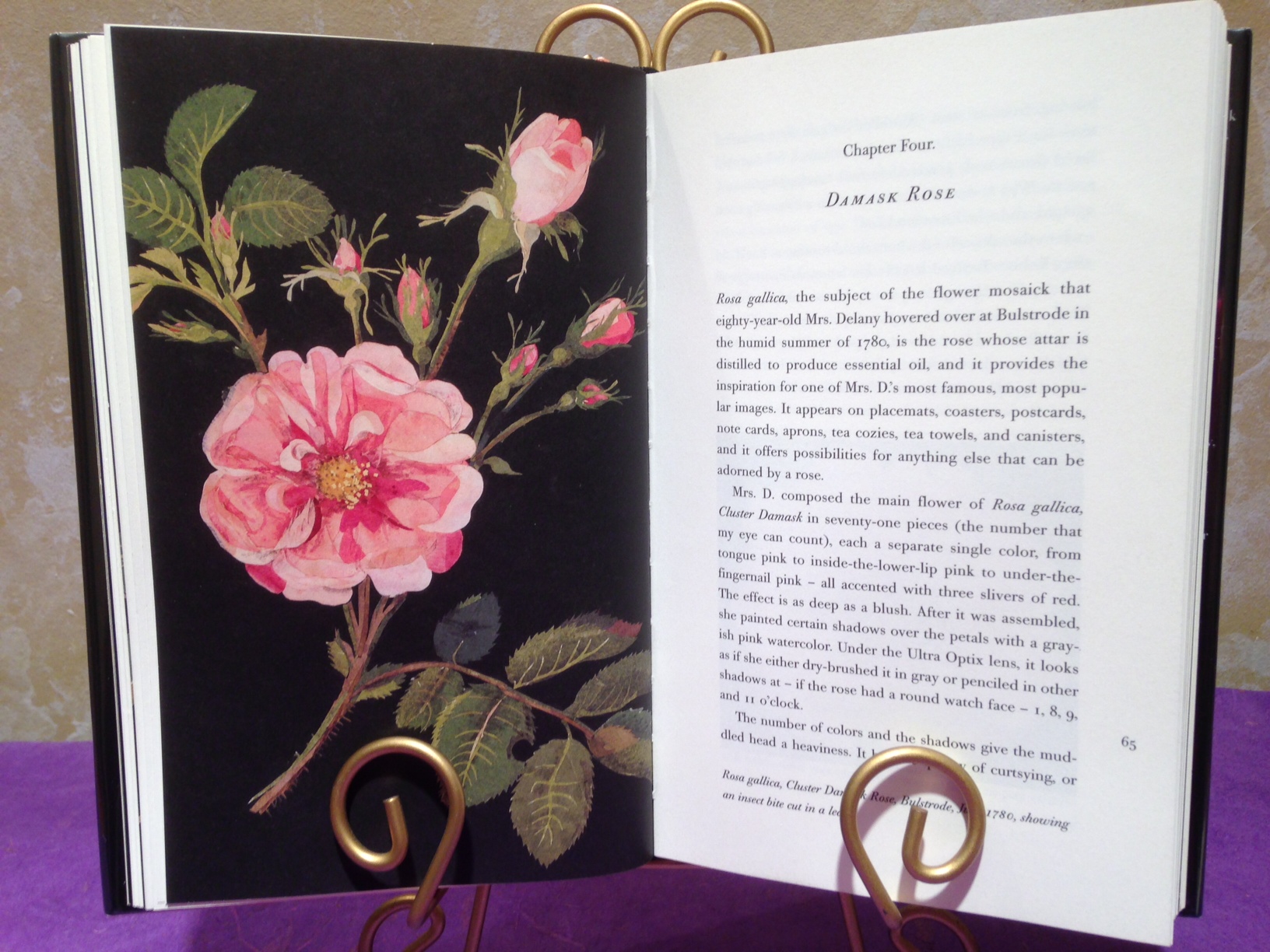
“. . . if a rose had a round watch face” (65)
Her most famous and popular image is the Damask Rose, appearing on postcards, place-mats, tea towels, and canisters. The main flower includes about 71 pieces of carefully cut papers, covering the gamut of pinks from slivers of red to blush and “under-the-finger-nail pink.”
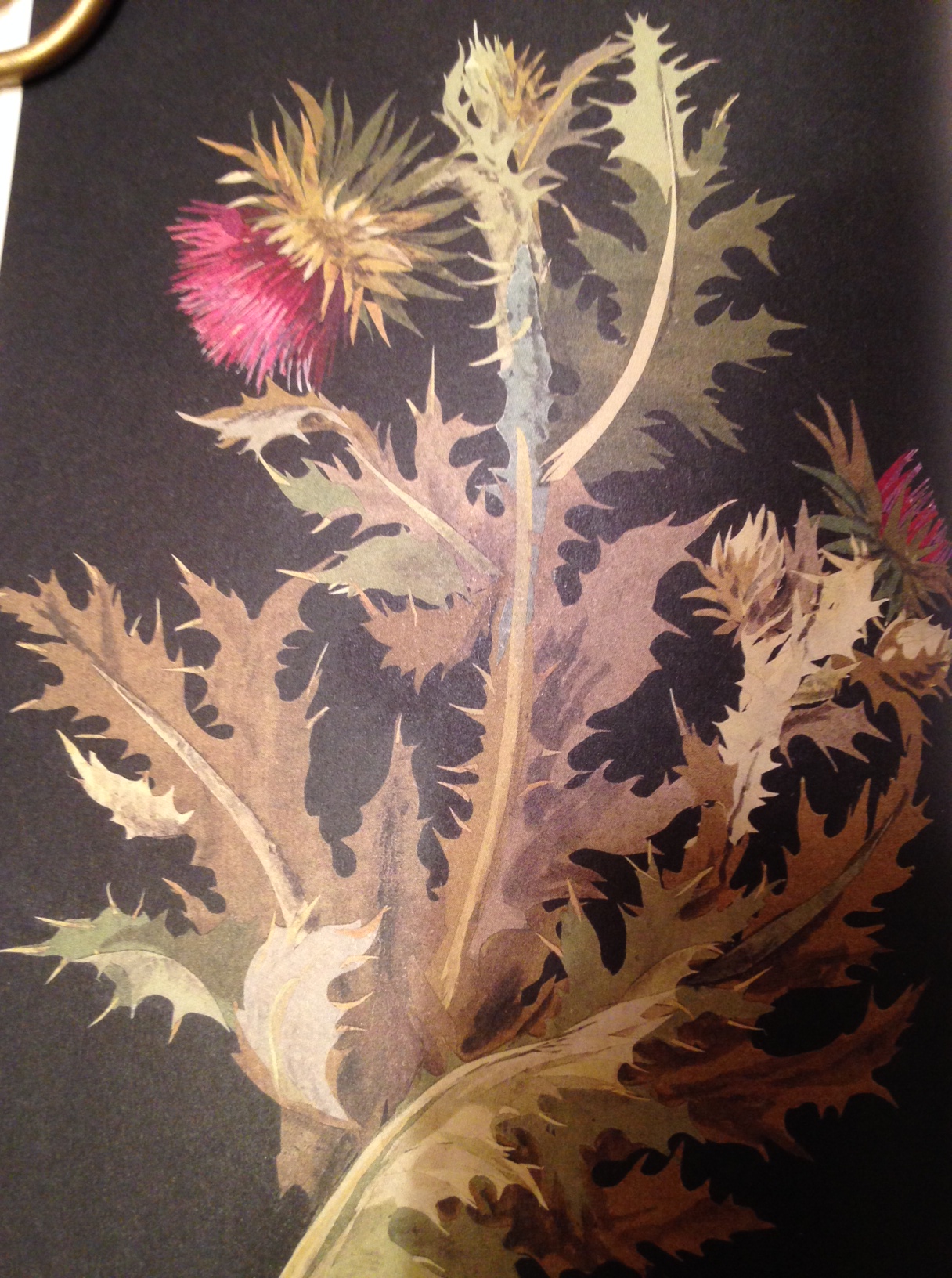
Nodding thistle, a cousin of the dandelion, with swirling foliage
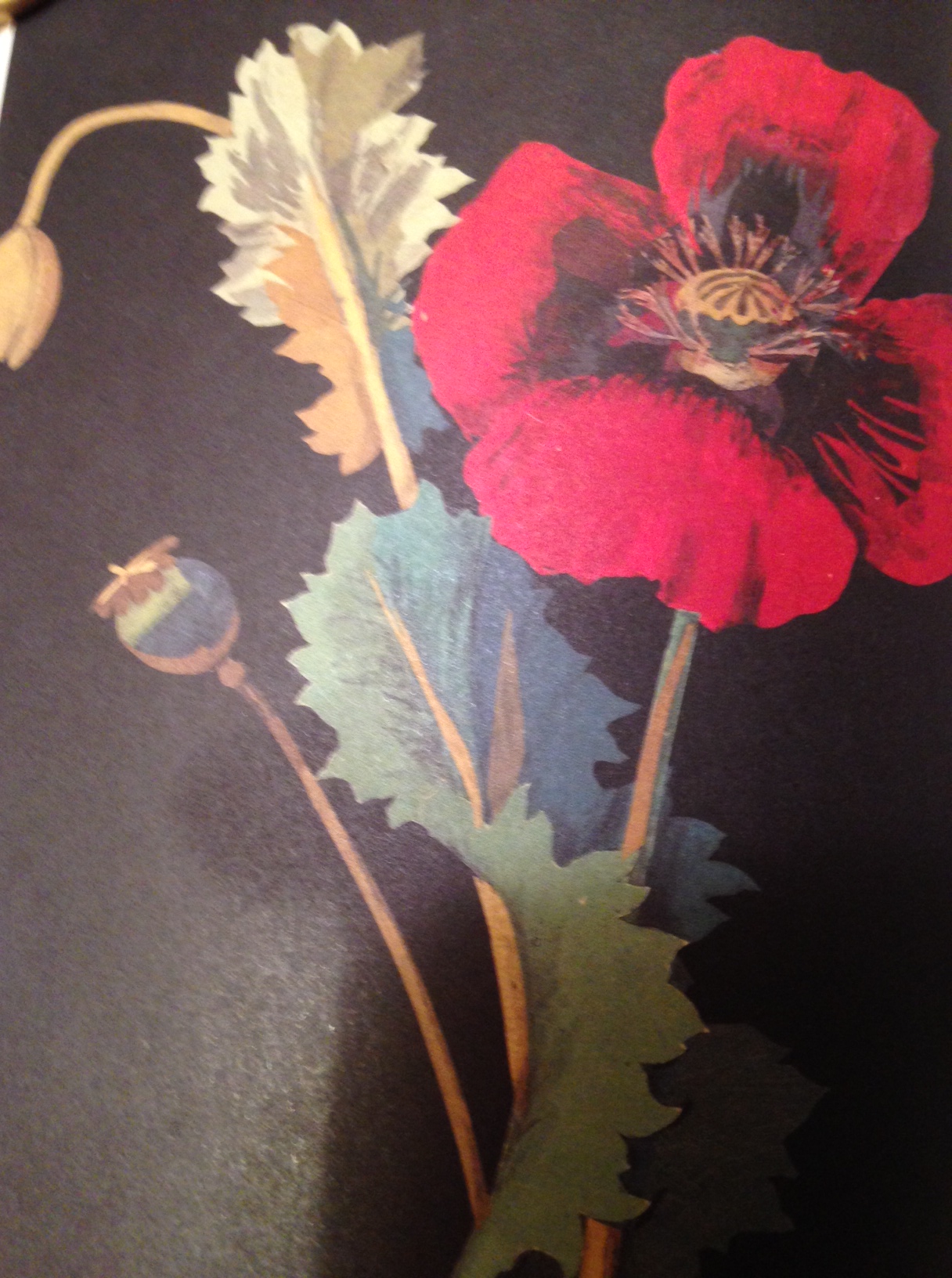
Operatic Opium Poppy
The theatrical-looking opium poppy is cut from a single green piece of paper. “The whole effect is of a kimono-like gown billowed by a breeze, like the robe of a star soloist falling down from her shoulders” upside down (118).
” . . . lines swoop and swoon with freckled energy” (141)
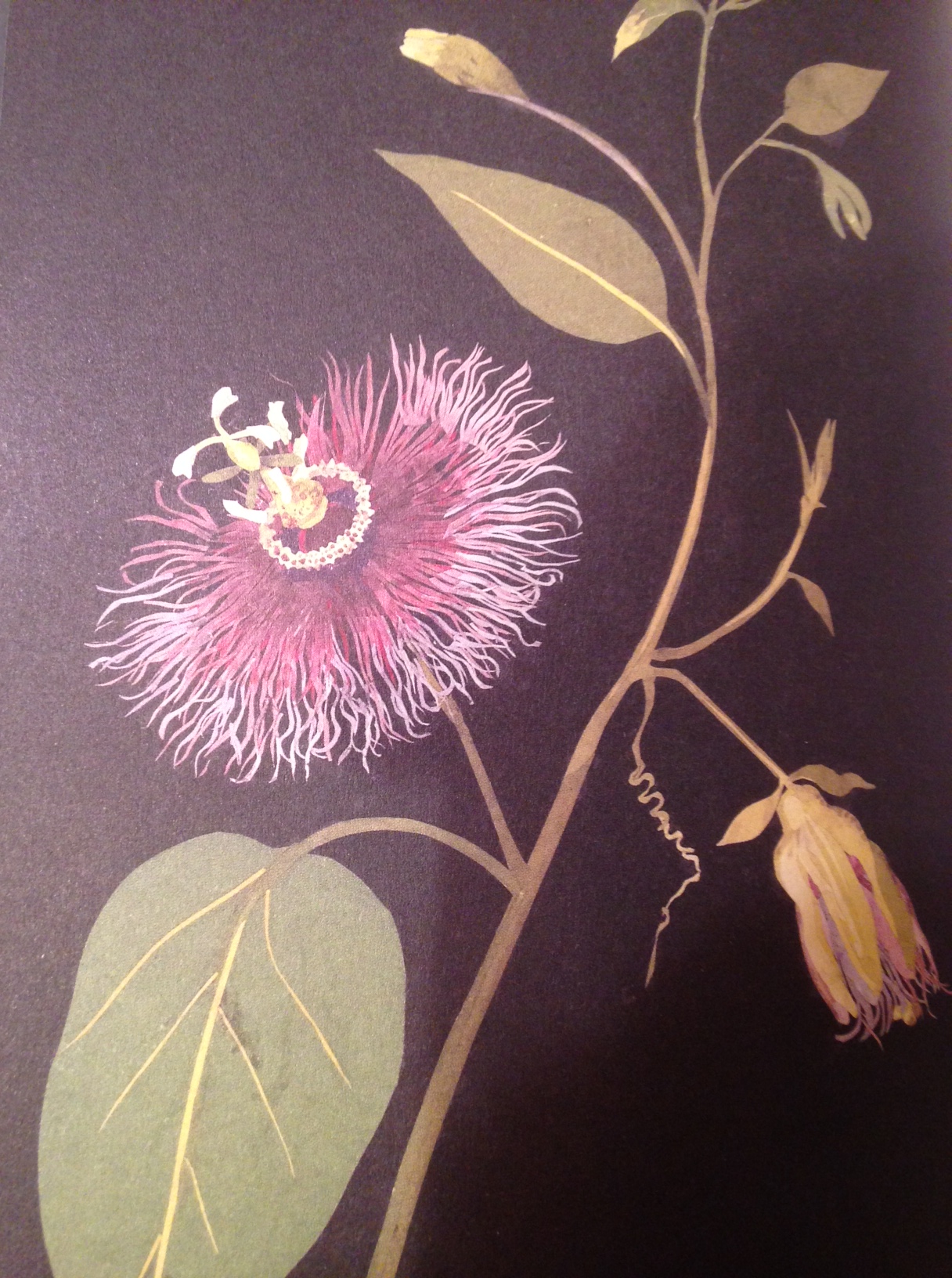
Mary Delany’s output was phenomenal. In 1777, the year she constructed the passion flower, she cut out her collage/mosaics at the rate of one per day, and between the ages of 77-87 creating one every four days (185).
For the passion flower, Mary Delany cut out 230 petals scissored “like little grass skirts, where the strands of grass are attached to a belt” (169). She made up her colored papers . . . washing whole sheets of paper in varying hues. In the case of the passion flower, olive, loden, beige ivory for the leaves, and the flower rust, red, purples, deep and pale pinks, lavender. To the pigments she added gum arabic, honey, ox gall to prepare and preserve the papers. All done on a matte black background, always on dramatic black.
Mrs. Delany was born into the aristocracy with a wide circle of friends which included composer George Frederic Handel and the satirist Jonathan Swift. John Wesley even courted her. Yet her posh outer life was checkered with challenge: an arranged teen-age marriage to an aging drunken sot, problems with cash flow, at mid-life the loss of her soul-mate, Patrick Delany, a man who knew her worth, then deaths of close relatives, and finally her own illness.
Yet like her flowers, cut with a blade, not outlined by a brush, Mary Delany blazed a path for herself with a scissors, scalpel, tweezers, and needle. Combined with her imagination and gutsy determination, she made art that endures.
Age is the sum of all we do.
Charles Bulkowski, quoted by Molly Peacock (343)
The root of the word inspiration is “breath.” What activity do you do that inspires you, gives you energy?
Or takes your breath away – maybe even give you a second wind?
What will you be [still] doing at age 72?
The career of flowers differs from ours only in audibleness.
If I swallow a water-melon seed, my stomach might swell up.
If I touch freckle-faced Ricky with the dirty fingernails, I might grow a baby. Oh no!
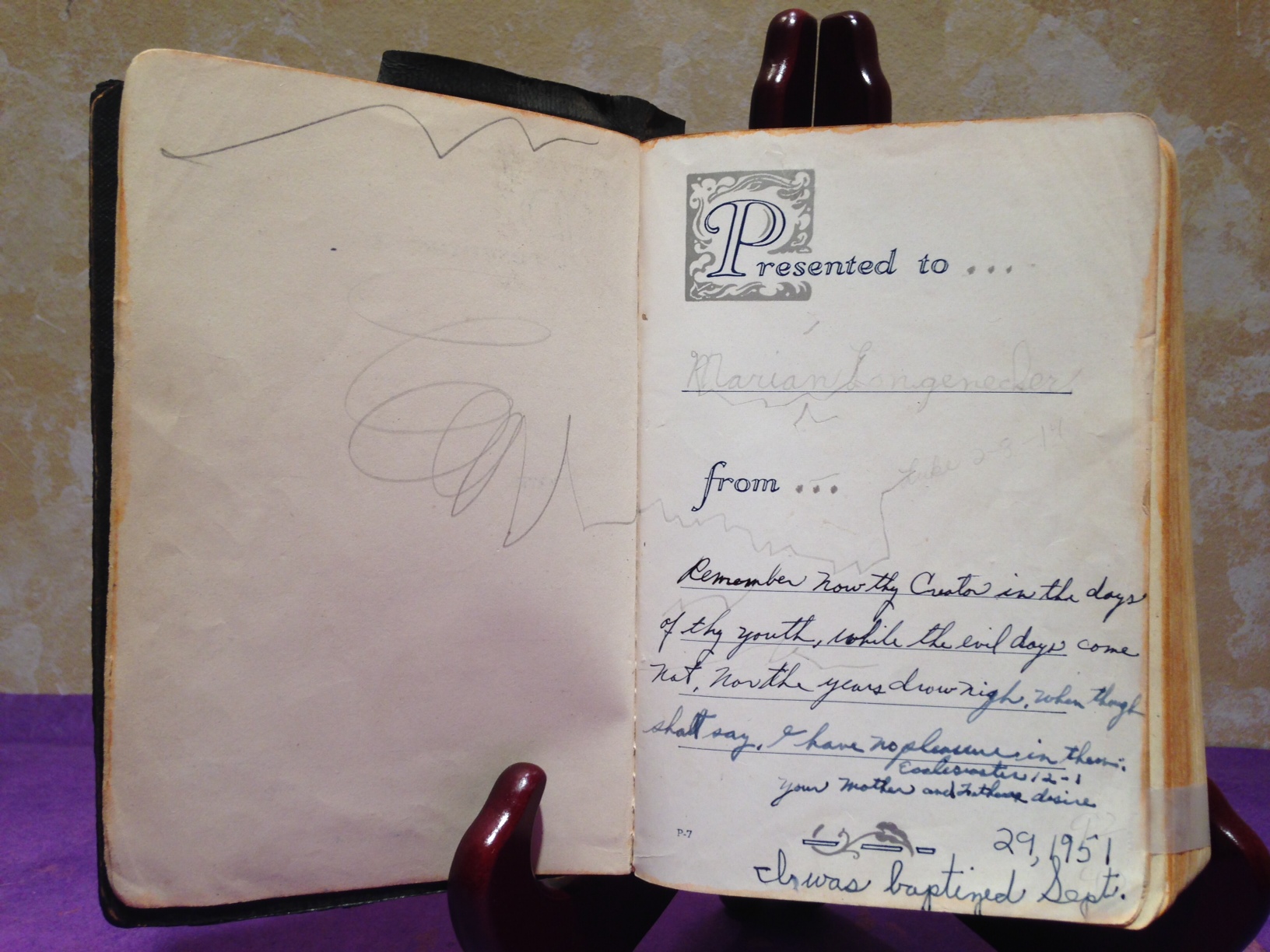
Those were my childhood fears. With a limited sex education, I tried never to swallow watermelon seeds or touch grimy Ricky. But my parents also had fears, largely unfounded. What my Daddy dreaded most as the father of three adolescent girls is that one of us might turn up pregnant some day and bring shame and disgrace upon the family. “We don’t ever want to hear of that happening in our family,” he exhorted. In my Bible he wrote this not-so-veiled admonition from Ecclesiastes:
Daddy’s inscription of Ecclesiastes 12:1 in the flyleaf of my Bible
Why he worried about my falling into mortal sin was beyond my comprehension: I always had my nose in a book and rarely dated Mennonite farm boys, or any other boys for that matter.
My experience with the lusts of men were of the non-Mennonite variety in my early teens. Summers I worked behind the meat counter for the Kleinfelters at Middletown Merchandise Mart. No worries with Mr. Kleinfelter, though he was often a bit tipsy, but some of his suppliers were another matter. Oily-haired Mr. Zapcic would creep up to the counter and invite me to “help” him in his produce business in Lancaster. “I need somebody to work behind the counter. You would be perfect!”
“That’s pretty far from Elizabethtown,” I mentioned innocently. Lancaster was almost 20 miles away.
Without my asking, Mr. Z. offered: “Oh, I’d see that you got there. You could ride with me.” It finally dawned on me what he was after and afterwards tried to ignore him. Yet he continued to harass me. Like Pamela in Samuel RIchardson’s novel, I rebuffed the man’s advances. Finally, I had to solicit some Kleinfelter help to get him to let me alone.
* * * * *
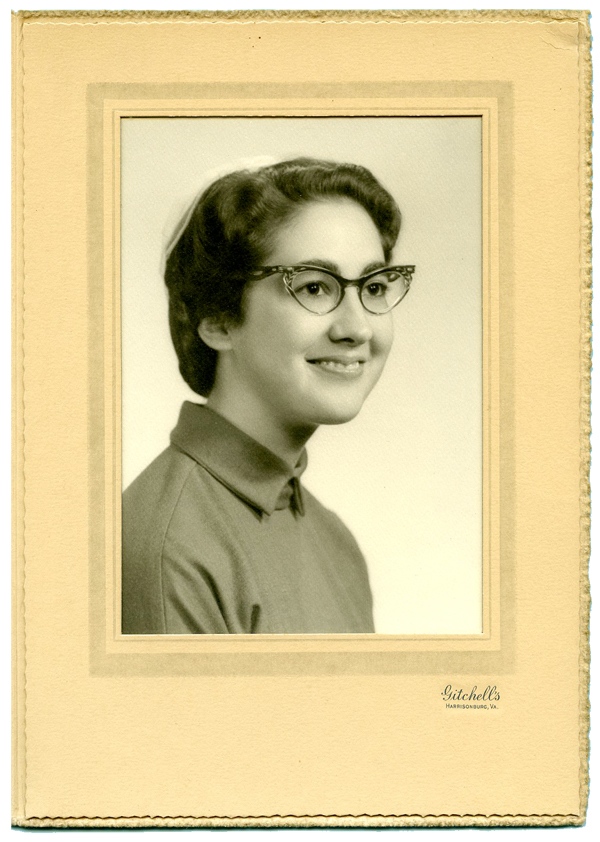
Senior Photo: Eastern Mennonite College
During the summer of 1964 my Aunt Ruthie and I attended Temple University, she to complete her Master in Education degree and me to begin it. From the hamlet of Rheems at 4:30 in the morning, we drove to Lancaster, took a train from Lancaster to Philadelphia, then rode the subway into north Philadelphia and walked eleven blocks to the campus of Temple University with classrooms filled with students who chain-smoked. I still wore a prayer veiling with a crown of dark brown braids fastened with hairpins underneath, ever the epitome of moral innocence. Ruthie’s classes lasted longer than mine, so I waited for her on a circular, wooden bench on the grassy campus outside the classroom.
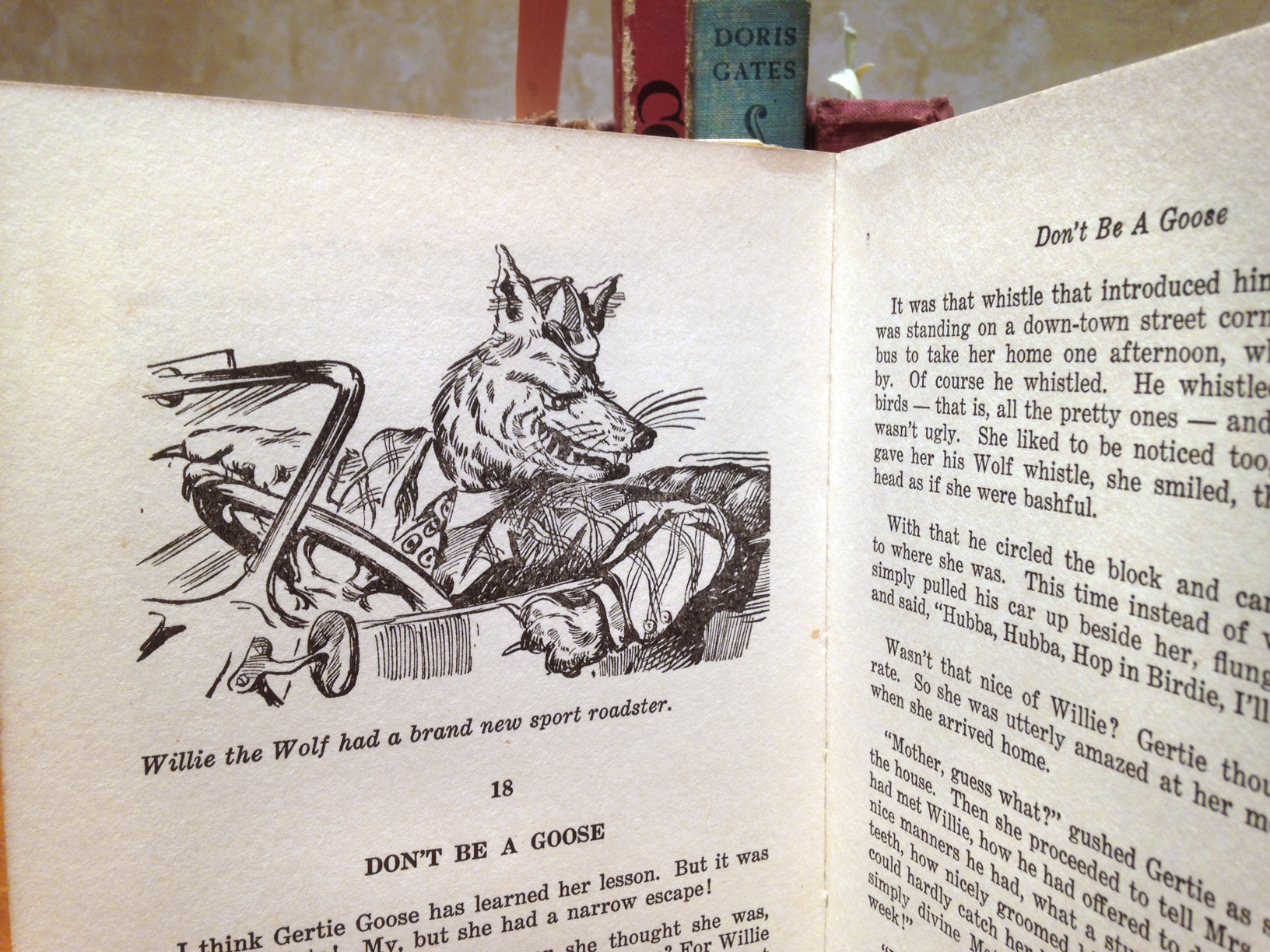
A suave older man approaches me and raves about my hair. It could be a scene right out of Bird Life in Wington, Gertie the Goose meets Willie the Wolf.
I notice at once his pearly white, even teeth and brushed back hair. Is he a college student? He for sure doesn’t look like one. Other students are milling around, I notice, so what could be the harm in talking to this stranger?
Willie: “Sprechen ze deutsche?” Not waiting for an answer, he spouts, “You have gorgeous hair. It’s so thick and glossy.”
Willie: I own a hair salon in the suburbs of Philly. I’d take you there and give you a different hair-do. It would frame your face really nice.
Gertie: Really?
Willie: Of course, I wouldn’t charge you anything.
Gertie: Well, thank you.
The dialogue continues for another minute or two, and then two things happen: I feel an electrical zap down my spine and a visitation from the Holy Spirit, who urgently whispers — “NO!” in my ear: “Run for your life. This guy is up to no good.”
Scales fall from my eyes as I swiftly dismiss his cunning ideas–and find an excuse to leave the bench and search desperately for Aunt Ruthie. Her class must be over. Soon, I hope. God, I hope soon!
Willie the Wolf in roadster tries to seduce Gertie the Goose in Calvin Reid’s cautionary tales
It’s your turn. Any narrow escapes from unsavory characters in your early years? Other threats to your moral virtue?
Your story is welcome here, and I will always reply.
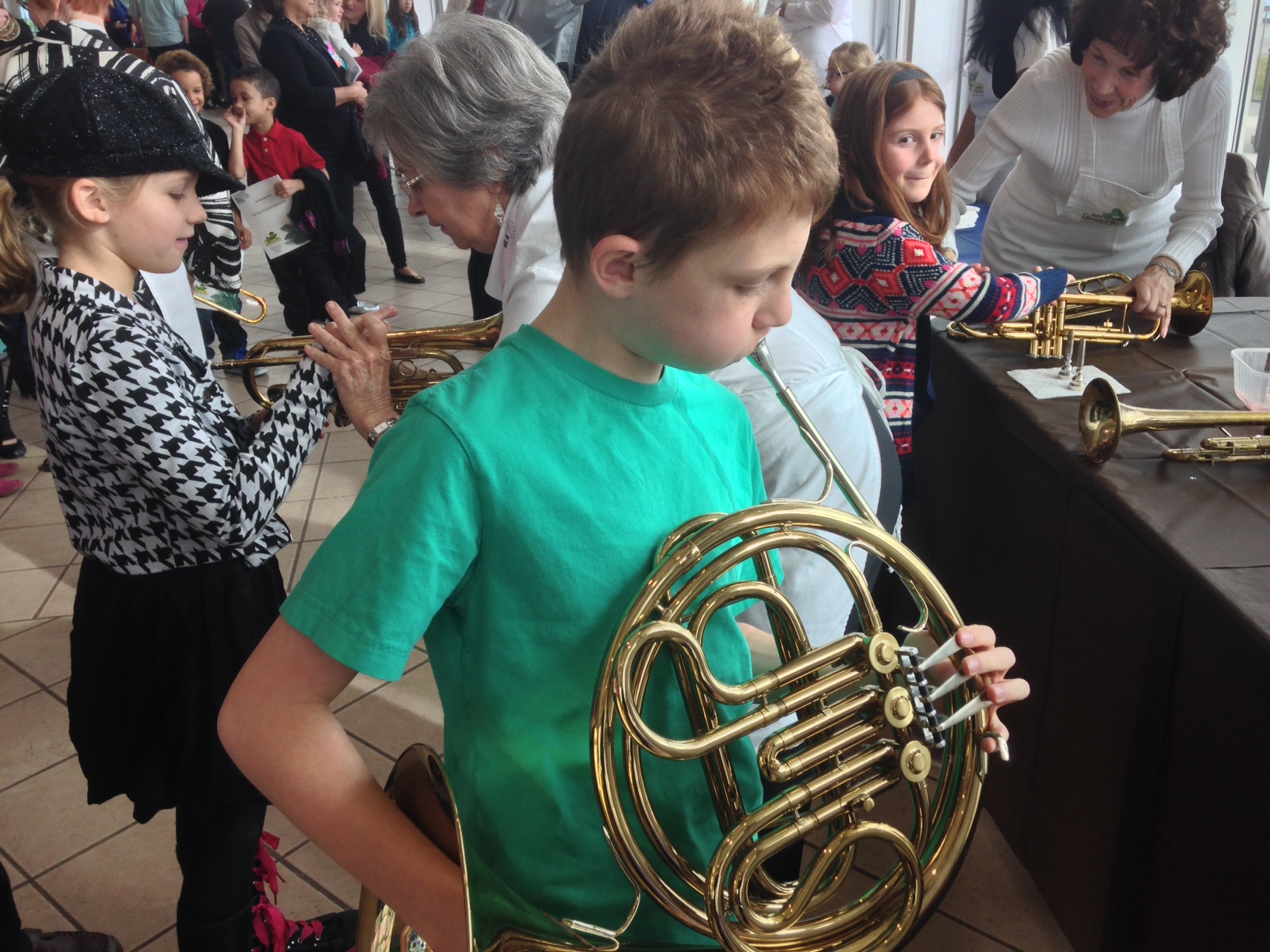
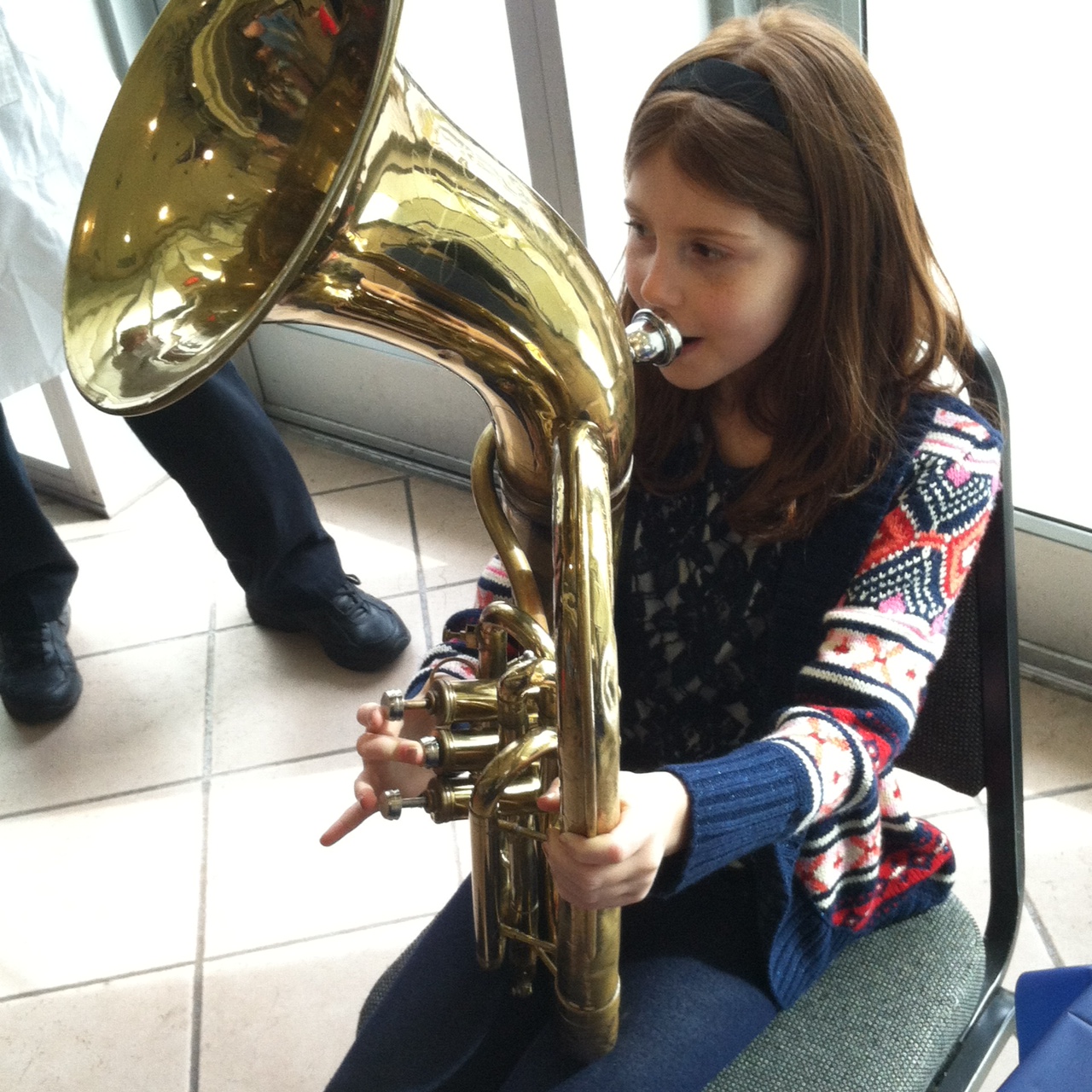
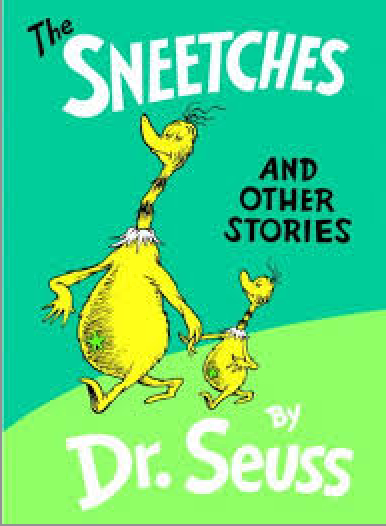
Last Sunday afternoon, we took our red-haired grand-kids, the Daltons, to the Jacksonville Symphony Family Series, featuring The Sneetches. There was a pre-concert Orchestra Zoo with dozens of kids standing in lines to bang on, blow into, or saw the strings of grown-up instruments.
Patrick & French Horn at the Orchestra Zoo
Jenna & Tuba at the Instrument Zoo
During the concert, the conductor asked each section of the orchestra to play a segment of a piece separately to let the kids hear the true sounds of the various instruments.Then came the pictorial story of the Sneetches animated on screen and read by a narrator, all accompanied by the whimsical strings, the complaining woodwinds, and the booming drums in Jacoby Symphony Hall.
If you need a brush-up on the Dr. Seuss plot line, two camps of yellow, fantastical creatures called Sneetches are separated by whether or not they have stars tattooed on their bellies. The Star-Belly Sneetches think they are best and make their Plain-Belly counterparts feel sad and inferior. Magically, Sylvester McMonkey McBean comes along with his Star-on and Star-off machines. Now the Plain-Bellies are thrilled because they match the elite. But the original Star Bellies are angry because they no longer stand out as special. Now no one is happy.
Between the Star Bellies and the Plain-Bellies there is plenty of bad feeling to go around. Then the conniving Star Bellies hatch an idea: Let’s get Sylvester McMonkey McBean to remove all the stars from bellies. Determined to find a solution, money from both belly camps gets stuffed into McBeans’ pockets, and he leaves town a rich monkey. Poorer in pocket, but richer in understanding, none of the Sneetches can remember who was what originally now that they all look the same. Finally, there is a level playing field.
The Sneetches’ conclusion: It doesn’t really matter what they look like—they can all be friends, stars or no stars. As the story ends, conviviality reigns.
In the car on the way home:
Jenna: “I really liked it! Those Sneetches were really cool, and they all liked each other at the end.”
Patrick: “It doesn’t matter what you look like. Everyone is the same. Oh, and there’s another thing: Don’t give away all your money away for a dumb reason.”
Grandpa: “You are special whether you have a star on your belly or not.”
First of all, I wouldn’t want a star on my belly, would you? I wouldn’t want to draw attention to my worst feature whether it looked cool or not.
If you are human, you probably are a Sneetch, prone to some of the dark emotions these yellow bellies felt: feelings of inferiority, pride, dis-content, fear, frustration, and envy.
You may or may not agree with Alex Daydream (that has to be a pseudonym!) who claims that no emotion is strictly good or bad.
Anger clouds our judgement
Love can make us blind
If emotions are so ruinous
What good one can I find?
Empathy makes us better people
Pain brings us back always stronger
Sadness gives way to happiness
Meaning a better life lived longer.
Alex Daydream
Some of the writer’s conclusions may be questionable (I have to wonder does “Pain bring us back always stronger”?) Growing up a Mennonite in the Longenecker family of Lancaster County, we children were not encouraged to show our real emotions, especially not in public. In my memory, there was a huge gulf between feeling emotions and being able to truly express them.
But what matters is what you think.
Were you encouraged to express your true feelings as a child?
As the poet claims, does allowing oneself to feel emotions make for a more meaningful life? What about expressing them?
The British poet Robert Herrick writes a fine sonnet about the allure of the slightly askew, the saucy, the off-beat–the messy in dress! Well, he has a point, but I don’t agree in general. I like neatness and appreciate the beauty of orderliness.
Too precise hand-writing clothes hanger, college days EMC
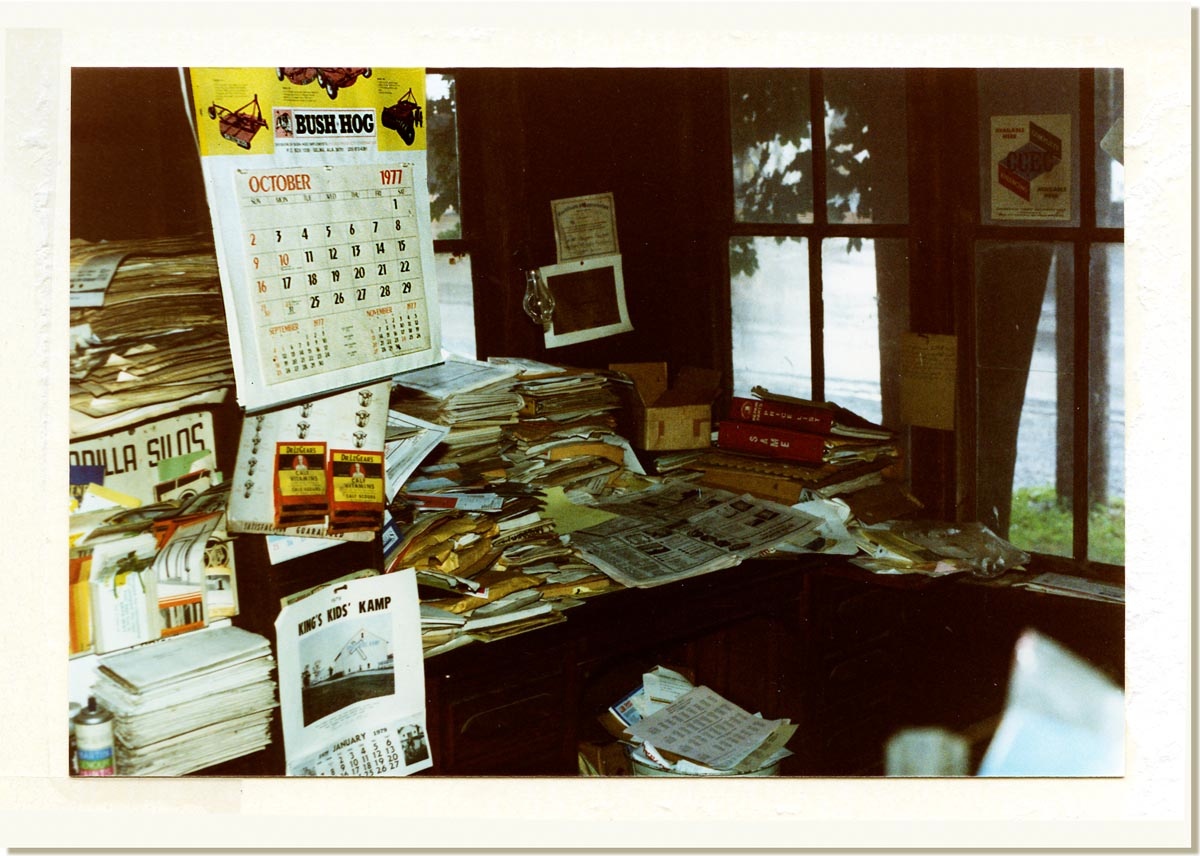
Mother was a neatnik too, every hair in place under her prayer covering, the whole house scrubbed clean every Friday, a place for everything and everything in its place. On the other hand, my dad, who was precise in the mechanics of fixing machinery in his farm supply business, was by nature messy, messy, messy–in his office, inside his truck, on the porch of his shop.
Brother Mark before sale of business
Daddy’s messy manner drove me crazy. Besides, it was embarrassing! In the middle of the village of Rheems, the shop faced Harrisburg Avenue with two main sections, one behind the other. The front part housed dozens of storage bins for nuts, bolts, screws, odd implements and, curiously, a Victrola sitting squat right beside the door to the sales office. During planting season, bags of Royster fertilizer for sale would be deposited off to the side near a loading/unloading door. As you walked to the rear, a long wooden ramp led to the back section where the dirty work was done, Daddy and his helpers fixing disk harrows, plows, or welding broken parts. Behind the shop was an assortment of implements stored Sanford & Son-style from which the mechanics harvested parts.
Occasionally, when Daddy said, “It’s time to sweep the shop,” I shuddered because I would be working in the cold with piles of stuff everywhere. Spritzing soapy water from a bucket to settle the dust, I watched charcoal-grey pustules of dirt and grease bead up on the cement floor, then tried to push-broom the filth into a dust pan, often an exercise in futility.
Though Daddy was messy, he had a strong Pennsylvania Dutch work ethic. At the shop six days a week, he caught up with office work and telephone sales in the evenings. “I worked like a Trojan today, and still didn’t get the Fox Harvester ready for Phares Weaver in time,” he’d say to Mother as he walked in the door. And he did so well in sales, dealerships would send him and Mother as VIPs on all-expense paid trips to Ohio, Florida, or Arizona to learn about new farm equipment. Once his sales were so high, his whole family, including three married daughters and son enjoyed a week-long vacation in Jamaica.
Daddy in his later years, taking a breather
So there’s neat and there is messy. “God is a God of order!” shouts one. The other camp retorts: “But you can’t be creative and neat at the same time!”
This post began with an homage to the slightly slovenly, the off-kilter. It ends with a writer lamenting her neat freakiness.
Being A Neat Freak
Being a neat freak, is certainly not a
blessing! No one enjoys, being this
way. When I find everything thrown
all around, on impulse, I have to put
them all away. I have always lived by
the creed, there’s a place for everything
and everything, in its place! It’s
aggravating, dealing with this, but I
know it’s something, I’ve got to face.
I’ve often wondered, how does a
person, get to be this way? It didn’t
happen over night, or in just a day.
Perhaps, it’s what we learned, when
we were young. And frankly speaking,
I’m tired of hearing people say, try not
to be so high strung! I’d like nothing
better, if I could let up, just a little bit,
by not letting myself become so
perturbed. Upon giving this some
thought, I realize, isn’t all of this, quite
absurd!
This week we celebrate Martin Luther King Day, a tribute to the man with a vision for racial equality in the twentieth century and beyond. Just so, this post pays tribute to his dream and his legacy through a Mennonite lens.
“Jesus Loves the Little Children, All the Children of the World, Red, Brown, Yellow, Black and White,They are Precious in His Sight, Jesus Loves the Little Children of the World.”
As a tiny tot I was taught this song in Sunday School at Bossler’s Mennonite Church in the 1950s though the entire congregation was white. I saw children with slanted eyes and yellowish skin in picture books and a few black people in Lancaster and Harrisburg or maybe on the PRR train on our way to Philadelphia. But there were no children of a different skin color at Rheems Elementary School. Or even at Elizabethtown High School. Not a one!
It was ancestry, not skin color, that made a difference in my family. Grandma Longenecker, benign soul though she was, did make disparaging remarks about other ethnic groups. She called a woman she was slightly acquainted with in Bainbridge “The Hunky Lady.” From her tone, I think Grandma Fannie was referring to the woman’s origins in Hungary, and therefore different from us, the Pennsylvania Dutch. And she made no bones about her view of Irish housekeeping. If we made a mess playing in her big kitchen, she’d remark, “It looks Irish in here,” and we’d be tidying up behind her broom. Fast!
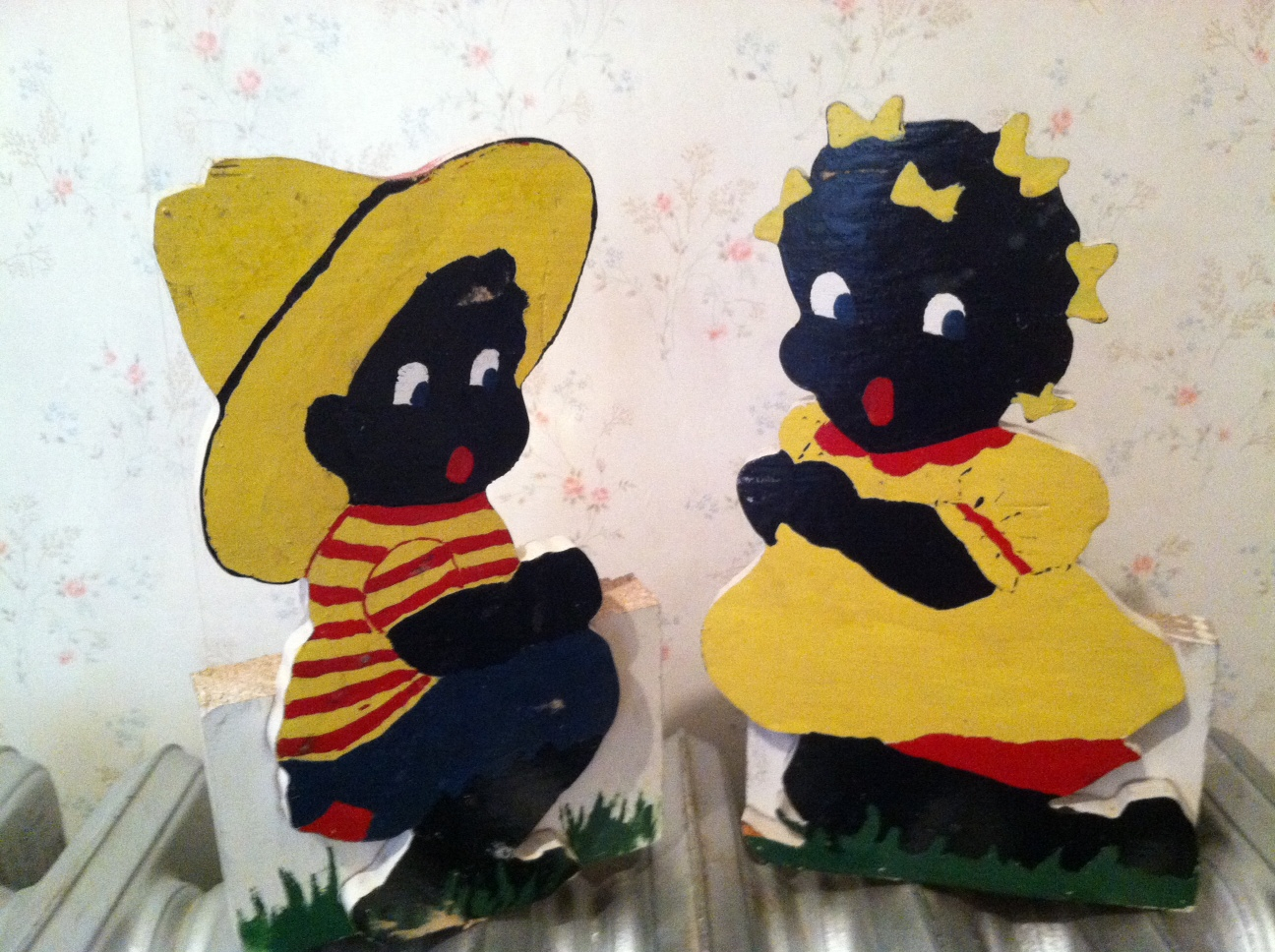
In a recent visit to the attic, I came upon a pair of bookends featuring two pop-eyed black faces, a boy and a girl, painted in grade school. Were such children curiosities to us? Novelties? Why would my teacher approve of such an art project? Along with stories like Little Black Sambo, they were obviously part of the folklore of another era, not at all politically correct by today’s standards.
My first encounter with a black person, up close and personal, was with little Chico Duncan, a black boy from New York City, who came to our home for a week in the “Fresh Air” program in which volunteer families would give city children summer vacations in the country. (Shirley Showalter’s book Blush devotes an entire chapter to her friendship with their family’s Fresh Air girl.) The most fascinating thing about Chico was his hair, kinky black and glistening. Was his hair naturally oily or did he put on something from a bottle? I longed to touch it and feel the texture, but fear or embarrassment or both restrained me from even asking. Besides, he was a BOY, and I had hoped for a girl to play with!
But that was years ago. Now at Bossler’s Church, children who sing “Jesus Loves the Little Children” may actually be sitting besides a child with a darker skin tone. The church treasurer, a former missionary, has an Ethiopian husband; one farm family has adopted African-American twin babies. There is a couple of Middle-Eastern descent. The Bishop, Director of African Programming with Eastern Mennonite Missions, has biological grand-children of Kenyan-American ancestry.
And my Grandma Longenecker? For at least two decades through Lutheran Social Services, she and Aunt Ruthie sponsored families from all over the world—particularly Viet Nam, Africa, and eastern Europe. They, along with many other Lancaster County families, welcomed the immigrants and refugees from countries at war for weeks or months at a time until they could get a job, an apartment of their own, even acquire an education.
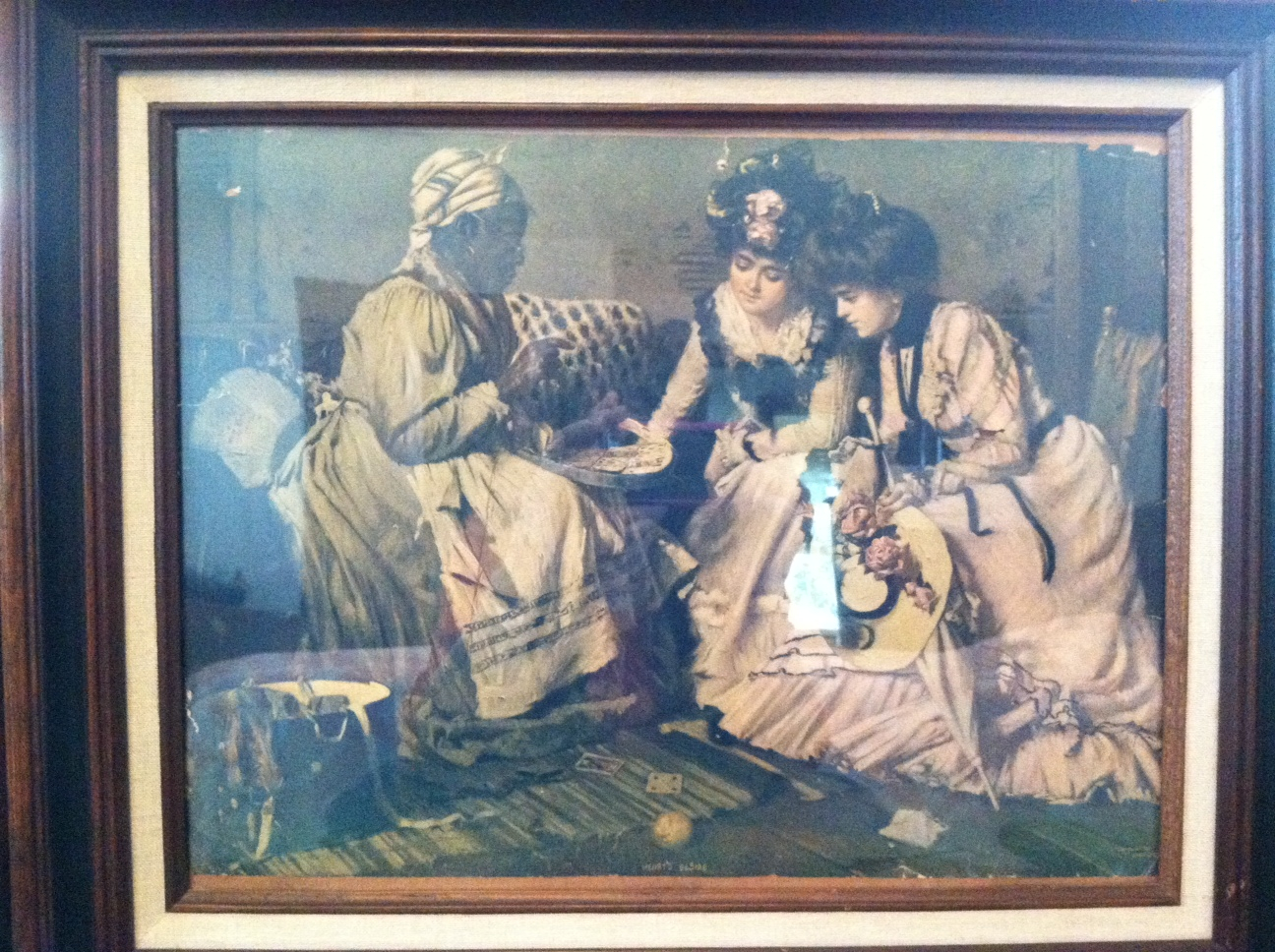
A few months ago, I re-visited Aunt Ruthie’s bedroom, (now unoccupied because she lives at Landis Homes) and saw on the wall as if for the first time, a framed picture of three women:
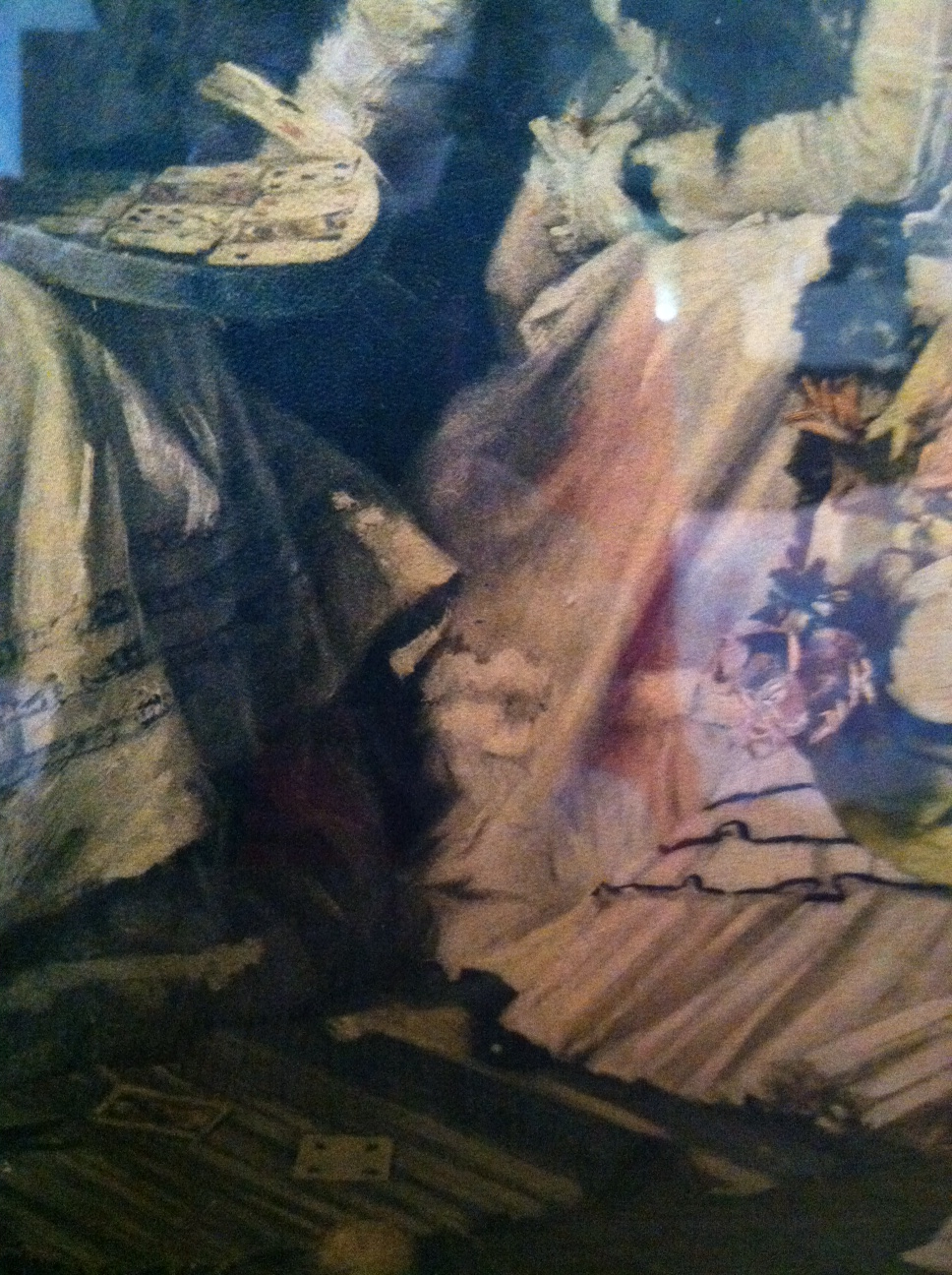
Two elegantly dressed Victorian women and a black woman, obviously a maid, playing cards. Is the maid holding the card tray for the other two? Is she teaching the ladies tricks of the trade? Are all three playing the game? Three would make a better game, don’t you think?
Detail: Women Playing Cards
What experience with race did you encounter as a child? What story or anecdote can you add? I love when the bell chimes with your comment!
Anna Quindlen in her splendid 84-page book How Reading Changed My Life describes reading as her “perfect island.” She doesn’t say where the island exists, so it can be anywhere the reader imagines it to be.
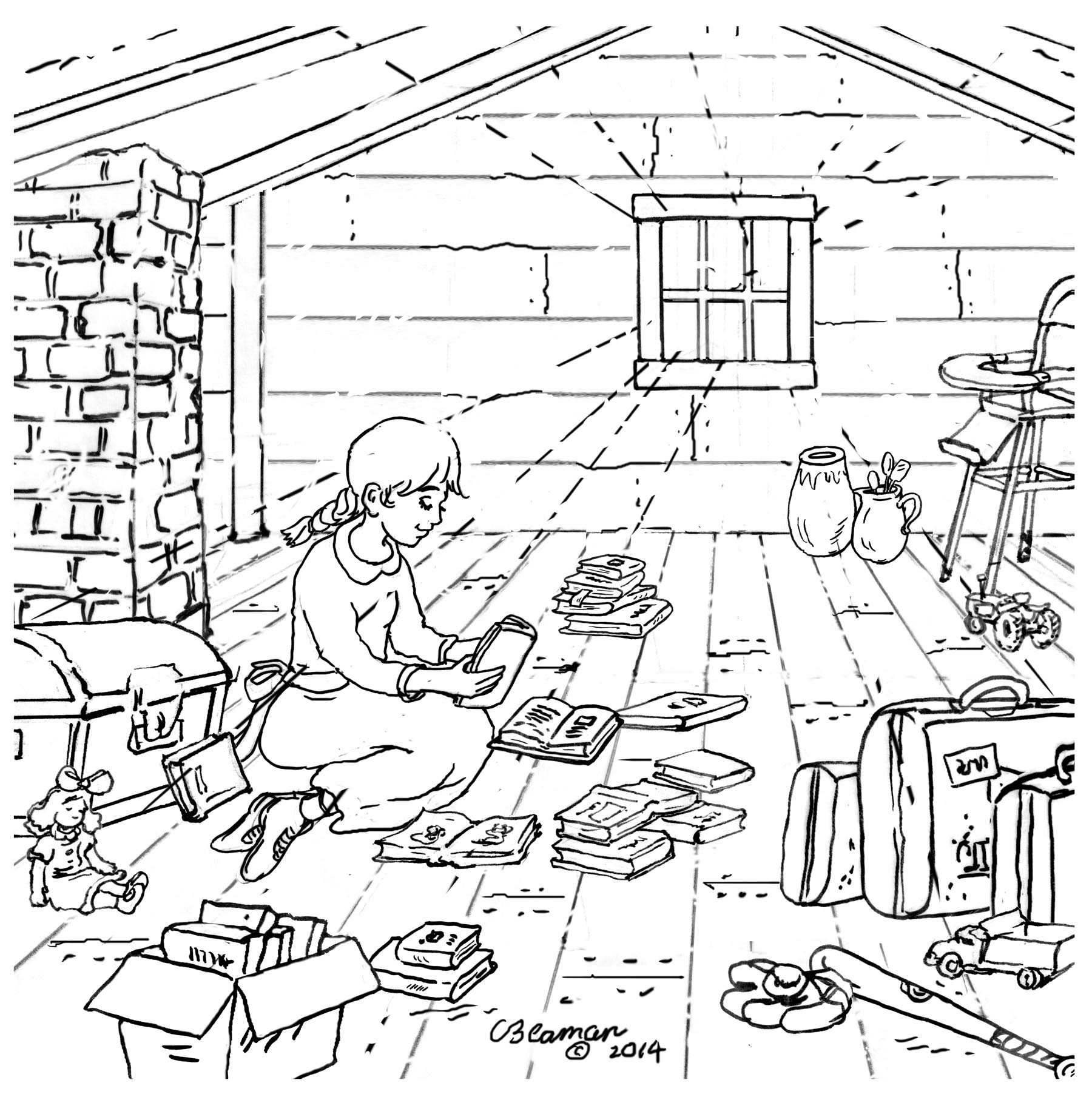
My perfect island as a girl was the attic under the sloping roof, unless it was summer steamy hot, or winter frosty cold. Then my nest was on my bed, or flopped on the davenport, across a chair, anywhere . . . .
My books were not like Quindlen’s list of “10 Books for a Girl Who Is Full of Beans.” I didn’t read her noble suggestions like Little Women, Anne of Green Gables, Madeline, or even A Wrinkle in Time as a young girl, but I did become addicted to the Cherry Ames series, books in the mold of Nancy Drew: Cherry Ames, Student Nurse, Army Nurse, Flight Nurse. If you have read them, you may know Cherry, short for “Charity,” is the heroine in a series of 27 mystery novels with hospital settings between 1943 and 1968.
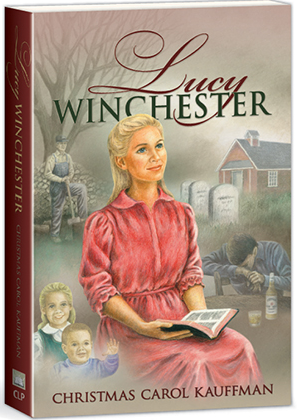
I slurped up Lucy Winchester by Mennonite author Christmas Carol Kauffman, the story of Lucy’s spiritual quest to find peace “set against the backdrop of two difficult marriages and many sorrows, broken promises, sickness, infant deaths, alcoholism, and poverty.”
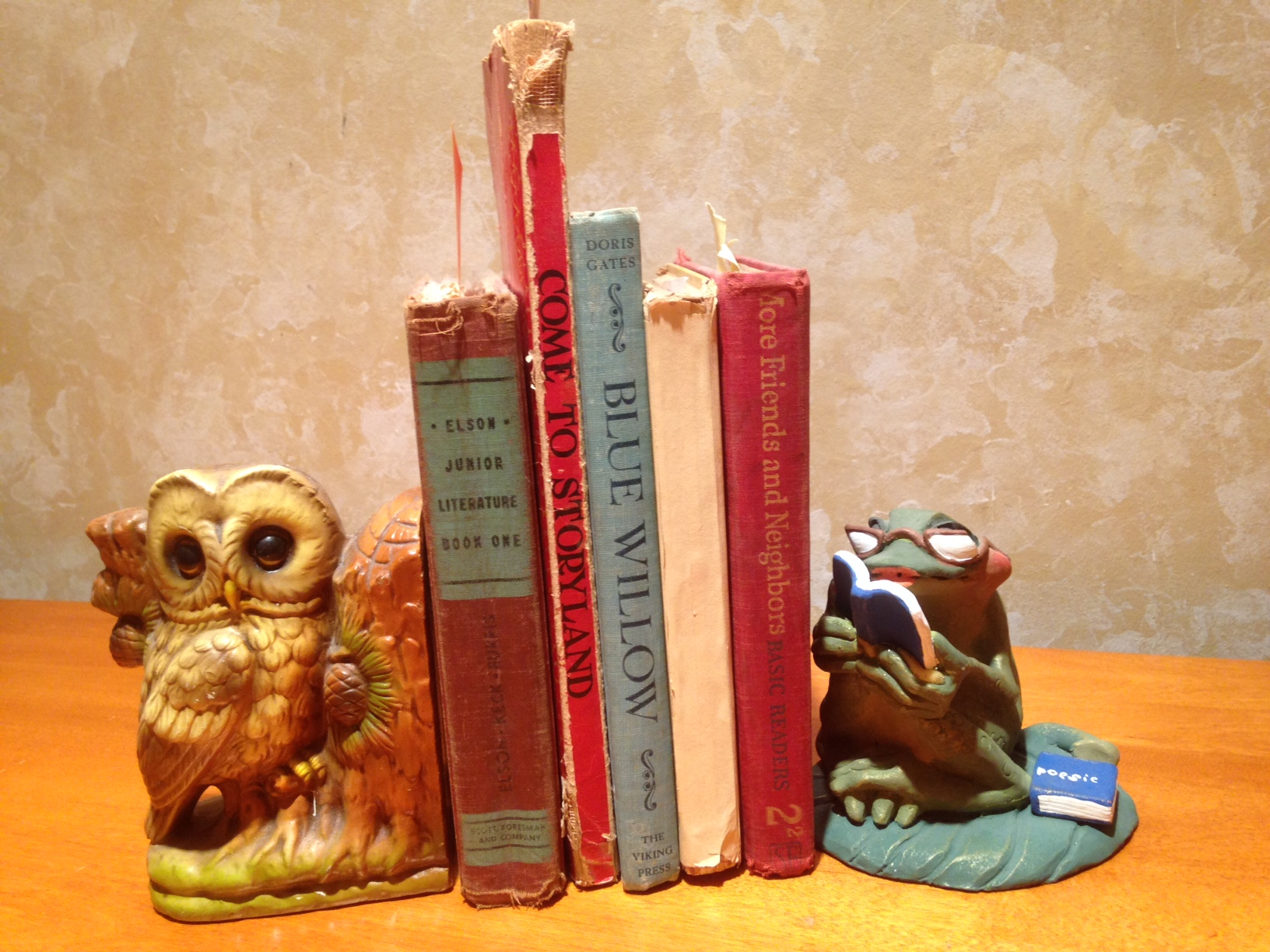
In a trip up to the attic again as an adult, my sisters and I rummaged through the stash of antique books (they’re over 50!) and divvied them up among ourselves.
Yes, I read books, books, lots of them, but these are what remain from girlhood days:
The book whose spine is taped up is entitled Bird Life in Wington (1948) a book of parables by Rev. J. Calvin Reid, pastor of Mt. Lebanon Presbyterian Church in Pittsburgh,
Willie the Wolf with fangs in roadster ready to pounce on naive Gertie Goose
who invented the First Birderian Church of Wington to deliver sermonettes to parishioners named Professor Magpie, Baldy Eagle, Mr. Heron, a fisherman–you get the idea.
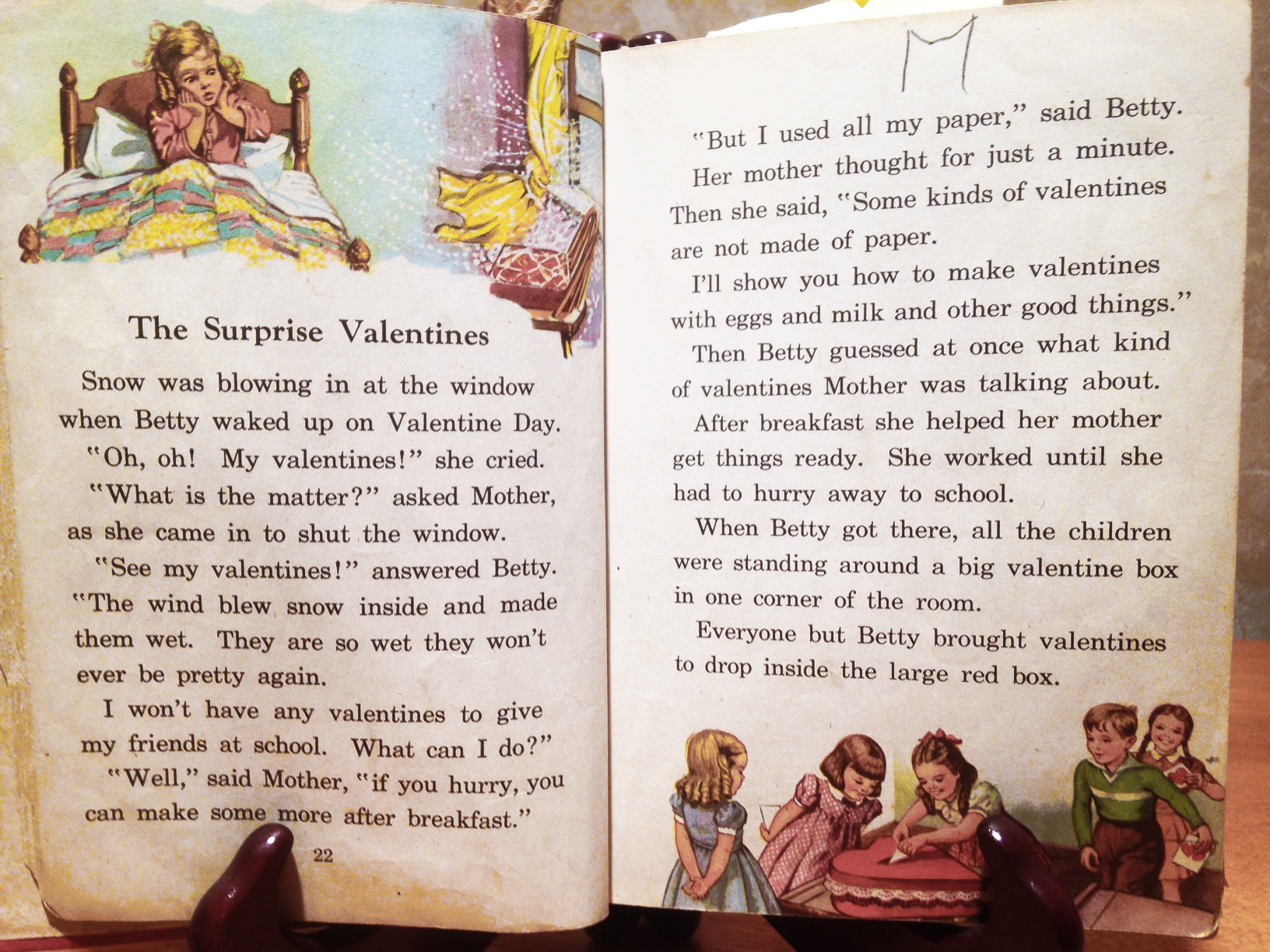
More Friends and Neighbors (Scott-Foresman & Company, 1941)
The images in this Valentine story are imprinted on my mind with cookie cutter precision, the secret to the surprise valentines that replace the snow-damaged paper cards by the window. This reader also contained the story of the “The Woman Who Used Her Head” by chopping a hole in her roof to accommodate the lofty altitude of her Christmas tree.
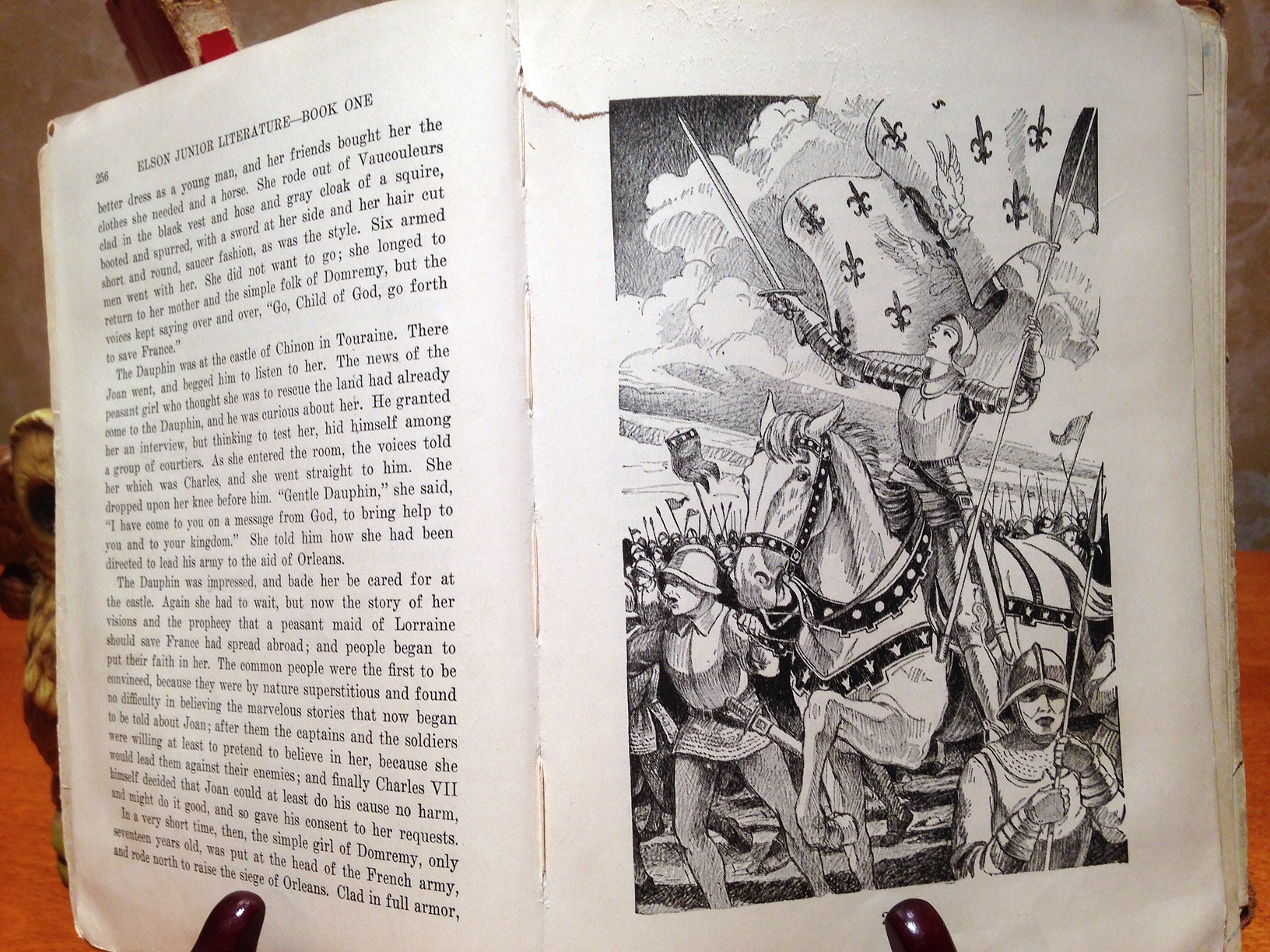
I always loved to turn the page and find an etching in the Elson Junior Literature Book One
Finally, a “real” literature book with Hawthorne’s The Great Stone Face, Emerson’s poem The Snowstorm, announced by “all the trumpets of the sky,” Longfellow’s The Courtship of Miles Standish, and Joan of Arc, the heroic maid who saved France from conquest. A vision, voices, an ancient prophecy–what could be more romantic for a plain Mennonite girl who dreamed of castles, and princes, and fulfillment, oh my!
Did this post jog your memory of textbooks, gift books, library books from your own past?
Please tell us about them.
Another invitation to vote for my story in The Gutsy Story Contest:
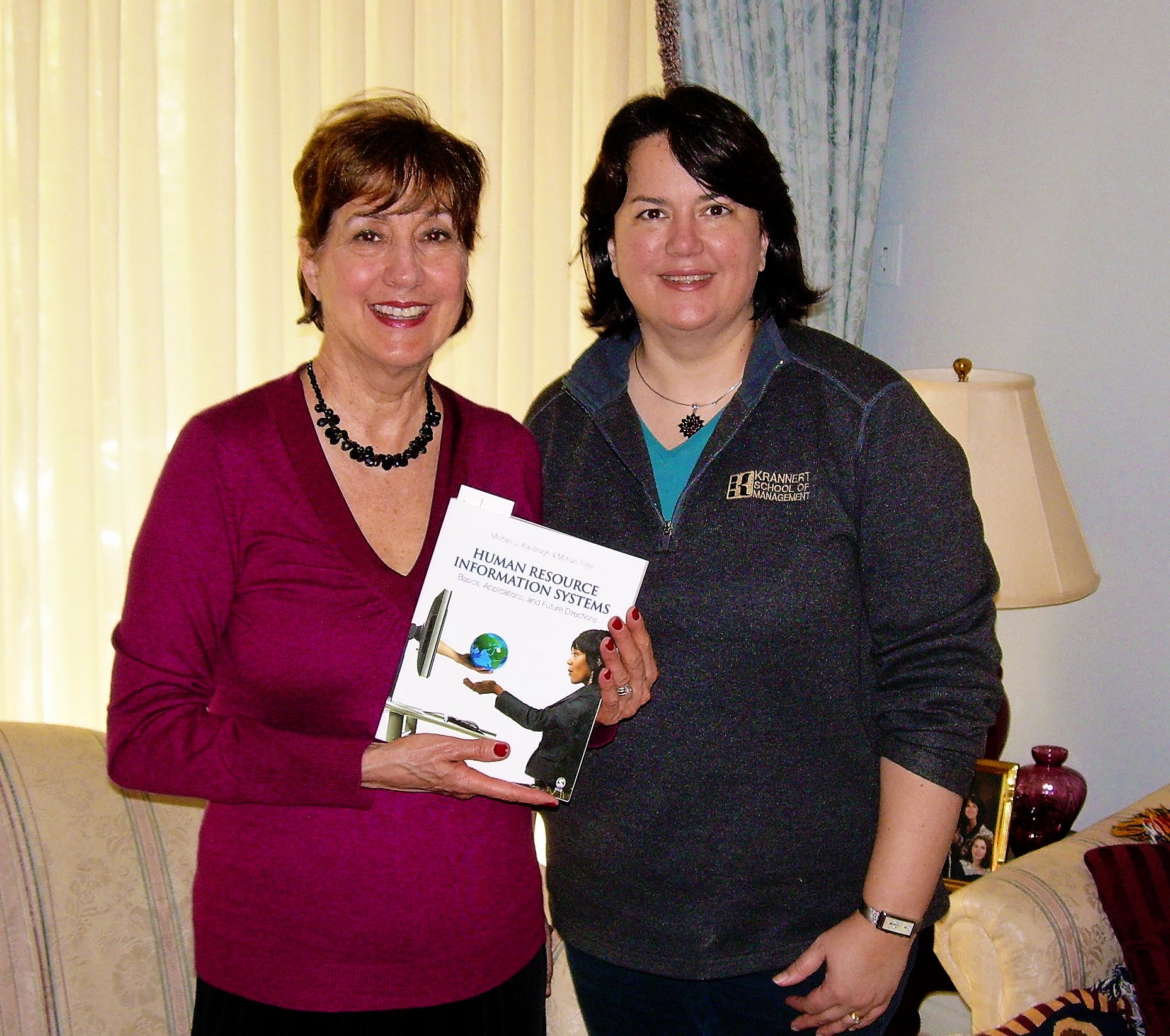
Last Wednesday, into my inbox popped a message which included an invitation to lunch from Karen Bruner Upright, my former student at Florida State College. The last time I saw her, she was a “surprise” visitor at Christmas, marching up the walkway to our house, book proudly in hand, with a chapter she co-wrote with a colleague.
When we first met in my college classroom, Karen was my first-year composition student on her third try at getting through the course. Though she attributes her previous failures to not going to class and not feeling motivated, from the beginning, she was a stellar student, whose essays became examples I repeatedly used as models for other students. Revealing her occupation back then as a restaurant chef, one essay in particular stands out, an illustration-type paper with the line “The heat of a commercial kitchen comes from both the ovens and the chefs” as she proceeds to describe two other chefs and herself as “the most obnoxious chef I have ever known.”
When I pointed out her writing gift, she at first stared at me blankly, almost in disbelief. She has since gone on to complete her M.B.A. degree at Purdue University and is currently employed as Systems Manager for Proctor and Gamble–and become co-author of a chapter in a book about technology for human resources. There is no end to what this woman can accomplish. Oh, and did I mention, she still loves to cook, featuring her savory concoctions on her website plannedovers.com
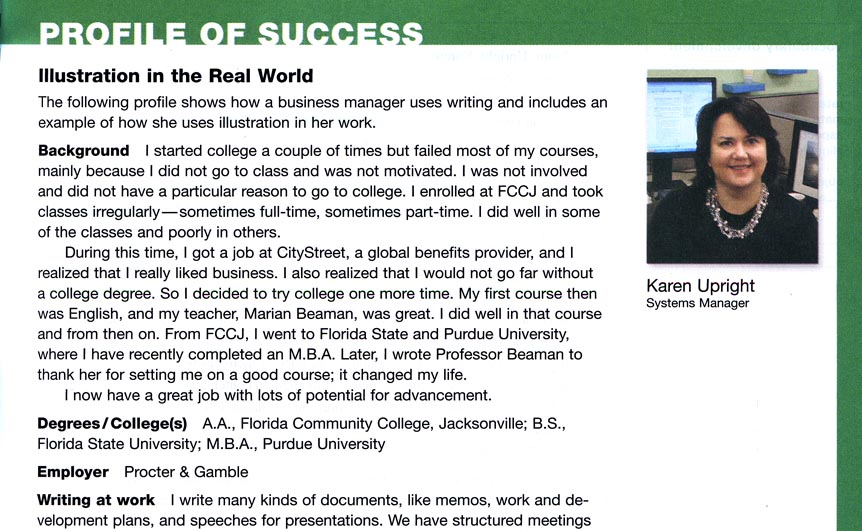
Along the way, Karen has also become conversant in French, every Friday calling her friend in the south of France, so she can maintain her fluency. Also, she has been featured as a Profile in Success in a college textbook by Susan Anker entitled Real Writing with Readings.
Thumbnail of page 145 in Real Writing with Readings college text, 5th ed.
Of all the students who have paraded through my classroom, Karen Upright stands at the top my list of Students Who Inspire.
Downright fabulous!
Is there some you know, like Karen, who persisted and made it through high school, college–some other challenge? Do tell us about it.
My mother and I are waiting in Doctor Garber’s examining room, which always has a sharp smell of rubbing alcohol. She’s the patient, and I’m with her sitting on a chair eyeing the metal tray holding at least a dozen tiny vials, so cute they look like they could fit in the kitchen of my doll-house. But they are vials of venom, possible culprits. Nurse Becky Longenecker carefully fills little syringes with each fluid, which puncture the skin of Mommy’s extended arm trying to determine whether it is house dust, hay, mildew, turpentine, or cat dander that is causing her frightful asthma attacks. I watch as some injections leave a puffy patch or a bright red spot. She leaves the office with a paper packet of pills to try. Maybe these will help.
But I guess they aren’t working either. Once again, Mother is propped up on feather pillows gasping for breath, her face blanched white with the effort. It’s scary for Daddy and my sisters too. We feel helpless. But Daddy knows about Ordinance # 7 in the Statement of Christian Doctrine of the Lancaster Conference of the Mennonite Church: “Anointing. According to James 5:10-18 we encourage our members to call for anointing with oil accompanied by the prayer of faith for healing.”
Olive Oil in a Vial of Healing
So my dad has called for Pastor Martin R. Kraybill and Deacon John R. Kraybill, brothers, to come to Mom and Dad’s bedroom upstairs for the anointing of oil as prescribed in the New Testament passage of James 5:14 & 15.
Is any sick among you? Let him call for the elders of the church: and let them pray over him, anointing him with oil in the name of the Lord. And the prayer of faith shall save the sick, and the Lord shall raise him up; and if he have committed sins, they shall be forgiven him.
As Pastor Martin prays and reads the scripture to Mother and to the family assembled around her bed, Deacon John anoints her forehead with olive oil, an outward symbol of the healing that is transpiring within. Mom later describes a tingling sensation like a warm, electrical current radiating from the top of her spine to the bottom. “It felt wonderful!” she says. She has been healed immediately—and by the power of the Holy Spirit.
No more doctor visits for asthma ever again, the vials of venom to test for triggers, a thing of the past. Praise God!
Have you or someone you know had an experience similar to this? We’d love to hear your story.
Facebook asks boldly, “Do you want to post this on your wall?” meaning do you want this information available to your Facebook friends? Obviously, walls in the 1950s were not electronic. The only walls we knew then were made of plaster. But more on that later!
Longenecker Homestead in the family for five generations
The John Longenecker homestead sits just across the road from Bossler Mennonite Church. The scene is bucolic, farms and land extending as far as the eye can see in this quiet niche of western Lancaster County. Poles that once attached electrical wiring to this house are gone, so I assume a plainer family, probably Amish, now lives in the house and farms the acreage.
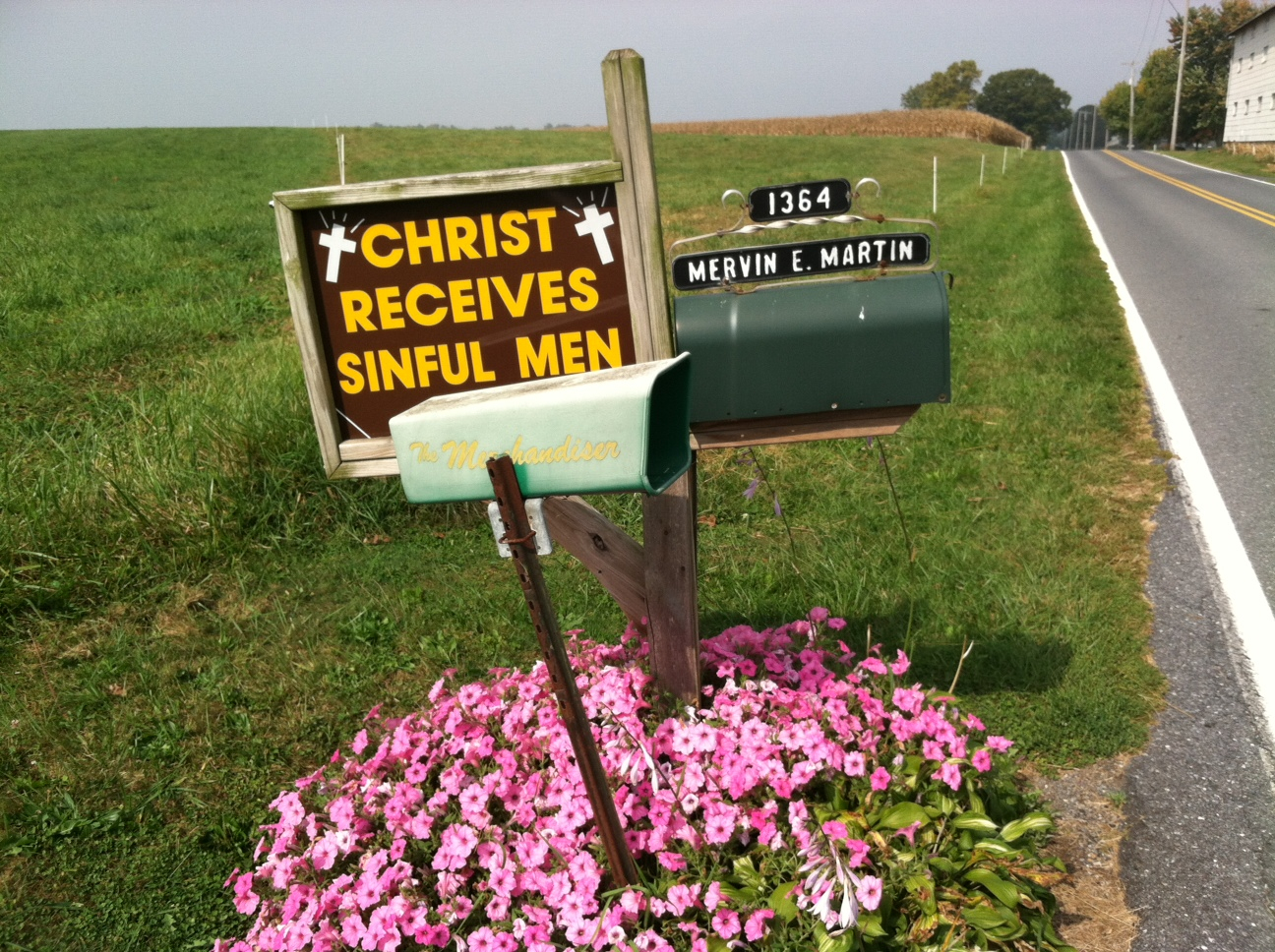
Apparently the family is not bashful about proclaiming their convictions, broadcasting from their mailbox on both sides two biblical admonitions, one from John 8:11, words of Jesus to the Samaritan woman.
Usually painted scenes and pretty art adorn the walls of modern homes, but “back in the day” wall hangings we called mottoes were intended to exhort and encourage. Above the door leading from my Grandma’s kitchen to the sitting room is this stern commandment:
Upstairs in Grandma’s Victorian-style bedroom is a poem with a much softer touch, embroidered for her mother by my aunt, Ruth Longenecker:
My Mother’s Garden, an embroidered poem by author Alice E. Allen
In our own home was this fixture from Proverbs 3:6 in the little walkway between our living and dining rooms. There it was from childhood to adulthood imprinting our minds and hearts until it eventually became invisible to us.
The wall hanging that made the biggest impression on me was Rudyard Kipling’s “If, for Men” adapted into an the idealized version for women or girls. I never tried to memorize the whole poem, but the words “If you can hear the whispering about you . . . ” keep chiming in my mind even now:
IF – for Girls
If you can hear the whispering about you
And never yield to deal in whispers, too;
If you can bravely smile when loved ones doubt you
And never doubt, in turn, what loved ones do;
If you can keep a sweet and gentle spirit
In spite of fame or fortune, rank or place,
And though you win your goal or only near it,
Can win with poise or lose with equal grace;
If you can meet with Unbelief, believing,
And hallow in your heart, a simple creed,
If you can meet Deception, undeceiving,
And learn to look to God for all you need;
If you can be what girls should be to mothers:
Chums in joy and comrades in distress,
And be unto others as you’d have the others
Be unto you – – no more, and yet no less;
If you can keep within your heart the power
To say that firm, unconquerable “No,”
If you can brave a present shadowed hour
Rather than yield to build a future woe;
If you can love, yet not let loving master,
But keep yourself within your own self’s clasp,
And not let Dreaming lead you to disaster
Nor Pity’s fascination loose your grasp;
If you can lock your heart on confidences
Nor ever needlessly in turn confide;
If you can put behind you all pretenses
Of mock humility or foolish pride;
If you can keep the simple, homely virtue
Of walking right with God – – then have no fear
That anything in all the world can hurt you – –
And – – which is more – – you’ll be a Woman, dear.
by Elizabeth Lincoln Otis
We want to know. What was/is hanging on the walls of your home, past or present?
By the way, it’s not too late to enter the book giveaway contest for a chance to win a copy of Valerie Weaver-Zercher’s book The Thrill of the Chaste: The Allure of Amish Romance Novels.
Click HERE to post a comment and a chance to win. The contest closes on Saturday, November 9, 2013 at noon. Only comments logged into this website can be honored. The winner will be announced here on this blog and in an email.
Browse the inspirational-fiction section of most bookstores, and you will find cover after cover of comely young women wearing dresses with capes, and often pensive expressions . . . . Occasionally a male figure lingers in the background, his face obscured by a hat, but more often the Amish maiden is alone in her pastoral reverie, gaze averted and thoughts inscrutable.
Photo at Barnes & Noble Bookstore featuring authors Beverly Lewis, Cindy Woodsmall, and Linda Byler, the only Amish novel writer who is herself a member of the Old Order Amish
So begins Valerie Weaver-Zercher’s Thrill of the Chaste: The Allure of Amish Romance Novels, published by Johns Hopkins University Press, an in-depth analysis of the appeal of Amish fiction. She looks closely at writers, readers, and the cultural changes at the heart of this phenomenon. And a phenomenon it truly is: 95 new Amish romance novels were published in 2012, at “the rate of about one every four days.” (4)
I met Valerie at a lecture she presented at Eastern Mennonite University in October 2013. She noted that some view Amish romance novels as fluff, nostalgic but formulaic concoctions. But novelists like Beverly Lewis, Linda Byler, Wanda Brunstetter, and Cindy Woodsmall must have tapped into the deep yearnings of many readers. Why else would their books fly off the shelves of bookstores?
“Are you curious too?”
“Okay, I thought so.”
Since her lecture, I have communicated with Valerie to bring you the essence of her lecture in a crisp Q & A format.
MLB: Why is Amish romance fiction so popular?
VWZ: As I talked to readers of Amish fiction, I heard lots of things about why they like Amish novels. But they mentioned two reasons over and over again. First, for loyal readers of the genre, the books offer a vacation, of sorts, to a “slow and simple life.” Many people articulate their love of Amish fiction as inversely related to the spiraling nature of modern life: that is, as contemporary life feels more and more sped up, chaotic, and complex, they are more drawn to narratives of a people who have apparently escaped the craziness. While the readers with whom I spoke didn’t use this term, they were expressing a thought similar to an idea French theorist Gilles Lipovetsky introduced in 2005: hypermodernity.He defined hypermodernity as “the frenzied escalation of ‘more, always more’ [that] has now infiltrated every sphere of collective life.” This hypermodern context is characterized by the high speed of technological change, information transfer, consumption, social change, individualism, global capitalism. Many of us experience it simply as the feeling that life is moving at a pace that we simply can’t keep up with. So Amish fiction, in an age of hypermodernity, offers readers the means through which to take a temporary vacation.
Second, readers said they like Amish novels because they are “clean reads”: that is, books devoid of the sexualized content that permeates much of popular culture products. Sociologist Kenneth Kammeyer employs the term hypersexual to describe a situation in which “sexual discourse, erotica, and pornography are present in almost all aspects of society.” Other observers have used terms like pornified, raunch, and striptease to characterize twenty-first-century culture, evidenced by thongs and push-up bras marketed to elementary-school-aged girls. So readers, many of whom are evangelical Christian women, find in Amish novels a respite from the feeling of being bombarded by hypersexualized culture.
But there are other reasons too. Some of the reasons have to do with the fact that publishers can get more books into the hands of more readers more quickly than ever. So the fact that there are more Amish novels being published likely means that more readers are finding them. That is, there’s a greater demand for Amish novels than ever; there’s also a greater supply.
MLB: What are these novel readers seeking?
VWZ: As I said above, I think there’s a great appeal for many readers in the feeling of a temporary, imaginative vacation from hypermodern, hypersexualized life. The novels allow readers to vicariously participate in an Amish life without actually having to give up their Kindles and their life insurance and their cars. The more technologically saturated our lives become, the more intrigued we are, I think, by people who have escaped at least some of it.
MLB: Do these stories reflect real Amish life?
VWZ: That’s a complex question, actually, and one that is difficult to answer. I have a whole chapter in my book about that question. Some of it depends whether you’re talking about the genre as a whole or about the work of a particular novelist and whether you’re talking about the tangible details of Amish life, or the more intangible cultural and religious sensibilities of the Amish. Also, there are so many different ways of being Amish these days that if readers think that reading a novel set in one community—even a quite accurate novel—makes them knowledgeable about the Amish: well, they’re probably wrong.
Overall, I would say that most readers likely learn more that is correct about the Amish than information that is incorrect. Having said that, there are lots of misperceptions about Amish life that circulate in the novels and get passed on to readers, especially related to shunning and rumspringa. And then there’s the larger question of whether we as outsiders can understand Amish life from the inside-out well enough to craft a narrative that accurate reflects the internal life, spirituality, understanding of the church and family, etc., of an Amish person. That is, a novel might get all the “facts” of Amish life right, but still miss the more abstract, intangible feel of looking at the world from an Amish perspective. So that’s not a very good answer; but those are some of the reasons that the question is a hard one!
MLB: Obviously you read some of these novels during the course of writing your book. Did you enjoy reading them?
VWZ: I enjoyed some of the novels and disliked others. I actually don’t read a ton of fiction in general; I tend to read more nonfiction. I’m now working as a book editor for the Mennonite publisher, Herald Press, and I have really enjoyed editing a historical Amish novel entitled Jacob’s Choice by Ervin R. Stutzman. It comes out in February 2014. It’s based on actual events in the mid-1700s: an attack on the Amish Hochstetler family during the French and Indian War. I’m a descendant of the Hochstetler family, as are many Swiss-German Mennonites and Amish in Pennsylvania and other states, so I and many other readers have a special interest in reading this novel. It’s the first of three in the Return to Northkill series.
MLB: In general, readers of inspirational fiction are evangelical Christian women. Who else is included in the demographic of Amish romance novel readers?
VWZ: I talked to men who love Amish fiction, Catholic women who love it, and African Americans who read it. And as I did my research, I kept hearing about more and more people who don’t fit the evangelical female demographic. Old Colony Mennonites (both men and women) in Bolivia, for example. Old Order Mennonite readers. Amish readers. A missionary doctor. A librarian. An at-home mom. The readership is diverse, even as evangelical Christian women still constitute the bulk of the audience.
MLB: How do Amish readers themselves respond to these novels?
VWZ: I have a whole chapter on that question too! I also reflect on that question in this piece in the Los Angeles Review of Books. The Amish people I interviewed had opinions all over the map. Most were at least semi-critical of the novels, especially the fact that most are being produced by outsiders.
MLB: Your book, which you dub “narrative scholarship,” is a marvel of research with a 9-page bibliography, which includes books, magazine articles and interviews. Though well-documented, the book is witty and often reads like a story. How much time did this project require?
VWZ: Yes, I spent a lot of time on the research and writing of this book. I researched and wrote over the course of about a year, and then spent about six months working on revisions of various kinds. But I loved the entire process, despite moments of being unconvinced that I’d be able to pull it off. The variety of things I got to do—talk to readers, visit a book group, chat with Amish folks, read novels, read theory, and of course write—was just lovely. It was indeed very hard work, but very fulfilling. I loved the challenge of blending a narrative nonfiction voice with an analytical/scholarly lens.
MLB: You are busy mother of three young boys and an author husband. How did you manage to write this book along with your family obligations?
VWZ: It wasn’t easy. But I was freelancing at the time, so I was able to decline editing projects or just take on the ones I had time for and then devote the rest of my time to research and writing. Our kids are all in school now, so I wrote during the day while they were at school and sometimes early in the morning or occasionally (very occasionally!) late at night. I do much better getting up early to work rather than trying to stay up late. Also, I got a fellowship from the Young Center for Anabaptist and Pietist Studies at Elizabethtown College during the fall of the year I was working on this book, and that helped me to prioritize the project and begin to wrap up the writing.
About Valerie Weaver-Zercher
Valerie Weaver-Zercher is author of Thrill of the Chaste: The Allure of Amish Romance Novels. Her writing has appeared in the Wall Street Journal, Chicago Tribune, Los Angeles Times, The Christian Century, Sojourners, and The Mennonite, among other publications. She is also managing editor of trade books at Herald Press. She and her husband Dave have three sons and live in Mechanicsburg, Pennsylvania. They attend Slate Hill Mennonite Church.
Enter to win a copy of her book by entering the book giveaway contest!
If you would like to enter for a chance to win a copy of Thrill of the Chaste: The Allure of Amish Romance Novels by Valerie Weaver-Zercher, simply leave a comment at the bottom of this post. Valerie has graciously offered to donate a copy of her book to the winner!
If you are reading this anywhere other than my blog, such as on Facebook or in an email please hop on over to my blog, Plain and Fancy Girl. Only comments left on my blog will be entered into the giveaway.
The deadline for this contest is Saturday, November 9, 2013, at noon. The winner will be chosen using Random.org and will be contacted privately via email as well as cited in an announcement in a blog post here next week.
Now it’s your turn!
Make a comment or ask Valerie a question about Amish romance novels or about her other writing.










 Plain and Fancy