In Florida, most people take baths once a day. It’s too hot not to. And it’s a safe bet most people in contemporary America take more than one bath a week.
Not so in the olden days. Mildred Armstrong Kalish writes of her family’s once-a-week bathing in her chock-full-of-detail memoir of growing up on an Iowa Farm during the Depression and vividly describes the extra bath needed on days working in the hay-field:
When dusk came after a day like this [reaping and storing hay], Mama would fetch a steaming kettle of water from the kitchen stove and bring it out to the porch where, during the summer months, we set up a washing station which consisted of a wooden bench, an enamel wash basin, clean towels, a mirror, and a pail of fresh water for drinking or to temper the hot water. She started with us girls, giving us a soaping from head to toe and sending us, towels and nightgowns in hand and naked as jaybird, across the grassy lawn to the windmill. Once there, Sis and I pumped pails of refreshing cold water and doused each other all over until we fairly tingled. After we dried ourselves, we donned our cotton nighties and ran back to the house and up to bed. We would be dead to the world in minutes.
In the Longenecker family, mirrors, pumps, and windmills were not involved in the bathing process, but we did bathe once a week whether we needed it or not—usually on a Saturday night before Sunday church. The exceptions were a visit to the doctor or getting rid of ickiness after sickness. Then we called the bath a “rinse off.”
Before our house had a “real” hot water heater, there was an apparatus in the cellar that could have heated water year round. But it was not used in the summer because “It’s just too hot to run that thing when it’s so hot outside already!” So June – August or September, our bath water was heated in a tea kettle or large pan on the kitchen stove and carted in buckets upstairs to the bathroom. Baths were taken in the order of cleanliness, or lack thereof. Usually bath time started early Saturday evening with my sister Jean and Janice, the two youngest, together in the tub with a fragrant bar of Ivory soap, the soap that floats! Soon it was my turn, then Mother, and finally Daddy, a farm equipment mechanic, who was the dirtiest of all.
After all the baths, the 99.44/100 % pure Ivory was made murky with all the build-up of grime, dyeing tub water a charcoal-ish, murky tone and a film of grease on top. It would take more than one scrubbing with BAB-O to restore the porcelain shine, for sure.
Courtesy: Google Images
Did we get clean? I am sure youngest sister Jean did and probably Janice too. Were we frugal? Yes, and to a fault.
Let’s Talk: Your thoughts please!
What about your baths as a child? Any particular products you remember using?
What else are you curious about growing up Mennonite in the 1950s? What other topics would interest you?
I am in a small room of our church standing in a circle of women and girls in the presence of our Bishop and Deacons who will ask each of us 2 questions:
* Are you in harmony with the rules and regulations of the Mennonite Church?
* Are you at peace with God and your fellow man?
We are all plain, wearing coverings on our heads and simple dresses with capes, and expected to answer “Yes” to each question and answer them truthfully with a pure heart. I wonder though about Della and Doris in the group. During the last Council Meeting, as this question is called, they each answered “As much as possible” when queried about their willingness to keep church rules. I have noticed that they always push the envelope on fashion, wearing dresses with collars with piping, expensive fabrics, and shoes just a hair below chic. Their answers were acceptable apparently last time, for here they are back again in our close-knit circle.
It is a week or two before Communion at Bossler Mennonite Church, and we assemble in small groups, men and women separately to be examined in preparation for one of our most important ordinances, Communion (Article II, Section 2 of the Lancaster Conference Rules 1968). A memorial to Christ’s suffering and death, church members who have professed faith in Christ, stand in a line to partake of the sacred emblems of Christ’s broken body and shed blood symbolized by a morsel of bread and a sip of grape juice (never wine!) from a communal goblet. We share a common faith and common heritage, many of us branches of the same family tree at Bossler’s Mennonite Church: Garbers, Hesses, Kraybills, Kreiders, Weavers, Wengers, Zimmermans, and of course, Longeneckers.
Our church fathers feel responsible that none of their flock observe Communion unworthily. And we members fear damnation if we have unconfessed sin in our lives. Our pastor intones from the pulpit these words: I Cor. 11:29 “For he that eateth and drinketh unworthily, eateth and drinketh damnation to himself, not discerning the Lord’s body.”
Next Sunday, we sing lovely hymns a capella as we circle row by row around the sanctuary to observe the ordinance of Communion: “Bread of Heaven,” “Alas! And Did My Saviour Bleed?” “Saw Ye My Saviour?” and “When I Survey the Wondrous Cross” are among the oft-sung music selections:
When I Survey the Wondrous Cross
Like the cycles of the seasons, spring and fall, we repeat the circles of Council Meeting and Communion year after year.
TUBS:
After the Communion service in the church, men and women gather separately in their vestibules to observe the Feet Washing Ordinance, Article II, Section 3 of our Conference rules, according to the gospel of John 13:1-9. Our fathers, uncles, and grandpas bring in oblong, galvanized basins of luke-warm water and then quickly disappear.
There is an awkward moment when I look around for a partner. My hope is to find someone else close in age. But a time or two I have been stuck with an older woman – bad breath and chin hairs, really off-putting for a girl of fourteen.
But I’m lucky to pair up this time with Gladys Garber, one of my teen-age friends. We take turns: each tying the terry cloth apron to our waistlines and washing each other’s feet. No scrubbing is involved here, just a gentle hand-pouring of water over one foot and then the other, drying each foot separately, tenderly.
But there’s more. After the foot-washing is finished, It is now time to observe the last ordinance, the Holy Kiss, an “expression of fervent love” (Romans 16:16). And, no, it’s not a peck on the cheek!
It was Socrates who said, “The unexamined life is not worth living.” It is not possible to accuse good Mennonite folk of that transgression. They are a people who share a common heritage, a common faith, and a common goal of a pure and holy life.
CareBear Cliff has given me a diamond ring for Easter, baked in a blueberry muffin with a plastic bunny-rabbit stick on top. It is my first piece of jewelry ever and I’m 25 years old. Imagining everyone is as thrilled as I am, I flash the sparkling stone in front of Grandma Longenecker.
“Look, Grandma!” I say ecstatically, offering my hand for her to inspect the glittering diamond solitaire in a silver setting.
She turns ashen-faced, at the sight. At the moment, she says nothing but her eyes communicate betrayal. I’ve betrayed my heritage and my family values, I quickly gather.
Though she knows I am straddling the fence between Mennonite life and something else, she still sees me as a plain girl, who once adhered to the strict teachings of the Lancaster Mennonite Conference rules of 1968, especially Article III, Section 6 on Attire: “ . . . brethren and sisters shall not use not wear jewelry or other ornaments.”
My joy bubble has popped and I slowly withdraw my hand, which has figuratively been slapped.
Imagine my surprise and bafflement when years later, she sits my sisters and I down around the kitchen table and produces 3 ring boxes. “Now where did they come from?” I wonder. Apparently hiding in her dresser drawer for decades.
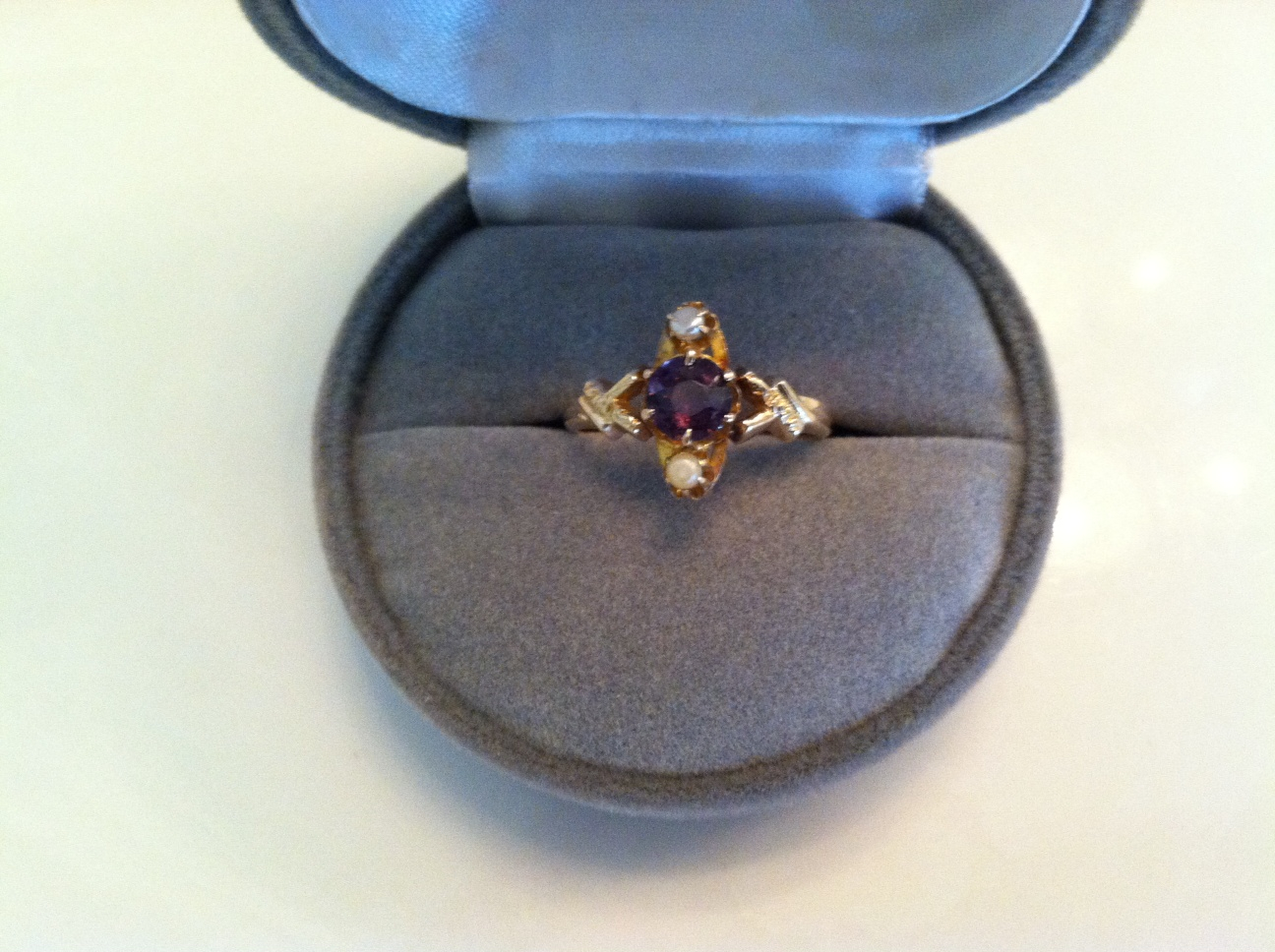
Grandma’s ring in her fancy years
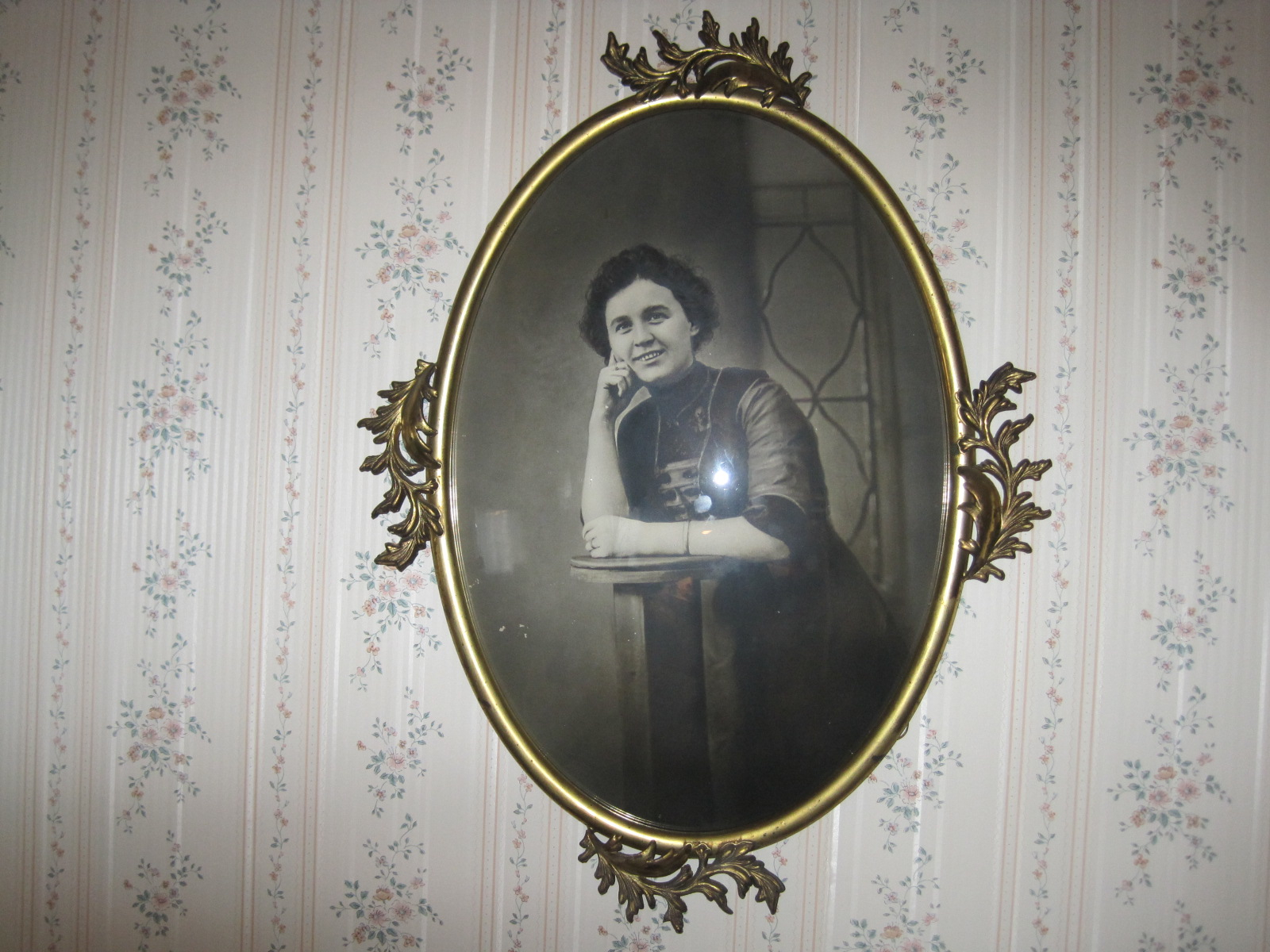
Before her marriage to Grandpa Henry, she was fancy, and wore all the regalia of a fashionable Victorian woman: hats with plumes, dresses with bustle and beadwork—and even a bracelet and RINGS! Now Janice gets Grandma’s opal engagement ring, Jean gets her larger amethyst ring, and I am bequeathed a lovely one with a smaller amethyst and four seed pearls. Well, I declare.
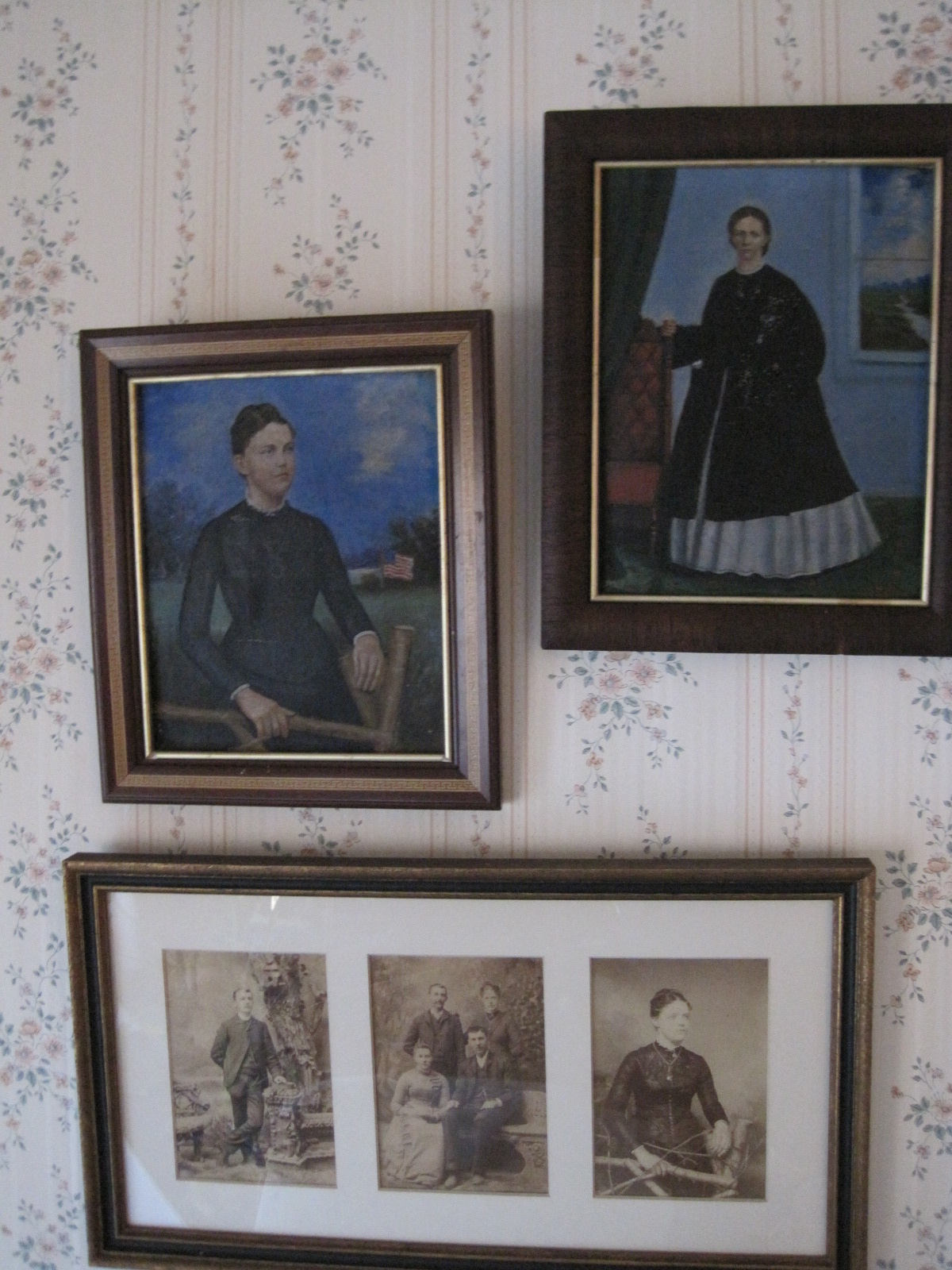
Grandma before her marriage to Mennonite Henry LongeneckerOil Paintings of Grandma Longenecker and Great Grandma Martin
And Gloves
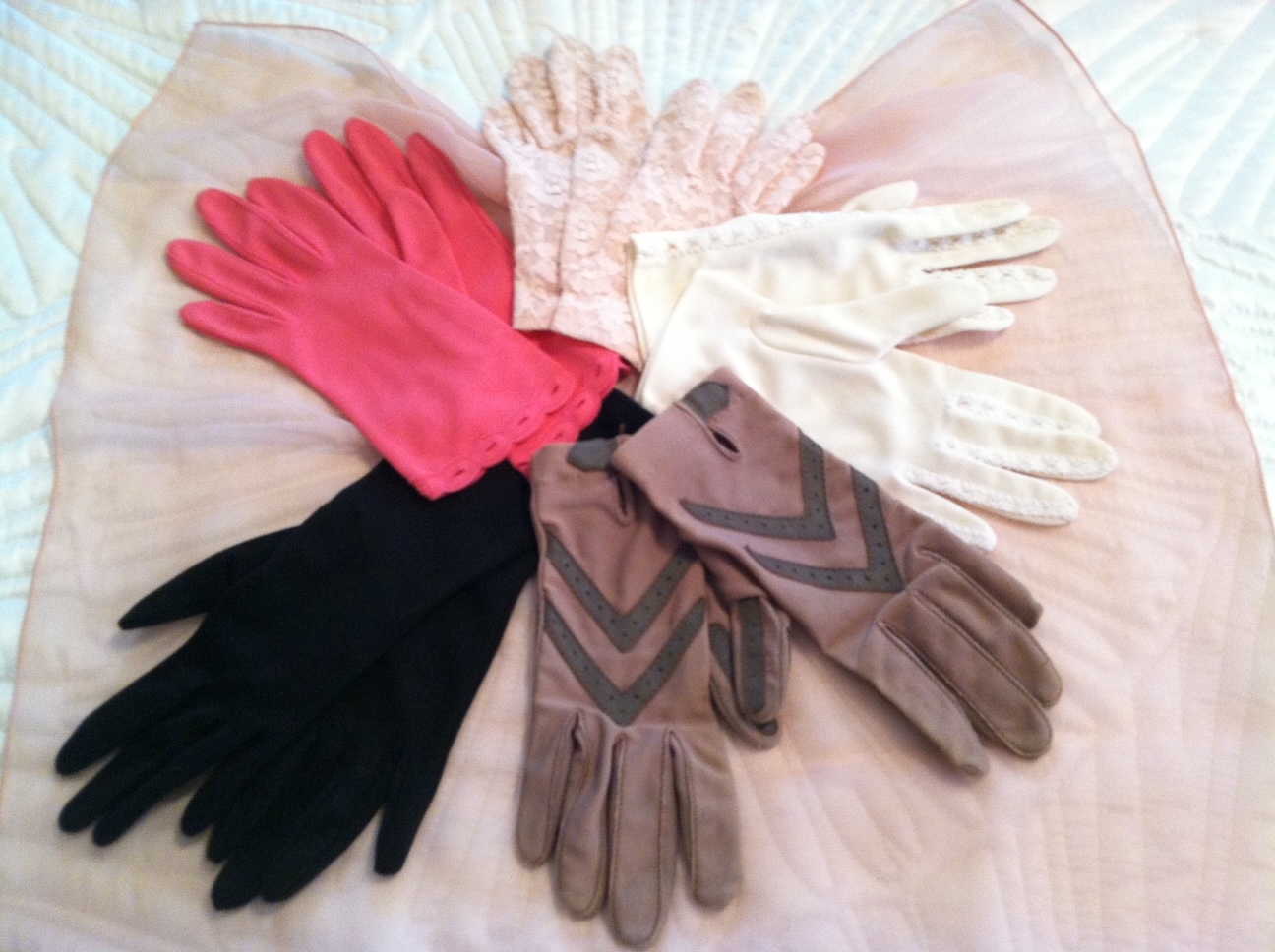
Nowadays casual Fridays last all week long, Presidential candidates have ditched the white shirt and tie to look cool, and ladies don’t wear gloves anymore except for warmth in the wintertime. No longer a fashion statement, women’s gloves appear as curiosities in the dressy section of antique shops or museums.
My collection of old gloves
In my collection of old gloves, the plain and fancy mingle. Guess which pair was worn by one of my attendants at our wedding. The choices are at 10:00 o’clock, 12:00 o’clock, and 3:00 o’clock.
Like this post? Follow my blog and get many more free of charge! Just type in your email address at the top of the page and click “subscribe!” WordPress keeps your email address private.
“Tie your head shut!” – An oft-heard admonition from my mother, my Aunt Ruthie, and Grandma Longenecker. Translation: If you tie your head shut, you won’t get sick with colds, sinus trouble, what not. And so our heads are tied shut with bonnets and bandannas and then adorned with the Mennonite prayer veiling. In other words, there is usually something besides my hair on top of my head or around my ears from babyhood on up.
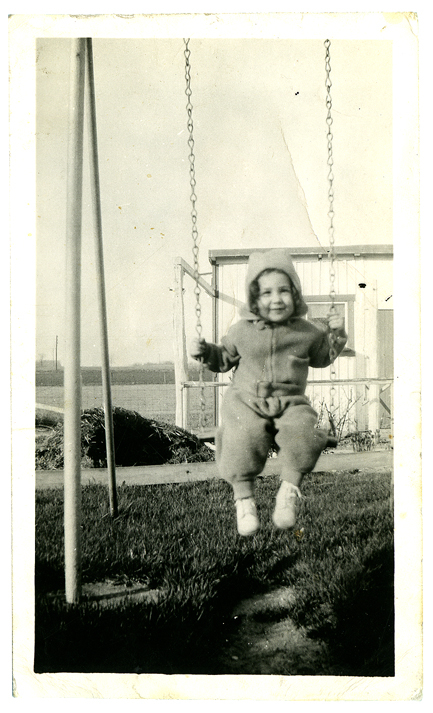
My photo at 10 months old features a machine-sewn miniature version of a bonnet that I remember my Grandma wearing in the garden.
On billboards we see the little blond girl advertising a fake way to get sun-tanned. “Don’t be a paleface,” she says. But we don’t need to buy Coppertone lotion to make our skins dark. We get our tans the honest way. Our skin turns brown naturally in the summer playing outside or working in the garden or tomato patch. To tell the truth, we depend on the sun-bonnet or the grace of God to not scorch our tough Swiss skins.
Bundled up in snowsuitAnother hat – on tricycle
More Bonnets & Bandannas @ Work
Like Mildred Armstrong Kalish in her must-read memoir Little Heathens depicting rural life in Iowa during the Depression, we in Pennsylvania Dutch land are not offended or shocked by four-letter words that are part of our daily life either: cook, bake, wash, iron, dust, pick tomatoes, sweet corn, beans, or sweet potatoes.
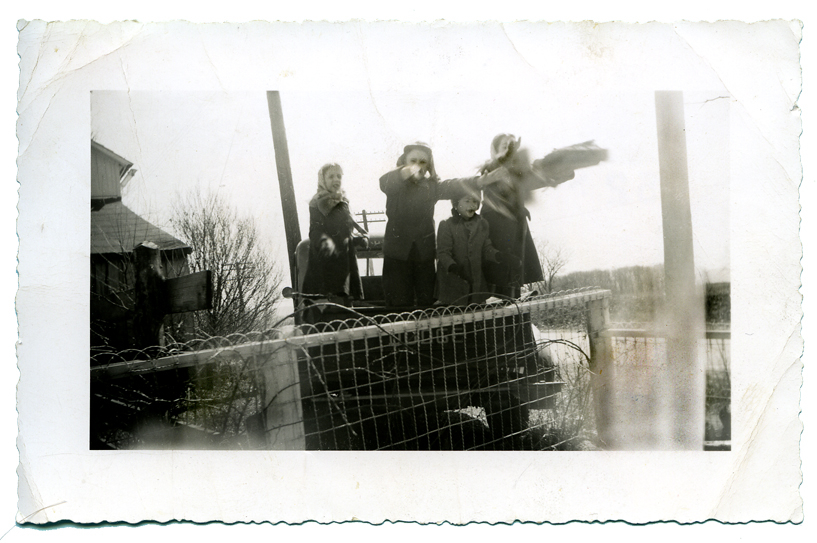
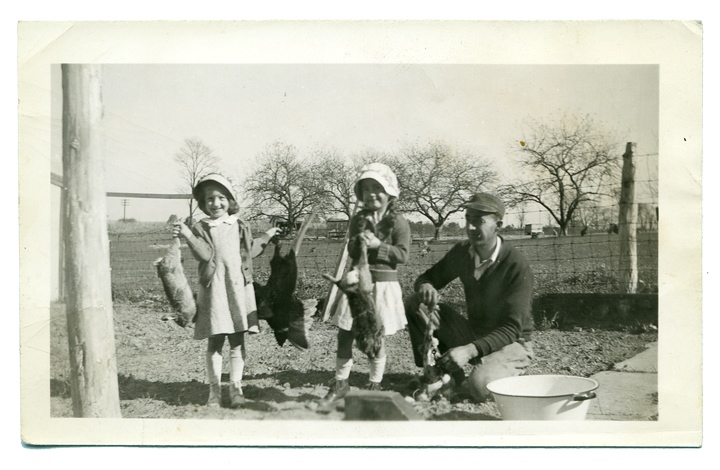
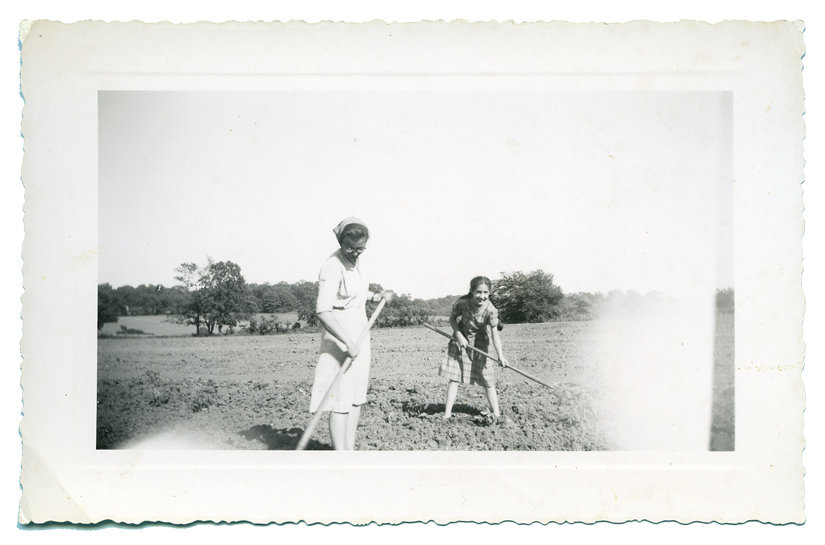
Sisters and I throwing wood for furnaceCousin Janet and I say, “Rabbit for dinner!”Aunt Ruthie with scarf and I hoeing in tomato field
WIth skirts and scarves we plant, hoe, and pick tomatoes in Bainbridge, PA. For details, see Tomato Girl, parts I and II.
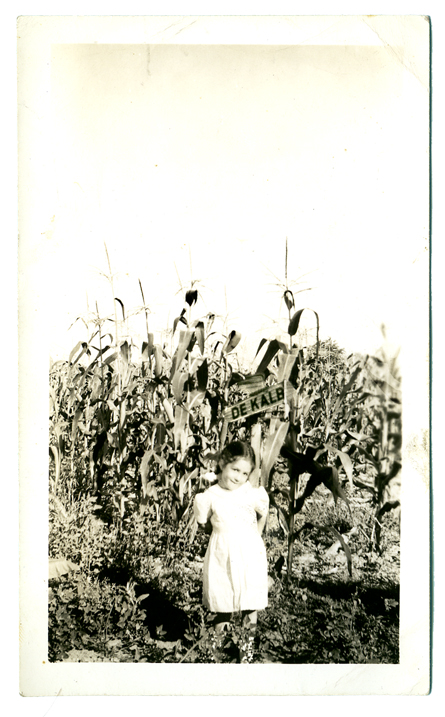
Proudly advertising DeKalb corn, no bonnet or bandanna
School and Sex Ed
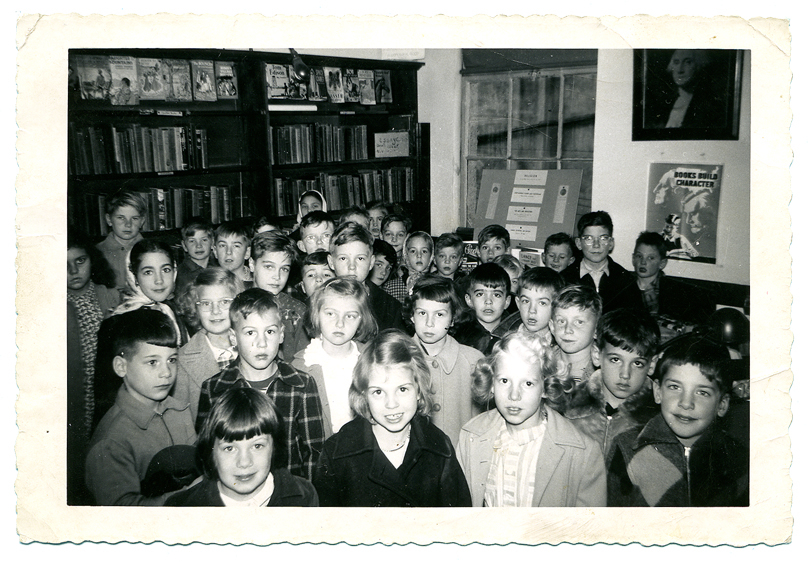
Surrounded by girls with curls visiting the Elizabethtown Library, I’m the one to the left with a floral bandanna, keeping my head tied shut, just like Mother expected.
My class at Elizabethtown Library
With all its books, this library is an impressive step up from the small bookcase at Rheems Elementary School. Yes, there is a library at Bossler Mennonite Church too, which is where I begin to get my sex education. In a blue and white book with a glossy, stiff cover, I discover that when a mommy and daddy “got very close” a baby was created. “Now what does “get very close” mean?” I wonder. Later I un-earth a book entitled Sane Sex Life with a red, black and white dust cover in my parents’ bedroom. Hidden in their wardrobe among sweaters, long-johns, and mothballs, this book adds a new dimension to my literary diet of Lippincott textbooks, church catechism, and storybooks. Whenever I think my mother won’t hear the sound of the wardrobe door open, I sneak a look at its realistic drawings (gasp!) and mind-boggling explanations, astonished that such a books exists.
Yes, I keep these strange revelations under my hat, bandanna, prayer veiling–whatever I am wearing on my head.
And Play
Picnicking with plain friends
Prayer coverings take no vacations. Because a woman is apt to pray any time or any place, the Church (Lancaster Mennonite Conference) ordains that we stay veiled morning, noon, and night.
What special outfits do you remember from your childhood or teen-age years?
The bees came the summer of 1964, the summer I turned fourteen and my life went spinning off into a whole new orbit, and I mean whole new orbit. Looking back on it now, I want to say the bees were sent to me. I want to say they showed up like the angel Gabriel appearing to the Virgin Mary, setting events in motion I could never have guessed. Sue Monk Kidd, The Secret Life of Bees pages 1, 2
If you’ve read Sue Monk Kidd’s novel, The Secret Life of Bees, you know that bees are a metaphor for the flight Lily Melissa Owens takes to escape a mother-less house (except for nanny Rosaleen) and the domination of an angry father to find a true family and home. In the process, she learns the truth of her mother’s past, finds a hive of new mothers, and discovers her own identity. In other words, she discovers her true self, the whole point of a good coming-of-age novel.
Substitute a different date and a different age, and you have my story with major variations. Unlike Lily, I had a caring family with a highly functioning Mother, but I lived the life of a Lancaster County Mennonite girl, separate from mainstream culture. I envisioned a more colorful life that would offer excitement and surprise. Thus, the bees in my bonnet (literally, a bonnet) propelled me to explore life beyond what I believed was the sheltered, nurturing, but confining, boundaries of my Mennonite upbringing. “What would happen if I sampled the honey from a different hive?” I wondered.
No, I didn’t have a jar of bees on my dresser like Lily, but I did recognize an inner voice saying to me, “Marian, your jar is open.” And off I buzzed to a different state, a changed outward appearance, and eventually a new name.
In the process, I landed in another city (Charlotte, NC) in a house with two young women, who, like Lily’s three Boatwright sisters in the Pink House, groomed me for a different life. A life with bright colors, loose hair, fancy dresses but not jarring me away from deeply held values.
Like Lily Melissa Owens, I have sampled the honey of good experience along with the vinegar of trials. Of course, I like the honey better. Here are some life secrets from the “. . . Life of Bees.”
1. IT’S BETTER TO BE SWEET THAN SOUR!
“We lived for honey. We swallowed a spoonful in the morning to wake us up and one at night to put us to sleep. We took it with every meal to calm the mind, give us stamina, and prevent fatal disease. We swabbed ourselves in it to disinfect cuts or heal chapped lips. It went in our baths, our skin cream, our raspberry tea and biscuits. Nothing was safe from honey. . . . [It] was the ambrosia of the gods and the shampoo of the goddesses.” (84)
August [Boatwright] said beeswax “could make your fishing line float, your button thread stronger, your furniture shinier, your stuck window glide, and your irritated skin glow like a baby’s bottom. Beeswax was a miracle cure for everything.” (84)
2. OBSERVE ETIQUETTE.
What works in the bee yard works in the world. “Don’t be afraid, as no life-loving bee wants to sting you. Still, don’t be an idiot: wear long sleeves and long pants. Don’t swat . . . . If you feel angry, whistle. Anger agitates, while whistling melts a bees’s temper. Act like you know what you’re doing, even if you don’t. Above all, send the bees love. Every little thing wants to be loved.” (92)
3. USE YOUR SMARTS.
“People don’t realize how smart bees are, even smarter than dolphins. Bees know enough geometry to make row after row of perfect hexagons, angles so accurate you’d think they used rulers. They take plain flower juice and turn it into something everyone in the world loves to pour on biscuits.” (137)
4. NOTICE THAT OTHERS ALSO HAVE IMPORTANT ROLES TO PLAY; YOU’RE NOT ALWAYS THE QUEEN BEE! In the bee kingdom there are nest-builders, field bees with good navigation skills to gather nectar and pollen, nurse bees, and mortician bees. At the extreme ends: drones and, oh, yes, the Queen Bee with her attendants. (148-149)
5. COMMUNICATE!
“The whole fabric of honey bee society depends on communication—on an innate ability to send and receive messages, to encode and decode information.” Gould, James L. and Carol Grant Gould. The Honey Bee, quoted in The Secret Life of Bees (165)
6. YOU ARE CAPABLE OF MORE THAN YOU THINK.
The worker bee is just over a centimeter long and weighs only about sixty milligrams; nevertheless, she can fly with a load heavier than herself. Gould, James L. and Carol Grant Gould.The Honey Bee, quoted in The Secret Life of Bees, (256)
7. ENJOY BREATH-TAKING BEAUTY!
According to August, if you’ve never seen a cluster of beehives first thing in the morning, you’ve missed the eighth wonder of the world. Picture these white bees tucked under pine tees. The sun will slant through the branches, shining in the sprinkles of dew drying on the lids. There will be a few hundred bees doing laps around the hive boxes, just warming up, but mostly taking their bathroom break, as bees are so clean they will not soil the inside of their hives. From the distance it will look like a big painting . . . in a museum, but museums can’t capture the sound. Fifty feet away you will hear it, a humming that sounds like it came from a different planet. At thirty feet your skin will start to vibrate. The hair will lift on your neck. Your head will say, Don’t go any farther, but your heart will send you straight into the hum, where you will be swallowed by it. You will stand there and think, I am in the center of the universe, where everything is sung to life. (286)
The whole family crams into the gray 1951 Studebaker: Our family of five, Daddy, Mommy, Janice Jean and I (Mark isn’t born yet), Aunt Ruthie and Grandma–seven stuffed into an airplane cockpit, it feels like. We don’t take two cars because we are frugal. It saves gas if we all go together.
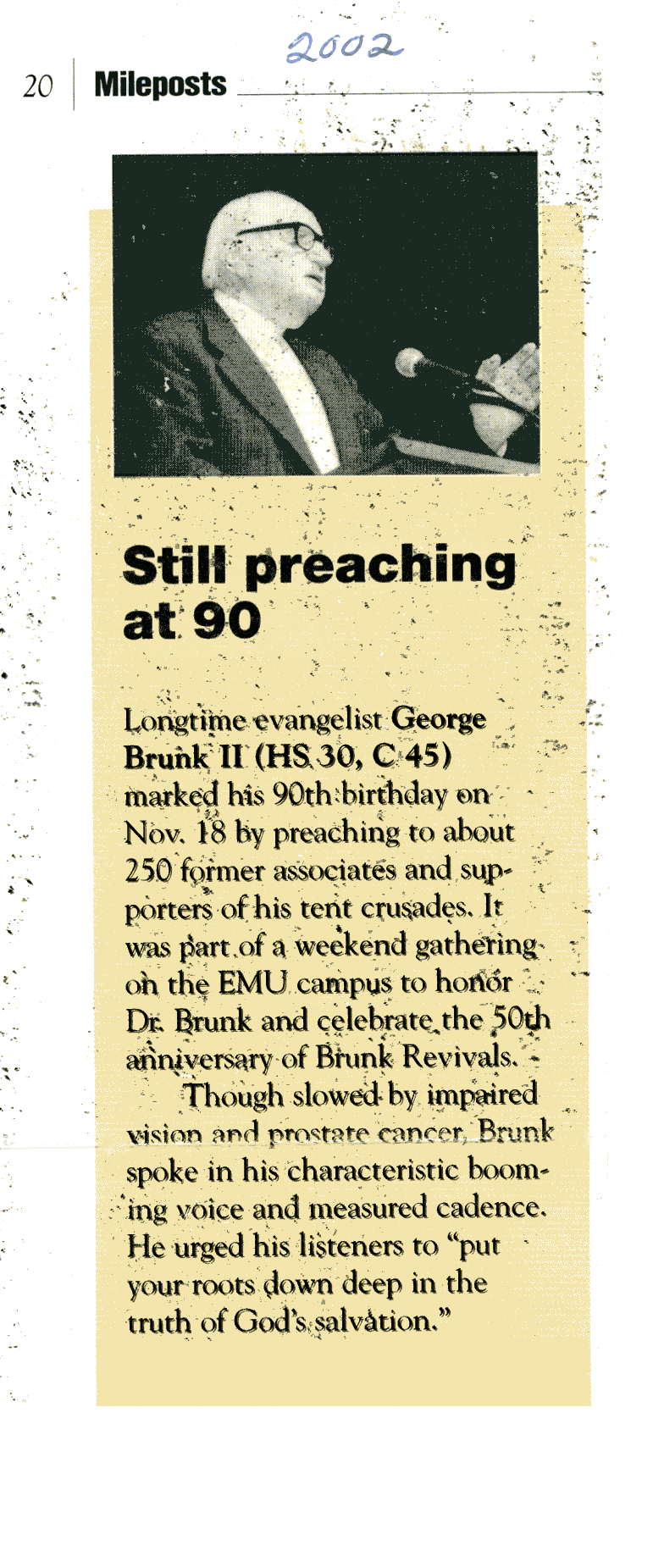
Tonight is the first night of the Brunk Tent Revival. Two brothers, George, the evangelist, and Lawrence, the song-leader, have brought a huge, unstriped tent all the way from Virginia in a tractor-trailer truck. As we approach the tent, I think we’re going to a circus except that there are pine plank benches crunched down on sawdust and spiral-bound, red, white, and powder blue songbooks on the seats. The crowd, of course, doesn’t look like circus-goers. They are polite, plain people, some pious-acting, but others even laughing. I notice the pig-tailed girls I play with when we have a “bunch” over for Sunday dinner: there are the Garber sisters, the Oberholtzers, the Brubakers, and Kraybills. We exchange shy smiles and find seats by families.
Since I was six weeks old, I have been taken to Bosslers’ Mennonite Church way out in the country where roads run at right angles according to each farmer’s acreage. In the corner of a white hanky, my mother always ties a shiny copper penny that I put into the little metal pig in my Sunday School class when we say, “Dropping, dropping, dropping, drop-ping, hear the pennies fall, every one for Jesus, He will take them all.” I like the pictures of Jacob and the Ladder of Angels or Joseph and his Coat of Many Colors I paste into my lesson book. We gather in the meetinghouse for sermons amply illustrated with biblical quotes from our pastor, Martin Kraybill. He is intent on inscribing our mental tapes with scriptural quotations. I am just beginning to join in with the four-part harmony I hear, blending with the sopranos and altos from the women’s side, and the tenors and basses on the men’s side of the aisle: I like the way the basses move up the scale to join the tenors in the hymn “More Holiness GIve Me” and the way the sopranos and altos get to sing two bars of music without the bass clef in “O Worship the Lord.”
Tonight at the revival service we also sing a cappella, keeping pace with the song-leader’s energetic gestures. Then Brother Brunk comes to the lectern, a hefty Bible in one hand. He starts off with a joke or silly comment, which my Grandpa Metzler criticizes with the comment, “He even makes the people laugh!” He then preaches about our guilt because of sin and God’s loving plan to save us through his Son Jesus. His words pierce my consciousness, and a sense of need fills my heart. I can visualize Jesus standing before me with outstretched arms.
Will you receive Jesus into your heart and have Him cleanse you of your sin tonight? Now is the day of salvation. Come to Jesus now!”
The invitation for people to come forward sounds like an appeal directed only to me. I begin to cry softly, tears falling onto the lap of my lavender and white dotted Swiss dress, hoping someone will pay attention and tell me what to do next. I cry louder and notice my parents discussing what to do with Marian. Daddy walks with me down the aisle and ushers me into a “prayer room,” a miniature tent off to the side. There I meet kind Anna Ruth Breneman who shows me more Bible verses and prays short phrases that I repeat, asking Jesus to come into my heart, take away all my sin and fill me with new life. I feel cleansed, happy, relieved.
There is another step in the process. Next, I am led to a platform where I as a nine-year-old make my first public speech, a testimony of four simple words: “I’m glad I’m saved.” Aunt Ruthie meets me after the benediction and gives me a kiss on the cheek, which takes me by surprise. She has never before shown much affection. Apparently she approves of my decision.
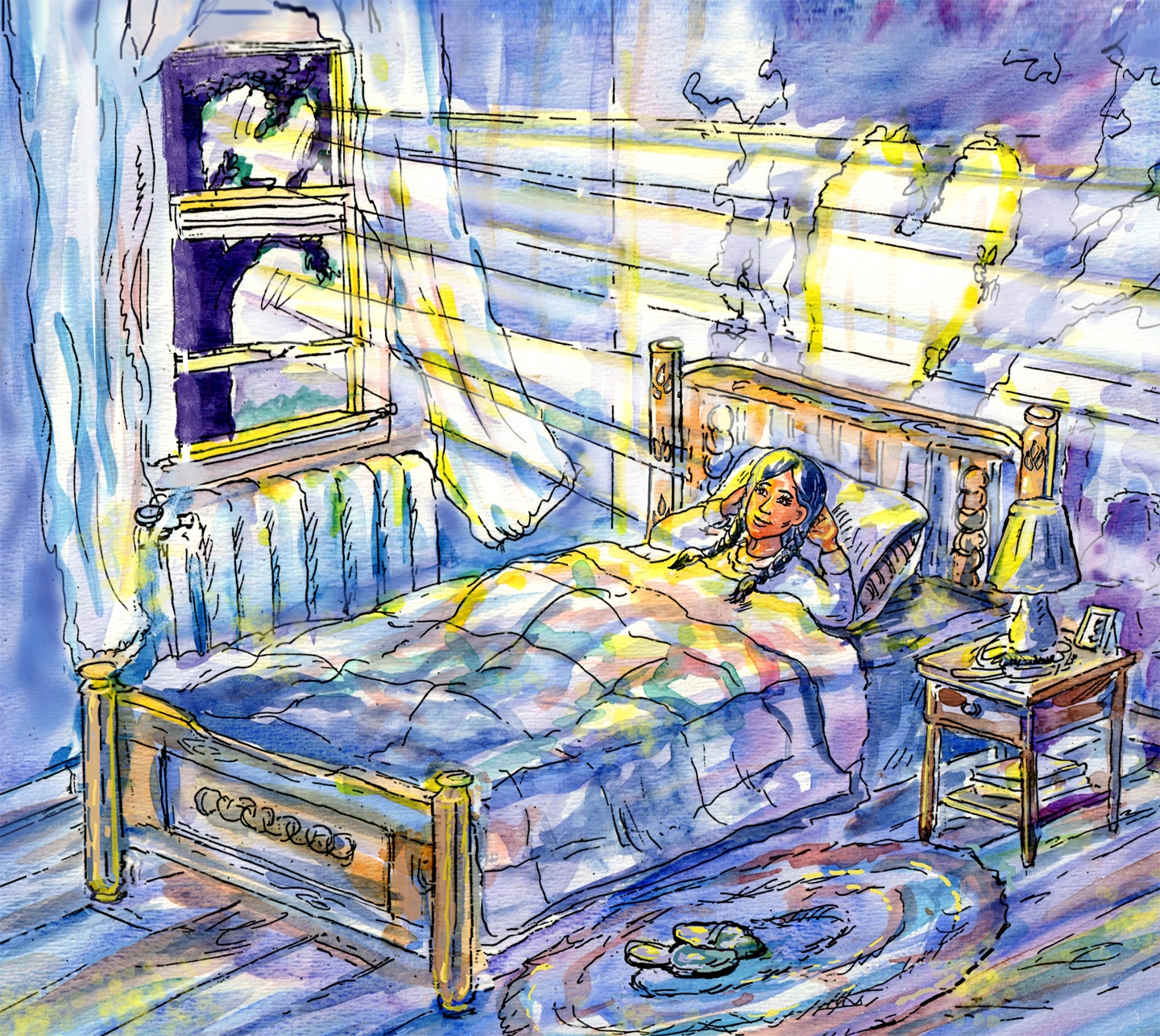
On the way home, I sit on the back seat next to the window and look up at the clear, starry sky and full harvest moon. I feel euphoric. Later on, I go to bed and see that same moon casting a shaft of pure radiance in through the window-panes, bathing the oak headboard with mellow light. It traces the interlocking circular patterns punctuated by an upright sprig of laurel on each bedpost. Silent night, holy night, all is calm, all is bright with the shaft of light that has penetrated the panes of glass magnifying the joy in my heart.
Years later, I learn that the proper word for this moment is epiphany, a manifestation of divinity in the life of a simple, trusting, Mennonite girl.
The Martin clan gathers together for large family meals at my Grandma Longenecker’s house because Grandma, the oldest in her family, is a wonderful cook and has an enormous kitchen. Everybody likes Grandma, my dad’s mother. Grandma Fannie was a Martin and the Martins are Brinsers, formerly a part of a plain sect called the “River Brethren.” Source
They are not nearly as plain as my mother’s side of the family, except for Great Uncle Joe’s wife Bertha whose covering is cut squarish. Bertha and Joe have two daughters, Honey and Mary. I press my nose to the window anticipating their arrival. They look like peacocks, favoring vivid purples, blues and greens. And always with a floaty fabric like silk, crepe, or challis. I’m determined to be a fancy girl like them someday.
Aunt Ruthie with fancy Mary Martin Landis and husband
Just as important, though, is what they talk about around the table and afterwards: Politics! And with a pipe. After dinner, cousin Sammy and I will play our little game with Uncle Joe and whoever he’s talking to. We know that Uncle Joe nearly burns his fingers with a lighted match as he talks about the world going up in smoke. In our little game, we try to hold our breath without passing out while he lights the match, tamps down the tobacco, ignites it, and blows out the match. Sammy and I are perched on the stairs behind the mahogany banister to watch today’s performance. Right now below us Uncle Joe is talking to my Dad about old Joe Sta-leen, the Russian Premier.
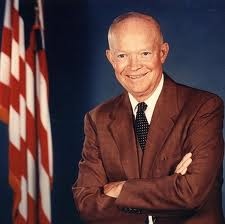
Striking the match, Uncle Joe exclaims to my dad, “Ya know, Ray, I felt a little uneasy when Truman and the Democrats were in the White House, but now that Eisenhower has taken over, things are looking better for us.” Sammy and I both take a deep breath and try to hang on for the duration.
“Eisenhower is a good, old Pennsylvania Dutchman,” my dad says. “Did you know his mother was a Mennonite from Gettysburg?”
The match between Joe’s thumb and index finger is half-burned, and he has made no effort to light his pipe yet. “Jah,” says Uncle Joe, “That’s what they tell me. We can’t trust those Russians. They’d just as soon bomb us as . . . .” On and on he goes, but he’s edged the match close enough to the pipe tobacco to blow his breath in and out a couple of times. Sammy’s face is starting to look like a red balloon and I nearly start to giggle. If we can just hang on for a few more seconds, . . . our cheeks puff out more and more with unexpelled air.
The match is charred to the absolute edge of Uncle Joe’s fingertips. Any second now he’ll singe his fingers. I hear the slow ticking of the grandfather clock in the corner, adding suspense. With one more deep inhalation, though Joe sucks in, touches the match light to the fragrant tobacco mix, blows out the fire, and a swirl of blue smoke entwines my dad and Uncle Joe in their version of politics.
With one second to go, danger is averted, and Sammy and I catch another deep breath, so we can take turns sliding down the banister again.
In spite of their fervor, my elders believed a myth: Eisenhower’s mother was actually not a Mennonite. Yes, she had Mennonite (River Brethren) ancestry, but she herself was a Jehovah’s Witness. Source
And further, their stance as Anabaptists and pacifists was politically ironic: the President they so avidly supported was a military man, a 5-star general to boot, so opposed to the attitude of non-resistance my people embraced.
A few years later, some of the rich farmland of northern Lancaster County was threatened by a proposed air base. A delegation of plain people including my dad, Grandma, and Uncle Joe, dressed up and drove to Washington D.C. to make their case with government officials.
Sadie Greider, Grandma, and Daddy
In the end, further investigation found that there were sinkholes (sinkholes!) on the farm land, making it unsatisfactory as a site for a military air base. The land spared, they thanked God Almighty.
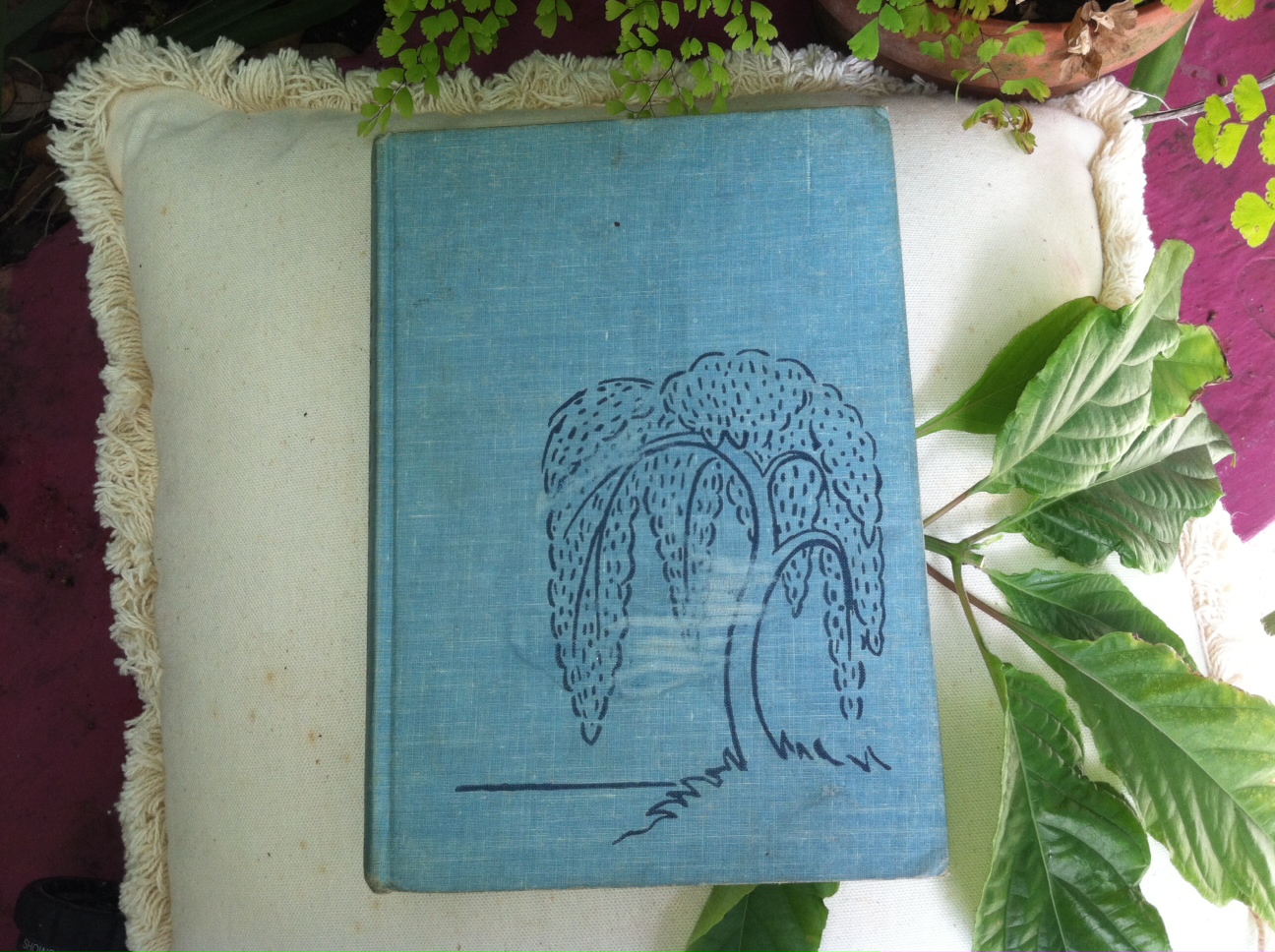
When Mom says “sca-doo!” at home, we know we can find amusement at Grandma’s house. Aside from the mysteries of the woods behind her house, other attractions include a slope where lilies of the valley blossom in April. A chicken house big enough to actually play house in. An out-house equipped with a Sears & Roebuck catalog for wiping, its little roof-top smothered by lilac bushes–wonderful air freshener! And a willow tree. We love that willow tree by a trickling brook where we play Bride, with a cast-off piece of netting like my mother, aunts, and grandmas use for prayer veilings.
At ten, I’m the oldest, so I direct my sisters at first. “Jeanie, go to the chicken house for the veil.” There are no chickens in Grandma’s chicken-house anymore, just a bunch of crates and wooden boards we use other times for make-believe. Jean goes off to retrieve the big square of white netting in its hiding place inside the door in a crate on the right. “Janice, let’s find some flowers for the bouquet.” Off we go in different directions, and Janice comes back with dandelion blossoms, and I find some irises.
Blue Willow book from parents early 1950s
We meet back at the willow tree, its arching fronds our sanctuary for many a glorious wedding. We need a bell ringer, a bride and a groom. Before I can get a word in edgewise, Jean pipes up, “Let me be the bride this time; I wanna be the bride, pleeease.” Well, I guess we can give in this time. Then Janice and I dicker for who plays groom and who rings the bell. Next, we have to get the bride ready.
Janice places the netting on Jean’s head just so, and I pull her pigtails up behind her ears and use the light brown braids to tie the veil securely to the top of her head. Now, we’re all set: Groom Janice loops one arm around Jean’s, and I rush over to the longest willow branch I can find and pull on its thin, sinewy length until the wedding bell chimes overhead, and then we all, including the bride, sing together in warbly voice: “Here comes the briiide, please step asiiide.” It’s a magical moment. A breeze blows gently through the willow branches and fans the bouquet of purple and gold. But before the bride has a chance to whisper, “I do,” we hear Daddy’s truck drive in the lane. He’s come to pick us up and bring home a big kettle of saffron-flavored pot pie from his mom’s stove for our supper at home on top of the hill.
There are no crystal balls to visualize our own weddings in the future, but we are careful not to duplicate color choices for our attendants. Jean starts with blue, Marian with pink, and Janice has yellow, a pleasing bouquet of hues. But our veils are white.
Thumbnail: Home is on Anchor Road, connecting our house to Grandma’s house and neighbors in between. The story continues . . .
. . . . As we drive from Grandma’s past the Hoffers, I notice off to the right the weathered frame house of Mr. Heisey, who contentedly makes and fixes clocks. Then come our next-door neighbors, the Mummas, who have just opened the Clearview, a home-style diner on Route # 230, which parallels our road. Their old Lincoln Continental bobs in and out of their driveway early and late. Owning a restaurant is slavery in more ways than one, Mom says. Our mother likes Edna Mumma, who like Mom has a brood of kids to worry over.
Before the restaurant took over all of her time, Mom used to enjoy Edna’s Spencer parties (like Tupperware, but with metal stays and elastic, not plastic), specializing in heavy-duty corsets for well-fed Lancaster County bodies.
Sometimes Edna calls up my mom and asks her to help out on chicken “dressing” days. Together they kill the chickens, pluck their feathers and chop them up into separate pieces for cooking. I can hear one half of their conversation on the phone:
“Sure, I’d be glad to help . . . just say when.”
“No, I don’t want anything for it. Remember, you gave us 4 or 5 pullets the last time I helped. . . . “
“You daresn’t look on turns like that. . . .”
“Okay. I’ll be over as soon as I’m done making applesauce.” Working together, they often dress thirty or forty chickens at one time.
Lancaster County farm women are always busy. Why, the day before my sister Janice was born Mom was dressing chickens. Before Jean was born, she was canning peaches, and before I was born at home, she was hoeing tobacco.
A mixture of gravel and grass connects our house to the Mummas, only a 1/2 mile from Grandma’s. Out in front of our white frame and green-shuttered house, there are two leafy maple trees and a forsythia bush, which puts out spiky, yellow blooms in April. Until we get too heavy, my sisters and I can climb all over the red Japanese maple beside the house. Our porch, flanked by four evenly spaced posts, sports two painted metal chairs in the summertime and a swing from where we can count cars on a Saturday afternoon or hope for Uncles Landis, Leroy, Clyde, Abe or Aunt Verna and our cousins to visit on Sundays after church.
The Rentzels live next door and on the corner the Gromolls, whose clothing is two degrees plainer than ours. I believe they’re black bumpers, an ultra-conservative branch of Mennonites, who paint their bumpers black to avoid showing off shiny chrome. A small street separates their house from Wolgemuth’s Tavern, where we surmise Betty Rentzel finds some of her clients, lured by the glowing red porch light. Daddy calls the tavern a beer joint. Every so often he has to rescue a drunken driver from the wreckage of a car that doesn’t steer well enough to stay on the road in front of our house. One Saturday night it was Charlie Oberholtzer, who still can’t look Dad in the eye.
Rounding off our neighborhood is a huge, grey farmhouse, sheltering two families: cheery, loud-spoken Eva Gebhardt and the Hilsher family with a gang of boys who feed the pigs, cows, and chickens on the farm and help their dad plant corn in the acreage across the road from our house.
Strange neighbors are not unusual. What interesting neighbors do you recall from your childhood?
“Keep your hand upon the throttle and your eye upon the rail,” my Dad sings in his top-of–the-lungs baritone, the volume of his voice amplified by the force of his hands on the keyboard. Every Saturday night Daddy sits down at our mahogany Marshall and Wendell upright piano in the living room and reviews songs in his repertoire. Fresh air is blowing through the open windows. Probably the whole neighborhood can hear.
Now he’s moved on to other tunes: “Turn Your Radio On” and “On the Jericho Road, on the Jericho Road, there’s for just two—no more and no less, no more and no less, just Jesus and you, just Jesus and yooooo. . . .”
I’m in the dining room studying my ninth-grade Pennsylvania history. “Marian come in here and sing a little,” he begs.
“Oh maybe after a while,” I half-promise and flee to the kitchen where my mother is standing over the stove, making salmon casserole to put in the oven while we are at church tomorrow. Even washing gooey dishes looks more appealing to me than competing with my dad’s loud volume and heavy-handedness. He attacks the piano keys like he’s hammering a bent piece of metal at his shop.
Now Janice is walking in the door, and Dad pleads, “Come on, just sing the second verse.” He wants her to join him on the long piano bench that holds piles of family photos bulging from the compartment under its lid. She sits down with him for a little bit, and I hear a soprano with a lot of tremolo join in with Daddy’s lower notes on another song: “Under His wings, under His wings, Who from His love can se-ver? Under His wings my soul shall abide, Safely abide for-e-ver.”
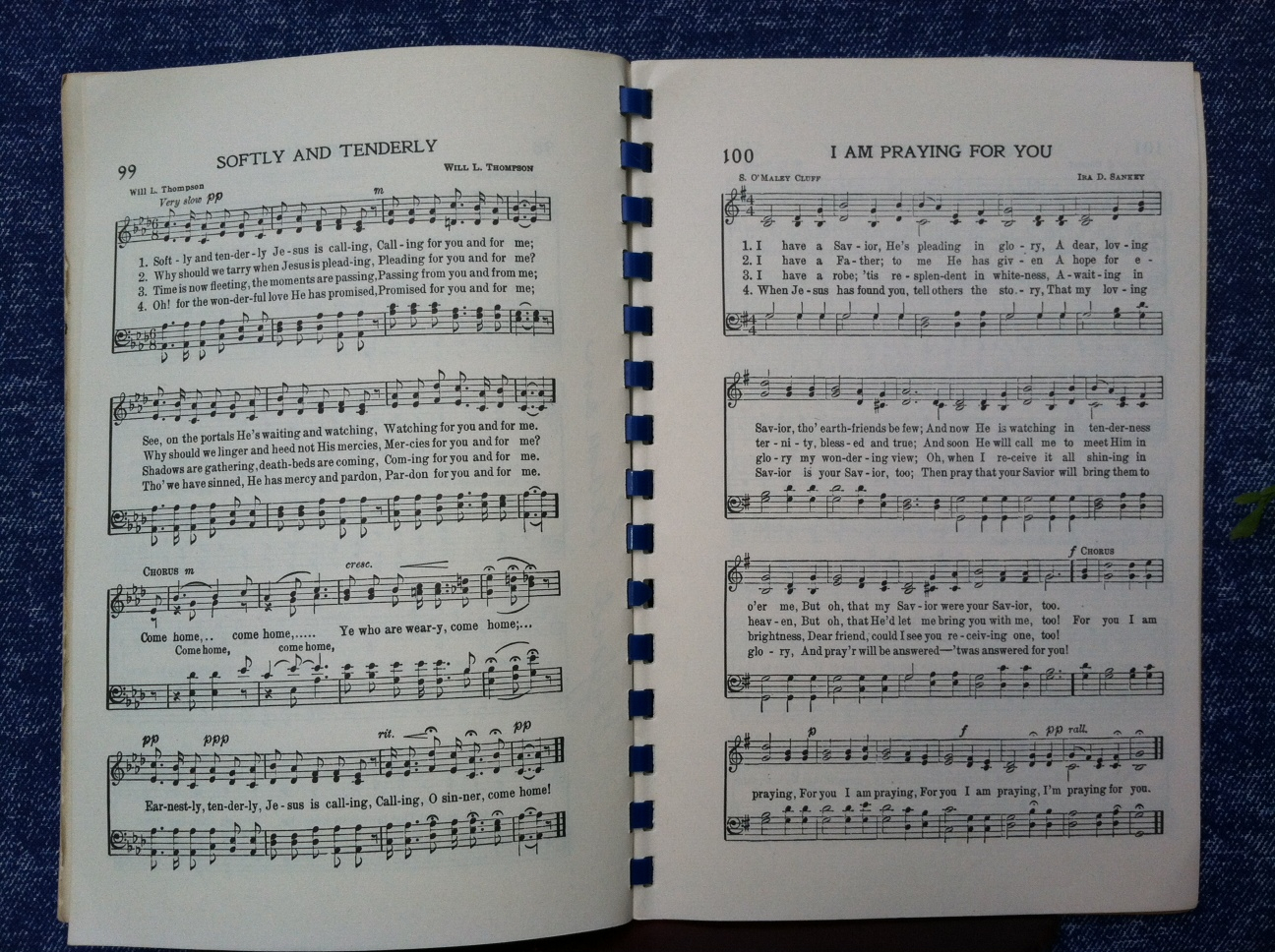
There’s still another sister, and when Janice moves off the bench, Jean keeps the bench warm and Daddy happily singing “Softly and Tenderly Jesus is Calling.”
Now Daddy has moved away from the piano, gotten out his shiny Gibson guitar and starts yodeling. My sisters and I think he is acting goofy: “Yodel-ay-ee-oo, yodel-ay-ee-ooo,” he bellows out joyfully as he strikes the strings of his guitar.
In spite of his noisy outbursts, I like the silky red cord attached to the instrument with its sunburst design veneer and the variety of colorful picks he’s accumulated. They remind me of funny-shaped tiddly-winks. Dad sure does like music. I don’t think he’d object to a piano at our church, which deems “it improper to employ instrumental music in worship and church activities.” (Article III, Section 2, Public Worship)
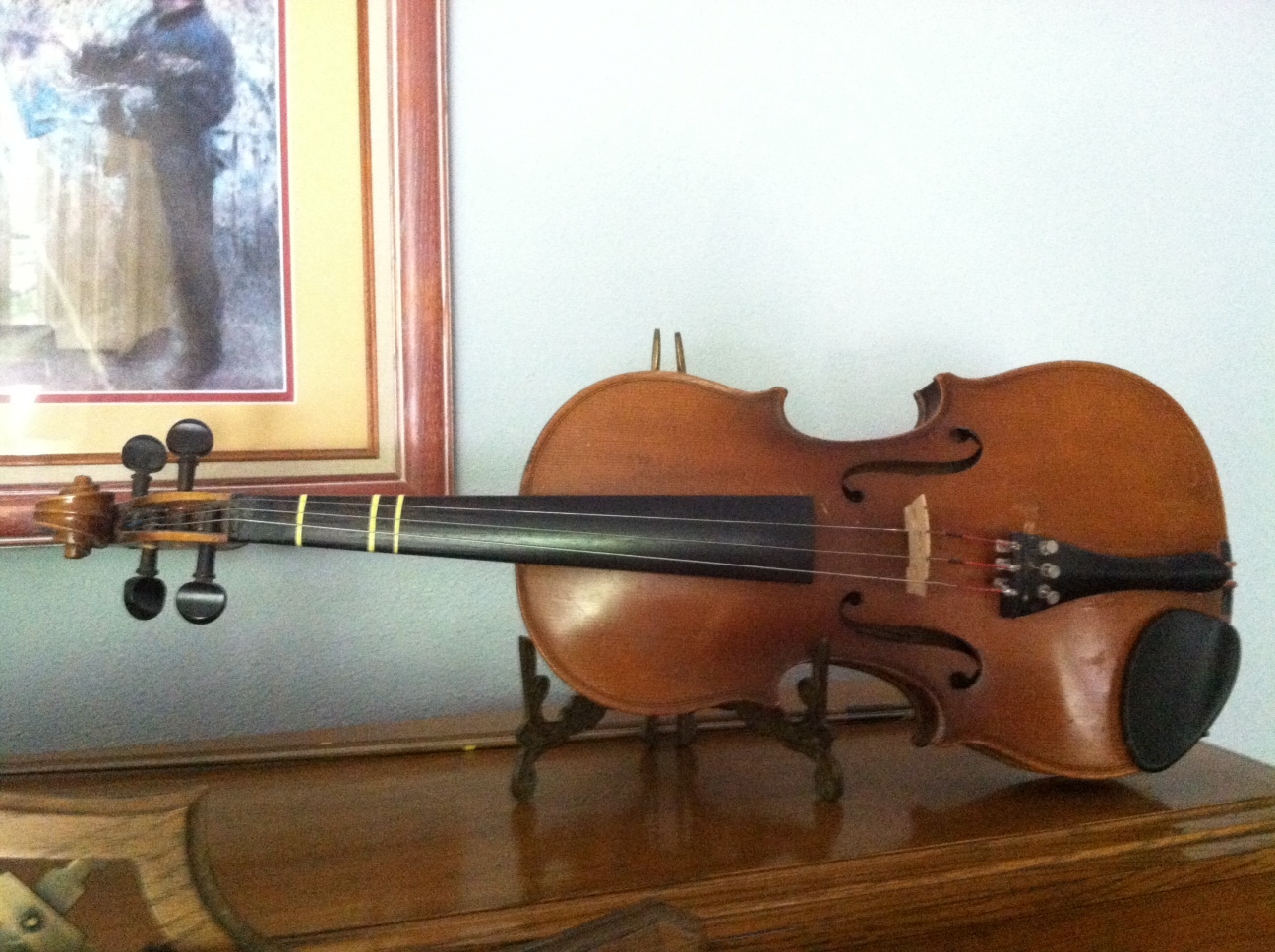
Last year at the beginning of eighth grade, Daddy came home and out of a clear blue sky presented me with a violin case. Looking as pleased as punch, he put the faux-leather textured black case on the dining room table, gesturing for me to open it.
“It’s for me?” I look puzzled but start to fiddle with the metal clasps on the case.
“What do you mean, is it for you? Of course, it’s for you. Why do ya think I put it here in front of you. I paid only $ 70.00 for it. Noah Klaus, up at the music store wanted more, but I told him that was my best offer. I wasn’t gonna let him horns-waggle me.”
Slowly I open the lid and see a gorgeous violin inside, a caramel-colored wooden instrument, its curvy shape tapering to a fancy scroll. I peer inside the S-shaped openings and see a paper tag with the label: Copy of Antonius Stradivarius / Handarbeit / Garmisch bei Mittenwald – Made in Germany.
“Now I want you to take lessons, so you can be in the orchestra at school. You play the piano pretty good. I don’t imagine a violin would be a whole lot harder.”
“Well, . . I don’t know about that,” I hear my voice trailing off.
I wonder why Daddy kept these plans and dreams for me to himself. I would have liked to go with him to the music store and have seen the other choices. Why does he always leave me out of decisions like this? He makes choices for me just like he plays the piano, loud and heavy-handed. Yet he seems so pleased with his purchase; I’m sure he imagines that I’m just as thrilled. Anyway, I start taking lessons from Mrs. Santeusanio.
True to his inclination, mechanical themes ran through much of my Dad’s repertoire, songs of railroads, highways, and ships (Let the Lower Lights Be Burning). Why even the radio he sang about is a mechanism.
My musical preferences are more eclectic and include classical, pop and contemporary. Yet, I see that however clumsy his efforts, Daddy was transmitting to me his love for music. Often a melody or song floats through my head as easily as my Dad’s music did out our living room window. You might say the sound of music has masked some of my Dad’s missteps as a parent. For that I am thankful.
Statement of Christian Doctrine and Rules and Discipline of the Lancaster Conference of the Mennonite Church, 1968.
What interests or hobbies did a parent or close relative instill in your life? Was your experience a positive or negative one? Tell us about it.


















 Plain and Fancy