Neat vs. Messy

                              Delight in Disorder

A sweet disorder in the dress

Kindles in clothes a wantonness.

A lawn about the shoulders thrown

Into a fine distraction;

An erring lace, which here and there

Enthralls the crimson stomacher;

A cuff neglectful, and thereby

Ribbons to flow confusedly;

A winning wave, deserving note,

In the tempestuous petticoat;

A careless shoestring, in whose tie

I see a wild civility;

Do more bewitch me than when art

Is too precise in every part.

The British poet Robert Herrick writes a fine sonnet about the allure of the slightly askew, the saucy, the off-beat–the messy in dress! Well, he has a point, but I don’t agree in general. I like neatness and appreciate the beauty of orderliness.

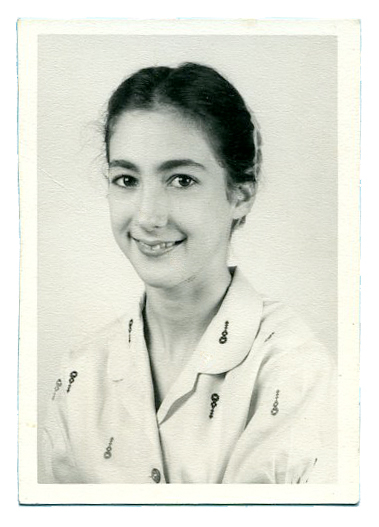
Too precise hand-writing Hanger, EMC college days
Too precise hand-writing
clothes hanger, college days EMC

Mother was a neatnik too, every hair in place under her prayer covering, the whole house scrubbed clean every Friday, a place for everything and everything in its place. On the other hand, my dad, who was precise in the mechanics of fixing machinery in his farm supply business, was by nature messy, messy, messy–in his office, inside his truck, on the porch of his shop.
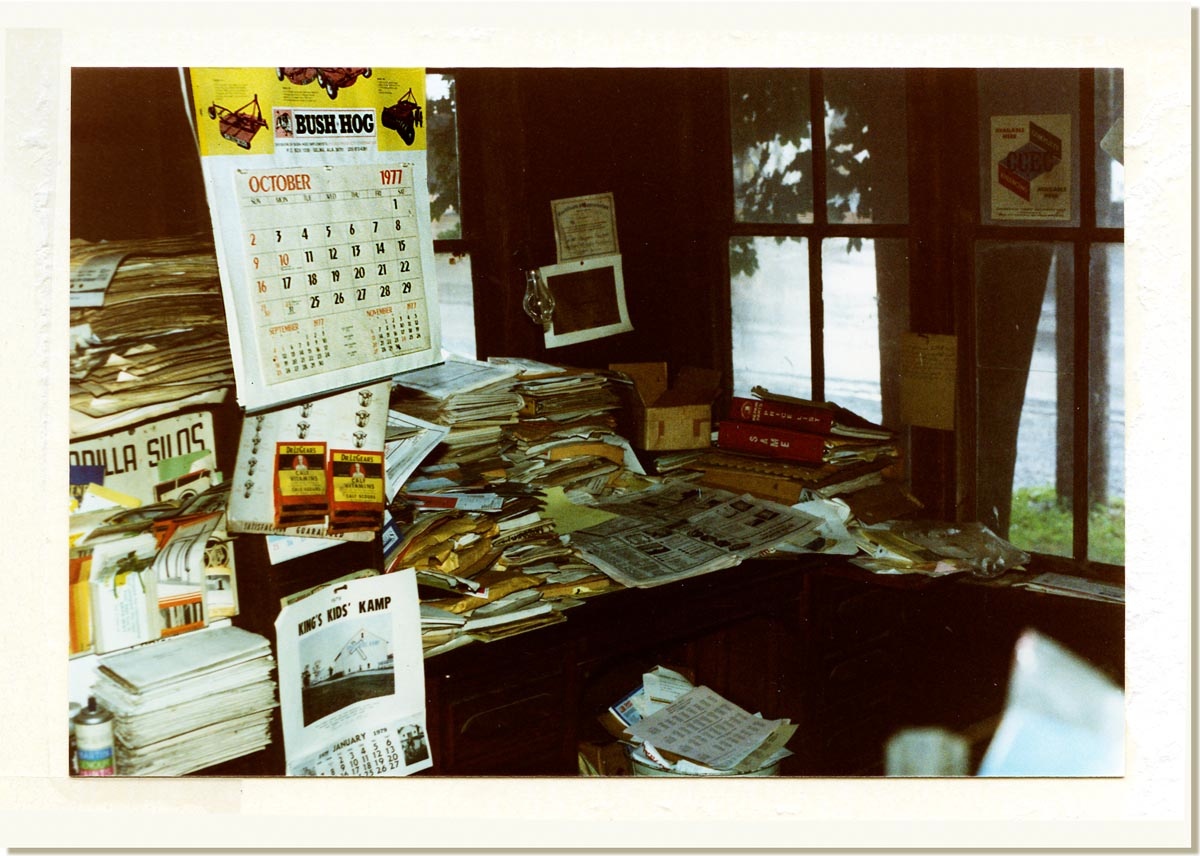
Dad's Office

Brother Mark before sale of business

Daddy’s messy manner drove me crazy. Besides, it was embarrassing! In the middle of the village of Rheems, the shop faced Harrisburg Avenue with two main sections, one behind the other. The front part housed dozens of storage bins for nuts, bolts, screws, odd implements and, curiously, a Victrola sitting squat right beside the door to the sales office. During planting season, bags of Royster fertilizer for sale would be deposited off to the side near a loading/unloading door. As you walked to the rear, a long wooden ramp led to the back section where the dirty work was done, Daddy and his helpers fixing disk harrows, plows, or welding broken parts. Behind the shop was an assortment of implements stored Sanford & Son-style from which the mechanics harvested parts.

Occasionally, when Daddy said, “It’s time to sweep the shop,” I shuddered because I would be working in the cold with piles of stuff everywhere. Spritzing soapy water from a bucket to settle the dust, I watched charcoal-grey pustules of dirt and grease bead up on the cement floor, then tried to push-broom the filth into a dust pan, often an exercise in futility.

Though Daddy was messy, he had a strong Pennsylvania Dutch work ethic. At the shop six days a week, he caught up with office work and telephone sales in the evenings. “I worked like a Trojan today, and still didn’t get the Fox Harvester ready for Phares Weaver in time,” he’d say to Mother as he walked in the door. And he did so well in sales, dealerships would send him and Mother as VIPs on all-expense paid trips to Ohio, Florida, or Arizona to learn about new farm equipment. Once his sales were so high, his whole family, including three married daughters and son enjoyed a week-long vacation in Jamaica.

Daddy in his later years, taking a breather

So there’s neat and there is messy. “God is a God of order!” shouts one. The other camp retorts: “But you can’t be creative and neat at the same time!”

This post began with an homage to the slightly slovenly, the off-kilter. It ends with a writer lamenting her neat freakiness.

Being A Neat Freak

Being a neat freak, is certainly not a
blessing! No one enjoys, being this
way. When I find everything thrown
all around, on impulse, I have to put
them all away. I have always lived by
the creed, there’s a place for everything
and everything, in its place! It’s
aggravating, dealing with this, but I
know it’s something, I’ve got to face.
I’ve often wondered, how does a
person, get to be this way? It didn’t
happen over night, or in just a day.
Perhaps, it’s what we learned, when
we were young. And frankly speaking,
I’m tired of hearing people say, try not
to be so high strung! I’d like nothing
better, if I could let up, just a little bit,
by not letting myself become so
perturbed. Upon giving this some
thought, I realize, isn’t all of this, quite
absurd!

Now it’s your turn: neat vs. messy — Can they co-exist?
Is it possible to find a middle ground?
Thank you for sounding out on this topic. Your thoughts please. They keep me going! And I will always reply.

War and Peace: Rhyme & Reason

On the eve of the Gulf War exactly 23 years ago today, I took a walk in the brisk evening air. As I rounded the curve of Emerald Isle Circle West in our neighborhood, I noticed the scarlet blush in the sky at sunset. With that striking image in mind and an imminent war on the national consciousness, I wrote these words:

CRIMSON SKY AT DUSK

The throat of the sky is inflamed,

livid with anger at the war it must swallow,

gagged by the bloodshed which rages in the jaws

of Babylon.

An olive branch on its tongue,

the dove of peace

touches the parched flesh with healing.

constrained by love

which sends streams

into the desert.

January 21, 1991, eve of Gulf War

Mennonites are pacifists, adhering to the tenets of nonresistance: opposed to war, not participating in military service, but sharing love and overcoming evil with good. I am no longer a Mennonite, but I choose peace over war, whenever possible.

Dove of Peace: Mennonite Central Committee logo

On her show last week, Diane Rehm interviewed the former Secretary of Defense, Robert Gates, on the publication of his book, Duty: Memoirs of a Secretary at War. Having served under eight Presidents, Mr. Gates reflected on the hard decisions national leaders must make concerning going to war and keeping the peace. One memorable line from the former Secretary, who often spoke in terms of pros and cons: “We [Americans] over-estimate our ability to shape events in other countries.” At the end of 51 minutes, Diane Rehm concluded the interview with another memorable remark: “I wasn’t supposed to say this on air, but thank you to all who serve.” And the piped in music carried her voice away.

I suppose that’s how I think about war, with ambivalence: I don’t applaud war. Peace is preferable, peace is the goal in all conflict, in my opinion. But when I see a man or woman dressed in a military uniform, often at an airport, I often approach them and say “Thank you” too.

Do you side with either viewpoint about war? Is it hypocritical to embrace both?

Were there war heroes or conscientious objectors in your family history? Inquiring minds want to know.

I love when you read and comment. And I will always reply.

Mennonites and Race: A Longenecker Lens

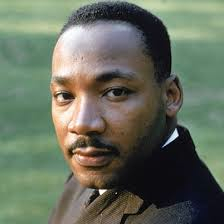
This week we celebrate Martin Luther King Day, a tribute to the man with a vision for racial equality in the twentieth century and beyond. Just so, this post pays tribute to his dream and his legacy through a Mennonite lens.

Dr. Martin Luther King

“Jesus Loves the Little Children, All the Children of the World, Red, Brown, Yellow, Black and White,They are Precious in His Sight, Jesus Loves the Little Children of the World.”

As a tiny tot I was taught this song in Sunday School at Bossler’s Mennonite Church in the 1950s though the entire congregation was white. I saw children with slanted eyes and yellowish skin in picture books and a few black people in Lancaster and Harrisburg or maybe on the PRR train on our way to Philadelphia. But there were no children of a different skin color at Rheems Elementary School.  Or even at Elizabethtown High School. Not a one!

It was ancestry, not skin color, that made a difference in my family. Grandma Longenecker, benign soul though she was, did make disparaging remarks about other ethnic groups. She called a woman she was slightly acquainted with in Bainbridge “The Hunky Lady.” From her tone, I think Grandma Fannie was referring to the woman’s origins in Hungary, and therefore different from us, the Pennsylvania Dutch. And she made no bones about her view of Irish housekeeping. If we made a mess playing in her big kitchen, she’d remark, “It looks Irish in here,” and we’d be tidying up behind her broom. Fast!

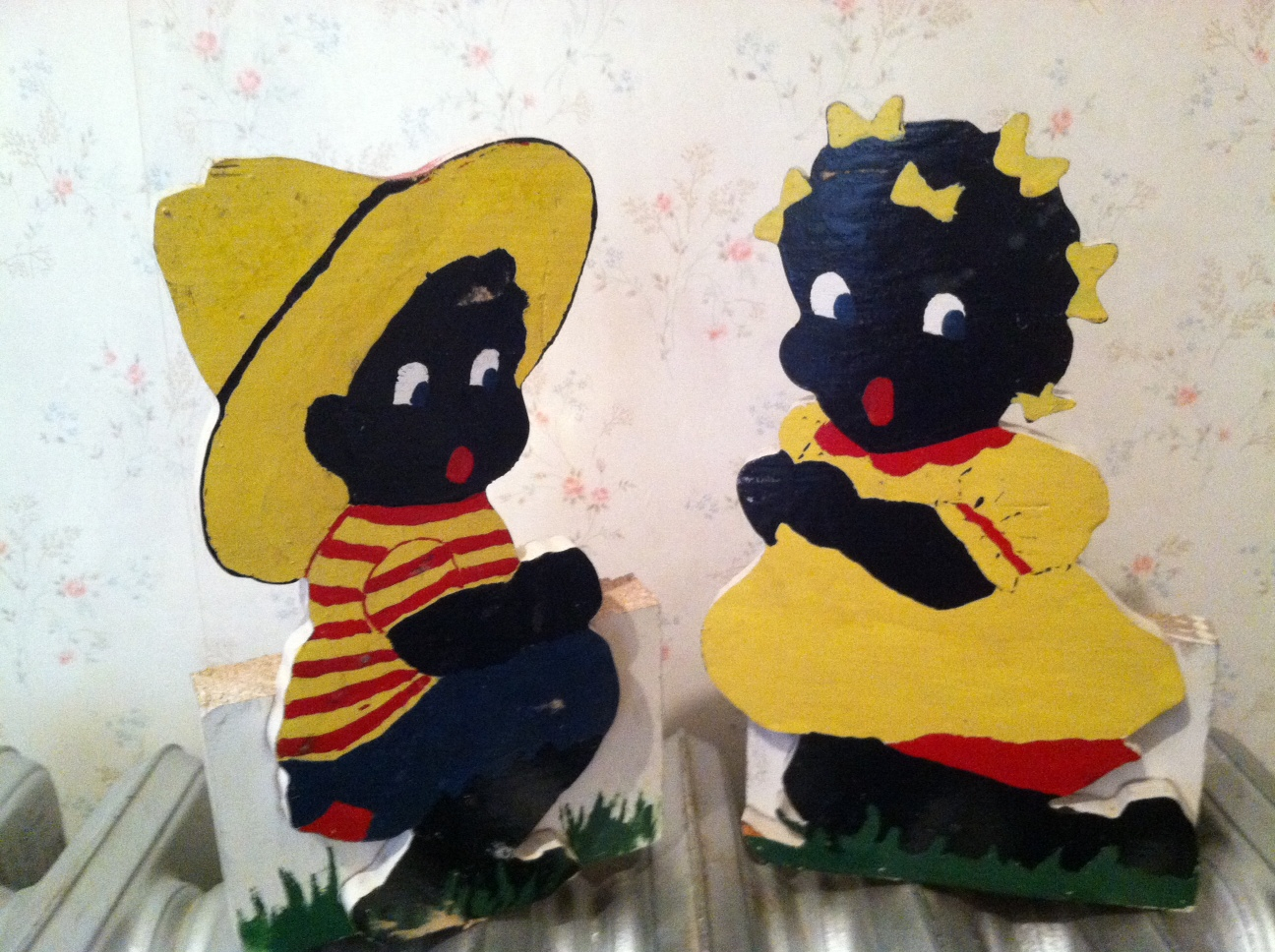
In a recent visit to the attic, I came upon a pair of bookends featuring two pop-eyed black faces, a boy and a girl, painted in grade school.  Were such children curiosities to us? Novelties? Why would my teacher approve of  such an art project? Along with stories like Little Black Sambo, they were obviously part of the folklore of another era, not at all politically correct by today’s standards.

blackBookends

My first encounter with a black person, up close and personal, was with little Chico Duncan, a black boy from New York City, who came to our home for a week in the “Fresh Air” program in which volunteer families would give city children summer vacations in the country. (Shirley Showalter’s book Blush devotes an entire chapter to her friendship with their family’s Fresh Air girl.) The most fascinating thing about Chico was his hair, kinky black and glistening. Was his hair naturally oily or did he put on something from a bottle? I longed to touch it and feel the texture, but fear or embarrassment or both restrained me from even asking. Besides, he was a BOY, and I had hoped for a girl to play with!

But that was years ago. Now at Bossler’s Church, children who sing “Jesus Loves the Little Children” may actually be sitting besides a child with a darker skin tone. The church treasurer, a former missionary, has an Ethiopian husband; one farm family has adopted African-American twin babies. There is a couple of Middle-Eastern descent. The Bishop, Director of African Programming with Eastern Mennonite Missions, has biological grand-children of Kenyan-American ancestry.

And my Grandma Longenecker? For at least two decades through Lutheran Social Services, she and Aunt Ruthie sponsored families from all over the world—particularly Viet Nam, Africa, and eastern Europe. They, along with many other Lancaster County families, welcomed the immigrants and refugees from countries at war for weeks or months at a time until they could get a job, an apartment of their own, even acquire an education.

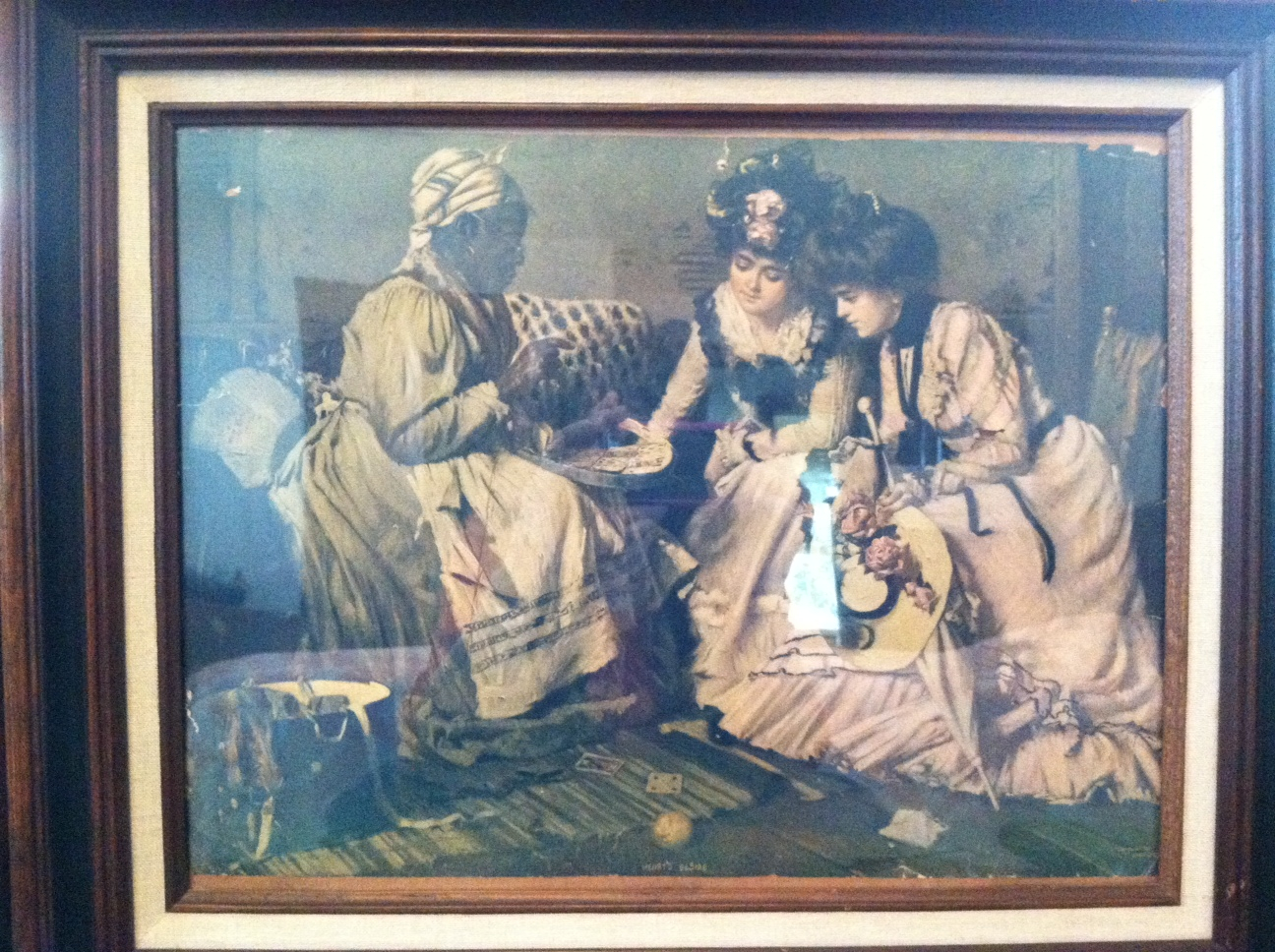
A few months ago, I re-visited Aunt Ruthie’s bedroom, (now unoccupied because she lives at Landis Homes) and saw on the wall as if for the first time, a framed picture of three women:

CardGame2

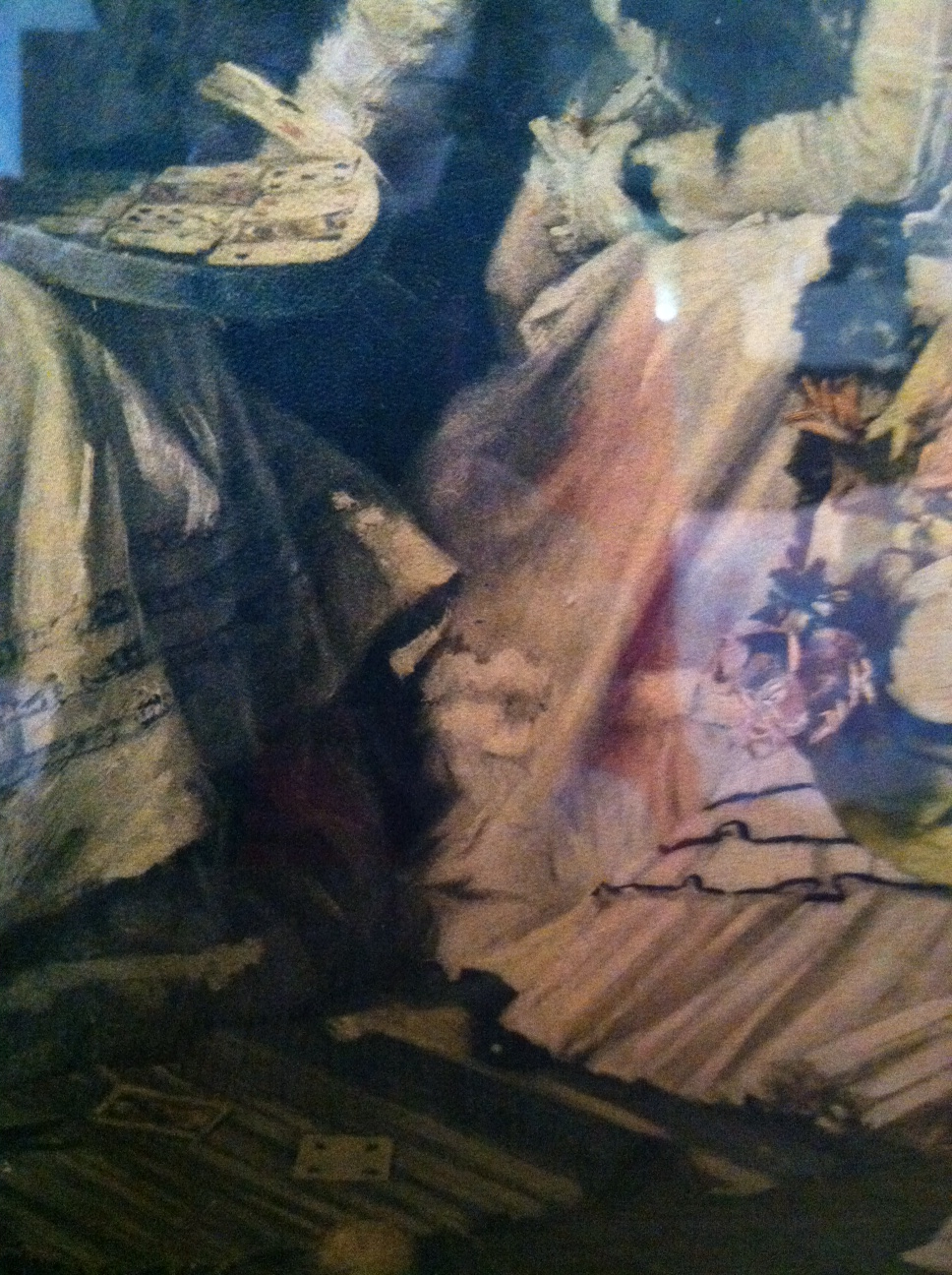
Two elegantly dressed Victorian women and a black woman, obviously a maid, playing cards. Is the maid holding the card tray for the other two? Is she teaching the ladies tricks of the trade? Are all three playing the game? Three would make a better game, don’t you think?

Detail: Women Playing Cards

What experience with race did you encounter as a child? What story or anecdote can you add? I love when the bell chimes with your comment!

The Longenecker Christmas Tree & Charlie Brown

The Longenecker Christmas Tree.

Well, there was none. Not one. Not ever. Despite the fact that the Christmas song, “O Tannenbaum” is of German origin, most Pennsylvania Dutch Mennonite homes of the 1950s and 60s did not light Christmas trees. Decorated trees were lumped together with other worldly pleasures like jewelry, makeup, and movies and therefore not permitted. At least the Ray Longenecker family did not have one. We were plain and I longed for some fancy.

One year I found a limb from our maple tree out front with little branches that looked as forlorn as Charlie Brown’s tree. I brought it into the living room and tried to find trinkets and a red ribbon or two for decoration.

It was a sad little tree. It looked something like this, only wedged into our living room radiator and anchored by balled-up newspaper no doubt.

forlornTree

Good grief! I know how Charlie Brown must have felt. But at least his had “a wooden trunk and soft green needles” with a red ball on the end of a branch instead of a timid little ribbon.

CBrownSadTree

Charlie Brown’s luck seems to change when Lucy appoints him as director of the Christmas play in which Linus reads Luke 2 from scripture. After the play, the performers migrate outdoors toward Charlie’s sagging tree. Charlie Brown eventually gets his wish for a fine Christmas tree as the gang “donate” the festive string of lights from Snoopy’s doghouse to the dress up the little tree. Charity in action.

CBrownHappyTree

No, there was no Christmas tree in our home or in the sanctuary of my family’s home church, Bossler’s Mennonite Church. But like Linus and friends, we heard the Christmas story from Luke 2 faithfully recited and at the end of the service, we received hand-outs of navel oranges every year, the orange orbs passed hand to hand down the rows.

Nowadays in the Longenecker-Beaman home there is a happy fir tree, bedecked with ornaments from several generations. And we all rehearse the precious old story of the nativity in the Bible passage Luke 2 on Christmas morning.

A wondrous story, plain and simple, read beside a fanciful tree.

O Tannenbaum! Longenecker-Beaman Tree 2013
O Tannenbaum!  The Beaman Tree 2013

Hark, the Herald Angels Sing, Glory to the Newborn King!     Sung by Charlie Brown   and friends

Add a Christmas tree tale from your past . . . or present. Join the conversation and I will add my little bit as I always do. 

Merry Christmas~~Merry Christmas~~Merry Christmas!

Coming next: Purple Passages with Time and Tiny Tim

Babes in an Urban Woods: Part II

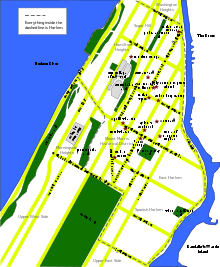
Map of Harlem, neighborhood in northern Manhattan, NYC

On the ground floor again, we breathe a sigh of relief as we spot the bus two blocks away ready to pick us up to go back to the mission. On the way to our mobile haven, we pass pawn shops armed like fortresses, lurid adult bookstores with XXX ratings, filthy-looking lounges, a stark store-front church.

Then we spot a gargantuan black woman with a red satin turban and purple robe–a bathrobe? a graduation gown? She’s “preaching” about Jehovah God in the middle of the sidewalk. I think she’s preaching until I see she is holding an upside-down Sears and Roebuck catalog as her bible and then inhale alcoholic fumes emanating from her body. We try to go around her, but this frightful creature grabs me by the shoulder in a death grip, and I am spun round and round in dizzying circles. There is little I can do to resist the grasp of this drunken prophetess. “Hazel, Hazel, help me,” I call out with a voice that feels somehow disconnected from my body. Hazel is astounded too and stands there immobile. I fall onto the scorching pavement as the woman lets go of me mid-air. By now Brother Paul and Sister Lois have raced up the street to our aid.

Someone deposits me across two empty seats on our bus. I am aware of heads hovering over me as a blurry hand wipes my face with a cool, wet handkerchief. We are going back to Brother Ernie’s mission on Eighth Avenue for lunch. It’s quiet for a few minutes. Then Brother Frank leads everyone in singing “When the Roll is Called Up Yonder, I’ll Be There” as we bounce across the avenues.

But I don’t join in. My head is buzzing with the pain of too many unanswered questions. Did the church elders know about the risks and think that telling us would discourage us from going? Did they come here innocent and ignorant like us and also get a rude awakening? Why didn’t Brother Ernie, now almost a New Yorker himself, give us more pointers?

Back at the mission, I have recuperated enough to eat our meal of home-made egg salad sandwiches and chicken corn soup brought up from home in ice chests, relieved that I have survived the jungle of Harlem.

BLUSH Contest closes tonight, October 2, 2013, at midnight! Here’s the link to the Contest Rules for a chance to win a copy of Shirley’s memoir:  

Review of Shirley Showalter’s BLUSH and Book Giveaway

Your comments welcome! I always respond.

Babes in an Urban Woods: Part I

Age 14 1/2
Age 14 1/2

During our teens, my church friends–Miriam, Gladys, Hazel, and I congregate at each other’s houses after church on Sunday night for ice cream, chips, and stereo music: Songs from the West, anything by Mantovani, and The Singing Nun. We would rather have dates like Janie and Thelma, but since we don’t, we pretend that this weekly ritual is fun.

One of our other faux definitions for fun includes cultivating an acre of tomatoes. The youth group from church farm tomatoes on a fertile plot of land near Bossler’s Mennonite Church called The Lord’s Acre. We plant, water, weed, and harvest the tomatoes, giving the profit to missions. Another mission outreach is in New York City, where Ernest Kraybill, one of our deacon’s sons, drives taxi during the day and pastors a small mission church in Harlem. Some of us, along with young marrieds, are getting ready to board a bus and distribute gospel tracts in the Big City. A year ago, the freshmen from E-town High took a field trip to New York. Radio City Music Hall with its sunburst fan of a stage is my favorite memory: seeing the Rockettes was a dream come true for a sheltered girl from Rheems. After the show, we saw a movie–yes, an actual MOOOOOVEEE in dynamic sound and Technicolor, featuring Barbara Stanwyck, the very first movie star I had ever seen performing on the silver screen. Her flawless skin and hair, impeccable makeup, and a cream, cool voice mesmerized me.

On what turns out to be the hottest Saturday in August most of the teens and young adults from Bossler’s plan to spend all day Saturday bringing the gospel to poor, needy heathens in the inner city. It’s summer-time, and I wear my sheer voile lavender frock, so I won’t feel overheated with a modest cape over the dress. We are leaving in the early morning about 4:30 am, so we can spend the day giving out tracts in apartment buildings all over Harlem, With Hazel, my seat-partner, I board the bus for the 3 1/2 hour trip to New York City. Garbed in the plainest of clothing and christened with our white Mennonite caps, we are out to convert the world.

On the bus, we talk and doze, and doze and talk our way to the exotic lights, thrumming noises, and foreign smells of Harlem in north Manhattan, a neighborhood of about 1/4 million people. After we arrive, we proceed by twos among the tenement building in the concrete jungle of the 18th block of Harlem, armed with nothing but gospel tracts and innocence. Like the others, Hazel and I are assigned one tenement building with floors upon floors of apartments. Our strategy is to walk all the way to the top and do our distributing on the way down.

tenement building - courtesy: Google Images
tenement building – courtesy: Google Images

“Whew, it sure does stink in here!” The odors of stale air, dried blood, urine, and burnt cooking assault our country noses on the way up. There are beer bottles, Schlitz and Black Label–some broken, I notice, strewn on the landings between floors.

“Did you hear that?” I ask Hazel as we both witness a full-scale brawl going on inside one of the apartments. The sweaty-looking door-opener snatches a tract from our hands.

“I can’t believe these words,” Hazel comments as we gape at the graffiti on the pock-marked concrete walls: Call_____ for a good time . . . Go to #x!*X you dirty niggers . . . .  Undaunted, we manage to bless all the other apartment dwellers with our fliers as we descend. More screaming and yelling. Things are really getting violent on the other side of the wall.

“Are we going to make it out alive?” I wonder. But things are about to get even worse.

What happens next? Part II

                                                              *   *   *   *   *

GOOD NEWS! There is still time to enter the contest on my review of Shirley Showalter’s new memoir BLUSH, hot off the press. Just POST a COMMENT on the review! Read and Comment @ Shirley Showalter’s BLUSH – A Review and Book Giveaway

THE CONTEST

You can enter to win a copy of this book now!

Here are the details:

WHAT:  Read my review of Shirley Hershey Showalter’s memoir: Blush: A Mennonite Girl Meets a Glittering World.
PRIZE:   One lucky commenter will win a copy of BLUSH, after only one week now in its second printing!

WHEN:  Review posted Wednesday, September 25, 2013

WHERE:  Right here on Plain and Fancy Girl

And all you have to do is show up, read my review and leave a comment. Only comments posted on my blog will be counted as an entry.

The giveaway will close one week later on Wednesday, October 2, 2013 at 12:00 midnight. I will announce the winner here and by email.

I invite you to come by and enter the contest by commenting on the review. Feel free to invite your reading friends!

Again, here’s the link to the review: Shirley Showalter’s BLUSH: A Review and Book Giveaway and a chance to win a copy of Shirley’s book!


Shirley Showalter’s Memoir “Blush” – a Review & Book Giveaway

 
My Review

Shirley Hershey Showalter’s Blush: A Mennonite Girl Meets a Glittering World sings the song of her early life as a Mennonite girl in 250 pitch-perfect pages. Born into a family of Lancaster County Swiss Mennonite parents, the author recounts the story of the first 18 years of her girlhood on an 100-acre dairy farm in the 1950s and early ‘60s. The book delivers in its promise to play out her memories of  school, church, and home, “the three legs of my childhood stool,” as she puts it. “Each carried both sweet and sour memories” of ways this plain girl fit in and ways she stood out as different.

Her melody line bravely hits the sharps and flats of her experiences. She grabs her reader by the hand to walk into their farm meadow as she and her brother Henry play amid the Holstein cows and fragrant bluebells by the creek on a cloudless, spring day. We learn secrets of good Pennsylvania Dutch cookery in her mother’s kitchen and are privy to recipes of delicious dishes in an appendix to the book. She lets us hear the congregation joyously singing hymns of the faith a cappella in 4-part harmony though in a sex-segregated sanctuary. But her song turns to a minor key as she vividly describes the sudden death of her infant sister, her by turns affectionate and adversarial relationship with her conflicted father, and later in a brush with a rigid Mennonite bishop.

This memoir abounds in artful motifs. In the preface the author is sitting on the sandstone steps on the way down to the arch cellar of The Home Place, now known as Forgotten Seasons Bed & Breakfast. She describes the arch in this cellar as the entrance to a storehouse of provision for her parents and grandparents against the want of the Great Depression and a bunker of bounty during the Cold War. Indeed, the book succeeds as documentation of major political currents and cultural icons of the era: Eisenhower and later Kennedy, the Studebaker Lark, the Phillies, Elvis. Other visuals include a map of the Lititz environs, her family tree, along with beloved family portraits and snapshots.

For me as a reader, the most endearing arch in her story is the rainbow in her mother’s invented story of “The Magic Elevator,” which she, a diarist and aspiring writer herself, wrote at age fifteen and has adapted for her children and grand-children through the years. Her mother, Shirley’s first mentor, challenged the norm in a story she recounts early in the book: Although the Rules and Discipline of the Lancaster County Mennonite Conference condemned worldly weddings, including carrying a bridal bouquet, Shirley’s mother Barbara Ann craftily transformed the family’s plain living room into a fancy bower of flowers and palms for the ceremony. After all, at church we sing fervently of beauty in “This is My Father’s World,” she must have reasoned. Evidently, Shirley was not the first Mennonite in her family with moxie.

Shirley’s story sings because it rings true. And, yes, Shirley, you did go home again. The Oh! at the center of her story leads readers to a fresh discovery of home, where one’s heart is nourished and where, as T. S. Eliot puts it, we can all “arrive where we started / And know the place for the very first time.”

“There are many ways to arrive at a place, many of them unimaginable at the beginning of the journey.”    BLUSH

Meet the Author:

Her Memoir – Blush: A Mennonite Girl Meets a Glittering World

About Shirley

Shirley Hershey Showalter grew up on a family dairy farm in Lancaster County, Pennsylvania. She went on to become a Goshen College (IN) professor, then president, and then a foundation executive at the Fetzer Institute (MI).

Her childhood memoir, Blush: A Mennonite Girl Meets a Glittering World, has been published by Herald Press on September 19, 2013. Follow the journey of the book on her Facebook page and on her blog.

THE CONTEST

You can enter to win a copy of this book right now!

Here are the details:

WHAT:  Read my review of Shirley Hershey Showalter’s memoir: Blush: A Mennonite Girl Meets a Glittering World and comment.

PRIZE:   One lucky commenter will win a copy of BLUSH

WHEN:  Review posted Wednesday, September 25, 2013

WHERE:  Right here on Plain and Fancy Girl

And all you have to do is show up, read my review and leave a comment.

The giveaway will close one week later on Wednesday, October 2, 2013 at 12:00 midnight. I will announce the winner here and by email. Only comments posted on this blog will count as an entry.

I invite you to come by and enter the contest by commenting on the review. Feel free to invite your reading friends!

Book Giveaway Contest & Taste of Shirley’s Memoir “Blush”

News Flash!

Upcoming Review and Book Giveaway of Blush: A Mennonite Girl Meets the Glittering World by Shirley Hershey Showalter

On Wednesday, September 25, I will be reviewing Shirley Hershey Showalter’s new memoir – Blush: A Mennonite Girl Meets the Glittering World.

WHO IS SHIRLEY HERSHEY SHOWALTER?

Though Shirley and I both grew up Mennonite in the same county and in the same decade, our paths did not cross until I saw her website http://www.shirleyshowalter.com/ flashing across the screen in a class entitled What the Heck is a Blog? at the University of North Florida in Jacksonville. I immediately recognized her name as Swiss Mennonite and probably of Lancaster County, PA origin. And sure enough, right on both counts. Since March 2013 we have become blogging pals, and I am thrilled to promote her book as the story of a life surprisingly parallel to mine, a story of derring-do!

DETAILS OF THE CONTEST:

 WHAT:  My review of Shirley Hershey Showalter’s memoir –  Blush: A Mennonite Girl Meets the Glittering World.

 PLUS:   One lucky commenter will win a copy of BLUSH.

 WHEN:  Wednesday, September 25, 2013

 WHERE:  Right here on Plain and Fancy Girl

 And all you have to do is show up, read my review and leave a comment.

 The giveaway will close one week later on Wednesday, October 2, 2013 at 12:00 midnight. I will announce the lucky winner here and by email.

I invite you to come by and enter. Feel free to invite all your reading friends!

Shirley Hershey Showalter  Shirley Hershey Showalter, author of BLUSH: A Mennonite Girl Meets a Glittering World

I promise: you will be transported, says Bill Moyers of this memoir. Part Mennonite in a Little Black Dress, part Growing Up Amish, and part Little House on the Prairie, this book evokes a lost time, in Lancaster County, Pennsylvania, when a sheltered little girl with big dreams entered a family and church caught up in the midst of the cultural changes of the 1950s and `60s.
With gentle humor and clear-eyed affection the author, who grew up to become a college president, tells the story of her first encounters with the glittering world and her desire for fancy forbidden things she could see but not touch. The reader enters a plain Mennonite Church building, walks through the meadow, makes sweet and sour feasts in the kitchen and watches the little girl grow up. Along the way, five other children enter the family, one baby sister dies, the family moves to the home place. The major decisions, whether to join the church, and whether to leave home and become the first person in her family to attend college, will have the reader rooting for the girl to break a new path.  (Amazon Books)

Mennonite Flashback II: Circles and Tubs

CIRCLES:

I am in a small room of our church standing in a circle of women and girls in the presence of our Bishop and Deacons who will ask each of us 2 questions:

* Are you in harmony with the rules and regulations of the Mennonite Church?

* Are you at peace with God and your fellow man?

We are all plain, wearing coverings on our heads and simple dresses with capes, and expected to answer “Yes” to each question and answer them truthfully with a pure heart. I wonder though about Della and Doris in the group. During the last Council Meeting, as this question is called, they each answered “As much as possible” when queried about their willingness to keep church rules. I have noticed that  they always push the envelope on fashion, wearing dresses with collars with piping, expensive fabrics, and shoes just a hair below chic. Their answers were acceptable apparently last time, for here they are back again in our close-knit circle.

It is a week or two before Communion at Bossler Mennonite Church, and we assemble in small groups, men and women separately to be examined in preparation for one of our most important ordinances, Communion (Article II, Section 2 of the Lancaster Conference Rules 1968). A memorial to Christ’s suffering and death, church members who have professed faith in Christ, stand in a line to partake of the sacred emblems of Christ’s broken body and shed blood symbolized by a morsel of bread and a sip of grape juice (never wine!) from a communal goblet. We share a common faith and common heritage, many of us branches of the same family tree at Bossler’s Mennonite Church: Garbers, Hesses, Kraybills, Kreiders, Weavers, Wengers, Zimmermans, and of course, Longeneckers.

Our church fathers feel responsible that none of their flock observe Communion unworthily. And we members fear damnation if we have unconfessed sin in our lives. Our pastor intones from the pulpit these words: I Cor. 11:29 “For he that eateth and drinketh unworthily, eateth and drinketh damnation to himself, not discerning the Lord’s body.”

Next Sunday, we sing lovely hymns a capella as we circle row by row around the sanctuary to observe the ordinance of Communion: “Bread of Heaven,” “Alas! And Did My Saviour Bleed?” “Saw Ye My Saviour?” and “When I Survey the Wondrous Cross” are among the oft-sung music selections:

History of the Hymnal - 100 Classic Christian Hymns

When I Survey the Wondrous Cross

Like the cycles of the seasons, spring and fall, we repeat the circles of Council Meeting and Communion year after year.

TUBS:

After the Communion service in the church, men and women gather separately in their vestibules to observe the Feet Washing Ordinance, Article  II, Section 3 of our Conference rules, according to the gospel of John 13:1-9. Our fathers, uncles, and grandpas bring in oblong, galvanized basins of luke-warm water and then quickly disappear.

There is an awkward moment when I look around for a partner. My hope is to find someone else close in age. But a time or two I have been stuck with an older woman – bad breath and chin hairs, really off-putting for a girl of fourteen.

RevFootwashing

But I’m lucky to pair up this time with Gladys Garber, one of my teen-age friends. We take turns: each tying the terry cloth apron to our waistlines and washing each other’s feet. No scrubbing is involved here, just a gentle hand-pouring of water over one foot and then the other, drying each foot separately, tenderly.

But there’s more. After the foot-washing is finished, It is now time to observe the last ordinance, the Holy Kiss, an “expression of fervent love” (Romans 16:16). And, no, it’s not a peck on the cheek!

It was Socrates who said, “The unexamined life is not worth living.” It is not possible to accuse good Mennonite folk of that transgression. They are a people who share a common heritage, a common faith, and a common goal of a pure and holy life.

Go back

Your message has been sent

Warning
Warning
Warning
Warning

Warning.

It’s No Secret: The Life of Bees and Beamans

Bee - Joel's FB

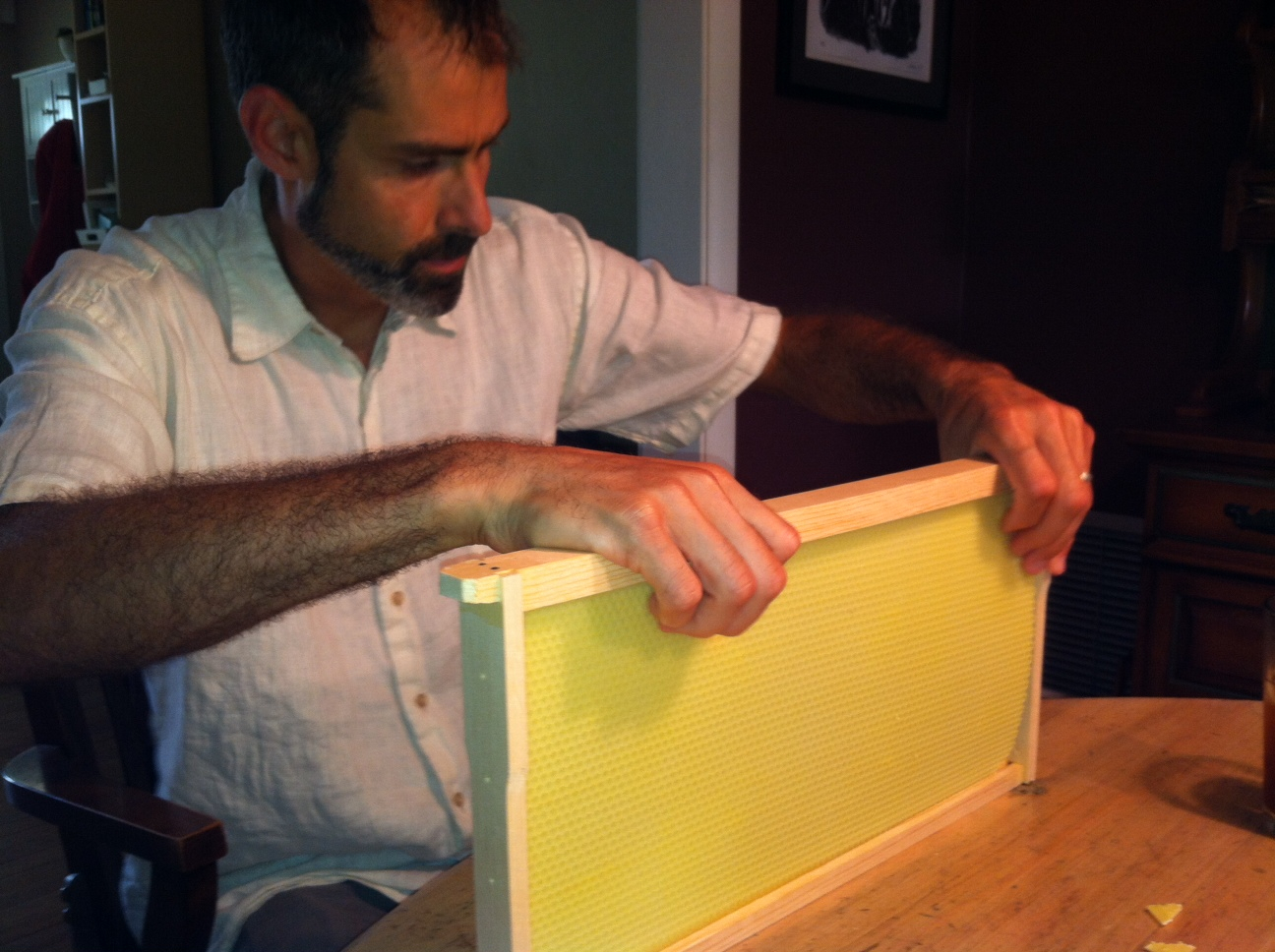
Joel Beaman and bee hive frame
Beaman hive in back yard

Bee Video / Facebook

The bees came the summer of 1964, the summer I turned fourteen and my life went spinning off into a whole new orbit, and I mean whole new orbit. Looking back on it now, I want to say the bees were sent to me. I want to say they showed up like the angel Gabriel appearing to the Virgin Mary, setting events in motion I could never have guessed.  Sue Monk Kidd, The Secret Life of Bees       pages 1, 2

If you’ve read Sue Monk Kidd’s novel, The Secret Life of Bees, you know that bees are a metaphor for the flight Lily Melissa Owens takes to escape a mother-less house (except for nanny Rosaleen) and the domination of an angry father to find a true family and home. In the process, she learns the truth of her mother’s past, finds a hive of new mothers, and discovers her own identity. In other words, she discovers her true self, the whole point of a good coming-of-age novel.

Substitute a different date and a different age, and you have my story with major variations. Unlike Lily, I had a caring family with a highly functioning Mother, but I lived the life of a Lancaster County Mennonite girl, separate from mainstream culture. I envisioned a more colorful life that would offer excitement and surprise. Thus, the bees in my bonnet (literally, a bonnet) propelled me to explore life beyond what I believed was the sheltered, nurturing, but confining, boundaries of my Mennonite upbringing. “What would happen if I sampled the honey from a different hive?” I wondered.

No, I didn’t have a jar of bees on my dresser like Lily, but I did recognize an inner voice saying to me, “Marian, your jar is open.” And off I buzzed to a different state, a changed outward appearance, and eventually a new name.

In the process, I landed in another city (Charlotte, NC) in a house with two young women, who, like Lily’s three Boatwright sisters in the Pink House, groomed me for a different life. A life with bright colors, loose hair, fancy dresses but not jarring me away from deeply held values.

Like Lily Melissa Owens, I have sampled the honey of good experience along with the vinegar of trials. Of course, I like the honey better. Here are some life secrets from the “. . . Life of Bees.”

1. IT’S BETTER TO BE SWEET THAN SOUR!

“We lived for honey. We swallowed a spoonful in the morning to wake us up and one at night to put us to sleep. We took it with every meal to calm the mind, give us stamina, and prevent fatal disease. We swabbed ourselves in it to disinfect cuts or heal chapped lips. It went in our baths, our skin cream, our raspberry tea and biscuits. Nothing was safe from honey. . . . [It] was the ambrosia of the gods and the shampoo of the goddesses.”   (84)

August [Boatwright] said beeswax “could make your fishing line float, your button thread stronger, your furniture shinier, your stuck window glide, and your irritated skin glow like a baby’s bottom. Beeswax was a miracle cure for everything.”  (84)

2. OBSERVE ETIQUETTE.

What works in the bee yard works in the world. “Don’t be afraid, as no life-loving bee wants to sting you. Still, don’t be an idiot: wear long sleeves and long pants. Don’t swat . . . . If you feel angry, whistle. Anger agitates, while whistling melts a bees’s temper. Act like you know what you’re doing, even if you don’t. Above all, send the bees love. Every little thing wants to be loved.”  (92) 

3. USE YOUR SMARTS.

“People don’t realize how smart bees are, even smarter than dolphins. Bees know enough geometry to make row after row of perfect hexagons, angles so accurate you’d think they used rulers. They take plain flower juice and turn it into something everyone in the world loves to pour on biscuits.”  (137)

4. NOTICE THAT OTHERS ALSO HAVE IMPORTANT ROLES TO PLAY; YOU’RE NOT ALWAYS THE QUEEN BEE! In the bee kingdom there are nest-builders, field bees with good navigation skills to gather nectar and pollen, nurse bees, and mortician bees. At the extreme ends: drones and, oh, yes,  the Queen Bee with her attendants.   (148-149)

5. COMMUNICATE!

“The whole fabric of honey bee society depends on communication—on an innate ability to send and receive messages, to encode and decode information.”  Gould, James L. and Carol Grant Gould. The Honey Bee, quoted in The Secret Life of Bees  (165)

6. YOU ARE CAPABLE OF MORE THAN YOU THINK.

The worker bee is just over a centimeter long and weighs only about sixty milligrams; nevertheless, she can fly with a load heavier than herself.  Gould, James L. and Carol Grant Gould. The Honey Bee, quoted in The Secret Life of Bees, (256)

7. ENJOY BREATH-TAKING BEAUTY!

According to August, if you’ve never seen a cluster of beehives first thing in the morning, you’ve missed the eighth wonder of the world. Picture these white bees tucked under pine tees. The sun will slant through the branches, shining in the sprinkles of dew drying on the lids. There will be a few hundred bees doing laps around the hive boxes, just warming up, but mostly taking their bathroom break, as bees are so clean they will not soil the inside of their hives. From the distance it will look like a big painting . . .  in a museum, but museums can’t capture the sound. Fifty feet away you will hear it, a humming that sounds like it came from a different planet. At thirty feet your skin will start to vibrate. The hair will lift on your neck. Your head will say, Don’t go any farther, but your heart will send you straight into the hum, where you will be swallowed by it. You will stand there and think, I am in the center of the universe, where everything is sung to life.    (286)

Bee - Joel's FB

Bee Video

Create a buzz!

Was there a time in your life when the jar of your life opened, and you flew out of it into a different orbit?

Like Lily Owens in the novel, have you found a hive of friends to nurture you?

Who is the queen bee in your life story? Well, it could be a king or a prince too, I guess.

All quotes: Kidd, Sue Monk. The Secret Life of Bees. New York: Penguin Books, 2002.