Remembrance of Things Past: She Kept His Sweater

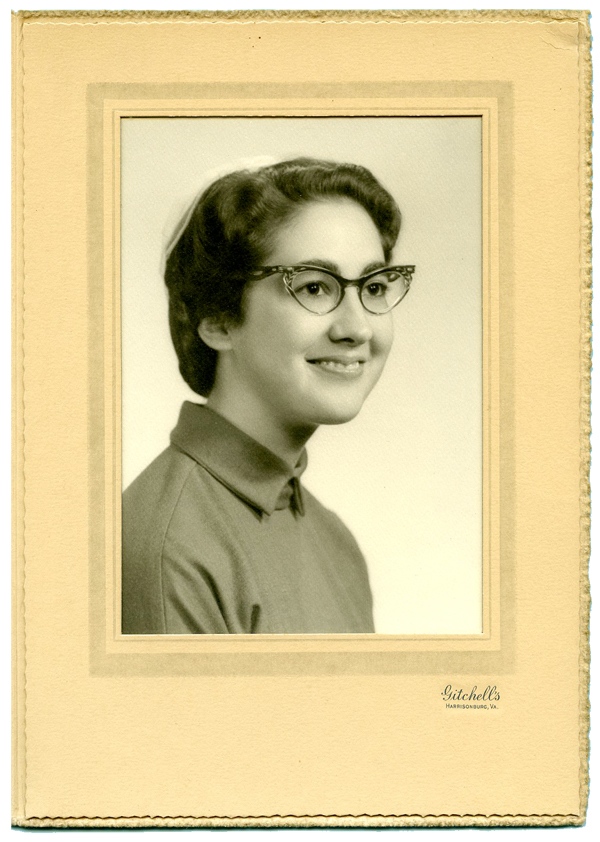
Jane Martin Walters never attended a single Elizabethtown High School Class Reunion, and Dr. Norman P. Will no longer attends college graduations as a president emeritus at Florida State College at Jacksonville. Yet, they both linger in my memory though Jane died in her mid-twenties and Dr. Will in his late-fifties. I have vowed to get rid of memorabilia in anticipation of down-sizing one day, but I can’t – I just CAN’T – part with the pieces of paper that attach their memory to mine.

Jane was smart, very smart, and excelled in college prep track classes in high school. Unlike mine, her learning appeared to be effortless. And her home life quiet and orderly too. After a snow day off from school one winter Jane remarked that she loved snow days because her Mom would pop popcorn, and she and her family would sit by the fireplace and read or play games. In contrast, after the thrill of sledding on traffic-free roads passed, our house was noisy, no hearth for refuge in sight.
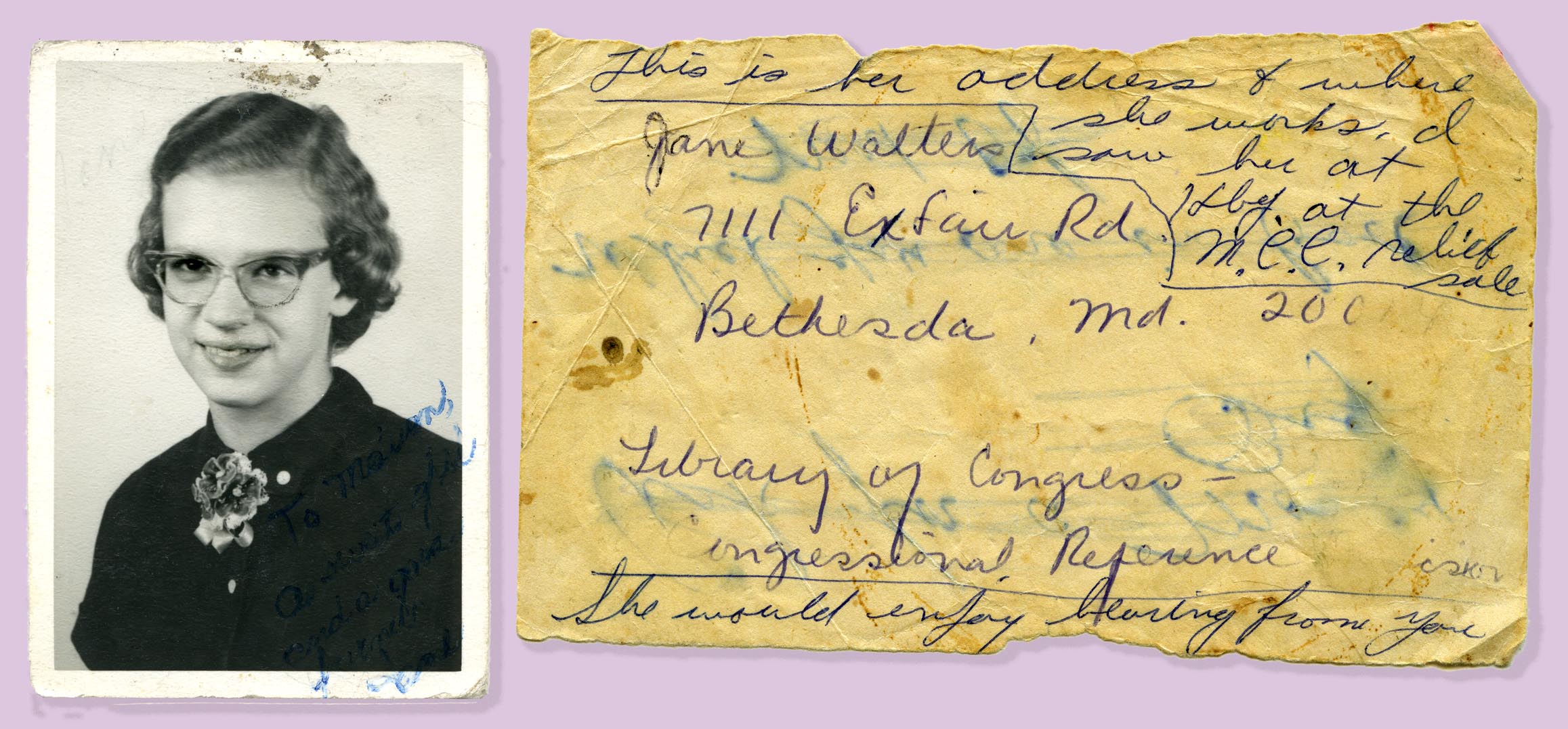
Jane and a note from my mother who saw her in Harrisburg at the MCC (Mennonite Central Committee) relief sale.
Jane and a note from my mother who saw her in Harrisburg at the MCC (Mennonite Central Committee) relief sale – 1960s

You might get the impression I felt envious. But I didn’t. Jane was poised on a pedestal in my eyes, and I admired what appeared to be her calm cadence through life. When I heard she married and worked at the Library of Congress in the Congressional Reference Department, I was pleased. Maybe I’d visit her in Washington D. C. some day. But some day never came. She died of cancer shortly after after her marriage and at the beginning of a promising career. Aunt Ruthie told me, “She ate a nice dinner with her family, said her goodbyes and died in her sleep that night.” I was devastated.
*  *  *

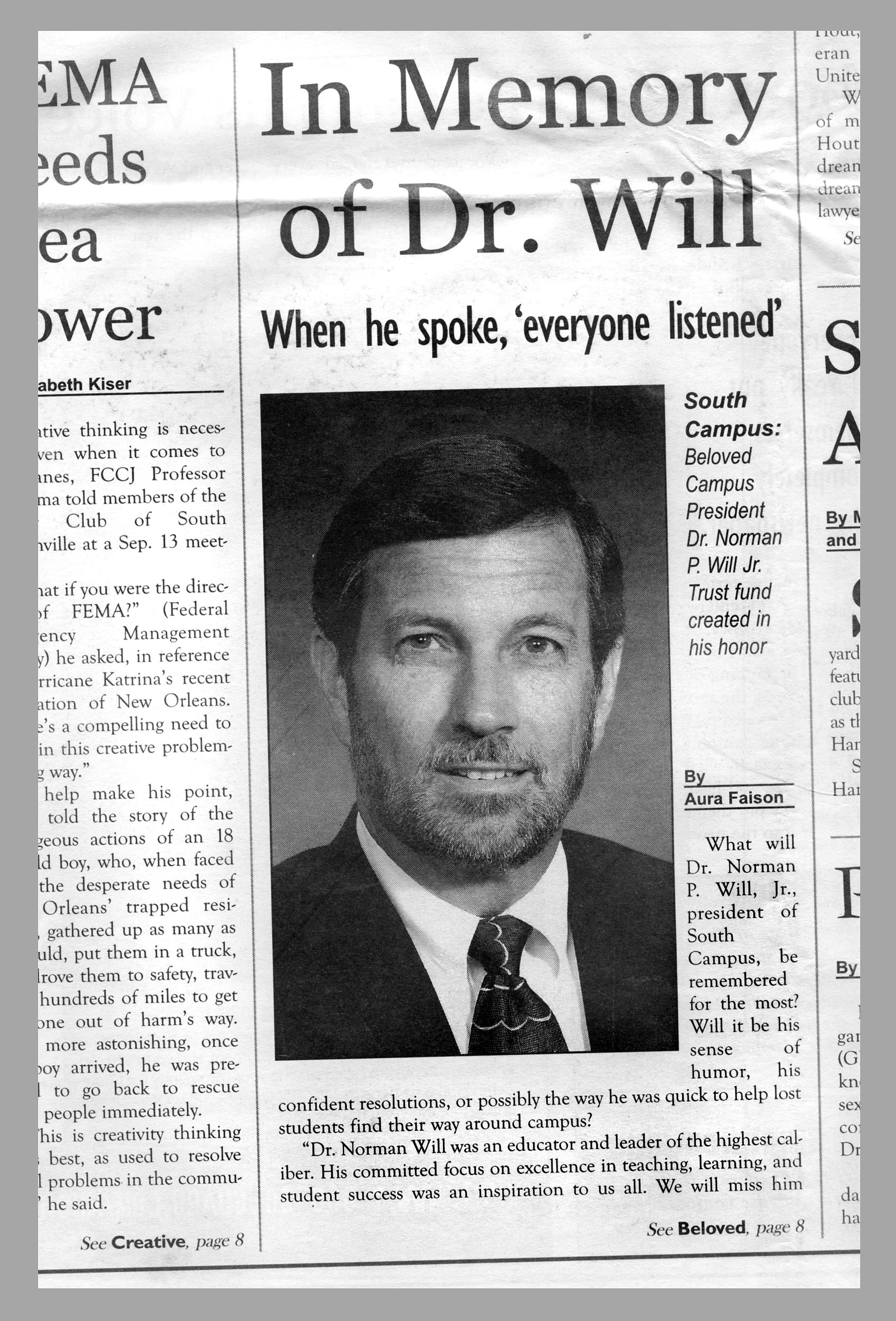
Dr Will_Campus newspaper_FCCJ

I admired Dr. Norm Will too, though in a vastly different way. An English professor had become a college president: All’s right with the world! College operations purred along smoothly with Dr. Will at the helm. He advocated free thought, offering friendly evening colloquia for faculty on diverse topics like current ideas in neuroscience and the health of Florida’s St. Johns River. But on the first day of Convocation in 2005, Dr. Will did not appear. He had died the night before while sipping wine and reading The History of God by Karen Armstrong, a text I later happened to reference in my paper for The Oxford Roundtable.

In her piece “Dealing with the Dead” (The New Yorker, October 11, 2010), Jennifer Egan discusses the deaths of three close family members and observes that she has kept an article of clothing from each: her grandmother’s 3-tiered necklace of fake pearls, her father’s navy-blue wool V-neck sweater, and her stepfather’s gray and burgundy argyle sweater. Though the pearls eventually broke as she rounded a corner in the East Village, Jennifer vows to wear the sweaters “until they unravel into shreds” because she likes their feel against her skin. Author Egan shares wisdom gained from loss as she opines:

  • “Wearing the garments of a person I loved was like being wrapped in a protective force field.”
  • “When the clock stops on a life, all things emanating from it become precious, finite, and cordoned off for preservation.”
  • Keeping items from those who have passed on “is a way of keeping them engaged in life’s daily transactions—in other words, alive.” [Italics mine.]

I will add a quotation of my own from Shakespeare’s King Richard III: So wise so young, they say, do never live long.” And then from Scripture:

  “So teach us to number our days that we may apply our hearts unto wisdom.”           Psalm 90:12  KJV

*  *  *

Have you experienced loss? Is your story like any of the stories I tell or very different? Here’s the place to share it.
Home-grown Miracles: See, Taste, Touch

estrawberries

 StrawPoem2

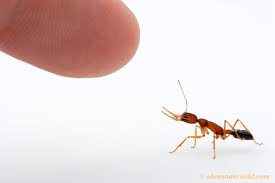
AntFinger

BugPoem1

radishes

Radish3

Egg

EGG

Reader, in your hand you hold

A silver case, a box of gold.

I have no door, however small,

Unless you pierce my tender wall,

And there’s no skill in healing then

Shall ever make me whole again.

Show pity, Reader, for my plight:

Let be, or else consume me quite.

– Jay MacPherson

All poems from Animal, Vegetable, Mineral: Poems About Small Things, selected by Myra Cohn Livingston, HarperCollins, 1994.

*  *  *

Barbara Kingsolver, author of several New York Times best-sellers including The Poisonwood Bible, published her first work of non-fiction, Animal, Vegetable, Miracle: A Year of Food in 2007, which makes the case for eating local. Here is an excerpt from the book:

“This is the story of a year in which we made every attempt to feed ourselves animals and vegetables whose provenance we really knew . . . and of how our family was changed by our first year of deliberately eating food produced from the same place where we worked, went to school, loved our neighbors, drank the water, and breathed the air.”

The blurb from GoodReads website entices to read more:

Hang on for the ride: With characteristic poetry and pluck, Barbara Kingsolver and her family sweep readers along on their journey away from the industrial-food pipeline to a rural life in which they vow to buy only food raised in their own neighborhood, grow it themselves, or learn to live without it. Their good-humored search yields surprising discoveries about turkey sex life and overly zealous zucchini plants, en route to a food culture that’s better for the neighborhood and also better on the table.

Part memoir, part journalistic investigation, Animal, Vegetable, Miracle makes a passionate case for putting the kitchen back at the center of family life and diversified farms at the center of the American diet.

Depending on where you live, you are enjoying some fresh fruits, vegetables, or flowers this time of year. 

What appeals to your senses right now?

Where the Magic Happens

Sailboat

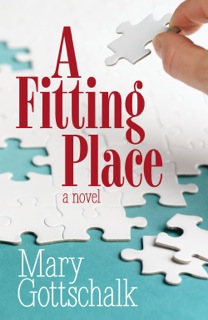
I am happy to introduce a new writer to these pages, Mary Gottschalk. Actually you have already visited Mary’s website if you read my recent post on her blog Flying the Coop: Leaving Mennonite Land. But though she is new to my blog, Mary is certainly not a new author, having published a memoir, Sailing Down the Moonbeam in 2008 and just off the press her first novel, A Fitting Place (May 2014).

Mary will tell you that she and I have competely different life experiences and views of the world, but our writing shares a common theme of willingness to leave our comfort zones.

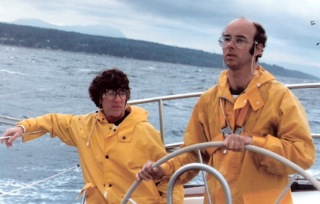
Mary’s Turn: Unlike Marian, I didn’t grow up in a religious environment or have a close-knit family. I first left home at age 13 to go to boarding school, and never lived at home again for more than a month. The love of my life did not show up until I was in my 60s. Much like Marian’s journey from plain to fancy, however, I have been perennially in search of new ideas and new perspectives. I’ve often had to lose sight of the metaphorical shore in order to find them. Ironically, the most dramatic change in my perspective came when I had literally lost sight of the shore, a day when I was roughly a thousand miles out into the Pacific Ocean, heading west along an unmarked route. That day, my husband and I were two years into a planned circumnavigation of the world in a 37-foot sailboat. Much as Marian chose to leave her natal community, I chose to abandon a successful New York career in high finance to explore the larger world.

Around the world with Mary and Tom

Throughout our cruise, we’d often had to trim our sails to unpredictable winds and set our rudder to compensate for erratic currents. We sailed as close to our intended course as we could, but all too often, we ended the day someplace other than where we’d set out to go. As good sailors on a well-fitted sailboat, not much could go very wrong, but we knew that if something did, we would probably die. Life and death were pretty much out of our hands. That watershed day, a sunny afternoon with clear skies and calm seas, it struck me that sailing was a metaphor for life. I suddenly understood that I’d had no more control over my life and death when I lived and worked in New York City than I did while sailing on the Pacific Ocean. And it seemed obvious that if I couldn’t control my fate, I might as well spend my days doing something meaningful and satisfying, rather than wasting precious time and energy trying—all too often in vain—to meet the expectations of others. It seemed equally obvious that if I hadn’t decided to sail away from the metaphorical as well as the geographic shore, I’d still be living under the illusion that I could actually control my life.

It is this last concept—that you grow the most when you step outside your comfort zone—that has been the driving force behind my life as an author. My memoir, Sailing Down the Moonbeam starts with my decision to step out of my comfort zone from a professional and cultural perspective. It ends as I begin a new, more purposeful way of life that has sustained me for a quarter of a century.

moonbeam

But few people can quit their jobs and head off into the sunset. I wanted to explore the growth that can take place when a woman stays close to home. In my novel, A Fitting Place, Lindsey Chandler is hurtled out of her psychological comfort zone by the betrayal of those she most trusts. Her journey to emotional maturity begins when she begins to re-examine her entire value system, including loyalty, marriage and gender roles.

A Fitting Place Cover Design_293 pages_Cream

Mary asks you, “How has stepping out of your comfort zone changed your life?”

 *  *  *

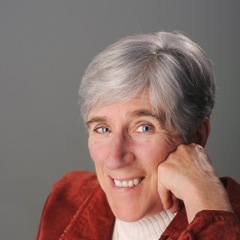
More about Mary: MaryProfilePic

Mary has made a career out of changing careers. She spent nearly thirty years in the financial markets, including consulting projects in New York, New Zealand and Australia. Along the way, she dropped out several times. In the mid-80s, at age 40, Mary and her husband Tom embarked on the three-year sailing voyage that is the subject of her memoir, SAILING DOWN THE MOONBEAM. When the voyage ended, she returned to her career in finance, but dropped out again to provide financial and strategic planning services to the nonprofit community. In her latest incarnation, she is a full time writer. Her first novel, A FITTING PLACE, was released May 1, 2014.  She lives in Des Moines, Iowa.

Contact Mary:

Website

Twitter

Facebook

LinkedIn

Google+

Links to her Books:

Sailing Down the Moonbeam 

A Fitting Place

Fighting Spirit: Rhetoric, Rotten Rulers, and a Sex Strike

Is a family graduation on your calendar this year?

As a faculty member at Florida State College at Jacksonville (then Florida Community College), I attended graduation every year in full regalia with hundreds of ecstatic grads, joyful families, and proud faculty and administration.

The Tawdry Tale

One year stands out though: 2001. State Representative X rose to the podium to deliver the commencement address and announced that his remarks would be short and to the point. Relieved, the audience sat back to enjoy a brief speech entitled A Short Guide to a Happy Life.  Hmm . . . the title sounded familiar, I thought. Then he went on to tick off the main points: 1. Don’t confuse life with work. 2. Life is what happens when you are making other plans. 3. If you win the rat race, you are still a rat. . . . Then it dawned on me. I have heard this all before. In fact I’ve read it. Recently. In a book. In a book by Anna Quindlen with the same title. This man with an honorable title in high office is plagiarizing his speech, giving no credit to Quindlen or reference to her book. His whole speech. Boldly. Baldly. With no bones about honesty!

QuindlenShortGuide

My sense of justice on high alert, I set out to right the wrong. No, to expose the guilty. I contact the campus president in charge of graduation. Yes, she will check up on my suspicion and she does follow through. There are more emails and phone calls, which in the end boil down to the critical question: Where is the audio recording of that address? Alas, it is never un-earthed. We are told the recording mechanism failed (?) and thus no incriminating evidence is available. Sadly, just my words remain which have now fallen. Flat. On deaf ears.

*  *  *

My own college graduation is a distant memory. When I graduated from Eastern Mennonite College with a degree in English, I was still a plain girl, but with a B. A. degree in English education. I don’t remember at all who spoke at the commencement address or what the topic was, but I am sure there was an emphasis on service to others, demonstrating peace while upholding justice, still strong tenets of my alma mater, now Eastern Mennonite University.

Senior Photo: Eastern Mennonite College


The Nobel Laureate

Tomorrow another graduation occurs. On Sunday, April 27, 2014 an honorable woman, Leymah Gbowee, co-winner of the 2011 Nobel Peace Prize and a 2007 EMU alumna, will give the 96th annual commencement address at Eastern Mennonite University. Gbowee was the focus of a documentary “Pray the Devil Back to Hell,” which demonstrates how women, both Christian and Muslim confronted then-Liberian President Charles Taylor “with a demand for peace and end a bloody 14-year-old civil war.” Her genius: Gbowee rallied women, all dressed in white from various ethnic groups to lock arms, protest, and over time literally pray the ruthless rebels, including the President, into retreat. They even staged a sex strike which her book describes in more detail. In 2007 Leymah Gbowee received a Master of Arts in Conflict Transformation from the Center for Justice and Peace-building at EMU, also her alma mater. No doubt in her graduation speech she will make reference to her book: Mighty Be Our Powers: How Sisterhood, Prayer, and Sex Changed a Nation at War.

BookLaymahGbowee

But I can assure you—she has plagiarized neither her book nor her speech!

*  *  *

When have you become outspoken against an injustice?  What were the results?

Have you heard of Leymah Gbowee? Anyone else you know with her qualities?

Happy Birthday, Will!

News Flash!

ShakesBirthdayCrown

To mark Shakespeare’s 450th birthday, “the Royal Shakespeare Company is spearheading a three year Jubilee, between 2014 and 2016, that will involve theatre performances, events and live streaming cinema around the world.”

*  *  *  *  *

Florida State College students: Of course they're discussing Shakespeare!
Florida State College students: Of course they’re discussing Shakespeare!

It’s April 23 in my college class of English Lit students. Each has brought in a can of Coke, Dr. Pepper or bottled water. I bring cupcakes—chocolate and vanilla for the party.

Reputedly, April 23, 1564 is the birthday of William Shakespeare, the Bard of Avon. It is also the date of his death in 1616, but we are celebrating his life, especially the writing of his gushy love sonnets (“Shall I compare thee to a summer’s day?”) and his play, King Lear, which we have just read with all that fussing about a father’s will, sister sniping, revenge and murder. The body count is always high in Shakespeare’s tragedies.

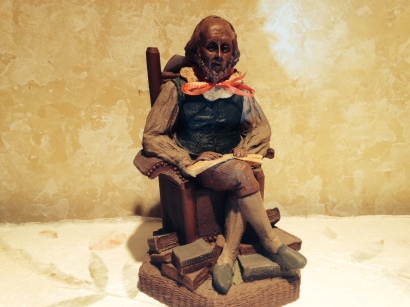
A fixture at every birthday party, Shakespeare wore a bow today.
A fixture at every birthday party, Shakespeare wears a bow today.

Until I was out of high school, I did not realize that my Mennonite Mom was referring to Shakespeare’s line “God has given you one face, and you make yourself another” (Hamlet) when she chided me for wearing makeup. “I’m happy with the face God gave me,” she would retort.

And Grandma Longenecker probably wasn’t aware she was quoting from Midsummer NIght’s Dream either when she tried to comfort me with the words of Lysander: “The course of true love never did run smooth” over my break-up with David, a boyfriend in college. And of various presidents, Truman, Eisenhower, or Kennedy, she would quote from Shakespeare’s Henry IV: “Uneasy lies the head that wears the crown.” I can still hear her cracking the “C” in crown.

Other quotes you may know: 

  • Better three hours too soon than a minute too late.
  • If music be the food of love, play on.
  • Suspicion always haunts the guilty mind.
  • No legacy is so rich as honesty.
  • What’s in a name? That which we call a rose by any other name would smell as sweet.
  • O, had I but followed the arts!
  • ‘Tis better to bear the ills we have than fly to others that we know not of.
  • With mirth and laughter let old wrinkles come.
  • This above all; to thine own self be true.

What special sayings do you remember from your childhood?


What quotes by Shakespeare can you add to the list?

I love it when you comment!

Please check it out: My writer friend, Traci Carver, teacher at Valwood School, a college prep high school in Valdosta, GA, posted on her blog a creative classroom scene from Shakespeare’s Romeo and Juliet featuring foam pool noodles and Twitter hashtags. Creative and memorable!


Purple Passages: A Dragon with a Gift, April 2014

LILACS

LILACS

April is the cruellest month, breeding

Lilacs out of the dead land, mixing

Memory and desire, stirring

Dull roots and spring rain.

T. S. Eliot The Waste-Land


When Lilacs last in the dooryard bloom’d

And the great star early droop’d in the western sky in the night,

I mourn’d, and yet shall mourn with every-returning spring.

Ever-returning spring, trinity sure to me you bring,

Lilac blooming perennial and drooping star in the west,

And thought of him I love.


Walt Whitman, elegy commemorating the death of Lincoln, 1865


EASTER

Easter is very important to me, it’s a second chance.  ―  Reba McEntire

Do not abandon yourselves to despair. We are the Easter people and hallelujah is our song.    ― Pope John Paul II


LAUGHTER

Laughter is the shock absorber that eases the blows of life.    (Unknown)

Laughter is a tranquilizer with no side effects.  ―  Arnold H. Glasgow


WORK

Nothing is really work unless you would rather be doing something else. ―  J. M. Barrie

When you can’t figure out what to do, it’s time for a nap.    ― Mason Cooley


CHALLENGE

Challenge is a dragon with a gift in its mouth. Dragon and Gift_final_shade+color_crop_5x5_300

Tame the dragon and the gift is yours.

Noela Evans, on persevering through problems, endurance

Shakespeare says it another way, but with a toad:  Sweet are the uses of adversity which, like the toad, ugly and venomous, wears yet a precious jewel in his head. 

READING

Reading gives us someplace to go when we have to stay where we are. ― Mason Cooley

One rainy Sunday when I was in the third grade, I picked up a book to look at the pictures and discovered that even though I did not want to, I was reading. I have been a reader ever since.   ― Beverly Cleary

Marian Reading_14mos._2x4_300 THE  FUTURE

The best thing about the future is it comes one day at a time.  ― Abraham Lincoln

 *   *   *

Do you believe a challenge is a dragon with a gift in its mouth? A story about this that comes to mind . . . ?

What category can you add a quote to? 

What other topics would you like to see in this monthly feature, Purple Passages?

Coming next: Mennonite Flashback III: Rabbits and Rings

2 Easter Vignettes: Sacred and Sentimental

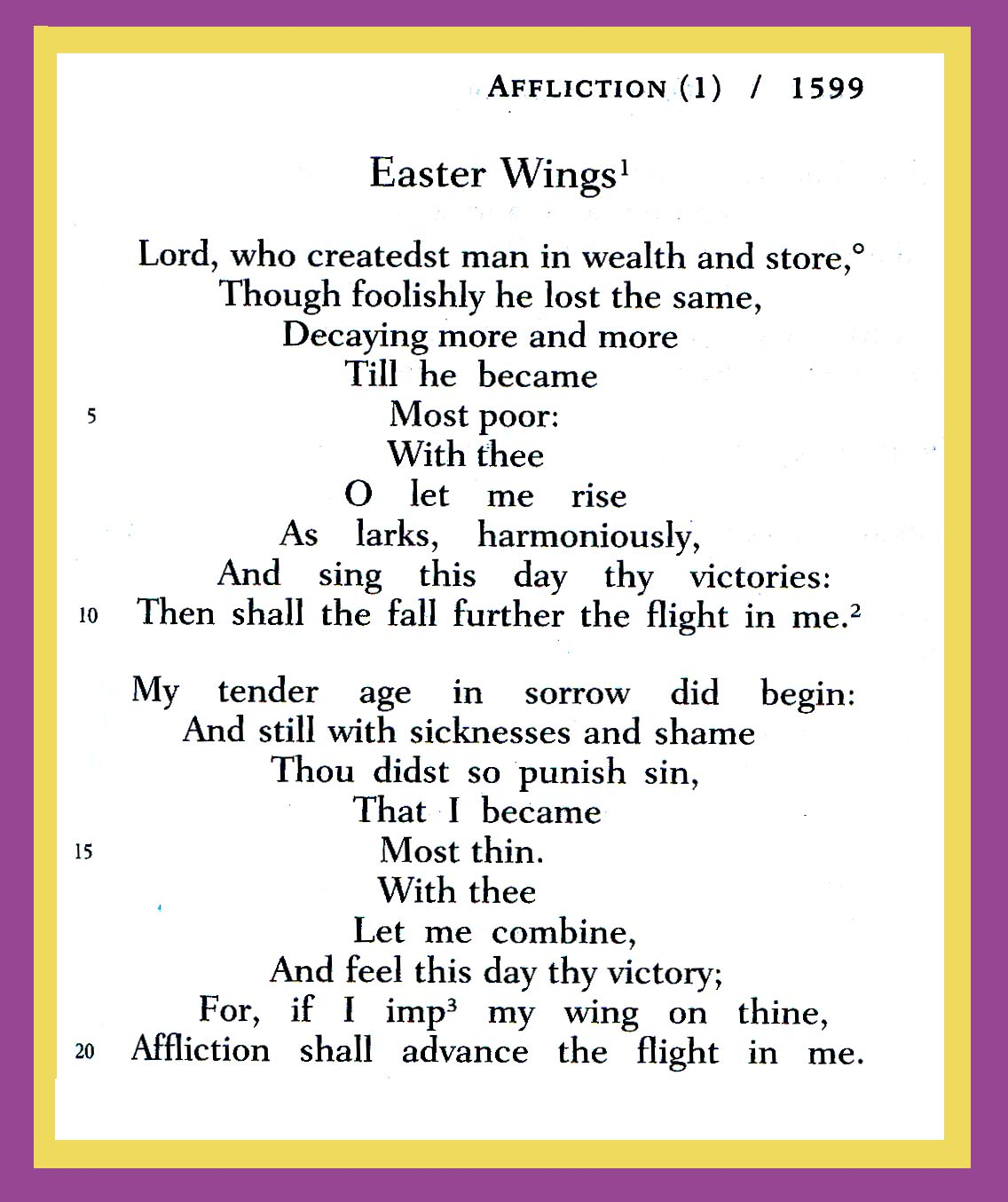
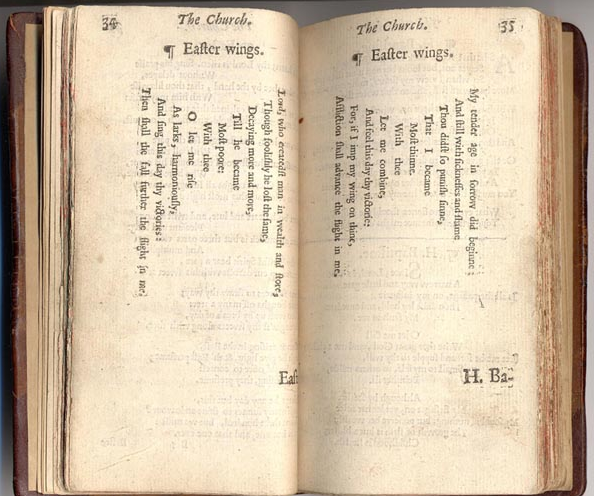
* Poem for Easter – British poet George Herbert loved to explore the soul’s inner architecture. He often wrote poems with shapes representing a theme, the resurrection in this case. The poetic lines, “increasing and decreasing to imitate flight,” also mimic the spiritual experience of rising and falling.

Easter WingsVertical_poem_4x5_300

Then viewed vertically the poem displays images of two butterflies, symbols of new life: Emblem poetry (technopaegnia) printed in a shape that reflects the subject of the poem.

Manuscript from the Bodleian Collection, Oxford University, 1633

Since by long centuries of custom the date of Easter is annually determined from the first Sunday after the full moon on or after March 21, the intertwining of physical and spiritual seasons is virtually inevitable.

Wisdom in Waiting: Spring’s Sacred Days by Phyllis Tickle

* Easter parade at Rheems Elementary School

My Mennonite school teacher, Miss Ruth Longenecker, was an artist. Though she dressed plainly with hair in a bun and a standard regulation prayer covering, her life brimmed with color, design, and pageantry. She painted in oils, preserving the old sycamore tree by the bridge at the old Martin home place on canvas:

Sycamore tree and bridge along lane leading up to the Martin farm Oil painting by Ruth Martin Longenecker
Sycamore tree and bridge along lane leading up to the Martin farm       Oil painting by Ruth Martin Longenecker

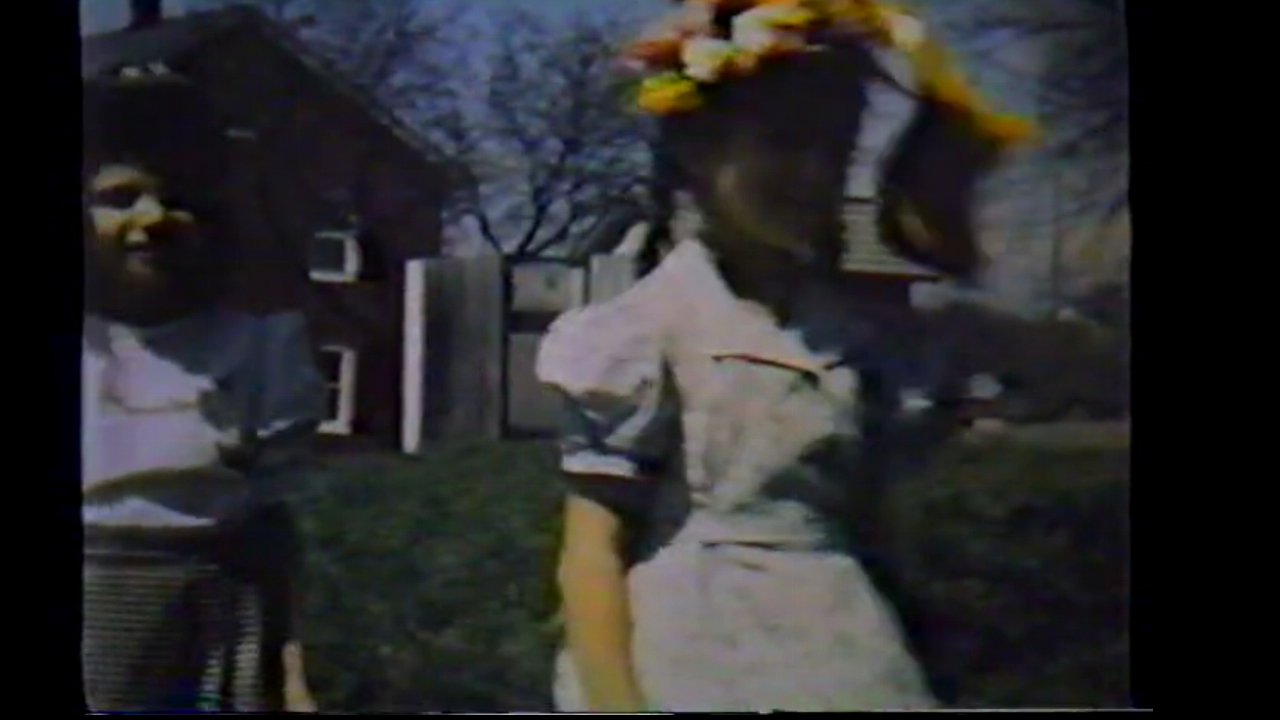
In her classroom at Christmas time was a tall tree laden with brilliant bulbs and glistening tinsel at school, though Mennonites were discouraged from having worldly Christmas trees at home. For St. Patrick’s Day, my classmates and I wore Derby hats and huge green shamrocks. But Easter was a real blow-out. Students brought hats and silky flowers from home to add to the creative collection (pasted, stapled, sewed). We paraded up and down the village streets near Rheems Elementary School, our teacher preserving the frivolity on her 16 mm movie film. Even the boys wore hats, some even more flower-encrusted than the girls.

Hand-made millinery on display at Rheems Elementary School

Thank you for commenting. You can count on me to reply.

The conversation continues . . . .

Coming Monday: Guest post on Mary Gottschalk’s blog: Flying the Coop: Leaving Mennonite Land

Purple Passages with a Fish & a Kiss

Purple Passages with a Fish & a Kiss, March 2014 Edition

Winter

Winter lies too long in country towns; hangs on until it is stale and shabby, old and sullen.     Willa Cather, My Antonia

If winter comes, can spring be far behind?     Percy Bysshe Shelley “Ode to the West Wind”

Gardens

Bougainvillea in my Garden

The garden is one of the two great metaphors for humanity. The other, of course, is the river.      Anne Lamott, Bird by Bird

Grief

In God’s garden of grace, even a broken tree can bring forth fruit . . . . The greater the grief the fewer the words.         Pastor Rick Warren on The View: Friday, Dec. 7, 2013

The way to love anything is to realize that it may be lost.    G. K. Chesterton

When a loved one becomes a memory, the memory becomes a treasure. Author Unknown   (viewed on Kathy Pooler’s website, January 27, 2014)

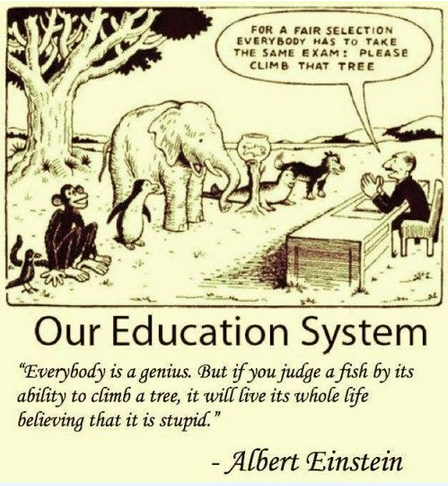
Einstein

bestEinsteinFishQuote

(Quote on education attributed to Einstein but disputed by some sources.)

KissingEinstein

 SUCCESS and HAPPINESS

Success is not the key to happiness, happiness is the key to success. If you love what you are doing you will be successful.         Dr. Albert Schweitzer  (Quoted in Daily Devotional: The Word for You Today, Dec. 2013–Feb. 2014.)

Question Mark w border1_1x1_300

Dear Reader: You may have noticed I have included only one garden quote today.

Can you add a quote or a thought about gardening or beauty?

Can you add any other quote to the themes this month?


Facebook: http://www.facebook/marian.beaman/

Twitter: www.twitter.com/martabeaman

A Year of Biblical Womanhood: Rachel Held Evans’ Secrets Divulged

This evening my alma mater, Eastern Mennonite University, is hosting author Rachel Held Evans, one of the foremost thinkers and writers in evangelical circles today who has appeared on Oprah and The View and spotlighted by NPR, the BBC and The Washington Post. Her spell-binding book will stir you to see women, biblical and otherwise, in a new light.

If your comfort zone is just too cozy to leave right now, you can read about a gutsy woman who ditched her comfy life-style, visiting “an Amish schoolhouse in Gap, Pennsylvania; a pig farm in Cochabamba, Bolivia; and a Benedictine monastery in Cullman, Alabama.” Admitting to being domestically challenged, she took up knitting and baking even working her way through the recipes in Martha Stewart’s Cooking School.

Rachel Held Evans characterizes herself as a liberated woman, but for one year she became an Old Testament woman who admits she “spent an afternoon on my rooftop, adopted a computer-baby, camped out in my front yard during my period,” and left eight pounds of dough to rise in my bathroom.”

via Rachel Held Evans' website
via website of Rachel Held Evans

Intrigued by many of her friends who abandoned their careers for traditional gender roles in the home, “Evans decided to try it for herself, vowing to take all of the Bible’s instructions for women as literally as possible for a year,” sometimes pushing them to their literal extreme. The result is A Year of Biblical Womanhood: How a Liberated Woman Found Herself Sitting on Her Roof, Covering Her Head, and Calling Her Husband “Master,” a New York Times best-seller.

Each chapter records a month in which Evans focuses on a biblical virtue: October – gentleness, November – Domesticity, and so on.There is nothing starchy about her subtitles with chapters like February/Beauty “My Breasts are Like Towers” and March/Modesty “Hula-Hooping with the Amish,” who she mentions don’t wear white for their weddings because it’s worldly and don’t marry in June because that’s worldly too! 

The end of each chapter “month” features a character study of women like Eve or Mary Magdalene, but includes more obscure women like Junia, the Apostle or Huldah, the Prophet. That’s where Evans’ astute scholarship is most evident. With two unanswered questions, author Evans plunges into astonishing biblical research as her 8 pages of documentation verify: What does God truly expect of women? Is there a prescription for biblical womanhood? She admits:

I took my research way too seriously, combing through feminist, conservative, and liberal commentaries, and seeking out Jewish, Catholic, and Protestant perspectives on each issue. I spoke with modern-day women practicing ancient biblical mandates in their own lives—a polygamist, a pastor, a Quiverfull daughter, an Orthodox Jew, an Amish grandmother. I scoured the Bible, cover to cover, isolating and examining every verse I could find about mothers, daughters widows, wives, concubines, queens, prophetesses, and prostitutes.

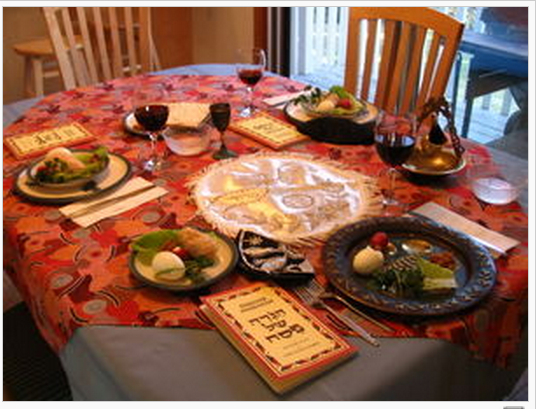
But Rachel had divine help along her pathway: Ahava, an orthodox Jew she met online who advised Rachel on all things Jewish. Guys in the food aisles at a Wal-Mart in East Tennessee who helped her search for Kosher ingredients for her Seder celebration. And her ever-accommodating husband Dan, whom she praises with a home-made sign at the city gates of Dayton, Tennessee, near where they live.

Seder table setting courtesy Wikipedia
Seder table setting courtesy Wikipedia images

Evans’ book is definitely a page-turner. I read her 310-page book in under 3 days. As one reviewer exclaims; “An unexpected, laugh-out-loud then turn the page and tear up, enjoyable and poignant read.” Another agrees that Rachel Evans tackles “the most sacred cows, willing to ask the trickiest questions” and observing fresh perspectives. For example, she reminds readers that it took the defiance of two queens to save the Jews—Esther by appearing before the king, Vashti by refusing to.”

Her website: http://www.rachelheldevans.com

Eschewing the traditional interpretation of Proverbs 31 that yokes most women with unreachable goals, Evans strives instead to be more like the Hebrew Eschet chayil, woman of valor, at its core a blessing to invoke, not a title to be earned.            “plain and fancy” observation

 Question Mark w border1_1x1_300

What do you think of author Evans’ experiment? Its outcomes?

Your thoughts added to mine can launch an animated conversation!

Behind the Scenes @ “Plain and Fancy Girl”

Writing a blog post is magical–right? Words appear in the right order and photos sift down from above and settle into a nifty niche between paragraphs. Well, sort of . . . When I created the post Mennonites, Ventrlloquists, and Memoir, 3 things happened in succession:

1. In Vladimir Nabokov’s memoir I read that the author can “ventriloquize” his voice by inventing incidents, characters, and relationships.

2. The word “ventriloquize” sparked an image of Howdy Doody and the forbidden TV show I sneaked off to watch.

EmersonTVHowdyDoody

3. That reminded me of a story about our next door neighbors, the “red-light” Rentzels whom I wrote about 10 years ago.

Writing that post wasn’t fast or easy but it was smooth, not usually the case.

So I invite you to the website of author Kathleen Pooler, who is hosting me today in a blog post which features me “undressing” some of my posts in public. Click here for secrets divulged! (You can leave a comment below or better yet on Kathy’s blog.)