And the great star early droop’d in the western sky in the night,
I mourn’d, and yet shall mourn with every-returning spring.
Ever-returning spring, trinity sure to me you bring,
Lilac blooming perennial and drooping star in the west,
And thought of him I love.
Walt Whitman, elegy commemorating the death of Lincoln, 1865
EASTER
Easter is very important to me, it’s a second chance. ― Reba McEntire
Do not abandon yourselves to despair. We are the Easter people and hallelujah is our song. ― Pope John Paul II
LAUGHTER
Laughter is the shock absorber that eases the blows of life. (Unknown)
Laughter is a tranquilizer with no side effects. ― Arnold H. Glasgow
WORK
Nothing is really work unless you would rather be doing something else. ― J. M. Barrie
When you can’t figure out what to do, it’s time for a nap. ― Mason Cooley
CHALLENGE
Challenge is a dragon with a gift in its mouth.
Tame the dragon and the gift is yours.
Noela Evans, on persevering through problems, endurance
Shakespeare says it another way, but with a toad: Sweet are the uses of adversity which, like the toad, ugly and venomous, wears yet a precious jewel in his head.
READING
Reading gives us someplace to go when we have to stay where we are. ― Mason Cooley
One rainy Sunday when I was in the third grade, I picked up a book to look at the pictures and discovered that even though I did not want to, I was reading. I have been a reader ever since. ― Beverly Cleary
THE FUTURE
The best thing about the future is it comes one day at a time. ― Abraham Lincoln
* * *
Do you believe a challenge is a dragon with a gift in its mouth? A story about this that comes to mind . . . ?
What category can you add a quote to?
What other topics would you like to see in this monthly feature, Purple Passages?
Coming next: Mennonite Flashback III: Rabbits and Rings
Mother Longenecker still lives in the same house she and Daddy bought soon after they got married in 1940. Their bedroom looked the same for decades, but it’s changed over the years. Here’s what is missing . . . and what I remember from so long ago.
1. The Art Deco inlaid-wood vanity where Mother sits on a bench to comb her long, glossy black hair before twisting it into a bun topped with a Mennonite covering.
Courtesy Google Images
2. A matching wardrobe smelling of moth balls and a copy of Sane Sex Life, with a dust cover of scarlet red and white. Black and white pen illustrations included. Eyes wide in wonder.
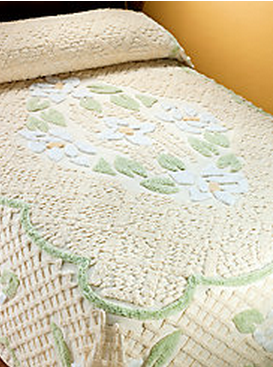
3. The chenille bedspread. I love the fluffy texture and the furry feeling under the pillows when I smooth the spread as I make my parents’ bed.
4. A skinny box with a silky slip inside wrapped in white tissue, brought home from a shopping trip to Hagar’s, Garvins, or Watt & Shand in Lancaster. We sometimes call them petticoats.
5. Evening in Paris cologne. Did Mom buy it for herself or was it a birthday gift from Daddy?
6. A jar of Noxzema. Sticking a finger deep in and gouging out a spoon of cleansing cream that feels cold on my skin even in the summertime. Can you smell the camphor and menthol just now? Maybe a touch of eucalyptus?
7. Daddy. He died in 1985.
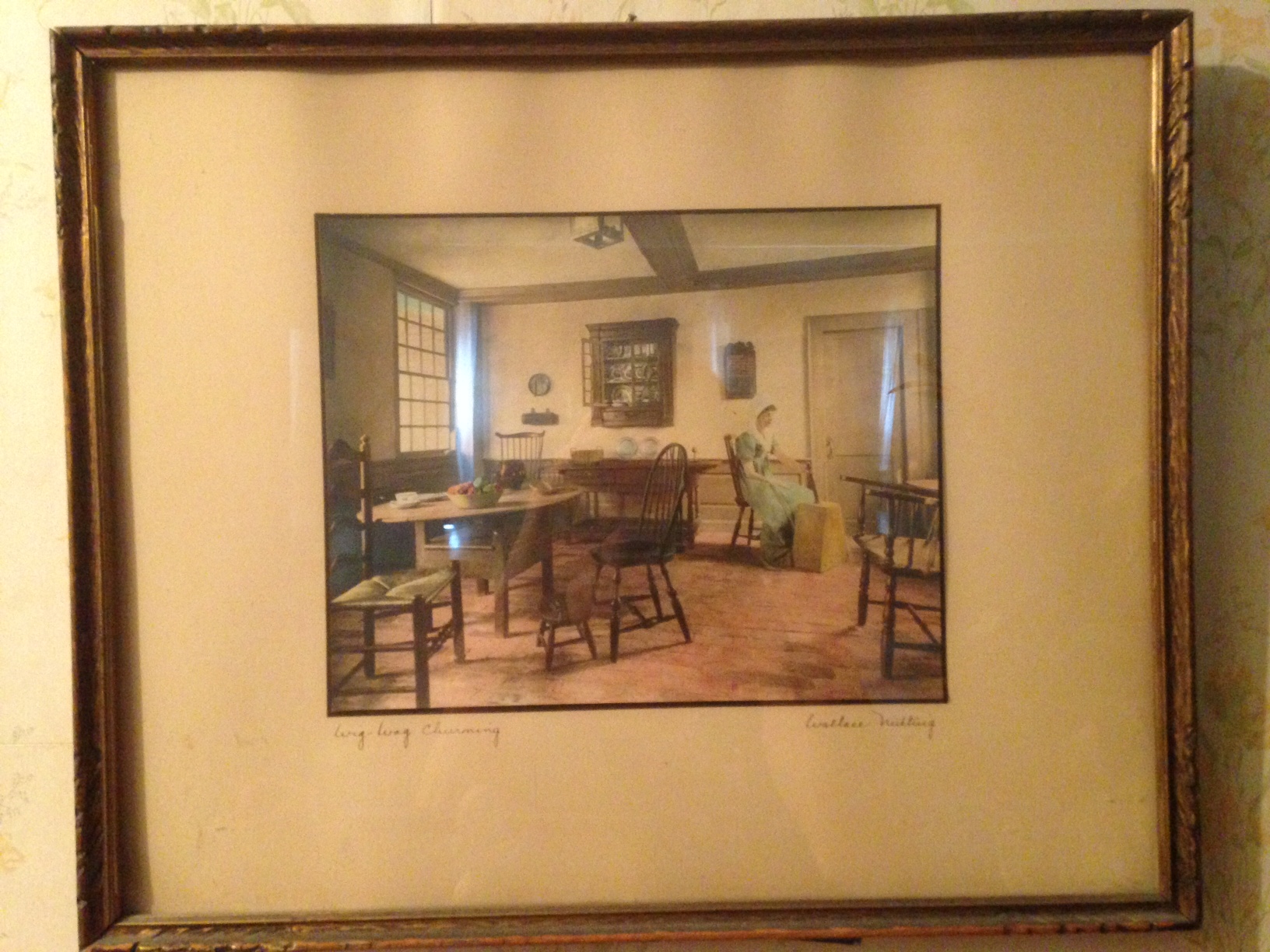
Postcript: What is still there? Hanging on the wall above a highboy, a framed pastel-tinted print by Wallace Nutting. The title on the left reads “Wig Wag Churning” (girl seated churning butter). A phrase on the right: “Wallace Nutting.” As a youngster, I kept looking for a boy named Wallace cracking nuts. Much later I figure out Mr. Nutting must be the artist.
What images or scents do you associate with your mother?
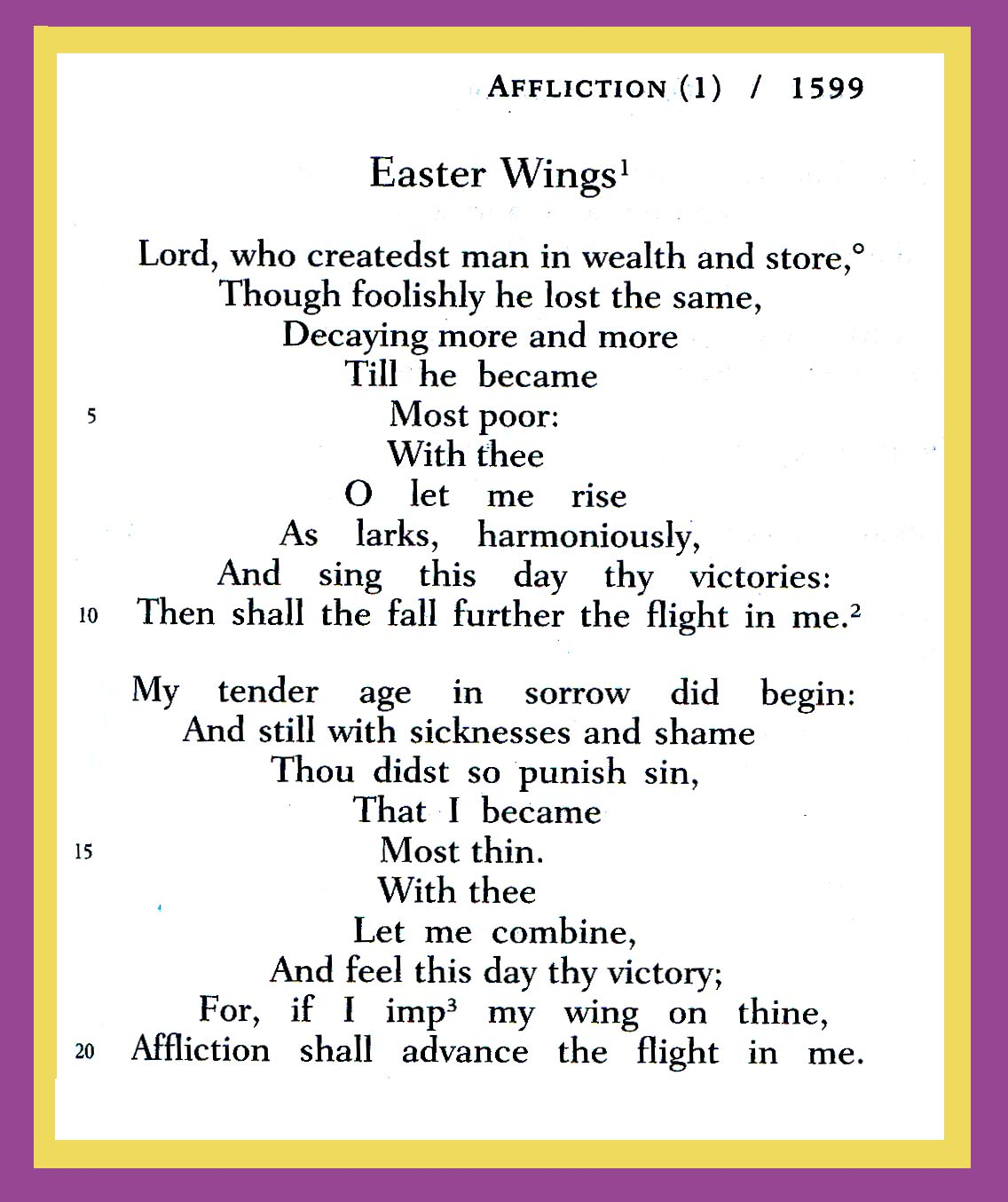
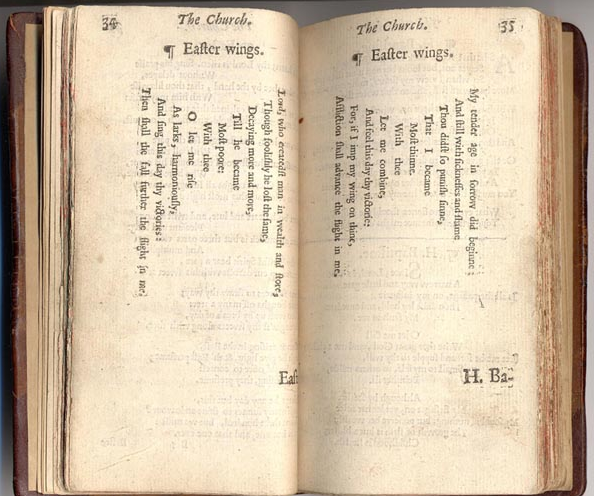
*Poem for Easter – British poet George Herbert loved to explore the soul’s inner architecture. He often wrote poems with shapes representing a theme, the resurrection in this case. The poetic lines, “increasing and decreasing to imitate flight,” also mimic the spiritual experience of rising and falling.
Then viewed vertically the poem displays images of two butterflies, symbols of new life: Emblem poetry (technopaegnia) printed in a shape that reflects the subject of the poem.
Manuscript from the Bodleian Collection, Oxford University, 1633
Since by long centuries of custom the date of Easter is annually determined from the first Sunday after the full moon on or after March 21, the intertwining of physical and spiritual seasons is virtually inevitable.
Wisdom in Waiting: Spring’s Sacred Days by Phyllis Tickle
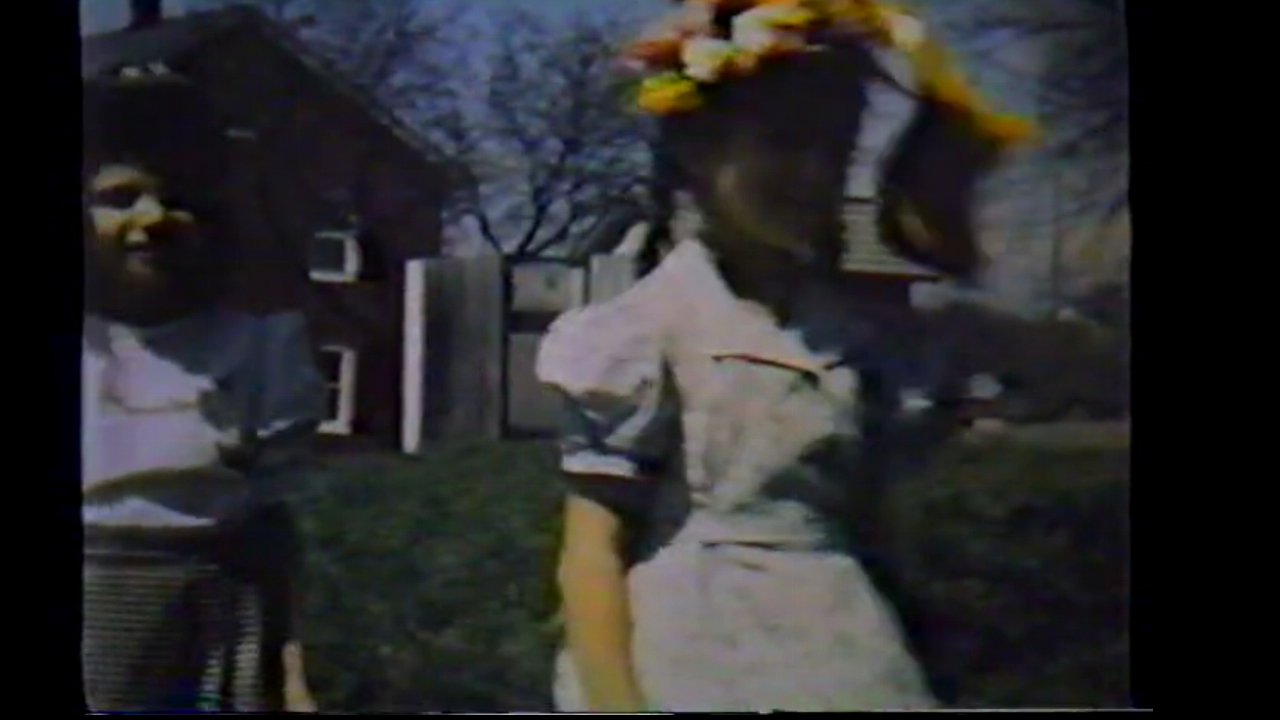
*Easter parade at Rheems Elementary School
My Mennonite school teacher, Miss Ruth Longenecker, was an artist. Though she dressed plainly with hair in a bun and a standard regulation prayer covering, her life brimmed with color, design, and pageantry. She painted in oils, preserving the old sycamore tree by the bridge at the old Martin home place on canvas:
Sycamore tree and bridge along lane leading up to the Martin farm Oil painting by Ruth Martin Longenecker
In her classroom at Christmas time was a tall tree laden with brilliant bulbs and glistening tinsel at school, though Mennonites were discouraged from having worldly Christmas trees at home. For St. Patrick’s Day, my classmates and I wore Derby hats and huge green shamrocks. But Easter was a real blow-out. Students brought hats and silky flowers from home to add to the creative collection (pasted, stapled, sewed). We paraded up and down the village streets near Rheems Elementary School, our teacher preserving the frivolity on her 16 mm movie film. Even the boys wore hats, some even more flower-encrusted than the girls.
Hand-made millinery on display at Rheems Elementary School
Thank you for commenting. You can count on me to reply.
The conversation continues . . . .
Coming Monday: Guest post on Mary Gottschalk’s blog: Flying the Coop: Leaving Mennonite Land
Purple Passages with a Fish & a Kiss, March 2014 Edition
Winter
Winter lies too long in country towns; hangs on until it is stale and shabby, old and sullen. Willa Cather, My Antonia
If winter comes, can spring be far behind? Percy Bysshe Shelley “Ode to the West Wind”
Gardens
Bougainvillea in my Garden
The garden is one of the two great metaphors for humanity. The other, of course, is the river. Anne Lamott, Bird by Bird
Grief
In God’s garden of grace, even a broken tree can bring forth fruit . . . . The greater the grief the fewer the words. Pastor Rick Warren on The View: Friday, Dec. 7, 2013
The way to love anything is to realize that it may be lost. G. K. Chesterton
When a loved one becomes a memory, the memory becomes a treasure. Author Unknown (viewed on Kathy Pooler’s website, January 27, 2014)
Einstein
(Quote on education attributed to Einstein but disputed by some sources.)
SUCCESS and HAPPINESS
Success is not the key to happiness, happiness is the key to success. If you love what you are doing you will be successful. Dr. Albert Schweitzer (Quoted in Daily Devotional: The Word for You Today, Dec. 2013–Feb. 2014.)
Dear Reader:You may have noticed I have included only one garden quote today.
Can you add a quote or a thought about gardening or beauty?
Can you add any other quote to the themes this month?
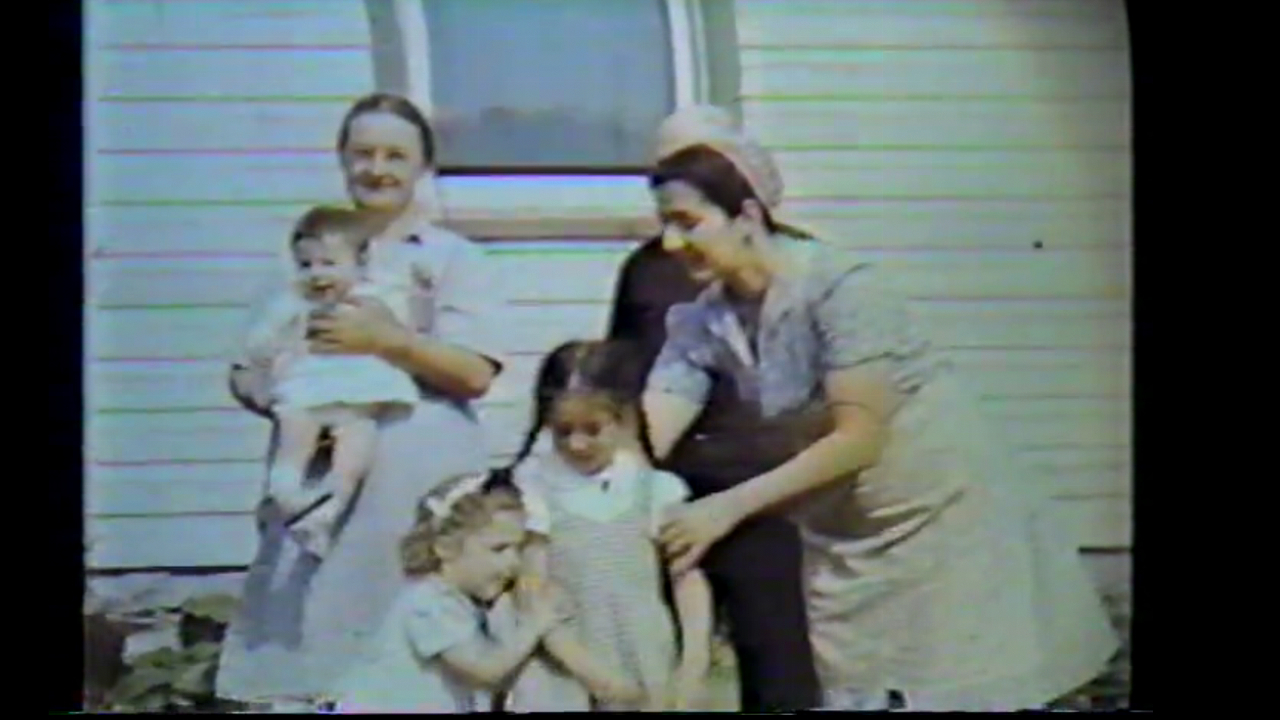
Looking at indistinct footage from 16 millimeter home movies of the 1950s has invited me to examine from a distance the much younger, and in many ways different, version of myself. Not surprisingly, I appear in the “mothering” mode in many of the shots. I have always assumed such behavior was because I was the first-born child.
But where does the mothering instinct come from? Is it inborn? Learned from one’s own mother? Are some born without it? Who knows. The jury is still out on the answers to some of these questions.
Mother positioning me with pigtails for the movie shoot with Grandma
My mother was not the firstborn in her family but she was the oldest girl, so when her own mother died when she was nine, there were high expectations for her including milking two cows in the morning before she went to school. All too soon, she became a little mother alongside the house-keeper, nurturing her two younger siblings.
In the sit-com Everybody Loves Raymond, “Mother-ish” is the word Mama Marie Barone has used to describe her modus operandi. Although I cringe to compare myself at any age to meddling mama Barone, it did seem natural for me to take on such a mothering role in my family. After all, I was the first-born, always ready to “tend” the younger ones.
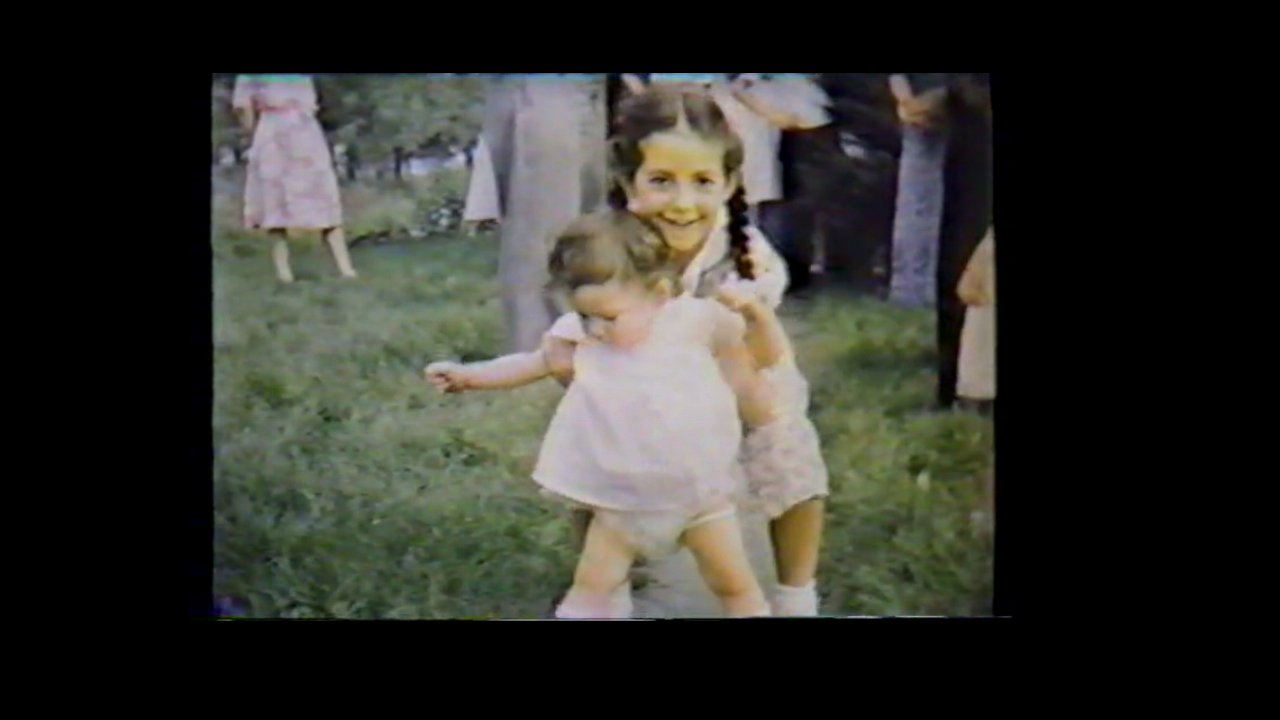
Big sister helping little sister Jean to walk
Even looking straight ahead, I was aware of wiggly little sister, who would spoil the photo if she crawled away in this video clip:
* * * * *
Several years later, with a prayer covering almost as big as my mother’s and with motherly aplomb, I held my baby brother Mark.
13-year-old “mother” holding baby brother Mark, with sister Jean
Alfred Adler was one of the first theorists to suggest that birth order has a profound effect on personality. However, his ideas about birth order have been repeatedly challenged by other researchers, like Cliff Isaacson, who argue that birth order is not a fixed state but subject to other influencing factors. Other studies (Scientific American) claim that family size, rather than birth order, is a better predictor of personality than birth order. Yet the concept of the take-charge, bossy (did I say “mother-ish?”) first-born persists in popular psychology.
I wonder where you are in your family’s birth order: first, middle, last, or an only child?
Do you think this has influenced your personality at all?
Thanks for replying. You will always hear from me and probably learn from other commenters too. The stories continue!
Red hats, purple dresses, feather boas — all signatures of the Red Hat Society. There is even a Queen Mother, Sue Ellen Cooper of Orange County, California, who founded the Society in 1998 after she hosted a fancy tea party for ladies decked out in purple and red. Since then, Cooper has written two best-sellers about her Society, which has spawned thousands of chapters of women with “hattitude” nationwide.
“When I am an old woman, I shall wear purple / With a red hat . . . !”
My sisters and I had our own Red Hat Lady, my plain Grandma Longenecker’s fancy cousin, Mame Goss, who brought picked-over hats of all colors to us from a millinery shop where she worked in Middletown, Pennsylvania. Getting hats from Mame was heady stuff! She was a main character in the script of our youthful play-acting.
Mame is one step closer to revealing the treasures in her bag now. Soon we lay eyes on the partly smashed trousseau of hats, left over from the spring season. We fight over who gets what, of course.
* * *
“Here’s a straw hat with a polka dot bow, “ I say but cast it aside. Janice and Jean don’t pick it up either. They are eying the red satin bows and lavender netting attached to other headgear.
* * *
“Hey, I want this one,” Janice and Jean tussle over a swoopy hat with pink flowers. Jean finally picks up a white thing that looks like an upside-down, flat-bottomed boat with a wad of blue tulle tied in a fluffy bow in the back. Janice’s is flat and round and dark, not my taste, with black-eyed Susan circling the straw hat. I get the best hat, I believe. It is flat and round too, but navy, and studded with azalea pink silk flowers around the edges. Best of all, I can pull a dark blue net over my face. Instantly, I become a woman of mystery and allure.
* * *
We take our newly-found treasures up to Grandma’s bedroom and indulge in more fantasy. The space between her marble-topped vanity and tall headboard becomes our runway. We take turns prancing in front of her vanity mirror with wavy glass, cocking our heads just so and smiling at our reflections.
One day Auntie Mame brings another batch of hats. When I spy the red felt with broad brim, I know it is mine. Our catwalk this time is not the narrow confines of Grandma’s bedroom, but the front lawn along Harrisburg Avenue: Marian, Janice, and Jean preen for the camera this time. Soon enough we will stuff our hair under a prayer veiling, but until then, we’re fancy girls!
Home movie from the 1950s
Do you remember playing dress up as a kid? What were your costumes? Inquiring minds want to hear your story.
“All you need is love. But a little chocolate now and then doesn’t hurt.”
So says Charles M. Schulz. Valentine’s Day is interpreted by many to include cards, chocolates, candlelight and roses. Some even break the bank buying expensive jewelry. Valentine’s day was named for a Christian martyr dating back to the 5th century, but according to Arnie Seipel in an essay for NPR, its origins are dark and bloody even, beginning with the wild and crazy Romans and their feast of Lupercalia.
During the Middle Ages tokens of love were first expressed by handmade paper cards. In the 14th century Chaucer helped romanticize the holiday with his love quotes like “love is blind” from The Canterbury Tales and his Parlement of Foules, featuring an assembly of birds gathered together to choose their mates. From the Renaissance to the Victorian Age and beyond, poets wrote sonnets extolling romantic love: Shakespeare, known especially during this season for Sonnet # 116, and Elizabeth Barrett Browning’s famous lines “How do I Love Thee? Let me count the ways” in Sonnet # 43.
Today, Valentine’s Day is big business. In 2011, sales reached $ 18.6 billion. This year the figure will probably exceed 20 billion. Seipel quotes Helen Fisher, a sociologist at Rutgers University, who says that if commercialization has spoiled the day, we can blame only ourselves for buying into it. But the celebration of Valentine’s Day goes on nonetheless. Even with some sayings on candy hearts we never imagined:
A few candy heart sayings updated by social media: Courtesy Google Images
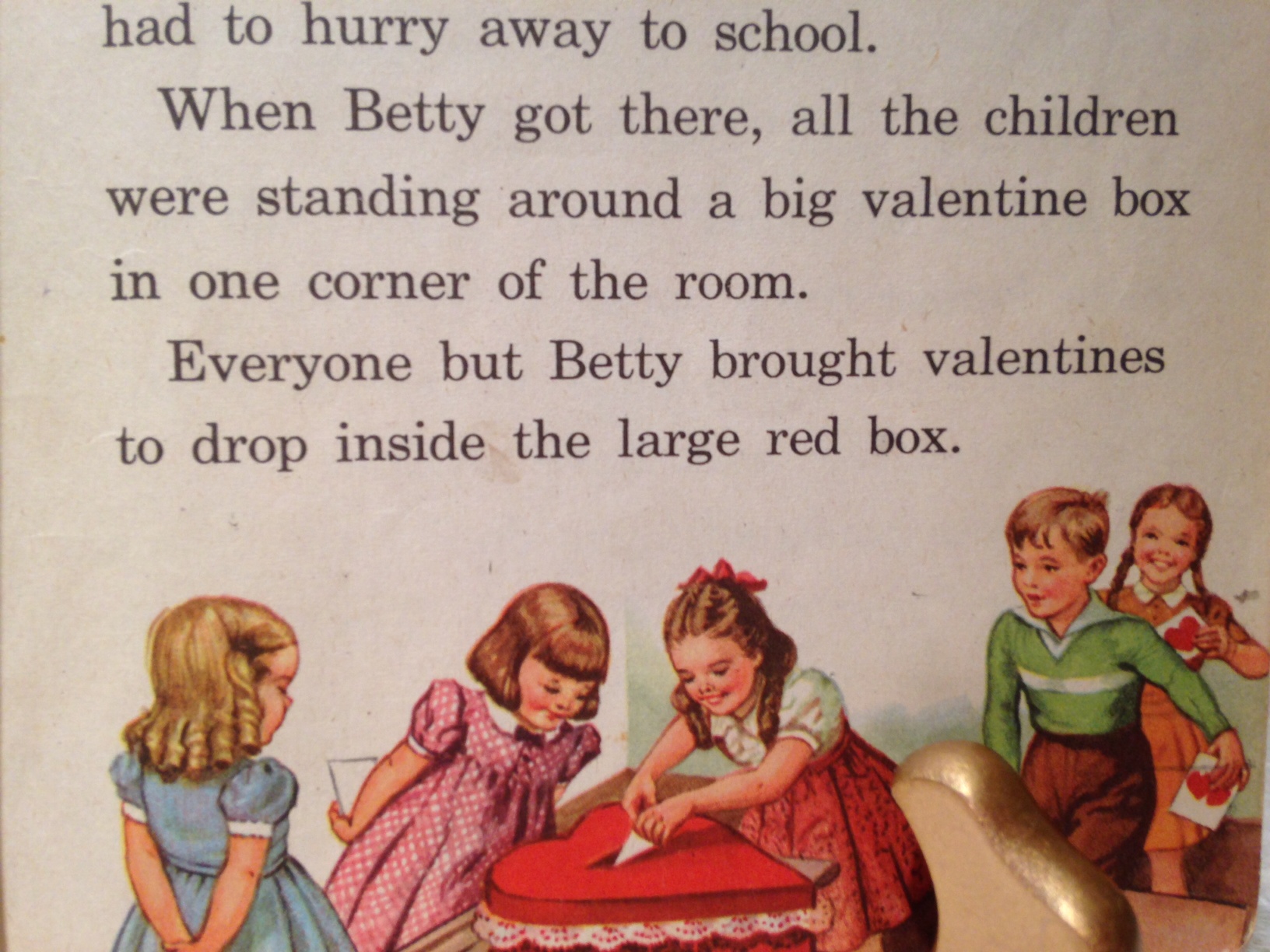
Years ago, candies like these were hand-picked for that special one, but many valentine cards were home-made. I remember making valentines for friends at school or punching cut-outs for classmates and dropping them in to the big, square box decorated red and white for Valentine’s Day at Rheems Elementary School. Stories in our readers illustrated children making, not buying, Valentine cards for friends:
“The Surprise Valentines,” Gray and Arbuthnot, Scott Foresman & Company, 1941.
Do you remember making or receiving hand-made valentines? Are you holding on to an old Valentine card for sentimental reasons?
Vintage cut-out card, Cliff Collection 1966
Your thoughts start the conversation—or keep it going. Thank you!
If I swallow a water-melon seed, my stomach might swell up.
If I touch freckle-faced Ricky with the dirty fingernails, I might grow a baby. Oh no!
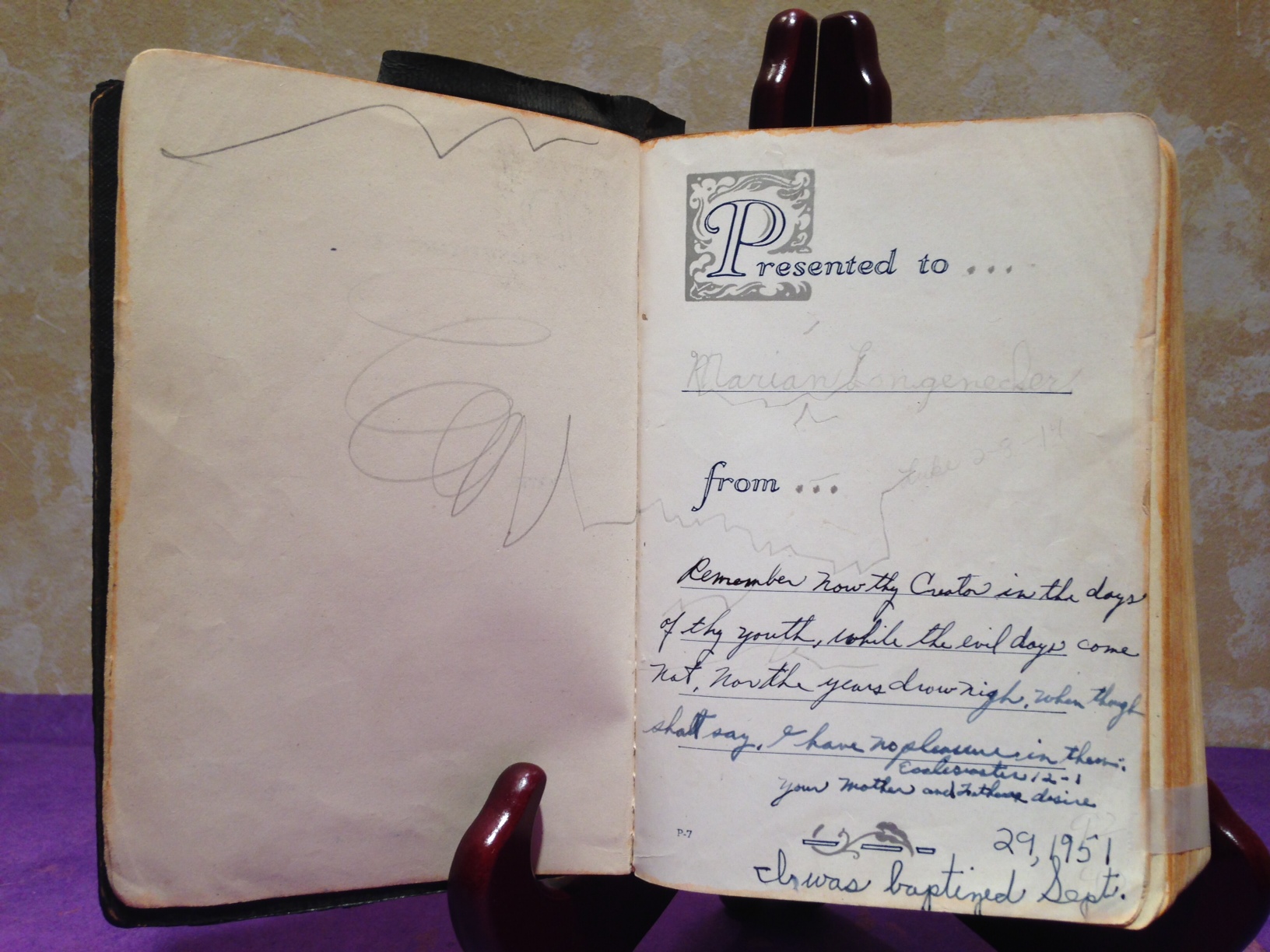
Those were my childhood fears. With a limited sex education, I tried never to swallow watermelon seeds or touch grimy Ricky. But my parents also had fears, largely unfounded. What my Daddy dreaded most as the father of three adolescent girls is that one of us might turn up pregnant some day and bring shame and disgrace upon the family. “We don’t ever want to hear of that happening in our family,” he exhorted. In my Bible he wrote this not-so-veiled admonition from Ecclesiastes:
Daddy’s inscription of Ecclesiastes 12:1 in the flyleaf of my Bible
Why he worried about my falling into mortal sin was beyond my comprehension: I always had my nose in a book and rarely dated Mennonite farm boys, or any other boys for that matter.
My experience with the lusts of men were of the non-Mennonite variety in my early teens. Summers I worked behind the meat counter for the Kleinfelters at Middletown Merchandise Mart. No worries with Mr. Kleinfelter, though he was often a bit tipsy, but some of his suppliers were another matter. Oily-haired Mr. Zapcic would creep up to the counter and invite me to “help” him in his produce business in Lancaster. “I need somebody to work behind the counter. You would be perfect!”
“That’s pretty far from Elizabethtown,” I mentioned innocently. Lancaster was almost 20 miles away.
Without my asking, Mr. Z. offered: “Oh, I’d see that you got there. You could ride with me.” It finally dawned on me what he was after and afterwards tried to ignore him. Yet he continued to harass me. Like Pamela in Samuel RIchardson’s novel, I rebuffed the man’s advances. Finally, I had to solicit some Kleinfelter help to get him to let me alone.
* * * * *
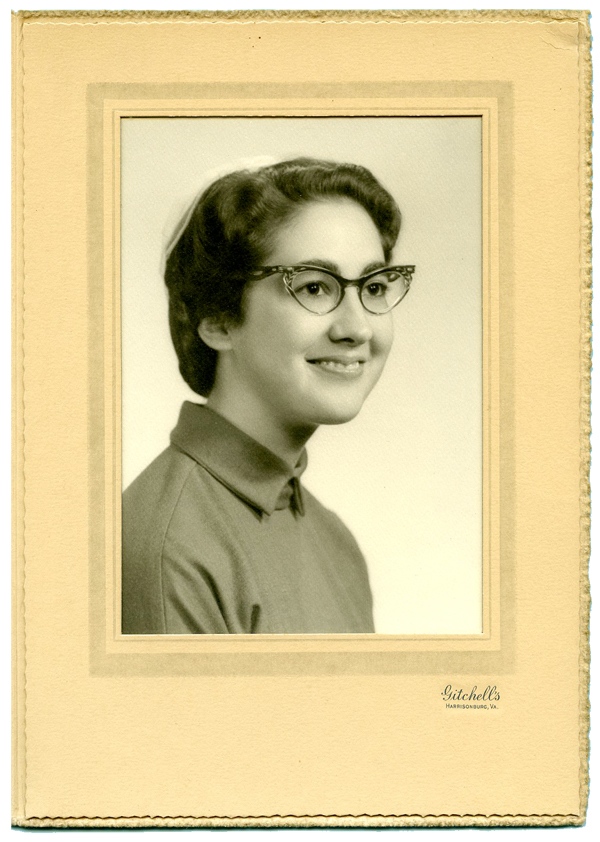
Senior Photo: Eastern Mennonite College
During the summer of 1964 my Aunt Ruthie and I attended Temple University, she to complete her Master in Education degree and me to begin it. From the hamlet of Rheems at 4:30 in the morning, we drove to Lancaster, took a train from Lancaster to Philadelphia, then rode the subway into north Philadelphia and walked eleven blocks to the campus of Temple University with classrooms filled with students who chain-smoked. I still wore a prayer veiling with a crown of dark brown braids fastened with hairpins underneath, ever the epitome of moral innocence. Ruthie’s classes lasted longer than mine, so I waited for her on a circular, wooden bench on the grassy campus outside the classroom.
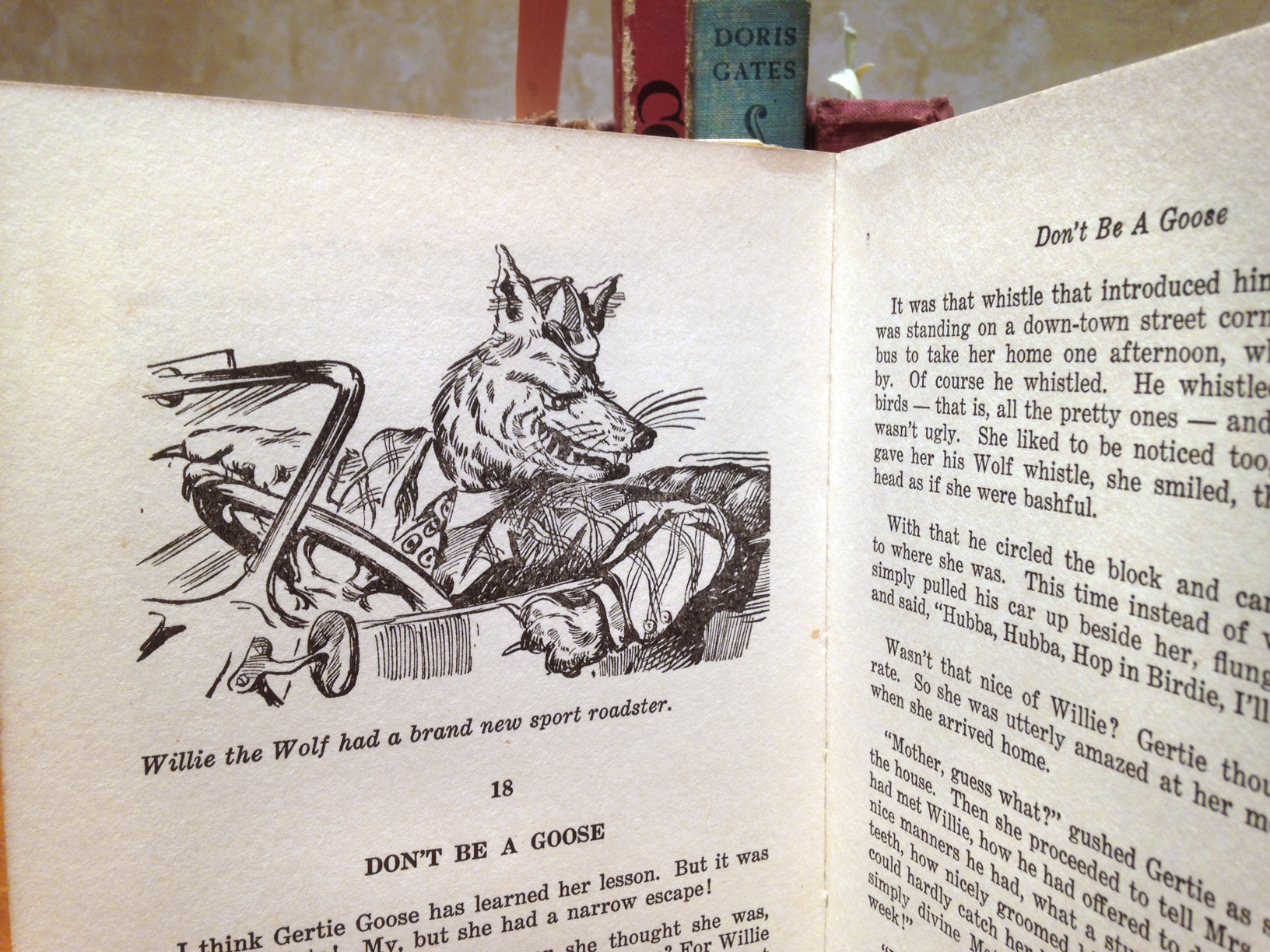
A suave older man approaches me and raves about my hair. It could be a scene right out of Bird Life in Wington, Gertie the Goose meets Willie the Wolf.
I notice at once his pearly white, even teeth and brushed back hair. Is he a college student? He for sure doesn’t look like one. Other students are milling around, I notice, so what could be the harm in talking to this stranger?
Willie: “Sprechen ze deutsche?” Not waiting for an answer, he spouts, “You have gorgeous hair. It’s so thick and glossy.”
Willie: I own a hair salon in the suburbs of Philly. I’d take you there and give you a different hair-do. It would frame your face really nice.
Gertie: Really?
Willie: Of course, I wouldn’t charge you anything.
Gertie: Well, thank you.
The dialogue continues for another minute or two, and then two things happen: I feel an electrical zap down my spine and a visitation from the Holy Spirit, who urgently whispers — “NO!” in my ear: “Run for your life. This guy is up to no good.”
Scales fall from my eyes as I swiftly dismiss his cunning ideas–and find an excuse to leave the bench and search desperately for Aunt Ruthie. Her class must be over. Soon, I hope. God, I hope soon!
Willie the Wolf in roadster tries to seduce Gertie the Goose in Calvin Reid’s cautionary tales
It’s your turn. Any narrow escapes from unsavory characters in your early years? Other threats to your moral virtue?
Your story is welcome here, and I will always reply.
The British poet Robert Herrick writes a fine sonnet about the allure of the slightly askew, the saucy, the off-beat–the messy in dress! Well, he has a point, but I don’t agree in general. I like neatness and appreciate the beauty of orderliness.
Too precise hand-writing clothes hanger, college days EMC
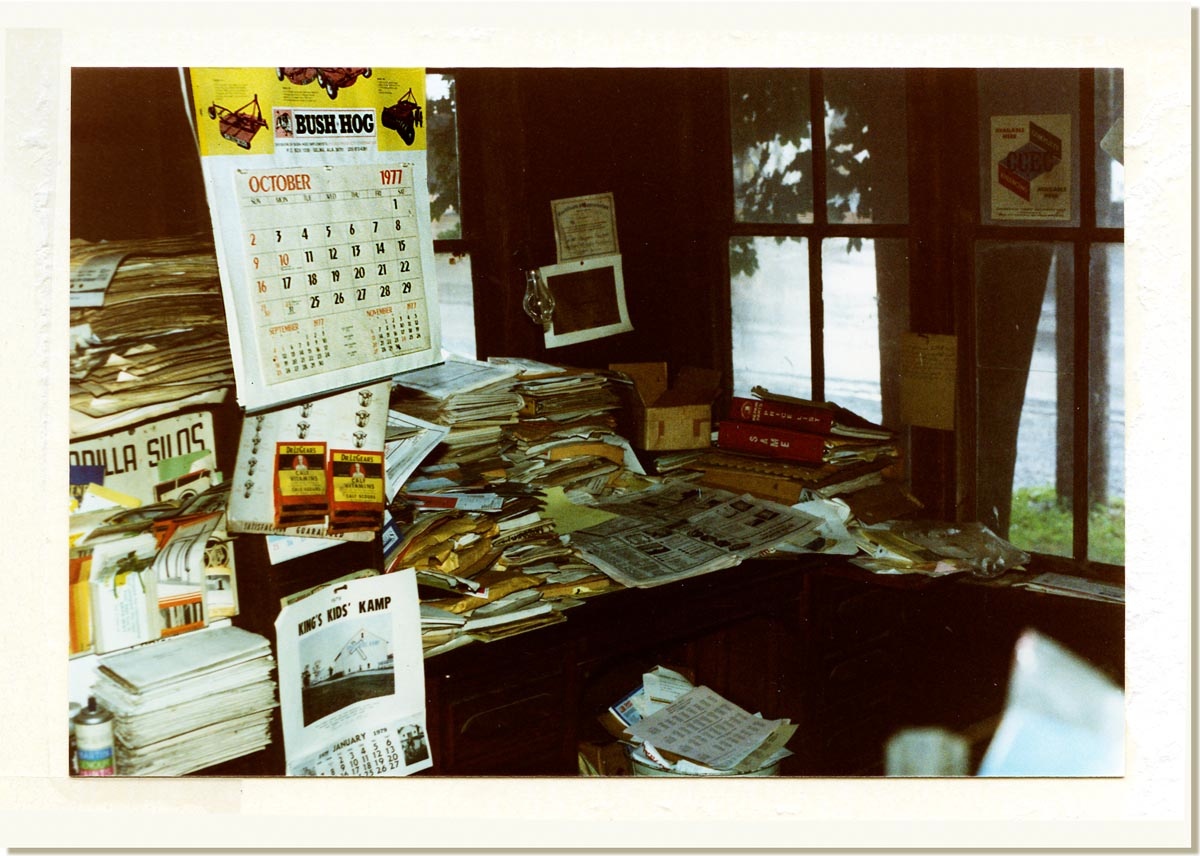
Mother was a neatnik too, every hair in place under her prayer covering, the whole house scrubbed clean every Friday, a place for everything and everything in its place. On the other hand, my dad, who was precise in the mechanics of fixing machinery in his farm supply business, was by nature messy, messy, messy–in his office, inside his truck, on the porch of his shop.
Brother Mark before sale of business
Daddy’s messy manner drove me crazy. Besides, it was embarrassing! In the middle of the village of Rheems, the shop faced Harrisburg Avenue with two main sections, one behind the other. The front part housed dozens of storage bins for nuts, bolts, screws, odd implements and, curiously, a Victrola sitting squat right beside the door to the sales office. During planting season, bags of Royster fertilizer for sale would be deposited off to the side near a loading/unloading door. As you walked to the rear, a long wooden ramp led to the back section where the dirty work was done, Daddy and his helpers fixing disk harrows, plows, or welding broken parts. Behind the shop was an assortment of implements stored Sanford & Son-style from which the mechanics harvested parts.
Occasionally, when Daddy said, “It’s time to sweep the shop,” I shuddered because I would be working in the cold with piles of stuff everywhere. Spritzing soapy water from a bucket to settle the dust, I watched charcoal-grey pustules of dirt and grease bead up on the cement floor, then tried to push-broom the filth into a dust pan, often an exercise in futility.
Though Daddy was messy, he had a strong Pennsylvania Dutch work ethic. At the shop six days a week, he caught up with office work and telephone sales in the evenings. “I worked like a Trojan today, and still didn’t get the Fox Harvester ready for Phares Weaver in time,” he’d say to Mother as he walked in the door. And he did so well in sales, dealerships would send him and Mother as VIPs on all-expense paid trips to Ohio, Florida, or Arizona to learn about new farm equipment. Once his sales were so high, his whole family, including three married daughters and son enjoyed a week-long vacation in Jamaica.
Daddy in his later years, taking a breather
So there’s neat and there is messy. “God is a God of order!” shouts one. The other camp retorts: “But you can’t be creative and neat at the same time!”
This post began with an homage to the slightly slovenly, the off-kilter. It ends with a writer lamenting her neat freakiness.
Being A Neat Freak
Being a neat freak, is certainly not a
blessing! No one enjoys, being this
way. When I find everything thrown
all around, on impulse, I have to put
them all away. I have always lived by
the creed, there’s a place for everything
and everything, in its place! It’s
aggravating, dealing with this, but I
know it’s something, I’ve got to face.
I’ve often wondered, how does a
person, get to be this way? It didn’t
happen over night, or in just a day.
Perhaps, it’s what we learned, when
we were young. And frankly speaking,
I’m tired of hearing people say, try not
to be so high strung! I’d like nothing
better, if I could let up, just a little bit,
by not letting myself become so
perturbed. Upon giving this some
thought, I realize, isn’t all of this, quite
absurd!
A man must have dreams–memory dreams of the past and eager dreams of the future. I never want to stop reaching for new goals. – Maurice Chevalier
Then the Lord answered me and said: “Write the vision And make it plain on tablets, That he may run who reads it. Habakkuk 2:2 New King James Version (NKJV)
Between your dream‘s inspiration and its manifestation, there’s going to be a lot of perspiration. Daily Devotional: The Word for you Today, January 2, 2014 entry
A [wo]man is not old until regrets take the place of dreams. John Barrymore
MEMORY
Yesterday is today’s memory and tomorrow is today’s dream. Kahlil Gibran
Memory is the script of the soul. Aristototle
Each day of our lives we make deposits in the memory banks of our [grand]children. Charles R. Swindoll
God gave us memory so we might have roses in December, (January, February . . )
From my JOURNALS 1996-1998
Gratitude is the heart’s memory. French proverb
Puttering is creating a fresh interior landscape. Sarah Ban Breathnach in Simple Abundance
Women share with men the need for personal success, even the taste for power, and no longer are we willing to satisfy those needs through the achievements of surrogates, whether husbands, children or merely role models. Elizabeth Dole
On Music:
“The auditory nerve is very closely connected to the limbic system so that sound (i.e. music) does not have to go through the cortex of the brain but goes directly to the heart, the senses.” unknown source (noted April 9, 1998)
Rhythm in music imprints language on the brain in a way pure auditory words will not. Slower tempo in classical music develops a framework for learning to occur. NPR report on “The Mozart Effect” (1998)
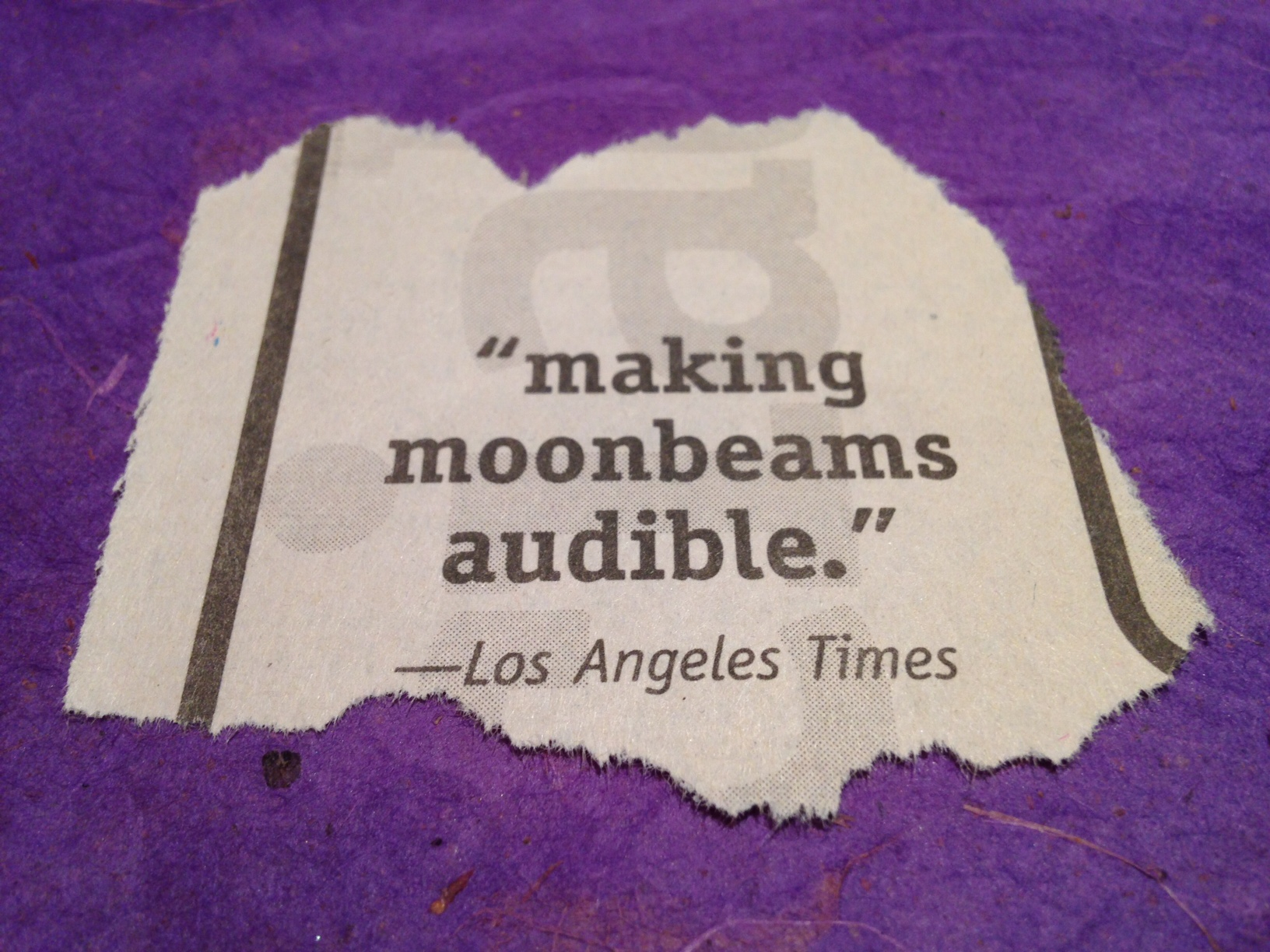
What Makes a Moonbeam Audible for you?
Feel free to comment also on any of the categories about: visions, dreams, memory, music, or something else. I will always reply!
Still time to vote for my story in Sonia Marsh’s My Gutsy Story Contest. Thank you, thank you to all who have already voted. You make a difference!


 THE FUTURE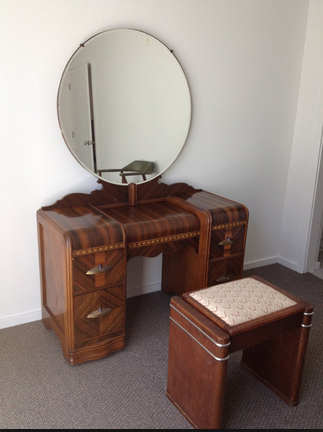



















 Plain and Fancy