The earth laughs in flowers.” – Ralph Waldo Emerson
MIRRORS
Life is a mirror and will reflect back to the thinker what he thinks into it. – Ernest Holmes
Mirrors can both reflect and distort as Tennyson suggests:
And moving through a mirror clear
That hangs before her all the year . . .
But in her web she still delights
To weave the mirror’s magic sights . . .
– The Lady of Shalott
An old friend is the best mirror. – George Herbert
* * *
PHOTOGRAPHY
Definition of photograph before the digital era: a picture painted by the sun without instruction in art. – Ambrose Bierce
Photography takes an instant out of time, altering life by holding it still. – Dorothea Lange
Later we’ll look at photographs, the way every family does, making much of the frozen moments, the icons of ancestry, the dead laughing right in your face, or just staring that non-committal historical gaze.” – Patricia Hampl The Florist’s Daughter
What Tallulah Bankhead thinks about photographs: They used to photograph Shirley Temple through gauze. They should photograph me through linoleum. Ha!
* * *
Photographs and mirrors. Your thoughts or quotes about either.
Sunsets, especially sunsets on the beach are # 1 on the list of clichés to avoid in photography. Yet beach sunsets persist on Instagram and Facebook because they are breath-taking, evocative.
Photo credit: Jackie Gassett
. . . the gauzy hinge between sea and sky, the limitless horizon dividing the elements, the disappearing point where we were headed.”
Patricia Hampl The Florist’s Daughter
My mother had a placid and accepting attitude toward life and death. At her funeral the hymns sung by the congregation were full of hope, “I Stand Amazed” and “The Love of God” among them. Another song in the Mennonite Church Hymnal entitled “Sunset and Evening Star” (which was not sung) pulls out the first four words of Tennyson’s poem “Crossing the Bar” written in 1889 just three years before he died.
Tennyson, also appearing to accept death as part of life, uses the metaphor of the sandbar on the beach to paint a picture of the tide of life pushing out to the “boundless deep” to which we return. The poet hopes that though he may be carried beyond the limits of time and space as we know them “he will look upon the face of his ‘Pilot’ when he has crossed the sand bar.”
This past July Mother crossed the bar into eternal glory and there she has beheld the face of her Pilot. Oh, how we miss her.
But now I must cross the bar of challenge and opportunity ever looking for new horizons. How about you?
What bar of challenge and opportunity confronts you now?
So now it matters almost not at all to any of them except as a storybook matters; loved in childhood but outgrown in adolescence, it still matters, still instructs, still is part of what the adult becomes.
Phyllis Tickle, The Graces We Remember: Songs in Ordinary Time (126)
When our children Crista and Joel were little, a prelude to nap-time was their mother chanting in a sing-song voice: “Come to the storybook chair, the story book chair, the story book chair, and we’ll read . . . .” Hearing that, they’d head for the rocking chair and climb on my lap for colorful Richard Scarry pages or the clever tricks of a George and Martha book. I’m carrying on a tradition that began with my mother who read to me from picture books, and also recited poetry from her school days.
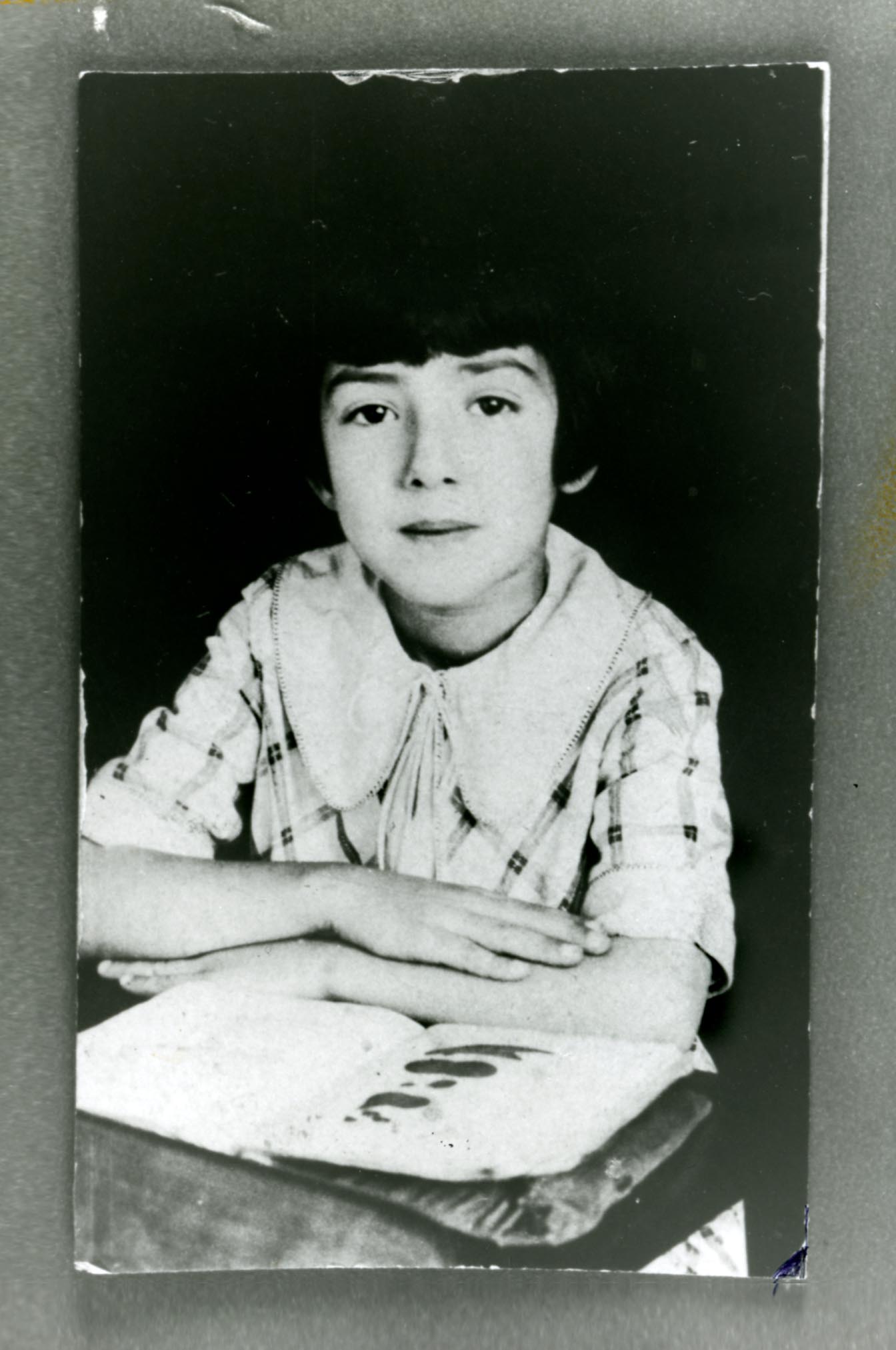
My journal tells me (and it does not lie) these are the poems by Robert Louis Stevenson that Mother recited to me in 1999 from her memories of Lime Rock School near Lititz, Pennsylvania in the mid 1920s.
Ruth Metzler Lime Rock School 1920s
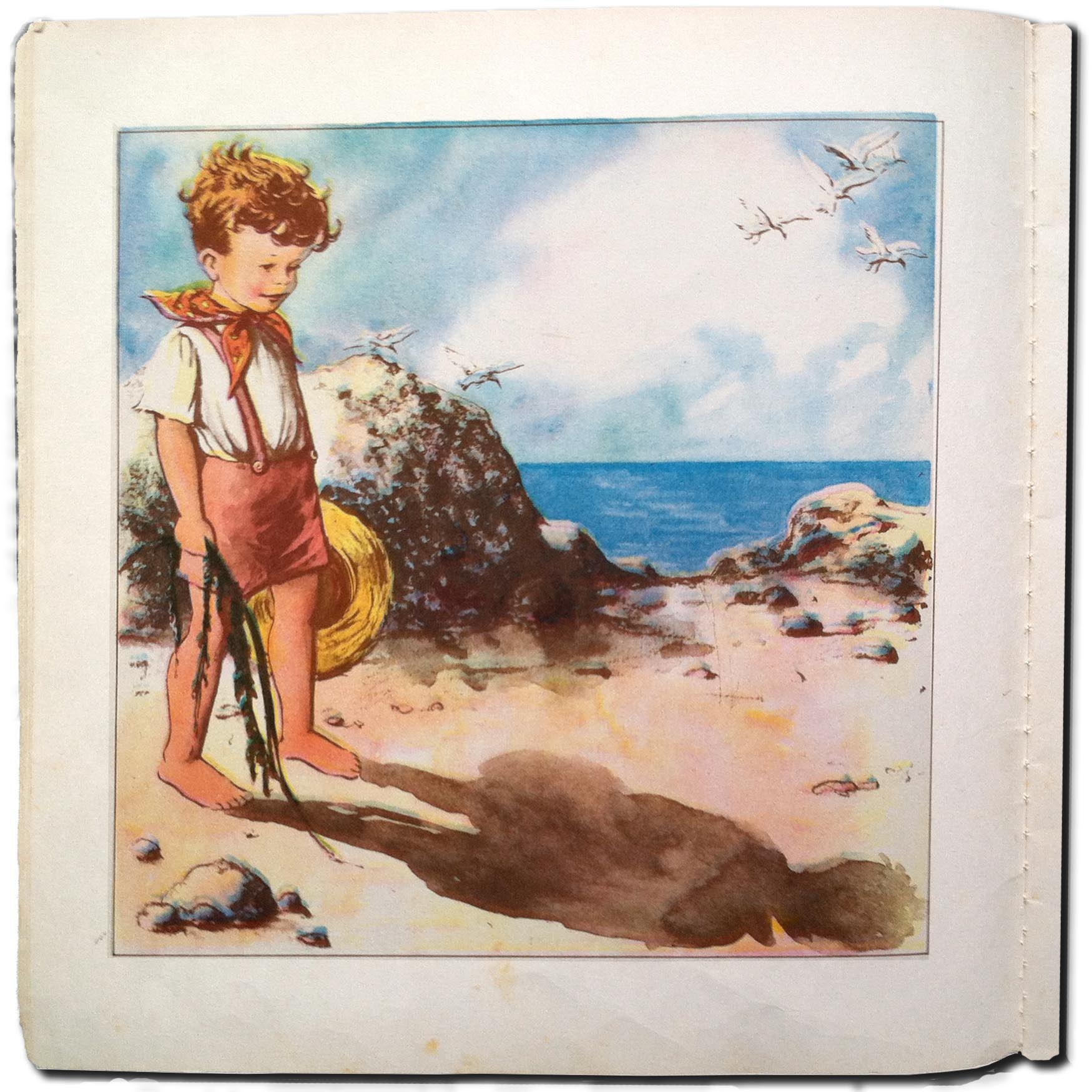
Illustrations from A Child’s Garden of Verses, John Martin’s House, Inc., circa 1945
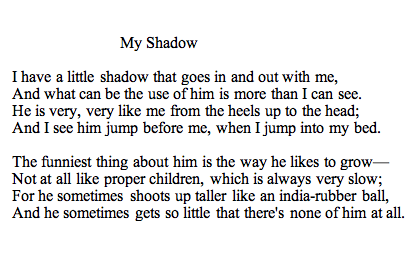
She also recited the verses of “My Shadow” from the “Golden Book of Poetry” 1947 with the familiar first two stanzas:
At the beginning of second grade, the summer I turned seven, I had my tonsils removed and among my memories (besides drinking chocolate milk through a straw and trying to swallow smashed bananas) is reading the poem “The Land of Counterpane” under a quilt that probably matched my own upon my sick-bed.
What are your early memories of reading? Did a friend or family member recite poetry or other words of wisdom to you?
Kathy and I are not old friends. In fact, our friendship is rather recent as we have explored each other’s blog posts early this year, discovering that we both were developing our writing skills after long, satisfying careers, hers in medicine and mine in education.
In March, she featured me on a blog post describing my writing process and in May I published a preview of her memoir now published in July 2014. Beyond this, we have discovered that our values are rooted in a strong Christian faith.
Kathy Pooler’s memoir Ever Faithful to His Lead is a smooth read but with a tale that is often tumultuous. Her memoir unfolds like a novel with pleasing dialogue and silky descriptions of her prom dress and her hand-made wedding gown in stark contrast to the rocky road she travels to become a strong, assertive woman.
In the course of her journey, Kathy earns several academic degrees among them the distinguished Certified Family Nurse Practitioner qualification. Yet she stumbles with poor choices in love, choosing one wrong partner after another in her search for a stable marriage like that she imagined her parents’ to be. In fact, she admits early on that she can trace her “inability to discern dangerous situations to a lack of exposure to anything out of the ordinary.”
Readers can applaud the resilient woman emerging from the frightened person who hid from her first husband in her hallway closet to a woman who is finally able to trust her own instincts. Her candor and vulnerability appear on every page. Kathy often pulls the reader aside to contemplate her motivation, as for example: “I was always second-guessing myself, quickly shoving doubts aside to paint the picture of what I needed the world to be.”
When you as reader want to snatch the blinders off the writer’s eyes and yell “Stop!” into her ears, you know the author has succeeded in pulling you into her world. This memoir is a cautionary tale for anyone on an elusive search for Mr. Right. For anyone already in an abusive relationship, Kathy’s story offers courage and hope. Admitting it is time to make big-girl choices, her last chapter promises, “Raw, hopeful, ready to dance to my own song—my new faith waiting patiently in the background.”
The book concludes with nine discussion questions for book clubs and a “Share the Hope” section with the notation that each purchase contributes toward the National Coalition of Domestic Violence Awareness Association. Author Pooler is already at work on a sequel: Hope Matters.
A tortoise had become friendly with two geese who promised to take it to their home in the mountains. The plan: The geese would hold a stick in their beaks while the tortoise would grasp it in the middle with his mouth, but he must be careful not to talk. During the journey, villagers below made fun of the tortoise. When it answered back, it fell to its destruction.
You guessed the moral: Talking at the wrong time can lead to fatal consequences!
Quick Quiz
1. Are you the first to air your knowledge when your favorite topic comes up?
2. Do you interject your opinion before anyone else has a chance to speak?
3. Do you tune out what others are saying because you are busy thinking of a comment?
I’m just guessing here, but you were probably the 3rd grader whose hand was the first to shoot up when your teacher asked a question. And I must say I am guilty as charged. Just see the Cliff and Marian misunderstanding below.
* * *
Hearing and listening are not the same thing. The difference between the sense of hearing and the skill of listening is attention, says Seth Horowitz in a New York Times piece.
The Harvard Business Review blog reveals that one in four corporate leaders have a listening deficit. No surprise there! In the business world, failure to listen can muddle the lines of communication, “sink careers, and if it’s the CEO with the deficit, derail the company.” In our personal lives, muddle and mayhem can result.
Good advice for better listening? First of all, slow down. While listening seems like such a passive thing to do, it is essential for understanding. Secondly, consider the source. “Try to understand each person’s frame of reference—where they are coming from.” Disagreements can often be averted with skilled listening.
Studies show that thoughts move about four times as fast as speech. No wonder it’s so hard to slow down and actually listen.
Here is the beginning of a list of tips for good listening:
1. Give full attention to whoever is speaking.
2. Don’t interrupt. Let the other person finish before you begin speaking.
3. Listen with your face as well as your ears. It’s appropriate to smile, frown, laugh, be silent at times when you are in conversation.
A Cliff and Marian Misunderstanding
Sometimes listeners with a lot of practice get muddled up. Here is a “He said / She said” from our own experience:
Marian: Let’s eat out today.
Cliff: Wonderful idea. (Time passes – Cliff leaves and comes home about dinner time noticing I’m in the middle of meal preparation.)
Cliff: I thought we were eating out this evening. Why, I had some ideas about where we would go.
Marian: For goodness sake, I was thinking that it would be nice to eat outside on the patio because it’s so cool.
Cliff: But I thought you meant we were eating out, like in a restaurant!
God help me!
Listening in the Longenecker Family 1950s
Living in the Longenecker family in the 1950s, we children were taught to listen, pay attention. In a parent-centered household, we listened to directions about chores, instructions about what to do and what not to do. To balance things out though, we also listened to Daddy singing as he played the guitar or the piano, or to Mother singing off-key in the kitchen. “I’ll be somewhere, listening, I’ll be somewhere listening, I’ll be somewhere listening for my na-aa-mm-e . . .
Please add your own tip, an observation, or an anecdote about listening or the lack thereof.
Hold fast to dreams, for if dreams die, life is a broken-winged bird that cannot fly.
– Langston Hughes in Dreams
Dreams always come in a size too big so we can grow into them. – Josie Bisset
. . . if one advances confidently in the direction of his dreams, and endeavors to live the life which he has imagined, he will meet with a success unexpected in common hours.
– Henry David Thoreau in Walden Pond
Grandparents
“But grandparents, imbued with a different sense of time, create a narrative arc across generations. If parents are the forward momentum of a child’s llife, we become the curators of traditions.” – Ellen Goodman/Washington Post Writers Group quoted in the Florida Times Union.
“Our echoes roll from soul to soul and grow forever and forever.” – Alfred, Lord Tennyson in The Splendour Falls on Castle Walls from The Princess
Psalm 78: 2-4
2 I will open my mouth with a parable;
I will utter hidden things, things from of old—
3 things we have heard and known,
things our ancestors have told us.
4 We will not hide them from their descendants;
we will tell the next generation
the praiseworthy deeds of the Lord,
his power, and the wonders he has done.
New International Version
Being Special, Unique
There are no ordinary people. You have never talked to a mere mortal. – C. S. Lewis
While we have the gift of life, it seems to me the only tragedy is to allow part of us to die – whether it is our spirit, our creativity or our glorious uniqueness. – Gilda Radner
Conventional is not for me. I like things that are uniquely Flo. I like being different. – Florence Griffith Joyner, Olympic track and field star
Deep Summer
Heat Wave: “Deep summer is when laziness finds respectability.” – Sam Keen
Summer afternoon, summer afternoon; to me those have always been the two most beautiful words in the English language. – Henry James
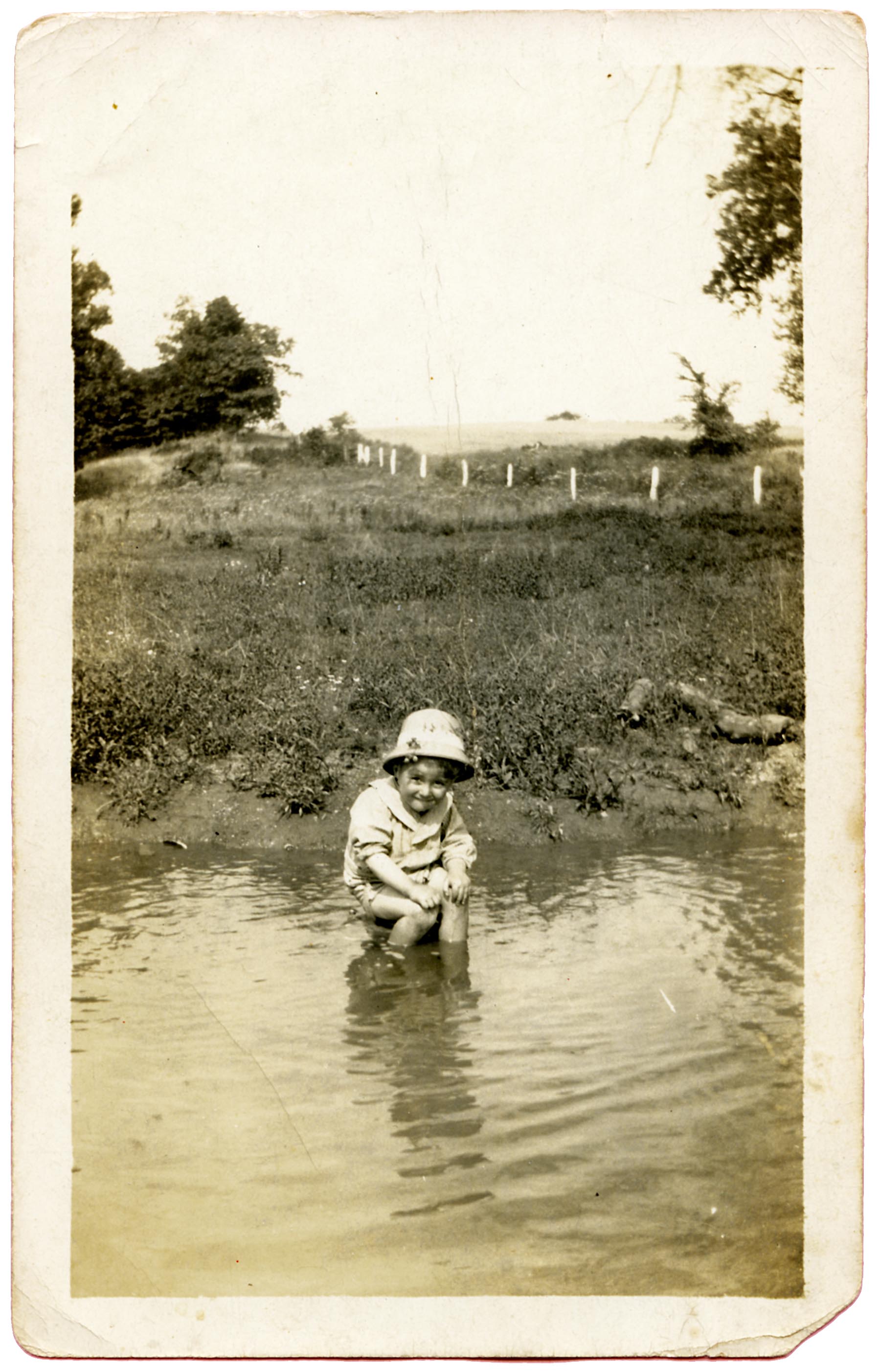
My dad Ray Longenecker at the Grandpa Martin farm, circa 1920
People don’t notice whether it’s winter or summer when they’re happy.
– Anton Chekhov
Your turn!
Did any of these quotes feel like an “Aha” moment for you? Will you add one?
Coming next: “I’m All Ears” with a Cliff & Marian tiff
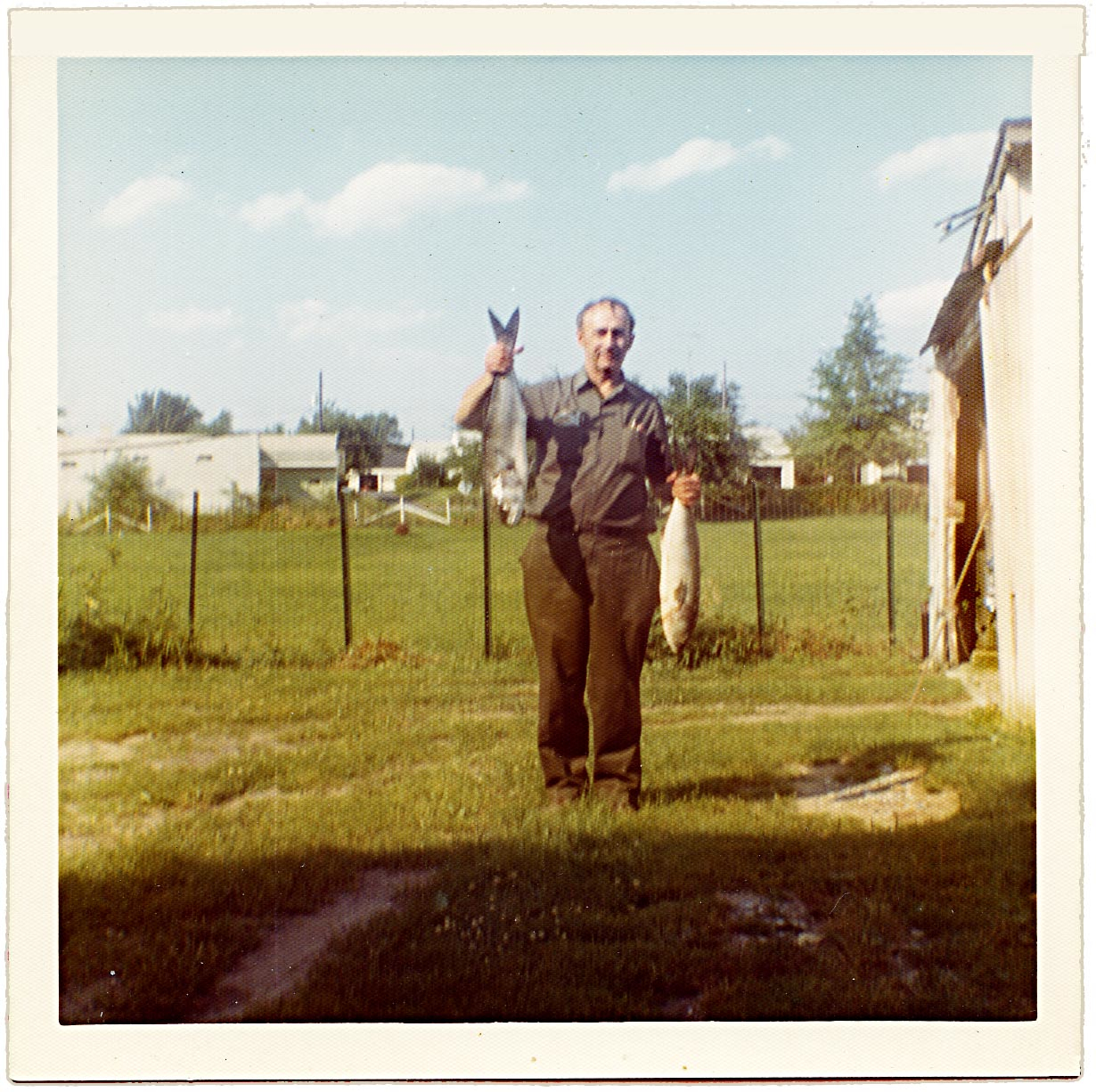
Daddy was an avid hunter (pheasants and deer mostly) and an eager fisherman. The outdoors took him away from the stresses of his business, Longenecker Farm Supply, and helped him literally recharge his batteries. I never went hunting with him, but he invited me once or twice on deep-sea fishing trips in my early teens.
Many summers ago, friends from Bosslers’ along with a few relatives chartered a boat and went deep sea fishing in the Atlantic south of the Delaware Bay. Unlike the New Testament disciples who fished with empty nets all night long until they followed the wisdom of Jesus, we PA Dutch fishermen hauled “em in right and left”– starboard and port. And unlike the disciples who had to cast their “nets” on the other side, we had a great catch without switching to a different strategy. Unbelievably, we novice fishermen were rewarded with a net-breaking haul of bass or trout. Somehow the figure of the number 68 (or maybe it was just 65) sticks in my mind as the amount of fish I caught single-handedly that day. Others easily topped my number. No fish tale here!
(I’m the one with the bandanna and sweater on the left side of the boat; Daddy is grinning behind Uncle Paul whose hand is raised.)
Generally, I had a strained relationship with Daddy. The stories of the ill-begotten bike and his unannounced violin purchase on earlier posts underscored his lack of knowledge of relating to me as his oldest daughter and subsequently my resistance to his overtures toward making a satisfactory connection.
But outside the walls of our house, taking walks or catching fish together, such barriers disappeared. These photographs evoke these pleasant memories, times when we were in tune with nature and with each other as father and daughter.
Childhood that place where purity of feeling reigns, was merging into adolescence, where ambiguity begins.
Mary Peacock in The Paper Garden
And that is where I was, the age of ambiguity and change.
* * *
Comments? A question? An anecdote from your own experience growing up.
We’re having lunch at Mother’s house today: home-grown tomato sandwiches, Silver Queen corn on the cob, and fresh tossed salad with a wrapped-up cucumber found left in her refrigerator. There is also a boiled egg she cooked recently, but Mom is not here. She is gone, left this life on July 28 just five days after her 96th birthday.
We (my sisters, brother and I) were together in June and had a high old time with Mother, eating out, making butter, playing Uno. In her boxy, blue l989 Dodge Spirit she drove herself to the July Christian Women meeting at The Gathering Place in Mt. Joy, went to the drive-through at her bank and wrote out checks to pay her bills. She attended the Metzler Reunion at Lititz Springs Park shortly before her birthday. A church bulletin in her Bible is dated July 20, 2014. Mom was even up to having lunch on July 23 with Nan Garber from church, who shares the same birthday week. But after that, she began feeling un-well, attributing her sickness to possible food poisoning. However, a pernicious bacteria was taking over her body, which no medical treatment could touch. Her death has stunned us all. We are in shock.
Yet we are grateful that after a long life of good health and sound mind, her suffering was brief though her influence eternal.
Indeed, the quality of her life was A+ up until the very end. Some snippets from her 3-day hospital stay:
Optimism: “We are having a sunny day today.”
Acceptance: “Whatever the good Lord wants for me . . . . I am ready to go.”
Wit: As she is moved from her hospital room to ICU she quips: “I want my glasses on, so I can see whether I’m going in the right direction.”
Gratitude: “It’s nice to have a loving family.” And finally . . .
Love: “I love you too!”
Among the songs sung at her funeral a cappella in 4-part harmony at Bossler Mennonite Church was “The Love of God,” a song she requested as she planned her memorial service years ago.
For I am persuaded that neither death, nor life, nor angels, nor principalities, nor powers, nor things present, nor things to come, nor height, nor depth, nor any other creature shall be able to separate us from the love of God, which is in Christ Jesus our Lord.
Romans 8: 38, 39
* * *
Psychologists tell us grief involves several stages. According to the Kübler-Ross model, they include denial, anger, bargaining, depression, and acceptance–eventually. These stages are not always experienced in linear fashion, and they are usually recursive, cycling through body, mind and spirit in relentless waves, unpredictable and strong.
But the death of a father or mother hits its own particular nerve in one’s psyche and heart as I observed traveling to see Mother for the very last time in this life:
“Her absence is like the sky, spread over everything,” notes C. S. Lewis in A Grief Observed.
Jane Howard, in A Different Woman probes the pain inherent in one’s separation from a beloved friend, partner, father or mother:
The death of my mother made me feel like a deck of cards being shuffled by giant, unseen hands. Parents, however old they and we may grow to be, serve among other things to shield us from a sense of our doom. As long as they are around, we can avoid the facts of our mortality; we can still be innocent children. Something, some day will replace that innocence, maybe something more useful, but we cannot know what, or how soon, and while we wait, it hurts.
How about you?
Have you experienced loss, gradual or sudden? How have you adjusted to it?
A grande dame of British theatre, Judi Dench, spoke with Anderson Cooper just before the release of the movie The Best Exotic Marigold Hotel in 2012 making crystal clear she has no plans to rest on her laurels and retire. In another interview she remarks about retirement: “I just think you ought to go on if you got the energy. If you got the energy, then everything is possible. But I think if you give up, then nothing presents itself to you anymore.”
My definition of retirement fits hers precisely: This phase in life for me is a time to re-tool, re-tire as in “put on new tires and roll on.” After decades in the teaching world, I literally took off my graduation regalia for the last time and tried on other robes: I began taking “The Lowrey Magic Organ Course” with a group (ugh), had to re-take many of the unit “speaking” quizzes in Rosetta Stone French (ugh-ugh), took up sky-diving (okay, an exaggeration!). But I had lunch in the middle of the week with friends, reveled in grandmother-hood full tilt.
I still relish the grandmother role and I often have lunch mid-day with friends or a pedicure mid-week, but my writing life has taken over the hours I spent in the classroom and grading papers after-hours. Blogging/writing is my new calling, requiring both head and heart, what I missed most about teaching anyway.
Recently, at Mother’s house I picked up the July 2014 issue of PURPOSE, a Mennonite publication containing “stories of faith and promise,” similar to those offered in Guideposts magazine. Here are some choice bits, including one from a 20-something:
Katie Funk Wiebe, the grande dame of Mennonite Memoir in my opinion, writes in her essay Looking Back from the Mountaintop: “At age 89 I am standing on a mountaintop. Below me is my life journey: there I stumbled, there I found footholds, there the path took a hairpin turn into darkness, there I found light . . . .” Her conclusion? “There may still be a distance to climb.”
In her essay “From a Fire Escape,” Dorothy Beidler admits “I have more questions than answers and that is definitely okay with me. Later she urges, “Find your niche, your passion, your soul gift.” Even in retirement.
Former CEO and business owner Burton Buller notes the difficulty in relinquishing the idea of being in charge but now is being inspired by “a newfound sense of gratitude.”
Melodie Miller Davis ponders the name for her new phase with her title “Final Quarter, Final Third?” letting this time of her life reverberate with purpose and intention to the tune of Frank Sinatra’s “My Way” or Kris Kristofferson’s lyrics “Bread for the body and song for the soul.”
Marian Durksen Wiens speaks of the richness of being reused and recycled as she and her husband return to volunteer in Korea, a land where they had previously worked.
Finally, a 20-something, Marcus Rempel, acknowledges that though dreams of a well-insured future lie “crumpled at [his] feet like a balled-up newspaper,” he values the safety network of family in this life and eternal life in the age to come.
The idea of retirement is a fairly new one. In the early twentieth century when life expectancy for men and women was in their 40s and 50s, retirement was practically unknown, certainly not seen as a sizable chunk of time. Now many men and women can expect to live 20-30 years beyond retirement age.
In the movie The Best Exotic Marigold Hotel, the Judi Dench character, Evelyn Greenslade, supplies the narration “book-end to bookend . . . and keeps a blog of her activities” from the opening sequence to the Day 51 moral that ends the film ‘We get up in the morning, we do our best.'”
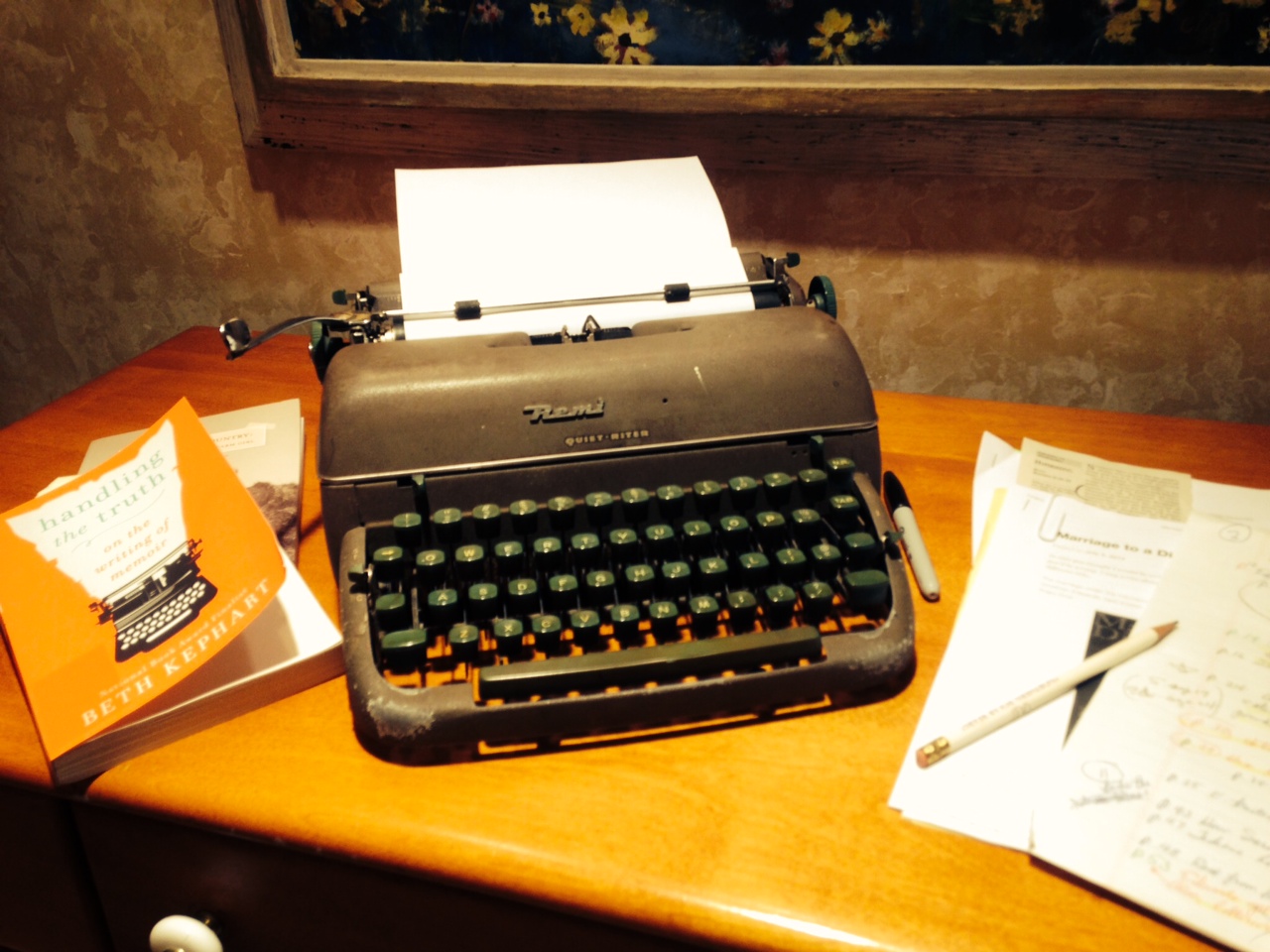
Old Remington typewriter from college days – 1960s
Like her, when I get up in the morning I aim to do my best, especially on days I can connect with my friends in the blog world.
My policy on cake is pro having it and pro eating it. – Boris Johnson
* * *
July is the birthday month for four our immediate family. If you count our extended family, there are three or four more birthdays this month.
This month I celebrate the birthdays of three of my one and õn-lies:
The Inimitable Mother Ruth Metzler Longenecker
Mother and her morning ritual, reading her Bible, age 96
My One and Only Son
Joel with one-and-only daughter-in-law Sarah at cousin’s wedding
My One and Only Grand-Daughter Jenna Skye Dalton
July Birthdays
July birthdays in our family span four generations. Apparently, I tried very hard to become my mother’s first birthday present after her marriage the previous year, having missed being born on her own birthday by just one day. Our son and grand-daughter are birthday presents to me – Joel born two days after my birthday and Jenna preceding my birthday by a mere five days.
Who are your one and ôn-lies – birthdays or otherwise?














 Plain and Fancy