“Is the spring coming?” he said. “What is it like?
“It is the sun shining on the rain and the rain falling on the sunshine . . . ~ Frances Hodgson Burnett, author of The Secret Garden
Tulip magnolia tree in our neighborhood just about to hit full bloom in Florida, early February ~ Sunshine, no rain in sight
[in Just-] a poem by e. e. cummings, (his name usually shown in lower case letters) who is known for odd spacing and made-up words like “mud-luscious” and “puddle-wonderful” so evocative of the squooshiness that follows the winter thaw. This British poet clumped together some of the names and other words he uses, just like mud on your shoes in springtime. Remember all that? Here are the first nine lines.
The only thing that keeps a man going is energy. And what is energy but liking life? Louis Auchincloss, A World of Profit
MIRACLES
C.S. Lewis wrote, “Miracles are a retelling in small letters of the very same story which is written across the whole world in letters too large for some of us to see.”
MITTENS
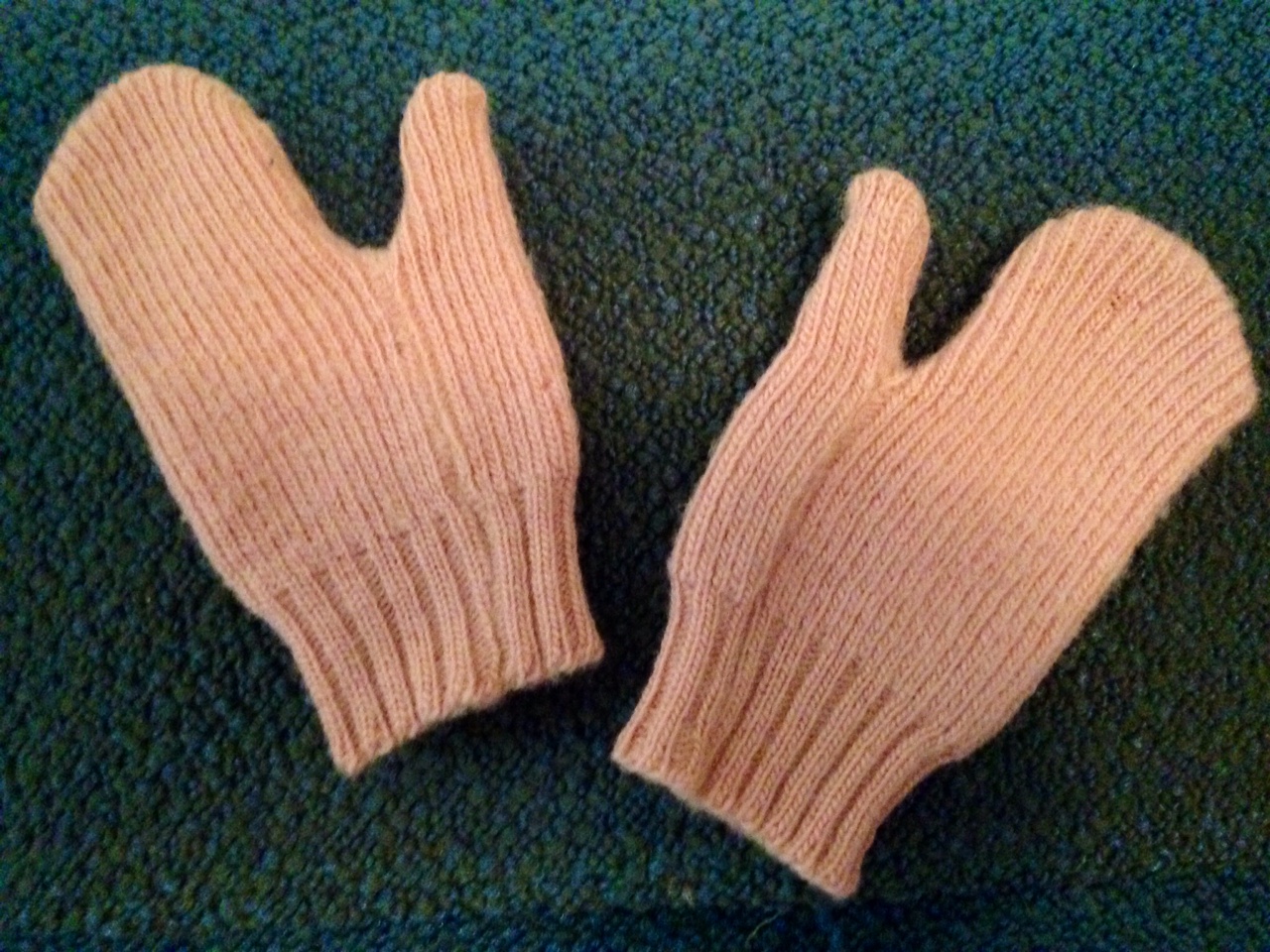
The wee Longenecker girls wore mittens because it was cold in Pennsylvania until near the end of March. These are the mittens I remember my sisters Janice wearing. Jean probably inherited them when her hands grew big enough. Somehow I recall a string of woven yarn attaching the mittens under the coat so the little girls wouldn’t lose their mittens. Mittens actually do keep little hands warmer than gloves would – body heat from all four fingers and thumb is trapped inside the glove just like this. . .
. . . which reminds me of the Mother Goose nursery rhyme about the Three Little Kittens. You can probably hear the sing-song sound of the phrases as you read this tale.
In the verses which follow, the kittens put on their mittens, then get them dirty, are scolded by their mother, inducing them to wash their mittens, even hanging them out to dry. In the final verse, Mother Cat compliments her kitties while teaching them a lesson in scavenging for their dinner:
“What, washed your mittens, then you’re good kittens,
But I smell a rat close by.”
“Meow, meow, meow,
We smell a rat close by.”
Your turn! This is a free-for-all post. Add your thoughts or quotes on spring, energy, miracles, mittens – or something else.
Coming next: Grandmother Kayaks Solo from Maine to Guatemala. Why?
I am sitting with my three friends, Gladys Graybill, Hazel Garber, and Millie Zimmerman near the pulpit in front of Bossler Mennonite Church to be baptized. At the prompting of our Bishop Clarence E. Lutz, we kneel, and as we kneel I hear the crinkle of the skirt of my caped dress. Mother and I have chosen a taffeta fabric for this special day – a dress made of tiny checks of navy, silver and white to set off my dark-haired braids now covered with a prayer veiling. The dress has a tiny collar with navy piping. I love that navy piping. Besides the silky fabric, this tiny decoration is the only fancy thing about this plain dress with a cape overlaying the bodice.
Since I made a spiritual decision in June, I have been wearing my hair in pigtails topped with a covering. For the first time since then, my braided hair has been pinned up around my head with hairpins in accordance with church rules. But today my prayer veiling has strings dangling from its two corners. Before the service, we have met in the church basement with the Bishop’s wife Elsie Lutz, who has requested that we girls wear strings of white satin ribbon attached the two corners of our coverings, I suppose for an extra measure of plainness. “Oh, you girls look so nice!” she gushes as she inspects our apparel, especially our heads, before we ascend the steps to the main sanctuary.
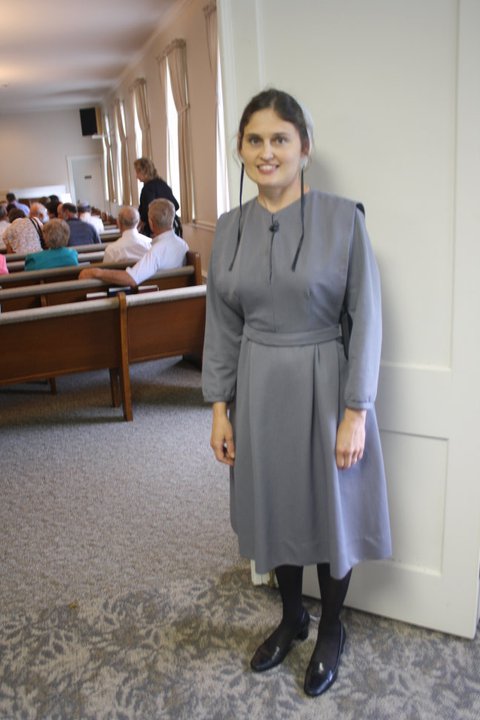
This young woman’s covering strings are black. Mine were white, but attached the same way. (Bicentennial photo, Bossler Mennonite Church)
We three girls are ushered to the front where Bishop Lutz and Deacon John Kraybill wait with a basin of water and a white linen towel ironed smooth. We have been through a kind of catechism entitled “Instructions to Beginners in the Christian Life,” which includes a review of the tenets of faith, nonresistance to evil and nonconformity to the world, and the ordinances of Communion, Feet Washing, the Devotional Covering, the Holy Kiss, Anointing with Oil, and Marriage. The first ordinance is Baptism, which we are now ready to participate in with two “I do’s” and “I am (sorry for my sins), with a final “I do,” promising by the “grace of God, and the aid of the Holy Spirit, to submit [myself] to Christ and His Word, and faithfully to abide in the same until death.”
After prayer, we remain kneeling. And the Bishop, assisted by the Deacon who is holding a basin of water, takes a handful of water from the basin and pours it methodically three times in succession on the head of the applicant intoning the words: “I baptize thee with water, in the name of the Father, and of the Son, and of the Holy Ghost.” This statement is followed by the Bishop taking us by the hand and saying as we rise:
In the name of Christ and His Church I give you my hand. Arise! And as Christ was raised up by the glory of the Father, even so thou also shalt walk in newness of life . . .
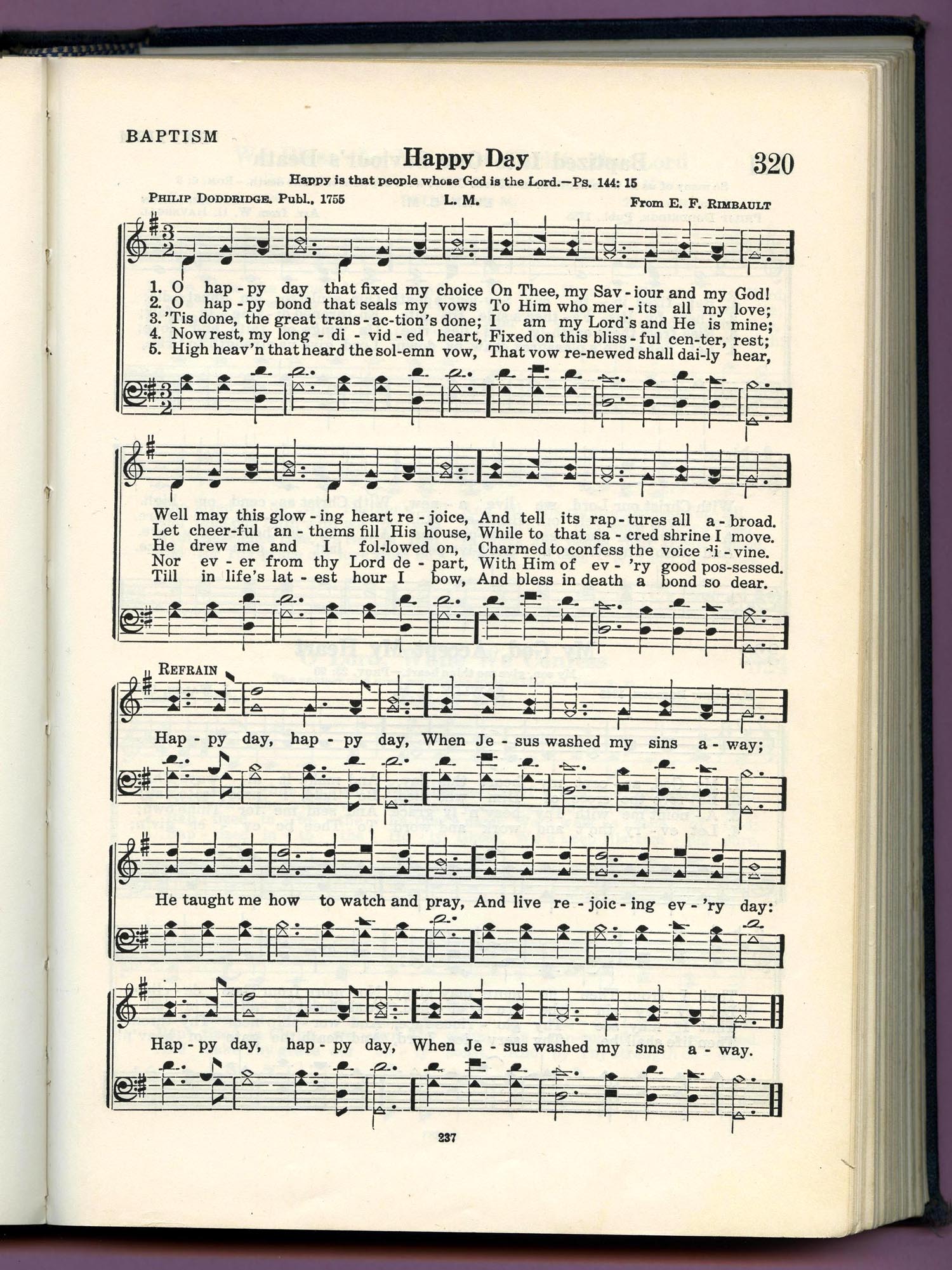
The wives of the Bishop and the Deacon then give us the kiss of peace, and thus we are received into the church fellowship. The congregation in four-part harmony happily joins in the tradition of singing “O Happy Day” from the Mennonite Church Hymnal with shaped notes.
I remember this day so well. It was September 29, 1951, my sister Janice’s birthday.
* * *
Earlier this month, our oldest grandson and only grand-daughter, Patrick and Jenna Dalton, were baptized at Highlands Baptist Church. Their family attends a Lutheran Church, which like the Mennonites also baptizes by sprinkling, but since their parents wanted their Uncle Bill to baptize them, they complied (happily I might add) with baptism by immersion. Words similar to those spoken at my baptism accompanied their immersion in the water: “Buried with Christ in his death . . . raised to walk in newness of life.”
Rev. Bill Caverly baptizing grand-nephew Patrick Dalton
What special sacred ceremonies have you observed or participated in yourself?
To my friends both in the northern and southern hemisphere, some thoughts about the weather. All quotations from BrainyQuotes.
Sometimes I wish I was the weather, you’d bring me up in conversation forever. And when it rained, I’d be the talk of the day. — John Mayer
I like the cold weather. It means you get work done. — Noam Chomsky
Wherever you go, no matter what the weather, always bring your own sunshine. — Anthony J. D’Angelo
Scarves, mittens, and hats are a great way to express your personality in the cold weather. — Brad Goreski
Where’s my hat? Freezing temps on Chincoteague Island, VA Chic Dumps? Best guess: Chicken and Dumplings
People don’t notice whether it’s winter or summer when they’re happy.
— Anton Chekhov
For there is no friend like a sister / In calm or stormy weather; / To cheer one on the tedious way, / To fetch one if one goes astray, / To lift one if one totters down,/ To strengthen whilst one stands. –– Christina Rossetti
(from “Goblin Market”)
A friendship can weather most things and thrive in thin soil; but it needs a little mulch of letters and phone calls and small, silly presents every so often – just to save it from drying out completely. — Pam Brown
The forecast: Spring will come!
Paperwhites from the narcissus family, with their “delicate color and sweet, musky fragrance,” a forecast of spring to come.
While the earth remaineth, seedtime and harvest, and cold and heat, and summer and winter, and day and night shall not cease. Genesis 8:22 KJV
I’m guessing you agree with some quotes more than others. One or two you may completely disagree with.
Can you add another one? We’ll be listening . . .
Coming next: Wanda: Boring in Beige or Beautiful in Blue?
On December 29, author/blogger Joan Rough published a post declaring her optimistic intentions for 2015 and pondering a single word to characterize this new year while contemplating words of wisdom used other years. Some choices she suggested: Believe, Dare, Trust, Patience, Forward. Even the word Intention would be a good star to steer by, she mused.
Other commenters suggested words like Flow and Connection. Thus, Purple Passages for January is constructed from 3 of these words: Dare, Intention, Flow
DARE
“Daring ideas are like chessmen moved forward. They may be beaten, but they may start a winning game.”
― Johann Wolfgang von Goethe
“Somewhere over the rainbow, skies are blue, and the dreams that you dare to dream really do come true.”
― E.Y. Harburg
INTENTION
Any time women come together with a collective intention, it’s a powerful thing. Whether it’s sitting down making a quilt, in a kitchen preparing a meal, in a club reading the same book, or around the table playing cards, or planning a birthday party, when women come together with a collective intention, magic happens.
I learned this, at least, by my experiment; that if one advancesconfidently in the direction of his dreams, and endeavors to live the life which he has imagined, he will meet with a success unexpected in common hours. Henry David Thoreau, Walden
What do you think?
“Just go with the flow” is an expression offered sometimes as advice for tough times. How do you experience “flow” in your life now? How about daring, ― or intending?
Have you picked a guide word for 2015?
* * *
A final word: Trust in the Lord with all your heart; and lean not unto your own understanding. Proverbs 3:5
Coming next: Signs and a Wonder: St. Simons Island
Every single memory of snow in my childhood is pleasant. Sparkling flakes in luminous free-fall as I look out the kitchen window. Snow festooning evergreen boughs. Then bundling up in snowsuits, knitted caps, mittens. Getting out the sleds.
After more than one snowstorm, Aunt Ruthie grabbed her movie camera and trained her sharp eye on some big, tall sledders who went coasting down the hill from our house to Grandma Longenecker’s.
Then she captured our anticipation of trumping through nearly hip-high snow and finally (my favorite) Mother pulling my sister Janice and I on the Flexible Flyer sled along Anchor Road.
Another parent and daughter are observing the snow in The First Snowfall by American poet James Russell Lowell, a poem I remember Mother reciting.
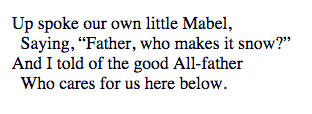
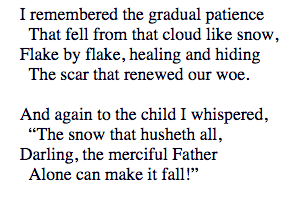
Mabel marvels at the beauty of the snow and inquires of its origin . . .
. . . but as the father’s replies to Mabel, he remembers the snow which hides the scar of another child’s burial plot.
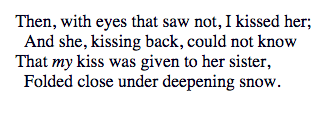
Then Mabel feels her father’s gentle kiss, a kiss she will never know was intended for the daughter beyond his touch. The last stanza leaves Mabel in child-like wonder, her father in pensive grief.
This post began with snapshots of fun in the snow and ended with a reflection on loss. But snow can be the setting for other memorable events: a frolic with friends, a car accident, a marriage proposal (I’ll save that for another post!)
You probably have memories of snow, recent or long ago. Here’s your chance to share them.
How do you see yourself – Kitchen Goddess, Diva of Design, Mom’s Taxi, Writer Extraordinaire, Care-Taker?
Artist Haley Hasler paints herself as a strong woman in super-abundant settings usually with children and often with food.
Currently displayed at the Museum of Contemporary Art in Jacksonville, FL, Hasler demonstrates the resurgence of realism with bold strokes on large canvases. It is impossible to miss her exuberance. As she explains on her website, “The self-portrait confronts the viewer with an outward representation of the inner self.” And what an energetic self that must be!
She depicts her figures in fanciful costumes of daily life “balanced at the precipice of chaos” (a quote from the gallery that features her work.) Her paintings may recall life at home for you in days gone by, but I’m guessing on a less-grand scale.
Young girl peeks out from under the tea table while playing a violin as boy (possibly her brother) snoozes or at least pretends to.
MOCA permits photography of art works for non-commercial purposes
* * *
Like Haley Hasler working in the same decade of the 1970s, artist Judy Chicago portrays not just one but 39 women in her famous work displayed in the Brooklyn Museum, NYC. And instead of a single canvas, Ms. Chicago’s installation entitled The Dinner Party features a huge triangular table measuring 48 feet on each of its three sides honoring famous women throughout history, each with a symbolic place setting: a napkin, utensils, goblet and a plate.
Photo Courtesy of Wikipedia
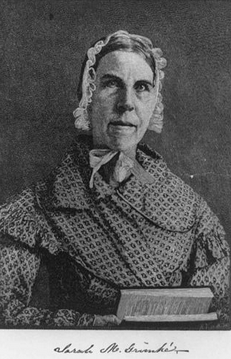
Also a part of this installation, on the Heritage Floor of the museum appear white tiles of gilded porcelain inscribed with the names of 999 more notable women. Among these is the name of Sarah Moore Grimké (1792 -1873) an American abolitionist and writer who did extensive public speaking opposing slavery and supporting women’s rights.
Here is one determined woman
Sarah Grimké is one of the dual protagonists in The Invention of Wings (2014), the much acclaimed historical novel by prize-winning author Sue Monk Kidd, who was inspired to write the book (she admits in her Acknowledgements) while viewing Judy Chicago’s The Dinner Party installation. Sarah, speaker, writer, and suffragist, helped change the course of American history with her activism.
Sue Monk Kidd’s book with the two main characters, Sarah Grimké and her handmaid Hetty Handful, will be the topic of next week’s blog post. Stand by for action!
Maybe the words Diva, Goddess, Tooth Fairy or Activist don’t come to mind when you think of yourself. But you do have a title whether it’s Sister, Cook, Doctor, Teacher, Grandmother, a combination of the two, or something else entirely.
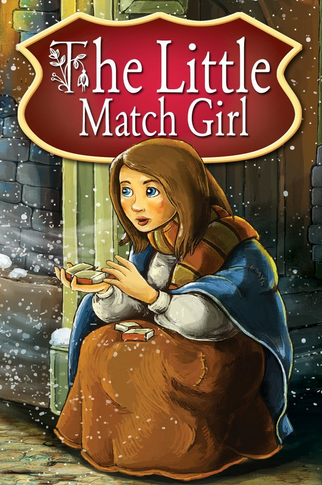
On a cold winter’s eve, a poor girl shivering on the street tries to sell matches afraid to return home to her father who would beat her for not selling all her matches.
Cover: Courtesy Amazon Books
Finding shelter in a nook, she lights matches to warm herself. The matches ignite her imagination and she envisions a Christmas tree and a holiday feast. As she looks skyward, she spies a shooting star and recalls her dead grandmother remarking that such a star means someone is dying and going to heaven. As she lights the next match, she catches a vision of her grandmother, the only person ever to treat her with love and kindness. Finally running out of matches, she dies and her soul is carried to heaven. The next morning, passersby find the little girl dead in the street. They feel pity for her but cannot bring her back to life.
Lives Cut Short
Trayvon Williams and Michael Brown must have had visions of a better life, a bright future. Their visions will be unrealized, their lives cut short by a bullet. While there is still controversy over the details surrounding each case of police intervention, there is no doubt that the outcome raises questions about police reaction in a perceived threatening situation. It should be noted here that black officers, greatly outnumbered by whites in the police force, account for little more than 10% of all fatal police shootings according to one report. But of those they kill, 78 % are black. Main stream media, however, gives little attention to such stories or to those involving black officers and white offenders.
Author Mary Gottschalk speculates on what prompts these high profile shootings of black teens. In a recent blog post, she comments on the lack of respect for cultural differences and asks, “. . . is it a system that trains a white police officer in a black community, when confronted by what appears to be an angry or aggressive black man, to shoot first and ask questions later?”
One commenter to this essay, Janet Givens, offered one explanation: “I’d say fear plays a factor . . . the fact that we often fear what we don’t know: we demonize our enemy to feel morally superior so we can justify defending ourselves.”
And so the conversation continues . . . .
Another Time – A Different Story
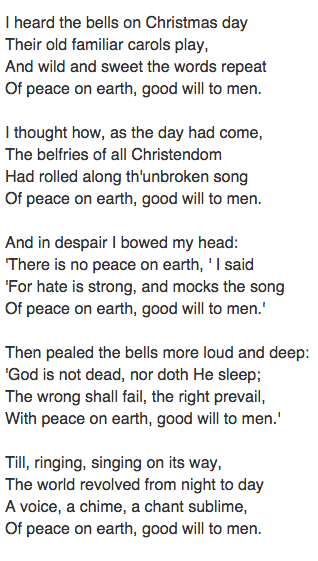
We tend to believe that we live in the worst of times. Maybe this is true. Yet poet Henry Wordsworth Longfellow (1807-1882) documents a terrible time in our nation’s history, the Civil War, fought to secure freedom from slavery. He wrote one of his most famous poems, I Heard the Bells on Christmas Day, having survived the outbreak of the Civil War, the untimely death of his beloved wife Fanny during a house fire, and a severely wounded son Charles. Theses lyrics written in 1864 show the depth of his sorrow but suggest hope and peace as the stanzas progress:
At Christmastime 2014, celebrating peace and joy seems like a mockery given the tumultuous year we have experienced. But wars and unrest have always existed. “Hate is strong and mocks the song of peace on earth goodwill toward men.”
Yet, hearts open to hope can bring a renewed call to action toward peace.
Call to Action
Author Gottschalk in her post last week revealed the little-known personal details about Michael Brown’s mother, Lesley McSpadden, who “was not allowed to approach him as he lay in blazing sunshine in a public street for four hours. Once his body was removed from the street, she was not allowed to see it for two weeks.”
Shirley Showalter, another commenter on Mary’s post, demonstrates what a peaceful call to action looks like as she remarks:
Because of this essay and the story you told about Lesley McSpadden (the mother of Michael Brown), I am going to write her a letter. It’s a little thing, but I want her to feel how this story touched me. Thank you for writing.
Like the little match girl, none of the lives lost on our streets or in our schools can be brought back, but they leave a legacy that can motivate us to hopeful action.
For a shorter version (2′ 20″) of “I Heard the Bells on Christmas Day” by Burl Ives, click below.
Your Turn
What is your take on any of these stories? An opposing viewpoint?
Welcome to my 200th blog post! It’s here because you have visited this blog, a time or two, or maybe way more often. Writers write for many reasons, most importantly to express themselves. But most writers don’t like to write in a void. Writing is communication. And communication, for me at least, is a two-way street.
Julie Powell agrees with me. Remember Julie Powell in the movie Julie & Julia?
Julie, using Julia Child as her muse, conceives an idea for her blog in this scene:
The quotes below are excerpted from the movie script, all based on her best-selling book with a much longer title:
WHY DO YOU DO IT?“It’s a regimen, Mom, like doing pushups!”
SOMETIMES IT’S FRUSTRATING!Julie shouts at her computer: Is there anyone out there reading me?
Then later: Today I had 12 comments from readers and I didn’t know any one of ‘em!
WHY WE CONTINUE . . .
Julie comments: Julia taught me what it takes to find your way in the world. It’s not what I thought it was. I thought it was all about-I don’t know, confidence or will or luck. Those are all some good things to have, no question. But there’s something else, something that these things grow out of. It’s joy.
Unlike Hansel and Gretel, whose mother tried to starve them and then lock them out of the house, Mother Longenecker provided well for her children and left behind, not white pebbles or bread crumbs, but hand-written notes tucked away to tag her heirlooms. Each note provides a designated recipient sometimes with a bit of family history.
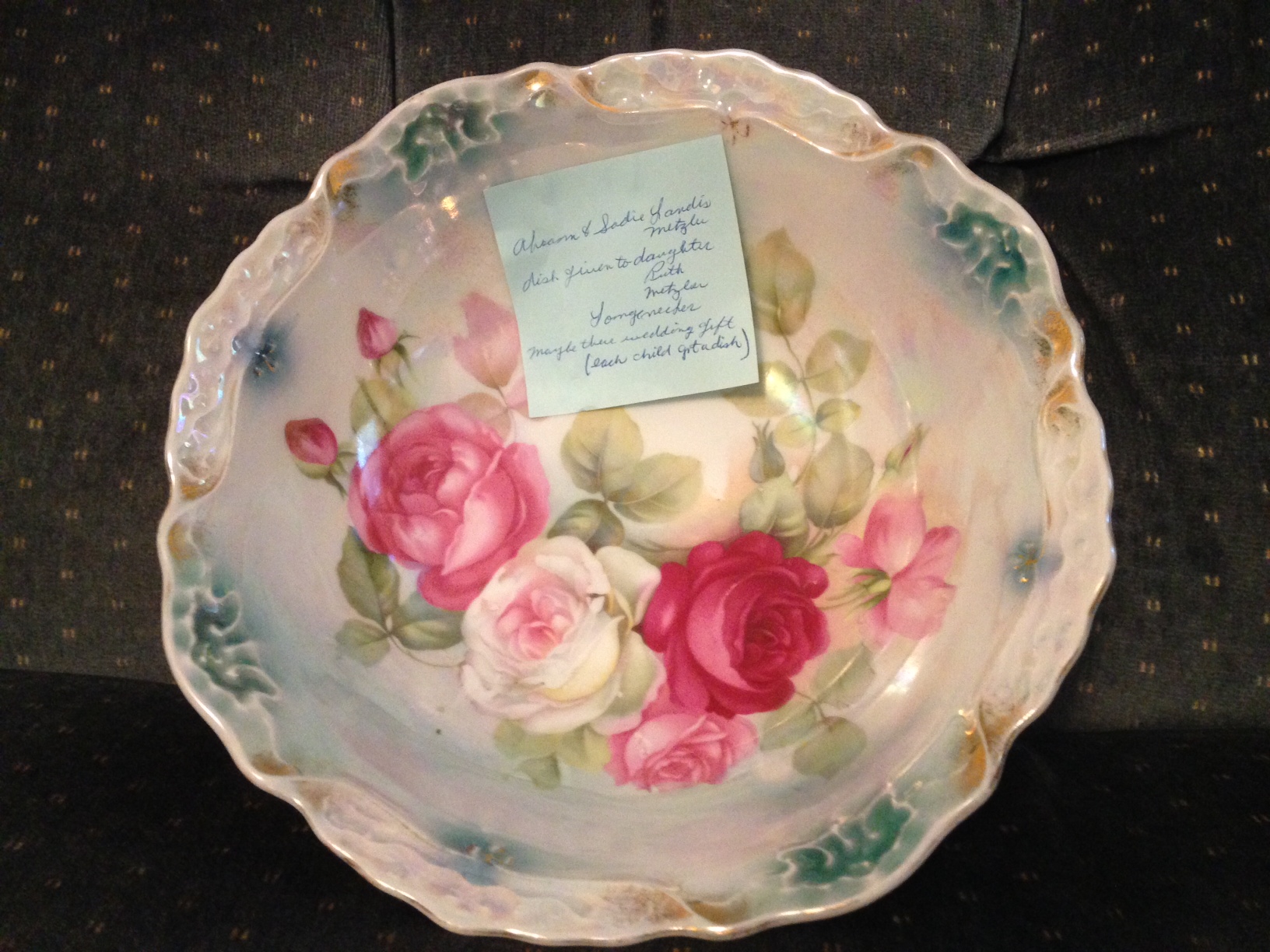
1. Floral Serving Dish
Dish given to my mother from her parents, Abram and Sadie Metzler on her wedding day
One of Mother’s grand-daughters will get this dish no doubt and will know its provenance, which would probably be lost forever, without the note .
2. Keepsake from Mother’s Sunday School teacher at Erb Mennonite Church with teacher Mrs. Kathryn Bomberger. The note emphasizes the biblical account of creation found in the book of Genesis and on the reverse side a quick guide to prayers, parables, and verses commemorating sacred events. You can find more of the history of the Erb Mennonite Church here, including its roots in the Swiss-German Anabaptist culture.
Mother’s Sunday School Class at Erb’s Mennonite Church Mrs. Kathryn Bomberger, teacher
For many months now, this photograph has served as the banner on my Facebook page. When I posted it, I was totally unaware of Mother’s imminent death. Now I am loath to replace it with a different photo. All the ladies are plain here, except the smiling woman seated on my mother’s left. I imagine this shot was taken after Sunday dinner at the home of the teacher.
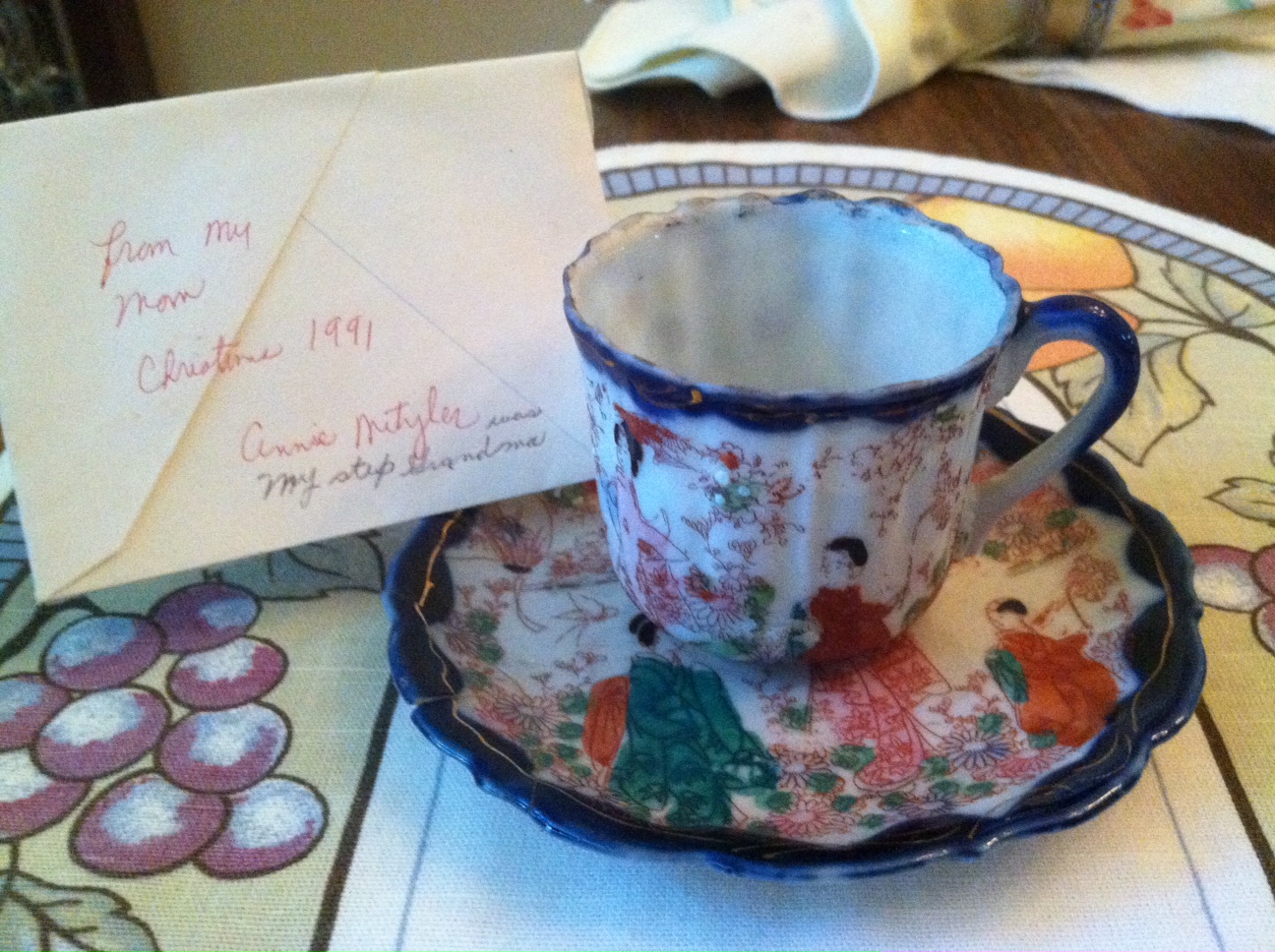
3. Japanese Cup & Saucer
According to my notation in red in 1991, Annie Metzler gave this set to my mother, who notes in her own hand-writing that she was Mom’s step-mother. This vintage piece is hand-stamped Made in Japan, possibly created during the Golden Age of Japan’s trade with the United States in the 1921-1941 era.
Mother had “secret smarts” that we became more aware of recently, revealing her keen interest in the continuity of memory as she passes both artifacts and notes on to the next generation.
Do you have any family notes like these? Do you tag things you want to pass on? Here’s where to share your wise observations . . .
My Mother Ruth Landis Metzler was a simple girl who grew up on a farm near Lititz, Pennsylvania and attended Erb’s Mennonite Church. As a young woman, she wore plain clothing and never cut her hair. Her adornment was of the biblical kind as the Apostle Paul admonishes:
I also want the women to dress modestly, with decency and propriety, adorning themselves, not with elaborate hairstyles or gold or pearls or expensive clothes . . .
I Timothy 2:9 NIV
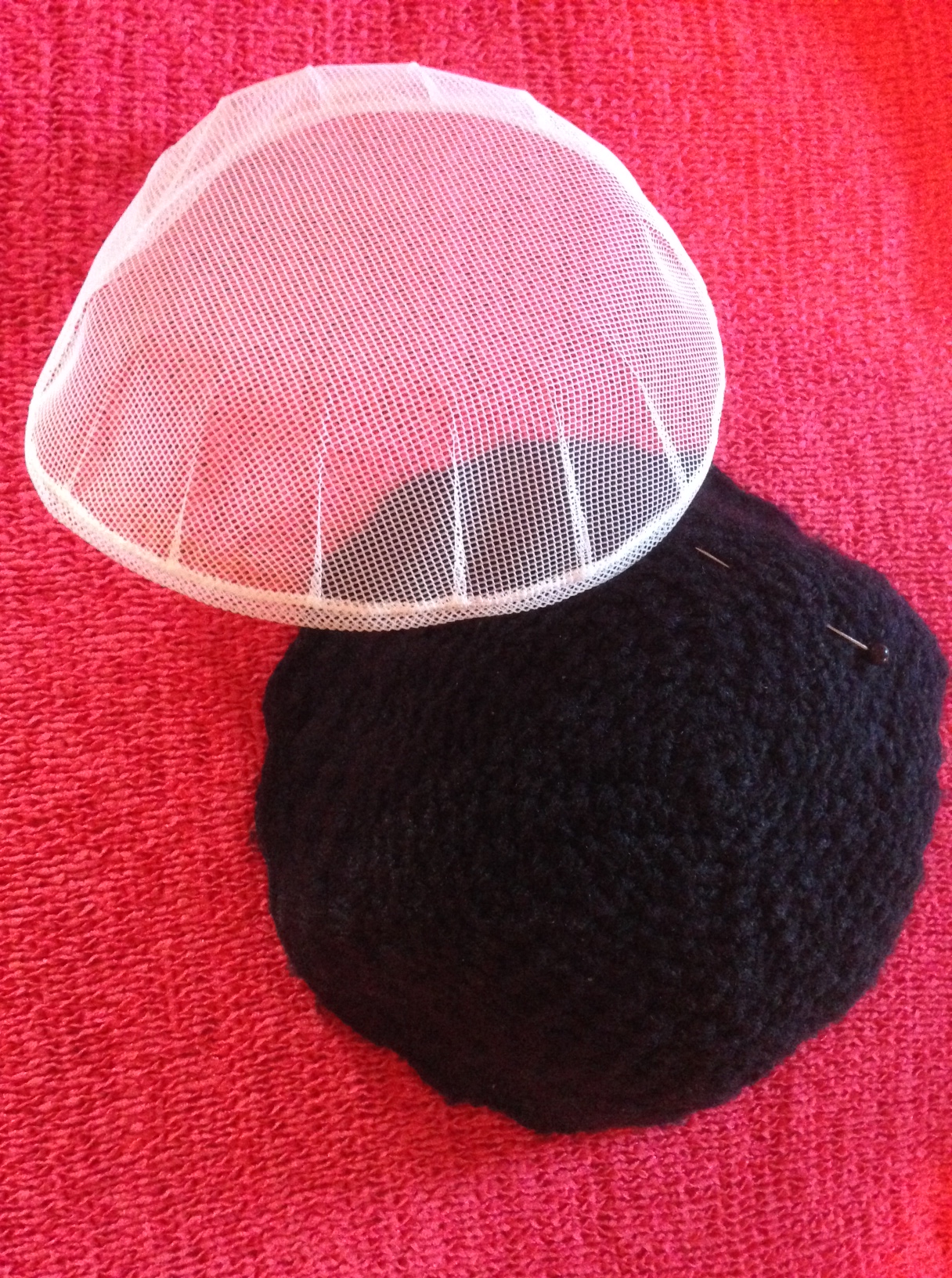
As we sorted through her personal effects recently, we found two prayer coverings and three bonnets, all miniature versions of those large sizes (jumbo, actually) she wore during her girlhood and all through the years we children lived at home.
On the clipboard in her kitchen, we found the business card to the Sue’s Covering Shop in Lititz where she bought her most recent headgear, the black bonnet now rivaling the size of a Jewish yarmulke and fastened with a shiny black-tipped hat pin.
Size mattered among the various congregations in the Lancaster Mennonite Conference in all the years my mother wore prayer coverings. Handwritten on Sue’s Covering Shop business card was Mother’s latest size: D – 19 1/2. When I called Sue’s, the clerk said that D indicates the pattern number, the higher the number (okay, it’s a letter) the larger the size. And 19 1/2 describes the inches around the circumference of her covering.
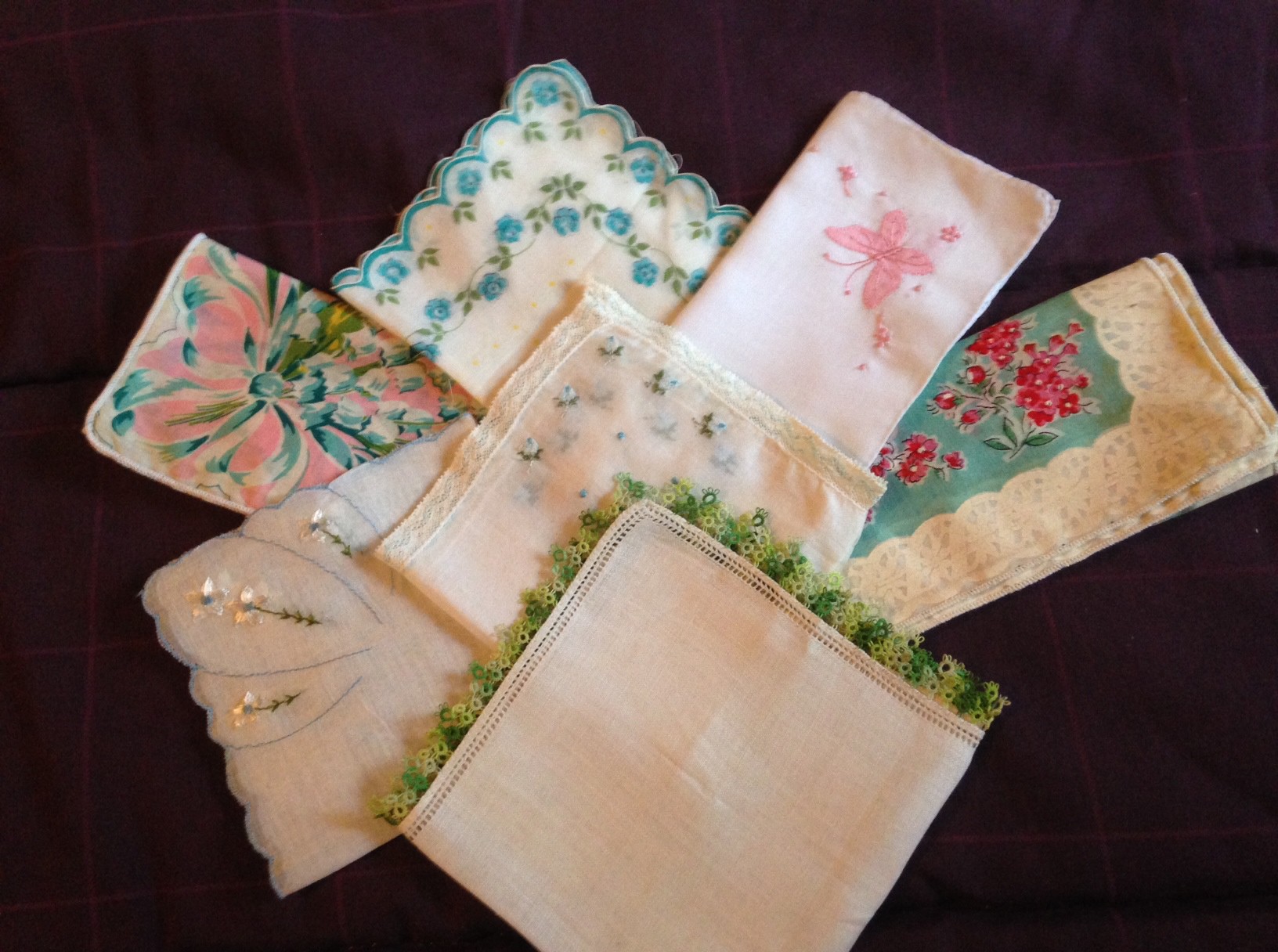
Hankies, now replaced by Kleenex, were once a part of every woman’s wardrobe. As a young child, my offering (a penny as a toddler, and later a nickel as I grew older) was tied into one corner of my white handkerchief, so I could untie the knot and put the coin into the tin box my teacher passed around during the Sunday School class. Surprisingly, Mother’s hankies were fancy, some even gaudily so, and one even boasts green tatting.
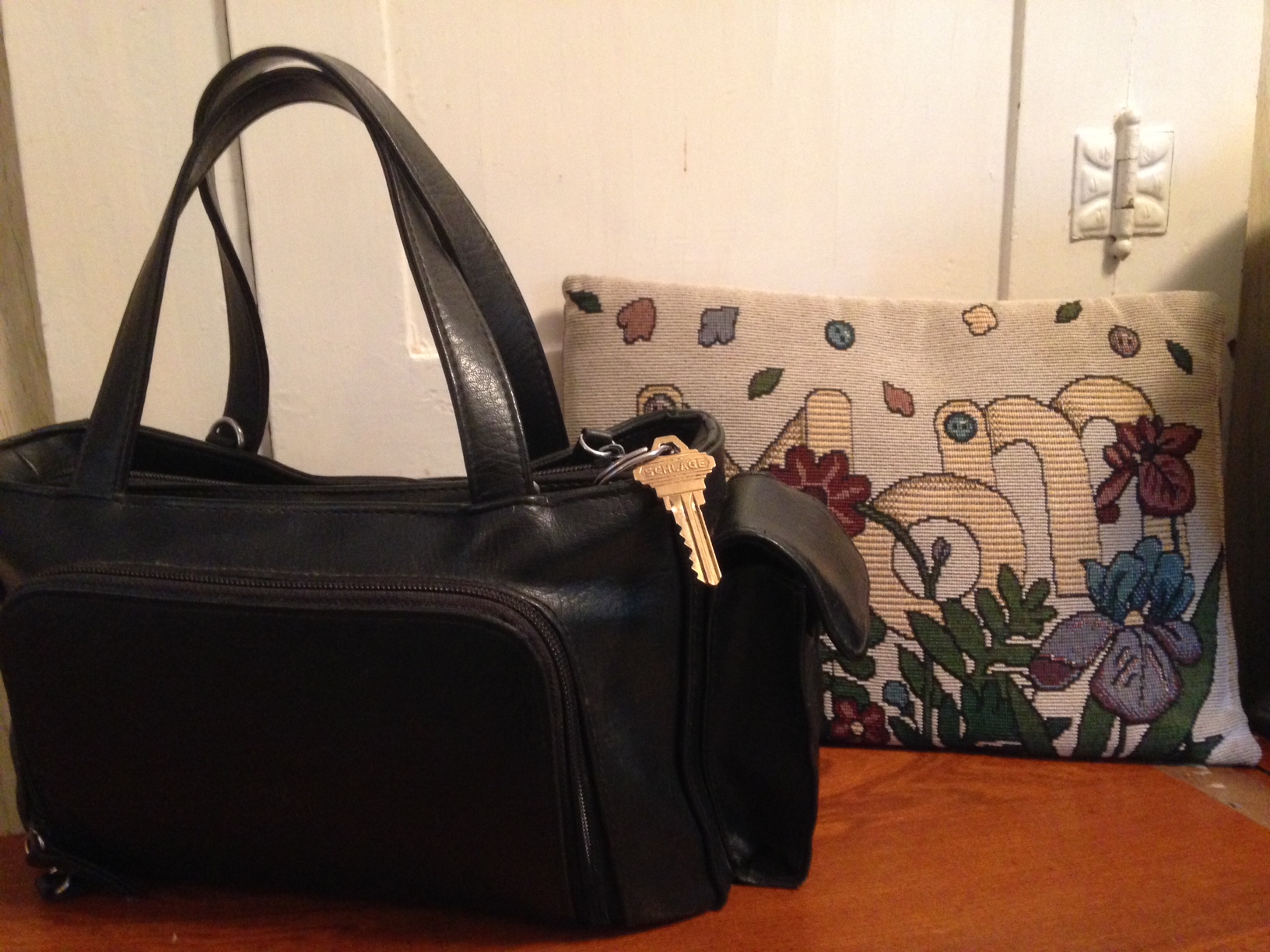
Mom’s purses have usually been black and serviceable though we found set aside a hand-tooled leather purse and remember a lacquered basket-weave popular in the 1950s and 60s. In the October 2014 issue of Guideposts, Malinda Bertels takes stock of her Grandma’s purse and finds in it tissues for applying rouge, a vial of holy water and a faded inscription on a small wooden cross which provides insight and courage to move forward. Mom’s purse contained none of those things, only the bare essentials.
The very last purse she ever carried had a zippered compartment on the outside and all the pockets she liked on the inside for her cards and such. Most important was the pouch on one side, probably designed for a cellphone, but which held her house and car keys. The house key remains, but the car keys have been passed on to a friend from church.
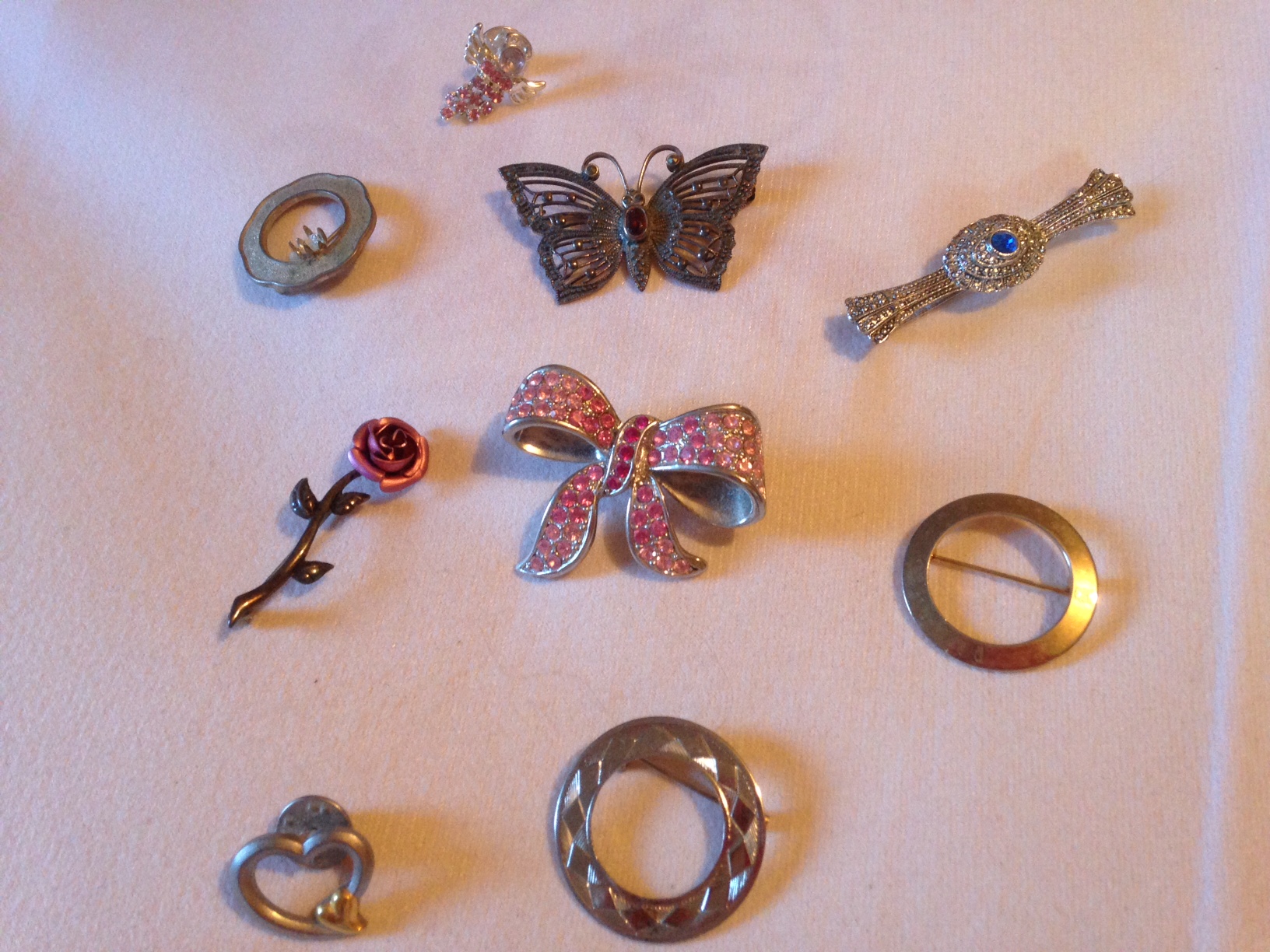
Mother never wore any jewelry except a wrist-watch, but friends bought cute little pins for her anyway. They were never all in one spot, but when we gathered them together, they numbered nine. The only one I ever remember her wearing was the round silver-faceted one, probably to her grandson Austin’s wedding.
Plain and fancy, her wardrobe included the gamut. A plain woman with fancy edges, that was Mom!
* * *
A souvenir of their honeymoon, this pillow was found among Mother’s treasures, obviously a gift from Dad, revealing his softer side.
Was/Is your mom plain or fancy? Are you similar or different in fashion sense?
















 Plain and Fancy