This week two years ago Mother was snatched from our world just five days after her 96th birthday. Late on a Monday evening, July 28, 2014, she was transported into a new and better land.
Mother lived on a dairy farm in the Manheim – Lititz area of Pennsylvania. When she married my father Ray, she moved about 12 miles west, still in Lancaster County. Like many Mennonite couples in the 1940s, they honeymooned in Niagara Falls, New York, where I most likely was conceived.
Over the years, she visited the Philadelphia Flower Show and strolled through Longwood Gardens exclaiming, “Oh, my, such beautiful flowers we saw!”
When my sisters and I studied at Eastern Mennonite College, she and daddy drove to Harrisonburg, Virginia several times, back then a four-hour drive to the Shenandoah Valley. “My, look at the mountains in the distance – so pretty,” she said.
Mother seemed happy to be a homebody. She never seemed curious about seeing world capitals as her daughters were. Traveling around the United States in five weeks with a friend as I did once would seem incomprehensible to her. “Why would I want to do that?” I can hear her say.
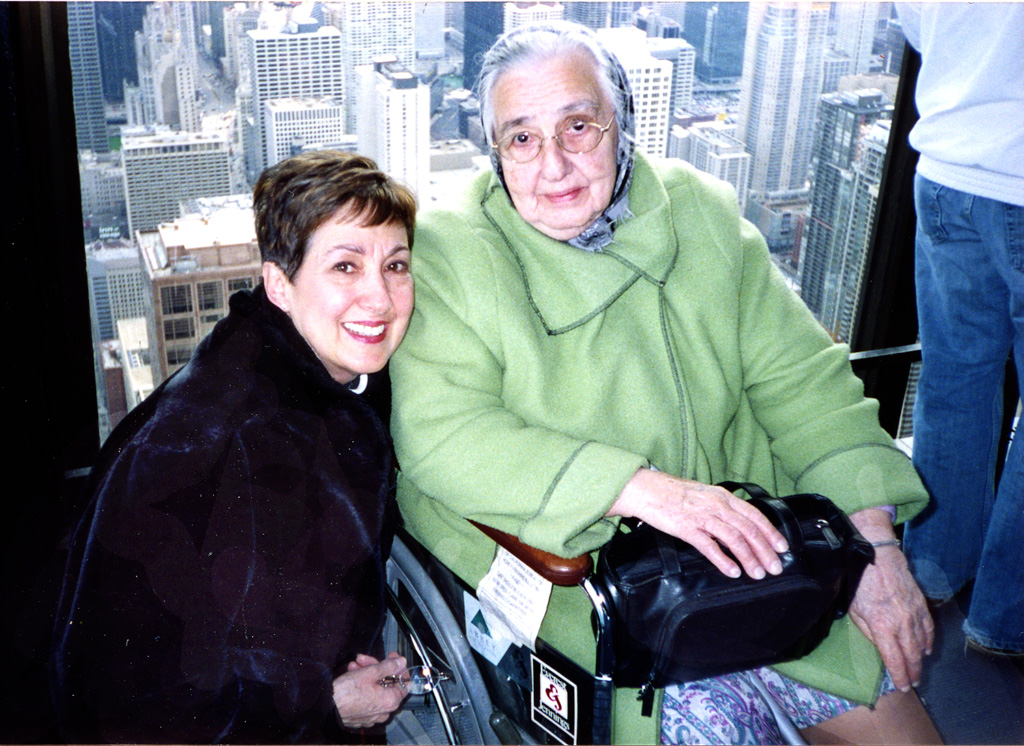
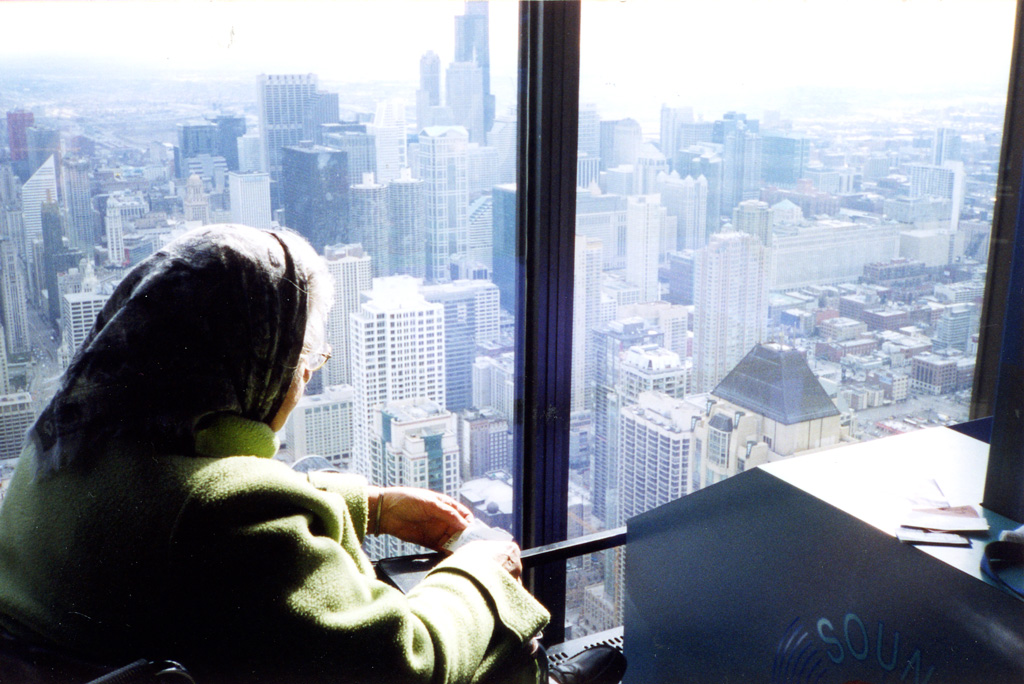
But when her first great grandsons were born seven weeks apart in 2003, I was able to goad her to fly to Chicago where our son and daughter lived.
Viewing the city from the Hancock Building, she sat in awe at the vast expanse of skyscrapers.
These photos recall pleasant memories and now re-confirm in my heart and mind her citizenship in a heavenly world.
In her life on earth, she was confident she would one day live in a Beautiful City full of brilliant light and everlasting joy.
For s/he looked for a city, which hath foundations, whose builder and maker is God.
Mother often sang about heaven at the top of her lungs in front of the kitchen stove, making breakfast for her children before school. Her voice, always off key, sang about a beautiful city I imagine she could visualize as she scrambled eggs with shakes of pepper and filled cups with cocoa, each with a dollop of butter.
We miss you, Mom!
July 23, 1918 – July 28, 2014
Mother embraces her great grandson Patrick, held by Grandpa Cliff, 2004
Remember the Beverly Hillbillies? The Clampetts strike oil in the Ozarks and move to Beverly Hills in a rags-to-riches sitcom of the 1960s.
Beverly Hillbillies Moving Van, courtesy Google Images
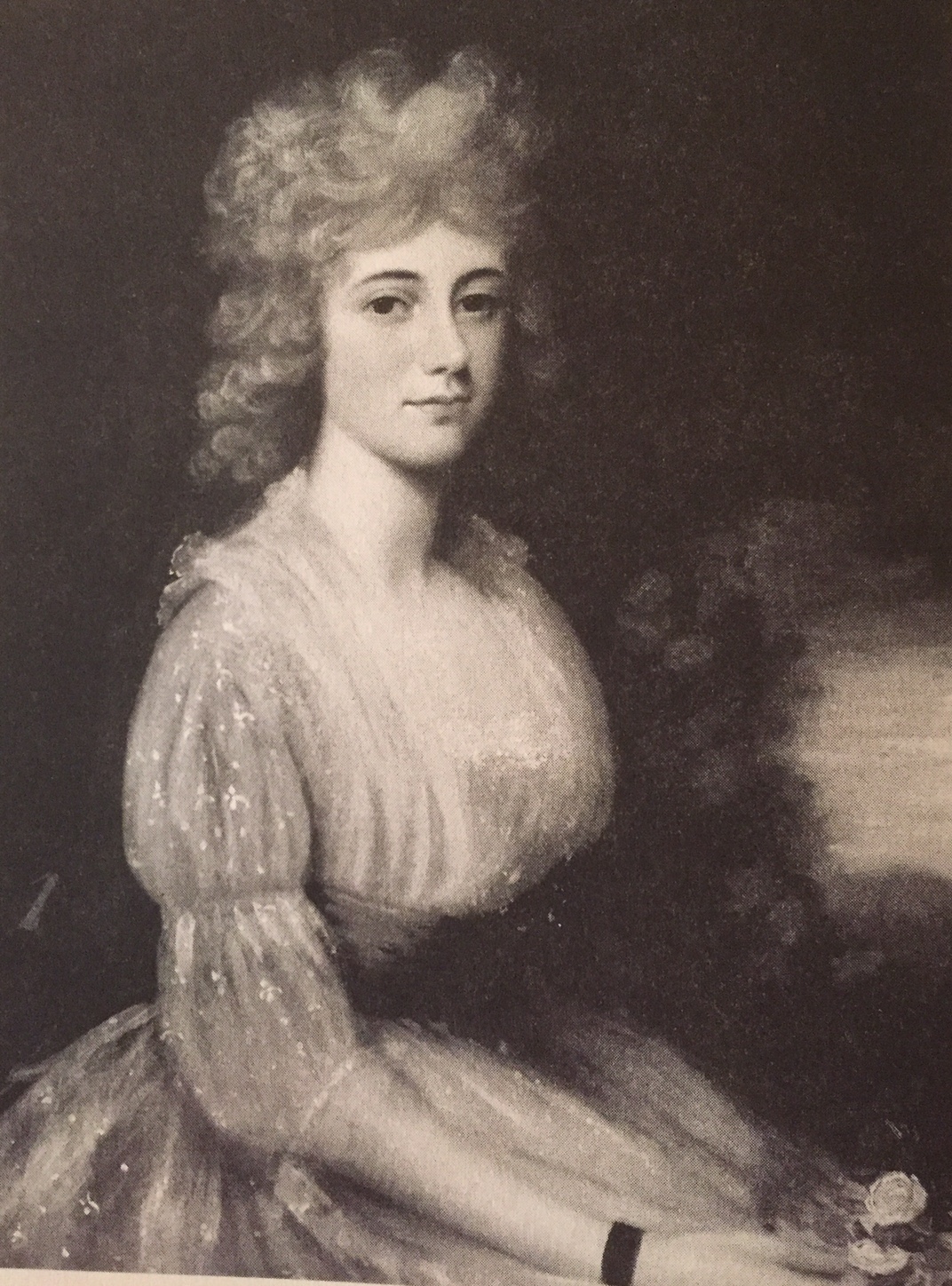
Of an entirely different era and social class, diarist Louisa Catherine Adams, wife of the 6th American President, John Quincy Adams, writes about multiple moves – both in European nations where John Quincy was diplomat and in the United States serving variously as senator, secretary of state, president, and finally congressman again.
Woman on the Move
After the birth of her third child, “as soon as she could rise from her bed, she lifted the lids of her empty trunks and opened her packing cases to prepare to leave for Washington. She was ‘a wanderer’ again.” (140)
In her boldest move, Louisa traversed the passage from St. Petersburg to Paris while Napoleon rampaged through Europe. She traveled 2000 miles in 40 days, a journey almost unheard of for a woman alone.
Louisa and Son Charles’ Wild Ride
In 1815, while John Quincy was gone to Paris, Louisa in St. Petersburg had to “sell the furniture, dispose of the house, and buy a carriage that could carry her across the continent” to Paris. She needed supplies: food, drink, clothing, maps, tools and enough medicines for a small apothecary. She had read the map herself, not having heard from her husband, and unflinchingly set her course.
Her largest expense was the carriage, “a berline, a large vehicle with four seats and glass windows, all balanced on an elaborate suspension of springs intended to smooth the rough ride.” Leaving St. Petersburg, the carriage was outfitted with sleigh runners. Wheels were packed when she met melting roads traveling west and south. (206)
She sewed gold and silver into her skirts to hide her wealth from robbers and from her male servants. (206)
Touch of Humor:
During the sojourn, though her two male servants were armed, she put on her son’s military cap and held his toy sword so that what she hoped was a menacing silhouette would show through the carriage window. (221)
True to her declaration when she married Adams, “When my husband married me, he made a great mistake if he thought I only intended to play an echo.” (8)
Her Most Moving Adventure
Louisa, often sickly and afflicted with self-doubt, recorded her grief in “Diaries of a Nobody.” After all, she was often geographically separated from her husband during his ascendance to power, she suffered multiple miscarriages, all of her children except Charles preceded her in death, and she struggled with erysipelas, a skin inflammation.
But her vividly told “Narrative of a Journey from Russia to France” enabled her to tunnel “her way out of depression with the sharp spade of her sardonic humor . . . .“ (396)
She wrote about Baptiste, innkeepers, haggard soldiers she has passed on the road, frightened faces of the women she met, cries of Vive Napoleón! She remembers the practical difficulties she had overcome: the moment the carriage wheel had come loose, the problem of procuring servants, the dangerous decision to ford a half-frozen river. She wrote about her growing confidence, which rippled out of her descriptions and into her voice. (411)
“Her story was her own. No other woman in America had experienced anything like it. But she made its lessons universal. It was a story about women and what women could achieve . . . . She wrote: ‘Under all circumstances, we must never desert ourselves.’” (411)
Move for Equality
At 62, in an era when a woman’s life span was about 40, she was blossoming. Like the Grimké sisters of Charleston, with whom she corresponded, she championed women’s rights and the freeing of slaves.
The Lesson of a Cracked Washbasin
Cracked Washbasin, Google Images
John Quincy and Louisa Adams observed their 50th wedding anniversary, a milestone almost unheard of in the mid-1800s. Before she died, Louisa presented her daughter-in-law Abby Adams with a cracked washbasin, symbolic of the naked faces bent toward it sometimes joyful and other times full of inconsolable pain, mirroring life itself. (444)
Want More Louisa?
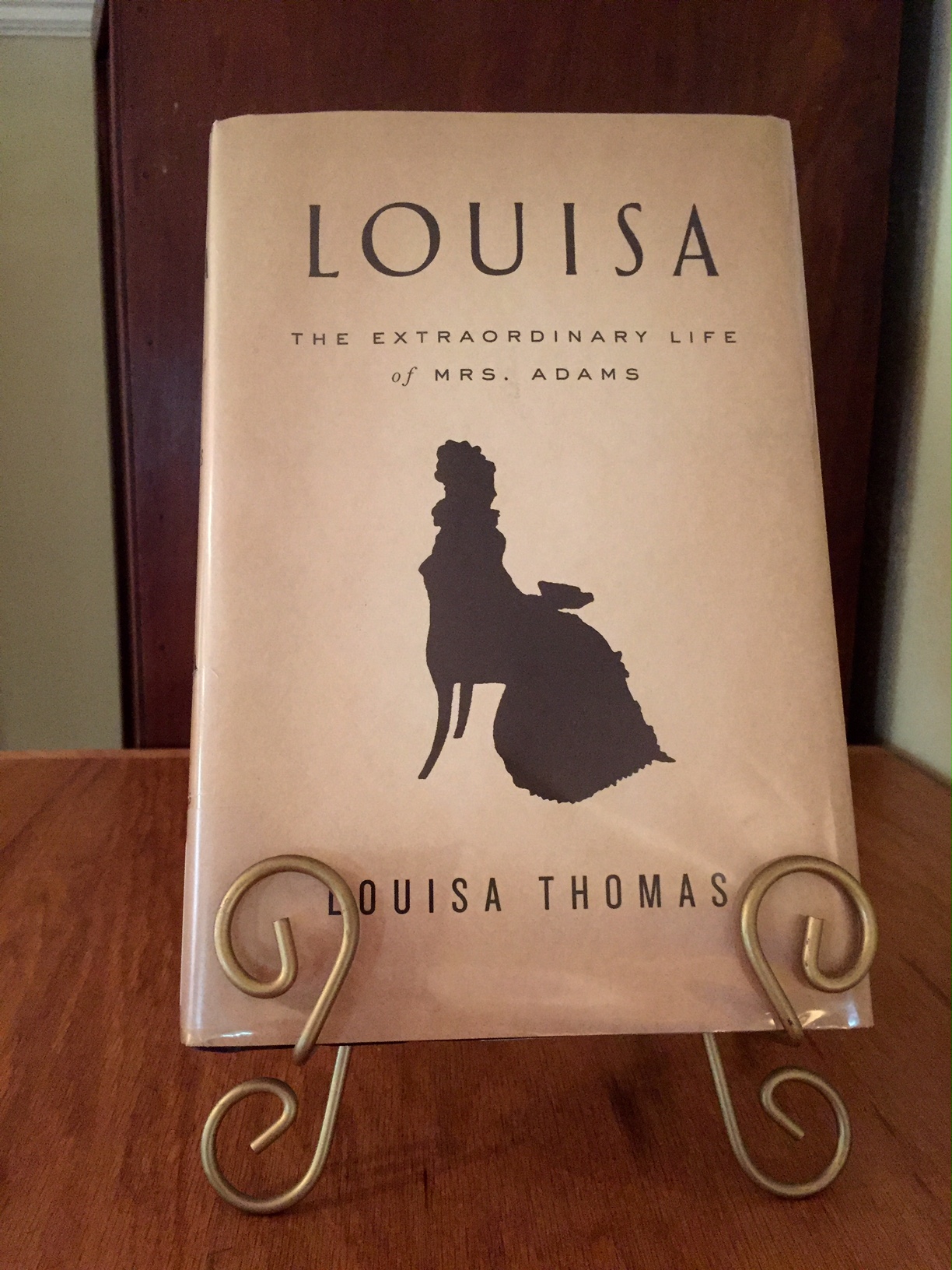
Writer and editor Louisa Thomas has written a stunning account of a memorable woman entitled Louisa: The Extraordinary Life of Mrs. Adams, 2016.
Thomas’ biography sings with color as she describes an incandescent sun on their approach to St. Petersburg, which edged “the statues with fire and [made] creamy walls blush.” (90)
His Turn: An Artist Discards, Donates, and Discovers
Cliff relaxes with coffee, snack and audio book in May before the frenzy began.
Truth be told, my husband Cliff would rather not move. Despite the fact it’s getting harder for him to mow our enormous lawn in one fell swoop or scoop up oak leaves by the millions, he would rather stay put.
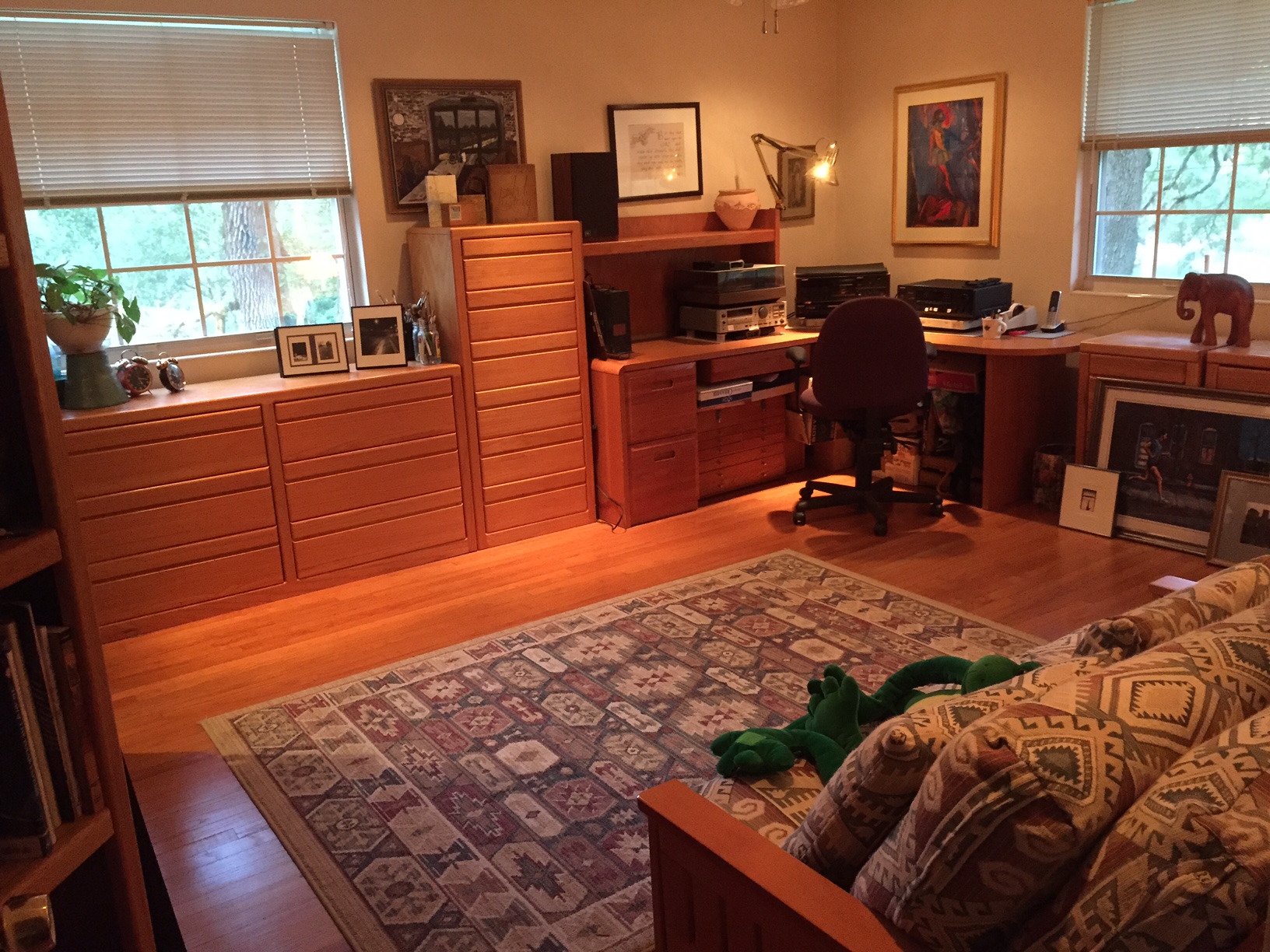
He’s comfortable with oaken file drawers filled with art supplies and designs in his office and an extra large room upstairs for painting and sound recording, shown here in its current pristine state. (It’s okay to read between the lines: artists are not necessarily neat!)
Art/Music Studio ready for staging, 2016
Still, he wisely understands that mounting stairs and maintaining a large corner property may be too much for us as we approach our elder years just around the corner.
The Discarding Process
And so, like me, he has sifted through, scanned, sorted, recycled, and discarded. But it ain’t easy.
Donations that Inspire
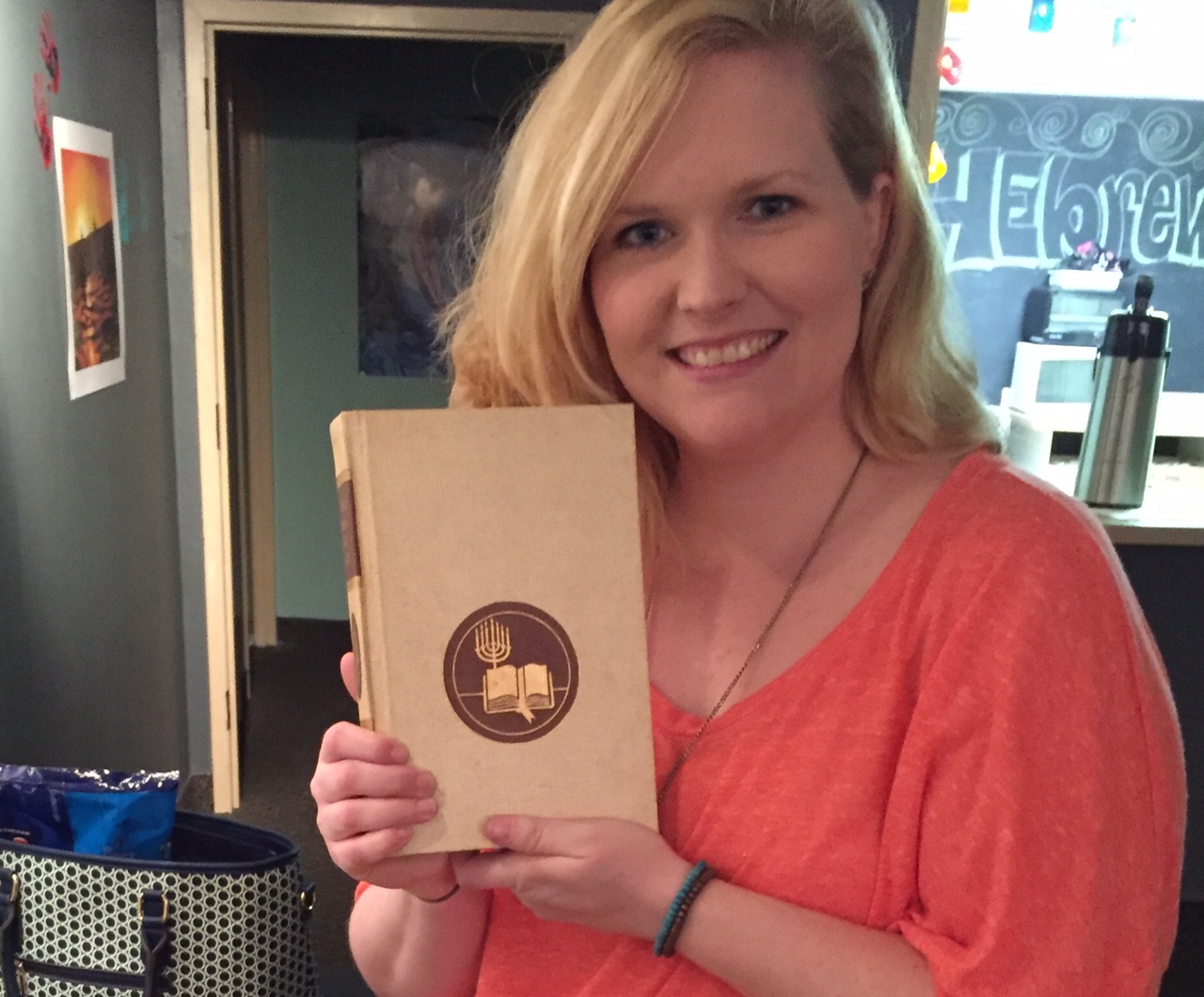
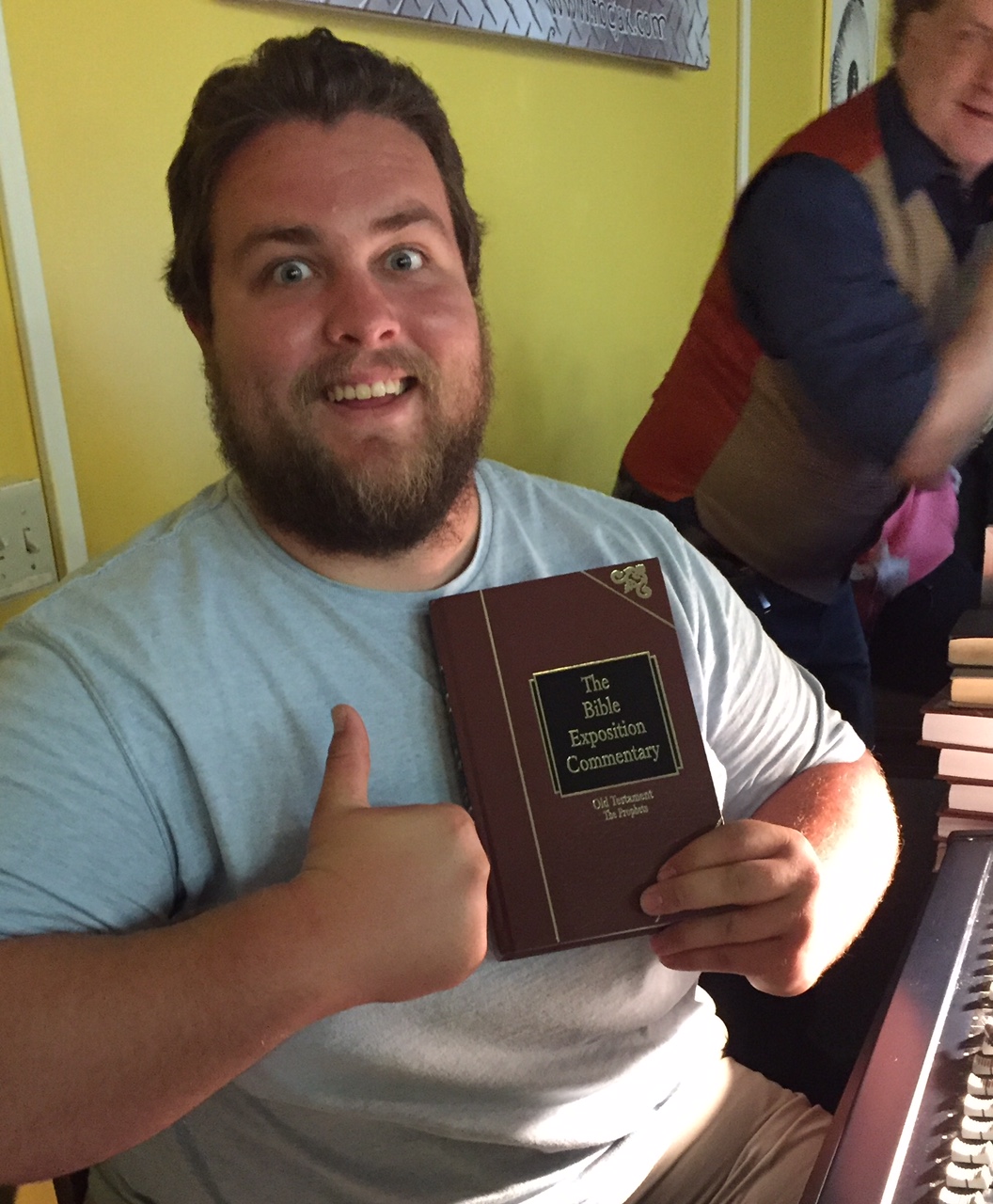
Still, he has sparked joy in book-loving friends at church.
Mama Ashley, reader to three daughters. Her oldest had the highest SAT reading score in her class.Matt joyfully received a set of expository Bible commentaries. Part of the thrill on his face may also be explained by the fact he is getting married soon.
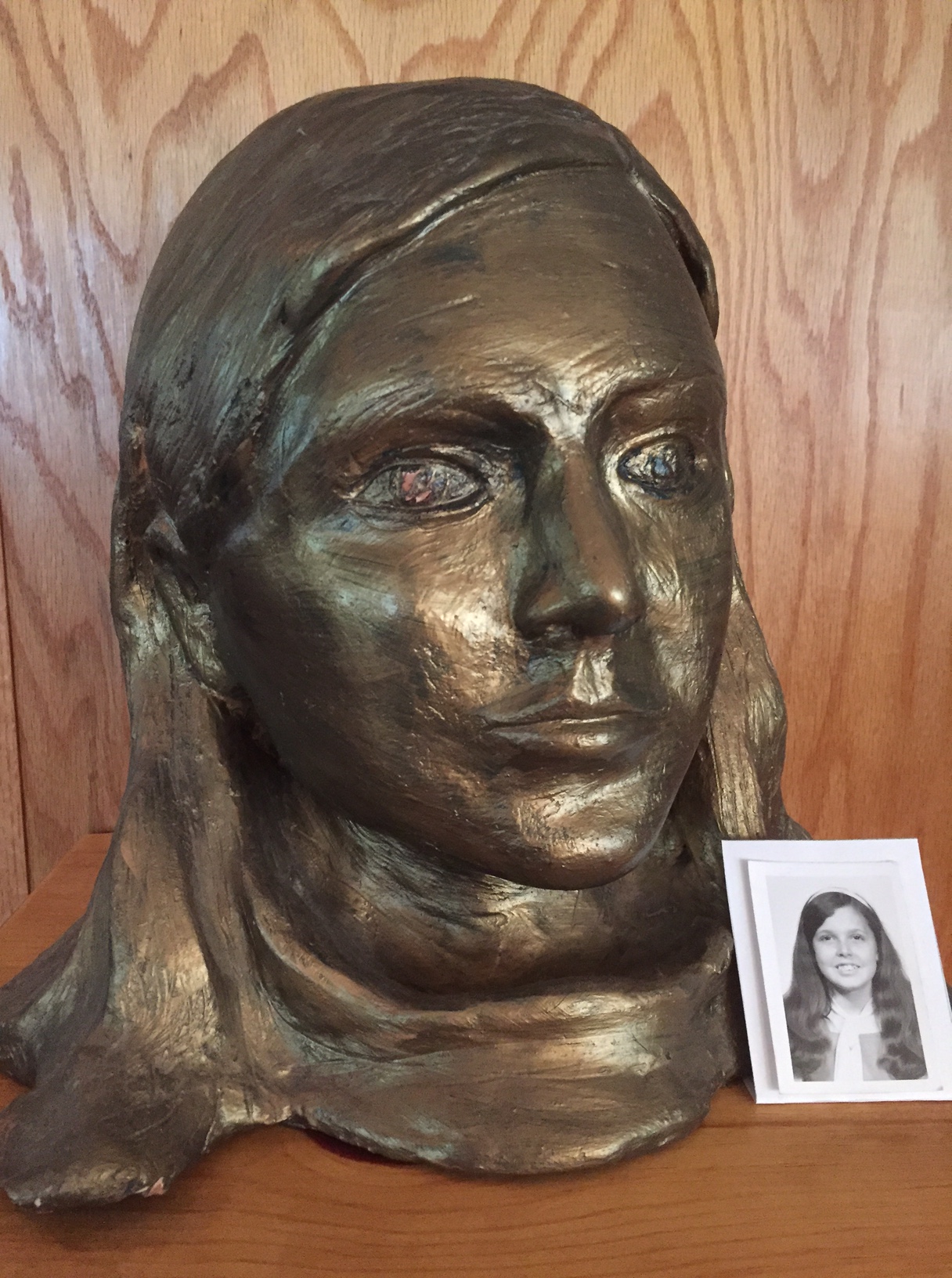
Discoveries Along the Way: Some items, like this bronze bust, were hidden in plain sight:
Bronzed bust of Cliff’s student at Norwood Elementary School, 1966
Others had to be unearthed, like this photo of a Barbara Streisand painting, part of a series of famous New York personalities showcased at “Arnie’s New York, New York” restaurant in Jacksonville in the 1980s. Some of the other 4 x 6 foot paintings included Groucho Marx, Norman Rockwell, Frank Sinatra, Woody Allen, and Joe Namath.
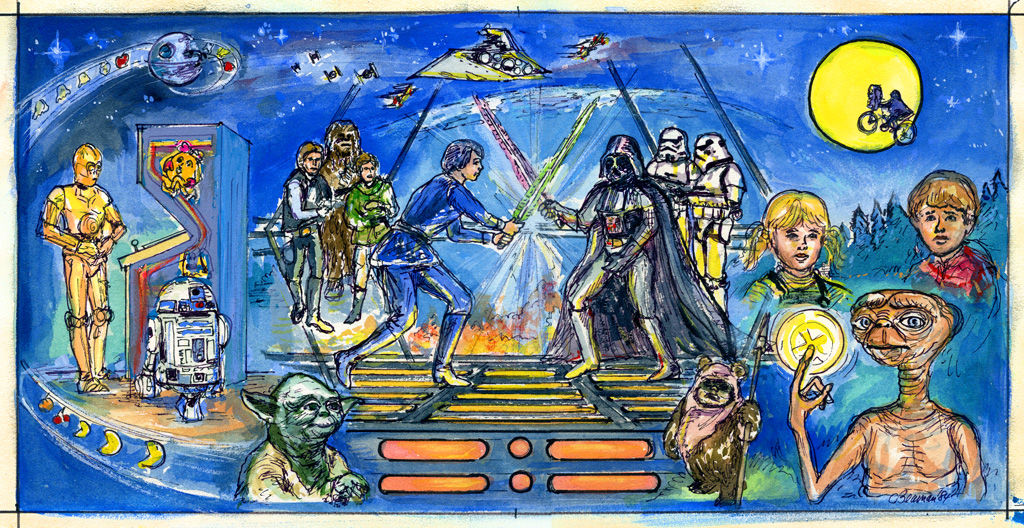
In a tall armoire on a narrow shelf, he found the preliminary watercolor study for a Star Wars painting, which when completed graced the main elevator at Wolfson Children’s Hospital, one among a hundred paintings for the hospital.
Star Wars Color Study, 1984
He has also found lurking in drawers, pencil drawings of college classmates and professors in the classroom, sketches of unsuspecting diners in restaurants. (To be revealed)
Logo for Aqua East Surf Shop, Jacksonville Beach, Florida, Cliff Beaman design
A Male View: Paring Down and Tidying Up
Joshua Fields Millburn, author of Everything that Remains: A Memoir by the Minimalists, shares the masculine perspective of living with little and savoring what you have. “Blindsided by the loss of his mother and his marriage in the same month,” Millburn made daring life changes. You can read my short review of his book here.
Goodreads Image
* * *
What are the pitfalls (or blessings) of moving with a spouse or other relative?
Have you made fascinating discoveries during a move or while organizing your possessions?
Coming in two weeks (July 20): Louisa Adams’ Moving Adventure








 Plain and Fancy