My writer friend Janet Givens and I have both said Goodbye to houses this summer. She, to a vacation house on a canal in Chincoteague Island, Virginia, and me to our family homestead 12 miles from the beach in Jacksonville, Florida, geographically about 750 miles apart as the crow flies.
Our meeting in 2014 was also geographical – and digital. I responded to Janet’s post about her Peace Corps experience in Kazakhstan, linking her experience to my trip to Ukraine, both countries with a Soviet-era history. From there the connection continued on each other’s blogs. That was until I, along with 5-6 other writers, were invited to her cozy log house on the Island. You can view the view memories of that magical first trip here.
I know many of the nooks and crannies of Janet’s special place and feel I’m such a lucky duck to accept her invitation not once but twice to the spacious log house for a writers’ retreat. I can understand her bittersweet sentiments as she lets go of it now.
On both trips, we spent time writing, eating healthy food, talking and laughing in the sunroom, and gazing at the sparkly bay, which leads out to the Atlantic.
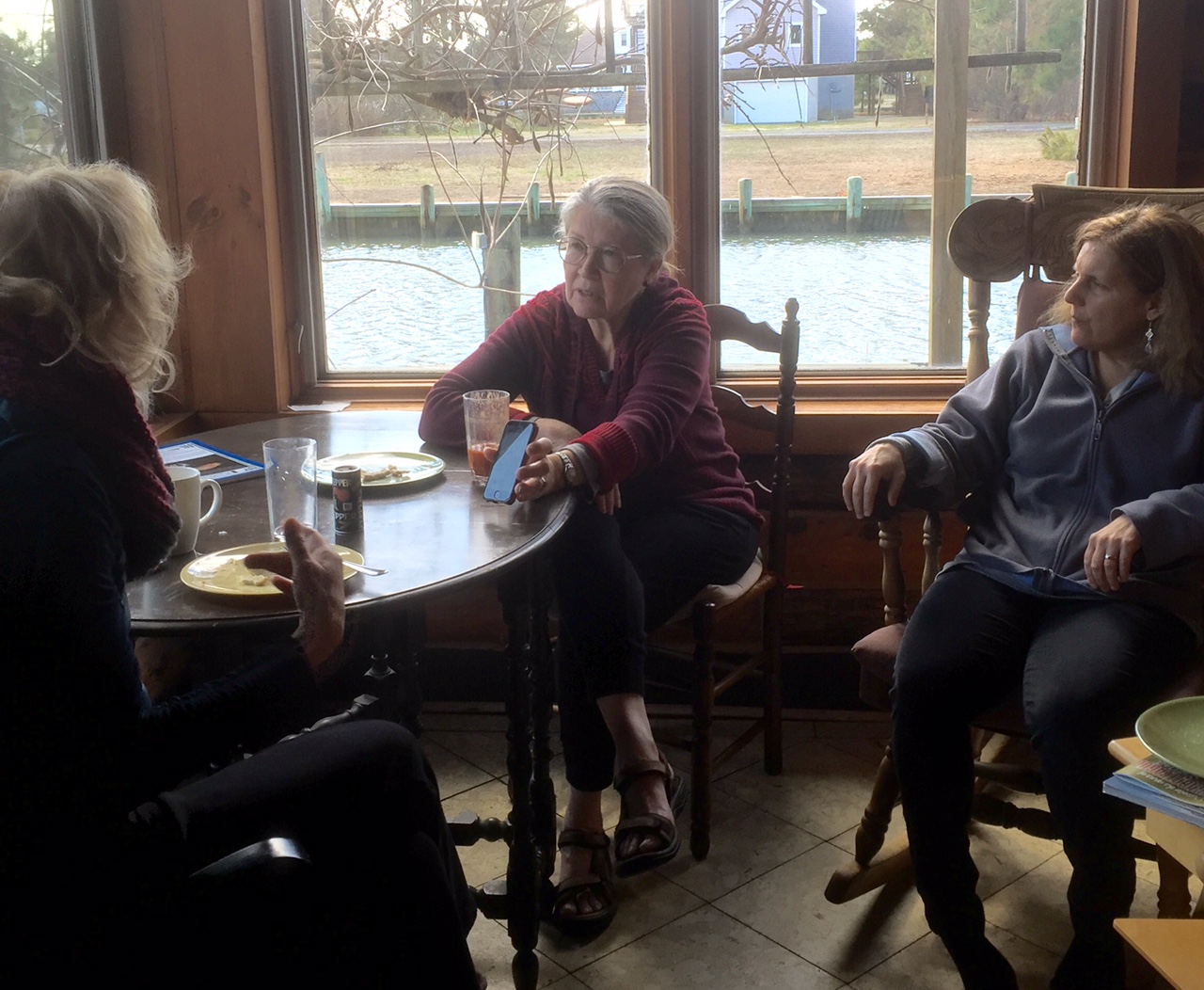
Susan Weidener, Janet, and Merril Smith sharing photos
Ah, and seeing the ponies, personal and close up:
A Vermonter, Janet is bidding farewell to her second home after 22 years. We’ve lived in our house, our primary residence, for 37 years. Pencil marks on the kitchen door record our kids heights from ages 8 and 9 ½ until they were teens. Photos of our long history there fill family albums.
Of course it’s a cliché, but life really is all about trade-offs and feeling gratitude for what is now. I think Janet would agree with the J. R. R. Tolkien quote below. I know I do!
Maybe you have had attachments to a house in your past, perhaps a childhood home or one you used to own or visit.
Golly, it could be the one you live it right now. Grab a cup of something cool or warm and let’s have a chat! 🙂
Above all, do check out Janet’s own thoughts about her love affair with the Chincoteague house here on her blog. You can also find a link to her memoir there: At Home on the Kazakh Steppe.
I’ve written about a Mouse, a Madras dress, Marie Kondo, my Mate’s stored secrets and Louisa Adams’ Moving adventure during our Big Move from a tri-level to a single floor. Now we are settling in. You may be curious about what happened to all the books originally stacked on the shelves of my three adjoining bookcases next to my former writing desk.
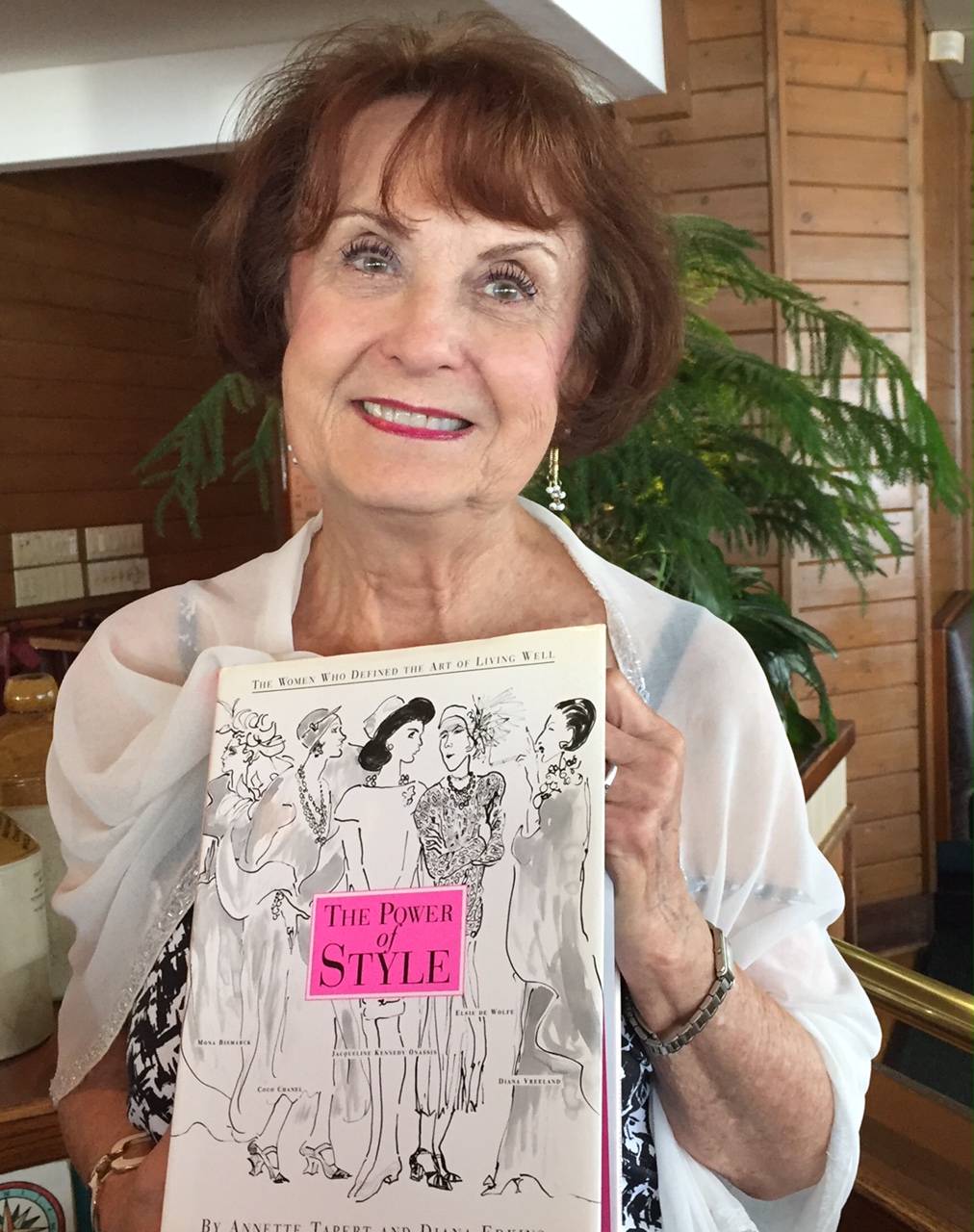
I gave away plenty. This week, Ian got my 1950 copy of The Peanut Man. He sucked in a gasp when I told him George Washington Carver was sold as a slave in exchange for a horse but bravely used God’s wisdom to find hundreds of uses for sweet potatoes and peanuts. Another book, The Power of Style became a birthday gift to my friend Carolyn, a stylish woman whose blouse underneath declares she is cleverly disguised as a responsible adult.
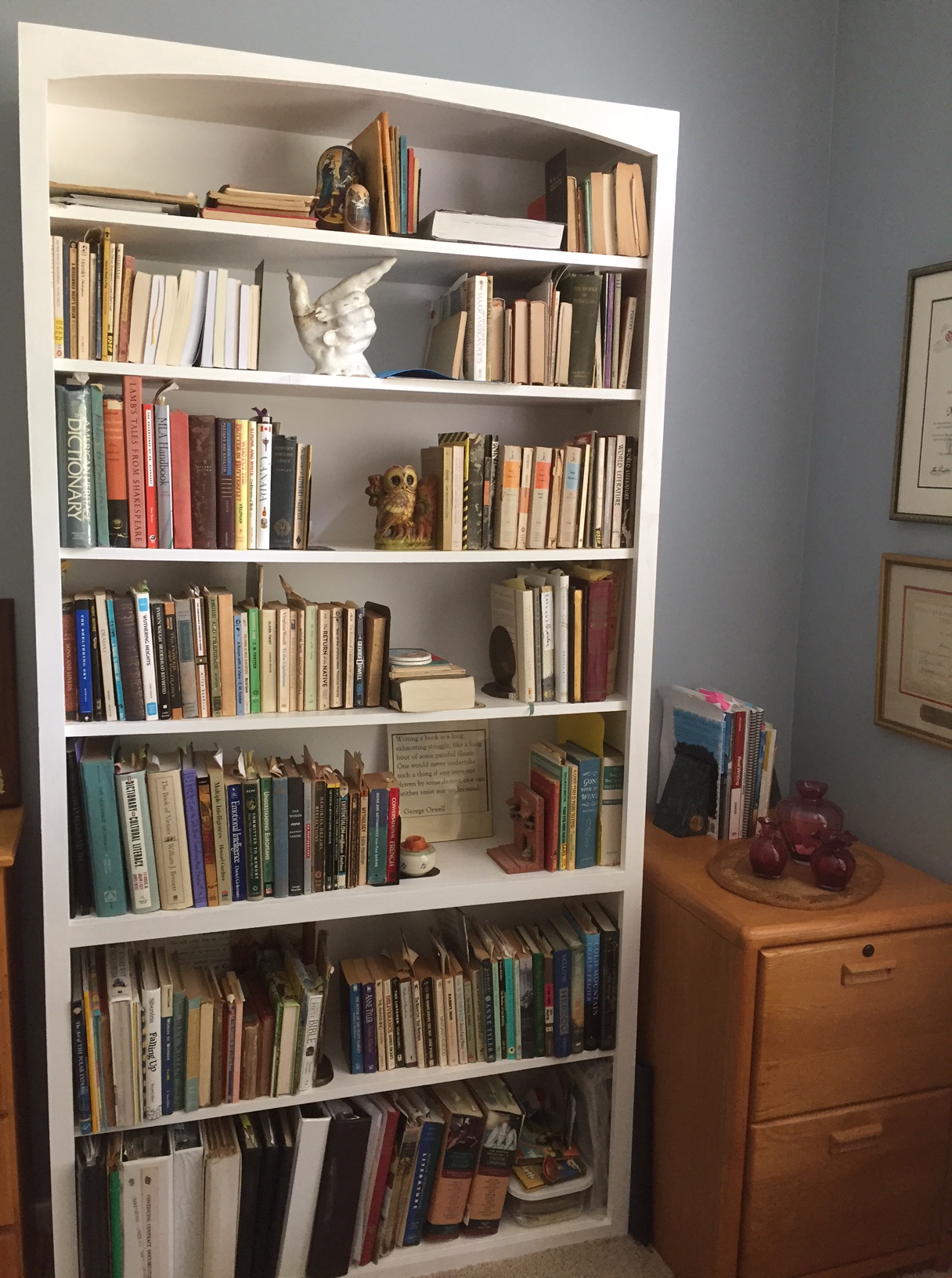
Back in May I started with three floor-to-ceiling bookcases, now condensed to just one. My other books have cozy nests elsewhere, cosseted in small spaces all around our new home.
A book rack in a corner of the great room holds books for morning meditation, including my lilac gratitude book.
My journal for rants and other facts of life has gone missing. It has an iridescent Tiffany-style cover. If it turns up at your house, please let me know. I’m dying to have it back!
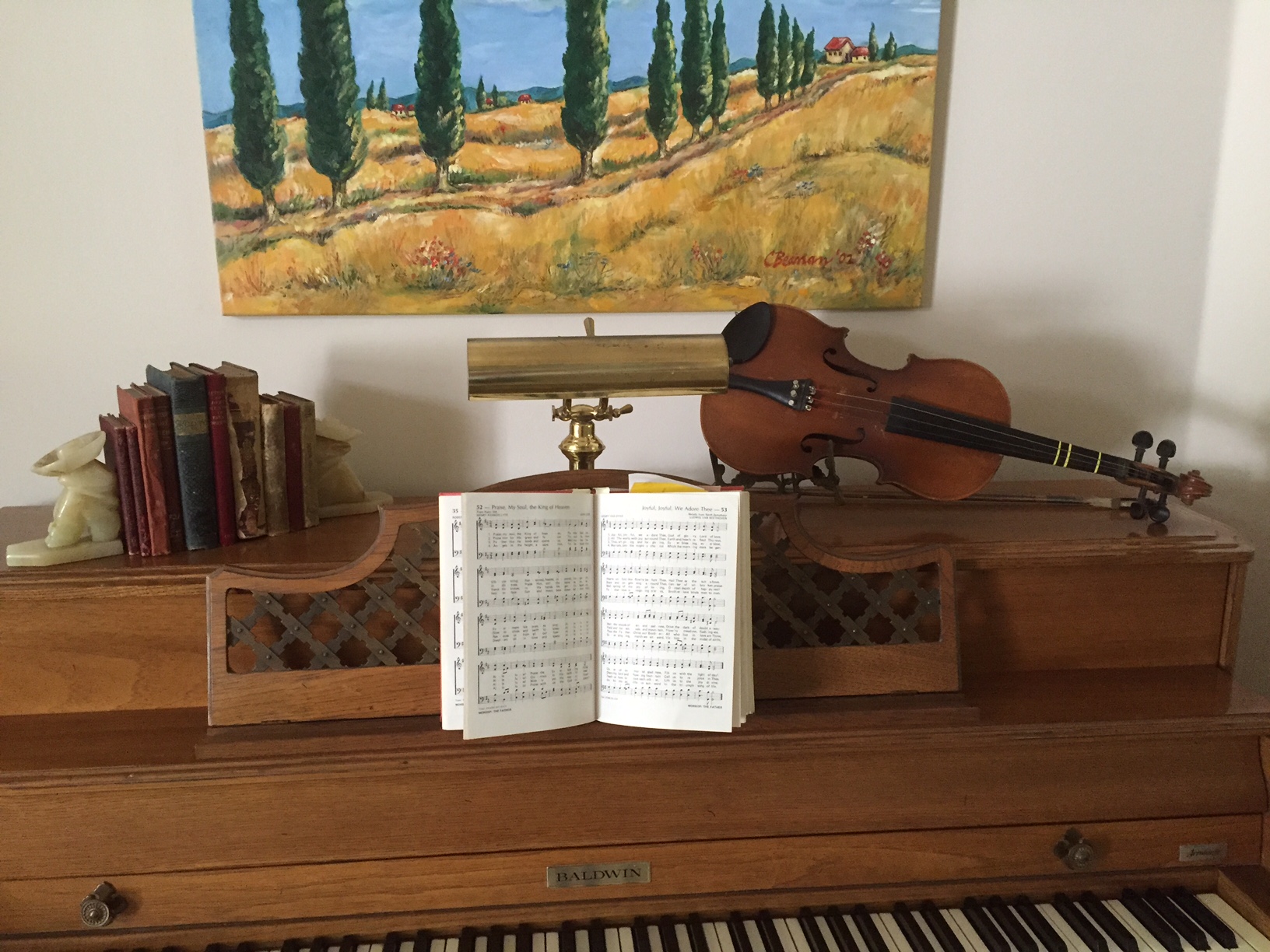
Old books, my hymn books, and a violin in-need-of-repair with the bridge missing fill an alcove in the hallway. Cathedral ceilings have amplified both glorious sounds and sour notes – ha!
The dining room has built-ins for china and books. On the window seat, small crocks (one from Mother) hold in place more old books, including the one at the far end on my blog banner.
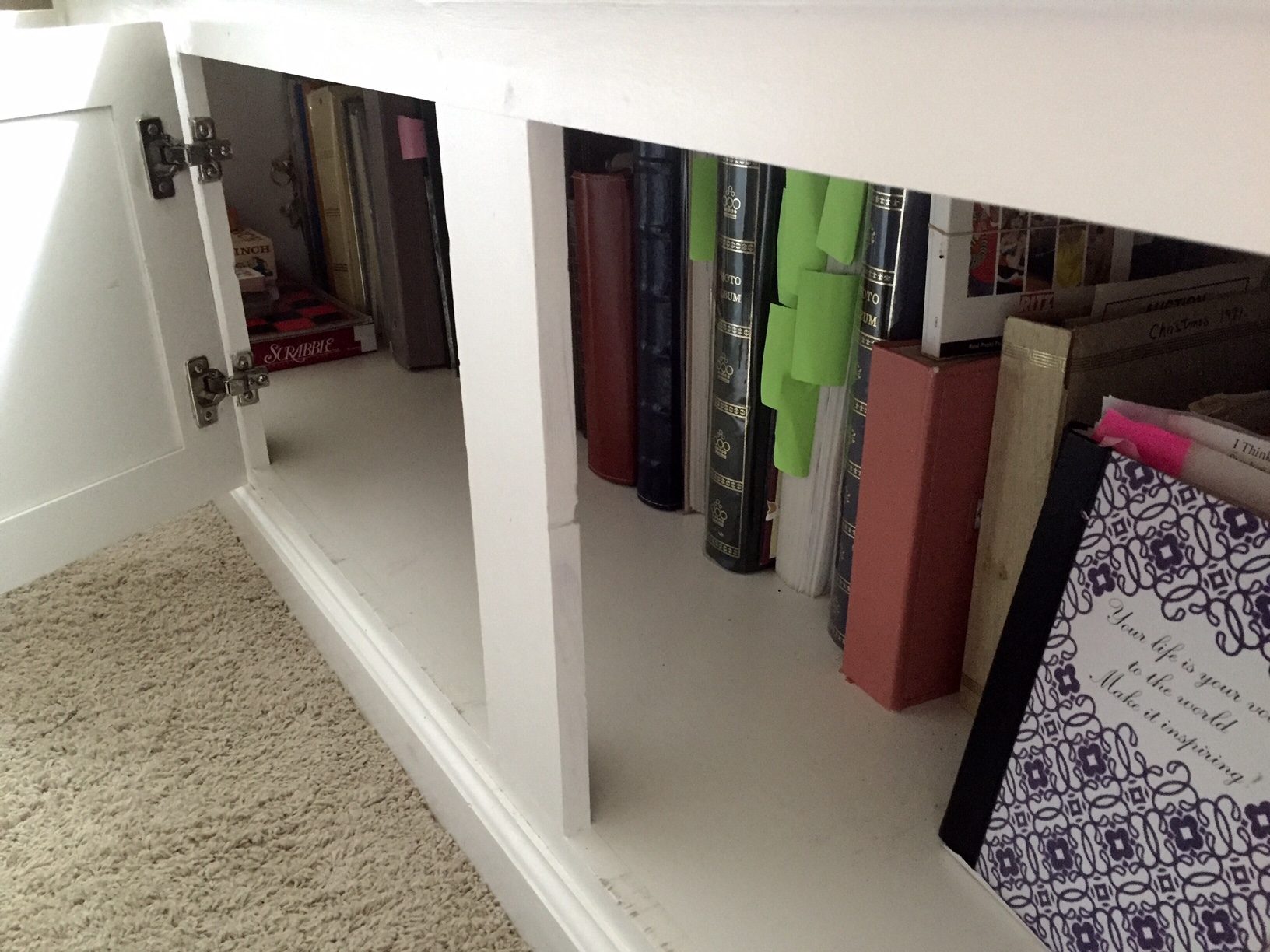
Underneath, a long cabinet swallowed up over two dozen photo albums and about a dozen journals.
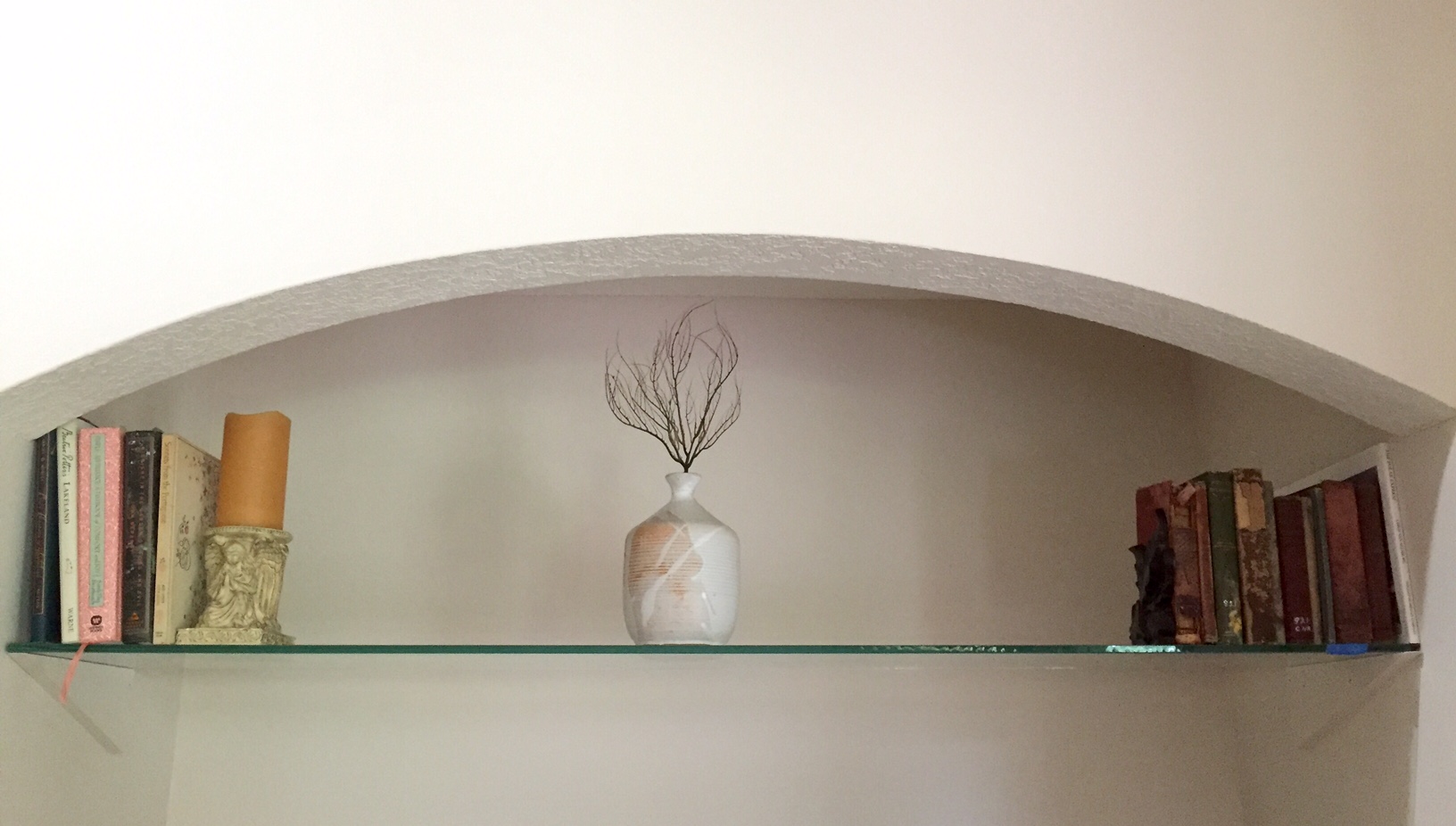
Above the media center in the living room, a sturdy candlestick holds up Sonnets of the Portuguese, Beatrix Potter’s Lakeland, Sarah Ban Breathnach’s Simple Abundance popular in 1995 and Alice in Wonderland, a gift from son Joel and wife Sarah, Christmas 1998. Coral from Key West separates these from another stash of antique books.
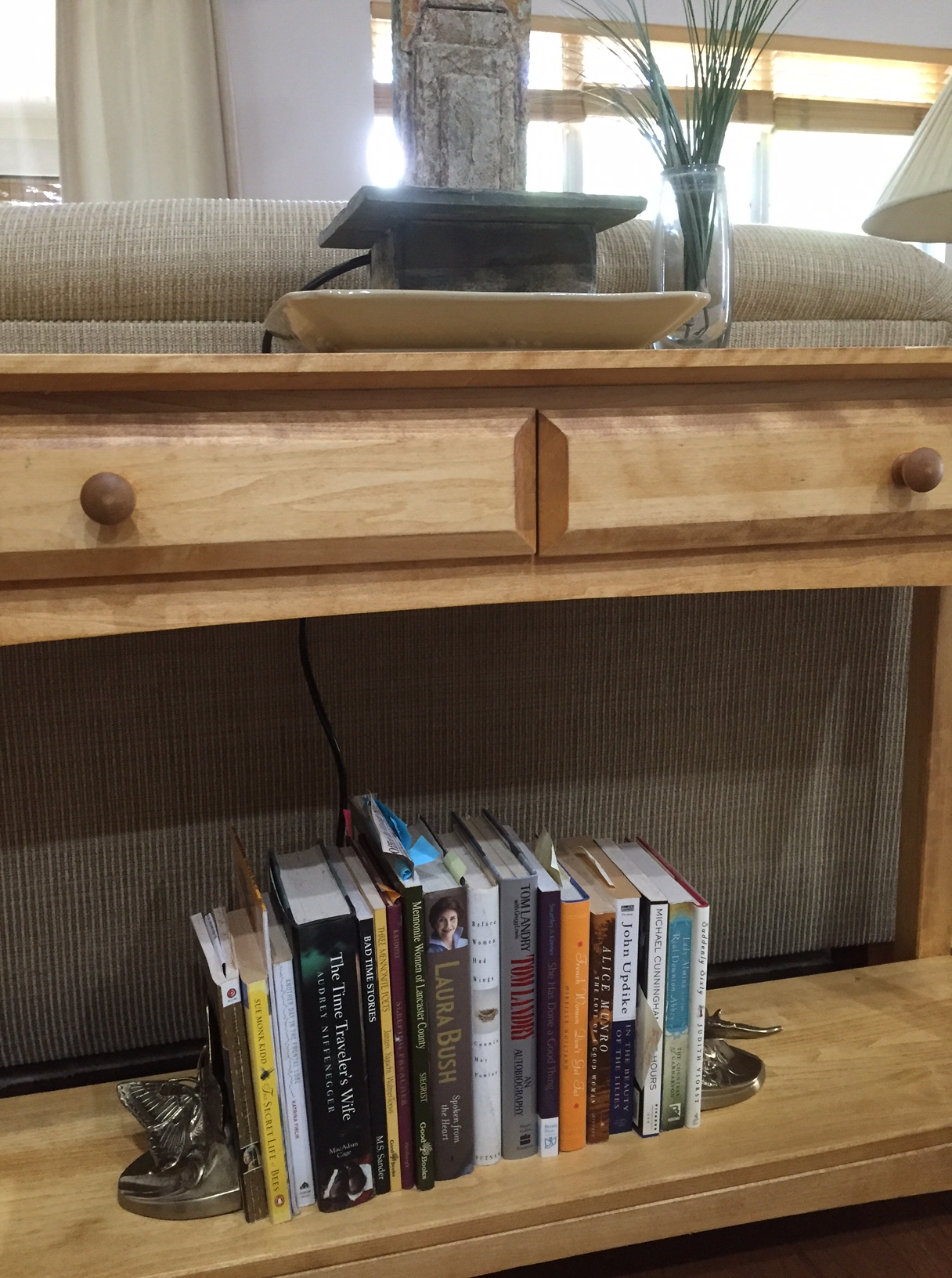
Under the sofa table, brass butterflies hold some of my books by Mennonite writers, a collection by my favorite short story author, Alice Munro, one of John Updike’s novels, Judith Viorst books and The Story of Lady Almina and the Real Downton Abbey by the Countess of Carnarvon.
The water closet, should you choose to linger on the “throne,” offers a changing display of reading material.
And finally, I pared down kitchen recipe books. What remains has a distinctly Mennonite/Amish vibe with slender tea-time booklets at right. Most recipes are available online, so the 4-inch thick encyclopedias had to go. Besides, my favorite recipes sit snug in a computer desktop file.
Four months ago in our former home, I began with three adjoining bookcases, jammed with books. In the photo below, I had already started purging.
Space for my books is much smaller now, condensed to just one. Besides, it was time to let some tomes go. Looking back, I see my method for giving away or keeping has been more intuitive than rational. Autographed books, gifts from friends or family had to stay. Hardest to let go – textbooks laden with notes I had labored so long to create.
A glitch occurred as we tried to stabilize this bookcase. When the cable guy came, he angled the bookcase to hookup the internet and pushed the oak file-case forward. When he finished, he shoved the case too far to the right, so we couldn’t get it pushed back to the wall. Because it was overloaded with books and too heavy to move, son-in-law Joe and husband Cliff relayed books from case to floor and back again, so the behemoth could be moved into its final resting place. Bless them!
“I like best to have one book in my hand, and a stack of others on the floor beside me, so as to know the supply of poppy and mandragora will not run out before the small hours.” Dorothy Parker, The Collected Dorothy Parker (My stack has dwindled.)
Do you believe as William Dean Howells suggests
Oh, nothing furnishes a room like books.
What books are among your favorites? Which ones would you never, ever part with?
Do you have places to showcase special books?
What other room accessories do you value? More quotes about books are welcome here too ~ thank you!
Flop – flop – floppity – bop bop! That was the sound of grandson Ian’s heavy plastic bag of supplies bouncing off his left leg walking into orientation last week at Mandarin Oaks Elementary School.
I didn’t pay too much attention to its contents until I helped him place supplies into wire bins at the back of his classroom: Purell germicide, Clorox wipes, Ziploc freezer bags, even multiple boxes of Puffs tissues.. The only item I recognized as a school supply was a ream of paper to print pages from a classroom computer.
On the first day of class, Ian, now a third grader, carried an aqua-blue lunch zippered pouch and a black backpack no doubt stuffed with notebooks and crayons. As a first grader at Rheems Elementary School, I wore a dress and carried a plaid book-bag with a plastic handle and a metal lunch box, probably plaid too. In the 1940s, plaids or checks were in.
Google ImagesSecond Grade: Rheems Elementary School
I didn’t learn the alphabet until I was five. But learning is speeded up these days. Students are pushed to advance. Ian and others in his age group probably have memorized their letters by age three or four. The curriculum in his particular third grade class includes reading twenty-five chapter books out of class during the school year. Peering into his book bag today, I spotted Madeleine l’Engle’s A Wrinkle in Time, The Chronicles of Narnia by C. S. Lewis, and Kate DeCamillo’s Because of Winn Dixie. Reminiscing, I remember reading aloud and silently during class, simple books. Our teacher read to the class after lunch as we rested our heads on the desktop. Instructors then encouraged but did not quantify the number of books to read until junior high school.
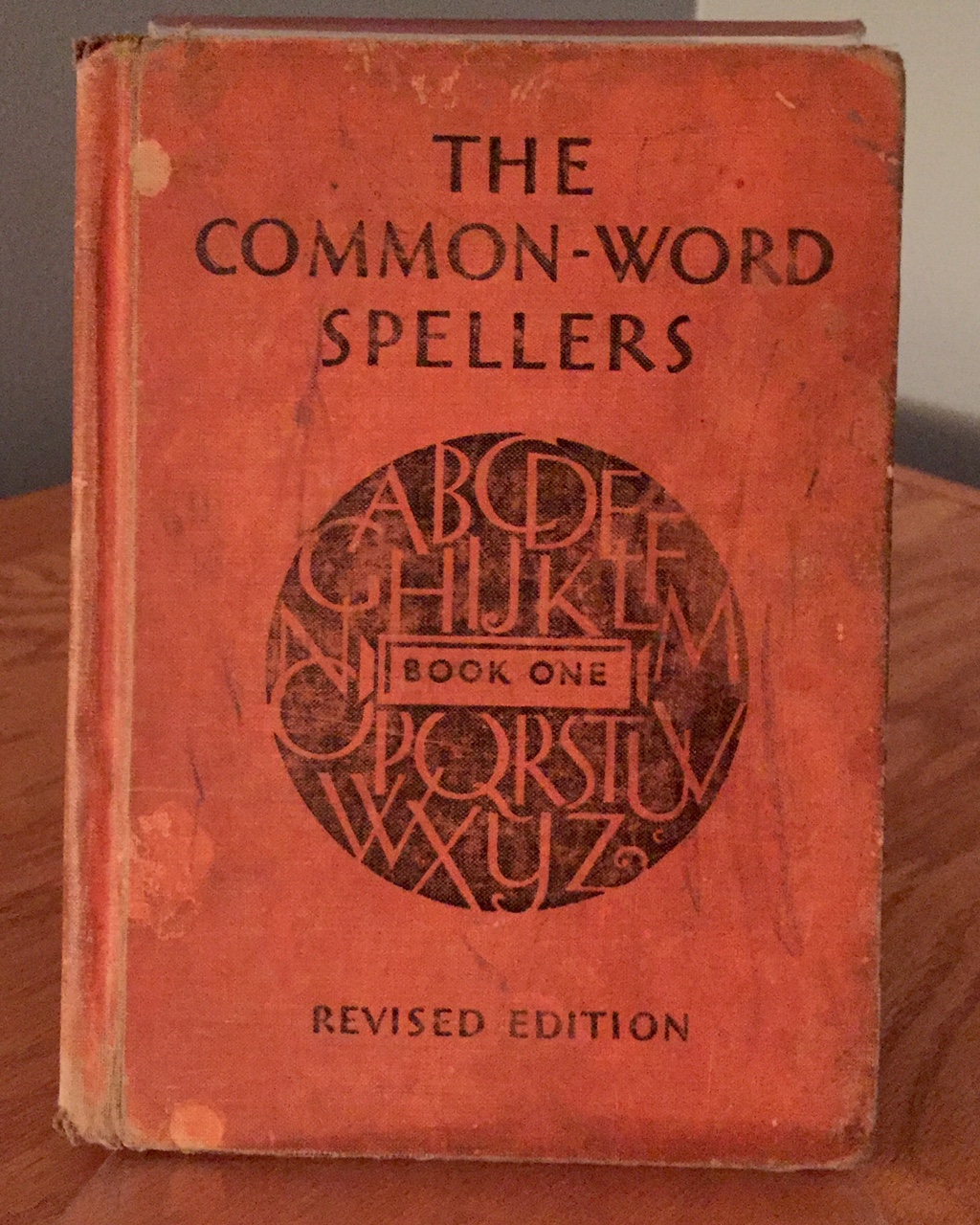
Teachers nowadays may teach spelling, but do not issue students textbooks such as The Common-Word Spellers like this one below published in 1921 by Ginn and Company.
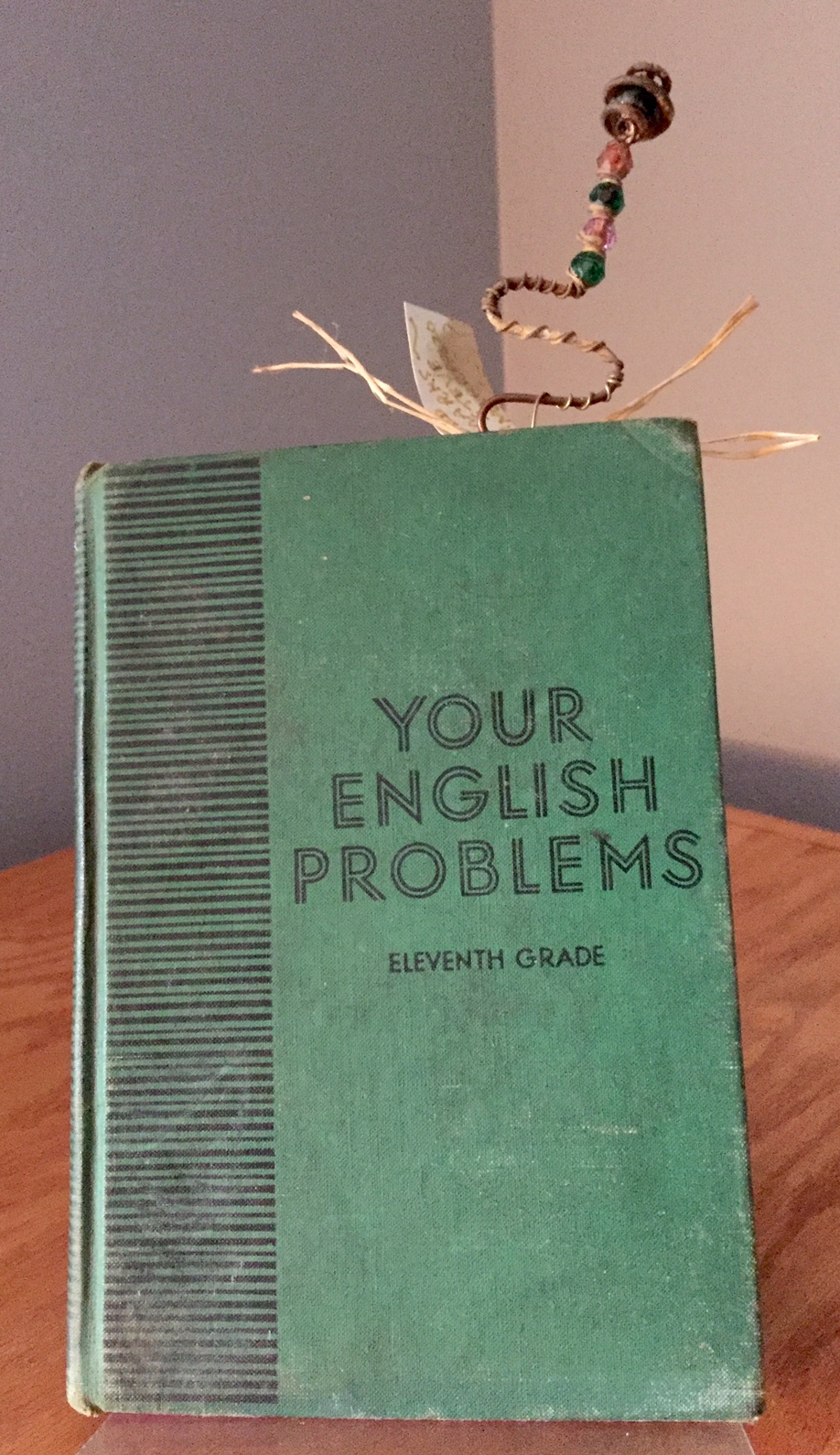
Nor do grammar book titles these days warn students about getting tangled in English problems, negative wording that educators today would probably nix.
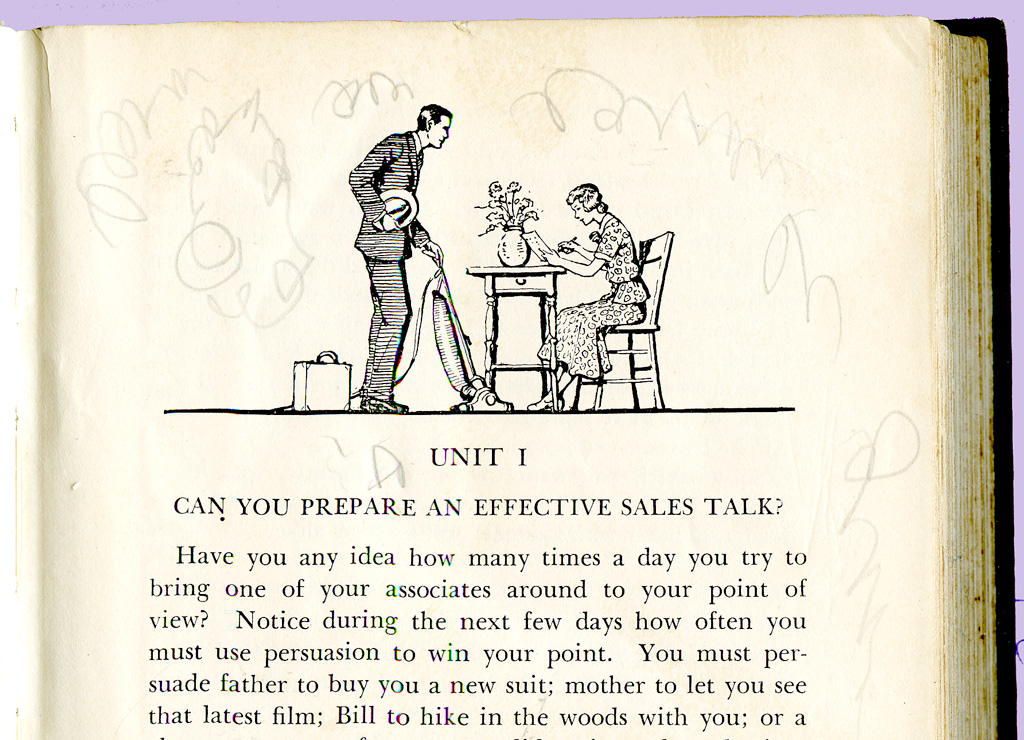
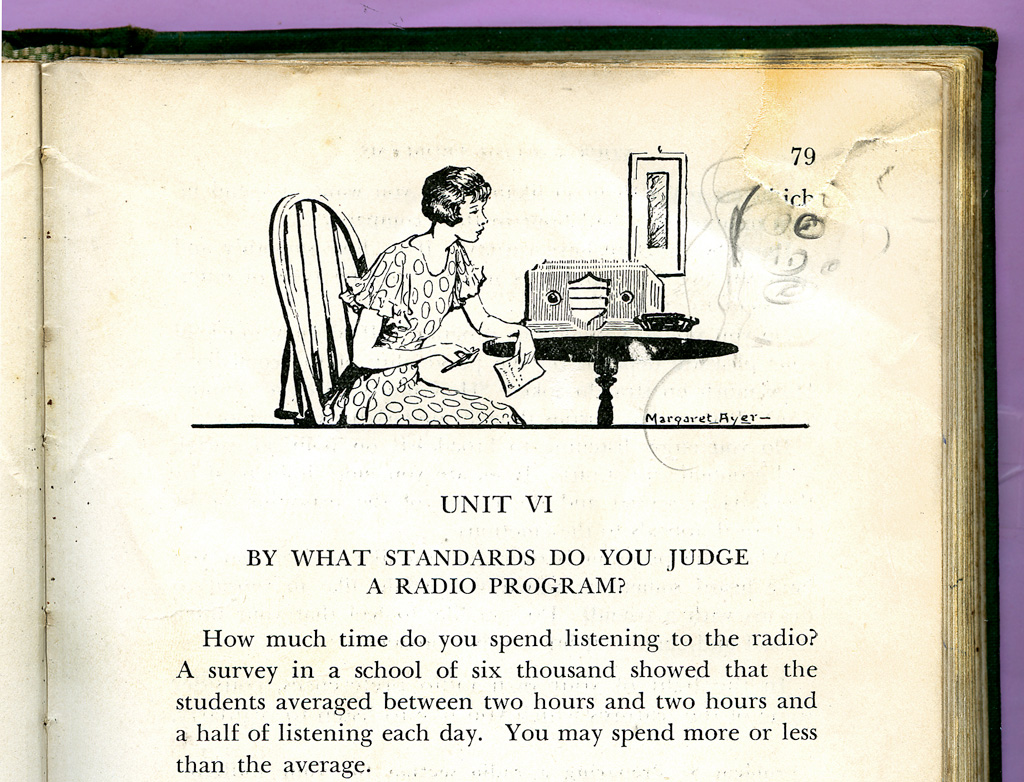
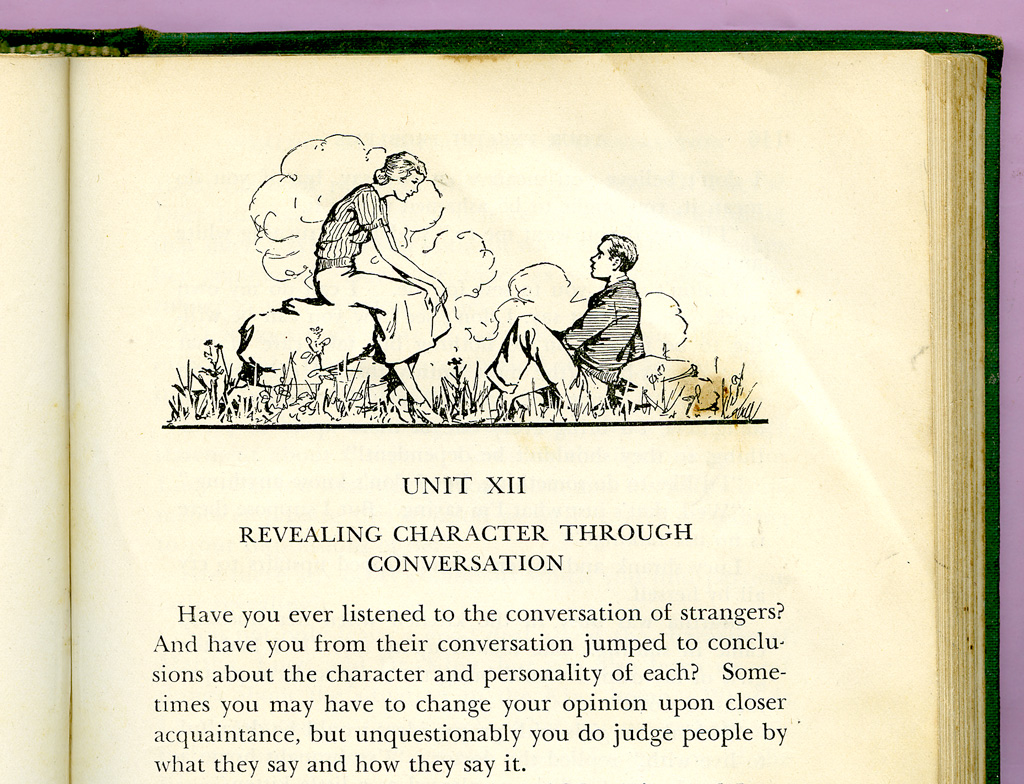
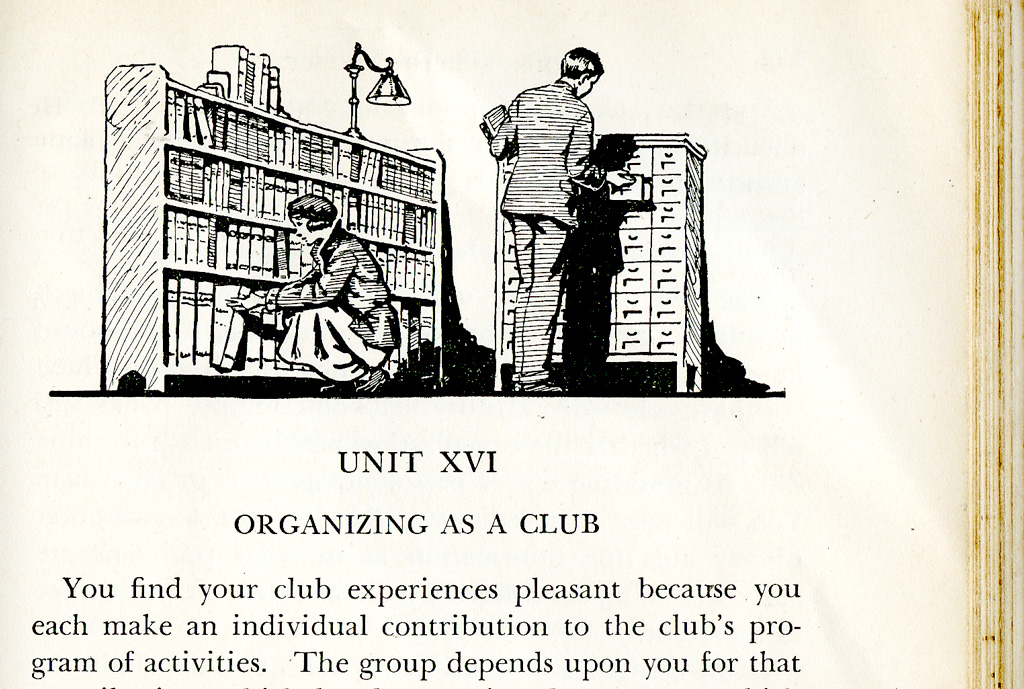
This antique practical English text by Easterbrook, Clark, and Knickerbocker bears a copyright date of 1935. Quaint but exquisite pen & ink illustrations announce various chapter headings, which also depict social skills needed for the business world, especially preparing for a career in journalism. Thanks to this gift from friend Carolyn, you can catch a glimpse below of what curriculum planners and textbook authors thought students needed to succeed in the 1930s.
The technology depicted here is mostly obsolete, yet it feels like a novelty because we are eighty years removed from this era.
Hat in hand is a tip-off that the gentleman running the vacuum cleaner expects $$$ from his sales presentation, not a huge hug from an appreciative wife. Is the woman at the desk examining the manual? writing a check? Housewives then did not hesitate to open their doors to the Fuller Brush salesman and their ilk.
iPods with ear-buds have replaced the big box with knobs enjoying pride of place here on the table. How about you?
In an age when Facebook posts, text messaging and Snapchat often constitute communication, leaning in and maintaining eye contact suggests that face-to-face conversation can reveal character. Does this scene recall meaningful conversation with a loved one?
For some, hand-held Kindles and Google searches have replaced library bookshelves and the card catalog. Remember those? And careful notes written in ink on index cards?
Jenna and Patrick Dalton on their first day of school at Mandarin Middle School, book bags de rigueur (2016-2017 academic year)
“School is hard. It’s a job. But instead of getting paid in money you get paid with knowledge.” ~Jenna after her first day of school, August 15, 2016
* * *
Your turn: Do any of the pictures above ignite a memory or spark a story? What is your take on current technology? What ways of communicating should be preserved?
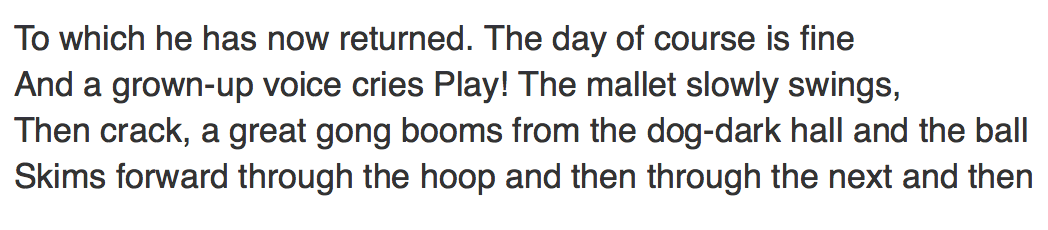
And as the world tilts toward the dog days of summer, that’s how I see it too: tiny images of poetry seen through the prism of my childhood, remembering summers in the Longenecker back yard and inside Grandma’s house. Louis Macneice expresses these sentiments vividly in his poem, “Soap Suds”
Soap Suds
Vintage Lawn Croquet with wooden mallets and balls – Google Advanced Image (The Longeneckers had one almost identical.)
Though Macneice reminds us there’s no going back to childhood after experiencing the realities of an adult, our younger selves can still exist in memory – as photographs preserved in sepia tone. And like the bubbles in soap suds, I recall a childhood that is ephemeral, fleeting:
I can see the nicked edge of the croquet mallet, as it strikes the striped ball with a “thwack” sending it on a scrolling roll . . .
. . . taste the root-beer float Mom made from Hires concentrate, laying the 2-quart Ball jars side by side on the cellar floor to “cure.” . . . hear the straw suck of the cool drink like the sound of sudsy sink water draining.
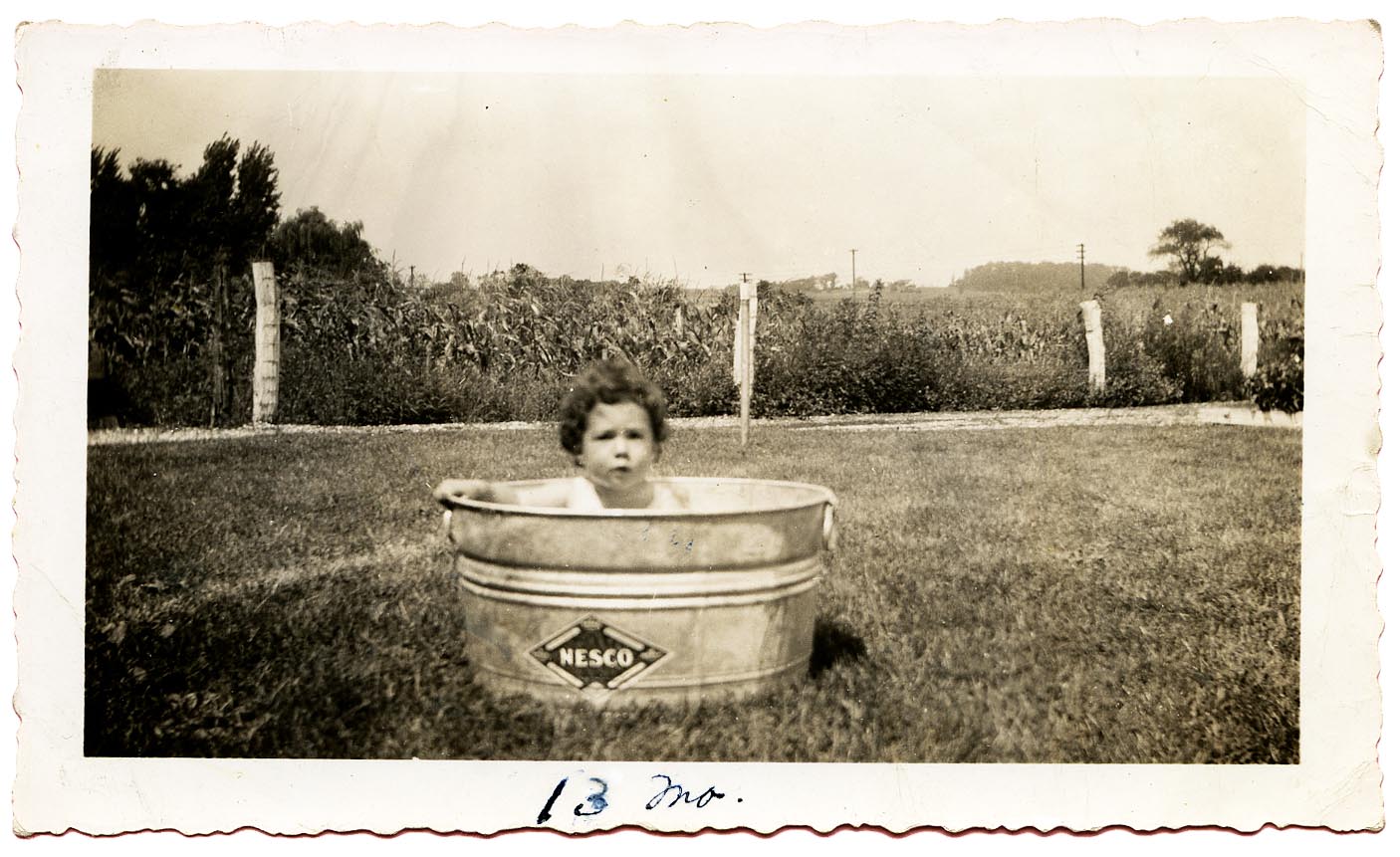
. . . feelthe cool water as I splashed in the tub on a hot summer day in August.
* * *
Only one piece of playground equipment was a fixture in our back yard, an iron swing painted glossy silver. Here Daddy, probably at Mother’s prompting, posed with me in his plain coat and black bow tie before or after church at Bossler Mennonite. He has a tentative hold on his firstborn daughter, perhaps still feeling awkward as a parent. The calendar must have shown April because I was 9 months old. No roses or peonies bloom yet in the garden behind us.
Credit: Globe and still life. The antique globe above comes from Norwood Elementary School where Cliff first taught school. He composed the still life painting next to it during his Master’s degree studies at Florida State University.
Did your family have a croquet set? Do you still use it?
What other pictures or stories of childhood summers did this post spark in your memory?
How as an adult, have you tried to retrieve child-like wonder and playfulness?
Coming next: School Daze – They Ain’t What They Used to Be
When we met, Cliff’s very first words to me were “Nice to see you again.”
My quick quip, “Nice to see you again too.”
But I’m getting ahead of my story. Way ahead . . .
* * *
During the months of June and July, I published a series of posts about moving from our large family home to a smaller abode. An earlier post discussed this move from my husband’s point of view: His Turn, an Artist Discards, Donates, and Discovers. I mentioned then that I may reveal later some of Cliff’s discoveries, unearthed drawings from an armoire that have not seen the light of day for literally decades.
I’m showing the first one on this post.
But first, some background . . .
Through the ingenuity of my Pennsylvania neighbor next door, Paul Mumma, I met Cliff, his college roommate, as a blind date on December 18, 1965, a fact I recorded in an entry with many embellishments in my journal. My iPhone says the day of the week that year was a Saturday.
On what turned out to be a double date, Paul, his girlfriend Betty, Cliff and I drove down Anchor Road on the way to the education building of a small church which the four of us intended to decorate for Christmas. On a blackboard in one of the Sunday School rooms Cliff first revealed his artistic talent by drawing a Santa Claus, mostly for my benefit, I surmise. (Sorry, the Santa Claus has been erased.)
A few days later, he had me pose in the living room of my parents’ home for many minutes. He explained that he was drawing my portrait. I sat very still for a long, long time.
Cliff finally flipped the paper to expose the drawing. I was aghast when I saw what the clever artist had been playing with on paper for forty-five minutes: He had morphed my then-slender figure into a porky jungle animal with a cute blue bow.
He laughed heartily when he saw my shocked reaction.
After the gasp, all ll I could manage was an incredulous giggle. “You got me,” I thought.
The next week was Christmas. Then I heard him tell me, “I think I am falling in like.”
Really? What’s that like, I wondered.
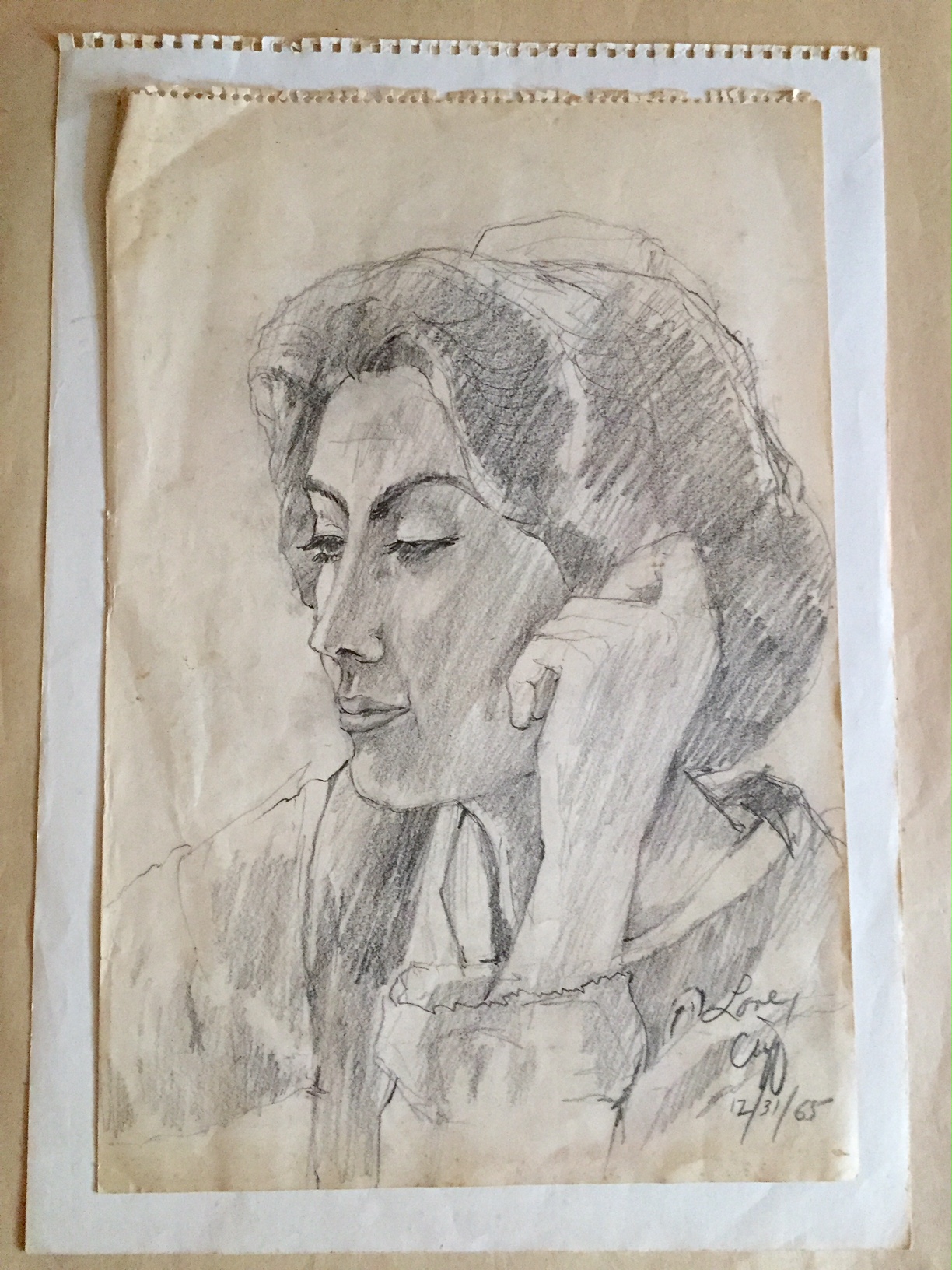
About a week later, Cliff drew a proper picture of me.
The Drawing
He drew a good likeness of the serious me and prophesied my future, I think, by exaggerating my pile of dark hair and miniaturizing my prayer cap.
He signed it, Love, Cliff.
Yes, Reader, I married him.
Reader, I married him. A quiet wedding we had: he and I, the parson and clerk, were alone present. ~ Jane Eyre, Ch. 38, C. Brontë
Our wedding was not quiet. And more than four people were present.
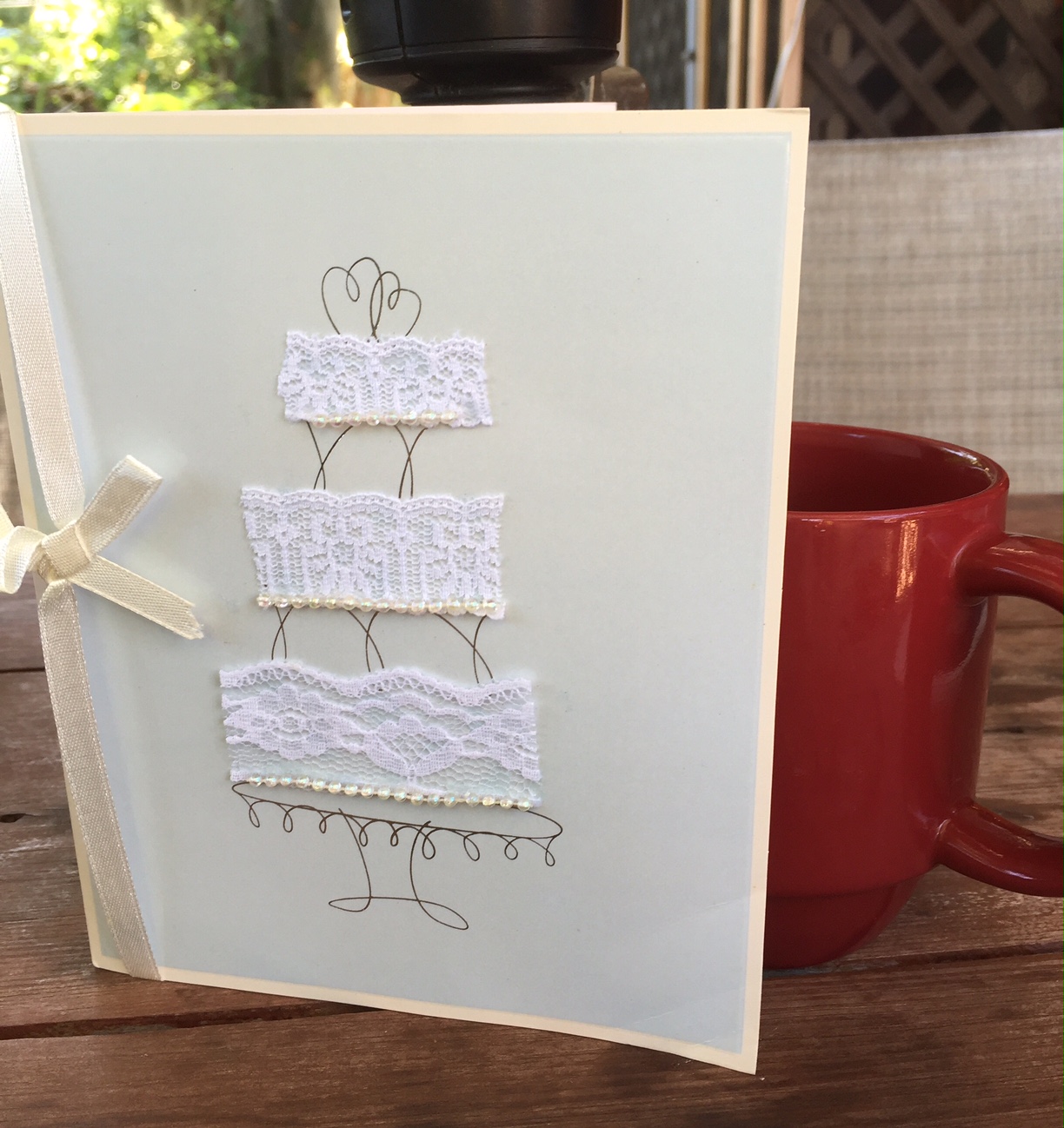
A Card
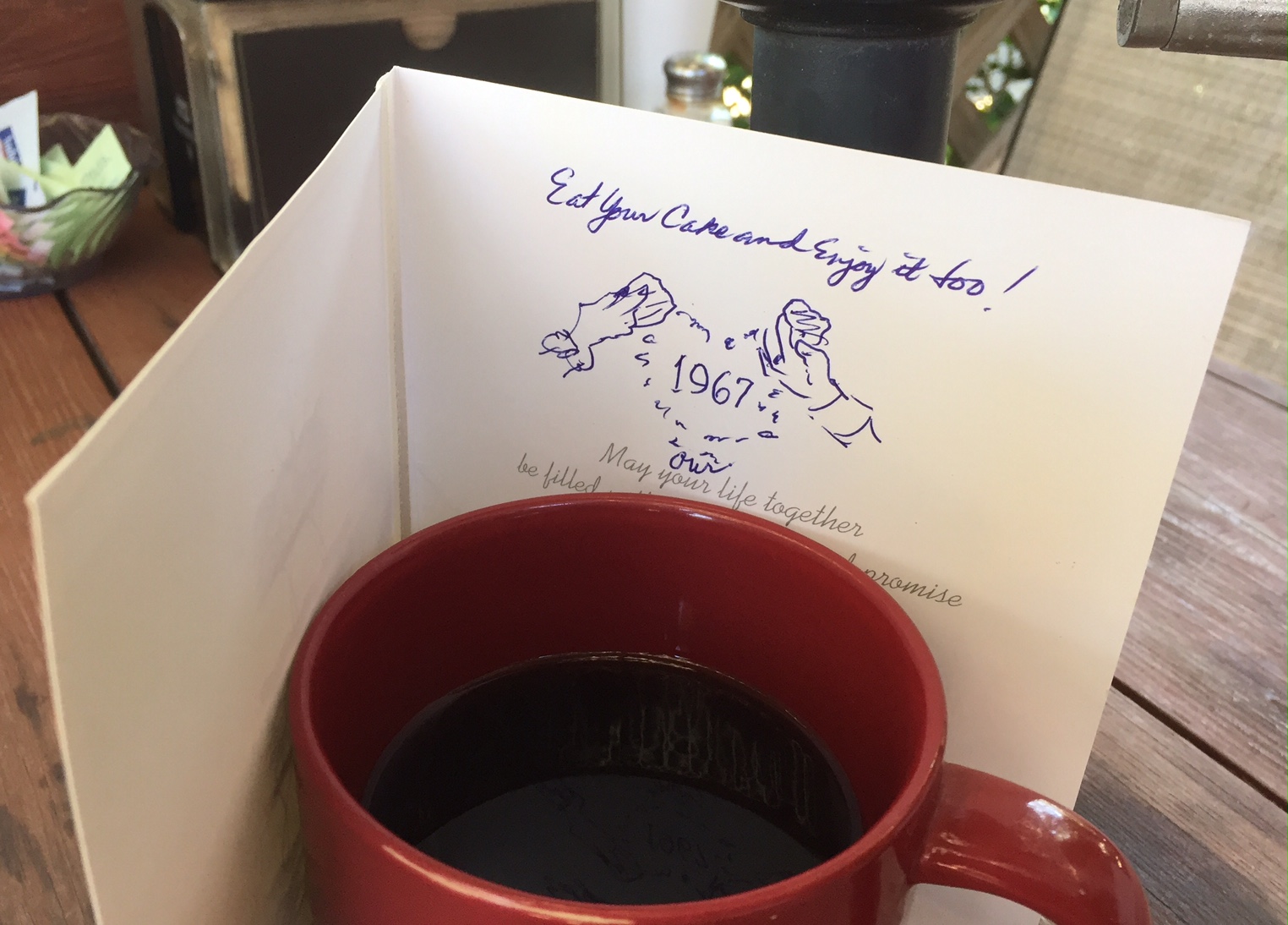
A few weeks ago when Cliff pulled out piles of papers and other drawings including the one above, a small bag fell out from one of the crevices in the same art armoire. The envelope was dusty but well-preserved after years in hiding. Inside he found an anniversary card he apparently had bought in his travels and had been intending to give me about 10-15 years ago, so he imagines. Time had preserved the lacy layers. But he added a fresh, new message.
Dear Reader, have you ever found lost or long-buried mementoes of sentimental value?
Thank you for adding your discoveries here.
By the way, our move became a reality yesterday, August 9, in case you are wondering when all this hoopla has culminated. Next week, prepared in advance: Summer on Anchor Road: Sights, Smells, & Sounds
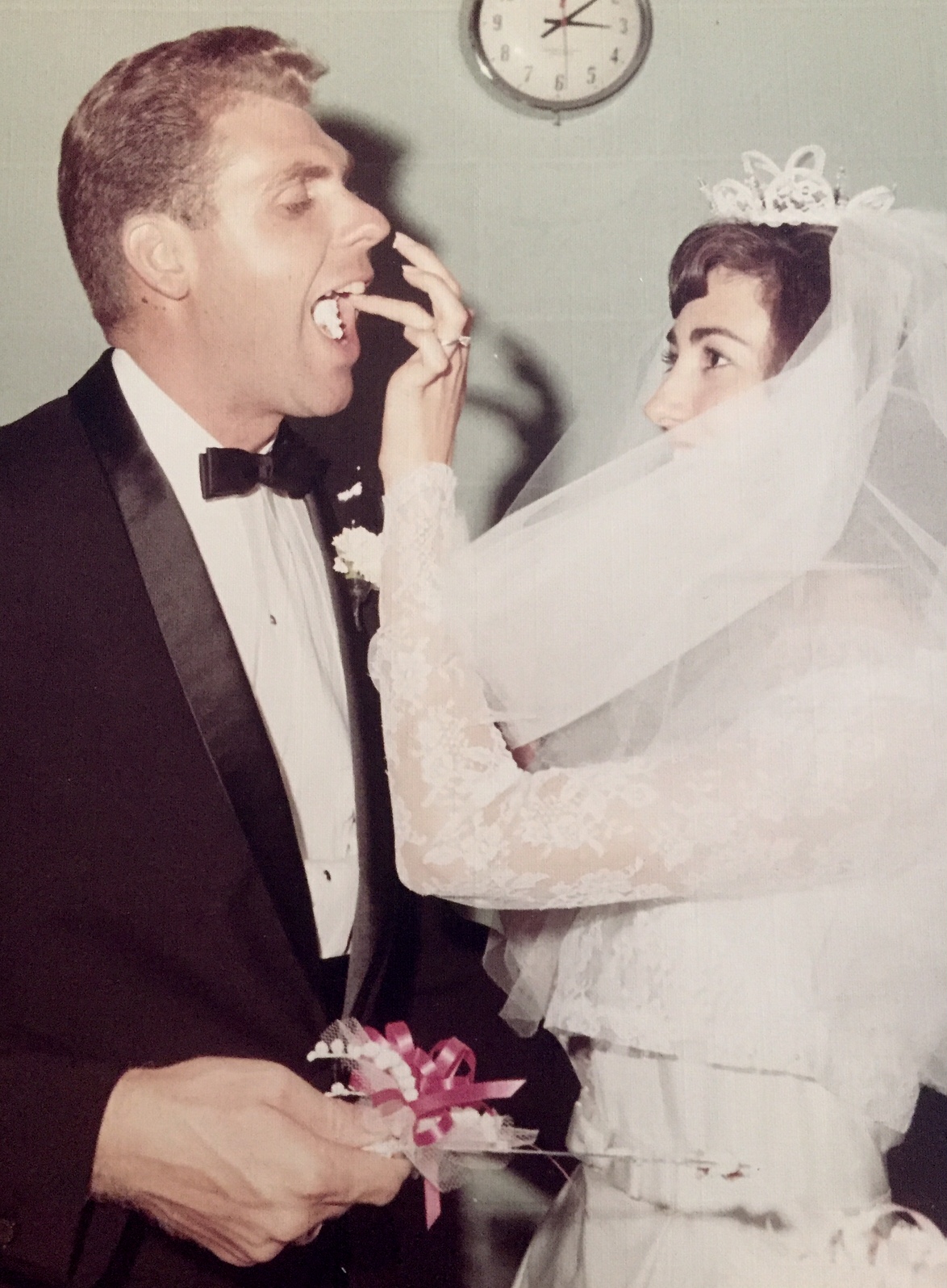
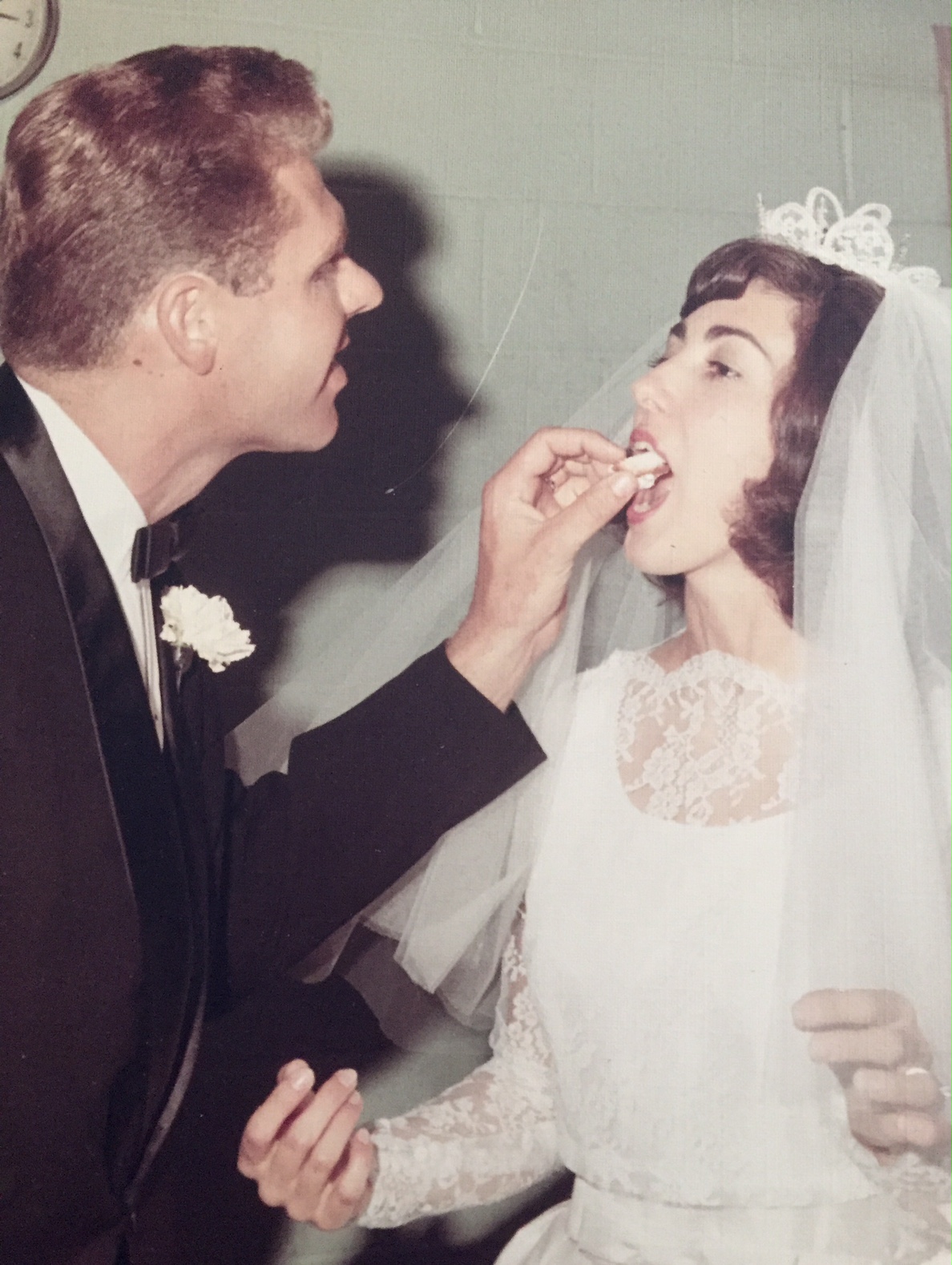
“Let them eat cake!” That’s what newly weds and their guests do at wedding receptions. At 9 ½ minutes after three o’clock on August 5, 1967, I fed my groom a huge mouthful of cake, and he returned the favor more gingerly ten seconds later, if the clock on the wall is any indication.
We are on the verge of celebrating our 49th anniversary. Like the seventh note in an octave, we are almost there, but have not yet reached the golden mark.
How have we gotten this far without hitting the skids? I could make a long list of suggestions, but right now I have only one:
Watch Your Words
Cake is sweet to the tongue just as our words should be to one another. Words have power. Let your spouse or partner hear “please” and ”thank you” every day. Sarcasm is out. Surely contempt must go. Public humiliation, a big NO!
Say “Yes” as often as humanly possible.
Wait for the best time to make a request, offer a suggestion. Everyone needs 5-10 minutes to decompress after walking through the door. Let your spouse have time to breathe before requiring a response.
Once a day, notice the positive out loud: the way they look, something they’ve said, or done.
Michael Hyatt, author and speaker, affirms that “Marriage is a powerful visual of how you treat the people you value the most. (“Why Speaking Well of Your Spouse is So Important”)
Ever the tip and list maker, Hyatt in another post shares his recipe for how to become your spouse’s best friend. Many of items on the list regard minding our words, for example: “Extend grace to me when I am grumpy or having a bad day. Speak well of me when I am not present.”
“Listen without judging or trying to fix me.”
Humorist Ogden Nash adds a dash of rhyme and reason to the mix:
If you want your marriage to sizzle
With love in the loving cup.
Whenever you’re wrong, admit it.
Whenever you’re right, shut up!
And finally,“Let your speech always be gracious, seasoned with salt, so that you may know how you ought to answer everyone.”
~ Colossians 4:6, New Revised Standard Version
Light a Candle
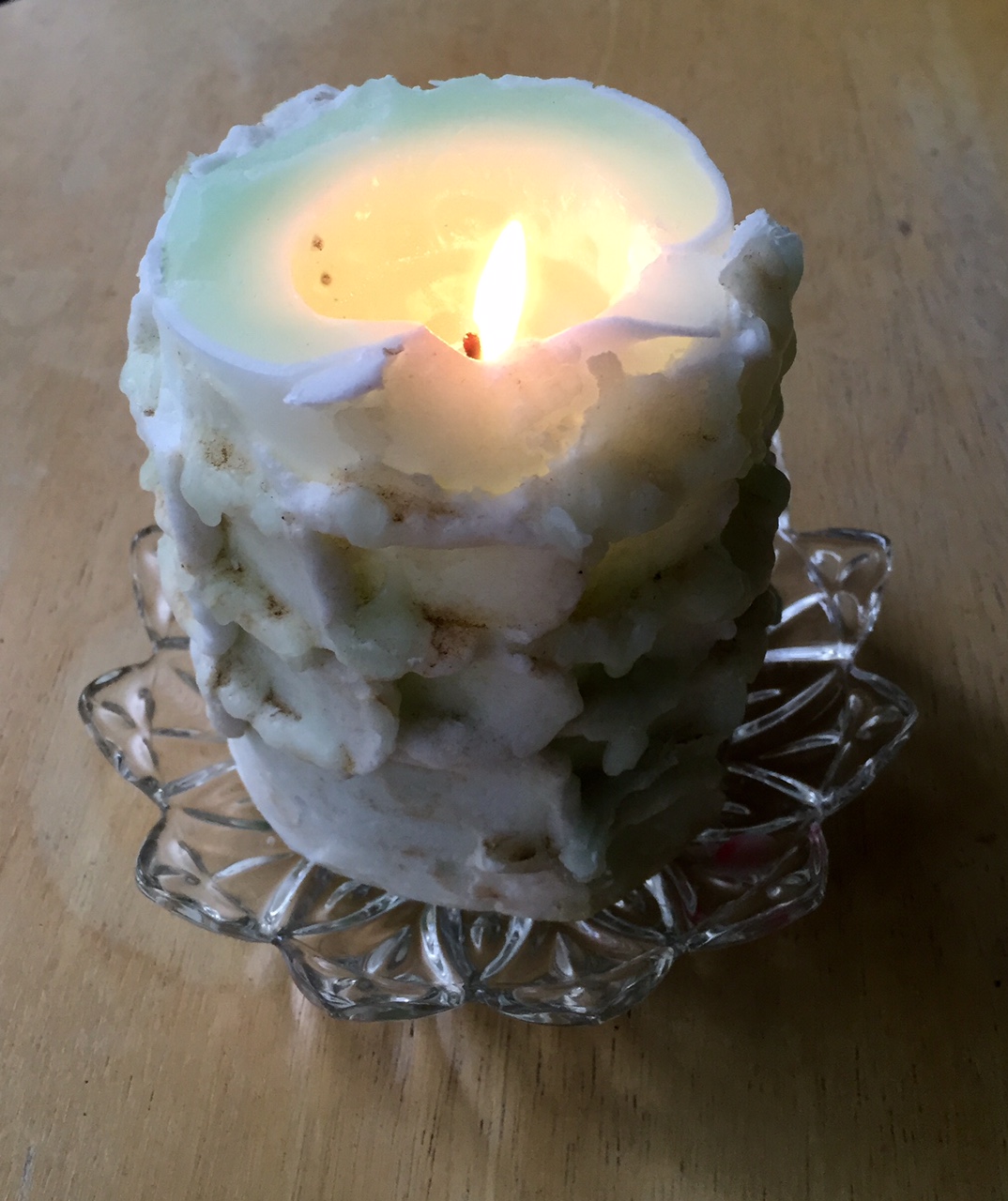
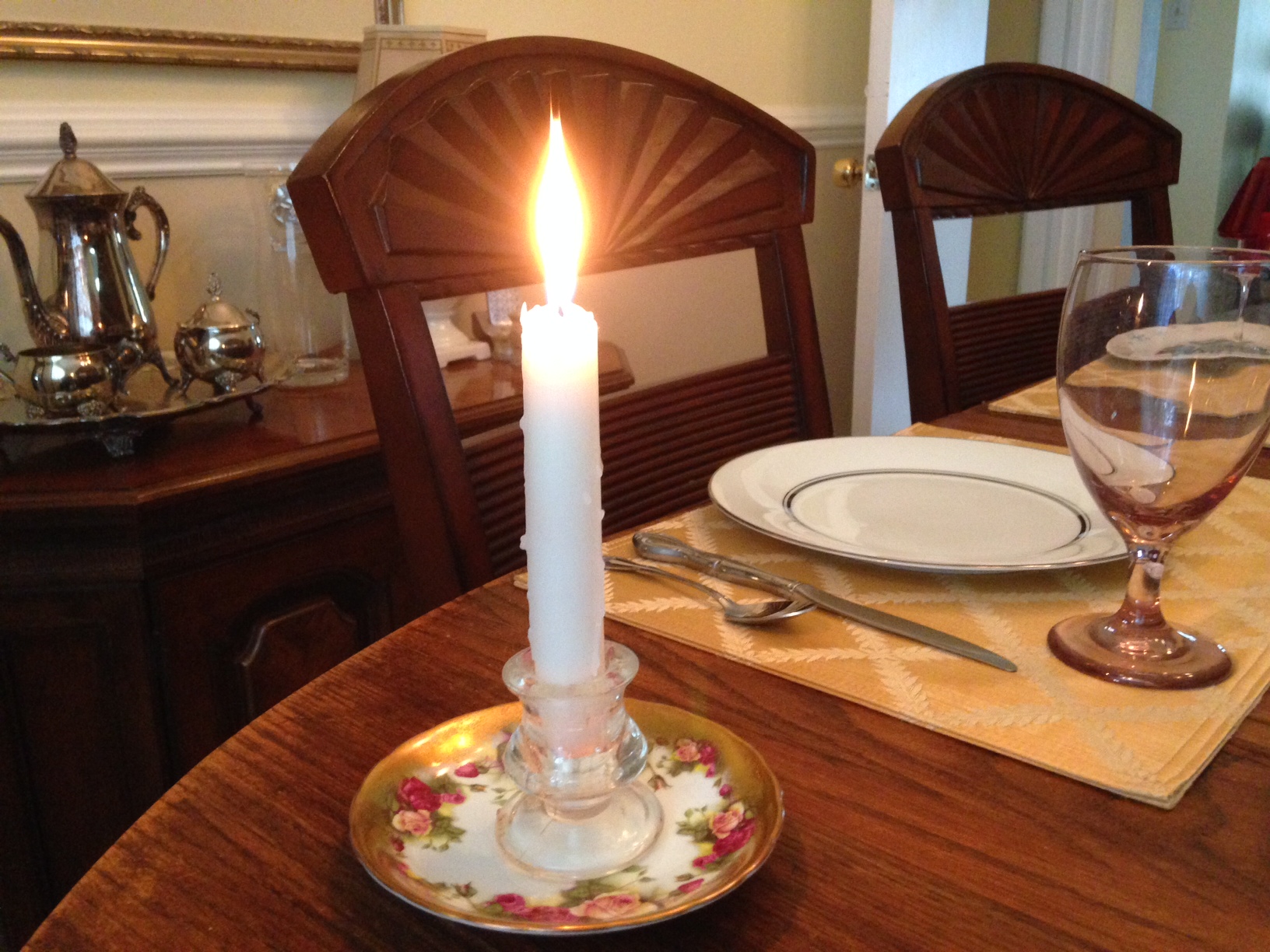
This candle first flickered and then burned brightly on a pedestal at Calvary Presbyterian Church in Charlotte, North Carolina. The candle came with instructions to burn for one hour on our anniversary date. Some years the candle probably has shone for more than an hour. But we may have even skipped a year or two. Nevertheless, the long, tapered candle is very short and stubby now. Yet the flame still burns brightly.
Whether you are married or not, on this day I light a candle for you and whatever family relationship is most important in your life.
Your thoughts, recollections, or advice are welcome here. Thank you!
Coming next: Drawing on Love: A Brief Retrospective
This week two years ago Mother was snatched from our world just five days after her 96th birthday. Late on a Monday evening, July 28, 2014, she was transported into a new and better land.
Mother lived on a dairy farm in the Manheim – Lititz area of Pennsylvania. When she married my father Ray, she moved about 12 miles west, still in Lancaster County. Like many Mennonite couples in the 1940s, they honeymooned in Niagara Falls, New York, where I most likely was conceived.
Over the years, she visited the Philadelphia Flower Show and strolled through Longwood Gardens exclaiming, “Oh, my, such beautiful flowers we saw!”
When my sisters and I studied at Eastern Mennonite College, she and daddy drove to Harrisonburg, Virginia several times, back then a four-hour drive to the Shenandoah Valley. “My, look at the mountains in the distance – so pretty,” she said.
Mother seemed happy to be a homebody. She never seemed curious about seeing world capitals as her daughters were. Traveling around the United States in five weeks with a friend as I did once would seem incomprehensible to her. “Why would I want to do that?” I can hear her say.
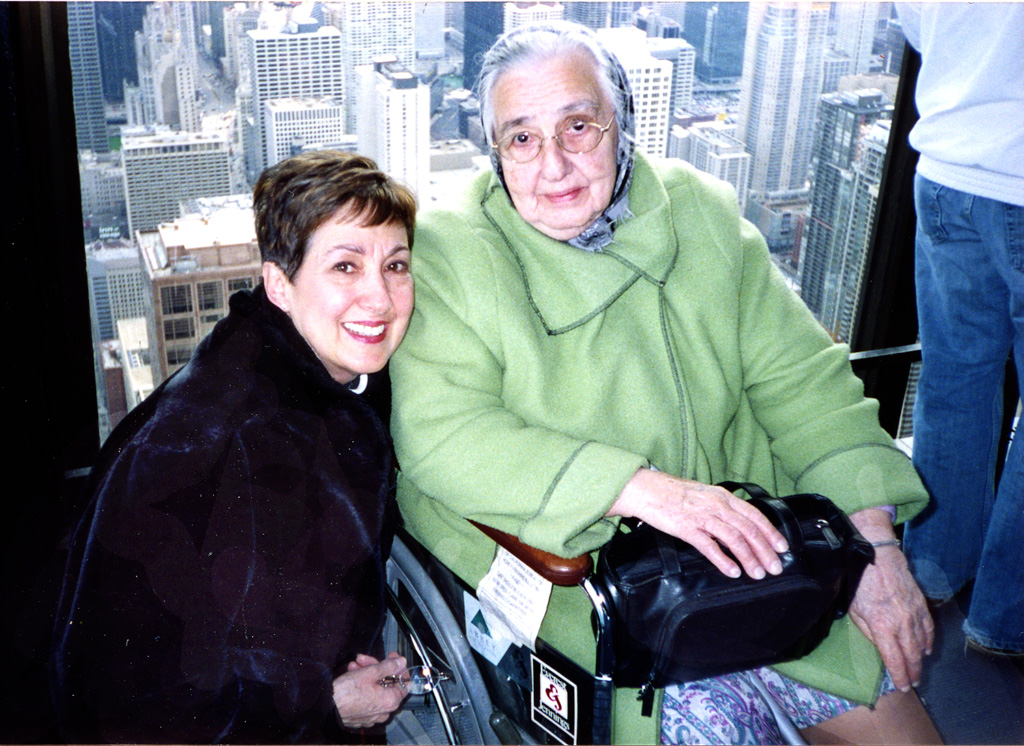
But when her first great grandsons were born seven weeks apart in 2003, I was able to goad her to fly to Chicago where our son and daughter lived.
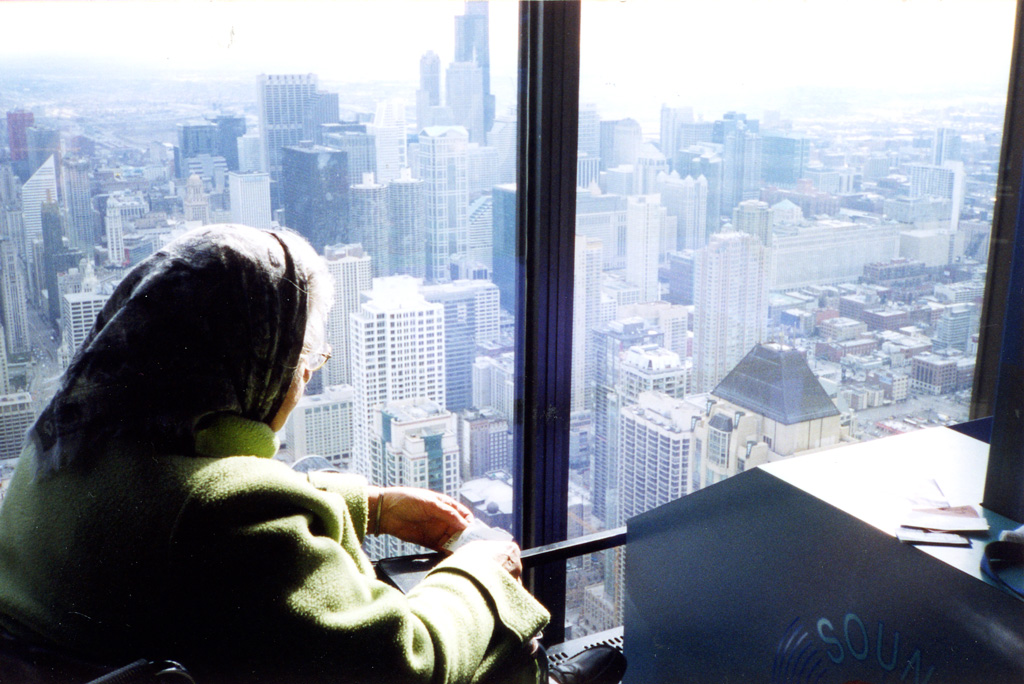
Viewing the city from the Hancock Building, she sat in awe at the vast expanse of skyscrapers.
These photos recall pleasant memories and now re-confirm in my heart and mind her citizenship in a heavenly world.
In her life on earth, she was confident she would one day live in a Beautiful City full of brilliant light and everlasting joy.
For s/he looked for a city, which hath foundations, whose builder and maker is God.
Mother often sang about heaven at the top of her lungs in front of the kitchen stove, making breakfast for her children before school. Her voice, always off key, sang about a beautiful city I imagine she could visualize as she scrambled eggs with shakes of pepper and filled cups with cocoa, each with a dollop of butter.
We miss you, Mom!
July 23, 1918 – July 28, 2014
Mother embraces her great grandson Patrick, held by Grandpa Cliff, 2004
Remember the Beverly Hillbillies? The Clampetts strike oil in the Ozarks and move to Beverly Hills in a rags-to-riches sitcom of the 1960s.
Beverly Hillbillies Moving Van, courtesy Google Images
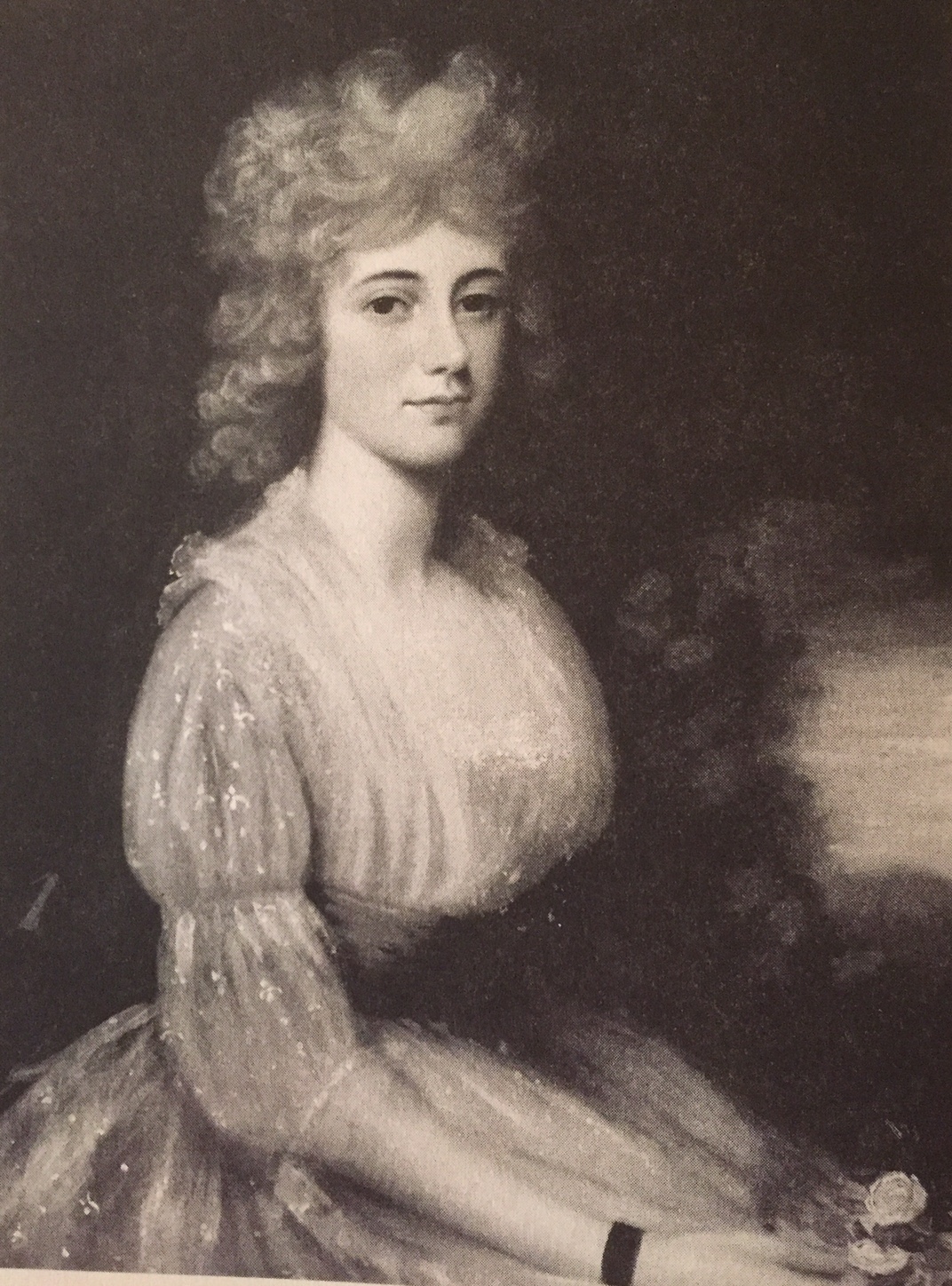
Of an entirely different era and social class, diarist Louisa Catherine Adams, wife of the 6th American President, John Quincy Adams, writes about multiple moves – both in European nations where John Quincy was diplomat and in the United States serving variously as senator, secretary of state, president, and finally congressman again.
Woman on the Move
After the birth of her third child, “as soon as she could rise from her bed, she lifted the lids of her empty trunks and opened her packing cases to prepare to leave for Washington. She was ‘a wanderer’ again.” (140)
In her boldest move, Louisa traversed the passage from St. Petersburg to Paris while Napoleon rampaged through Europe. She traveled 2000 miles in 40 days, a journey almost unheard of for a woman alone.
Louisa and Son Charles’ Wild Ride
In 1815, while John Quincy was gone to Paris, Louisa in St. Petersburg had to “sell the furniture, dispose of the house, and buy a carriage that could carry her across the continent” to Paris. She needed supplies: food, drink, clothing, maps, tools and enough medicines for a small apothecary. She had read the map herself, not having heard from her husband, and unflinchingly set her course.
Her largest expense was the carriage, “a berline, a large vehicle with four seats and glass windows, all balanced on an elaborate suspension of springs intended to smooth the rough ride.” Leaving St. Petersburg, the carriage was outfitted with sleigh runners. Wheels were packed when she met melting roads traveling west and south. (206)
She sewed gold and silver into her skirts to hide her wealth from robbers and from her male servants. (206)
Touch of Humor:
During the sojourn, though her two male servants were armed, she put on her son’s military cap and held his toy sword so that what she hoped was a menacing silhouette would show through the carriage window. (221)
True to her declaration when she married Adams, “When my husband married me, he made a great mistake if he thought I only intended to play an echo.” (8)
Her Most Moving Adventure
Louisa, often sickly and afflicted with self-doubt, recorded her grief in “Diaries of a Nobody.” After all, she was often geographically separated from her husband during his ascendance to power, she suffered multiple miscarriages, all of her children except Charles preceded her in death, and she struggled with erysipelas, a skin inflammation.
But her vividly told “Narrative of a Journey from Russia to France” enabled her to tunnel “her way out of depression with the sharp spade of her sardonic humor . . . .“ (396)
She wrote about Baptiste, innkeepers, haggard soldiers she has passed on the road, frightened faces of the women she met, cries of Vive Napoleón! She remembers the practical difficulties she had overcome: the moment the carriage wheel had come loose, the problem of procuring servants, the dangerous decision to ford a half-frozen river. She wrote about her growing confidence, which rippled out of her descriptions and into her voice. (411)
“Her story was her own. No other woman in America had experienced anything like it. But she made its lessons universal. It was a story about women and what women could achieve . . . . She wrote: ‘Under all circumstances, we must never desert ourselves.’” (411)
Move for Equality
At 62, in an era when a woman’s life span was about 40, she was blossoming. Like the Grimké sisters of Charleston, with whom she corresponded, she championed women’s rights and the freeing of slaves.
The Lesson of a Cracked Washbasin
Cracked Washbasin, Google Images
John Quincy and Louisa Adams observed their 50th wedding anniversary, a milestone almost unheard of in the mid-1800s. Before she died, Louisa presented her daughter-in-law Abby Adams with a cracked washbasin, symbolic of the naked faces bent toward it sometimes joyful and other times full of inconsolable pain, mirroring life itself. (444)
Want More Louisa?
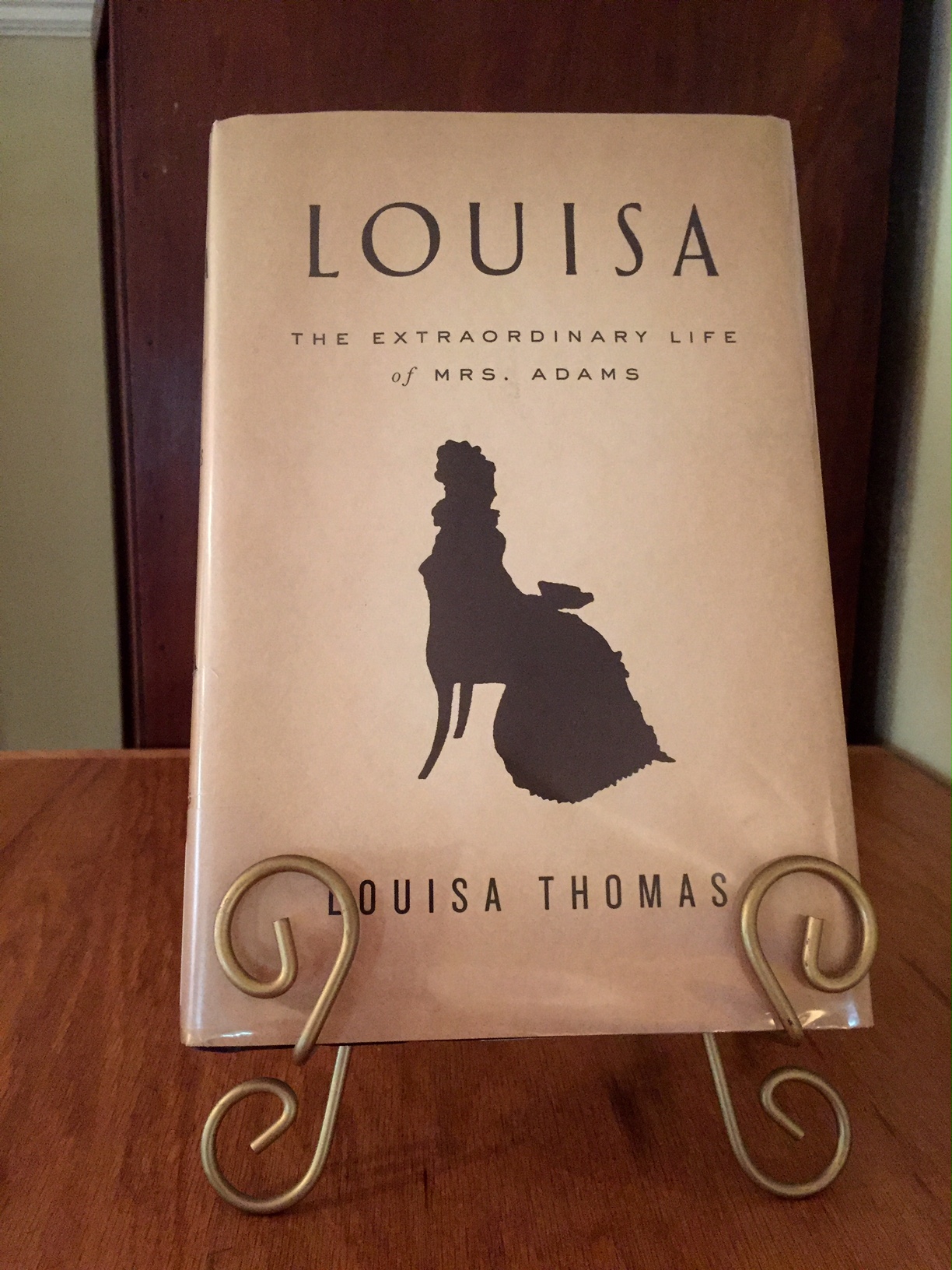
Writer and editor Louisa Thomas has written a stunning account of a memorable woman entitled Louisa: The Extraordinary Life of Mrs. Adams, 2016.
Thomas’ biography sings with color as she describes an incandescent sun on their approach to St. Petersburg, which edged “the statues with fire and [made] creamy walls blush.” (90)
His Turn: An Artist Discards, Donates, and Discovers
Cliff relaxes with coffee, snack and audio book in May before the frenzy began.
Truth be told, my husband Cliff would rather not move. Despite the fact it’s getting harder for him to mow our enormous lawn in one fell swoop or scoop up oak leaves by the millions, he would rather stay put.
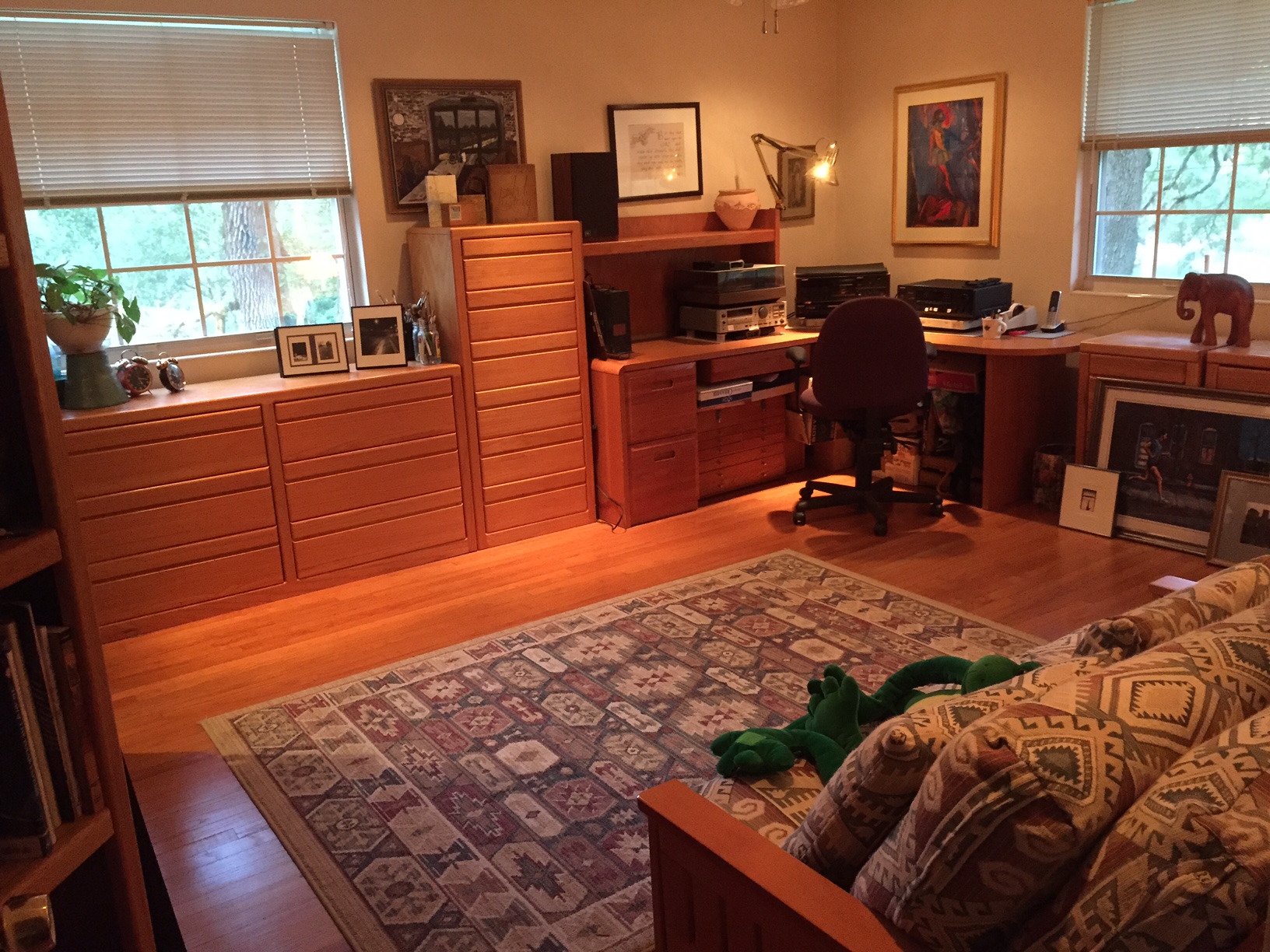
He’s comfortable with oaken file drawers filled with art supplies and designs in his office and an extra large room upstairs for painting and sound recording, shown here in its current pristine state. (It’s okay to read between the lines: artists are not necessarily neat!)
Art/Music Studio ready for staging, 2016
Still, he wisely understands that mounting stairs and maintaining a large corner property may be too much for us as we approach our elder years just around the corner.
The Discarding Process
And so, like me, he has sifted through, scanned, sorted, recycled, and discarded. But it ain’t easy.
Donations that Inspire
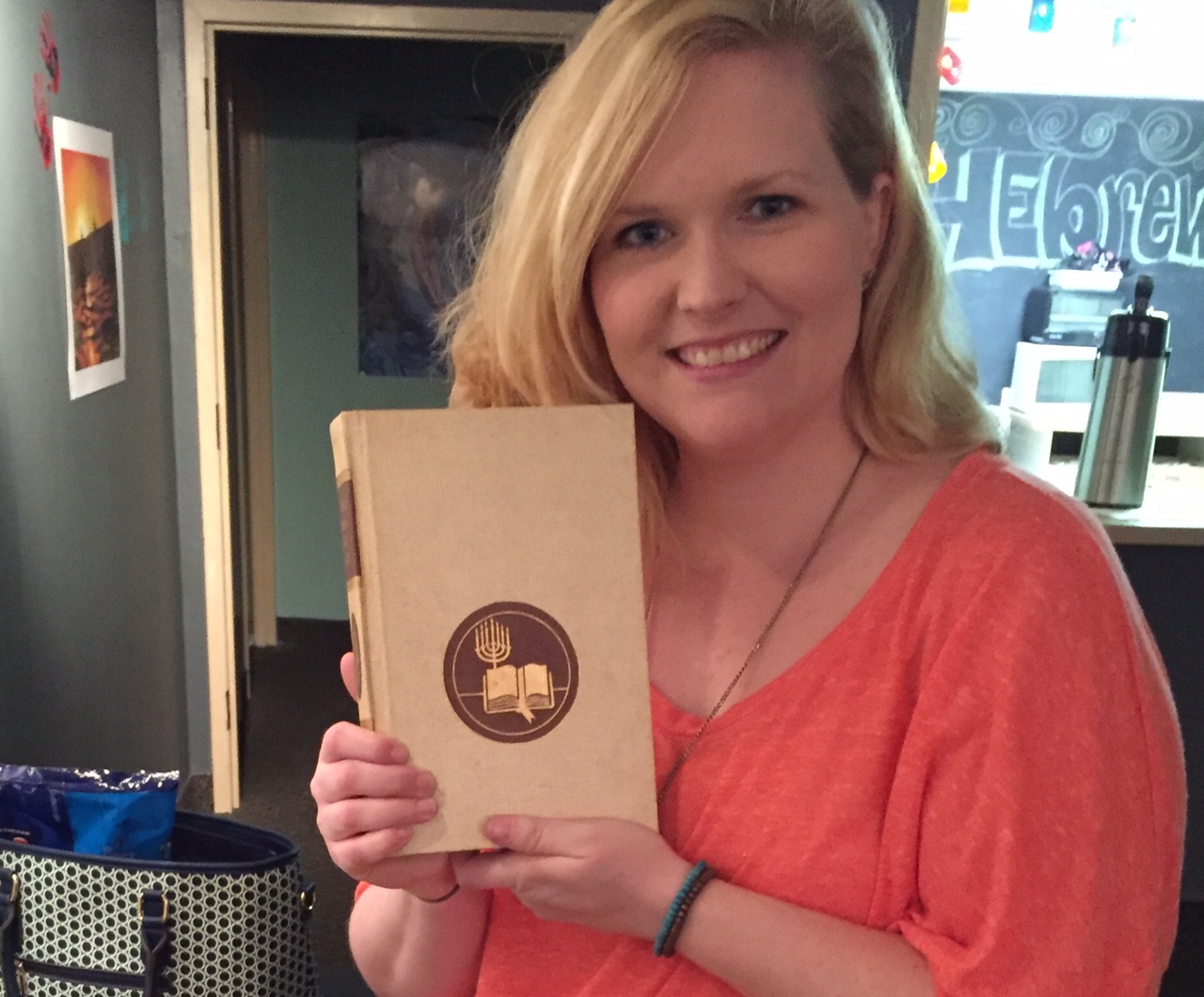
Still, he has sparked joy in book-loving friends at church.
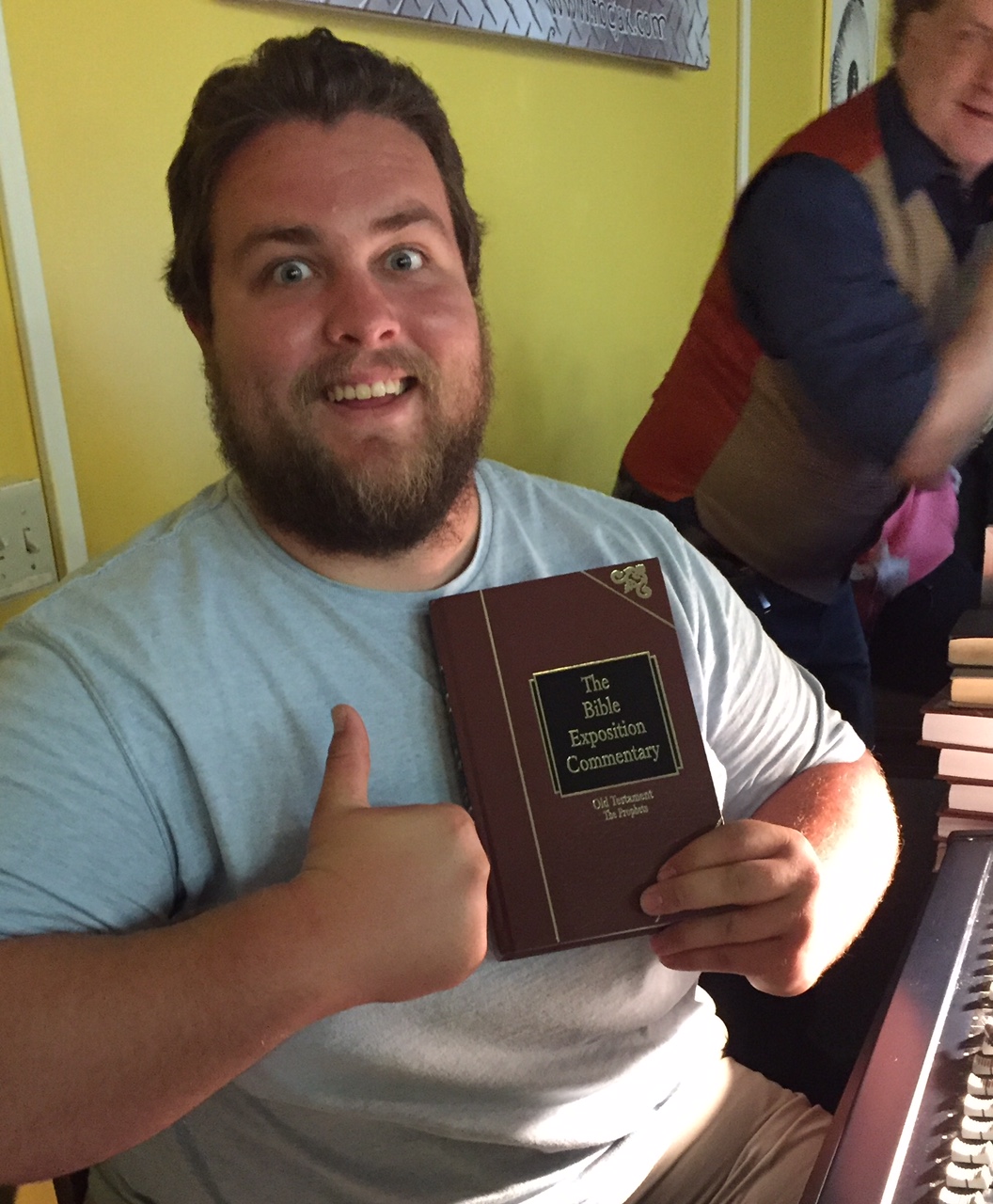
Mama Ashley, reader to three daughters. Her oldest had the highest SAT reading score in her class.Matt joyfully received a set of expository Bible commentaries. Part of the thrill on his face may also be explained by the fact he is getting married soon.
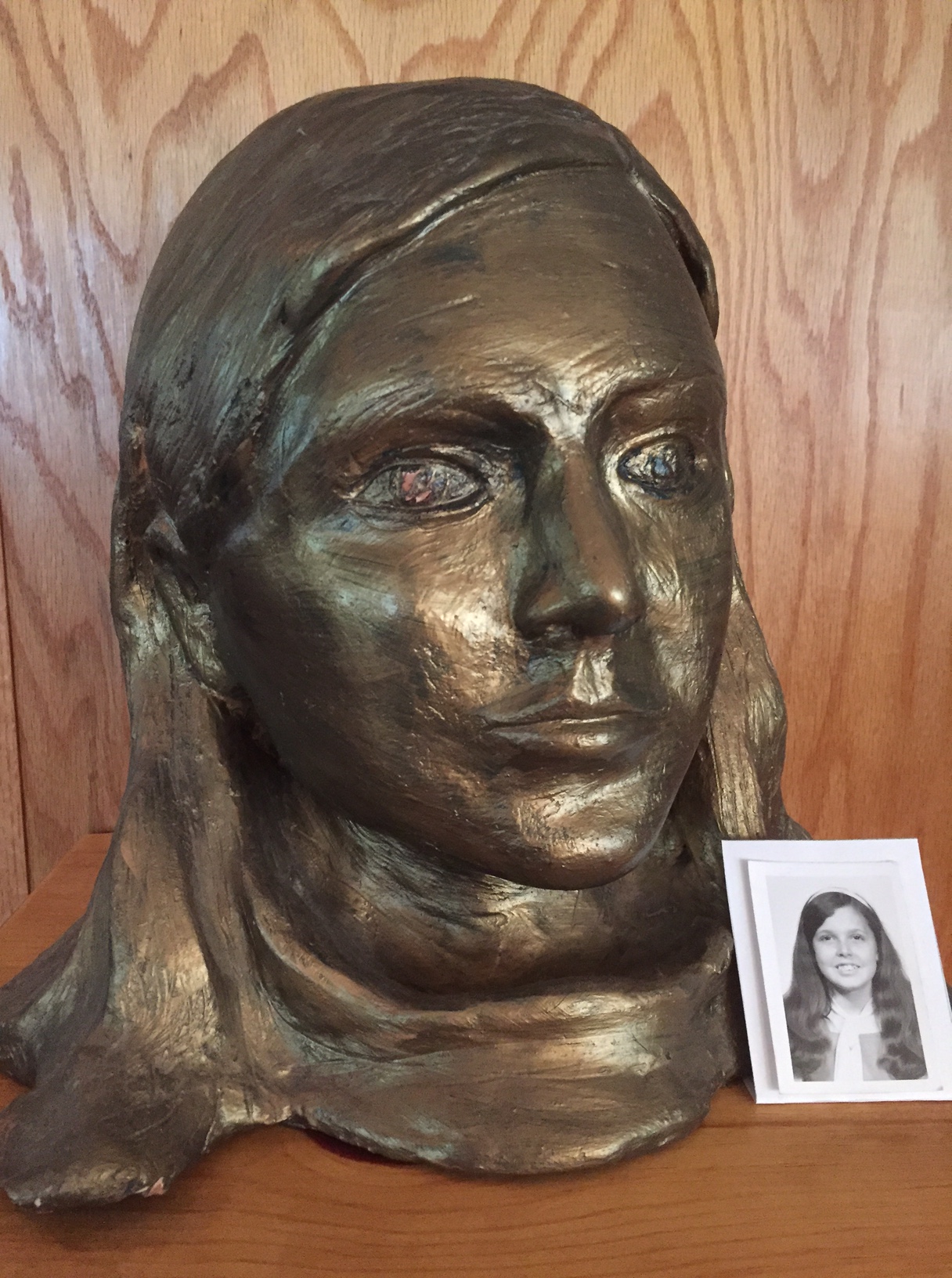
Discoveries Along the Way: Some items, like this bronze bust, were hidden in plain sight:
Bronzed bust of Cliff’s student at Norwood Elementary School, 1966
Others had to be unearthed, like this photo of a Barbara Streisand painting, part of a series of famous New York personalities showcased at “Arnie’s New York, New York” restaurant in Jacksonville in the 1980s. Some of the other 4 x 6 foot paintings included Groucho Marx, Norman Rockwell, Frank Sinatra, Woody Allen, and Joe Namath.
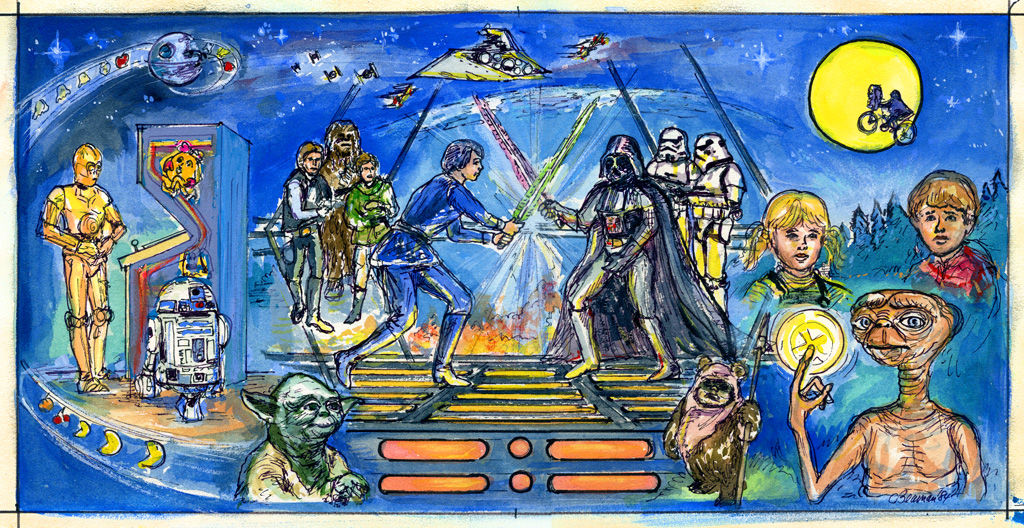
In a tall armoire on a narrow shelf, he found the preliminary watercolor study for a Star Wars painting, which when completed graced the main elevator at Wolfson Children’s Hospital, one among a hundred paintings for the hospital.
Star Wars Color Study, 1984
He has also found lurking in drawers, pencil drawings of college classmates and professors in the classroom, sketches of unsuspecting diners in restaurants. (To be revealed)
Logo for Aqua East Surf Shop, Jacksonville Beach, Florida, Cliff Beaman design
A Male View: Paring Down and Tidying Up
Joshua Fields Millburn, author of Everything that Remains: A Memoir by the Minimalists, shares the masculine perspective of living with little and savoring what you have. “Blindsided by the loss of his mother and his marriage in the same month,” Millburn made daring life changes. You can read my short review of his book here.
Goodreads Image
* * *
What are the pitfalls (or blessings) of moving with a spouse or other relative?
Have you made fascinating discoveries during a move or while organizing your possessions?
Coming in two weeks (July 20): Louisa Adams’ Moving Adventure
Would you pass up an invitation to a lawn soirée on a holiday weekend? This week 107 years ago my grandma, Miss Fanny Martin, then a single woman, received a penny postcard invitation to such a gathering on July 3, 1909.
Mary Elizabeth Kob writes in neat cursive: “You are heartily invited to attend a Lawn Soirée July 3, 1909 in honor of Jacob S. Kob at his home. Meet 7:30. Refreshments. Respectfully, Mary Elizabeth Kob.” I assume my grandmother attended the party.
From my vantage point in the 21st century, it’s hard to piece together the details. Was Mary Elizabeth Jacob’s wife, daughter, or sister? Based on the name alone, it’s hard to tell. Was the occasion a combination birthday and Fourth of July celebration? If so, the emphasis may have been on the national holiday judging from the red, white, and blue postcard colors.
Leo Kob was the only “Kob” name familiar to me when I was growing up in Elizabethtown, Pennsylvania. Leo, whom I heard my parents refer to as “Kobbie,” owned a G. E. Oil and Gas Heating business in Elizabethtown, a family business that boasted the phrase “Since 1904” in a page in my high school yearbook. Maybe Leo bought or inherited the business from his grandfather or father. Was Leo related to Jacob? A search of genealogical records could prove or disprove any relationship.
Yes, excavating one’s family history leads to questions, some without clear answers.
Piecing together fragments of family history requires a measure of conjecture and speculation. Therefore, when one reaches the limits of family history and historical record, what happens next? Memoir writers can use a technique known as “perhapsing,” a tool for supplying detail in a scene when memory is unreliable or when facts are simply missing. According the writer Lisa Knopp, “The word perhaps cues the reader that the information [the writer] is imparting is not factual but speculative.” Because deviating too far from fact could result in fiction, life story writers have a tight rope to balance here. Yet “perhapsing” used sparingly or a well-placed “it might have been” can occasionally provide motivation and action, adding richness and complexity to the narrative.
Knowing about Leo Kob and his family is not critical to my own memoir writing, but writing about the details of my visit to New York City to distribute gospel tracts as a young Mennonite girl is significant, as this excerpt illustrates:
Perhaps my memory has amped up the details, but I can now imagine this frightful creature grabbing me by the shoulder in a death grip as I am spun round and round like a whirling dervish. In my film clip of this horror show there was little I could do to resist the grasp of this drunken prophetess. I felt dizzy and afraid.
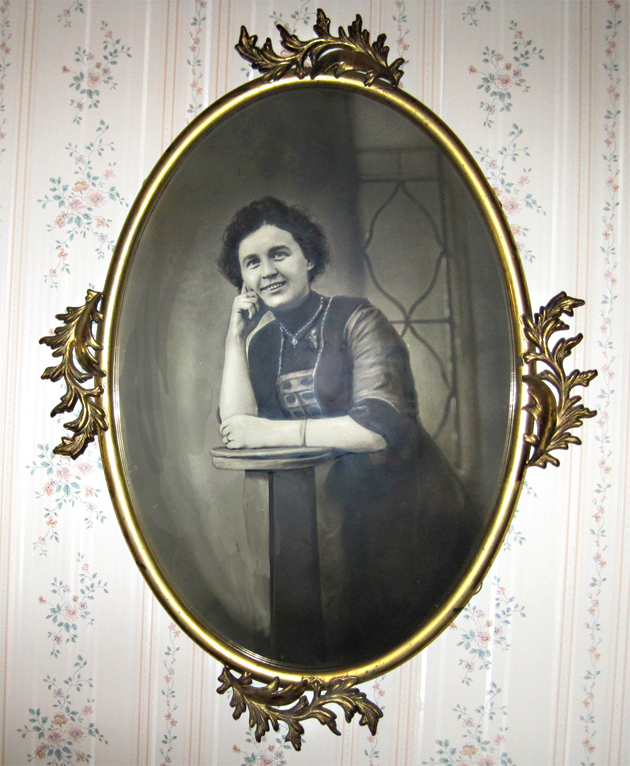
About this 1909 postcard? When my plain Grandma Longenecker received this post card, she looked like this:
Fancy Victorian Fannie Longenecker before she became Mennonite
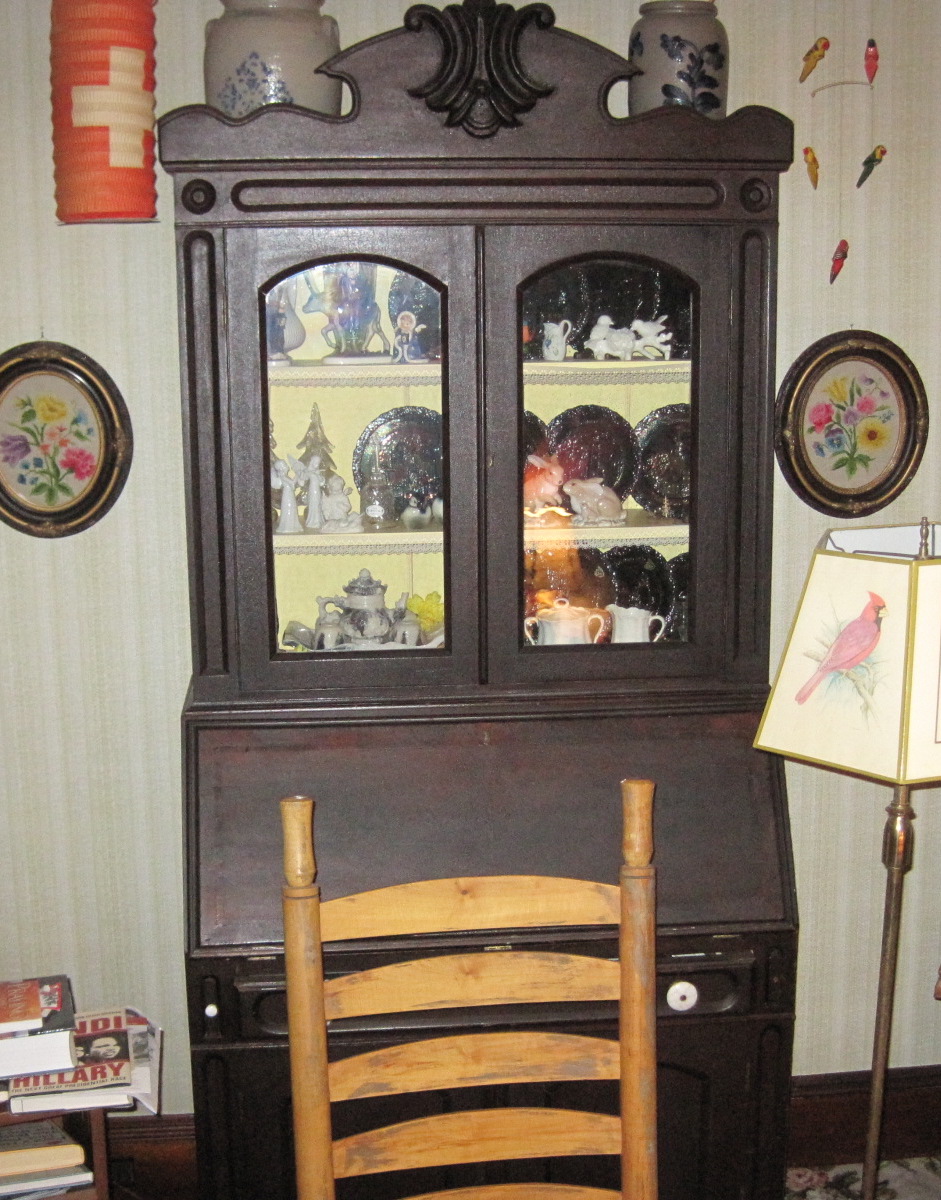
I found it in a stash of other cards inside the fold-out compartment of Aunt Ruthie’s secretary. What other treasures may be hiding there? I wonder.
What treasures have you found either by design – or unexpectedly?
As a reader, what do you think of the literary device called “perhapsing”? Have you used it as a writer?































 Plain and Fancy