What’s Your Name Again?

My name is Marian. What’s yours?

A familiar greeting . . .

Names have always fascinated me. I’ve even written about names and naming in previous posts:  What’s in a Name? and The Name Game.

But what about name changing? Celebrities, like actors, musicians and other entertainers have changed their names as a way disguise their ancestry, make a statement or achieve a unique identity.

In mid-century, British-sounding names in the entertainment industry were thought to be more appealing to the public than Slavic, German or Jewish-sounding names. Thus . . .

Robert Allen Zimmerman →  Bob Dylan

Issur Danielovtich Demsky → Kirk Douglas

Helen Lydia Mironoff →  Helen Mirren

Entertainer Whoopi Goldberg apparently began life as Caryn Elaine Johnson.

Dancer Fred Astaire was once Frederick Austerlitz.

Actor Ben Kingsley’s birth certificate reads “Krishna Pandit Bhanji.”

Lady Gaga’s Italian heritage is revealed in her birth name, Stefani Joanne Angelina Germanotta and Jennifer Anniston’s Greek ancestry in Jennifer Anastassakis.

Vanilla Ice probably signed his grade school papers as Robert Van Winkle.

The suave designer Ralph Lauren was once Ralph Lifshitz!

My maiden name was Longenecker, which was changed to Beaman when I married. As a teacher, I would tell students how to spell my name using the 3-little-words approach: Be-a-man. Very rarely was my last name misspelled.

However, my first name (Marian) apparently is tricky to spell. It is often misspelled and in a number of puzzling variations. People with PhDs (not you of course!) and book authors (again, not you!) are the most frequent offenders. Yes, I’ve kept track of them – ha!

Names_variation of Marian_Envelop_8x5_300

Marion

Marianne

Mariam

Miriam

Marrian (on a name card at a dinner by a computer that stuttered)

Mariana

Marina

Miram

No wonder John Wayne is no longer MariOn Morrison!

TruckMariam


Can you add any other interesting name changes to the ones above? Maybe you have some examples of strange naming or spelling from your own family . . .

P.S. Even if you mangle the spelling of my name, we’ll still be friends. That’s a promise!  😉

What is a Name_Marian

Coming next: Purple Passages with the Bard of Avon
Our Easter in Ukraine

Khristos voskres!

Christ is risen indeed!

These words spoken in Russian are the very first expression of Easter joy we hear on Sunday, April 24, 2011 as folks gather at Birth of Christ Church in Kiev, Ukraine, preparing for the worship hour.

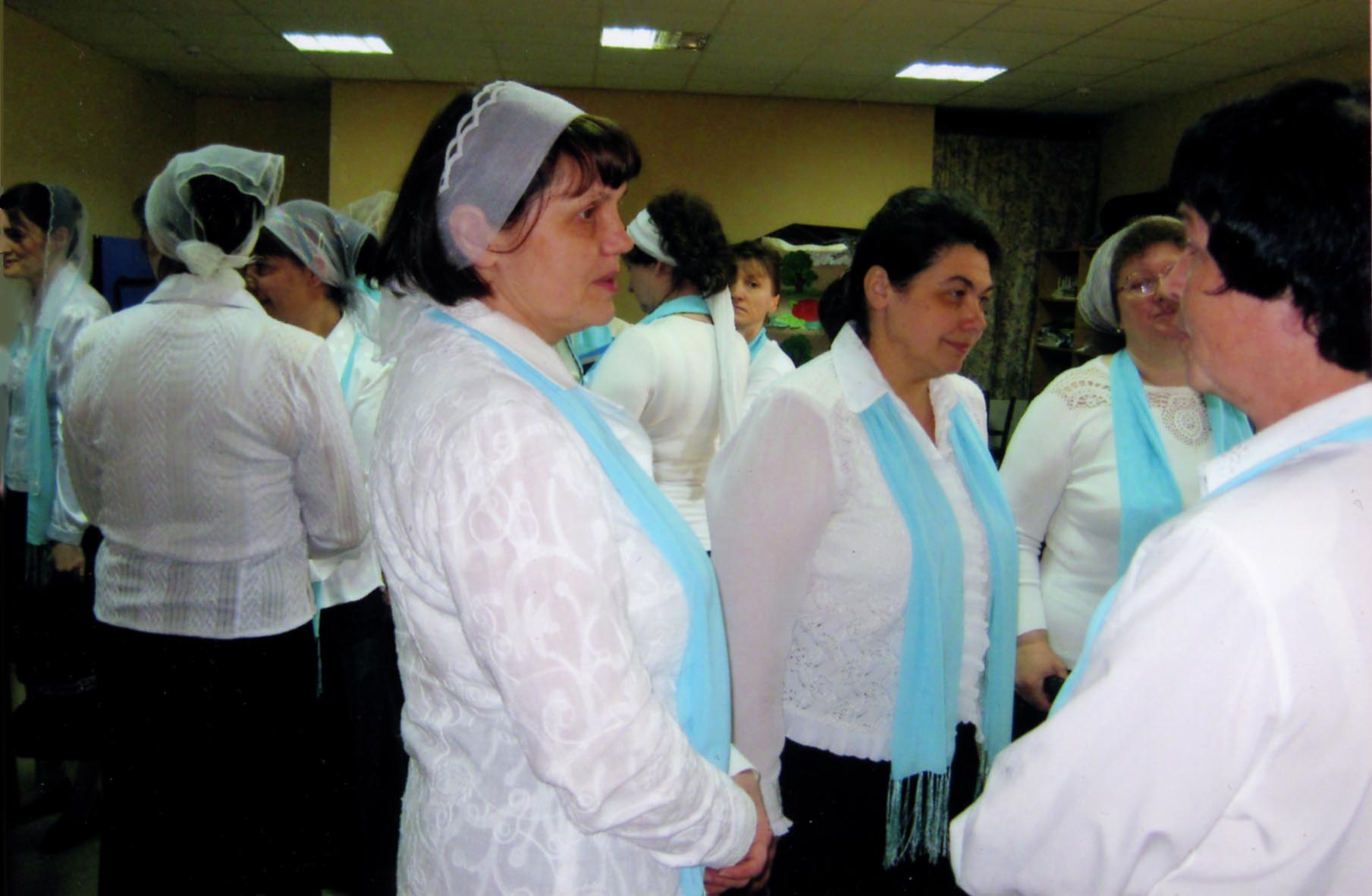
Here is the choir after rehearsal preparing to ascend the steps to the sanctuary for the Easter service.

Easter_UK_Birth of Christ Choir

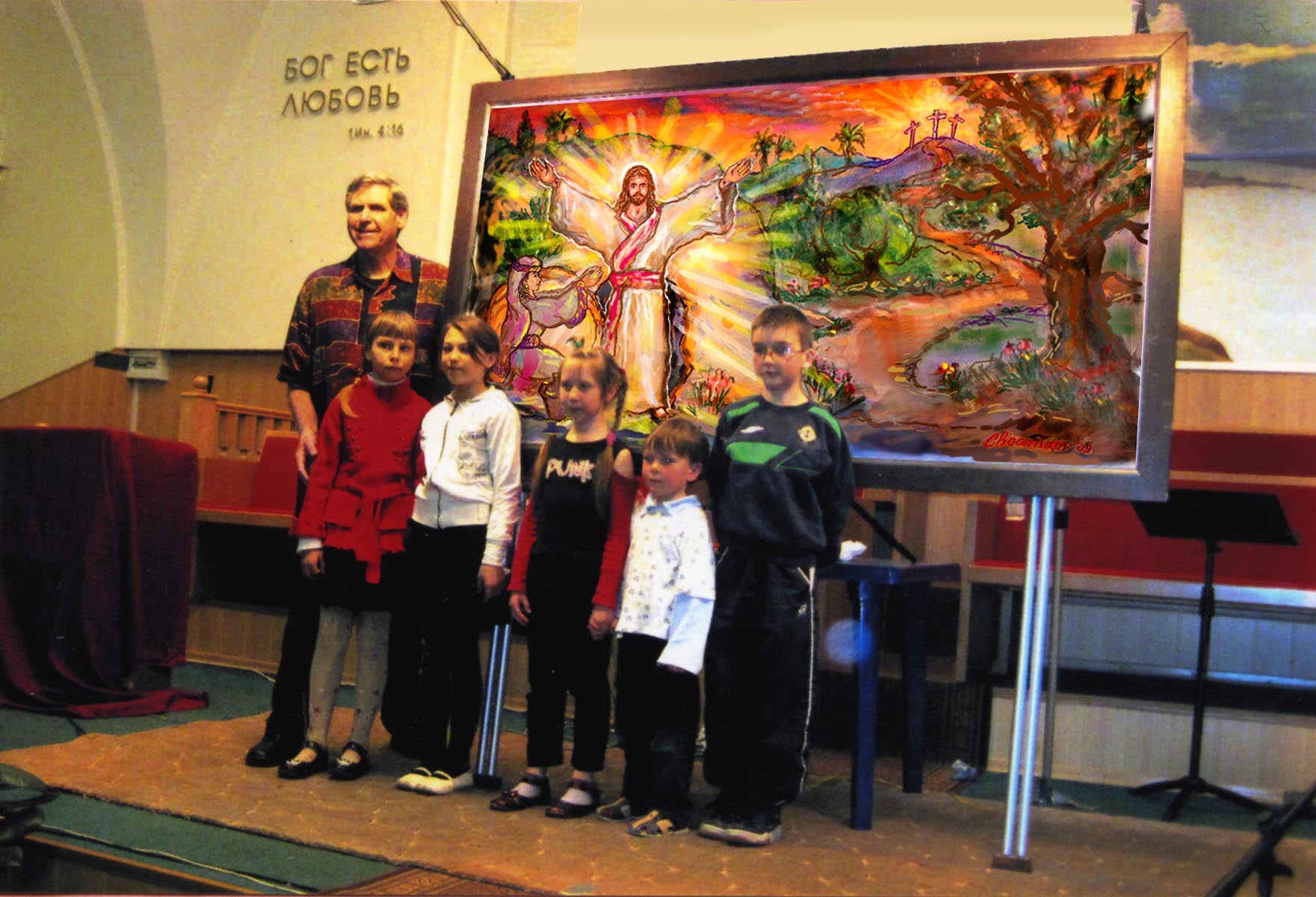
At the invitation of ABCLife, Kathy Gould’s ministry to children and families, husband Cliff and I spent two weeks in Kiev (April 8 – 28, 2011) and surrounding towns performing art and music shows in public schools and churches. His final program entitled “He is Risen” is presented here at Birth of Christ Church on Easter weekend.

After the exchange of greetings, we worship by singing songs of the resurrection and then thrill to the experience of seeing the “He is risen!” presentation accompanied by exultant music and special lighting effects.

Easter_Birth of Christ+new mural_6x4_300

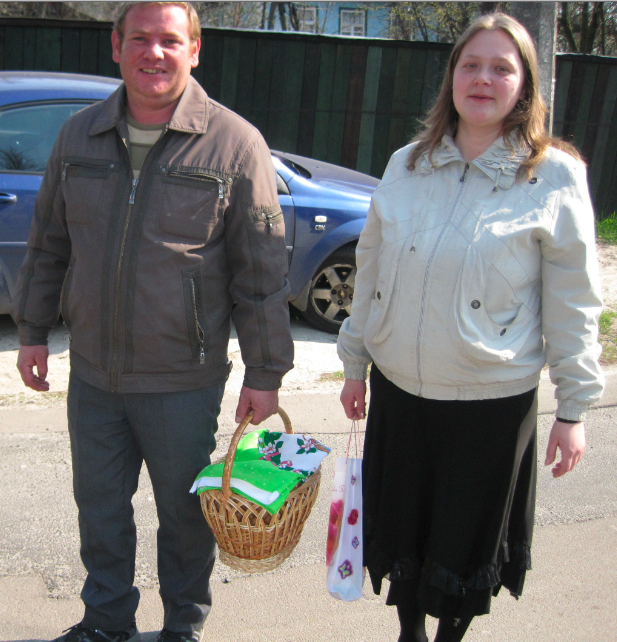
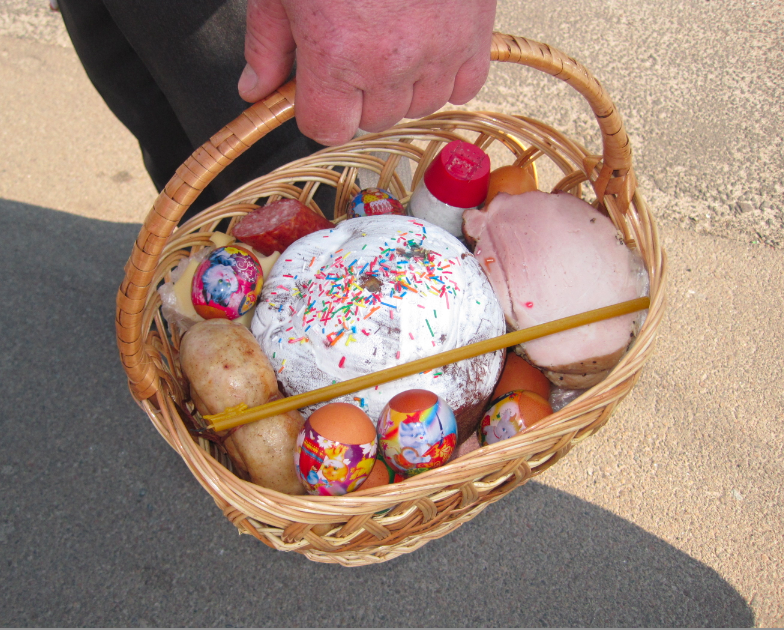
Before the service, early this Sunday morning, we see a couple, basket of Easter bread and eggs in hand, wending their way toward a Ukrainian Orthodox church farther down the road. Ukrainians walk every where possible as cars are very expensive here, and today the weather is cool and gorgeous. This couple graciously allow me to photograph their beautiful paschal offering.

UkraineEasterCoupleUkraineEasterBasket

Their special bread is frosted and coated with sprinkles. Here is a recipe for Ukrainian Easter Bread (Paska) from Extending the Table, a World Community Cookbook published by MennoMedia in a revised edition. In my older edition from 1991, the recipe is found on page 65.

RecipeExtending the Table_recipe_p65

*  *  *

After completing 19 shows in a 12-day period, we are ready for a respite, which we enjoy in Crimea: the ornate Livadia Palace, site of the signing of the peace treaty between Roosevelt, Churchill, and Stalin; the Church of Foros with its onion domes, where celebrities marry. Then in a park in the city of Yalta, a statue of Pushkin, the celebrated Russian poet and one of Chekhov’s “Lady with Her Dog” virtually come to life along the promenade bordering the Black Sea.

Sadly, the door is barred to Crimea now, once the accessible southern-most region of Ukraine. Since our visit, President Vladimir Putin has wrested this lovely coastal land from Ukrainian hands.

Pray for the people of Ukraine!


Cliff’s YouTube connection

Coming next: Enchanted April, Renewal and Possibilities

Grandmother Kayaks from Maine to Guatemala for the Children at the Dump

Grandmother Kayaks from Maine to Guatemala for the Children at the Dump

These were the words in my invitation to a reception promoting Project Safe Passage honoring Dr. Deb Walters’ efforts to raise funds via her Kayak trips.

KayakDebWaltersPIC

A stellar professional career behind her, this woman is paddling with passion in her mission to rescue children and families who live in the garbage dump of Guatemala City in Guatemala, providing them with literacy programs and medical help.

DebWaltersBio

Who is Deb Walters?

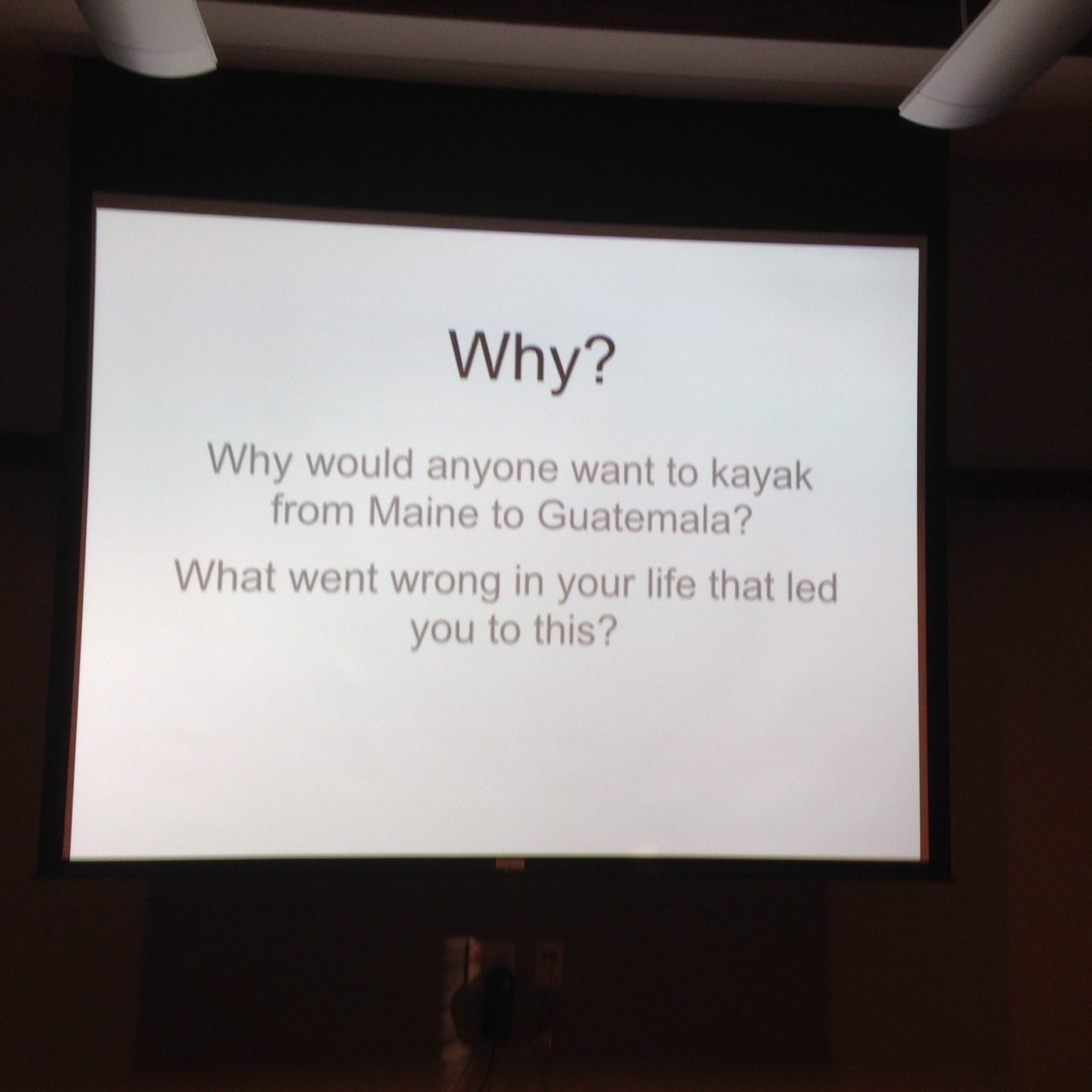
Dr. Deb has always been adventuresome, having made solo trips to the Arctic, kayaking around the Northwest Passage, and leading kayaking expeditions, which she began in 1981. Several years ago, she was among a group of Rotarians who went to Guatemala City, saw the need and decided to do something positive about it. She reports, laughingly of course, that when she embarked on her first journey one person came up to her and asked this question:

WhySafePassage

The Need & How The Safe Passage School Helps

Over 9 million people live in Guatemala City, Guatemala, and 10,000 of those people scavenge for food in the city garbage heap and for any items they can find to sell to survive. Safe Passage was organized in 1999 to rescue these people from their dire situation through literacy and medical help. Kayaking is Deb’s way of fund-raising for this organization. She has reached 92% of her goal to raise $ 150,000.00 to fund expanding the school to include grades 3 and 4.

  • Safe Passage Educational Center houses classrooms, a cafeteria, library and a medical clinic, serving nearly 2000 family in 2014.
  • Provides literacy: English speakers are 3 times more likely to get a job. Incomes of Safe Passage graduates are 5 times higher than that of the average resident of Guatemala City.
  • Provides teacher training for local public schools.

Deb’s Day in her Kayak, a Chesapeake 18 model

She says every day “feels like I’m jumping off a cliff!” Typically she paddles 2-8 hours daily, monitored by her husband Chris back home via a tracking device that reports her whereabouts every 10 minutes. He helped her assemble tents, suits, cooking ware, and other travel equipment.

The children of Safe Passage have donated yellow, rubber ducks “El Patito Amistoso” for her kayak, so she has companionship while she travels.

KIDSsagePassage

Dr. Deb and Guatemalan boy: Safepassage.org/kayak video

Hazards:

  • Drug cartels control some sections of the waterway. “If they see you, they shoot you.”
  • Deb has encountered sharks, alligators, and whales. When she encounters a marine animal, she “looks them in the eyes while she sings.” Once however, at night she and her kayak were flipped over by a manatee on the Inter-coastal Waterway in Florida.
  • Once she kayaked out of the U. S. security zone, and the Coast Guard came after her with guns a-blazing. She could have been fined $ 500.00 and served 3 years in prison. The officers relented, however, when they discovered her cause and escorted her to safety.

Interruption!

After completing 1057 miles from Maine to South Carolina, her most recent trip was temporarily stalled by intense shoulder pain alternating with numbness, and Deb had to stop four times in the early part of the trip for medical attention. Doctors discovered a herniated disk in her neck which was surgically repaired with a titanium piece which in an X-ray looks to her like the image of a “thumbs up”! She says, jokingly, “I’ve been screwed!”

She is hoping to resume this latest trip in October and complete the remaining miles to Guatemala City.

Success Stories

  • One 73-year-old woman in the garbage dump enrolled in Safe Passage so she could help her grandchildren do homework. She herself learned to read and now she is writing her Memoir!
  • Another woman named Miranda rescued from the dump exclaimed after her success: “If you believe you can do it, you can do it!”

Final Words from Deb:

“Like many people who embrace an adventure, I learned more from the people I met than they learned from me.”

After her presentation, Deb admitted: “Even though I’ve seen this video many times, I never see it without tears in my eyes.”

DebWaltersMe

Her blog: KayakForSafePassageKids.blogspot.com

The organization: SafePassage.org


Maybe your story is not as dramatic as Deb’s, but it has involved getting out of your comfort zone. We’d like to hear about it – or your response to Deb’s adventure.

The Nook: A Different Definition

Where did you study? Was your desk a dining room or kitchen table? The couch? A separate room? Did you listen to music as you studied? Or did you tune out the noise of the household when you crammed for a test or wrote a report? Louise DeSalvo author of The Art of Slow Writing, a book about writing as a meditative, patient process, muses about her own study nook in this excerpt:


My parents valued education, so when I was young, the only time my parents didn’t bother me was when I was doing homework. My father made me a triangular desk that fit into a space at the top of the stairs. . .


Sitting at my desk while I was working, nobody told me what to do. My father was pleased with my industry rather than angry with me. My mother wanted me to study because, no matter how much she needed my help, she wanted me to do well in school.  Sitting at my desk working helped me feel a sense of control in my chaotic household (188, 189).

Louise’s writing desk was triangular probably positioned in a corner. It strikes me that she may have faced the wall, not a window, a rather confining, even claustrophobic view.

As for me as a student at Elizabethtown High, when the noise downstairs around my spread at the dining room table overpowered my ability to concentrate, I’d flee upstairs to a study desk that looks like this, a bedside table with a brown goose-necked lamp. Mother had the table refinished years later and replaced my gooseneck lamp with this one: a faux milk-glass base with a lacy, fluted lampshade.

Study Desk 2

Here’s how I write about this “desk” as a flash of memory:

My books and notebooks are piled on the dining room table. I’m in ninth grade and when the house gets too noisy, I go upstairs to the bedroom I share with my sister Janice and study there. My study table is just a wooden bedside table. It’s tiny, with two of the four legs spaced closer together. There’s space for a little lamp on top and maybe a book or two on the shelf below – a piece of furniture not designed for serious study. There is no place to put my legs really, but I scrunch myself under the teeny table with my knees touching, a brown goose-necked lamp cocked so I can read, take notes on scored 3 x 5 index cards, or write in meticulous cursive in my notebook, one for each subject.


Image: eBay
eBay Image: mid-century goose-neck lamp

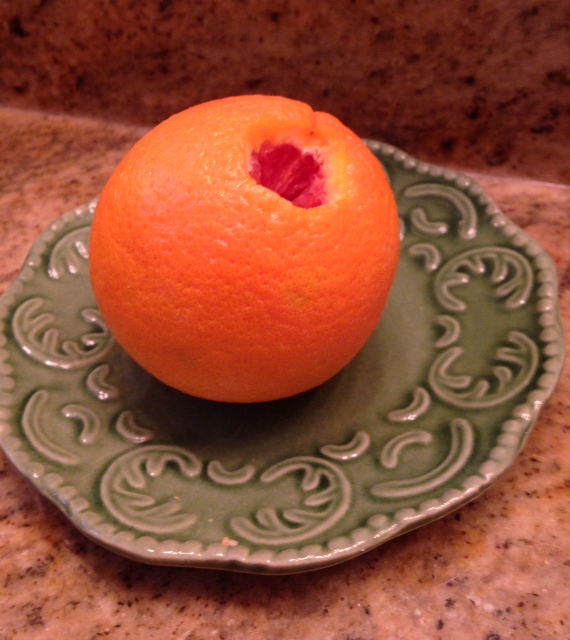
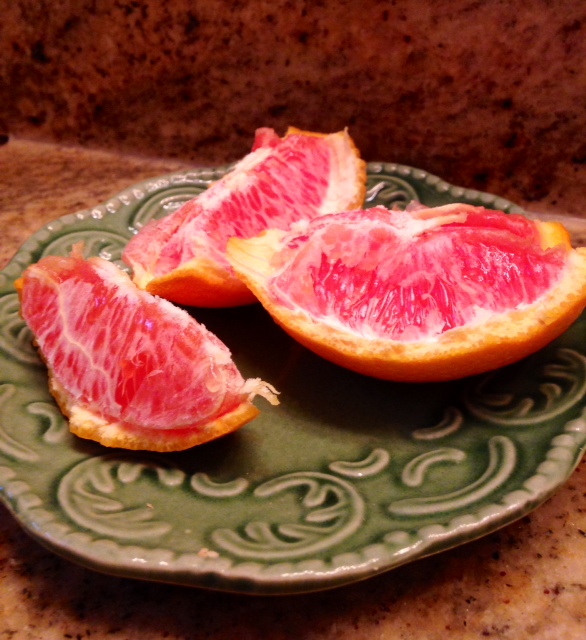
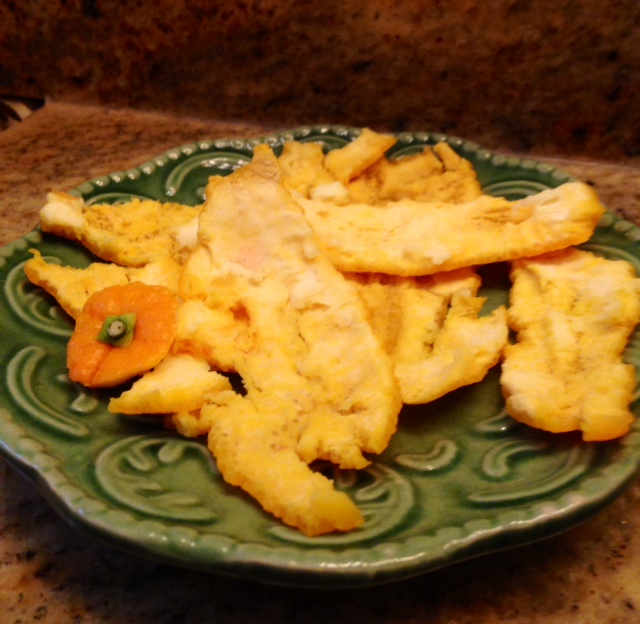
I consumed book chapters, algebraic formulas, and historical data. I also consumed apples, carrots, or oranges. Yes, as I studied, I nibbled. Like a dog worrying a bone, I ate apples to the core, sometimes discovering nothing but apple seeds in the palm of my hand along with the fibrous center hull, when I looked up from the page. Carrots were eaten down to the nubs. And oranges too. First, I sucked out some of the juice, then broke the orange into five or six sections, eating them one by one. Finally, I consumed the white inner rind too, one incisor-dig at a time, only the outer skin remaining.

Orange WholeOrange SectionsOrange Bitten RindOrange Peel


Study – an all-consuming proposition  . . .  

Some books are to be tasted, others to be swallowed, and some few to be chewed and digested.

        ~ Sir Francis Bacon  “Of Studies”


Did you study at home, at the library? Did you have chaos or quiet? Maybe you had a photographic memory and didn’t have to study much.

Were you a nibbler too? Inquiring minds want to know.


Coming next: Purple Passages with a Pop of Pink, March 2015 edition

The Potting Shed and Other Marvels

I just talked to my brother Mark in Pennsylvania, and our 15-minute conversation was interspersed with his exclaiming . . .

“It’s sleeting.”

Then, a few minutes later, “It’s raining . . .”

And finally, “It’s sleeting again!”

It’s March and most people north of the Florida latitude are sick of winter. Suffering from S.A.D. (Seasonal Affective Disorder}, they are waiting to see the sun break through the winter blahs and unveil the crocuses and narcissus ready to pierce the soil.

Writer Linda Joan Smith had that feeling in mind when she said

Outside Snow’s dingy blanket may still muffle the stirrings of tulips and daffodils, and the pond may still be rimmed with ice. The reward of the garden must wait, but our gardening labors have begun. (“The Potting Shed,” The Traditional Home, March 2002)

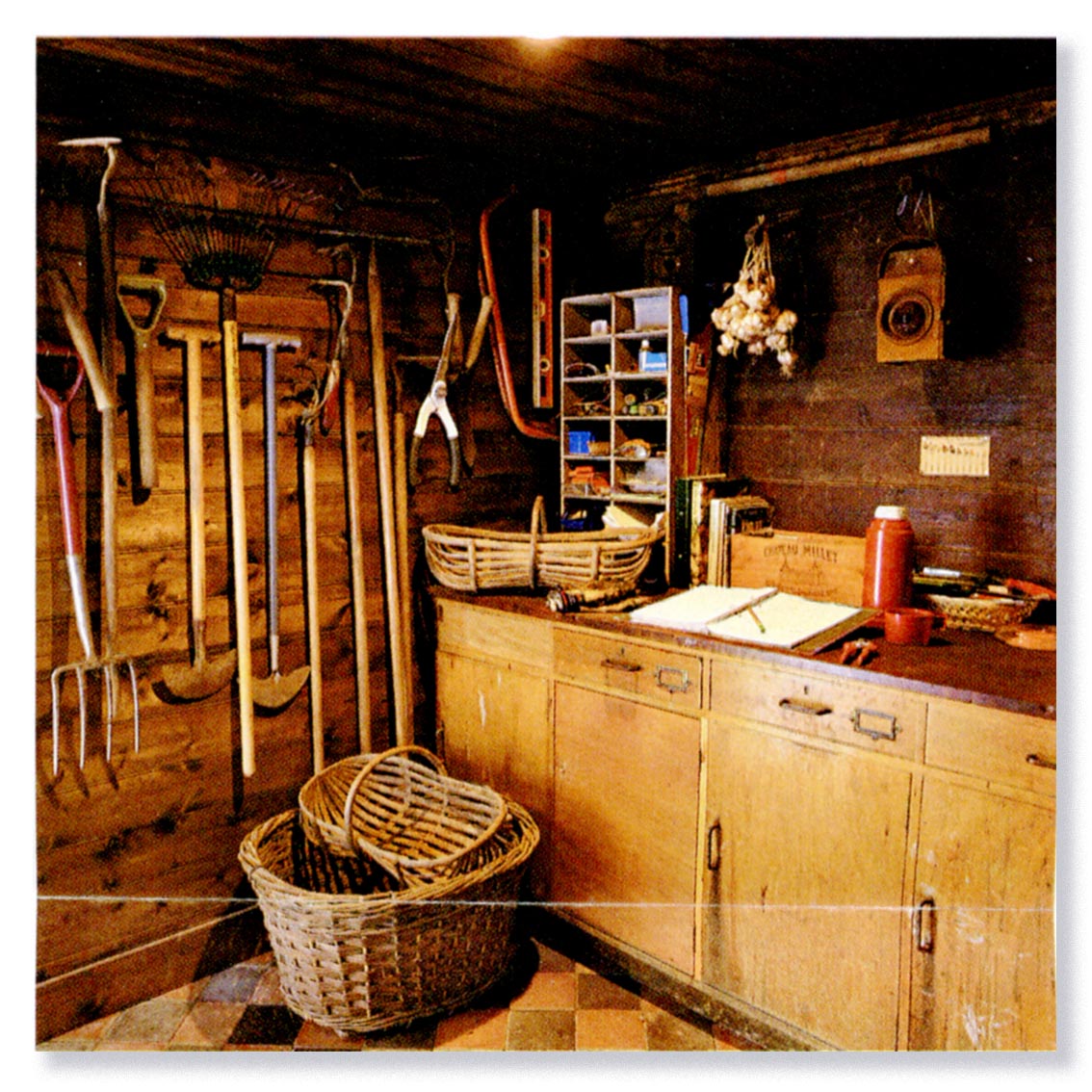
Smith celebrates the potting shed, “the room that is as much a workshop to the gardener as the kitchen is to a cook.” She makes reference to the advice of John Claudius Loudon, who in his 1830s An Encyclopaedia of Gardening, recommends that proper potting shed must have light, air and warmth, including “a fireplace never omitted.” Smith’s article pictures two versions of the shed – an impressionistic one where there may not be precise order . . .

Illustration: James Staag, Traditional Home, March 2002

And one meticulously appointed where there is “a place for everything, and everything in its place,” (229) so says Mr. Barnes of Bicton Gardens writing in the1840s.

Photograph: Curtice Taylor, Traditional Home, March 2002

My blog friend Linda Hoye, who moved recently from the Pacific Northwest to Canada, is a gardener extraordinaire. In her blog A Slice of Simple Life she uses plastic gallon jugs for winter sowing:

Winter sowing is placing seeds outside, in the winter, in mini-greenhouses made from things like empty milk jugs. The plastic jugs protect the seeds from harsh weather while allowing the cold to toughen them up during the cold weather. When it gets warm enough inside of the little greenhouses the seeds germinate and become viable outdoor plants sooner than those started indoors because there’s no need to harden off the plants.

When you check out her post, you can see her mini-greenhouse project complete with a photo of the jugs in a tub.

Did I mention that Linda is innovative? Yes, indeed. She gives a blow by blow pictorial account of preparing a worm hotel – indoors. Knowing that worms aerate the soil, she nurtures them as help-mates in the growing process. Even she says, “Eww!” as she mingles coir mix, pumice and finely chopped veggie scraps topped with a damp newspaper before she moves the operation to the garage. Soon she will prayerfully tuck seeds, tiny flecks of hope, into dampened soil. Obviously, Linda has faith that “to plant a garden is to believe in tomorrow” (Audrey Hepburn).

And gardener Hoye believes in whimsy too, as her creation of a fairy garden illustrates, anticipating spring in a post entitled “Spring is in the Air.

FairyGardenLHoye

Some Gardening Quotes:

“Outside there is water music as packs of snowflakes melt into water drops, merge into rivulets, trickle into puddles, then subside into pools and streams. The garden is mud, but no matter. Soon it will drain and dry in the strengthening sun.”  ~ “The Potting Shed,” The Traditional Home (March 2002)

“In the spring, at the end of the day, you should smell like dirt.“~ Margaret Atwood in Bluebeard’s Egg (1986)


In March 1985 my farmer parents, Mother and Daddy Longenecker, left wintry Pennsylvania and visited Florida where they couldn’t wait to get their hands into the soil. Soil that nourishes citrus trees, azaleas, and camellias is not necessarily good for hardy Lancaster County plantings. Daddy took one look at the sandy soil in my sister Jan’s huge back yard and ordered a load of chicken manure. After working it into the ground, he and Mother scored straight rows for planting.

Mother Ruth Longenecker sowing seeds in Florida

Do you have gardening tricks or stories about gardening to share? Here’s your chance!

Wanda: Boring in Beige to Beautiful in Blue

Two “Beautiful” Stories today . . .

Jenna’s Story

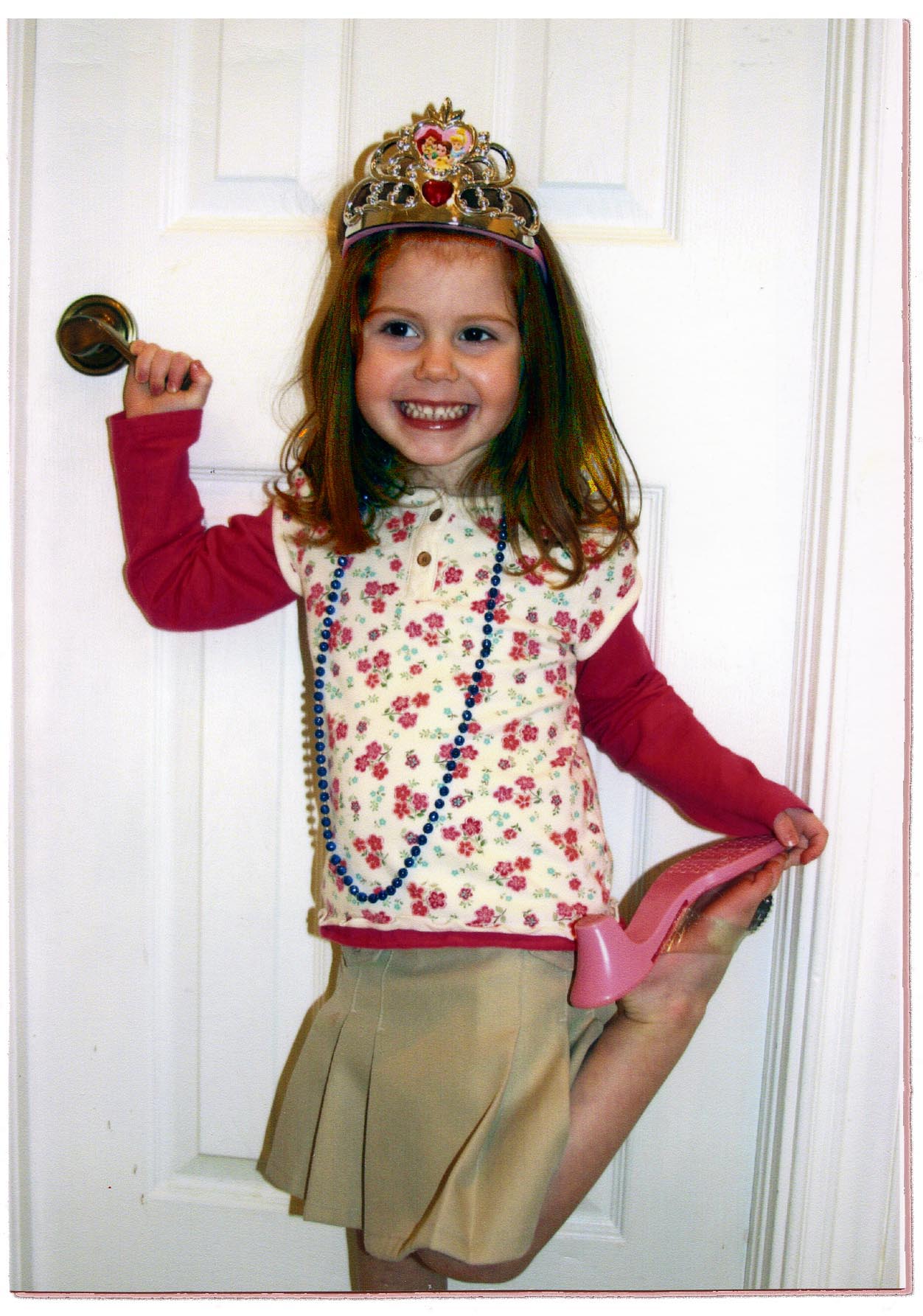
My auburn-haired granddaughter Jenna is very cute, and people frequently tell her how pretty she is. From an early age (here at 3 1/2), she has loved to primp and preen.

2009_Jenna dressed up as princess

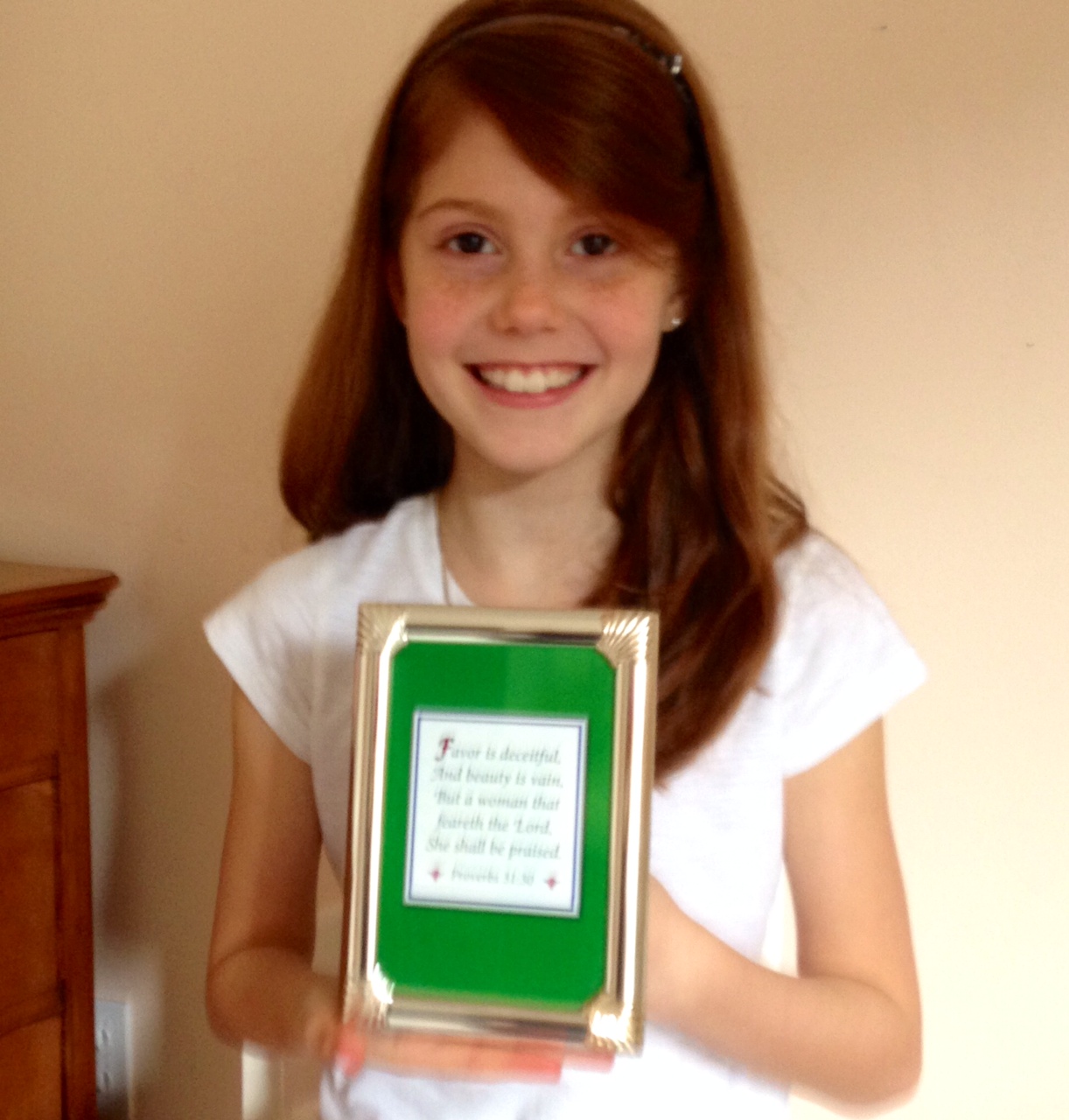
Even before she turned two, she would wake up, put on a gaudy plastic tiara and blue Lucite high-heels and toddle around her bedroom, every inch a princess. And there’s certainly nothing wrong with play-acting. But since then, in our Nana/Grand-daughter talks, I have reminded her that there are two kinds of beauty, the inside and outside kind. One lasts. The other one fades. Last year for her 9th birthday, her Grandpa and I collaborated on a gift to help her remember the meaning of inner beauty as she blossoms into a young woman.

It looked like this:

JennaFrame

 Here is the verse close-up:

03Proverbs_for Jenna_01gr_4x6

We have talked about the meaning of those solemn and ancient words from the King James Version: favor, deceitful, vain — and have discussed what the verse written centuries ago might be saying to a young girl like her today. She knows for sure that there is nothing wrong with being attractive, but looks are not the most important thing in her life.

to be continued . . .

Wanda’s Story

I don’t know Wanda’s last name, but I know what she looked like before/after her appearance on the TV show “What Not to Wear.” Hosts of the show, Clint Kelly and Stacy London, help Wanda, a family therapist from San Diego, transform from boring beige to beautiful blue. In the course of the metamorphosis, the 47-year-old career woman, reveals that she grew up in a Mennonite culture and thought of beauty as something “to be frowned upon,” something even “dangerous” to use her description.

Here is Wanda’s frumpy before and stylish “after” look:

WandaNotToWear

You can see her “before” pict and hear a snippet of her story on this short YouTube

For Wanda, no more “monochromatic modesty or khaki catastrophe.” She exclaims at the end of the show: “Now I can walk into the future with my inside and outside more coherent.” In the grand finale, a band of friends and relatives gather around the stage to applaud the transformed Wanda who glitters in stylish heels and a purple “date” dress.

As the banner on my welcome page shows (Mennonite prayer veiling paired with a pair of sassy red heels), I can certainly relate to Wanda’s viewpoint. You can read about it in a former post. My own metamorphosis from plain to fancy did not happen nearly as quickly as hers, but over the years I have tried to focus on the qualities that reflect inner beauty just as I try to model them for my grand-daughter Jenna.

What about you? Maybe you are not 40-something anymore. You might be 50, 60 or beyond. Still there’s beauty at any age. That’s certainly what I think.


Do you (as Wanda now thinks) believe your inside and outside appearance should match?

How do you define Beauty?

Coming next: Moments of Discovery: Mother’s Quilts


JennaDressedUp

Purple Passages with a Weather Forecast

To my friends both in the northern and southern hemisphere, some thoughts about the weather. All quotations from BrainyQuotes.

Sometimes I wish I was the weather, you’d bring me up in conversation forever. And when it rained, I’d be the talk of the day.  —  John Mayer


I like the cold weather. It means you get work done.   — Noam Chomsky


Wherever you go, no matter what the weather, always bring your own sunshine.    — Anthony J. D’Angelo


Scarves, mittens, and hats are a great way to express your personality in the cold weather.   — Brad Goreski


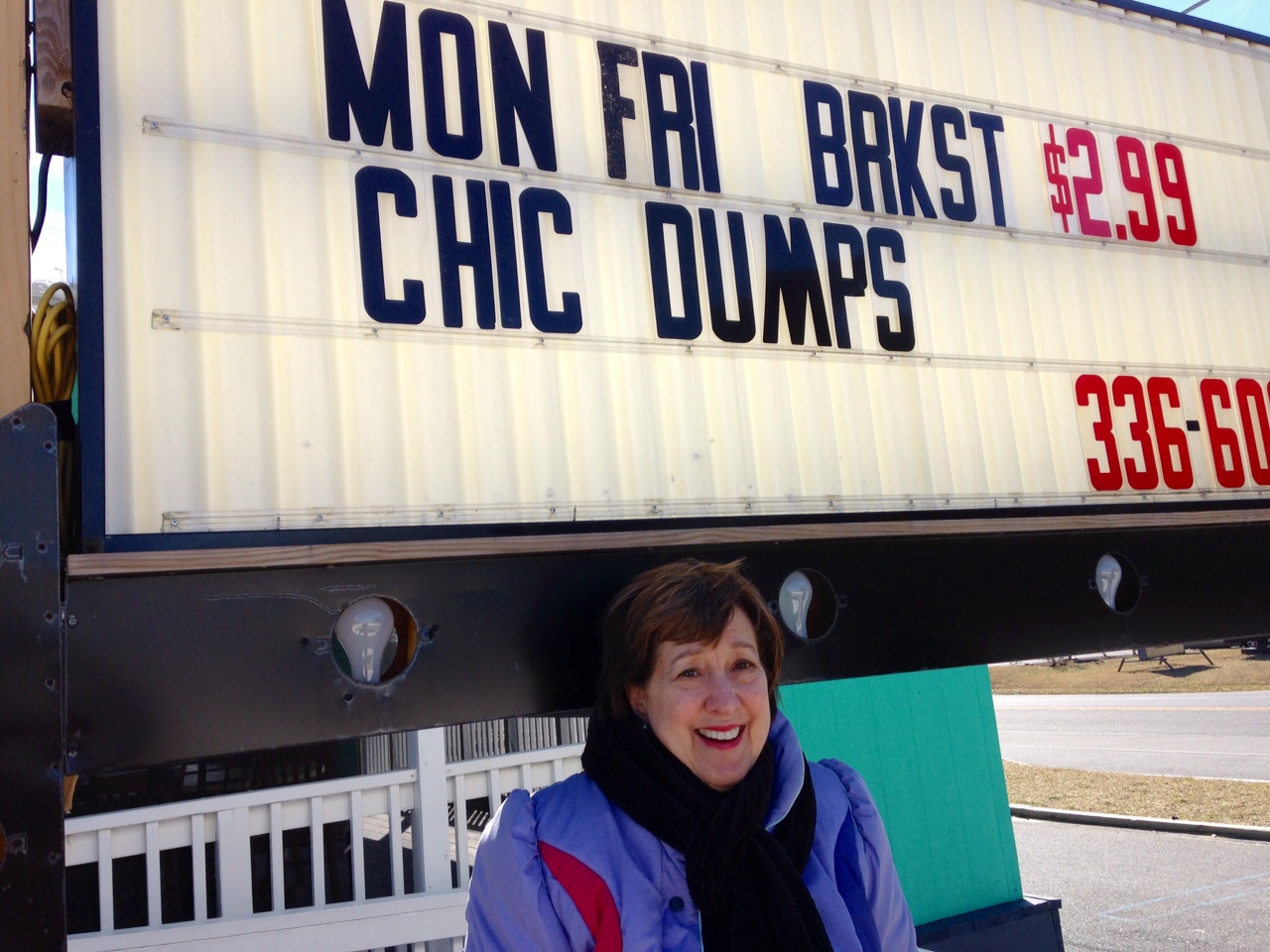
Where's my hat? Freezing temps on Chincoteague Island, VA
Where’s my hat? Freezing temps on Chincoteague Island, VA                              Chic Dumps? Best guess: Chicken and Dumplings


People don’t notice whether it’s winter or summer when they’re happy.

— Anton Chekhov


For there is no friend like a sister / In calm or stormy weather; / To cheer one on the tedious way, / To fetch one if one goes astray, / To lift one if one totters down,/ To strengthen whilst one stands.   –– Christina Rossetti

(from “Goblin Market”)


A friendship can weather most things and thrive in thin soil; but it needs a little mulch of letters and phone calls and small, silly presents every so often – just to save it from drying out completely.       — Pam Brown


The forecast: Spring will come!

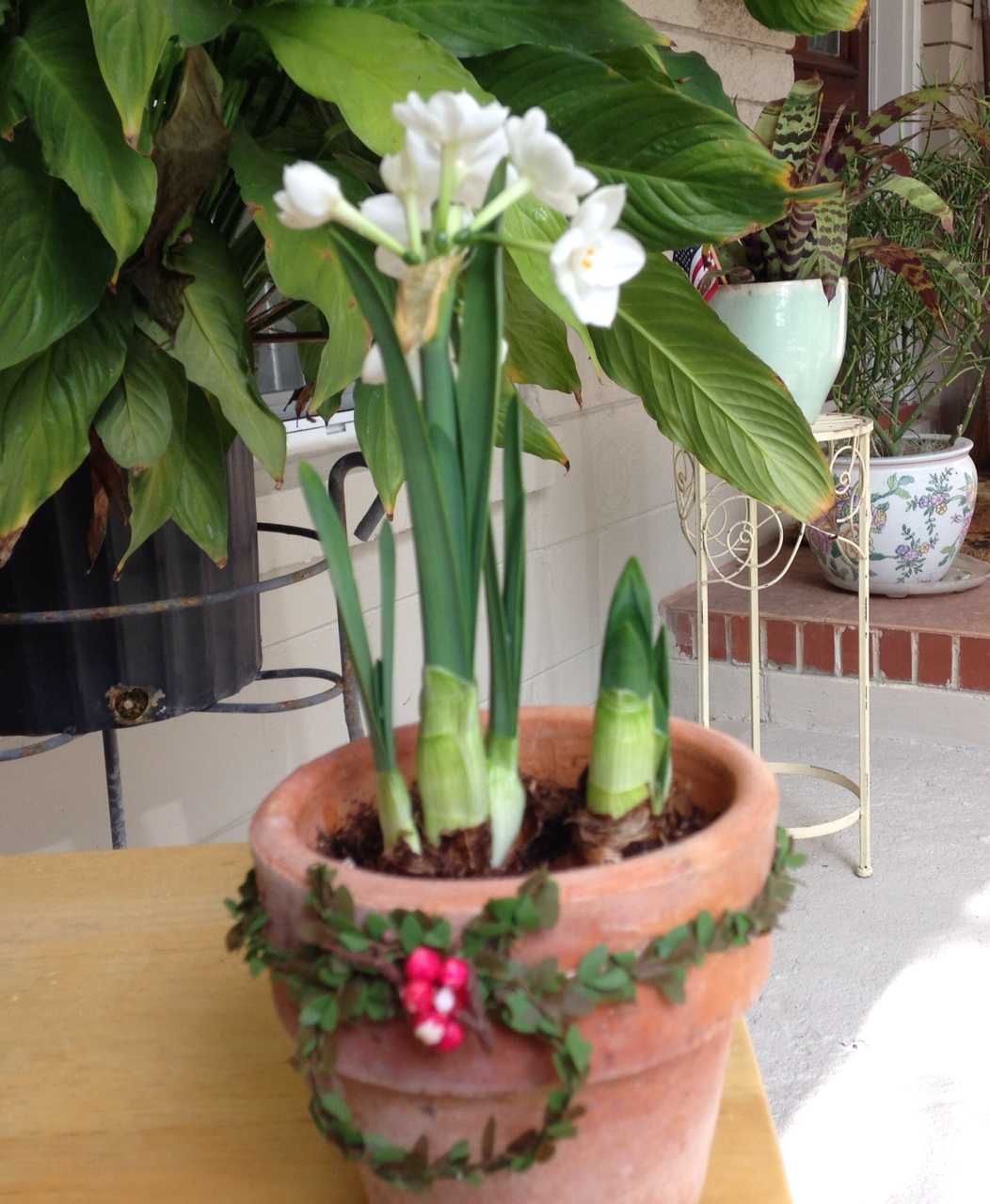
Paperwhites

Paperwhites from the narcissus family, with their “delicate color and sweet, musky fragrance,” a forecast of spring to come.

While the earth remaineth, seedtime and harvest, and cold and heat, and summer and winter, and day and night shall not cease.    Genesis 8:22  KJV


I’m guessing you agree with some quotes more than others. One or two you may completely disagree with. 

Can you add another one? We’ll be listening . . .


Coming next: Wanda: Boring in Beige or Beautiful in Blue?

Signs and Wonders: Chincoteague Island

Once upon a time, there were five memoirists who met online through their writing websites. One of them, Janet Givens, who had a rustic log house on Chincoteague Island, Virginia, invited four blogging friends to join her for a writers’ retreat: Kathy Pooler, Joan Rough, Shirley Showalter and me.

According to Janet, “It was grand.” At the end of the week, we all agreed. Now, you ask, what made the week so special?

First of all, the spacious log house was charming: LogHouseChico.VA

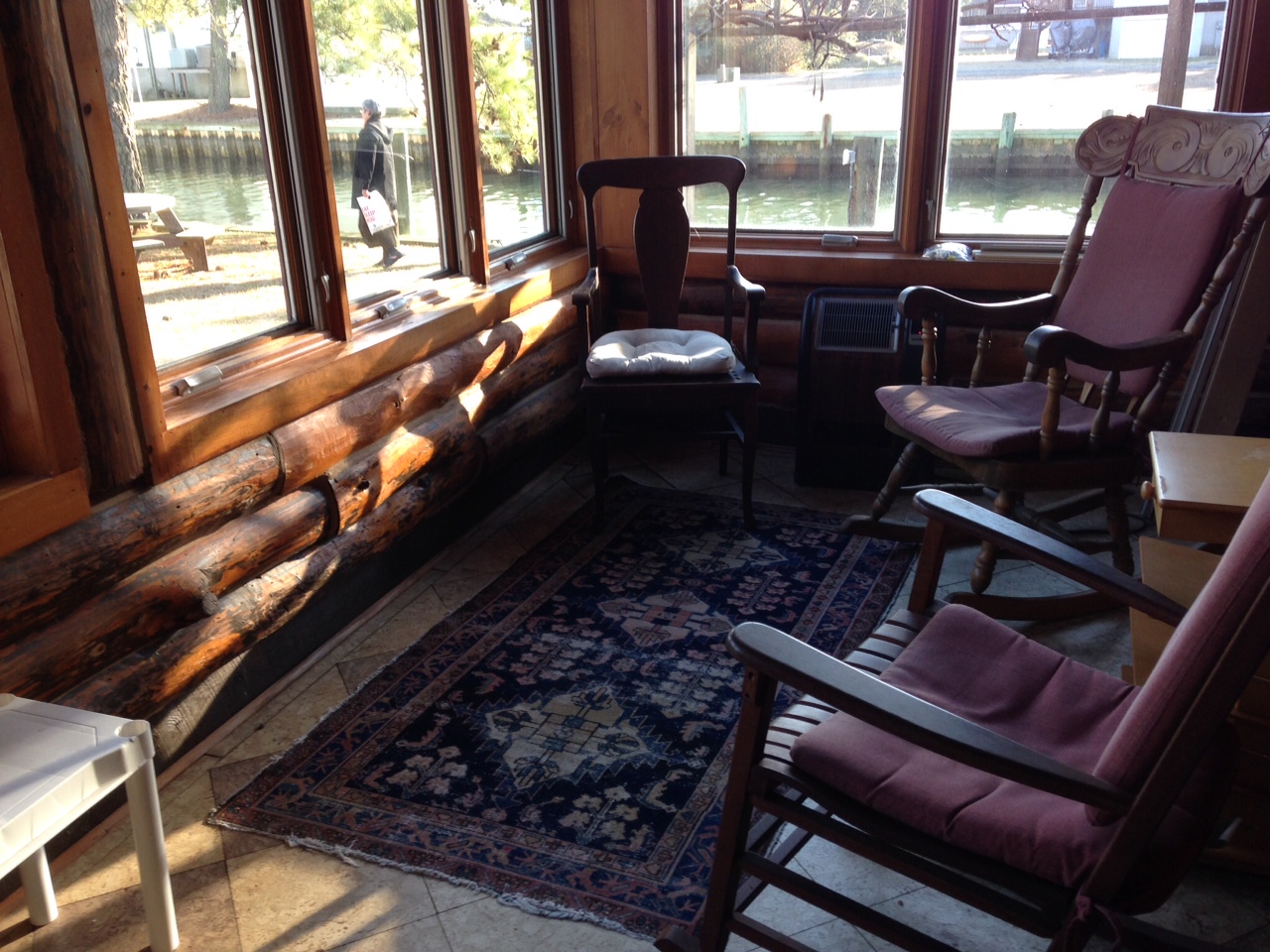
And there is an enclosed porch where we ate breakfast overlooking a canal and the shimmering Oyster Bay facing east.

ChairsLogPorch

All around the house were clever or catty sayings on wooden plaques: GrumpySignSmokingFireSmokingMan

No one was voted off the Island. We all stayed!
No one was voted off the Island. We all stayed.

That’s right:  Everyone behaved!

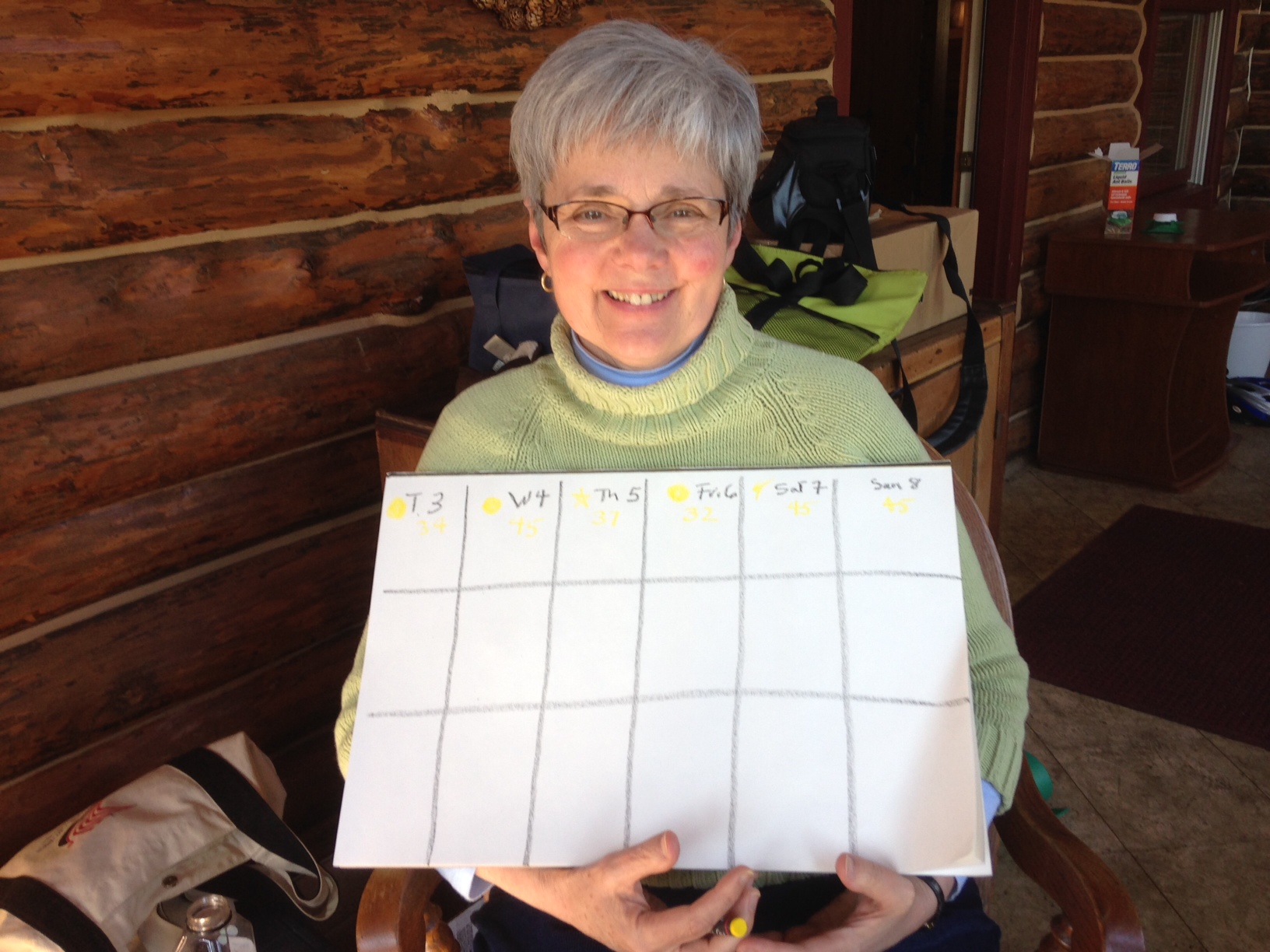
As we began, we did have a plan to include the clichéd 3 F’s and a W: food, fun, fellowship – and writing, of course. In a joint effort, Shirley recorded on paper how our days might unfold.

ScheduleSHS

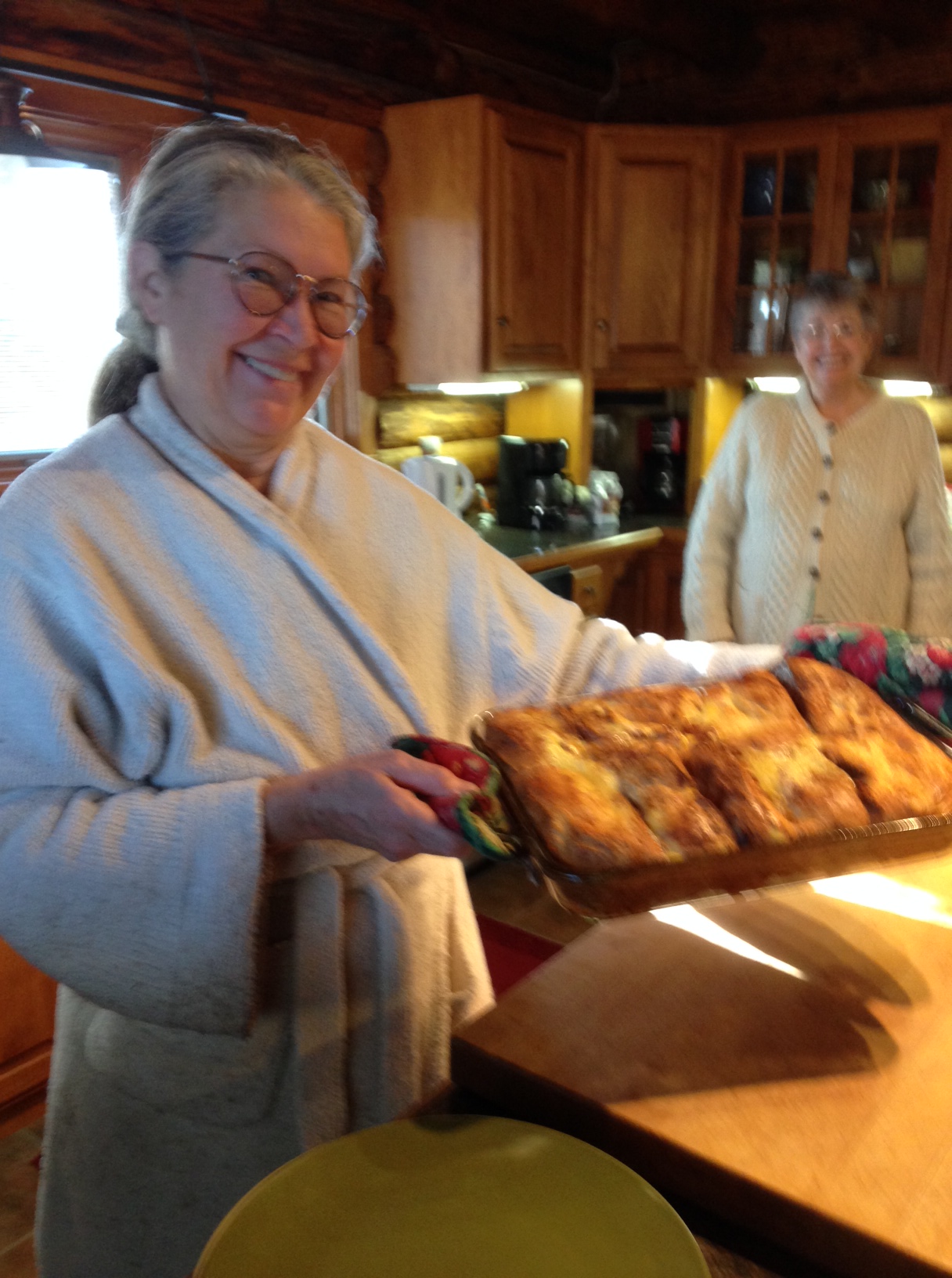
Every day, we enjoyed breakfast together, one day with French toast oven-baked by our host Janet with Joan beaming her blessing:  FrenchBread

Then we had writing time and do-it-yourself lunches with afternoons for more writing or walks.

Some days it was cold!   MarianKathyJoan

One fairly warm day, we all took a hike into the Assateague Preserve to see the world-renowned ponies, made famous by Marguerite Henry’s Misty Books. According to one friend’s pedometer, we logged about 3 miles walking the beach and side trails.

And we enjoyed the exhibit at the Visitors’ Center:PonySignExhibit

Other Days, we wandered along the main road in Chincoteague. As we explored, we found some interesting sights.PianoWrapped

And a mailbox replicating the house of the owner in the distance:

Mailbox replica of house behind

Every evening, we had healthy meals: Chicken chili, frittata, stuffed sweet potatoes, pasta fagioli. This night, Joan is helping Shirley serve broccoli soup with Waldorf salad.     KitchenCooks

After dinner from Tuesday – Saturday, we gathered on the comfy sofa and chairs close to the wood stove. From 7 – 9:30 one of us had the spotlight with an opportunity to get feedback on our writing or blogging. As a beginning memoirist, on Tuesday night, I got clarity about the focus for my story. Distributing a preliminary outline, I asked, “Where in all this muddle is my true story?” Happily, I got wise words from three women who’ve already published memoirs (Kathy, Janet, and Shirley) and one (Joan) with a book poised for publication.

MeComputer

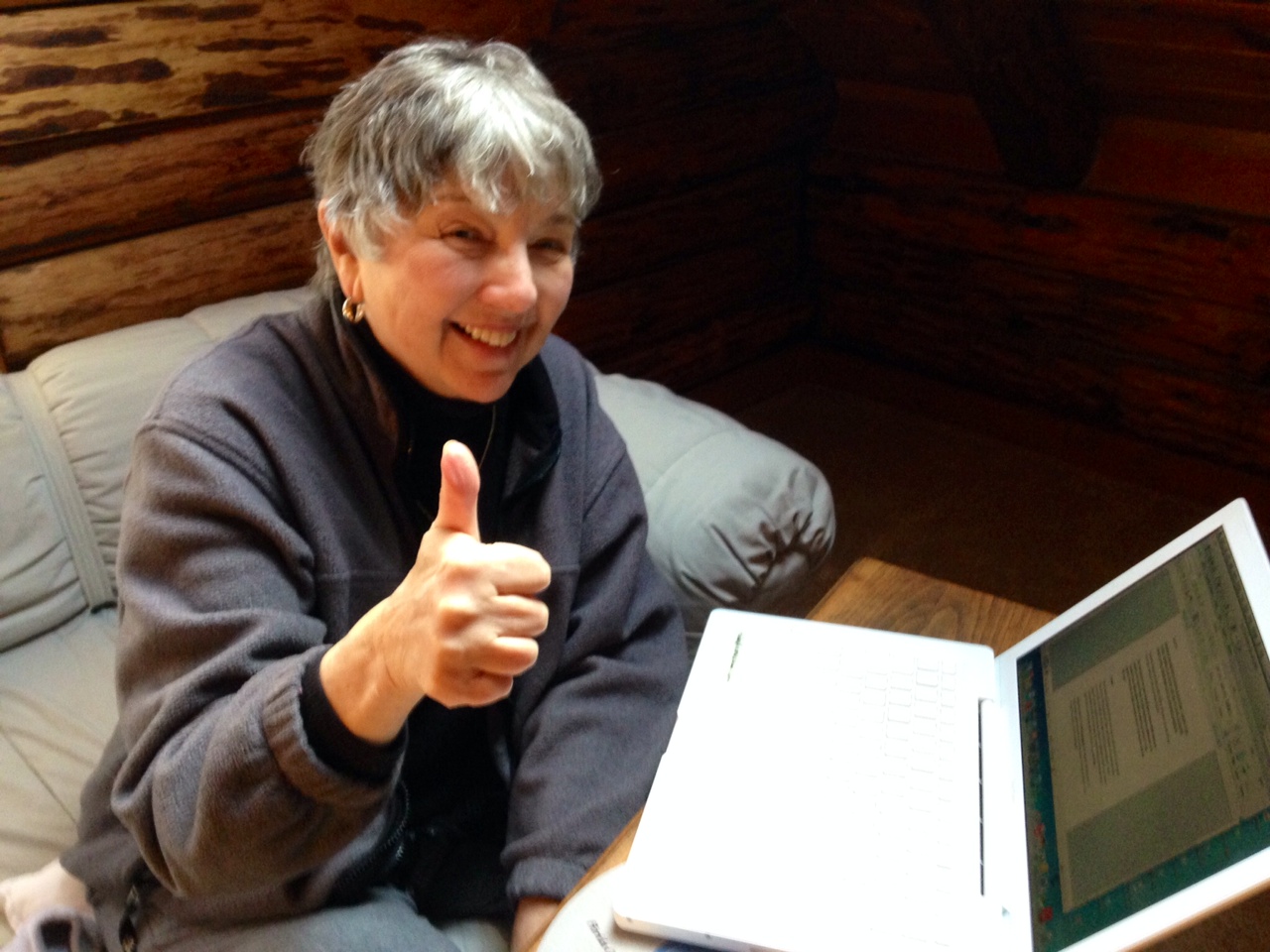
After struggling through revisions, my room-mate Kathy, gestures her approval of my story blurb and synopsis:

ThumbsUpKathy

On Sunday, our last full day together, we joined Janet at the Sundial Book store for her author talk/book signing.

SundialBooksChincoVA

JanetBookSign

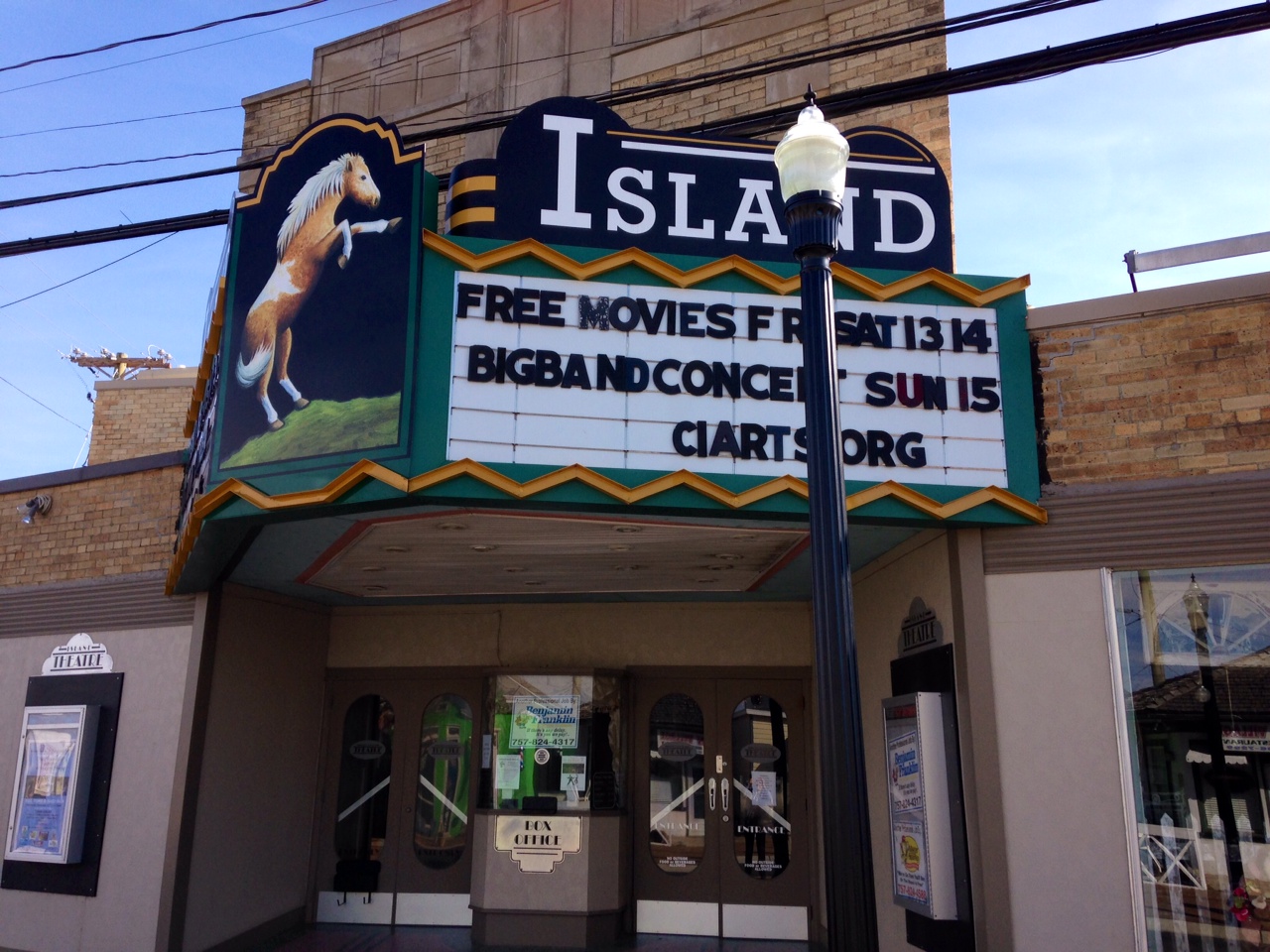
Afterwards we bought books and other gifts for our loved ones. Leaving the store, we spotted the theatre marquee across the street . . .

IslandTheatreMarquee

. . . and behind the store, outsized LOVE chairs by the bridge. (Think Lily Tomlin dwarfed in a big chair here.)

LOVEchiars

Finally, we gathered again to celebrate the productive week and our deepened friendships as we watched back-to-back episodes of Downton Abbey. As the week ended, we all wrote off into the sunset.

*  *  *

Our story, like Downton Abbey, proceeded in chronological time but with some flashbacks, like many good stories.

My version of The Week at Chincoteague is based on a variation of the story model by PIXAR, the moviemaker who tells perfect stories like Toy Story I and II. Since 1995, their storytelling wisdom has spawned many a tall/true tale. Yes, Shirley shared this link with me last week, which I pass on as a template for your own story. Here is the PIXAR prompt page.

AuthorLifeStory

My husband Cliff designed the cover for our photo albums of the week:

Alternate Title:  Cinco Chinco Chiques
Alternate Title: Cinco Chinco Chiques


In today’s post title, I promised you a Wonder, and here it is: 

Standing:  Janet Givens, Kathy Pooler, Marian Beaman    Seated: Shirley Showalter, Joan Rough
Standing: Janet Givens, Kathy Pooler, Marian Beaman
Seated: Shirley Showalter, Joan Rough

 Five writers, none of whom had met all the others, retreat to a magical island for a WONDERful time, honing their writing skills and deepening friendships.


Click HERE for more information on how to reserve Janet’s log house for a writers’ retreat or your own family vacation!

WhenGetThere


We love words! Share some of your thoughts here . . .  


Coming next: Purple Passages and a Weather Forecast

What’s in a Name?

My high school yearbook The Elizabethan sports such 3-syllable last names as Aschendorf, Biesecker, Espenshade, Hippensteel, Oxenrider, and Zimmerman. In Lancaster County, Pennsylvania any roster of names would be heavily represented by families of German-Swiss origin.

Yes, there were Smiths, McLaughlins, and Youngs, but the Pennsylvania Dutch names far outnumbered them. On class rosters there were no names from the Cyrillic alphabet like Lyashchenko or like Chang, formed of Asian characters. Not a one. Yet as our world has grown more culturally diverse, so have the class rosters and phone directories of small towns like Elizabethtown, Pennsylvania.

In the January 6, 2015 edition of Performance Today, Fred Child referred to a list of musicians with jaw-breaking names. You can find the complete list on their Facebook page, but here are a few choice ones:

Composer Carl Ditters von Dittersdorf

Conductor Hans Knappertsbusch

Poet Walther von der Vogelweide

Composer Einojuhani Rautavaara

Composer Heinrich Ignaz Franz von Biber

Conductor Gennady Rozhdestvensky

Musicologist Cuthbert Girdlestone

Tenor Wolfgang Windgassen

Ditters von Dittersdorf rolls most trippingly off the tongue as does the very onomatopoetic Windgassen. Imagine a tenor named Wind-gassen. Or even a wood-wind player with such a name!

My journal of our trip to the English countryside records place names that also tickle the tongue and the funny-bone. As I admonished my husband/driver to keep left while driving with a right-sided steering wheel, cute towns whizzed by with no-kidding names like Gigglewick, Blubberhouse, Wigglesworth, Nook, Cow Brow, Button Moon, and Hutton Roof. No, I didn’t make these up! There was even a Curl Up and Dye Hair Salon.

Ireland_Roundabout sign_6x4_300

In Scotland menus feature haggis (chopped sheep hearts, livers, mixed with oats and spices), bashed neeps (turnips), and champit tatties (mashed potatoes). In Ireland we encountered the quaint village of Ballyvaughan, and Cairig Beag, a Bed & Breakfast not far from the town of Sneem with houses colored bright orange, Kelly green, and sunny yellow.


What’s in a name? that which we call a rose / By any other name would smell as sweet . . . .

In Act II of Romeo and Juliet, Shakespeare writes of the star-crossed lovers who bear the names of their feuding families, Montague and Capulet, implying that the names of things [people] do not affect who they really are or their love for each other.

"A rose is a rose is a rose . . . "  Gertrude Stein
“A rose is a rose is a rose . . . ” Gertrude Stein

Actually, in the expression “a rose is a rose is a rose,” Ms. Stein was referring to the English painter Sir Francis Rose, not to the flower as is commonly supposed. Now the phrase has come to define anything that is incapable of explanation.

What place or people names strike you as fanciful or interesting in another way? 

I love words! Share some of yours.

Bonus: As it happens, this week memoirist/friend Shirley Showalter blogs on the power of naming as a way to find one’s vocation and calling. Read about it here.


Sue, Sarah, and Handful: Reviewing The Invention of Wings

Sue Monk Kidd, best known for her debut novel, The Secret Life of Bees, has published her third novel, the acclaimed The Invention of Wings (2014).

Courtesy, Riffle Books

My Review

A full-page spread advertising Sue Monk Kidd’s latest work of historical fiction recently appeared in the New Yorker, which tells readers something about the stature of this work. Set in Charleston, SC, the novelist creates parallel stories representing two strata of early nineteenth-century America, alternating chapters with the voices of two engaging characters: the aristocratic Sarah Grimke and the hand-maid (creative name for slave) assigned to her, Hetty Handful Grimke. Kidd’s sweeping novel is set in motion on Sarah’s eleventh birthday, when she is given ownership of ten-year-old Handful. Over the next thirty-five years, both strive for a life of their own “forming a complex relationship marked by guilt, defiance, estrangement and the uneasy ways of love” as one reviewer characterizes it. Woven into the fabric of this novel is the alliance of the Grimke sisters, Sarah and Angelina, who advocate for the equality of slaves and the rights of women.

While the unfolding plot intertwines other historical figures, both factual and imagined, Kidd held my attention with her metaphors and other descriptions. I was particularly intrigued with the exquisite quilts Handful’s cunning mother Charlotte fabricated, often using the image of blackbird wings as a triangular motif in the design. In the acknowledgements section, the author mentions too her reference to the American black folktale, from which she drew inspiration about “people in Africa being able to fly and then losing their wings when captured into slavery.”

The two main characters in this book effectively invent their own wings, Sarah by tirelessly advocating for human rights and Handful by staging her own escape to freedom. Her often repeated refrain:

If you don’t know where you came from, you have to know where you’re going.

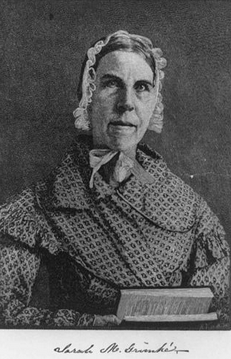
That's one determined woman
Sarah Grimke, one determined woman


Quilts

Have a look at some of handmaid Hetty’s exquisite quilts on this website. Possibly the best seamstress in Charleston, the quilting of Hetty and her mother Charlotte offered her freedom spiritually as she recorded her family’s history, and freedom physically too by enabling her to fashion a disguise that may have enabled her to escape.

Q & A with the Author

Website: Sue Monk Kidd

Sue Monk Kidd has created an intriguing story from mountains of research including historical dates and events, articles, letters, all inspired by viewing Judy Chicago’s The Dinner Party referred to in my last post.

See the intriguing Q & A with Sue Monk Kidd, who observed separate water fountains, black women sitting in the backseats of white women’s limousines, and the story of Rosa Parks in her own youth.

  • How could the author visualize Hetty so vividly?
  • How is Hetty or Sarah like Lily in The Secret Life of Bees?
  • How could Sue recreate the dialect of 19th-century Charleston on paper?

Your turn!

Sue Monk Kidd was published first in Guideposts and Readers’ Digest. Do you remember her writing from back then?

Can you relate to any of the characters in Sue Monk Kidd’s writings? 


BooksNYorkerCover