Amish Buggies: They Come in Colors

When I bring 5-pound bags of Wenger’s famous ham-loaf frozen from Pennsylvania to Florida, the plastic-coated tubs of meat are wrapped in newspaper and then shrink-wrapped in plastic. The wrapping on one of the packages revealed answers to the intriguing question: Who make Amish buggies?

Amish Buggies1_5x5_300

Writer Jack Brubaker born in Bird-in-Hand, PA keeps Lancaster Countians informed about local culture, history, and humor in his syndicated column The Scribbler. In the Tuesday, October 1, 2013 edition of the Intelligencer Journal/Lancaster New Era, Jack noted that a reader from Mount Joy, PA requested more details about Amish buggies. The reader had never seen a used buggy lot and wondered if the Amish recycle buggies. Also, he had been to Indiana recently and saw the Amish using buggies with slanted undercarriages that looked like an armored Humvee. Here are the main points of Jack The Scribbler’s response to his reader:

  • “Jake King, the Amish operator of Weavertown Coach, along the Old Philadelphia Pike between Bird-in-Hand and Intercourse, says there are about 17 manufacturers of new Amish buggies in Lancaster County, Pennsylvania,” including his company which has its own wheelwright shop.
  • Buggy-making is a cooperative effort:  Five or six shops make buggy bodies, known as “the box.” Other businesses make axles, springs and wheels. Still others assemble fiberglass floors and side panels.
  • King says his various employees become good at one thing: “You have to be a good electrician, painter and upholstery trimmer.”
  • What is the cost of a new buggy? “The average carriage for the ‘young guys’ sells for about $ 8000, with a more elaborate dashboard and better grade of upholstery than the ordinary type of buggy which ranges from $ 6000-6500.
  • Buggy vs. car: Buggy resale is high. Buggies require a horse: $3000 for the animal plus harness and feed. But, King notes, “they also don’t drink $ 4-per-gallon gasoline.”
Courtesy Google Images
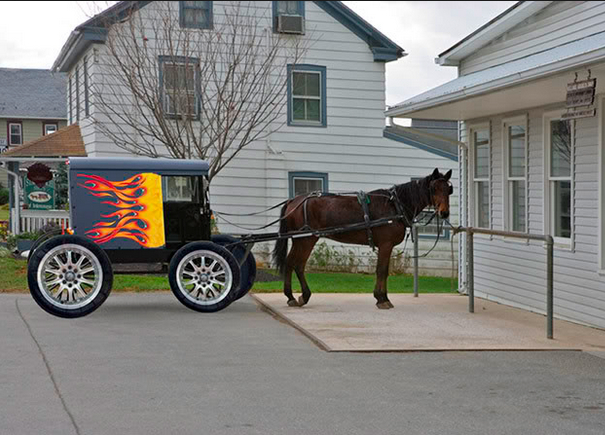
Courtesy Google Images                                          (Real . . . or a Photoshop job?)

The different colors and design reflect the owner’s community: Gray (PA), Black (Ohio and Indiana), Yellow (Byler Old Order Amish in Big Valley, Mifflin County, PA), White (Ohio), Brown (New Wilmington, PA and New York). Honestly, this surprised me as I think I’ve only ever seen black or dark gray buggies.

Like most Mennonites, Amish are thrifty, so of course they recycle their buggies, either through private sales or at spring “mud sales.”


Question Mark w border1_1x1_300


Are there Amish buggies in your community?

What new fact, opinion, or question can you add to the discussion?

Just for Fun: Signs Around Town

Signs . . . they’re everywhere . . . billboards in the city, stickers on cars, comments on Facebook. I found some wise ones in a novelty shop, on a car, on a piece of paper, on a writer’s sweat shirt. Some you’ve seen before. Others, I hope, are new. Silly video at the end!

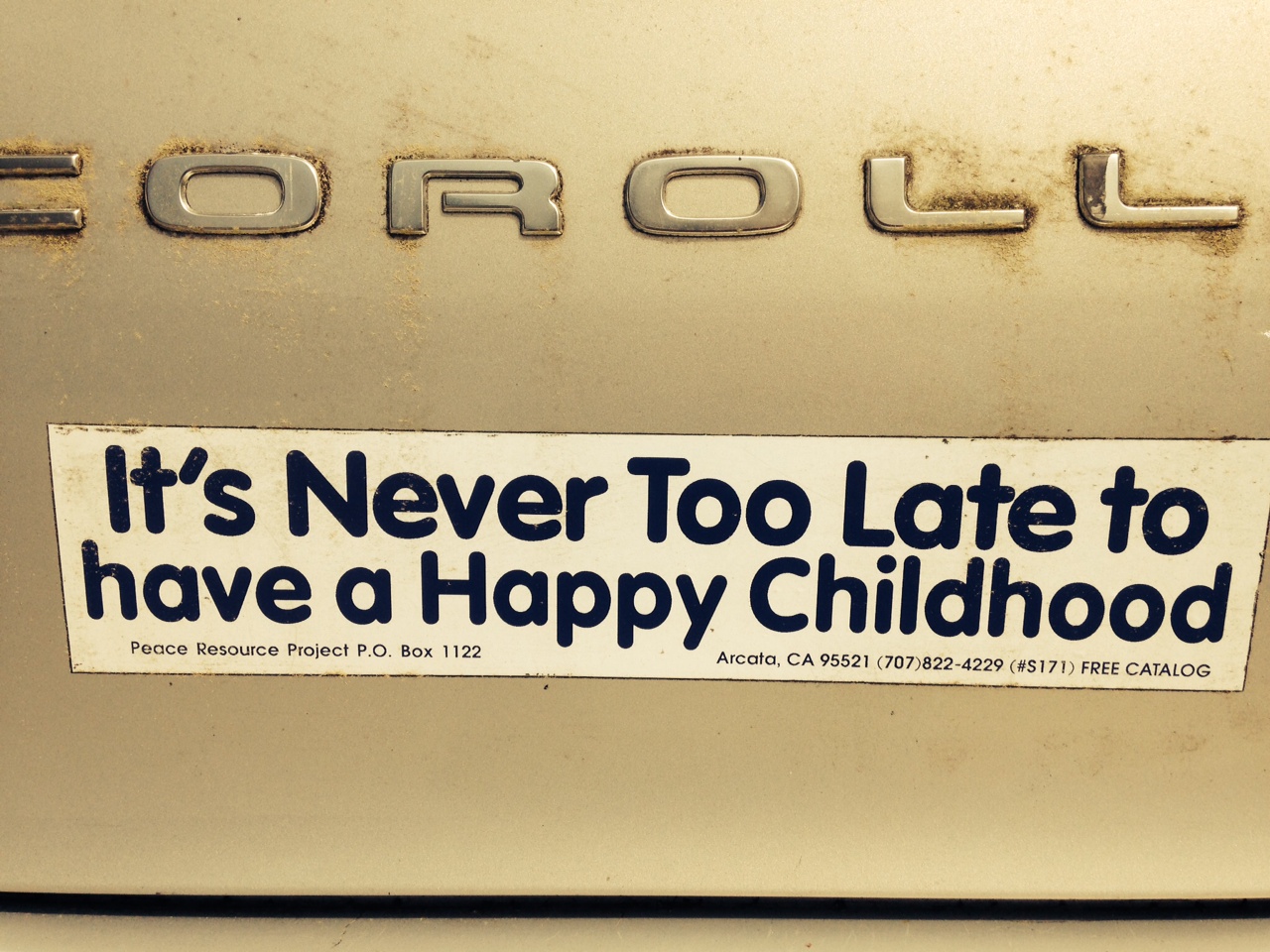
SignHappy Childhood

Quotation now thoroughly engrained in pop culture from the Tom Robbins’ novel Still Life with Woodpecker, an un-fairy tale with princess Leigh-Cheri and outlaw Bernard.

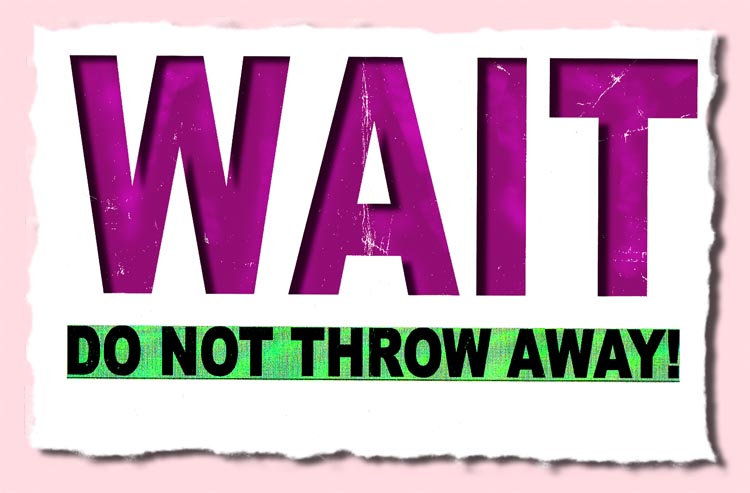
WAIT_Do Not Throw Away_sign_5x3_150

“Wait, Wait, Don’t Tell Me,” a popular NPR broadcast on Saturday mornings . . . what we do at traffic signals, the post office, a doctor’s office. . . counsel from the Lord we resist hearing:

Wait on the Lord: be of good courage, and He shall strengthen thine heart: wait, I say, on the Lord.

Psalm 27:14

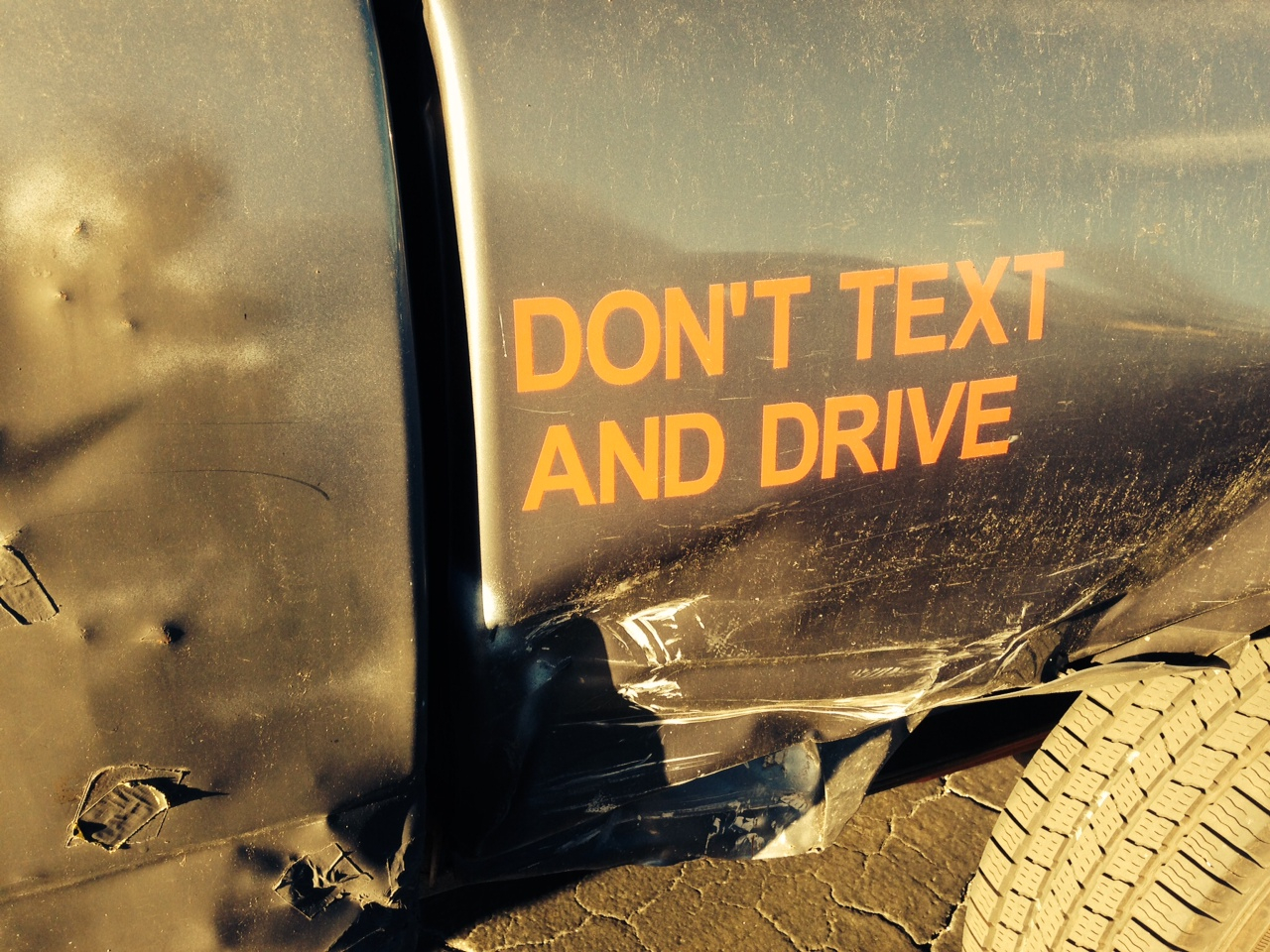
DriveTextSign

“I won’t fix my car until YOU learn your lesson,” this driver insists.

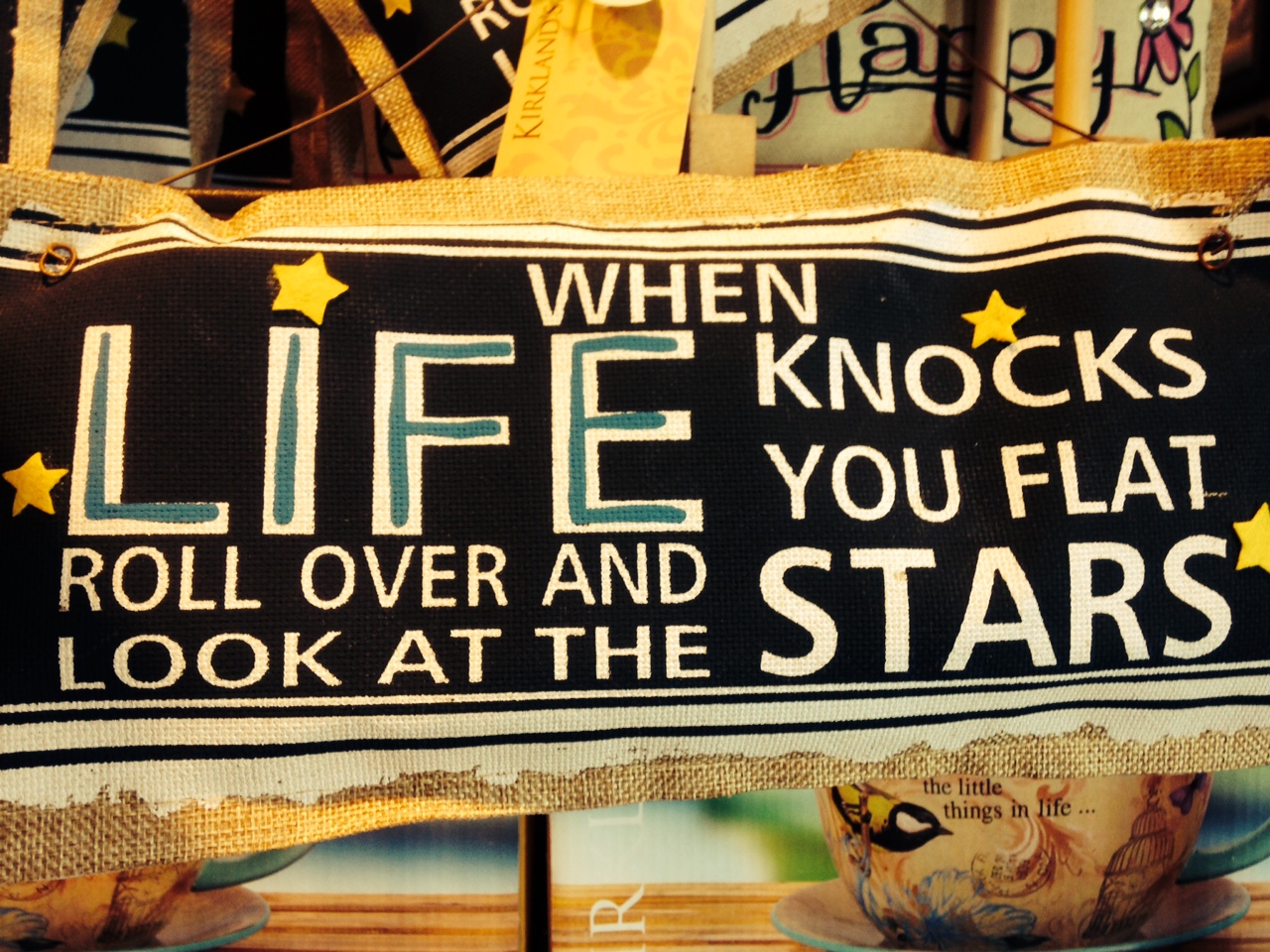
SignLifeKnocksFlat

Easy to say — until it actually happens to you!

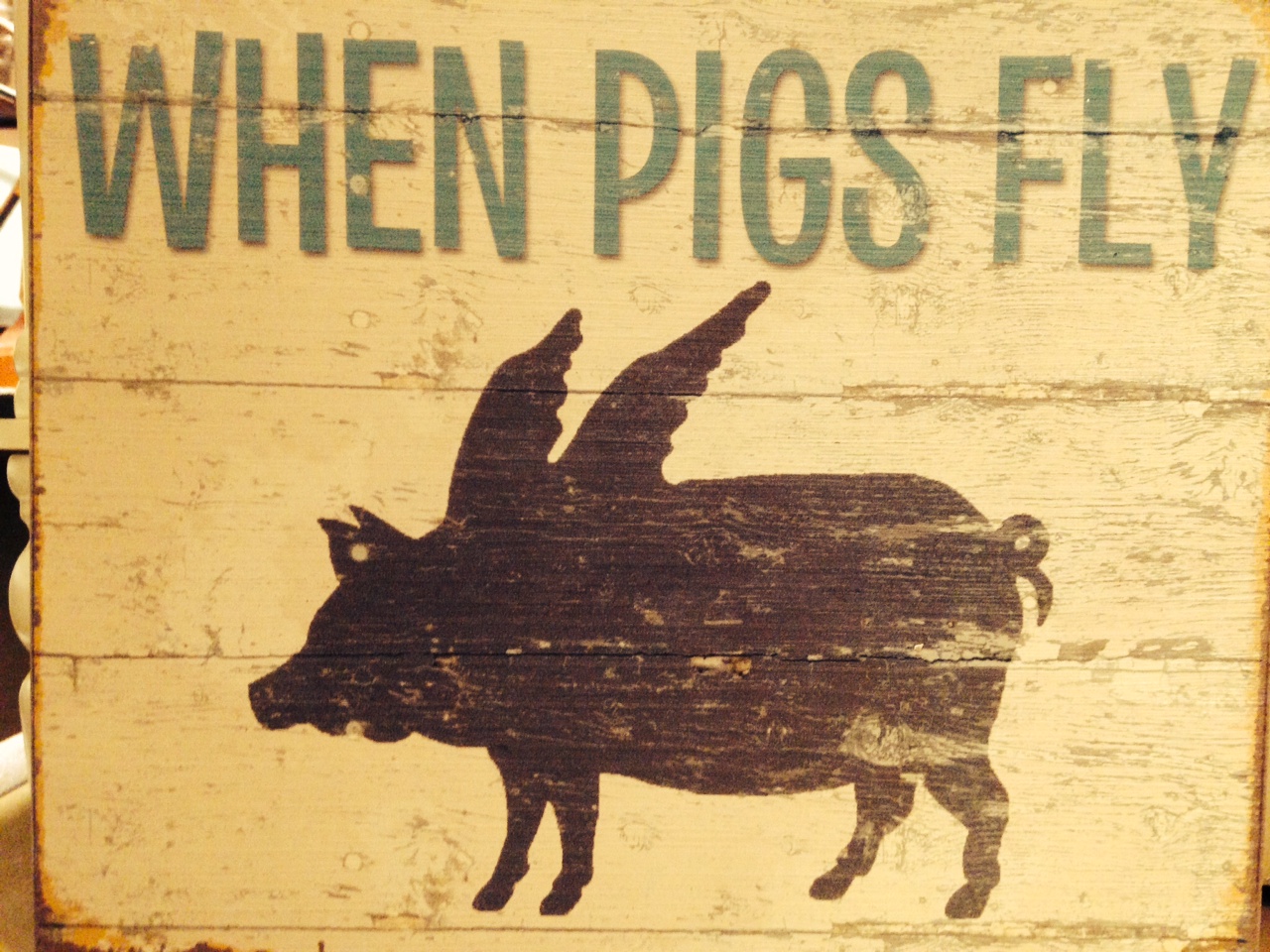
pigsFly

Favorite come-back of my colleague, Dr. Laura, when students plead for a better grade.

Yes, pigs actually DO fly at the Ole Country Buffet in Valdosta, Georgia (Cliff on the road)

SignCarefulNovel

Her sweat shirt warning vengeance, I watch my step around Jennifer, a writer friend.


Question Mark w border1_1x1_300

What quotes on plaques or signage have you seen around your town? Somewhere else?

Inquiring minds have to know!


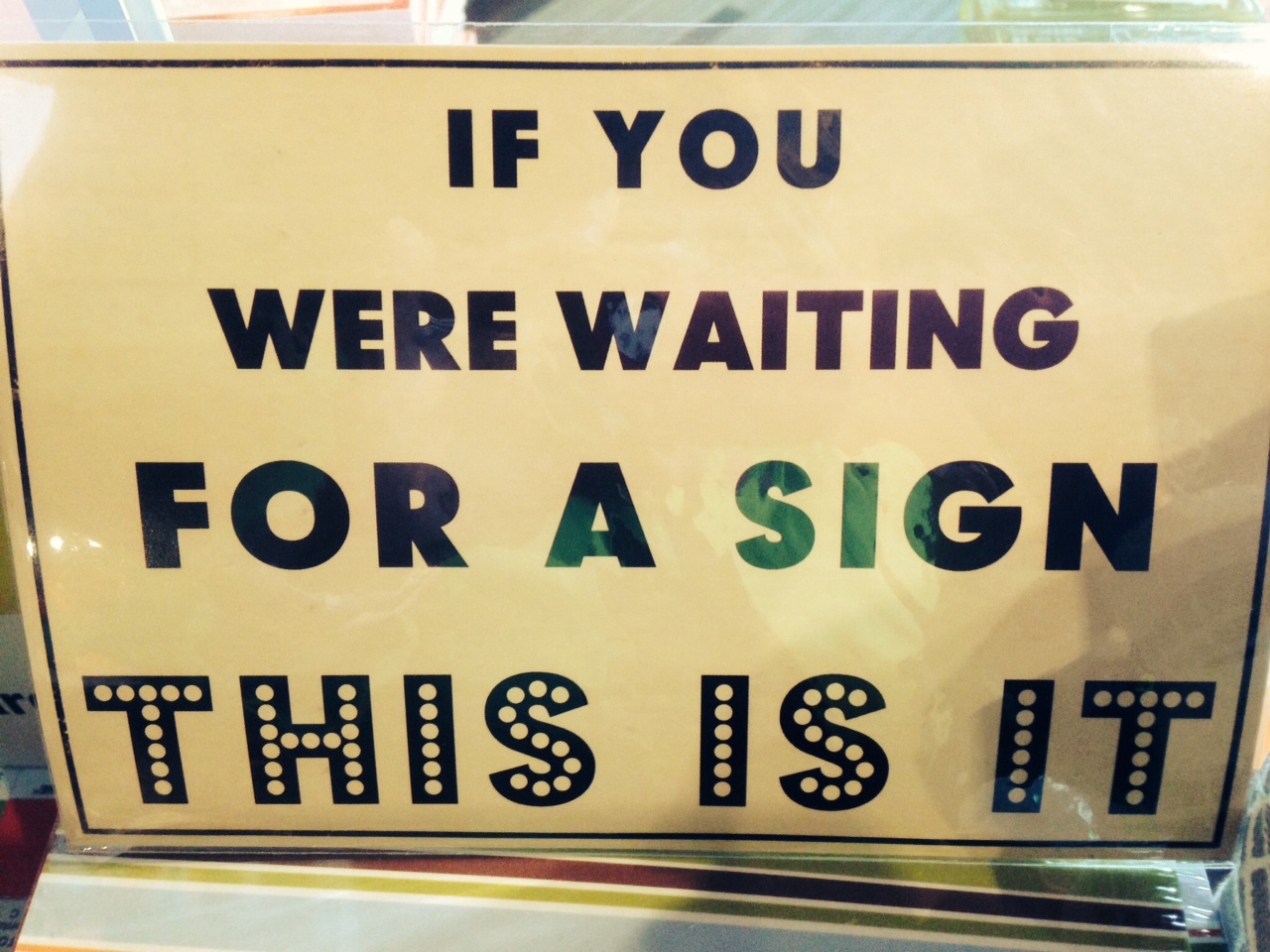
WaitingForSign

Purple Passages with a Fish & a Kiss

Purple Passages with a Fish & a Kiss, March 2014 Edition

Winter

Winter lies too long in country towns; hangs on until it is stale and shabby, old and sullen.     Willa Cather, My Antonia

If winter comes, can spring be far behind?     Percy Bysshe Shelley “Ode to the West Wind”

Gardens

Bougainvillea in my Garden

The garden is one of the two great metaphors for humanity. The other, of course, is the river.      Anne Lamott, Bird by Bird

Grief

In God’s garden of grace, even a broken tree can bring forth fruit . . . . The greater the grief the fewer the words.         Pastor Rick Warren on The View: Friday, Dec. 7, 2013

The way to love anything is to realize that it may be lost.    G. K. Chesterton

When a loved one becomes a memory, the memory becomes a treasure. Author Unknown   (viewed on Kathy Pooler’s website, January 27, 2014)

Einstein

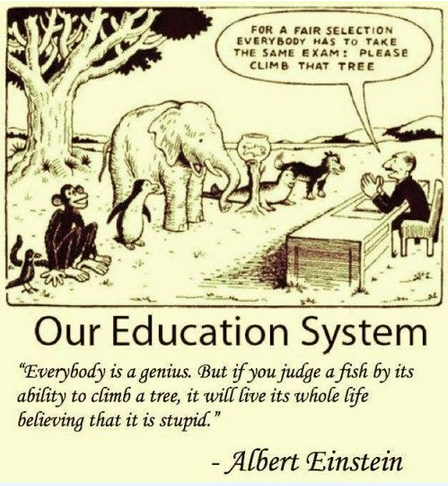
bestEinsteinFishQuote

(Quote on education attributed to Einstein but disputed by some sources.)

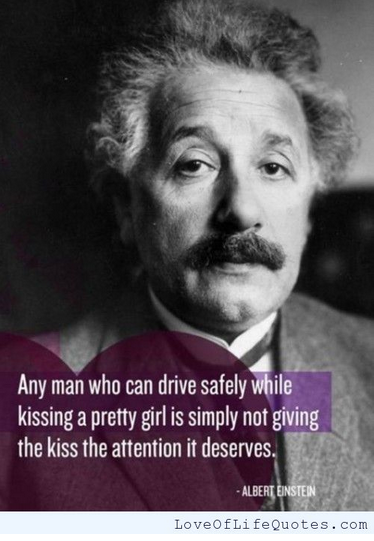
KissingEinstein

 SUCCESS and HAPPINESS

Success is not the key to happiness, happiness is the key to success. If you love what you are doing you will be successful.         Dr. Albert Schweitzer  (Quoted in Daily Devotional: The Word for You Today, Dec. 2013–Feb. 2014.)

Question Mark w border1_1x1_300

Dear Reader: You may have noticed I have included only one garden quote today.

Can you add a quote or a thought about gardening or beauty?

Can you add any other quote to the themes this month?


Facebook: http://www.facebook/marian.beaman/

Twitter: www.twitter.com/martabeaman

A Year of Biblical Womanhood: Rachel Held Evans’ Secrets Divulged

This evening my alma mater, Eastern Mennonite University, is hosting author Rachel Held Evans, one of the foremost thinkers and writers in evangelical circles today who has appeared on Oprah and The View and spotlighted by NPR, the BBC and The Washington Post. Her spell-binding book will stir you to see women, biblical and otherwise, in a new light.

If your comfort zone is just too cozy to leave right now, you can read about a gutsy woman who ditched her comfy life-style, visiting “an Amish schoolhouse in Gap, Pennsylvania; a pig farm in Cochabamba, Bolivia; and a Benedictine monastery in Cullman, Alabama.” Admitting to being domestically challenged, she took up knitting and baking even working her way through the recipes in Martha Stewart’s Cooking School.

Rachel Held Evans characterizes herself as a liberated woman, but for one year she became an Old Testament woman who admits she “spent an afternoon on my rooftop, adopted a computer-baby, camped out in my front yard during my period,” and left eight pounds of dough to rise in my bathroom.”

via Rachel Held Evans' website
via website of Rachel Held Evans

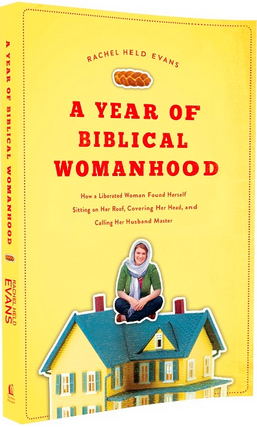
Intrigued by many of her friends who abandoned their careers for traditional gender roles in the home, “Evans decided to try it for herself, vowing to take all of the Bible’s instructions for women as literally as possible for a year,” sometimes pushing them to their literal extreme. The result is A Year of Biblical Womanhood: How a Liberated Woman Found Herself Sitting on Her Roof, Covering Her Head, and Calling Her Husband “Master,” a New York Times best-seller.

Each chapter records a month in which Evans focuses on a biblical virtue: October – gentleness, November – Domesticity, and so on.There is nothing starchy about her subtitles with chapters like February/Beauty “My Breasts are Like Towers” and March/Modesty “Hula-Hooping with the Amish,” who she mentions don’t wear white for their weddings because it’s worldly and don’t marry in June because that’s worldly too! 

The end of each chapter “month” features a character study of women like Eve or Mary Magdalene, but includes more obscure women like Junia, the Apostle or Huldah, the Prophet. That’s where Evans’ astute scholarship is most evident. With two unanswered questions, author Evans plunges into astonishing biblical research as her 8 pages of documentation verify: What does God truly expect of women? Is there a prescription for biblical womanhood? She admits:

I took my research way too seriously, combing through feminist, conservative, and liberal commentaries, and seeking out Jewish, Catholic, and Protestant perspectives on each issue. I spoke with modern-day women practicing ancient biblical mandates in their own lives—a polygamist, a pastor, a Quiverfull daughter, an Orthodox Jew, an Amish grandmother. I scoured the Bible, cover to cover, isolating and examining every verse I could find about mothers, daughters widows, wives, concubines, queens, prophetesses, and prostitutes.

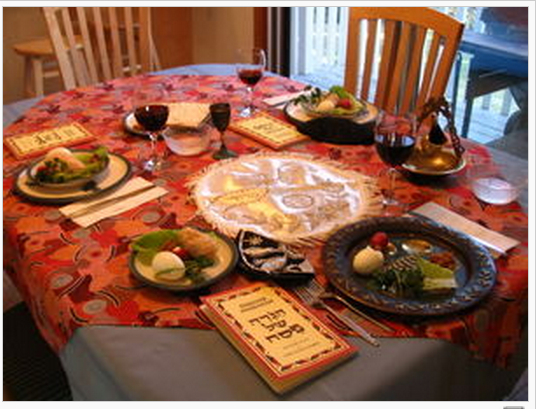
But Rachel had divine help along her pathway: Ahava, an orthodox Jew she met online who advised Rachel on all things Jewish. Guys in the food aisles at a Wal-Mart in East Tennessee who helped her search for Kosher ingredients for her Seder celebration. And her ever-accommodating husband Dan, whom she praises with a home-made sign at the city gates of Dayton, Tennessee, near where they live.

Seder table setting courtesy Wikipedia
Seder table setting courtesy Wikipedia images

Evans’ book is definitely a page-turner. I read her 310-page book in under 3 days. As one reviewer exclaims; “An unexpected, laugh-out-loud then turn the page and tear up, enjoyable and poignant read.” Another agrees that Rachel Evans tackles “the most sacred cows, willing to ask the trickiest questions” and observing fresh perspectives. For example, she reminds readers that it took the defiance of two queens to save the Jews—Esther by appearing before the king, Vashti by refusing to.”

Her website: http://www.rachelheldevans.com

Eschewing the traditional interpretation of Proverbs 31 that yokes most women with unreachable goals, Evans strives instead to be more like the Hebrew Eschet chayil, woman of valor, at its core a blessing to invoke, not a title to be earned.            “plain and fancy” observation

 Question Mark w border1_1x1_300

What do you think of author Evans’ experiment? Its outcomes?

Your thoughts added to mine can launch an animated conversation!

It’s Not Easy Being Green

Killarney Shamrock_modified_02    This post first appeared March 15, 2013 now published again to celebrate the wearing of the green!

It’s a long way from Lancaster county, PA to Jacksonville, FL, but years ago our family moved into a neighborhood called Killarney Shores with street names like Emerald Isle Circle, Leprechaun Court, and St. Patrick Lane. On the day of Ireland’s famous saint, I give you my story of keeping it green:

The lurid orange zoning sign meant something, stuck ominously at the edge of the woods where our children used to roam freely up and down the deep ravines and along a serpentine creek bordering the neighborhood. I have always loved natural beauty, so it is no surprise that one of the items on the wish list for our next address was “a house on a hill with tall trees.”  A hill with tall trees–a laughable request especially since most of Jacksonville is flat with palm trees bordered by the beach. But our prayer was answered–a huge corner lot with 17 magnificent laurel oak and live oak trees, romantic symbols of the Deep South, nestled in a secret cove just blocks off a busy boulevard.

Yet there was much to fear that November day when I spotted the land use / zoning sign: The memory of the terrorist attack on our nation on September 11, 2001 still overwhelming our minds, our community had to address an encroaching menace much closer to home: Our rural, residential zoning status was being challenged by big box Wal-Mart, who wanted to build a  Super Center (gasp!) in the woods 200-feet from our homes. This would threaten the woods our children had played in, close to the burial site of our family dog, and near a lake by which we moored our canoe, Killarney Queen.

First, we had to find out what was going on. There were trips to the Planning and Development Department downtown with my good buddy Ann. If we are going to fight Goliath, the behemoth of retailers, our tiny neighborhood of 65 homes had to be educated. When we weighed in as opposition during the first City Hall hearing, dozens of residents responded to my hastily printed green fliers, some out of curiosity, some with animosity, but all with concern for the preservation of the quality of life in our secluded neighborhood. I, along with my neighbors, became familiar with a strange new vocabulary:  Land Use Amendment Application, Planned Unit Development, Rezoning Ordinance.

Neighbors opened their doors to strategy-planning meetings, furnishing refreshments and dishing up good-will. Residents from up-the-hill met those from around-the-circle . . . . as we joined hands in consensus. Even our councilwoman joined in, assuring us she would have a decision to develop the rural residential area into commercial uses deferred and deferred and deferred. We hired a City Planner for big bucks to “give us credibility.” On April 11, 2002 we had a showdown with the Walmart bigwigs, their cool, professional presentation countered by our-best-we-could-do foam-core display. Residents packed a school auditorium, wearing shamrock buttons that read “Keep it Green.” My neighbor Richy recently diagnosed with kidney cancer came to show his support. We all listened to Wal-Mart’s company staff show-and-tell session, which extolled the merits of the store to the community, implying the layout would make their 215,000 square-foot presence virtually unobtrusive. However, when our council-woman took the stand, we were in for the biggest let-down of all:  “Really, you’d be better off if you let Walmart develop the land. The company has big bucks and can make loads of concessions to you. Why they’ll even make a big retaining pond with a lovely fountain to enjoy as you drive by. What if an adult entertainment facility buys the land later? Or a huge liquor store?  Then where would you be?” To rub it in, the Wal-Mart people asked for some of our shamrocks, “to show solidarity in pursuing the green,” they said.  Green? Green like money?

images-4_as is    In the end, the journey toward a resolution was a zig-zaggy path of uncertainty fraught with the unexpected. It was truly Mr. Toad’s Wild Ride. But we were bound together to face our common foe. The St. Johns River-keeper became a new friend, a neighborhood advocate from a nearby community coached us to anticipate possible next “moves” from City Hall and Wa-Mart. The Florida Times-Union ran progress reports, the local TV station featured us on an evening newscast. The process proceeded with fits and starts: rapid action following by long waits. At the final meeting at City Hall, for example, we signed in at 5:30 p.m. and were heard by the formal City Council at 12:45 a.m.  Though the decision for land use was ruled in favor of Wal-Mart, our community gained thirteen concessions, including 4.7 acres of conservation easement to compensate partially for the additional impact on traffic and loss of wetlands. And the fountain!

images-8_2x2in

Of course, there is more concrete and asphalt next to our beloved woodlands, but our community will never be the same. We have learned the importance of team-work to meet an outside challenge, and in the process have become true neighbors.

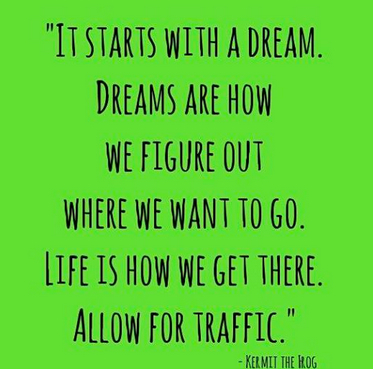
Yes, Kermit the Frog, is right:

“It’s not that easy being green;

But green’s the color Spring.

And green can be big like an ocean, or important like a mountain,

Or tall like a tree.

When green is all there is to be

It could make you wonder why, but why wonder why?

Wonder, I am green and it’ll do fine, it’s beautiful!

And I think it’s what I want to be.”

     When we moved in years ago, Killarney Shores was very WASP-y, with the origin of many residents reflective of the street names. Now we share care, concern, and meals with Burmese, Bosnian, African-Americans – folks of all colors, a lovely palette of skin tones; white mingles with tan and mahogany. Symphony member, handyman, business owner, retirees live side by side. And if an outside threat strikes again, I have no doubt we will present a united front.

Rainbow_as is

Yes, green is important — very important. And in these times of awareness of our earth’s fragility, it is important to preserve, to recycle, even to restore our resources. But even more important is learning to value of community that can exist in all neighborhoods, all citizens of our planet and residents of a close-knit community with families from around the world.

Do you live in a neighborhood where there you have noticed changes recently? In the last few years?  How have these changes affected you?

Tell us your story.
KermitFrogDreams

Story of Hope: A Killer’s Wife Speaks

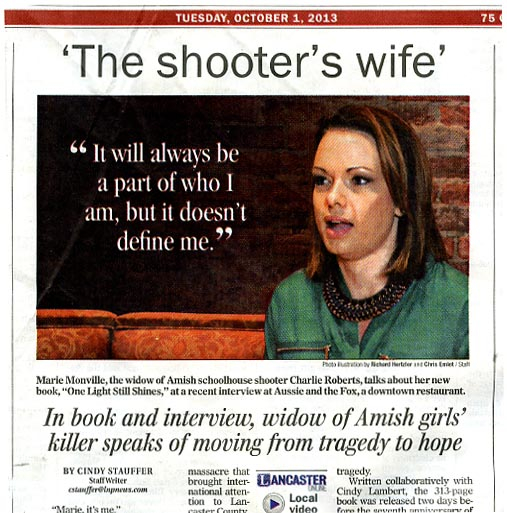
When I bring 5-pound bags of Wenger’s famous ham-loaf frozen from Pennsylvania to Florida, the plastic-coated tubs of meat are wrapped in newspaper and then shrink-wrapped in plastic. The wrapping on one of the packages (we need two to feed the clan now!) revealed the riveting story of Marie Monville, the widow of Amish school house shooter Charlie Roberts.

Shooters%20Wife_100113

What Happened

In a story that brought international attention to Lancaster County, Charles Roberts methodically shot ten Amish girls inside a one-room school-house, killing five, injuring five others, and then turning the gun on himself. Roberts’ wife Marie learned of the impending massacre through a letter Charles left for her directing her to his final phone call, which revealed the unresolved feelings he harbored after the deaths of two of his daughters, one a premature birth and the other an ectopic pregnancy. Though the couple went on to have three healthy children, the loss of Elise and Isabella, he says in the letter, “changed my life forever. I am filled with so much hate, hate toward myself, hate toward God, and unimaginable emptiness.”

Immediately After

Because he hid his clinical depression so well, Marie had no signs her husband was so deeply disturbed and headed for a psychotic break-down. Even the police queried, “Were there any signs of violence before the shooting?”  She also feared what the public may be thinking: Are you a liar, covering up a failure to act? Are you an idiot, blind to the obvious? But Marie had been blind-sided.

Her own family and her husband’s family were “stalwart,” Marie writes. “A beloved aunt and uncle gave her family a place to hide out from the media in their own home in Lititz, Pennsylvania, comforting and feeding them in their darkest hours.

Forgiveness from the Amish Community

1. Just hours after the horrible shooting, Marie’s father greeted a group of Amish men who knocked on the door. She writes: 

An Amish man with a long gray beard stepped toward my father and opened his arms wide. My father fell into those arms, his shoulders heaving, held and comforted by a friend. Grief met grief.

2. Shielding the family from the media, “the families of the slain girls went to the cemetery for Roberts’ burial. They also went to a meeting at the Bart Fire Hall for families and first responders, sharing their feelings” and saying they were praying for Marie and her children.

Her Book

Marie Roberts Monville intersperses her account of the tragedy with the story of her own life in rural Lancaster County and tells as a teen-ager meeting Charlie Roberts, the grandson of a church friend, at a dinner one day. After marriage, they had three children, aged 7, 5, and 18 months old at the time of the tragedy which occurred over seven years ago at Nickel Mines.

OneLightStillShines

One Light,” written from a Christian perspective, shows how the author’s faith in God has sustained her through unimaginable grief and brought healing. Now re-married, she is a stay-at-home Mom and blogger on whisperandwonder with the subtitle “quiet musings from my heart.” Marie wrote the book to tell her true story of how horror and tragedy met love and forgiveness. She also seeks to connect with readers who are in the midst of suffering by posing the question:

What is your story? Mistreatment, injustice, torment, suffering, grief or even the worst that humanity can do to one another? Receive the gift of love. And when again the lights go out, you too will see that one light still shines.

Though her experience is similar in some ways to that of Marina Oswald, wife of President Kennedy’s assassin, Marie Roberts Monville has refused to become a pariah, but now lives life to the fullest, sharing light and hope.

Question Mark w border1_1x1_300

Do you know someone who has survive trauma and grief?

Do you have a story of survival of your own to tell?

What is Your Most Beloved Book?

There are several childhood books in my library that are in the I’ll-never-part-with category, except maybe to pass on to grand-children. One of them is Come to Storyland with pages missing and others as brittle as autumn leaves.

beloved book

Here is blogger friend and author Susan Nicholls’ story about her favorite. (Click to view more illustrations and the rest of her story.)  Do you have a beloved book or books?

S.K. Nicholls's avatarS.K. Nicholls

I have an old copy of Uncle Wiggily in the Countryby Howard R. Garis. The copyrights are 1916 and 1940. The title is worn, the book is held together with tape. Various children have colored its yellowed, torn pages. The book was first purchased by my grandma to read to my aunt and my mother. They were born in 1940 and 1942 respectively.

Grandmother and Uncle Wiggly Grandmother Nicholls and Uncle Wiggily

Then, my mother read it to me and my two sisters, one older, one younger. We used to cuddle in the center of my sister’s twin bed and listen as she read each chapter. We would embrace under the covers protecting each other and hiding from the tiddlewink, an evil but sympathetic creature with claws and sharp teeth who lived in any body of water from swamps and ponds to bathtubs and washtubs. My mother died when I was eight, and…

View original post 422 more words

Dear Heart: My Driver’s License Speaks

Tucked under the signature of my Florida driver’s license are two words in blood-red that indicate that I am an organ donor. 

Blog_Marians FL License_4x2_300

This means that if I were in a fatal crash, my kidneys, liver, lungs, corneas—even my heart could be harvested for transplantation. Harvested and transplanted, two very agricultural-sounding terms for the brutal evisceration that must transpire before another human being can benefit from these vital organs.

via Goodreads
Image via Goodreads

Eleanor Vincent describes the impact of such a supreme gift from a mother’s point of view in her poignant memoir, Swimming with Maya: A Mother’s Story. When her 19-year-old daughter is left in a coma induced by a crushing fall from a horse, Eleanor struggles to make a heart-rending decision. What should be the fate of Maya’s healthy organs? Especially her heart. In the end, Maya’s heart is given to middle-aged Chilean businessman and father of two young children. Along this bumpy ride to full acceptance, Maya’s mother, whose husband no longer played a role in her daughter’s life, begins to think of Fernando, the heart recipient, as her daughter’s adopted father, “a kind of benign benefactor.”

Without telling anyone . . . I appoint Fernando the titular head of my family—a family that has shattered on the physical plane but one that I reconstitute in the ghost realm of my imagination. Seeing Maya’s continuing life through transplantation offers me a spiritual replacement for the searing physical absence of my daughter. She is dead, yes, but not entirely. Fernando experiences her vitality. As the home of Maya’s heart, he becomes a father figure for my daughter. As long as I see it this way, I don’t have to conduct the tug of war between my pain and his healing all alone. (216)

  *  *  *  *  *

via Goodreads
Image via Goodreads

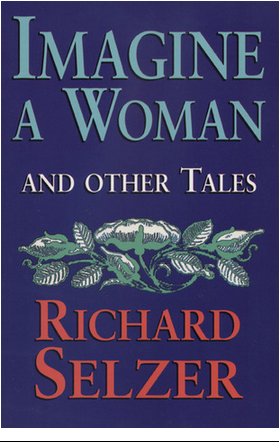
Like author Eleanor Vincent, surgeon and writer Richard Selzer describes the sense of comfort the emphatic, but soothing, lub-dup, lub-dup conveyed to the ear of the fictional Hannah, who made an equally heart-wrenching decision to donate her husband Sam‘s heart so that its recipient Henry Pope can live. As she lowers her ear to Henry’s chest, she senses her husband’s presence:

She could have stayed there forever, bathed in the sound and touch of that heart. Thus she lay, until her ear and the chest of the man had fused into a single bridge of flesh across which marched, one after the other, in cadence, the parade of that mighty heart. (27)

Clearly, organ donation of a loved one is dear, costly in both physical and emotional terms.

The designation “organ donor” has been on my driver’s license for a long time. I am not young, like Maya, or even in early middle-age, like Sam, So, I ponder, if donation became an option, would medical people even want my organs? Would my husband sign the papers to authorize such a donation? Now he says “Okay” to the kidneys, lungs, and corneas and possibly other tissues. But No! to my heart.

Your heart belongs to me, he says.

The case, apparently, is closed.

Do you know someone who has participated in organ donation either as a donor or as a recipient?  Have you? Other thoughts?

*  *  *  *  *

I’m celebrating my blog-i-versary. One year ago yesterday my first blog post was published. Thank you, thank you for making this first year so rewarding and memorable!
Thank you, dear reader!

Be My Valentine

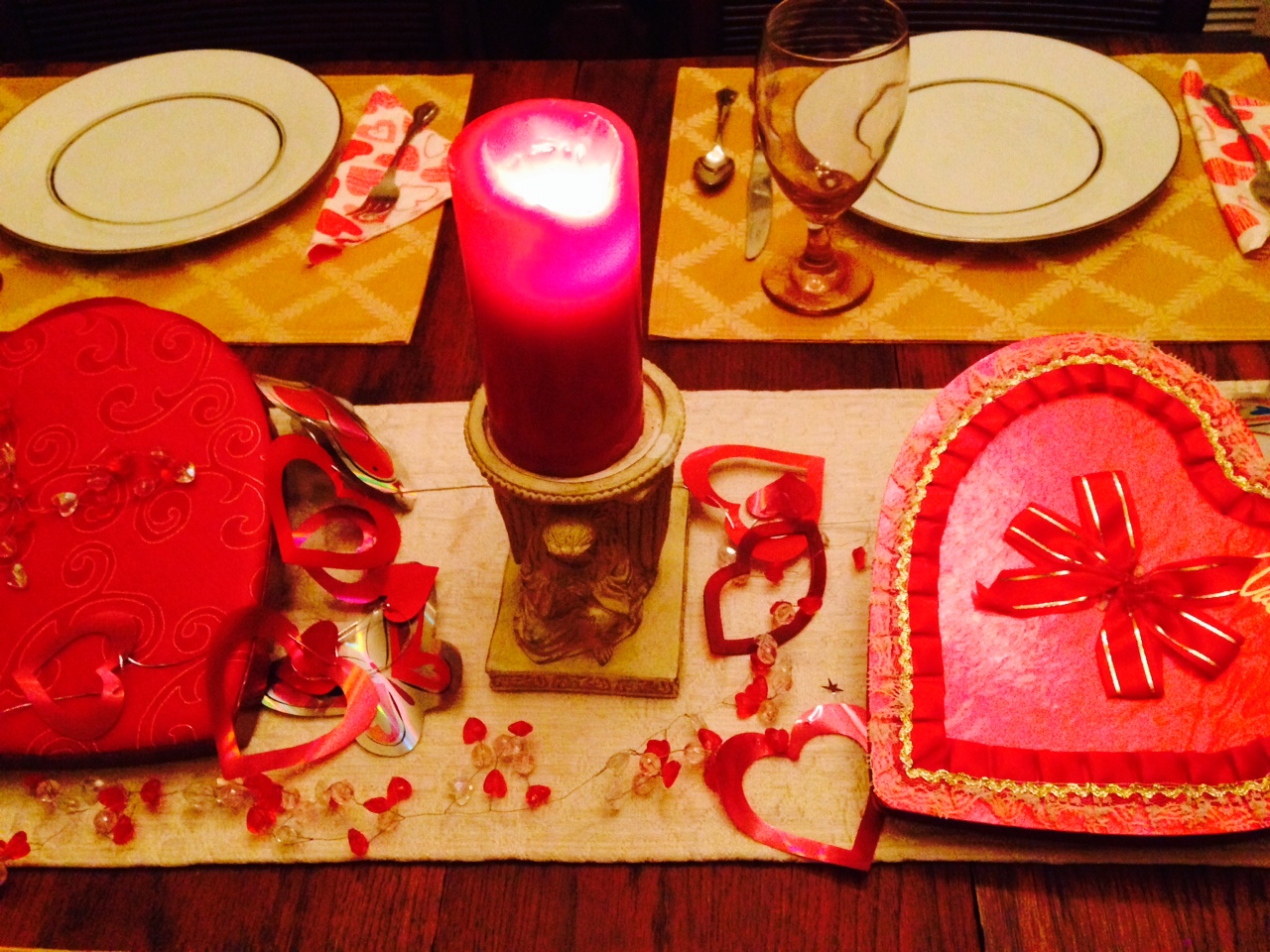
RevValentineTable

“All you need is love. But a little chocolate now and then doesn’t hurt.”

So says Charles M. Schulz. Valentine’s Day is interpreted by many to include cards, chocolates, candlelight and roses. Some even break the bank buying expensive jewelry. Valentine’s day was named for a Christian martyr dating back to the 5th century, but according to Arnie Seipel in an essay for NPR, its origins are dark and bloody even, beginning with the wild and crazy Romans and their feast of Lupercalia.
During the Middle Ages tokens of love were first expressed by handmade paper cards. In the 14th century Chaucer helped romanticize the holiday with his love quotes like “love is blind” from The Canterbury Tales and his Parlement of Foules, featuring an assembly of birds gathered together to choose their mates. From the Renaissance to the Victorian Age and beyond, poets wrote sonnets extolling romantic love: Shakespeare, known especially during this season for Sonnet # 116, and Elizabeth Barrett Browning’s famous lines “How do I Love Thee? Let me count the ways” in Sonnet # 43.

Today, Valentine’s Day is big business. In 2011, sales reached $ 18.6 billion. This year the figure will probably exceed 20 billion. Seipel quotes Helen Fisher, a sociologist at Rutgers University, who says that if commercialization has spoiled the day, we can blame only ourselves for buying into it. But the celebration of Valentine’s Day goes on nonetheless. Even with some sayings on candy hearts we never imagined:

A few candy heart sayings we never saw: Courtesy Google Images
A few candy heart sayings updated by social media: Courtesy Google Images

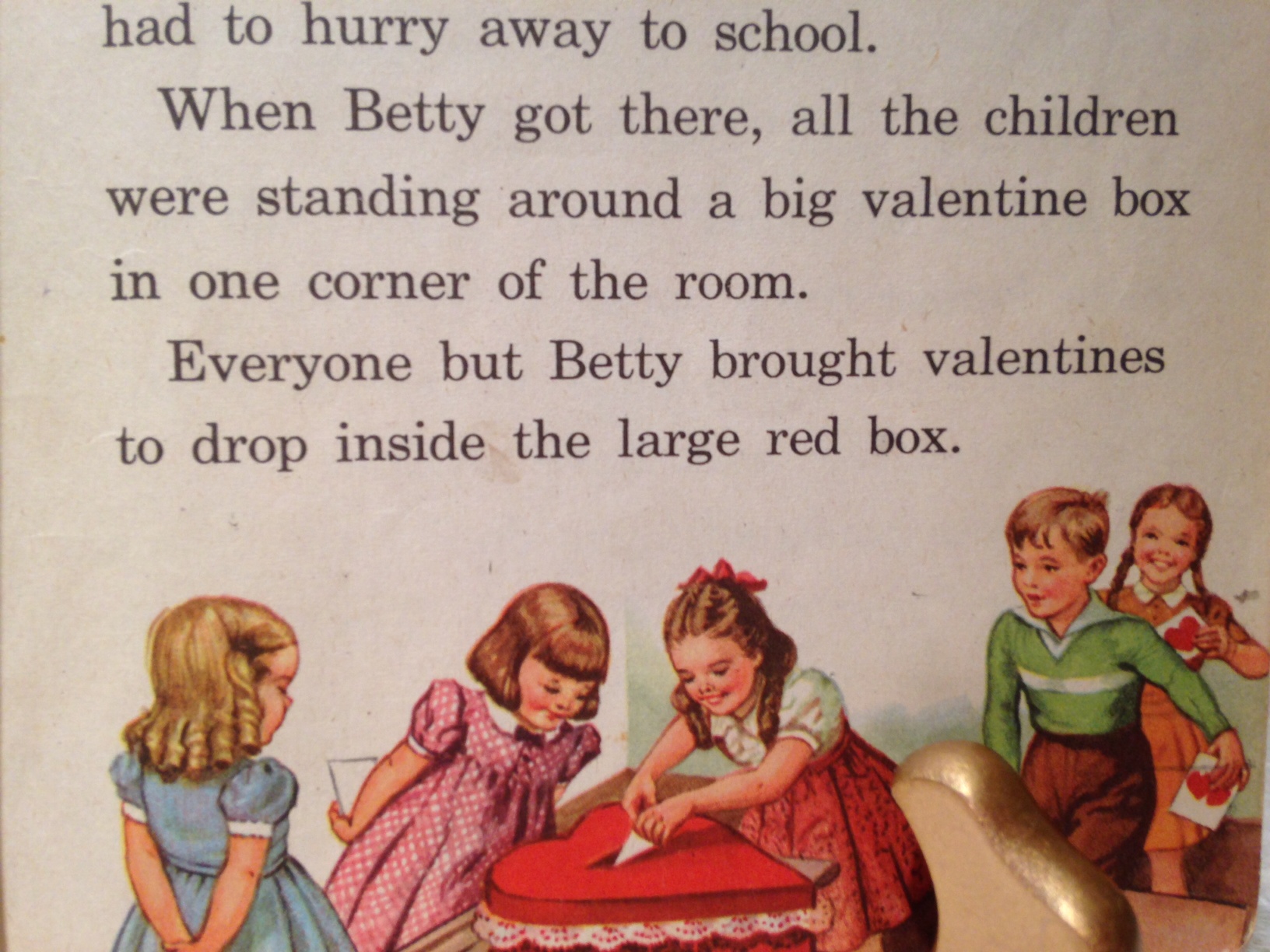
Years ago, candies like these were hand-picked for that special one, but many valentine cards were home-made. I remember making valentines for friends at school or punching cut-outs for classmates and dropping them in to the big, square box decorated red and white for Valentine’s Day at Rheems Elementary School. Stories in our readers illustrated children making, not buying, Valentine cards for friends:

"The Surprise Valentines," Gray and Arbuthnot, Scott Foresman & Company, 1941.
“The Surprise Valentines,” Gray and Arbuthnot, Scott Foresman & Company, 1941.

Do you remember making or receiving hand-made valentines? Are you holding on to an old Valentine card for sentimental reasons?

Vintage Cut-out Card, Cliff Collection
Vintage cut-out card, Cliff Collection 1966

Your thoughts start the conversation—or keep it going. Thank you!

← Back

Thank you for your response. ✨

Are You a Sneetch?

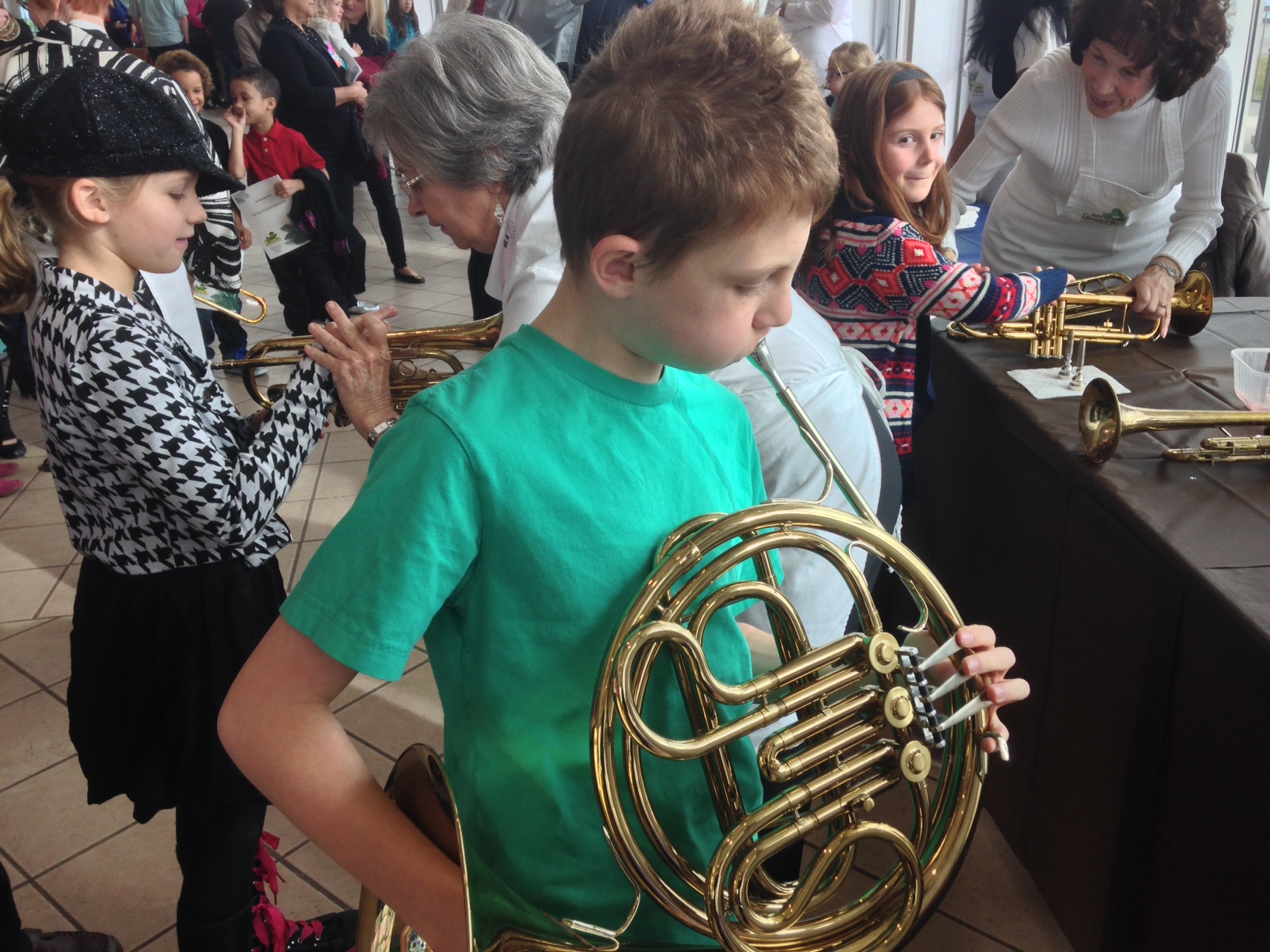
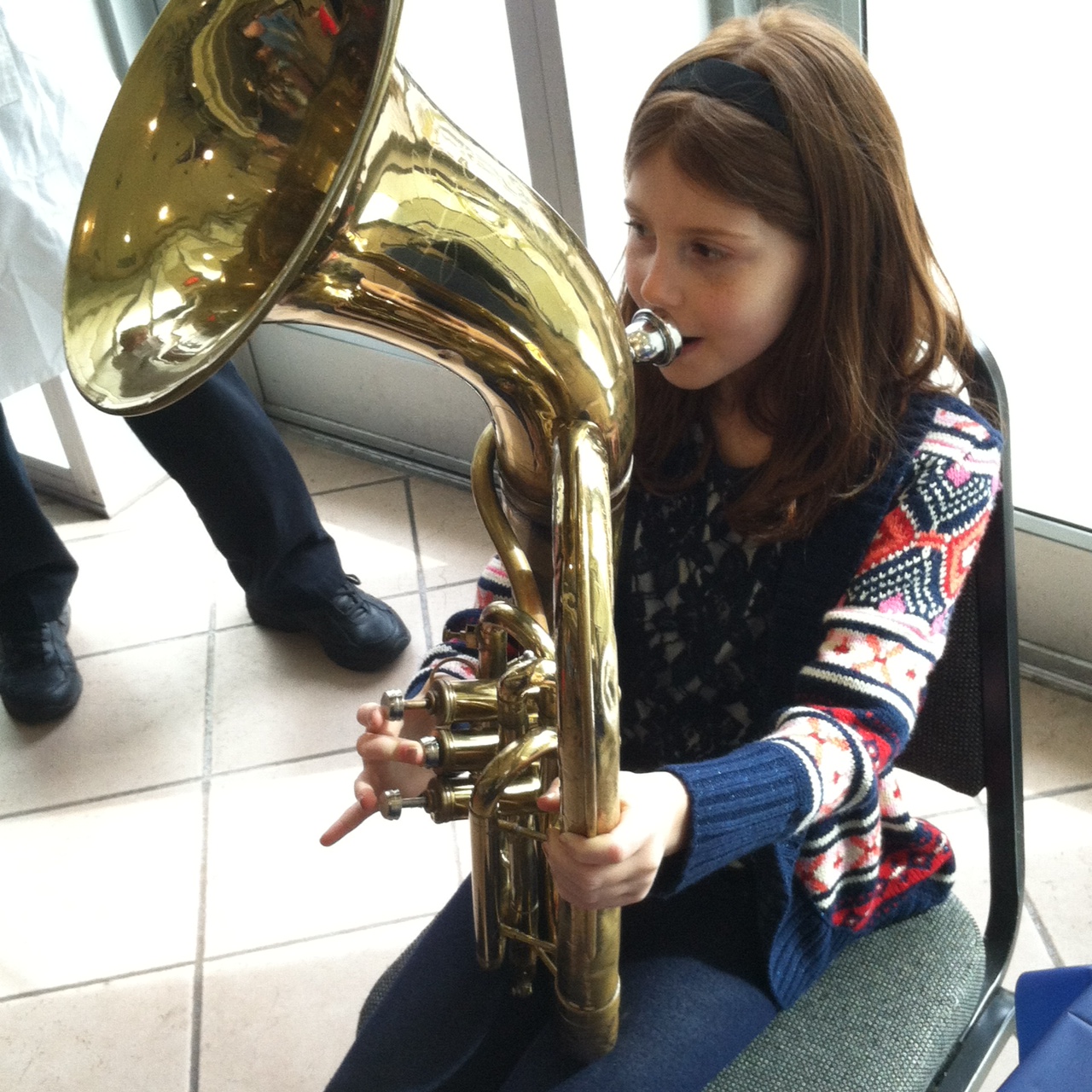
Last Sunday afternoon, we took our red-haired grand-kids, the Daltons, to the Jacksonville Symphony Family Series, featuring The Sneetches. There was a pre-concert Orchestra Zoo with dozens of kids standing in lines to bang on, blow into, or saw the strings of grown-up instruments.

Patrick and French Horn, Orchestra Zoo
Patrick & French Horn at the Orchestra Zoo
Jenna & Tuba at the Instrument Zoo

During the concert, the conductor asked each section of the orchestra to play a segment of a piece separately to let the kids hear the true sounds of the various instruments.Then came the pictorial story of the Sneetches animated on screen and read by a narrator, all accompanied by the whimsical strings, the complaining woodwinds, and the booming drums in Jacoby Symphony Hall.

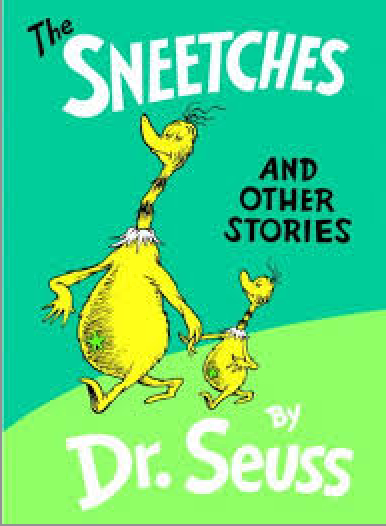
SneetchesCover

If you need a brush-up on the Dr. Seuss plot line, two camps of yellow, fantastical creatures called Sneetches are separated by whether or not they have stars tattooed on their bellies. The Star-Belly Sneetches think they are best and make their Plain-Belly counterparts feel sad and inferior. Magically, Sylvester McMonkey McBean comes along with his Star-on and Star-off machines. Now the Plain-Bellies are thrilled because they match the elite. But the original Star Bellies are angry because they no longer stand out as special. Now no one is happy.

Between the Star Bellies and the Plain-Bellies there is plenty of bad feeling to go around.  Then the conniving Star Bellies hatch an idea: Let’s get Sylvester McMonkey McBean to remove all the stars from bellies. Determined to find a solution, money from both belly camps gets stuffed into McBeans’ pockets, and he leaves town a rich monkey. Poorer in pocket, but richer in understanding, none of the Sneetches can remember who was what originally now that they all look the same. Finally, there is a level playing field.

The Sneetches’ conclusion: It doesn’t really matter what they look like—they can all be friends, stars or no stars. As the story ends, conviviality reigns.

In the car on the way home:

Jenna: “I really liked it! Those Sneetches were really cool, and they all liked each other at the end.”

Patrick: “It doesn’t matter what you look like. Everyone is the same.  Oh, and there’s another thing: Don’t give away all your money away for a dumb reason.”

Grandpa: “You are special whether you have a star on your belly or not.”

First of all, I wouldn’t want a star on my belly, would you? I wouldn’t want to draw attention to my worst feature whether it looked cool or not.

If you are human, you probably are a Sneetch, prone to some of the dark emotions these yellow bellies felt: feelings of inferiority, pride, dis-content, fear, frustration, and envy.

You may or may not agree with Alex Daydream (that has to be a pseudonym!) who claims that no emotion is strictly good or bad.

No Emotion Is Strictly Good Or Bad

Anger clouds our judgement
Love can make us blind
If emotions are so ruinous
What good one can I find?

Empathy makes us better people
Pain brings us back always stronger
Sadness gives way to happiness
Meaning a better life lived longer.

Alex Daydream
Some of the writer’s conclusions may be questionable (I have to wonder does “Pain bring us back always stronger”?) Growing up a Mennonite in the Longenecker family of Lancaster County, we children were not encouraged to show our real emotions, especially not in public. In my memory, there was a huge gulf between feeling emotions and being able to truly express them.
But what matters is what you think.
Were you encouraged to express your true feelings as a child?
As the poet claims, does allowing oneself to feel emotions make for a more meaningful life? What about expressing them?