There are several childhood books in my library that are in the I’ll-never-part-with category, except maybe to pass on to grand-children. One of them is Come to Storyland with pages missing and others as brittle as autumn leaves.
Here is blogger friend and author Susan Nicholls’ story about her favorite. (Click to view more illustrations and the rest of her story.) Do you have a beloved book or books?
I have an old copy of Uncle Wiggily in the Countryby Howard R. Garis. The copyrights are 1916 and 1940. The title is worn, the book is held together with tape. Various children have colored its yellowed, torn pages. The book was first purchased by my grandma to read to my aunt and my mother. They were born in 1940 and 1942 respectively.
Grandmother Nicholls and Uncle Wiggily
Then, my mother read it to me and my two sisters, one older, one younger. We used to cuddle in the center of my sister’s twin bed and listen as she read each chapter. We would embrace under the covers protecting each other and hiding from the tiddlewink, an evil but sympathetic creature with claws and sharp teeth who lived in any body of water from swamps and ponds to bathtubs and washtubs. My mother died when I was eight, and…
Tucked under the signature of my Florida driver’s license are two words in blood-red that indicate that I am an organ donor.
This means that if I were in a fatal crash, my kidneys, liver, lungs, corneas—even my heart could be harvested for transplantation. Harvested and transplanted, two very agricultural-sounding terms for the brutal evisceration that must transpire before another human being can benefit from these vital organs.
Image via Goodreads
Eleanor Vincent describes the impact of such a supreme gift from a mother’s point of view in her poignant memoir, Swimming with Maya: A Mother’s Story. When her 19-year-old daughter is left in a coma induced by a crushing fall from a horse, Eleanor struggles to make a heart-rending decision. What should be the fate of Maya’s healthy organs? Especially her heart. In the end, Maya’s heart is given to middle-aged Chilean businessman and father of two young children. Along this bumpy ride to full acceptance, Maya’s mother, whose husband no longer played a role in her daughter’s life, begins to think of Fernando, the heart recipient, as her daughter’s adopted father, “a kind of benign benefactor.”
Without telling anyone . . . I appoint Fernando the titular head of my family—a family that has shattered on the physical plane but one that I reconstitute in the ghost realm of my imagination. Seeing Maya’s continuing life through transplantation offers me a spiritual replacement for the searing physical absence of my daughter. She is dead, yes, but not entirely. Fernando experiences her vitality. As the home of Maya’s heart, he becomes a father figure for my daughter. As long as I see it this way, I don’t have to conduct the tug of war between my pain and his healing all alone. (216)
* * * * *
Image via Goodreads
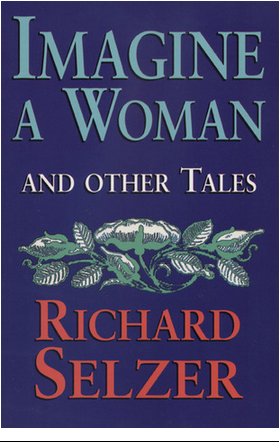
Like author Eleanor Vincent, surgeon and writer Richard Selzer describes the sense of comfort the emphatic, but soothing, lub-dup, lub-dup conveyed to the ear of the fictional Hannah, who made an equally heart-wrenching decision to donate her husband Sam‘s heart so that its recipient Henry Pope can live. As she lowers her ear to Henry’s chest, she senses her husband’s presence:
She could have stayed there forever, bathed in the sound and touch of that heart. Thus she lay, until her ear and the chest of the man had fused into a single bridge of flesh across which marched, one after the other, in cadence, the parade of that mighty heart. (27)
Clearly, organ donation of a loved one is dear, costly in both physical and emotional terms.
The designation “organ donor” has been on my driver’s license for a long time. I am not young, like Maya, or even in early middle-age, like Sam, So, I ponder, if donation became an option, would medical people even want my organs? Would my husband sign the papers to authorize such a donation? Now he says “Okay” to the kidneys, lungs, and corneas and possibly other tissues. But No! to my heart.
Your heart belongs to me, he says.
The case, apparently, is closed.
Do you know someone who has participated in organ donation either as a donor or as a recipient? Have you? Other thoughts?
* * * * *
I’m celebrating my blog-i-versary. One year ago yesterday my first blog post was published. Thank you, thank you for making this first year so rewarding and memorable!
“All you need is love. But a little chocolate now and then doesn’t hurt.”
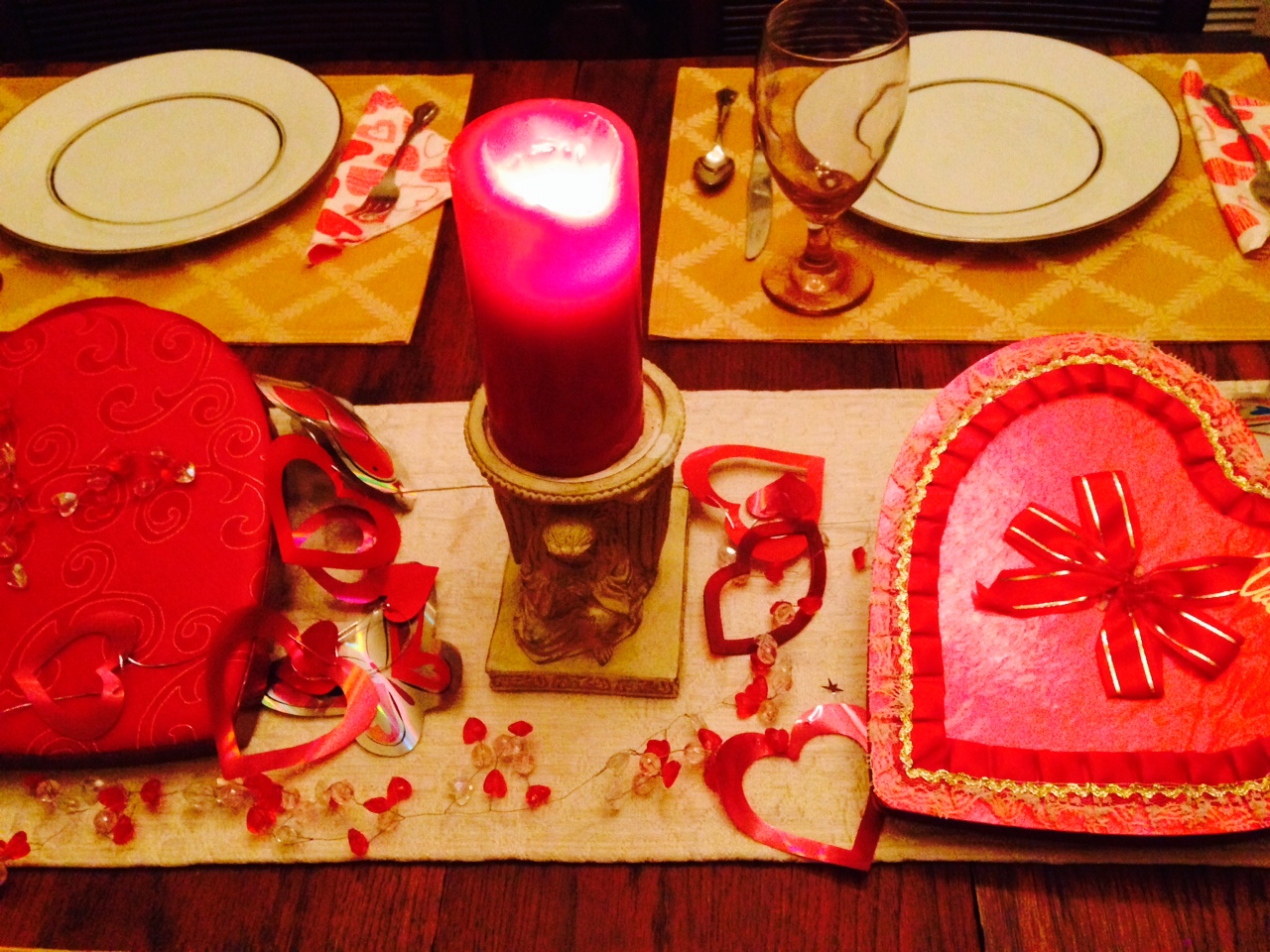
So says Charles M. Schulz. Valentine’s Day is interpreted by many to include cards, chocolates, candlelight and roses. Some even break the bank buying expensive jewelry. Valentine’s day was named for a Christian martyr dating back to the 5th century, but according to Arnie Seipel in an essay for NPR, its origins are dark and bloody even, beginning with the wild and crazy Romans and their feast of Lupercalia.
During the Middle Ages tokens of love were first expressed by handmade paper cards. In the 14th century Chaucer helped romanticize the holiday with his love quotes like “love is blind” from The Canterbury Tales and his Parlement of Foules, featuring an assembly of birds gathered together to choose their mates. From the Renaissance to the Victorian Age and beyond, poets wrote sonnets extolling romantic love: Shakespeare, known especially during this season for Sonnet # 116, and Elizabeth Barrett Browning’s famous lines “How do I Love Thee? Let me count the ways” in Sonnet # 43.
Today, Valentine’s Day is big business. In 2011, sales reached $ 18.6 billion. This year the figure will probably exceed 20 billion. Seipel quotes Helen Fisher, a sociologist at Rutgers University, who says that if commercialization has spoiled the day, we can blame only ourselves for buying into it. But the celebration of Valentine’s Day goes on nonetheless. Even with some sayings on candy hearts we never imagined:
A few candy heart sayings updated by social media: Courtesy Google Images
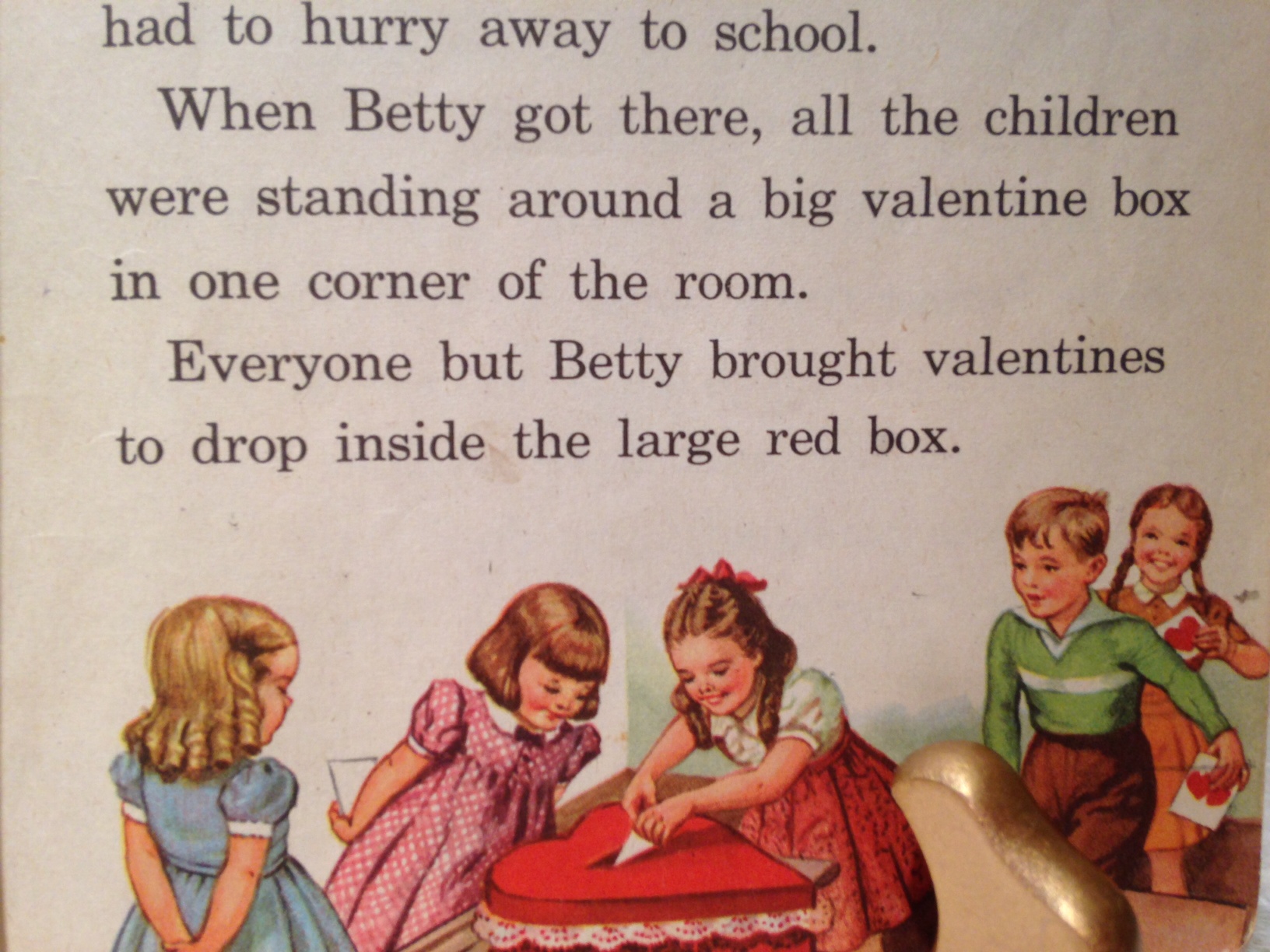
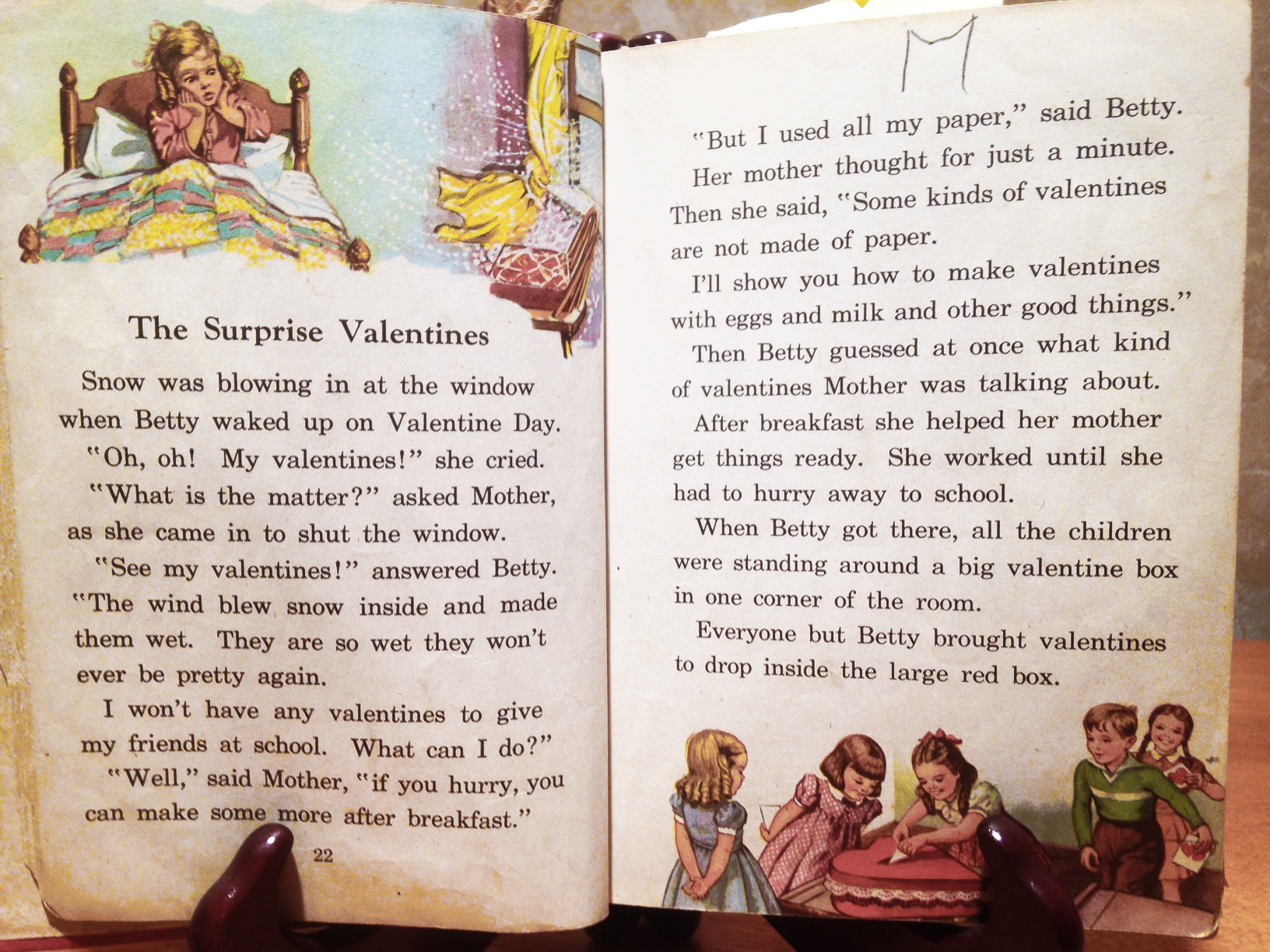
Years ago, candies like these were hand-picked for that special one, but many valentine cards were home-made. I remember making valentines for friends at school or punching cut-outs for classmates and dropping them in to the big, square box decorated red and white for Valentine’s Day at Rheems Elementary School. Stories in our readers illustrated children making, not buying, Valentine cards for friends:
“The Surprise Valentines,” Gray and Arbuthnot, Scott Foresman & Company, 1941.
Do you remember making or receiving hand-made valentines? Are you holding on to an old Valentine card for sentimental reasons?
Vintage cut-out card, Cliff Collection 1966
Your thoughts start the conversation—or keep it going. Thank you!
Think of February as God’s special gift of time sandwiched between all the hubbub of past holidays and the upcoming arrival of a busy spring. To me, February is the ideal month to regroup . . . to review where I’ve been and to rethink where I’m going. I have found it is the best time of the entire year to pause for several concentrated weeks of deliberate reflection.
Chuck Swindoll, Insight for Living 1999
February is merely as long as is needed to pass the time until March. — Dr. J. R. Stockton
LOVERS
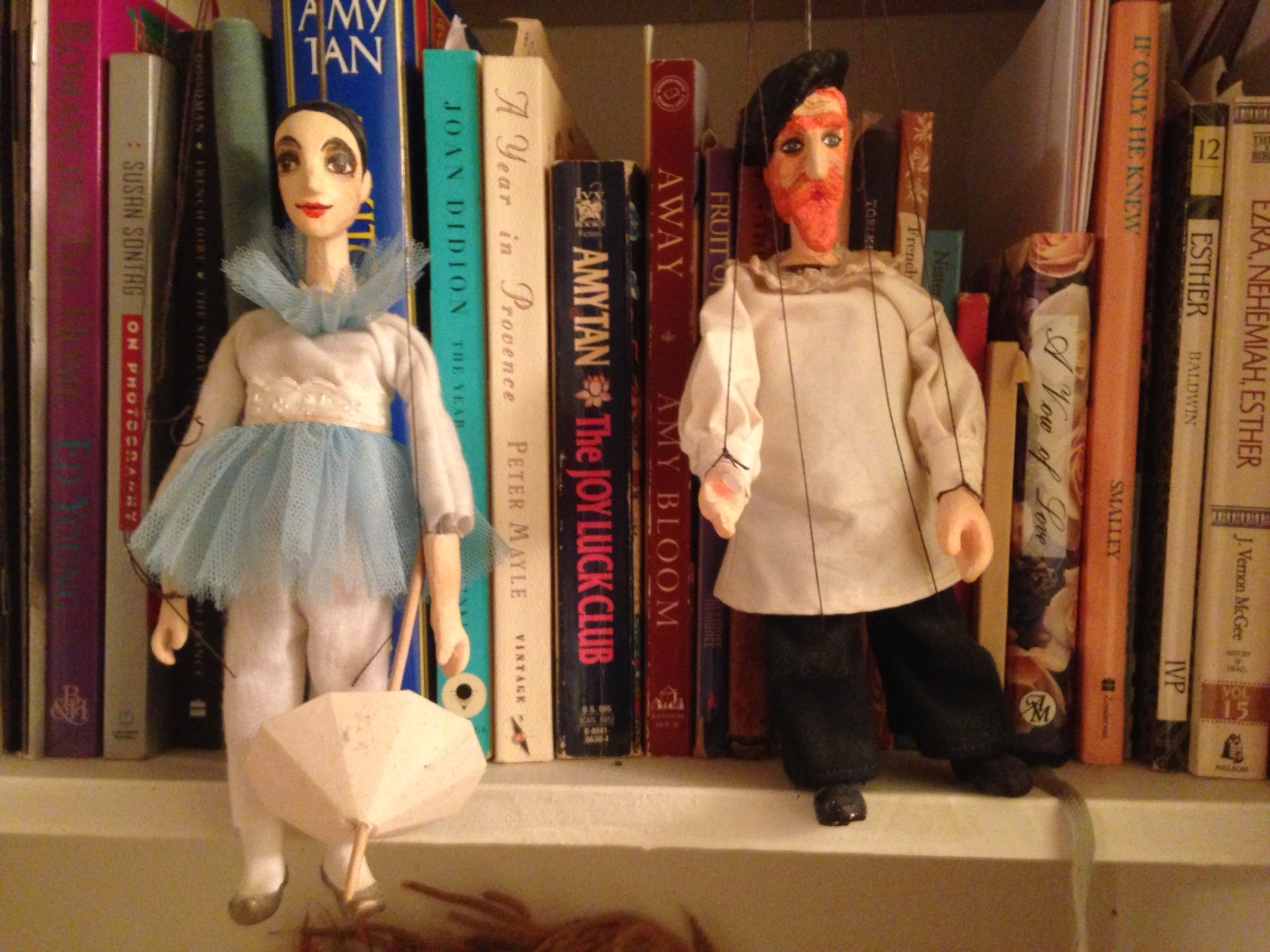
Marionettes from Prague – Books from all over
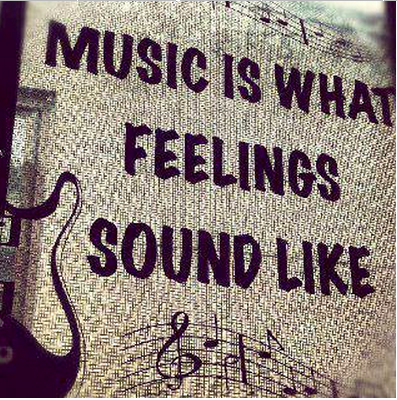
MUSIC: The Mozart Effect (Notes from Lecture) March 2000
Classical music, like Mozart or Hayden stimulates Beta waves suited for high-quality, analytical thinking.
Jazz: like Miles Davis or John Coltraine, creates order from chaos, good for thinking that does not lend itself to simple linear solution. Generates theta waves: highly creative brain consciousness associated with out-of-the-box creativity, spiritual insight.
Rock: Makes a statement about TIME, especially suited to people who need to be vigilant like those in an inner city environment. Sharpens awareness!
New Age / Alternative: Music organized around SPACE; suited for people who live in a highly mental structure.
Music creates a current on which images flow. It can catch an image in its nets so it can be looked at, analyzed. Glamour, January 1999
IN THE ZONE/ATTITUDE
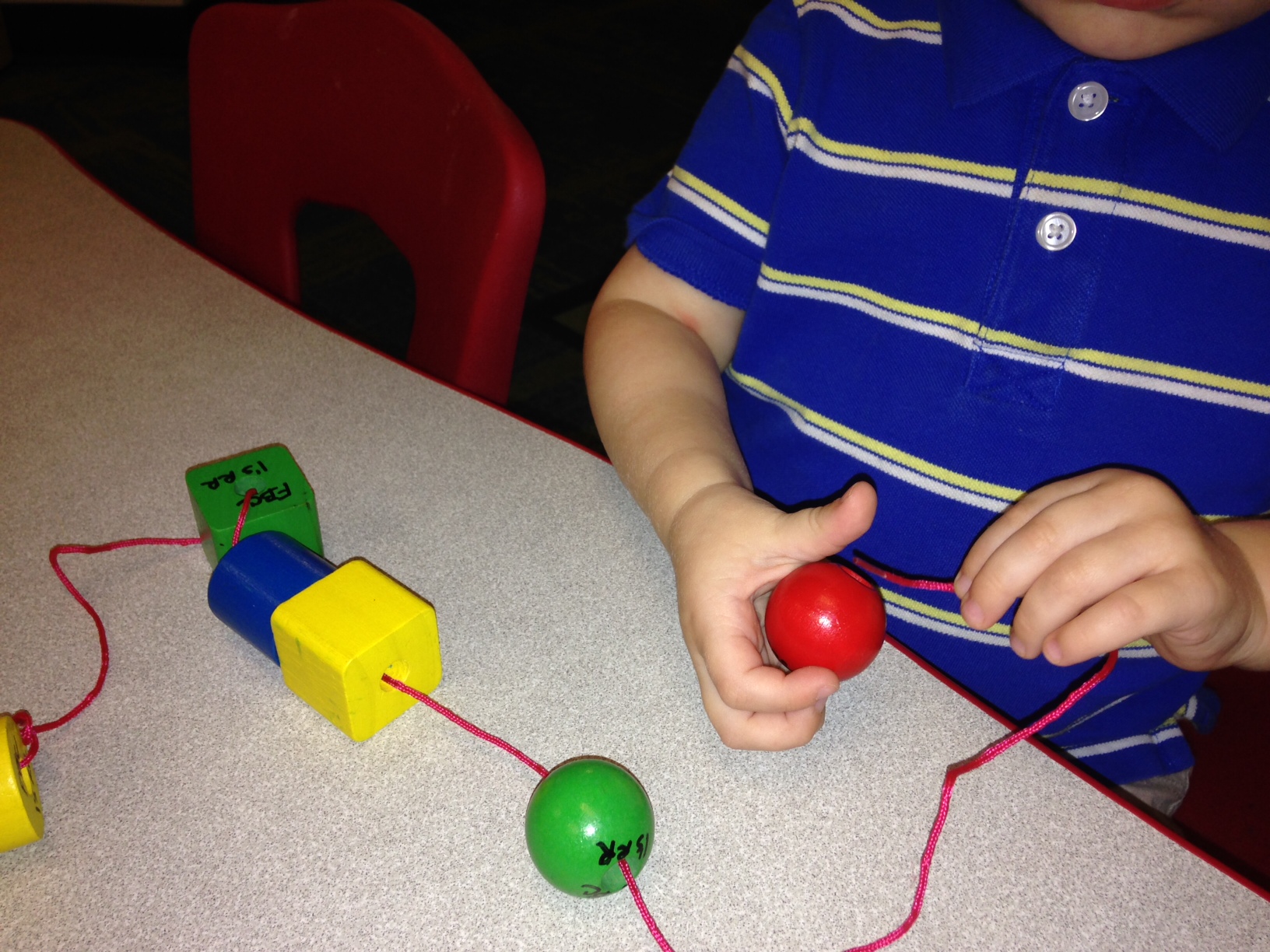
I learned that you should feel when writing, not like Lord Byron on a mountain top, but like a child stringing beads in kindergarten, happy, absorbed, and quietly putting one bead one after another. Brenda Ueland
And frame your mind to mirth and merriment / Which bars a thousand harms and lengthens life.” Wm. Shakespeare, The Taming of the Shrew
We do not see things as they are; we see things as we are. Anais Nin
Your turn:
Add a quote? Comment on one or two you have just read?
Now you are probably thinking . . . age 72 is a long way off, or it’s just around the corner. Either way, it’s a question worth pondering.
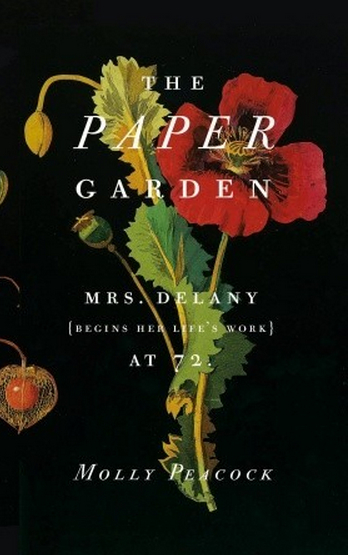
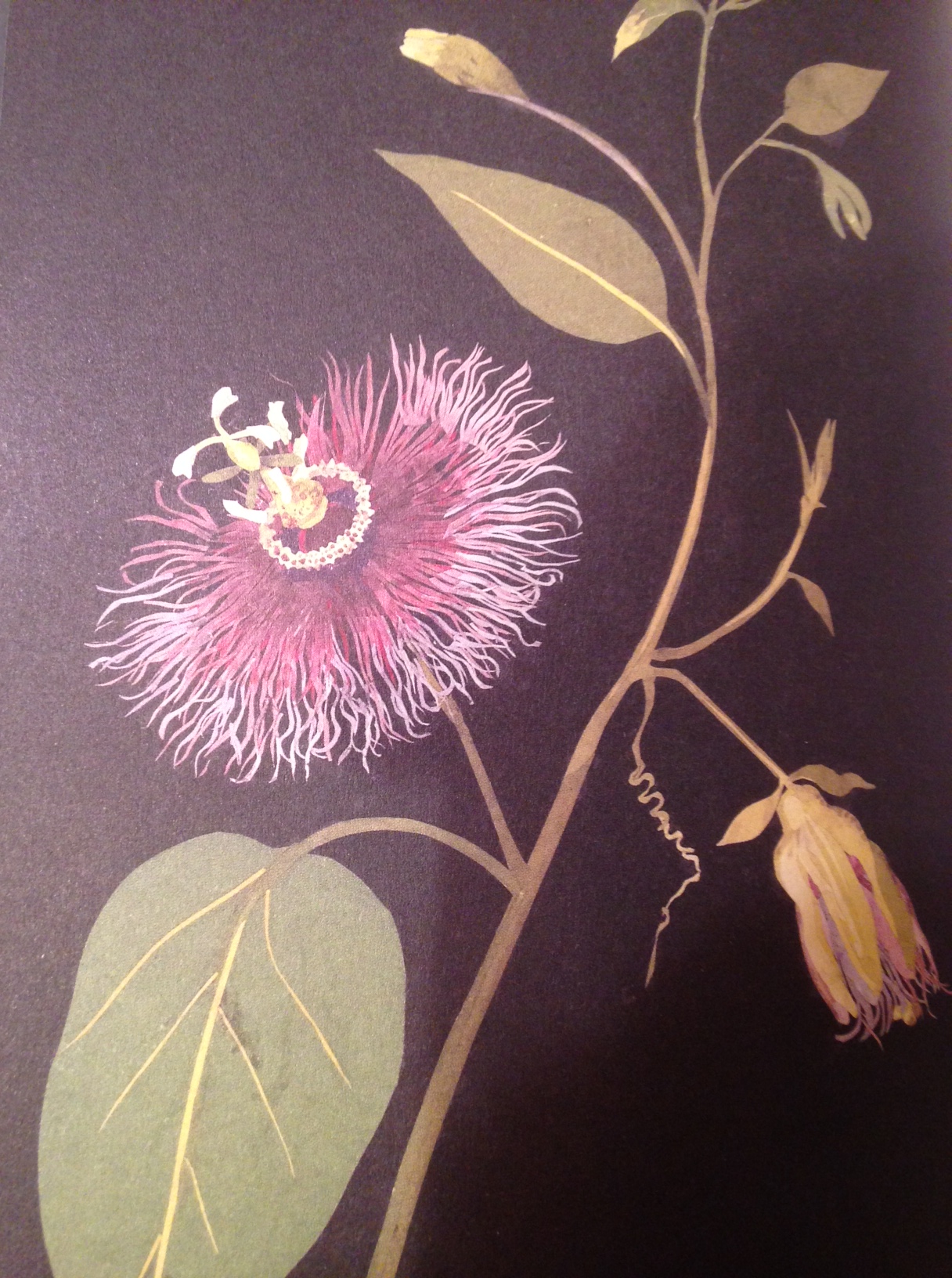
In 1700 the average life expectancy was 37. In fact, 40 would be pushing it. Yet, in that very year Mary Granville Pendarves Delany was born and lived to be 88. More impressive is the fact that at age 72 she invented mixed media collage and eventually created “an astonishing 985 botanically correct, breathtaking cut-paper flowers, now housed in the British Museum and referred to as the Botanica Delanica.”
Image: Courtesy of Good Reads
Poet Molly Peacock, author of The Paper Garden: Mrs. Delany begins her life work at 72, recreates the “Aha!” moment for Mary Delany early in the book:
One afternoon in 1772 [the recently widowed Mary Delany] noticed how a piece of colored paper matched the dropped petal of a geranium. After making that vital . . . connection between paper and petal, she lifted the eighteenth-century equivalent of an X-Acto blade . . . and began to maneuver, carefully cutting the exact geranium petal shape from the scarlet paper.
Then she snipped another and another, beginning the most remarkable work of her entire life.
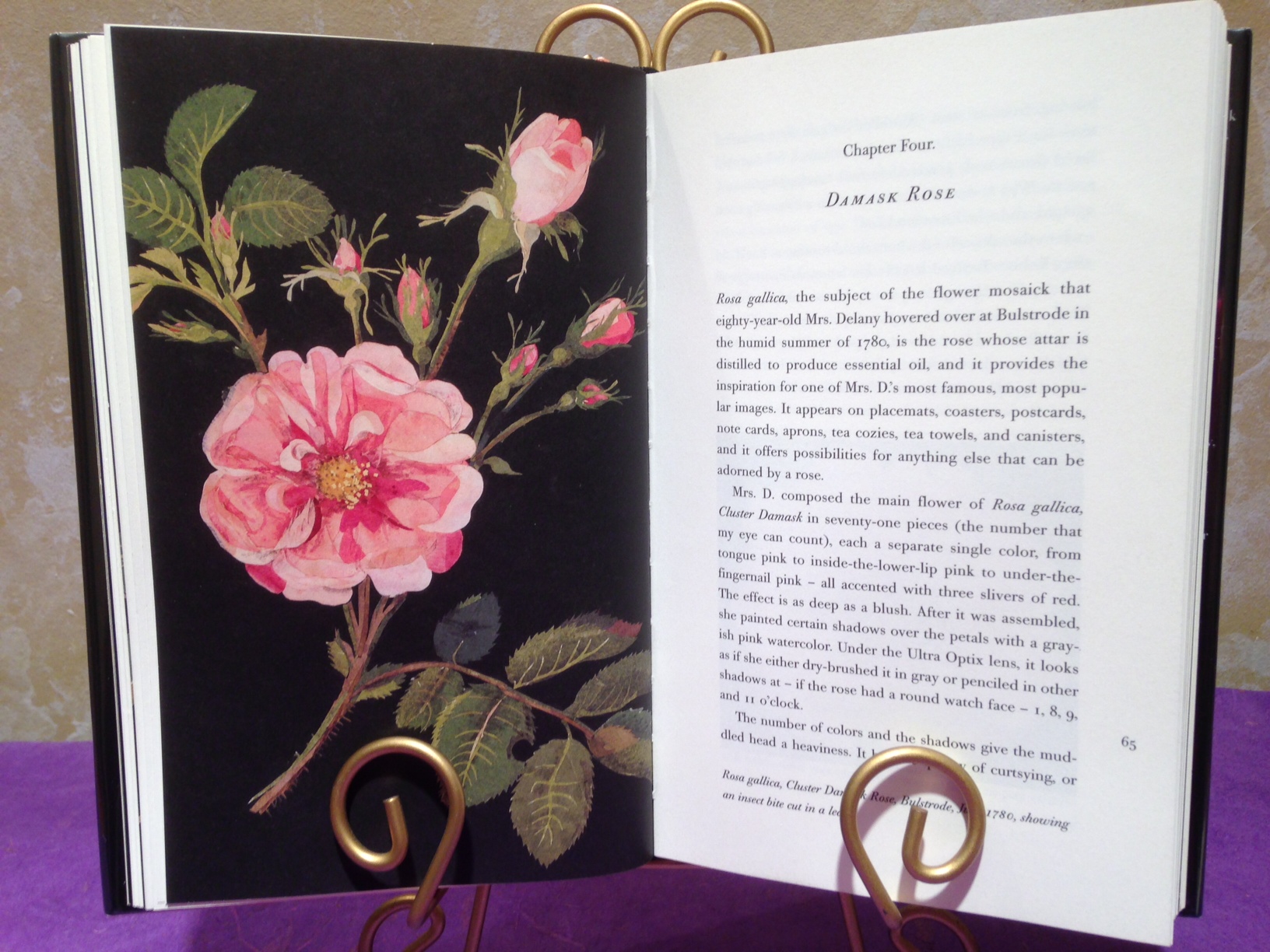
“. . . if a rose had a round watch face” (65)
Her most famous and popular image is the Damask Rose, appearing on postcards, place-mats, tea towels, and canisters. The main flower includes about 71 pieces of carefully cut papers, covering the gamut of pinks from slivers of red to blush and “under-the-finger-nail pink.”
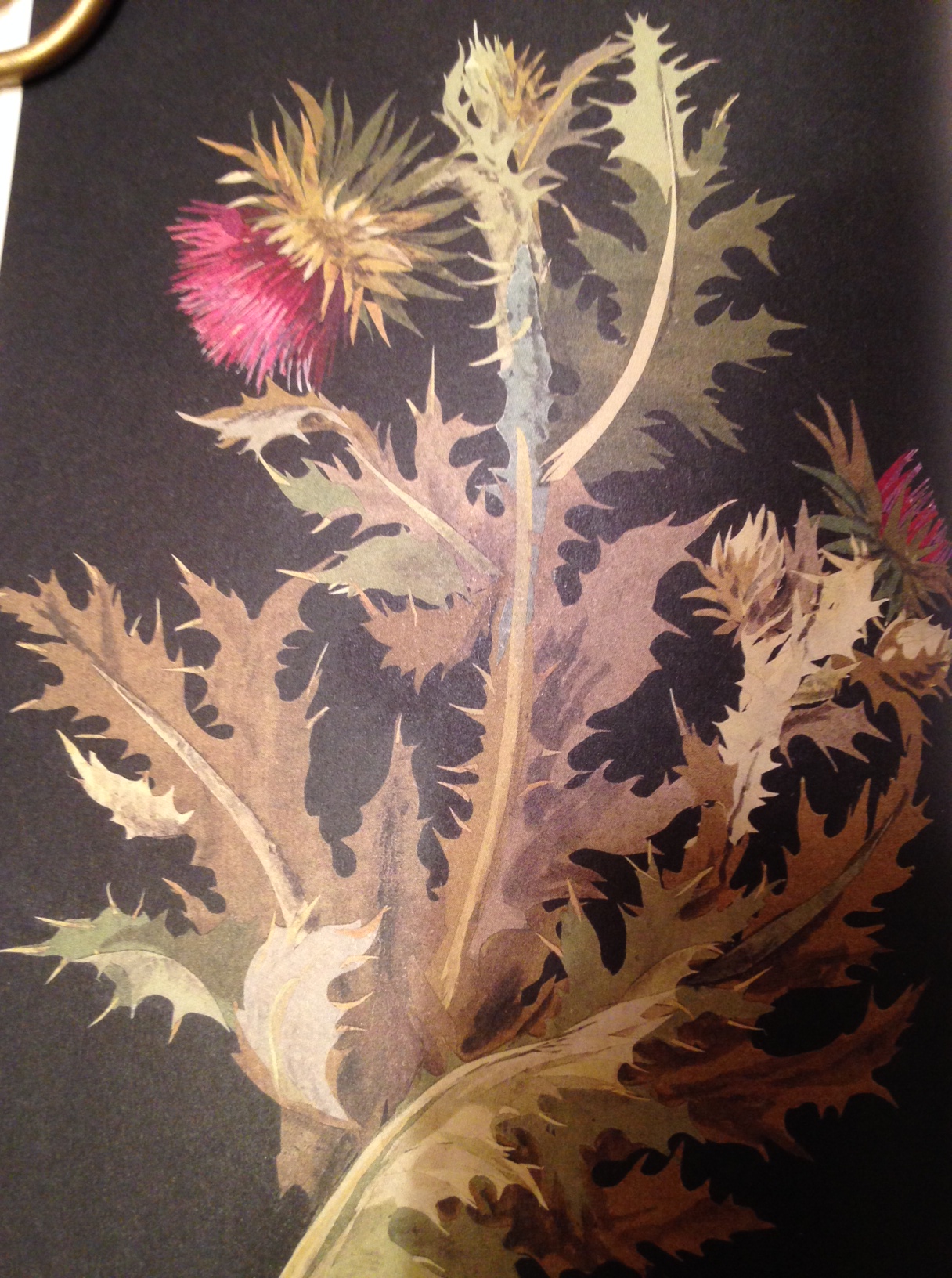
Nodding thistle, a cousin of the dandelion, with swirling foliage
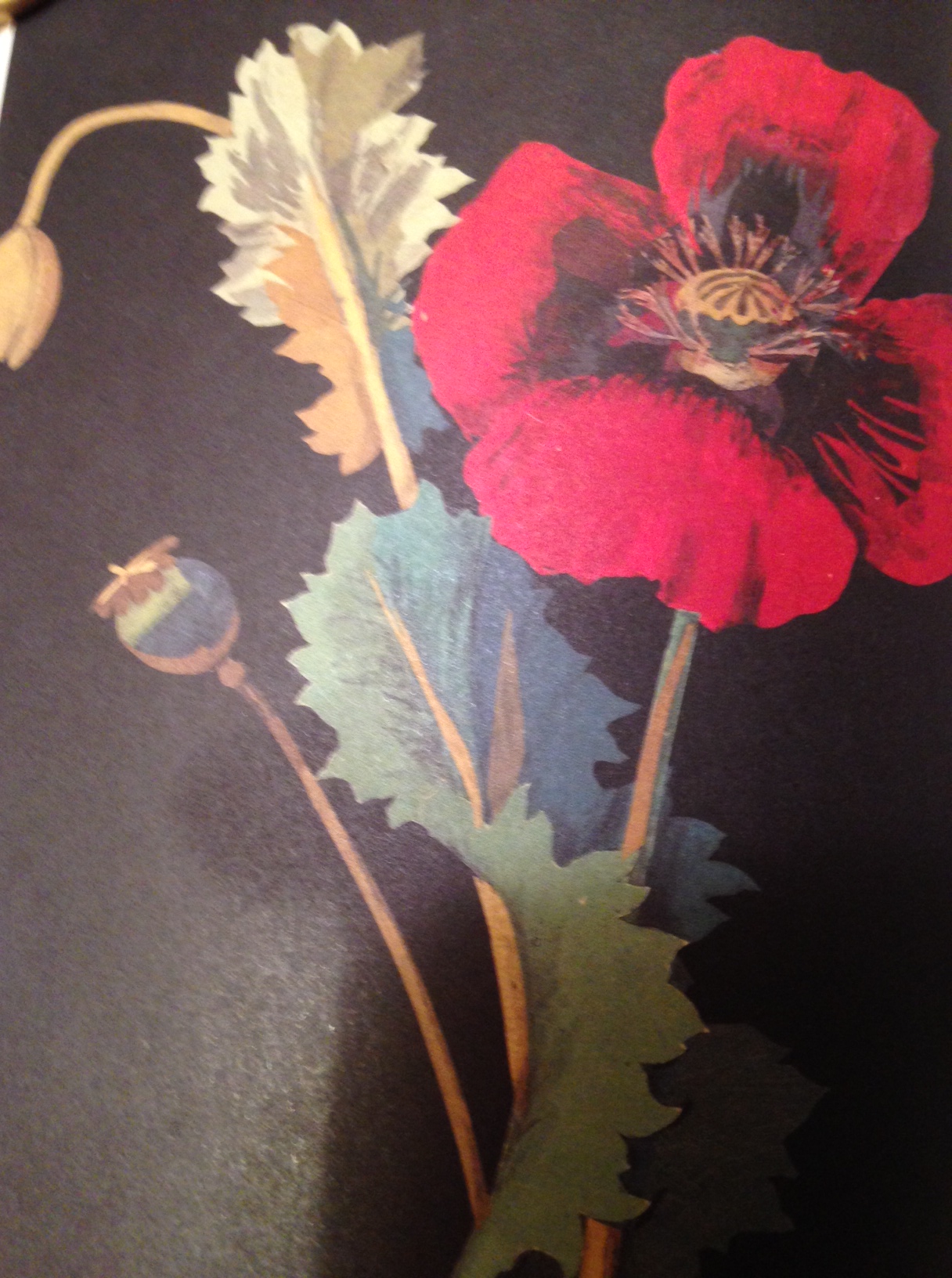
Operatic Opium Poppy
The theatrical-looking opium poppy is cut from a single green piece of paper. “The whole effect is of a kimono-like gown billowed by a breeze, like the robe of a star soloist falling down from her shoulders” upside down (118).
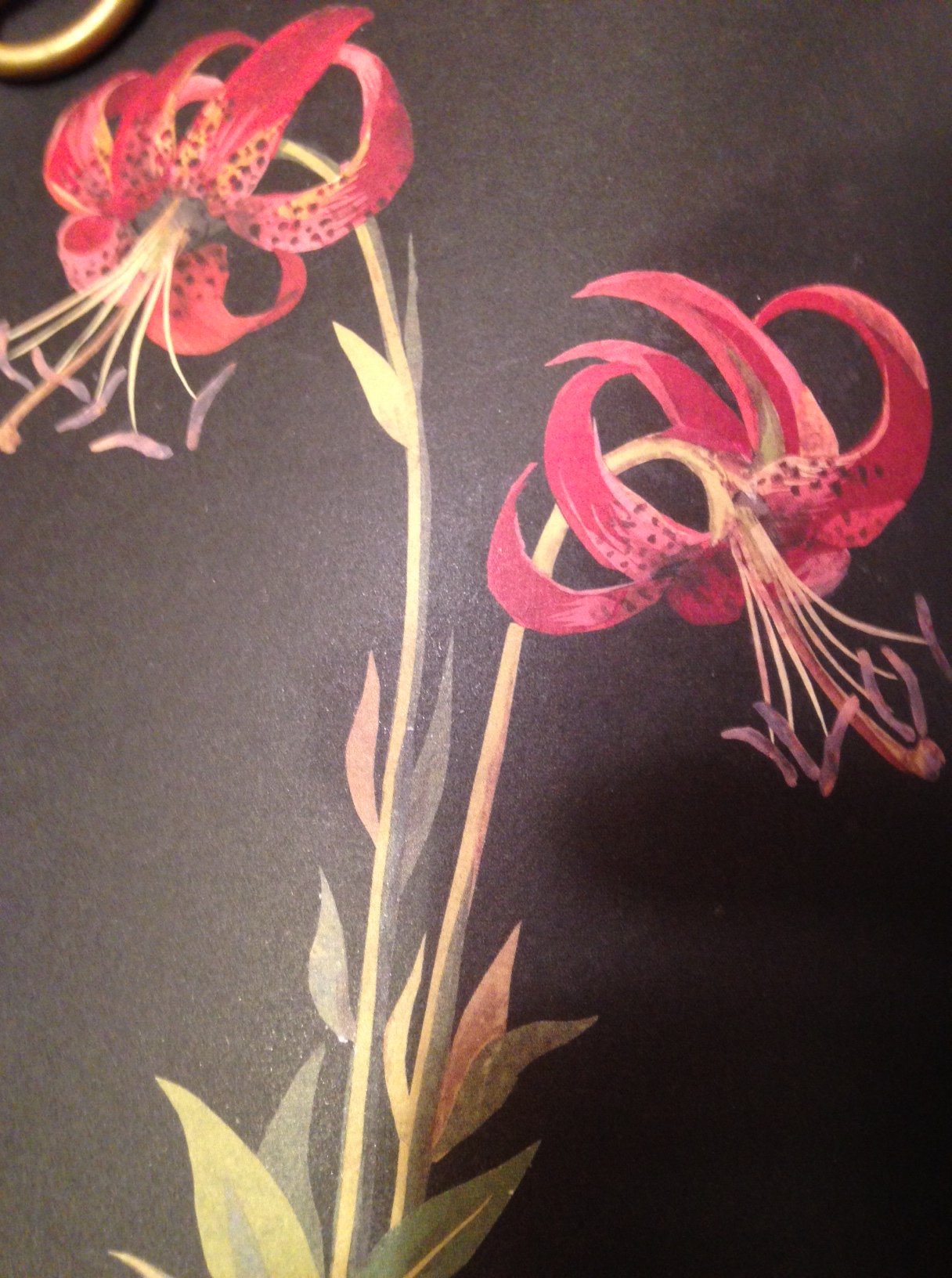
” . . . lines swoop and swoon with freckled energy” (141)
Mary Delany’s output was phenomenal. In 1777, the year she constructed the passion flower, she cut out her collage/mosaics at the rate of one per day, and between the ages of 77-87 creating one every four days (185).
For the passion flower, Mary Delany cut out 230 petals scissored “like little grass skirts, where the strands of grass are attached to a belt” (169). She made up her colored papers . . . washing whole sheets of paper in varying hues. In the case of the passion flower, olive, loden, beige ivory for the leaves, and the flower rust, red, purples, deep and pale pinks, lavender. To the pigments she added gum arabic, honey, ox gall to prepare and preserve the papers. All done on a matte black background, always on dramatic black.
Mrs. Delany was born into the aristocracy with a wide circle of friends which included composer George Frederic Handel and the satirist Jonathan Swift. John Wesley even courted her. Yet her posh outer life was checkered with challenge: an arranged teen-age marriage to an aging drunken sot, problems with cash flow, at mid-life the loss of her soul-mate, Patrick Delany, a man who knew her worth, then deaths of close relatives, and finally her own illness.
Yet like her flowers, cut with a blade, not outlined by a brush, Mary Delany blazed a path for herself with a scissors, scalpel, tweezers, and needle. Combined with her imagination and gutsy determination, she made art that endures.
Age is the sum of all we do.
Charles Bulkowski, quoted by Molly Peacock (343)
The root of the word inspiration is “breath.” What activity do you do that inspires you, gives you energy?
Or takes your breath away – maybe even give you a second wind?
What will you be [still] doing at age 72?
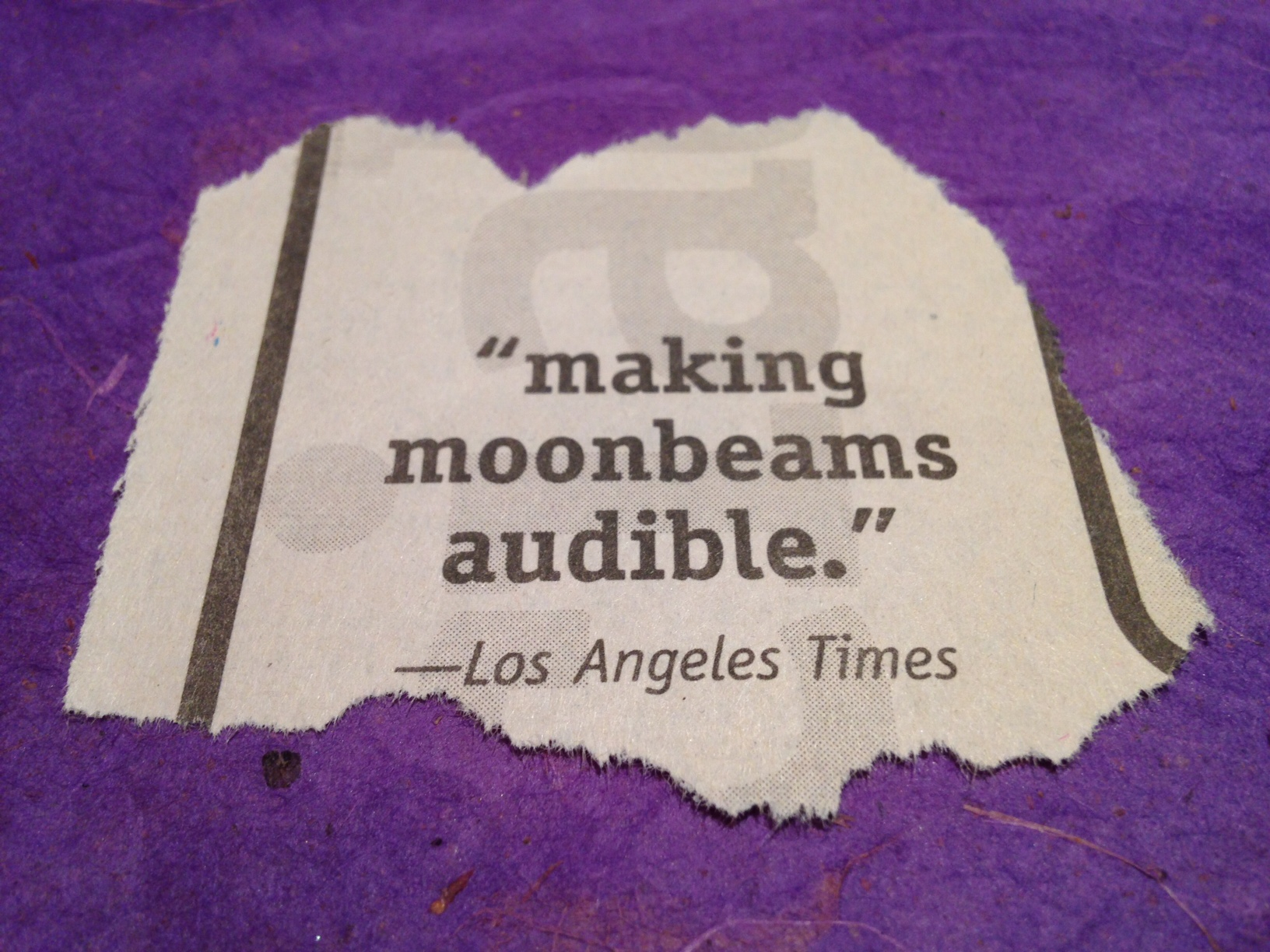
The career of flowers differs from ours only in audibleness.
A man must have dreams–memory dreams of the past and eager dreams of the future. I never want to stop reaching for new goals. – Maurice Chevalier
Then the Lord answered me and said: “Write the vision And make it plain on tablets, That he may run who reads it. Habakkuk 2:2 New King James Version (NKJV)
Between your dream‘s inspiration and its manifestation, there’s going to be a lot of perspiration. Daily Devotional: The Word for you Today, January 2, 2014 entry
A [wo]man is not old until regrets take the place of dreams. John Barrymore
MEMORY
Yesterday is today’s memory and tomorrow is today’s dream. Kahlil Gibran
Memory is the script of the soul. Aristototle
Each day of our lives we make deposits in the memory banks of our [grand]children. Charles R. Swindoll
God gave us memory so we might have roses in December, (January, February . . )
From my JOURNALS 1996-1998
Gratitude is the heart’s memory. French proverb
Puttering is creating a fresh interior landscape. Sarah Ban Breathnach in Simple Abundance
Women share with men the need for personal success, even the taste for power, and no longer are we willing to satisfy those needs through the achievements of surrogates, whether husbands, children or merely role models. Elizabeth Dole
On Music:
“The auditory nerve is very closely connected to the limbic system so that sound (i.e. music) does not have to go through the cortex of the brain but goes directly to the heart, the senses.” unknown source (noted April 9, 1998)
Rhythm in music imprints language on the brain in a way pure auditory words will not. Slower tempo in classical music develops a framework for learning to occur. NPR report on “The Mozart Effect” (1998)
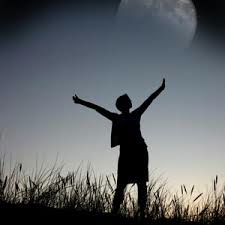
What Makes a Moonbeam Audible for you?
Feel free to comment also on any of the categories about: visions, dreams, memory, music, or something else. I will always reply!
Still time to vote for my story in Sonia Marsh’s My Gutsy Story Contest. Thank you, thank you to all who have already voted. You make a difference!
Anna Quindlen in her splendid 84-page book How Reading Changed My Life describes reading as her “perfect island.” She doesn’t say where the island exists, so it can be anywhere the reader imagines it to be.
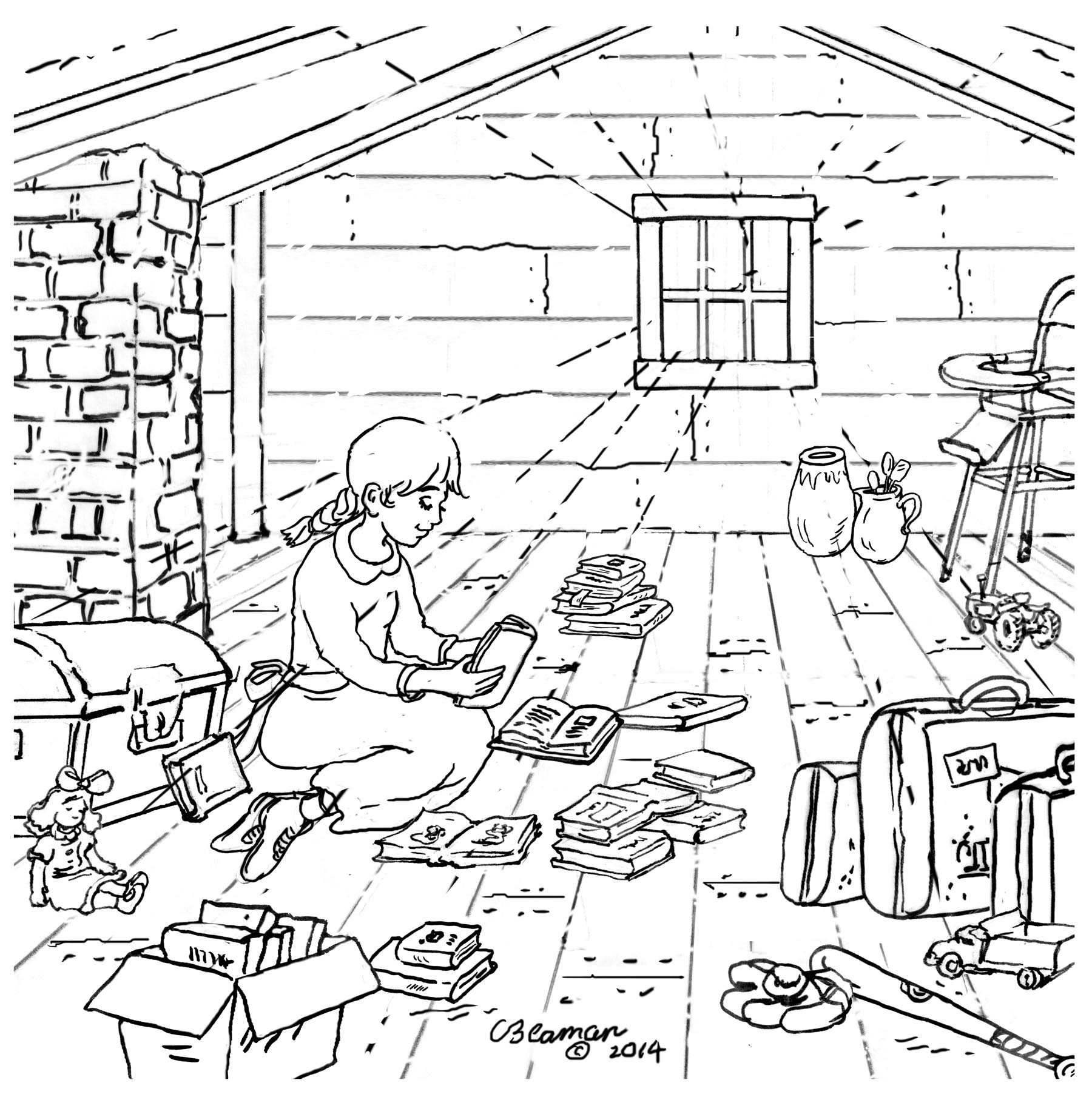
My perfect island as a girl was the attic under the sloping roof, unless it was summer steamy hot, or winter frosty cold. Then my nest was on my bed, or flopped on the davenport, across a chair, anywhere . . . .
My books were not like Quindlen’s list of “10 Books for a Girl Who Is Full of Beans.” I didn’t read her noble suggestions like Little Women, Anne of Green Gables, Madeline, or even A Wrinkle in Time as a young girl, but I did become addicted to the Cherry Ames series, books in the mold of Nancy Drew: Cherry Ames, Student Nurse, Army Nurse, Flight Nurse. If you have read them, you may know Cherry, short for “Charity,” is the heroine in a series of 27 mystery novels with hospital settings between 1943 and 1968.
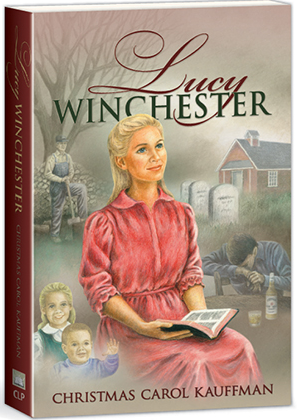
I slurped up Lucy Winchester by Mennonite author Christmas Carol Kauffman, the story of Lucy’s spiritual quest to find peace “set against the backdrop of two difficult marriages and many sorrows, broken promises, sickness, infant deaths, alcoholism, and poverty.”
In a trip up to the attic again as an adult, my sisters and I rummaged through the stash of antique books (they’re over 50!) and divvied them up among ourselves.
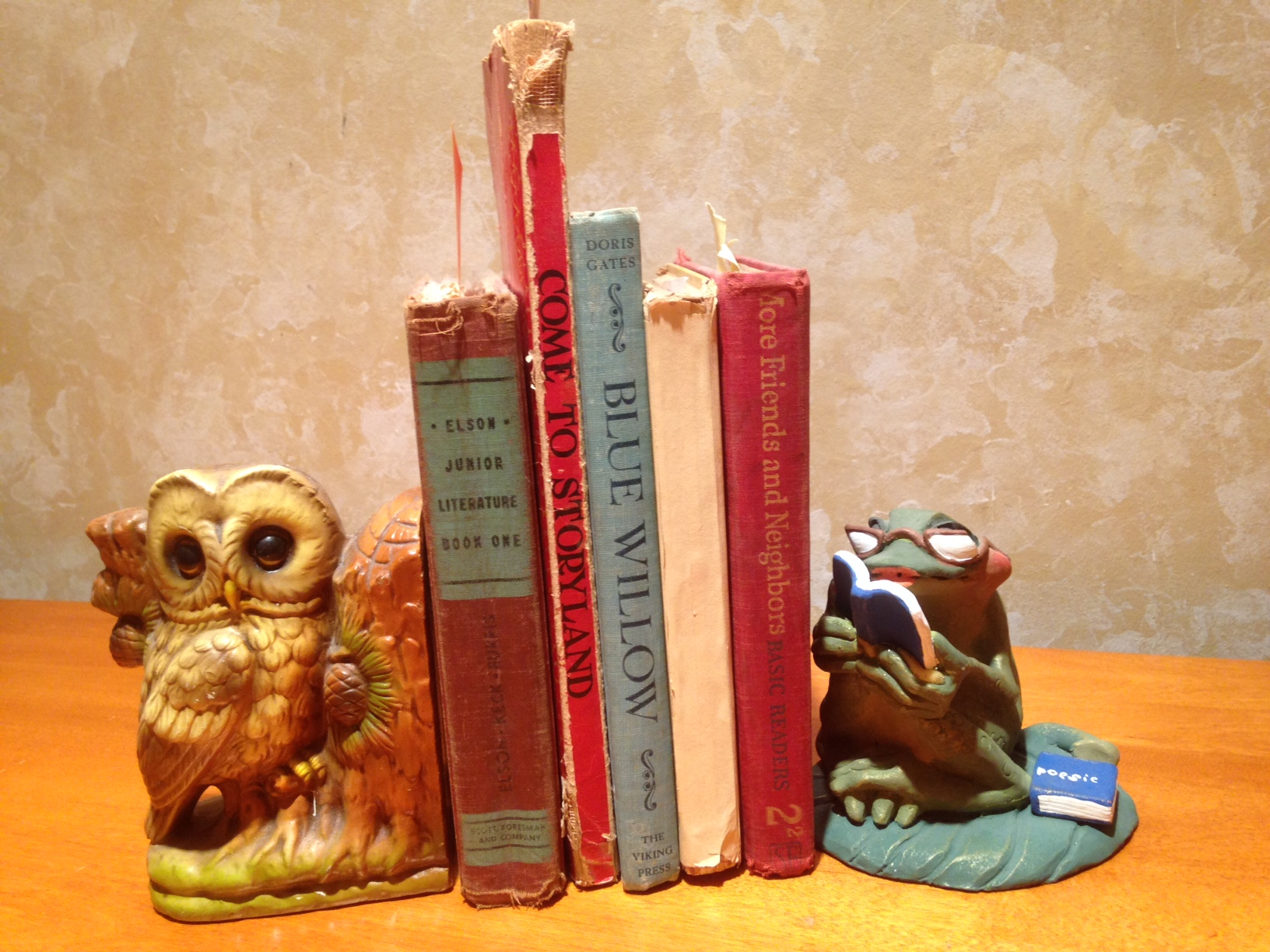
Yes, I read books, books, lots of them, but these are what remain from girlhood days:
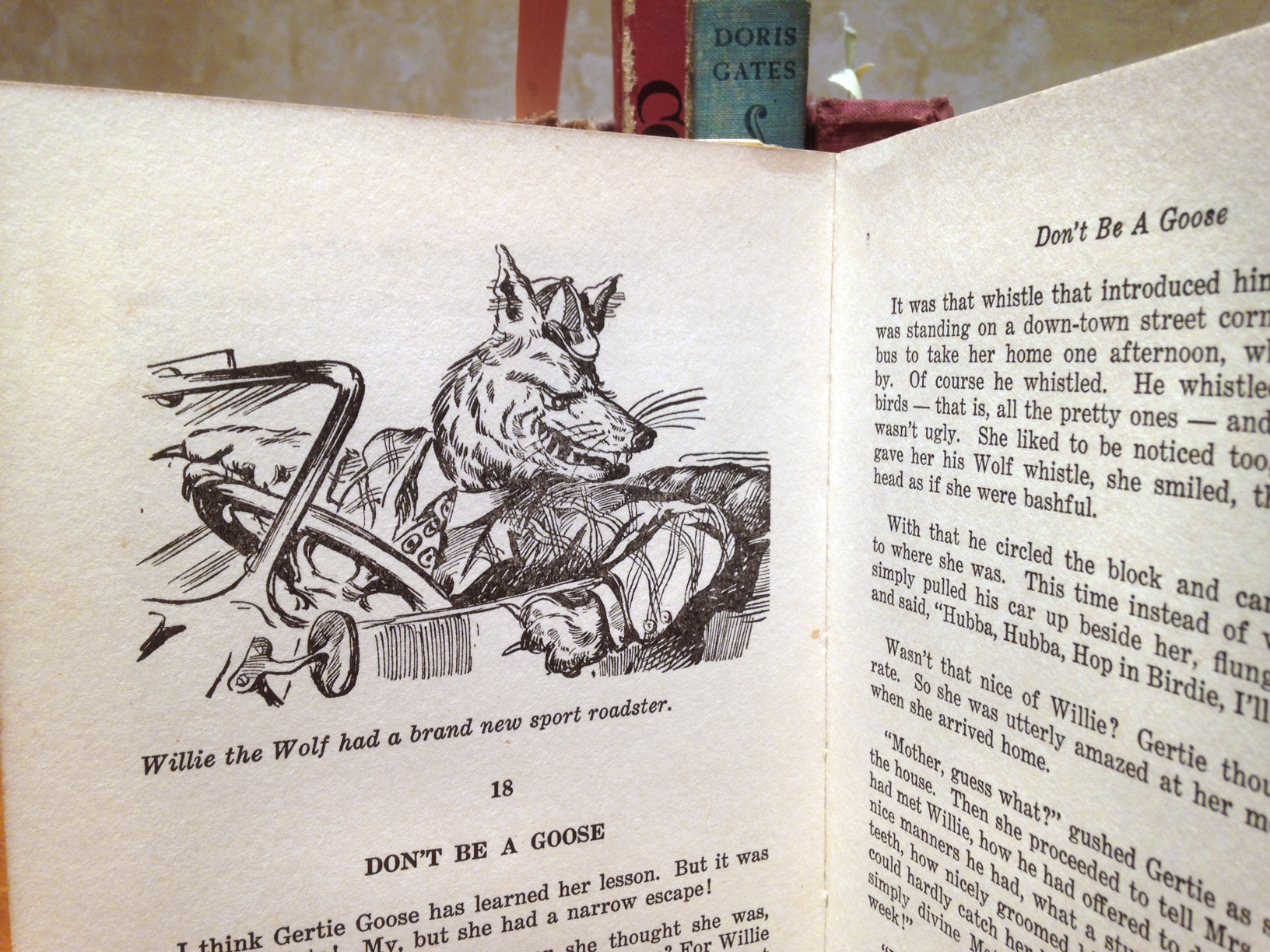
The book whose spine is taped up is entitled Bird Life in Wington (1948) a book of parables by Rev. J. Calvin Reid, pastor of Mt. Lebanon Presbyterian Church in Pittsburgh,
Willie the Wolf with fangs in roadster ready to pounce on naive Gertie Goose
who invented the First Birderian Church of Wington to deliver sermonettes to parishioners named Professor Magpie, Baldy Eagle, Mr. Heron, a fisherman–you get the idea.
More Friends and Neighbors (Scott-Foresman & Company, 1941)
The images in this Valentine story are imprinted on my mind with cookie cutter precision, the secret to the surprise valentines that replace the snow-damaged paper cards by the window. This reader also contained the story of the “The Woman Who Used Her Head” by chopping a hole in her roof to accommodate the lofty altitude of her Christmas tree.
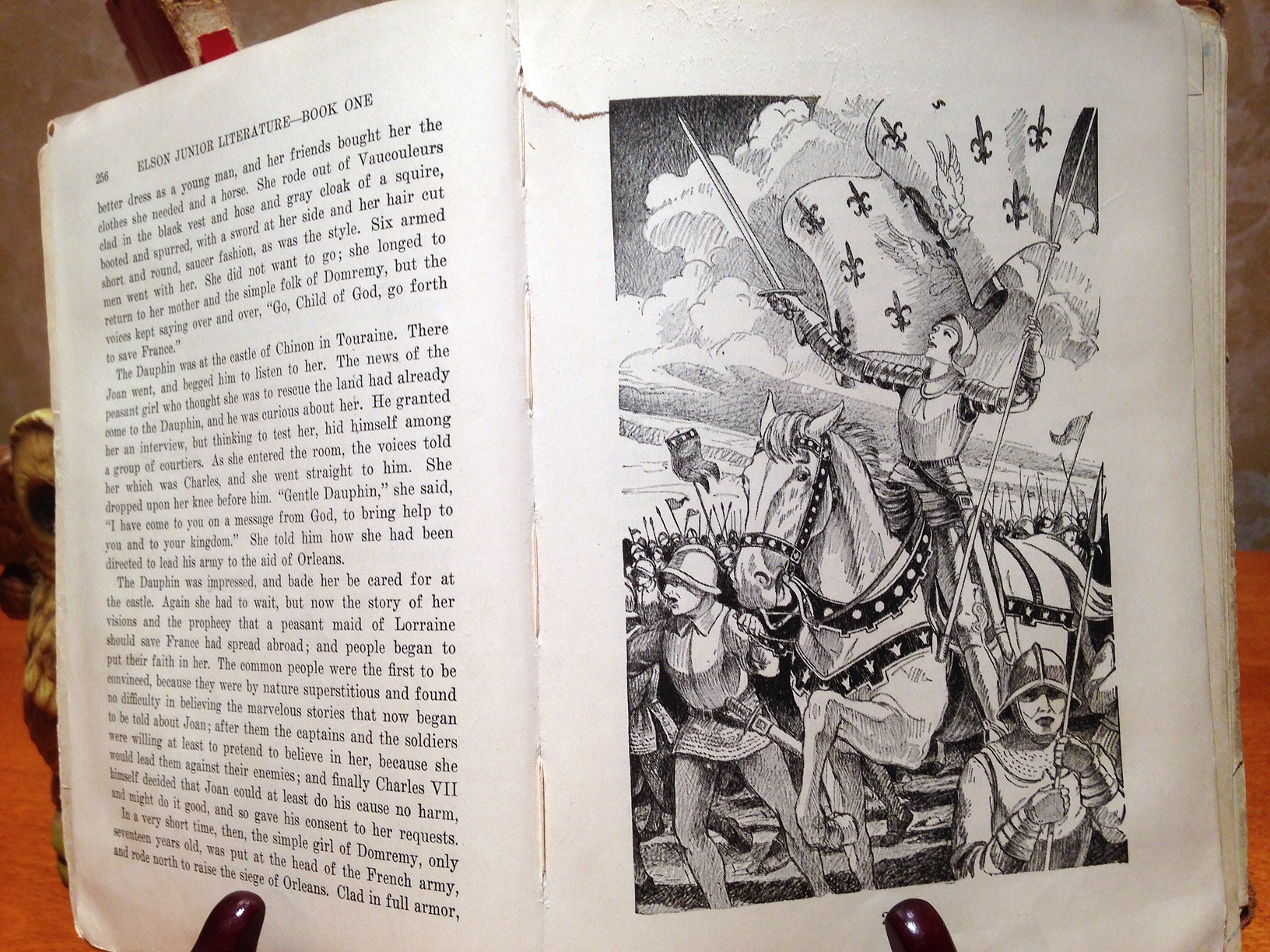
I always loved to turn the page and find an etching in the Elson Junior Literature Book One
Finally, a “real” literature book with Hawthorne’s The Great Stone Face, Emerson’s poem The Snowstorm, announced by “all the trumpets of the sky,” Longfellow’s The Courtship of Miles Standish, and Joan of Arc, the heroic maid who saved France from conquest. A vision, voices, an ancient prophecy–what could be more romantic for a plain Mennonite girl who dreamed of castles, and princes, and fulfillment, oh my!
Did this post jog your memory of textbooks, gift books, library books from your own past?
Please tell us about them.
Another invitation to vote for my story in The Gutsy Story Contest:


 Grandmother Nicholls and Uncle Wiggily






 Plain and Fancy