A Robbery, Sad Friday, and a Clump of Daffodils

“I’ve been robbed!’ These are the only words artist/performer Cliff can utter as he walks toward his Dodge van, noticing that the air-vent window on the driver’s side has been pushed in at an odd angle. It’s about 4:30 a.m. Good Friday, April 1, 1994.

Rushing around the vehicle to open the side doors, he begins to take inventory of what’s missing: sound equipment including a stereo mixer, a professional-grade tape player, a recorder and at least 150 treasured CDs missing from cases. An envelope with cash – gone. All gone! He walks frantically around the parking lot of the Quality Inn he is leaving and spots a black suitcase, which the thieves have thrown into a ravine. Empty!

It was the end of a very productive month presenting 35 multi-media school assembly programs in Florida and Georgia. Cliff had driven to Nashville, Tennessee because his next shows would be in the Memphis area. He had been looking forward to boarding a 6:00 a.m. Delta flight to come home on Good Friday and spend Easter weekend with his family. This weekend, however, turned out to be a mixed blessing – The splendor of the resurrection service at church conflicted with the discordant thoughts about his recent loss: Lost equipment, lost musical discs, remembering malfunctioning hotel parking lights that had probably contributed to the thieves finding his van easy prey. And after all, it was Nashville, music city.

After returning to the Nashville airport after Easter to continue his itinerary, he takes stock. Though the robbery has felt like a violation, a form of rape actually, he could count his blessings: 1. His CD player vital to the music that accompanies his drawing was in a separate case, undisturbed and  2. He had copies of program music at his home base, Jacksonville.

Still reeling from the impact of the loss of inanimate “friends” that provided the musical score to his chalk drawing on a large easel, he must soldier on toward St. Louis, Missouri for next week’s shows. Behind the wheel again, he popped in a cassette tape, a musical companion on the long hauls between cities: soaring classical music and uplifting hymns, a distraction from the recent robbery. His itinerary takes him through Cape Girardeau, Missouri, where his journal notations begin:

The undulating ribbon of asphalt in Interstate 55, the hum of the van engine, rumbling of tires, and rushing air together with the music combined their forces to calm my mind . . . .  Now a spot of yellow caught my attention. Was it litter – or something else? The blurry image that I imagine are daffodils soon vanished from my side view mirror.


I keep driving but feel an urgency to turn around. The nest of daffodils keep calling me. “Come back. Don’t go another mile. You may miss a special moment in your life, a moment that can put a special gladness in your heart.

 Finally, he turns around at the next exit, heading south, as he wonders, “How far had I traveled since I had seen the flowers? I honestly had no idea, but I retraced my path even farther than I thought necessary to spot those daffodils again.” He gives up and heads north again. But feeling a tug even more insistent, he turns the van around one more time.

Passing over the exit I continued searching, almost holding my breath. My jaw set, my eyes straining for anything yellow.


I nervously looked at my watch. I could not believe that two hours had passed since first sighting those images of hope. Miles and time seem to merge together. My odometer indicated I had gone 120 miles since first turning back. What was I to do? It was getting late; I had to get to St. Louis soon.


And then ahead I saw it—a flash of golden yellow. My heart leaped with joy—It was there after all, several clumps of daffodils, but I saw two huddled together, spring-like beauties, raising their slender pastel green fingers, lifting golden heads to the heavens!

daffodilREAL2

The next challenge: Finding a container and extracting the two daffodils from the hard soil without a trowel or shovel.

With traffic whizzing by and like a mad man on a single mission, I quickly swung open the back and side doors of the van, and found a plastic one-gallon container of spring water. Out gurgled the water. Then, I rummaged through my tool bag until I found a razor blade to cut out the topside portion of the jug.

How to dig up the daffodils though?

Once again, I dashed back to the van and from deep within my jungle of sound and art equipment, boxes and bags, I pulled out an aluminum yardstick. With both hands on my innovative shovel, I vigorously dug down deep into the damp soil and rock encasing the two flowers. After leveraging the living plants into a plastic bag, I carefully placed them into the jug, watering the daffodils and even hiding them in bushes outside overnight for safe-keeping at hotel rest stops before the next trip home.

On this Saturday, April 9, 1994 my husband spent 2 ¼ hours driving an extra 125 miles to capture in real time this evidence of hope and then later spent more hours penning this story in a travelogue entitled “I Stopped Beside the Road Today.”

The robbers did their dirty deed in an unlighted parking lot and left no evidence of their identity behind. Yet, Cliff searched for beauty among the rubble and found it, proof of the hope it represents.
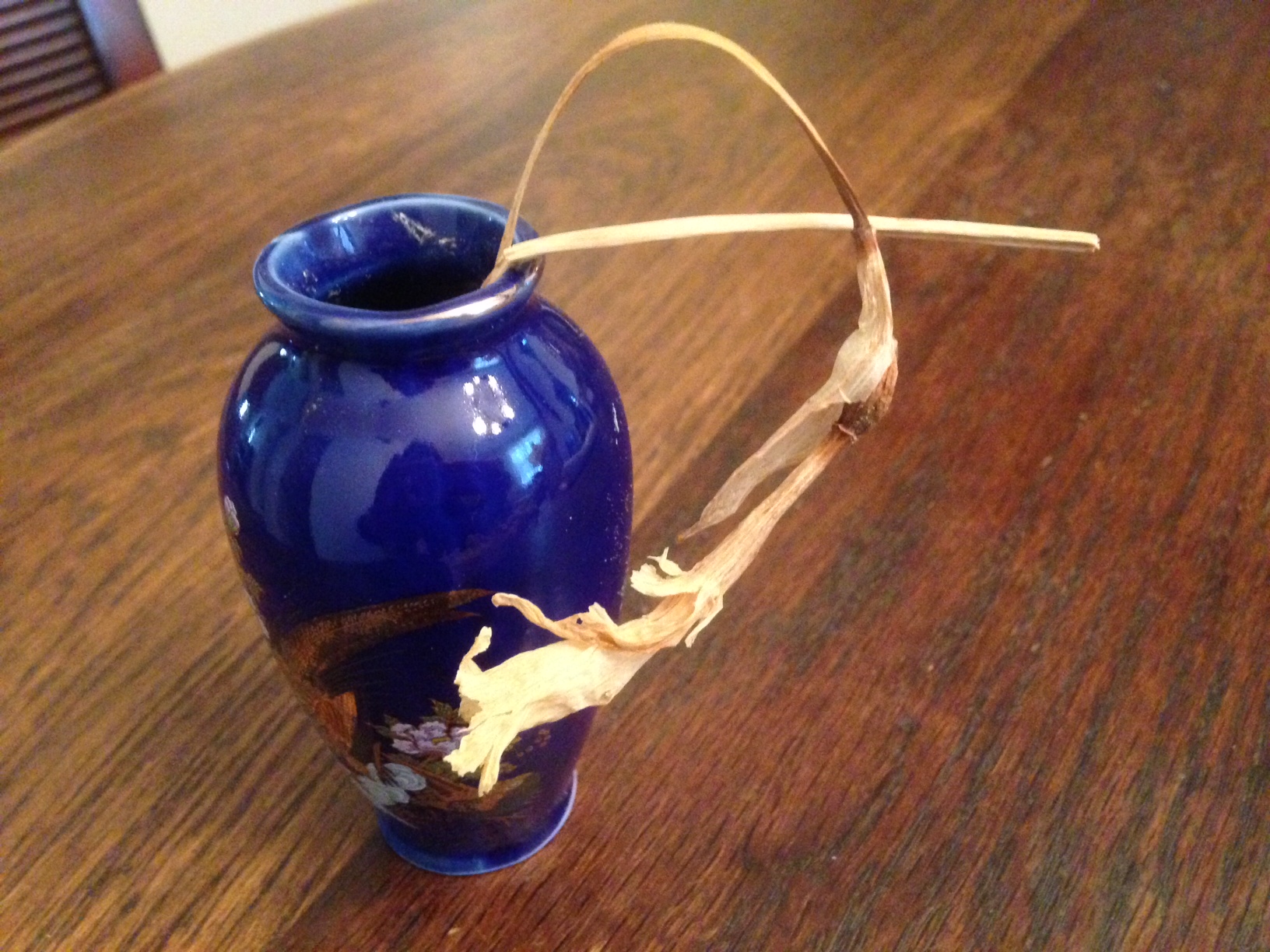
DaffodilDried

I have saved the dried-up daffodils, one headless, in a blue vase for 21 years.

And I can’t find it in me – at least not yet – to destroy these bedraggled tendrils – evidence of a Bad Friday turned Good!


Have you ever been robbed? Have you lost something so valuable you searched and searched? Here’s where to tell your story!

*  *  *

Links to Cliff Beaman, artist – http://americanartassemblies.com

YouTube video

*  *  *

Bonus: Tradition has it that the daffodil, the Lent Lily, will open on Ash Wednesday and die on Easter Day. In a poem entitled The Lent Lily, A. E. Housman writes of the daffodil as a yellow trumpet heralding the glories of spring.

Coming next: Our Easter in Ukraine

Purple Passages with a Pop of Pink, March 2015 edition

SPRING

“Is the spring coming?” he said. “What is it like?

“It is the sun shining on the rain and the rain falling on the sunshine . . .  ~  Frances Hodgson Burnett, author of The Secret Garden

Tulip magnolia tree in our neighborhood just about to bloom in Florida, early February
Tulip magnolia tree in our neighborhood just about to hit full bloom in Florida, early February   ~  Sunshine, no rain in sight

[in Just-] a poem by e. e. cummings, (his name usually shown in lower case letters) who is known for odd spacing and made-up words like “mud-luscious” and “puddle-wonderful” so evocative of the squooshiness that follows the winter thaw. This British poet clumped together some of the names and other words he uses, just like mud on your shoes in springtime. Remember all that? Here are the first nine lines.

spring          when the world is mud-
luscious the little
lame balloonman

whistles          far          and wee

and eddieandbill come

running from marbles and

piracies and it’s
spring

when the world is puddle-wonderful


ENERGY

The only thing that keeps a man going is energy. And what is energy but liking life?   Louis Auchincloss, A World of Profit

MIRACLES

C.S. Lewis wrote, “Miracles are a retelling in small letters of the very same story which is written across the whole world in letters too large for some of us to see.”

MITTENS

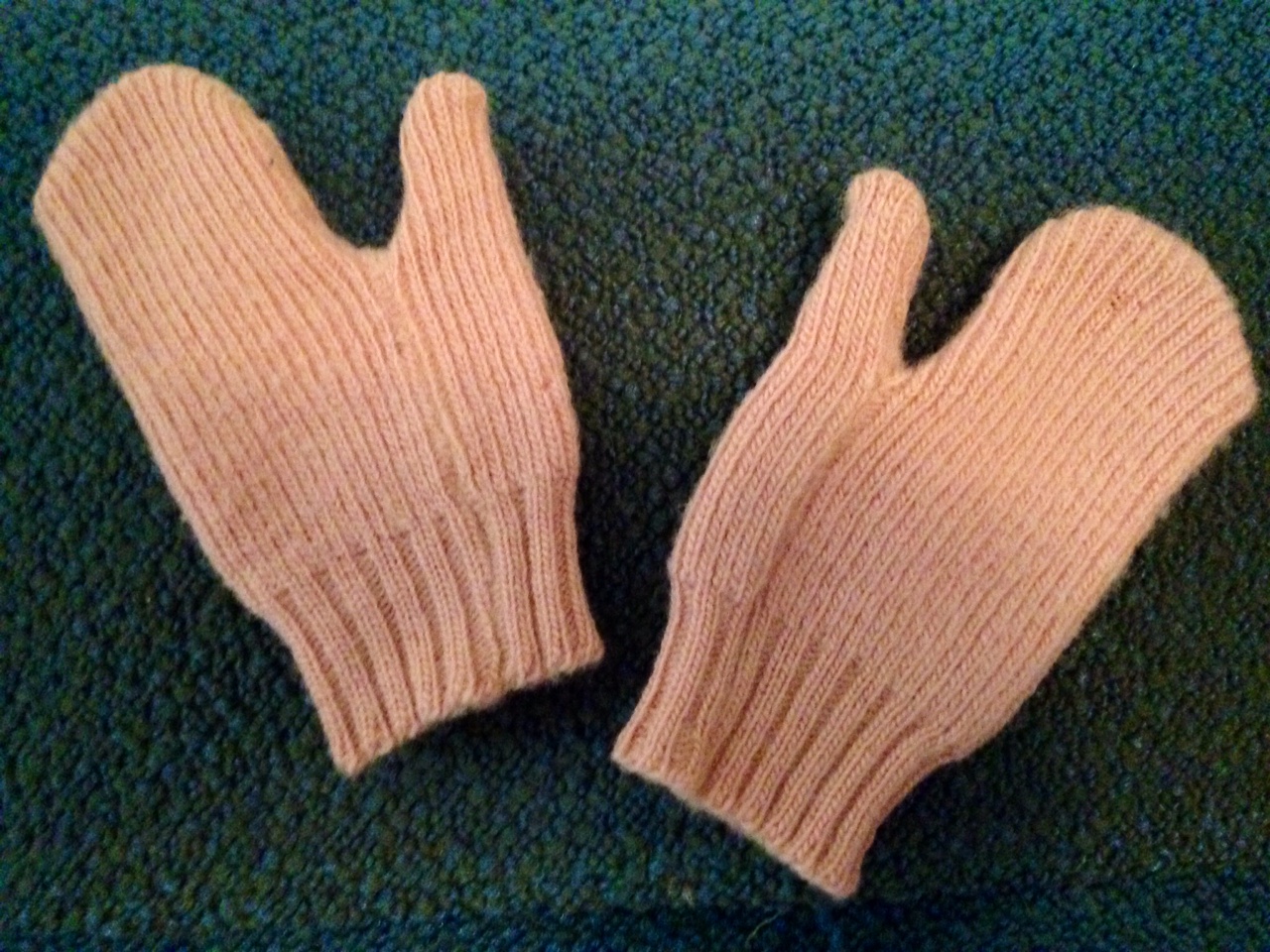
The wee Longenecker girls wore mittens because it was cold in Pennsylvania until near the end of March. These are the mittens I remember my sisters Janice wearing. Jean probably inherited them when her hands grew big enough. Somehow I recall a string of woven yarn attaching the mittens under the coat so the little girls wouldn’t lose their mittens. Mittens actually do keep little hands warmer than gloves would – body heat from all four fingers and thumb is trapped inside the glove just like this. . .

PinkMittens

. . . which reminds me of the Mother Goose nursery rhyme about the Three Little Kittens. You can probably hear the sing-song sound of the phrases as you read this tale.

KittenMittensScreenShot

In the verses which follow, the kittens put on their mittens, then get them dirty, are scolded by their mother, inducing them to wash their mittens, even hanging them out to dry. In the final verse, Mother Cat compliments her kitties while teaching them a lesson in scavenging for their dinner:

“What, washed your mittens, then you’re good kittens,
But I smell a rat close by.”
“Meow, meow, meow,
We smell a rat close by.”

Your turn! This is a free-for-all post. Add your thoughts or quotes on spring, energy, miracles, mittens – or something else.
Coming next: Grandmother Kayaks Solo from Maine to Guatemala. Why?

The Potting Shed and Other Marvels

I just talked to my brother Mark in Pennsylvania, and our 15-minute conversation was interspersed with his exclaiming . . .

“It’s sleeting.”

Then, a few minutes later, “It’s raining . . .”

And finally, “It’s sleeting again!”

It’s March and most people north of the Florida latitude are sick of winter. Suffering from S.A.D. (Seasonal Affective Disorder}, they are waiting to see the sun break through the winter blahs and unveil the crocuses and narcissus ready to pierce the soil.

Writer Linda Joan Smith had that feeling in mind when she said

Outside Snow’s dingy blanket may still muffle the stirrings of tulips and daffodils, and the pond may still be rimmed with ice. The reward of the garden must wait, but our gardening labors have begun. (“The Potting Shed,” The Traditional Home, March 2002)

Smith celebrates the potting shed, “the room that is as much a workshop to the gardener as the kitchen is to a cook.” She makes reference to the advice of John Claudius Loudon, who in his 1830s An Encyclopaedia of Gardening, recommends that proper potting shed must have light, air and warmth, including “a fireplace never omitted.” Smith’s article pictures two versions of the shed – an impressionistic one where there may not be precise order . . .

Illustration: James Staag, Traditional Home, March 2002

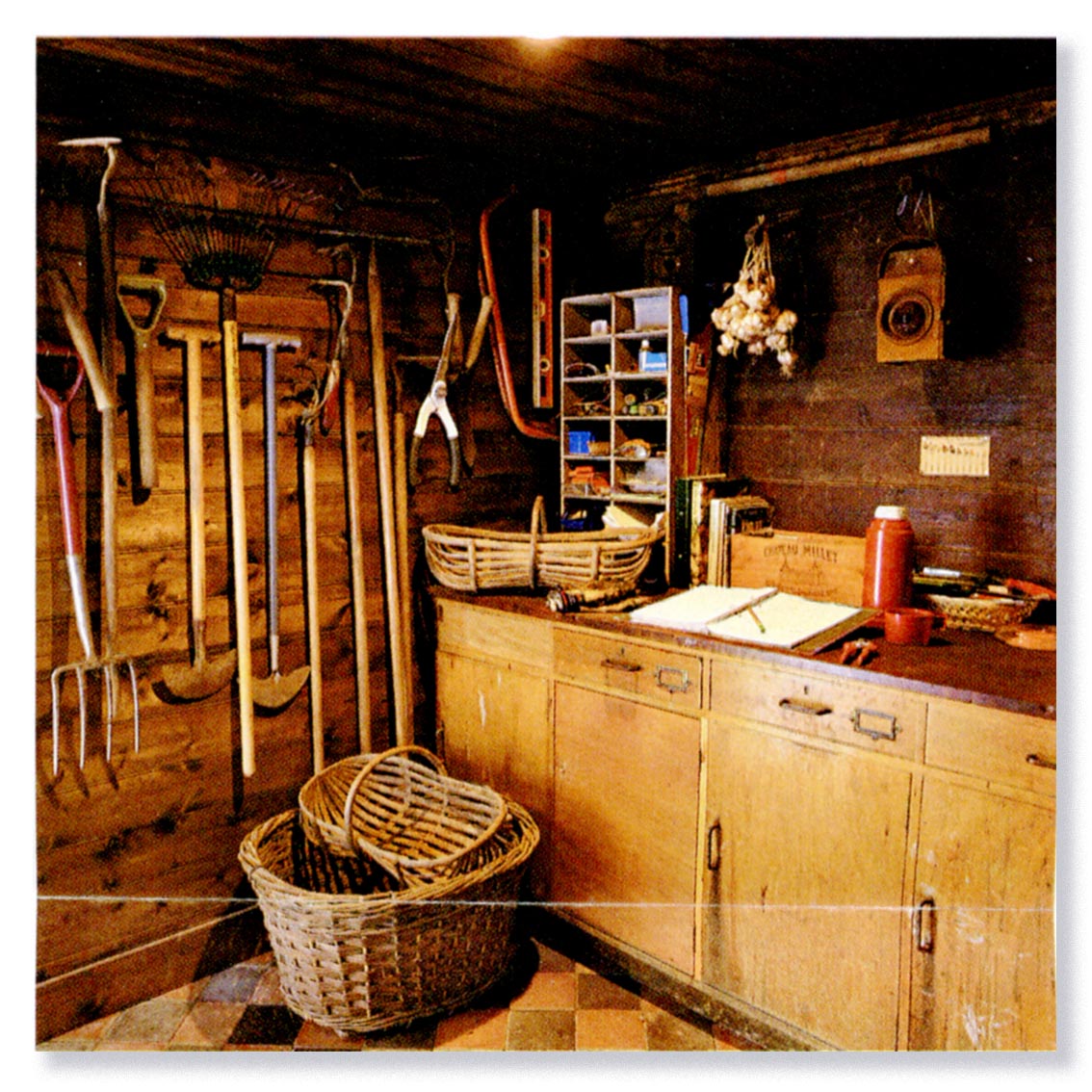
And one meticulously appointed where there is “a place for everything, and everything in its place,” (229) so says Mr. Barnes of Bicton Gardens writing in the1840s.

Photograph: Curtice Taylor, Traditional Home, March 2002

My blog friend Linda Hoye, who moved recently from the Pacific Northwest to Canada, is a gardener extraordinaire. In her blog A Slice of Simple Life she uses plastic gallon jugs for winter sowing:

Winter sowing is placing seeds outside, in the winter, in mini-greenhouses made from things like empty milk jugs. The plastic jugs protect the seeds from harsh weather while allowing the cold to toughen them up during the cold weather. When it gets warm enough inside of the little greenhouses the seeds germinate and become viable outdoor plants sooner than those started indoors because there’s no need to harden off the plants.

When you check out her post, you can see her mini-greenhouse project complete with a photo of the jugs in a tub.

Did I mention that Linda is innovative? Yes, indeed. She gives a blow by blow pictorial account of preparing a worm hotel – indoors. Knowing that worms aerate the soil, she nurtures them as help-mates in the growing process. Even she says, “Eww!” as she mingles coir mix, pumice and finely chopped veggie scraps topped with a damp newspaper before she moves the operation to the garage. Soon she will prayerfully tuck seeds, tiny flecks of hope, into dampened soil. Obviously, Linda has faith that “to plant a garden is to believe in tomorrow” (Audrey Hepburn).

And gardener Hoye believes in whimsy too, as her creation of a fairy garden illustrates, anticipating spring in a post entitled “Spring is in the Air.

FairyGardenLHoye

Some Gardening Quotes:

“Outside there is water music as packs of snowflakes melt into water drops, merge into rivulets, trickle into puddles, then subside into pools and streams. The garden is mud, but no matter. Soon it will drain and dry in the strengthening sun.”  ~ “The Potting Shed,” The Traditional Home (March 2002)

“In the spring, at the end of the day, you should smell like dirt.“~ Margaret Atwood in Bluebeard’s Egg (1986)


In March 1985 my farmer parents, Mother and Daddy Longenecker, left wintry Pennsylvania and visited Florida where they couldn’t wait to get their hands into the soil. Soil that nourishes citrus trees, azaleas, and camellias is not necessarily good for hardy Lancaster County plantings. Daddy took one look at the sandy soil in my sister Jan’s huge back yard and ordered a load of chicken manure. After working it into the ground, he and Mother scored straight rows for planting.

Mother Ruth Longenecker sowing seeds in Florida

Do you have gardening tricks or stories about gardening to share? Here’s your chance!

Wanda: Boring in Beige to Beautiful in Blue

Two “Beautiful” Stories today . . .

Jenna’s Story

My auburn-haired granddaughter Jenna is very cute, and people frequently tell her how pretty she is. From an early age (here at 3 1/2), she has loved to primp and preen.

2009_Jenna dressed up as princess

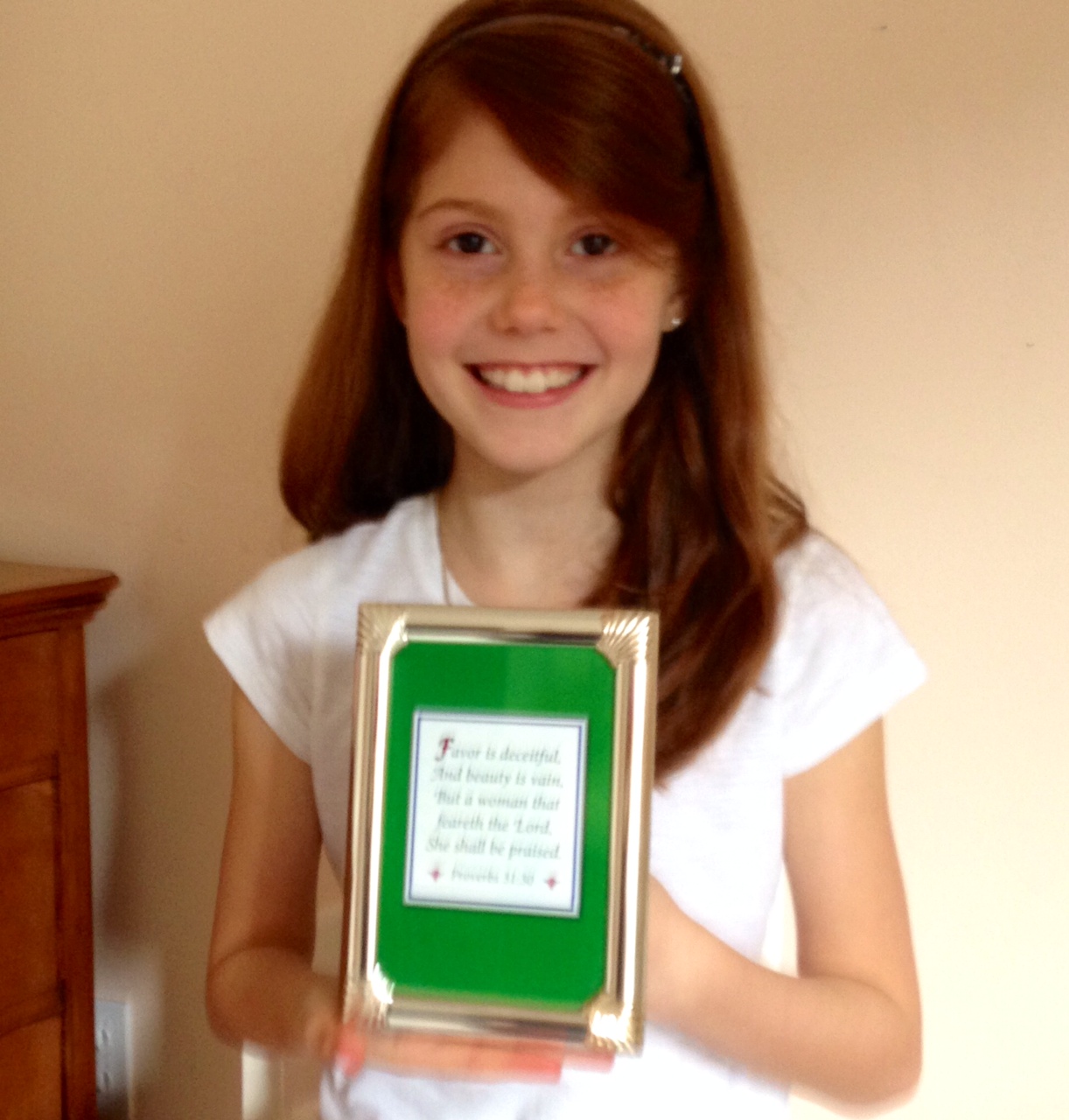
Even before she turned two, she would wake up, put on a gaudy plastic tiara and blue Lucite high-heels and toddle around her bedroom, every inch a princess. And there’s certainly nothing wrong with play-acting. But since then, in our Nana/Grand-daughter talks, I have reminded her that there are two kinds of beauty, the inside and outside kind. One lasts. The other one fades. Last year for her 9th birthday, her Grandpa and I collaborated on a gift to help her remember the meaning of inner beauty as she blossoms into a young woman.

It looked like this:

JennaFrame

 Here is the verse close-up:

03Proverbs_for Jenna_01gr_4x6

We have talked about the meaning of those solemn and ancient words from the King James Version: favor, deceitful, vain — and have discussed what the verse written centuries ago might be saying to a young girl like her today. She knows for sure that there is nothing wrong with being attractive, but looks are not the most important thing in her life.

to be continued . . .

Wanda’s Story

I don’t know Wanda’s last name, but I know what she looked like before/after her appearance on the TV show “What Not to Wear.” Hosts of the show, Clint Kelly and Stacy London, help Wanda, a family therapist from San Diego, transform from boring beige to beautiful blue. In the course of the metamorphosis, the 47-year-old career woman, reveals that she grew up in a Mennonite culture and thought of beauty as something “to be frowned upon,” something even “dangerous” to use her description.

Here is Wanda’s frumpy before and stylish “after” look:

WandaNotToWear

You can see her “before” pict and hear a snippet of her story on this short YouTube

For Wanda, no more “monochromatic modesty or khaki catastrophe.” She exclaims at the end of the show: “Now I can walk into the future with my inside and outside more coherent.” In the grand finale, a band of friends and relatives gather around the stage to applaud the transformed Wanda who glitters in stylish heels and a purple “date” dress.

As the banner on my welcome page shows (Mennonite prayer veiling paired with a pair of sassy red heels), I can certainly relate to Wanda’s viewpoint. You can read about it in a former post. My own metamorphosis from plain to fancy did not happen nearly as quickly as hers, but over the years I have tried to focus on the qualities that reflect inner beauty just as I try to model them for my grand-daughter Jenna.

What about you? Maybe you are not 40-something anymore. You might be 50, 60 or beyond. Still there’s beauty at any age. That’s certainly what I think.


Do you (as Wanda now thinks) believe your inside and outside appearance should match?

How do you define Beauty?

Coming next: Moments of Discovery: Mother’s Quilts


JennaDressedUp

Teaser or Cuppa Coffee?

What is your favorite warm beverage? It’s February, and by now you have tweaked the art of finding comfort in a cup. Is it tea, coffee or a hot toddy?

Maybe it’s hot chocolate!

CocoaToast


In promoting the Fifth Season of Downton Abbey, PBS used tea to tantalize. Twitter was chirping with the hashtag #BIGsip and illustrations of how to party like the British:

Screen Shot 2015-01-17 at 3.53.39 PMScreen Shot 2015-01-17 at 3.55.13 PM

The tea at these fancy gatherings was probably brewed through ceramic or metal sieves. I doubt there was a tea bag in sight!

BrewTea

Once I was invited to a tea party at my professor’s home. There was a bold disclaimer on the invitation: Tea will NOT be served. Instead, there were other fanciful beverages, none of which was served warm. Twice I invited faculty to my home, and we actually had flavored tea – and coffee.
tea labels

So, back to the question: What is your favorite warm beverage (and/or treat) this time of year? Spread some sugar, honey, or . . . .

CoffeeFriend

A woman is like a tea bag ~ you can’t tell how strong she is until you put her in hot water.   Eleanor Roosevelt

Bonus: RANDOM ACTS OF COFFEE! Coffee drinker pays it forward ordering coffee for the next 500 (gasp!) customers at Canadian coffee shop. Read all about it here!

Ice is Nice but Snow Glows

Do you have winter fun – sledding, tobogganing, ice skating, even skiing? Maybe now it’s a vicarious experience with kids or grandkids. I wrote about it last year in another post. Since then, I’ve paged through albums to find photos of our Floridian family having fun in the ice and snow.

For author Patricia Hampl, The Florist’s Daughter, winter fun was ice skating:

In winter, skating was even better, the whole body thrown into orbit. Ice-skating was my sport, the only athletic passion of my piano-playing, book-reading, indoor girlhood: A northern pleasure, a cold-weather art form   (129).


SKATING 

2000-_1200_Ian skating w Grandpa

Grandson Ian wobbly at first on cold ice on a warm day in St. Augustine, Florida. Outside temperature was almost 70 degrees, the ice got slushy, maybe a good thing for beginners.


SKIING  Gliding, sliding down a hill, that’s what skiing is under the best possible circumstances.

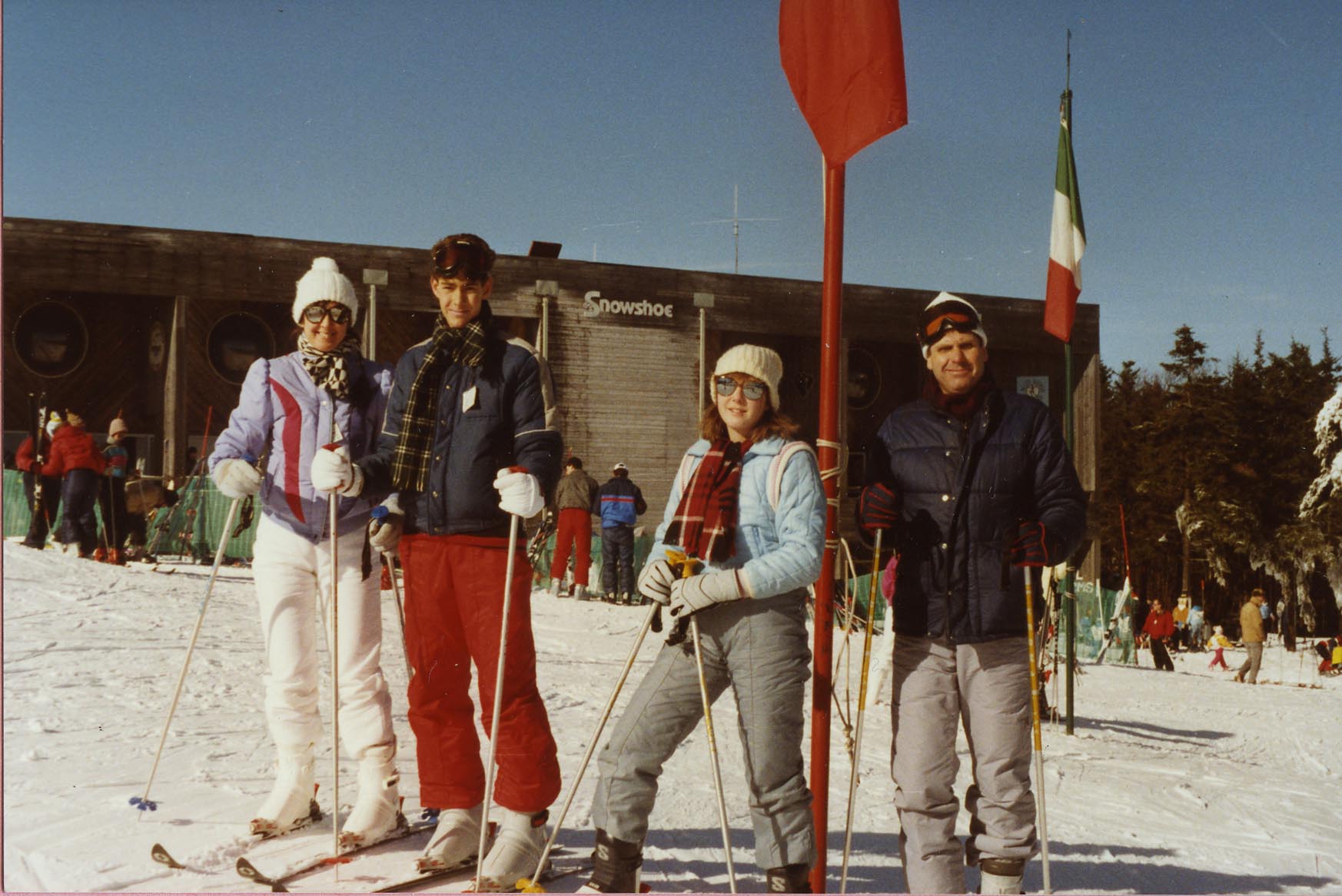
Before they left the nest, Joel and Crista with parents in Snowshoe, WV

1999_0100_Marian_Cliff_Snowshoe skiing

Hilarous fun: Helen and Charles Blankenship warming up with us after a cold day on the slopes at Lake Tahoe, Utah
What’s so hiliarous?: Helen and Charles Blankenship warming up with us after a cold day on the slopes at Lake Tahoe, California


SNOWFLAKES

Do you remember cutting out paper snowflakes like this?

SnowflakeFoldSnowflakeHalf

SnowflakeOpen

For detailed instructions with a video, click here.


Snowflakes make Emily Dickinson want to dance a jig, so she says!

Snow Flakes

I counted till they danced so
Their slippers leaped the town,
And then I took a pencil
To note the rebels down.
And then they grew so jolly
I did resign the prig,
And ten of my once stately toes
Are marshalled for a jig!


Your turn:  What is your winter fun? Sledding, tobogganing, ice skating, even skiing? Maybe now it’s a vicarious experience with kids or grandkids. We’re dying to find out.
Coming next: Teaser of Cuppa Coffee?

Acquainted with Grief: Author Elaine Mansfield Speaks

January 28, 2014 – It is six months to the day since Mother passed away. I feel melancholy now. Maybe the cold weather has something to do with it, but more and more I miss the warmth of our Saturday morning long-distance phone calls and sitting around her dining room table, the tingly warmth of homemade vegetable soup in my belly.

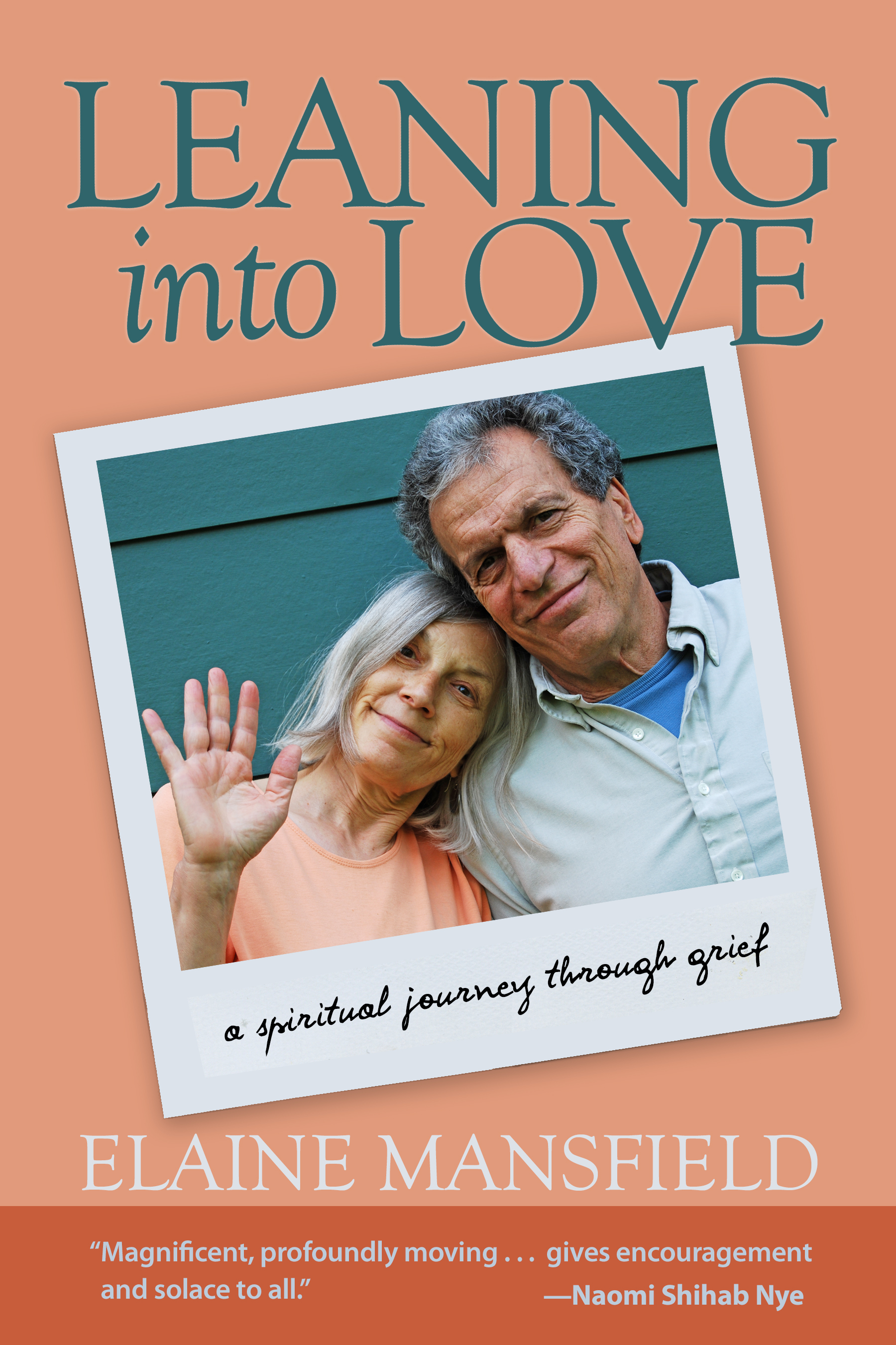
Elaine Mansfield too has experienced loss – of her mother and of her husband both in a 13-month time span. She eloquently records the loss of her husband in a memoir entitled Leaning into Love: A Spiritual Journey through Grief (October 2014)

LeaningIntoLove cover hi res

Elaine and I definitely differ in our world view and philosophy of life, hers based on Jungian psychology and meditation, and mine with a distinctively Christian perspective. Yet pain is pain, and we share the intimate, human experience of grief.

Here is our conversation about Elaine’s unique journey:

MB: How did your mother’s passing in 2007 affect you and Vic?

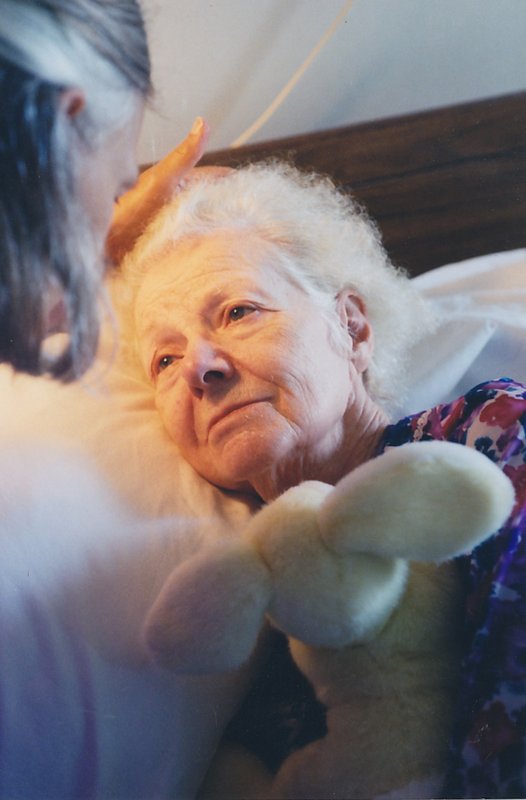
EM: My mom had Alzheimer’s Disease for twelve years. Her body was curled in a fetal position and her eyes were closed. She had been unresponsive for years. She died quietly during a lull in Vic’s cancer treatment, so grieving for my mother merged with anticipatory grief for Vic.

Iva_Elaine 2004


MB: Why did you write Leaning into Love: A Spiritual Journey Through Grief?

EM: At first, I wrote to digest and understand what had happened. When times are rough, I pay attention to life’s lessons. Writing was my way of doing that. During Vic’s illness, I kept journals so I could remember every detail during an emotional time. Five years after his death, my experiences became a book to help others deal with love and loss. I also hoped to create an engaging memoir that would interest any reader.


MB: What is the main theme of your book?

EM: The book is about a strong marriage and the initiation of losing a trusted partner: dissolution of the old order, then a period of confusion and despair, then a slow return to new life and possibility.


Vic & Elaine 1968


MB: In the book you promise your dying husband of 42 years, “I’ll find a way to be all right.”  What lies behind this statement?

EM: Vic and I shared every joy, sorrow, and dream. We’d had an intimate relationship since I met him when I was 21. He was concerned about leaving me and concerned about my grief. Even while I did all I could to help him live, I felt determined to find a way to make life work after his death. He was relieved when I said so. Of course, I had no idea how challenging that would be.


MB: Just like in your blog posts, you use poetic language in your book to describe bereavement and your slow recovery. For example, you describe a group of dolphins as “luminous revelations leaping from the great unconscious sea.” What other descriptive lines from the book are you especially proud of?

EM: “Our first kisses taste of tears and the knowledge that our time together is finite.”

“Mostly he sleeps, but when he’s awake, he whispers words of sweet gratitude.”

“Despite my better judgment, hope floats in, ethereal and transient as a feather.”


MB: What will readers learn from the book? What is the take-away?

EM: Everyone loses things they love—people, jobs, homes, health, dreams. It’s natural to grieve and long for what we cherish. I’ve learned that facing our losses and sorrows makes us more realistic and open-hearted human beings. We understand what matters in life and see that everyone suffers. In this way, sorrow leads us to kindness.


MB: Your book attracts readers who have dealt with or are now dealing with loss. What is your best advice to them?

EM: Experiment and find what comforts you: solitude, friends, nature, music, therapy. The smallest rituals helped me. I left flowers at the gravesite and said prayers there. Writing brought me daily comfort.

Watch for small signs of joy and hope. A bird chirping. The first spring flower. A child’s laughter. Grief is part of life. Give yourself time to feel what you feel. Open to grief and let it open your heart to love.

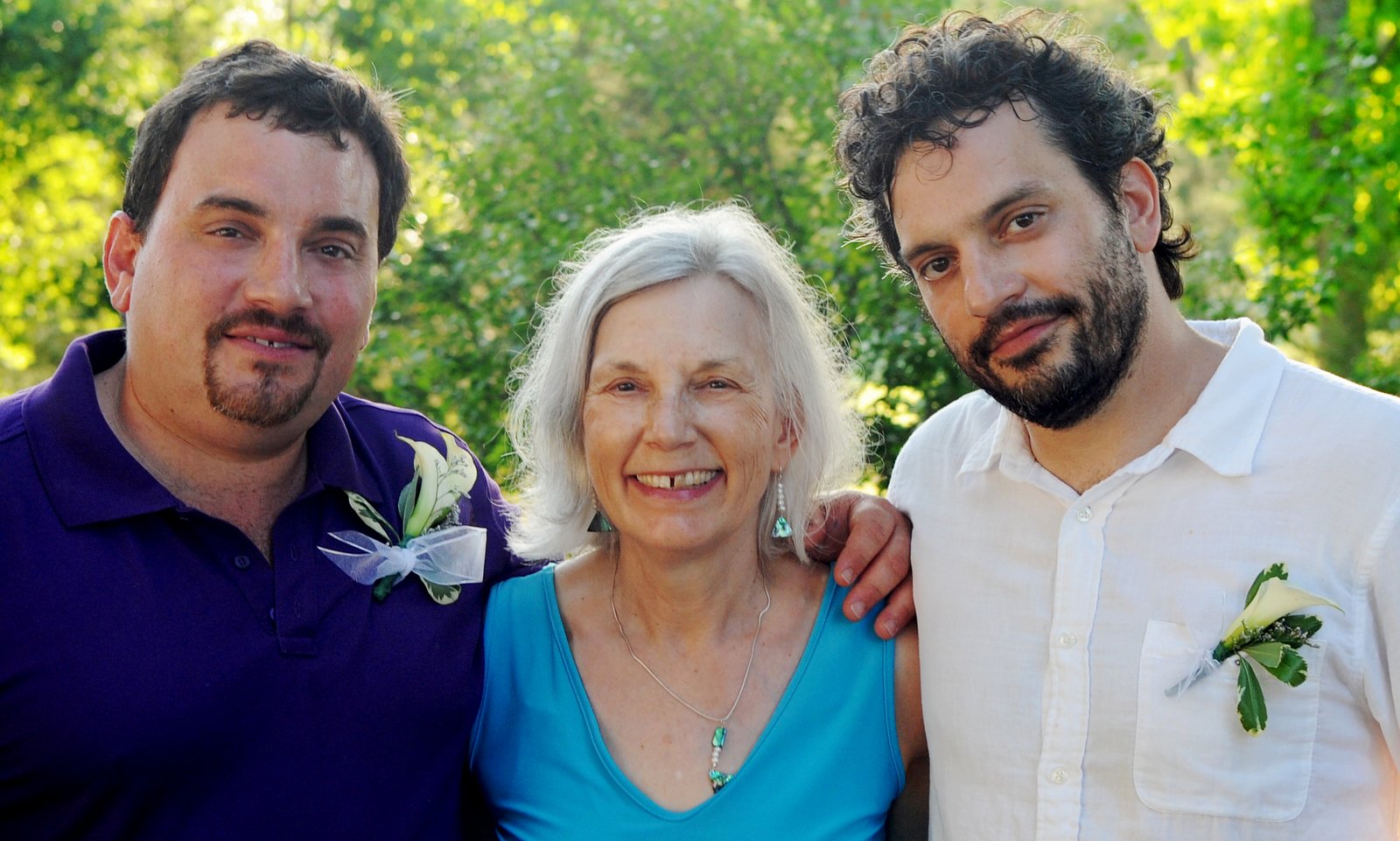
Elaine with her sons David and Anthony


Her biography

Elaine Mansfield’s book Leaning into Love: A Spiritual Journey through Grief was published by Larson Publications (October 2014). Elaine writes from a spiritual perspective that reflects over forty years as a student of philosophy, Buddhism, Jungian psychology, mythology, and meditation. Elaine gave a TEDx talk called “Good Grief! What I Learned from Loss” on November 8, 2014 with TEDx ChemungRiver at Corning Museum of Glass in Corning, NY.

After a career as a health counselor and writer, Elaine’s work has focused on bereavement and loss since her husband’s death in 2008. Elaine facilitates bereavement support groups at Hospicare and Palliative Care Services in Ithaca, NY and writes for the Hospicare newsletter and website. She also writes a weekly blog about the adventures and lessons of life and loss, leads workshops, and lectures on bereavement topics. Her articles have been published in The Healing Muse, Open to Hope, Shambhala Sunspace, KirstyTV, Caring.com, Alzheimers.net, GriefHealing, and elephantjournal.

About Leaning into Love:

“Reading this beautiful memoir of love and loss and triumph felt to me like a sacred journey into the very heart and soul of the courageous woman who writes it.” Marty Tousley of Grief Healing.

“Not only a touching and courageous memoir about love, illness, death and grief, Elaine Mansfield’s Leaning into Love is a manual for healing that offers us the emotional and spiritual tools needed to grow and even flourish through Life’s deepest crises.” Dale Borglum, Living/Dying Project

Buy the book

See her website

Hear her TEDx talk


They say that “Time assuages” –
Time never did assuage –
An actual suffering strengthens
As Sinews do, with Age –

 Emily Dickinson

Mother Ruth Metzler Longenecker    1918 - 2014
Mother Ruth Metzler Longenecker  1918 – 2014

How about you? How have you dealt with grief over the loss of a loved one, mother, father, life partner, close relative — a pet, even?

Signs and a Wonder: St. Simons Island

Nestled in the marshes east of Brunswick, Georgia, is charming St. Simons Island. Golfers, bicyclers, and fishermen revel in its delights. Fresh Atlantic shrimp were available at the Mullet Bay Cafe during our week-end getaway. Tourists, like us, strolled along the streets of St. Simons village, canopied with centuries-old live oaks.

OakStSimons

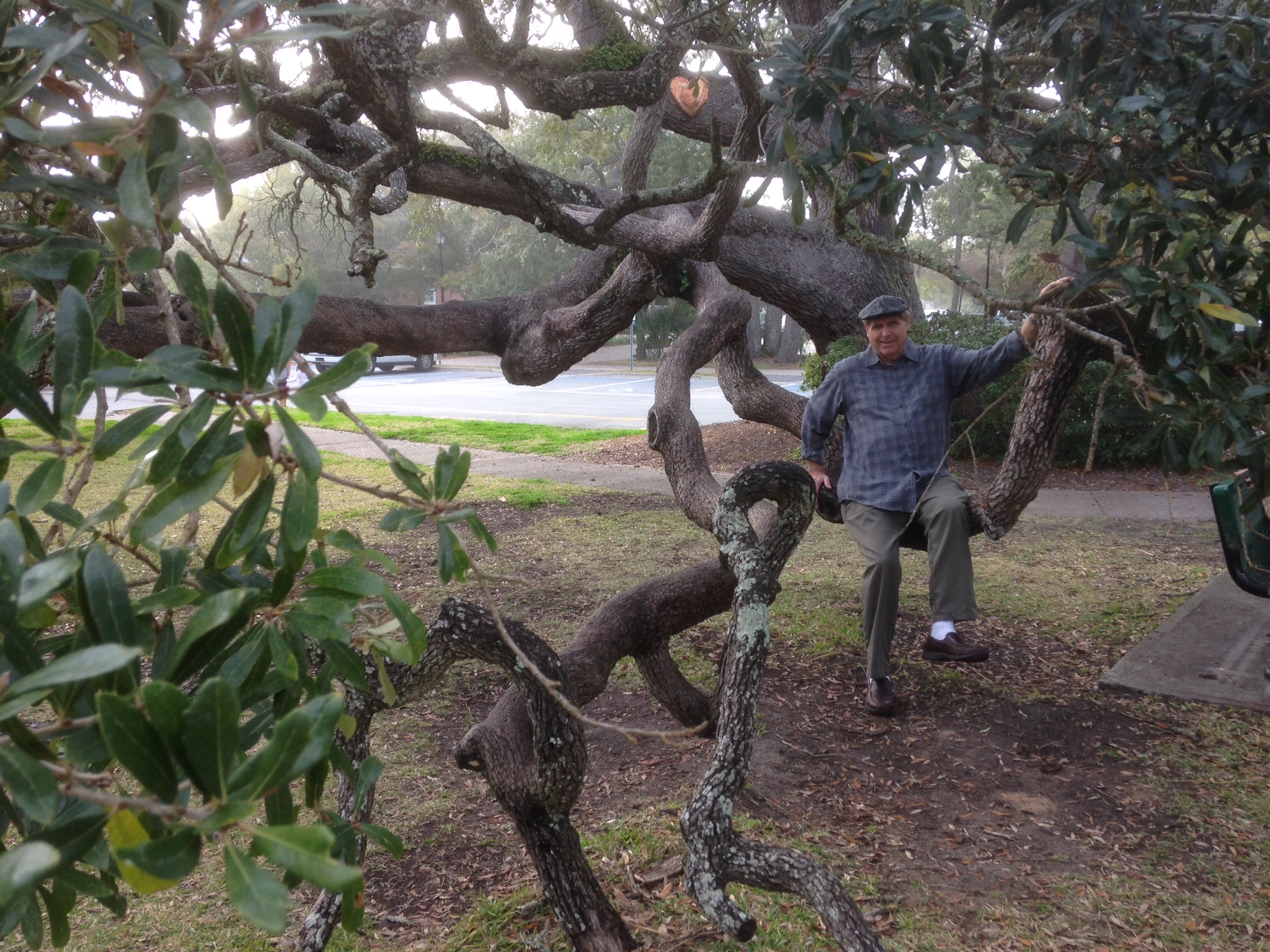
Some of the oaks had mutated into this:

GnarlyOak

Here the limbs from ancient live oaks gracefully curved downward, touched the soil, forming a self-sustaining tree, and then over the years grew upwards until it grafted into its mother tree, a type of amazing Möbius structure.

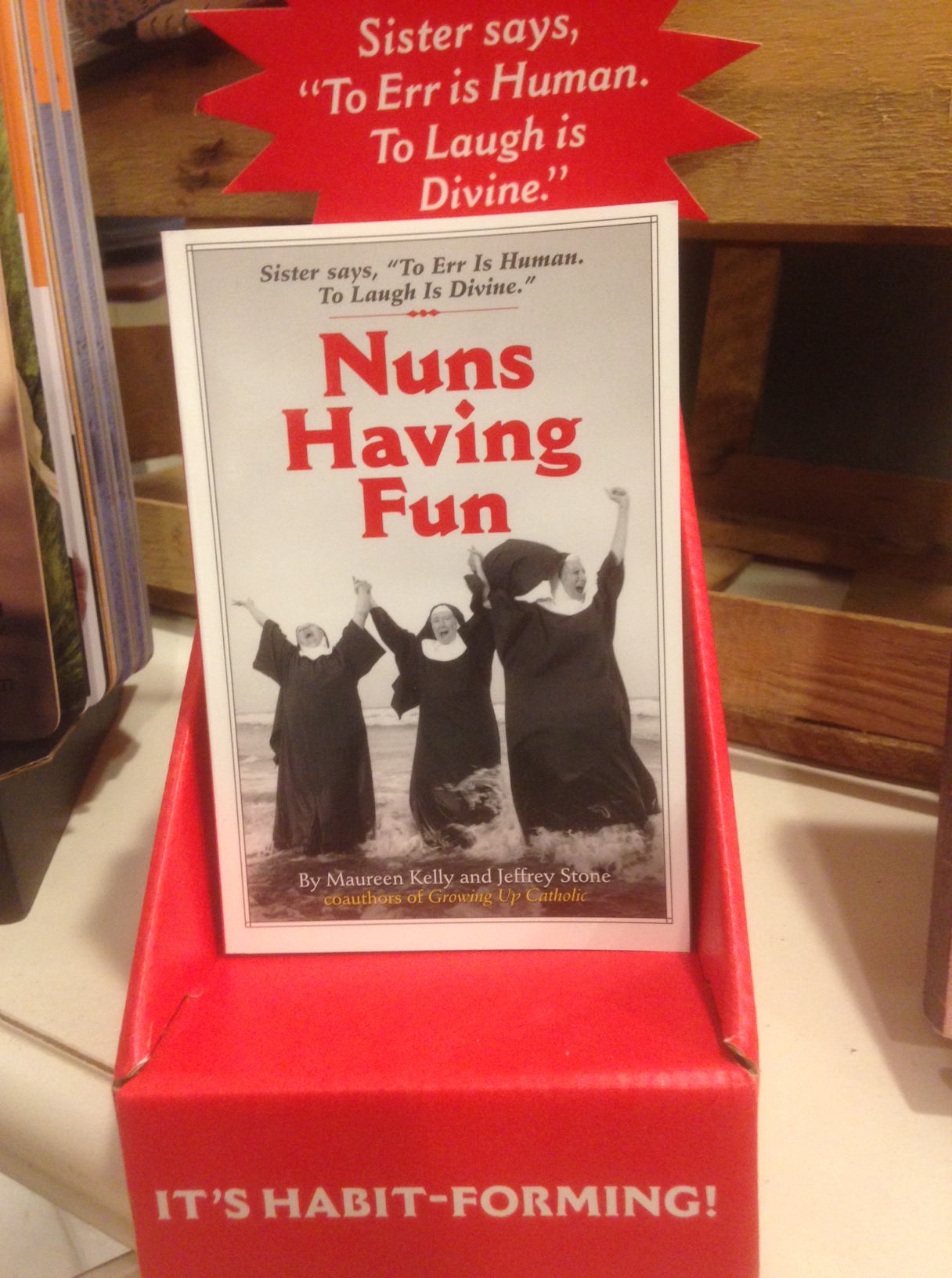
Cute shops, one which boasts “Extraordinary Things You Don’t Need,” display books, curios and signs like these:

RedneckHornCondimentSignNunFunSign

And for the canine lovers:

DogBook


If you are crafty, Pane in the Glass is your source for stained glass hobby supplies. You need a week, not just a weekend to explore St. Simons Island.


Away from town, two other attractions grabbed our attention: Fort Frederica, a military town on the colonial Georgia frontier, which defended the settlers from Spanish invaders and Old Frederica Church, also called Christ Episcopal Church, where Charles and John Wesley preached.

In 1961 author Eugenia Price discovered St. Simons Island on a book-signing tour, “In the cemetery for Christ Church, she saw a tombstone for the Reverend Anson Dodge and his two wives. This inspired her to research the area, including history and famous figures. She would spend the remainder of her life writing detailed historical novels set in the American South, many of which were critically acclaimed. Her early works, particularly the “St Simons Trilogy” which consists of the books “The Beloved Invader” (1965), “New Moon Rising” (1969) and “Lighthouse” (1972) were extensively researched and based on real people.”

Finally, we behold a lovely wonder, the signature stained glass window in the church, depicting the original plain structure, which could easily pass for an early Mennonite meetinghouse, without the steeple of course.

FredericaChurchStainedGlass


Have you visited an historic town recently?  A charming town you can recommend for a weekend getaway?


Coming next: Mad, Sad, Glad: Emoticons Show It All

Moments of Discovery # 4: A Flash Bulb and a Doll

A snapshot of a baby boy dressed as a girl and an old flash bulb. Those are some of the items we find clearing out Mother’s house. Last October my sisters and I began the arduous task of sorting, saving, or recycling the accumulated store of her possessions having lived in the same house for over 73 years. You can read about it here.

BoxesPacked

Today’s post features snapshots, both photos and artifacts, from both Mother and Daddy with a surprising find at the end.

MOTHER: Some of what I found from Mother could be filed into 3 categories of nurturing:

Feed

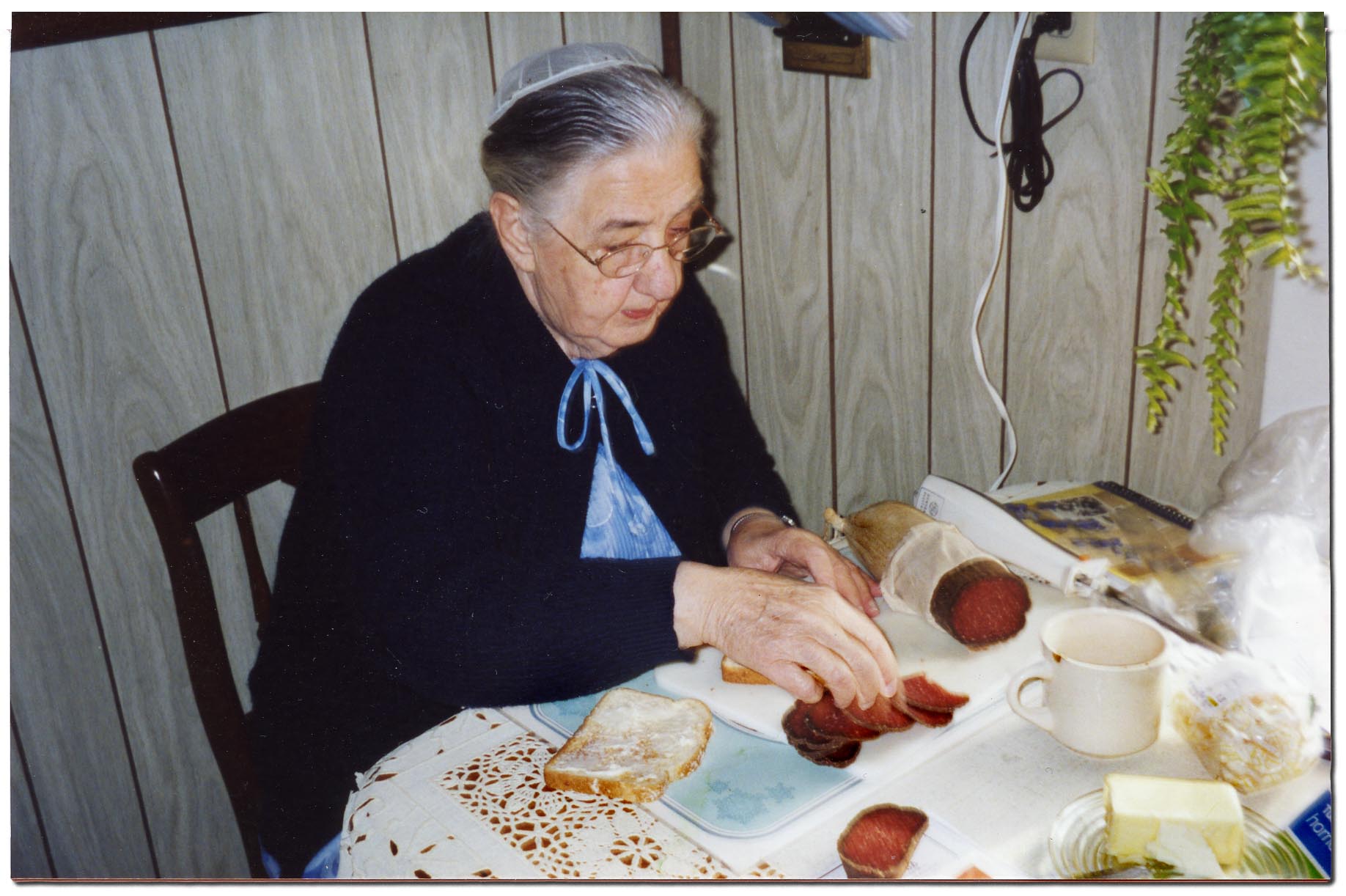
Our metal lunch pails carried many a bologna sandwich, usually Baum’s Bologna from their shop north of E-town. After Mother pulled back the burlap, she sliced thick rounds for sandwiches on buttered bread – always butter . . .

Mother L_balogna sandwiches

Read

Every picture, every story seems familiar in this Bible Story Book with pages, crackly brown with age. Sniffing into the spine, I roll back in time to the little girl on her lap. I loved the art work then. Now I love its charm even more. Did Daddy read these stories to me too? Maybe so, but I can’t remember.

BedtimeCoverBedtime Preface

Remember

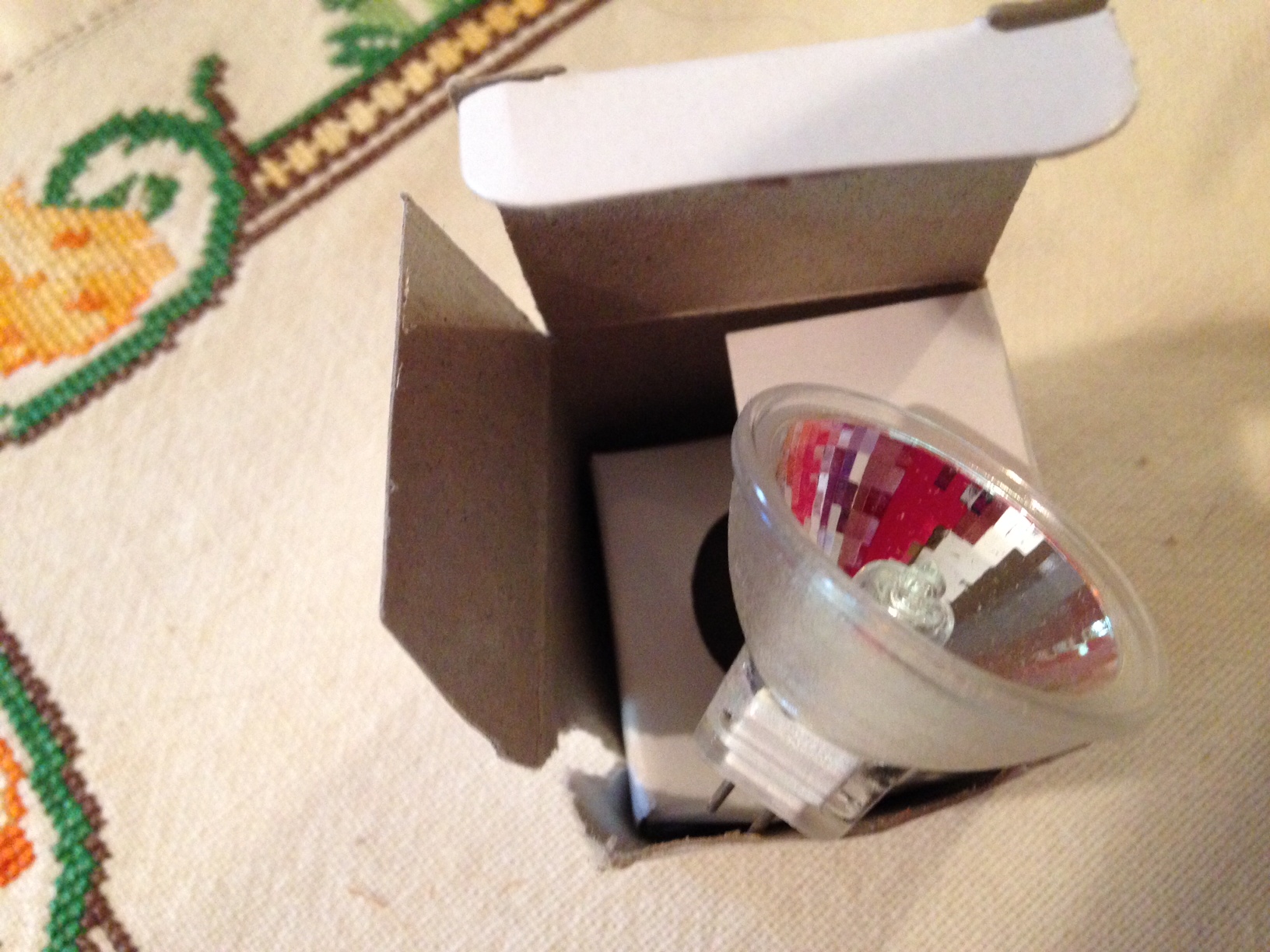
Cameras freeze time, preserving memories. Mother didn’t write in a journal, but she consistently recorded our family’s story over time. The old box camera is long gone, but here is a “flash” of memory possibly from her last camera . . .

FlashBulb

DADDY  Some of what I found representing my father was surprising:

Although I have several photos of Daddy holding me as a baby, my father was a man’s man: a tractor-driving, motor-fixing, field-plowing, deer-hunting guy. He even hammered on the piano keys. His work clothes were of black moleskin cloth, matching the grease he was in close contact with at the shop. I am certain he never wore pink. Yet here he is posed for the camera in a dress, flanked by his parents, Henry and Fannie Longenecker, my Victorian grandma not yet attired in Mennonite garb that would characterize the rest of her life. Daddy’s dress is not a christening outfit. There was no christening among Mennonites. I suspect that babies of both genders wore dresses to make diaper changing easier.

Henry and Fannie Longenecker with son Ray

Needlework

Our scavenging took us to the attic chest filled with treasured quilts. My sister Jean and Mother tagged each one a few years ago, so there would be no doubt as to their provenance. Apparently, Daddy drew his needle through a white quilt, stitching animals in red. I see a camel, sheep, chicken, pig, duck, an elephant. Even an ostrich.

Here is just a teaser. (Look for Daddy’s full quilt on a later post!)

Quilt with animal stitching by my father, Ray M. Longenecker

Nickname

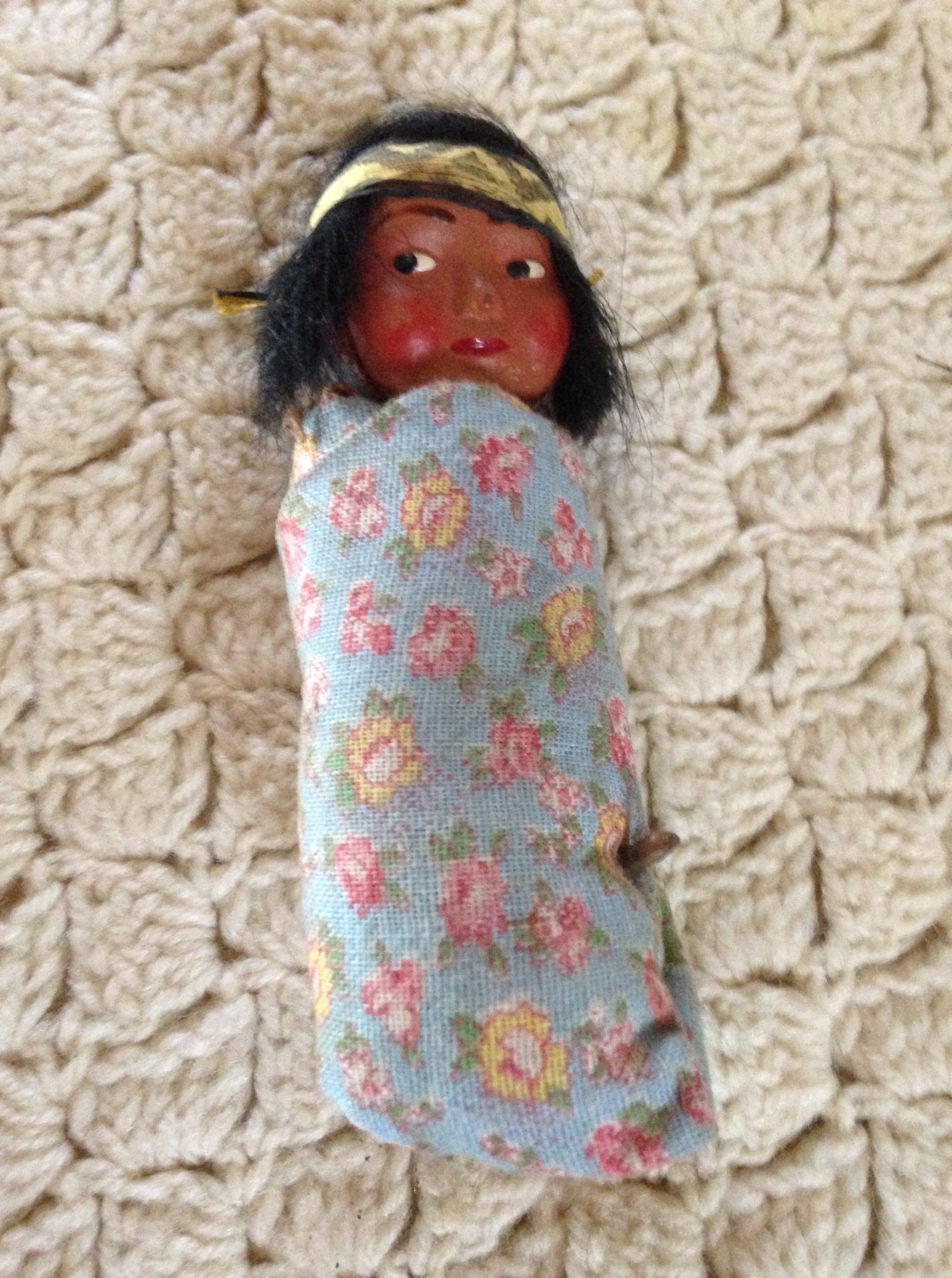
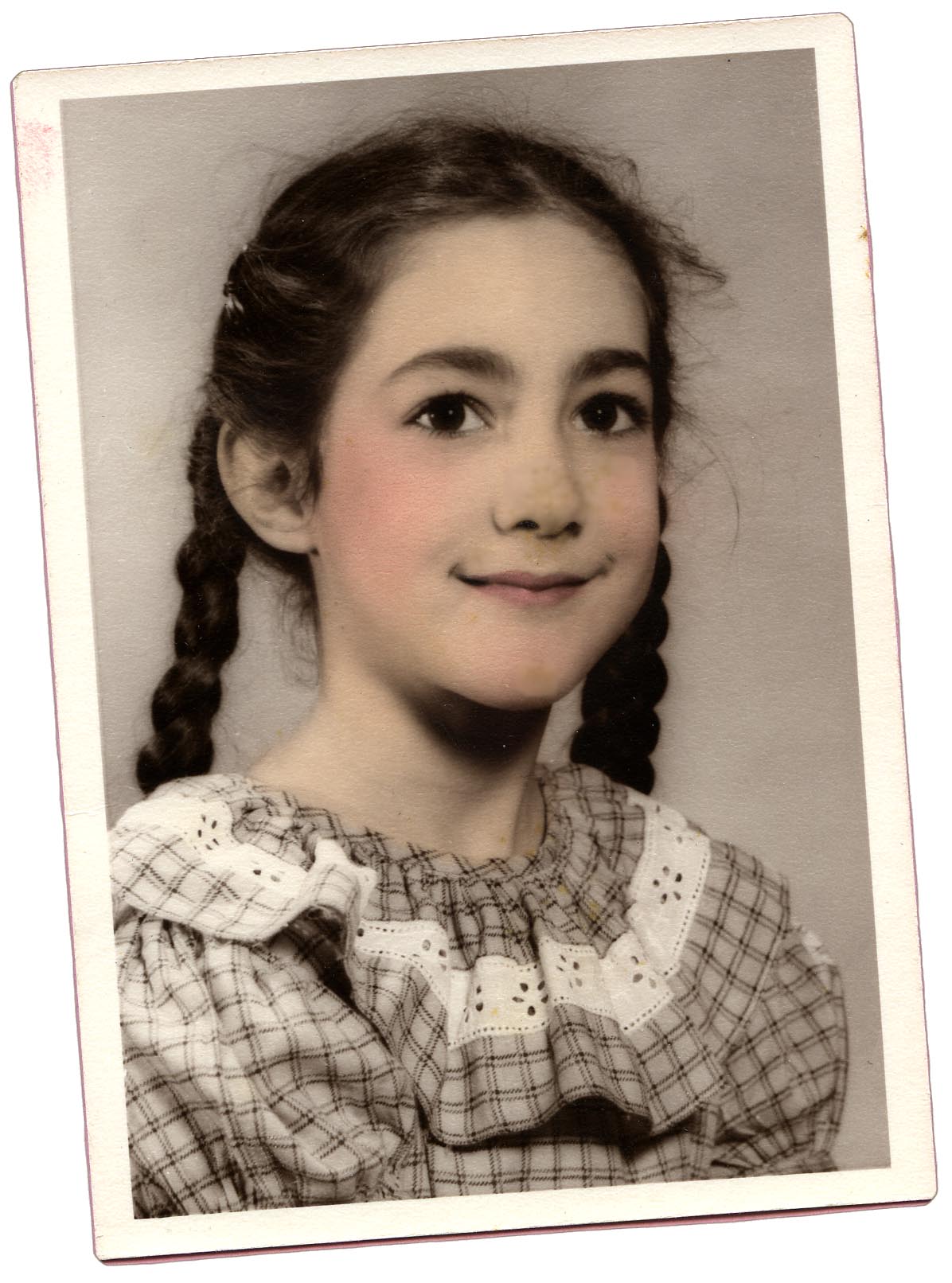
Daddy’s nickname for me was Pocahontas, not so much because I looked native American, but probably because of my thick, dark braids and big eyes. When I found this doll, I decided it shouldn’t be given away, sold, or recycled. It now sits on the dresser in our bedroom with “strubbly” hair, not braided!

Pocahontas

Marian w braids_K-

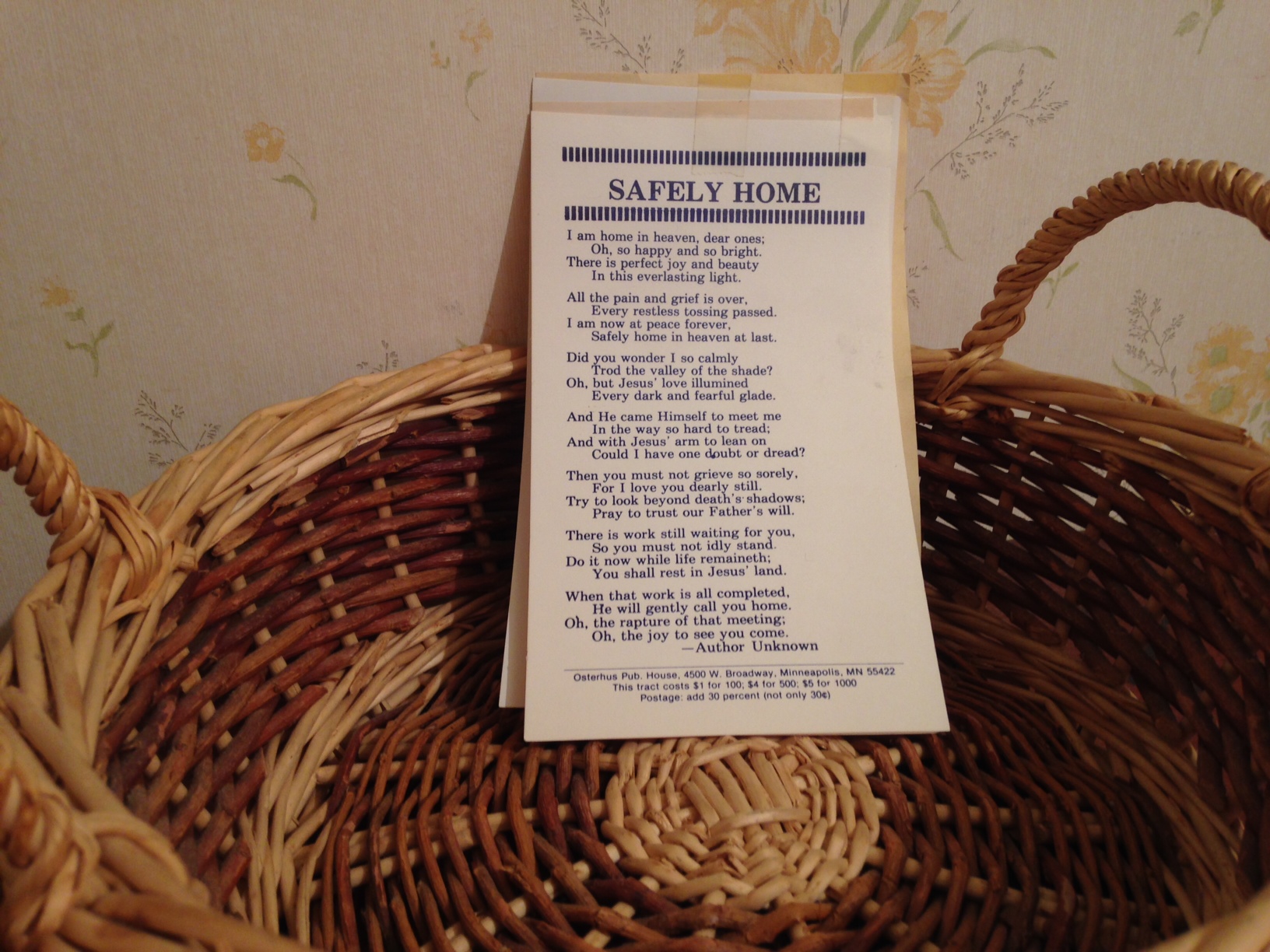
Final Note: A Curious Find   On our first visit to Mother’s house in October after the funeral, we saw a wicker basket on top of a hallway chest with a poem entitled “Safely Home,” something we had never noticed before. Were we blind to it earlier? Having a premonition of what was to come, did Mother put it there for us?

SafelyHomeBasket

I am home in heaven, dear ones; / Oh, so happy and so bright. / There is perfect joy and beauty / In this everlasting light . . . .

 (Anonymous, Osterhus Publishing House)  . . . a mute but eloquent affirmation


Your turn: Are you holding on to something you treasure from a loved one? A photograph? A small gift? 

2014 in review: Plain and Fancy Girl

The WordPress.com stats helper monkeys prepared a 2014 annual report for this blog. Readers and commenters like you fuel my inspiration. Thank you for your part in a successful year of blogging.

Here’s an excerpt:

The concert hall at the Sydney Opera House holds 2,700 people. This blog was viewed about 24,000 times in 2014. If it were a concert at Sydney Opera House, it would take about 9 sold-out performances for that many people to see it.

Click here to see the complete report.