Did you ever have a Pollyanna? A secret pal back in the days when mail traveled only in paper envelopes with postage?
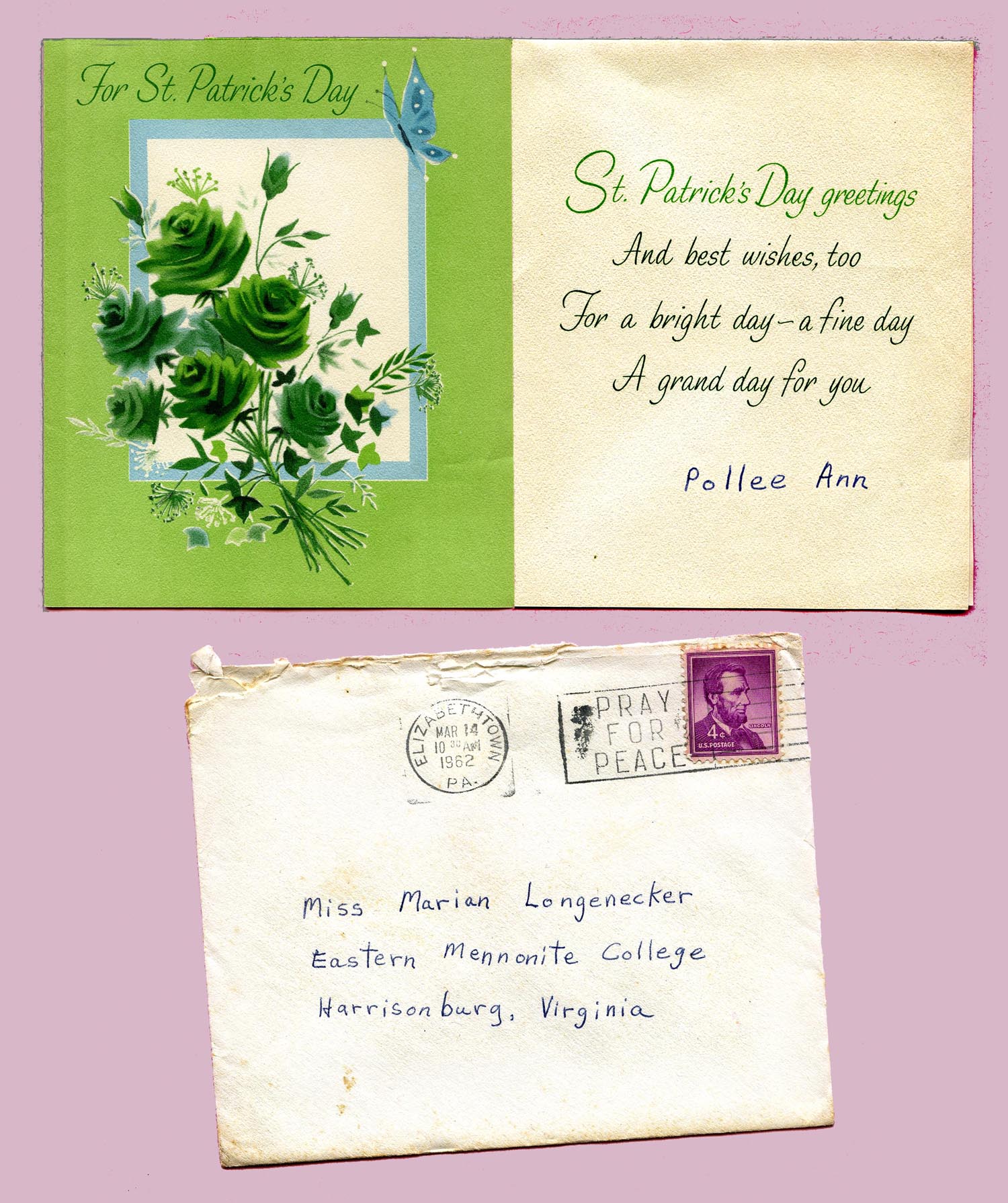
As I was going through one of my Boxes under the Bed, I found this quaint gem sent to me at college in celebration of St. Patrick’s Day, March 17. The charming card is signed Pollee Ann, obviously a reference to the main character in the children’s book series Pollyanna by Eleanor H. Porter, who finds the glad in everything. Though she was tragically orphaned and sent to live in the home of her gruff Aunt Polly, 11-year-old Pollyanna has come to represent eternal optimism as she spreads cheer, sometimes secretly, all around town.
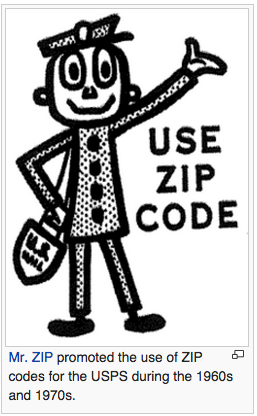
My secret pal spells her name “Pollee Ann,” an interesting sobriquet for Pollyanna. And the card reached me in spite of the fact there is no street address or zip code, not introduced into the postal system until 1963. The termZIP, an acronym for Zone Improvement Plan,was chosen to suggest that “mail travels more efficiently, and therefore more quickly (zipping along), when senders use the code in the postal address.”
Image: Wikipedia
Have a Zippy St. Patrick’s Day!
Some celebrate St. Patrick’s Day by baking/eating cupcakes or cookies with green icing or wearing a shamrock pin. How do you celebrate St. Patrick’s Day?
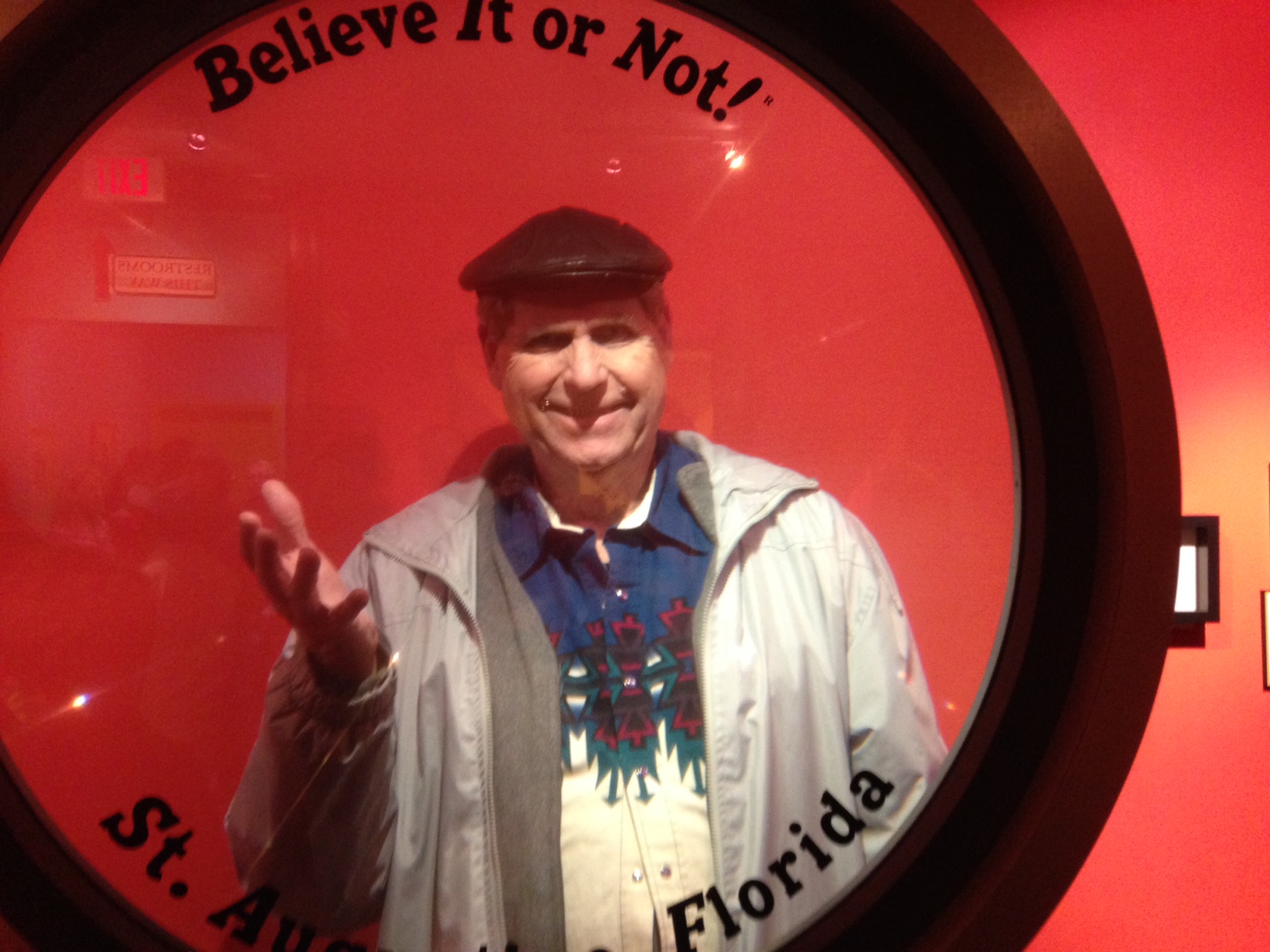
Recently Grandpa Cliff and NaNa Marian took the Beaman boys to the Odditorium (not a misspelling!) of Ripley’s Believe It or Not in St. Augustine Florida.
The Saturday excursion was billed as a Mystery Trip, so the boys didn’t know exactly where they were going, but they did know it would be fun. After a 40-minute drive south from Jacksonville, the Mystery Bus with windshield wipers chugging away pulled into the very last parking space at Ripley’s.
Ripley’s Believe It or Not is a franchise with various locations nation-wide, dealing in “bizarre events and items so strange and unusual, that readers might question the claims.” Some of the 20,000 photographs, 30,000 artifacts, and more than 100,000 cartoon panels in the collection are displayed here at The Oldest City location.
Some of the jaw-dropping oddities we saw:
Lord’s Prayer etched onto the head of a pin
This prayer also etched onto a grain of rice
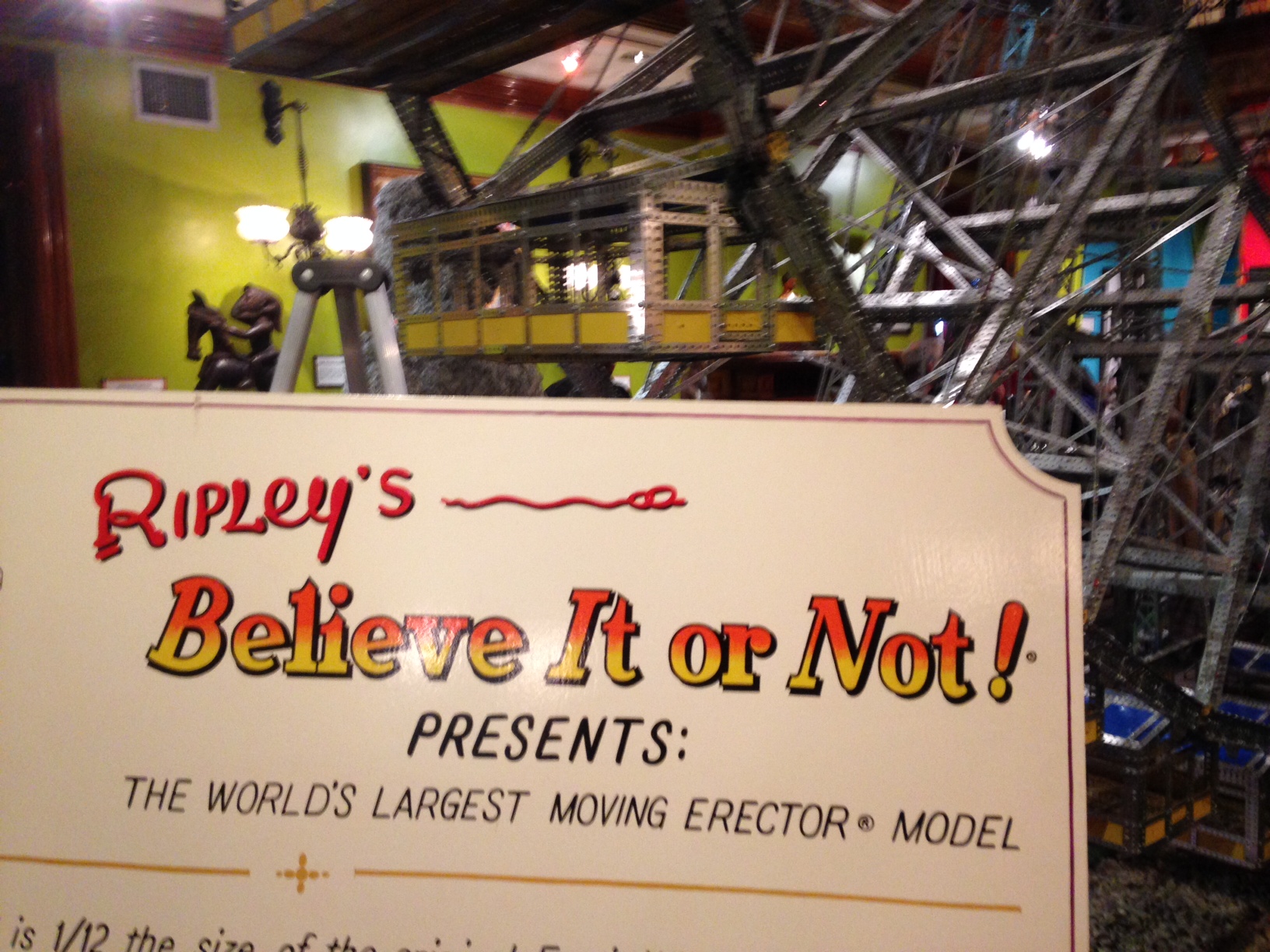
Erector set parts made into the World’s Largest Ferris Wheel model
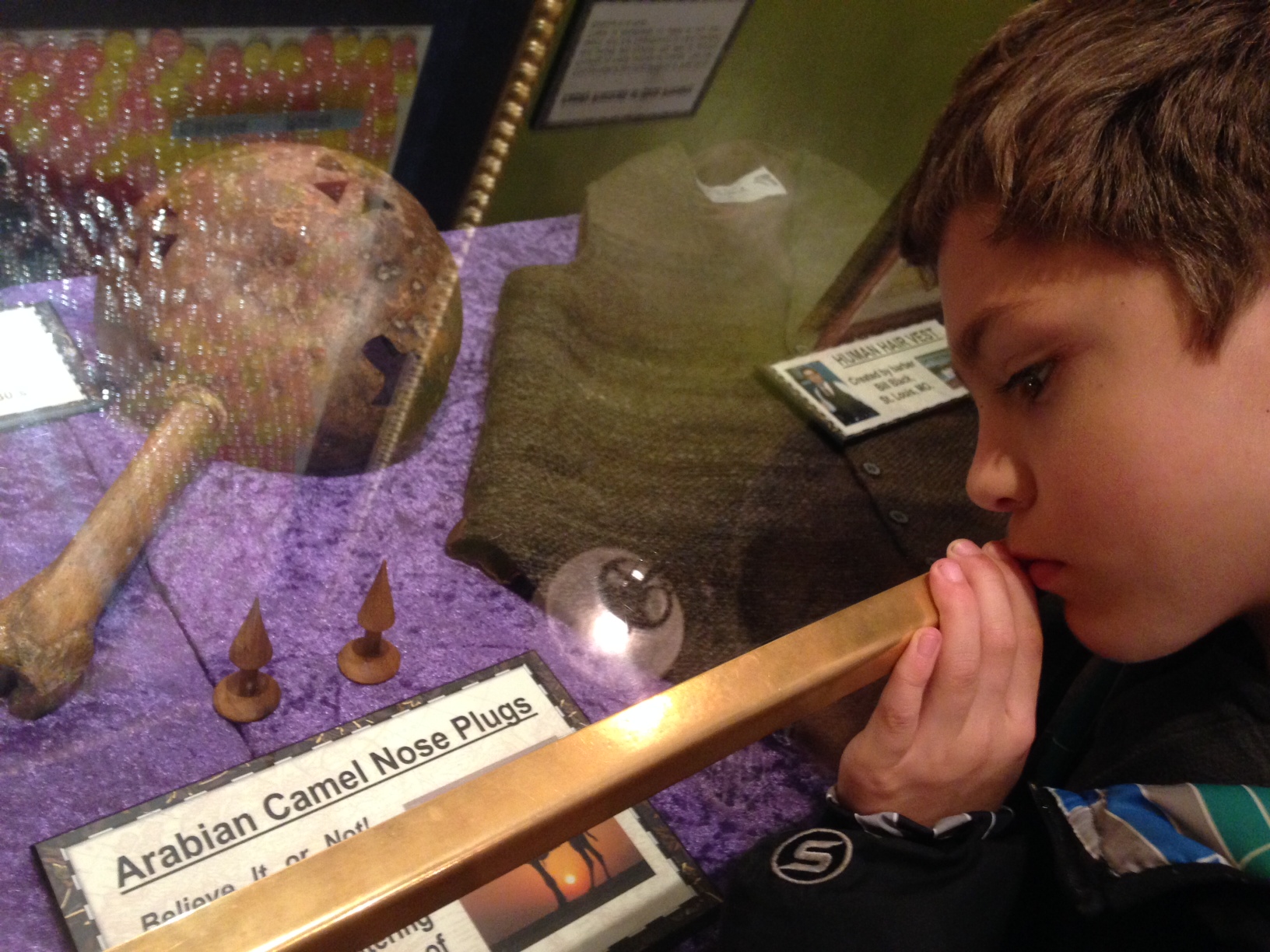
Arabian camel nose plugs
Replica of the Notre Dame Cathedral constructed with over 160,000 match sticks
Voodoo doll in an ancient basket
Mannequin of man weighing over a half ton
Model of Notre Dame Cathedral constructed of 160,000 match sticks
And this one took me back in time, Curtis and Ian looking at the Lord’s Prayer etched on a grain of rice through a microscope . . .
Seeing the back of Curtis’ head (on left) reminded me of our son Joel’s image at a similar age. So I flashed back in time, and then I was struck piercingly into flash forward motion with the thought that grandson Curtis will be in middle school in the fall. With poet Percy Bysshe Shelley, I lament “O World! O Life! O TIme! (Where has all the time gone? Not long ago he was just entering first grade!)
A few weeks ago, Shirley Hershey Showalter, who publishes weekly Magical Memoir Moments, posed an engaging prompt for writers. In the March 3, 2015 edition she took her readers on a visit to the Wheel of Time. Looking at a photo of her grandson Owen staring out the window watching his mother leave for work, Showalter imagines what his thoughts might be. She remembered a similar moment years ago when her own son, perhaps wistfully, watched her leave the house for her job. Then she poses two questions for her readers:
When was the last time something pierced your heart?
Did it ignite the Wheel of Time in you?
Contemplating the second question as I gazed at Curtis and Ian, I realized a ping of joy along as three thoughts came to mind all at once: We are blessed to have them, their whole life is ahead of them, and as the photo seems to suggest, they are facing forward to meet the future . . .
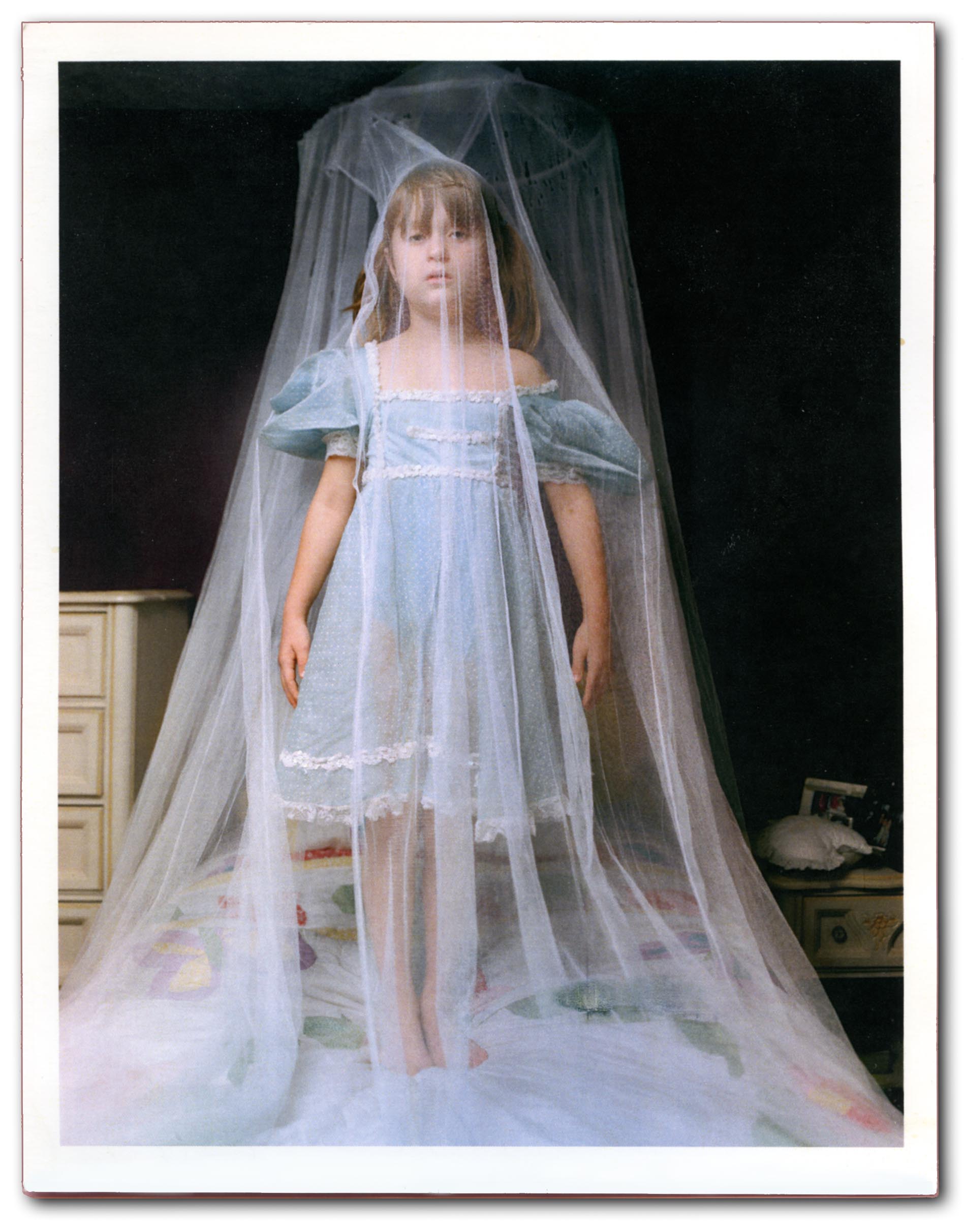
Photographer Angela Strassheim, in a recent exhibition at Jacksonville’s Museum of Contemporary Art, specializes in framing the lives of her nieces and nephews as they pass through early stages of their lives. Her collection illustrates the precious, fleeting nature of childhood and adolescence. One photograph that caught my eye was the “Girl in Blue Dress” which depicts a pixie princess frozen in a childhood phase that evaporates all too quickly. This large photo of Strassheim’s niece with dimensions of 75 x 60 inches, probably foreshadows the young girl becoming a married woman, draped as she is now in a canopy over her bed that seems to mimic a bridal veil.
Robert Ripley is right. Life is full of mystery and awe. Sometimes it’s un-unbelievable too!
Your thoughts are always welcome here. Do join the conversation . . .
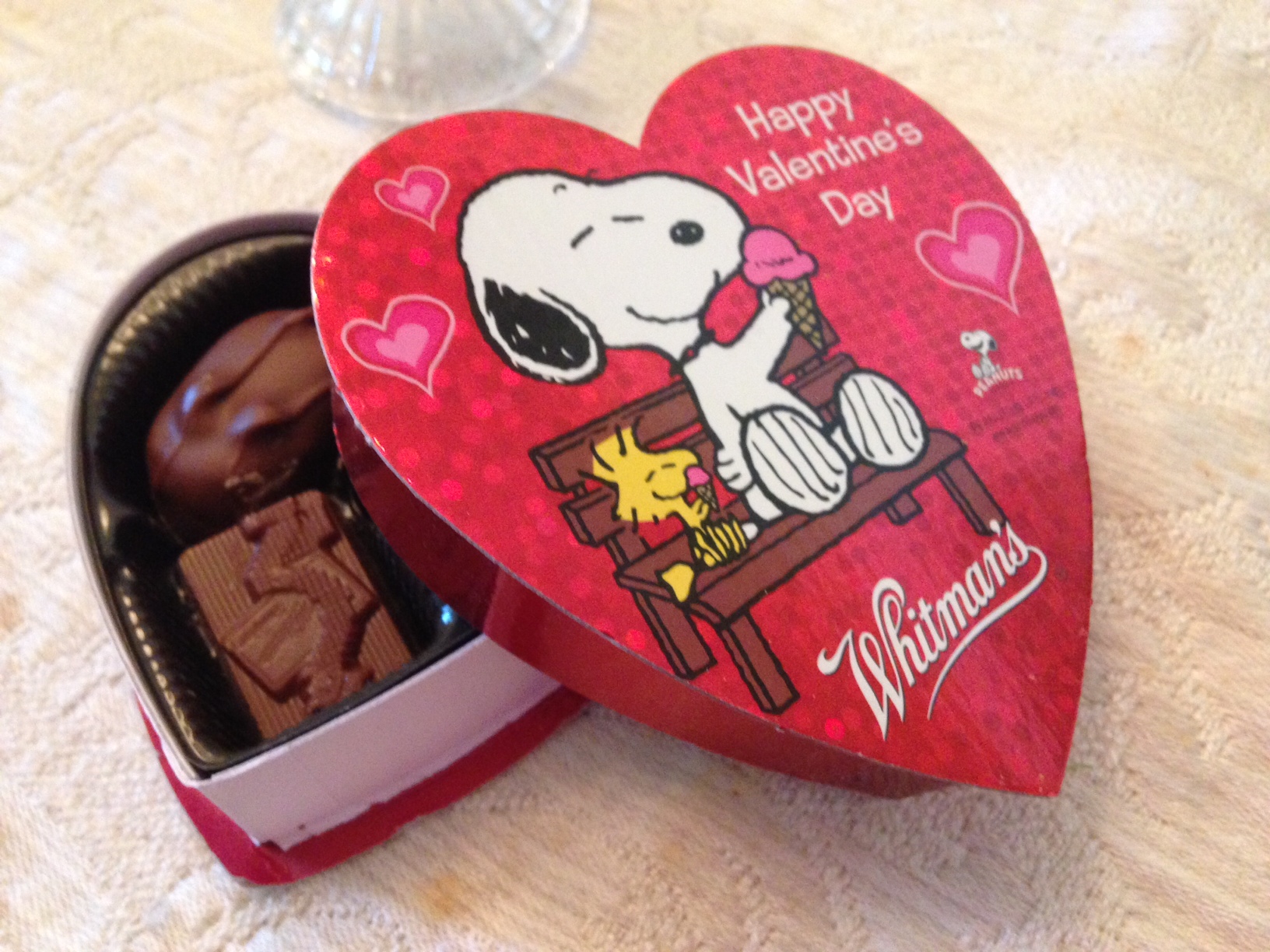
Actor Tom Hanks in the movie Forrest Gump tries to strike up a conversation with a tired nurse seated beside him on a park bench. Holding a box of chocolates in his hand, Forrest offers her a treat, “My mother always said, “Life is like a box of chocolates. You never know what you’re gonna get.” You remember the scene. Here is a 38-second clip from the movie:
“Health by chocolate” is one of the phrases that popped up on the web when I researched the health benefits of eating chocolate, which may stem from the antioxidant flavonoids find in the cacao bean. Another website listed 9 benefits of eating chocolate. Rich and delicious dark chocolate especially (at least 70 % cacao, a disease-killing bullet) is “good for more than healing a broken heart” it touts.
Among the nine benefits included in this article were a healthy heart, possible weight loss (because it lessens one’s cravings for other sweet, salty, and fatty foods), stress reduction, and even higher intelligence in the short term because chocolate boosts blood flow to the brain.
The box of chocolates Forrest Gump was holding contains way more calories than this article suggests because the candies were probably filled with nougat, sweet cherries, caramel, and other taste-bud ticklers. But he’s right, unless the box lid is imprinted with the different flavors, you never know what you are going to get. Usually, though, the surprise is pleasant.
In the 2000 movie Choclat, Vianne Rocher, played by Juliette Binoche, tries to guess Roux’s (Johnny Depp’s) favorite chocolate confection. Vianne tries more than once to offer the treat that will get an “Aha” from him, including presenting him with one in a special white box. Later she succeeds unexpectedly as you can see here:
l
Receiving or giving a box of chocolates (or even savoring hot chocolate) is a welcome experience any time of year.
What is your relationship with chocolate? What is your favorite kind of chocolate?
My high school yearbook The Elizabethan sports such 3-syllable last names as Aschendorf, Biesecker, Espenshade, Hippensteel, Oxenrider, and Zimmerman. In Lancaster County, Pennsylvania any roster of names would be heavily represented by families of German-Swiss origin.
Yes, there were Smiths, McLaughlins, and Youngs, but the Pennsylvania Dutch names far outnumbered them. On class rosters there were no names from the Cyrillic alphabet like Lyashchenko or like Chang, formed of Asian characters. Not a one. Yet as our world has grown more culturally diverse, so have the class rosters and phone directories of small towns like Elizabethtown, Pennsylvania.
In the January 6, 2015 edition of Performance Today, Fred Child referred to a list of musicians with jaw-breaking names. You can find the complete list on their Facebook page, but here are a few choice ones:
Composer Carl Ditters von Dittersdorf
Conductor Hans Knappertsbusch
Poet Walther von der Vogelweide
Composer Einojuhani Rautavaara
Composer Heinrich Ignaz Franz von Biber
Conductor Gennady Rozhdestvensky
Musicologist Cuthbert Girdlestone
Tenor Wolfgang Windgassen
Ditters von Dittersdorf rolls most trippingly off the tongue as does the very onomatopoetic Windgassen. Imagine a tenor named Wind-gassen. Or even a wood-wind player with such a name!
My journal of our trip to the English countryside records place names that also tickle the tongue and the funny-bone. As I admonished my husband/driver to keep left while driving with a right-sided steering wheel, cute towns whizzed by with no-kidding names like Gigglewick, Blubberhouse, Wigglesworth, Nook, Cow Brow, Button Moon, and Hutton Roof. No, I didn’t make these up! There was even a Curl Up and Dye Hair Salon.
In Scotland menus feature haggis (chopped sheep hearts, livers, mixed with oats and spices), bashed neeps (turnips), and champit tatties (mashed potatoes). In Ireland we encountered the quaint village of Ballyvaughan, and Cairig Beag, a Bed & Breakfast not far from the town of Sneem with houses colored bright orange, Kelly green, and sunny yellow.
What’s in a name? that which we call a rose / By any other name would smell as sweet . . . .
In Act II of Romeo and Juliet, Shakespeare writes of the star-crossed lovers who bear the names of their feuding families, Montague and Capulet, implying that the names of things [people] do not affect who they really are or their love for each other.
“A rose is a rose is a rose . . . ” Gertrude Stein
Actually, in the expression “a rose is a rose is a rose,” Ms. Stein was referring to the English painter Sir Francis Rose, not to the flower as is commonly supposed. Now the phrase has come to define anything that is incapable of explanation.
What place or people names strike you as fanciful or interesting in another way?
I love words! Share some of yours.
Bonus: As it happens, this week memoirist/friend Shirley Showalter blogs on the power of naming as a way to find one’s vocation and calling. Read about it here.
Do you have winter fun – sledding, tobogganing, ice skating, even skiing? Maybe now it’s a vicarious experience with kids or grandkids. I wrote about it last year in another post. Since then, I’ve paged through albums to find photos of our Floridian family having fun in the ice and snow.
In winter, skating was even better, the whole body thrown into orbit. Ice-skating was my sport, the only athletic passion of my piano-playing, book-reading, indoor girlhood: A northern pleasure, a cold-weather art form (129).
SKATING
Grandson Ian wobbly at first on cold ice on a warm day in St. Augustine, Florida. Outside temperature was almost 70 degrees, the ice got slushy, maybe a good thing for beginners.
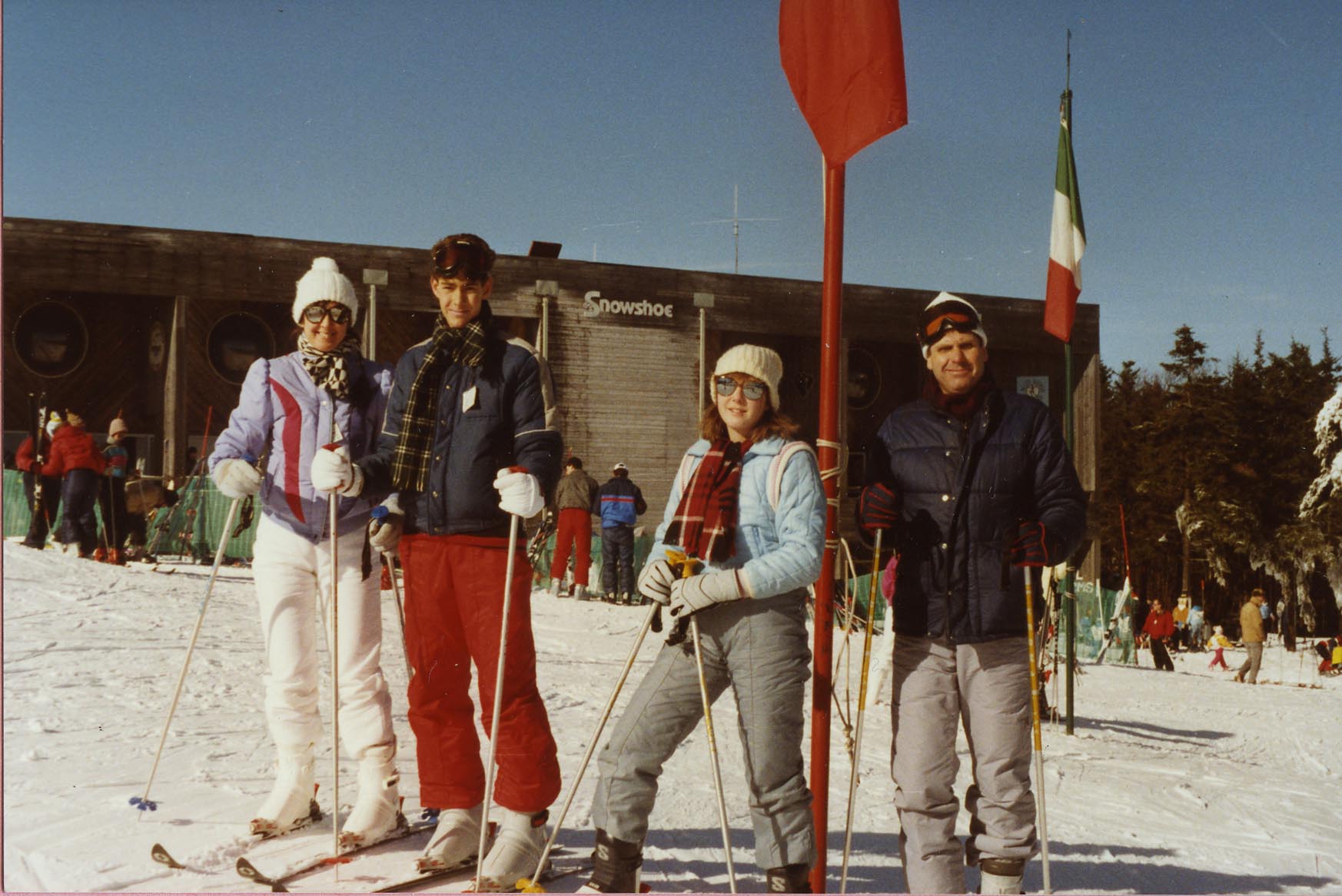
SKIING Gliding, sliding down a hill, that’s what skiing is under the best possible circumstances.
Before they left the nest, Joel and Crista with parents in Snowshoe, WV
What’s so hiliarous?: Helen and Charles Blankenship warming up with us after a cold day on the slopes at Lake Tahoe, California
SNOWFLAKES
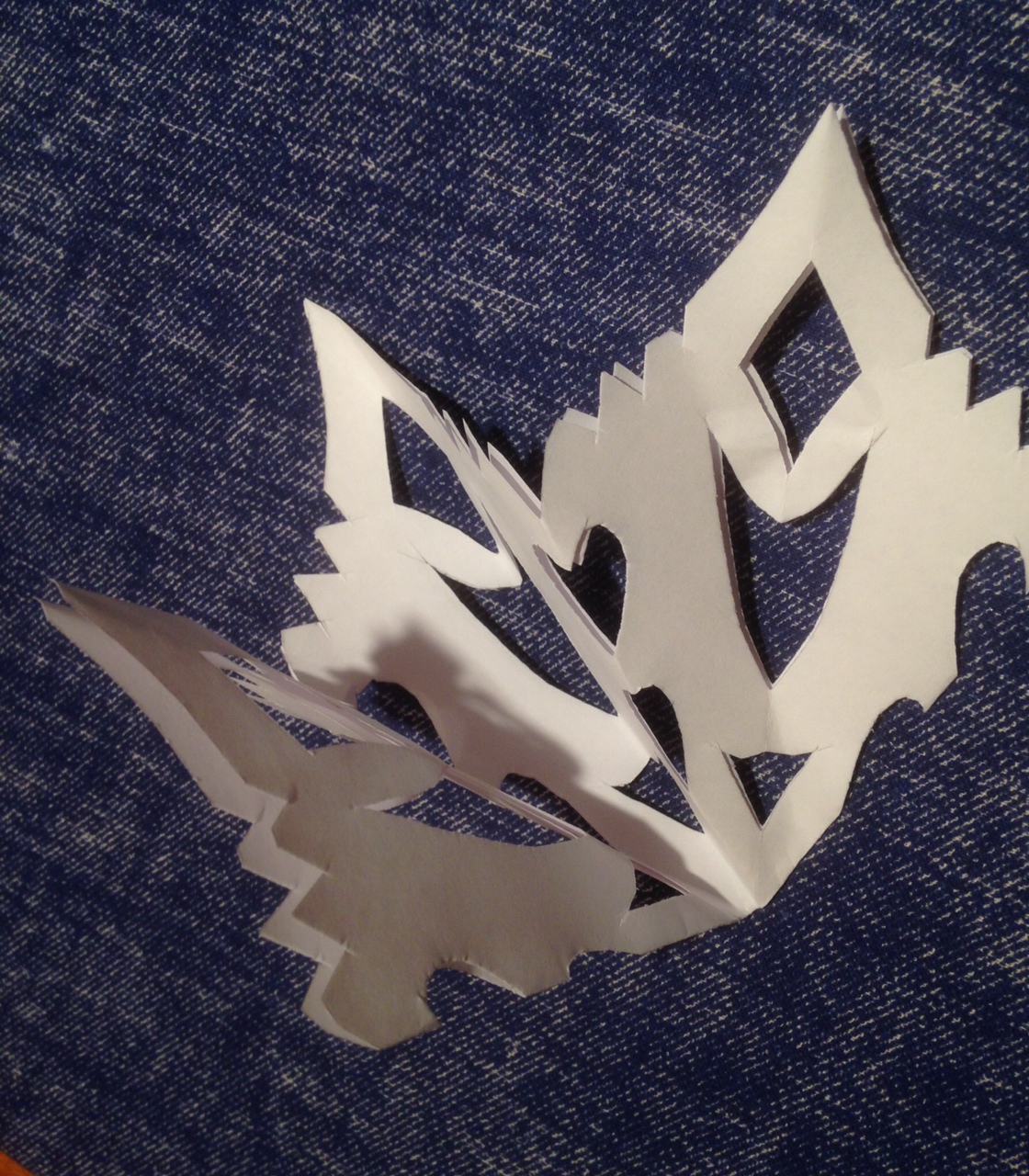
Do you remember cutting out paper snowflakes like this?
For detailed instructions with a video, click here.
Snowflakes make Emily Dickinson want to dance a jig, so she says!
I counted till they danced so
Their slippers leaped the town,
And then I took a pencil
To note the rebels down.
And then they grew so jolly
I did resign the prig,
And ten of my once stately toes
Are marshalled for a jig!
Your turn: What is your winter fun? Sledding, tobogganing, ice skating, even skiing? Maybe now it’s a vicarious experience with kids or grandkids. We’re dying to find out.
A snapshot of a baby boy dressed as a girl and an old flash bulb. Those are some of the items we find clearing out Mother’s house. Last October my sisters and I began the arduous task of sorting, saving, or recycling the accumulated store of her possessions having lived in the same house for over 73 years. You can read about it here.
Today’s post features snapshots, both photos and artifacts, from both Mother and Daddy with a surprising find at the end.
MOTHER: Some of what I found from Mother could be filed into 3 categories of nurturing:
Feed
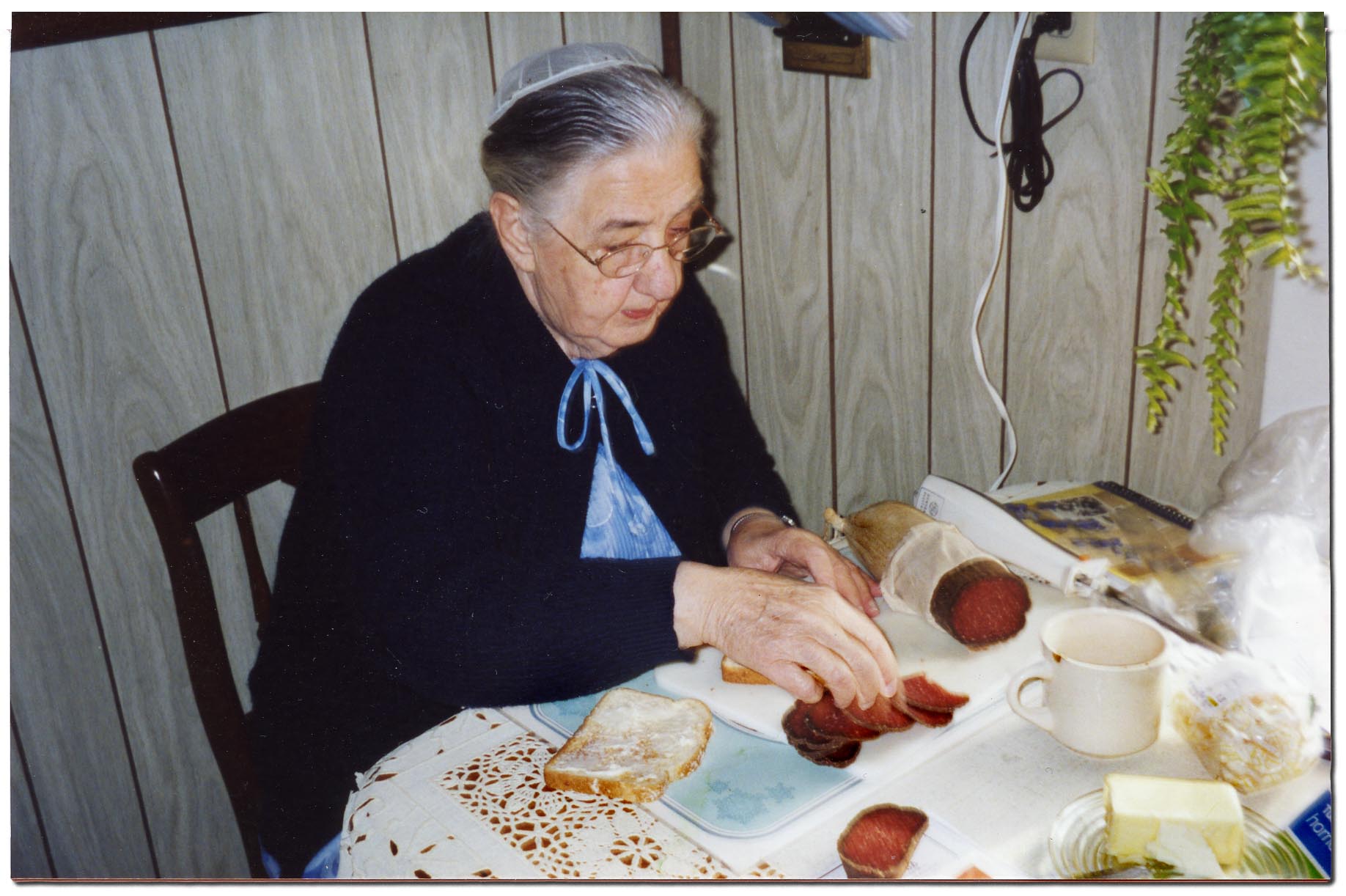
Our metal lunch pails carried many a bologna sandwich, usually Baum’s Bologna from their shop north of E-town. After Mother pulled back the burlap, she sliced thick rounds for sandwiches on buttered bread – always butter . . .
Read
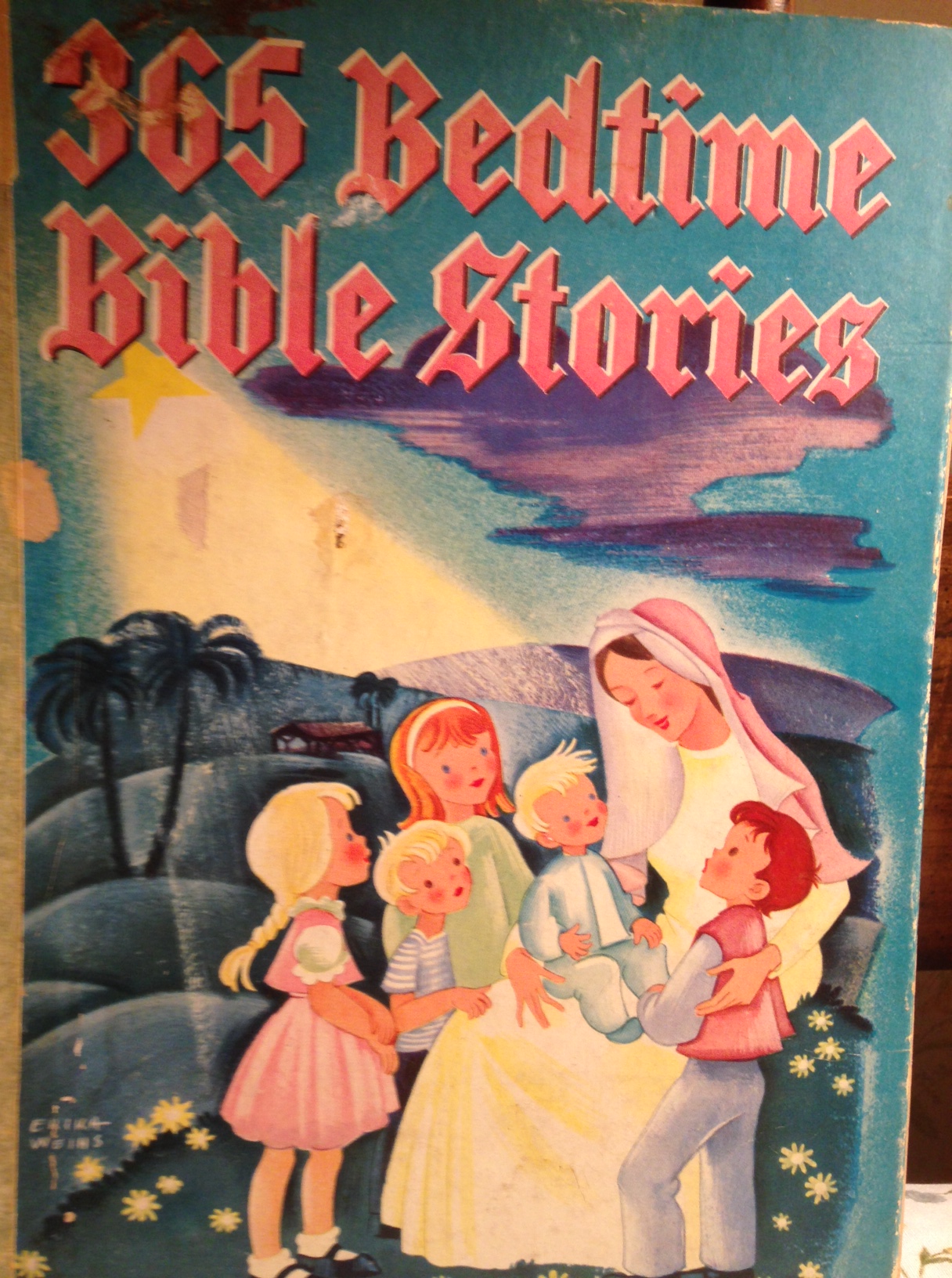
Every picture, every story seems familiar in this Bible Story Book with pages, crackly brown with age. Sniffing into the spine, I roll back in time to the little girl on her lap. I loved the art work then. Now I love its charm even more. Did Daddy read these stories to me too? Maybe so, but I can’t remember.
Remember
Cameras freeze time, preserving memories. Mother didn’t write in a journal, but she consistently recorded our family’s story over time. The old box camera is long gone, but here is a “flash” of memory possibly from her last camera . . .
DADDY Some of what I found representing my father was surprising:
Although I have several photos of Daddy holding me as a baby, my father was a man’s man: a tractor-driving, motor-fixing, field-plowing, deer-hunting guy. He even hammered on the piano keys. His work clothes were of black moleskin cloth, matching the grease he was in close contact with at the shop. I am certain he never wore pink. Yet here he is posed for the camera in a dress, flanked by his parents, Henry and Fannie Longenecker, my Victorian grandma not yet attired in Mennonite garb that would characterize the rest of her life. Daddy’s dress is not a christening outfit. There was no christening among Mennonites. I suspect that babies of both genders wore dresses to make diaper changing easier.
Henry and Fannie Longenecker with son Ray
Needlework
Our scavenging took us to the attic chest filled with treasured quilts. My sister Jean and Mother tagged each one a few years ago, so there would be no doubt as to their provenance. Apparently, Daddy drew his needle through a white quilt, stitching animals in red. I see a camel, sheep, chicken, pig, duck, an elephant. Even an ostrich.
Here is just a teaser. (Look for Daddy’s full quilt on a later post!)
Quilt with animal stitching by my father, Ray M. Longenecker
Nickname
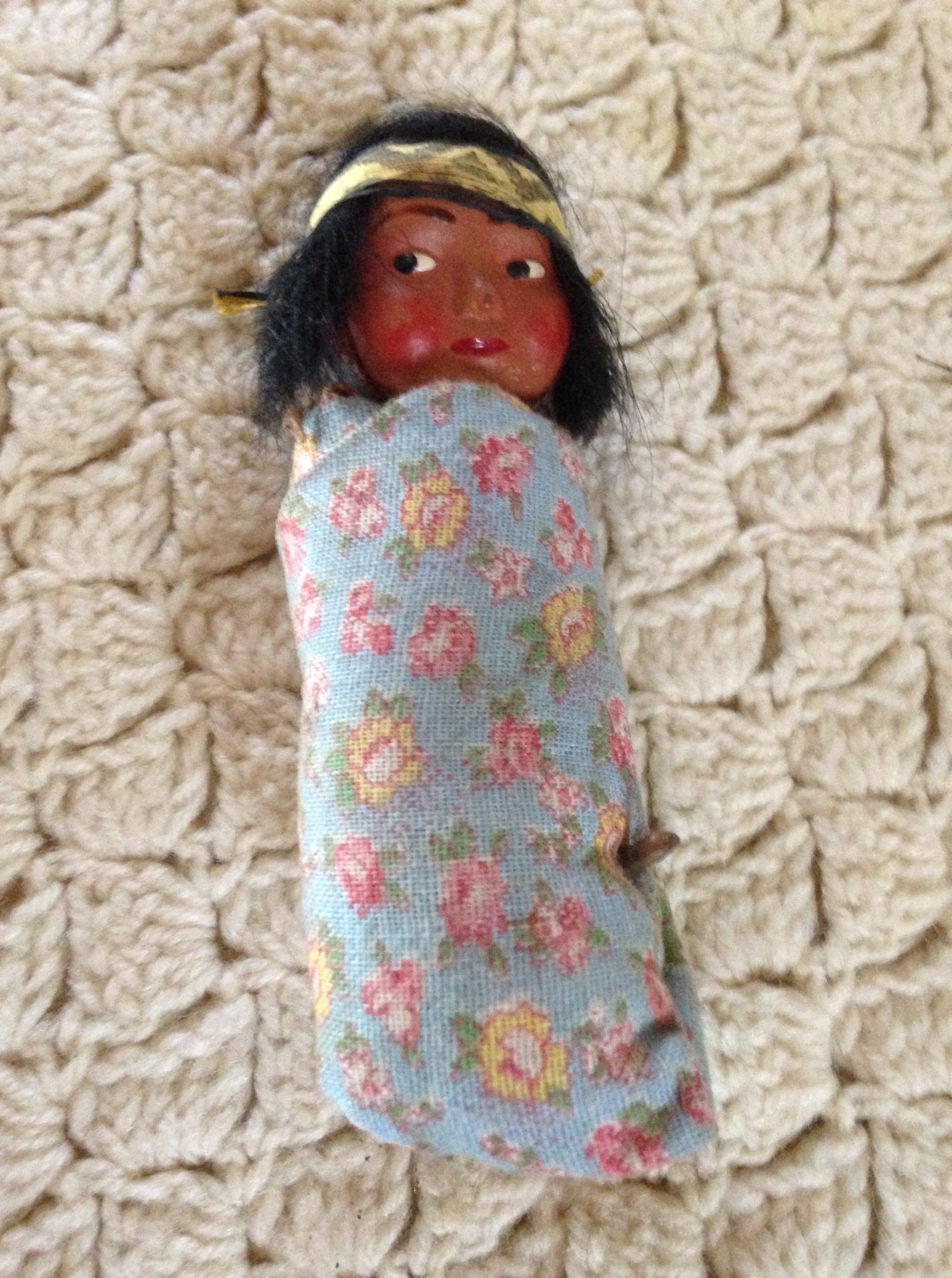
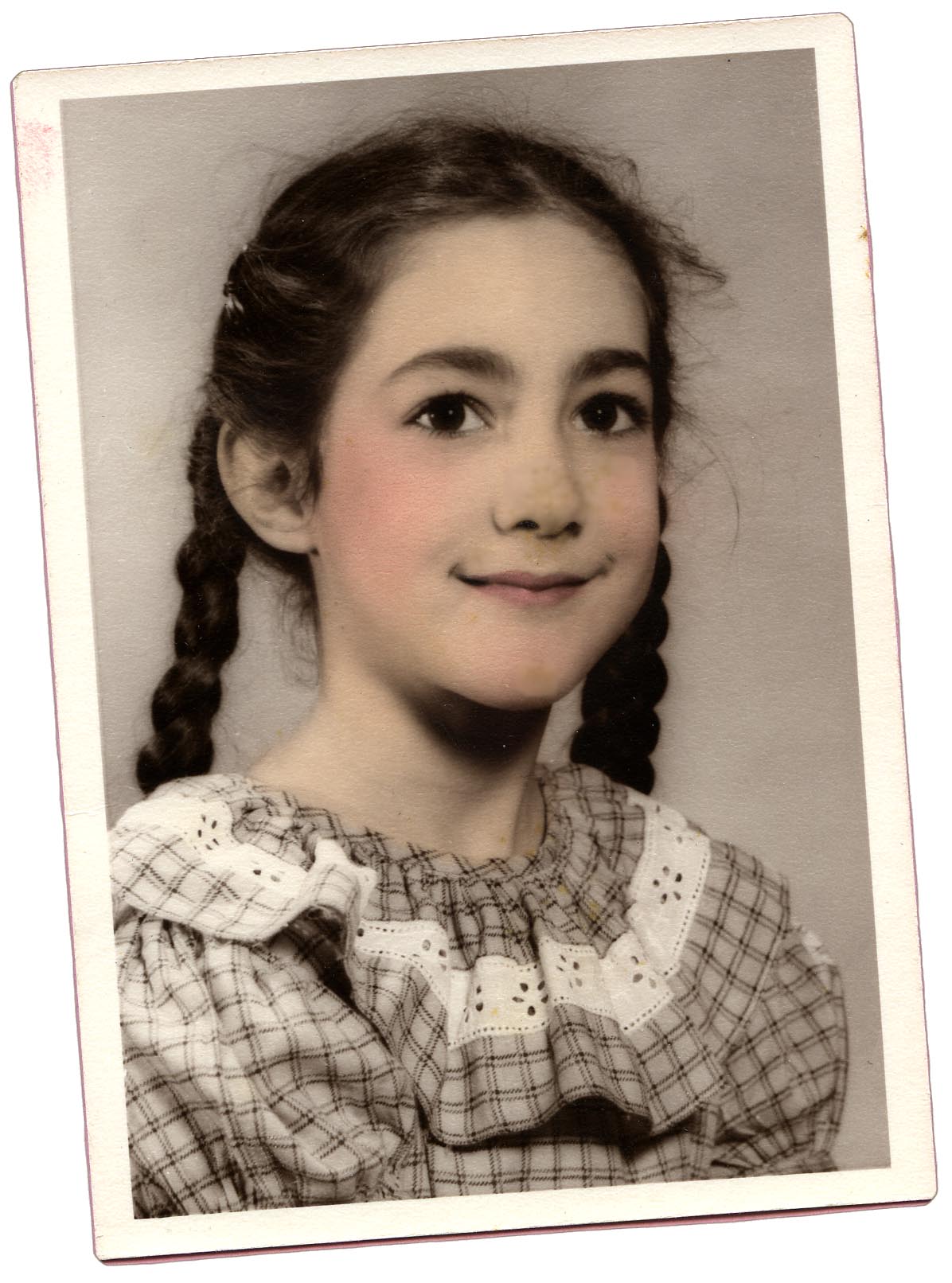
Daddy’s nickname for me was Pocahontas, not so much because I looked native American, but probably because of my thick, dark braids and big eyes. When I found this doll, I decided it shouldn’t be given away, sold, or recycled. It now sits on the dresser in our bedroom with “strubbly” hair, not braided!
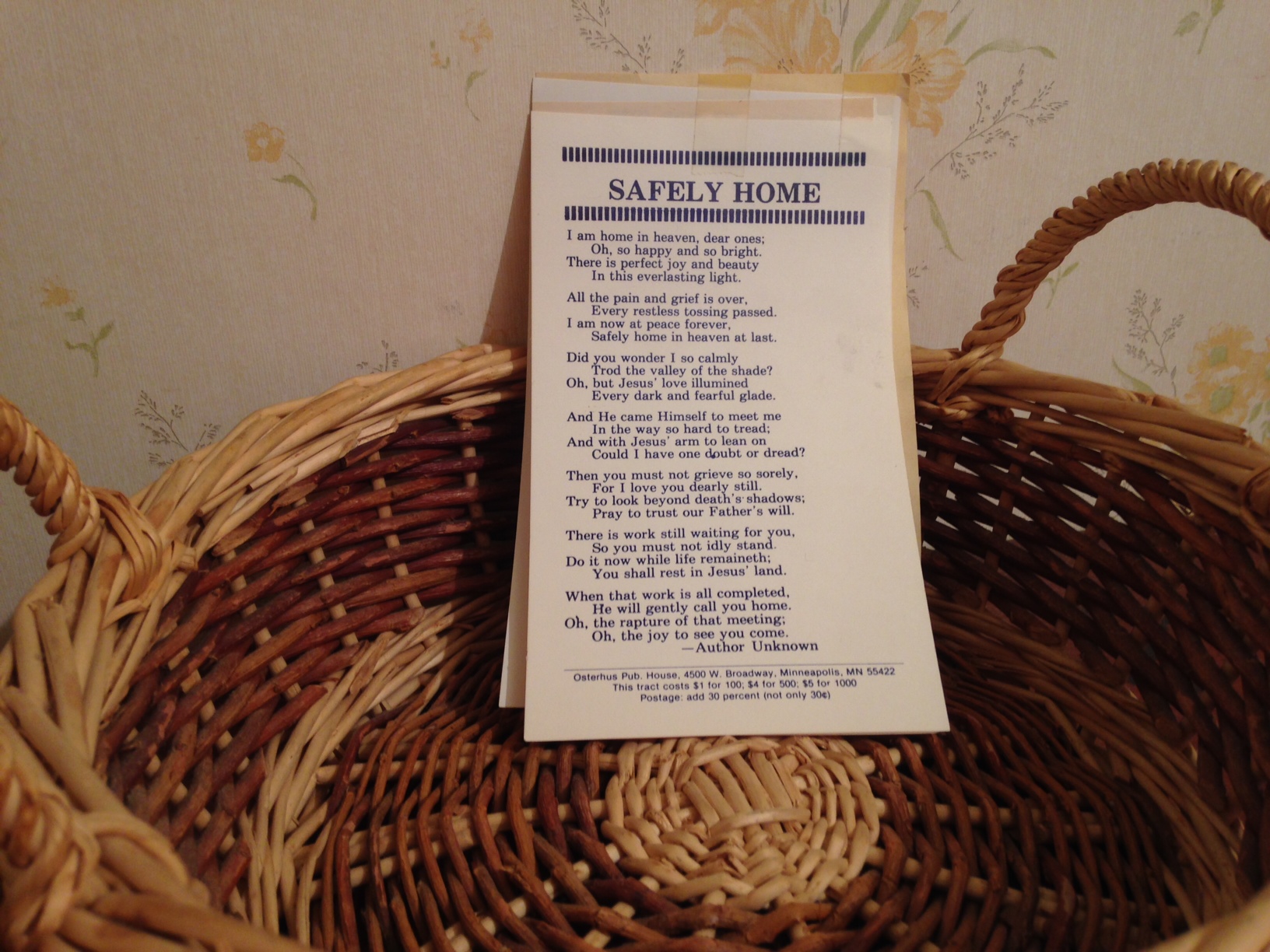
Final Note: A Curious Find On our first visit to Mother’s house in October after the funeral, we saw a wicker basket on top of a hallway chest with a poem entitled “Safely Home,” something we had never noticed before. Were we blind to it earlier? Having a premonition of what was to come, did Mother put it there for us?
I am home in heaven, dear ones; / Oh, so happy and so bright. / There is perfect joy and beauty / In this everlasting light . . . .
(Anonymous, Osterhus Publishing House) . . . a mute but eloquent affirmation
Your turn: Are you holding on to something you treasure from a loved one? A photograph? A small gift?
Every single memory of snow in my childhood is pleasant. Sparkling flakes in luminous free-fall as I look out the kitchen window. Snow festooning evergreen boughs. Then bundling up in snowsuits, knitted caps, mittens. Getting out the sleds.
After more than one snowstorm, Aunt Ruthie grabbed her movie camera and trained her sharp eye on some big, tall sledders who went coasting down the hill from our house to Grandma Longenecker’s.
Then she captured our anticipation of trumping through nearly hip-high snow and finally (my favorite) Mother pulling my sister Janice and I on the Flexible Flyer sled along Anchor Road.
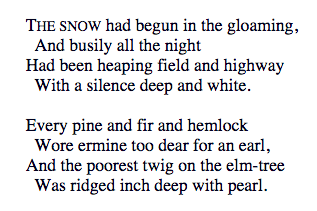
Another parent and daughter are observing the snow in The First Snowfall by American poet James Russell Lowell, a poem I remember Mother reciting.
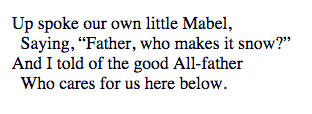
Mabel marvels at the beauty of the snow and inquires of its origin . . .
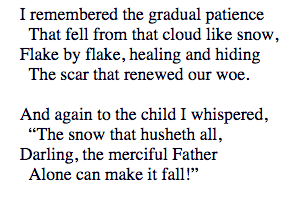
. . . but as the father’s replies to Mabel, he remembers the snow which hides the scar of another child’s burial plot.
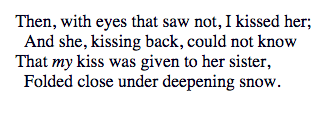
Then Mabel feels her father’s gentle kiss, a kiss she will never know was intended for the daughter beyond his touch. The last stanza leaves Mabel in child-like wonder, her father in pensive grief.
This post began with snapshots of fun in the snow and ended with a reflection on loss. But snow can be the setting for other memorable events: a frolic with friends, a car accident, a marriage proposal (I’ll save that for another post!)
You probably have memories of snow, recent or long ago. Here’s your chance to share them.
In June Mother Longenecker and her daughters Marian and Janice created butter-shaking memories in a two-quart jar, making butter using three easy steps:
Pour cream into 2-quart jar.
Shake until you rattle and roll.
Remove the congealed mass from the jar. Add a pinch of salt.
In July, my Southern friend Carolyn honored my birthday in a “Shake-Rattle-and-Roll Butter-Shake” party. Today you can open up an old-time textbook with me and behold first-graders learning about butter making in a reader published by Lyons and Carnahan with the copyright dates spanning the years 1927-1936.
Interestingly, the Child’s Story Reader also lists three simple steps for butter making expressed in first-grader language:
We got the cream from a cow.
We put the cream in a jar.
We shook the jar.
Jack and Jane even added a pinch of salt to the mixture, and afterwards they had a party of butter on bread!
Another page shows a recipe for butter milk made with a churn with Aunt Ellen assisting.
More Moments of Discovery
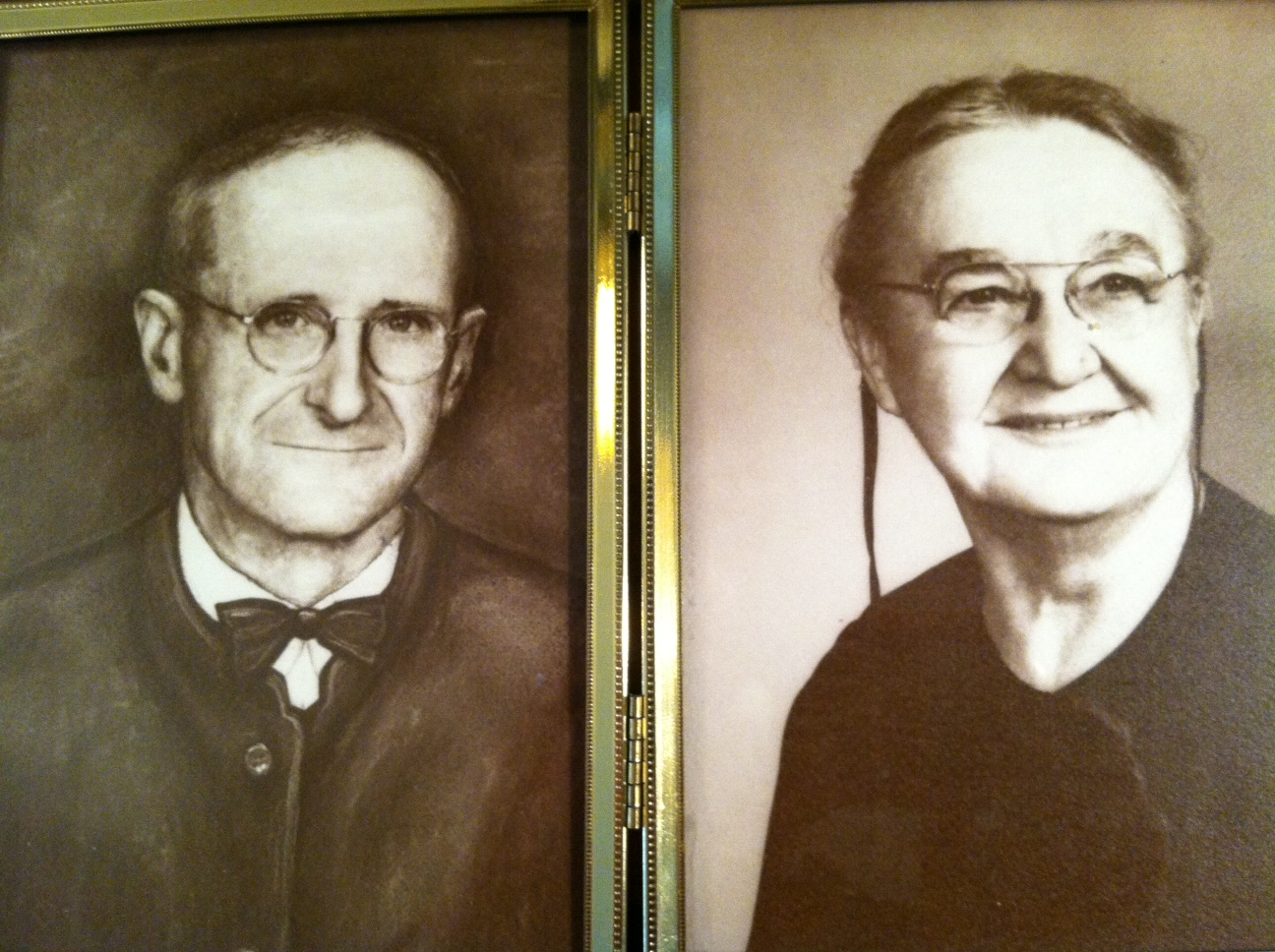
Henry and Fannie Longenecker, Mennonite Grandparents
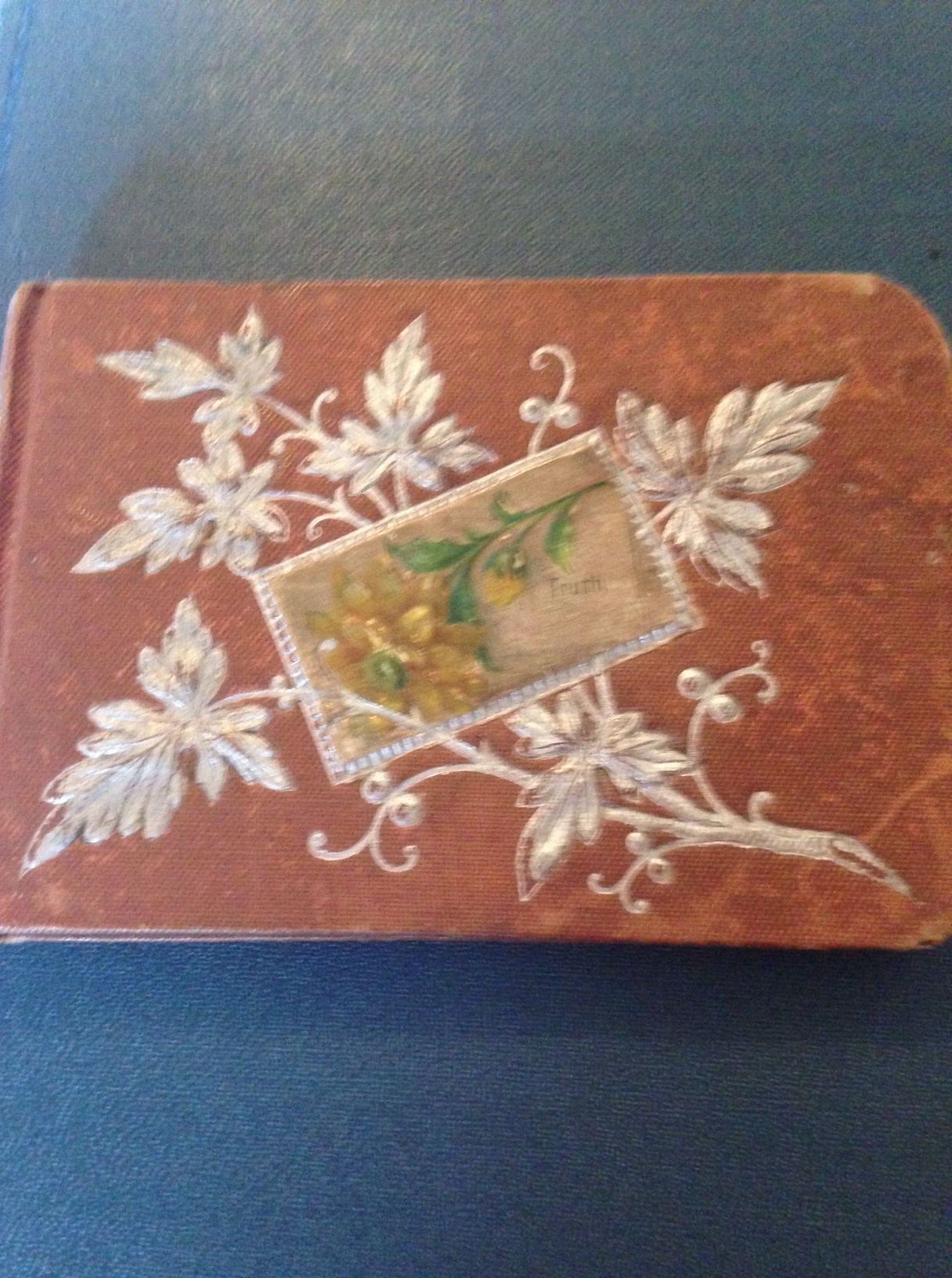
Henry Risser Longenecker, referred to by friends and family as H. R. or “Hen,” was my grandfather on Dad’s side of the family. He died when I was five, but I have a distinct memory of him killing a snake in the grass with a long stick. Like my father, he was a doctor of motors interested in steam engines, Model A Fords, and farm equipment. Until I unearthed his autograph book, I had no idea he had artistic leanings as revealed in his autograph book. Autograph books, common in classrooms in the 1800s, contained signatures, artwork, and bits of poetry. According to Folklore: An Encylopedia of Beliefs, Customs, Tales, Music, and Art, Vol. 1 (edited by Thomas A. Green) autograph books, existed as early as the fifteenth century and were seen as “a mark of gentility until the beginning of the twentieth century.”
The cover of Henry Longenecker’s autograph book reveals artistic flair with a faint inscription of a great virtue taught to every school child, the word Truth visible if you squint carefully at five faint letters appearing close to the embossed yellow flower.
The dedication appears in flowing cursive penmanship with a dove’s beak clasping Cupid’s arrows
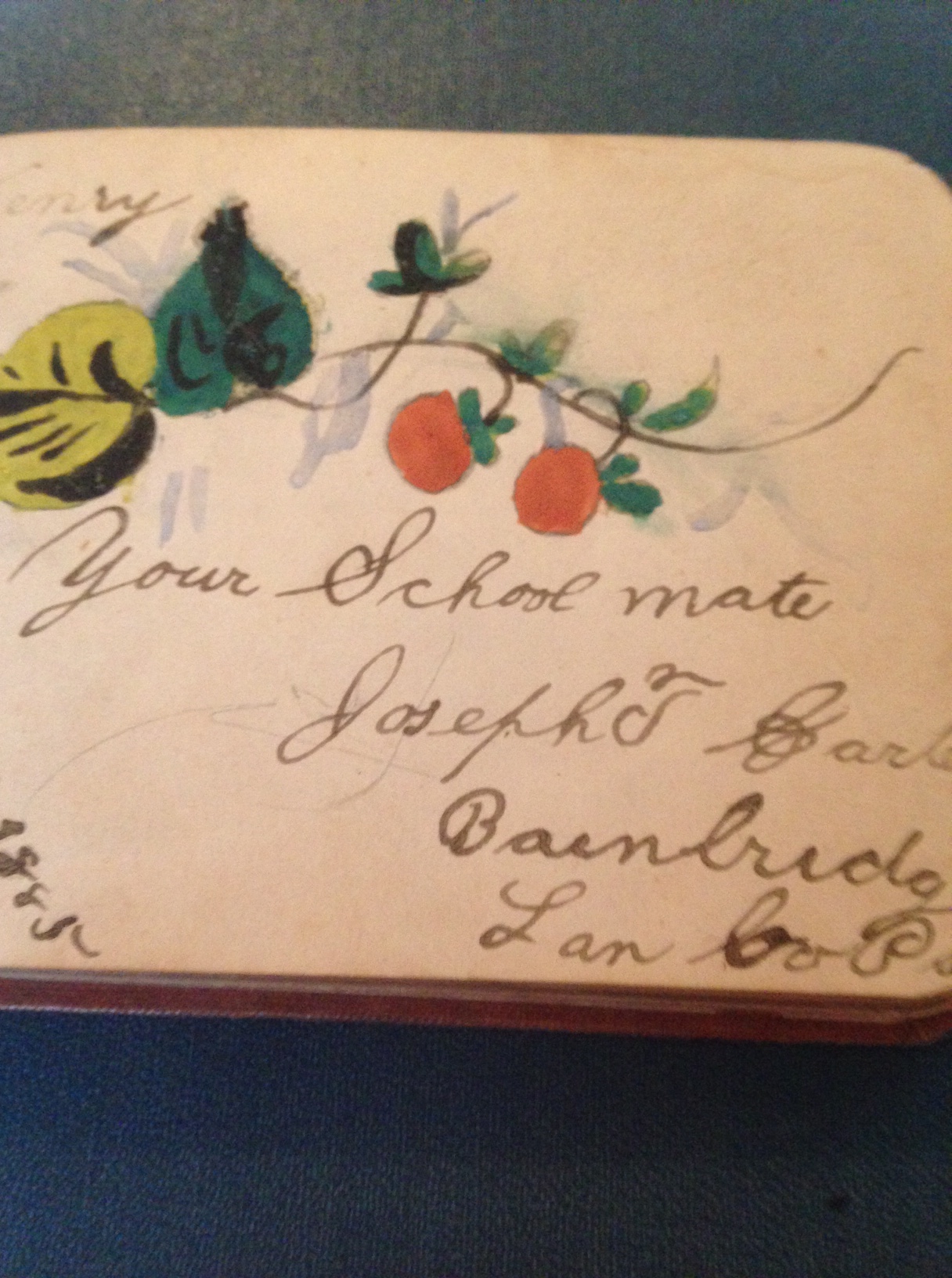
Painted artwork, still-brilliant, graced most pages like this one, complete with signature and date.
Signature: Joseph T. Garber Complete date: February 3,1885
Autograph books tell us several things about students in the late 1800s:
1. Penmanship was taught and valued as an artistic skill.
2. Friendship and learning were intertwined. Both were expressed as an art form.
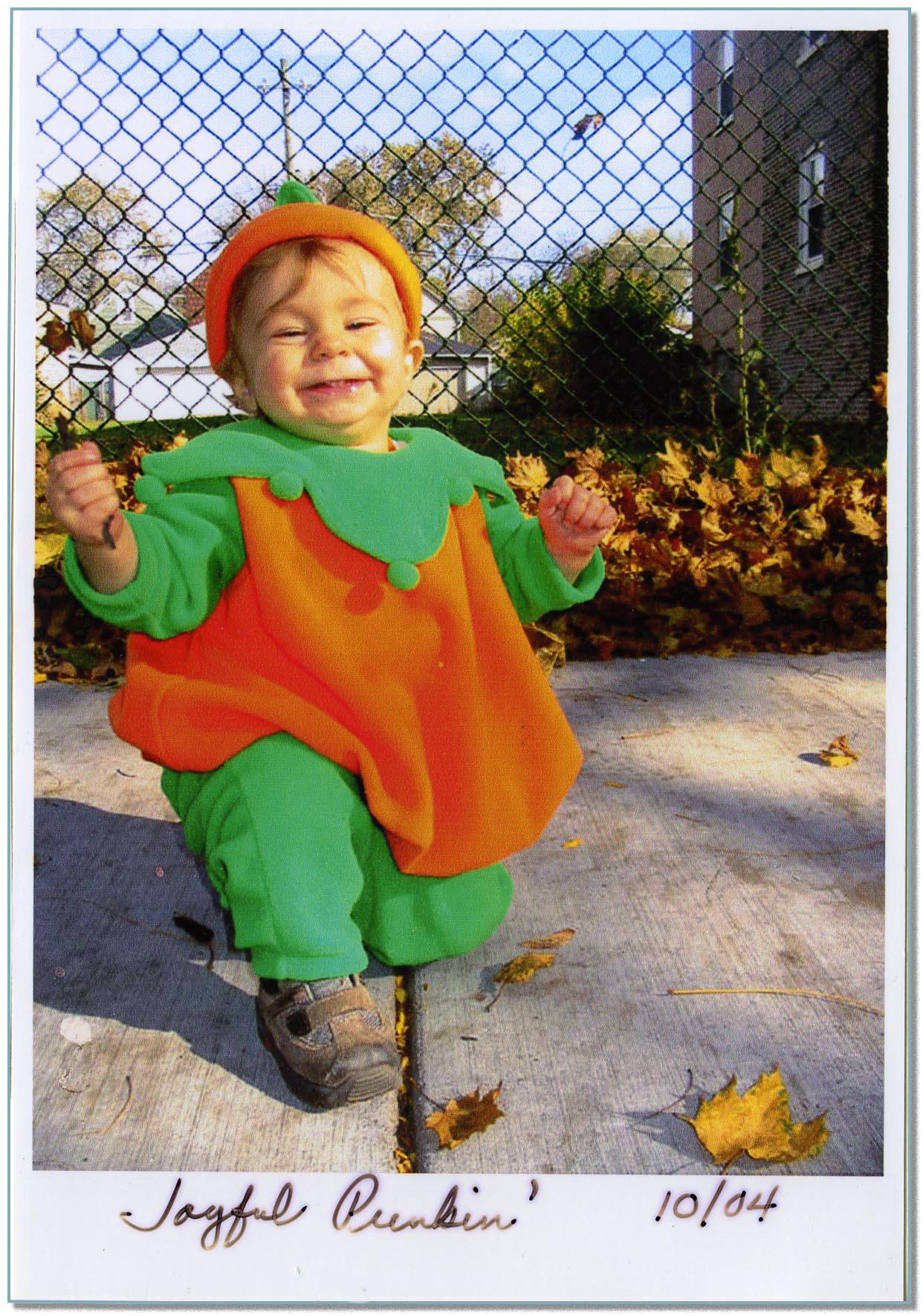
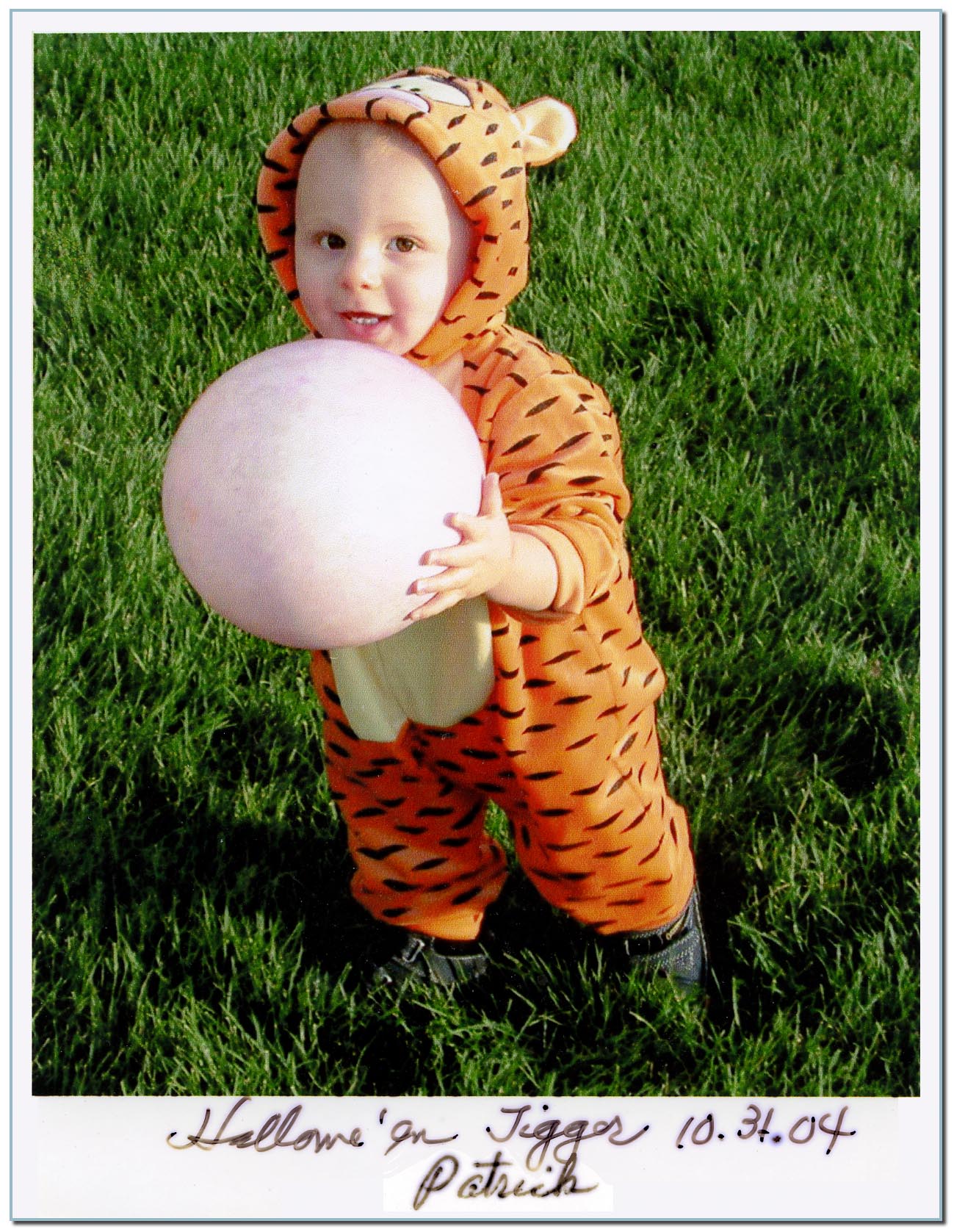
Ten years ago grandsons Patrick and Curtis were one-year-olds at Hallowe’en. In October 2004 they lived far away from us in Chicago. Fortunately, their parents captured snapshots of them in costume, Curtis a pumpkin and Patrick, Tigger, both in store-bought outfits, unlike my own get-ups, which were always homemade as shown in my Hallowe’en post last year.
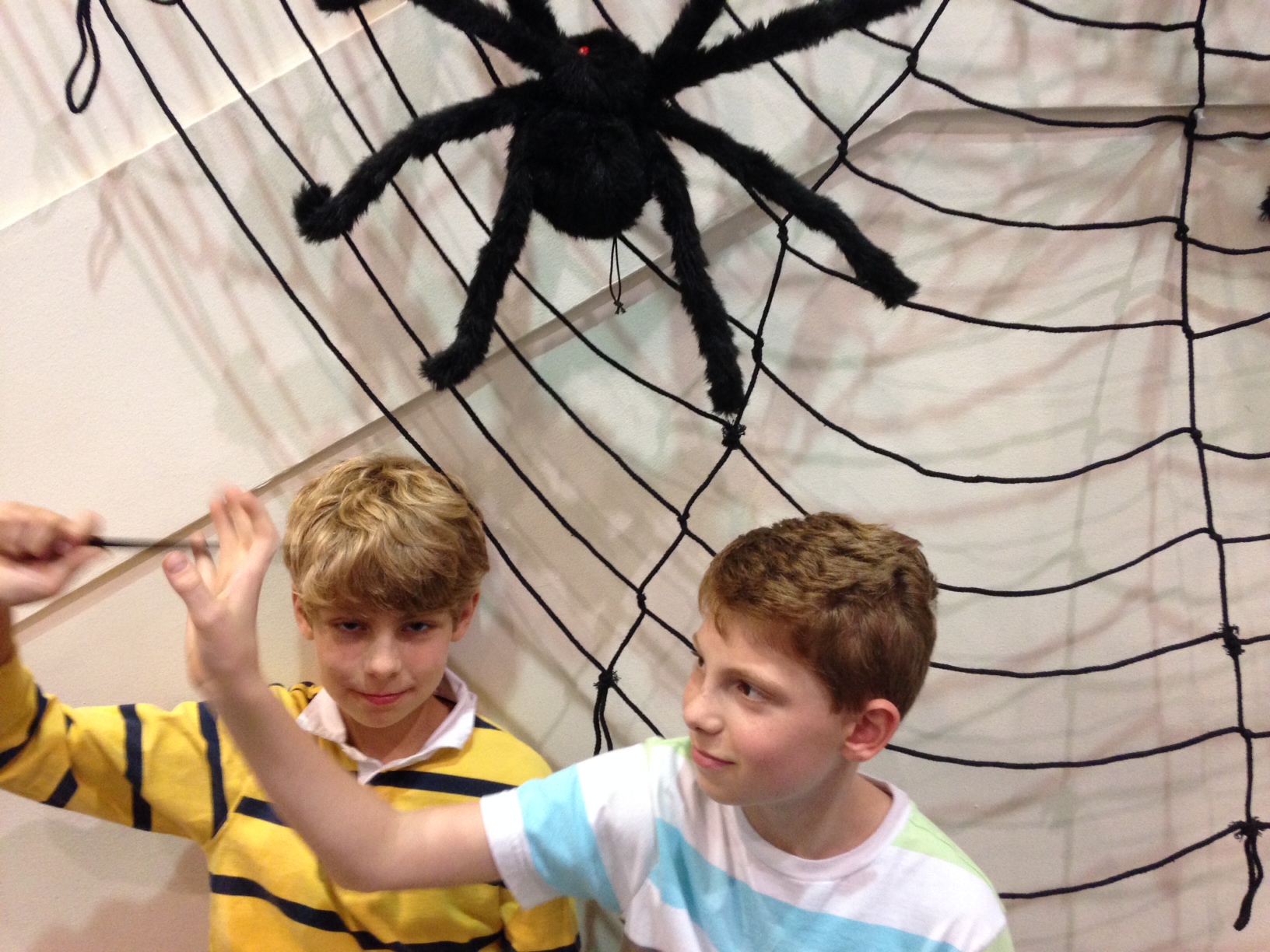
Last weekend, among the children dressed as Muggles, Dumbledores, or Valdemort, Patrick and Curtis chose to attend the “Harry Potter” Sunday Symphony sans costume. Only Curtis wielded a wand, which caused a wee bit of trouble amidst the spider webs.
* * *
Students at Rheems Elementary School grades 1 – 8, though familiar with Washington Irving’s “The Legend of Ichabod Crane” and perhaps Poe’s “The Tell-Tale Heart” could not have anticipated J. R. R. Rowlings’ Harry Potter series.
Though Rheems was no School for Hogwarts, our village school had its own version of The Sorcerer’s Stone and the Goblet of Fire in the Deathly Hallows of the school’s basement, made ghoulish by the upper grades who created scary events with “eye” grapes in bowls, ghostly recorded voices among the hay-bales, and an illuminated skeleton.
Students raided closets and attics to conjure up costumes for the Hallowe’en parade, the culmination of visits to the House of Horrors in the basement of the school. My Mennonite aunt, also my teacher Miss Longenecker, initiated much of the fanfare that marked all the holidays, both the sacred and the secular. Here she has recorded our annual Hallowe’en parade, including the stumbles and falls!
Quote of the week by Erma Bombeck:
A grandmother pretends she doesn’t know who you are on Halloween.
Your Hallowe’en memories — a scary tale? a memorable outfit? The conversation starts here.
Coming next: What’s for Dinner: Dried Beef Gravy and . . .
My Mother Ruth Landis Metzler was a simple girl who grew up on a farm near Lititz, Pennsylvania and attended Erb’s Mennonite Church. As a young woman, she wore plain clothing and never cut her hair. Her adornment was of the biblical kind as the Apostle Paul admonishes:
I also want the women to dress modestly, with decency and propriety, adorning themselves, not with elaborate hairstyles or gold or pearls or expensive clothes . . .
I Timothy 2:9 NIV
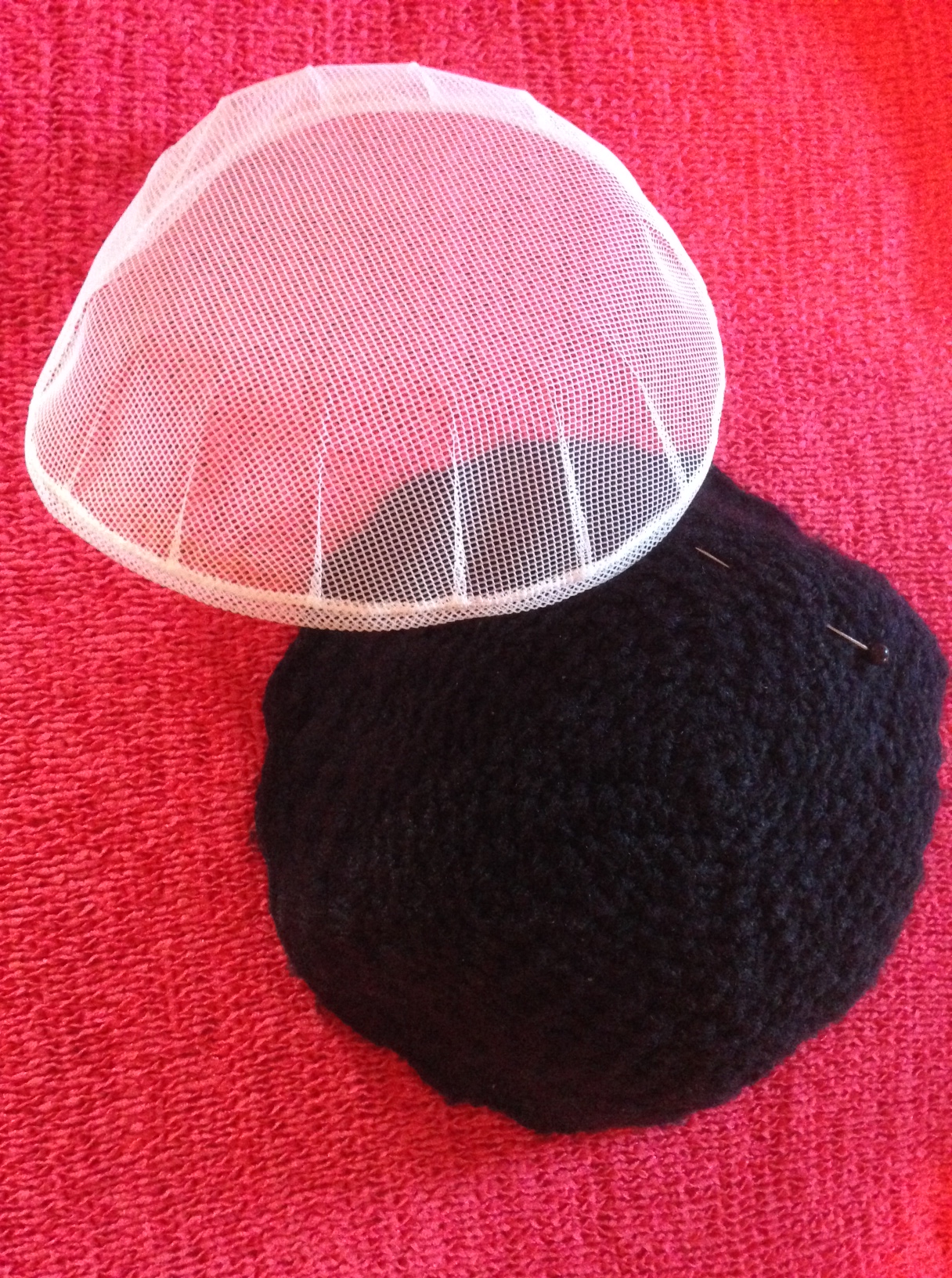
As we sorted through her personal effects recently, we found two prayer coverings and three bonnets, all miniature versions of those large sizes (jumbo, actually) she wore during her girlhood and all through the years we children lived at home.
On the clipboard in her kitchen, we found the business card to the Sue’s Covering Shop in Lititz where she bought her most recent headgear, the black bonnet now rivaling the size of a Jewish yarmulke and fastened with a shiny black-tipped hat pin.
Size mattered among the various congregations in the Lancaster Mennonite Conference in all the years my mother wore prayer coverings. Handwritten on Sue’s Covering Shop business card was Mother’s latest size: D – 19 1/2. When I called Sue’s, the clerk said that D indicates the pattern number, the higher the number (okay, it’s a letter) the larger the size. And 19 1/2 describes the inches around the circumference of her covering.
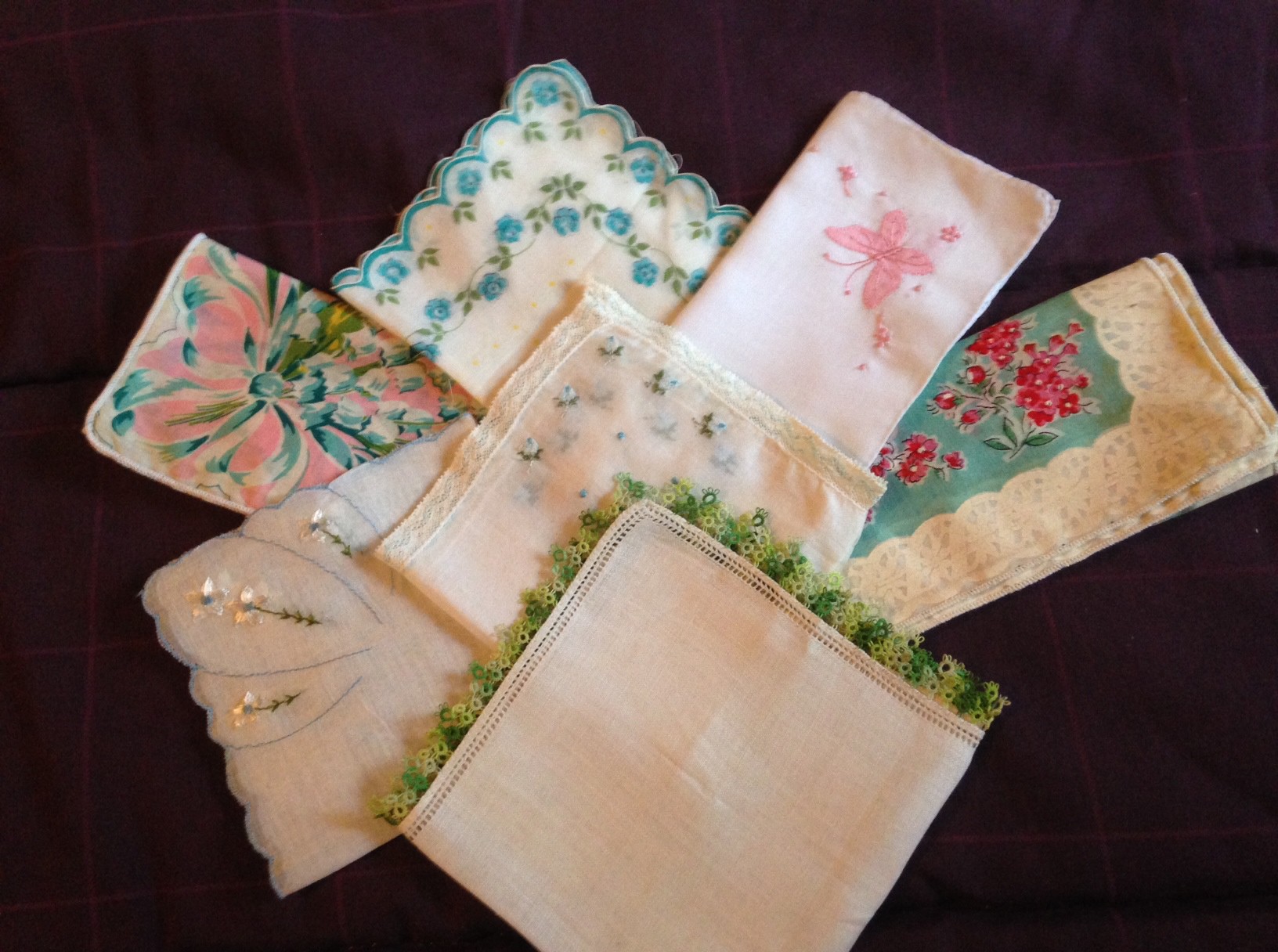
Hankies, now replaced by Kleenex, were once a part of every woman’s wardrobe. As a young child, my offering (a penny as a toddler, and later a nickel as I grew older) was tied into one corner of my white handkerchief, so I could untie the knot and put the coin into the tin box my teacher passed around during the Sunday School class. Surprisingly, Mother’s hankies were fancy, some even gaudily so, and one even boasts green tatting.
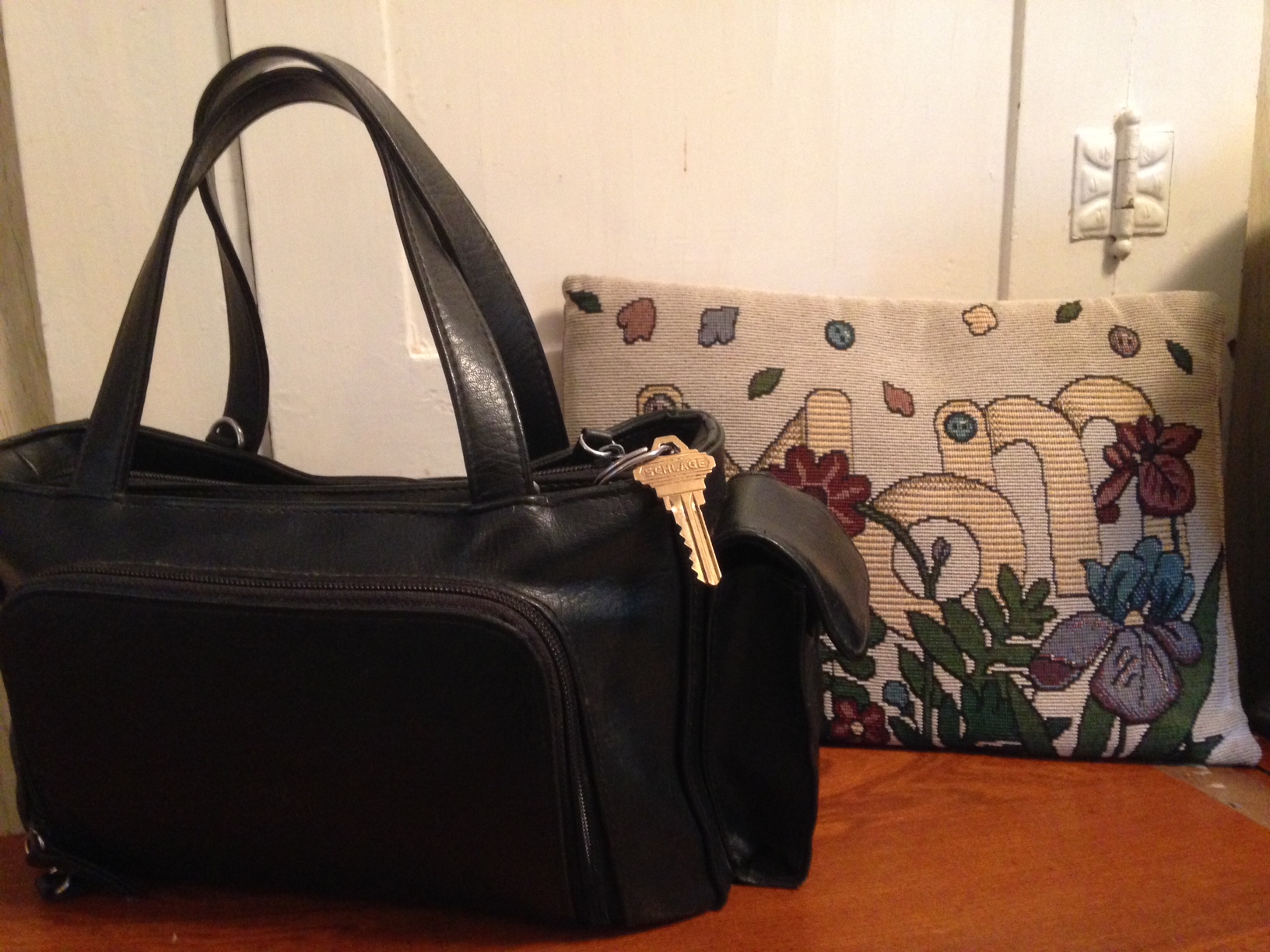
Mom’s purses have usually been black and serviceable though we found set aside a hand-tooled leather purse and remember a lacquered basket-weave popular in the 1950s and 60s. In the October 2014 issue of Guideposts, Malinda Bertels takes stock of her Grandma’s purse and finds in it tissues for applying rouge, a vial of holy water and a faded inscription on a small wooden cross which provides insight and courage to move forward. Mom’s purse contained none of those things, only the bare essentials.
The very last purse she ever carried had a zippered compartment on the outside and all the pockets she liked on the inside for her cards and such. Most important was the pouch on one side, probably designed for a cellphone, but which held her house and car keys. The house key remains, but the car keys have been passed on to a friend from church.
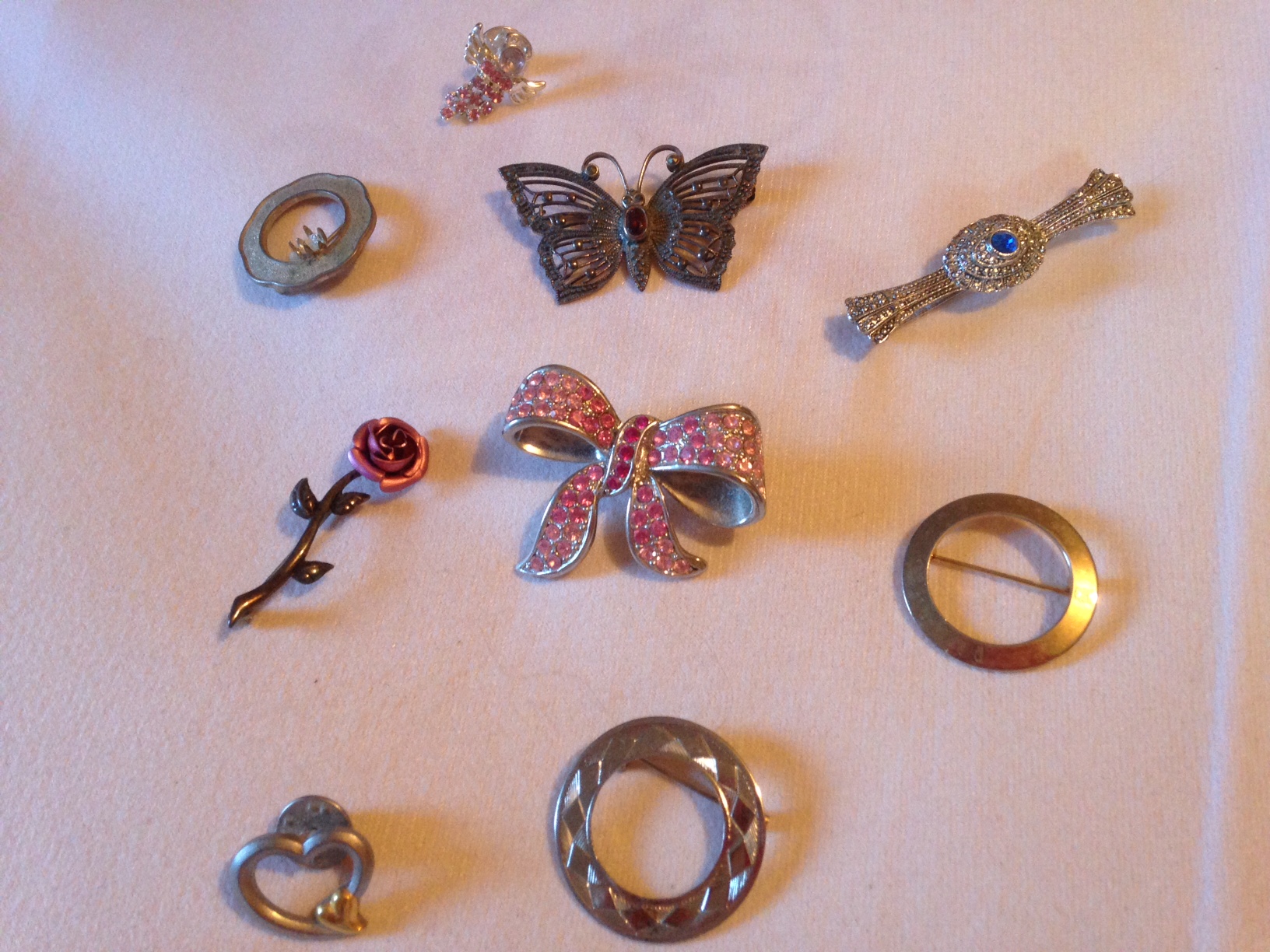
Mother never wore any jewelry except a wrist-watch, but friends bought cute little pins for her anyway. They were never all in one spot, but when we gathered them together, they numbered nine. The only one I ever remember her wearing was the round silver-faceted one, probably to her grandson Austin’s wedding.
Plain and fancy, her wardrobe included the gamut. A plain woman with fancy edges, that was Mom!
* * *
A souvenir of their honeymoon, this pillow was found among Mother’s treasures, obviously a gift from Dad, revealing his softer side.
Was/Is your mom plain or fancy? Are you similar or different in fashion sense?


















 Plain and Fancy