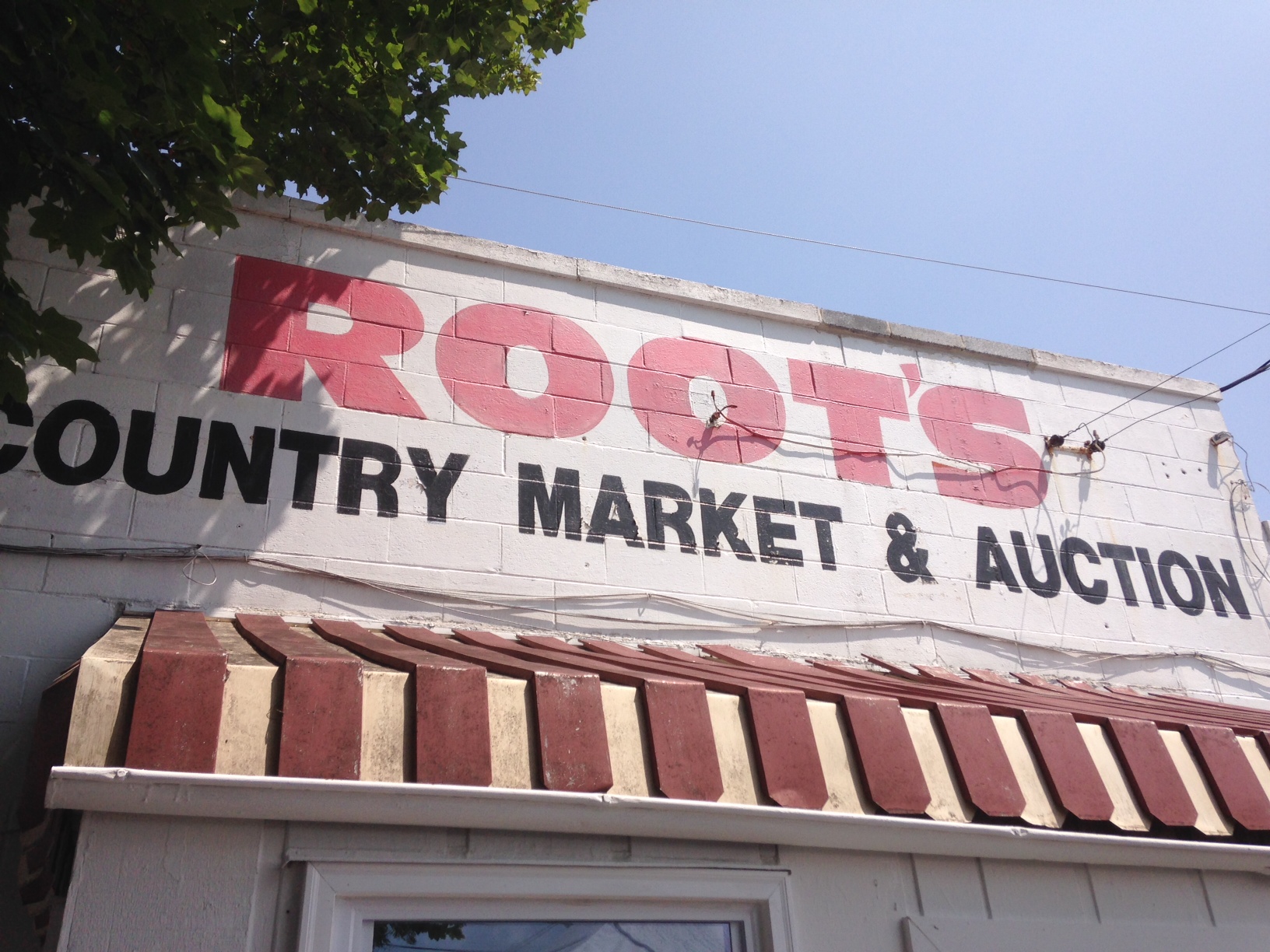
Are you hankering for chocolate-covered bacon, do you want to buy a rooster for your flock? A hat for the next Downton Abbey gala? Welcome to Root’s Country Market and Auction, a fixture from my childhood my sisters, husband, and I re-visit near Manheim, Pennsylvania.
Root’s, with over 200 stand-holders, is the oldest single family-run country market in Lancaster County. Beginning as a poultry auction in 1925, Root’s “has evolved over the years to become a piece of Lancaster County heritage.” Come walk with me along the aisles of stands, some housed in long sheds, others outdoors under awnings.
Did I say you can get all gussied up for next Downton Abbey series? At our first stop, we try on funny Brit hats rivaling those of Princesses Beatrix and Eugenie we remember gasping over at the William and Kate’s royal wedding.
From fancy we meet plain at many of the produce stands either selling or buying vine-ripe tomatoes.
Yes, there are household items and books galore, but many stands cater to shoppers wanting fresh meats, produce, deli and bakery items–and flowers. This farmer boasts fresh blooms from his Manheim farm.
I promised you chocolate-covered bacon. Here is a look at a taste-tester. Yes, I had a bite too!
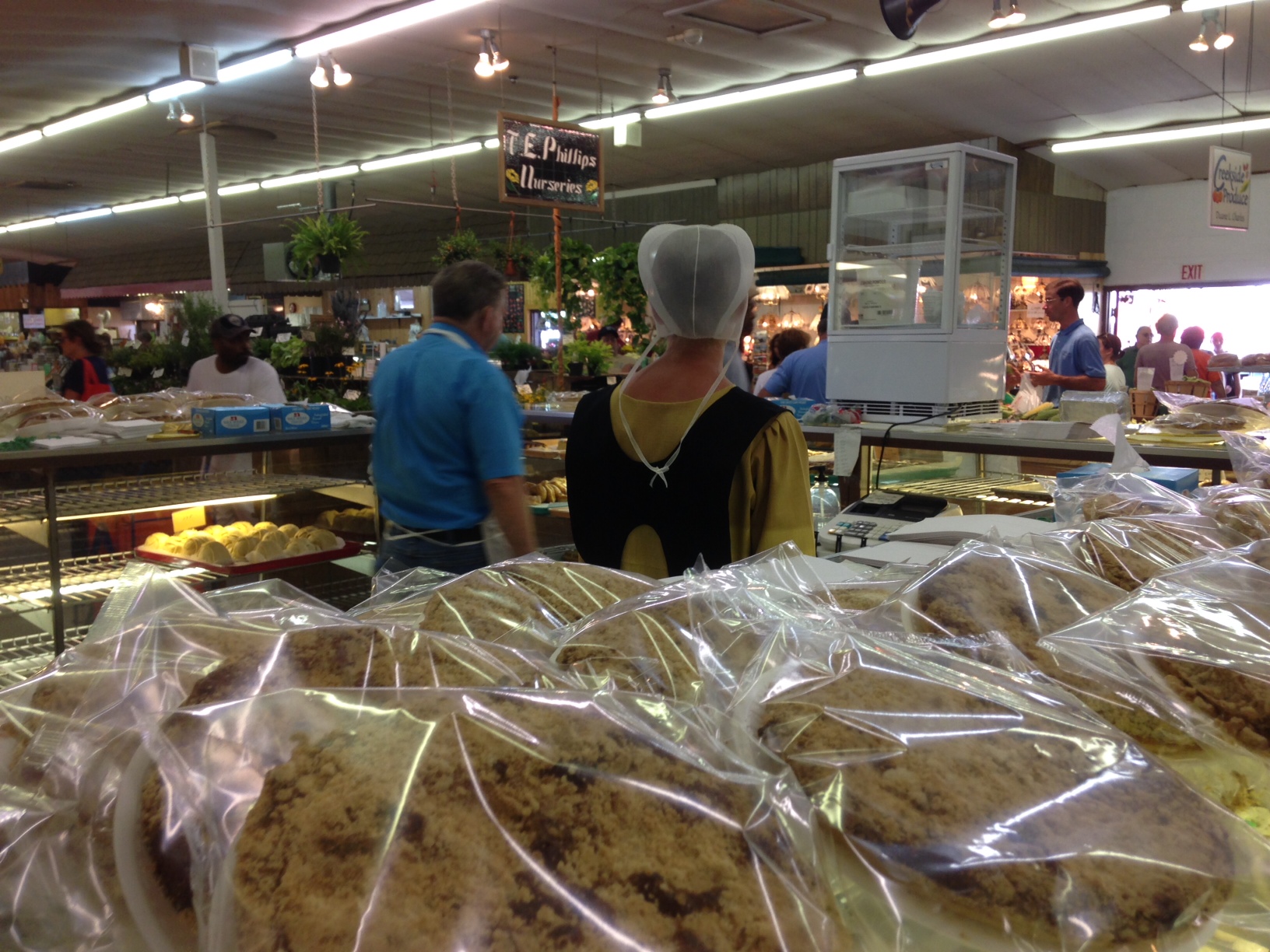
Then on to pickles, funnel cakes, and shoofly pies with wet bottoms satisfying the sweet and sour tastes:
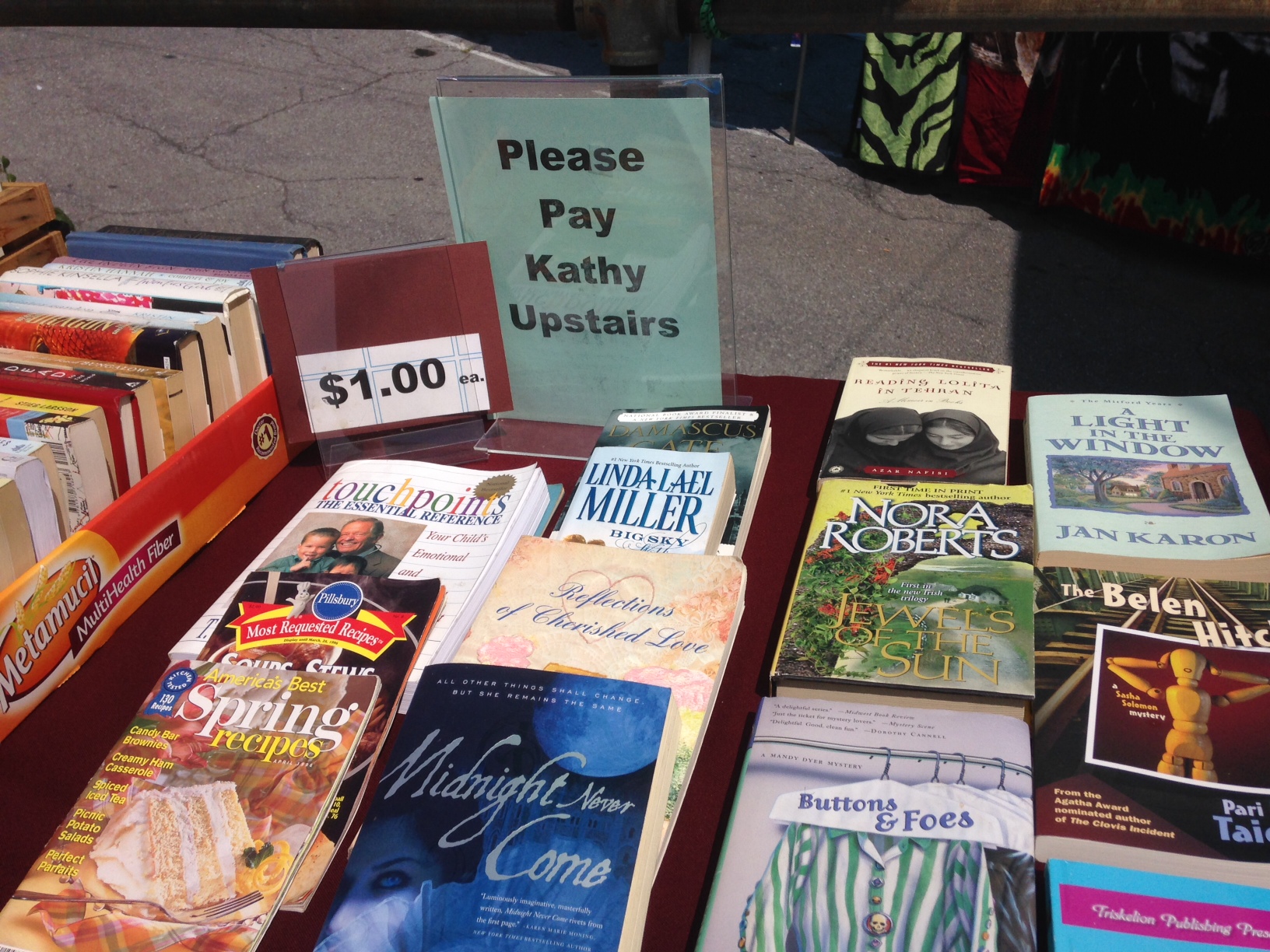
Root’s is a market, and yes, we buy from not just photograph the vendors, but the market is also an auction house. Walking from one of the parking lots, we spy a warning sign urging bidders to uphold the integrity of the auction:
Wanna bid on a coop of roosters?
Our tour ends with Rosa, who graciously invites me to sample and buy one of her multi-colored angel-food cakes, pies, or whoopie pies at Miriams’s Pies. All home-made, of course. That’s the only way in Pennsylvania Dutch land. When I asked her permission to photograph and promote her wares, she admits with shy pride, “One of our customers put us on Facebook!”
I wonder . . . is there a piece of your past you want to re-visit? We are dying to know the “what – where – who” of your story. As always, you are invited to be part of our conversation.
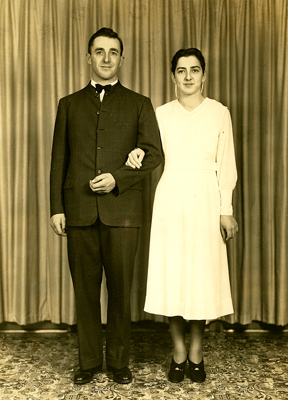
This is the wedding portrait of my mother and father
Ruth Landis Metzler and Ray Martin Longenecker
October 26, 1940
June is the month for many American weddings. And so is August. Because many Mennonites were farmers, Mennonite weddings often took place in October, a month that signaled a break in heavy farm work after most of the crops had been harvested. My dad was a farm implement dealer, so his work cycle mimicked that of the farmers he served, which would probably explain the October date for the wedding.
The bride and groom, my parents, are dressed in Mennonite attire and comply with the rules for weddings prescribed by the church in this era: no bridal party prancing down an aisle to “Here Comes the Bride,” no flowers, and definitely no exchange of rings.
Excerpts from Article II, Separation and Nonconformity, Section 2. Public Worship. (19) from the Statement of Christian Doctrine and Rules and Discipline of the Mennonite Church, 1968:
“We deem it improper to employ instrumental music in worship and church activities.”
“Weddings shall be conducted in a Christian manner avoiding all vain display and in accordance with the prescribed regulations for weddings.”
* * *
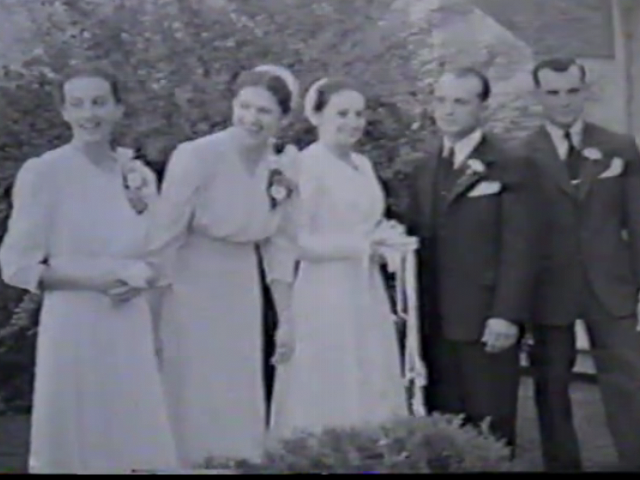
Anna Mae Longenecker’s father John is my dad’s first cousin on his father’s side of the family. Anna Mae with her brothers and sisters lived on the farm at Bosslers Corner, a farm bought from William and John Penn by Robert Allison in 1762, and subsequently bought from Jacob Bossler by John and Nancy Longenecker and kept in the Longenecker family for five generations. On the lawn of this homestead, one of John’s daughter’s, Anna Mae, poses for wedding photographs with her new husband, Hiram Aungst.
Anna Mae Longenecker with her new husband and sisters posing for wedding photos on the lawn of the John Longenecker homestead.
Either the rules for wedding have relaxed a little in the ten or more years since my parents’ wedding, or brides have become more bold. This wedding accessories include corsages for attendants, a white Bible with streamers for the bride and the groom and groomsmen in non-Mennonite suits and neckties.
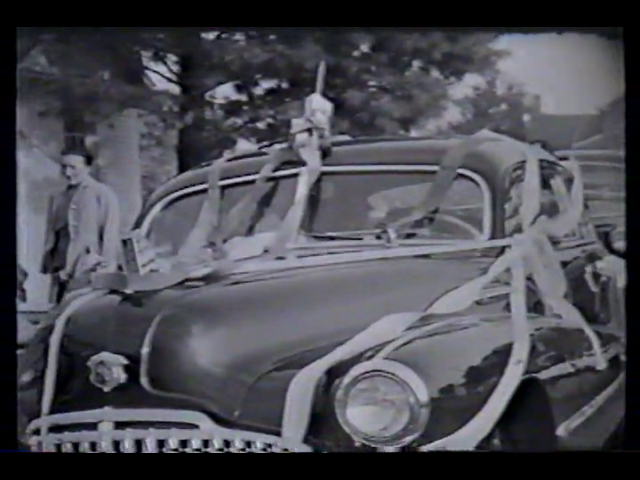
As the video shows, there was muted frivolity after the wedding which included rice throwing. Yes, it was real rice, not bird-seed!
Note the cars decorated in full post-ceremony regalia, worthy of any “fancy” wedding.
Then and now: Your thoughts on wedding ceremonies welcome.
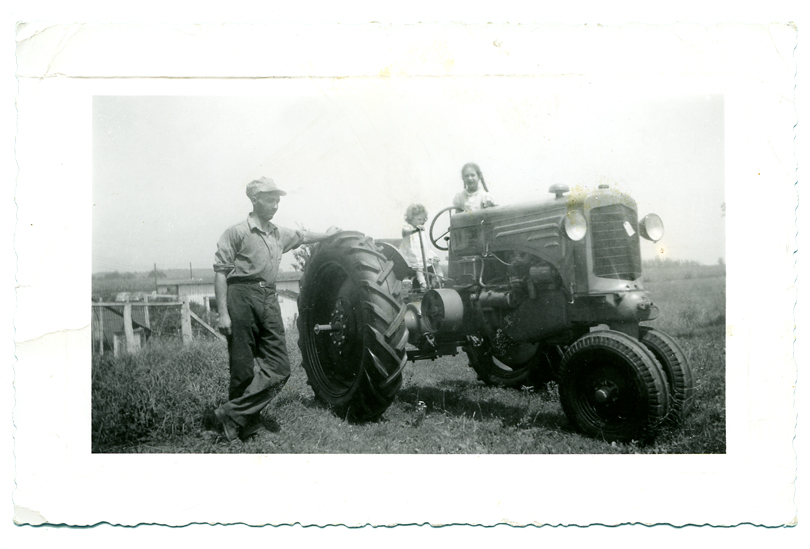
My father wore many hats. Work hats mostly, but also a goofy blue derby hat I faintly remember stashed high up on a closet shelf, and a fedora reserved for Sundays or other special occasions. Through his long history at the shop, Daddy sold a wide array of tractor brands which supplied him with hats embroidered with their company logo: Massey-Harris, Minneapolis Moline, New Idea, Fox, and Deutz.
His hats changed with his loyalty to the brand of farm equipment he was promoting. None made him happier, however, than the hat he wore with one of his first purchases after his father, Henry R. Longenecker, passed the business on to him. With the tag still attached to the grill, Daddy proudly drove the new Massey-Harris tractor back and forth in the alley next to the shop in Rheems, his sister Aunt Ruthie recording the spectacle with her new 16 mm movie camera.
Shop Hats
The Welding Helmet Invented by the German Hans Goldschmidt in 1903, welding was one of my Dad’s specialties, a boon to farmers with harvester units or even plow shares needing repair. A free-standing acetylene cylinder and oxygen tank for welding stood near one of the double wooden doors. This allowed easy access for welding repairs as a tractor or harvesting equipment was pulled through the giant, wheeled doors that ran back and forth on a metal channel.
I watched Daddy slap a Darth Vader-like helmet on his head, don long, flared-sleeve gloves, and use long, skinny welding rods to fuse broken parts together. Sparks flew everywhere in this Fourth of July fireworks show extending into August, the height of the harvesting season.
Along the back of the dark recesses of the shop was a large grinding machine that could sharpen a 6 to 8-foot section of blade used for scissoring hay, wheat or barley.
Daddy did most of his work in his shop but occasionally he was called to the field. A doctor of motors, he made “house” calls to the fields of anxious farmers, work stalled with broken-down equipment.
Farm Hats
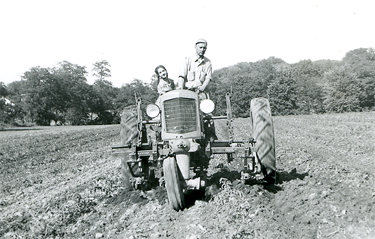
My father was first of all a farm implement dealer and mechanic, but he also farmed ten acres of land in Bainbridge, Pennsylvania combining corn and tobacco crops and then later corn with tomatoes. Farming is serious business in the searing sun requiring a cap with a long bill. The result: a white “farmer” forehead and red-brown cheeks and arms. My mother and Aunt Ruthie often wore sun bonnets, in the field but as you can see, we were bare-headed and probably bare-footed too.
Cultivating land for tomato crop in Bainbridge
A beekeeper too, my dad wore a bulky hat complete with a mesh veil to smoke out the bees.
Fancy Hats
Church, weddings, funerals – all were occasions for a fancy fedora. But one occasion in particular required dressing up: posing on the steps of the U. S. Capitol building ready to meet with congressmen regarding the threat of a proposed air base to some of the rich farmland of northern Lancaster County. A sizable delegation of plain people (many of them Mennonites) including my dad in his fedora and Grandma drove to Washington D.C. to make their case with government officials. When a follow-up investigation was conducted, sink-holes had reportedly been found in the farm-land around Bossler’s Mennonite Church. The case was subsequently closed.
Sadie Greider, Grandma Fannie Longenecker and Ray Longenecker on steps of the Capitol in Washington, D. C.
Tell us about your dad’s hats – what he wore, or any other “Dad” memory you want to share now.
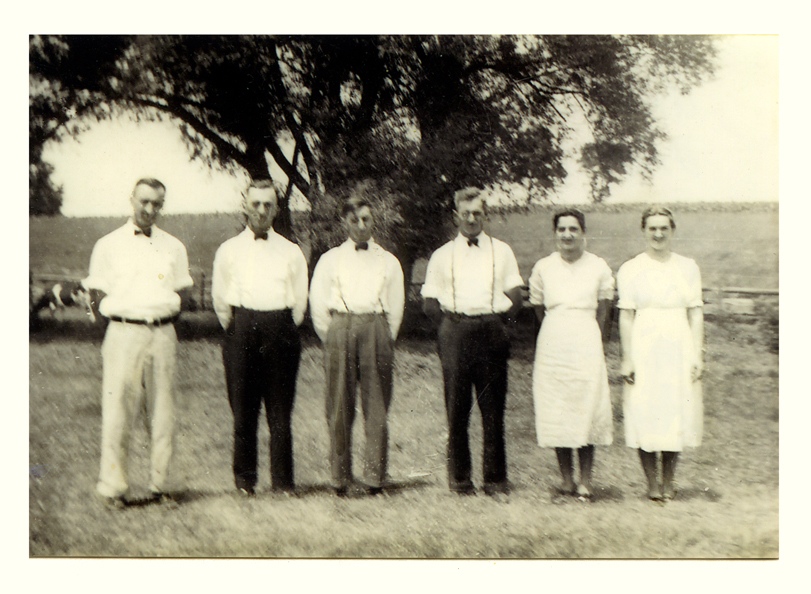
Here is my mother’s family of four brothers and one sister in a farm meadow in the 1940s. They are children of Abram Hernley Metzler and Sadie Landis Metzler, a Mennonite family of Lancaster County, Pennsylvania.
Standing in birth order are her brothers Landis, Leroy, Clyde, Abram, Jr., with my mother and her sister Verna. Two of her siblings died in their sixties, the others in their seventies. Only my mother is still alive at age 95.
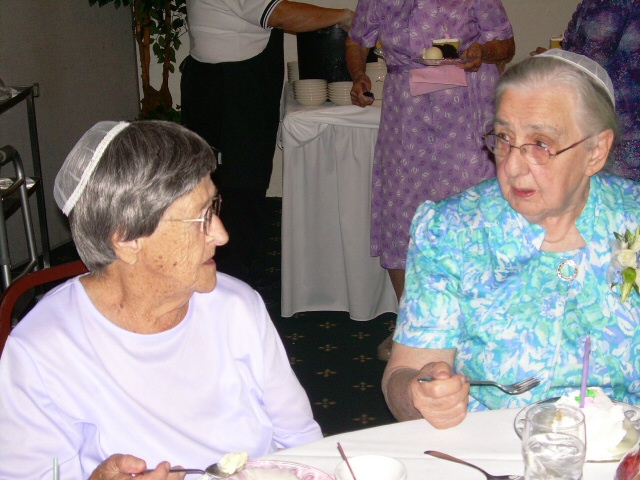
When Mother turned 90 in 2008, her 94-year-old sister-in-law Cecilia Metzler, married to my Uncle Clyde, said to her: “Ninety’s nothing . . . . You have to live past that to make your mark these days.” (Then I saw a quick smile and heard an I-got-you-there chuckle.) Aunt Cecilia, who calls herself Cece now, has always been energetic and feisty, a farm wife and a pastor’s wife. Up until 2011, she has sent me Christmas cards – always the first week of December. And via her daughter Erma’s account, I would occasionally even get email messages from her.
Mother too has always been strong and hardy all these years. She still lives alone but has watchful neighbors along with my brother Mark who checks in with her regularly. Her mind is still sharp though her hearing, which has always been in a category I’d call bionic, is failing now. When I asked her a few weeks ago, “Do you remember wearing Evening in Paris cologne?” She questioned me back, “Carrots, what do you mean carrots?” This from a woman who most of her life had to hold the telephone receiver away from her ear because the sound was too loud. Oh, my.
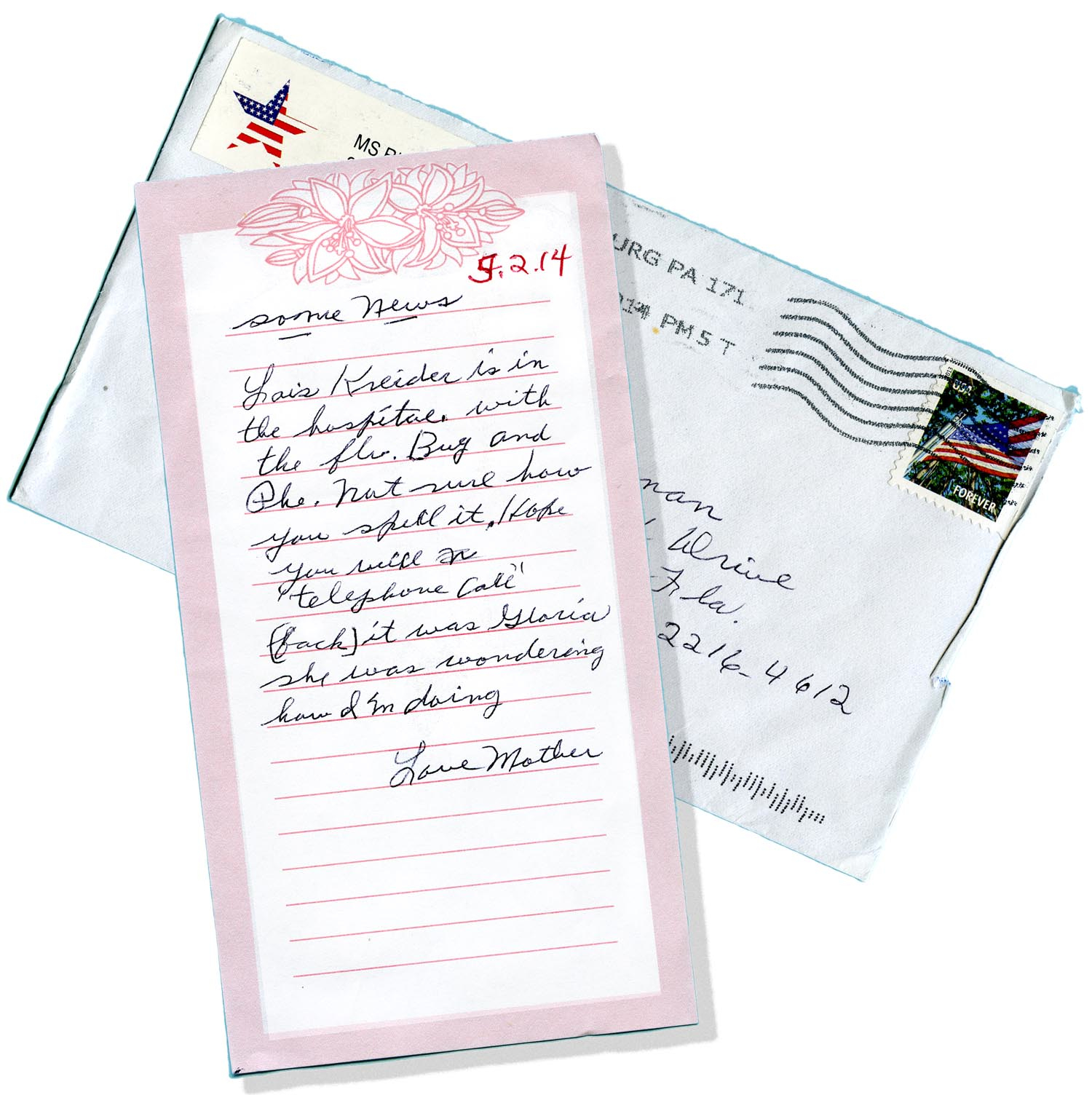
I call her often, but she says she likes to get something in the mail, a letter with a stamp on it, she hints. As if to demonstrate how it’s done, last week she sent me a short note with concern about a friend’s health along with a check for special vitamins I send to her. Yes, she still pays her own bills.
Thankfully, her friend is fine now.“Cecilia, do you really think we are going to live to be 100?” my mother may be asking. (Photo: Mother’s 90th party at The Gathering Place, Mount Joy, PA.)
* * *
Recently, “60 Minutes” aired a show entitled Living to 90 and Beyond hosted by correspondent Lesley Stahl. The show featured interviews of some of the more than 1600 men and women who participated in a study named “90+” funded by the National Institute of Health. All of the data was collected in the 1980s from residents of a community south of Los Angeles called Leisure World, now re-named Laguna Woods. The study was launched to determine the secrets of longevity and perhaps find clues to preventing diseases like Alzheimer’s often associated with advancing age.
On air, the interviewees, all over 90, were shown undergoing physical testing: reflexes, pace of walking, how quickly they could sit down and stand up again. Their mental acuity was checked as well: Tell me today’s date, spell w-o-r-l-d backwards, remember these words (brown, shirt, charity) – I’ll ask you to repeat them to me in a minute. And so on.
Claudia Kawas, spokesperson for the NIH study, concluded with some statements that weren’t at all surprising. And some that were:
People who exercise definitely live longer than those who don’t.
Board games, socializing with friends, working in the garden enhance mental health.
Taking vitamins doesn’t seem to make much difference.
It’s not good to be skinny when you are old.
Drinking 1-3 cups of coffee seems to be beneficial.
One or two glasses of wine daily is recommended.
My Mother, almost 96, and Aunt Cecilia, now age 99, were part of the “Game Girls” crowd in their prime. They loved playing Uno, Skip-Bo, and Hand & Foot with friends. And they probably both still drink one or two cups of coffee with breakfast.
But rest assured, neither of these good, elderly Mennonite ladies ever imbibes a glass of wine with dinner.
* * *
Most of us know one or more friends or family members over 90. Does longevity run in your family?
Do you have a story about a nonagenarian you know?
Coming next: A visit with author Kathleen Pooler and introducing her new book!
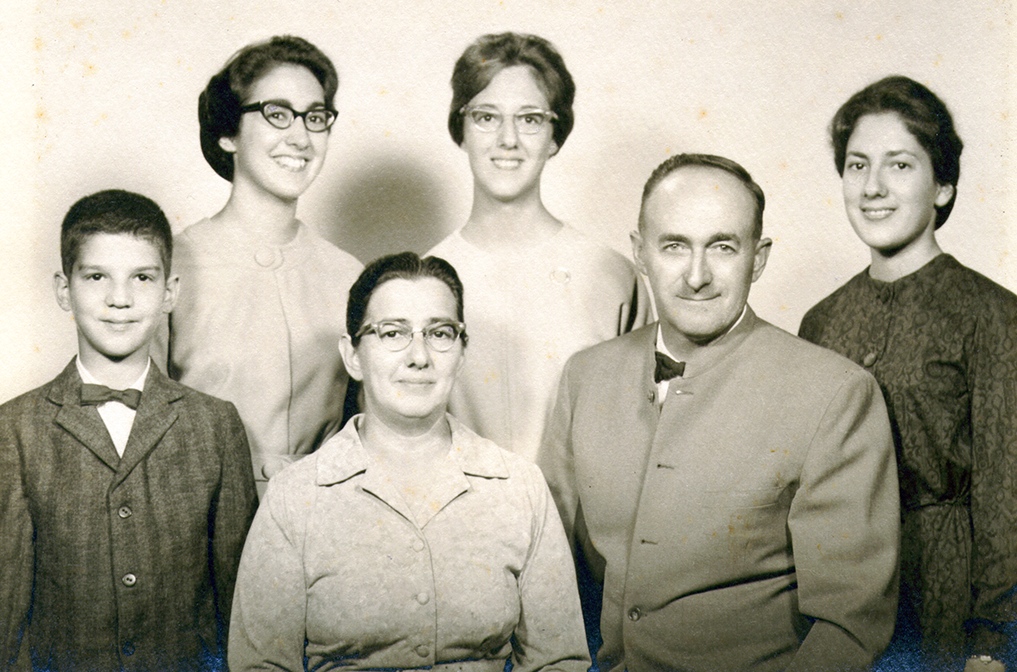
Longenecker family portrait circa 1961: Mark, Marian, Janice, Jean with parents
This is the family I grew up in: my parents Ray and Ruth with my two sisters and one brother. But after I left home and eventually married, my parents had more children. No, my mother was not a modern-day Sarah. She didn’t have babies in old age. But in their early sixties, Mother and Daddy “adopted” another set of children, about a dozen daughters in all, through an agency called New Life for Girls.
Because they entered my parents’ lives after I left home, I never felt jealous of them. They were simply unknown to me, mysterious. Oh, I did meet two of them, Gloria and Julie. They came to see my mother when she visited her first two grandsons born in Chicago in 2003. By then these girls both had grown children of their own.
Gloria’s Story
Gloria grew up in inner city Chicago with an alcoholic father who beat her mother and more than once tried to choke her with a dog chain. Her mother, single now with 8 children to feed, had to go to work. Alone in the world, Gloria turned to drugs and men, looking for love. She set her sights on rich men, men she hoped would take care of her. But the rich men were users, drug dealers or worse. Not surprisingly, Gloria became pregnant at age 14.
One day an evangelist named Brother Raymond, came into Gloria’s neighborhood. She responded to this kind man’s message of salvation and made a profession of faith in Jesus Christ. Though her heart had changed, Gloria’s life didn’t get any easier. Several times she slid back into her old ways and had more babies out of wed-lock. The hard times made her harder. She became tough as nails, always looking for a fight.
Finally, Brother Raymond suggested a way out. “There is an agency called New Life for Girls in Pennsylvania that might help you get your life on track. To enter their program though you would have to agree to their rules and stick by them. Also, your children would be staying in a separate facility.”
Gloria: “Oh no, I can’t be separated from my children!”
Brother Raymond: “Well, then we’ll try to find a host family for you, so that on weekends you can visit with them in a nice Christian home in the country.”
And that’s how my parents’ lives intersected with Gloria’s.
Weekends with the Longeneckers
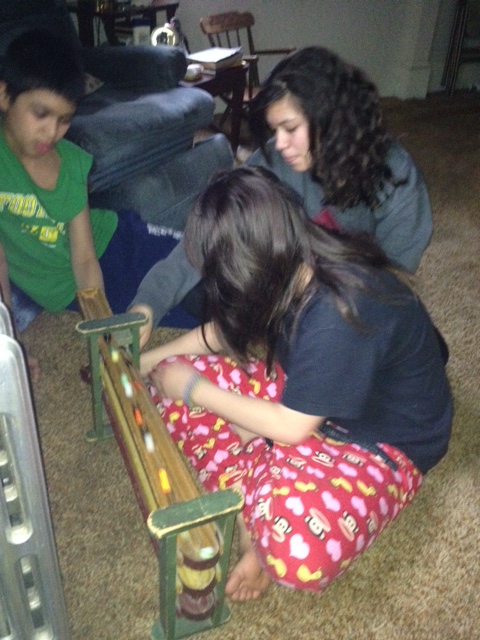
Gloria was looking for an anchor and she found one in her weekend visits to the Longenecker family on Anchor Road near Elizabethtown. Pennsylvania. Most importantly, she could be with her children. Mother and Daddy would pick Gloria up at the train station with her four children who played with toys including the same marble-roller I played with as a child.
Gloria’s grand-children playing with the same marble-roller we had as children: Demetri 12, Inani 13, and Samantha 10.
And she could enjoy Lancaster County abundance. “This is how life should be,” Gloria exclaims as she recalls some of her favorite things:
Going to Root’s Sale where fresh farm produce abounds.
Helping Mom make applesauce with her metal sieve and wooden mallet.
Turning the crank on the ice cream churn, always vanilla with Hershey’s chocolate syrup and peanut sprinkles.
Helping with quilting at Bossler’s Mennonite Church Sewing Circle.
Eating fresh corn on the cob – and fresh tomatoes out of the garden, both dripping juice.
Making tangy home-made root beer from Hires Root Beer Extract, the two-quart jars cooling on their sides in the cellar.
Having devotions with my parents on Sunday morning after which my dad would march over to the piano and bang out the melody to “Fill My Cup, Lord,” singing at the top of his lungs.
Following the Longenecker rules. And to the letter.
My brother Mark still lived at home when Gloria and her children visited, so she got some first-hand tips on getting children to obey. When Mark questioned Mother about why he had to get up and go to church Sunday morning, Mom would reply, “Because you’re in my house and that is the rule.”
But Gloria recalls Mother’s softer side when she tearfully called her at one point to break the news about yet another unplanned pregnancy: “She never criticized me; she stood by me, and said “’You just have to trust that God is still in control.’”
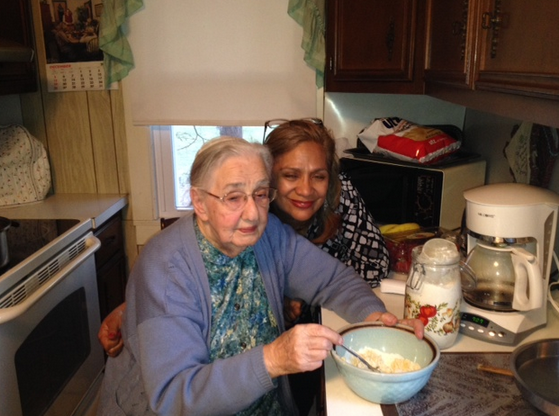
Gloria Araujo in kitchen with Mother (age 95) April 2014
Gloria Today
Over the years, Gloria has told her own children and grand-children this same bold statement when they question her authority: “Because you’re in my house and that is the rule.” And she teaches her clients how to use firm discipline with their children in her role as a social worker at The First Baptist Church of Wheaton, Illinois, where she has recently been appointed deaconess.
“Now I work with many Cuban refugees, help them get into an apartment, find jobs and medical aid—set them on the right track. It feels so good to see lives changed,” she says.
In Retrospect
In a little green autograph book sitting on one of Mother’s living room end tables are listed all the names of the girls from New Life my parents have hosted. This April in her recent visit, Gloria noticed that her name was the first one to be signed in 1978, along with her sister Julie’s. After the signatures of 11-12 other girls, she signed the book again. “It’s only suitable that I sign the last page,” she says.
Therefore if any man is in Christ, he is a new creature:
the old things are passed away; behold, all things become new.
Is a family graduation on your calendar this year?
As a faculty member at Florida State College at Jacksonville (then Florida Community College), I attended graduation every year in full regalia with hundreds of ecstatic grads, joyful families, and proud faculty and administration.
The Tawdry Tale
One year stands out though: 2001. State Representative X rose to the podium to deliver the commencement address and announced that his remarks would be short and to the point. Relieved, the audience sat back to enjoy a brief speech entitled A Short Guide to a Happy Life. Hmm . . . the title sounded familiar, I thought. Then he went on to tick off the main points: 1. Don’t confuse life with work. 2. Life is what happens when you are making other plans. 3. If you win the rat race, you are still a rat. . . . Then it dawned on me. I have heard this all before. In fact I’ve read it. Recently. In a book. In a book by Anna Quindlen with the same title. This man with an honorable title in high office is plagiarizing his speech, giving no credit to Quindlen or reference to her book. His whole speech. Boldly. Baldly. With no bones about honesty!
My sense of justice on high alert, I set out to right the wrong. No, to expose the guilty. I contact the campus president in charge of graduation. Yes, she will check up on my suspicion and she does follow through. There are more emails and phone calls, which in the end boil down to the critical question: Where is the audio recording of that address? Alas, it is never un-earthed. We are told the recording mechanism failed (?) and thus no incriminating evidence is available. Sadly, just my words remain which have now fallen. Flat. On deaf ears.
* * *
My own college graduation is a distant memory. When I graduated from Eastern Mennonite College with a degree in English, I was still a plain girl, but with a B. A. degree in English education. I don’t remember at all who spoke at the commencement address or what the topic was, but I am sure there was an emphasis on service to others, demonstrating peace while upholding justice, still strong tenets of my alma mater, now Eastern Mennonite University.
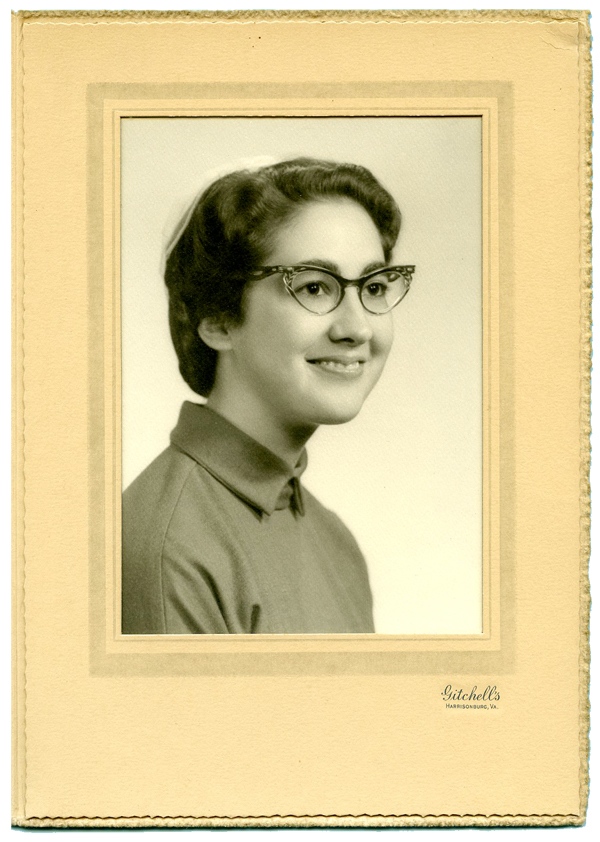
Senior Photo: Eastern Mennonite College
The Nobel Laureate
Tomorrow another graduation occurs. On Sunday, April 27, 2014 an honorable woman, Leymah Gbowee, co-winner of the 2011 Nobel Peace Prize and a 2007 EMU alumna, will give the 96th annual commencement address at Eastern Mennonite University. Gbowee was the focus of a documentary “Pray the Devil Back to Hell,” which demonstrates how women, both Christian and Muslim confronted then-Liberian President Charles Taylor “with a demand for peace and end a bloody 14-year-old civil war.” Her genius: Gbowee rallied women, all dressed in white from various ethnic groups to lock arms, protest, and over time literally pray the ruthless rebels, including the President, into retreat. They even staged a sex strike which her book describes in more detail. In 2007 Leymah Gbowee received a Master of Arts in Conflict Transformation from the Center for Justice and Peace-building at EMU, also her alma mater. No doubt in her graduation speech she will make reference to her book: Mighty Be Our Powers: How Sisterhood, Prayer, and Sex Changed a Nation at War.
But I can assure you—she has plagiarized neither her book nor her speech!
* * *
When have you become outspoken against an injustice? What were the results?
Have you heard of Leymah Gbowee? Anyone else you know with her qualities?
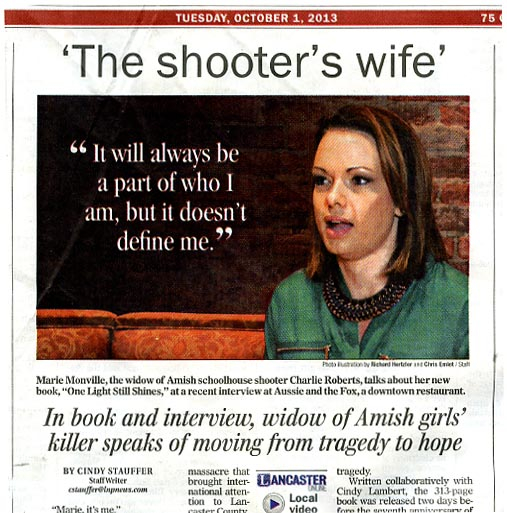
When I bring 5-pound bags of Wenger’s famous ham-loaf frozen from Pennsylvania to Florida, the plastic-coated tubs of meat are wrapped in newspaper and then shrink-wrapped in plastic. The wrapping on one of the packages (we need two to feed the clan now!) revealed the riveting story of Marie Monville, the widow of Amish school house shooter Charlie Roberts.
What Happened
In a story that brought international attention to Lancaster County, Charles Roberts methodically shot ten Amish girls inside a one-room school-house, killing five, injuring five others, and then turning the gun on himself. Roberts’ wife Marie learned of the impending massacre through a letter Charles left for her directing her to his final phone call, which revealed the unresolved feelings he harbored after the deaths of two of his daughters, one a premature birth and the other an ectopic pregnancy. Though the couple went on to have three healthy children, the loss of Elise and Isabella, he says in the letter, “changed my life forever. I am filled with so much hate, hate toward myself, hate toward God, and unimaginable emptiness.”
Immediately After
Because he hid his clinical depression so well, Marie had no signs her husband was so deeply disturbed and headed for a psychotic break-down. Even the police queried, “Were there any signs of violence before the shooting?” She also feared what the public may be thinking: Are you a liar, covering up a failure to act? Are you an idiot, blind to the obvious? But Marie had been blind-sided.
Her own family and her husband’s family were “stalwart,” Marie writes. “A beloved aunt and uncle gave her family a place to hide out from the media in their own home in Lititz, Pennsylvania, comforting and feeding them in their darkest hours.
Forgiveness from the Amish Community
1. Just hours after the horrible shooting, Marie’s father greeted a group of Amish men who knocked on the door. She writes:
An Amish man with a long gray beard stepped toward my father and opened his arms wide. My father fell into those arms, his shoulders heaving, held and comforted by a friend. Grief met grief.
2. Shielding the family from the media, “the families of the slain girls went to the cemetery for Roberts’ burial. They also went to a meeting at the Bart Fire Hall for families and first responders, sharing their feelings” and saying they were praying for Marie and her children.
Her Book
Marie Roberts Monville intersperses her account of the tragedy with the story of her own life in rural Lancaster County and tells as a teen-ager meeting Charlie Roberts, the grandson of a church friend, at a dinner one day. After marriage, they had three children, aged 7, 5, and 18 months old at the time of the tragedy which occurred over seven years ago at Nickel Mines.
“One Light,” written from a Christian perspective, shows how the author’s faith in God has sustained her through unimaginable grief and brought healing. Now re-married, she is a stay-at-home Mom and blogger on whisperandwonder with the subtitle “quiet musings from my heart.” Marie wrote the book to tell her true story of how horror and tragedy met love and forgiveness. She also seeks to connect with readers who are in the midst of suffering by posing the question:
What is your story? Mistreatment, injustice, torment, suffering, grief or even the worst that humanity can do to one another? Receive the gift of love. And when again the lights go out, you too will see that one light still shines.
Though her experience is similar in some ways to that of Marina Oswald, wife of President Kennedy’s assassin, Marie Roberts Monville has refused to become a pariah, but now lives life to the fullest, sharing light and hope.
Do you know someone who has survive trauma and grief?
Do you have a story of survival of your own to tell?
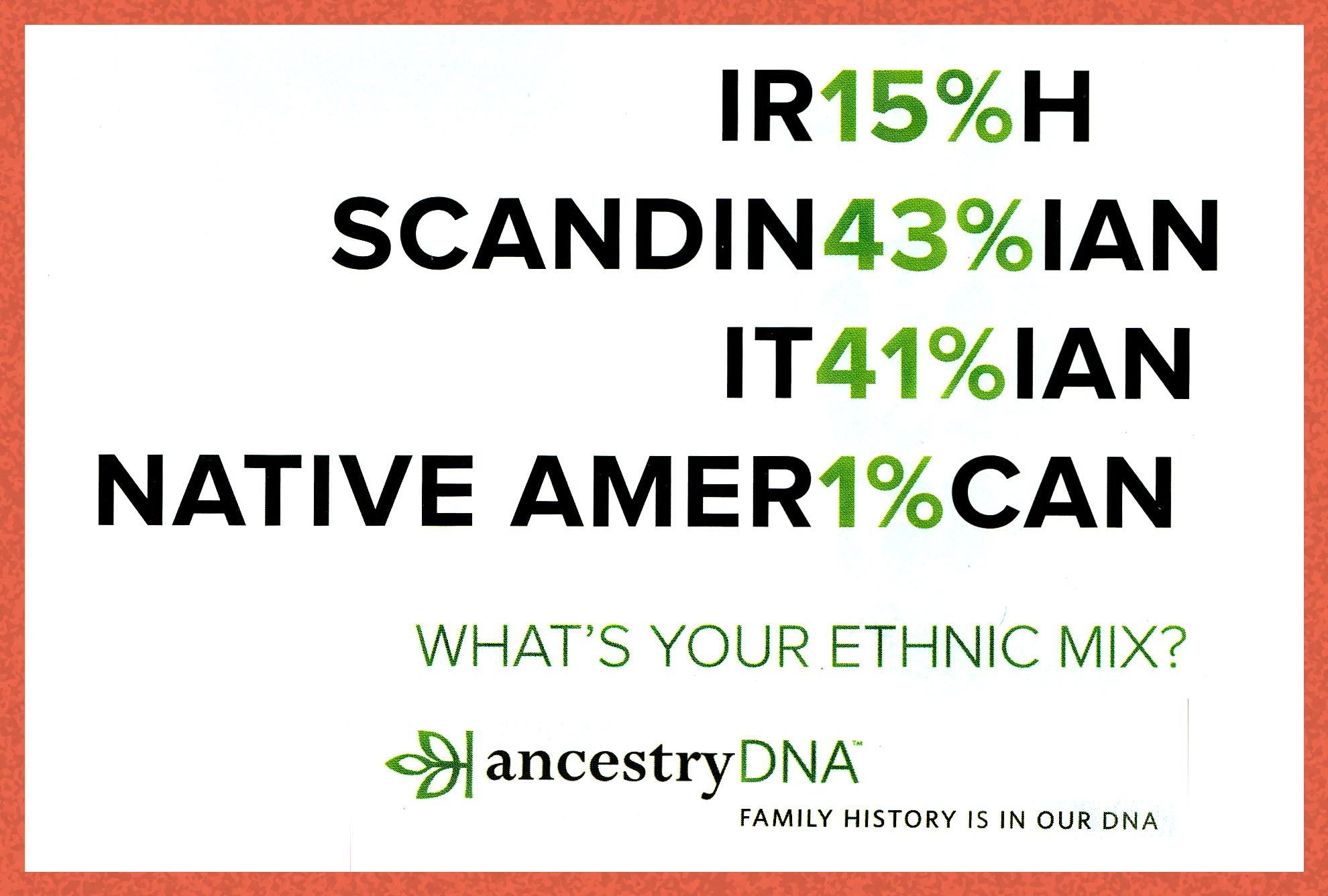
“Your DNA has a story. It’s time to discover it,” invites an ad on the back cover of the February 10, 2014 issue of The New Yorker. “It’s easier than ever to discover your ethnic heritage – and possibly find new cousins along the way,” the advertisement continues. Simply send in a small saliva sample, the key to revealing your DNA strands, which will unlock the secrets of your ethnic roots and disclose where your ancestors lived up to a thousand years ago.
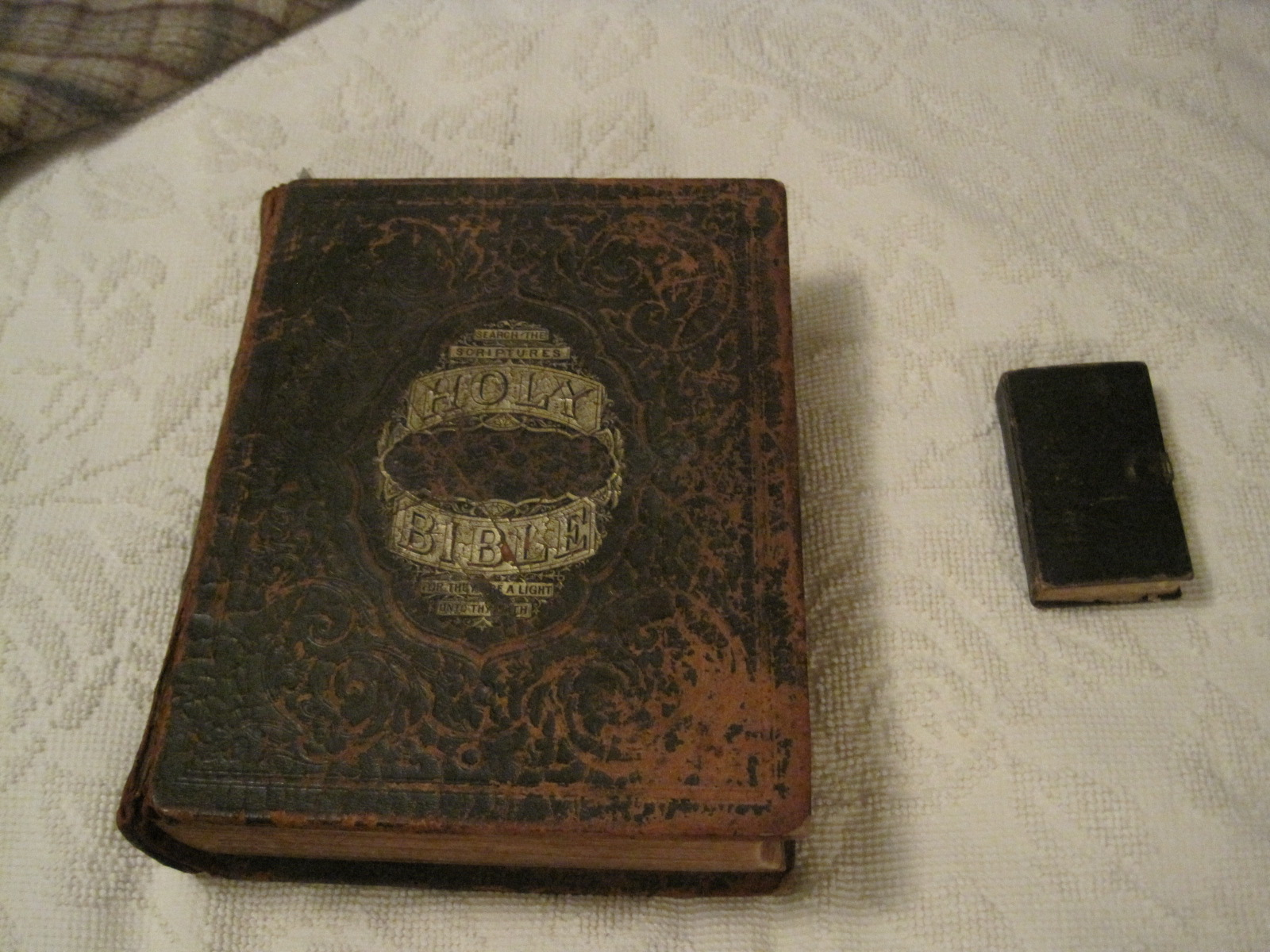
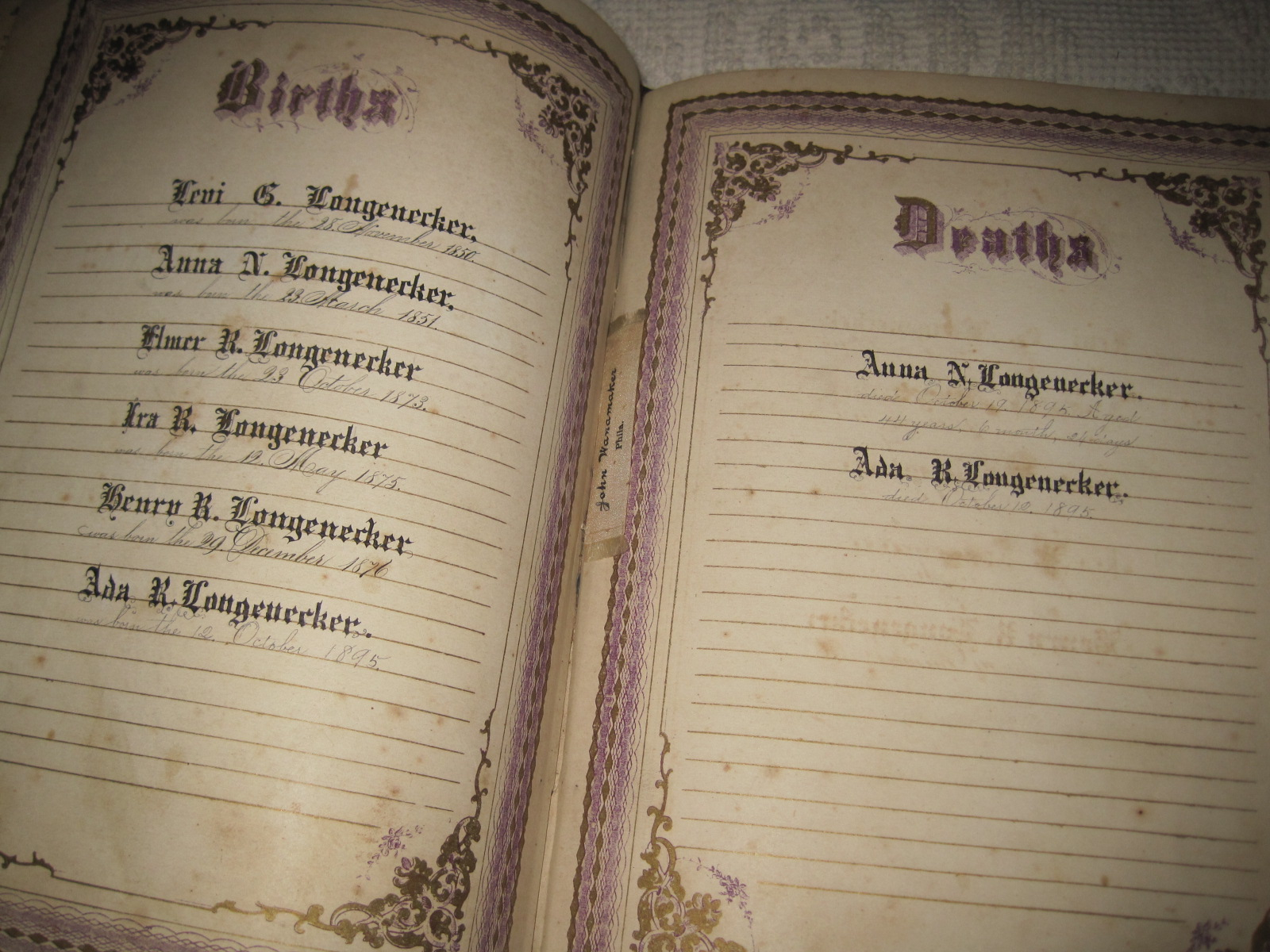
Genealogy, roots, ancestry . . . In my Pennsylvania Dutch family tree, names and dates were often written in the family Bible:
Longenecker Family Bible with German New Testament at right
Eight generations ago, Ulrich Langenegger (1664-1757), left his birthplace in Langnau, Switzerland, because of religious persecution, and moved to the Rhine Valley in Germany and subsequently immigrated to America from Rotterdam on the good ship Hope.
In America, his son, Christian Langenecker (1703-1759) settled in the rich farm land of Donegal Township in Lancaster County, Pennsylvania where followed two more generations of Christian Longeneckers, with the initial “a” in the last name changing finally to an “o.”
Henry Risser Longenecker, my Grandfather, son of Levi Longenecker, recorded in the family Bible.
And so the family tree on my father’s paternal side continues:
Christian Longenecker, Jr. 1785-1855 buried in Bossler Mennonite Church Cemetery
John Longenecker 1817-1898 married Nancy Garber, my great-great grandmother
Levi Longenecker 1850-1931 married Annie Risser, my great-grandmother
Henry Longenecker 1876-1946 married Fannie Martin, my grandmother
Ray Longenecker 1915-1985 married Ruth Metzler Longenecker, my mother
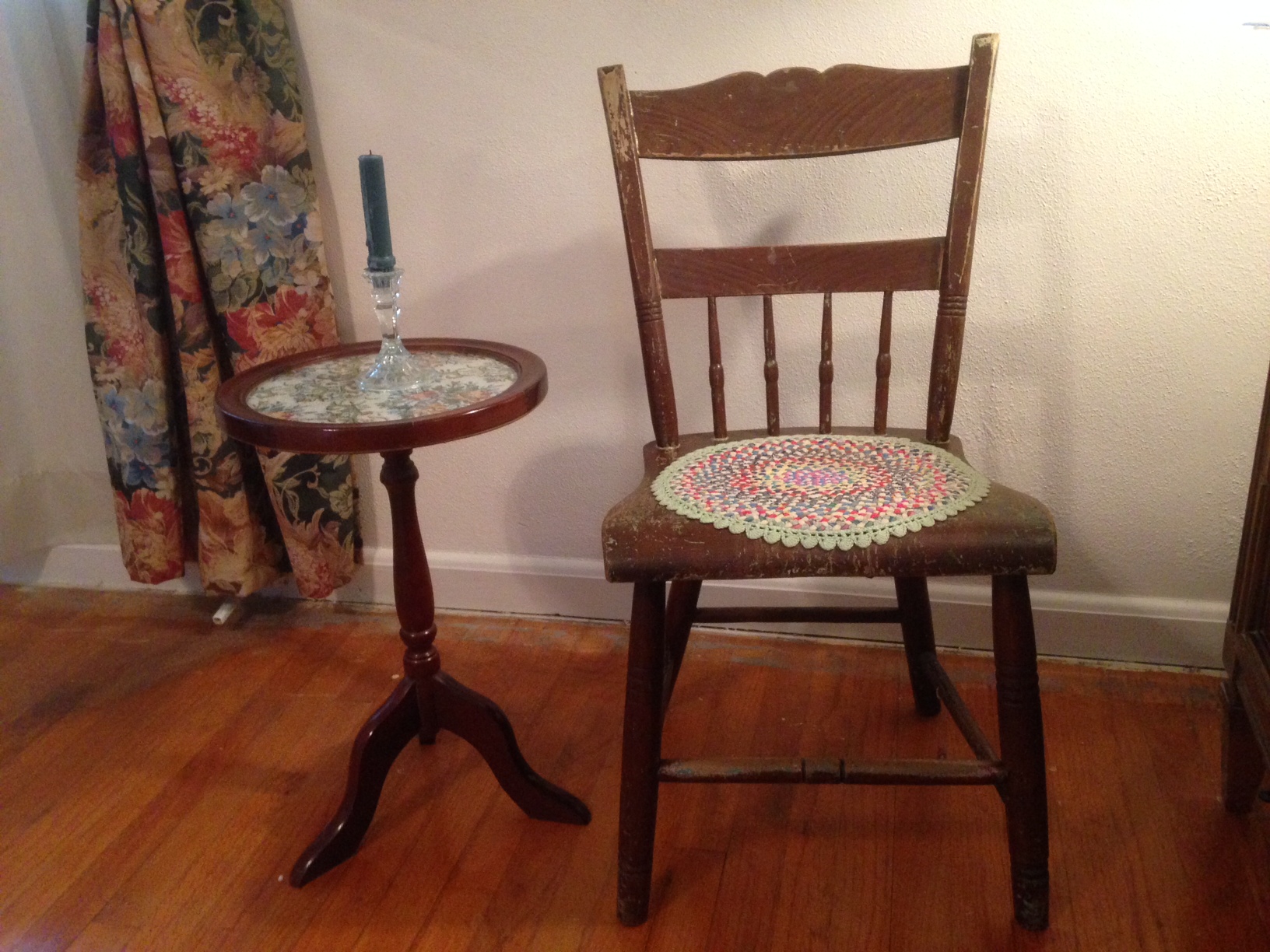
On my father’s maternal side some of our history is recorded on the bottom of a chair given to me in 1975. Even then it had a 150-year-old history of Martins, Brinsers, and Horsts in the lineage of my Grandmother Fannie Martin Longenecker.
The Martin Chair, circa 1815
My mother’s story is a blend of other Pennsylvania Dutch Names: Landis, Harnish, Hernley, and Metzler. After attending the 275th Metzler reunion last June, I wrote a post entitled Another Valentine, A Different Romance, recounting the parallel history of Swiss-German Mennonites who also came to Pennsylvania at the invitation of William Penn to farm the rich soil of Lancaster County.
Because of their unique heritage as plain folks, focus on Mennonite ancestry is not unusual. But interest in tracing one’s ancestry has ballooned nation-wide in the last decade. “Finding Your Roots” the immensely popular PBS series by Professor Henry Louis Gates which aired in 2012 mirrors that trend. Using both traditional research and genetics, the series traces the family roots of such disparate celebrities as Condoleezza Rice, Sanjay Gupta, Margaret Cho, Robert Downey Jr., and Rev. Rick Warren. There are some surprising intermingling of genetic roots among the stories as I recall.
Thus, as our family trees expand and send out branches in many different directions, the fascination with our roots continues: Healthy roots, thriving branches, the tag of Homecoming Weekend at Eastern Mennonite University last fall, says it well.
* * * * *
Do you know your ethnic mix? Does it matter to you?
Is your story more complex because of adoption?
What fascinating discoveries have you made in learning of your ancestry?
Your thoughts matter to me! I look forward to hearing from you.
If I swallow a water-melon seed, my stomach might swell up.
If I touch freckle-faced Ricky with the dirty fingernails, I might grow a baby. Oh no!
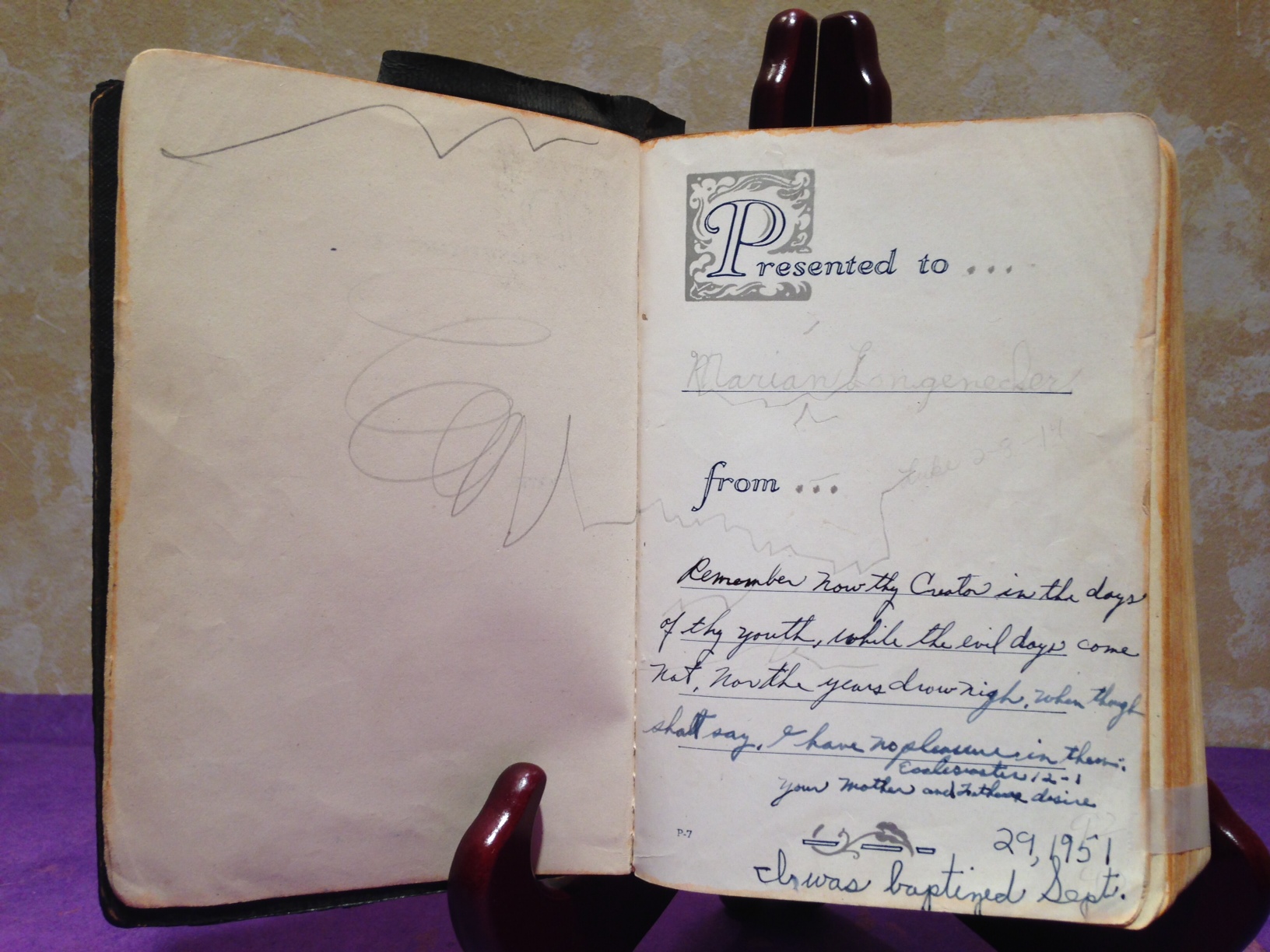
Those were my childhood fears. With a limited sex education, I tried never to swallow watermelon seeds or touch grimy Ricky. But my parents also had fears, largely unfounded. What my Daddy dreaded most as the father of three adolescent girls is that one of us might turn up pregnant some day and bring shame and disgrace upon the family. “We don’t ever want to hear of that happening in our family,” he exhorted. In my Bible he wrote this not-so-veiled admonition from Ecclesiastes:
Daddy’s inscription of Ecclesiastes 12:1 in the flyleaf of my Bible
Why he worried about my falling into mortal sin was beyond my comprehension: I always had my nose in a book and rarely dated Mennonite farm boys, or any other boys for that matter.
My experience with the lusts of men were of the non-Mennonite variety in my early teens. Summers I worked behind the meat counter for the Kleinfelters at Middletown Merchandise Mart. No worries with Mr. Kleinfelter, though he was often a bit tipsy, but some of his suppliers were another matter. Oily-haired Mr. Zapcic would creep up to the counter and invite me to “help” him in his produce business in Lancaster. “I need somebody to work behind the counter. You would be perfect!”
“That’s pretty far from Elizabethtown,” I mentioned innocently. Lancaster was almost 20 miles away.
Without my asking, Mr. Z. offered: “Oh, I’d see that you got there. You could ride with me.” It finally dawned on me what he was after and afterwards tried to ignore him. Yet he continued to harass me. Like Pamela in Samuel RIchardson’s novel, I rebuffed the man’s advances. Finally, I had to solicit some Kleinfelter help to get him to let me alone.
* * * * *
Senior Photo: Eastern Mennonite College
During the summer of 1964 my Aunt Ruthie and I attended Temple University, she to complete her Master in Education degree and me to begin it. From the hamlet of Rheems at 4:30 in the morning, we drove to Lancaster, took a train from Lancaster to Philadelphia, then rode the subway into north Philadelphia and walked eleven blocks to the campus of Temple University with classrooms filled with students who chain-smoked. I still wore a prayer veiling with a crown of dark brown braids fastened with hairpins underneath, ever the epitome of moral innocence. Ruthie’s classes lasted longer than mine, so I waited for her on a circular, wooden bench on the grassy campus outside the classroom.
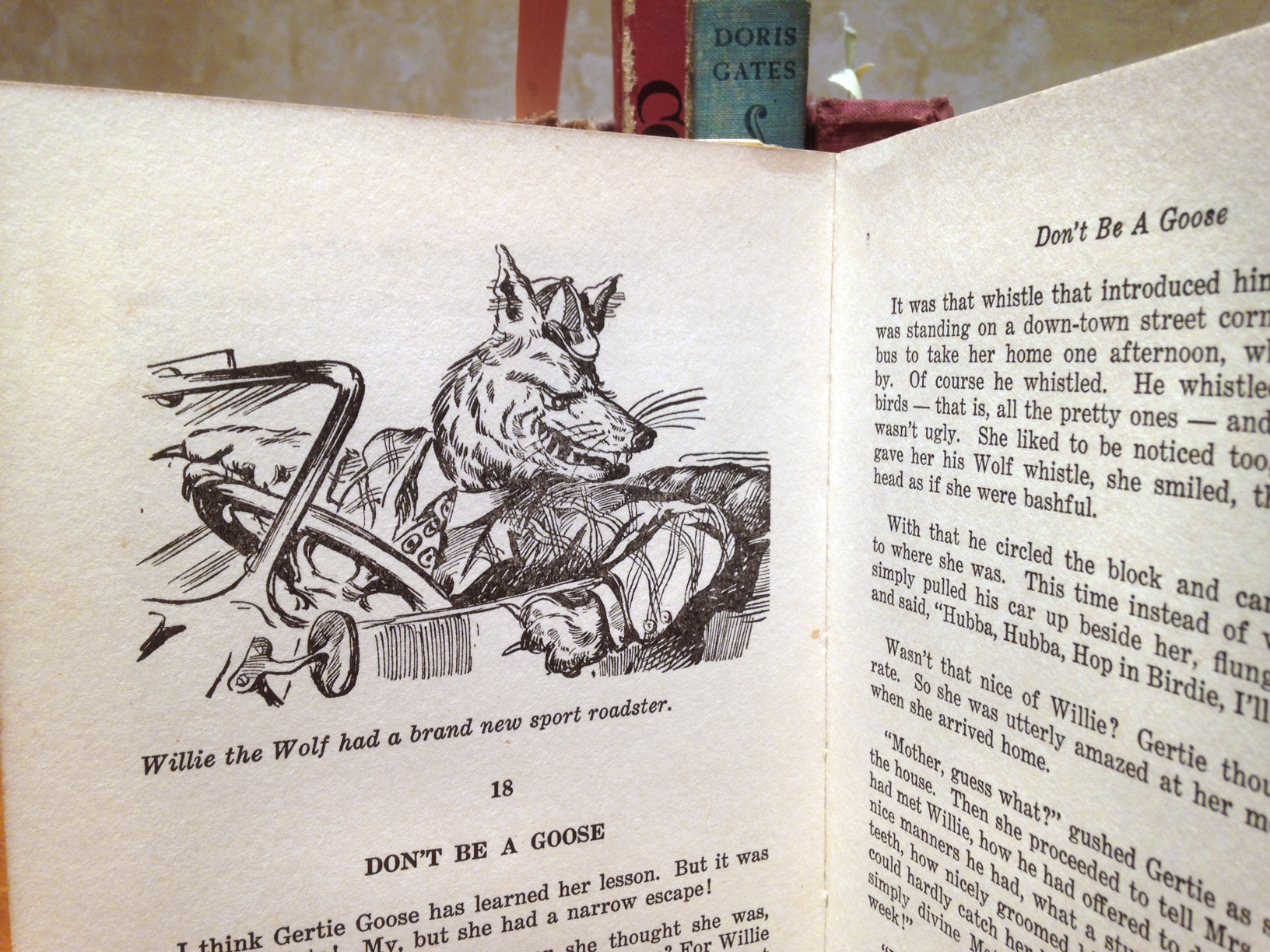
A suave older man approaches me and raves about my hair. It could be a scene right out of Bird Life in Wington, Gertie the Goose meets Willie the Wolf.
I notice at once his pearly white, even teeth and brushed back hair. Is he a college student? He for sure doesn’t look like one. Other students are milling around, I notice, so what could be the harm in talking to this stranger?
Willie: “Sprechen ze deutsche?” Not waiting for an answer, he spouts, “You have gorgeous hair. It’s so thick and glossy.”
Willie: I own a hair salon in the suburbs of Philly. I’d take you there and give you a different hair-do. It would frame your face really nice.
Gertie: Really?
Willie: Of course, I wouldn’t charge you anything.
Gertie: Well, thank you.
The dialogue continues for another minute or two, and then two things happen: I feel an electrical zap down my spine and a visitation from the Holy Spirit, who urgently whispers — “NO!” in my ear: “Run for your life. This guy is up to no good.”
Scales fall from my eyes as I swiftly dismiss his cunning ideas–and find an excuse to leave the bench and search desperately for Aunt Ruthie. Her class must be over. Soon, I hope. God, I hope soon!
Willie the Wolf in roadster tries to seduce Gertie the Goose in Calvin Reid’s cautionary tales
It’s your turn. Any narrow escapes from unsavory characters in your early years? Other threats to your moral virtue?
Your story is welcome here, and I will always reply.
On the eve of the Gulf War exactly 23 years ago today, I took a walk in the brisk evening air. As I rounded the curve of Emerald Isle Circle West in our neighborhood, I noticed the scarlet blush in the sky at sunset. With that striking image in mind and an imminent war on the national consciousness, I wrote these words:
CRIMSON SKY AT DUSK
The throat of the sky is inflamed,
livid with anger at the war it must swallow,
gagged by the bloodshed which rages in the jaws
of Babylon.
An olive branch on its tongue,
the dove of peace
touches the parched flesh with healing.
constrained by love
which sends streams
into the desert.
January 21, 1991, eve of Gulf War
Mennonites are pacifists, adhering to the tenets of nonresistance: opposed to war, not participating in military service, but sharing love and overcoming evil with good. I am no longer a Mennonite, but I choose peace over war, whenever possible.
Dove of Peace: Mennonite Central Committee logo
On her show last week, Diane Rehm interviewed the former Secretary of Defense, Robert Gates, on the publication of his book, Duty: Memoirs of a Secretary at War. Having served under eight Presidents, Mr. Gates reflected on the hard decisions national leaders must make concerning going to war and keeping the peace. One memorable line from the former Secretary, who often spoke in terms of pros and cons: “We [Americans] over-estimate our ability to shape events in other countries.” At the end of 51 minutes, Diane Rehm concluded the interview with another memorable remark: “I wasn’t supposed to say this on air, but thank you to all who serve.” And the piped in music carried her voice away.
I suppose that’s how I think about war, with ambivalence: I don’t applaud war. Peace is preferable, peace is the goal in all conflict, in my opinion. But when I see a man or woman dressed in a military uniform, often at an airport, I often approach them and say “Thank you” too.
Do you side with either viewpoint about war? Is it hypocritical to embrace both?
Were there war heroes or conscientious objectors in your family history? Inquiring minds want to know.
I love when you read and comment. And I will always reply.
















 Plain and Fancy