So now it matters almost not at all to any of them except as a storybook matters; loved in childhood but outgrown in adolescence, it still matters, still instructs, still is part of what the adult becomes.
Phyllis Tickle, The Graces We Remember: Songs in Ordinary Time (126)
When our children Crista and Joel were little, a prelude to nap-time was their mother chanting in a sing-song voice: “Come to the storybook chair, the story book chair, the story book chair, and we’ll read . . . .” Hearing that, they’d head for the rocking chair and climb on my lap for colorful Richard Scarry pages or the clever tricks of a George and Martha book. I’m carrying on a tradition that began with my mother who read to me from picture books, and also recited poetry from her school days.
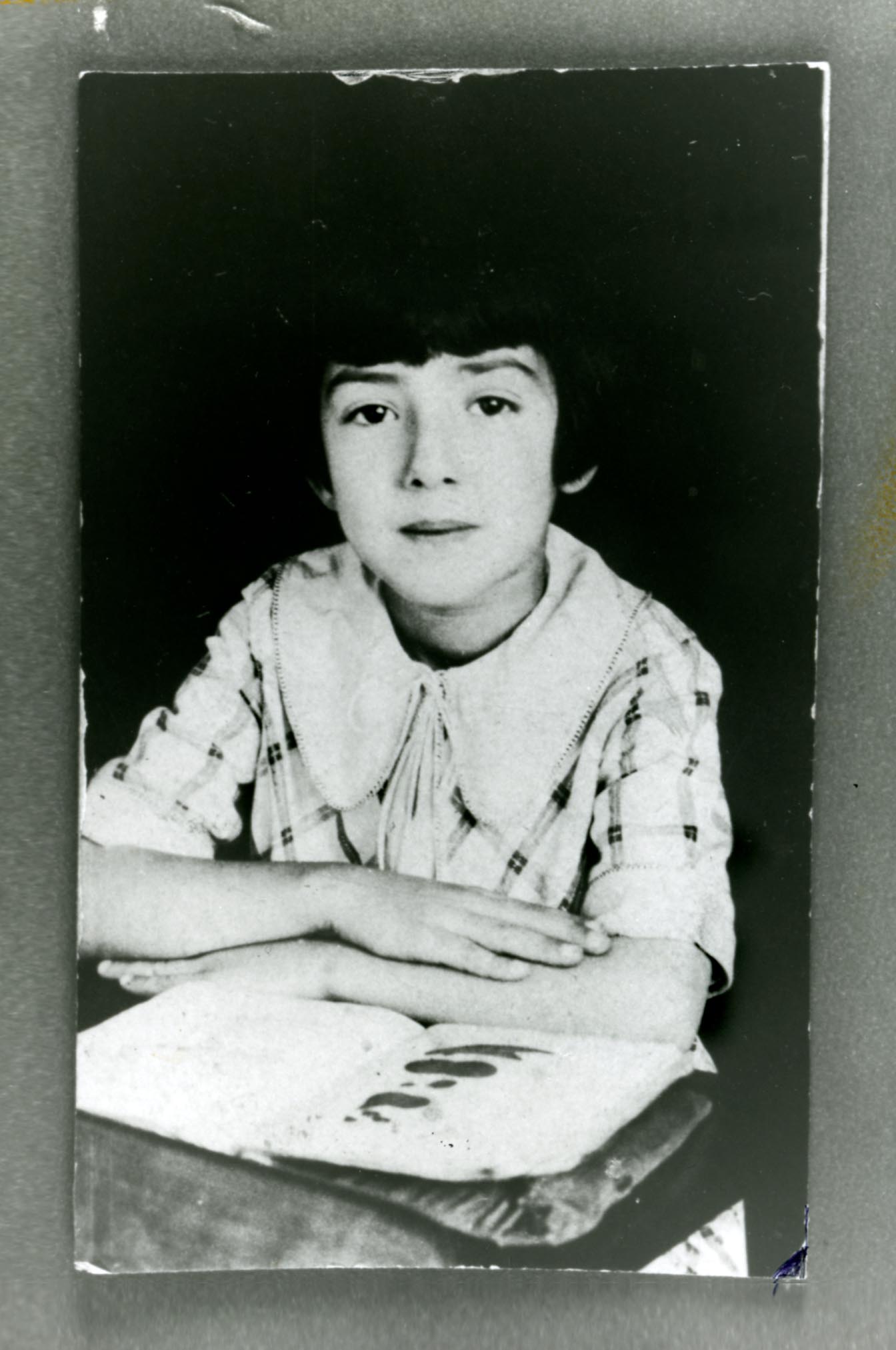
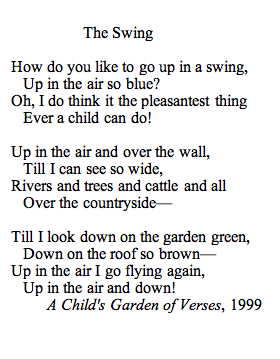
My journal tells me (and it does not lie) these are the poems by Robert Louis Stevenson that Mother recited to me in 1999 from her memories of Lime Rock School near Lititz, Pennsylvania in the mid 1920s.
Ruth Metzler Lime Rock School 1920s
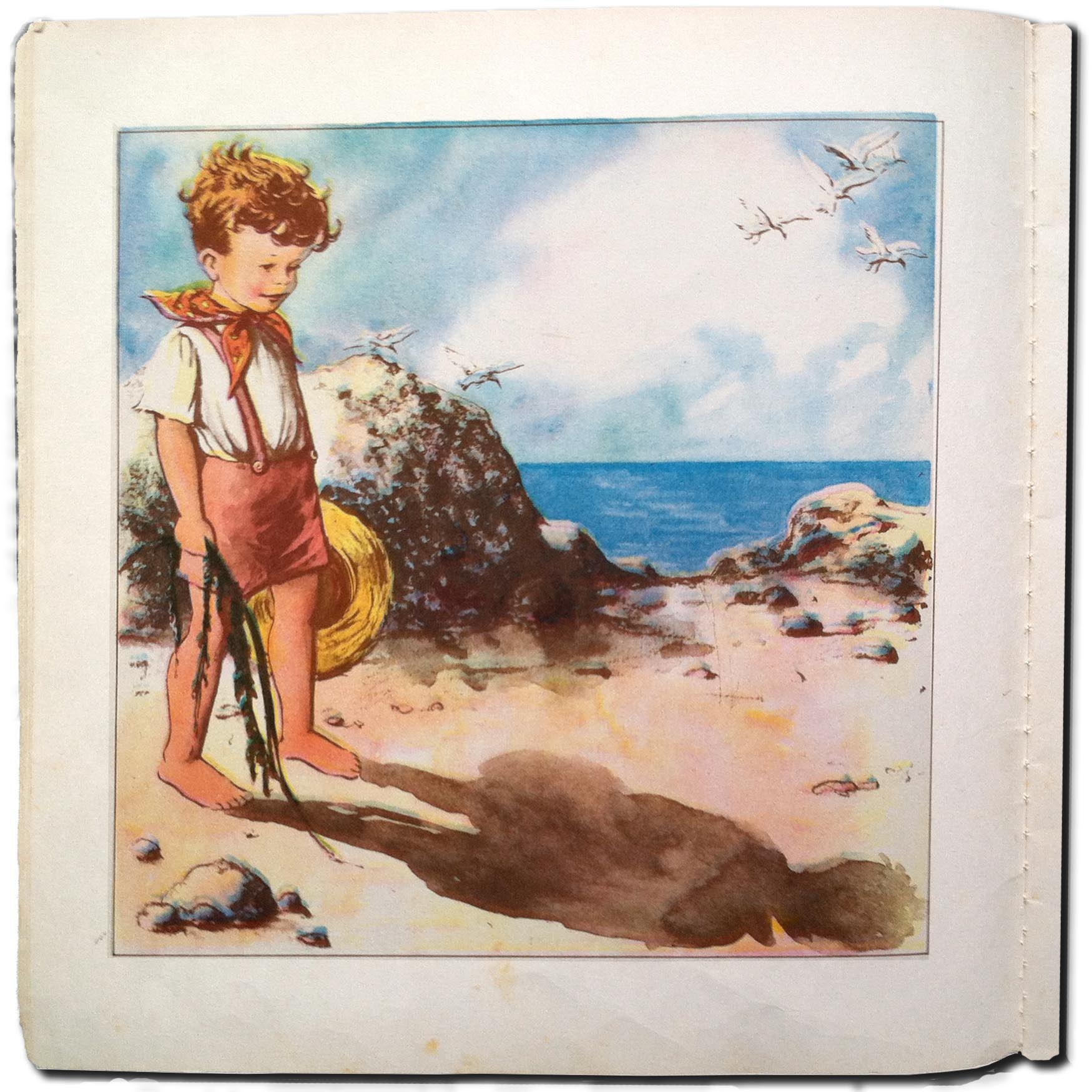
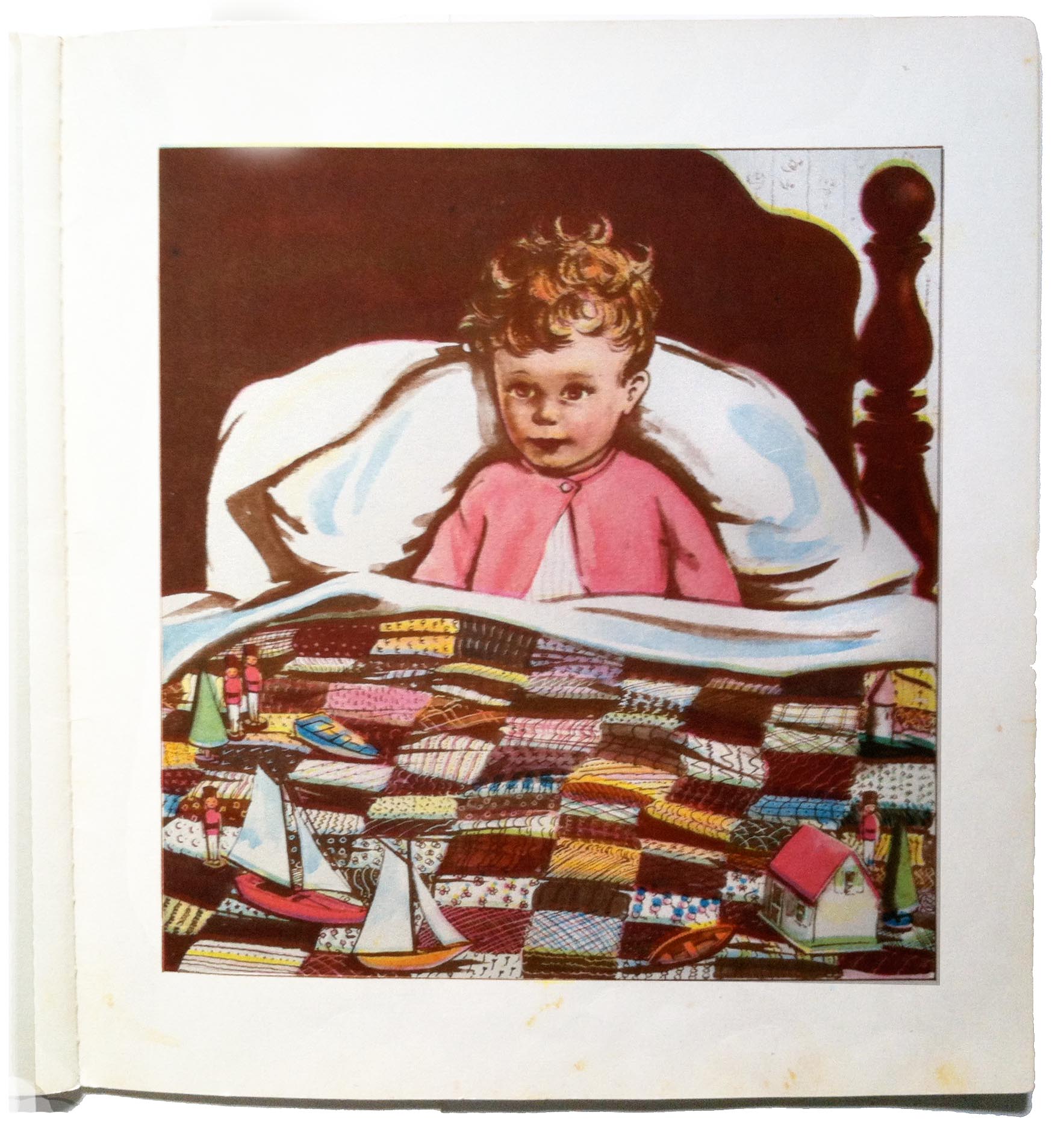
Illustrations from A Child’s Garden of Verses, John Martin’s House, Inc., circa 1945
She also recited the verses of “My Shadow” from the “Golden Book of Poetry” 1947 with the familiar first two stanzas:
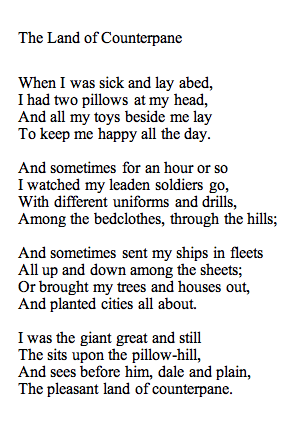
At the beginning of second grade, the summer I turned seven, I had my tonsils removed and among my memories (besides drinking chocolate milk through a straw and trying to swallow smashed bananas) is reading the poem “The Land of Counterpane” under a quilt that probably matched my own upon my sick-bed.
What are your early memories of reading? Did a friend or family member recite poetry or other words of wisdom to you?
I have had many moments of extreme emotion. Some you may know about like flunking my driver’s test, an explosion in the curio cabinet, and a broken piano leg — and some you may not.
According to my journal, this particular moment lasted almost an hour and happened in Positano, Italy, a terraced town poised on a peninsula along the Amalfi coast by a vertiginous slope to the sea.
Quaint Positano rises up, up, up to houses crouched in cozy rows and leans down, down, down to the snug little village below. We leave the charming hotel, Villa Rosa, to spy out the sights and shopping. Positano itself is dripping with bellissimo scenes: lemons the size of grapefruit, grapes a million, shiny red peppers, elegant shoppes, delikatessens. Cliff wants to check out the sights first and I prefer the shopping, so we decide to meet at a certain time and place “under the bougainvillea” before we go our separate ways for awhile.
Now a host of pergolas of bougainvillea adorn the village, each pergola with blooms that cascade like crimson waterfalls. Of course, I think he must mean the one on the way down the steep street leading into the village.
Upper bougainvillea – where I thought we’d meet
In one of the shops, plates of lemon yellow and Mediterranean blue catch my eye with painting on the back “dipinto a mano per alimenti Positano” – hand-painted dish. They come bubble-wrapped so I can snuggle them against breakage between layers of clothing in my suitcase, I think. I can’t decide between the blue and the yellow, so I get two of each, complementary.
Soon it’s noon, the time we agree to meet before lunch. So I meander back up to the brilliant bougainvillea to people-watch and wait for my prince. I wait and wait and wait. No Cliff in sight! That’s just like him – losing track of time when he’s snapping photos. The minutes pass and I’m starting to get mad. The temperature on my “mad” gauge rises even higher as the sun beats down furiously on my head. Why didn’t I wear a straw hat and then I think “Where is that man?”
Mad turns slowly to sad as I realize he must have fallen over from heat exhaustion and now is lying at the foot of the Duomo, his camera case splayed out beside his prostrate body. Oh, my goodness, do they have ambulances in such a small town? I haven’t heard sirens here unlike Rome where horns hee-haw all hours like electronic donkeys. Finally, I convince myself Cliff’s not dead and probably still wandering around. My emotions cycle between mad and sad a few more times until I see a tall, blond man approaching me looking very mad himself, certainly not glad to see me again.
C. “Where have you been? I’ve been waiting for you by the bougainvillea for almost an hour now!
M. “Well, I could ask the same thing. I have been waiting ages under this pergola for you. I thought you might have keeled over from the heat. Where in the world were you?”
C. “Don’t you remember? The last thing we talked about was the bougainvillea by the Duomo, so I thought that was the place we were supposed to meet!”
Where Cliff thought we’d meet – by the Duomo
We rehearse the scenario far too long and try to resolve the mix-up by arguing our own points of view, an exercise in futility. What we do agree on finally is a cool place for lunch which for us is a tomato-drenched pasta (larvae-shaped noodles) entré and an omelet. I exchange a pile of eggplant “aubergine” for an “ensalada mista,” garden salad.
Bellissimo!
I’ll bet you have a story similar to this one but with a different setting or a comment about this one.
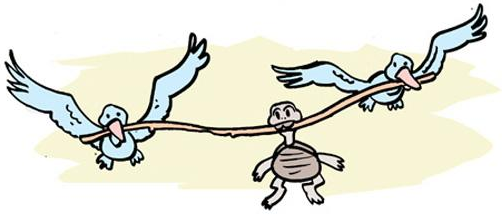
A tortoise had become friendly with two geese who promised to take it to their home in the mountains. The plan: The geese would hold a stick in their beaks while the tortoise would grasp it in the middle with his mouth, but he must be careful not to talk. During the journey, villagers below made fun of the tortoise. When it answered back, it fell to its destruction.
You guessed the moral: Talking at the wrong time can lead to fatal consequences!
Quick Quiz
1. Are you the first to air your knowledge when your favorite topic comes up?
2. Do you interject your opinion before anyone else has a chance to speak?
3. Do you tune out what others are saying because you are busy thinking of a comment?
I’m just guessing here, but you were probably the 3rd grader whose hand was the first to shoot up when your teacher asked a question. And I must say I am guilty as charged. Just see the Cliff and Marian misunderstanding below.
* * *
Hearing and listening are not the same thing. The difference between the sense of hearing and the skill of listening is attention, says Seth Horowitz in a New York Times piece.
The Harvard Business Review blog reveals that one in four corporate leaders have a listening deficit. No surprise there! In the business world, failure to listen can muddle the lines of communication, “sink careers, and if it’s the CEO with the deficit, derail the company.” In our personal lives, muddle and mayhem can result.
Good advice for better listening? First of all, slow down. While listening seems like such a passive thing to do, it is essential for understanding. Secondly, consider the source. “Try to understand each person’s frame of reference—where they are coming from.” Disagreements can often be averted with skilled listening.
Studies show that thoughts move about four times as fast as speech. No wonder it’s so hard to slow down and actually listen.
Here is the beginning of a list of tips for good listening:
1. Give full attention to whoever is speaking.
2. Don’t interrupt. Let the other person finish before you begin speaking.
3. Listen with your face as well as your ears. It’s appropriate to smile, frown, laugh, be silent at times when you are in conversation.
A Cliff and Marian Misunderstanding
Sometimes listeners with a lot of practice get muddled up. Here is a “He said / She said” from our own experience:
Marian: Let’s eat out today.
Cliff: Wonderful idea. (Time passes – Cliff leaves and comes home about dinner time noticing I’m in the middle of meal preparation.)
Cliff: I thought we were eating out this evening. Why, I had some ideas about where we would go.
Marian: For goodness sake, I was thinking that it would be nice to eat outside on the patio because it’s so cool.
Cliff: But I thought you meant we were eating out, like in a restaurant!
God help me!
Listening in the Longenecker Family 1950s
Living in the Longenecker family in the 1950s, we children were taught to listen, pay attention. In a parent-centered household, we listened to directions about chores, instructions about what to do and what not to do. To balance things out though, we also listened to Daddy singing as he played the guitar or the piano, or to Mother singing off-key in the kitchen. “I’ll be somewhere, listening, I’ll be somewhere listening, I’ll be somewhere listening for my na-aa-mm-e . . .
Please add your own tip, an observation, or an anecdote about listening or the lack thereof.
Hold fast to dreams, for if dreams die, life is a broken-winged bird that cannot fly.
– Langston Hughes in Dreams
Dreams always come in a size too big so we can grow into them. – Josie Bisset
. . . if one advances confidently in the direction of his dreams, and endeavors to live the life which he has imagined, he will meet with a success unexpected in common hours.
– Henry David Thoreau in Walden Pond
Grandparents
“But grandparents, imbued with a different sense of time, create a narrative arc across generations. If parents are the forward momentum of a child’s llife, we become the curators of traditions.” – Ellen Goodman/Washington Post Writers Group quoted in the Florida Times Union.
“Our echoes roll from soul to soul and grow forever and forever.” – Alfred, Lord Tennyson in The Splendour Falls on Castle Walls from The Princess
Psalm 78: 2-4
2 I will open my mouth with a parable;
I will utter hidden things, things from of old—
3 things we have heard and known,
things our ancestors have told us.
4 We will not hide them from their descendants;
we will tell the next generation
the praiseworthy deeds of the Lord,
his power, and the wonders he has done.
New International Version
Being Special, Unique
There are no ordinary people. You have never talked to a mere mortal. – C. S. Lewis
While we have the gift of life, it seems to me the only tragedy is to allow part of us to die – whether it is our spirit, our creativity or our glorious uniqueness. – Gilda Radner
Conventional is not for me. I like things that are uniquely Flo. I like being different. – Florence Griffith Joyner, Olympic track and field star
Deep Summer
Heat Wave: “Deep summer is when laziness finds respectability.” – Sam Keen
Summer afternoon, summer afternoon; to me those have always been the two most beautiful words in the English language. – Henry James
My dad Ray Longenecker at the Grandpa Martin farm, circa 1920
People don’t notice whether it’s winter or summer when they’re happy.
– Anton Chekhov
Your turn!
Did any of these quotes feel like an “Aha” moment for you? Will you add one?
Coming next: “I’m All Ears” with a Cliff & Marian tiff
Are you hankering for chocolate-covered bacon, do you want to buy a rooster for your flock? A hat for the next Downton Abbey gala? Welcome to Root’s Country Market and Auction, a fixture from my childhood my sisters, husband, and I re-visit near Manheim, Pennsylvania.
Root’s, with over 200 stand-holders, is the oldest single family-run country market in Lancaster County. Beginning as a poultry auction in 1925, Root’s “has evolved over the years to become a piece of Lancaster County heritage.” Come walk with me along the aisles of stands, some housed in long sheds, others outdoors under awnings.
Did I say you can get all gussied up for next Downton Abbey series? At our first stop, we try on funny Brit hats rivaling those of Princesses Beatrix and Eugenie we remember gasping over at the William and Kate’s royal wedding.
From fancy we meet plain at many of the produce stands either selling or buying vine-ripe tomatoes.
Yes, there are household items and books galore, but many stands cater to shoppers wanting fresh meats, produce, deli and bakery items–and flowers. This farmer boasts fresh blooms from his Manheim farm.
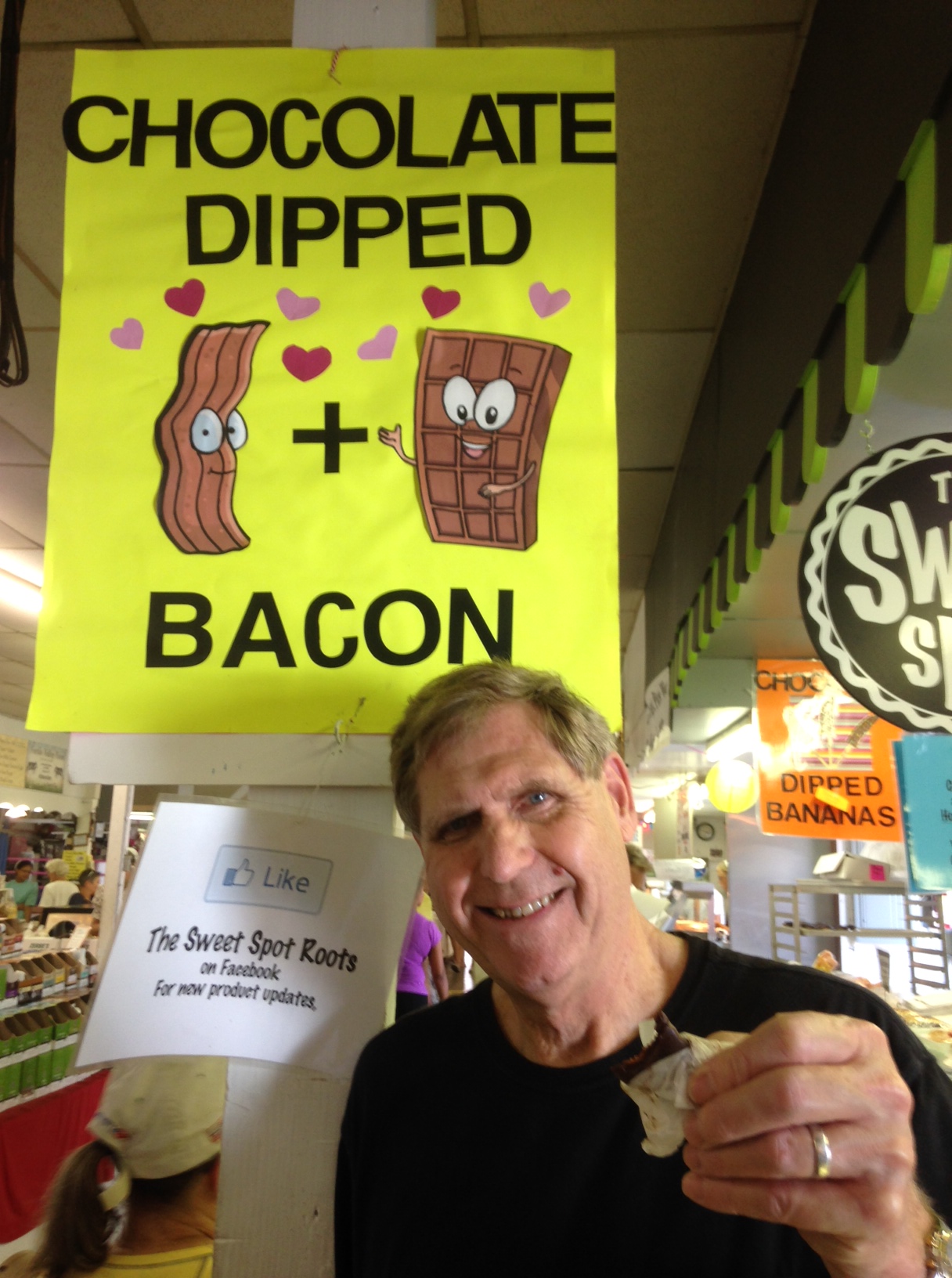
I promised you chocolate-covered bacon. Here is a look at a taste-tester. Yes, I had a bite too!
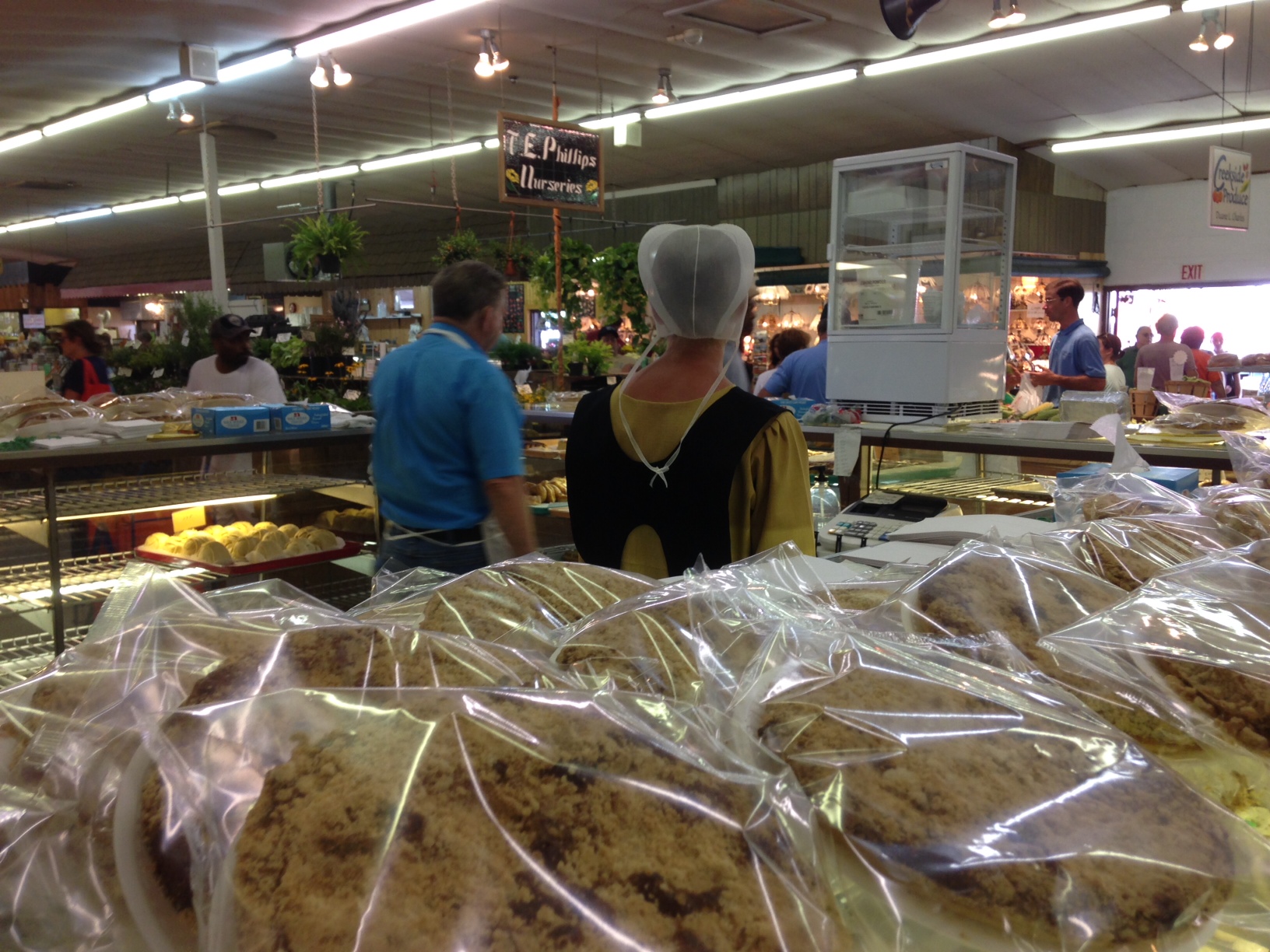
Then on to pickles, funnel cakes, and shoofly pies with wet bottoms satisfying the sweet and sour tastes:
Root’s is a market, and yes, we buy from not just photograph the vendors, but the market is also an auction house. Walking from one of the parking lots, we spy a warning sign urging bidders to uphold the integrity of the auction:
Wanna bid on a coop of roosters?
Our tour ends with Rosa, who graciously invites me to sample and buy one of her multi-colored angel-food cakes, pies, or whoopie pies at Miriams’s Pies. All home-made, of course. That’s the only way in Pennsylvania Dutch land. When I asked her permission to photograph and promote her wares, she admits with shy pride, “One of our customers put us on Facebook!”
I wonder . . . is there a piece of your past you want to re-visit? We are dying to know the “what – where – who” of your story. As always, you are invited to be part of our conversation.
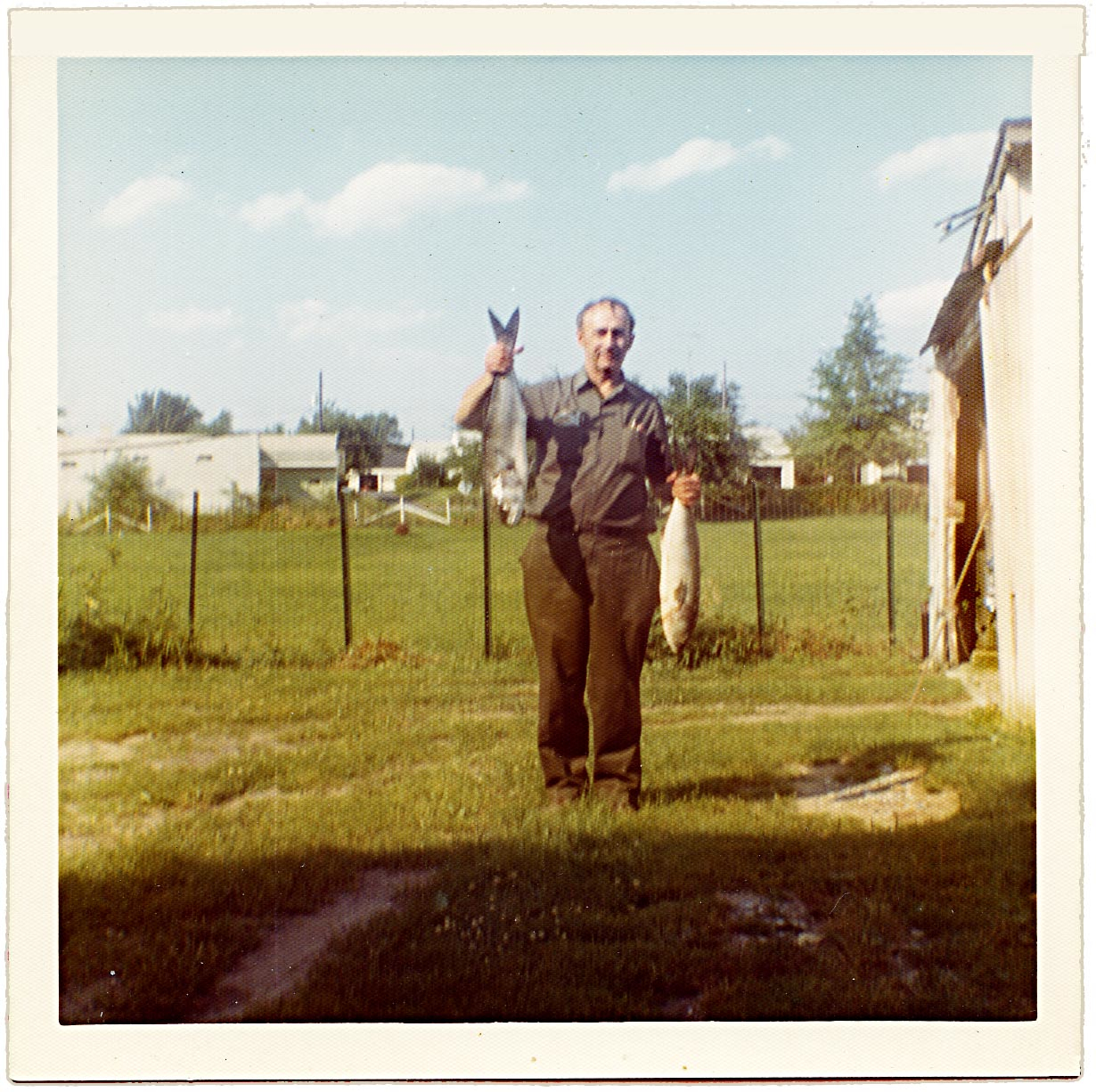
Daddy was an avid hunter (pheasants and deer mostly) and an eager fisherman. The outdoors took him away from the stresses of his business, Longenecker Farm Supply, and helped him literally recharge his batteries. I never went hunting with him, but he invited me once or twice on deep-sea fishing trips in my early teens.
Many summers ago, friends from Bosslers’ along with a few relatives chartered a boat and went deep sea fishing in the Atlantic south of the Delaware Bay. Unlike the New Testament disciples who fished with empty nets all night long until they followed the wisdom of Jesus, we PA Dutch fishermen hauled “em in right and left”– starboard and port. And unlike the disciples who had to cast their “nets” on the other side, we had a great catch without switching to a different strategy. Unbelievably, we novice fishermen were rewarded with a net-breaking haul of bass or trout. Somehow the figure of the number 68 (or maybe it was just 65) sticks in my mind as the amount of fish I caught single-handedly that day. Others easily topped my number. No fish tale here!
(I’m the one with the bandanna and sweater on the left side of the boat; Daddy is grinning behind Uncle Paul whose hand is raised.)
Generally, I had a strained relationship with Daddy. The stories of the ill-begotten bike and his unannounced violin purchase on earlier posts underscored his lack of knowledge of relating to me as his oldest daughter and subsequently my resistance to his overtures toward making a satisfactory connection.
But outside the walls of our house, taking walks or catching fish together, such barriers disappeared. These photographs evoke these pleasant memories, times when we were in tune with nature and with each other as father and daughter.
Childhood that place where purity of feeling reigns, was merging into adolescence, where ambiguity begins.
Mary Peacock in The Paper Garden
And that is where I was, the age of ambiguity and change.
* * *
Comments? A question? An anecdote from your own experience growing up.
We’re having lunch at Mother’s house today: home-grown tomato sandwiches, Silver Queen corn on the cob, and fresh tossed salad with a wrapped-up cucumber found left in her refrigerator. There is also a boiled egg she cooked recently, but Mom is not here. She is gone, left this life on July 28 just five days after her 96th birthday.
We (my sisters, brother and I) were together in June and had a high old time with Mother, eating out, making butter, playing Uno. In her boxy, blue l989 Dodge Spirit she drove herself to the July Christian Women meeting at The Gathering Place in Mt. Joy, went to the drive-through at her bank and wrote out checks to pay her bills. She attended the Metzler Reunion at Lititz Springs Park shortly before her birthday. A church bulletin in her Bible is dated July 20, 2014. Mom was even up to having lunch on July 23 with Nan Garber from church, who shares the same birthday week. But after that, she began feeling un-well, attributing her sickness to possible food poisoning. However, a pernicious bacteria was taking over her body, which no medical treatment could touch. Her death has stunned us all. We are in shock.
Yet we are grateful that after a long life of good health and sound mind, her suffering was brief though her influence eternal.
Indeed, the quality of her life was A+ up until the very end. Some snippets from her 3-day hospital stay:
Optimism: “We are having a sunny day today.”
Acceptance: “Whatever the good Lord wants for me . . . . I am ready to go.”
Wit: As she is moved from her hospital room to ICU she quips: “I want my glasses on, so I can see whether I’m going in the right direction.”
Gratitude: “It’s nice to have a loving family.” And finally . . .
Love: “I love you too!”
Among the songs sung at her funeral a cappella in 4-part harmony at Bossler Mennonite Church was “The Love of God,” a song she requested as she planned her memorial service years ago.
For I am persuaded that neither death, nor life, nor angels, nor principalities, nor powers, nor things present, nor things to come, nor height, nor depth, nor any other creature shall be able to separate us from the love of God, which is in Christ Jesus our Lord.
Romans 8: 38, 39
* * *
Psychologists tell us grief involves several stages. According to the Kübler-Ross model, they include denial, anger, bargaining, depression, and acceptance–eventually. These stages are not always experienced in linear fashion, and they are usually recursive, cycling through body, mind and spirit in relentless waves, unpredictable and strong.
But the death of a father or mother hits its own particular nerve in one’s psyche and heart as I observed traveling to see Mother for the very last time in this life:
“Her absence is like the sky, spread over everything,” notes C. S. Lewis in A Grief Observed.
Jane Howard, in A Different Woman probes the pain inherent in one’s separation from a beloved friend, partner, father or mother:
The death of my mother made me feel like a deck of cards being shuffled by giant, unseen hands. Parents, however old they and we may grow to be, serve among other things to shield us from a sense of our doom. As long as they are around, we can avoid the facts of our mortality; we can still be innocent children. Something, some day will replace that innocence, maybe something more useful, but we cannot know what, or how soon, and while we wait, it hurts.
How about you?
Have you experienced loss, gradual or sudden? How have you adjusted to it?
During the first week of August Cliff and I celebrate three wedding anniversaries, our son and daughter and their spouses along with our own. Our children are beginners at marriage (sort of), but for us it’s # 47, three years away from golden.
Our romance was of the “Some Enchanted Evening” sort, recounted in an earlier blog post which near the end merely hints of conflict to come. In the beginning, there was the clash of cultures: a high-energy, pioneer-type from the Pacific Northwest marries a Mennonite school teacher from southeastern Pennsylvania. As my mother-in-law said on our wedding day, “You two will have a lot of adjustments to make.” I knew that was true in my head but naively imagined of course we will be the exception: Doesn’t love conquer all?
Because of Cliff’s career, we settled in Jacksonville as newyweds, a city with a semi-tropical climate and an overwhelming expressway system–a far cry from the gentle, rolling hills and farmlands of Lancaster County; Southern accents, not lilting Pennsylvania lingo. Our adventures included both the typical and the unconventional: Living in a 8’ x 24’ foot travel trailer for a year and a half with a two-year-old daughter and baby son. Starting a fledgling graphic arts business in our home where we experienced both feast and famine. A miscarriage. Working on graduate degrees while raising a family. Long separations as Cliff traveled the country with his own art show. The deaths of Cliff’s mother and my father. And other unwelcome events: a mammoth falling oak just grazing the side of our house, the dining room ceiling becoming a sieve as the roof leaked, my new car totaled putting my back out of whack. Larkin Warren in her vignette “Because love grows deeper over time” illustrates her own version of marital challenge:
In the early days it was all about him. His favorite foods . . . . favorite flavor of ice cream, and whether he liked my hair up or down. I loved to make him laugh, and worked hard not to cry in front of him. I cleaned my house before he came over, always wore mascara, always had champagne in the fridge.
[But] we’ve seen each other at our worst, and that’s not an exaggeration. Physically ill, emotionally grief-stunned, job-panicked, or angry enough to throw crockery at the wall . . . . Red-faced, blotchy, hoarse from yelling. Our parents grow old, and ill, or nutty: our children make mistakes that drop us to our knees. Through it all, how on earth can he love me, given what a flawed, messy, moody person I am: The artifice is long gone; he see me.
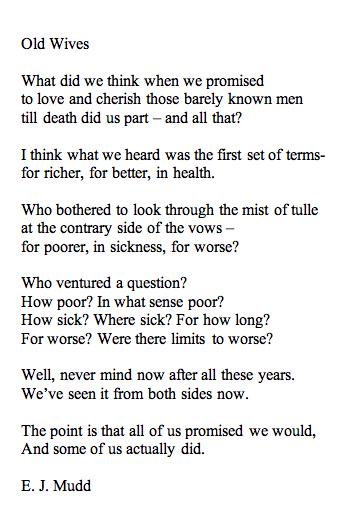
Yes, the artifice is gone. The scales, if there were any, have long since fallen from our eyes. In retrospect, we see clearly now. But we remember beholding the luster of un-tested love, the gritty struggles mingled with the shiny penny days. “We have seen it from both sides now,” says poet E. J. Mudd:
Adam Gopnik adds metaphorical wisdom: Love, like light is a thing that is enacted better than defined: we know it afterward by the traces it leaves on paper.
Dear reader, your traces on the “paper” of this post are welcome. Thanks for commenting. You may also enjoy reading secrets of a 20-year-marriage @ http://notquiteamishliving.com/2014/07/twenty-years-three-things-about-love-n-marriage/
* * *
One of the beloved members of our family has gone home to be with the Lord this week. Following the publication of this edition, postings on this blog will be suspended for a time.
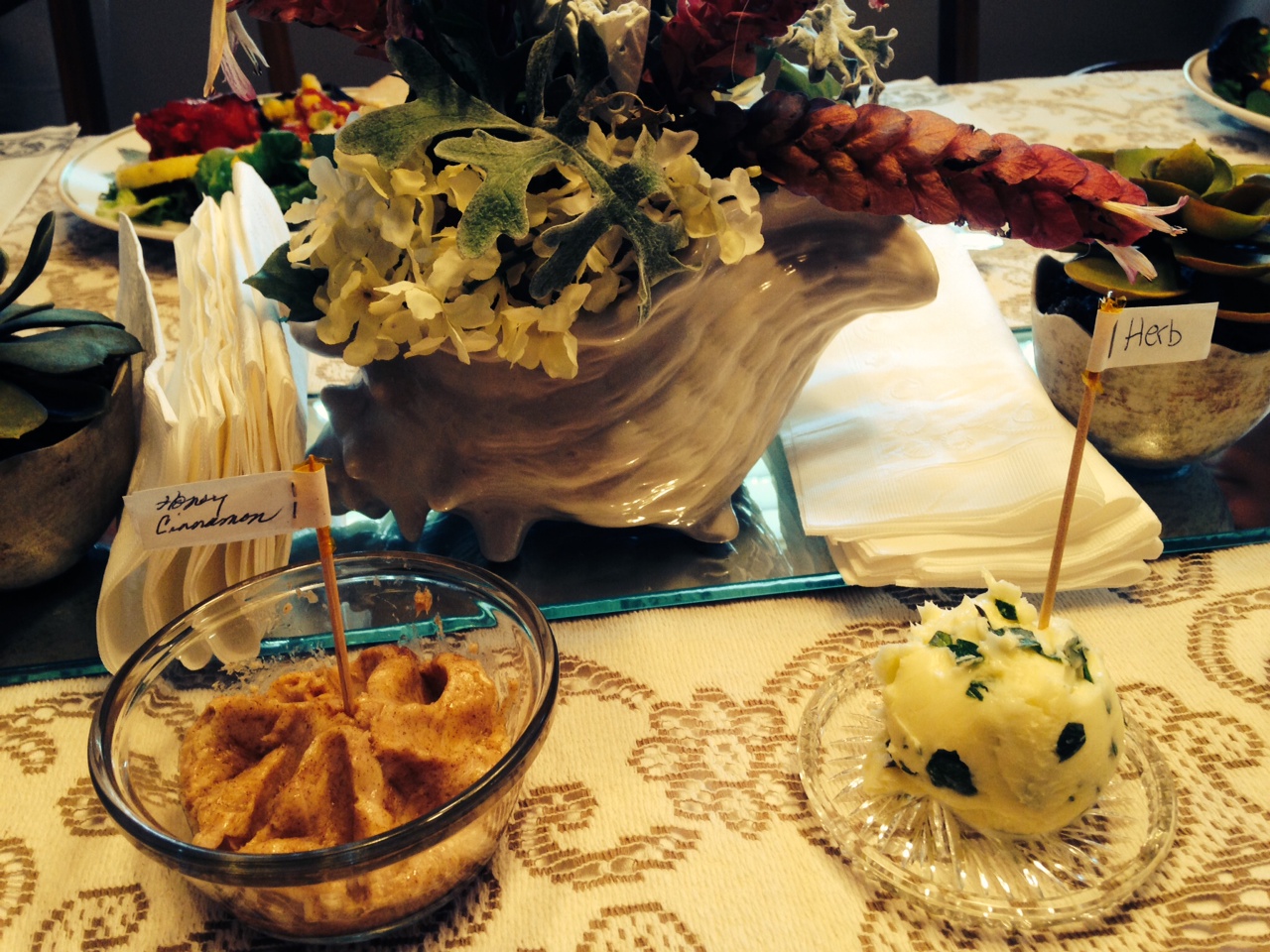
You may remember when I visited Pennsylvania last month we made butter the old-fashioned way, my mother, sister and I shaking cream in a 2-quart jar. This week my Southern friend Carolyn threw a birthday bash that included friends making butter together. We did just that – working in pairs, taking turns shaking, and doing it all to music of the 1950s and 60s.
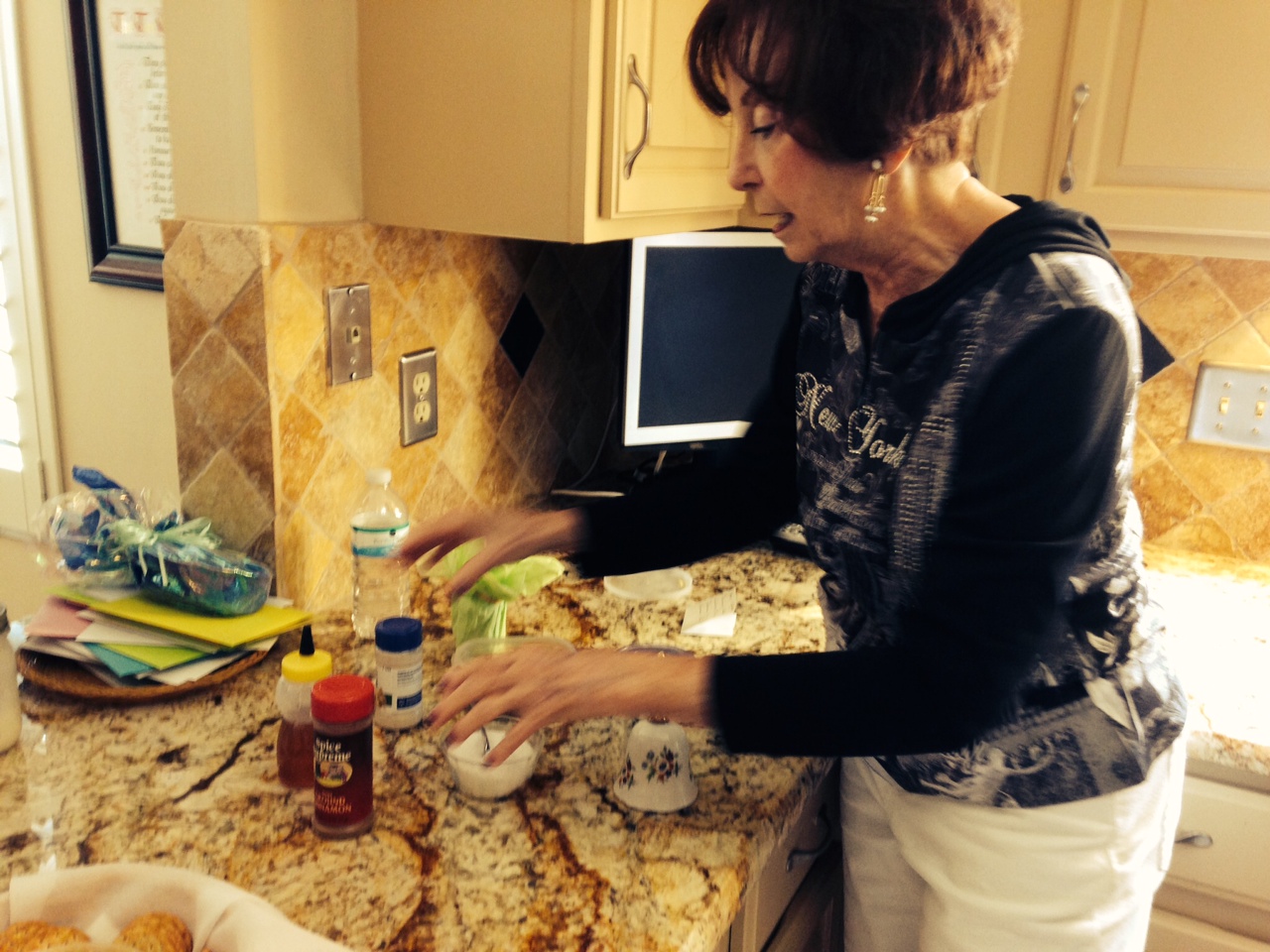
Here is Carolyn explaining how it’s done. Now girls, “Shake the cream until it curdles into butter. Add a pinch of salt. And then to spice it up a notch, choose a combination of honey, cinnamon, mixed herbs, or garlic salt to give your butter some personality . . . .”
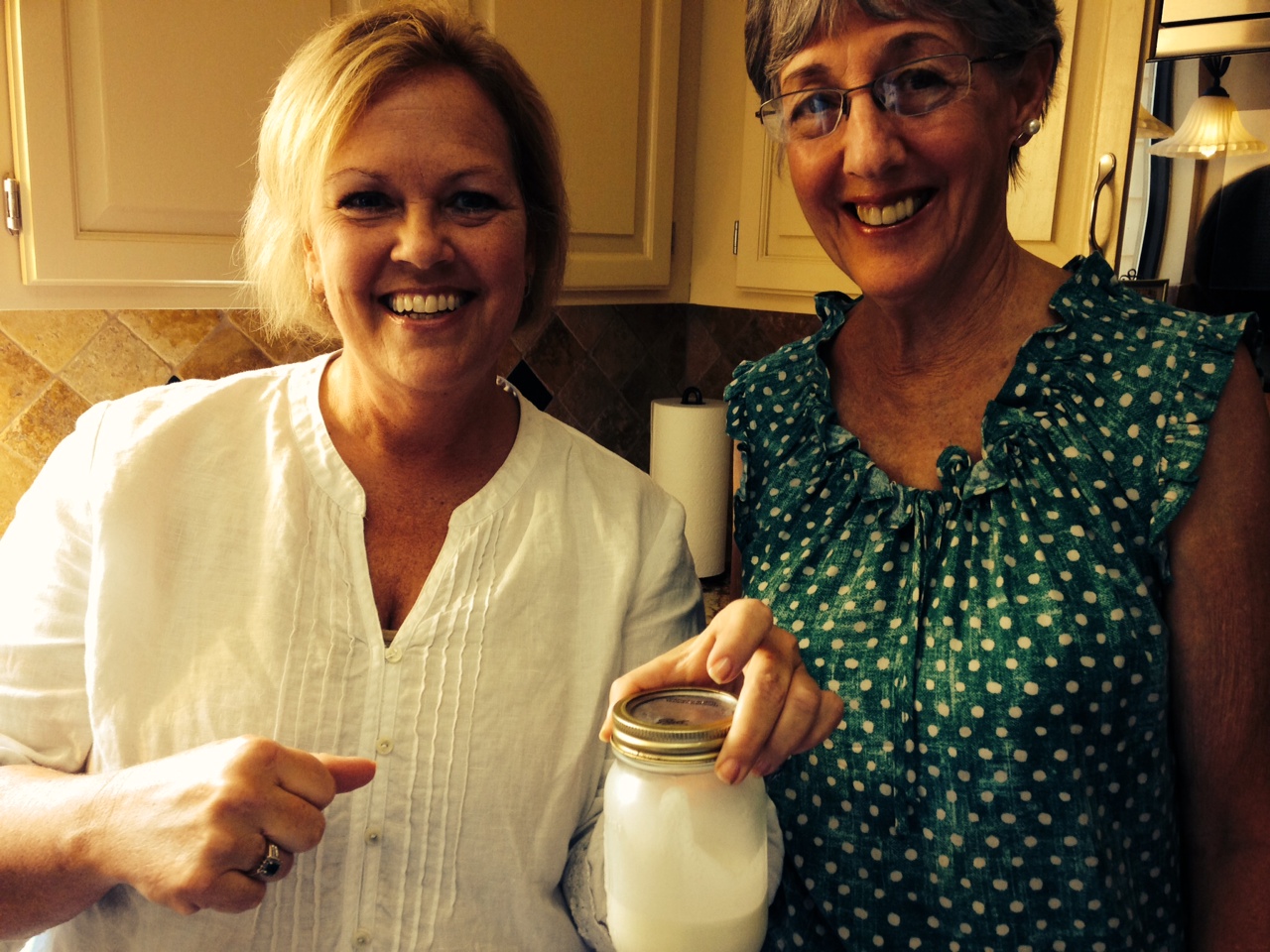
Next the ten of us pair off with pint jars of cream, handing off the jar to our mate when our arms are about to fall off . . .
And away we go!
To the tunes of Let’s Have a Party and All Shook Up, we Shake, Rattle, and Roll, way past curds and whey. Finally, with our butter balls all molded and labeled we sit down to a fancy feast, enhanced by the fruits of our labors.
In the 1960s, you could eat anything you wanted, and of course . . . there was no talk about fat and anything like that, and butter and cream were rife. Those were lovely days for gastronomy, I must say. Julia Child
* * *
Have you attended a memorable party, birthday or otherwise? Tell us about it. We’re curious.
Maybe we’ll copy-cat it. You know, imitation is the sincerest form of flattery.
My policy on cake is pro having it and pro eating it. – Boris Johnson
* * *
July is the birthday month for four our immediate family. If you count our extended family, there are three or four more birthdays this month.
This month I celebrate the birthdays of three of my one and õn-lies:
The Inimitable Mother Ruth Metzler Longenecker
Mother and her morning ritual, reading her Bible, age 96
My One and Only Son
Joel with one-and-only daughter-in-law Sarah at cousin’s wedding
My One and Only Grand-Daughter Jenna Skye Dalton
July Birthdays
July birthdays in our family span four generations. Apparently, I tried very hard to become my mother’s first birthday present after her marriage the previous year, having missed being born on her own birthday by just one day. Our son and grand-daughter are birthday presents to me – Joel born two days after my birthday and Jenna preceding my birthday by a mere five days.
Who are your one and ôn-lies – birthdays or otherwise?





















 Plain and Fancy