What Color Makes You Sing?

In praise of color!

God did not create the world in black and white. Our world vibrates with vivid color from the cerulean blue sky above to fluorescent coral reefs sea deep.

Courtesy TED Radio Hour

Generally, colors are hues we see, but Neil Harbisson hears color. Now, you ask, what is it like to hear color?

Born completely color-blind, Neil once lived in a monochromatic world. Fortunately, colors have sound frequencies that can be transmitted through bone conduction. Thus, Neil now “sees” color via a device attached to his head that allows him to perceive color in this unique way.

Recently on NPR’s TED talks, Neil was showcased in a broadcast headlined as “Wearable Sensor Turns Color-Blind Man into “Cyborg” [electronic man]. Here’s more:

Neil Harbisson is an artist, cyborgist and colorologist. His unique experience of color informs his artwork, which before his device the “eyeborg” was strictly black and white. By working with cyberneticist Adam Montandon, Harbisson helped design a lightweight eyepiece that he wears on his forehead that transposes the light frequencies of color hues into sound frequencies.

Harbisson’s artwork blurs the boundaries between sight and sound. In his sound portraits series, he listens to the colors of faces to create a microtonal chord. “When I see someone, I hear their face,” he exclaims.

As an artist, Neil paints sounds, transposing music to color. In the City Colours project, he expresses the capital cities of Europe in two colors.

This system works in reverse too. When Neil hears Mozart, who composes with many G notes, he sees lots of yellow. Justin Bieber, on the other hand, shows up as pink because of his many E notes.

Neil’s dressing is influenced by sound and key signatures as well. He admits, “I dress so it sounds good.” On the day of the interview, Neil admitted to being attired in C-sharp major. I have no idea what color this would be though he did say his favorite color is the invisible infrared, which emits a very low, soothing sound.


Neil suffers from or is blessed with (depending on how you look at it) the phenomenon of synesthesia which Dictionary.com defines as “a sensation experienced in a part of the body other than the part stimulated. For example, sound may evoke sensations of colour.”

Most of us are not color-blind like Neil nor do we experience color as a shape or sound. Yet like him we value a colorful life.

Your turn: What color makes you sing? How does color affect you?

Postscript

Today marks the 51st anniversary of the assassination of President John F. Kennedy. On that day, the world stopped. We as a nation were mute with sorrow and, accordingly, many wore sombre clothing as a token of respect. None can forget the valiant Jackie Kennedy veiled in black and by her side, John-John and Caroline, both in light blue suggesting hope for the future.
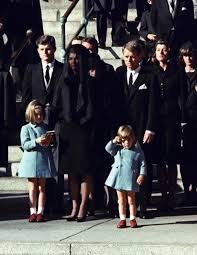
KennedyFuneral

Moments of Discovery # 3: Two Butter Stories and an Autograph Book

In June Mother Longenecker and her daughters Marian and Janice created butter-shaking memories in a two-quart jar, making butter using three easy steps:

  1. Pour cream into 2-quart jar.
  2. Shake until you rattle and roll.
  3. Remove the congealed mass from the jar. Add a pinch of salt.

In July, my Southern friend Carolyn honored my birthday in a “Shake-Rattle-and-Roll Butter-Shake” party. Today you can open up an old-time textbook with me and behold first-graders learning about butter making in a reader published by Lyons and Carnahan with the copyright dates spanning the years 1927-1936.

Reader1920s

Interestingly, the Child’s Story Reader also lists three simple steps for butter making expressed in first-grader language:

We got the cream from a cow.

We put the cream in a jar.

We shook the jar.

Jack and Jane even added a pinch of salt to the mixture, and afterwards they had a party of butter on bread!

ButterMakingSchool

Another page shows a recipe for butter milk made with a churn with Aunt Ellen assisting.

ButterChurnBook

More Moments of Discovery

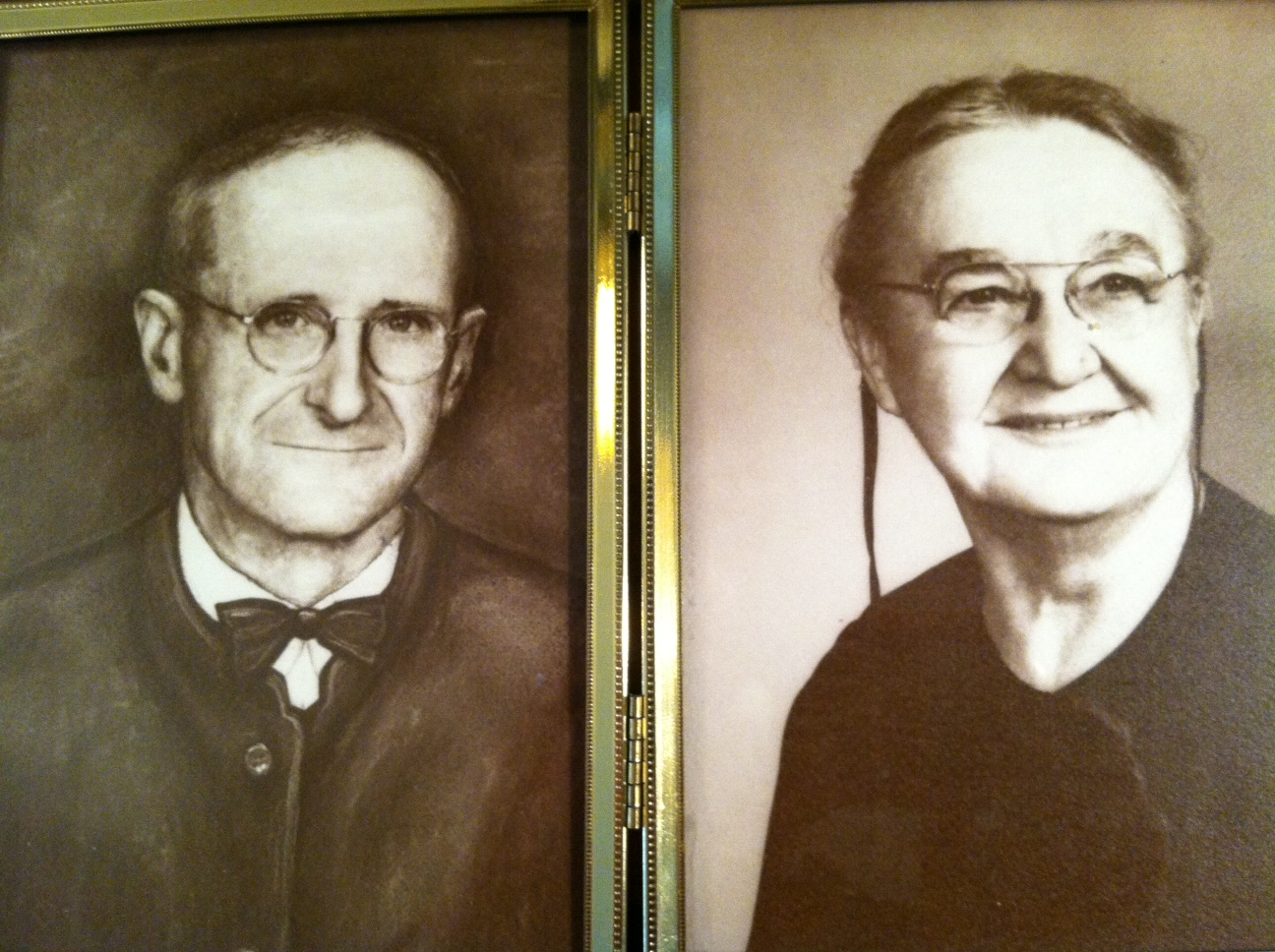
Henry and Fannie Longenecker, Grandparents
Henry and Fannie Longenecker, Mennonite Grandparents

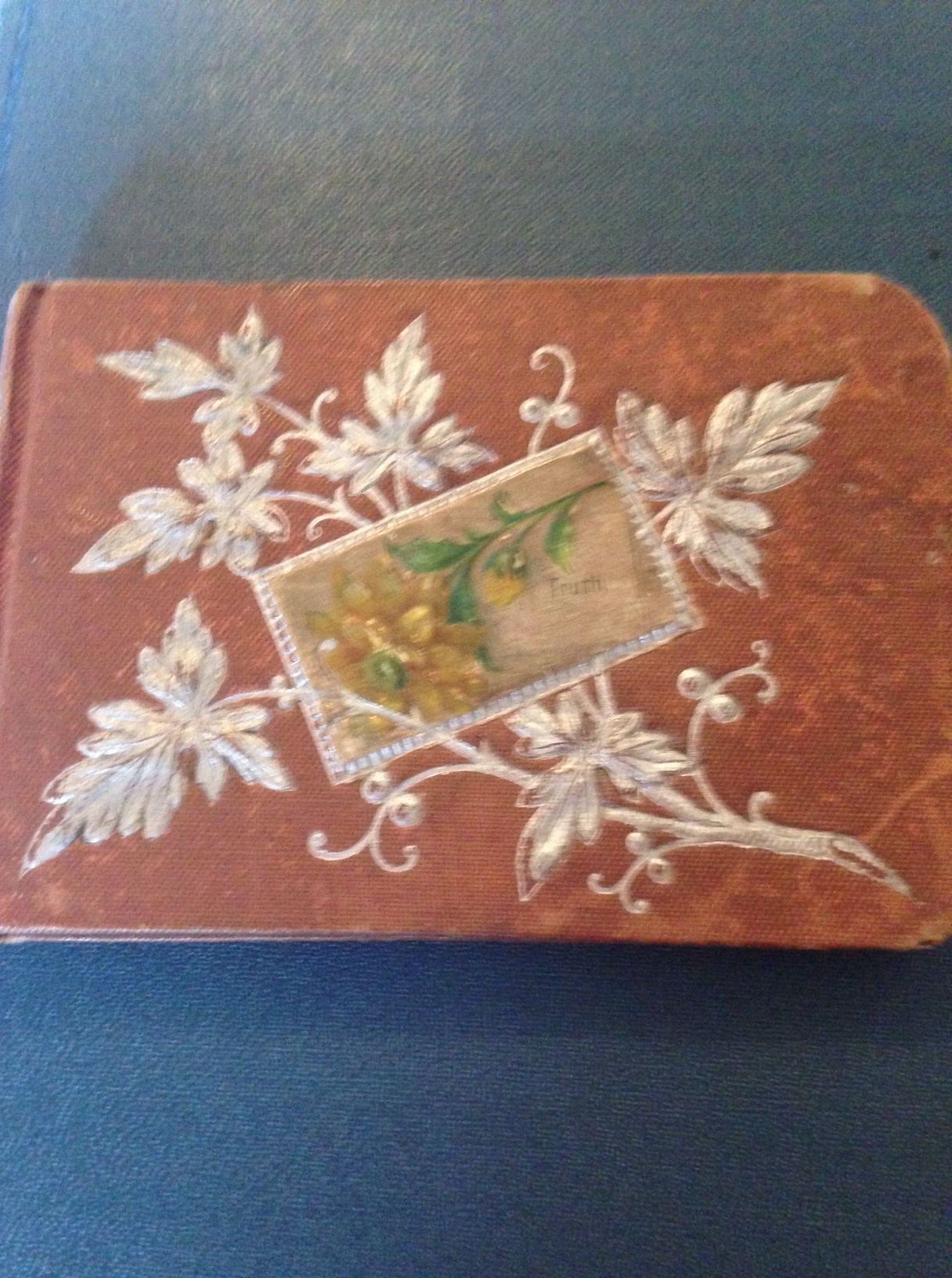
Henry Risser Longenecker, referred to by friends and family as H. R. or “Hen,” was my grandfather on Dad’s side of the family. He died when I was five, but I have a distinct memory of him killing a snake in the grass with a long stick. Like my father, he was a doctor of motors interested in steam engines, Model A Fords, and farm equipment. Until I unearthed his autograph book, I had no idea he had artistic leanings as revealed in his autograph book. Autograph books, common in classrooms in the 1800s, contained signatures, artwork, and bits of poetry. According to Folklore: An Encylopedia of Beliefs, Customs, Tales, Music, and Art, Vol. 1 (edited by Thomas A. Green) autograph books, existed as early as the fifteenth century and were seen as “a mark of gentility until the beginning of the twentieth century.”

The cover of Henry Longenecker’s autograph book reveals artistic flair with a faint inscription of a great virtue taught to every school child, the word Truth visible if you squint carefully at five faint letters appearing close to the embossed yellow flower.

HRLAutographBook

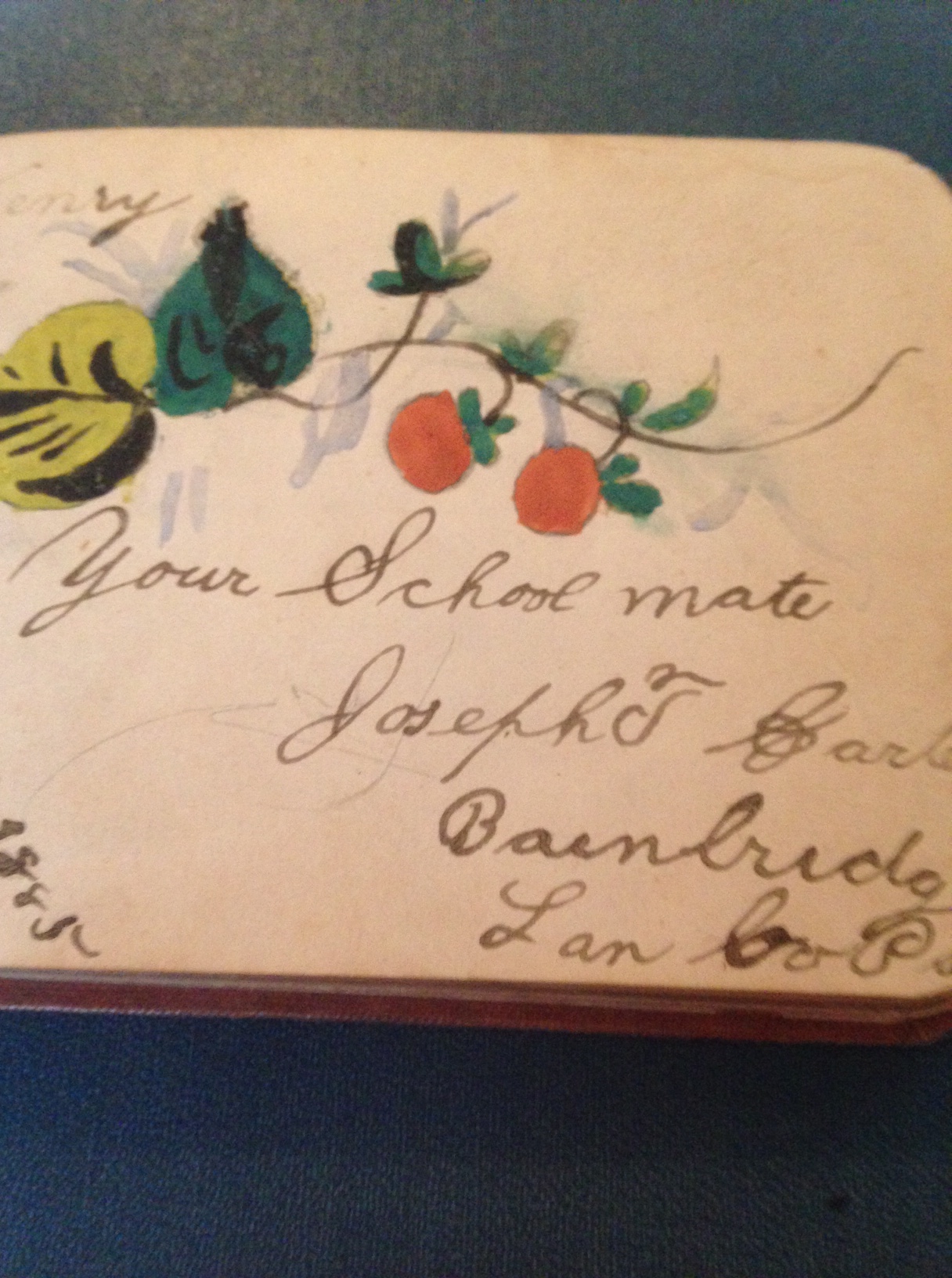
The dedication appears in flowing cursive penmanship with a dove’s beak clasping Cupid’s arrows

HRLsignatureAutograph_final

Painted artwork, still-brilliant, graced most pages like this one, complete with signature and date.

Signature: Joseph T.  Garber     Complete date: February 3,1885
Signature: Joseph T. Garber           Complete date: February 3,1885

 Autograph books tell us several things about students in the late 1800s:

1. Penmanship was taught and valued as an artistic skill.

2. Friendship and learning were intertwined. Both were expressed as an art form.

3. Students took great pride in their work.

*  *  *

What else can these books teach us?

Coming next: What color makes you sing?

At Home with Grandkids: Fun Stuff to Do

BAKE
It’s cold outside, maybe even Polar-vortex cold, and Saturdays with Grandma or Aunt or Mom will be spent indoors. One cold day three of our grandkids warmed up the house, at least the kitchen, with cupcake baking.

Gkids_2 kids_ top_chocolate +lowers_071008

Gkids_2 kids_bottom_chocolate+flowers_071008

Yes, it’s fun to help mix up the batter and lick the beaters, but the grandest thing is putting the plastic Gerbera daisy in the flower pot or scooping up the “chocolate” dirt. It’s okay that we get frosting all over our arms and face – Grandma doesn’t care, now does she?


TINKER and LINK

Downstairs the grand-kids find the ottoman/toy chest with classics like Lincoln Logs, just like sets from the 1960s but with added plastic gadgets. Tinkertoys – there is just no way to improve on Tinkertoys!

LincolnTinkerToys


STACK

Do you have a deck of jumbo cards? If so, you are in business. Patrick and Curtis both learned the meaning of the expression “house of cards” as they tried to stack playing cards on a shaky foundation. Incredibly they persisted even after a collapse or two. Bryan Berg, who holds the world record for a 75-story card tower, can rest easy. Still, both boys couldn’t enjoy the challenge more, as Patrick illustrates:

HappyPyramid6162_mod


FLICK

Their dad Cliff retooled this marble flick board from an old oaken desk in 1978 when Crista was 9 and Joel, 7. They both competed in “Flick the Marble,” trying to earn the higher number of points, best out of three! All four grandkids have since enjoyed the board. Even grand-nephew Noah and grand-niece Emily give it a whirl here.

EmilyNoah

GameBoard


WRITE with GRATITUDE

Back in February 2013, when “plain and fancy” launched, the theme of Grah-ti-Tood, announced my first blog post. The grandkids’ gratitude books were featured along with pictures Curtis and Ian had drawn. They are a year older now, and their thanksgiving continues. Sometimes reluctantly. But this time spontaneously, as conversation around the breakfast table last month moved around to things to be thankful for.

GratitudeCurtisIan

Curtis_Ian_Gratitude Book_102514

On October 25, 2014, Curtis is grateful for friends and thankful that the wars are not hurting me badly (Oh, my)! Ian says, “I am thankful that blueberry pancakes are the best!” Curtis’ illustrations are cartoon-like. Ian’s pancake is realistic with shading.

Each unique.


I am sure you thought of a game or activity to add to the assortment here. Suggestions, comments – it’s your turn!

Coming next: Moments of Discovery # 3: Two Butter Stories and an Autograph Book

Purple Passages and Fine China

READING

La Lectura es el viaje de los que no pueden tomar el tren.        – F. Croisset

(Reading is the journey of those who cannot take the train.)

Marian Reading_14mos._2x4_300

Some books are to be tasted, others to be swallowed, and some few to be chewed and digested . . . .           Sir Francis Bacon  “Of Studies”

I find television very educating. Every time somebody turns on the set, I go into the other room and read a book.     Groucho Marx

It is what you read when you don’t have to that determines what you will be when you can’t help it.    Oscar Wilde

LAUGHTER

When we laugh, a sort of temporary anesthesia is released within us that blocks the pain as our attention is diverted.      Chuck Swindoll in Five Meaningful Minutes a Day

I love people who make me laugh. I honestly think it’s the thing I like most, to laugh. It cures a multitude of ills. It’s probably the most important thing in a person.    Audrey Hepburn

CHINA   

Friendship is delicate as [china], once broken it can be fixed but there will always be cracks.    Waqar Ahmed

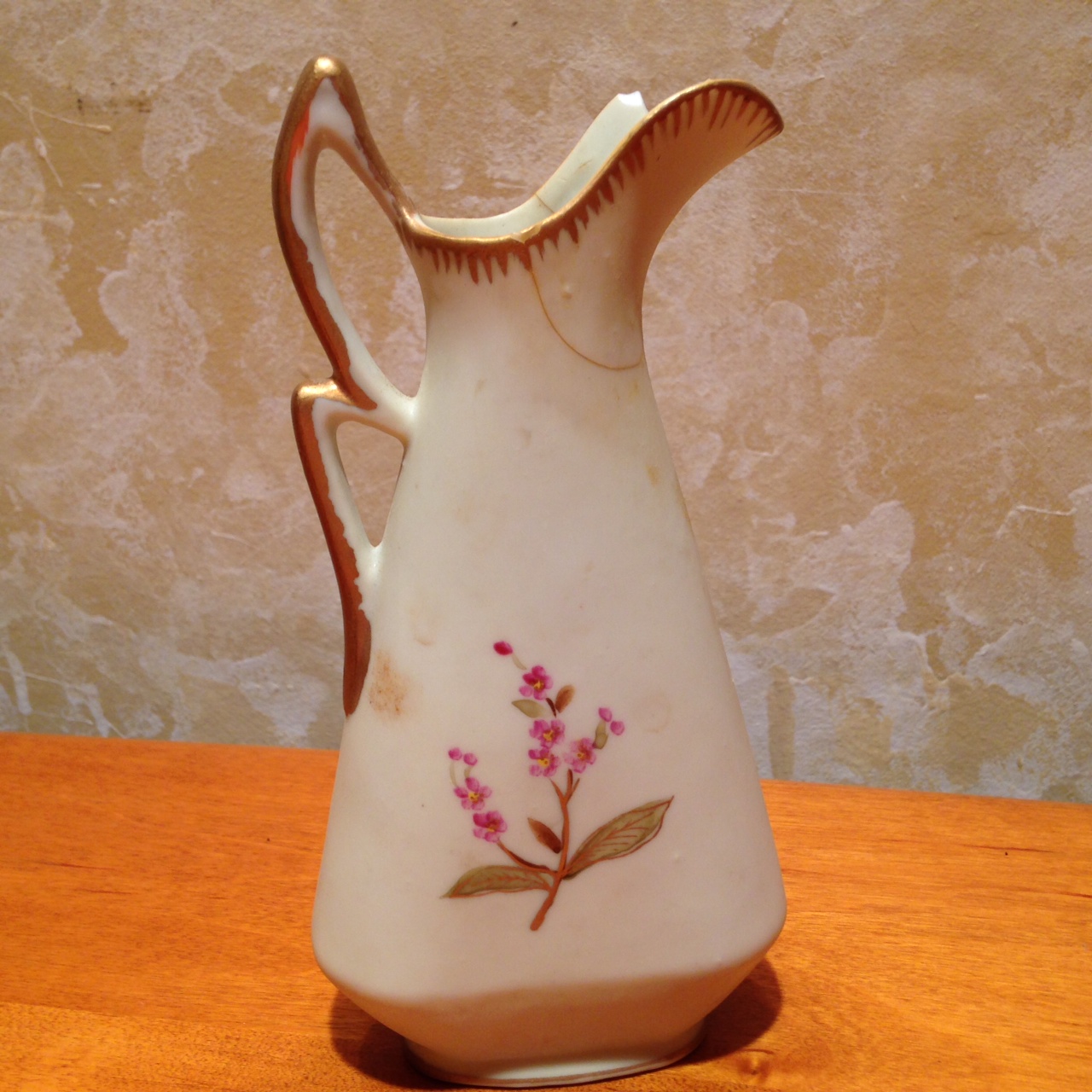
Pitcher Broken

It’s a wise husband who will buy his wife such fine china that she won’t trust him to wash the dishes.    – Honoré de Balzac

ChinaFine

I’ll love you, dear, I’ll love you till China and Africa meet and the river jumps over the mountain and salmon sing in the street.      – W. H. Auden

We have a week and a half left of work and we are like delicate china speeding toward a brick wall. Sounds fun, huh?     – Jennifer Anniston

Start living now. Stop saving the good china for that special occasion. Stop withholding your love until that special person materializes. Every day you are alive is a special occasion. Every minute, every breath, is a gift from God.     

                   Mary Manin Morrissey

A comment? Another quotation? Both are welcome here!

How to Tell Your Children What’s What

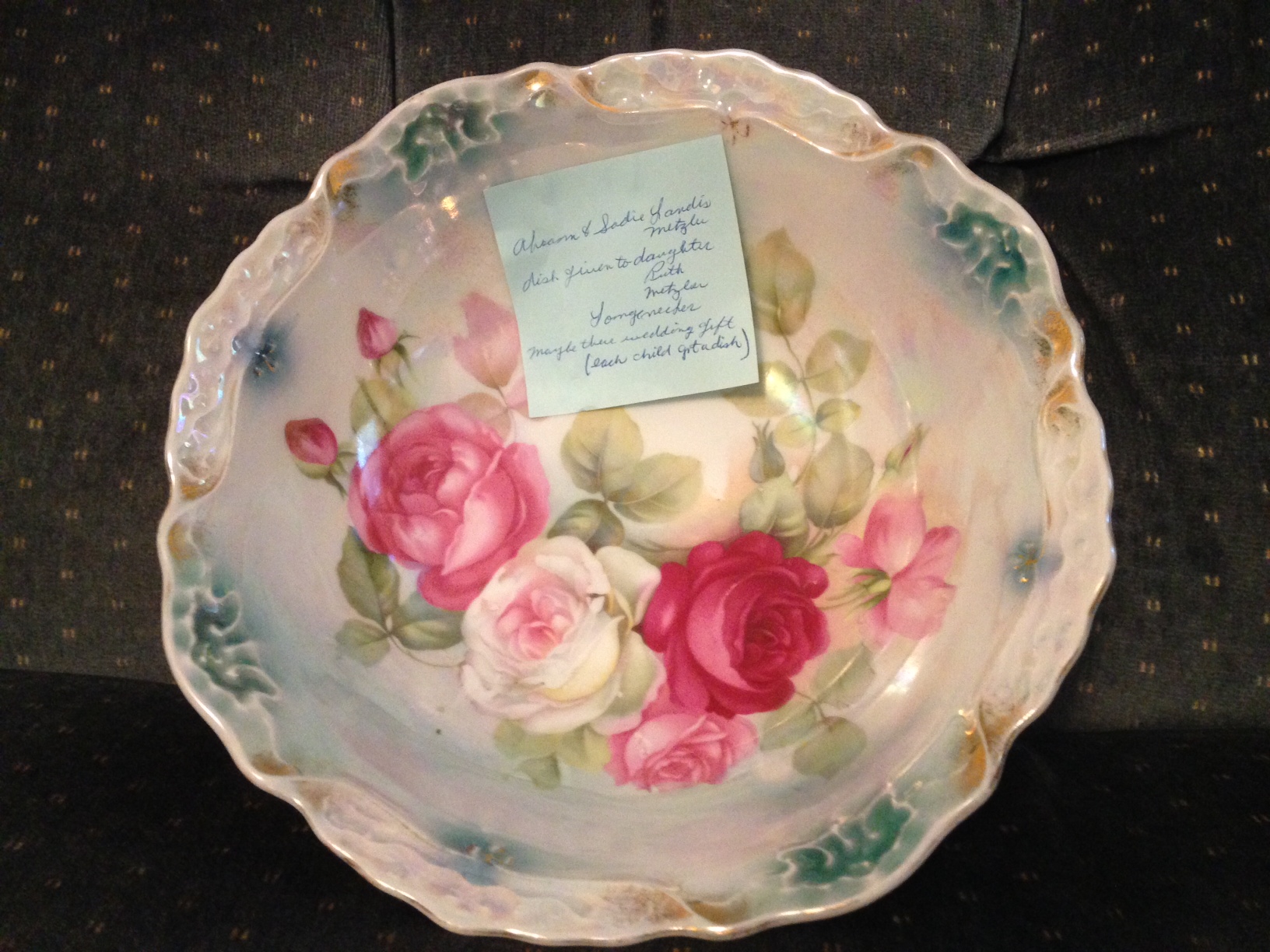
Unlike Hansel and Gretel, whose mother tried to starve them and then lock them out of the house, Mother Longenecker provided well for her children and left behind, not white pebbles or bread crumbs, but hand-written notes tucked away to tag her heirlooms. Each note provides a designated recipient sometimes with a bit of family history.

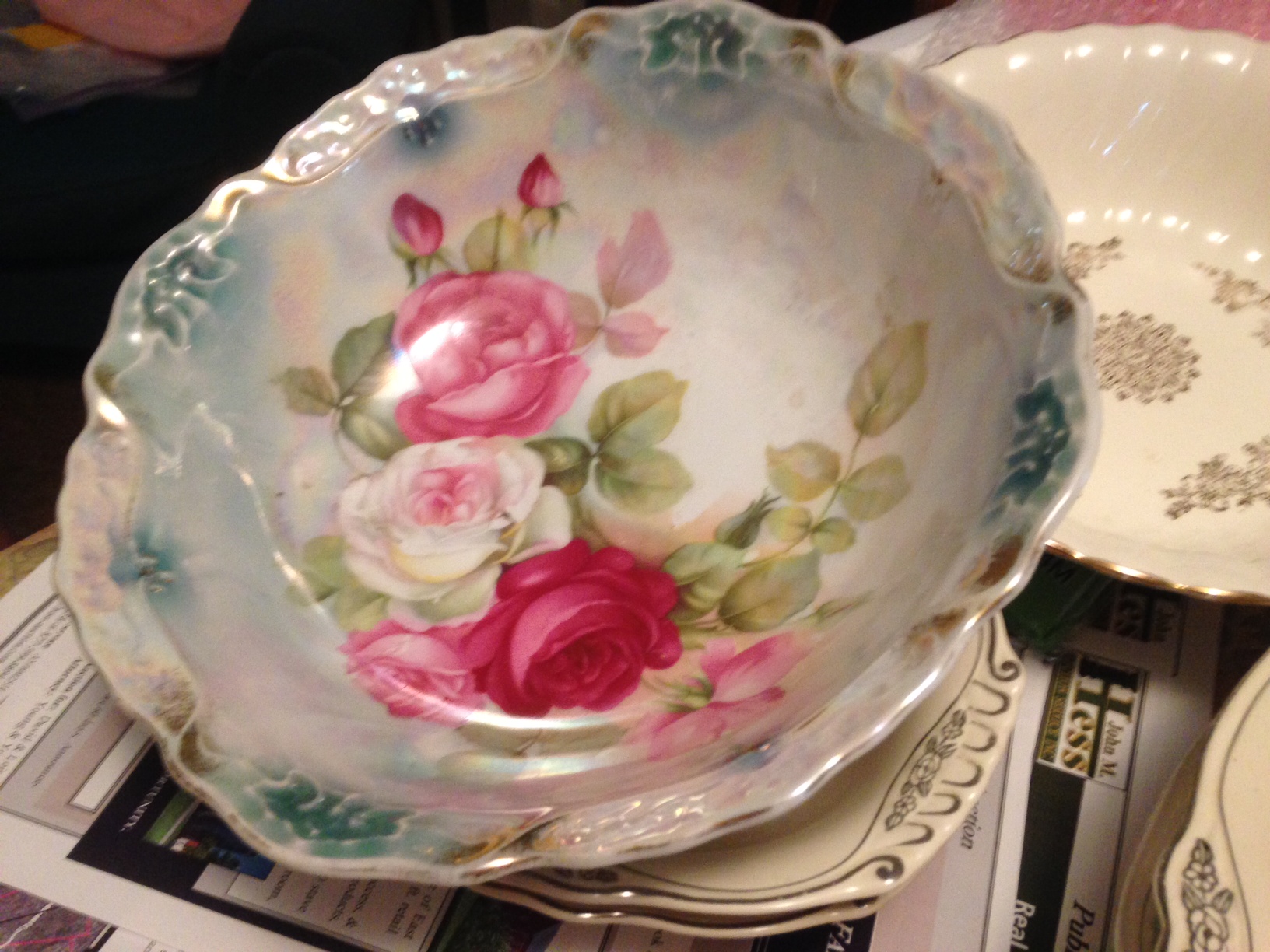
1. Floral Serving Dish

Dish given to my mother from her parents, Abram and Sadie Metzler on her wedding day

FloralDishMomNoteOne of Mother’s grand-daughters will get this dish no doubt and will know its provenance, which would probably be lost forever, without the note .


2. Keepsake from Mother’s Sunday School teacher at Erb Mennonite Church with teacher Mrs. Kathryn Bomberger. The note emphasizes the biblical account of creation found in the book of Genesis and on the reverse side a quick guide to prayers, parables, and verses commemorating sacred events. You can find more of the history of the Erb Mennonite Church here, including its roots in the Swiss-German Anabaptist culture.

Ruth Longenecker_SS card_front_back_note

Mother's Sunday School Class at Erb's Mennonite Church     Kathryn Bomberger, teacher
Mother’s Sunday School Class at Erb’s Mennonite Church       Mrs. Kathryn Bomberger, teacher

For many months now, this photograph has served as the banner on my Facebook page. When I posted it, I was totally unaware of Mother’s imminent death. Now I am loath to replace it with a different photo. All the ladies are plain here, except the smiling woman seated on my mother’s left. I imagine this shot was taken after Sunday dinner at the home of the teacher.


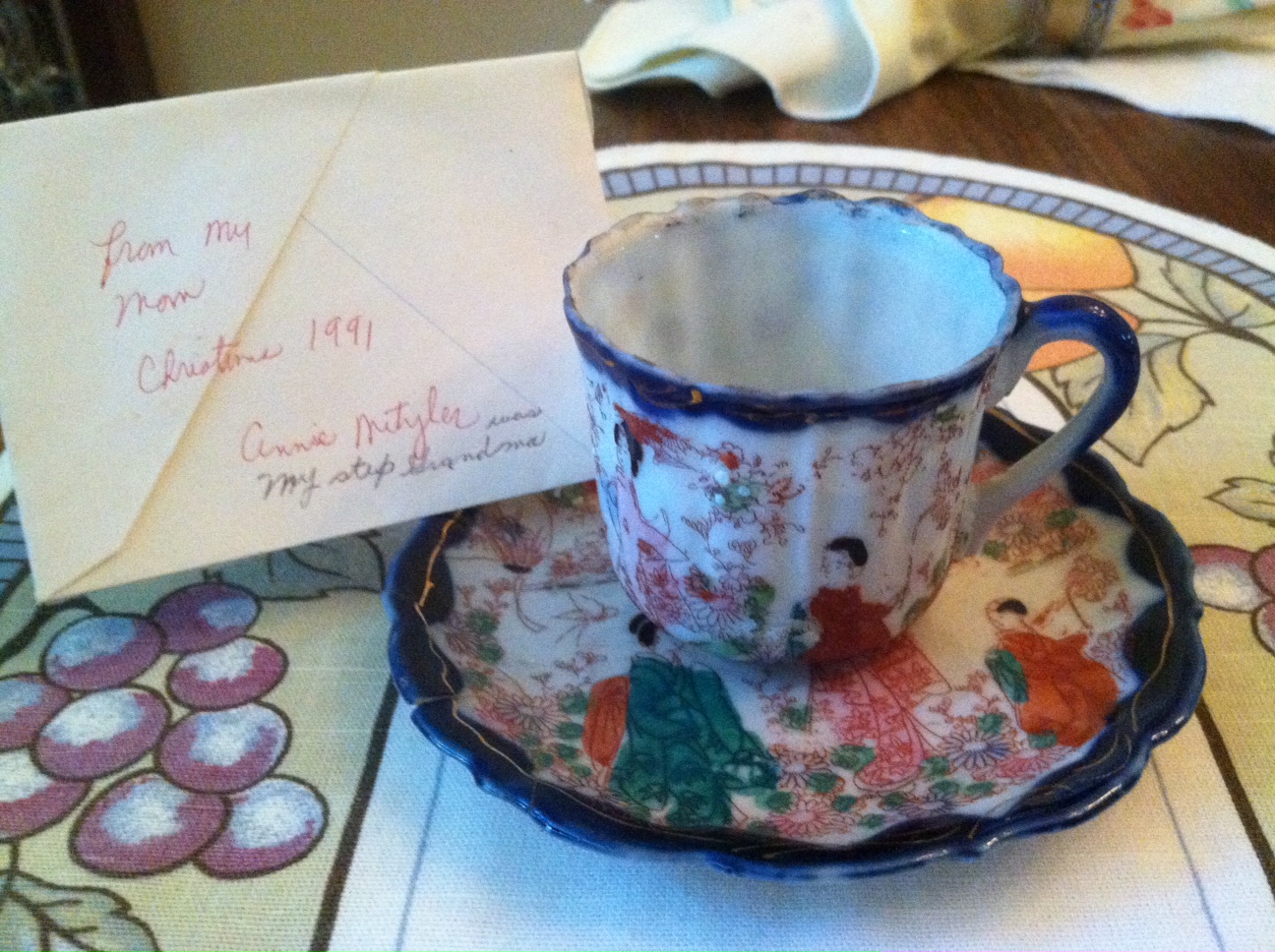
3. Japanese Cup & Saucer

Japanese Cup 2

According to my notation in red in 1991, Annie Metzler gave this set to my mother, who notes in her own hand-writing that she was Mom’s step-mother. This vintage piece is hand-stamped Made in Japan, possibly created during the Golden Age of Japan’s trade with the United States in the 1921-1941 era.

Mother had “secret smarts” that we became more aware of recently, revealing her keen interest in the continuity of memory as she passes both artifacts and notes on to the next generation.


Do you have any family notes like these? Do you tag things you want to pass on? Here’s where to share your wise observations . . .


Playing Tag, The 2014 WIP Tour: Who’s Next?

On the playground of Rheems Elementary School, Red Rover, Hide and Seek and Tag were standard fare. I wrote about fun at recess in a blog post last September entitled Games We Played.
Google Images
Google Images

In the blog world, I have been tagged in the 2014 Work in Progress (WIP) Blog Tour, offering authors the chance to share snippets of their Works in Progress. When Janet Givens tagged me, my first reaction was this: “I’m so busy in my personal life and my writing life, I don’t know how I could possibly squeeze in another thing!” At the time, she did not remind me that she herself was busy promoting her just-published memoir of her years in the Peace Corps At Home on the Kazakh Steppe while keeping current on her blog.

Before I said, “Okay, I’ll do it!” she explained, “It’s really simple. There are just three rules.”
1. Link back to the post of the person who nominated you. (See above.)
2. Write a blurb about and give the first sentences of your next three blog posts (or book chapters)

3. Nominate four other writers to do the same.


While thoughts of my memoir are incubating, I have spent time here on my blog mining material that may be woven into my book some day. Here, in chronological order, are the opening lines of my next two blog posts and a blurb from the preface to my work-in-progress memoir. That makes three!


November 8: “How to Tell Your Children What’s What” 

Unlike Hansel and Gretel whose mother tried to starve them and then lock them out of the house, Mother Longenecker provided well for her children and left behind, not white pebbles or bread crumbs, but hand-written notes tucked away to tag her heirlooms.


November 12: “Purple Passages and Fine China”

La Lectura es el viaje de los que no pueden tomar el tren.        – F. Croisset

(Reading is the journey of those who cannot take the train.)

Excerpt from preface of my untitled memoir, WIP:

There was a crooked man, and he walked a crooked mile,

He found a crooked sixpence against a crooked stile;

He bought a crooked cat which caught a crooked mouse,

And they all lived together in a little crooked house.

The Longenecker family doesn’t have a cat in residence but we all live together in a little crooked house. Crooked as in lintels above the bedroom doors that slope crazily so much so that they can never be closed tight. Crooked as in floors that sag slightly so that water flows oddly when I’m on my hands and knees washing up the kitchen linoleum. Sagging steps from the 1903 part of the house leading down to the cellar. Every night I sleep downhill on my hard feather pillow.

But there is nothing crooked or saggy about my upbringing . . . .


Now it’s my turn to tag 4 writers for the 2014 WIP Tour:

1. Laurie Buchanan, holistic health practitioner and life coach with inspirational posts weekly on Tuesdays with Laurie. They are short, sweet, and wise.

2. Marie Keates, blogger tells true stories with a British accent. When her fat-girl-slim-blog was hacked (decimated) recently, like a Phoenix she rose from the ashes and now posts at I Walk Alone.

3. Melodie Miller-Davis, author with over a dozen books/cookbooks to her credit, most from Herald Press, she writes weekly on her blog, Finding Harmony.

4. Marylin Warner, writing coach, short story and memoir author, writes of the remarkable connection to her literary mother suffering from Alzheimer’s in her blog Things I Want to Tell My Mother.

I hope you’ll click on the links and visit their sites often.

None of the four are under any obligation to play tag. But I hope they do. I’m looking forward to reading bits about their Works in Progress. So, Laurie, Marie, Melodie, and Marylin. You’re it!

*  *  *

Coming next: How to Tell Your Children What’s What

Moments of Discovery # 2: Dad’s 1921 Report Card & Mom’s 1989 Car

The bustle in a house

The morning after death

Is solemnest of industries

Enacted upon earth, —

The sweeping up the heart,

And putting love away

We shall not want to use again

Until eternity.

Emily Dickinson was referring to the morning after the death of a loved one, but such hustle could also refer to what happens weeks or months after a loved one dies, and the bereaved are required to sift through that loved one’s possessions.

There is no shortage of articles on how to tackle this bittersweet task. Sara Davidson in a piece in The New York Times asks, “What to do with Mother’s stuff?” which in her case too involved dispatching with a car, furnishings, and memorabilia. Following Joan Didion’s rule, she tried to follow the principle of touching an object only once, making a decision and moving on.

The most emotional aspect of cleaning out a house is sorting the belongings, says Elizabeth Weintraub in an article “Cleaning Out the House After a Death.” She suggests sorting items into three piles or tagging them with color-coded stickers: Items to keep, items to donate or sell, items to throw away. Wendy Schuman outlines “9 Tips for Cleaning Out Your Late Parent’s Home.” She remarks, “Consider the cleaning-out job a labor of love. As hard as it was, clearing out my mother’s home was the last important service I could render her . . . .”  

Recently, my sisters and I said our goodbyes again and again as we sorted, reminisced, cried, but forged ahead, emptying drawers, closets, and eventually rooms.

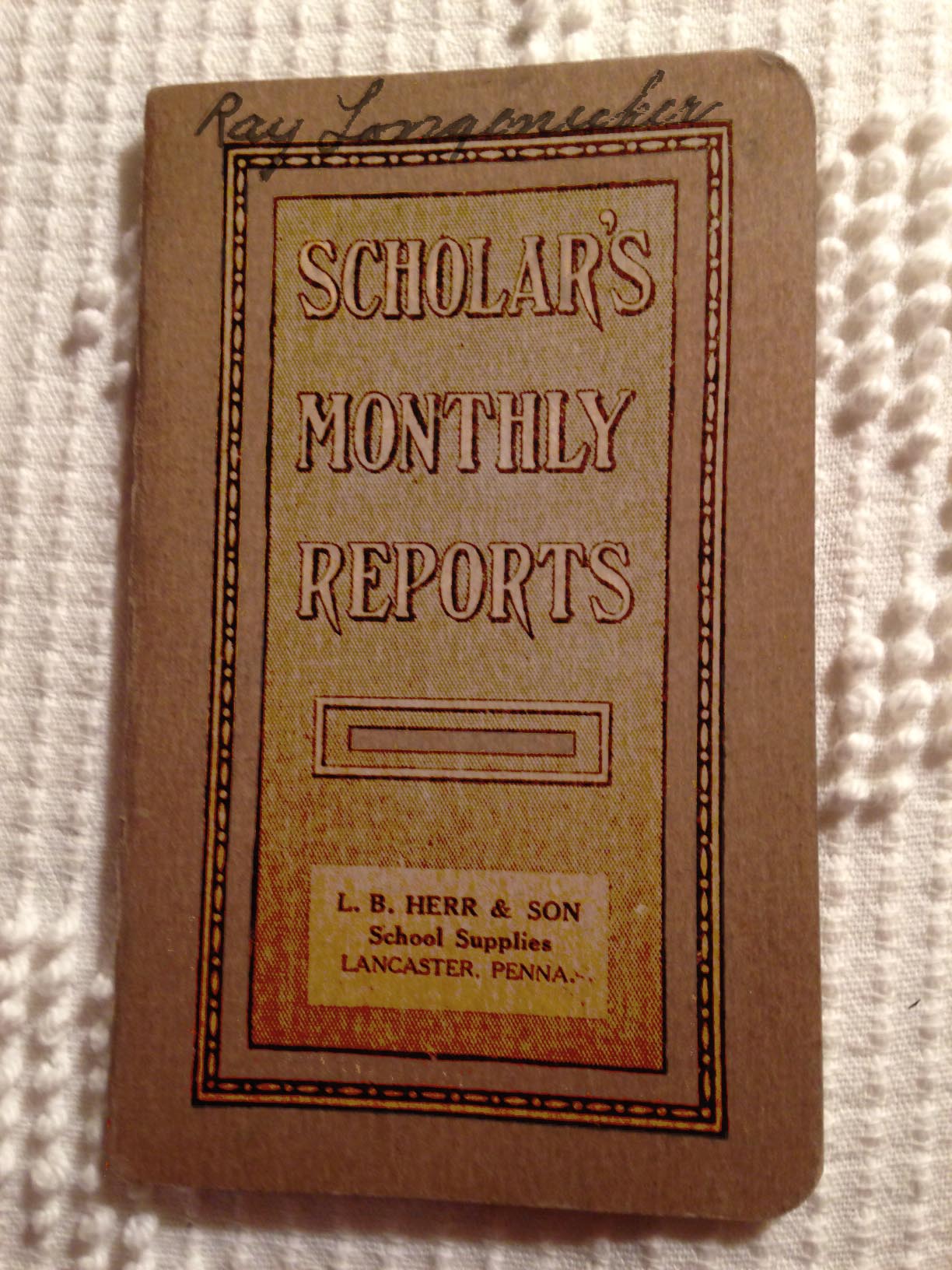
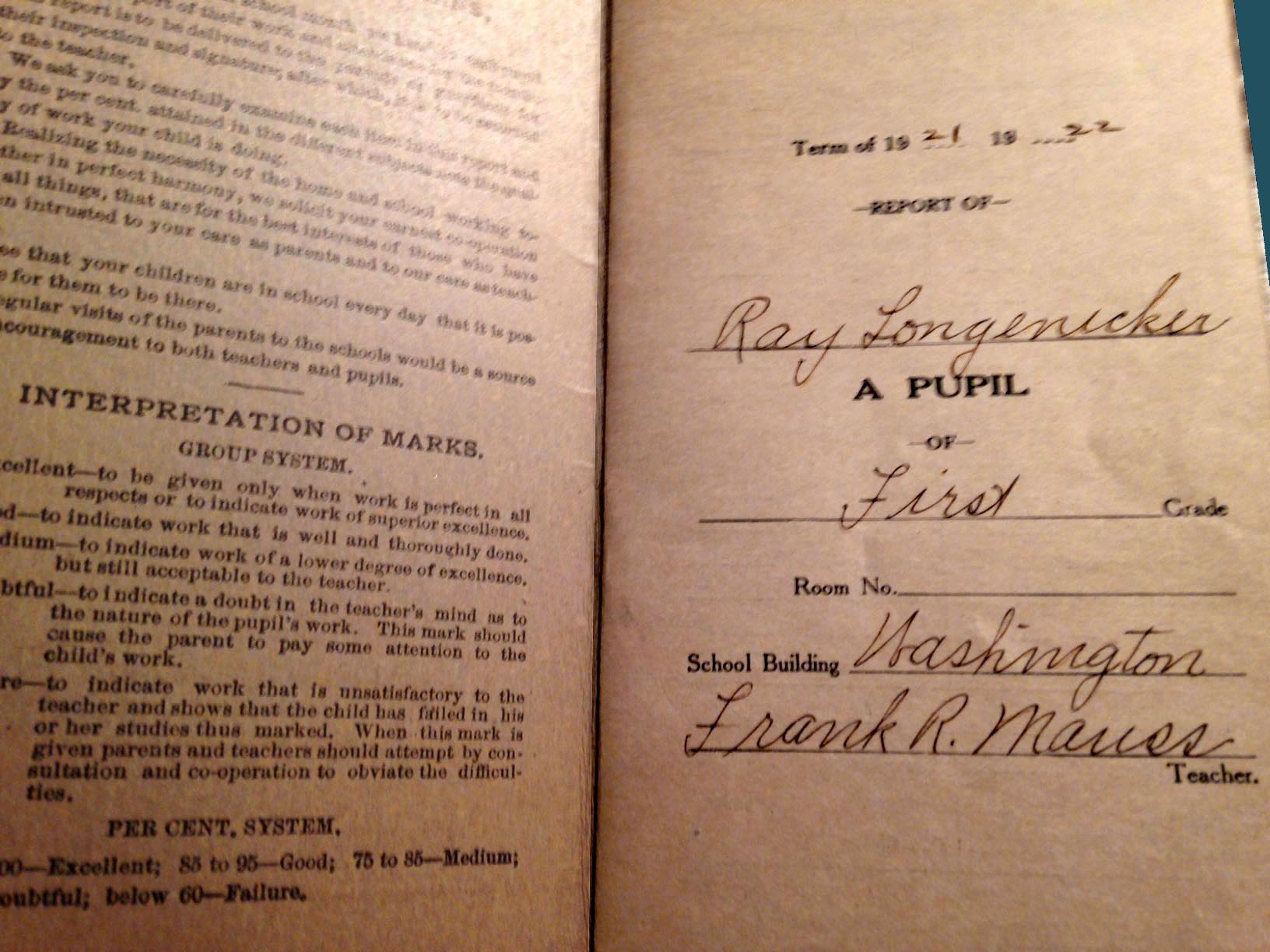
Some discoveries are hidden. Out of sight. Others are hidden in plain view. Last week we uncovered my dad’s first grade report card from 1921-22 in a box on the upper shelf of the closet. It’s a document, really, a fancy booklet with flowing cursive penmanship. The opening page announces the teacher’s name and school, Frank R. Mauss at Washington School, like many schools of the era on the same grounds as the church, in this case Bossler’s Mennonite Church.

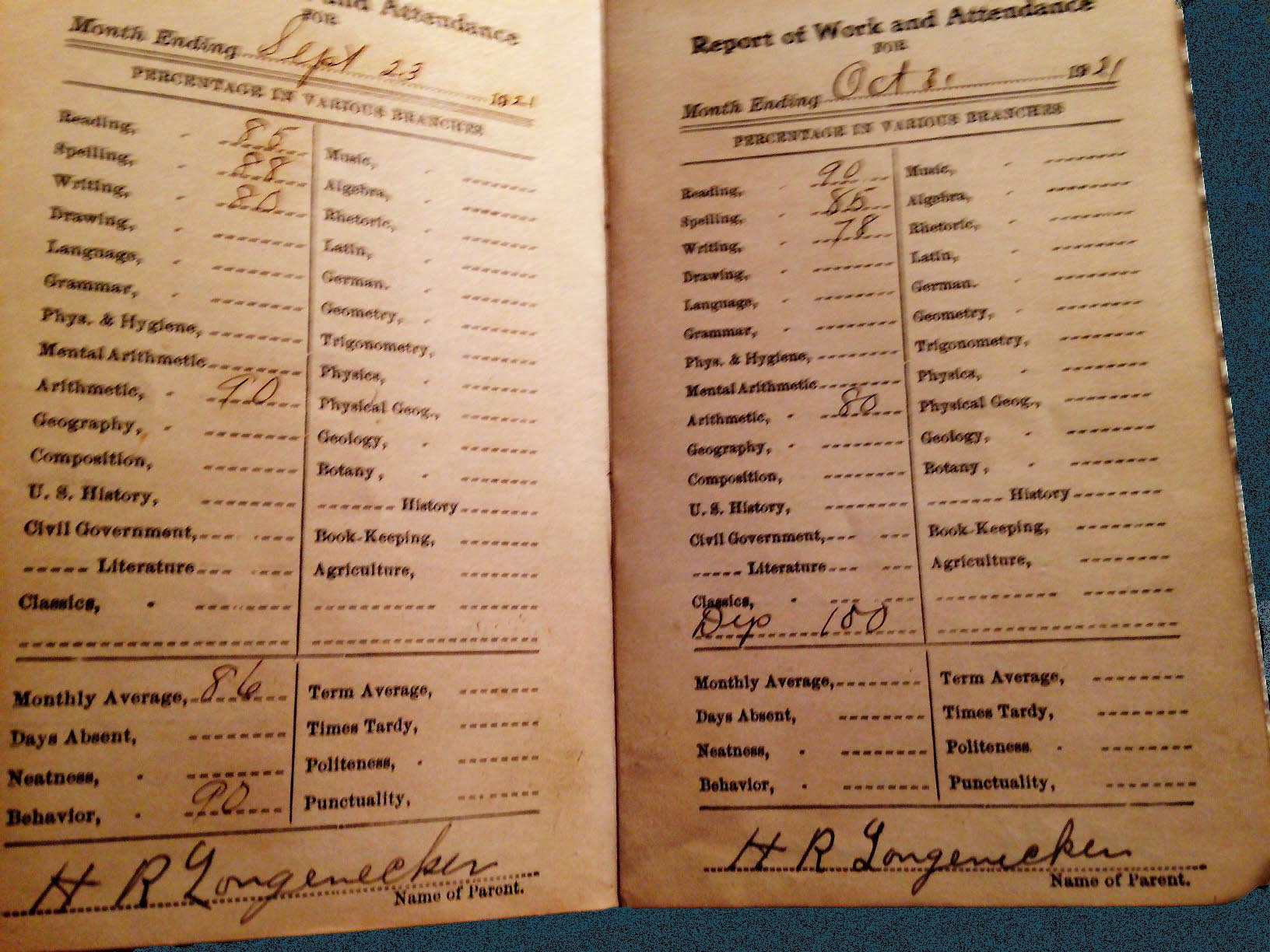
Ray Longeneckter_1st gr report card_4x5_300Ray Longenecker_report card1_inside_5x3_300

There are no vague S’s or U’s for satisfactory or unsatisfactory. Not even an A, B, or C. No, the grades are recorded precisely as percentages: 86% average for the first reporting period. And a 90% for behavior, not quite the teacher’s pet!

Ray Longenecker_report card2_inside_5x3_300

*  *  *

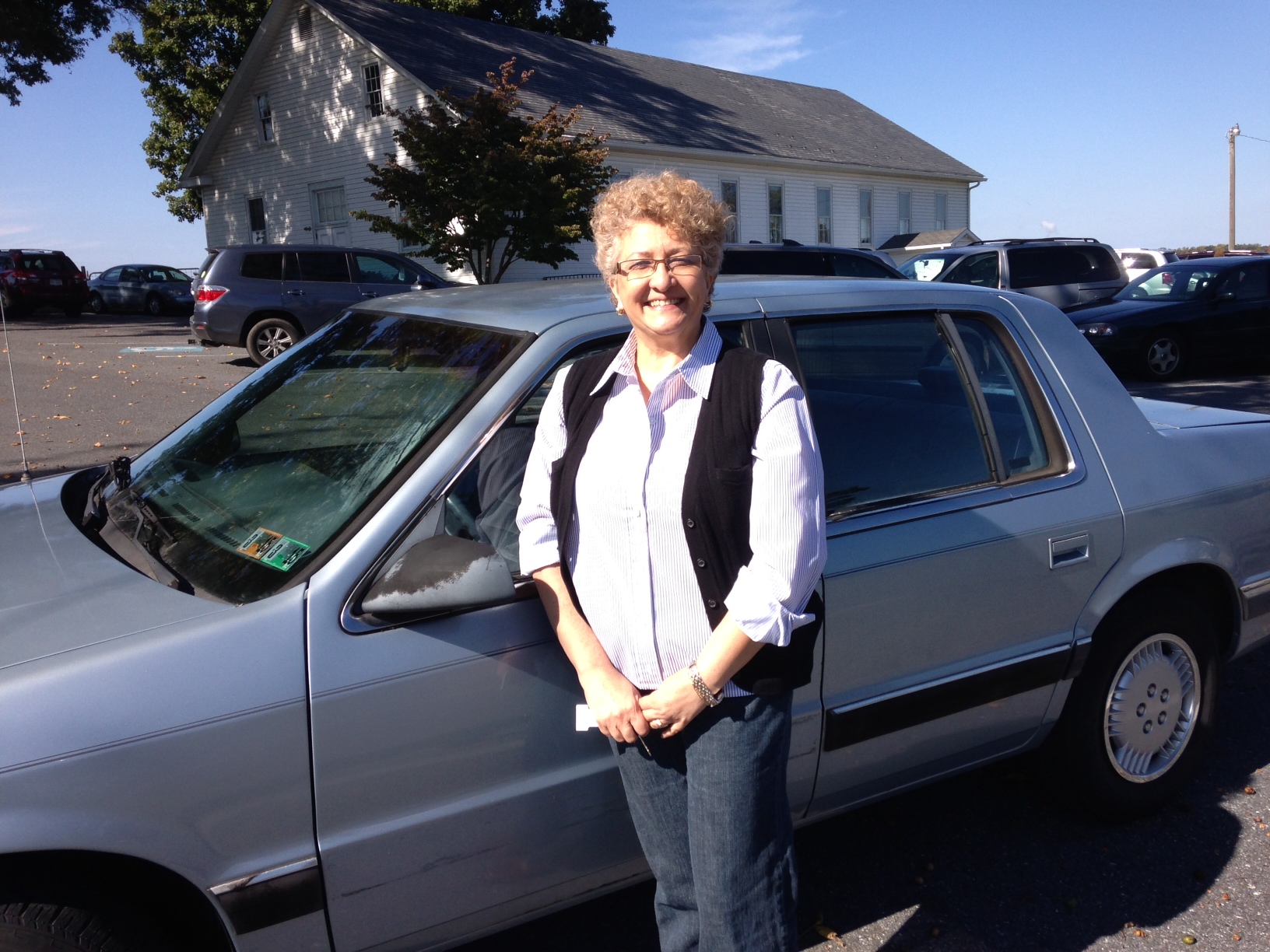
And, yes, other discoveries are hidden in plain view, like Mother’s Dodge Spirit. With 98,000 miles it’s been around the block more than once, but certainly not worthy of an antique license tag. What to do with it? After some deliberation, our sister Jean suggested we offer it to our friend Edda, a member of Bosslers’ Mennonite Church. A first-generation immigrant from Colombia, Edda is getting a foot-hold on a new life in the USA while enabling her son to get a college education. She is tickled pink with our recycled gift. A bonus for us: We get to see Mom’s car parked at church when we visit on Sundays.

EddaCar

Cards and cars – both have a second life, one an artifact to hold – the other, providing a pathway to the next step in adventure for a brave woman.

Valuing the past and the present, both solemn acts, both borne of love. As Wendy Schuman concludes, As I sorted through her things, I felt surrounded by her presence. In a way, it helped me say my final goodbye.”

Have you had to say goodbye to someone or something you have cherished?

How have you learned to say “Goodbye”?

Coming next: Mom’s Accessories: Bonnets, Hankies, Pins, and More

Secrets in My Hatbox

Just behind my desk, a wicker table holds three hat-boxes: One is floral, another has a repeating Tuscan scene and the third is transparent, the contents held taut by pale blue gossamer fabric. All are chock full of memorabilia from days gone by. All three, a type of journal-in-the-making.

Hatboxes

Depending on your style, your journal may be traditional with words and lists. Maybe you even paint or use colored pencils to amuse yourself or record an image. If you are tech savvy, you may have a photo journal, an audio or video journal. Maybe you are even into scrap-booking.

A hat-box is a type of scrapbook, really, a place to keep ticket stubs, magazine and newspaper clippings, programs, and fliers. You don’t actually have to write anything, unless you are into marginal notes, underlining and highlighting like me.

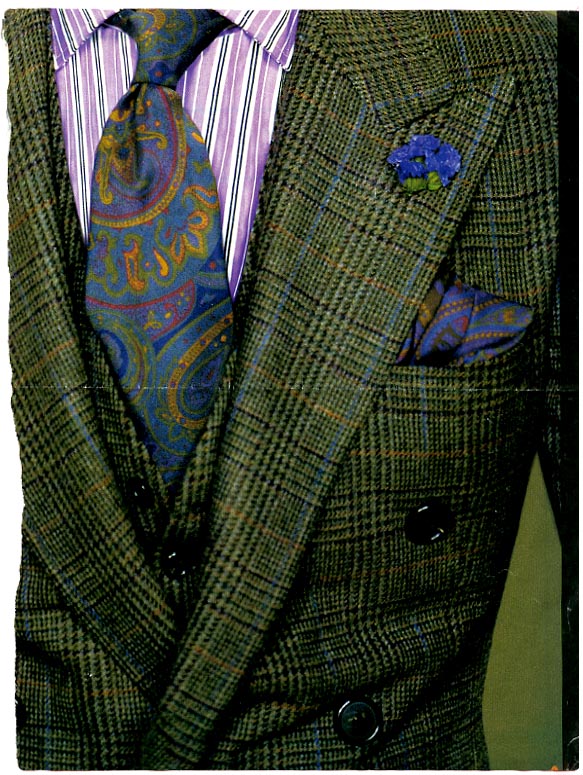
A few weeks ago, I opened one of my hat-boxes and found an article on the sexuality of corn that I may use on a blog post next spring. A page of a man’s outfit I thought natty also surfaced along with an article about videotaping I must have liked back in the May 7, 2007 issue of Newsweek.

Camcorder article

Suit magazine page

I like the irony of a Mennonite girl keeping clippings in a hat-box, hats forbidden in my teen years when fancy hats were then popular. But just like my youth, hat-boxes don’t contain the end of my story but seed kernels of what is yet to be.


Do you have a container, odd or simply utilitarian, for memorable “stuff”?

What does it look like? What do you keep inside?  Inquiring minds want to know . . . .

Moments of Discovery # 1: How Do You Furnish a House?

According to The Huffington Post, the median home price in the United States (2014) is $ 188,900.00. Even adjusted for inflation over the years, housing prices have increased enormously since the 1940s.

My parents were married in 1940. Until they bought their first home in 1941, they lived for a few months with my father’s parents, Henry and Fanny Longenecker, and then with a relative, “Uncle” Elmer Longenecker in the village of Rheems, Pennsylvania. The newlyweds’ first home of about 1240 square feet cost $ 5000.00.

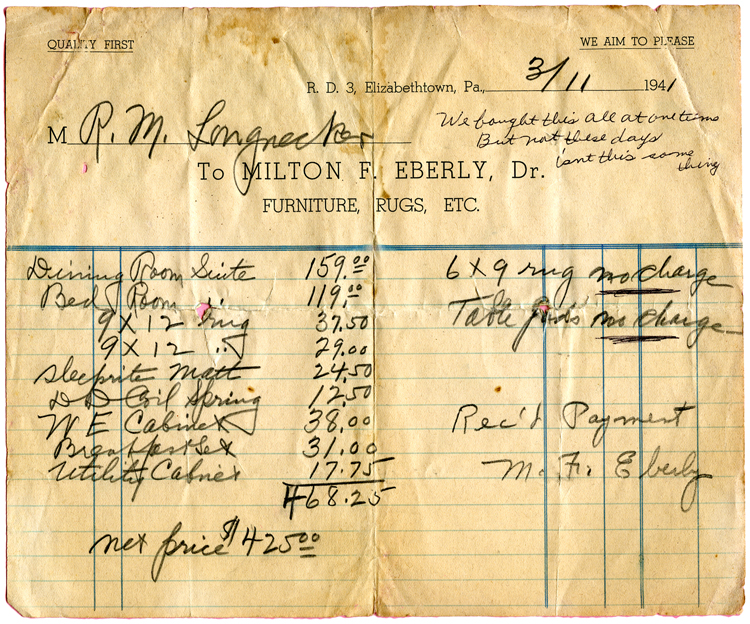
Just as astonishing as the price of the house was the bill for their home furnishings from Eberly Furniture Store just above Elizabethtown. They outfitted this home for $ 425.00 including a dining room and bedroom suites with a mattress and box springs, a kitchen table, rugs and two utility cabinets.

Eberly Furniture receipt_150

Please note that table pads for the dining room and a third, smaller rug were apparently thrown in as a bonus. Milton was a happy man the day Ray and Ruth Longenecker walked through the door of his store. And the feeling was mutual. My Mother’s comment on the receipt says it all: “We bought this all at one time, but not these days. Isn’t this something.”

The Art Deco bedroom suite has been replaced with something more contemporary but not nearly as beautiful to my taste. What is left of the original purchase: the kitchen table and chairs and the Duncan Phyfe dining room suite.

BuffetMomChinaCabinet

Isn’t that something?

The “Moments of Discovery” series is Part One of a continuing series that will unfold as we sort through the contents of the house on Anchor Road. It joins other series on this blog: Purple Passages, Moments of Extreme Emotion, and 10 Tips/Secrets.

How do you furnish a house – traditional, contemporary, eclectic? 

Coming next: Secrets in My Hatbox

Family Dinners: Keeping the Spark Alive

Are family dinners important? What about empty nesters? Families of one? Do family dinners protect against the effects of teen drug use and cyberbullying? Writer Melodie Miller Davis in her recent blog post “How do you keep family dinner?” got me thinking about recent research on the topic.

In her post, she refers to Columbia Casa Family Day, a national initiative to remind parents that they have the “power to help keep their kids substance free.” Cornell University researchers also have discovered that shared meals may help prevent eating disorders. An article in Time asserts that teens benefit from interaction with their families and find security in the shared, predictable ritual of family mealtime possibly preventing early drug use and the effects of cyber-bullying. However, there is also research that claims such effects are overstated or not verifiable.

Whatever the case may be, the faster the pace of our lives and the more insane world events become, the more I long for the sweet spaces of serenity that sharing family meals can provide.

The Longeneckers and the Metzlers, two strands of my family line were oblivious of any such research but carried on the ritual of family meal time together. Here is a post from the Metzler gatherings, often picnic style.

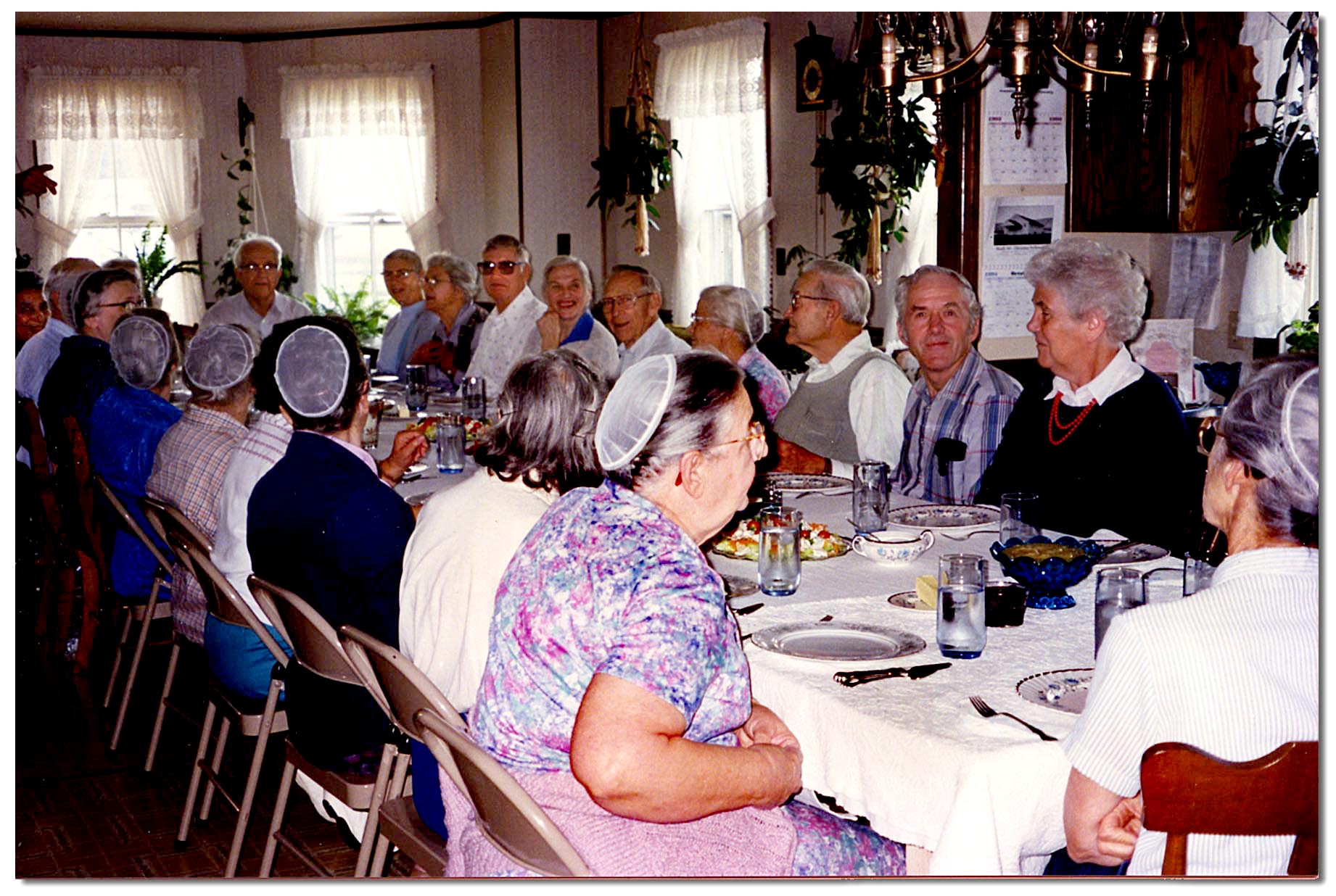
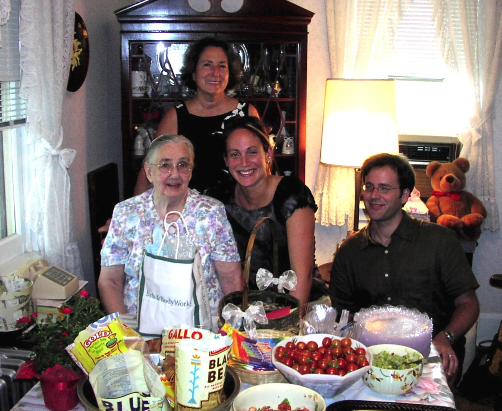
Family dinners can be very large as seen here in Grandma and Aunt Ruthie’s house with twenty, mostly Bossler Mennonite Church friends, gathered around their huge dining table.

Mother L_Bossler eating_at Ruthies

Whether large or small, indoors or out, dinners require preparation. My sister Jean and her family provide some of the “raw material” from a shared meal at Mother’s house.

Mom&FairfieldsREV

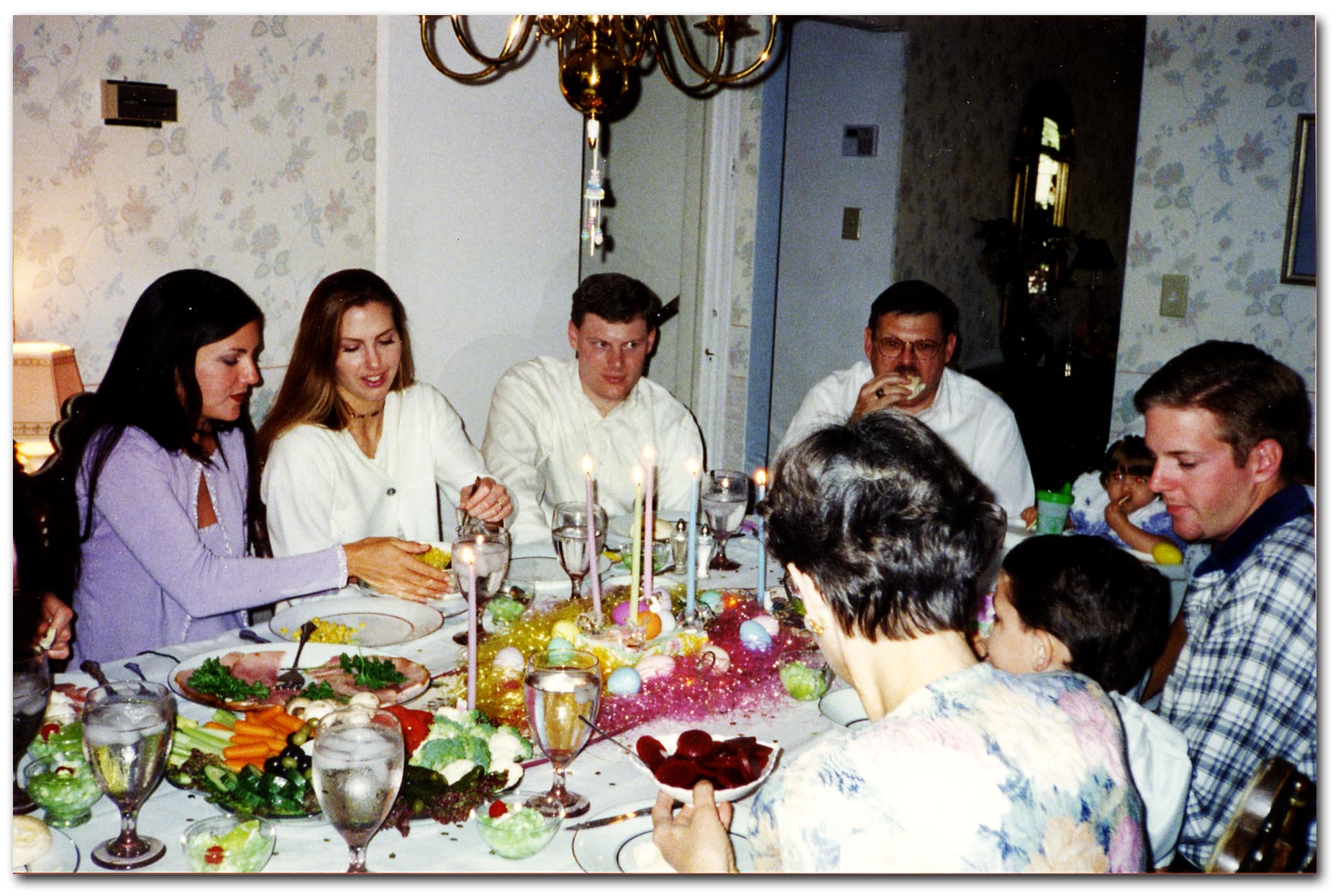
Years ago if we didn’t visit Pennsylvania, I shared holiday meal making with my sister Janice, who lives just 2 ½ miles from us.

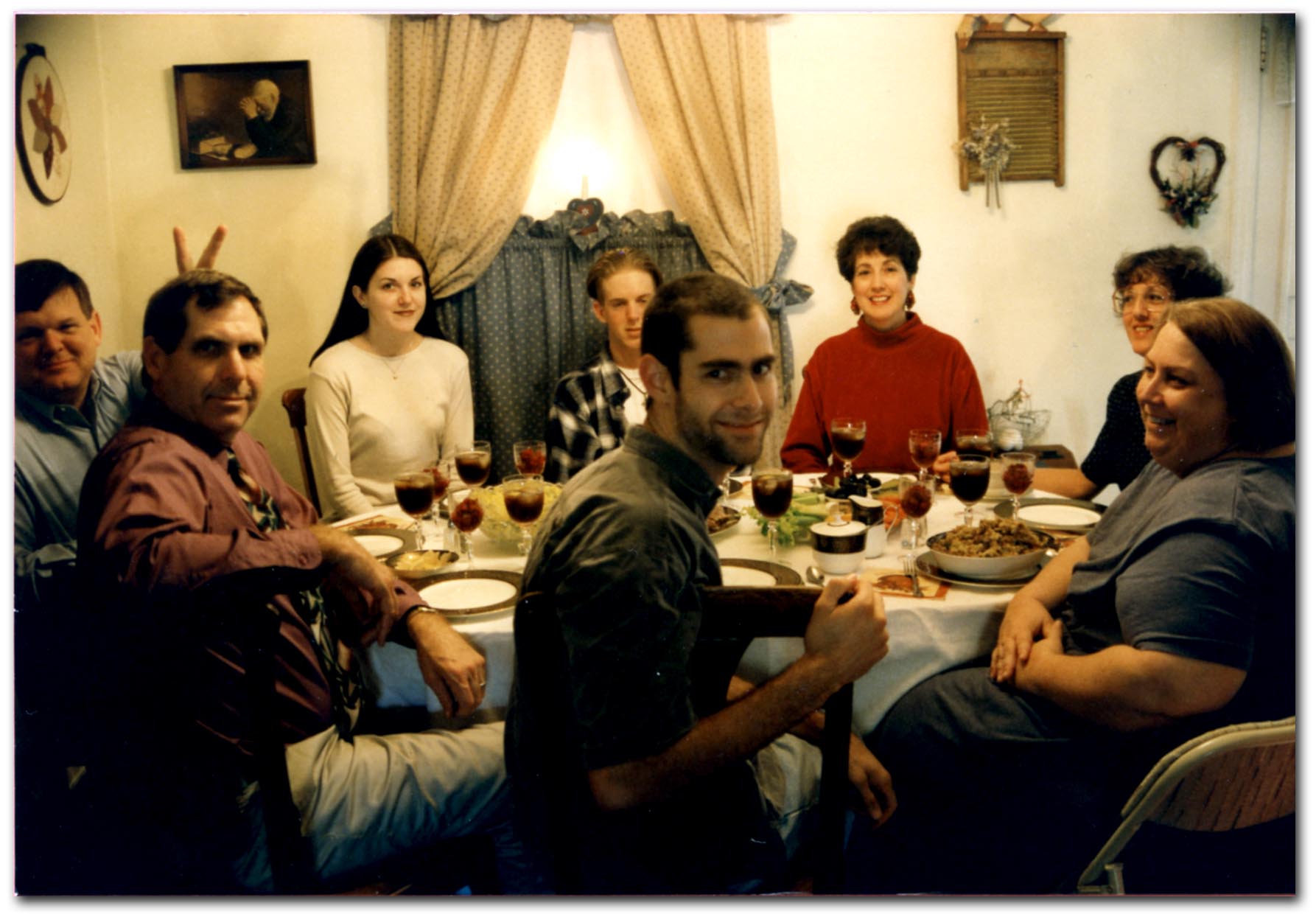
There's one in every crowd - even in family!
There’s a joker in every crowd – even in family!

03_meal_Easter_1999

And then the over-flow table with the kids . . .

04_meal_Thanksgiving_2005

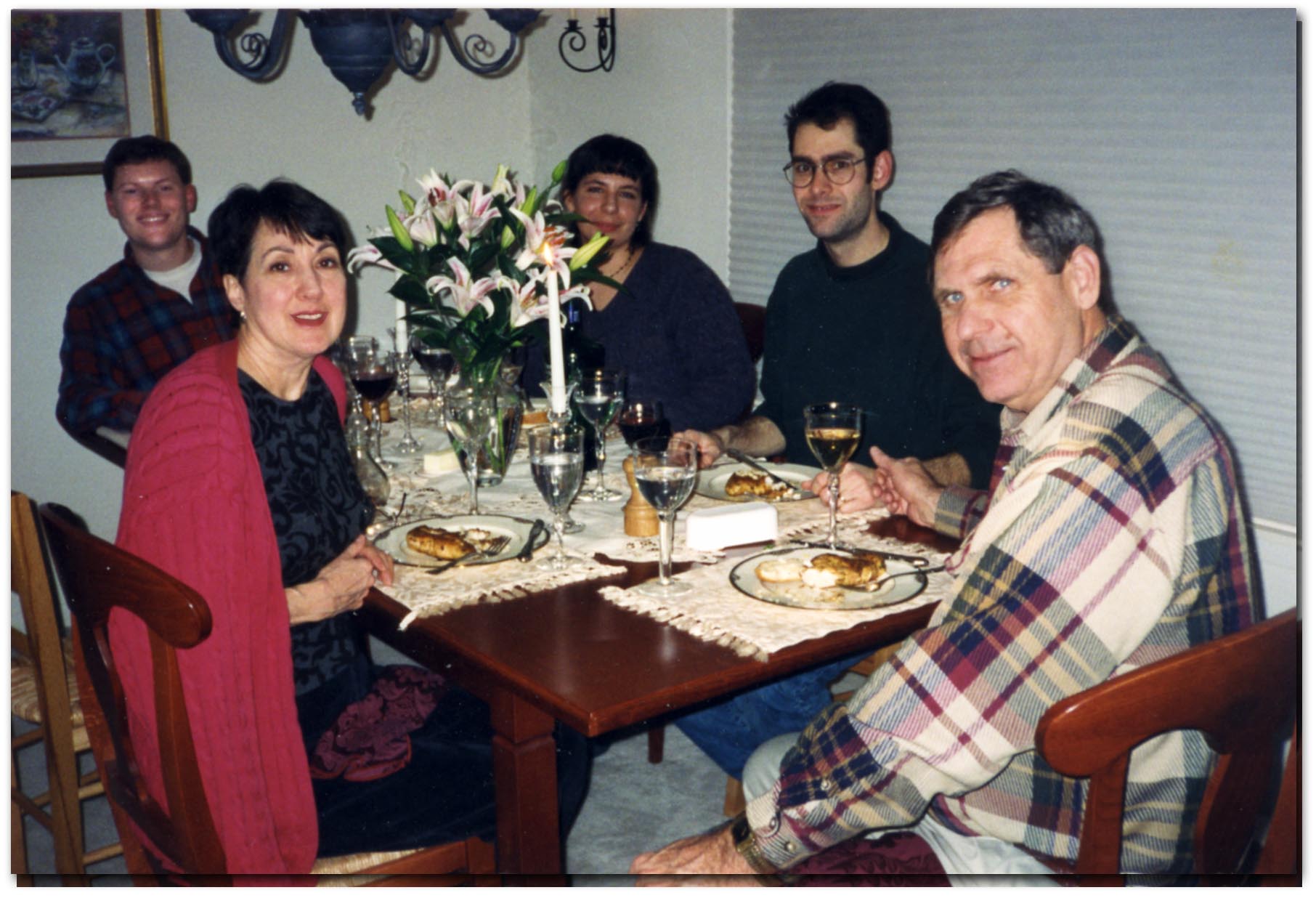
After awhile, our children began entertaining us, first in Chicago where all four worked, earned graduate degrees and started a family.

05_meal_Grayslake_1999

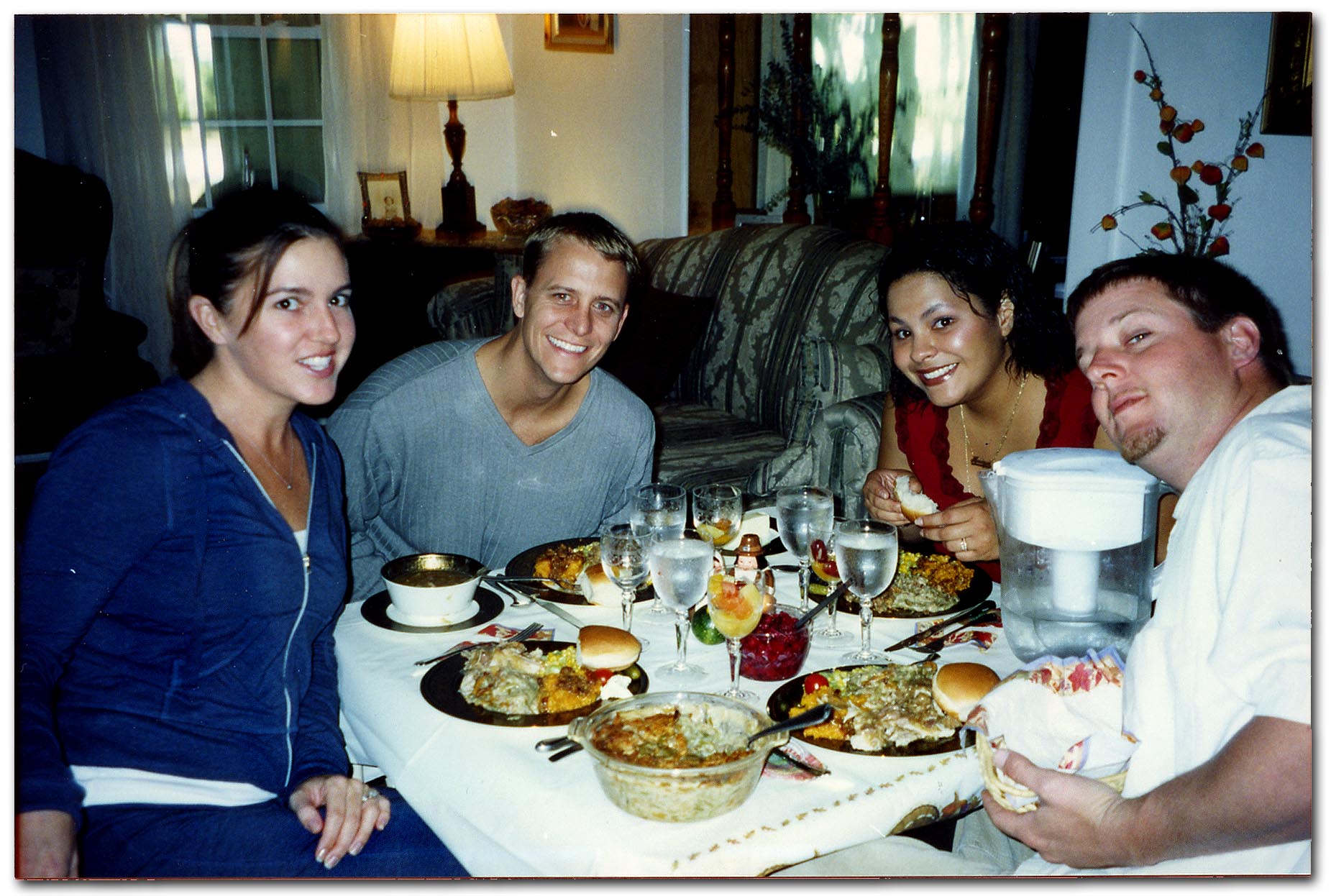
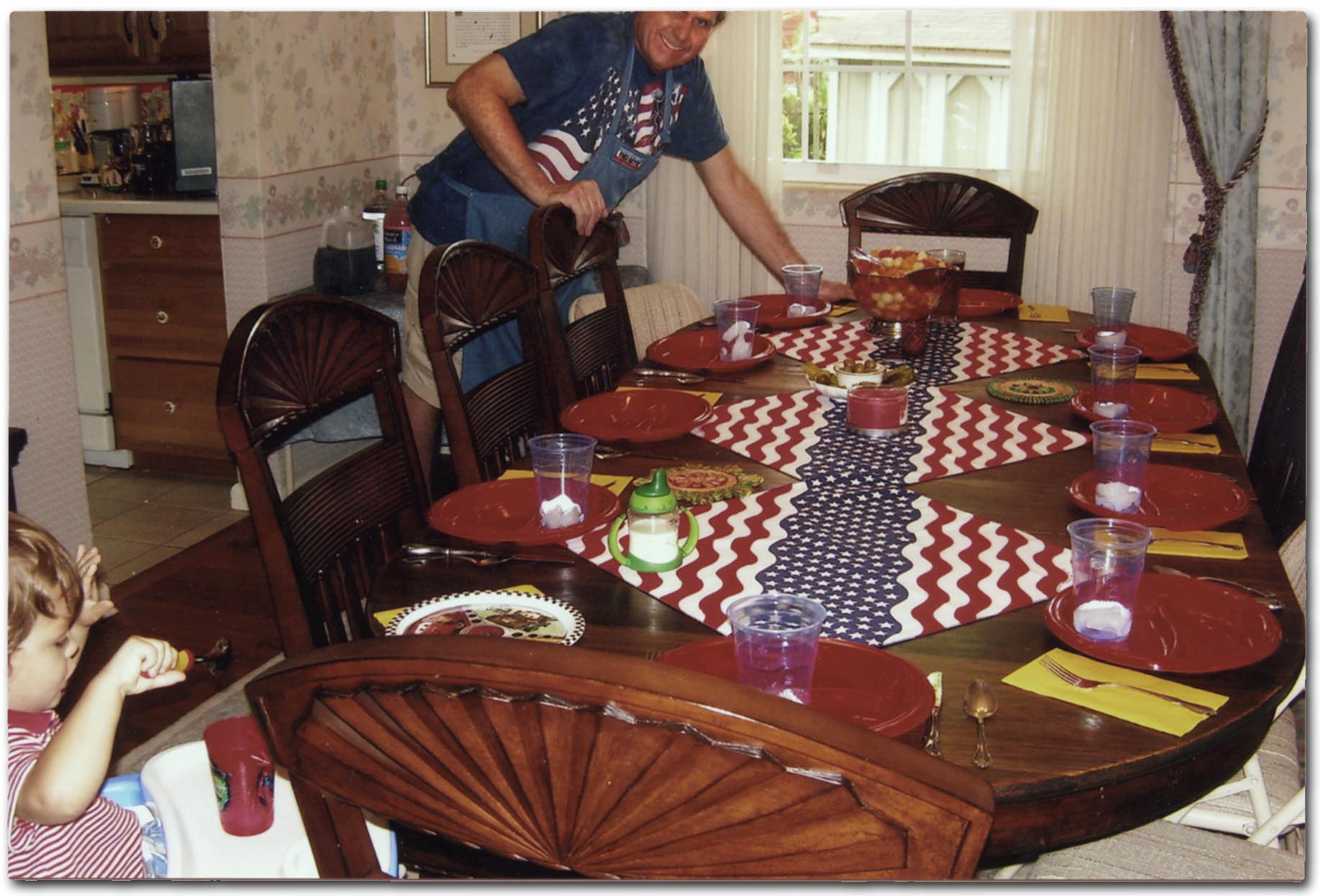
Then when they moved to Florida, two years apart, their meal making continued with Fourth of July at Joel’s house . . .

06_meal_Thanksgiving_Cristas_2009

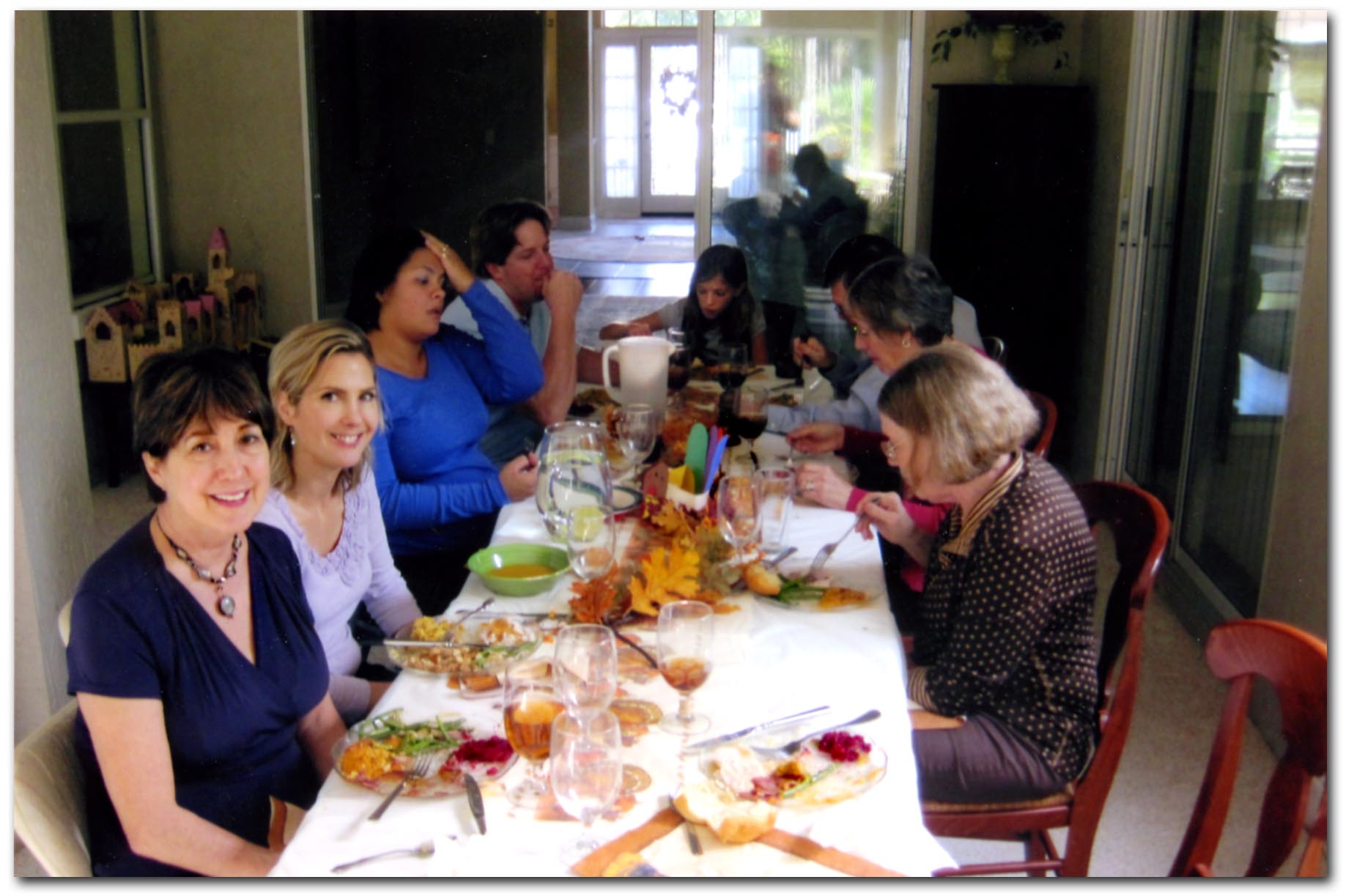
. . . and Thanksgiving at Crista’s house in her bright sun room.

Any excuse for a party! Besides birthdays, Fourth of July can be a cause for celebration too.

07_meal_Memorial Day_2009

One of us, who loved everything about entertaining from meal preparation to talking and eating around the table, will be missing this holiday season and every meal in between, our Mother Ruth Longenecker, hostess extraordinaire.

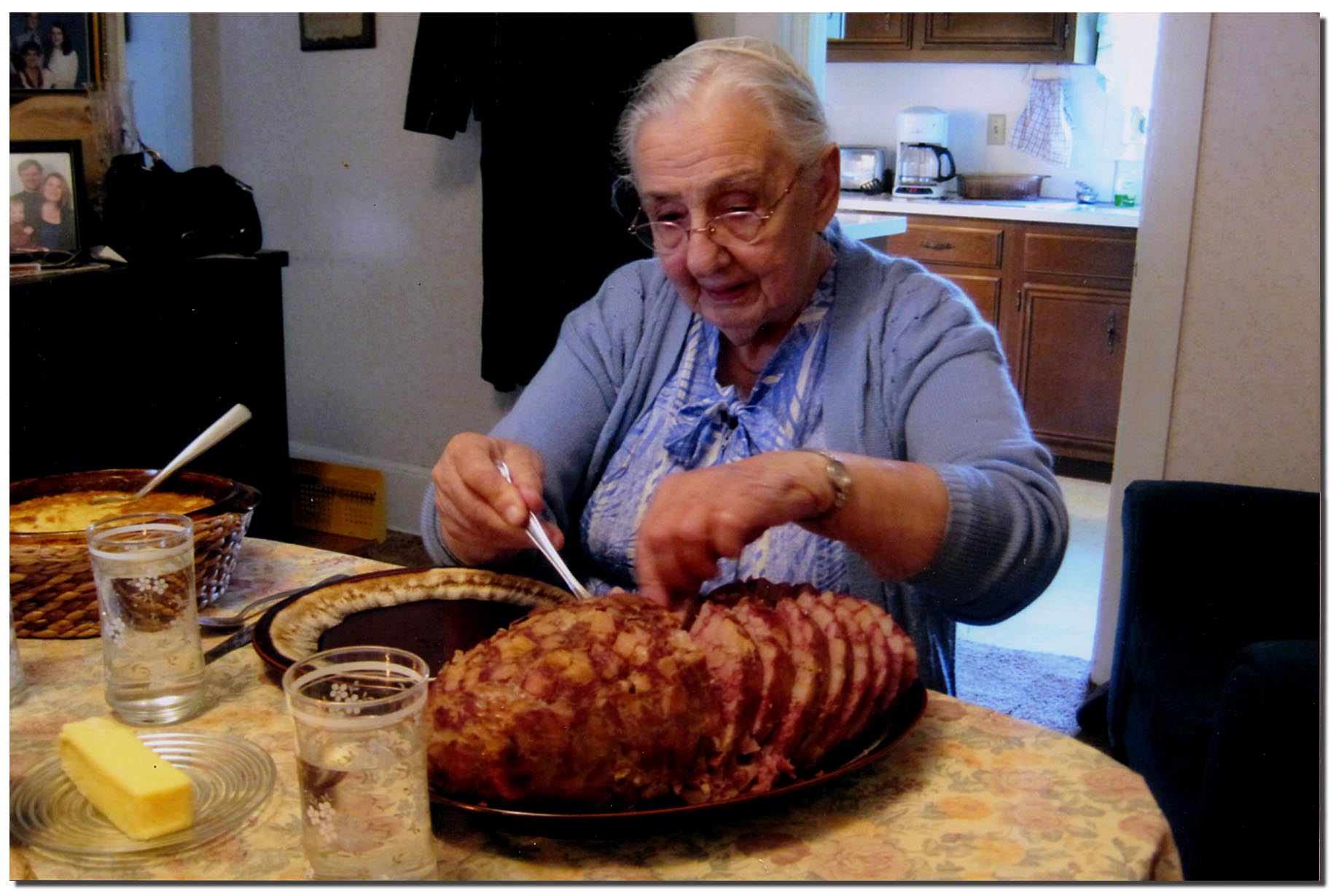
Mother slicing pig stomach with baked corn and a stick of butter close by
Mother slicing pig stomach with baked corn casserole and a stick of butter close by

 How have family dinners marked your family history?

Coming next: # 1 in a series “Moments of Discovery”