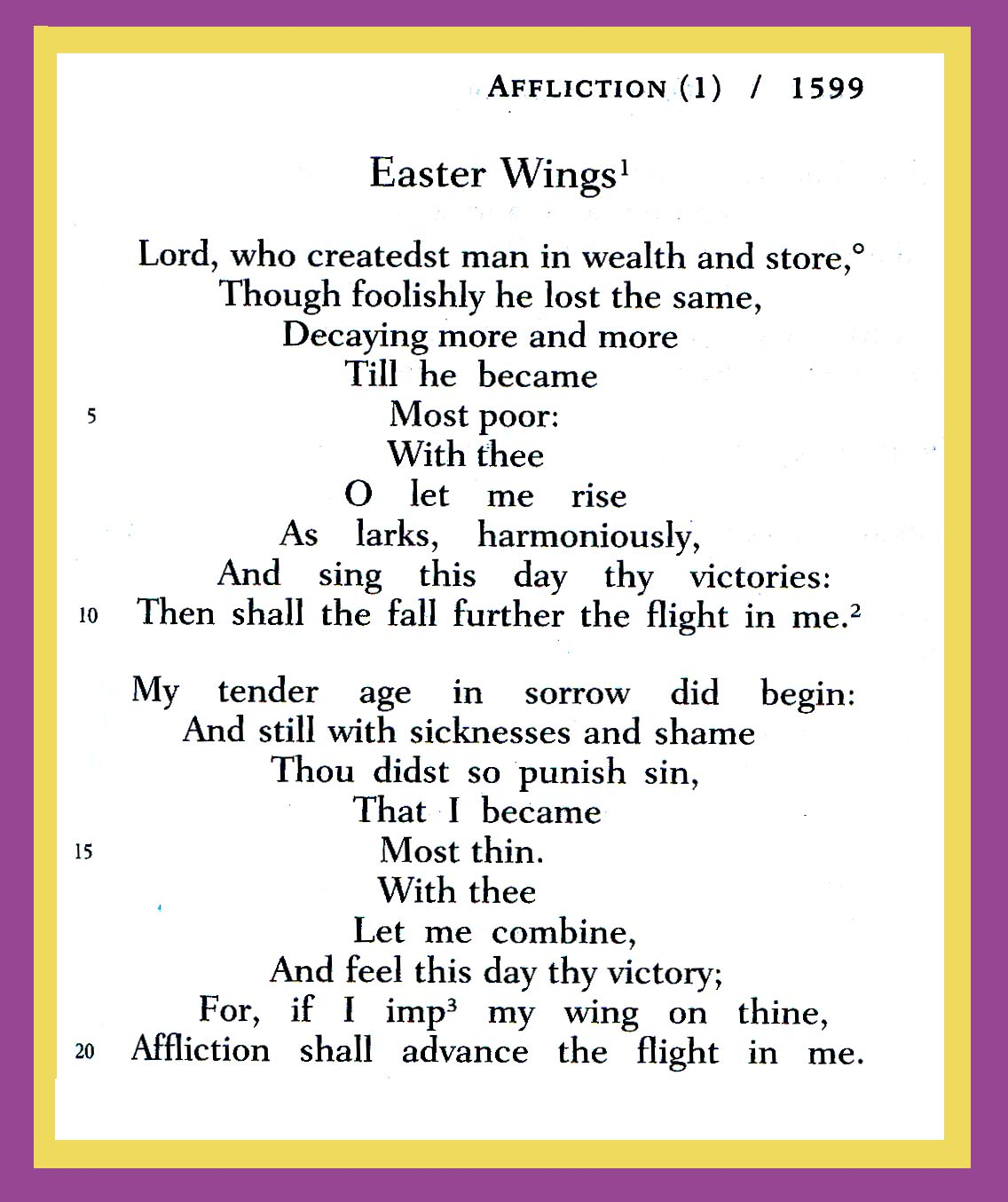
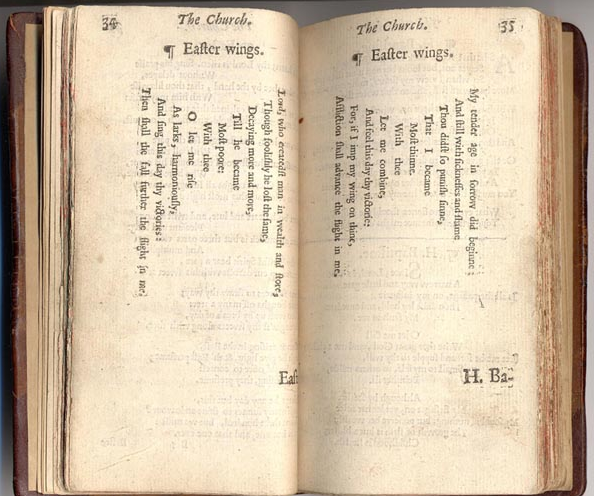
*Poem for Easter – British poet George Herbert loved to explore the soul’s inner architecture. He often wrote poems with shapes representing a theme, the resurrection in this case. The poetic lines, “increasing and decreasing to imitate flight,” also mimic the spiritual experience of rising and falling.
Then viewed vertically the poem displays images of two butterflies, symbols of new life: Emblem poetry (technopaegnia) printed in a shape that reflects the subject of the poem.
Manuscript from the Bodleian Collection, Oxford University, 1633
Since by long centuries of custom the date of Easter is annually determined from the first Sunday after the full moon on or after March 21, the intertwining of physical and spiritual seasons is virtually inevitable.
Wisdom in Waiting: Spring’s Sacred Days by Phyllis Tickle
*Easter parade at Rheems Elementary School
My Mennonite school teacher, Miss Ruth Longenecker, was an artist. Though she dressed plainly with hair in a bun and a standard regulation prayer covering, her life brimmed with color, design, and pageantry. She painted in oils, preserving the old sycamore tree by the bridge at the old Martin home place on canvas:
Sycamore tree and bridge along lane leading up to the Martin farm Oil painting by Ruth Martin Longenecker
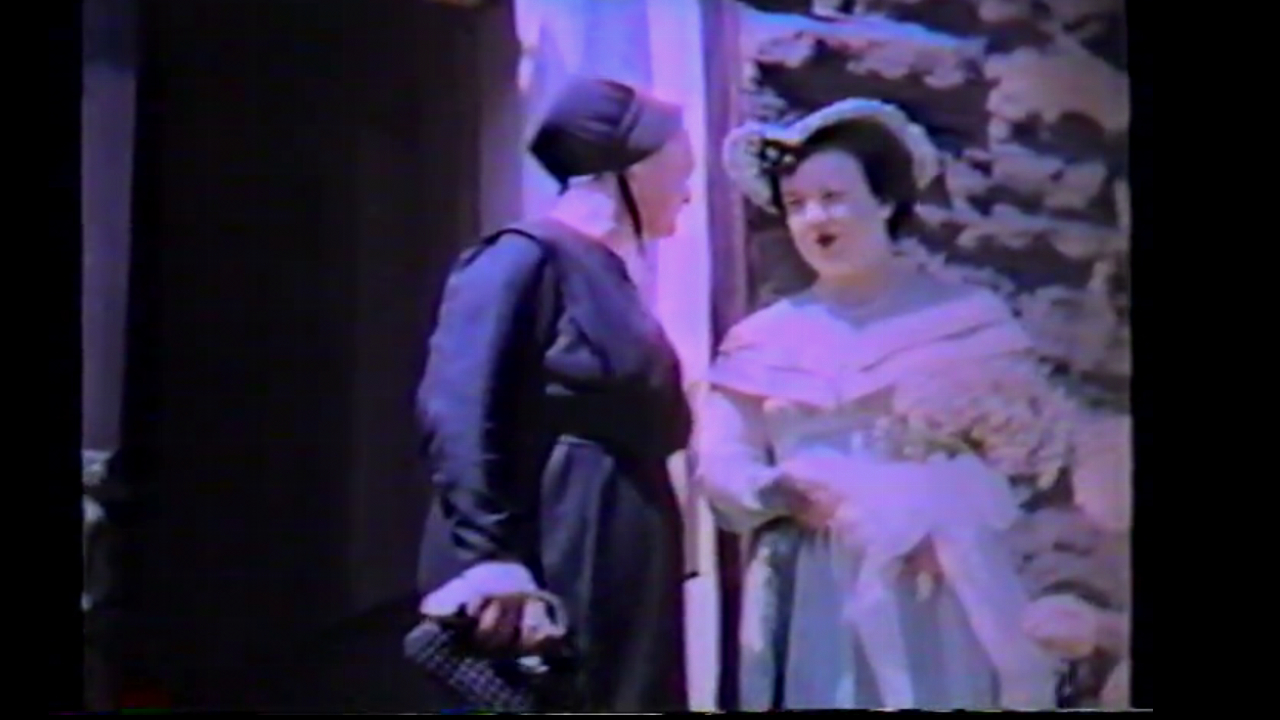
In her classroom at Christmas time was a tall tree laden with brilliant bulbs and glistening tinsel at school, though Mennonites were discouraged from having worldly Christmas trees at home. For St. Patrick’s Day, my classmates and I wore Derby hats and huge green shamrocks. But Easter was a real blow-out. Students brought hats and silky flowers from home to add to the creative collection (pasted, stapled, sewed). We paraded up and down the village streets near Rheems Elementary School, our teacher preserving the frivolity on her 16 mm movie film. Even the boys wore hats, some even more flower-encrusted than the girls.
Hand-made millinery on display at Rheems Elementary School
Thank you for commenting. You can count on me to reply.
The conversation continues . . . .
Coming Monday: Guest post on Mary Gottschalk’s blog: Flying the Coop: Leaving Mennonite Land
Easter eggs on the farm? Why sure – Fresh eggs from Aunt Sue’s chicken pen, popped into her kettle of water brought to a boil in the kitchen. And then in short order, eggs cooling on the counter soon ready for us to paint. With paint wands made of little wisps of cotton wrapped around tooth-picks, my sisters and I with all the other little cousins make squiggly lines, circles and scallop shapes on the curvy shells, filling them in with rainbow colors. Sometimes we even add little bunny or flower stickers. But all that artistry happens after devouring the Easter ham.
Grandma Longenecker’s sister Aunt Sue Martin, who never married, lived on the farm and took care of Great-Grandpa Sam after his wife Mary died. I’m about six now, and Easter dinner is celebrated around the table at the old home place in Dauphin County close to Middletown, PA. Families of Uncle Joe, Uncle Frank, and Grandma surround the table laden with ham, turkey, home-preserved vegetables, and finally desserts. The clucking of chickens and a few dog barks offer background sound to the talk, usually about politics and family matters. Before or after the meal, Aunt Sue, actually my great aunt, feeds her other hungry brood, here with my sister Janice.
Women learn early that anything that is alive is a potential and probable responsibility.
Phyllis Tickle, The Graces We Remember: Sacred Days of Ordinary Time (61)
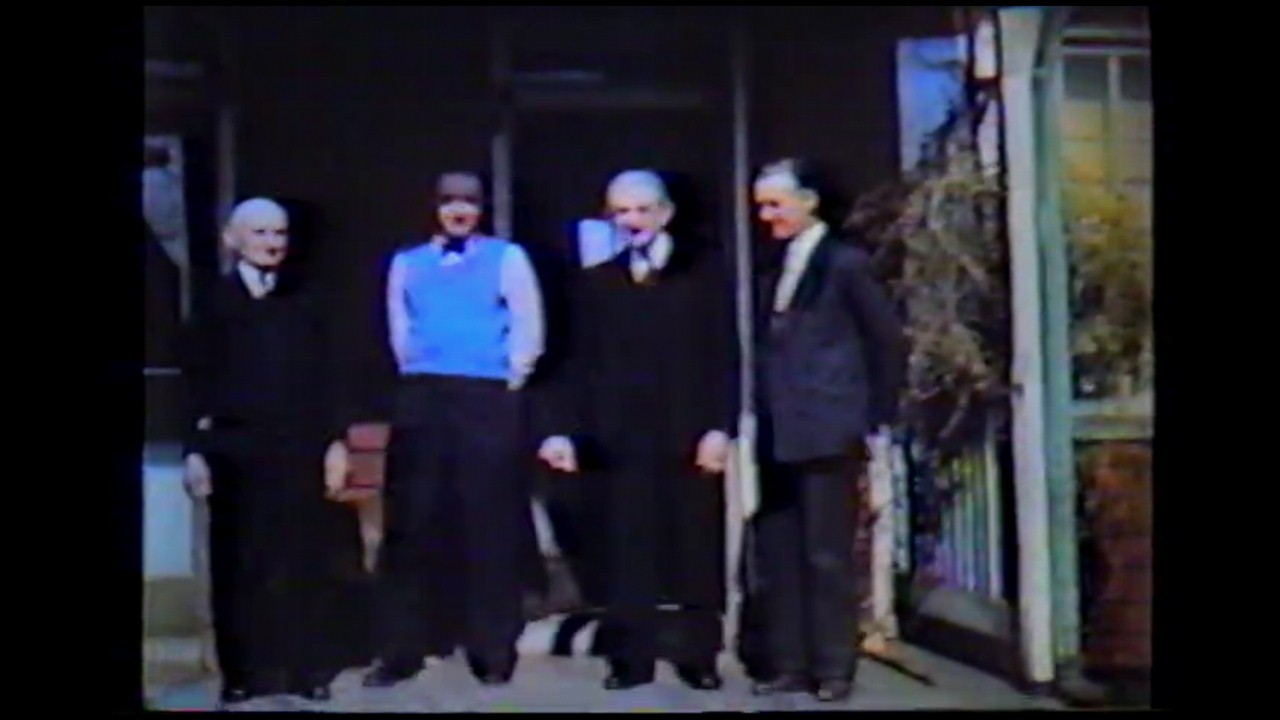
After the drowse-inducing pies and puddings, it is picture posing time. Aunt Ruthie with her new-fangled movie camera captures various relatives posing on the porch.
Grandpa Sam, my Dad, Cousin Leonard, Uncle Joe
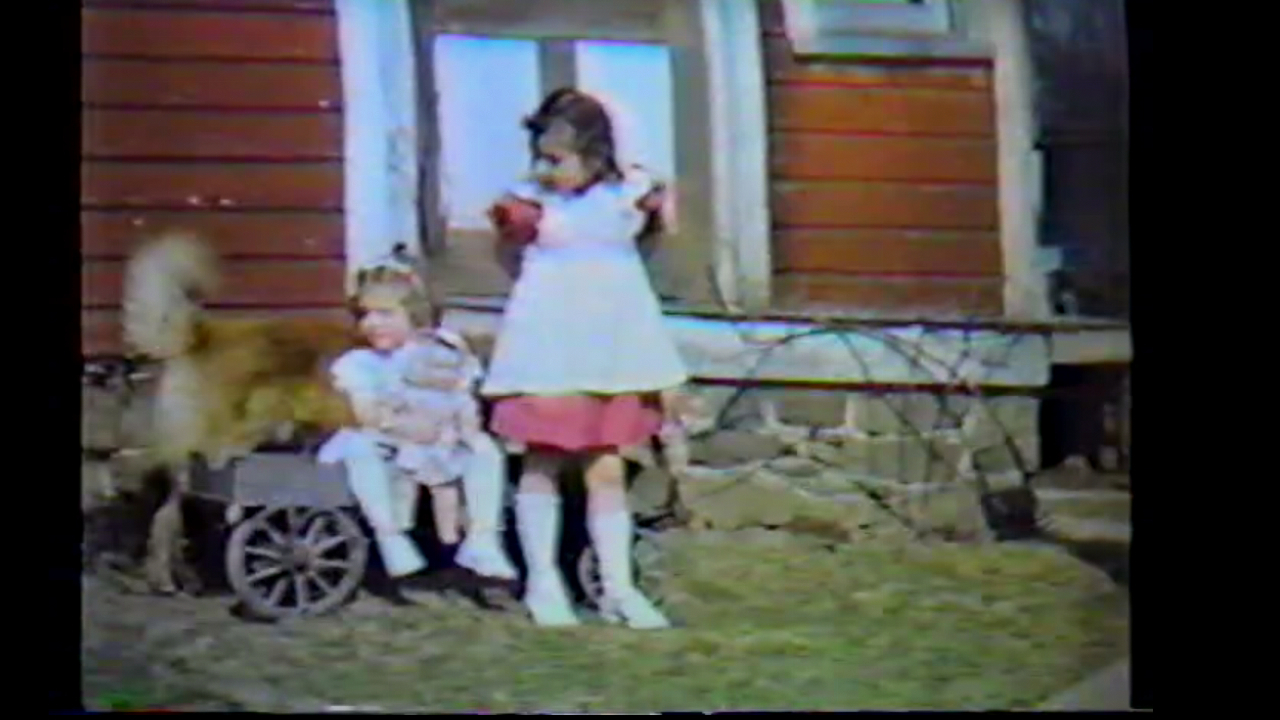
And then we play some more. Make up our own fun. Just the collie dog, a wagon, and the wide open meadows down by the creek are all it takes to keep us happy!
Marian and sister Janice with her dolly on Easter
Do your Easter memories include attending a church service? Eating a meal with relatives? Painting eggs? Hunting for Easter eggs?
What do you think of the quote by author Phyllis Tickle?
When I bring 5-pound bags of Wenger’s famous ham-loaf frozen from Pennsylvania to Florida, the plastic-coated tubs of meat are wrapped in newspaper and then shrink-wrapped in plastic. The wrapping on one of the packages revealed answers to the intriguing question: Who make Amish buggies?
Writer Jack Brubaker born in Bird-in-Hand, PA keeps Lancaster Countians informed about local culture, history, and humor in his syndicated column The Scribbler. In the Tuesday, October 1, 2013 edition of the Intelligencer Journal/Lancaster New Era, Jack noted that a reader from Mount Joy, PA requested more details about Amish buggies. The reader had never seen a used buggy lot and wondered if the Amish recycle buggies. Also, he had been to Indiana recently and saw the Amish using buggies with slanted undercarriages that looked like an armored Humvee. Here are the main points of Jack The Scribbler’s response to his reader:
“Jake King, the Amish operator of Weavertown Coach, along the Old Philadelphia Pike between Bird-in-Hand and Intercourse, says there are about 17 manufacturers of new Amish buggies in Lancaster County, Pennsylvania,” including his company which has its own wheelwright shop.
Buggy-making is a cooperative effort: Five or six shops make buggy bodies, known as “the box.” Other businesses make axles, springs and wheels. Still others assemble fiberglass floors and side panels.
King says his various employees become good at one thing: “You have to be a good electrician, painter and upholstery trimmer.”
What is the cost of a new buggy? “The average carriage for the ‘young guys’ sells for about $ 8000, with a more elaborate dashboard and better grade of upholstery than the ordinary type of buggy which ranges from $ 6000-6500.
Buggy vs. car: Buggy resale is high. Buggies require a horse: $3000 for the animal plus harness and feed. But, King notes, “they also don’t drink $ 4-per-gallon gasoline.”
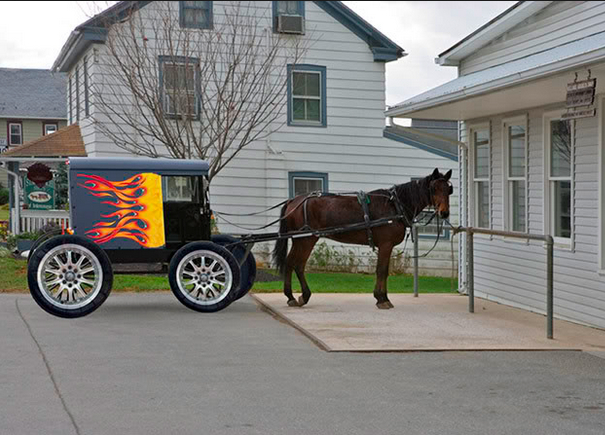
Courtesy Google Images (Real . . . or a Photoshop job?)
The different colors and design reflect the owner’s community: Gray (PA), Black (Ohio and Indiana), Yellow (Byler Old Order Amish in Big Valley, Mifflin County, PA), White (Ohio), Brown (New Wilmington, PA and New York). Honestly, this surprised me as I think I’ve only ever seen black or dark gray buggies.
Like most Mennonites, Amish are thrifty, so of course they recycle their buggies, either through private sales or at spring “mud sales.”
Are there Amish buggies in your community?
What new fact, opinion, or question can you add to the discussion?
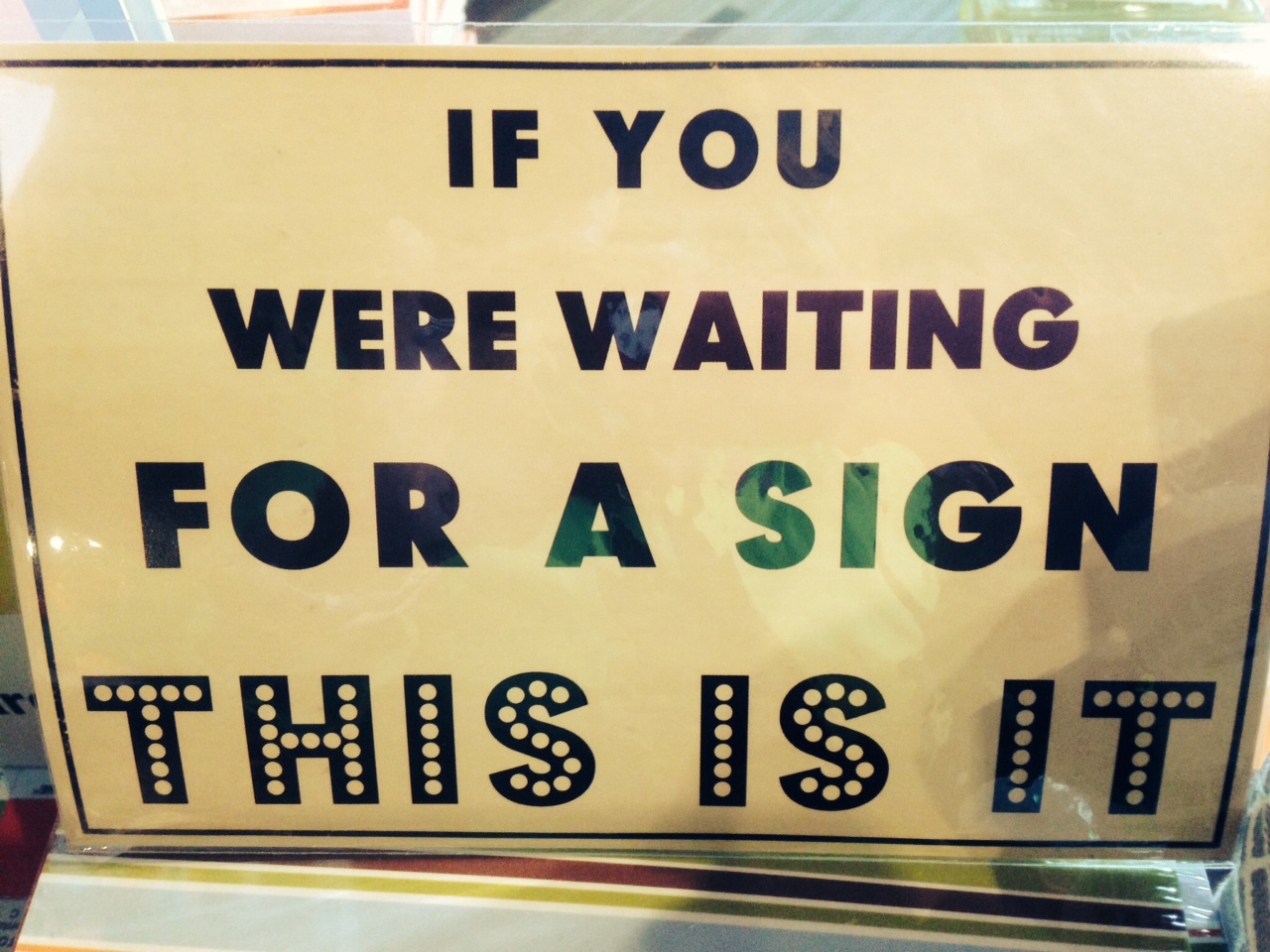
Signs . . . they’re everywhere . . . billboards in the city, stickers on cars, comments on Facebook. I found some wise ones in a novelty shop, on a car, on a piece of paper, on a writer’s sweat shirt. Some you’ve seen before. Others, I hope, are new. Silly video at the end!
Quotation now thoroughly engrained in pop culture from the Tom Robbins’ novel Still Life with Woodpecker, an un-fairy tale with princess Leigh-Cheri and outlaw Bernard.
“Wait, Wait, Don’t Tell Me,” a popular NPR broadcast on Saturday mornings . . . what we do at traffic signals, the post office, a doctor’s office. . . counsel from the Lord we resist hearing:
Wait on the Lord: be of good courage, and He shall strengthen thine heart: wait, I say, on the Lord.
Psalm 27:14
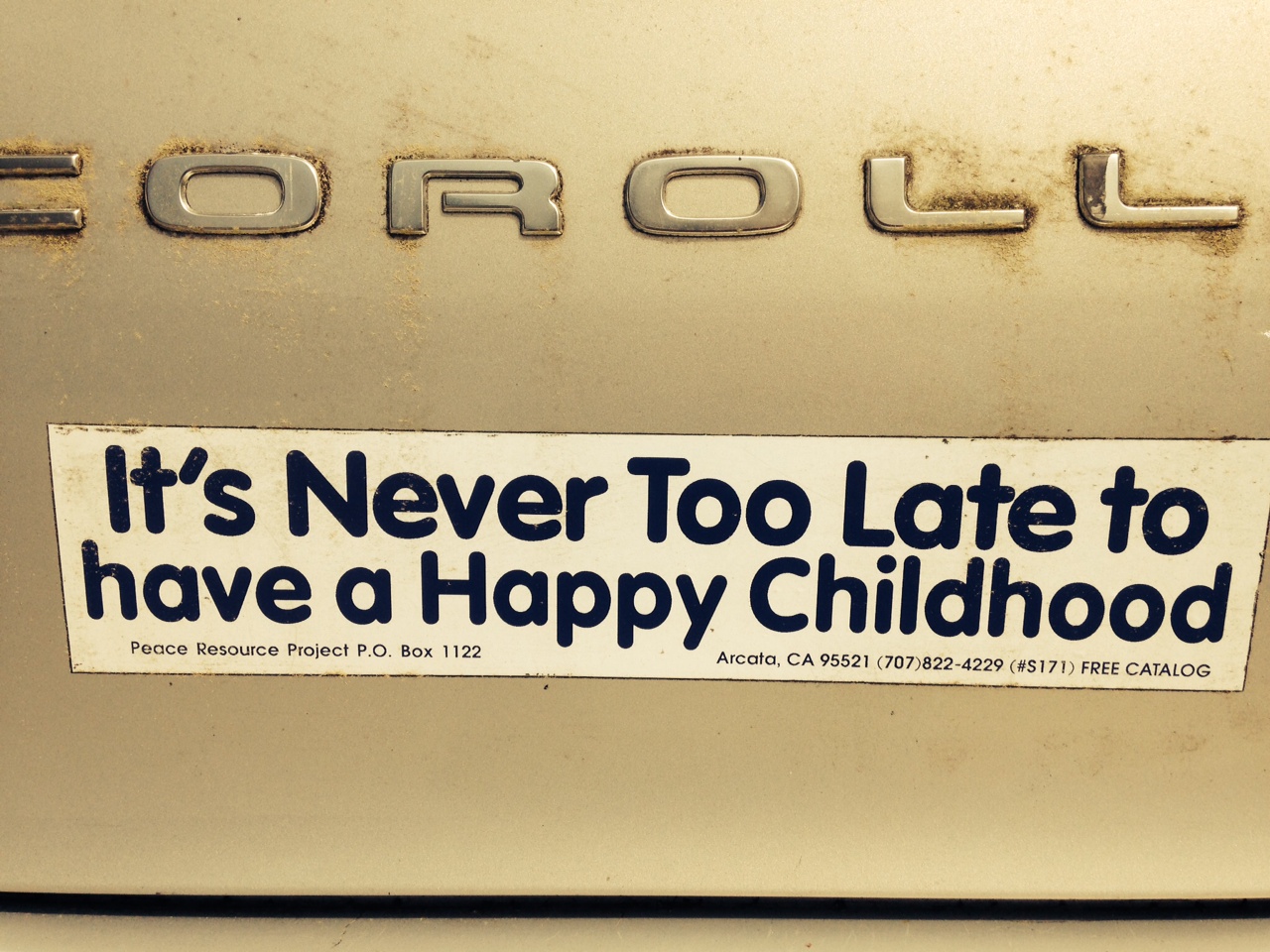
“I won’t fix my car until YOU learn your lesson,” this driver insists.
Easy to say — until it actually happens to you!
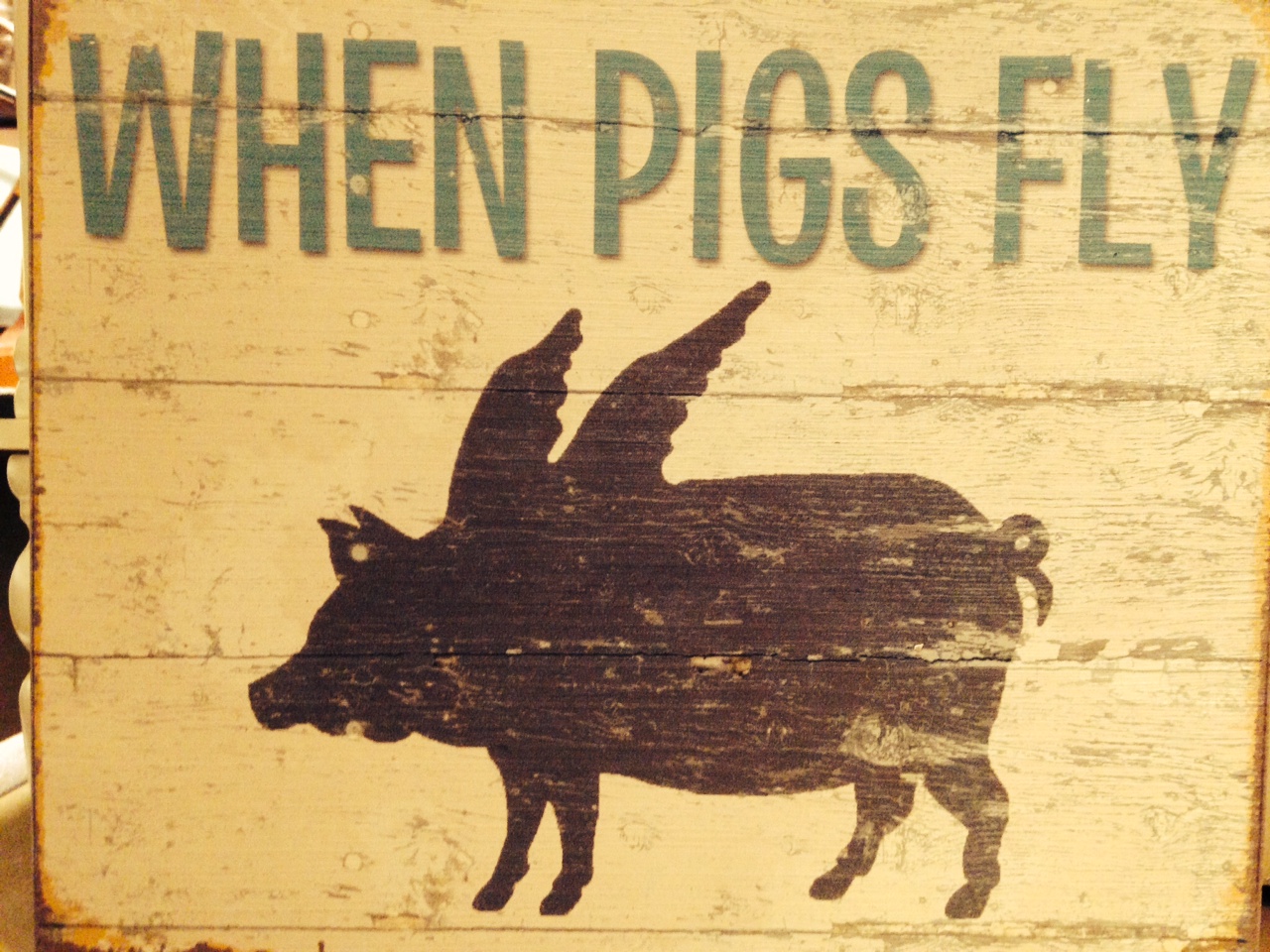
Favorite come-back of my colleague, Dr. Laura, when students plead for a better grade.
Yes, pigs actually DO fly at the Ole Country Buffet in Valdosta, Georgia (Cliff on the road)
Her sweat shirt warning vengeance, I watch my step around Jennifer, a writer friend.
What quotes on plaques or signage have you seen around your town? Somewhere else?
Author and blog friend, Merril Smith writes about what happens when opportunity knocks: Be prepared for romance, inspiration, and an introduction to the Dabba Wallahs!
“Not knowing when the dawn will come
I open every door.”
–Emily Dickinson
In the recent Indian movie, The Lunchbox, a lunchbox delivered to the wrong address sparks an unusual correspondence and changes the lives of the two main characters. (The lunchbox delivery service by the dabba wallahs of Mumbai transports over 200,000 lunchboxes each day, with mistake occurring only once in a million times. Here’s a video I found.) All of us have heard stories of a person who “was at the right (or wrong) place at the right (or wrong) time.” There are hundreds of movies, plays, and books based on chance encounters—for example, Alfred Hitchcock’s Strangers on a Train (1951) based on Patricia Highsmith’s novel. The reason why we repeat these clichés, and why these stories resonate with us is because they are so real. We’ve all had chance encounters; we’ve all experienced unexpected good…
Purple Passages with a Fish & a Kiss, March 2014 Edition
Winter
Winter lies too long in country towns; hangs on until it is stale and shabby, old and sullen. Willa Cather, My Antonia
If winter comes, can spring be far behind? Percy Bysshe Shelley “Ode to the West Wind”
Gardens
Bougainvillea in my Garden
The garden is one of the two great metaphors for humanity. The other, of course, is the river. Anne Lamott, Bird by Bird
Grief
In God’s garden of grace, even a broken tree can bring forth fruit . . . . The greater the grief the fewer the words. Pastor Rick Warren on The View: Friday, Dec. 7, 2013
The way to love anything is to realize that it may be lost. G. K. Chesterton
When a loved one becomes a memory, the memory becomes a treasure. Author Unknown (viewed on Kathy Pooler’s website, January 27, 2014)
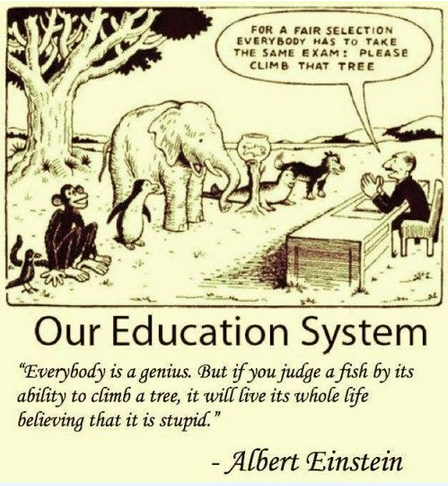
Einstein
(Quote on education attributed to Einstein but disputed by some sources.)
SUCCESS and HAPPINESS
Success is not the key to happiness, happiness is the key to success. If you love what you are doing you will be successful. Dr. Albert Schweitzer (Quoted in Daily Devotional: The Word for You Today, Dec. 2013–Feb. 2014.)
Dear Reader:You may have noticed I have included only one garden quote today.
Can you add a quote or a thought about gardening or beauty?
Can you add any other quote to the themes this month?
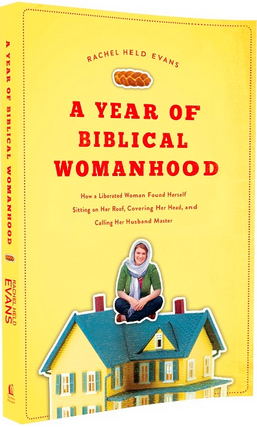
This evening my alma mater, Eastern Mennonite University, is hosting author Rachel Held Evans, one of the foremost thinkers and writers in evangelical circles today who has appeared on Oprah and The View and spotlighted by NPR, the BBC and The Washington Post. Her spell-binding book will stir you to see women, biblical and otherwise, in a new light.
If your comfort zone is just too cozy to leave right now, you can read about a gutsy woman who ditched her comfy life-style, visiting “an Amish schoolhouse in Gap, Pennsylvania; a pig farm in Cochabamba, Bolivia; and a Benedictine monastery in Cullman, Alabama.” Admitting to being domestically challenged, she took up knitting and baking even working her way through the recipes in Martha Stewart’s Cooking School.
Rachel Held Evans characterizes herself as a liberated woman, but for one year she became an Old Testament woman who admits she “spent an afternoon on my rooftop, adopted a computer-baby, camped out in my front yard during my period,” and left eight pounds of dough to rise in my bathroom.”
Each chapter records a month in which Evans focuses on a biblical virtue: October – gentleness, November – Domesticity, and so on.There is nothing starchy about her subtitles with chapters like February/Beauty “My Breasts are Like Towers” and March/Modesty “Hula-Hooping with the Amish,” who she mentions don’t wear white for their weddings because it’s worldly and don’t marry in June because that’s worldly too!
The end of each chapter “month” features a character study of women like Eve or Mary Magdalene, but includes more obscure women like Junia, the Apostle or Huldah, the Prophet. That’s where Evans’ astute scholarship is most evident. With two unanswered questions, author Evans plunges into astonishing biblical research as her 8 pages of documentation verify: What does God truly expect of women? Is there a prescription for biblical womanhood? She admits:
I took my research way too seriously, combing through feminist, conservative, and liberal commentaries, and seeking out Jewish, Catholic, and Protestant perspectives on each issue. I spoke with modern-day women practicing ancient biblical mandates in their own lives—a polygamist, a pastor, a Quiverfull daughter, an Orthodox Jew, an Amish grandmother. I scoured the Bible, cover to cover, isolating and examining every verse I could find about mothers, daughters widows, wives, concubines, queens, prophetesses, and prostitutes.
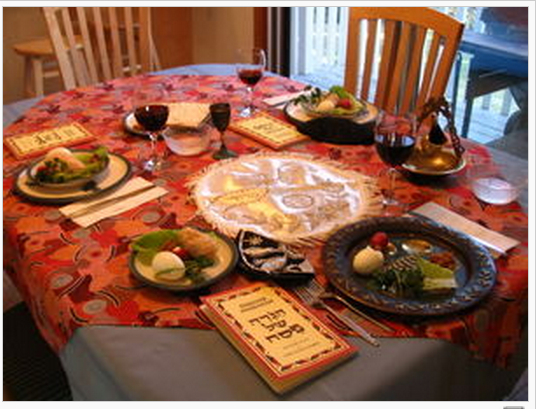
But Rachel had divine help along her pathway: Ahava, an orthodox Jew she met online who advised Rachel on all things Jewish. Guys in the food aisles at a Wal-Mart in East Tennessee who helped her search for Kosher ingredients for her Seder celebration. And her ever-accommodating husband Dan, whom she praises with a home-made sign at the city gates of Dayton, Tennessee, near where they live.
Seder table setting courtesy Wikipedia images
Evans’ book is definitely a page-turner. I read her 310-page book in under 3 days. As one reviewer exclaims; “An unexpected, laugh-out-loud then turn the page and tear up, enjoyable and poignant read.” Another agrees that Rachel Evans tackles “the most sacred cows, willing to ask the trickiest questions” and observing fresh perspectives. For example, she reminds readers that it took the defiance of two queens to save the Jews—Esther by appearing before the king, Vashti by refusing to.”
Eschewing the traditional interpretation of Proverbs 31 that yokes most women with unreachable goals, Evans strives instead to be more like the Hebrew Eschet chayil, woman of valor, at its core a blessing to invoke, not a title to be earned. “plain and fancy” observation
What do you think of author Evans’ experiment? Its outcomes?
Your thoughts added to mine can launch an animated conversation!
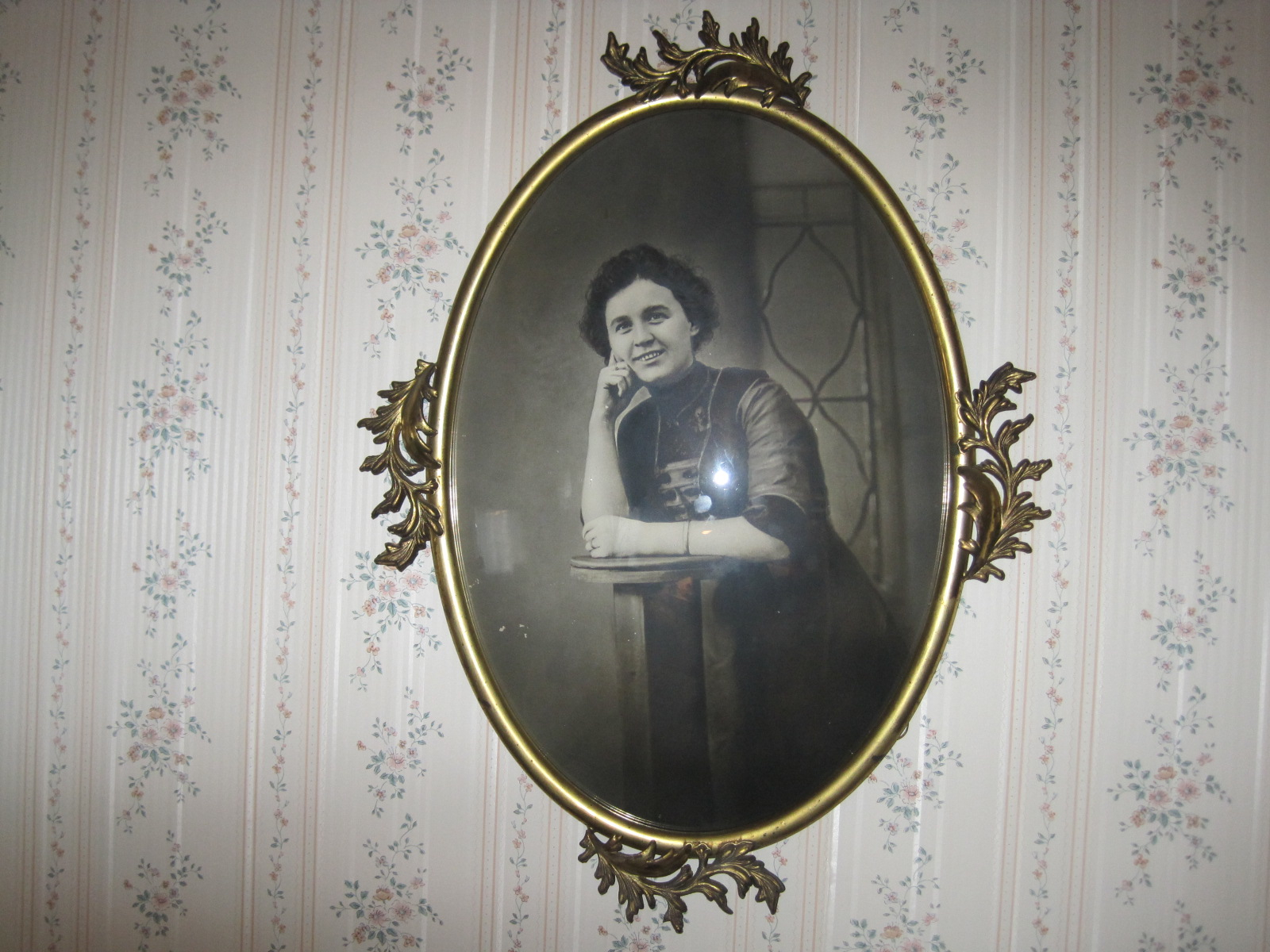
Grandma Longenecker with niece and maid-of-honor Evelyn (“Honey”)
10 ways I’m like (or unlike) my Grandma Longenecker
1. She started fancy and turned plain. I reversed the cycle, plain to fancy.
2. She always wore black laced-up shoes with heels to do housework. For me, it’s tennis shoes in winter and sandals in the summer. No heels in the kitchen.
3. She never voiced criticism about a person (except once). I am an exception to her rule.
4. She wished to have prettier hands. I love the compassion and service her work-worn hands reveal.
5. She never learned to drive. I passed my driver’s test on the third try.
6. She never watched television. I’m a Downton Abbey addict.
7. Her sewing machine was rarely silent. Mine has been stowed away in favor of a computer.
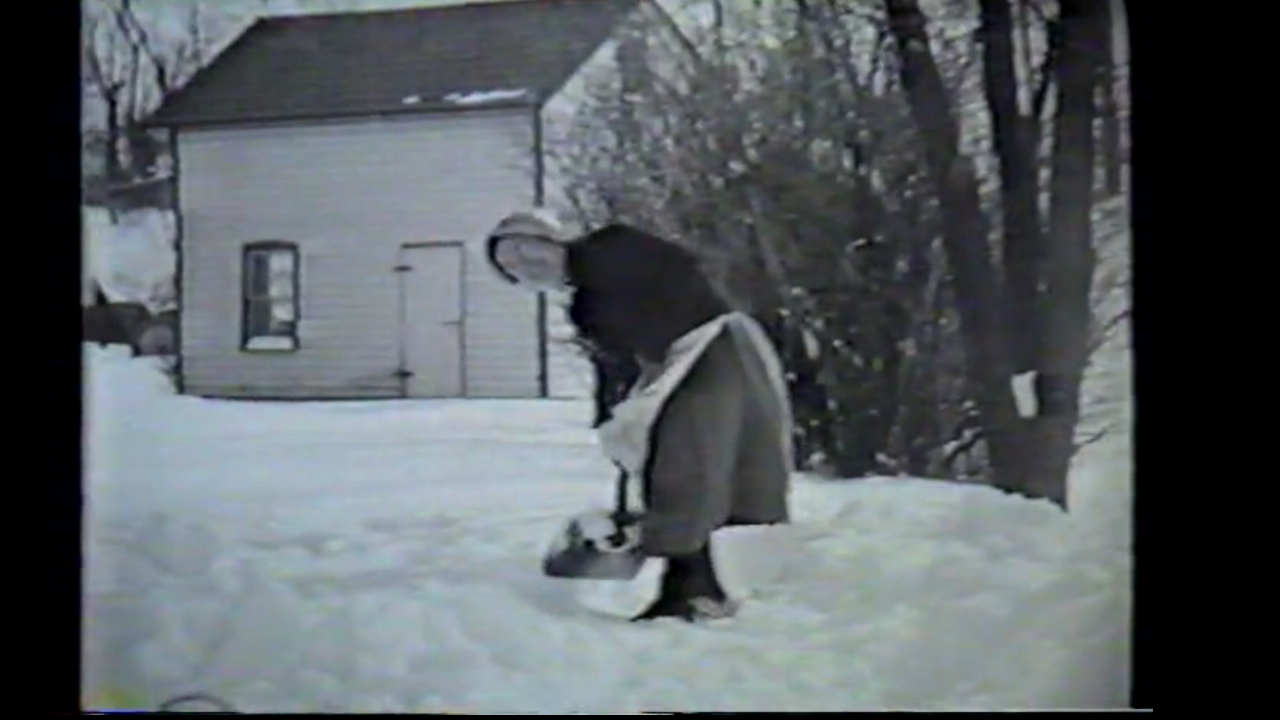
8. She shoveled snow in Pennsylvania. I now live in Florida sans snow…
Grandma in sun-bonnet, skirt, and apron shoveling snow in Pennsylvania, 1950s
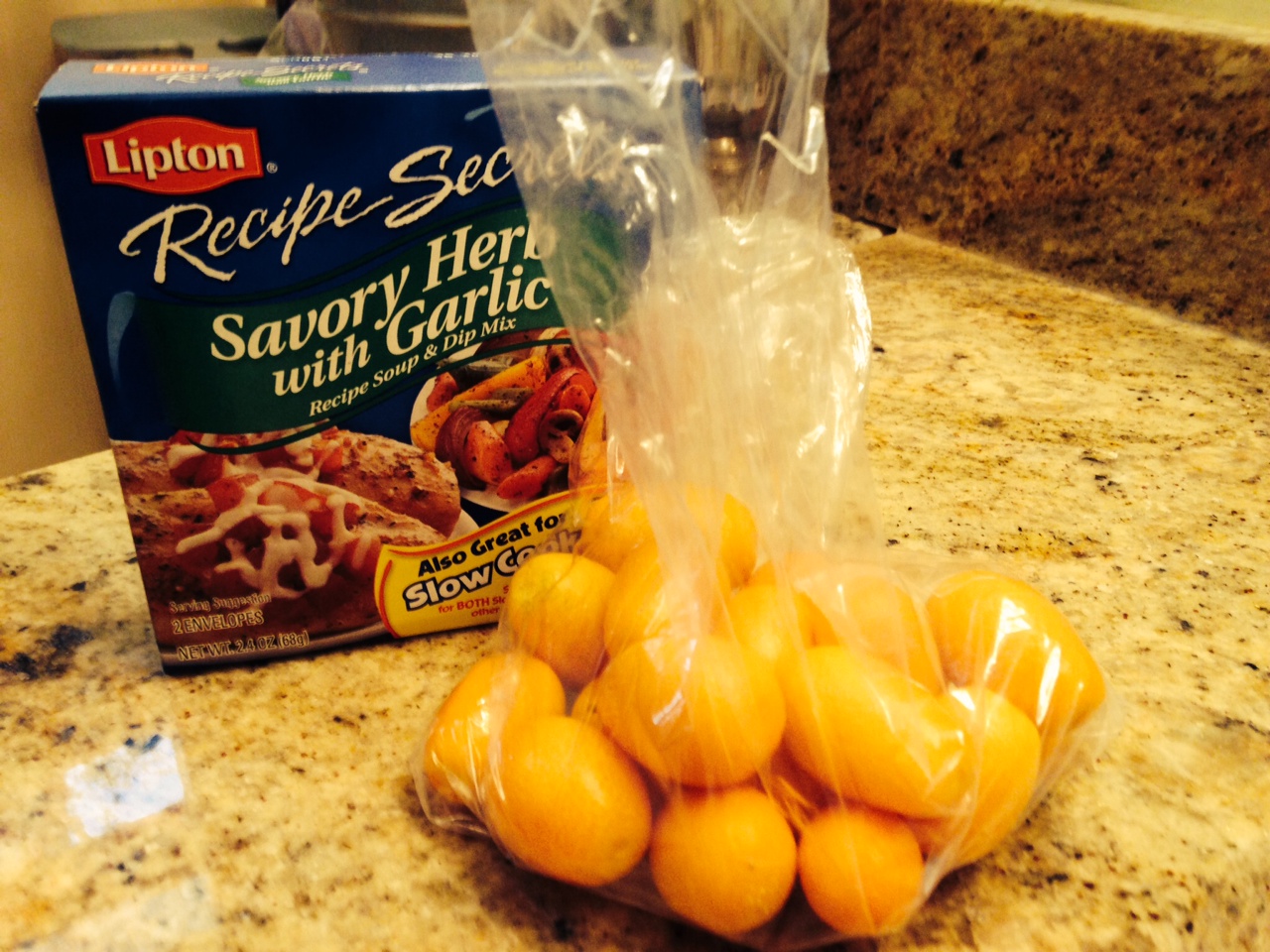
9. No one left her house without a garden snip or a tasty morsel from the table. I seem to have the same sharing habit. So does my sister Janice!
Home-grown kumquats and soup mix for a recipe from sister Janice
10. Grandma loved knee-slapping humor. Sister Jan remembers she even fell off a chair once overcome by gales of laughter. I don’t need an excuse to laugh either.
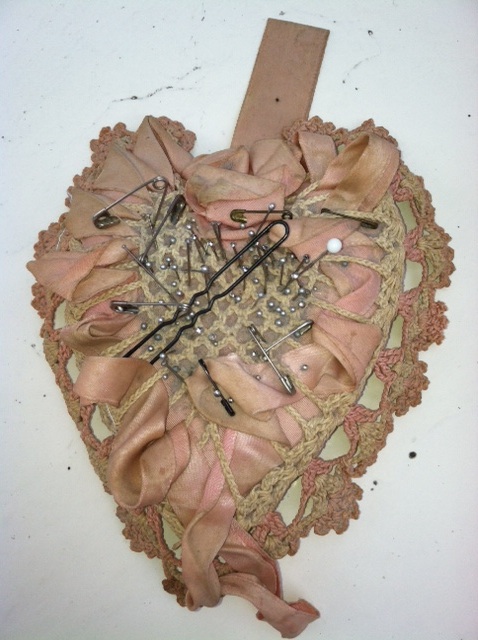
One of her pincushions I’ll never part with
What habits or preferences have been passed to you from a relative?
What other similarities or differences have been passed between the generations?
Looking at indistinct footage from 16 millimeter home movies of the 1950s has invited me to examine from a distance the much younger, and in many ways different, version of myself. Not surprisingly, I appear in the “mothering” mode in many of the shots. I have always assumed such behavior was because I was the first-born child.
But where does the mothering instinct come from? Is it inborn? Learned from one’s own mother? Are some born without it? Who knows. The jury is still out on the answers to some of these questions.
Mother positioning me with pigtails for the movie shoot with Grandma
My mother was not the firstborn in her family but she was the oldest girl, so when her own mother died when she was nine, there were high expectations for her including milking two cows in the morning before she went to school. All too soon, she became a little mother alongside the house-keeper, nurturing her two younger siblings.
In the sit-com Everybody Loves Raymond, “Mother-ish” is the word Mama Marie Barone has used to describe her modus operandi. Although I cringe to compare myself at any age to meddling mama Barone, it did seem natural for me to take on such a mothering role in my family. After all, I was the first-born, always ready to “tend” the younger ones.
Big sister helping little sister Jean to walk
Even looking straight ahead, I was aware of wiggly little sister, who would spoil the photo if she crawled away in this video clip:
* * * * *
Several years later, with a prayer covering almost as big as my mother’s and with motherly aplomb, I held my baby brother Mark.
13-year-old “mother” holding baby brother Mark, with sister Jean
Alfred Adler was one of the first theorists to suggest that birth order has a profound effect on personality. However, his ideas about birth order have been repeatedly challenged by other researchers, like Cliff Isaacson, who argue that birth order is not a fixed state but subject to other influencing factors. Other studies (Scientific American) claim that family size, rather than birth order, is a better predictor of personality than birth order. Yet the concept of the take-charge, bossy (did I say “mother-ish?”) first-born persists in popular psychology.
I wonder where you are in your family’s birth order: first, middle, last, or an only child?
Do you think this has influenced your personality at all?
Thanks for replying. You will always hear from me and probably learn from other commenters too. The stories continue!
There are several childhood books in my library that are in the I’ll-never-part-with category, except maybe to pass on to grand-children. One of them is Come to Storyland with pages missing and others as brittle as autumn leaves.
Here is blogger friend and author Susan Nicholls’ story about her favorite. (Click to view more illustrations and the rest of her story.) Do you have a beloved book or books?
I have an old copy of Uncle Wiggily in the Countryby Howard R. Garis. The copyrights are 1916 and 1940. The title is worn, the book is held together with tape. Various children have colored its yellowed, torn pages. The book was first purchased by my grandma to read to my aunt and my mother. They were born in 1940 and 1942 respectively.
Grandmother Nicholls and Uncle Wiggily
Then, my mother read it to me and my two sisters, one older, one younger. We used to cuddle in the center of my sister’s twin bed and listen as she read each chapter. We would embrace under the covers protecting each other and hiding from the tiddlewink, an evil but sympathetic creature with claws and sharp teeth who lived in any body of water from swamps and ponds to bathtubs and washtubs. My mother died when I was eight, and…

















 Plain and Fancy