Are You a Sneetch?

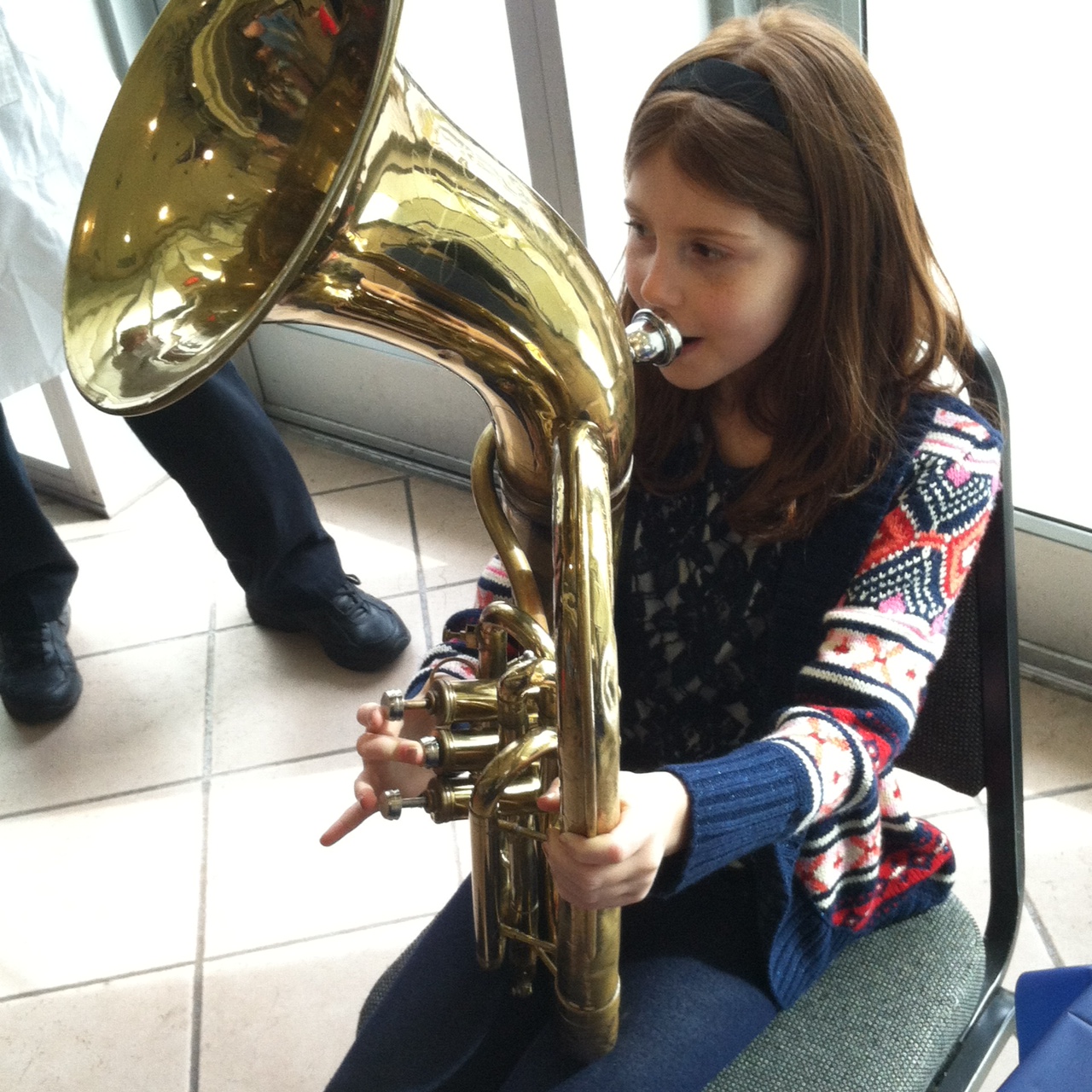
Last Sunday afternoon, we took our red-haired grand-kids, the Daltons, to the Jacksonville Symphony Family Series, featuring The Sneetches. There was a pre-concert Orchestra Zoo with dozens of kids standing in lines to bang on, blow into, or saw the strings of grown-up instruments.

Patrick and French Horn, Orchestra Zoo
Patrick & French Horn at the Orchestra Zoo
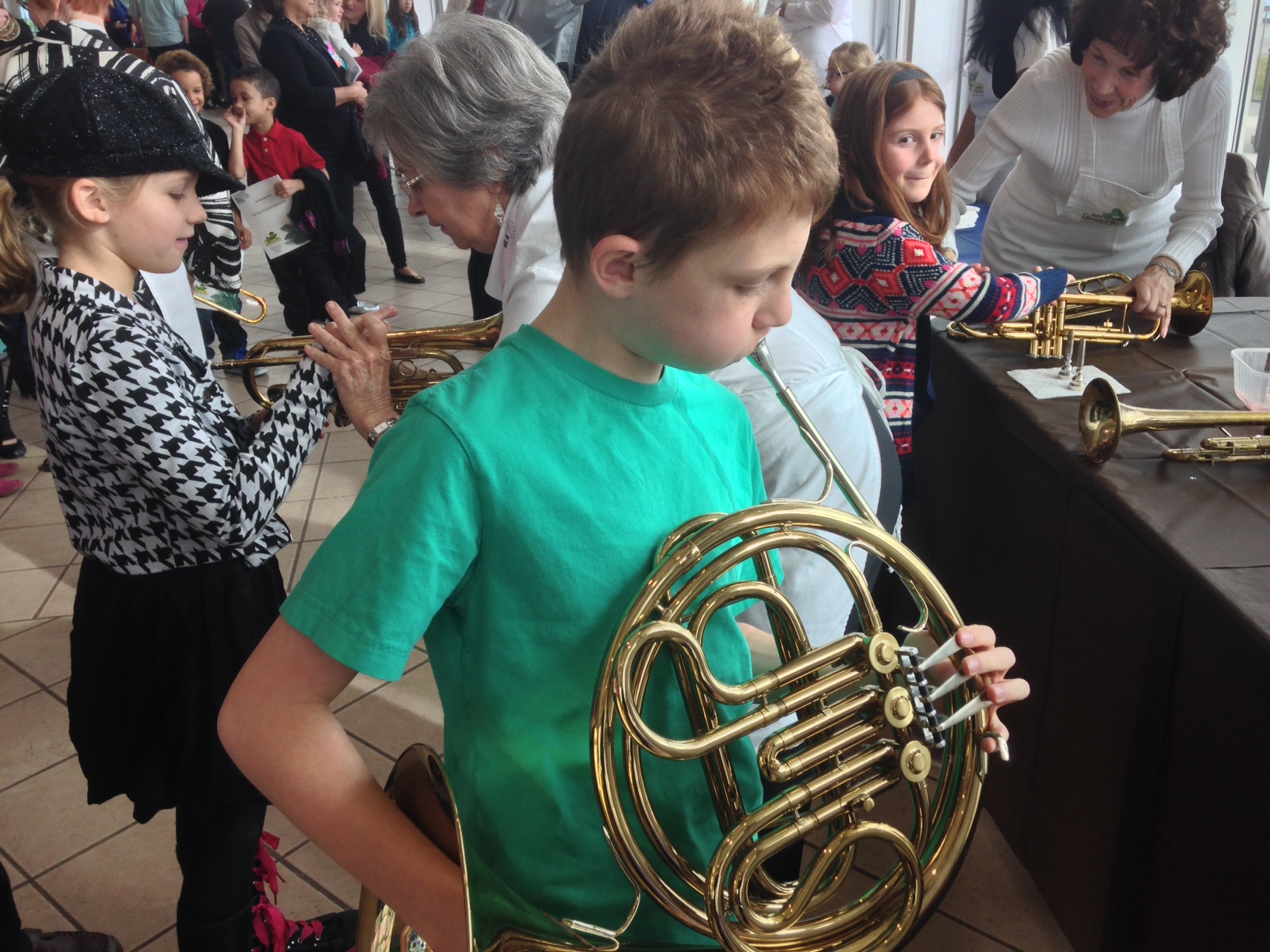
Jenna & Tuba at the Instrument Zoo

During the concert, the conductor asked each section of the orchestra to play a segment of a piece separately to let the kids hear the true sounds of the various instruments.Then came the pictorial story of the Sneetches animated on screen and read by a narrator, all accompanied by the whimsical strings, the complaining woodwinds, and the booming drums in Jacoby Symphony Hall.
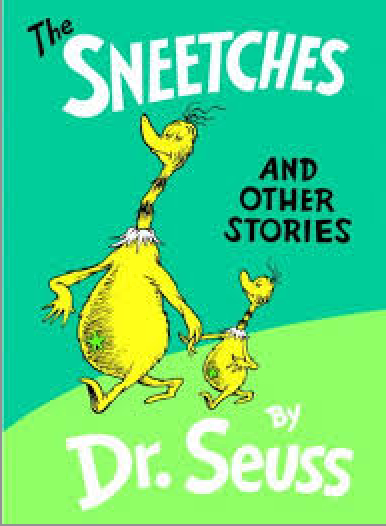
SneetchesCover

If you need a brush-up on the Dr. Seuss plot line, two camps of yellow, fantastical creatures called Sneetches are separated by whether or not they have stars tattooed on their bellies. The Star-Belly Sneetches think they are best and make their Plain-Belly counterparts feel sad and inferior. Magically, Sylvester McMonkey McBean comes along with his Star-on and Star-off machines. Now the Plain-Bellies are thrilled because they match the elite. But the original Star Bellies are angry because they no longer stand out as special. Now no one is happy.

Between the Star Bellies and the Plain-Bellies there is plenty of bad feeling to go around.  Then the conniving Star Bellies hatch an idea: Let’s get Sylvester McMonkey McBean to remove all the stars from bellies. Determined to find a solution, money from both belly camps gets stuffed into McBeans’ pockets, and he leaves town a rich monkey. Poorer in pocket, but richer in understanding, none of the Sneetches can remember who was what originally now that they all look the same. Finally, there is a level playing field.

The Sneetches’ conclusion: It doesn’t really matter what they look like—they can all be friends, stars or no stars. As the story ends, conviviality reigns.

In the car on the way home:

Jenna: “I really liked it! Those Sneetches were really cool, and they all liked each other at the end.”

Patrick: “It doesn’t matter what you look like. Everyone is the same.  Oh, and there’s another thing: Don’t give away all your money away for a dumb reason.”

Grandpa: “You are special whether you have a star on your belly or not.”

First of all, I wouldn’t want a star on my belly, would you? I wouldn’t want to draw attention to my worst feature whether it looked cool or not.

If you are human, you probably are a Sneetch, prone to some of the dark emotions these yellow bellies felt: feelings of inferiority, pride, dis-content, fear, frustration, and envy.

You may or may not agree with Alex Daydream (that has to be a pseudonym!) who claims that no emotion is strictly good or bad.

No Emotion Is Strictly Good Or Bad

Anger clouds our judgement
Love can make us blind
If emotions are so ruinous
What good one can I find?

Empathy makes us better people
Pain brings us back always stronger
Sadness gives way to happiness
Meaning a better life lived longer.

Alex Daydream
Some of the writer’s conclusions may be questionable (I have to wonder does “Pain bring us back always stronger”?) Growing up a Mennonite in the Longenecker family of Lancaster County, we children were not encouraged to show our real emotions, especially not in public. In my memory, there was a huge gulf between feeling emotions and being able to truly express them.
But what matters is what you think.
Were you encouraged to express your true feelings as a child?
As the poet claims, does allowing oneself to feel emotions make for a more meaningful life? What about expressing them?


Neat vs. Messy

                              Delight in Disorder

A sweet disorder in the dress

Kindles in clothes a wantonness.

A lawn about the shoulders thrown

Into a fine distraction;

An erring lace, which here and there

Enthralls the crimson stomacher;

A cuff neglectful, and thereby

Ribbons to flow confusedly;

A winning wave, deserving note,

In the tempestuous petticoat;

A careless shoestring, in whose tie

I see a wild civility;

Do more bewitch me than when art

Is too precise in every part.

The British poet Robert Herrick writes a fine sonnet about the allure of the slightly askew, the saucy, the off-beat–the messy in dress! Well, he has a point, but I don’t agree in general. I like neatness and appreciate the beauty of orderliness.

Too precise hand-writing Hanger, EMC college days
Too precise hand-writing
clothes hanger, college days EMC

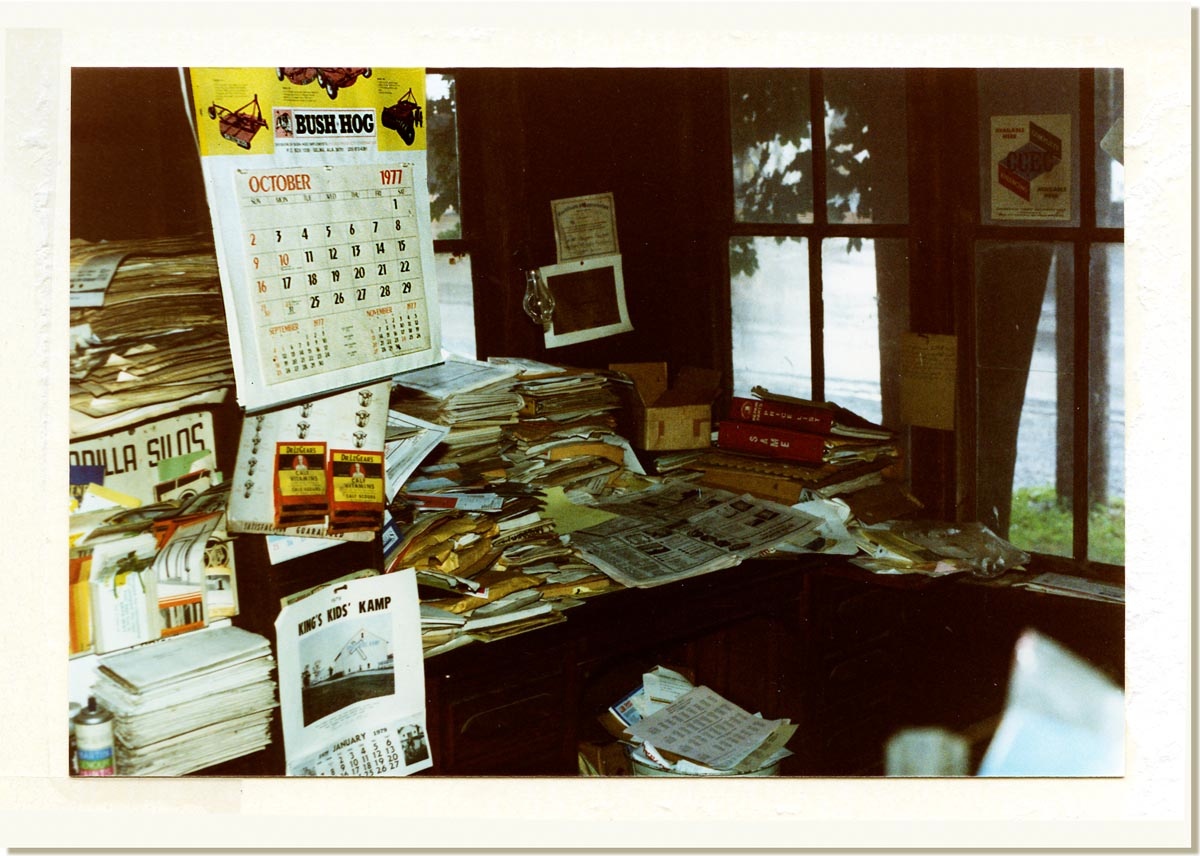
Mother was a neatnik too, every hair in place under her prayer covering, the whole house scrubbed clean every Friday, a place for everything and everything in its place. On the other hand, my dad, who was precise in the mechanics of fixing machinery in his farm supply business, was by nature messy, messy, messy–in his office, inside his truck, on the porch of his shop.

Dad's Office

Brother Mark before sale of business

Daddy’s messy manner drove me crazy. Besides, it was embarrassing! In the middle of the village of Rheems, the shop faced Harrisburg Avenue with two main sections, one behind the other. The front part housed dozens of storage bins for nuts, bolts, screws, odd implements and, curiously, a Victrola sitting squat right beside the door to the sales office. During planting season, bags of Royster fertilizer for sale would be deposited off to the side near a loading/unloading door. As you walked to the rear, a long wooden ramp led to the back section where the dirty work was done, Daddy and his helpers fixing disk harrows, plows, or welding broken parts. Behind the shop was an assortment of implements stored Sanford & Son-style from which the mechanics harvested parts.

Occasionally, when Daddy said, “It’s time to sweep the shop,” I shuddered because I would be working in the cold with piles of stuff everywhere. Spritzing soapy water from a bucket to settle the dust, I watched charcoal-grey pustules of dirt and grease bead up on the cement floor, then tried to push-broom the filth into a dust pan, often an exercise in futility.

Though Daddy was messy, he had a strong Pennsylvania Dutch work ethic. At the shop six days a week, he caught up with office work and telephone sales in the evenings. “I worked like a Trojan today, and still didn’t get the Fox Harvester ready for Phares Weaver in time,” he’d say to Mother as he walked in the door. And he did so well in sales, dealerships would send him and Mother as VIPs on all-expense paid trips to Ohio, Florida, or Arizona to learn about new farm equipment. Once his sales were so high, his whole family, including three married daughters and son enjoyed a week-long vacation in Jamaica.

Daddy in his later years, taking a breather

So there’s neat and there is messy. “God is a God of order!” shouts one. The other camp retorts: “But you can’t be creative and neat at the same time!”

This post began with an homage to the slightly slovenly, the off-kilter. It ends with a writer lamenting her neat freakiness.

Being A Neat Freak

Being a neat freak, is certainly not a
blessing! No one enjoys, being this
way. When I find everything thrown
all around, on impulse, I have to put
them all away. I have always lived by
the creed, there’s a place for everything
and everything, in its place! It’s
aggravating, dealing with this, but I
know it’s something, I’ve got to face.
I’ve often wondered, how does a
person, get to be this way? It didn’t
happen over night, or in just a day.
Perhaps, it’s what we learned, when
we were young. And frankly speaking,
I’m tired of hearing people say, try not
to be so high strung! I’d like nothing
better, if I could let up, just a little bit,
by not letting myself become so
perturbed. Upon giving this some
thought, I realize, isn’t all of this, quite
absurd!

Now it’s your turn: neat vs. messy — Can they co-exist?
Is it possible to find a middle ground?
Thank you for sounding out on this topic. Your thoughts please. They keep me going! And I will always reply.

Canned

I have just finished reading The Dirty Life, On Farming, Food, and Love by Kristin Kimball. And today my blogger friend, Susan Nicholls, has posted a piece entitled “Canned” complete with appetizing photos of the canned goods, stored on shelves for savory eating on wintry days like these.

Kimball’s book describes how she trades a life in the publishing world of Manhattan for growing vegetables, raising pigs and cattle on the farm of a man she had interviewed just months earlier. The story is told with the backdrop of the old/new movement toward local food, community-supported agriculture, a network of consumers and farmers who share the benefits (and risks) of food production. Consumers pay at the beginning of the growing season for a share of the anticipated harvest and then receive honey, eggs, meat, and dairy products, fruits and vegetables, whatever is in season.

Susan’s blog post “Canned” is a reminiscence on the stored wealth of nourishment in the cellar of her childhood. In her post today she recalls her grand-parents’ farmland and the “garden” of one and one-half acres her own family cultivated when her children were little. She reminds us of so much we take for granted in our land of abundance. Read it above!

S.K. Nicholls's avatarS.K. Nicholls

images (2)

I was in the grocery store yesterday and browsing the local produce…much of it not so local, being shipped from Chile, Spain, Costa Rica, California, and Mexico, but fresh nonetheless. Fresh watermelon and cantaloupes year around!

It is January and there were fresh beans, peas, broccoli, cauliflower, lettuce, asparagus, squash, cucumbers, cabbages, snow peas, avocados, apples, pears, oranges, tomatoes. We take so very much for granted in this global economy. I am not talking smartphones, computers, and tablets, but simple luxuries, like fresh food.

My grandparents had a huge farm, and they had a garden that covered three acres. They taught me about gardening and harvesting.

When my own children were growing up, we had an acre and a half that was garden space.

I can’t say that we grew organic, because pesticides and herbicides were used. I can’t say it was better or worse for us, but it…

View original post 441 more words

War and Peace: Rhyme & Reason

On the eve of the Gulf War exactly 23 years ago today, I took a walk in the brisk evening air. As I rounded the curve of Emerald Isle Circle West in our neighborhood, I noticed the scarlet blush in the sky at sunset. With that striking image in mind and an imminent war on the national consciousness, I wrote these words:

CRIMSON SKY AT DUSK

The throat of the sky is inflamed,

livid with anger at the war it must swallow,

gagged by the bloodshed which rages in the jaws

of Babylon.

An olive branch on its tongue,

the dove of peace

touches the parched flesh with healing.

constrained by love

which sends streams

into the desert.

January 21, 1991, eve of Gulf War

Mennonites are pacifists, adhering to the tenets of nonresistance: opposed to war, not participating in military service, but sharing love and overcoming evil with good. I am no longer a Mennonite, but I choose peace over war, whenever possible.

Dove of Peace: Mennonite Central Committee logo

On her show last week, Diane Rehm interviewed the former Secretary of Defense, Robert Gates, on the publication of his book, Duty: Memoirs of a Secretary at War. Having served under eight Presidents, Mr. Gates reflected on the hard decisions national leaders must make concerning going to war and keeping the peace. One memorable line from the former Secretary, who often spoke in terms of pros and cons: “We [Americans] over-estimate our ability to shape events in other countries.” At the end of 51 minutes, Diane Rehm concluded the interview with another memorable remark: “I wasn’t supposed to say this on air, but thank you to all who serve.” And the piped in music carried her voice away.

I suppose that’s how I think about war, with ambivalence: I don’t applaud war. Peace is preferable, peace is the goal in all conflict, in my opinion. But when I see a man or woman dressed in a military uniform, often at an airport, I often approach them and say “Thank you” too.

Do you side with either viewpoint about war? Is it hypocritical to embrace both?

Were there war heroes or conscientious objectors in your family history? Inquiring minds want to know.

I love when you read and comment. And I will always reply.

Mennonites and Race: A Longenecker Lens

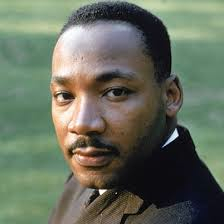
This week we celebrate Martin Luther King Day, a tribute to the man with a vision for racial equality in the twentieth century and beyond. Just so, this post pays tribute to his dream and his legacy through a Mennonite lens.

Dr. Martin Luther King

“Jesus Loves the Little Children, All the Children of the World, Red, Brown, Yellow, Black and White,They are Precious in His Sight, Jesus Loves the Little Children of the World.”

As a tiny tot I was taught this song in Sunday School at Bossler’s Mennonite Church in the 1950s though the entire congregation was white. I saw children with slanted eyes and yellowish skin in picture books and a few black people in Lancaster and Harrisburg or maybe on the PRR train on our way to Philadelphia. But there were no children of a different skin color at Rheems Elementary School.  Or even at Elizabethtown High School. Not a one!

It was ancestry, not skin color, that made a difference in my family. Grandma Longenecker, benign soul though she was, did make disparaging remarks about other ethnic groups. She called a woman she was slightly acquainted with in Bainbridge “The Hunky Lady.” From her tone, I think Grandma Fannie was referring to the woman’s origins in Hungary, and therefore different from us, the Pennsylvania Dutch. And she made no bones about her view of Irish housekeeping. If we made a mess playing in her big kitchen, she’d remark, “It looks Irish in here,” and we’d be tidying up behind her broom. Fast!

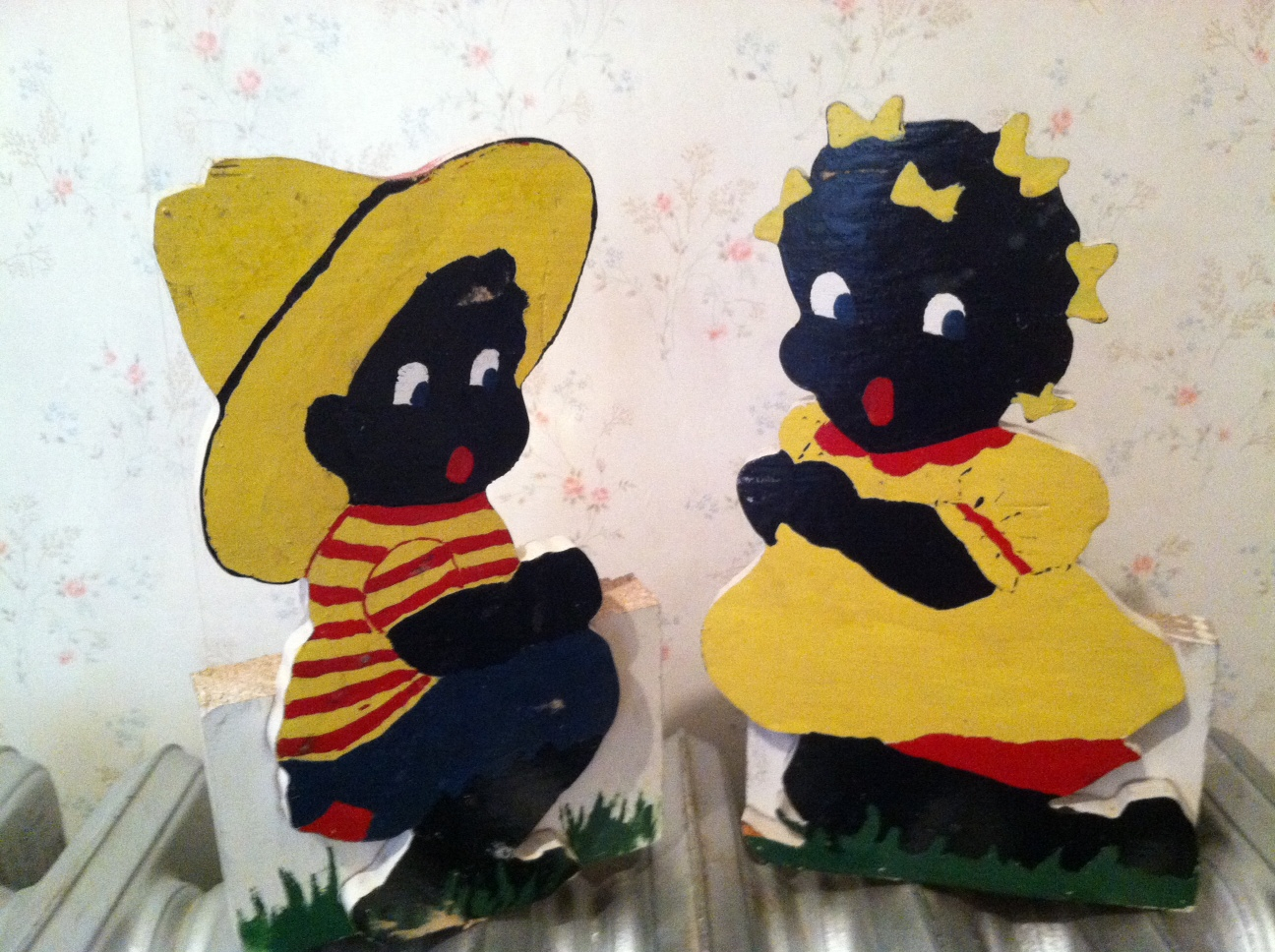
In a recent visit to the attic, I came upon a pair of bookends featuring two pop-eyed black faces, a boy and a girl, painted in grade school.  Were such children curiosities to us? Novelties? Why would my teacher approve of  such an art project? Along with stories like Little Black Sambo, they were obviously part of the folklore of another era, not at all politically correct by today’s standards.

blackBookends

My first encounter with a black person, up close and personal, was with little Chico Duncan, a black boy from New York City, who came to our home for a week in the “Fresh Air” program in which volunteer families would give city children summer vacations in the country. (Shirley Showalter’s book Blush devotes an entire chapter to her friendship with their family’s Fresh Air girl.) The most fascinating thing about Chico was his hair, kinky black and glistening. Was his hair naturally oily or did he put on something from a bottle? I longed to touch it and feel the texture, but fear or embarrassment or both restrained me from even asking. Besides, he was a BOY, and I had hoped for a girl to play with!

But that was years ago. Now at Bossler’s Church, children who sing “Jesus Loves the Little Children” may actually be sitting besides a child with a darker skin tone. The church treasurer, a former missionary, has an Ethiopian husband; one farm family has adopted African-American twin babies. There is a couple of Middle-Eastern descent. The Bishop, Director of African Programming with Eastern Mennonite Missions, has biological grand-children of Kenyan-American ancestry.

And my Grandma Longenecker? For at least two decades through Lutheran Social Services, she and Aunt Ruthie sponsored families from all over the world—particularly Viet Nam, Africa, and eastern Europe. They, along with many other Lancaster County families, welcomed the immigrants and refugees from countries at war for weeks or months at a time until they could get a job, an apartment of their own, even acquire an education.

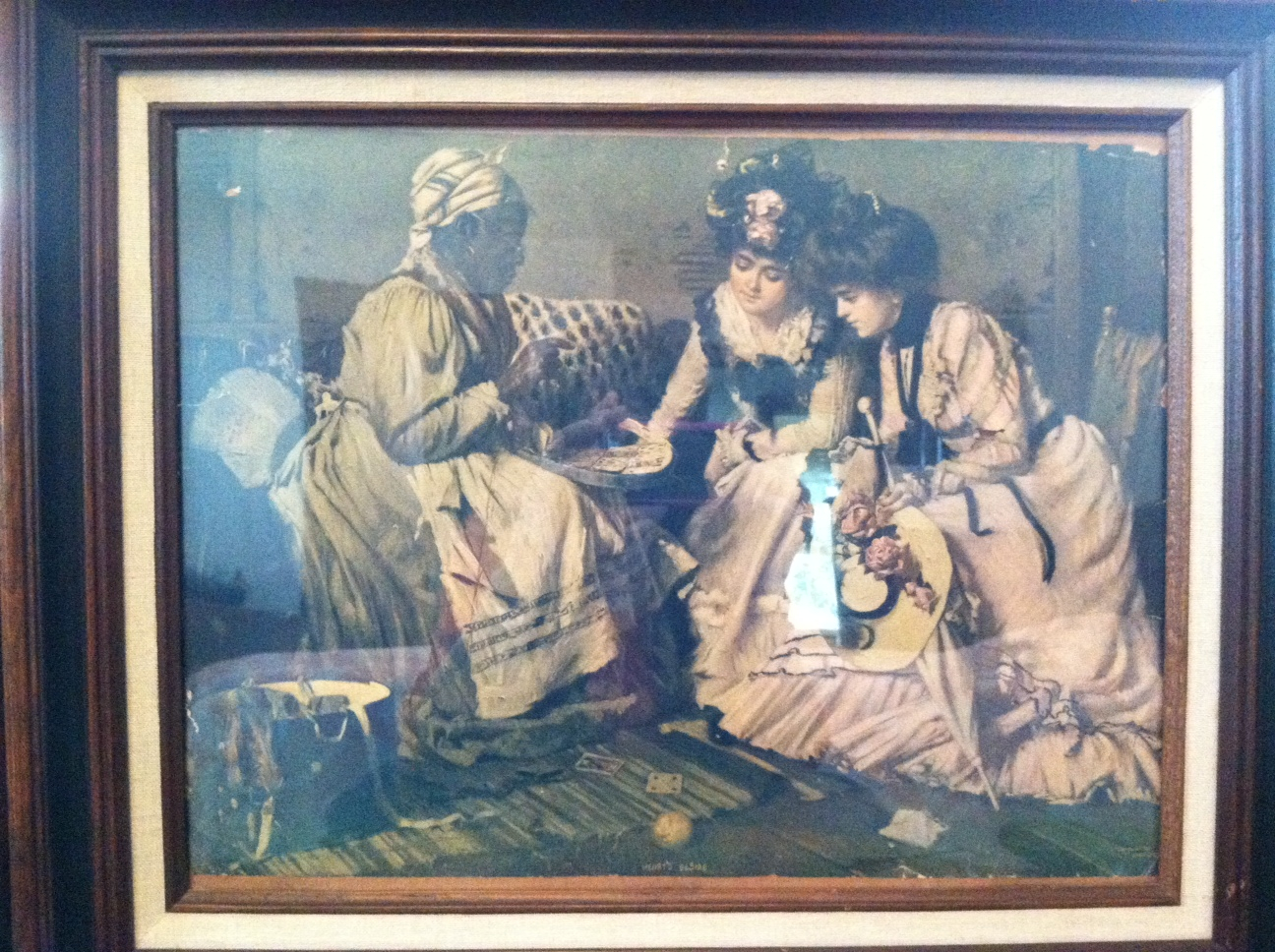
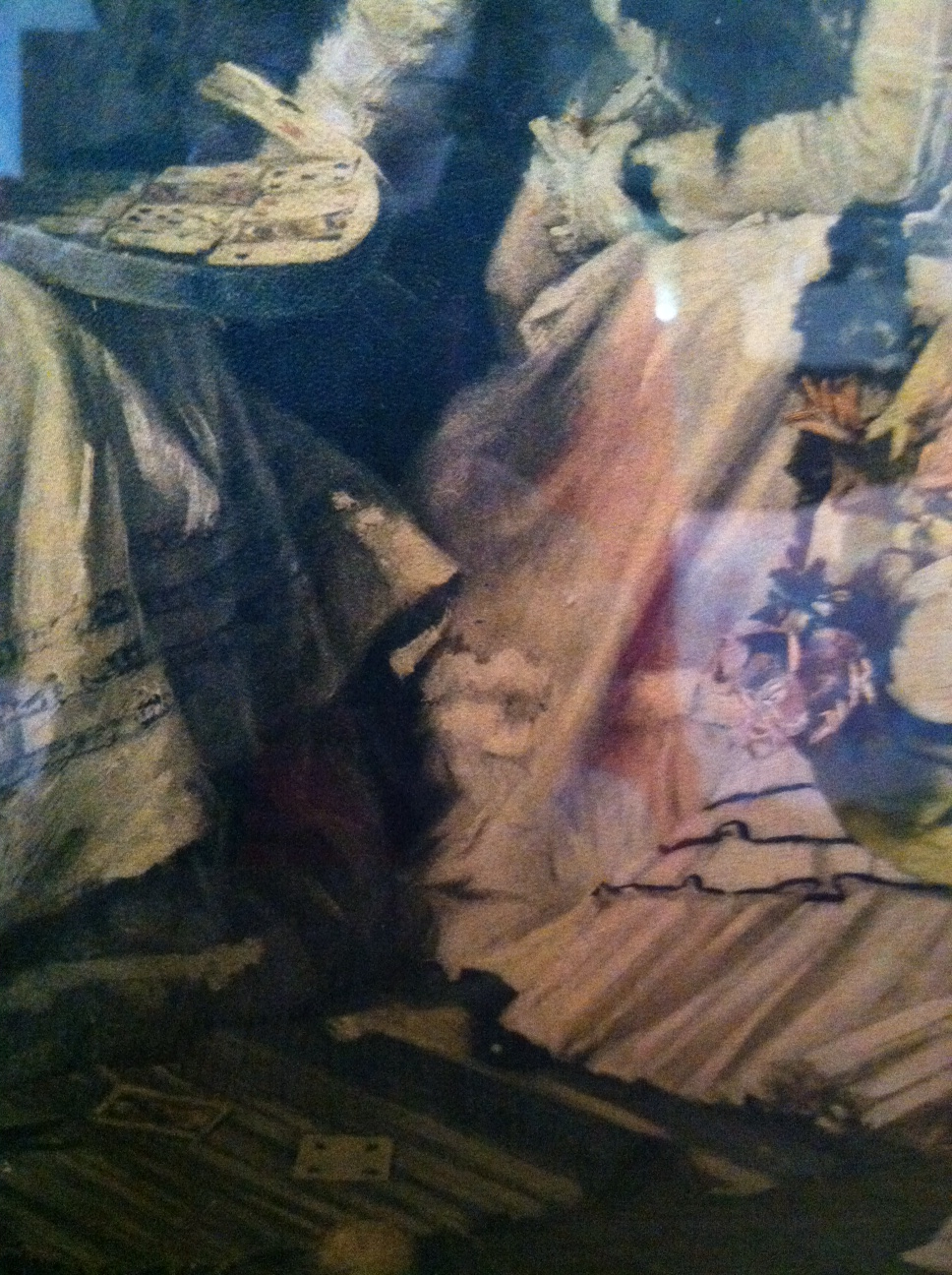
A few months ago, I re-visited Aunt Ruthie’s bedroom, (now unoccupied because she lives at Landis Homes) and saw on the wall as if for the first time, a framed picture of three women:

CardGame2

Two elegantly dressed Victorian women and a black woman, obviously a maid, playing cards. Is the maid holding the card tray for the other two? Is she teaching the ladies tricks of the trade? Are all three playing the game? Three would make a better game, don’t you think?

Detail: Women Playing Cards

What experience with race did you encounter as a child? What story or anecdote can you add? I love when the bell chimes with your comment!

Purple Passages with Pictures, January 2014 edition

VISIONS and DREAMS for 2014

courtesy Google Images

A man must have dreams–memory dreams of the past and eager dreams of the future. I never want to stop reaching for new goals. – Maurice Chevalier

Then the Lord answered me and said: “Write the vision And make it plain on tablets, That he may run who reads it.        Habakkuk 2:2   New King James Version (NKJV)

Between your dream‘s inspiration and its manifestation, there’s going to be a lot of perspiration.     Daily Devotional: The Word for you Today, January 2, 2014 entry

A [wo]man is not old until regrets take the place of dreams.  John Barrymore

MEMORY

Yesterday is today’s memory and tomorrow is today’s dream.  Kahlil Gibran

Memory is the script of the soul.  Aristototle

Each day of our lives we make deposits in the memory banks of our [grand]children. Charles R. Swindoll

rosesAzaleas

God gave us memory so we might have roses in December, (January, February  . . )

From my JOURNALS 1996-1998

Gratitude is the heart’s memory.  French proverb

Puttering is creating a fresh interior landscape.   Sarah Ban Breathnach in Simple Abundance

Women share with men the need for personal success, even the taste for power, and no longer are we willing to satisfy those needs through the achievements of surrogates, whether husbands, children or merely role models.       Elizabeth Dole

On Music:

“The auditory nerve is very closely connected to the limbic system so that sound (i.e. music) does not have to go through the cortex of the brain but goes directly to the heart, the senses.”     unknown source  (noted April 9, 1998)

MusicFeelings

Rhythm in music imprints language on the brain in a way pure auditory words will not. Slower tempo in classical music develops a framework for learning to occur. NPR report on “The Mozart Effect” (1998)

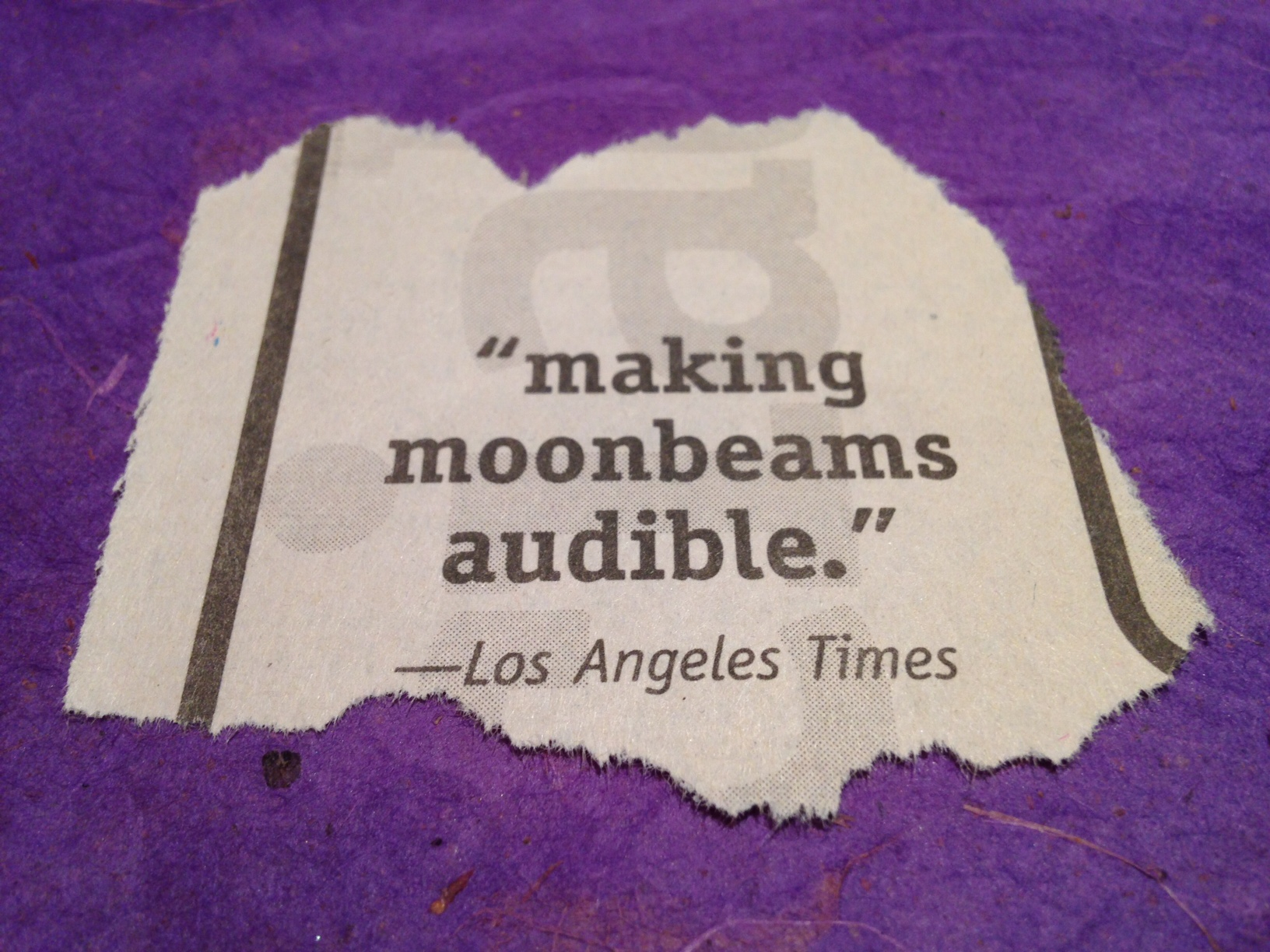
Moobeams

What Makes a Moonbeam Audible for you?

Feel free to comment also on any of the categories about: visions, dreams, memory, music, or something else. I will always reply!

Still time to vote for my story in Sonia Marsh’s My Gutsy Story Contest. Thank you, thank you to all who have already voted. You make a difference!

To Vote:  http://soniamarsh.com/2014/01/vote-for-your-favorite-december-2013-my-gutsy-story.html

To Read: http://soniamarsh.com/2013/12/rising-above-the-pettiness-to-focus-on-the-positive-by-marian-beaman.html

Sm.pleaseVote

Voting closes at 12:00 midnight PST, Wednesday, January 15, 2014.

Moments of Extreme Emotion: 100th Post Mark

Today I have reached a milestone, 100 blog posts and counting. Thank you, thank you for all your clicks, views, and commentary so far. I am commemorating this event in pictures.

Sunshine and Rain by Ian Christopher Beaman
“Sunshine and Rain” by Ian Christopher Beaman

Blogging is like life, up and down, sad and happy, rain and shine, day in and day out. Here is how Ian sees his Grandma/NaNa, picturing me with a split image, one eye blue, the other rosy pink. Does he see me as both a realist and an optimist? I can only surmise because I don’t know what is going on in his six-year-old mind. The bluest eye sees cold, hard facts; the other eye views life with rose-tinted glasses. A balanced view, if you ask me! Also, if you notice, he pictures me as being fruitful too: bushels of apples in the tree.

Did I say blogging is like life? Here’s the inside scoop on what writing blog posts is really like:

Blog_Extreme Emotions_Cry_7x5_300

But I love every minute. Really, I do!

RevBlog_Extreme_100 Posts_5x5_150

Most importantly, I get to send stories out into the ether and then “talk” to you after the writing is posted. We make a connection.

Only connect the prose and the passion, and both will be exalted, and then love will be seen at its height.

E. M. Forster  Howard’s End

My heart leaps up when you join the conversation.

Now it’s your turn:

What blog post is most memorable to you?  What would like to see more of?  Less of?

Voting is still open for My Gutsy Story.

To read the story:  http://soniamarsh.com/2013/12/rising-above-the-pettiness-to-focus-on-the-positive-by-marian-beaman.html

Sm.pleaseVote

To vote for my story:  http://soniamarsh.com/2014/01/vote-for-your-favorite-december-2013-my-gutsy-story.html         Thank you!

Up in the Garret

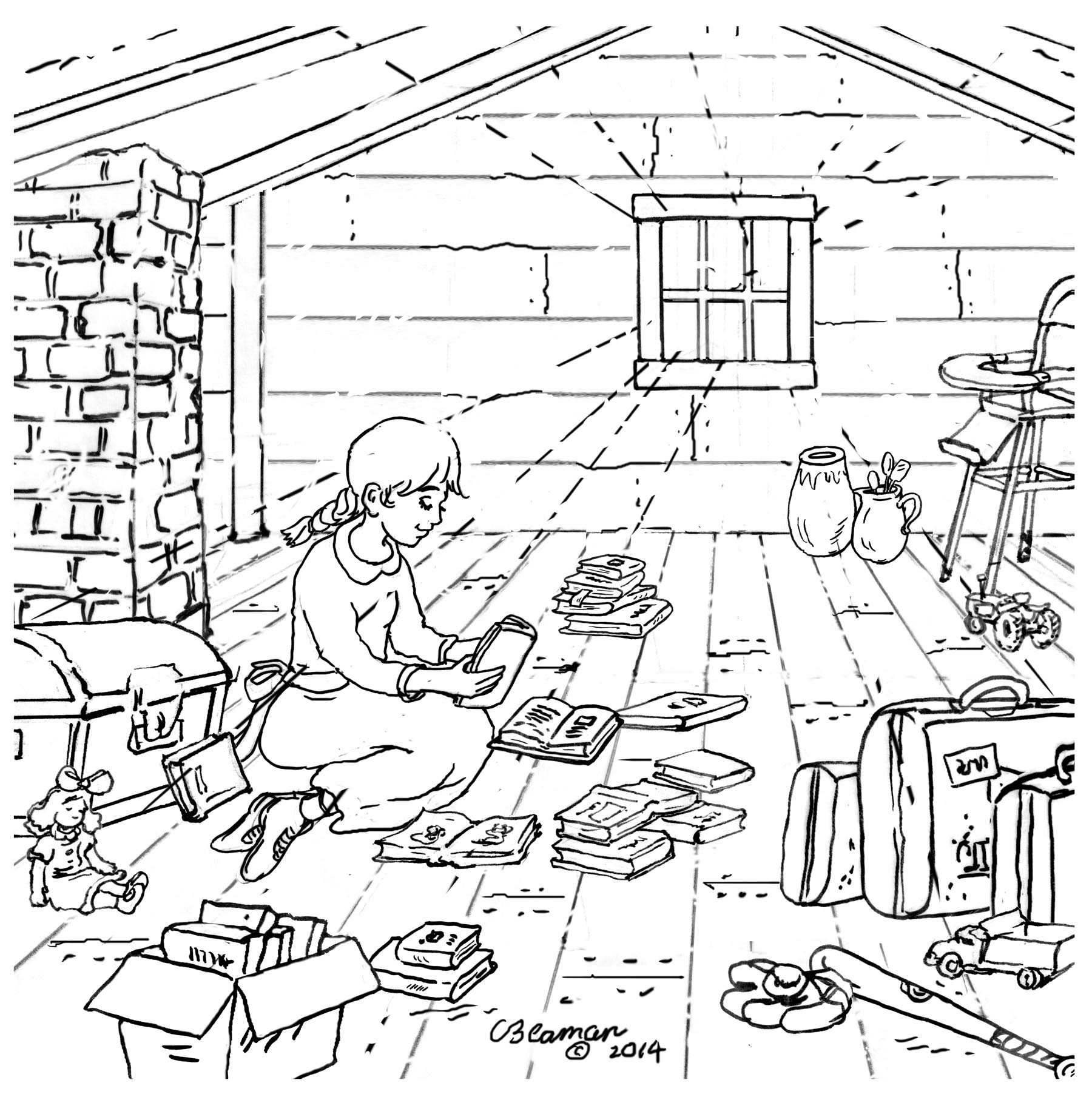
MAtticReading

Books, books, books!

I had found the secret of a garret-room

Piled high with cases in my father’s name,

Piled high, packed large,—where, creeping in

and out

Among the giant fossils of my past,

Like some small nimble mouse between

the ribs

Of a mastodon, I nibbled here and there

At this or that box, pulling through the gap,

In heats of terror, haste, victorious joy,

The first book first. And how I felt it beat

Under my pillow, in the morning’s dark,

An hour before the sun would let me read!

My books!

Elizabeth Barrett Browning, Aurora Leigh

Anna Quindlen in her splendid 84-page book How Reading Changed My Life describes reading as her “perfect island.” She doesn’t say where the island exists, so it can be anywhere the reader imagines it to be.

My perfect island as a girl was the attic under the sloping roof, unless it was summer steamy hot, or winter frosty cold. Then my nest was on my bed, or flopped on the davenport, across a chair, anywhere . . . .

My books were not like Quindlen’s list of “10 Books for a Girl Who Is Full of Beans.” I didn’t read her noble suggestions like Little Women, Anne of Green Gables, Madeline, or even A Wrinkle in Time as a young girl, but I did become addicted to the Cherry Ames series, books in the mold of Nancy Drew: Cherry Ames, Student Nurse, Army Nurse, Flight Nurse. If you have read them, you may know Cherry, short for “Charity,” is the heroine in a series of 27 mystery novels with hospital settings between 1943 and 1968.

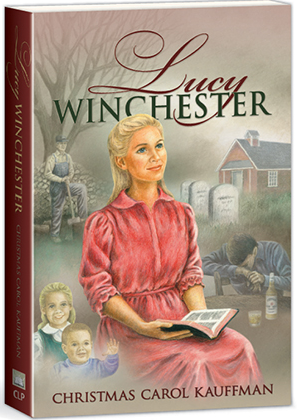
I slurped up Lucy Winchester by Mennonite author Christmas Carol Kauffman, the story of Lucy’s spiritual quest to find peace “set against the backdrop of two difficult marriages and many sorrows, broken promises, sickness, infant deaths, alcoholism, and poverty.”

LucyWInchester

In a trip up to the attic again as an adult, my sisters and I rummaged through the stash of antique books (they’re over 50!) and divvied them up among ourselves.

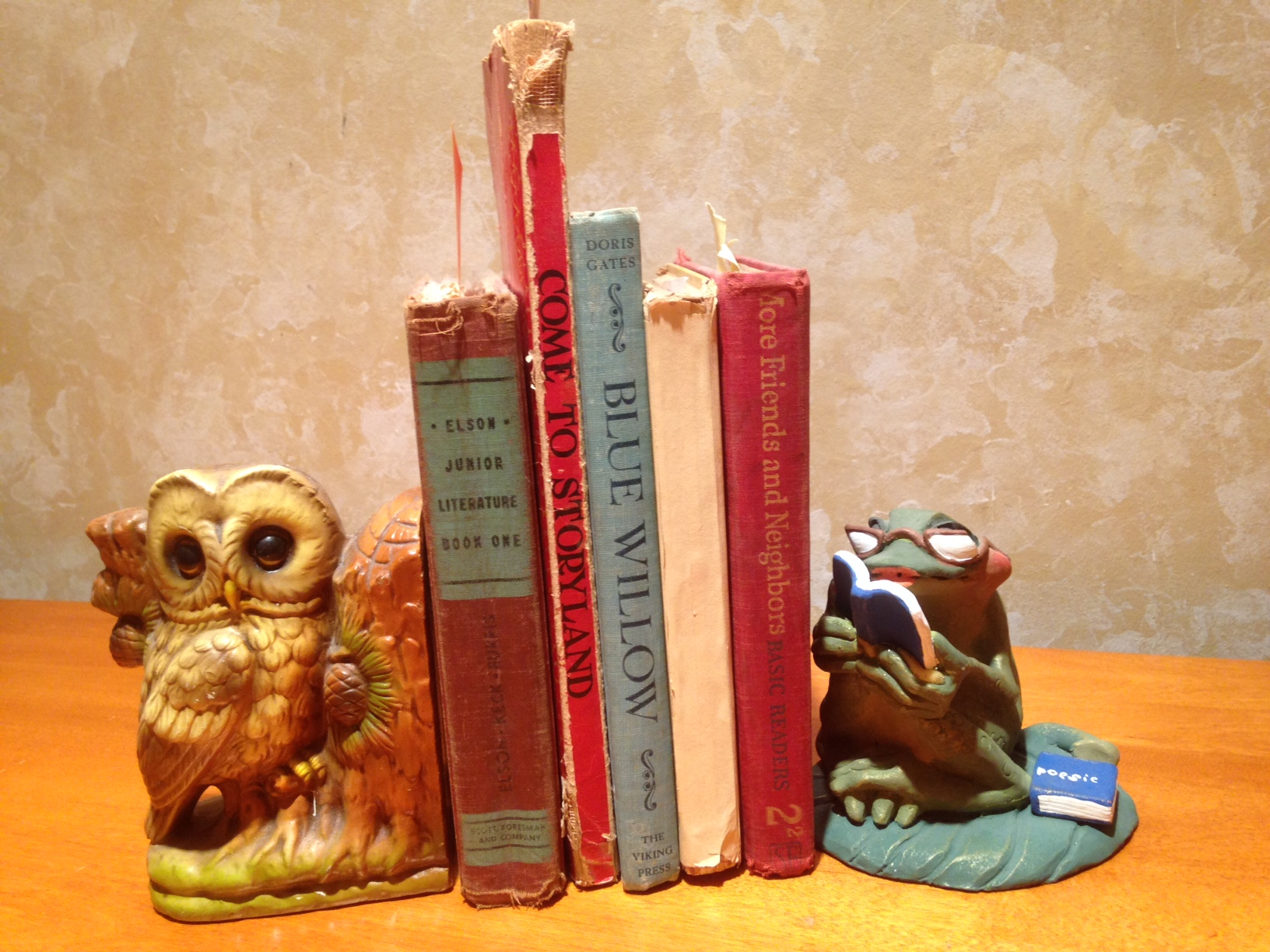
Yes, I read books, books, lots of them, but these are what remain from girlhood days:

ChildStorybooks

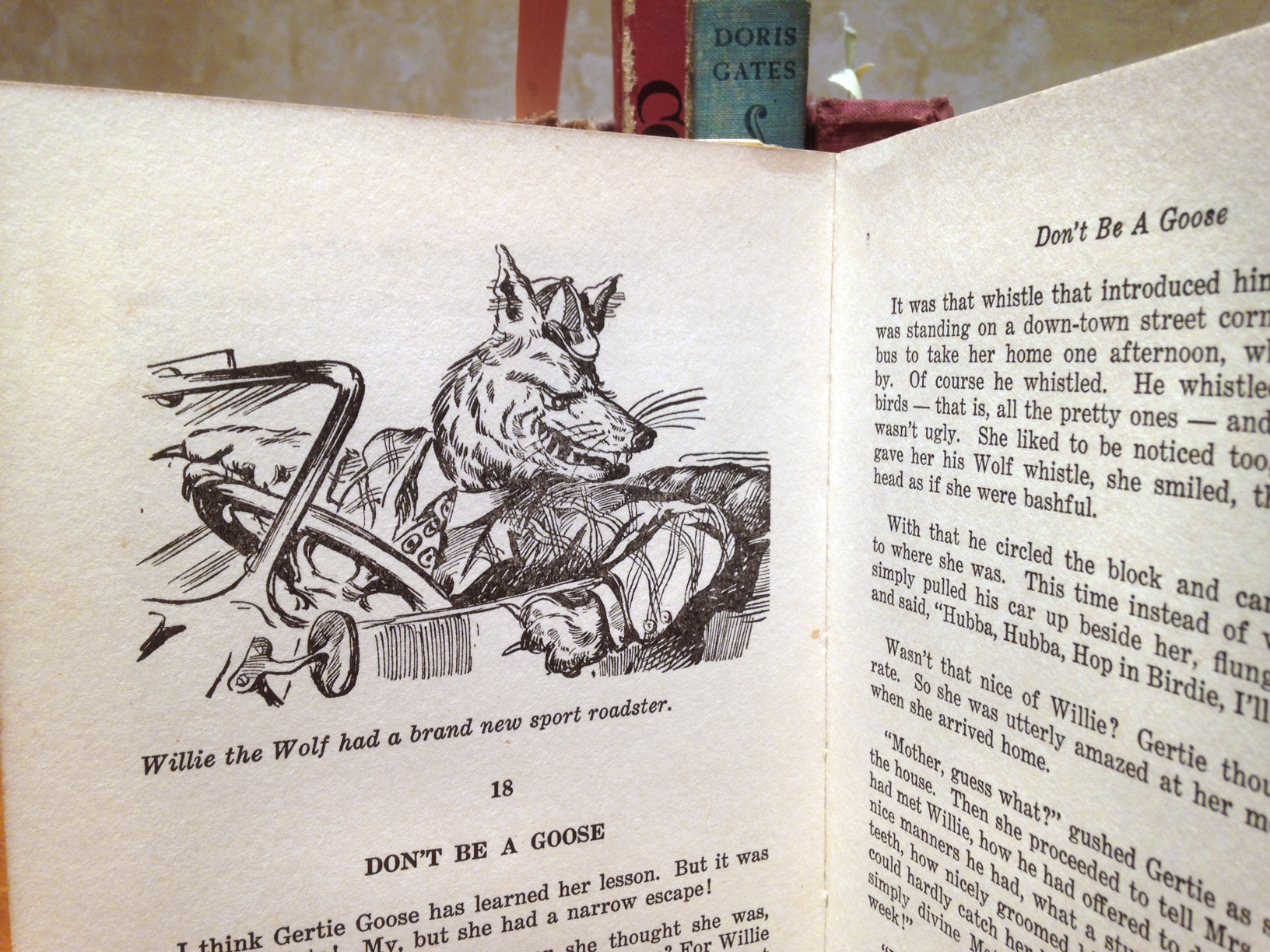
The book whose spine is taped up is entitled Bird Life in Wington (1948) a book of parables by Rev. J. Calvin Reid, pastor of  Mt. Lebanon Presbyterian Church in Pittsburgh,

Willie the Wolf in roadster tries to seduce Gertie Goose
Willie the Wolf with fangs in roadster ready to pounce on naive Gertie Goose

who invented the First Birderian Church of Wington to deliver sermonettes to parishioners named Professor Magpie, Baldy Eagle, Mr. Heron, a fisherman–you get the idea.

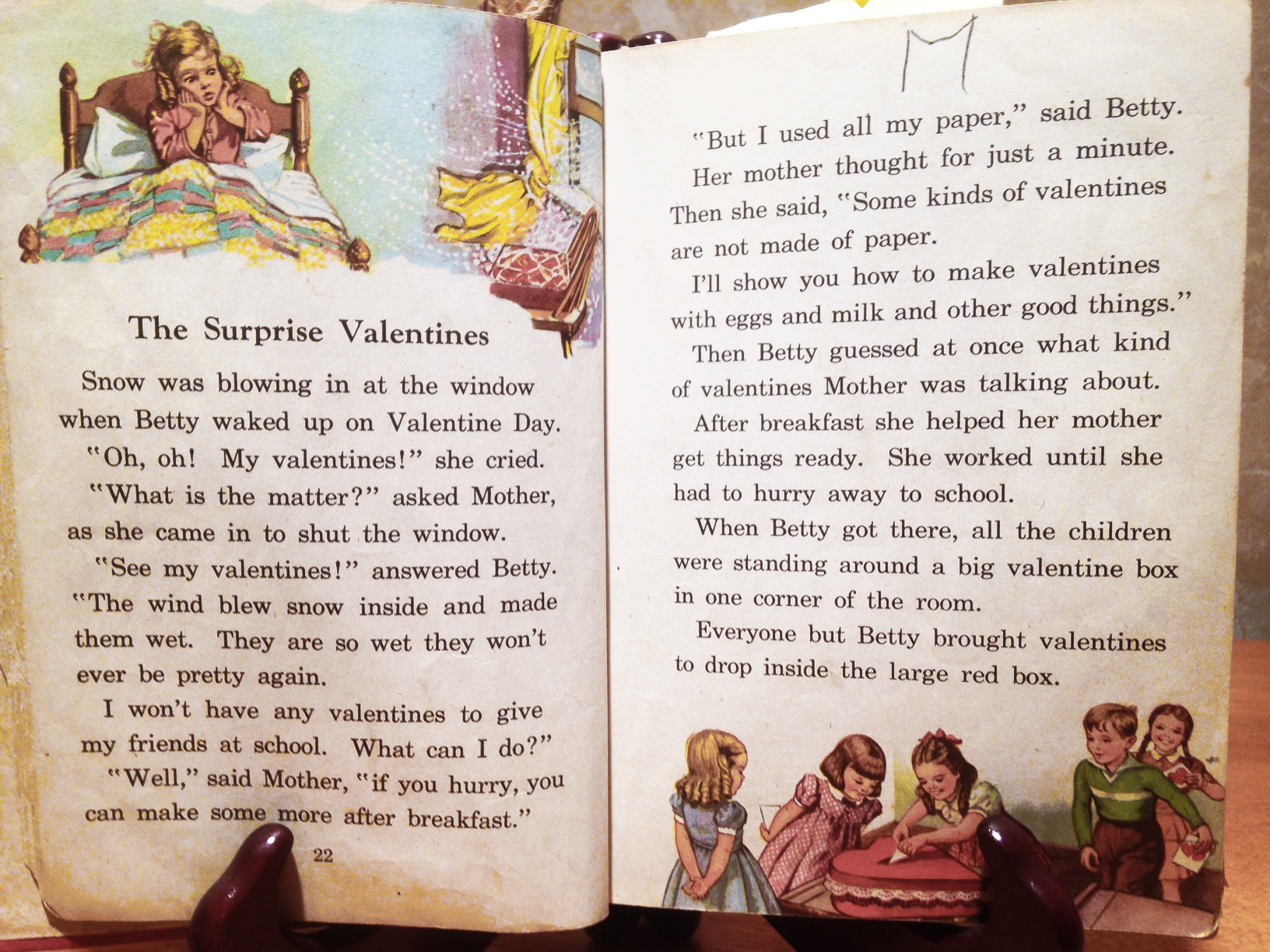
More Friends and Neighbors (Scott-Foresman & Company, 1941)

The images in this Valentine story are imprinted on my mind with cookie cutter precision, the secret to the surprise valentines that replace the snow-damaged paper cards by the window. This reader also contained the story of the “The Woman Who Used Her Head” by chopping a hole in her roof to accommodate the lofty altitude of her Christmas tree. 

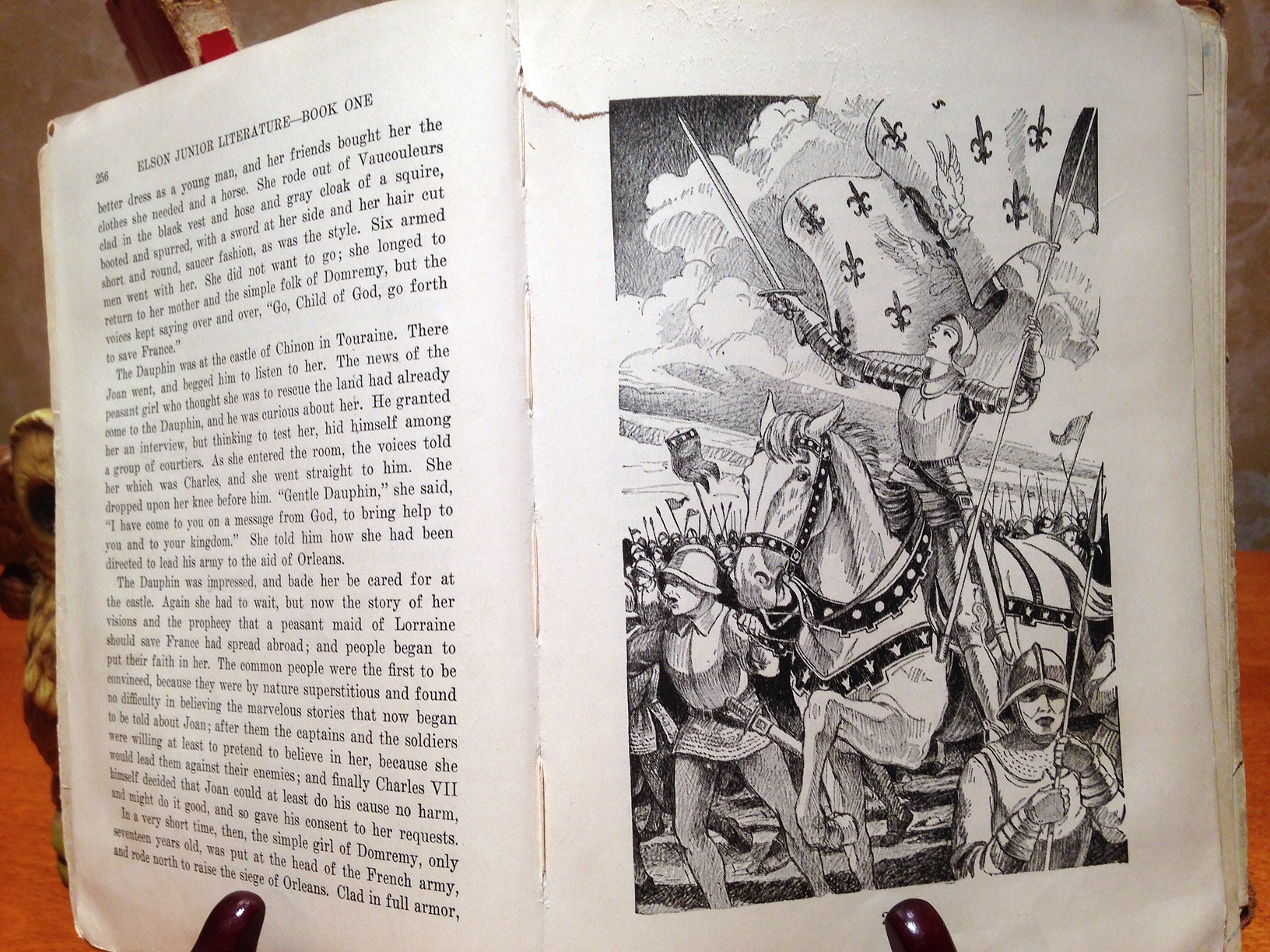
I always loved to turn the page and find an etching in the Elson Junior Literature Book One

Finally, a “real” literature book with Hawthorne’s The Great Stone Face, Emerson’s poem The Snowstorm, announced by “all the trumpets of the sky,” Longfellow’s The Courtship of Miles Standish, and Joan of Arc, the heroic maid who saved France from conquest. A vision, voices, an ancient prophecy–what could be more romantic for a plain Mennonite girl who dreamed of castles, and princes, and fulfillment, oh my!

Did this post jog your memory of textbooks, gift books, library books from your own past?

Please tell us about them.

Another invitation to vote for my story in The Gutsy Story Contest:

To Vote: http://soniamarsh.com/2014/01/vote-for-your-favorite-december-2013-my-gutsy-story.html

Sm.pleaseVote

To Read the Story:  http://soniamarsh.com/2013/12/rising-above-the-pettiness-to-focus-on-the-positive-by-marian-beaman.html

Huge Thanks to those who have already voted!

Note to Vote + Grandma’s Pork & Sauerkraut Dinner

New year, new opportunity: Vote for My Gutsy Story @

http://soniamarsh.com/2013/12/vote-for-your-favorite-december-2013-my-gutsy-story.html

Blog_Please Vote_3x3_300

Haven’t read it yet? There’s still time!

http://soniamarsh.com/2013/12/rising-above-the-pettiness-to-focus-on-the-positive-by-marian-beaman.html          THANK YOU!

Grandma’s Pork and Sauerkraut Dinner

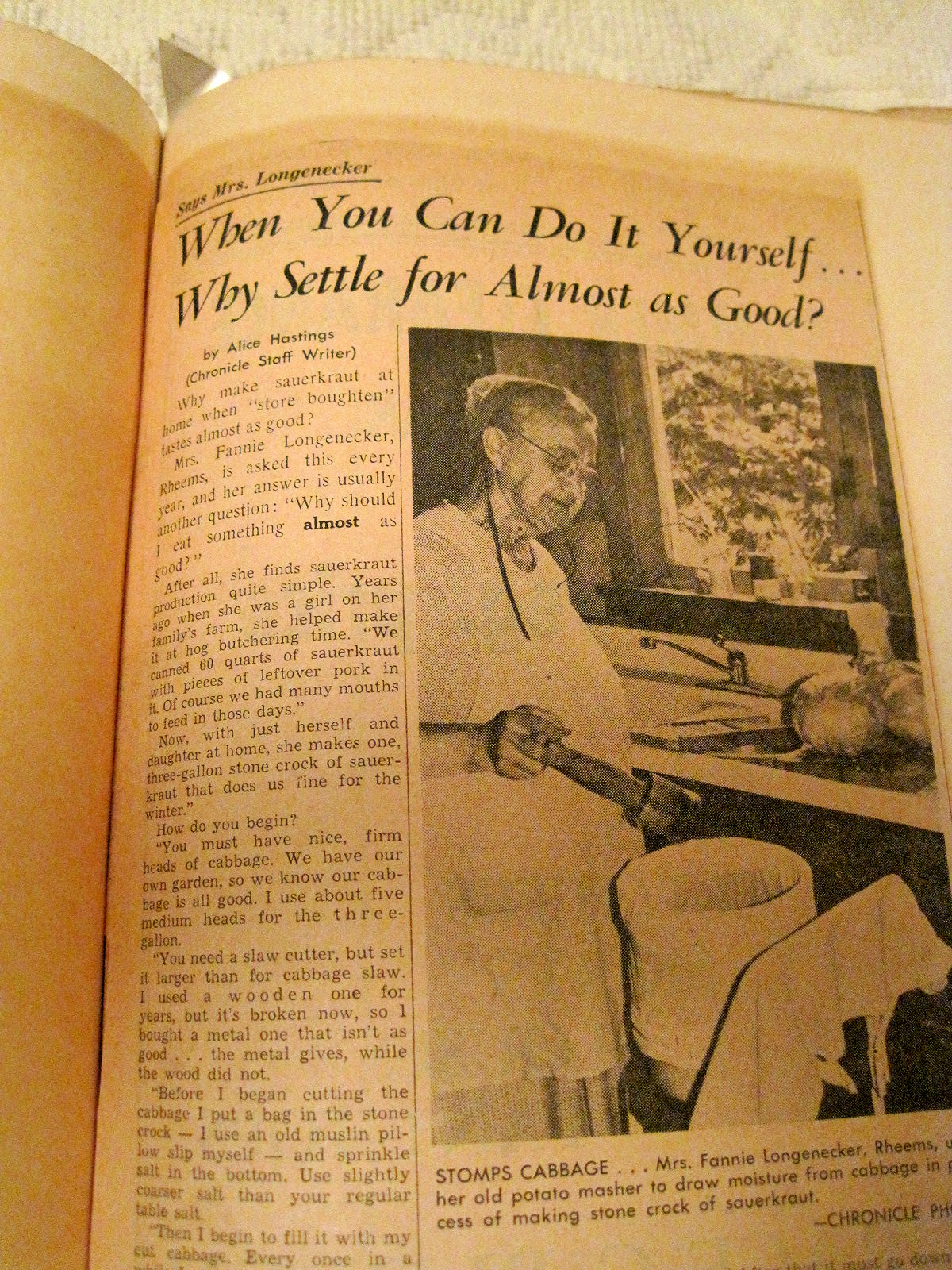
GmaSauerkrautArticleAs the article in the Elizabethtown Chronicle explains, my Grandma Fannie stomped cabbage by using “her old potato masher to draw moisture from cabbage in the process of making stone crock sauerkraut.” The Longenecker family always had pork and sauerkraut, along with mashed potatoes and apple sauce, for New Year’s Day as well as other times during the year.

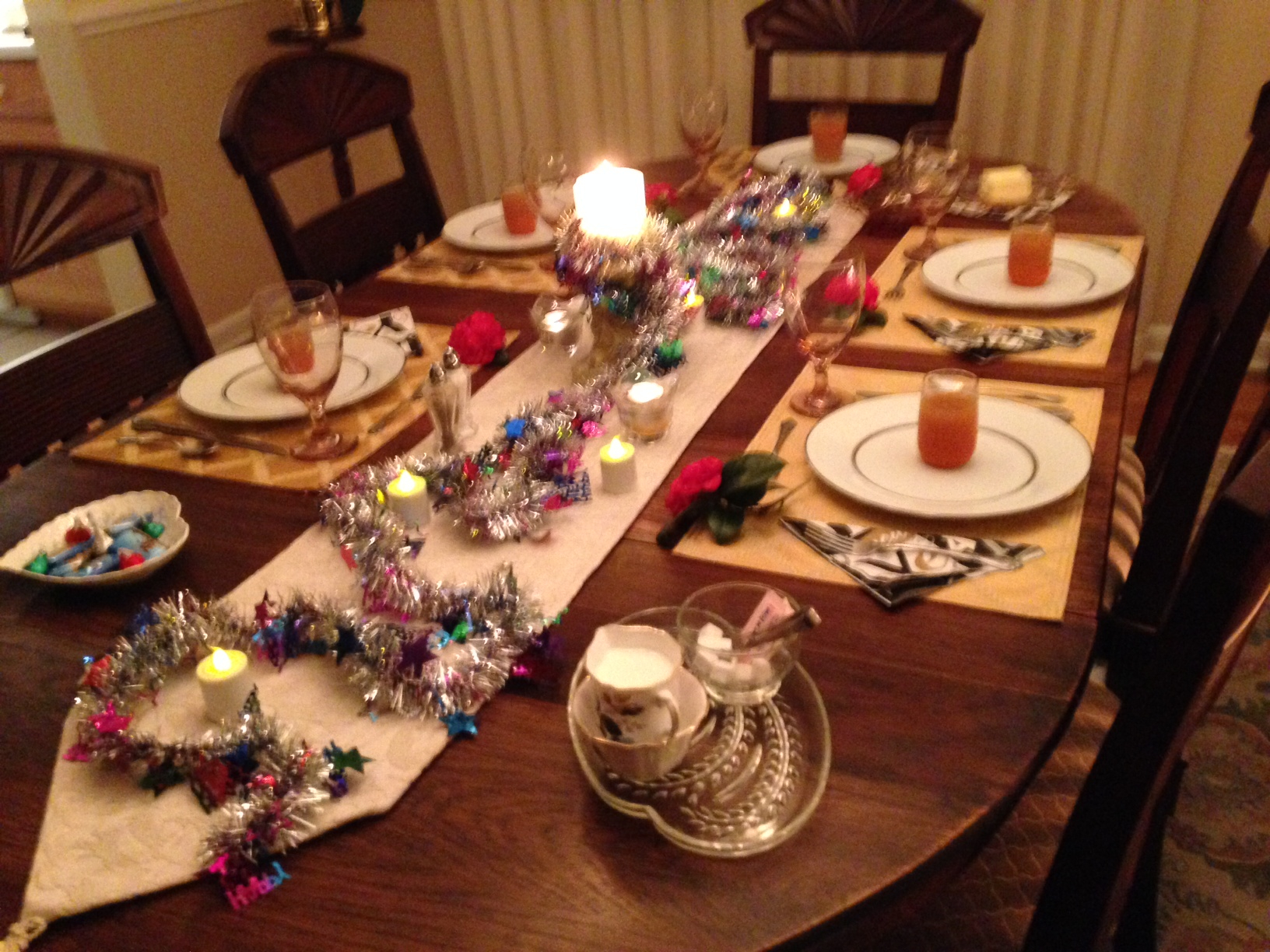
Just like many Pennsylvania Dutch families in 2013, we observed this New Year ritual with a menu of pork & sauerkraut and mashed potatoes.

Pork basted with mixture of meat juices, minced garlic, fresh dill, onion salt and dry mustard Sauerkraut with caraway seeds; baked apples
Pork basted with mixture of meat juices, minced garlic, fresh dill, onion salt, dry mustard
Sauerkraut with caraway seeds; baked apples

Around the table, counting our blessings: “. . . . Hitherto hath the Lord helped us.” I Samuel 7:12

New Year's Table

Your comments and mine make a conversation.

I will always reply!

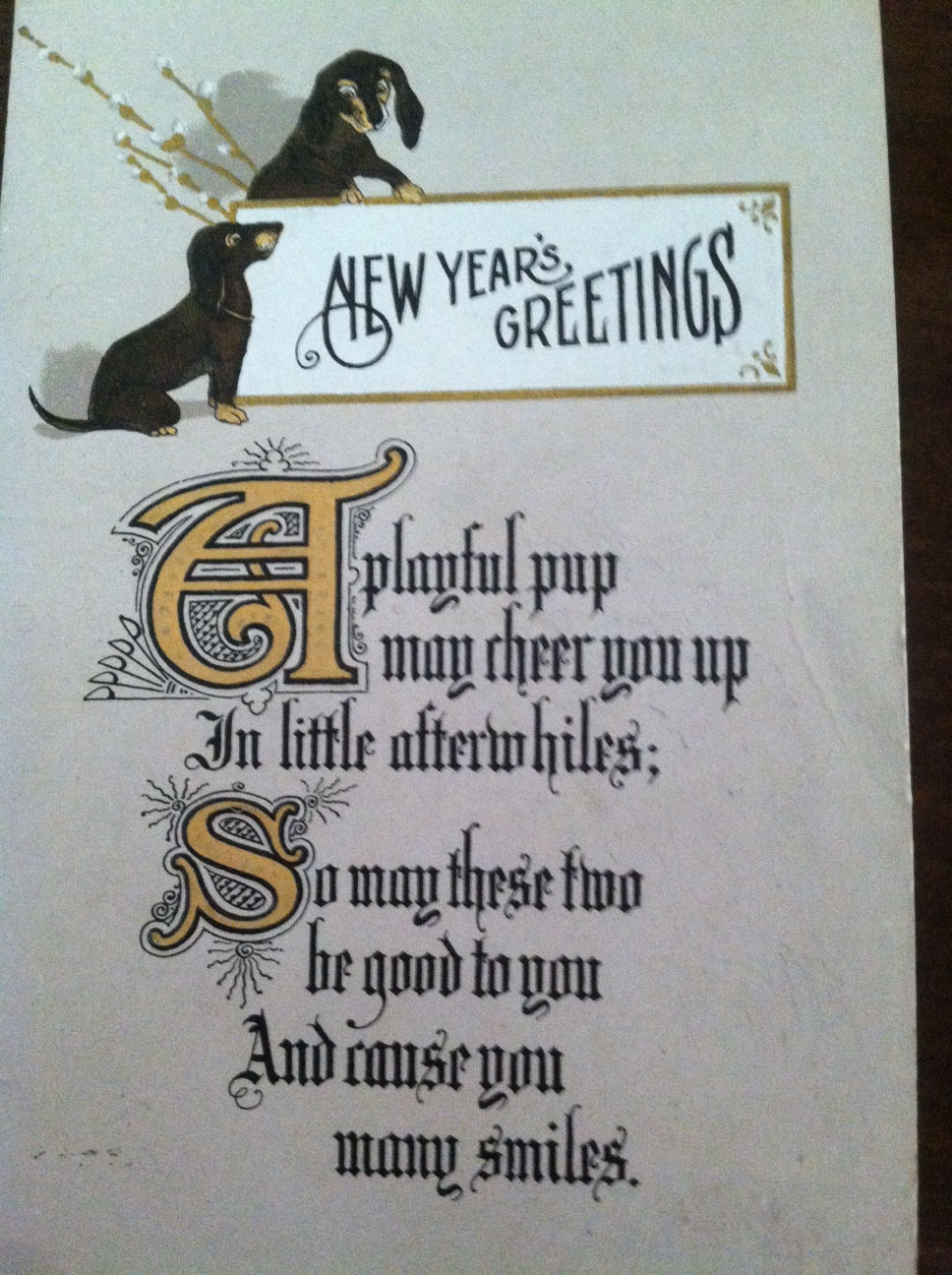
Grandma’s Victorian Greeting: Happy New Year!

Here is a postcard from precisely 100 years ago: Grandma Fannie Martin Longenecker’s New Year’s greeting passed down to me and then to our daughter Crista who now displays it in a frame with her holiday decorations:

NewYearPostcard

They were called penny postcards for a reason!

back of postcard

Yes, it’s 100 years old, postmarked December 30, 1913. Notice there is no street address in a town of thousands and certainly no zip code, not instituted until the 1960s. “R.R.” means Rural Route. Dauphin County adjoins Lancaster County to the west.

Have you held on to old postcards or letters? Where do you keep them?

Inquiring minds want to know! Please join the conversation.

                         *    *    *    *    *    *    *    *    *

VOTING BEGINS THURSDAY for My Gutsy Story on author Sonia Marsh’s website: To read the story: http://soniamarsh.com/2013/12/rising-above-the-pettiness-to-focus-on-the-positive-by-marian-beaman.html

Voting for My Gutsy December 2013 Story begins Jan. 2 and ends Jan. 15, 2014.