Babes in an Urban Woods: Part I

Age 14 1/2
Age 14 1/2

During our teens, my church friends–Miriam, Gladys, Hazel, and I congregate at each other’s houses after church on Sunday night for ice cream, chips, and stereo music: Songs from the West, anything by Mantovani, and The Singing Nun. We would rather have dates like Janie and Thelma, but since we don’t, we pretend that this weekly ritual is fun.

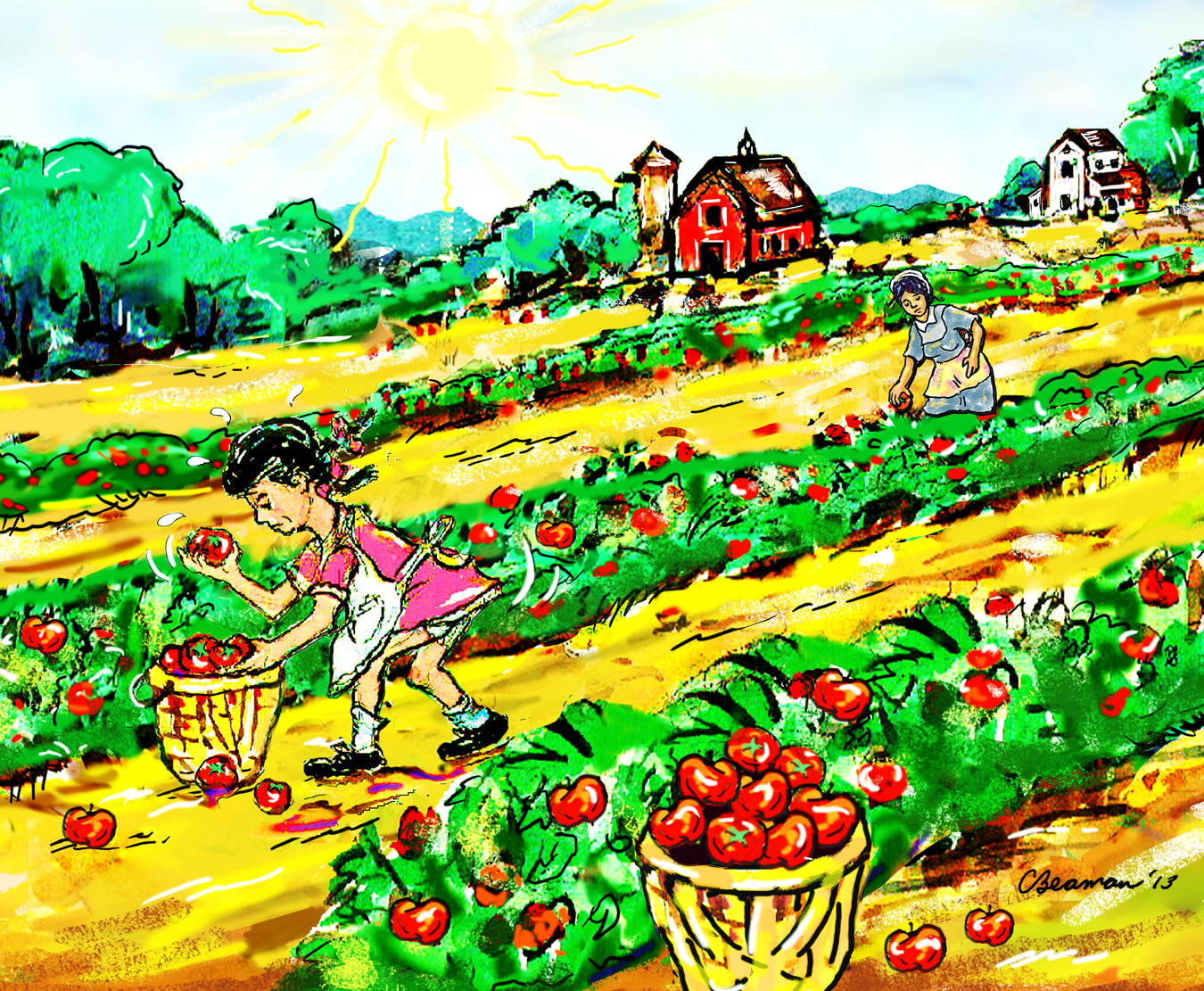
One of our other faux definitions for fun includes cultivating an acre of tomatoes. The youth group from church farm tomatoes on a fertile plot of land near Bossler’s Mennonite Church called The Lord’s Acre. We plant, water, weed, and harvest the tomatoes, giving the profit to missions. Another mission outreach is in New York City, where Ernest Kraybill, one of our deacon’s sons, drives taxi during the day and pastors a small mission church in Harlem. Some of us, along with young marrieds, are getting ready to board a bus and distribute gospel tracts in the Big City. A year ago, the freshmen from E-town High took a field trip to New York. Radio City Music Hall with its sunburst fan of a stage is my favorite memory: seeing the Rockettes was a dream come true for a sheltered girl from Rheems. After the show, we saw a movie–yes, an actual MOOOOOVEEE in dynamic sound and Technicolor, featuring Barbara Stanwyck, the very first movie star I had ever seen performing on the silver screen. Her flawless skin and hair, impeccable makeup, and a cream, cool voice mesmerized me.

On what turns out to be the hottest Saturday in August most of the teens and young adults from Bossler’s plan to spend all day Saturday bringing the gospel to poor, needy heathens in the inner city. It’s summer-time, and I wear my sheer voile lavender frock, so I won’t feel overheated with a modest cape over the dress. We are leaving in the early morning about 4:30 am, so we can spend the day giving out tracts in apartment buildings all over Harlem, With Hazel, my seat-partner, I board the bus for the 3 1/2 hour trip to New York City. Garbed in the plainest of clothing and christened with our white Mennonite caps, we are out to convert the world.

On the bus, we talk and doze, and doze and talk our way to the exotic lights, thrumming noises, and foreign smells of Harlem in north Manhattan, a neighborhood of about 1/4 million people. After we arrive, we proceed by twos among the tenement building in the concrete jungle of the 18th block of Harlem, armed with nothing but gospel tracts and innocence. Like the others, Hazel and I are assigned one tenement building with floors upon floors of apartments. Our strategy is to walk all the way to the top and do our distributing on the way down.

tenement building - courtesy: Google Images
tenement building – courtesy: Google Images

“Whew, it sure does stink in here!” The odors of stale air, dried blood, urine, and burnt cooking assault our country noses on the way up. There are beer bottles, Schlitz and Black Label–some broken, I notice, strewn on the landings between floors.

“Did you hear that?” I ask Hazel as we both witness a full-scale brawl going on inside one of the apartments. The sweaty-looking door-opener snatches a tract from our hands.

“I can’t believe these words,” Hazel comments as we gape at the graffiti on the pock-marked concrete walls: Call_____ for a good time . . . Go to #x!*X you dirty niggers . . . .  Undaunted, we manage to bless all the other apartment dwellers with our fliers as we descend. More screaming and yelling. Things are really getting violent on the other side of the wall.

“Are we going to make it out alive?” I wonder. But things are about to get even worse.

What happens next? Part II

                                                              *   *   *   *   *

GOOD NEWS! There is still time to enter the contest on my review of Shirley Showalter’s new memoir BLUSH, hot off the press. Just POST a COMMENT on the review! Read and Comment @ Shirley Showalter’s BLUSH – A Review and Book Giveaway

THE CONTEST

You can enter to win a copy of this book now!

Here are the details:

WHAT:  Read my review of Shirley Hershey Showalter’s memoir: Blush: A Mennonite Girl Meets a Glittering World.

PRIZE:   One lucky commenter will win a copy of BLUSH, after only one week now in its second printing!

WHEN:  Review posted Wednesday, September 25, 2013

WHERE:  Right here on Plain and Fancy Girl

And all you have to do is show up, read my review and leave a comment. Only comments posted on my blog will be counted as an entry.

The giveaway will close one week later on Wednesday, October 2, 2013 at 12:00 midnight. I will announce the winner here and by email.

I invite you to come by and enter the contest by commenting on the review. Feel free to invite your reading friends!

Again, here’s the link to the review: Shirley Showalter’s BLUSH: A Review and Book Giveaway and a chance to win a copy of Shirley’s book!


Shirley Showalter’s Memoir “Blush” – a Review & Book Giveaway

 
My Review

Shirley Hershey Showalter’s Blush: A Mennonite Girl Meets a Glittering World sings the song of her early life as a Mennonite girl in 250 pitch-perfect pages. Born into a family of Lancaster County Swiss Mennonite parents, the author recounts the story of the first 18 years of her girlhood on an 100-acre dairy farm in the 1950s and early ‘60s. The book delivers in its promise to play out her memories of  school, church, and home, “the three legs of my childhood stool,” as she puts it. “Each carried both sweet and sour memories” of ways this plain girl fit in and ways she stood out as different.

Her melody line bravely hits the sharps and flats of her experiences. She grabs her reader by the hand to walk into their farm meadow as she and her brother Henry play amid the Holstein cows and fragrant bluebells by the creek on a cloudless, spring day. We learn secrets of good Pennsylvania Dutch cookery in her mother’s kitchen and are privy to recipes of delicious dishes in an appendix to the book. She lets us hear the congregation joyously singing hymns of the faith a cappella in 4-part harmony though in a sex-segregated sanctuary. But her song turns to a minor key as she vividly describes the sudden death of her infant sister, her by turns affectionate and adversarial relationship with her conflicted father, and later in a brush with a rigid Mennonite bishop.

This memoir abounds in artful motifs. In the preface the author is sitting on the sandstone steps on the way down to the arch cellar of The Home Place, now known as Forgotten Seasons Bed & Breakfast. She describes the arch in this cellar as the entrance to a storehouse of provision for her parents and grandparents against the want of the Great Depression and a bunker of bounty during the Cold War. Indeed, the book succeeds as documentation of major political currents and cultural icons of the era: Eisenhower and later Kennedy, the Studebaker Lark, the Phillies, Elvis. Other visuals include a map of the Lititz environs, her family tree, along with beloved family portraits and snapshots.

For me as a reader, the most endearing arch in her story is the rainbow in her mother’s invented story of “The Magic Elevator,” which she, a diarist and aspiring writer herself, wrote at age fifteen and has adapted for her children and grand-children through the years. Her mother, Shirley’s first mentor, challenged the norm in a story she recounts early in the book: Although the Rules and Discipline of the Lancaster County Mennonite Conference condemned worldly weddings, including carrying a bridal bouquet, Shirley’s mother Barbara Ann craftily transformed the family’s plain living room into a fancy bower of flowers and palms for the ceremony. After all, at church we sing fervently of beauty in “This is My Father’s World,” she must have reasoned. Evidently, Shirley was not the first Mennonite in her family with moxie.

Shirley’s story sings because it rings true. And, yes, Shirley, you did go home again. The Oh! at the center of her story leads readers to a fresh discovery of home, where one’s heart is nourished and where, as T. S. Eliot puts it, we can all “arrive where we started / And know the place for the very first time.”

“There are many ways to arrive at a place, many of them unimaginable at the beginning of the journey.”    BLUSH

Meet the Author:

Her Memoir – Blush: A Mennonite Girl Meets a Glittering World
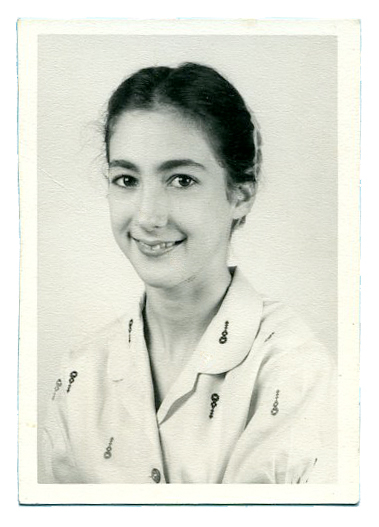
About Shirley

Shirley Hershey Showalter grew up on a family dairy farm in Lancaster County, Pennsylvania. She went on to become a Goshen College (IN) professor, then president, and then a foundation executive at the Fetzer Institute (MI).

Her childhood memoir, Blush: A Mennonite Girl Meets a Glittering World, has been published by Herald Press on September 19, 2013. Follow the journey of the book on her Facebook page and on her blog.

THE CONTEST

You can enter to win a copy of this book right now!

Here are the details:

WHAT:  Read my review of Shirley Hershey Showalter’s memoir: Blush: A Mennonite Girl Meets a Glittering World and comment.
PRIZE:   One lucky commenter will win a copy of BLUSH

WHEN:  Review posted Wednesday, September 25, 2013

WHERE:  Right here on Plain and Fancy Girl

And all you have to do is show up, read my review and leave a comment.

The giveaway will close one week later on Wednesday, October 2, 2013 at 12:00 midnight. I will announce the winner here and by email. Only comments posted on this blog will count as an entry.

I invite you to come by and enter the contest by commenting on the review. Feel free to invite your reading friends!

Book Giveaway Contest & Taste of Shirley’s Memoir “Blush”

News Flash!

Upcoming Review and Book Giveaway of Blush: A Mennonite Girl Meets the Glittering World by Shirley Hershey Showalter

On Wednesday, September 25, I will be reviewing Shirley Hershey Showalter’s new memoir – Blush: A Mennonite Girl Meets the Glittering World.

WHO IS SHIRLEY HERSHEY SHOWALTER?

Though Shirley and I both grew up Mennonite in the same county and in the same decade, our paths did not cross until I saw her website http://www.shirleyshowalter.com/ flashing across the screen in a class entitled What the Heck is a Blog? at the University of North Florida in Jacksonville. I immediately recognized her name as Swiss Mennonite and probably of Lancaster County, PA origin. And sure enough, right on both counts. Since March 2013 we have become blogging pals, and I am thrilled to promote her book as the story of a life surprisingly parallel to mine, a story of derring-do!

DETAILS OF THE CONTEST:

 WHAT:  My review of Shirley Hershey Showalter’s memoir –  Blush: A Mennonite Girl Meets the Glittering World.

 PLUS:   One lucky commenter will win a copy of BLUSH.

 WHEN:  Wednesday, September 25, 2013

 WHERE:  Right here on Plain and Fancy Girl

 And all you have to do is show up, read my review and leave a comment.

 The giveaway will close one week later on Wednesday, October 2, 2013 at 12:00 midnight. I will announce the lucky winner here and by email.

I invite you to come by and enter. Feel free to invite all your reading friends!

Shirley Hershey Showalter  Shirley Hershey Showalter, author of BLUSH: A Mennonite Girl Meets a Glittering World
I promise: you will be transported, says Bill Moyers of this memoir. Part Mennonite in a Little Black Dress, part Growing Up Amish, and part Little House on the Prairie, this book evokes a lost time, in Lancaster County, Pennsylvania, when a sheltered little girl with big dreams entered a family and church caught up in the midst of the cultural changes of the 1950s and `60s.
With gentle humor and clear-eyed affection the author, who grew up to become a college president, tells the story of her first encounters with the glittering world and her desire for fancy forbidden things she could see but not touch. The reader enters a plain Mennonite Church building, walks through the meadow, makes sweet and sour feasts in the kitchen and watches the little girl grow up. Along the way, five other children enter the family, one baby sister dies, the family moves to the home place. The major decisions, whether to join the church, and whether to leave home and become the first person in her family to attend college, will have the reader rooting for the girl to break a new path.  (Amazon Books)

Colleen’s Comfort Quilts: Knot Plain, Just Fancy

Since our children were little babes in blankets, Colleen and I have been friends. Our friendship, knitted together by similar values, compatible tastes, and love of beauty, has flexed with her moves from Florida to Maryland to Texas to California and back again.

Collie with Quilt

Like her quilts, experiences in our lives have at times matched the dark, nubby patches, the smooth, satiny ones, all stitched together by the happy binding of love.

Soon I’ll be taking her latest creation as a gift to my dear Aunt Ruthie’s 95th birthday celebration in her new residence at Landis Homes near Lititz, Pennsylvania.  Ever the artist, Aunt Ruthie has  painted in oils, designed her gardens as colorful collages, and sewn her own clothes in quaint combinations. She’ll love the quilt!

Dark, nubby patches mimic doggy fur of Ruthie's beloved Schnauzer Fritzie
Dark, nubby patches mimic doggy fur of Ruthie’s beloved Schnauzer Fritzie

Last weekend I caught up with Colleen and asked her a few questions. Please listen in!

1. What are touch quilts?

A touch quilt has various textures that are intended to provide a calming effect and soothe jangled nerves as they are stroked.  A touch quilt may be used while sitting in a favorite rocker or recliner, wheelchair, at naptime, in a waiting room or hospital bed and are similar in theory to the security blanket used by many small children.  They are loved by elders and children alike and have been found to be especially useful for those who are blind or have dementia.

2. How did you get started making them?

In 2005, my church started a Prayer Quilt ministry where I learned to make lap-size quilts;  I loved the idea and process and have been making them ever since.  In 2010, a women’s group I belonged to asked if anyone knew how to make touch quilts, which were  to be donated to the local Elder Day Stay.  I did a little research and found them to be very similar to the prayer quilts I already knew how to make, except for the fabrics used.  I made about 16 Touch Quilts over the next two years and got wonderful feedback from the excited recipients.

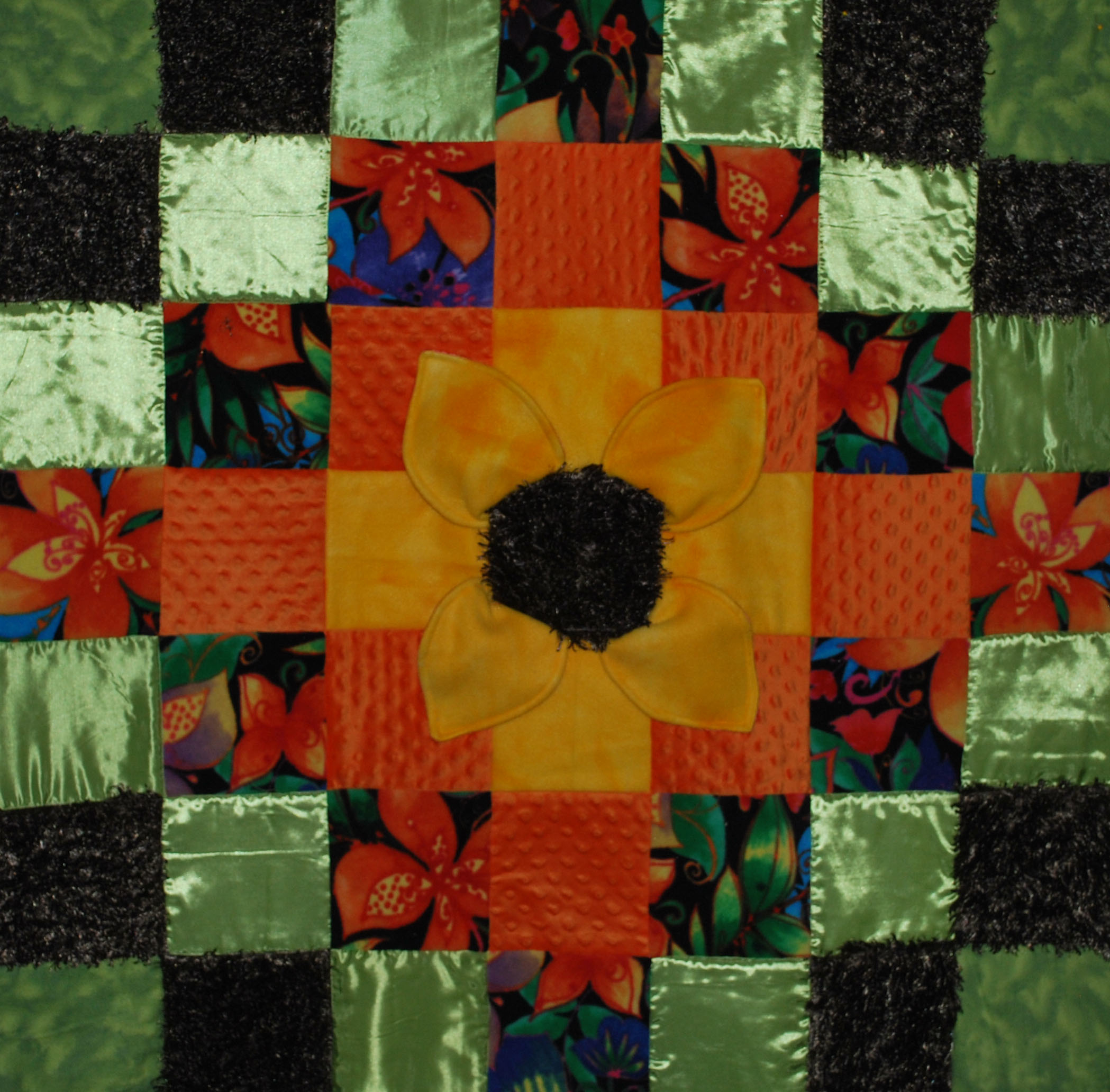
Gold, satin petals attached only at center

3. What types of fabrics do you use?

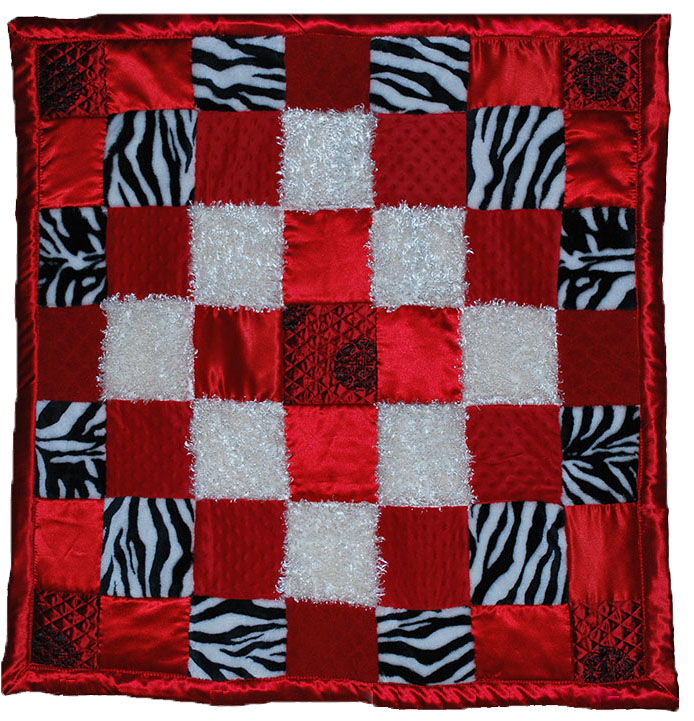
I look for pleasing colors in a variety of soft fabrics such as satin, corduroy, minky, flannel, fleece, fuzzy, furry, and more. I like to have some satin and fuzzy in every quilt and prefer satin bindings on all of them.

Sizes? (Dimensions of quilts)

I have made lap size (42 x 42), which is the most common size for all ages, nap size (42 x 54), and wheelchair size (36 x 36), which is intended to fit comfortably between the wheels without getting snagged.

4. Where do you get your inspiration for the designs and color combinations?

I try to include at least one fabric with a pattern and select complementary colors based on that. I start out designing on the computer and then put the cut fabric on my quilting “wall” to ensure the design fits the fabrics selected.  When I’m using a new design or a fabric with a new pattern, I often spend quite a bit of time rearranging the fabric blocks on the wall before I find a combination that feels and looks right.  It’s a creative process that can take hours and occasionally, days.

5. Who benefits from your quilts? To what organizations have you donated them?

I donate quilts to the Trinity United Methodist Church, Elder Day Stay, and various individuals.

redzebratquilt

Quilts by Colleen: Touchable Chic

Questions or comments about Colleen’s quilts? Reply below please!

Children’s book: The Boy and the Quilt by Mennonite author, Shirley Kurtz: http://www.goodreads.com/book/show/2729926-the-boy-and-the-quilt-with-four-color-artwork?from_search=true

School Daze: Games We Played

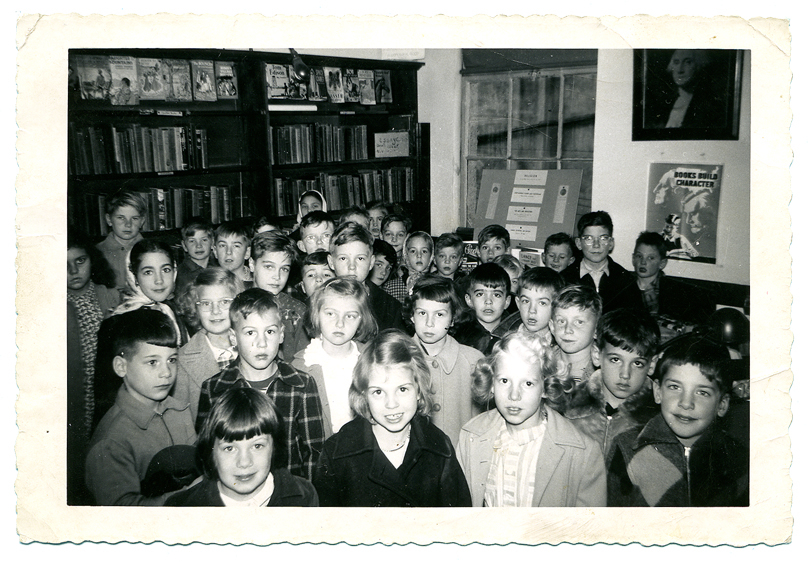
My class at Elizabethtown Library

Here we are all bunched up together for a photo documenting our excursion from Rheems Elementary School to the library in town about 3 miles away. But we’ll soon board buses, and go back to our two-room school-house in Rheems where we’ll probably have lunch or recess. And we’ll lose our serious faces, eyes agape.

Recess, yes! After Miss Longenecker, grades 1- 4, or Mrs. Kilhefner, grades 5 – 8, excuses us, we all scram out to the playground equipped with a slide, see-saw, and jungle gym with bars for climbing and twirling our bodies around. Before we go back to class, most of us will pay a visit to the typical wooden outhouses, one for girls and one for boys, right next to each other and both regularly anointed with lime to quell the smell.

Group Outdoor Games:

1. Softball  (Need an extra inning? Teachers, not so pressured by students’ test scores, may extend our play.)

2. Red Rover “Red Rover, Red Rover,” let ________ come over!) involving mad dashes around school building.

3. Crack the Whip  Classmates in a line, running, then strong body at one end stops short, so others flip around. Cheap thrill!

4. Tag   When someone chases you down on the playground and touches you, you are IT!

5. Hide and Go Seek   HideGoSeek

Games with Just a Few:

1. Simon says

2. Hop-scotch

3. Four square

4. Jump rope

5. Double jump rope  Each child has a handle on two different jump ropes and flicks them one at a time in opposite directions.  “I dare you not to trip up!”

Rainy Day Games:

1. Jacks  Jacks game

2. Pick Up Sticks

Courtesy: Google Images

3. Tiddly-Winks  (Players try to snap small plastic disks into a cup by pressing them on the edge with a large disk.)

Treat for Teacher:

Someone, probably Ralph, announces in the middle of class “Fruit Roll!” and kids behind every desk in class jump up with an apple, orange, or grapefruit to roll along the oiled, wooden schoolhouse floor toward the teacher’s desk, an unexpected treat!  [In an era when teachers fear spit balls or worse–guns! even, such a gesture is most endearing.]

FruitRoll

I wish I could show a photo of the school and outhouses, but one cold evening during Christmas vacation, the school burned down, suspiciously, and was replaced by a standard- issue concrete structure, not nearly as nostalgic as the steepled one with a bell that I remember.

I was already in junior high in the big school uptown when the fire occurred, but my sister Janice remembers being shifted to Washington School, the building adjacent to Bossler’s Mennonite Church, where our Daddy and Aunt Ruthie attended. This old school had a large furnace in the basement with a sizable flat top, and students would bring potatoes wrapped in foil to bake on top of the furnace for a nice hot lunch on cold, cold days.

Like Mildred Armstrong Kalish in her memoir, Little Heathens, depicting Iowa farm and school life during the Depression, I have fond, fond memories of Rheems Elementary School in the 1950s.

Fun time resource for parents, grandparents:

http://www.grandparents.com/grandkids/activities-games-and-crafts/outdoor-games

 *   *   *   *   *

Add some memorable games to the list!

Purple Passages iii with Pictures

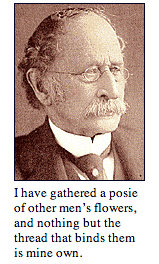
Quote from Bartlett himself
Quote from John Bartlett, who compiled over 11,00 quotations in the 10th edition of Quotations, 1919

Writing & Stories

  4.10.99  Why stories are so effective:

The best stories begin as mental pictures which turn into personal mirrors before they become insightful windows through which we’re able to view life with greater clarity and understanding.      Anonymous

12.15.95  I like everything about writing except the paperwork!  Novelist Peter de Vries

9.9.00  I feel 10 times smarter writing on the computer.    My student, ENC 1101

Travel

There’s no cure like travel

To help you unravel

The worries of living today.

When the poor brain is cracking

There’s nothing like packing

A suitcase and sailing away.

Cole Porter – Anything Goes.

7.15.13 The only real voyage of self-discovery consists not in seeking new landscapes but in seeing it with new eyes.   Marcel Proust

8.14.99  Distance lends enchantment to the view . . . .   Laura Ingalls Wilder, Little House in the Ozarks

10.22.96  I never found the companion that was so companionable as solitude. Thoreau

7.28.90  The trip to heaven will be easy because I have sent my heart on ahead.  Loretta Lynn

White-Water Rafting

Ocoee Rafting - Ducktown, TN
Ocoee Rafting – Ducktown, TN

White water rafting, especially level 3 or 4, is a grand metaphor for life:

1. Trust your Guide.

2. Stay IN the boat.

3. Have fun!

Dancing with the Stars

4.16.99  I don’t try to be better than anyone else. I try to be better than myself.   Mikhael Baryshnikov, dancer

5.13.90  If a man does not keep pace with his companions, perhaps it is because he hears a different drummer. Let him step to the music which he hears, however measured or far away.   Thoreau

5.10.99  And frame your mind to mirth and merriment / Which bars a thousand harms and lengthens life.    Wm. Shakespeare, The Taming of the Shrew

 A merry heart doeth good like medicine.  Proverbs 17:22.

Time and Happiness

 3.17.00  Human time does not turn in a circle. It runs ahead in a straight line. That is why man cannot be happy; happiness is the longing for repetition.  Milan Kundera, The Unbearable Lightness of Being

12.28.89  How plotless real life was [is]!  Anne Tyler, Dinner at the Homesick Restaurant

 5.9.90  Don’t worry about the meaning of life; pursue meaning in life every day.  Robert Fulghum

LifeVoiceJournal

12.19.99  You are only one thought away from a good feeling!  Sheil Krystal quoted in Rick Carlson’s Happiness

9.10.13  Sybil, in my book says, “Sometimes, the greatest gift you can give someone is the freedom to pursue their own happiness.”  Red Clay and Roses  SK Nicholls


Which quotes do you agree with?

Disagree?

Your turn: Share one you would add to the themes.

School Daze: Songs We Sang

Second Grade: Rheems Elementary School

Valentine parties, Easter parades, Hallowe’en fun houses in the basement, Christmas programs, we had them all, but those were special occasions. At Rheems Elementary, a two-room school, we had our daily ritual: Bell ringing from the school-house steeple (always by a boy), Bible reading, the Lord’s Prayer, the Pledge of Allegiance, and then singing before lessons began:

This is My Father’s World, My Country ‘Tis of Thee, and Home on the Range were staples in our little golden songbook. But many of the lyrics we sang would be considered insulting to various ethnic and racial groups today. For example, Old Solomon Levi, playing to the stereotype of the wily Jewish merchant:

My name is Solomon Levi

At my store in Salem Street,

There’s where you find your coats and vests,

And ev’rything else that’s neat:

I’ve second-handed Ulsterettes,

And ev’rything else that’s fine;

For all the boys — they trade with me,

At one hundred and forty-nine.

Chorus.

Oh, Mister Levi, Levi, tra, la, la, la.

Poor Solomon Levi, tra, la, la, la, la, la, la, la

Next, we might sing My Old Kentucky Home with what was then dubbed the negro dialect: “The sun shines bright in on my old Kentucky Home, / Tis summer, the darkies are gay.”

What! “Darkies are gay . . . “?  Innocent of the dissonance in the words we would discover later, we sang the chorus at the top of our lungs:” Weep no more, my lady. Oh, weep no more to-day; / We will sing one song for the old Kentucky home. / For the old Kentucky home, far away.” For sure, Paula Deen would be safe in such a culture.

The dialect continued when we belted out Dixie: “I wish I was in de land ob cotton, / Old times dar am not forgotten, Look a-way! Look a-way! Look a-way! Dixie Land.” There was even a winking nod to obesity in one of the stanzas: “Dar’s buckwheat cakes, an’ Injun batter, / Makes you fat or a little fatter . . . .

And then there was the wistful: When You and I Were Young, Maggie, and My Grandfather’s Clock, sung by youngsters that had no conception of aging or mortality.

Grandfather'sClock lyrics

GrandfatherClock_crop_180

Graduating to Junior High in 7th grade, the singing before lessons stopped, but my classmates and I were introduced to both highbrow and lowbrow music. The official music teacher, Miss Enterline, fresh out of college, enthralled us with Paul Dukas’ The Sorcerer’s Apprentice  and cajoled us to join her gender-separate choruses: Melo-men and Melo-dears. Then there was my homeroom and typing teacher, Mrs. Elsie Care. Her door name-plate said “Mrs.” but when she came to school in a dress with a zipper down the back, she asked a student to help out with the zippering up. Where was Mr. Care, I wondered: Traveling? Too busy to bother? Was she separated, or even divorced? I noticed someone always helped her out of her sartorial dilemma soon enough. Though she taught business courses, she insisted that we learned the words to “16 Ton,” even writing them on the blackboard with her large, loopy handwriting. At the time I thought it strange, but, endearingly, she had introduced us to pop culture:

 Tennessee Ernie Ford

Mrs. Care signed my yearbook with shorthand, which I neither cared about nor understood, but her quirkiness is etched in memory. . . Mrs. Elsie G. Care, the “G” for Gioconda, woman of mystery and intrigue.

← Back

Thank you for your response. ✨

Ode to Tomatoes: Plant, Pick, Eat

 Tomato Girl_crop_9x7_150

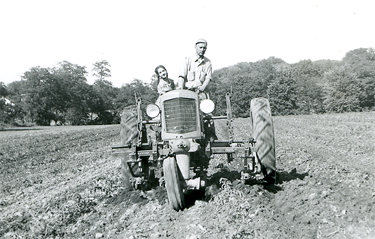
I never think of myself as a Daddy’s girl, because I get along with Mom better. But there I am in plain daylight grinning as I ride the tractor with Daddy. We’re cultivating the 9 acres of land in Bainbridge for the next tomato crop. I stand on the tractor’s floor board with the evenly spaced holes for draining mud and moisture. Hanging onto the back of the tractor seat, we climb a grade — putt-putt-putt-putt-putt — and then back on level ground, mom snaps our picture. It’s a warm day in May, and I see beads of sweat on Daddy’s neck even though there’s a slight breeze blowing.

Cultivating land for tomato crop in Bainbridge

Daddy wears many hats in his farm supply business. He mans the parts department, hires mechanics, markets his equipment, and when a new tractor, harvester, or cultivator arrives, he walks across the street in Rheems to the railroad tracks at the appointed time and pulls a new tractor from a PA Railroad freight car that stops for just minutes to make the delivery.

He is so proud of his new tractor. Either he has ordered it for a farmer from the Minneapolis Moline plant, or he has someone in mind to sell it to. I hear him on the phone now with a prospect: “Hello, this is Longenecker from Rheems . . . .“ Everyone in northern Lancaster County knows him, so he doesn’t have to say “Longenecker Farm Supply” or explain who he is.

Sister Jean and I admiring the new Minneapolis Moline tractor with Daddy

If there are Urban Mamas in Lancaster city, we don’t know about them. Everyone we know eats fresh and local from farms or country gardens. Cherries in May, peas in June, and sweet corn and tomatoes all summer long. In pea season, we gather around the kitchen table and eat a light supper of peas from the garden in a huge bowl. The china serving bowl I see now has embossed pink flowers and gilt edging. Of course, Mom pours lightly browned butter on top. “Butter always makes it better,” she says. After our fill of peas, peas, peas, there might be Breyer’s butter brickle ice cream and pretzels.

And sometimes, tomato sandwiches. Now, you ask, why would you eat tomato sandwiches when you were in the tomato patch all summer? Wouldn’t you be sick and tired of them? Well, not the way Mother fixes them:

TomatoOnVine

How to make the Perfect Tomato Sandwich, according to Mother Longenecker:

  • 2 slices of bread
  • Spread one side of each with mayonnaise, always Hellman’s
  • Layer medium-sliced, fresh tomatoes from the field (none of this harvest-green and then spray-with-preservatives business from the grocery store.)
  • Sprinkle some sugar on top of the tomatoes—and there you are!

TomSandYellow

If  you are counting calories and watching your waistline, this is not your dish. But try it just this once. It’s kind of sloppy: bright red tomato juice oozes out and puddles your plate, nourishing your senses and soul.

. . . at the midpoint
of summer,
the tomato,
star of earth, recurrent
and fertile
star,
displays
its convolutions,
its canals,
its remarkable amplitude
and abundance,
no pit,
no husk,
no leaves or thorns,
the tomato offers
its gift
of fiery color
and cool completeness.

excerpt from “Ode to Tomatoes,” Pablo Neruda

Breakfast is Served — with an Oops!

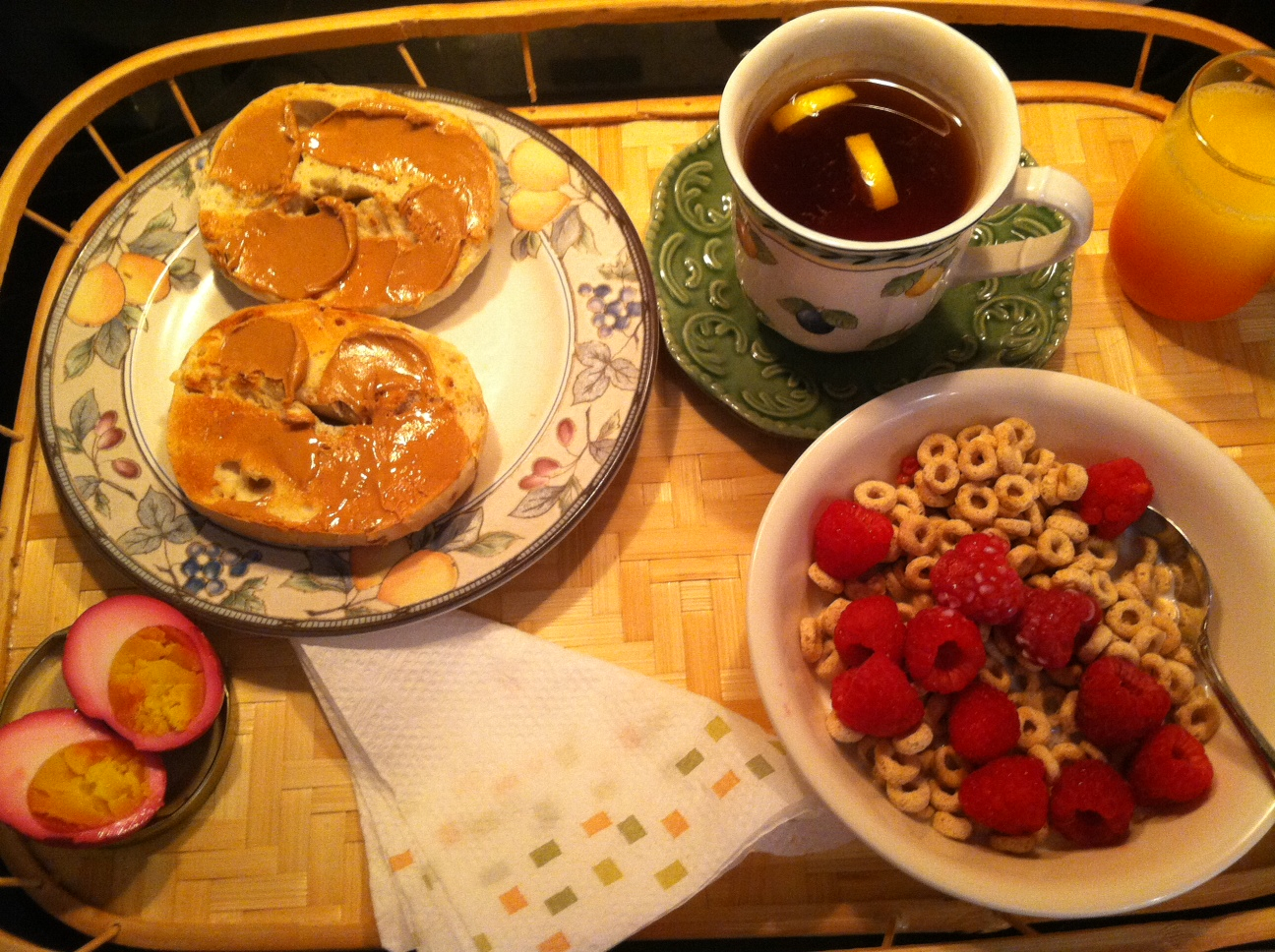
Before I dashed off to my college classes each morning, I had a 10-minute oasis of breakfast time around 6:30. With a modest-size repast of tea and lemon, bagel with peanut butter or cream cheese + a piece of fruit, I told God, “Thank you for this food and the leisure to enjoy it in.” Why would I even think to call it leisure? I had just 10 minutes before I bolted out the door, joined the traffic on Beach Boulevard, and rolled my car onto campus at 7:00 a.m. Busy day ahead!

Now in my writing phase of life, at 7:00 I may tune in to  20-minute yoga session, pre- or post-breakfast. It just depends.

But now my breakfasts are more abundant and leisurely. Well, . . . most of the time.

Yes, a nod to PaDutch taste buds - pickled eggs
Yes, a nod to PA Dutch taste buds – pickled eggs

Breakfast time includes a spiritual dimension:

First, CLEANSING . . .

WatermellonPureHeart

Then, moments of SILENCE

Silence, however brief (then) or longer (now). . . requires meaningful retreat from the hurly-burly busy-ness of life.

In his memoir, The Chosen, Chaim Potok’s main character, Reuven, speaks of the enlightenment his friend’s father, Reb Saunders, a Hasidic rabbi, imparts about the restorative value of long stretches of quiet: “. . . “I’ve begun to realize that you can listen to silence and learn from it.” And later Reuven’s brilliant friend Danny admits: “My father taught me with silence, . . . “ so I would not grow up with a mind having no soul.

Now take a deep breath . . . read s l o w l y :

When you are faithful in [silent meditation] . . .

you will slowly experience yourself in a deep way.

Because in this useless hour in which

you do nothing “important” or urgent

you have to come to terms with your basic powerlessness,

you have to feel your fundamental inability

to solve your or other people’s problems

or to change the world.

When you do not avoid that experience but live through it,

you will find out that your many projects, plans,

and obligations becomes less urgent, crucial, and important

and lose their power over you.

Abbot John Eudes Bamberger to Henry Nouwen  (Quoted in Fil Anderson’s Running on Empty, a book about living restoratively in “a world stuck on fast forward.” 73)

Next, MEDITATION . . .

Take another deep breath, read, and reflect

Patrick reading in Book of Luke

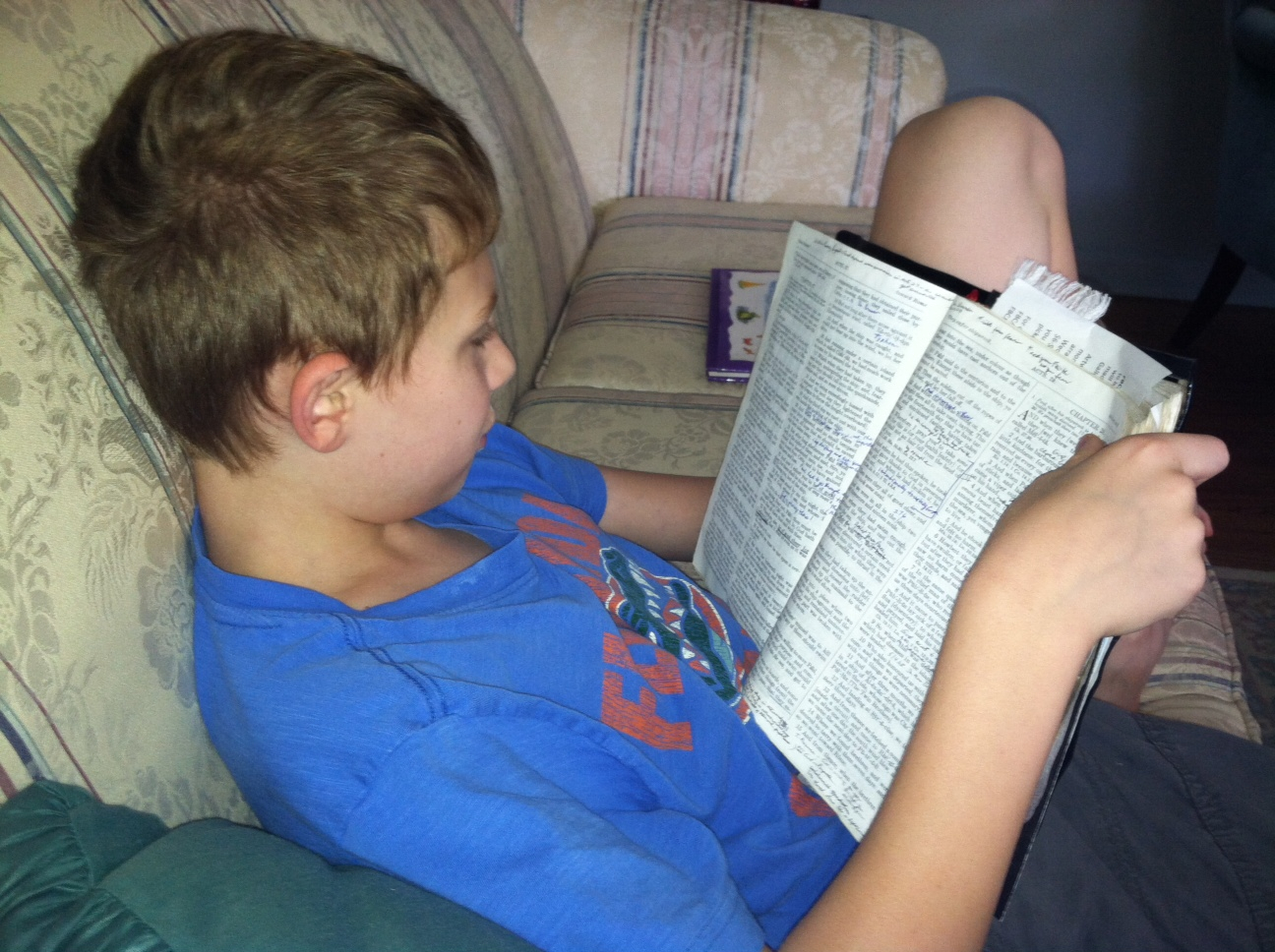
Grandson Patrick, my less pious stand-in for “Meditation.” He is reading from his Grandpa’s Bible the story of one of the shipwrecks of Apostle Paul he learned about in Vacation Bible School.

 Happy to say, I haven’t heard the phone ring yet, so there’s even time for another cup!

Seen in Santa Cruz Diner, CA

OOPS!

You were waiting for an OOPS! and here it comes. Life doesn’t always go as planned. Interruptions happen. And frequently. There is often a need to revert to Plan B. (See again Southern Friends Meet PA Dutch Dish)

Fil (really, not a misspelling) Anderson, again, in Running on Empty quotes Author Robert Benson, Living Prayer (page 81) who has devised a theory of life he dubs the “Rule of 21.”

Twenty-one minutes is the amount of time that one can go without being interrupted by a telephone call, a knock at the door, or an attack from cyberspace . . . .

Twenty-one days seems to be the maximum number of days that one’s life can go smoothly. The average is four, but the limit is twenty-one I think. It’s hard to live for more than twenty-one days without a car breaking down, a trip being cancelled, a family member getting sick, a pet dying, a tire going flat, a deadline being missed, or some other thing that scatters all of one’s otherwise neatly arranged ducks.

While I’m writing this post, there have been several hiccups in the rhythm of my own life. Specters in the form of medical, institutional, and financial needs have reared their unwelcome heads either in my own or our extended family. And it’s been, I gasp, about 21 hours — give or take a few!

*   *   *   *   *   *   *   *   *   *   *   *   *   *   *   *   *   *   *   *   *   *   *   *   *   *   *   *   *   *   *   *   *   *

Here’s the menu. Choose one or two!

Do you eat breakfast? Is it a meal eaten on the run? More leisurely?

What are your spiritual adaptations before, during, or after breakfast?

What do you do when your plans go awry?  Share a sure-fire coping strategy.

Splash: Another Time, A Different Tub

In Florida, most people take baths once a day. It’s too hot not to. And it’s a safe bet most people in contemporary America take more than one bath a week.

Not so in the olden days. Mildred Armstrong Kalish writes of her family’s once-a-week bathing in her chock-full-of-detail memoir of growing up on an Iowa Farm during the Depression and vividly describes the extra bath needed on days working in the hay-field:

When dusk came after a day like this [reaping and storing hay], Mama would fetch a steaming kettle of water from the kitchen stove and bring it out to the porch where, during the summer months, we set up a washing station which consisted of a wooden bench, an enamel wash basin, clean towels, a mirror, and a pail of fresh water for drinking or to temper the hot water. She started with us girls, giving us a soaping from head to toe and sending us, towels and nightgowns in hand and naked as jaybird, across the grassy lawn to the windmill. Once there, Sis and I pumped pails of refreshing cold water and doused each other all over until we fairly tingled. After we dried ourselves, we donned our cotton nighties and ran back to the house and up to bed. We would be dead to the world in minutes.

In the Longenecker family, mirrors, pumps, and windmills were not involved in the bathing process, but we did bathe once a week whether we needed it or not—usually on a Saturday night before Sunday church. The exceptions were a visit to the doctor or getting rid of ickiness after sickness. Then we called the bath a “rinse off.”

Before our house had a “real” hot water heater, there was an apparatus in the cellar that could have heated water year round. But it was not used in the summer because “It’s just too hot to run that thing when it’s so hot outside already!” So June – August or September, our bath water was heated in a tea kettle or large pan on the kitchen stove and carted in buckets upstairs to the bathroom. Baths were taken in the order of cleanliness, or lack thereof. Usually bath time started early Saturday evening with my sister Jean and Janice, the two youngest, together in the tub with a fragrant bar of Ivory soap, the soap that floats! Soon it was my turn, then Mother, and finally Daddy, a farm equipment mechanic, who was the dirtiest of all.

After all the baths, the 99.44/100 % pure Ivory was made murky with all the build-up of grime, dyeing tub water a charcoal-ish, murky tone and a film of grease on top. It would take more than one scrubbing with BAB-O to restore the porcelain shine, for sure.

Courtesy: Google Images

Did we get clean? I am sure youngest sister Jean did and probably Janice too. Were we frugal? Yes, and to a fault.

clawfootTUb

Let’s Talk: Your thoughts please!

What about your baths as a child? Any particular products you remember using?

What else are you curious about growing up Mennonite in the 1950s? What other topics would interest you?