Loving Hands, Homes & Teddy Bears

Hex signs on barns, fertile farms, plain dress, PA Dutch cooking: These are the first impressions many people have of Mennonites in Lancaster County. But the ethic of compassion of these folk draws from a deeper well: From their founder, Menno Simons, to the present day, the practice of helping others is deeply ingrained:

Menno Simons_mod_8x11_72                      

In fact, the mission statement on the website of the Mennonite Central Committee (MCC), echoes those words of Menno Simons in 1541:

The Mennonite Central Committee (MCC), a worldwide ministry of Anabaptist churches, shares God’s love and compassion for all in the name of Christ by responding to basic human needs and working for peace and justice. MCC envisions communities worldwide in right relationship with God, one another and creation.  

                         MCC_screen shot_2x2_150pix_72

Their logo expresses their mission as the cross and dove merge in a “dynamic, interactive relationship in which the cross empties into compassionate action fulfilling our call to global service.”

In a similar vein, loving hands was the image used for the theme of the 90th birthday celebration for my mother and aunt, her sister-in-law, both named Ruth Longenecker, have the same birth year and middle initial “M,” and live independently on the same street,

                            Hands clip

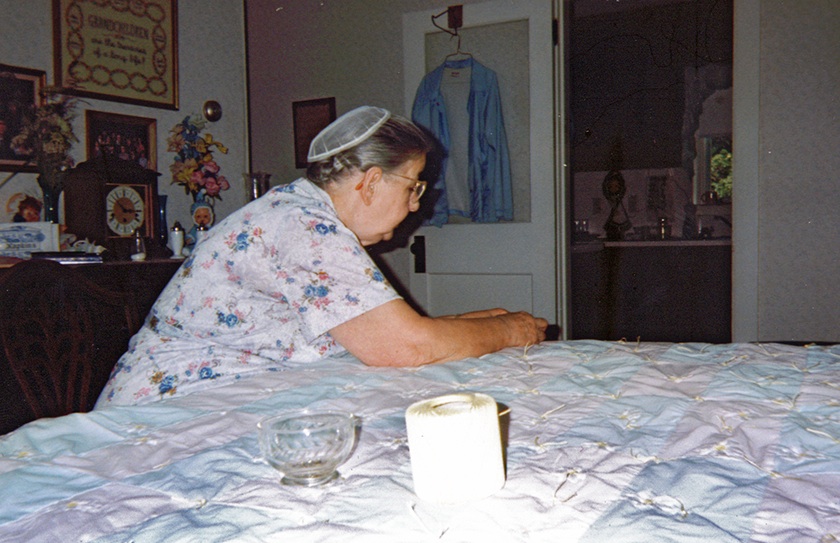
Mother is and was handy in many ways. Along with Daddy, my mother served on the board of New Life for Girls, an agency supporting the rehabilitation and guidance of young women in urban areas. For many years she volunteered at the Mennonite Home making beds. She served also at the MCC International Gift and Thrift Shop in Mt. Joy, PA. One Monday a month she went to sewing circle where she helped piece quilts and knotted comforters for overseas relief. My sisters and I also remember rolling long, long strips of gauze for bandages to send abroad.

             1995RuthKnottingComforter_small

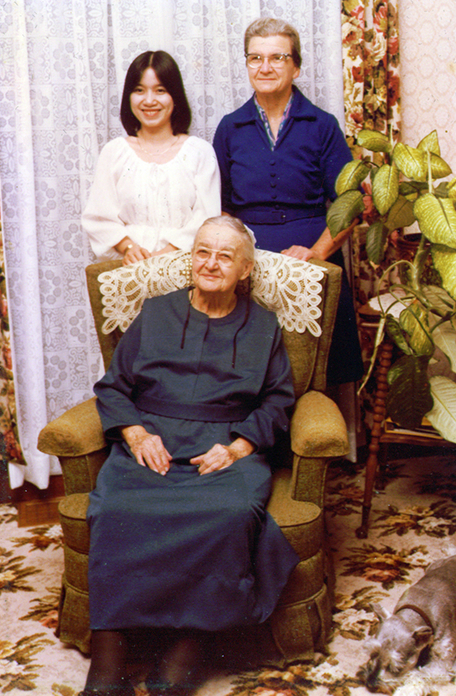
Aunt Ruthie, Principal of Rheems Elementary School and West Donegal Township tax collector, took her call to missions in a different direction. For over 25 years, she with Grandma, opened their home to refugees and immigrants, beginning with Phuong from Vietnam whom she sponsored. Her home was a warm cushion absorbing the cultural shock of leaving home and family. Aunt Ruthie was never married and has no biological children, so she was flummoxed by Phuong’s normal adolescent activity: She takes such long showers, she doesn’t know when to hang up the phone, and she wants to stay out so late!

      1989RuthieHouse 1979Grandma,Ruthie, Phuong_small

The house on Anchor Road was a safe haven, welcoming  refugees from a collage of countries in addition to Vietnam: Bosnia, Croatia, Serbia, Russia—anywhere there was political upheaval.

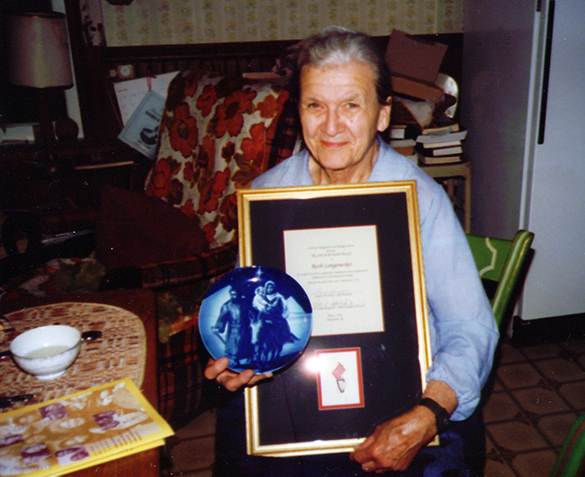
1990s SaltofEAward Salt of the Earth Award for 25 years of service through Lutheran Immigration and Refugee Services in recognition of “exceptional compassion in welcoming the stranger,” as Menno Simons admonished.

When I was a child, Grandma’s house was a Home Depot for relief: On the back porch she collected eggs from local farmers to help the needy. In a corner of the kitchen facing a window with a bird feeder, she parked her sewing machine with stacks of fabric in baskets to make baby clothes, blankets, shirts, pants, pajamas, and comforters. During the Great Depression, the needy were closer at hand, and Grandma would repair raggedy teddy bears with buttons for eyes, and red yarn or rick-rack for the mouth.

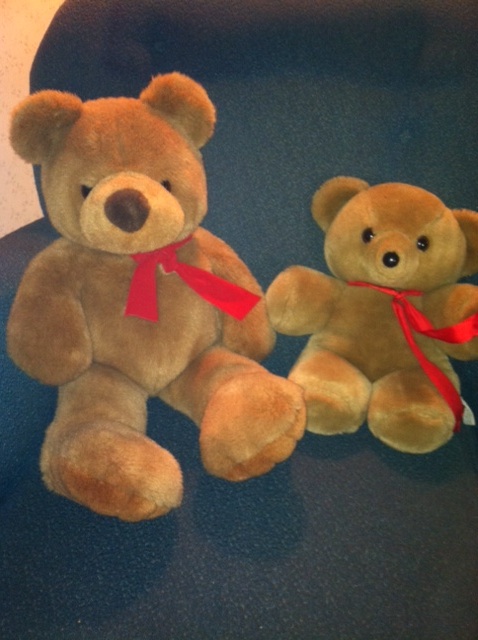
NormalTeddys TeddyBearDepression

Normal teddies                            Missing ears, detached arms

At the heart of all this giving is love, pure and simple. “And now abideth faith, hope, and charity, but the greatest of these is charity.” And nothing says “love” to a child like a teddy bear.

Like this post? Follow my blog and get lots more free of charge! Just type in your email address at the top of the page and click “subscribe.” WordPress keeps your email address private.


Beauty in Jars: 2 Vignettes

Beauty in Jars I

Yesterday morning, Mom assessing my cosmetics on her bathroom vanity: “What are you doing with all that stuff?” She doesn’t wait for an answer. “I wouldn’t know what to do with it all,” see adds as she eyes my jars of moisturizer, foundation, concealer, makeup remover.

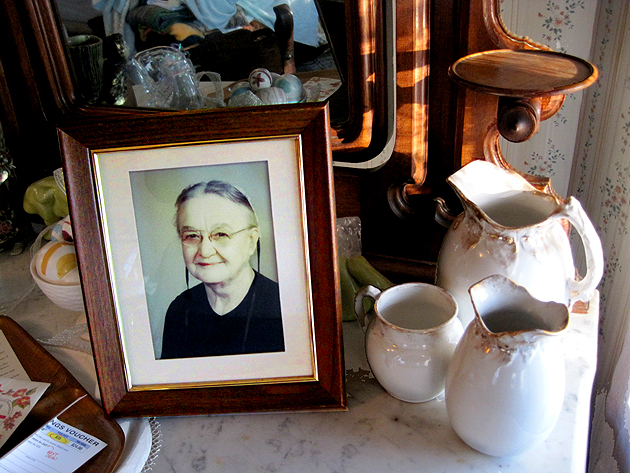
MomMeBeautyblog  Mom continues, “I’m happy with the face God gave me. If He had wanted it different, He would have made me different.” This from the now elderly woman whose husband said to her when they were dating, “You’re the most beautiful thing I’ve ever seen!”

 God has given you one face, and you make yourself another.      Shakespeare’s Hamlet

Beauty in Jars II

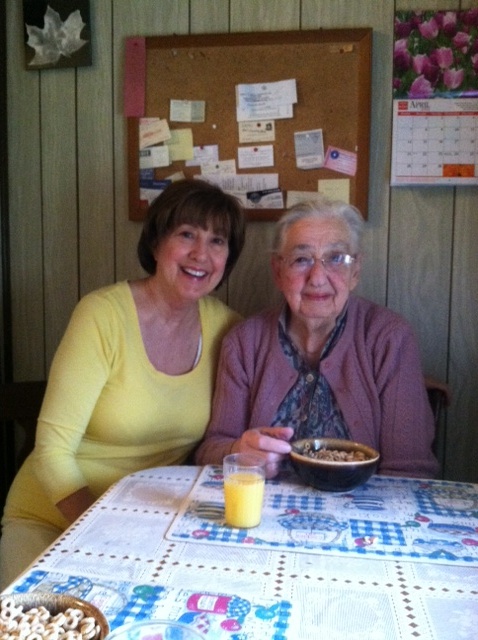
Mother has a smooth complexion for her age—genes or good eating, maybe a combination of both.  She is definitely a foodie, always has been. After eating a breakfast of Honey Nut Cheerios, juice, a banana and coffee, she asks, “Do we need a piece of chocolate now?” as she opens the box of confections from NaNa’s Homemade Sweet Treats in E-Town.

Our last chore together this PA visit is to wash the jars for canning in her basement cellar—Except for a few vintage jars, she’s giving most of them away because as she nears 95, she’s says, “I’m done with canning.” The jars filled with tomato juice, beets, peaches, apricots, pickled cantaloupe, strawberry jam, and pickles were simply beautiful as they lined her wooden shelves each season. There were even green beans before she had a freezer. Every year, her mother-in-law Fannie helped her chop an array of fresh vegetables for piccalilli, or what the PA Dutch call chow-chow. Now she’s donating most of the jars to Goodwill, but keeping a few vintage Ball and Mason Jars. A few have metal clasps that hug the glass lids.

VintageCanJars MomG'byeCanning Jars

            Vintage Canning Jars                       Mom saying goodbye to canning

 All the cliches come to mind here: Beauty is where you find it. Beauty is in the eye of the beholder. You’re beautiful inside and out.

I say, “Beauty is ageless.”

What memories of canning, long ago or recent, do you have? Share your story!

Game Girl

On the plane from Jacksonville, Florida to Harrisburg, Pennsylvania my dark, curly-haired seat mate is playing MahJong on her iPad. She is content clicking and dragging tiles with red, green, blue curlicue Chinese letters across the screen, relaxing and whiling away time as the plane glides over the clouds.

My Mom is a Game Girl. She likes both playing card games and TV game shows. Now I’m at my Mom’s house, and I know that every evening she watches Wheel of Fortune and Jeopardy back to back. Such shows seem pointless to me, but tonight I decide to watch with her. The audience yells wildly “WHEEEL OF FOR-TUNE” as the host bursts onto the scene, beginning with three mind-boggling categories: Things / Show Biz / Food & Drink. My mom coaches the contestant, “Don’t you know it’s too early in the game to buy a vowel?” A veteran viewer, she knows!

When I ask her why she likes the show, she responds, “I like to see if I can solve the puzzle,” and she often can and does.

Next, Jeopardy comes on. The audience is silent, and a disembodied voice announces a curious set of categories: Big City Suburbs / Body Language / Irish authors. Although Mom has never gone past eighth grade, she answers my Why question with this: “You can learn a lot.”

Mom is happy that I sit through the TV games with her. She really misses her game girls. They have all died now,” she says wistfully. Mary (who always said “Went!” after her turn), Bertha, Helen, Alice, and Elsie would gather at each other’s houses to play Skip-Bo, Hand and Foot, or Uno, a quilting bee of sorts with cards and food. Now she plays Triominos by herself and Uno if she has a partner or two.

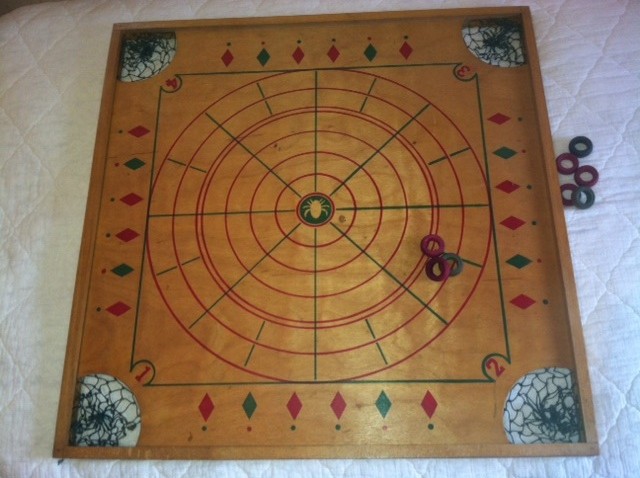
When I was a girl, we had board games: Parcheesi, Uncle Wiggly, Checkers and a Carrom board, a strike and pocket game with little red, green, and white pucks flicked with our fingers aiming for the green nets on each corner. One side of he board was painted for backgammon, the other side for checkers.

CaromBoard

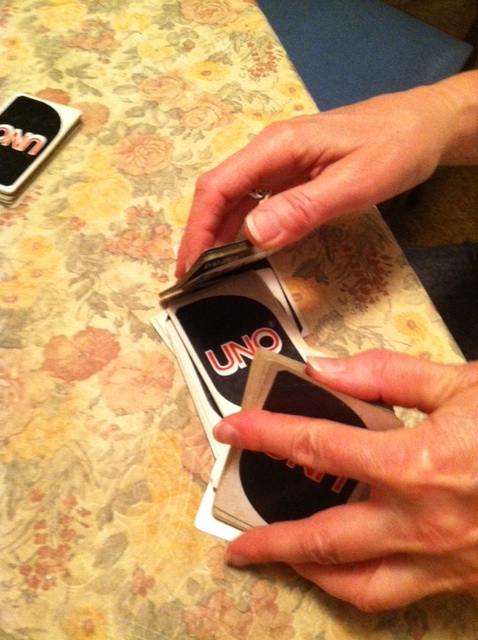
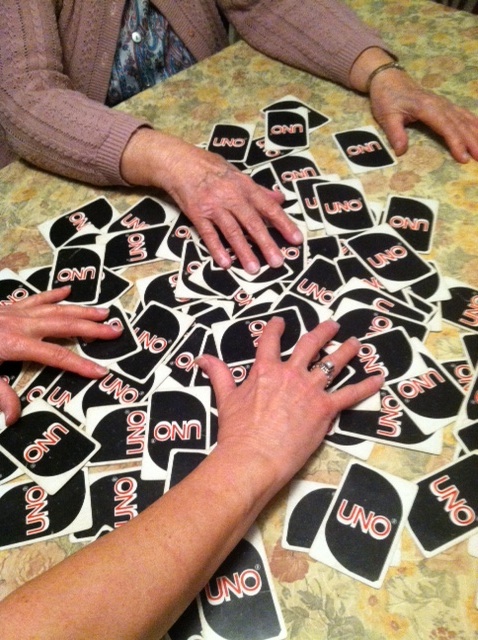
I don’t think we ever had actual playing cards; that would have been frowned upon by the Lancaster Mennonite Conference with its booklet of Rules and Regulations. But now we are playing Uno with my sister Jean. It’s a mindless game that won’t interfere with our chatting at the same time. My mother’s game girls, not having grown up with real playing cards, used the Mennonite shuffle, so we try that technique to turn the tide on my sister’s three-game winning streak. It doesn’t work, but it’s fun nonetheless.

UnoRegShuffle           MennoniteShuffle

Shuffling cards the regular way                     Shuffling cards the Mennonite way

Back in Jacksonville, table game playing is mostly reserved for the younger set. At the Hands-On Children’s Museum, my 6-year-old grandson Curtis tries to initiate me into Chess playing. The Chess pieces are instructive because they are inscribed with names like King-Queen-Bishop-Knight-Pawn and embossed arrows for moves. Curtis is patient with me to a point, but I can tell he is bored because he can simultaneously play a game of Tic-Tac-Toe with a girl on a board at the adjoining table.

Game Girl, I’m not. Given a choice, I’d settle for Scrabble–letters and words make sense to me. Game-wise, it comes closest to reading a book, my recreation of choice. With books or Scrabble, like Mom, I too like to see if I can solve the plot puzzle, and I can be entertained and learn something at the same time.

“The love of learning, the sequestered nooks, and all the sweet serenity of books. . . . ” Henry Wadsworth Longfellow, Morituri Salutamus

What games do you associate with childhood? Any you enjoy now with family or online? Join in!


The Name Game

One day at Elizabethtown High School, a lovely girl from Mississippi with long, red locks strolled into our class a month or two into the term. We were mesmerized by her Southern drawl and relaxed manner. Her name was Jeannine Loux, a last name which she stretched out into two syllables: Looow-ux. We all made up excuses to talk to her just to hear her strange but melodic speech. Obviously, when the roll was called her name stood out among the the German-Swiss names we were used to hearing.

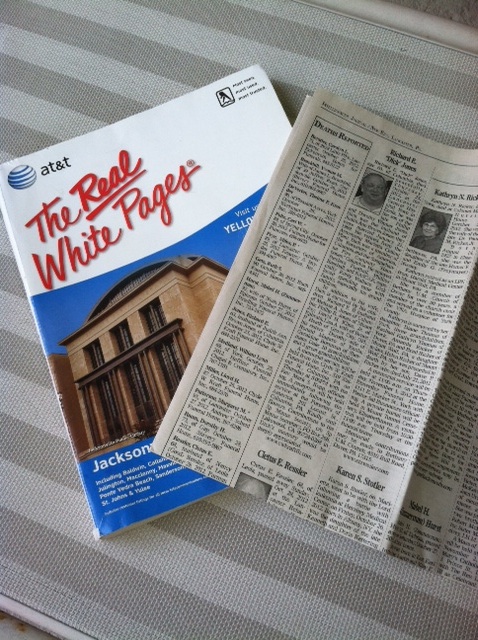
That was the 1950s. Since then, the culture in Pennsylvania Dutch country has become more diverse. Like in Jacksonville, Florida, there are family names like Chen, Patel or Lychenko in the Lancaster, Pennsylvania, phone book. Still, names in either phone directory, an ever-shrinking publication, can give clues to family origin.2Phonephoto Play The Name Game. Which group from Elizabethtown? Which from Jacksonville? You get extra points for saying the names aloud.

Group A

  1. Adams
  2. Anderson
  3. Bailey
  4. Jones
  5. McCall
  6. Higgenbotham
  7. Smith
  8. Taylor
  9. Thigpen
  10. Thistlethwaite

Group B

  1. Diffenderfer
  2. Herr
  3. Hollinger
  4. Kleinfelter
  5. Kauffman
  6. Oberholtzer
  7. Raffensburger
  8. Reifsnyder
  9. Shellenburger
  10. Zimmerman

Any strange-sounding names from your ancestry to share? From another family?

Mom: 3 Vignettes


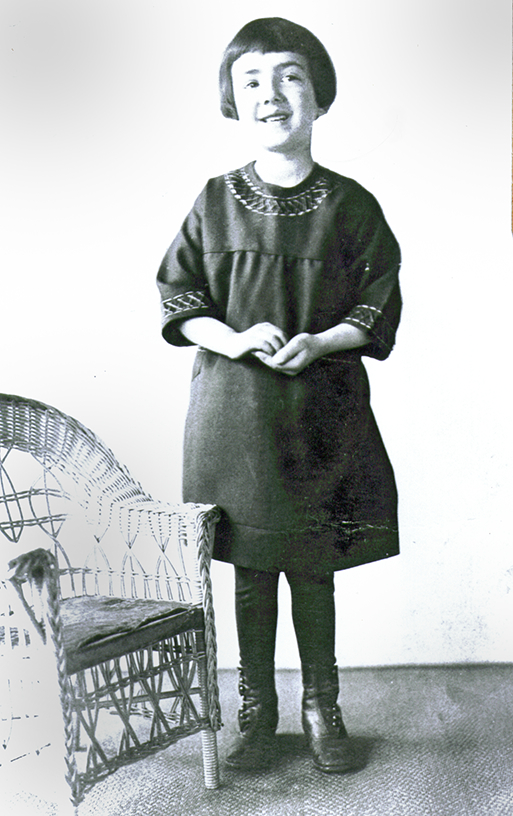
MomasChild    Mom as a Child            MomJiving

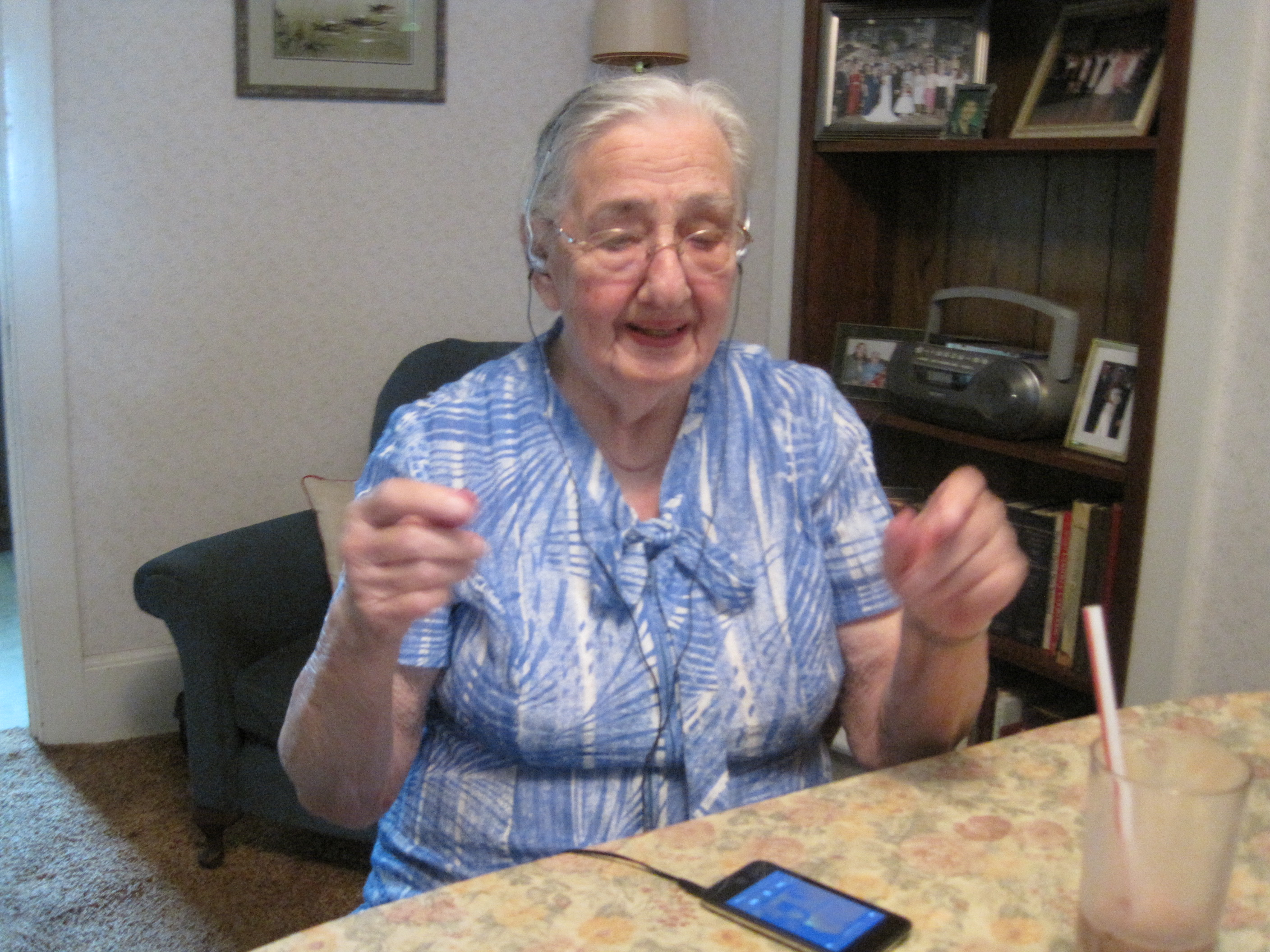
                 Mom Jiving to iPod Music

My mother never had a bucket list, and if she had one, jiving to “Life is Like a Mountain Railroad” on my iPod would not have been on it. My mother grew up on a dairy farm near Lititz, Pennsylvania, the oldest daughter in a family of six. Her own mother, Grandma Sadie Landis Metzler, died when she was nine, and because she was needed at home, her own education ended with the eighth grade. What intellectual curiosity I have comes from my Dad’s side, but I thank my mother for constant demonstrations of the social graces, including cooking and entertaining. She equates food with love of friends and family around her mahogany Duncan Phyfe table but that’s another story. These stories show below give a glimpse of her personality.

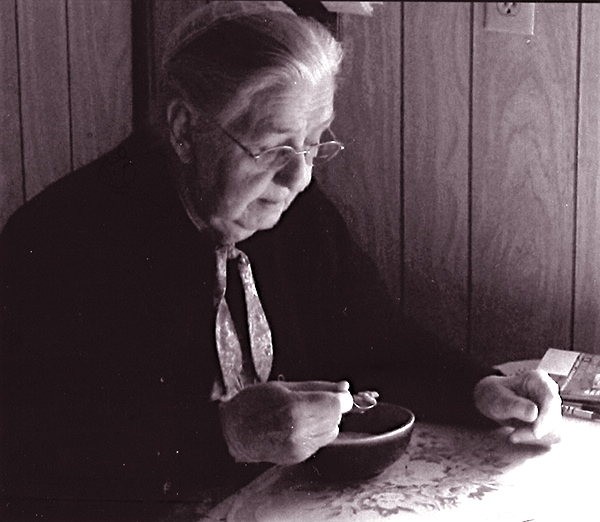
1990s Hands Ruth in kitchen_small-filtered-1  Mom enjoying home-made soup.

Mom’s Other Men

Growing up, I noticed my Mother had a lot of men in her life. None of these men competed with Daddy though, and there was no jealousy between them that I could detect. She didn’t have a driver’s license, but life came to her door in the olden days.  The Milkman aka Hertzler’s Dairy appeared twice a week and deposited 2 quarts of milk in an insulated metal can with a hinged top. The Stroehmann’s Bread Man walked into the house with his baked goods on a flat tray strapped about his neck: bread, doughnuts, cookies, other sweets. Once a week, a step-van swung by with the Green Grocer huckstering produce of every description: lettuce, beans, other fresh vegetables. To keep it all chilled, the Ice Man came and put a block of ice on top of the refrigerator to cool the food stored below like an ice chest. Every so often the Stanley Man, like a Fuller Brush Man, delivers brushes, cleaning fluids, plastic containers, and shoe strings. The Scissors Man came too with tools to sharpen knives and scissors. Two of Mom’s helpers cruised by in their trucks. For example, Groff’s Meat Market truck came by each week and stopped at the Longenecker house, but only if Mom remembered to put the cardboard card spelling out “Groff Meats” in the living room window. Also, the Rag Man announced his arrival with a sing-song “Rags, old bags” litany as he cruised down Anchor Road with his window down. When Mom opened the door, he took her left-overs, stuffing cloth remnants from Mom’s sewing projects, along with her old wash rags, into his trunk. She had it good!

My Mother – All Things Even

My Mother says she clipped red, pink, and white peonies and set them out on the porch for Memorial Day pickings. Today she has called a neighbor and invited her to come over and take some to share with the other family in the duplex across the street, so everyone gets a chance to enjoy the beauty.

That’s my Mom, with everything fair and even. Like the story of “ The Three Bears“ —not too big, not too small, but just right. The spouses of two of her four children have left their mates. That’s one too many. Pearl and Mary Jean and Cecilia have only one of their children divorced–but not two, that’s excessive. Even one’s too much. Why can’t they “forgive and forget? I just don’t see it,” she says.

Then there’s the matter of the walkers at Bosslers Church. Becky and Sister-in-law Ruth each have a walker. That makes two in the church, so Mom walks in with a cane. “Why a cane when you usually use a walker when you leave your house?” I ask. “A walker would certainly give you more stability, maybe even keep you from falling. Besides, you are the oldest one of the lot. You’ll be 95 in July. People would certainly understand.”

“Oh, we can’t have three walkers at the church. Three walkers in the aisle at Bosslers Church? Tsk, tsk, that would be too many. I’ll just use my cane.” Is it pride, is it something else? No, she just wants things to be even.

Sometimes when I call my Mother, our conversation ends with my quoting Jude 24: “Now unto Him Who is able to keep you from falling and to present you faultless before his presence with exceeding joy, to the only wise God our Savior, to Him be glory, majesty, dominion, and power, both now and evermore. Amen.” Of course, I mean the verse to be applied literally. She gets the point. Last Christmas, though, the meaning of the verse slapped me in the face, yes, actually!

Please Keep Me from Falling

This Friday morning I have Teddy on his leash.  Teddy is a cute, playful Cocker Spaniel that licks, jumps and snuggles all in the same minute. His parents and brothers are on vacation in PA, so I have volunteered to walk-pee-poop him around the block—well, several blocks.

Here we gooooo—whoooooooosh! We shoot out of the gate full throttle and down the first block, inspecting Christmas decorations, licking interesting morsels here and there. Oh, here I see some fern fronds that would look good in the vase on my kitchen window sill to garnish the pink & white camellias. I twist the stem and pluck it: Left hand, dog leash—right hand, fern frond. We turn the corner; the sun is shining brighter, the dog scampering left and right enjoying the brisk morning air.

My foot hits a concrete abutment on the sidewalk. Now I find myself in a weird posture, one I typically use only in Power-Pump on Mondays and Fridays at the gym with a 5-pound weight: I’m at a 45 degree angle propelled by the uneven pavement, and I’m falling—I mean really faaaaaalll-ing. Like stills in a movie, my body moves forward in jerky, slow motion. For a split second I think I can right myself, but NO, I’m going down for the count with both hands extended, unleashing the pet, my glasses, the frond and all my uprightness. Blood spurts from both knees, my hands are scraped too; I’m really banged up!

My uprightness—there’s a thought. Always longing for a balance in mood, sense of spirituality, level of energy, not being upset. How many times have I quoted verse 24 from Jude to my 94-year-old Mom: “Now unto him who is able to keep you from falling . . . .”

Indeed, I lost my balance and my dignity for a moment. But, it could have been so much worse: The dog didn’t run off, I am ambulatory despite scrapes on both knees and hands. Where were the angels? My brush with the sidewalk, I could assume, is to remind me that the law of gravity still works and—I am human and therefore subject to its laws. Yet, this time it was ordained that I recover, pick myself up, avoiding a visit to the emergency room with the need for X-rays, a doctor’s diagnosis, splints, or crutches. Who can discern “ Eternal Providence, / And justifie the wayes of God to men”?


You probably have a story about a quirky relative, your mother or someone else. Share it here.

Something else you thought about as you were reading?

A Walk in the Woods: Innocence and Disgrace

MY STORY

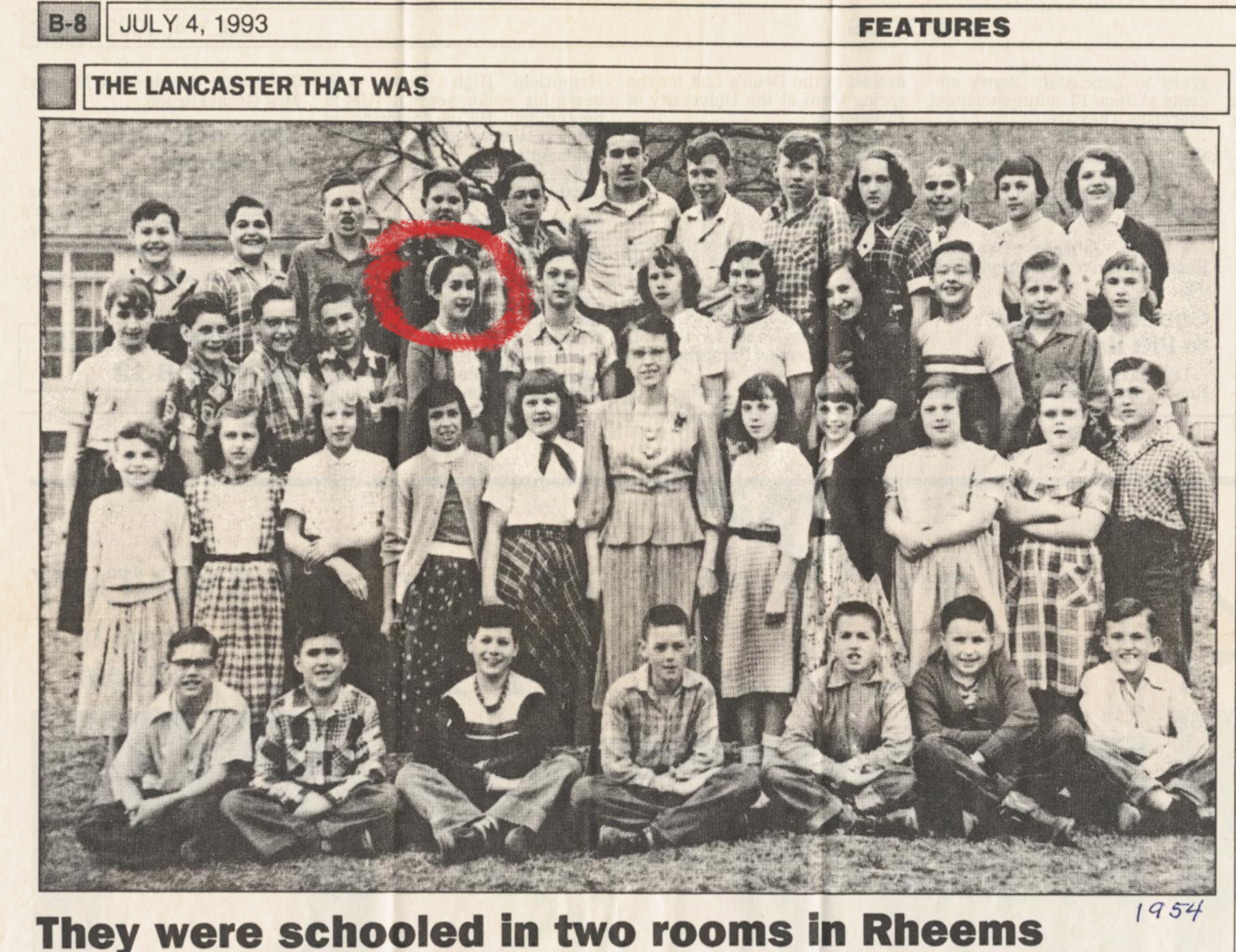
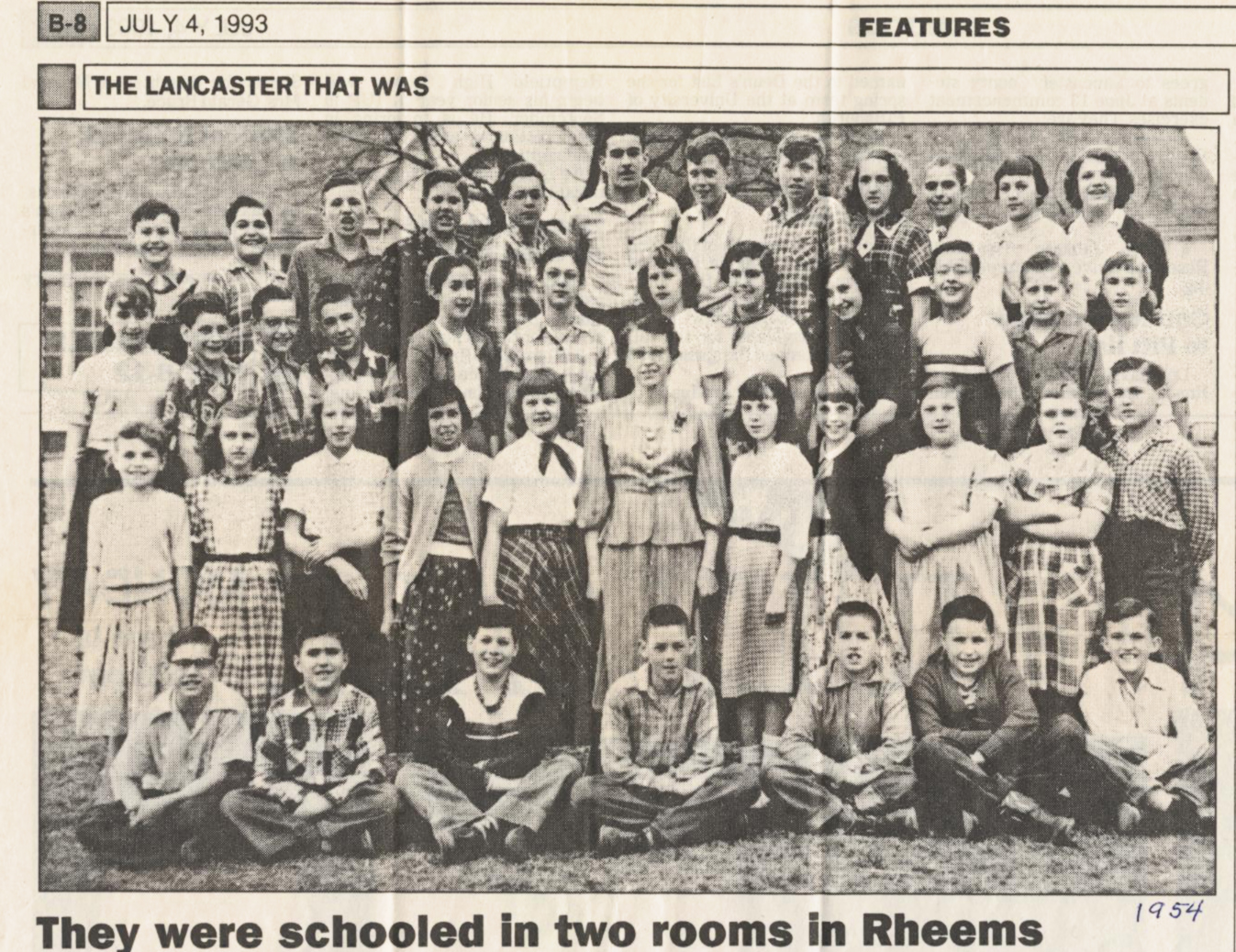
Wayne is good in math. He with the crew-cut and quiet, methodical ways can easily navigate math’s maze of numbers. We are both fourth graders at Rheems Elementary School. Unlike me, Wayne is a mathematical whiz; in a split second he makes sense of long division and fractions. But he likes to explore nature too. The village of Rheems is his home and mine is farther out, closer to real country.                                             RheemRedCircle Wayne is behind me in photo circa 1954

Wayne and I sometimes walk into Grandma’s Woods to explore nature and make up stories. One day we walk together to the woods, the three or four acres my sister Janice and Jean and I have already dubbed Sherwood Forest. The woods is actually a thicket of trees encircling a small quarry, now overgrown with moss and grass. The best route to the woods goes up the sledding hill, through a cluster of weather-worn Revolutionary War era tombstones growing cockeyed out of the grasses and overhung by raspberry bushes arching their fruit-laden spikes on the edge of the woods, not far from the Pennsylvania Railroad tracks.

Mark in Woods  Entering the deep, dark woods

Minutes become an hour or more as Wayne and I fancy Robin Hood and his merry men traipsing through. Another day we might imagine Hansel and Gretel wearily trying to find their way back home. The Eagle’s Nest is a special stop-off in the woods: there is no eagle, not even a nest. It is just a spoon of sod and rock perched on the edge of a bluff overhanging Grandma’s sweet cornfield. Before going back down the hill, Wayne and I sit now in its concave shelter and relish our snack of fresh-from-the-garden mint tea, pilfered from Grandma’s Frigidaire and fresh-baked molasses cookies.

Wayne asks, “Did you know New York City is built on solid limestone rock, just like the quarry over there?” He points in the direction of the Heisey Quarry, on the other side of the railroad tracks. Wayne is always making scientific pronouncements like this, adding to my store of knowledge.

But at the moment I’m more interested in plants growing in the humus right beside me. “Did you know there’s medicine all around us? My Grandma comes up here to find the leaves for Stinkin’ Tom, an ointment that smells like skunk, and Pig’s Ears plants to make salve for cuts and bruises and rashes.” Grandma harvests the herbal mixture from the plants in the woods and fries it in lard to concoct an ointment for healing. (See recipe “My Grandma’s Kitchen” post.)

“No kidding?” Wayne seems shocked that I know something he doesn’t already know.

“Yes, yesterday when I skinned my knee on the gravel, she got out her little round tin box, stuck her finger in the greenish goo and slathered the magic potion all over the cut. It smelled like licorice and onions  . . and skunk!”

“See,” I exclaim, proffering my bandaged knee, “it’s working already.”

Soon we scale down the twenty-foot bluff to flat land, barefoot toes pointing downhill, gathering momentum by the second. We run a short distance as the ground levels off. “Ouch!” we wince in unison; the gravel on the path to the house hurts our tender feet, not yet made calloused by long summer days outside.

Grandma is out on the back porch to greet us. Greet us? Heavens! She looks mad. And she has a yardstick in her hand too. Wayne flees as I get the one licking of my life from my Grandma, my warm, cozy-sweet Grandma.

Why did you do a thing like that?” Over and over she yells, “Why did you do a thing like that?”

I can’t imagine why she is giving me such a hard spanking just for playing in the woods with Wayne. What did I do wrong? Wayne was Robin Hood and I was Maid Marian, just like always. Aghast and confused, I wonder, “What is so bad about what we did that Grandma would get mad enough to spank me so hard?” I thought we just went for a walk in the woods.

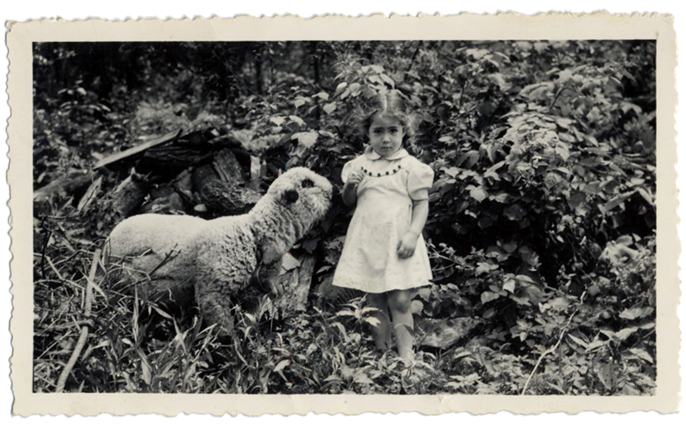
MarianHadALittleLambSmall             

The Back Story: My Victorian Grandma

Grandma is Fannie Horst Martin Longenecker, a handsome woman from Middletown, Pennsylvania, who was fancy before she married her plain Mennonite husband, Henry Risser Longenecker.

                                VictoriaGrandma_mod_3.5_180

As a girl, Grandma loved music and always walked to get back and forth from her piano lessons. Riding home from her lesson one afternoon, she was accosted and violated by a “man with a swarthy complexion,” according to the newspaper article about the incident.  From that point on, her father, Samuel Brinser Martin, allowed her to ride a horse to and from her lessons.

My Grandma Fannie never told anyone about the incident until her sister Sue shared the story with Grandma’s daughter, my Aunt Ruthie. Years later, I learned of the story and understood only then why she had whacked my bottom so mercilessly.

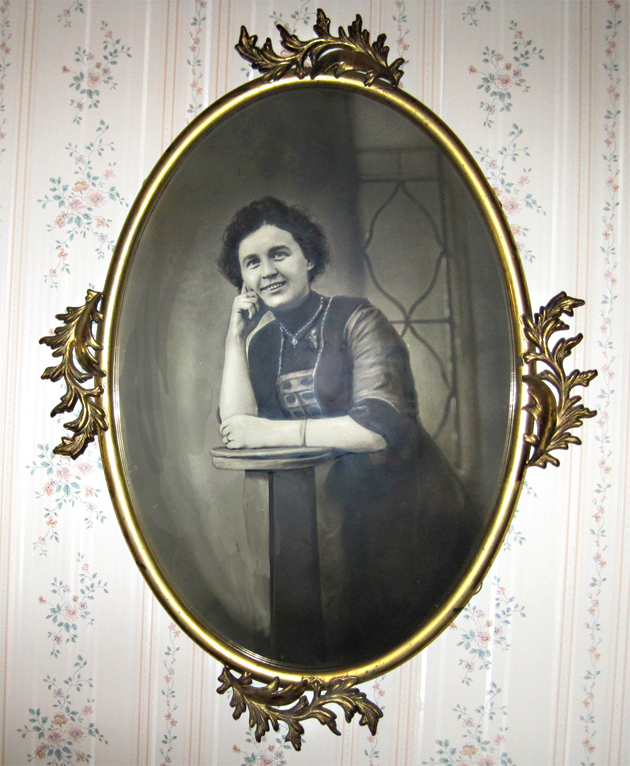
                          GrandmaPortrait_mod_3.5_180

Here’s my warm, cozy-sweet Grandma but years older than she appears in the story.

What innocent act do you remember from your childhood that was misinterpreted by an adult? Were the  consequences similar to mine? Tell us your story.

7 Easter Memories

1. Quiet time for Mom 12 – 3 p.m. on Good Friday afternoon to correspond to time Christ hung on the cross.

2. Easter jackets fully lined in pastel tweeds or plaids made by Aunt Ruthie. Easter dresses by Mom, sometimes with smocking or embroidery.

3. Home-made peanut butter and coconut eggs covered in glossy chocolate. (See recipe in “Mom’s Kitchen” blog post.)

4. Fancy lady hats donated by Grandma’s dear friend, Mame Goss, who worked in a millinery shop. No, we didn’t wear them to church!

GossHats

5. Easter eggs hidden under the pear tree, lilac bushes, behind the chicken house, in the tulips, wherever.

6. Deep voices singing full force “Up-from-the-grave-He-arose” from the hymn Christ Arose.

2ChristArose

7. Aunts, uncles, cousins surrounding a huge table groaning with ham and all the fixings.

What are your memories of this season?

Plain and Fancy @ Bossler Mennonite Church

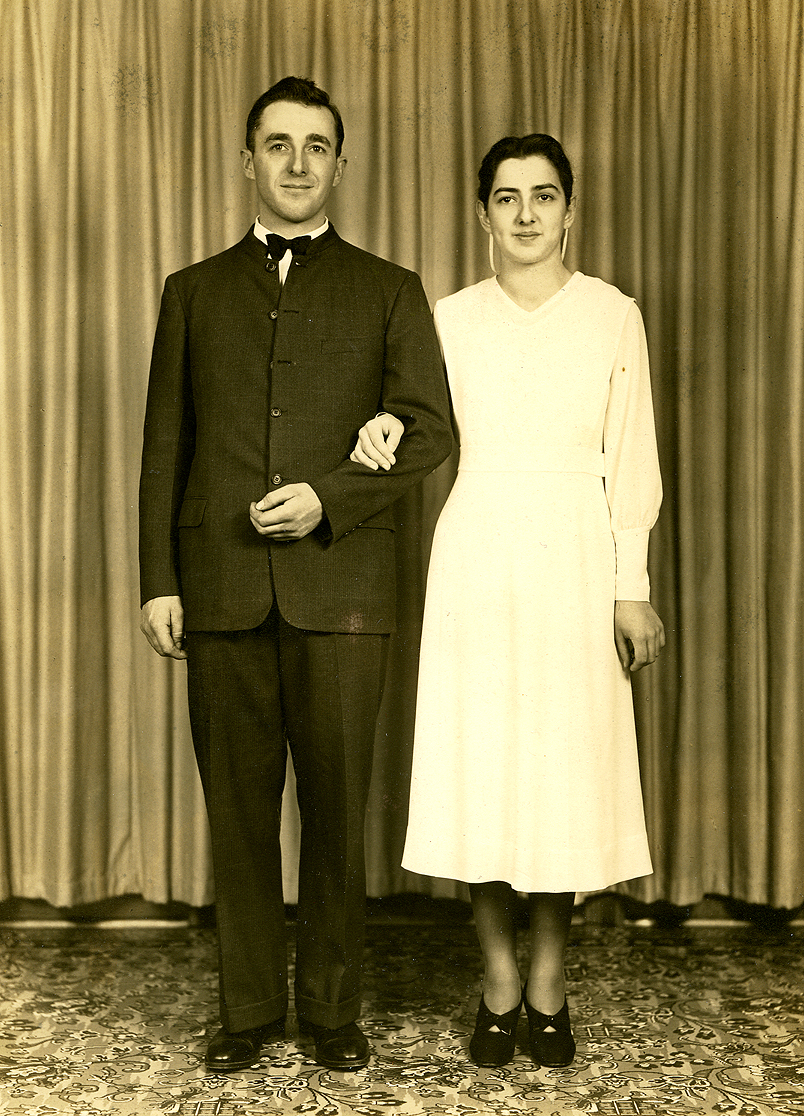
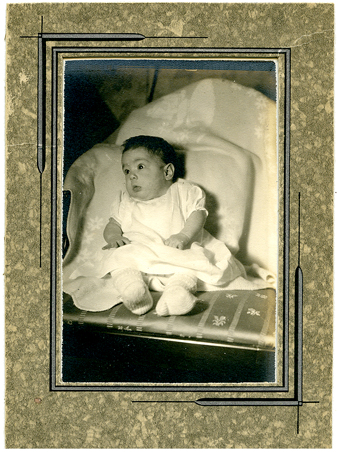
When I was about 6 weeks old, my parents took me to church–Bossler Mennonite Church close to Elizabethtown, PA. I was born in July–9 months, almost to the day, from my parents’ honeymoon night the previous October. When I got older and could figure out such things, my mother simply said, “Nothing happened before we were married.” She said it, so it must be true. In those days, abstinence was the professed norm for engaged couples, and a white dress almost certainly meant the bride was a virgin. A couple whose first child arrived too soon after the wedding date had to appear in front of the congregation and confess their sin of fornication.

Ray and Ruth Longenecker_5x7_150            Marian_as baby_5x5_72 19-05-17

The Christian Mingle of the 50s and 60s happened after the Sunday night service with girls and guys in separate groups lingering, a girl hoping for a guy to break out of his circle and ask her for a date. Weddings were frequently held in the fall, not in summer, after crops were harvested and the family and relatives had more time for big social events.

RuthL.bride Here is Dad’s first cousin, Ruth Longenecker, all decked out in her caped, white wedding dress and black shoes gazing at her tall, blond groom who wears a plain suit and no necktie. She carries a lacy handkerchief, something fancy, inserted into a white Bible (flowers were forbidden then) as she walked down the aisle.

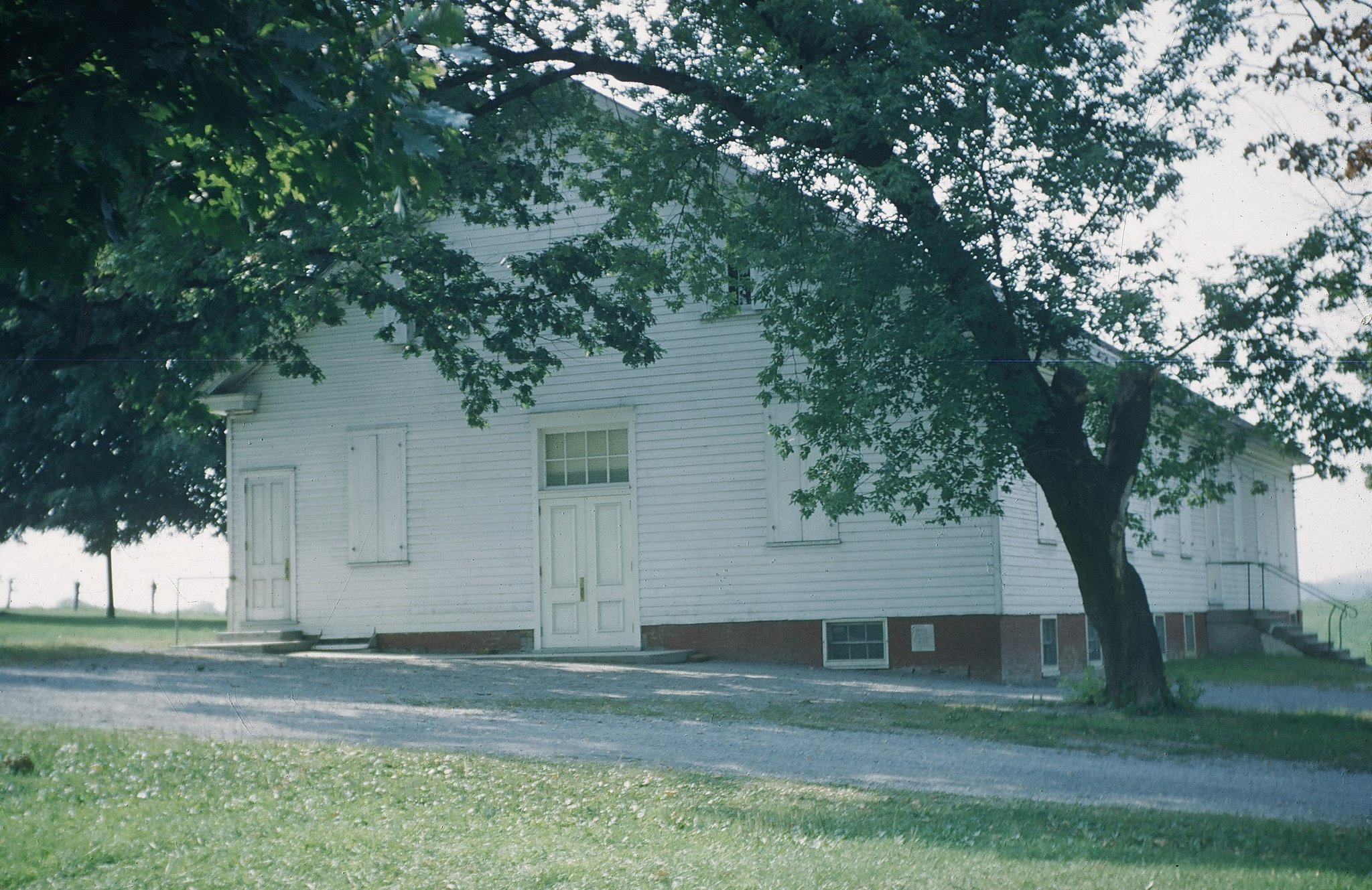
Bossler Church, which celebrated its bicentennial in 2011, was not at all fancy: white building with no steeple and a separate door for the women to enter at the left of the main entrance.

ChurchExterior

The interior too was spare with a middle aisle separating two rows of benches, the one on the right for the men. The other on the left for women. When Mr. Christian Clown Daring Do visited with me one Sunday, he plopped down on the women’s side, mortifying everyone including me.

Bossler Interior_mod_

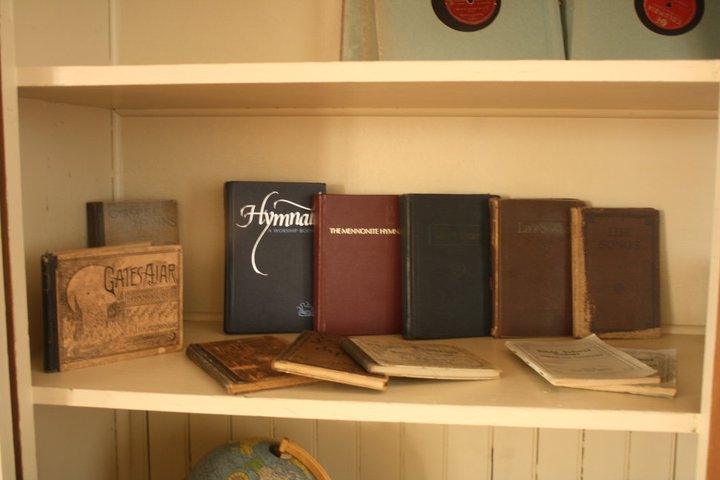
The separate sections, however, made for a wonderful blend of voices when we sang a capella in four-part harmony. No piano or organ in sight.

hymnbooks  Screen shot 2013-03-23 at 8.46.30 AM

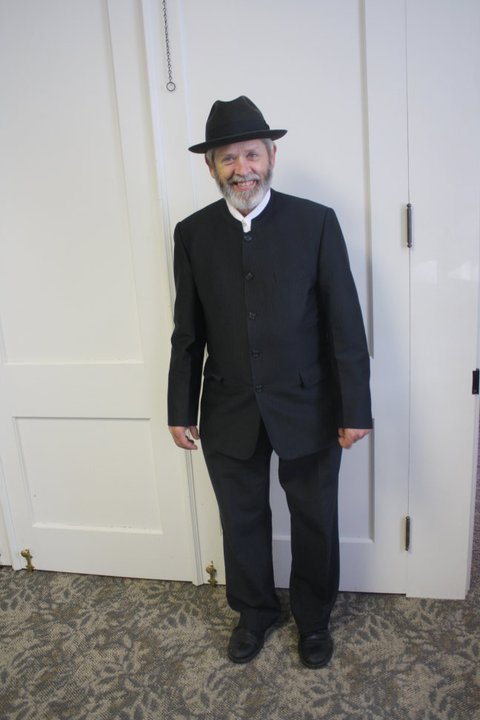
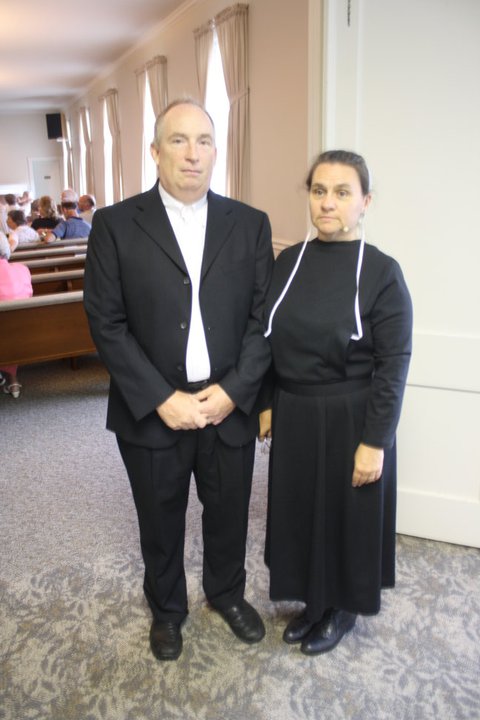
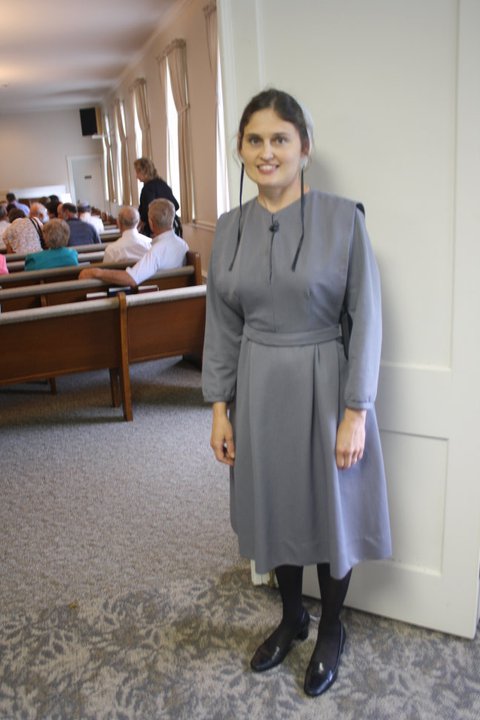
Of course, no fancy garb for members or minister: plain coat and sometimes a beard for the men, and a caped dress with a prayer veiling for women. Usually the older women had black ribbon attached to the veiling while the younger ones had white ones.

PastorFred plainCoupleBlack plaingirl

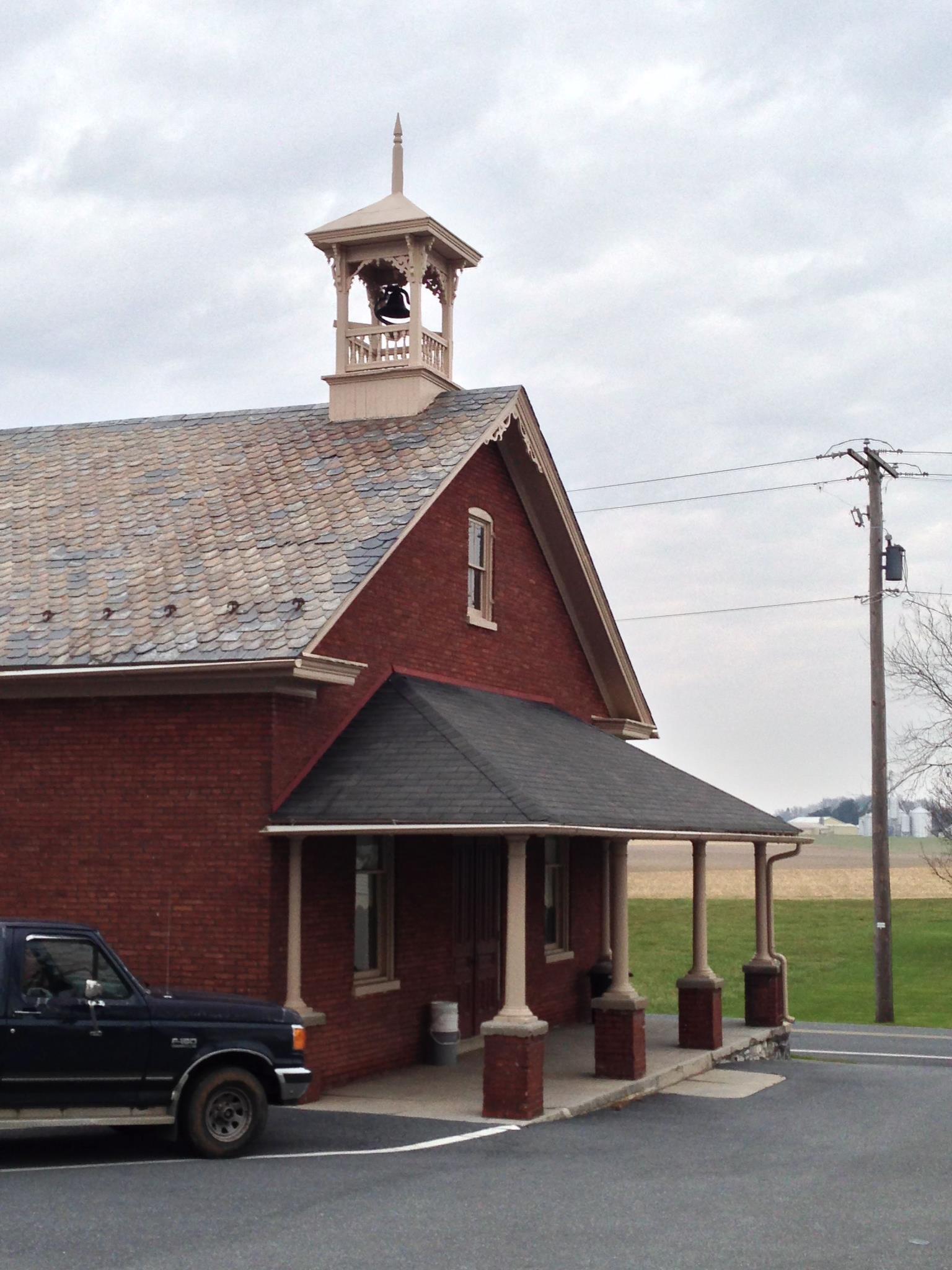
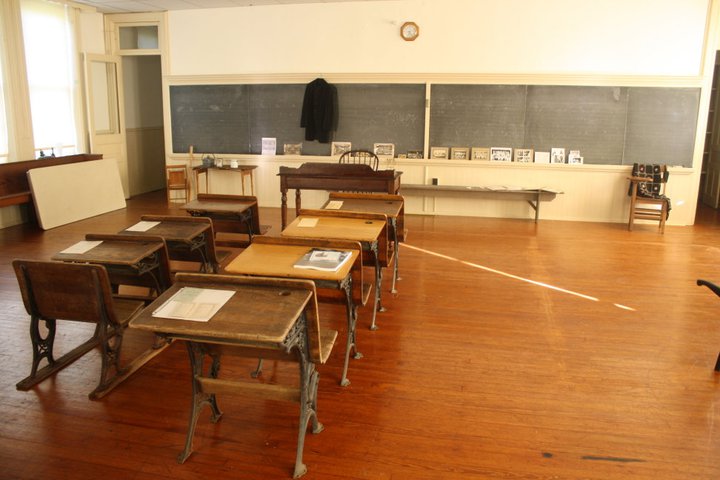
Next to the church was Washington School grades 1 – 8 with our church deacon once serving as schoolmaster: fancy bell tower, plain interior embellished only with replicas of

SchoolBell     Gilbert Stuart’s painting of Washington and Lincoln, an American flag, and little cards for each letter of the alphabet, printed lower and upper case set above the blackboard.

schoolexterior   schooldesks  original desks                                                                                                                       on display

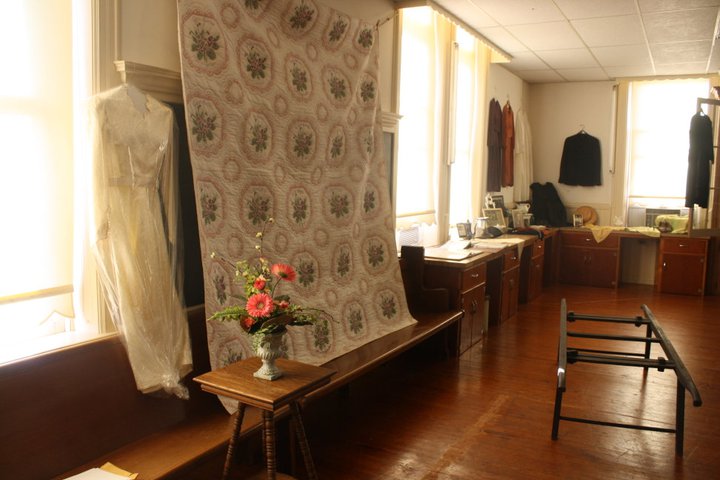
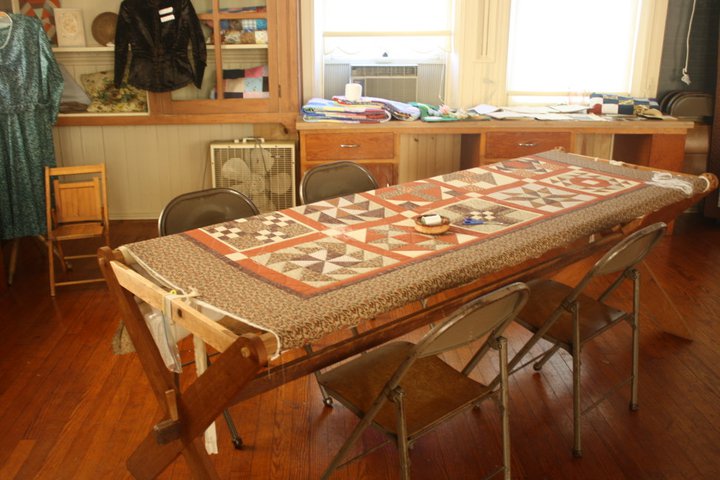
For Mennonites, the church was the hub of social life. When Howard Longenecker’s barn burned down, twice, men were on hand for the barn raising. Women gathered regularly in an anteroom at the church, or, later, at the school for sewing circle where they made comforters, baby blankets, and quilts.

quiltverticalquiltSchoolhouse

Plain or fancy? Which do I choose?  I choose both–as long as they are beautiful. “A thing of beauty is a joy forever.”      John Keats, Endymion

To some, my story seems quaint and odd. To others, it resonates because you share a similar heritage. What experiences in your childhood or teens do you think curious readers would like to know about?

How We Met: CareBear Cliff

Cliff

Whenever I leaf through my Bible, I often spot a special verse, Genesis 12:1, and note the date in the margin, July 1966: “Get thee out of thy country, and from thy kindred, and from thy father’s house, unto a land that I will show you.”

This is the catalyst for change I refer to constantly as I plan the journey alone from PA Dutch country to Charlotte, NC, where I begin a new and culturally shocking part of my life. Since graduating from Eastern Mennonite College in Virginia, I have spent the last year and a half as Sister Longenecker, teacher of English to seniors at Lancaster Mennonite School. I watch my p’s and q’s inside and outside of the classroom, especially outside of the classroom, making sure the fabrics I buy at Musser’s Fabric Shop to make my long, caped dresses are not too bright (maroon, not cherry red) and that I’m shod with pedestrian-looking shoes, brown or black—and not shiny patent leather, which I crave. In other words, I am to be a role model for my students. My colleagues, Verna, June, and I share experiences and expenses in a smallish trailer nestled in a grove of oaks on the edge of the campus. We risk renting a TV for major events (Kennedy’s assassination, for example), and get caught once by an inquisitive student who knocks on our door, spies the blue glow of the TV, and reports us to the dean, who gently chides us to get our news by less worldly means, like the newspaper. Life is calm and predictable like the repetitive blip on a heart monitor or the gentle swing of a clock pendulum. Too calm, in fact. I am ripe for change.

My next door neighbor, Paul, is dating a Guatemalan beauty, Betty, whom he met at Bob Jones University, considered the most square university in the world, I read in the October 1965 issue of Atlantic Monthly.  Paul shows me Cliff’s photo in his yearbook, and the image I see grins back at me like a clown; Paul tells me Cliff is from the west coast and doesn’t want to spend ten days of his Christmas holiday in a car (actually a commodious, ancient hearse, I discover later) with eight other Westerners just to be home for Christmas. “Will you be Cliff’s date for the holidays?” Paul proposes.

BlindDateScreen shot 2014-02-14 at 7.57.36 AM

Tonight, a few days before Christmas, I’m meeting the mystery man. Thick, dark brown braids circle the back of my head like a slipped halo, held in place by black wire hairpins. The white net prayer veiling usually covering my head is missing this evening; I am beginning to chafe under the traditions set by my culture. Later this evening. Paul, Betty, Cliff from the West, and I are all going out for a snack at Plain and Fancy. The doorbell rings at the home of the Longenecker’s. I wonder what Cliff looks like in person. And so I meet him for the first time, he at the bottom and I at the top of the stairs leading down to the dining room and the entryway of our front door.

A tall, blond fellow with deep-set eyes looks up at me after Mom opens the door:

“Nice to see you again,” Cliff says. Oh, he’s witty, I think.

“Nice to see you again too,” I say, not skipping a beat.

As the evening progresses, I find out that Cliff is an artist, and when he and I come back from the restaurant, I pose in the living room for my first live portrait. Several times I try to peek but to no avail.

“No,” he insists, “it’s not finished yet.”

After thirty minutes of fierce sketching, he announces that the masterpiece is finished.

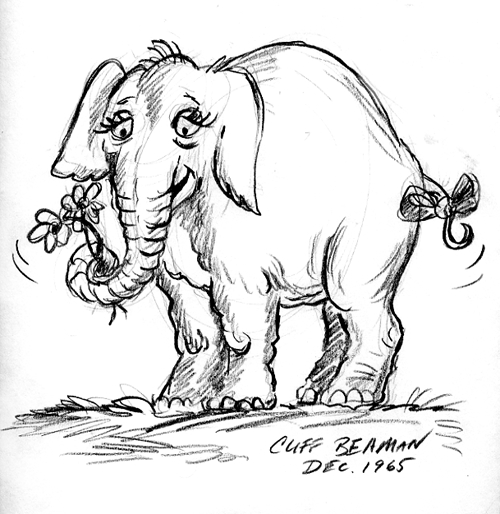
“Are you ready?” Cliff smiles, handing me my likeness. Shocked, I stare with open mouth and then blink in disbelief as he hands me a cartoon elephant with a blue ribbon around its tail.

“I can’t imagine why you spent all this time on . . . just an elephant, Why didn’t you draw a real picture of me?” Now, he laughs, a real guffaw.

Elephant drawing_7x7_72(1)

Tonight I have met a blond, blue-eyed Christian clown who seems clever, likes art, and thinks (though he doesn’t tell me then, of course) that I am the most unusual-looking person he’s ever met. There is mutual fascination: a young man from Washington state who wears a class ring the size of the Pope’s and a quaint-looking, plain girl from Lancaster County, Pennsylvania.

One evening a few days later the four of us, Paul, Betty, Cliff and I, pack ourselves into Paul’s ancient, black Mercedes to go decorate the former Schwanger’s Carpet Barn for Christmas, before it became a mission of Rheems Grace Brethren Church. I say pack ourselves because Cliff and I are sharing the back seat with Paul’s huge accordion case. Cliff, I notice, is wearing a thick coat with a furry collar and a black Cossack hat; he looks bear-ish, for sure. Patches of recent snow dot the cold, hard ground creating a winter-scape that matches my sombre mood. Just today the mail brought me a Dear John letter from a beau actually named John, a quasi-romantic carryover from college days. “I don’t think we should continue our relationship,” he says, Just like that! I have mixed feelings about this; I didn’t actually like John all that much, but it was nice to have someone.”

Cliff, Paul, and Betty are in high spirits now as we tumble out of the car, loaded with boxes of holiday festoon: rolls of garland and tree decorations; I soon get carried along with their bright mood. We unfurl the green and red garland around the windows and trim the tree, activities I relish for the first time. Mennonite families of the sixties frowned upon the glitter and glitz of Christmas.  When the church looks festive enough, Cliff gets out Paul’s accordion and bellows, “Joo-eey to the Worr-ld, the Lor-rd is Come!” and we all join in. After a while, Paul and Betty practice the ever more joyous, “Ring the Bells,” Betty’s solo soprano accompanied by Paul who loves to embellish her lyrical voice with lots of runs and trills.

Meanwhile, Cliff in the rear, is sketching on the chalkboard a Santa Claus, a snowman, and finally a manger scene.  “He is really talented,” I observe, but then wonder, “Why is he a theology student if he’s so good in art?”

We’re all getting hungry and Paul suggests,” “Hey, let’s go back home and make popcorn and listen to records. Paul has a huge stash of LP’s: Mantovani and the Reader’s Digest mood music: “Candlelight and Wine,” “Heavenly Voices,” “Hawaiian Paradise,” and “Songs at Twilight.” The Christmas tree lights at his house are all the illumination we’ll need to fall into a sentimental mood.

And so we pack up and climb back in the Mercedes with Cliff and me in the back seat again. The accordion case seems even more gigantic now, and there simply isn’t room for all the arms and legs. “Excuse me, but I’m going to have to put my arm on the seat around you,” he says.

“Oh, he doesn’t want me to think that he’s too forward,” I suppose.

The car moves deftly over the icy spots, thoughts of the “Dear John” letter fly into my head again, and I tell Cliff my sad news. My new-found friend seems to care genuinely. Tears fall and etch a crease down my face, he leans over to plant an empathetic kiss on my cheek, but he misses the mark as I drop my head and gentle as a butterfly touches my right eye with his lips  instead.

“How odd,’ I think. “A first kiss. . . and on my eye . . . how strange!”

Many nights Cliff and I indulge ourselves in the bounty of Paul’s kitchen pantry. This upstairs kitchen was purposely stocked by his mom, Edna, who also happens to own the Clearview Diner on Route 230. On the nights we eat at the Clearview, we enjoy good Old Pennsylvania Dutch meals—chipped beef and creamed gravy slathered over toast, loads of meat loaf, potato salad, carrot and raisin salad, and heavenly desserts like banana pudding, Dutch apple pie, mince pie, all savored as we share bits and pieces from each other’s lives.

And every night, it seems that we end of up again in Paul’s tiny upstairs living room cramped by a large sofa. The lights from the tree which sits snugly in one corner seem to shimmer along with the strains of “Winter Wonderland.” As we talk, the evening hours too soon fade into early morning. During these hours of popcorn, hot mulled cider, music and talk, our new bond of friendship grows quickly. We exchange stories about ourselves and our families, our hopes and ideals, and dreams of the future. One evening I notice a button missing from Cliff’s black “bear” coat and offer to sew it on. He digs around in his pocket and comes up with the button. Up and down, up and down, I sew and finally the button is snugly fastened to the wool jacket. I tie a knot on the under side and Cliff offers:

“Here, let me cut the knot,” as I hold the threads taut.

“Okay,” I say, assured that he’ll know what to do next. And then he snips the thread under the knot, totally severing it from the button.

“My stars,” I scream incredulously, “What did you do that for? Now the button won’t stay on because the knot is cut off!” I can’t imagine how anyone wouldn’t know where to snip the thread.

“Well, I didn’t think I was actually cutting the knot off; I guess I just happened to cut too low,” Cliff adds lamely.

But no excuse, logical or not, will suffice for what is in my books such an irresponsible mistake. The discussion escalates to a one-sided argument, and only a kiss temporarily diffuses the dismay I feel. My anger spent, Cliff then leans over, kissed me on the mouth this time. “I think I’m falling in like.” he whispers in my ear.

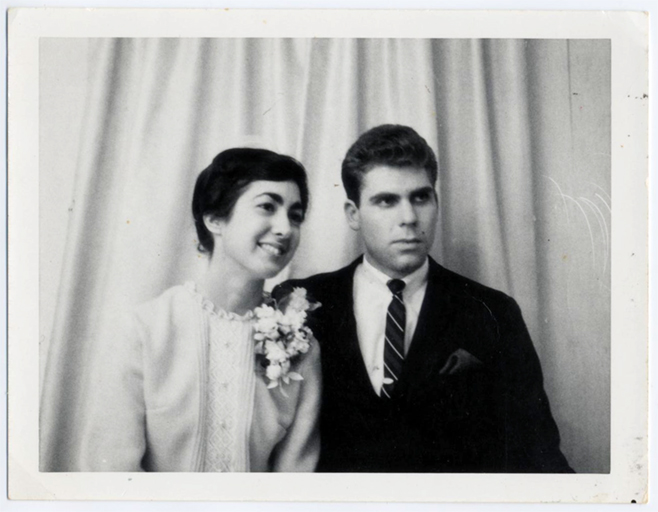
Marian_CLiff-firstnight     photo

I told you my love story. Now tell me yours.

Do you agree with Tennyson, “‘Tis better to have loved and lost / Than never to have loved at all”?   from In Memoriam A. H. H.
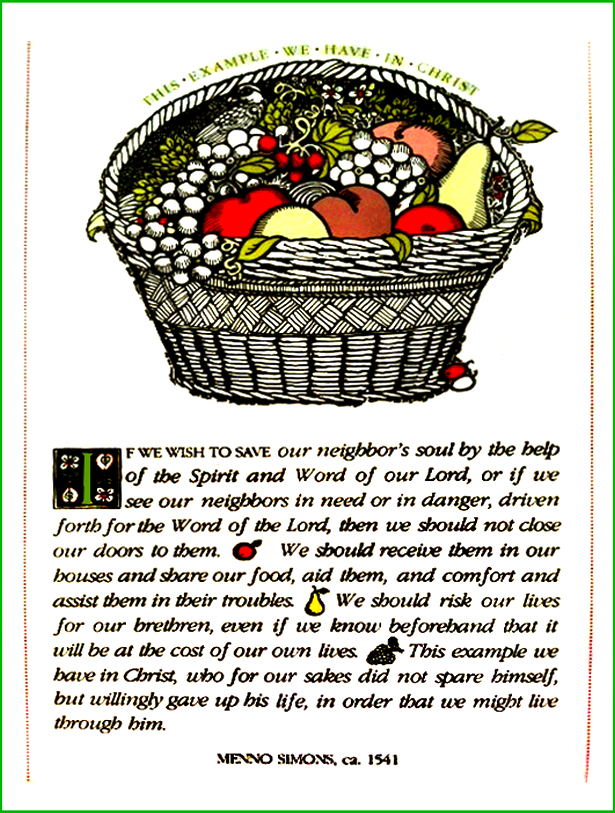
A Hornet’s Nest: The Bishop and My Shoes

They were gathered in a circle when I walked in. Call it naivete or being preoccupied with my classes, I was totally unprepared for the conclave of bishops, school administrators and other assorted male authorities that greeted me on entering the conference room at Lancaster Mennonite School where I was part of the English faculty. Yes, I had walked into a hornet’s nest indeed:

Bishop: Hello, Sister Longenecker

S. L.  (weakly) Hello

Bishop: We have called this meeting with you to discuss some matters that relate to the standards of this school and your manner of dress.

What! . . . This is an ambush.

S. L. Oh . . .

Bishop: Yes, you are familiar with the contract you signed last year when you were hired for this position.

S. L. Well, yes . . . .

Bishop: In it you agreed to uphold the “Rules and Discipline” of the Lancaster Conference of the Mennonite Church.

Christian Doctrine_cover_150_med

S. L. Yes, I recall. . . .

Bishop: You remember also there is a statement about the wearing of the plain cape dress.

S. L.  No comment . . . listening intently

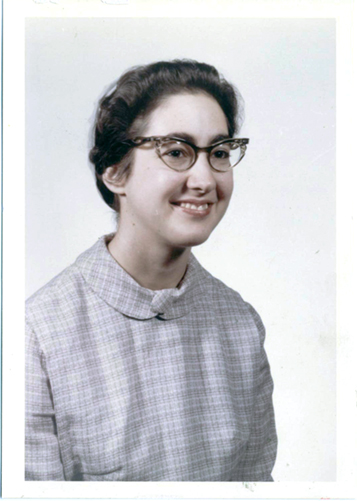
Bishop: We have noticed that you are embellishing your dress with a collar and fancy button, which seems entirely unnecessary and certainly not a good example to our students.

Marian_LMSchool

Bishop: Also, you have been wearing another dress made of red material as well.

S. L. Now completely aghast . . . I want to disappear. Well, I do have a dress like that but the fabric has very dark shades of red, not very bright at all.

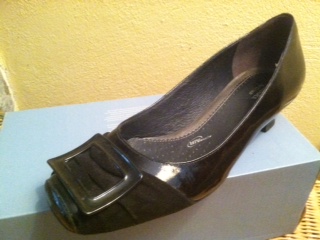
Bishop: And your shoes — the rules state that “ . . . dark footwear is the best expression of modesty and nonconformity for all our sisters,” and we hope that you will comply.

S. L. Looking down at my shoes, I see a black, patent leather shoe with a tiny bow and kitten heels. Dear Lord, this is getting very bad—I’m not a nun, but even I know that black patent leather shoes don’t really reflect up!

The Principal: To me, they look like dancing shoes.

S. L. Dancing shoes–gulp!–I don’t know even one dance step! Dancing is forbidden. It says so in the rule book.

Somehow the meeting concludes with no doubt some meek promise of compliance from me.

Fade to black . . . .

My Life in Shoes

Marian_Shoe Drawing_5x4_300med          blackshoes

Shoe drawing, circa age 10         Bane of the Bishop  1962

brownshoes           redshoes

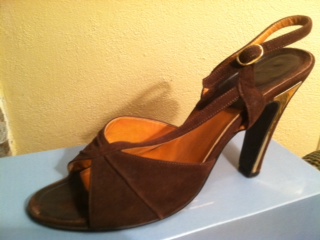
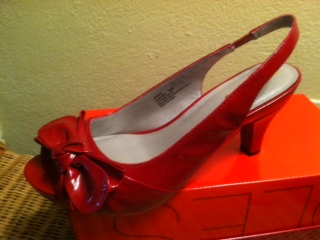
Break-out Shoes   1965               My style now – red and shiny

What emotional connections, positive or negative, do you have with a item of clothing in your past? Tell us your story.