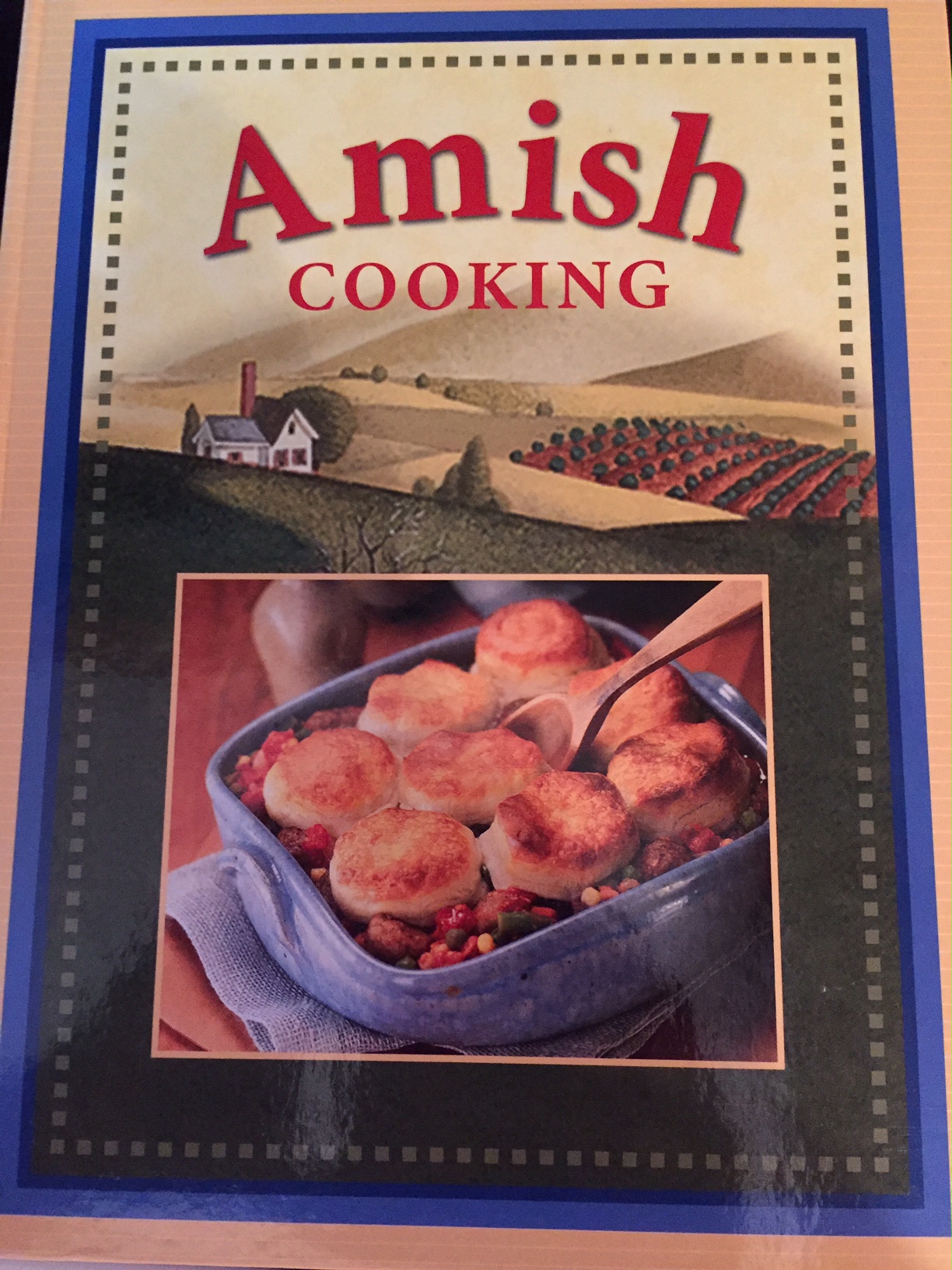
My sister Jan (“Janice,” growing up) is easily the best cook in our family. One of my birthday presents from her last year was a cookbook entitled Amish Cooking.
In the head-line this week, I say “A Touch of Amish” because the recipes are quick and easy and many contain shortcuts with ingredients like commercially prepared soup mixes, an item not usually associated with authentic Amish cooking. Still, when we’re pressed for time, quick and easy may be the way to go. Besides, as temps grow cooler, who doesn’t welcome a warmer kitchen made fragrant with an herbal mix from the oven.
Used by Permission: Publications International, Ltd.
Barring any need to skip off to the grocery store first, ten minutes is a short prep time, but extend the time just a bit so you don’t feel rushed.
If you are a purist, and prefer making recipes from scratch, you can substitute these herbs and spices for the mix: finely chopped onion or onion salt, diced garlic, chicken broth thickened slightly with one tsp. corn starch, chopped parsley
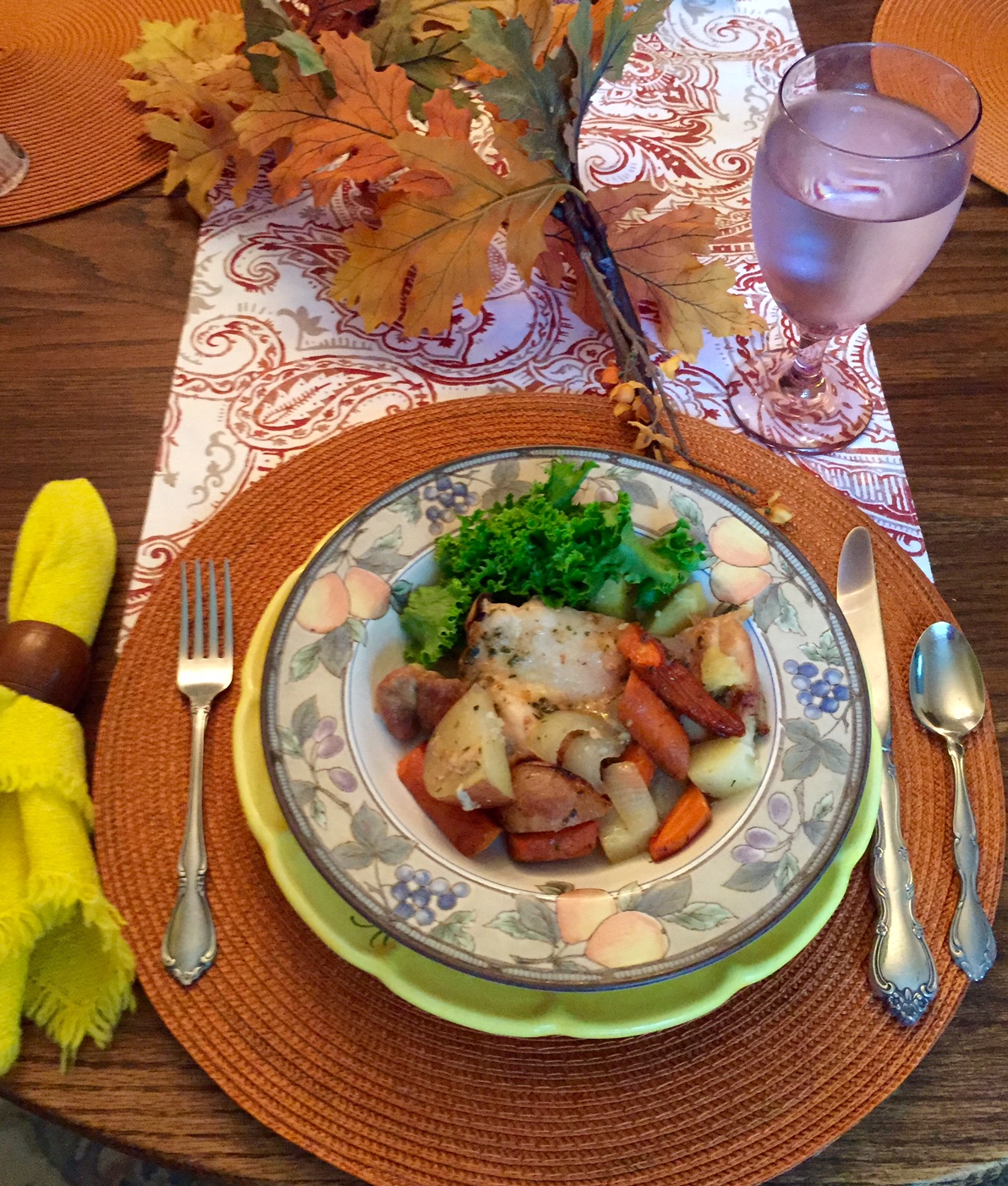
About the vegetables: To make sure the veggies are soft enough by the end of the baking time, I microwave them for 2-3 minutes before baking. Also, I use more potatoes and carrots than called for in the recipe and add an onion too.
Plated, a savory dish for harvest time this fall!
While the earth remaineth, seedtime and harvest, and cold and heat, and summer and winter, and day and night shall not cease.
Genesis 8:22
Busy day recipe or fall favorites – all are welcome here!
Coming next: Grace Notes: Mary Grace Martin & Her Pump Organ
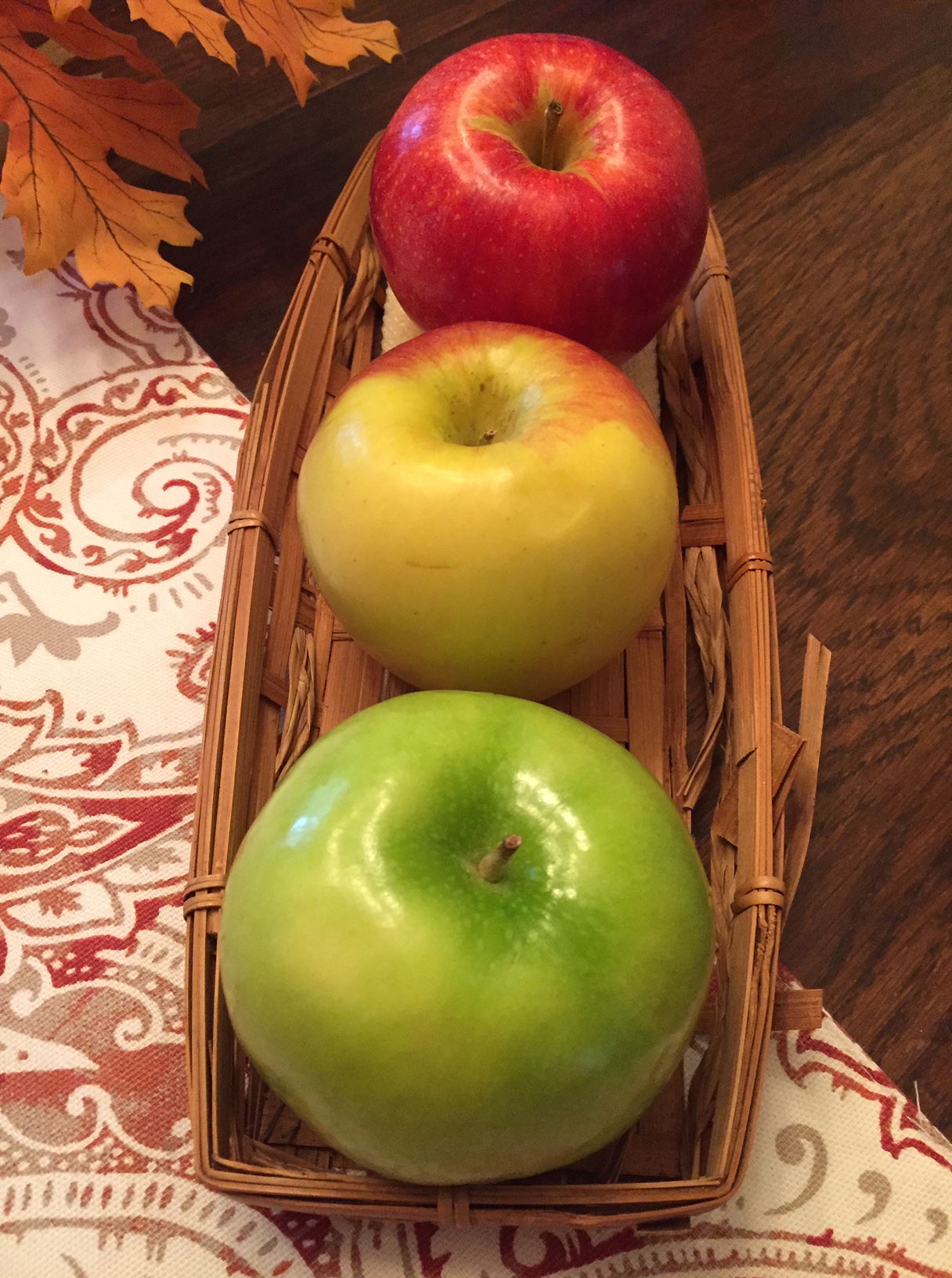
A green apple, a yellow apple, and a red apple, it’s like a fruity traffic light you can eat . . . . Did you know that my love has the consistency of applesauce? It’s true—and juicy. ~ Jarod Kintz
I ate a slice of humble pie, and it tasted like apples. ~ Jarod Kintz
Thoughtful Slices
It is remarkable how closely the history of the apple tree is connected with that of man. ~ Henry David Thoreau, “Wild Fruits”
Anyone can count the seeds in an apple, but only God can count the number of apples in a seed. ~ Robert H. Schuller
Every thought is a seed. If you plant crab apples, don’t plan on harvesting Golden Delicious. ~ Bill Meyer
Healthy Slices
Eating apples is good on so many levels. There’s fiber in the skin that’s really good for you. It helps with digestion and helps you absorb all the nutrients of everything you’ve eaten that day. Apples are a really good thing. ~ Rebecca Romijn
A Story Poem
Grandma Longenecker’s Apple Schnitz
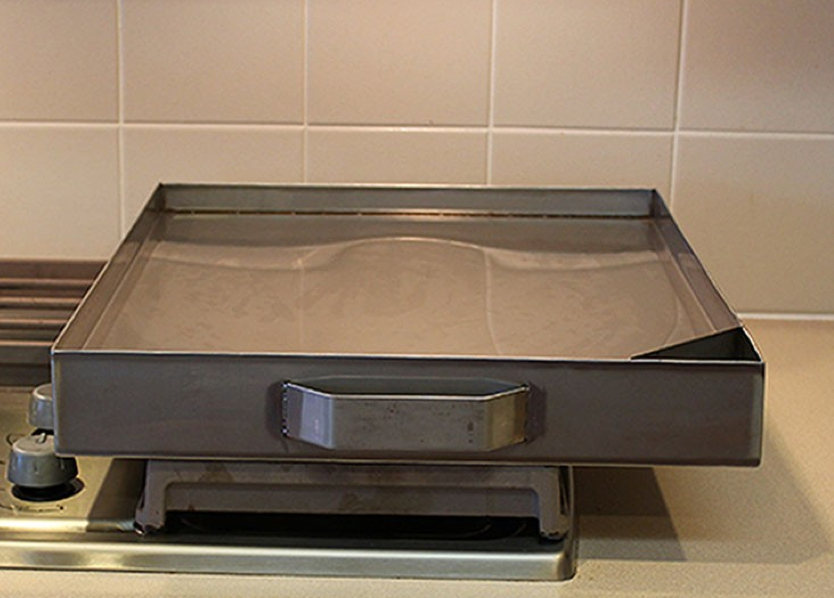
Grandma Longenecker dried apple slices locked in nutrients and flavor on a vintage food dehydrator similar to this updated one.
Food dehydrator: Google images
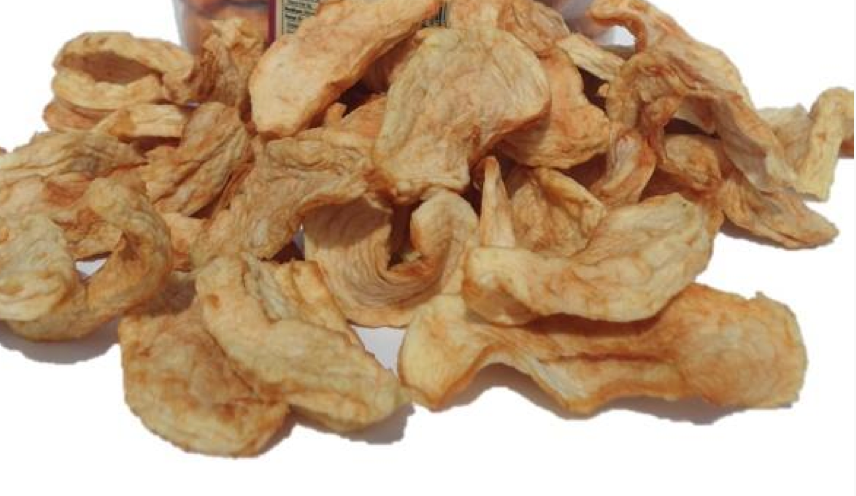
The flavor was concentrated, tart, and oh so chewy. Uh-um-good! These look just like Grandma’s! Later Aunt Ruthie Longenecker took over the tradition.
Apple Schnitz: Kauffman Farms
Red, Amber on Green Background – Van Gogh’s Apples
Do you associate apples with this season of the year? Any favorite recipes with apples? Thank you for adding quotes, recipes, or anything else that comes to mind here!
Dollar Discovery! On September 10, 2015 I opened an envelope dated April 30,1962 that Mother sent me in college. I had read her letter then, but did not open the Bossler Mennonite Church bulletin where she had tucked a dollar bill (series date 1957) until now. I wonder now whether she was testing to see if I had taken the time to open the bulletin she enclosed.
When I opened the bulletin commemorating Church College Day, a few weeks ago, out tumbled a “Silver Certificate” dollar bill backed by REAL money, not the “Federal Reserve” bills we carry around in our wallets nowadays.
US district Judge J. Skelly Wright ordered the desegregation of elementary schools in New Orleans, LA.
John Kenneth Galbraith, then U.S. Ambassador to India, wrote a letter to President Kennedy proposing a negotiated peace between North Vietnam and South Vietnam.
At the Ealing Jazz Club in London, Brian Jones was introduced to Mick Jagger and Keith Richards. The three would become the heart of The Rolling Stones.
Walter Cronkite replaced Douglas Edwards as the anchorman for the CBS Evening News.
The Century 21 Exposition World’s Fair opened in Seattle, Washington on April 21, 1962
What was happening in the Longenecker house then?
Here are unadulterated excerpts from Mother’s letter:
“Hello to all the gals at Peachey House. . . . “Did you get your book – – – I mean your ‘Books,’ The Post Master want to know when you got the book we send. Don’t for-get to tell us he want to see know how long it took to get to E. M. C.”
“. . . I called LaVon’s mother on Fri. the way it sounds Maybe you are taking her place. she is going to work for Dr. Walmer 5 weeks then she is going to be counsler at a few camps. She is sure you will like it. She said you even get off the fourth of July with Pay. she knows they pay over a $ a hour but she didn’t know right yet how much.” (Lavon Nolt (Kolb) is a school friend: We attended first grade → college together. Here Mother is discussing summer work for me.)
“. . . I started to tell you Janice [sister] and I were at the Mother & daughter banquet on Fri. eve. they really had a nice program. & plenty of food such as fruit cup, a very large slice of Ham loaf, baked potato, corn & peas, cold slaw, pickles & olives, celery & carotts, ice cream & cake Mints & nuts. Well, we were just stuffed.”
“. . . When you get your check get it cashed then you will have when you need.”
There are two references to money in this letter, three if you count the dollar bill I didn’t discover until now. I don’t remember what the check was intended for or the amount, but it was probably not enough for books or tuition. And seldom did Mother write a letter that didn’t mention a menu or food preparation.
I know now that she equated food with love. And she knew that money, even a little bit, would sweeten my passage through my college days too.
God bless the memory of my mother, who knew the value of a dollar . . .
. . . and the appeal of a home-cooked meal!
Did this post prod memories of happy surprises about money or food? Join the conversation here.
The closest thing I ever came to living in a convent was my year in the dormitory at Lancaster Mennonite School. It was much like living in the dorm at my alma mater, Eastern Mennonite College, now a University, but only more awkward. “Awkward?” you ask. “In what way awkward?”
As beginning teachers Verna Mohler (Colliver) and I were squirreled away in the LMS girls’ dormitory. Because of our tiny salaries, living here represented a major cost savings, but being so close to students, we sacrificed privacy. You can read all about this experience in last week’s post.
Students and faculty alike dressed plainly at LMS, no jewelry or fancy dress allowed. Students were sequestered from the world in other ways too: no competitive sports teams, no band or orchestra, and no theatre department.
My prior life in college was similar but a tad looser. There were intramural sports at EMC but musical expression was limited to various choruses which sang a cappella in four-part harmony. A highlight of the year came each spring when the music department presented Alfred Robert Gaul’s oratorio The Holy City, its celestial strains ringing in the rafters. However, no band or orchestra existed there either. And certainly no theatre department. To be fair, students performed plays staged in the chapel as for example Thornton Wilder’s Our Town. Our graduating class donated to the college its first piano.
During my junior year at EMC when the college dormitory was filled to overflowing, eight women students were selected to live on the edge of campus in a home called Peachey House.
Verna Mohler and I lived with six others including Martha Maust, who wrote in Verna’s yearbook: ” What with mice sitting on the kitchen floor, a chicken in a book-bag, plus eight girls with plenty of vim, vigor, and yelling power you couldn’t expect anything but great times.” Then too we lived through the mighty snowstorm in the winter of 1961-62 that cut us off from the rest of the campus.
One of my fondest memories is playing the violin with Thelma Swartendruber (Chow) one of my roommates here in the Peachey House living room.
I had played my instrument at Elizabethtown High School, where I was the only Mennonite girl in the orchestra simply thrilled to wear a fancy dress for concerts. My violin case followed me to college. Sunday afternoons we played with others, sometimes even with a faculty member whom I later dated.
* * *
Mennonites have always had a love affair with music ~ hymn books, tuning forks, and four-part acappella singing a staple of all worship services in this era.
Though the Lancaster Conference Mennonite Church did not allow instrumental music in the 1960s, many Mennonite families had a piano at home. We had one, a mahogany Marshall & Wendell upright with melodious richness, especially evident when I pushed down on the damper pedal for a gorgeous, sustained tone.
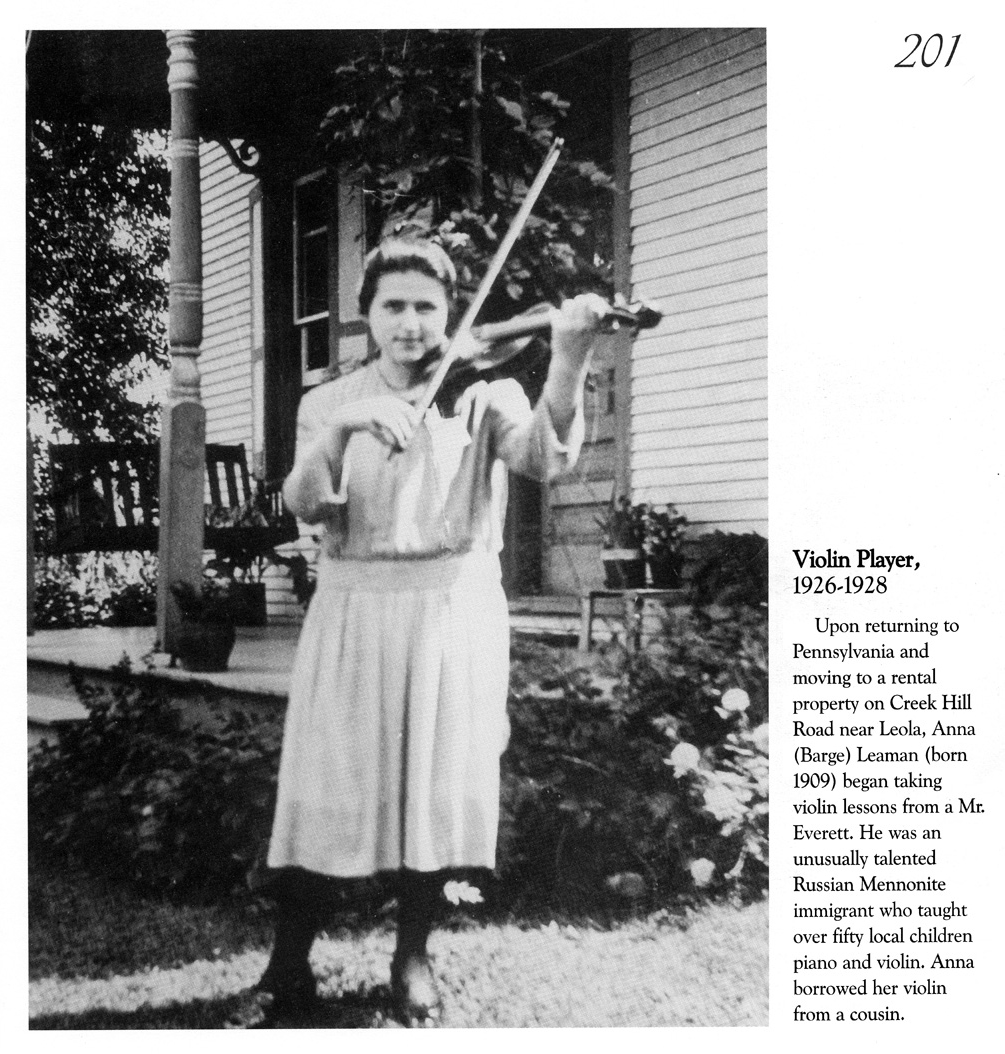
The photo below portrays a young Mennonite girl, Anna Leaman, with covering and caped dress circa 1926 playing the violin. Whether Anna was posing to please her parents or whether she loved playing the violin, it’s impossible to say. I do see a faint smile playing around her lips. Obviously she had been taking lessons and making music solo here.
Credit: Mennonite Women of Lancaster County, Joanne Hess Siegrist 1996
But rest assured, when she went to church on Sunday, no piano, organ or violin would drown out the blend of soprano, alto, tenor, and bass voices who worshipped in blessed harmony.
Did you play an instrument during school or college days? Do you still play it? Any anecdotes to add to the dorm life episodes here, or living with a roommate in an other arrangement?
Coming next: Moments of Discovery, The Story Behind the $ Bill
Nuns live in convents. At least that was true in America in the1960s. Strictly speaking I was not an actual nun, a Catholic sister with a habit like Karen Leahy, who left her convent at Mount Maria to pursue a literary life and experience more freedom. (My review of her book The Summer of Yes here.)
As a student at Eastern Mennonite College, where my un-cut hair was piled neatly under a prayer cap, serving the church was held in high esteem. In fact, the idea of service was drummed in to me as a teaching intern. And so, when the dean of education at the college suggested I apply to Lancaster Mennonite School for my first teaching job, I jumped at the chance. I could serve God and pursue a career I already knew I loved.
I didn’t wear a wimple, scapular, or tunic either. But, as a Mennonite girl in the 1960s, I did wear a prayer veiling and caped dress. My prayer veiling served to acknowledge my obedience to church rules while a cape over my bodice muffled whatever feminine contours I may have had then. Like Karen Leahy, known as Sister Marie Cordé, my clothing announced my separation from the world before I uttered a word. It also assumed a higher set of expectations from me.
Even before I joined the faculty at Lancaster Mennonite School, I wore a prayer veiling and a caped dress, but not all the time. Just for church. But now as Sister Longenecker, a teacher at LMS, plain clothing was de rigeur, not optional.
And I could do so with one of my EMC classmates, Verna Mohler. She and I had shared dorm space at EMC. Now we would transplant ourselves into a similar arrangement as beginning teachers at LMS.
Laurel Wreath yearbook, 1965
Verna and I were side by side and plain. She taught American Literature, and I English Literature along with Penmanship and Spelling.
Yes, side by side in the yearbook, The Laurel Wreath, whose table of contents featured 5 divisions: Faculty, Students, Organizations, Activities, and Worship. There was no orchestra or band – no football or basketball teams then either. Certainly no theatre.
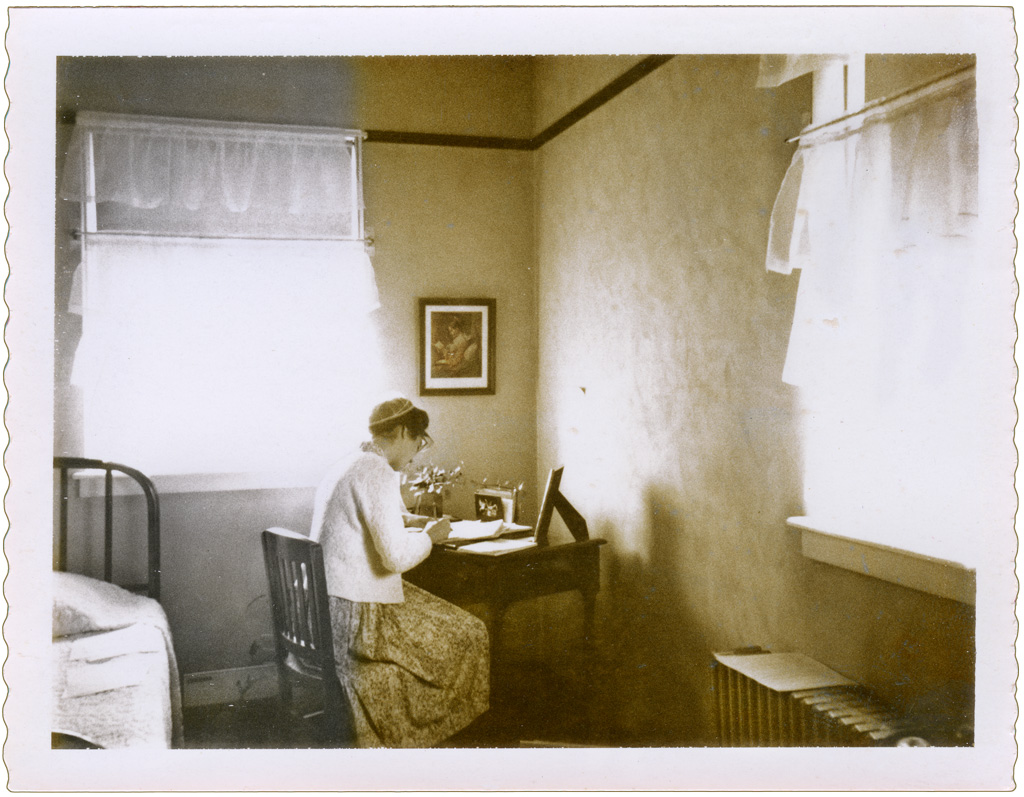
Filmy, white curtains filter pure, virginal light into this teacher’s dorm room study
During our first year of teaching we lived in adjoining rooms in the girls’ dormitory, an awkward situation because of the proximity of students. One evening before supper, I took off my cape and went to the dining hall with just a sweater over my dress. A perceptive student reported me to the Dean of Girls, who gently suggested I mend my ways and remain caped around students at all times.
Of course, our students were plain too . . .
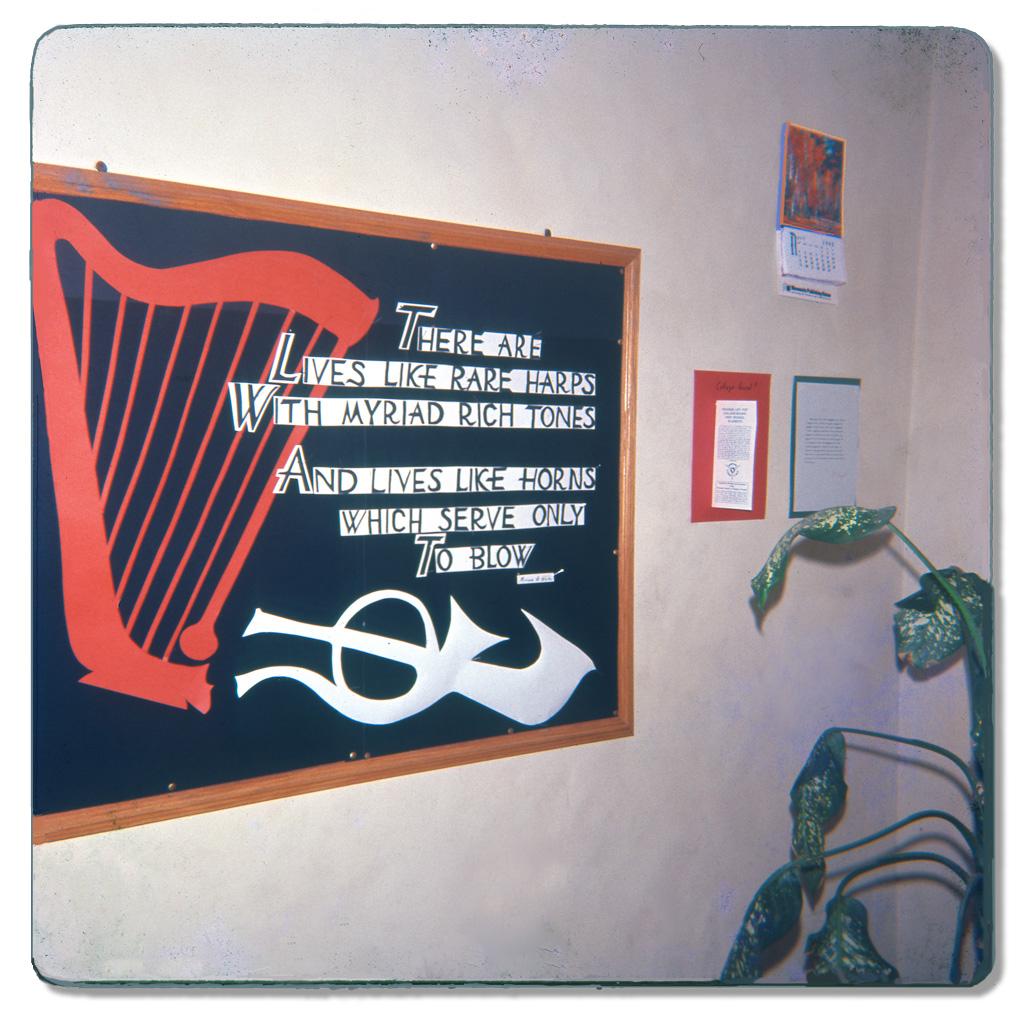
But my bulletin boards were fancy
Even then I liked quotations
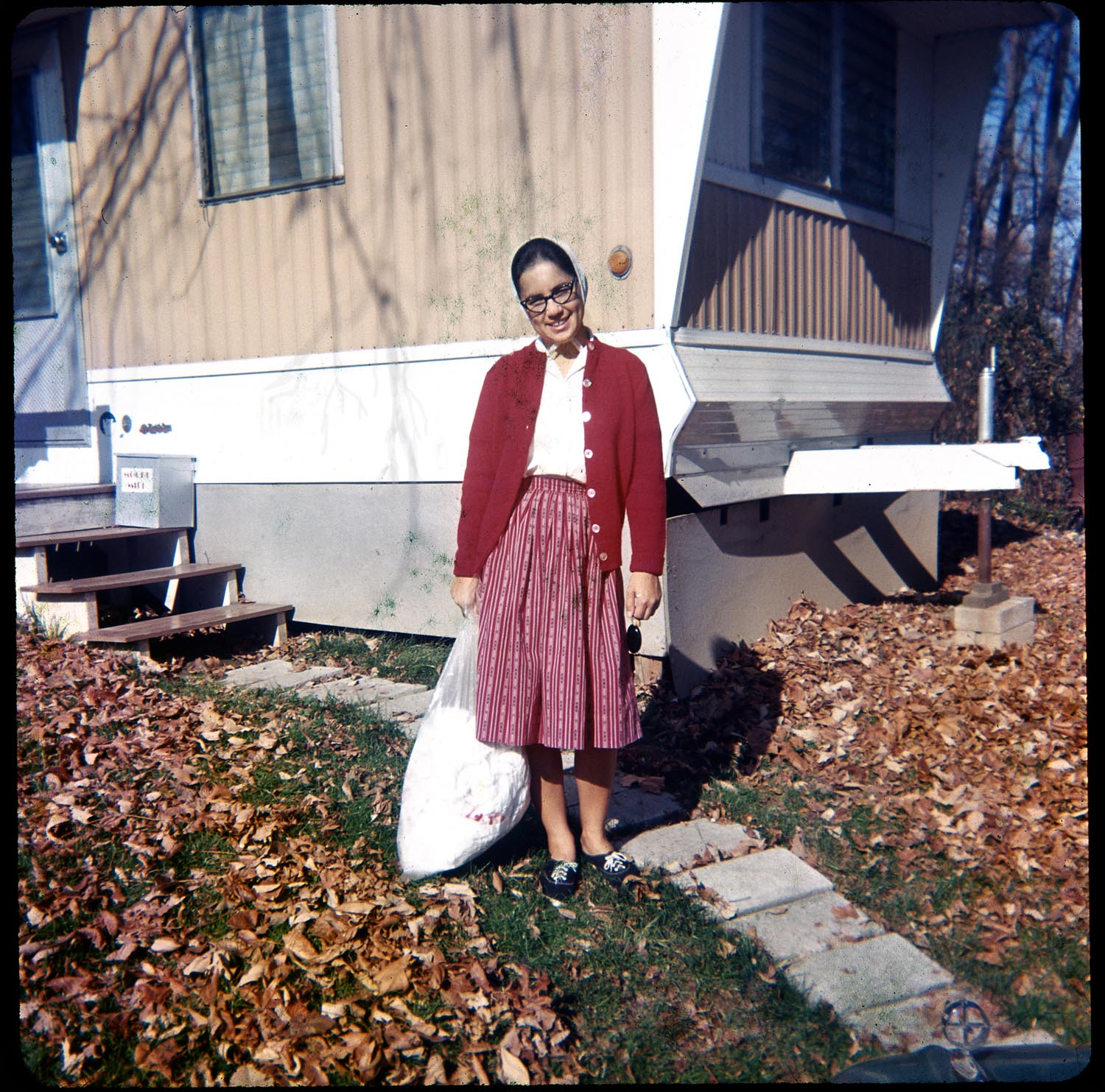
The second year Verna and I moved out of the girls’ dormitory and lived on the edge of campus in a mobile home, which we shared with June Sauder, the Home Economics teacher.
Our trailer was situated in a park-like setting on the other side of the Mill Stream, a bridge between us and campus buildings.
Here again I flirted with danger. One of us rented a TV to see the shocking story of the Kennedy assassination unfold and subsequent funeral proceedings. A student noted the blue glow from our trailer window and reported us to the administration, an action for which we were reprimanded. However, words that we heard on the broadcasts became additions to our students’ vocabulary knowledge: cortege, caisson, requiem.
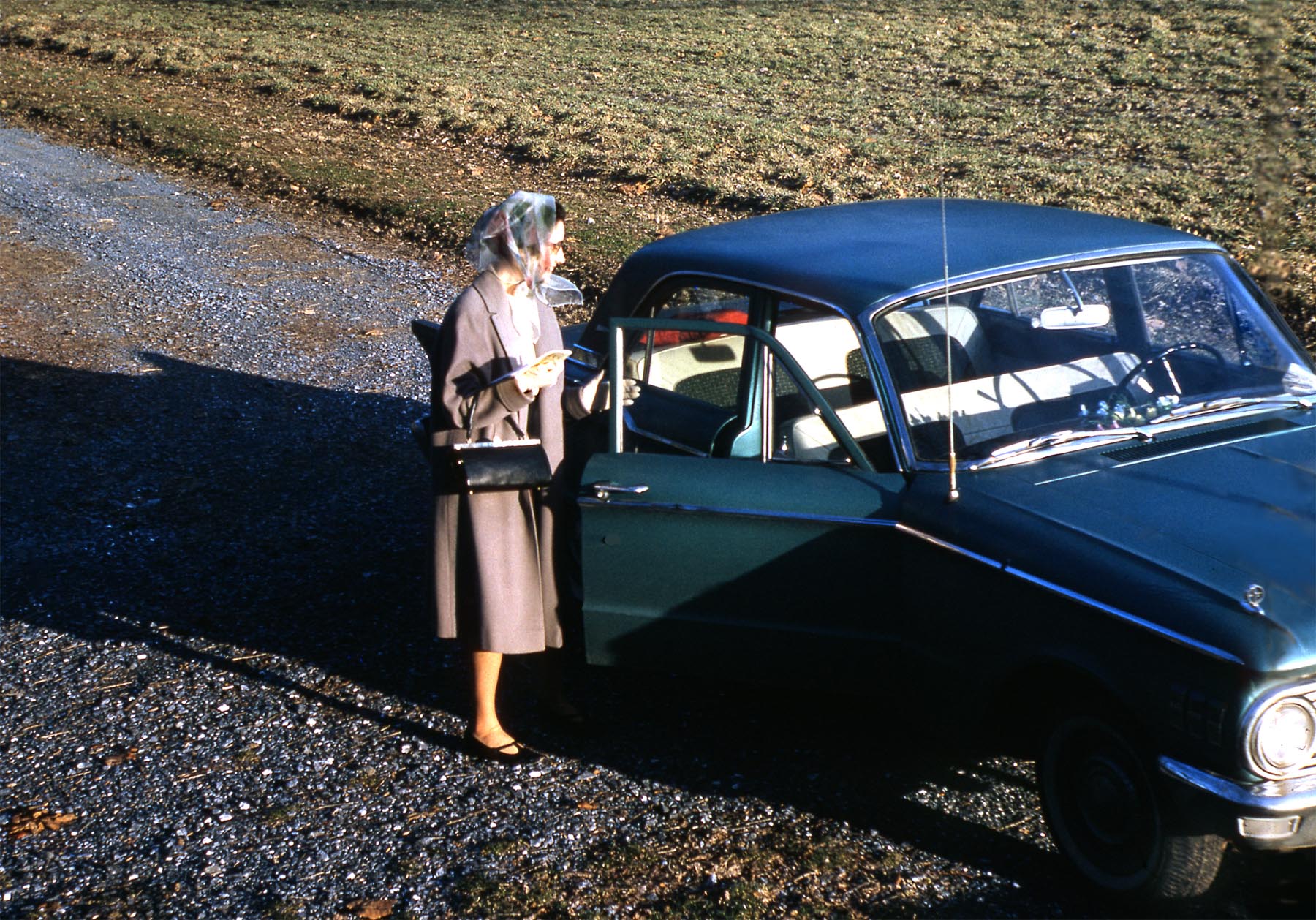
Sometimes after hours, we skipped wearing the prayer coverings, but always had our heads covered, even if it was with a filmy white bandanna.
Verna’s Comet became our get-away car when June, Verna and I drove into Lancaster city with serviceable black purses to admire fancy red ones in a shop window, our expressions hopeful.
We wore smaller coverings and no capes when we went shopping in Lancaster
The Lancaster Mennonite School publication, Bridges, to which I still subscribe, has changed dramatically since Verna’s and my short tenure there. Student rosters now include names like Rodriguez, Rosenfeld, and Fukuhara along with the typical Lancaster County Mennonite names Weaver, Harnish, and Nissley.
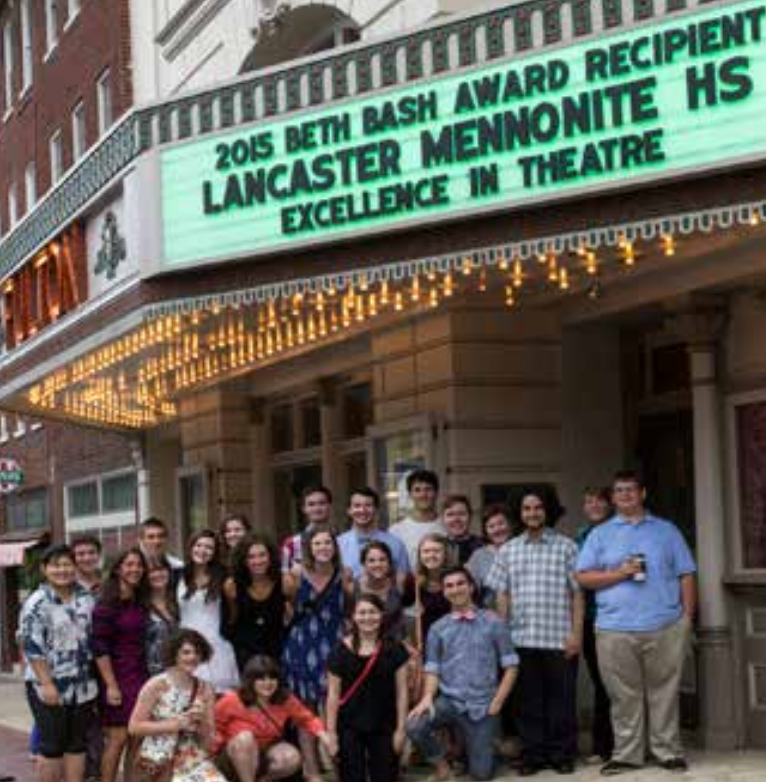
The LMS sports teams are going to the playoffs this year. Lancaster Mennonite and Lancaster Catholic are competing in an international ping-pong tournament. Most interesting of all, the name of Lancaster Mennonite High School appears on the Fulton Theatre marquee in downtown Lancaster displaying the 2015 Beth Bash Award for Excellence in the performance of Shakespeare’s The Tempest. Imagine!
A statement from their current principal J. Richard Thomas reveals the continuing strong spiritual mission of LMS:
As a school, we are building stronger wings and growing deeper roots one student at a time. Here students encounter a risen Christ who calls them to transformation, empowering them to be world changers. Our Graduate Profile states that our graduates will “practice global awareness, cultural sensitivity and humility, respect, an anti-racist lifestyle and compassionate living.”
With stronger wings and deeper roots, the graduates of the class of 2015 were commissioned to walk humbly with Jesus . . . and, in doing so, partnering with God in building a kingdom where individuals “from every tribe, language, people and nation” are gathered together around the Lamb. Revelation 5:9
Is your life, like mine, dramatically different now from your childhood experience? Share your story here.
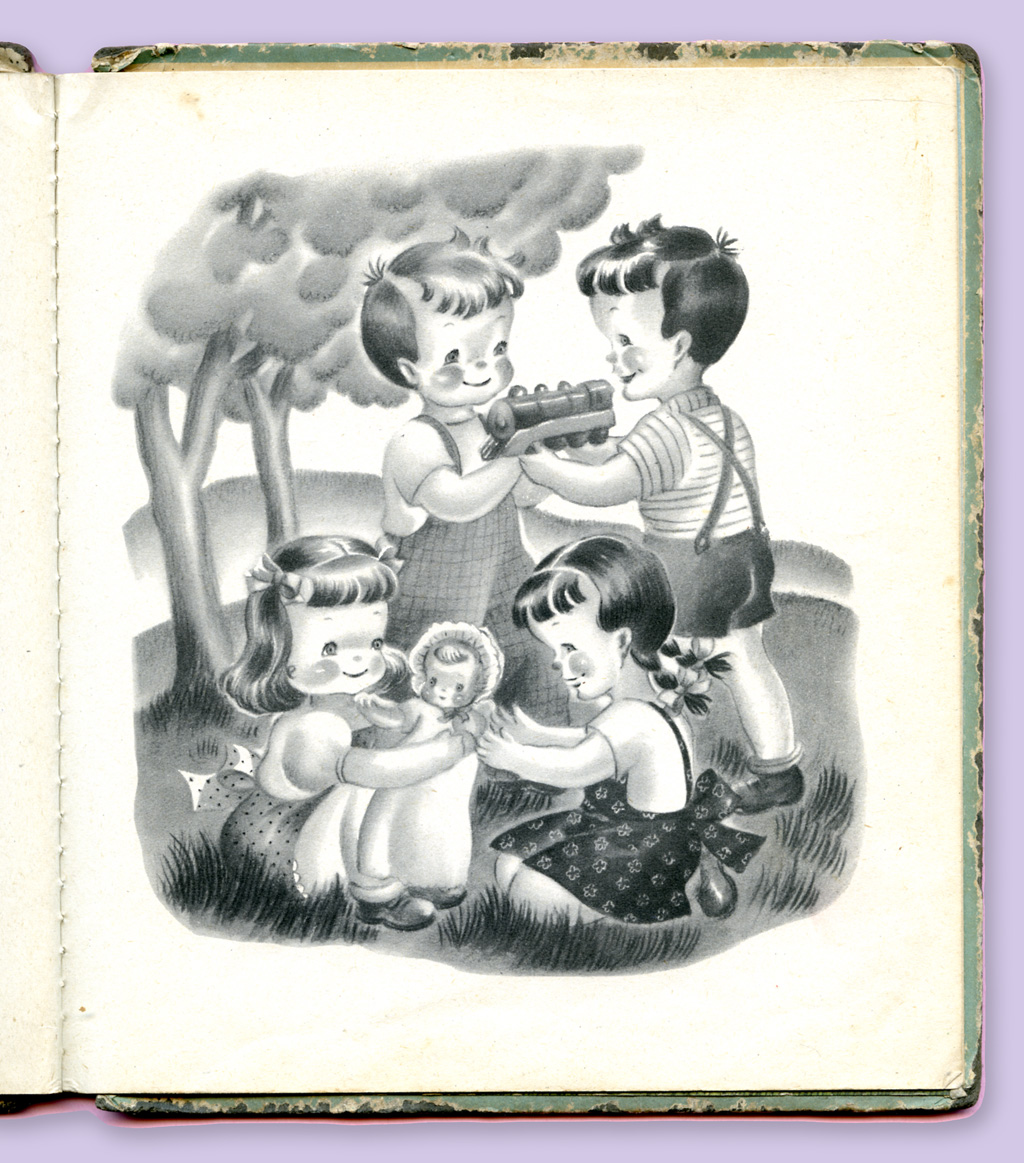
A toy train and a baby doll. That’s what these brother and sister pairs are exchanging with each other.
My Bible Book, 1948 ( 32)
Trading is fun among friends, no matter what their size. Big or little, old or young – most people like to exchange gifts, conversation, sometimes even big ideas.
It is a giant leap from tots trading toys to literary giants exchanging thoughts, but the principle is the same and so are the benefits.
C. S. Lewis and J. R. R. Tolkien, both scholars at Oxford University fired one another’s imaginations in a small group called The Inklings. Both yearned to write science fiction with faith and morality as a central theme. Legend has it that “they literally tossed a coin to decide who would write a book on space travel versus time travel.” Though their early attempts were not completely successful, C. S. Lewis went on to pen The Chronicles of Narnia, and J. R. R. Tolkien wrote the Lord of the Rings series. Generations since then have enjoyed the fantasy of Tolkien’s hobbits and elves of Middle-earth and Lewis’ charming children and Narnian nymphs.
Their haunt? Frequently The Rabbit Room, a snug space tucked away in the Eagle and Child pub, Oxford, where a roaring fire, animated conversation and pipe smoke fueled their imaginations. At least twice weekly these brilliant minds hatched plans for plots and both nurtured and challenged one another’s brain children.
The Eagle and Child – Tuesday morning meeting place of the Inklings with Lewis and Tolkien
* * *
Christiane Northrup, M. D. a frequent PBS-TV presenter, promotes friendship as one of the paths to glorious agelessness. A sub-topic on her website exhorts women of all ages to cultivate varied friendships that she dubs “tribes” of friends. Though I never thought of my friend groups as tribes, I do recognize various kinds of friends I’ve been privileged to know at various times and places in my life.
Church Friends
Writer Friends
Standing: Writers Janet Givens, Kathy Pooler, Marian Beaman Seated: Shirley Showalter, Joan Rough at Chincoteague Island, February 2015
Colleagues at Florida State College in Jacksonville
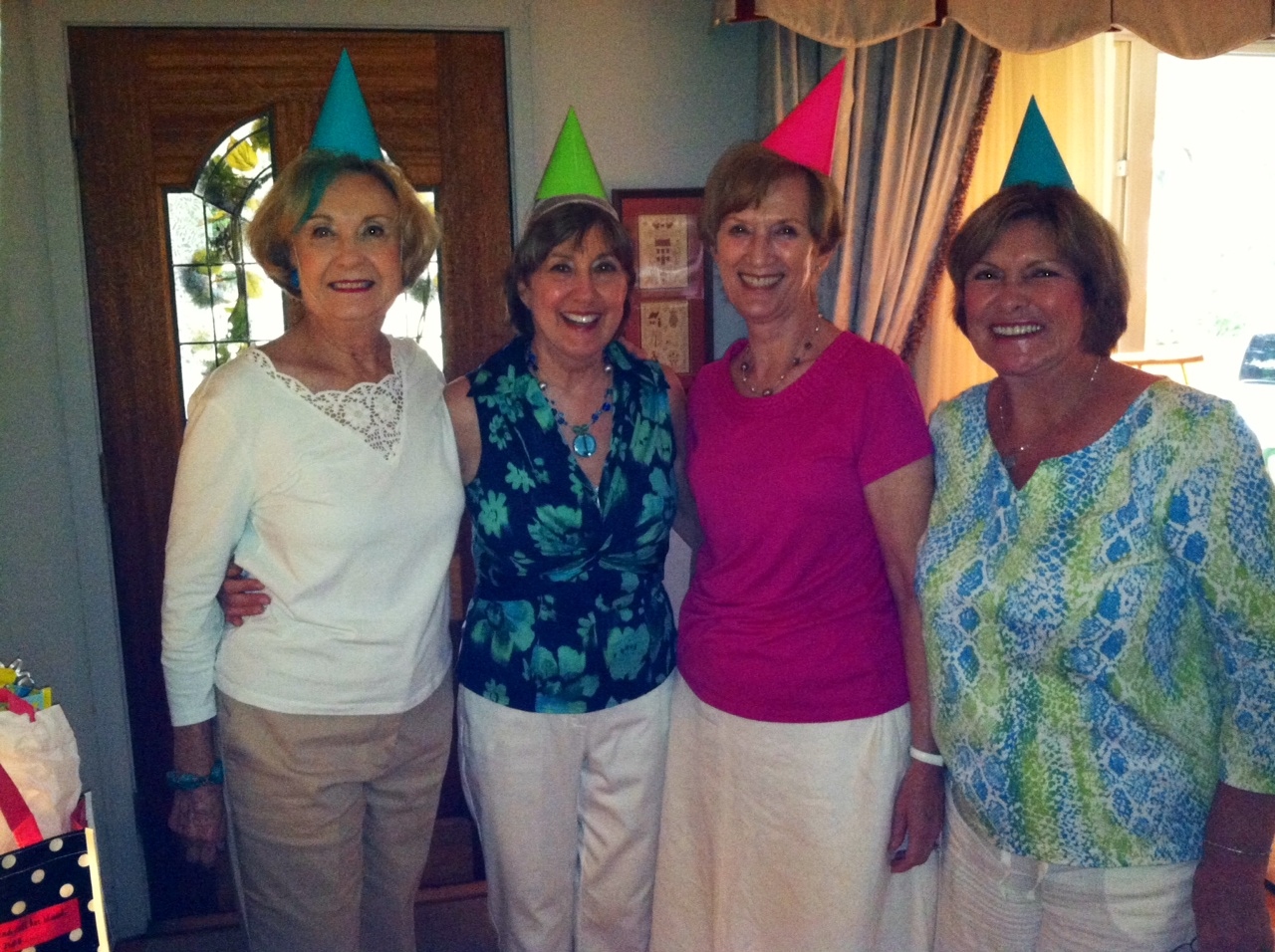
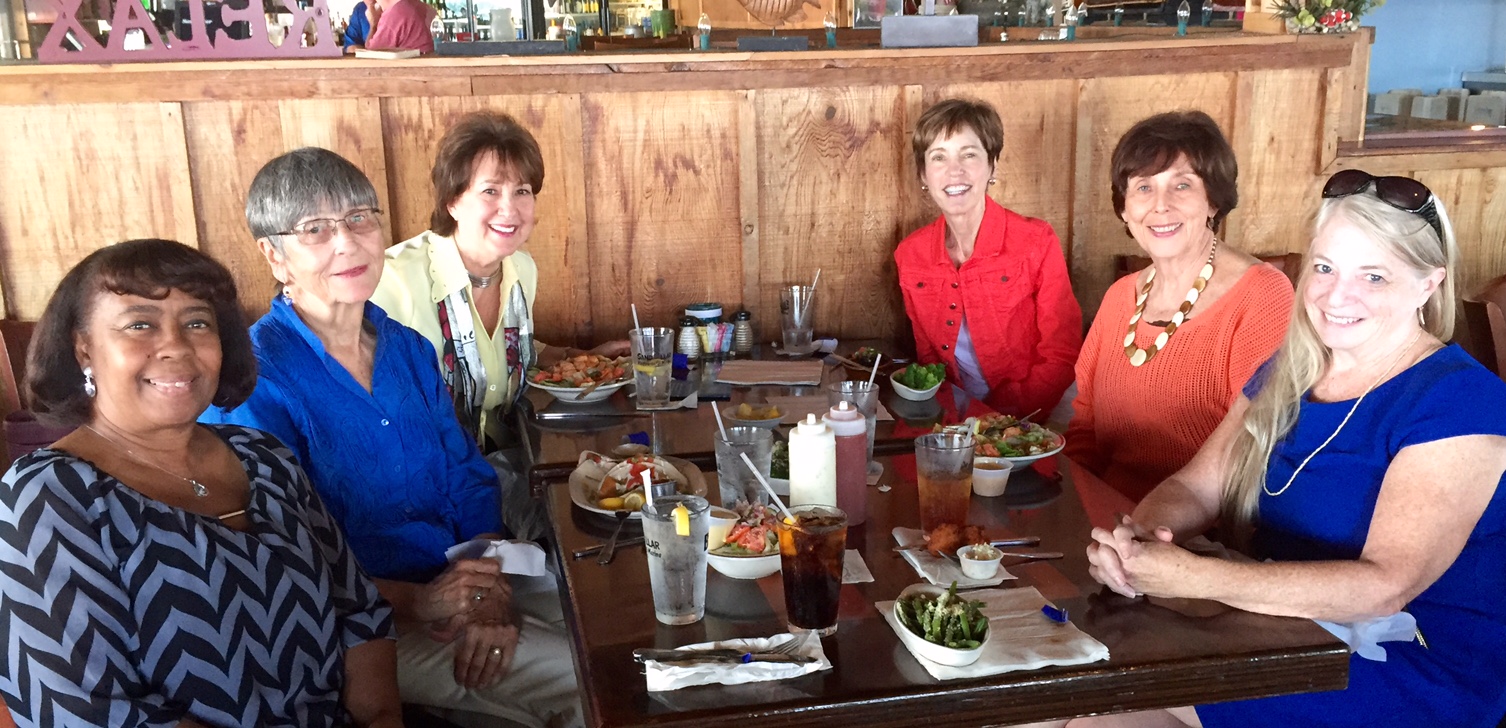
Retired FSCJ English faculty women, friends who lunch
Friends at the Gym (They’re bashful!)
Friends from Eastern Mennonite College
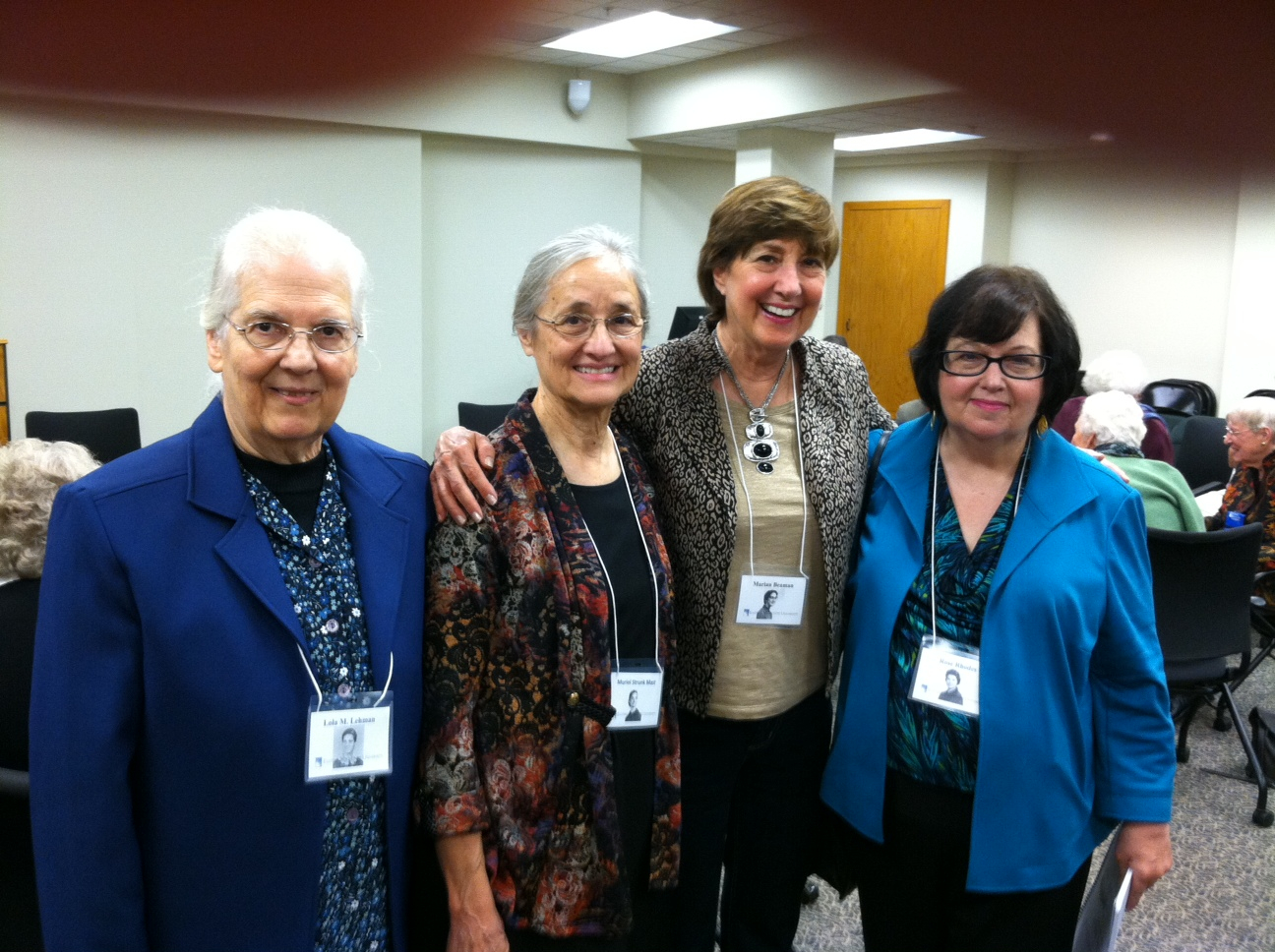
Other room-mates and friends: Our name tags imprinted with college yearbook photos.
Even sisters can be friends!
My friendship with Verna Mohler Colliver is one I’ve maintained since college days as room-mates at Eastern Mennonite College (now University). I caught up with Verna at our last college reunion.
My college room-mate Verna Mohler Colliver and me at EMU Homecoming, 2013
Since the reunion, Verna and I have exchanged photos and slides of ourselves as beginning teachers at Lancaster Mennonite School in the 1960s. Indeed, she helped me hatch a plan to reflect on those early years in our careers by providing some photo “fuel” for two upcoming blog posts. That’s what friends do. And I appreciate it too!
As iron sharpens iron, so a man sharpeneth the countenance of his friend.
Proverbs 27:17 King James Version
Do you have “tribes” of friends? Do you see them often? How do you keep your friendship(s) alive?
I bought this portable meal, a Lunchables, to give to a homeless person. So why is it still sitting in my refrigerator?
Last week I planned to give this lunch to the next person I saw holding a “Hungry & Homeless – Will you Help?” sign as I waited in my car for the traffic light to change on a busy boulevard in Jacksonville, Florida, a city that attracts the destitute for several reasons including its mild climate.
Sure enough, I was first in line at the red light leaving the grocery store, and I spotted a downtrodden young woman looked eager for my help. I popped the trunk and jumped out of the car, intending to offer her the lunch, but she declined, “No, ma’m. That won’t help at all. I need $ 99.00 to blah – blah – blah.” No, I didn’t give her $ 99.00 because I never give cash to the homeless. Instead, I give to the needy through our church or through homeless shelters in town.
Yet, this brief encounter left me conflicted, with two opposing strong sentiments: a Yes and a No
Yes, I did feel cynical as the light turned green, knowing the woman was probably scamming people. No, I will never stop feeling sorry for the “homeless” regardless of their intentions whether it’s a real physical need to survive, untreated mental illness or something else.
Giving money to the homeless is an economic crisis of the heart, a tug-of-war between the instinct to alleviate suffering and the knowledge that a donation might encourage, rather than relieve, the anguish of the poor. The Atlantic
On my nightstand sat a copy of The Invisible Thread: The true story of an 11-year-old panhandler, a busy sales executive, and an unlikely meeting with destiny. It was time to read it!
An Invisible Thread, a Review
“Excuse me, lady, do you have any spare change? I’m hungry.” Those were the first words out of the mouth of Maurice, as Laura Schroff, a publishing executive at Time Inc, rounded the corner from Broadway to 45th Street in New York City. She passed him by, but something special in his eyes halted her and she turned on her heel and, nearly killing herself in traffic, went back. Thus their paths converged and the story of a thirty-year relationship began.
No, Miss Laura did not give Maurice spare change but on the spot she took him to McDonald’s for a Big Mac, large fries, and milkshake. Then over the years they met every Monday night often at her luxury apartment where Maurice learned about ritual and rules for living: sitting down to eat a meal, showing up on time for school. Laura’s cozy nest provided a safe haven, an escape from his one-room hotel room, a den of violence where 10-12 assorted needy “friends” and family flopped to sleep off a drug binge or cook crack to deal on the streets.
Not until Chapter 8 does the reader learn about the tug on the other end of the invisible thread – the unspeakable violence in Laura’s middle-class childhood home where a father in drunken rages would fling full liquor bottles against the wall and destroy his son’s sports trophies.
She admits, “I couldn’t help but think that the terror and uncertainty we faced as children because of my father was similar to the chaos that Maurice now had to endure.” (107)
Laura’s memoir, reminiscent of The Blind Side, interweaves three dynamic narratives: The first, the story of Laura and Maurice’s growing relationship. Secondly, Laura’s back story as both victim and then survivor of her dysfunctional home. And finally, Maurice’s maturation into an adult with a family of his own, reflecting what Joseph Campbell calls “the hero’s journey” often fraught with obstacles and setbacks.
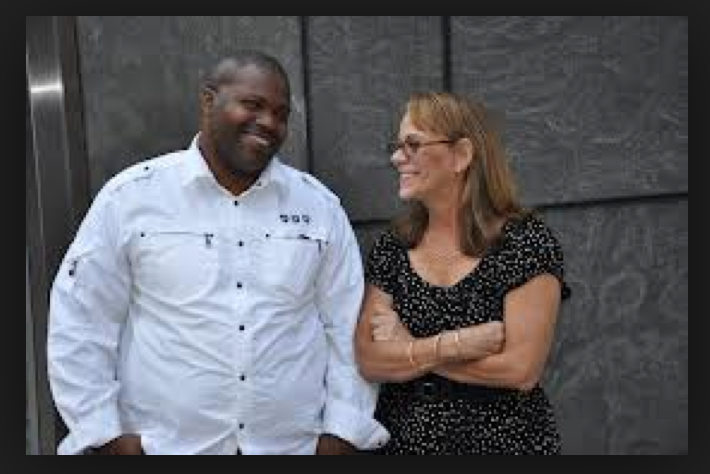
Maurice & Laura, Google Image
I began reading the book because I was intrigued by the disparity between an accomplished woman in Manhattan and a needy young boy from Brooklyn. I was compelled to read on because I wanted answers: Why would a young woman who helped make USA Today and InStyle successful publications risk all to build trust with a young man who had nothing to offer in return? How did an ill-kempt beggar boy, who has since developed a career in construction and is raising his own family, enrich that woman’s own life?
In the end, Author Schroff realizes that both she and Maurice had traveled together on a voyage of self-discovery. Her message: “This is a book about how, if we learn to let go of fears and burdens and expectations, we can find ourselves plunged into the sweet, unplanned blessings of life” (book blurb).
After thoughts
Should you give money to homeless people? According to the article in The Atlantic: “The short answer is no. The long answer is yes, but only if [you do it through] an organization that can ensure the money is spent wisely.”
But maybe . . . if you are someone with the incredible courage of Laura Schroff, there is still another answer.
Click here for a short video, a Lunch Date with Destiny
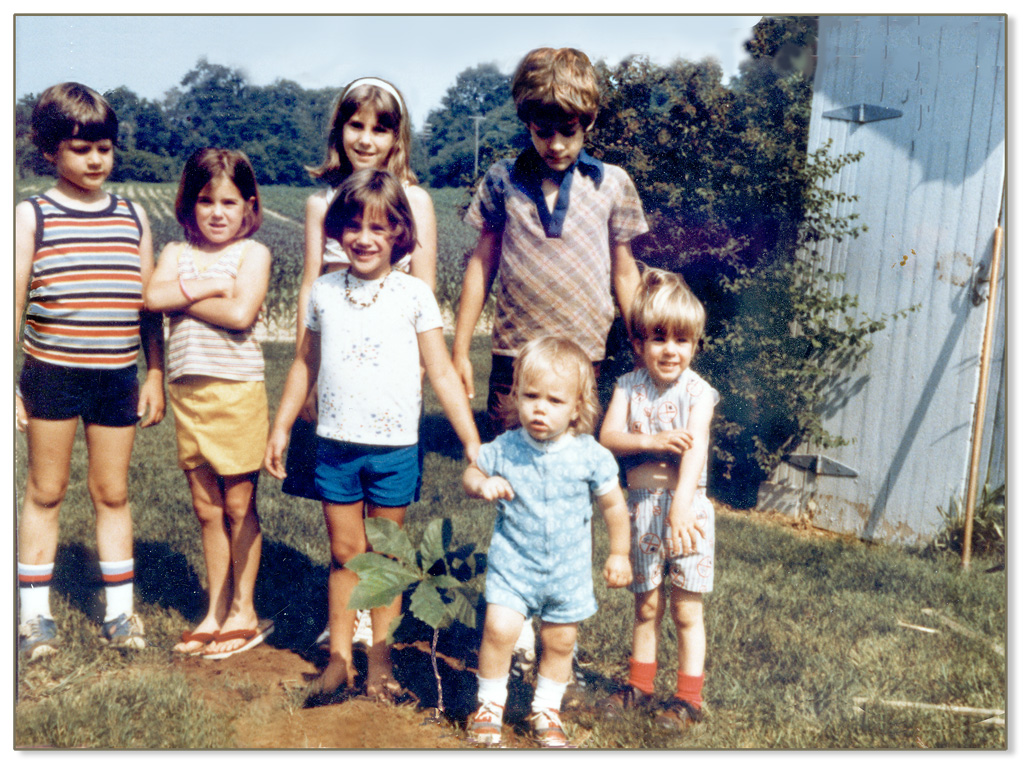
Once upon a time seven children from three different states came to visit their family in Pennsylvania. Some came from far away in a car, plane or train so they could see each other and get to know their grandparents and great-grandparents, who lived in the lush farmlands and wooded meadows of western Lancaster County.
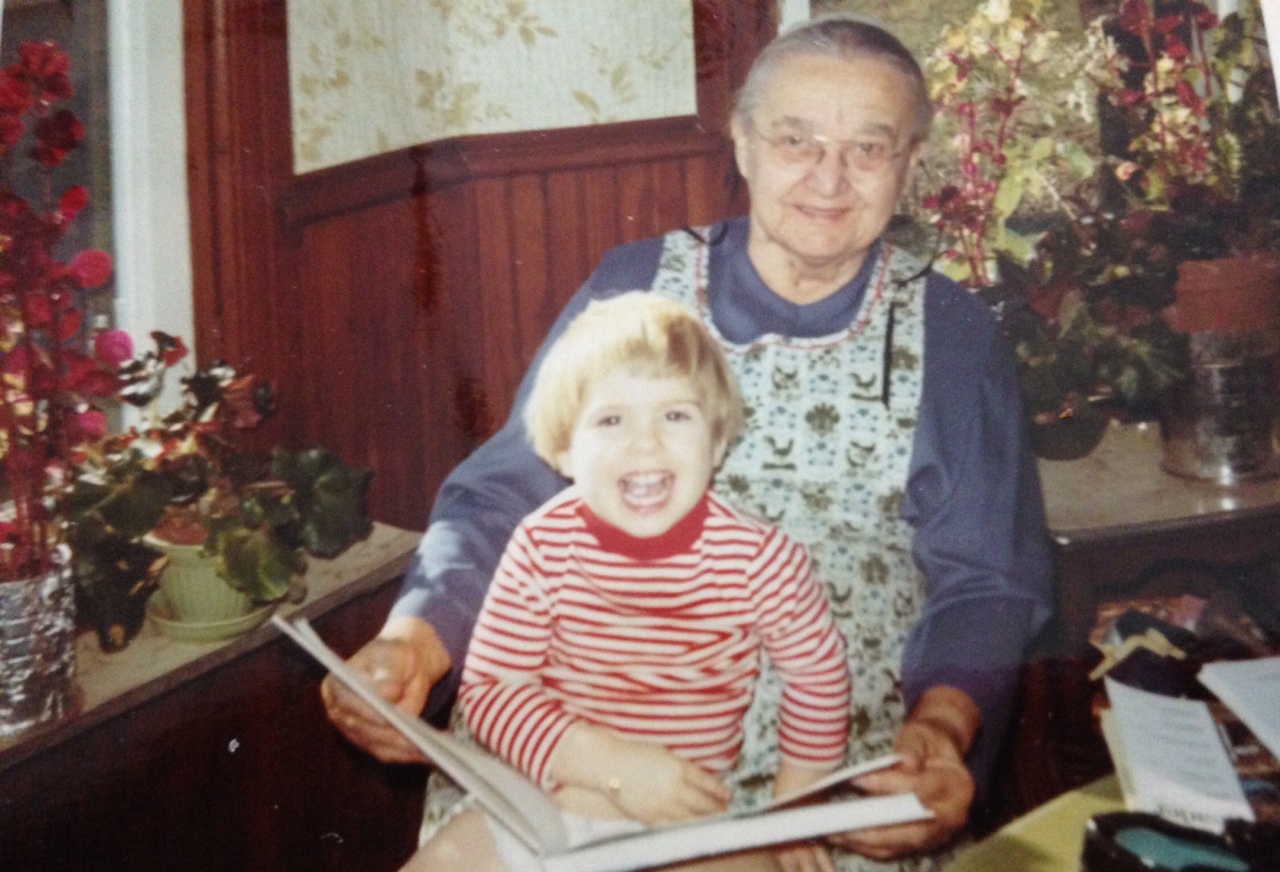
The joy of reading: Great Grandma Longenecker and Crista, age 3
Hearing bird sounds and reading stories: Great Grandma Longenecker with Crista, age 4
They liked too when Great Grandma would bring them warm strawberries from her patch in the spring time, and in the summer some ripe, pink-cheeked Bartlett pears from the tree planted near a gently flowing brook. Grandma loved trees and sometimes sat in the shade of a Japanese cherry tree as she rocked on the porch. She smelled the wisteria that twisted around a trellis close by and enjoyed the morning-glories climbing upon harp-like strings by the kitchen door.
One sad June day in 1980, their great grand-mother died, so all seven young children ages 1 1/2 – 11 gathered near the small village of Rheems to say “goodbye” to their Great Grandmother Fannie Longenecker, who was 89 years old. Some of the children called her Grandmother-of-the-Birds because she loved hearing birds chirp and gave them seeds to eat in the winter-time.
Great Grandma’s daughter, their Great Aunt Ruthie, loved trees too and when her mother died, she decided to plant an oak tree as a remembrance. All the children helped to plant the tree. Even the littlest one put some soil around the tree so the roots would be covered up tightly.
A Tall Tale
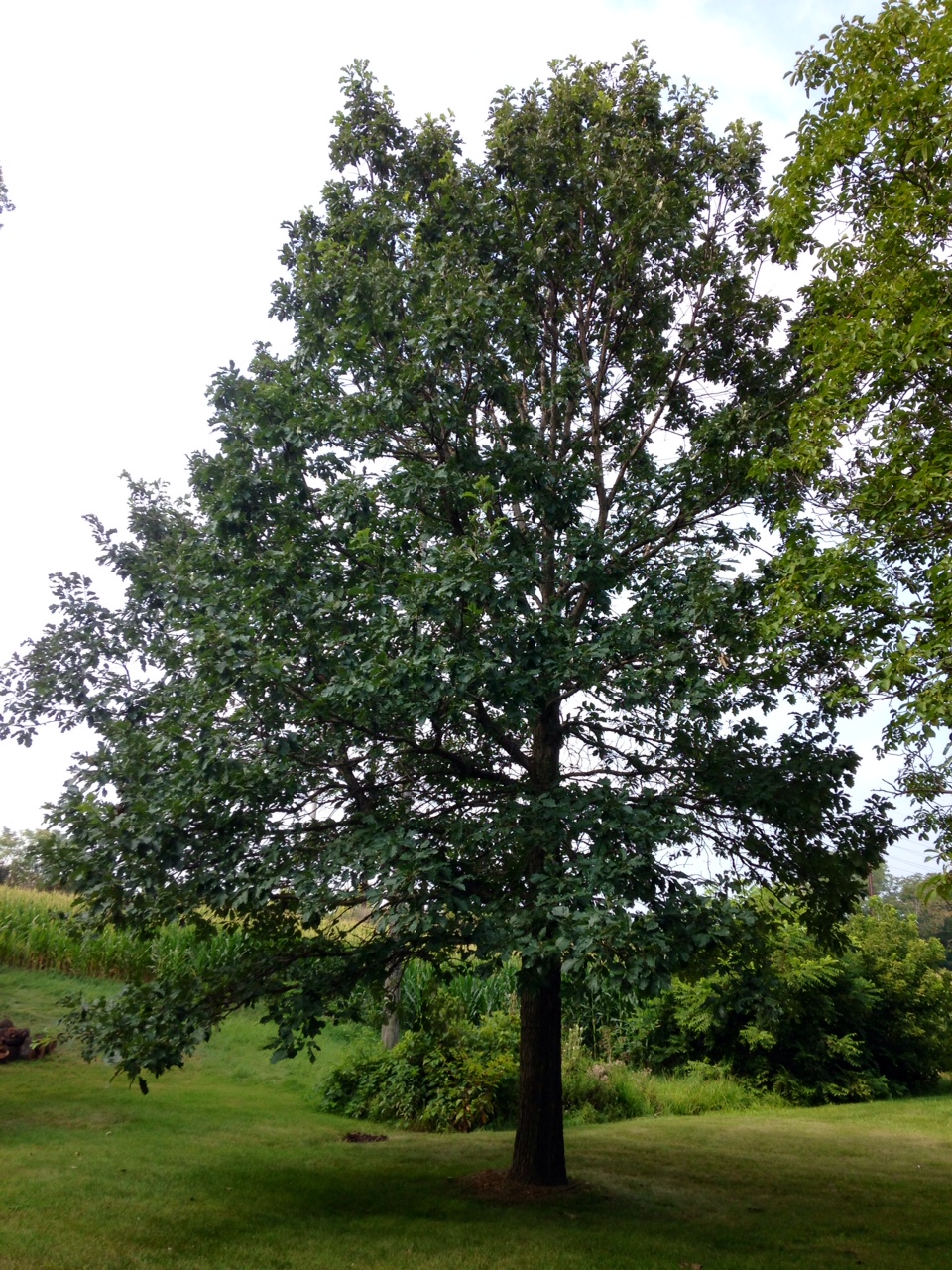
The tree grew and grew for thirty-five years. Now it is very, very tall. Cardinals, robins, and nuthatches hop around in its branches at various seasons of the year. In the summer squirrels enjoy the shade it sheds over the lawn.
Thirty-five-year-old oak tree planted in 1980 in Grandma Longenecker’s back yard 2015 photo
The children visit Great Grandma’s house still, but they don’t often come at the same time now because they have grown up and have families of their own. When they do come, though, they can see how tall the tree has grown and imagine how deep the roots have spread out since they planted that tiny tree so many, many years ago.
Like birds, they have flown away on strong wings . . .
Like trees, they have memories deeply rooted in the Pennsylvania soil
* * *
Someone is sitting in the shade today because someone planted a tree a long time ago. ~ Warren Buffett
A people without the knowledge of their past history, origin and culture is like a tree without roots. ~ Marcus Garvey
Even if I knew that tomorrow the world would go to pieces, I would still plant my apple tree. ~ Martin Luther
I think that I shall never see
A billboard lovely as a tree.
Perhaps, unless the billboards fall,
I’ll never see a tree at all.
~ Ogden Nash, “Song of the Open Road,” 1933 (parody of a Joyce Kilmer poem)
* * *
And he shall be like a tree planted by the rivers of water, that bringeth forth his fruit in his season; his leaf also shall not wither; and whatsoever he doeth shall prosper.
Psalm 1:3 KJV
Is there a tree of significance to your family? Where is it planted? What other images did you recall as you read this post?
My Mennonite Aunt Ruthie Longenecker is elderly now. She has always loved art and is still producing beautiful things nearing age 97. Like Mary Delany, known for her exquisite scissors art, age is no hindrance to creativity.
Note the red and teal crayons in Ruthie’s hand here.
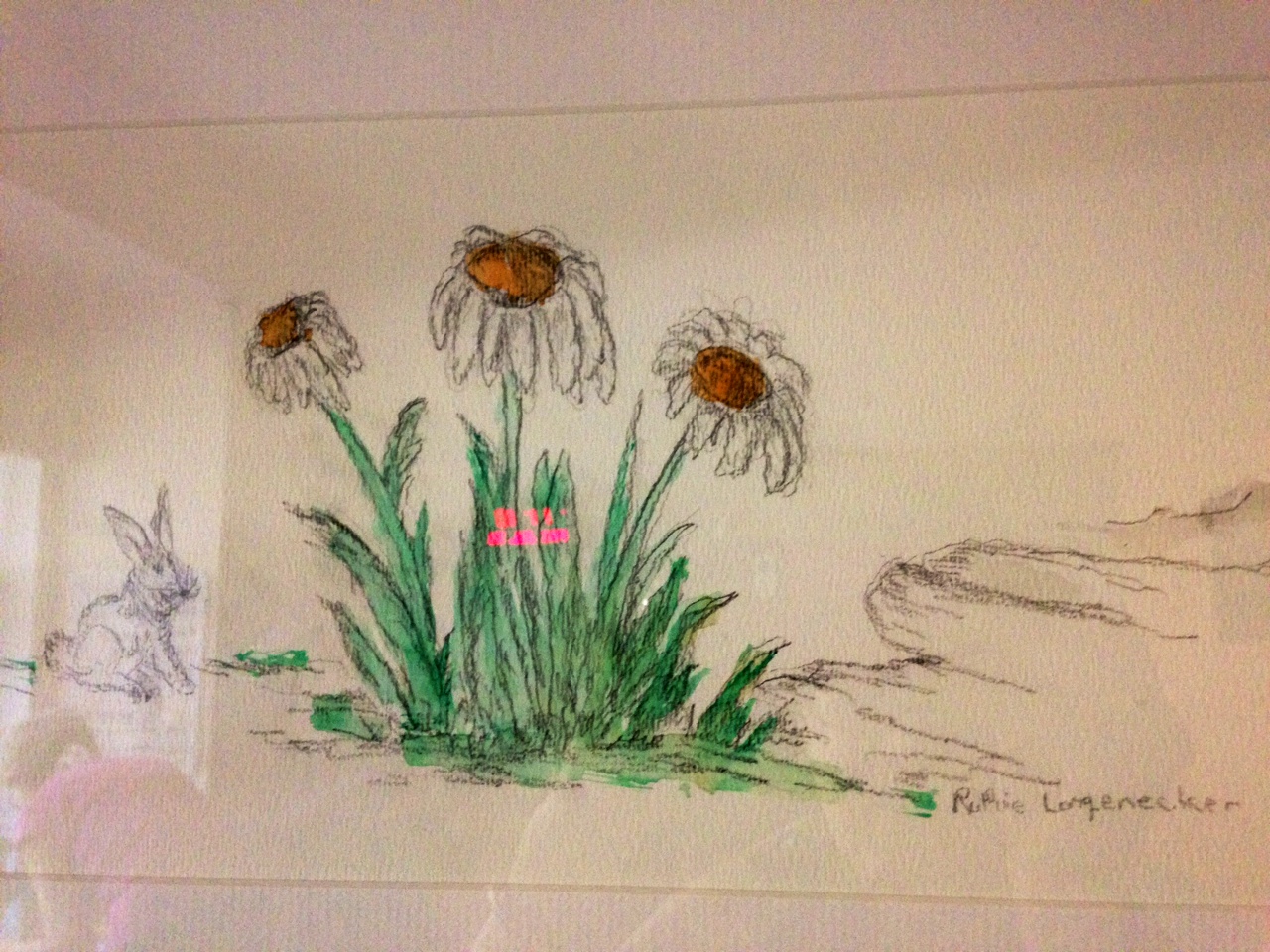
My Artist/Aunt/Teacher Ruthie now lives in a retirement community, where she took an art course several months ago. I have no way of knowing whether the instructor suggested the topic or not, but one thing is certain, her images reflect her deep love of plant and animal life.
Bunnies with trees – neon image a reflection of Ruthie’s wall date/time reminderDroopy daisy petals contrast with erect bunny ears
Aunt Ruthie, also my teacher in Grades 1-4 at Rheems Elementary School, splashed art all over our curriculum in addition to construction paper creations most every school child makes:
Clay moldings fired in a tiny kiln
Finger paints – My favorite, blending red and blue to make purple!
Jig-saw cut-outs made into wall hangings
Plaster of Paris figures
True, she taught the 3 R’s – reading, writing, and ‘rithmetic. I excelled in reading and was often chosen to read aloud “with expression” when the school superintendent appeared in the classroom. However, arithmetic was a different matter. I can still conjure up an image of her brown, beveled ruler dancing ominously above my hand, white-knuckled while struggling to line up 4-digit numbers vertically so the sums would add up correctly.
One happy pause in the school day came after lunch though: Picking colors from the stadium of crayons standing at attention in my green & gold box of 48 Crayolas. My classmates and I filled in the *purple curves and lines of figures from fairy tales and fables while she read from Uncle Remus or the tale of Rumpelstiltskin.
She took a course in oil painting, probably in her 40s or 50s, her love of nature evident in the works shown here.
White birch tree and bridge along lane leading up to the Martin farm Oil painting by Ruth Martin Longenecker
Aunt Ruthie/Miss Longenecker would likely smile in a self-deprecating way at the notion of linking her artistic flair with the idea of “art as sacred expression” which Melissa Pritchard asserts in an article suggesting that “Art [is] a form of active prayer.” Yet, in retrospect, I recognize that art for Aunt Ruthie was a full expression of her humanity, her creativity, and her spirituality.
On July 16, 2015, the U. S. Senate passed by a vote of 81/17 a bi-partisan Elementary and Secondary Education Act to ensure that “all students—regardless of their socioeconomic status—experience the demonstrable positive impact that [art] and music education has on learning and life.” In other words, the Senate is trying to catch up with what the research has been saying for years, the arts improve and reinforce learning in the full range of academic subjects.
Ruthie would be pleased with that move. In her mind, now addled by memory loss, art never ever left the curriculum. For her, art is ageless.
A thing of beauty is a joy forever. Its loveliness increases/ It will never / Pass into nothingness. – John Keats “Endymion”
* * *
Do you have a family member who excels in art? How do you express your own artistic flair? (Don’t discount the home arts like sewing, baking, making creative tablescapes.)





















 Plain and Fancy
