Lacing a belt of green and yellow gimp in crafts class
Trips to the snack shop for an orange Nehi
Bible study on the rocks, girls like us with braids, some with prayer caps
These are my sharpest memories of Girls’ Week at Laurelville Mennonite Camp just off the Pennsylvania Turnpike not far from Pittsburgh, PA. along with . . .
Cottages with cute names like Dew Drop Inn
Toasting marshmallows around a fire pit
Singing rounds, our voices echoing each phrase: “My paddle’s keen and bright, flashing with silver, follow the wild goose flight, dip, dip, and swing”
“Do, Lord, oh, do Lord, oh do remember me wa-ay (big voice dip here) be-yond the blue.”
What we didn’t do at Laurelville:
Set fire to the boys’ swim trunks hanging on the line (There were no boys)
Paint each other’s toenails hot pink. (No one had makeup – verboten)
Sneak a smoke in the woods after dark. (We didn’t have matches – or cigarettes!)
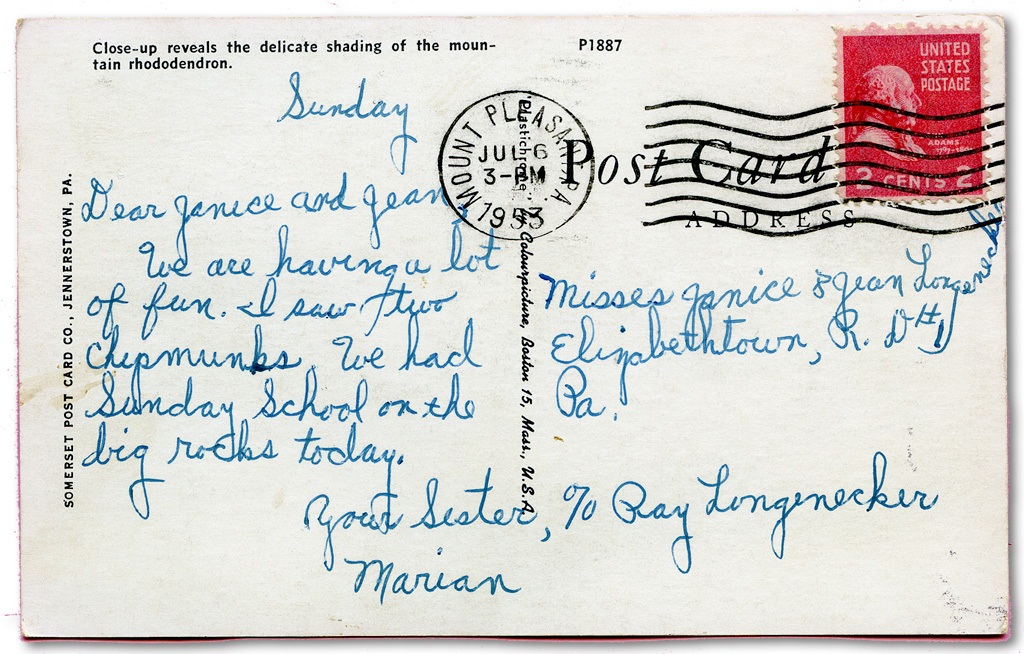
The postcard I sent to my sisters from Laurelville reveals the price of postage stamps, an address that winds around the edge in cursive script, and simple declarative sentences. It also tells how I felt, what I saw, where we worshiped.
Postcard with rhododendron sent from Laurelville Mennonite Camp in 1953
Memories of family week with my sisters and parents at Laurelville left a different imprint.
Family swim time
Doggie roast (Hot dogs, corn on the cob and roasted marshmallows)
Big plaque on dining room wall: “Come ye apart and rest awhile” Jesus’ invitation to his disciples in Mark 6:31
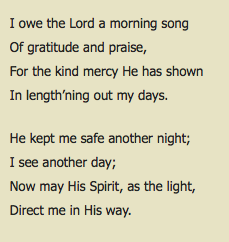
Morning blessing in song: “I owe the Lord a Morning Song” written by Amos Herr, Lancaster County pastor and farmer who couldn’t get through the snow drifts to church one Sunday morning in the 1850s and was inspired to pen both words and music to this song of gratitude. First two stanzas here:
We also sang something new to us: How Great Thou Art, a Swedish hymn written in 1885, which became an instant sensation in Christian circles in 1955 because of the Billy Graham Crusades.
When through the woods and forest glades I wander, I hear the birds sing sweetly in the trees; when I look down from lofty mountain grandeur and hear the brook and feel the gentle breeze.
What are your memories of camp? Here’s the place to share them – songs, games, mischief – other memorable moments.
Yes, imagine two Mennonite girls tripping across the country . . .
In a blue-gray 1958 Chevy Impala sedan
With a chauffeur and navigator
Through 47 states + Mexico
Five weeks in 1964: July 18 – August 24
My Travel Partners: The Metzlers, whom I call Aunt and Uncle, and their daughter Joann
Unlike John Steinbeck who wrote Travels with Charley about his one-man, one-dog travelogue in the 1960s, we were a four-some, Joann Herr, my new best friend, her parents, John and Mary Metzler, and me. But like Mark Twain, we were “innocents abroad,” leaving our cozy Mennonite countryside and venturing through the wild and wooly West to the Pacific coast, eyes agape with wonder.
Best Bud: Joann Metzler (Herr) whom I met while she was student teaching at Rheems Elementary School, where my Aunt Ruth Longenecker was principal. “She’s such a nice girl. You ought to meet her,” Ruthie said about Joann. She was right! I even thought so at the end of the trip.
Chauffeur Extraordinaire, Uncle John: One day he drove 748 miles! John Metzler, who raised crops and cattle, is related on my mother’s side of the family through a common ancestor, Valentine Metzler, whose immigration to Pennsylvania was celebrated in the reunion in 2013. During this thousands-of-miles-odyssey behind the wheel, he sometimes came up with quotable expressions:
“Oh, schmatza (PA Dutch for pain),” he frets when there are too many switchbacks on mountain roads.
“Now we’re caught with our pants down!” when he makes a wrong turn.
“I thought I’d be hen-pecked with three women around and by golly I am already!” he exclaims 11 days into the trip.
Navigator with a Built-in Compass, Aunt Mary: With only a road map and keen sense of direction, Joann’s mother “Aunt Mary” was quite a trooper. She made sure we were ready to roll between 6:30 and 7:00 am every day. When I felt road sick, she doled out Chiclets. She was eager to see her spry, 81-year-old Aunt Susan in Los Angeles.
In Cheyenne Uncle John was taken for a German because of his PA Dutch accent, and Mary tells him “ta be more English!” Here are the two smiling at Crater Lake, Oregon.
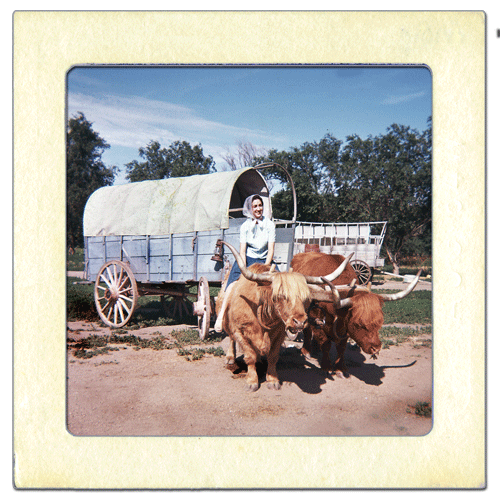
The Big Loop – Like Steinbeck, we did follow a northern route across the Mid-west, angling down through California and sweeping across the Southwest into Texas and further east to Florida and then north back home to Pennsylvania. Along the way, we sometimes fancied ourselves in foreign lands: Parts of Utah looked like Greece to us, the Rockies like the Swiss Alps, and some of Oregon, the Holy land because of myrtle trees.
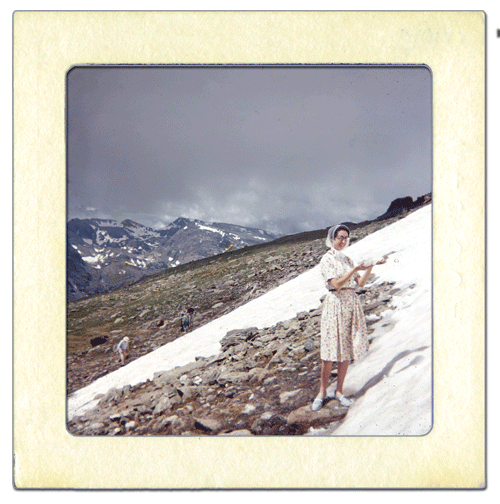
In the Rockies, I make a snowball on my birthday!
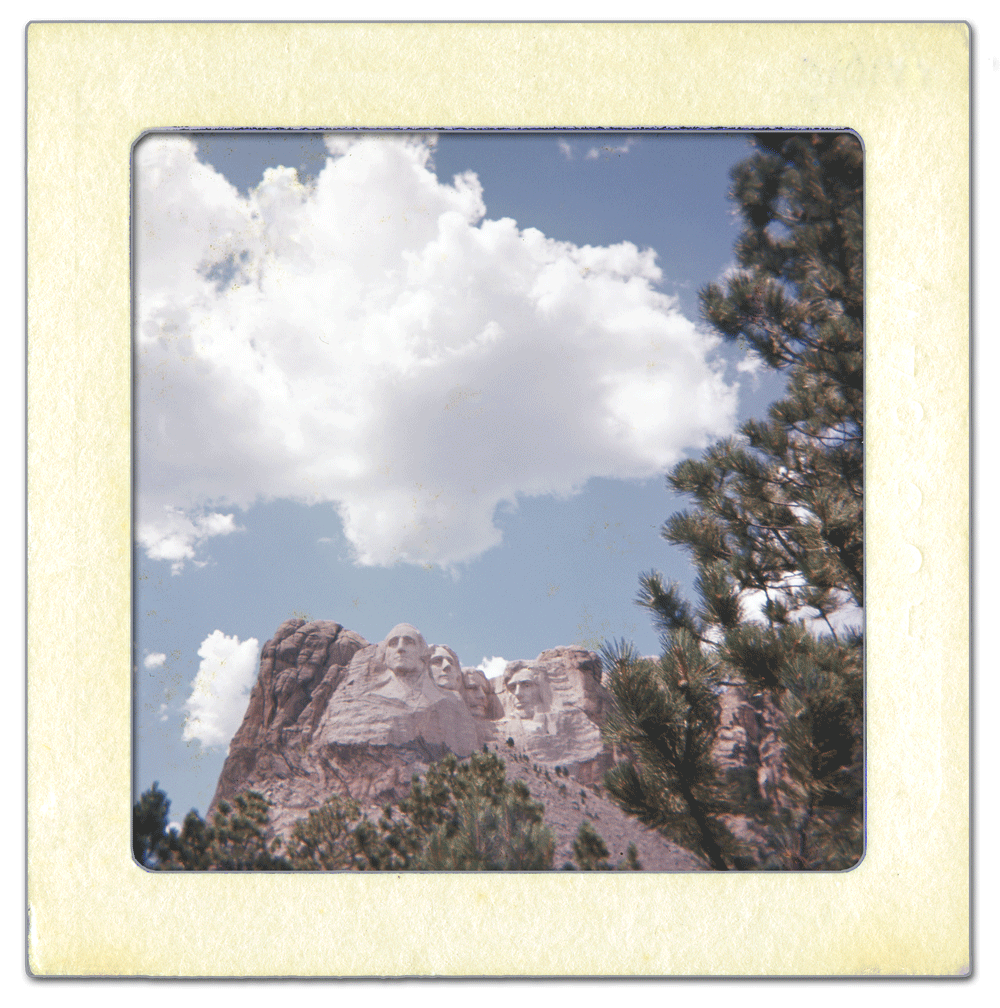
We were entranced by presidents, puffy clouds, national parks . . .
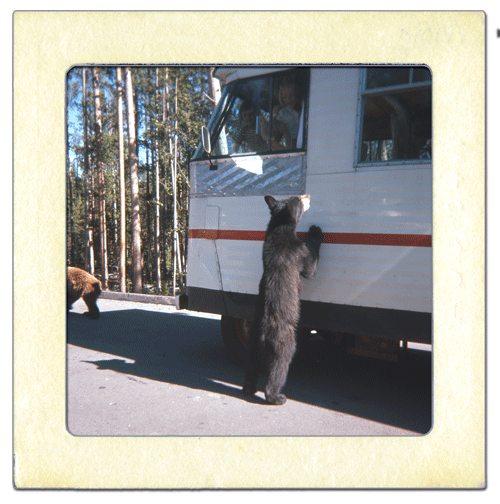
Yellowstone, 12 million acres of gorgeous scenery – even bears want a part of the action
And the Magnificent Grand Canyon
Oregon and California: Myrtle trees, Joshua trees, Dates and Olives!
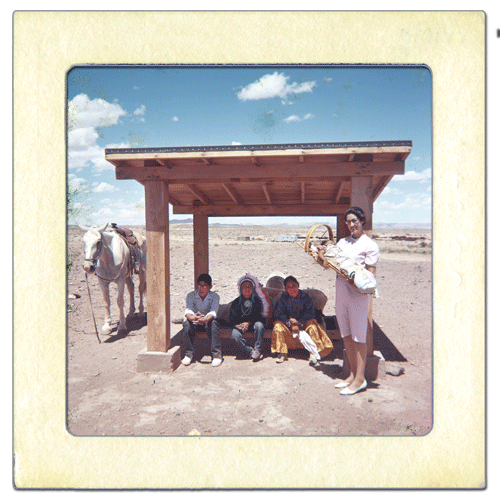
Joann and almond treeNavajo Indian Reservation: Family was pleased to pose in exchange for some pesos
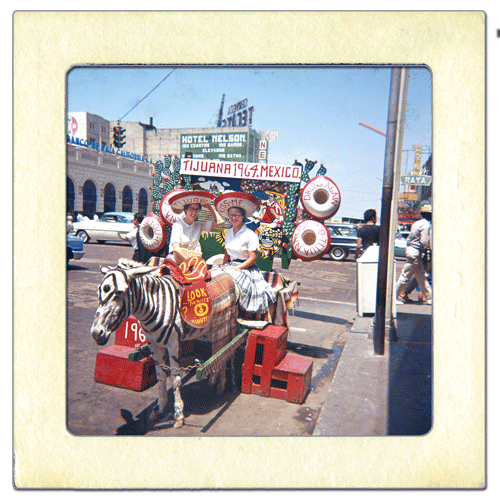
Tijuana, Mexico: sombreros, a heady substitute for our prayer caps. Joann had no idea she was inviting kisses!
What We Wore
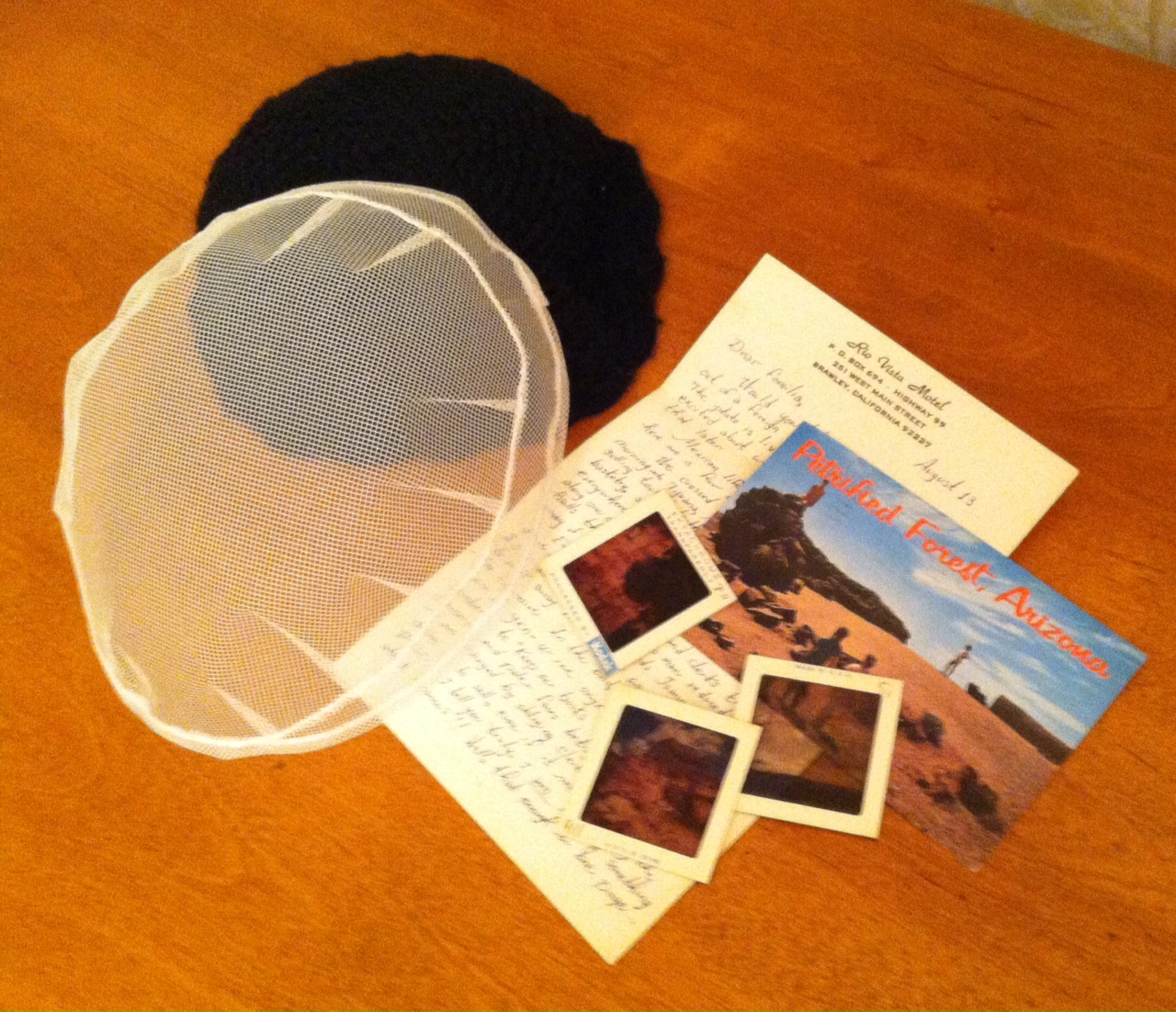
The photos prove our plainness. We always had something on our heads: prayer coverings, black bonnets on top of our caps for Sunday in Salt Lake City, Utah. Accordion pleated plastic wind-breakers for stiff breezes or rain. Dresses or skirts – absolutely no slacks or shorts.
Grandma Longenecker gave me a travel iron – no permanent press fabrics yet in our wardrobes in the Sixties.
Closeup of prayer covering and bonnet like Joann and I wore on the trip with Kodak Ektachrome slides, letter home and post card from the Petrified Forest, Arizona
Days were HOT!
One day it was 110 degrees in a car with no AC. Our Boontonware cups melted in the rear view window. Our backs made puddles on the seats, so we tried the feet-in-air position, backseat monkeys! Here below are the Boontonware cups before they melted! And, yes, photos at state lines were staged – part of our ritual.
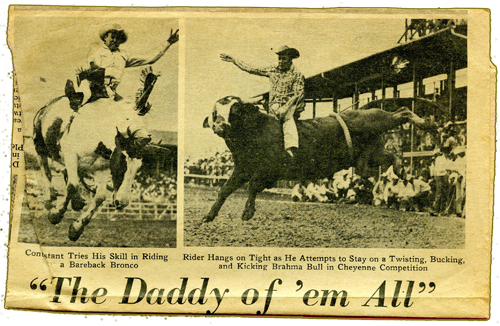
Uncle John couldn’t wait to get to Cheyenne, Wyoming to see the Rodeo, The Daddy of ’em All during Frontier-land week.
What We Did at Night
Sometimes Joan and I disturbed the peace of the Metzler pair next door in the motel. Once I kicked down a picture on a motel wall in Wisconsin and nearly fell on my head to try to retrieve it. Daily we wrote in our diaries and totted up our expenses down to the last penny.
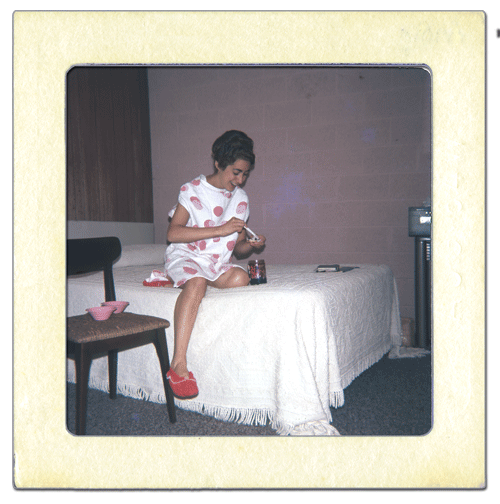
Usually we snacked and read books. One night I lowered the hem on a skirt with my sewing kit to comply with standards of Lancaster Mennonite School, where I would return to teaching in the fall. Here I’m making a feast of boysenberry bread near Kanab, Utah.
Many thanks to photo-enhancer Cliff for bringing faded memories back to life!
How did I pay for this trip on my slim school teacher’s salary? What secrets did my diary and expense book reveal? Did anyone from home remember my birthday? Find out in my next post!
Nose-to-the-Grindstone, that’s my dad. But I have proof in pictures that he once took a fling to Florida with his Lancaster County Mennonite buddies. Judging from the photos that remain and Mother’s comments, I can pretty much guarantee that there were no stops at a roadhouse, nights spent bar-hopping, or brothel visits.
According to their Swiss-German work ethnic and the spirit of the times, these five men, Parke Garber, Dick Sauder, Bud (Wilbur) Martin, Howard Longenecker and Daddy were destined to be dutiful farmers or businessmen, faithful husbands and fathers. But until they hit the groove for the rest of their lives, they would see the world, traveling over 800 miles from Pennsylvania to Florida.
My Dad
They traveled in a car of this vintage with a road-map, certainly no GPS!
To Cypress Gardens, Florida 1939
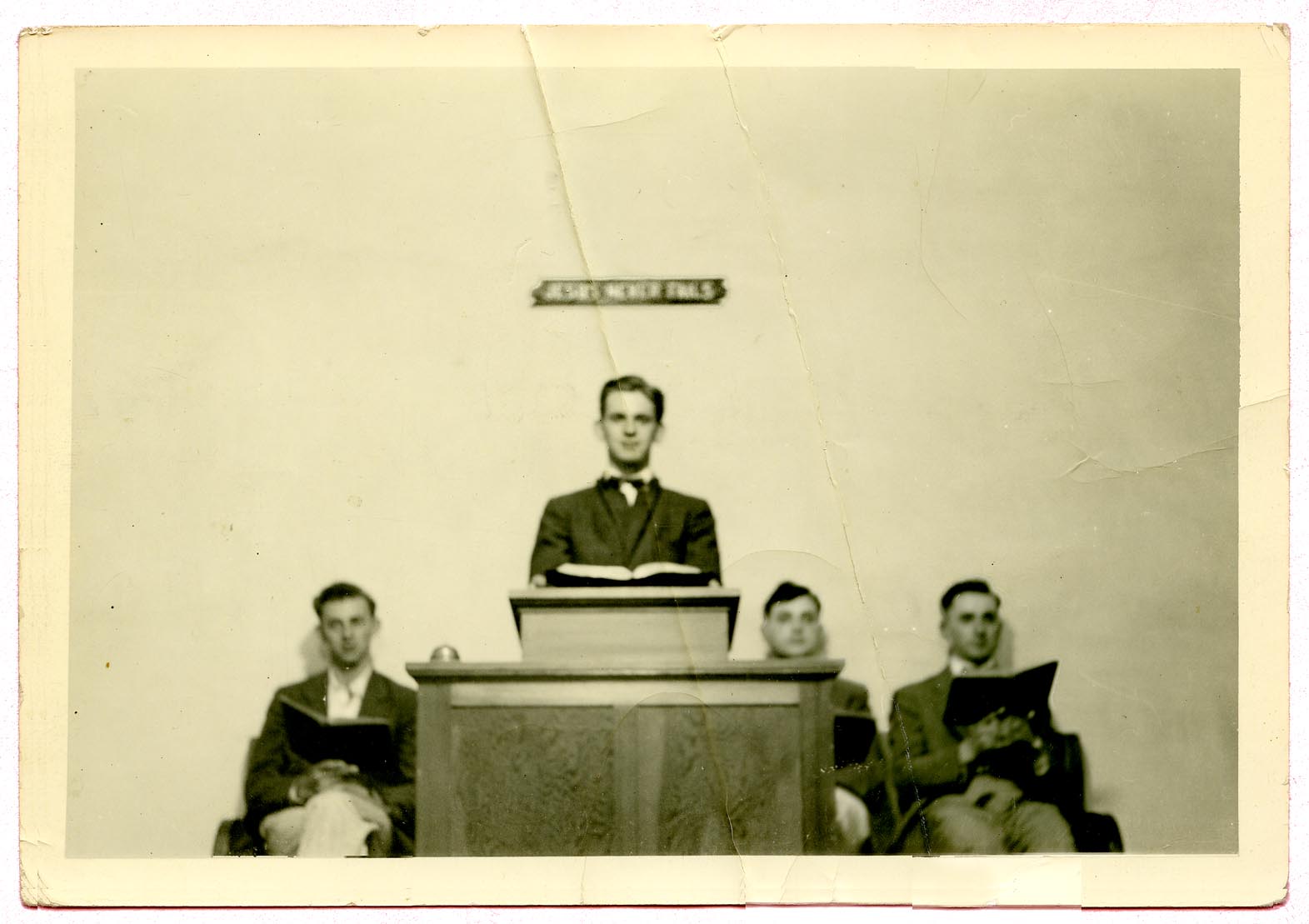
The craziest thing recorded is a snapshot of the men playing church under the skinny wooden banner Jesus Never Fails. I say they were playing church because that was what Mother told me and I never heard anything to the contrary. The “preacher” was a farmer turned car salesman and my sanctimonious-looking dad (at right), a farm implement dealer, holds a hymnbook or Bible.
Richard Sauder in pulpit, to the right Parke Garber, far right Ray Longenecker, my father (Unidentified man on left)
All these pictures were stored in a heap inside our family’s piano bench for decades. Only recently have they seen the light of day.
Based on the date here, my dad was 24. He was married in 1940 when he was 25, a year younger than my age at marriage. Men of this era did not usually marry until they could support a wife. The first question Daddy queried Cliff when he asked for my hand in marriage was “Do you think you can support her?” Looking back, the question seems a little strange as I was already a teacher of four years with a salary.
What I’d like to know:
Who’s idea was this trip?
Where did they eat? (These men were used to home-cooked meals.)
What did they talk about?
Did they ever wear casual clothing? (All I see here is white shirts, suspenders, ties and long trousers.)
Did they send postcards to their girlfriends?
Did they laugh and carry on?
Wouldn’t Dad have been astonished back then if he had known two of his daughters would be raising their families in Florida, so far away from their Lancaster County, PA childhood roots?
Do you have photos in your family albums that pose questions without answers?
Earlier this month, my husband Cliff and family laid to rest his father Lee Beaman in a tiny urn above the coffin of his mother in the cemetery adjoining the church. Across the street from the simple, white-plank Methodist Church near Ridgefield, WA, are lilac bushes in full bloom this April. If you live in the Pacific Northwest, here is a website you may want to check out: //lilacgardens.com/
Lilacs along Carty Road, near Bethel Methodist Church, Ridgefield, WA
Like floral fireworks, these blooms explode in vivid lavender, each blossom bursting in “bullet-shaped buds.” Poet Richard Wilbur seems to scrutinize the lilacs he describes by looking into not just at the hundreds of teeny buds arranged in each bursting bloom tighter than stick pins in a pincushion.
As poet Wilbur points out, each tiny lavender bud appears “quick and bursting,” not holding back its beauty – is open and free. Similarly, when friends and family eulogize the beloved, their remarks tend to be candid, “quick and bursting,” revealing true feelings, knowing this is probably the last time to express their sentiments publicly.
Lincoln and Lilacs
Another poet, Walt Whitman, connected grief to the springtime and lilacs as he expresses his deep attachment to Abraham Lincoln, whose death April 15, 1865, is commemorated in his famous poem When Lilacs Last By the Dooryard Bloom’d. Written in private, the poem is a public elegy to the President the people adored. The poet revered the President too and when the cortége passed by, Whitman placed a sprig of lilacs on the coffin:
“With delicate-color’d blossoms and heart-shaped leave of rich green, /A sprig with its flower I break.” (stanza 3) Then admitting that “the lilac with mastering odor holds me,” Whitman will forever associate the fragrance of lilacs with his fallen hero (stanza 13).
Finally, referring to Lincoln as a “Powerful western fallen star” the poem closes with the lines
For the sweetest, wisest soul of all my days and lands—and this for his dear sake,
Lilac and star and bird twined with the chant of my soul,
There in the fragrant pines and the cedars dusk and dim.
Kathy Beaman holding lilacs after Dad’s memorial service
Lilacs Bushes and Grandma’s Outhouse
Please permit me this odd segué!
I love lavender and purple – and I love lilacs and wisteria. Wisteria climbing joyfully on a trellis on Grandma’s verandah and lilacs some distance away. . .
Close to an oak tree that Grandma Longenecker’s grand-children planted in her honor after her death in 1980, was an outhouse (now long gone) surrounded by a clutch of lilac bushes. The lilacs around Grandma’s house served as a fragrant air freshener. Of course, there is nothing elegiac about an outhouse, a tallish, square white structure with a roof, equipped with a Sears & Roebuck catalog or better yet for the job – a phone book. The outhouse, dedicated to defecation, bears evidence that bodily functions continue, that you are still alive. Lilacs thrive there.
Long live the lilacs. Long live symbols of life, death, and rebirth!
* * *
. . . and a bush nobody had noticed burst into glory and fragrance, and it was a purple lilac bush. Such a jumble of spring and summer was not to be believed in, except by those who dwelt in those gardens.
The Enchanted April, Elizabeth von Arnim
Now, your turn. What is your relationship to lilacs or other spring flowers? To commemorating the death of loved ones?
Growing up in rural Lancaster County in the 1950s, I had very little opportunity to meet people of other ethnic groups, but I did have a Little Black Sambo book that introduced me to a culture different from mine. So, I have not always been embarrassed by this book. Fascinated, yes, but embarrassed, no. The picture of the tiger running around an African palm tree as the tiger morphed into a golden round pool of butter mesmerized me as a child, butter that would become one of the ingredients of the pancake recipe. The next page shows Black Sambo’s mother Black Mumbo with her glossy brown arm stirring a mound of melted butter making pancakes. The picture made me hungry. And on the last page:
And then they all sat down to supper. Black Mumbo ate twenty-seven pancakes, Black Jumbo ate fifty-five. But little Black Sambo ate a hundred and sixty-nine because he was so hungry!!! (Yes, there are three exclamation marks in the book I am holding.)
Characters in folktales are typically overblown, with exaggerated details like Little Black Sambo’s super big eyes, through which he gazes at three heaping plates of pancakes with a pot of syrup dribbling all over the table. Obviously, he is ready to stuff his mouth with piles of pancakes.
But there are other tales in the book with the Little Black Sambo cover: The Little Red Hen, The Tale of Peter Rabbit, and The Country Mouse and The Town Mouse. Mr. McGregor and the kitchen maid in the “Mouse” story have white faces, but there is no reference to their whiteness. Their race is assumed as white and therefore not particularly notable.
I paged through this book recently as we cleared out books in Mother’s house and marveled at the stereotypes about black people back then and was embarrassed by it: A black woman with a big butt and goofy name wearing a “maid” cap on her head, black people eating nothing but fried foods, everyone eating too much.
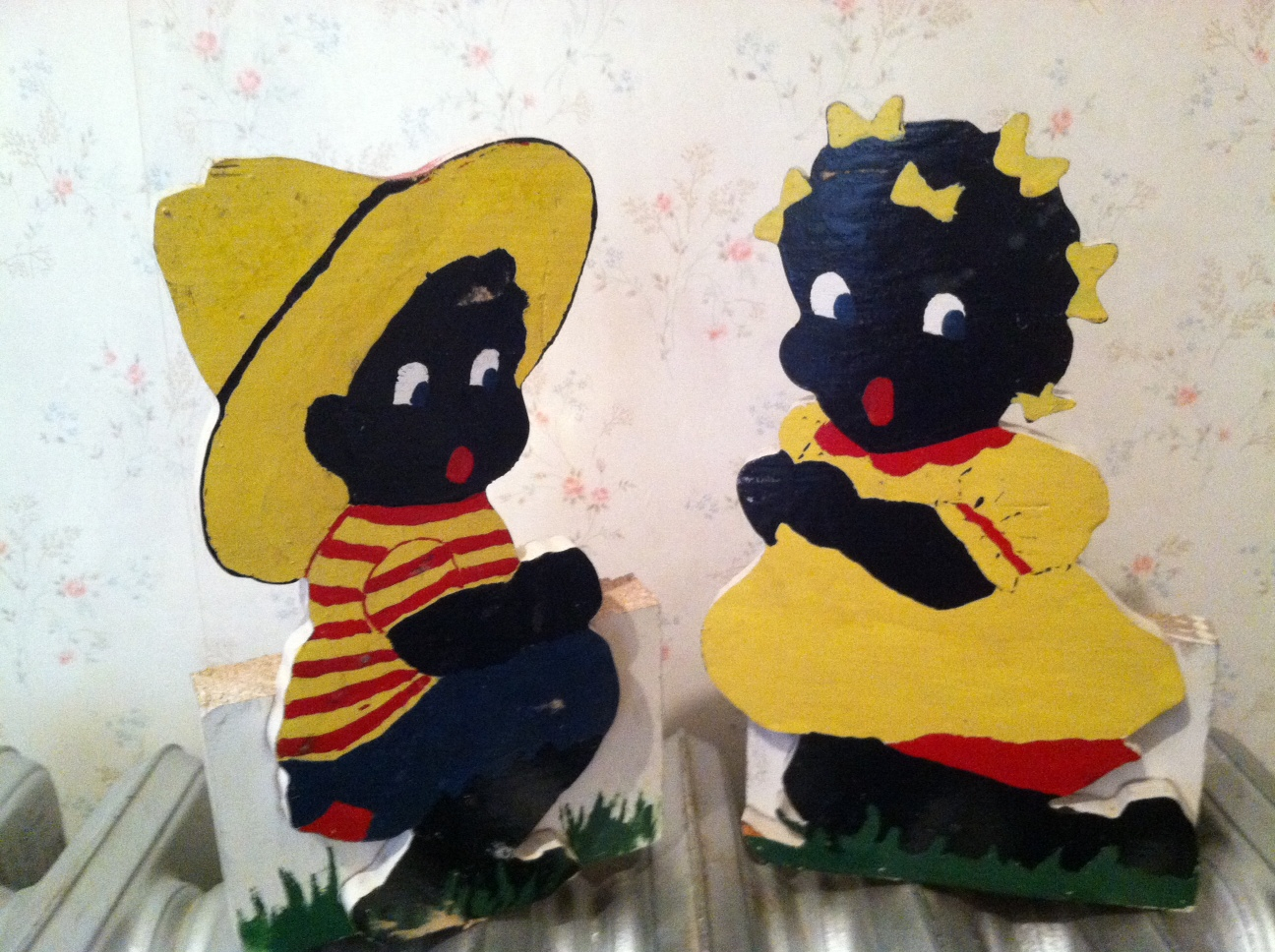
Another find un-earthed in our sifting through “Stuff” – a pair of book-ends I made in school that portrays black children as a novelty.
Interestingly, my niece Shakeeta, my brother Mark’s daughter, choose these as one of the few things she wanted as a remembrance from her Grandma Longenecker’s house. She hoists them up with a smile here:
I guess it’s time I catch up with the times and adjust my ideas about black memorabilia. Singer Anita Pointer certainly has. In an article entitled “A Lesson in History,” (AARP Feb/March 2015) Anita, one of the Pointer Sisters, says she collects black memorabilia so she’ll never forget how her people were once depicted.
We grew up in Oakland, California, but when I was 10 we visited my grandma in Arkansas. I couldn’t believe how people were living there. They had a white and a black part of town, and you stayed off the white side. At the department store, they had colored and white water fountains. I don’t want to ever forget that’s what it was like for us — and collecting black memorabilia is how I do that. (66)
Like Whoopi Goldberg and Spike Lee, Anita collects black memorabilia as museum pieces including a “Mammy” cookie jar, and a 1970s John Henry whiskey decanter made by Jim Beam. When the prestigious house of Sotheby’s came to appraise her collection, it took a year to sort and categorize it. She comments, “The appraiser said that I could pretty much charge what I want because most of the pieces are one of a kind.” In the end, Anita Pointer sees her collection of thousands of pieces as part of her personal history. She doesn’t apologize for any of it.
Of course, I’m hanging onto my Little Black Sambo book. It’s a part of my personal history.
Your comments welcome here!
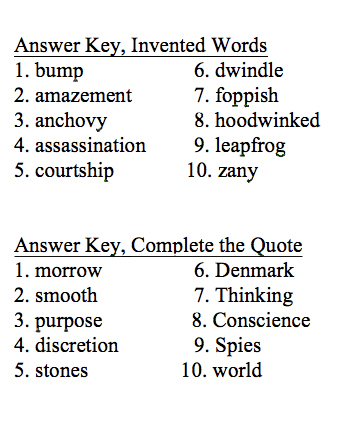
(Answers to Shakespeare puzzlers from April 22, 2015 post below.)
Clearing out a house after death is a sacred act, yet no amount of holiness assigned to this task can dismiss the back-breaking, shoulder-aching, neck-craning job of sorting, recycling, and passing on to others the possessions of a loved one. Aside from clothing and furniture, Mother left behind the tools of her trade in the kitchen along with beloved books of our childhood, some of which are displayed here.
Prepare Food & Serve It
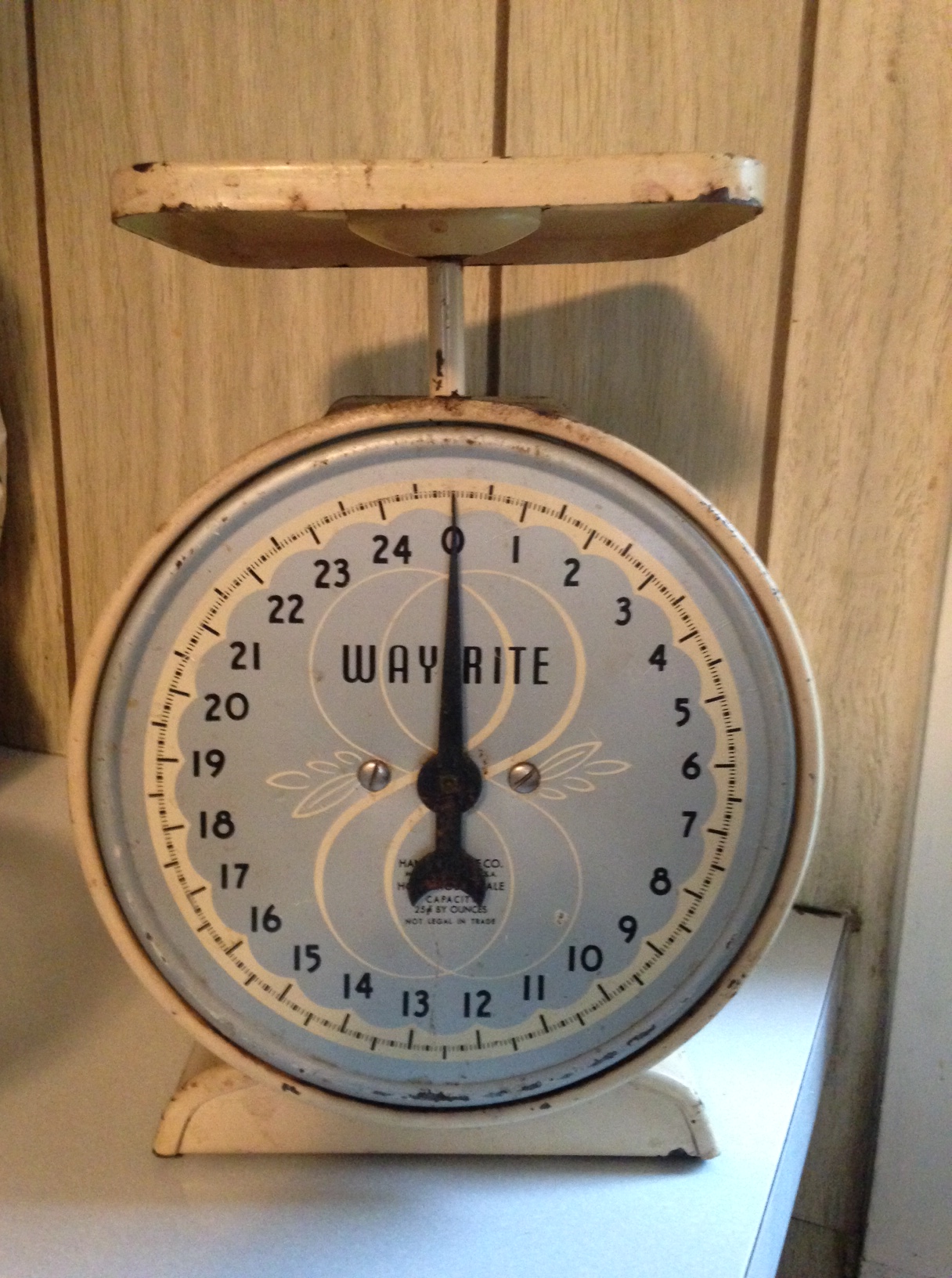
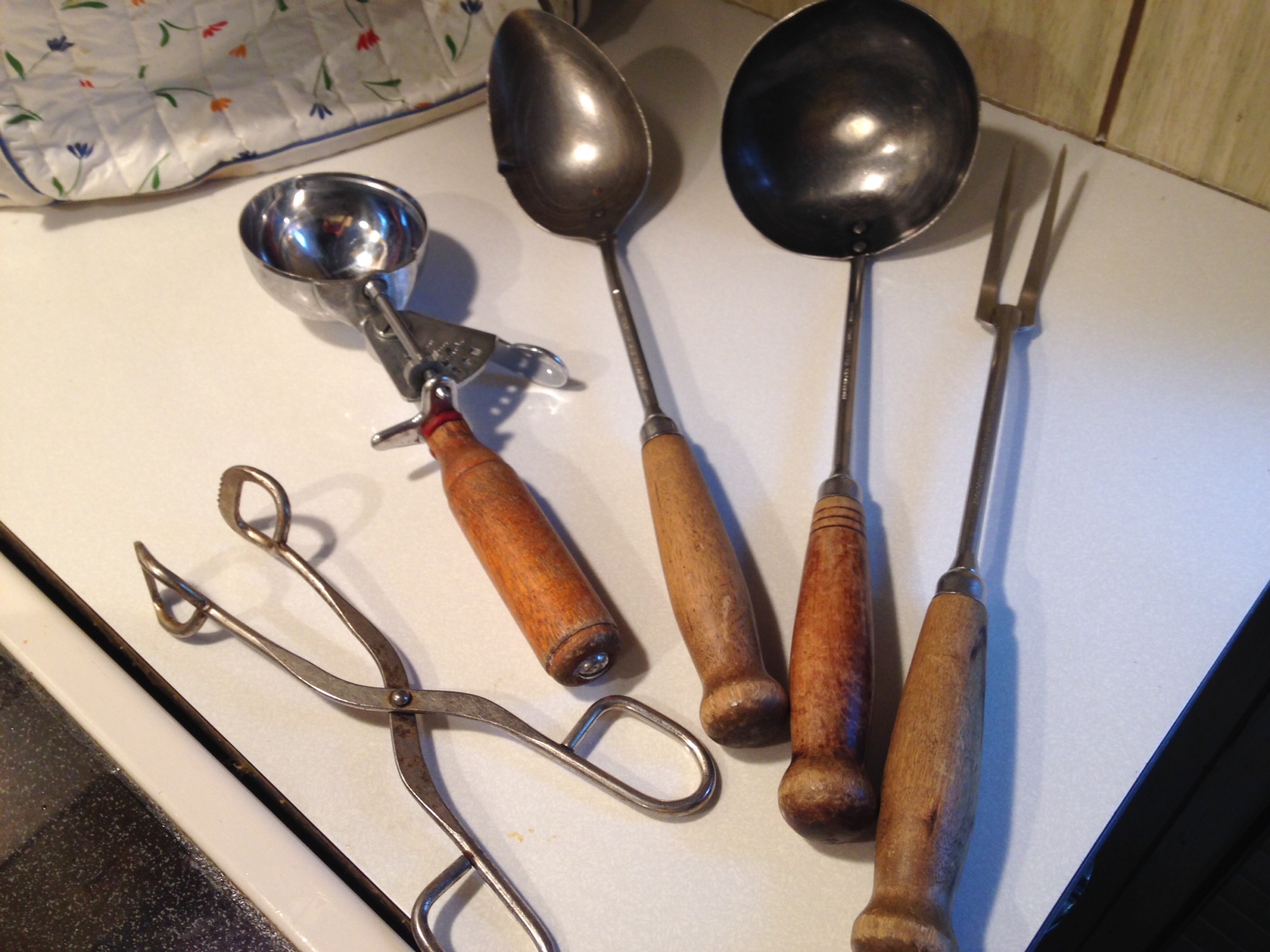
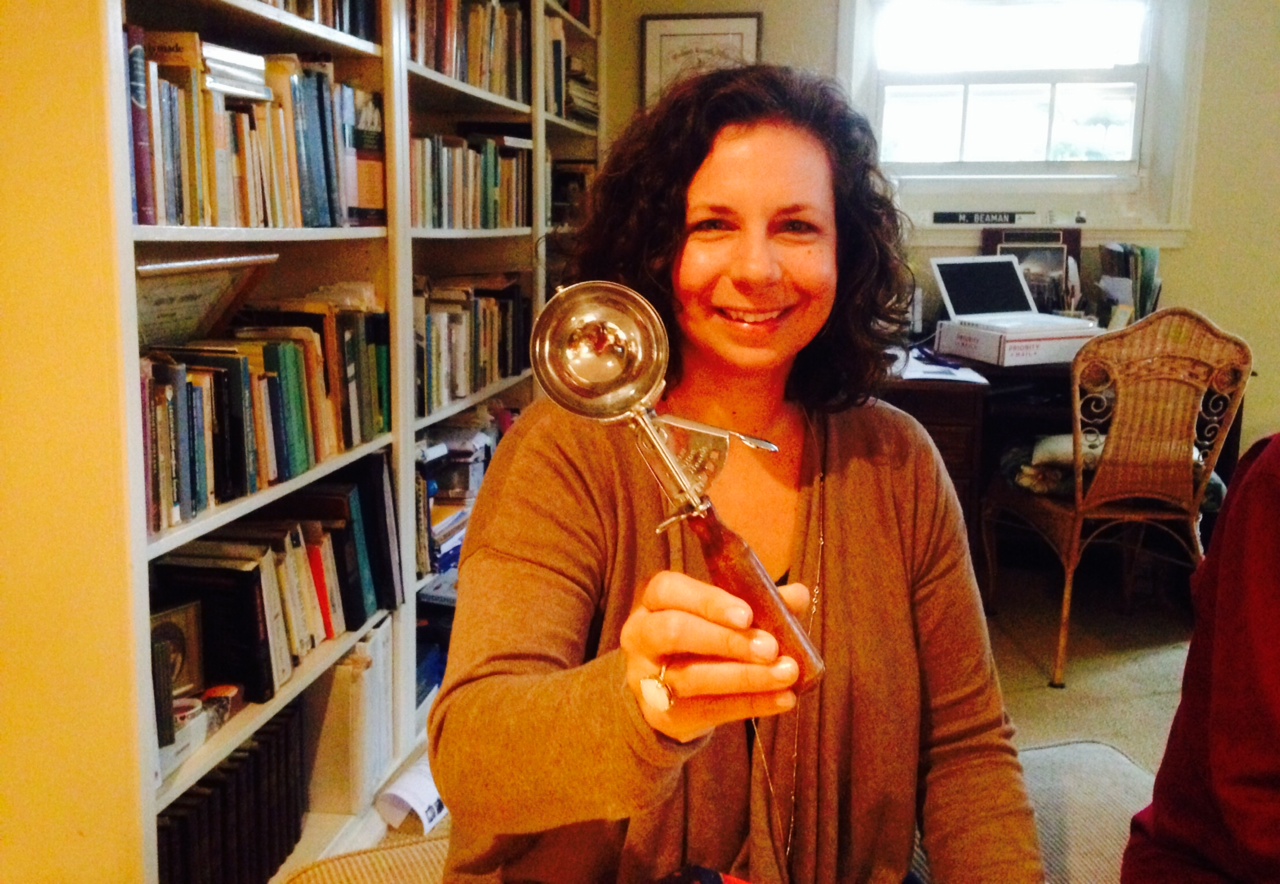
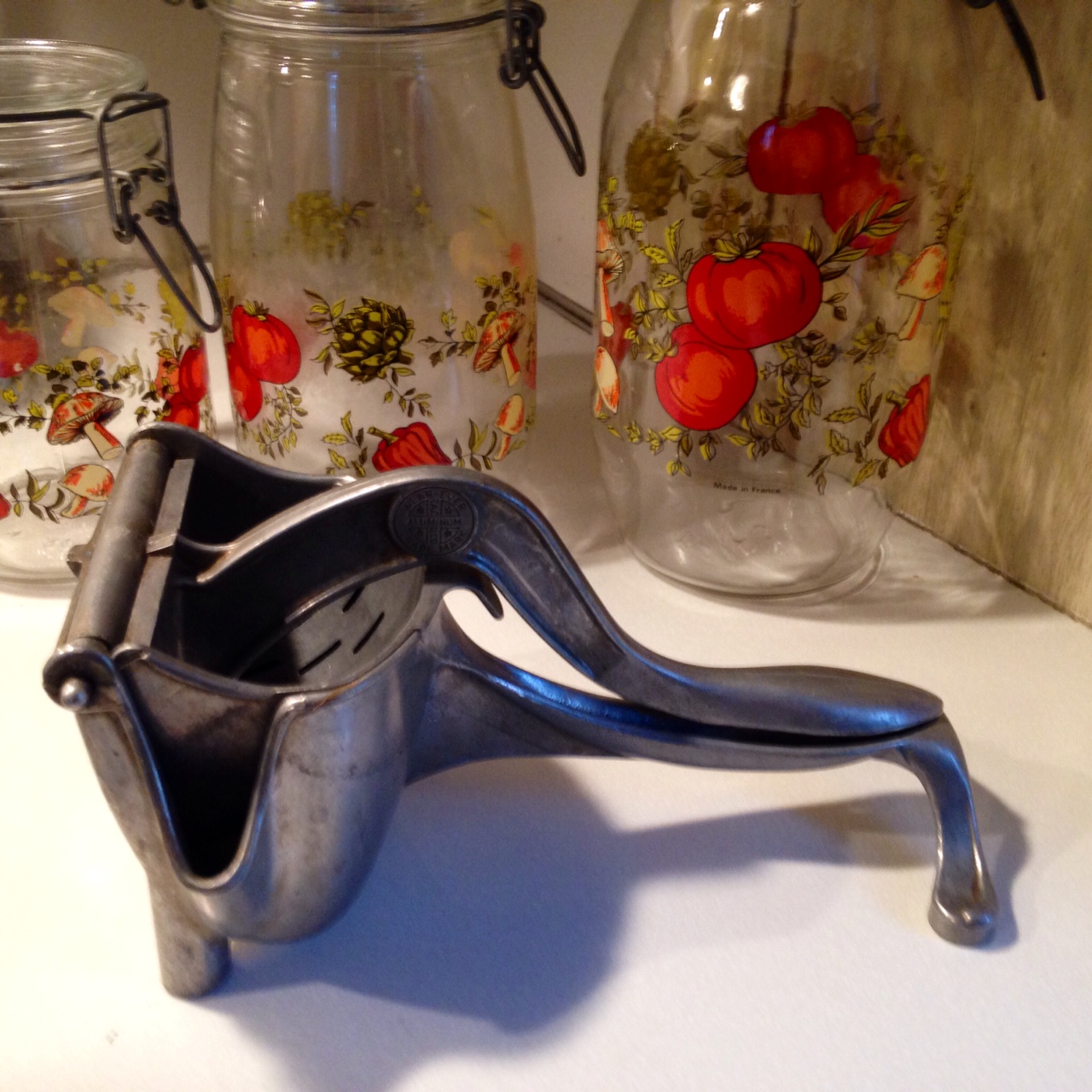
What remains: A scale on which all of our baby weights were noted and recorded (or ingredients for recipes measured), cooking utensils, ice cream dipper, and juicer, most of which have been passed on to grand-children.
My best guess is that these were wedding gifts or first (and only) time purchases. I don’t remember another scale, a different set of utensils, a second ice cream dipper or juicer ever passing over the threshold of our home. The throw-away mentality of our current consumer society never made sense to Mother. “You buy good, and keep it – for a lifetime” was her philosophy! Yes, prepare food and serve it, and with love! Her fancy china set, sterling silver flatware, and crystal glasses and goblets all have found homes with her grand-children.
Daughter-in-law Sarah pleased with Grandma’s ice cream scooper
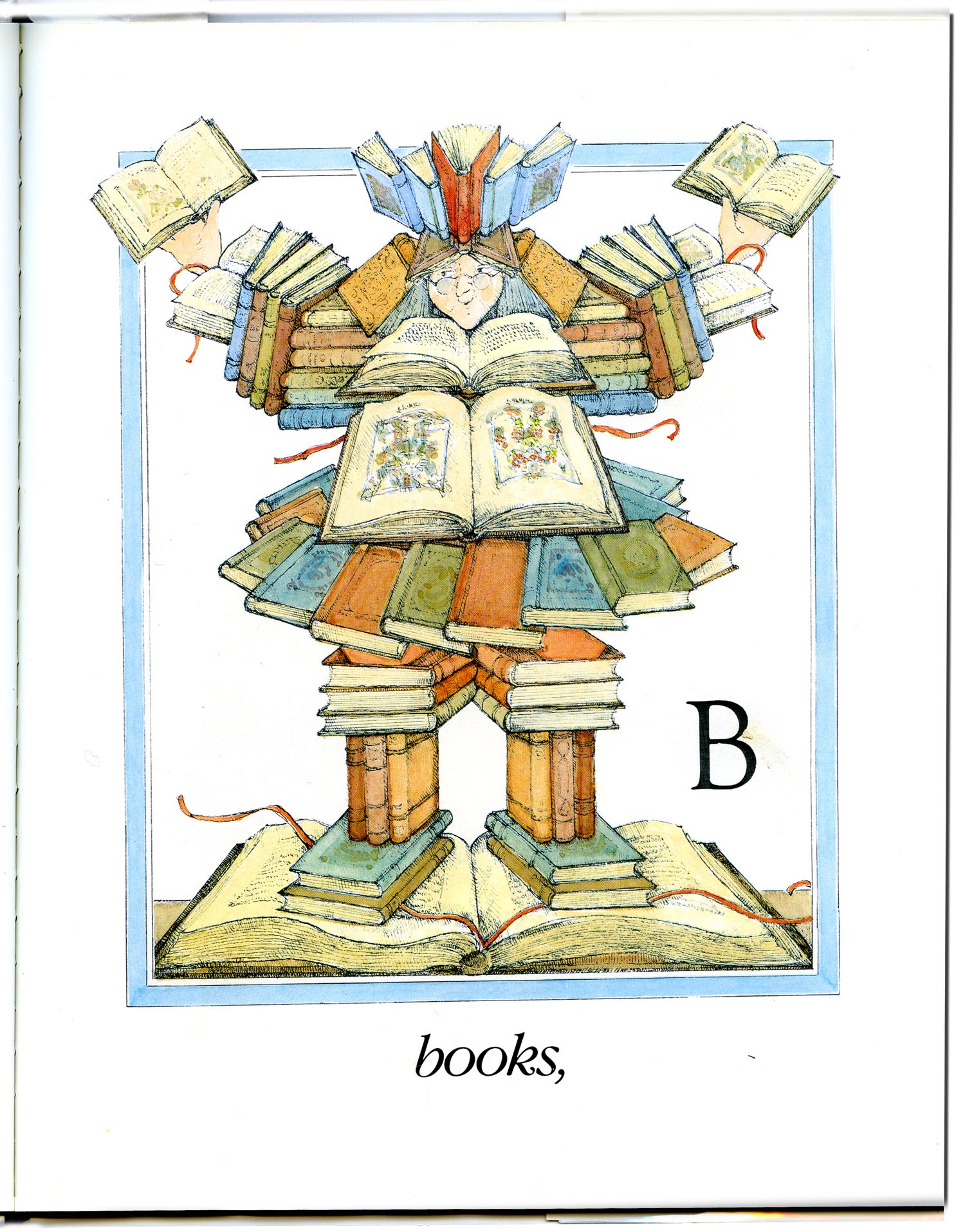
Don’t Forget to Stir in Imagination
Illustration from On Market Street by Anita and Arnold Lobel
In previous Moments of Discovery, you may have seen other books from Mother’s bookcase or from the attic.
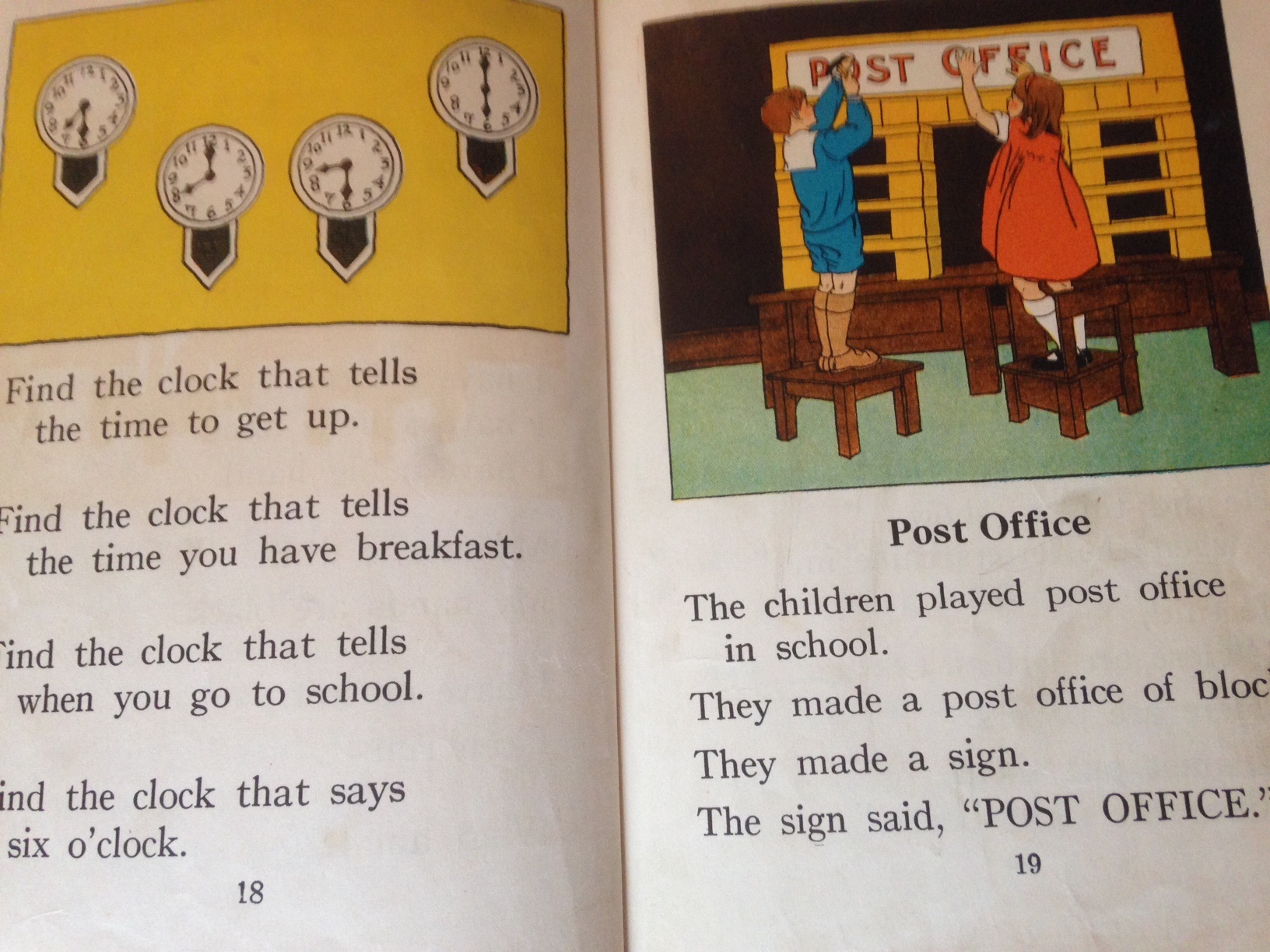
The book below, a reader, is certainly a keeper, recording media and methods that are becoming obsolete.
The Child-Story Reader, copyrights ranging from 1927-1936
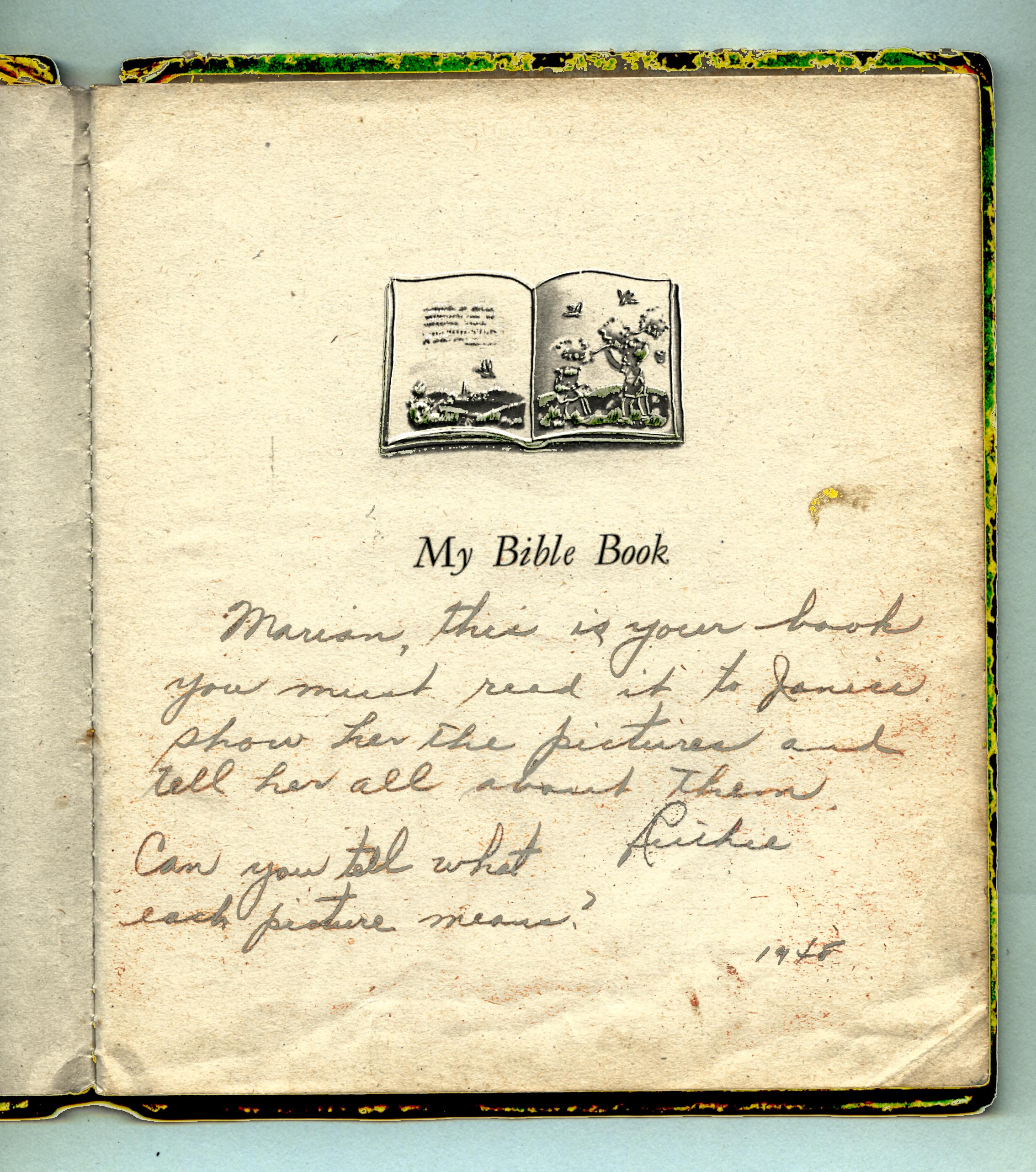
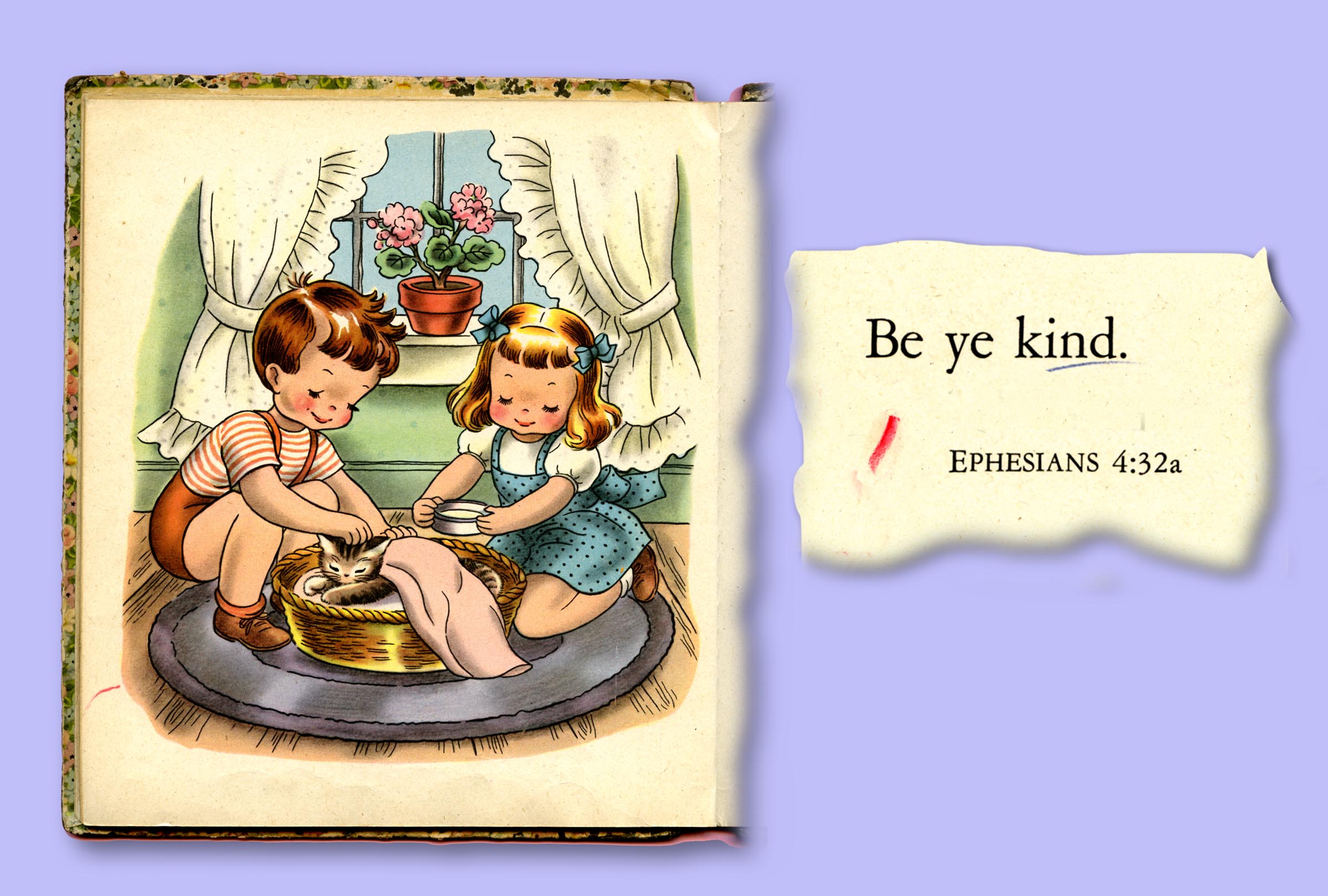
And one of my favorites is My Bible Book with verses selected by Janie Walker and pictures by Dean Bryant (Rand McNally and Company, 1946). These words and pictures have been imprinted on my childhood memory as I joined the red-haired boy and blonde-headed girl roaming around gardens and romping through meadows with their pets. It was a perfect world!
Aunt Ruthie gave me this book with penciled instructions to read it to my sister Janice, show her the pictures and tell her all about them.
Ever the teacher, she closes with her sweet lead-in question: “Can you tell what each picture means?” This is probably a Christmas gift or birthday present given to me in 1948.
Puppy dogs, a frog, a snowman, a kite, some birds, squirrels, a herd of cows, and a even a special kitty cat amuse the children as the pages turn with words of wisdom all quoted from scripture.
Do you have old books in your treasury of keepsakes? Some special utensils for cooking or serving passed down to you from a generation or two ago? We’re all ears!
Coming next: Button, Button, Who’s Got the Button?
Maybe a change in scenery is all you need to perk up. After a rough winter, the drowsy dreaminess of a warm, languid clime may sound very appealing.
If so, you have something in common with the middle-aged Lottie Wilkins and Rose Arbuthnot, both members of the same London ladies’ club, who become acquainted after reading a newspaper advertisement for a small, furnished medieval castle to be rented for the month of April on the balmy shores of the Mediterranean. They are seeking enchantment – and in April.
* * *
In February, I met Timeless Lady, a blogger who blends quirkiness and a strong, spiritual core in her posts. In a recent piece about the book/movie Enchanted April, she published the words in the newspaper ad that enticed these ladies to exchange London fog for idyllic Italy at a castle in Portofino, Italy no less. Here is The TImes newspaper ad that drew them in:
To Those Who Appreciate Wisteria and Sunshine. Small mediaeval Italian Castle on the shores of the Mediterranean to be Let furnished for the month of April. Necessary servants remain. Z, Box 1000, The Times.
Lottie Wilkins and Rose Arbuthnot, both wishing to escape the drab days of winter, also share a desire to leave the day-to-day drudgery of housekeeping and the struggles of marriage, Lottie to the klutzy Mellersh and Rose to her gawky Frederick. But there is the matter of money, so to share expenses they take on the elderly, crotchety Mrs. Fisher played by Joan Plowright, and the stunning, but aloof Lady Caroline Dester. As the wisteria and sunshine slowly work their magic, the characters are rejuvenated and re-discover hope and love.
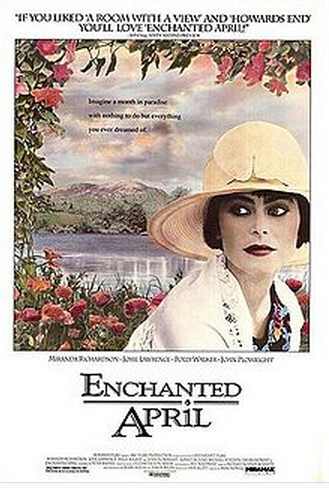
Film, 1992 Courtesy Wikipedia image featuring Lady Caroline Dester, who is sick of being grabbed by men!
In the early 1920s, just after World War I, author Elizabeth Von Arnim vacationed in the serenity of Portofino, Italy at Castello Brown, the same castle featured in the movie. Inspired by the magnificent medieval castle and the luscious gardens of San Salvatore, Von Arnim wrote “Enchanted April,” the book on which the movie is based.
I discovered a link to a free copy of the book via the Guttenberg Library, where you can search and find links to other books and stories you read as a child.
Want more Elizabeth Von Arnim? Click here for her Collected Works!
Cover image: courtesy Amazon Books
In case you haven’t seen the movie, or if you want to succumb once again to its captivating charms, here is the trailer from Miramax Films:
Quotes from Enchanted April
I want to just sit and not talk and not think . . . . ~ Caroline
If you wish for something hard enough, it happens! ~Lottie
Patio garden wisteria
When you want to get away from it all, where do you escape?
What is on your bucket list – Where would you like to go right now, or sometime soon?
Coming next: Moments of Discovery # 6 ~ Food for Thought, Stirred with Imagination
Where did you study? Was your desk a dining room or kitchen table? The couch? A separate room? Did you listen to music as you studied? Or did you tune out the noise of the household when you crammed for a test or wrote a report? Louise DeSalvo author of The Art of Slow Writing, a book about writing as a meditative, patient process, muses about her own study nook in this excerpt:
My parents valued education, so when I was young, the only time my parents didn’t bother me was when I was doing homework. My father made me a triangular desk that fit into a space at the top of the stairs. . .
Sitting at my desk while I was working, nobody told me what to do. My father was pleased with my industry rather than angry with me. My mother wanted me to study because, no matter how much she needed my help, she wanted me to do well in school. Sitting at my desk working helped me feel a sense of control in my chaotic household (188, 189).
Louise’s writing desk was triangular probably positioned in a corner. It strikes me that she may have faced the wall, not a window, a rather confining, even claustrophobic view.
As for me as a student at Elizabethtown High, when the noise downstairs around my spread at the dining room table overpowered my ability to concentrate, I’d flee upstairs to a study desk that looks like this, a bedside table with a brown goose-necked lamp. Mother had the table refinished years later and replaced my gooseneck lamp with this one: a faux milk-glass base with a lacy, fluted lampshade.
Here’s how I write about this “desk” as a flash of memory:
My books and notebooks are piled on the dining room table. I’m in ninth grade and when the house gets too noisy, I go upstairs to the bedroom I share with my sister Janice and study there. My study table is just a wooden bedside table. It’s tiny, with two of the four legs spaced closer together. There’s space for a little lamp on top and maybe a book or two on the shelf below – a piece of furniture not designed for serious study. There is no place to put my legs really, but I scrunch myself under the teeny table with my knees touching, a brown goose-necked lamp cocked so I can read, take notes on scored 3 x 5 index cards, or write in meticulous cursive in my notebook, one for each subject.
eBay Image: mid-century goose-neck lamp
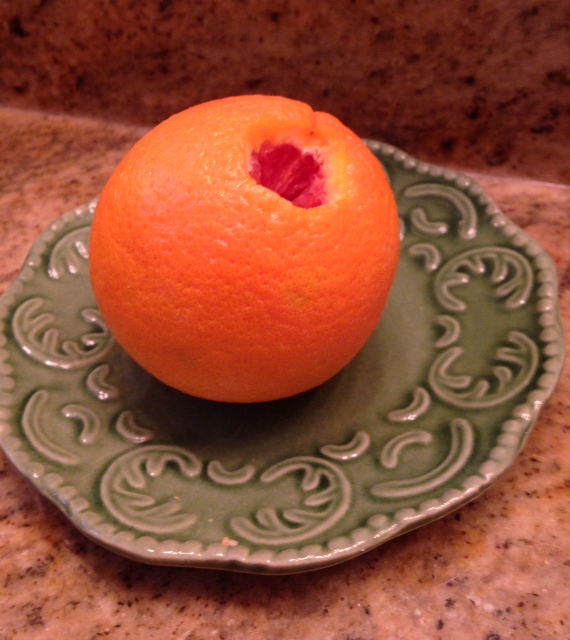
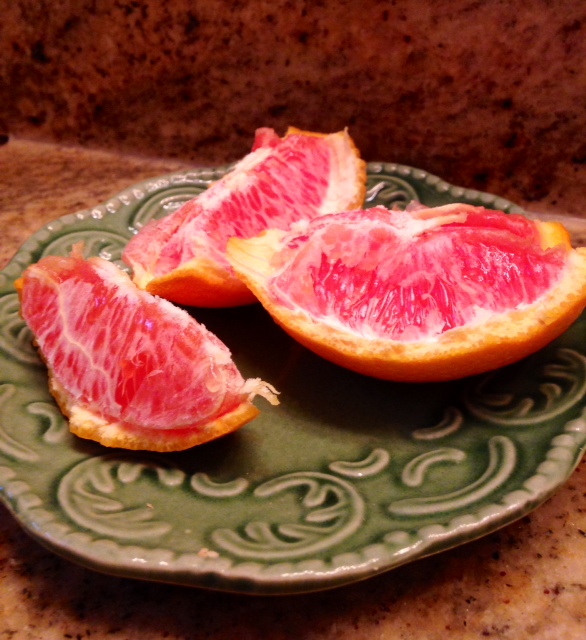
I consumed book chapters, algebraic formulas, and historical data. I also consumed apples, carrots, or oranges. Yes, as I studied, I nibbled. Like a dog worrying a bone, I ate apples to the core, sometimes discovering nothing but apple seeds in the palm of my hand along with the fibrous center hull, when I looked up from the page. Carrots were eaten down to the nubs. And oranges too. First, I sucked out some of the juice, then broke the orange into five or six sections, eating them one by one. Finally, I consumed the white inner rind too, one incisor-dig at a time, only the outer skin remaining.
Study – an all-consuming proposition . . .
Some books are to be tasted, others to be swallowed, and some few to be chewed and digested.
~ Sir Francis Bacon “Of Studies”
Did you study at home, at the library? Did you have chaos or quiet? Maybe you had a photographic memory and didn’t have to study much.
Were you a nibbler too? Inquiring minds want to know.
Coming next: Purple Passages with a Pop of Pink, March 2015 edition
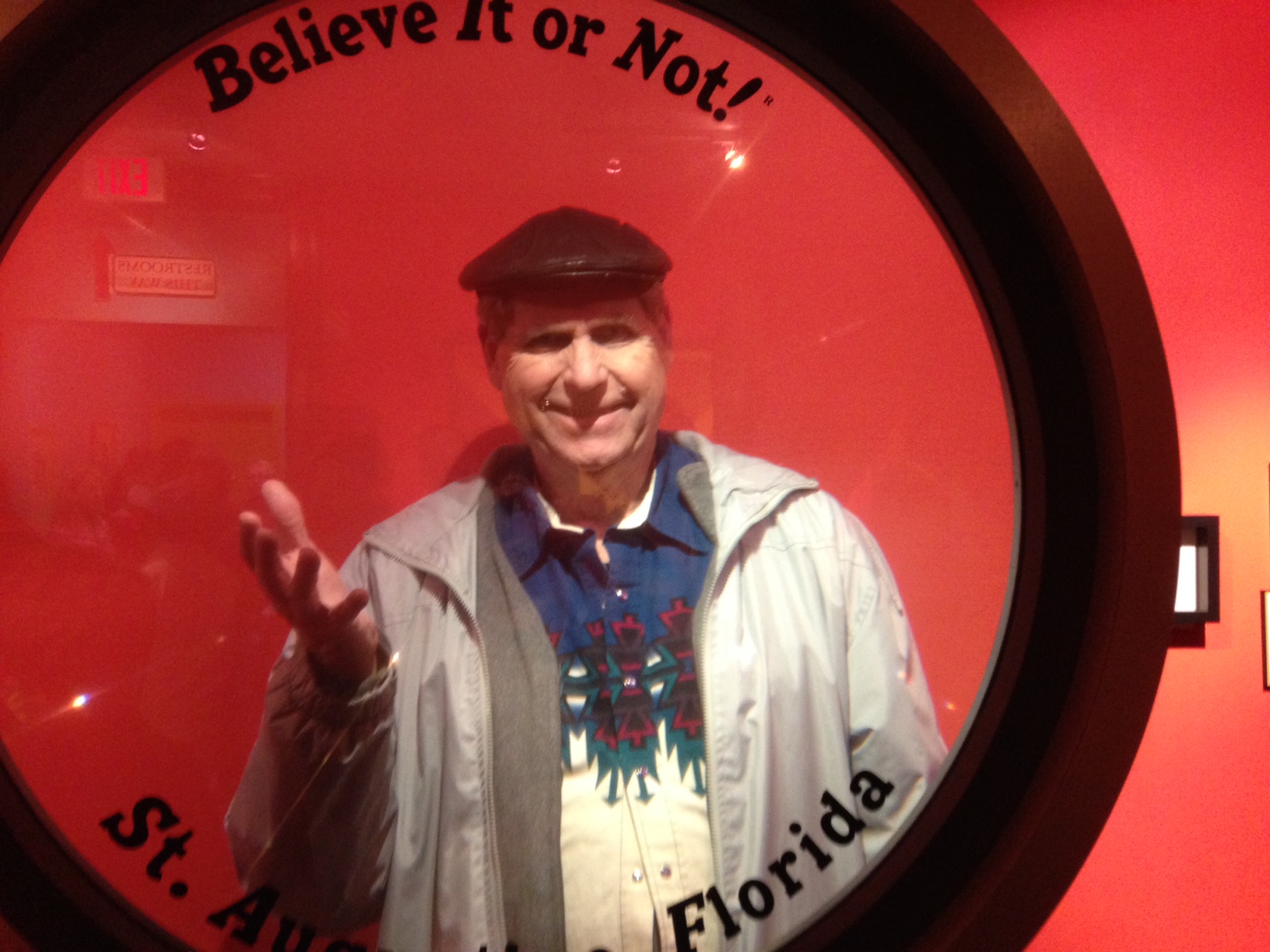
Recently Grandpa Cliff and NaNa Marian took the Beaman boys to the Odditorium (not a misspelling!) of Ripley’s Believe It or Not in St. Augustine Florida.
The Saturday excursion was billed as a Mystery Trip, so the boys didn’t know exactly where they were going, but they did know it would be fun. After a 40-minute drive south from Jacksonville, the Mystery Bus with windshield wipers chugging away pulled into the very last parking space at Ripley’s.
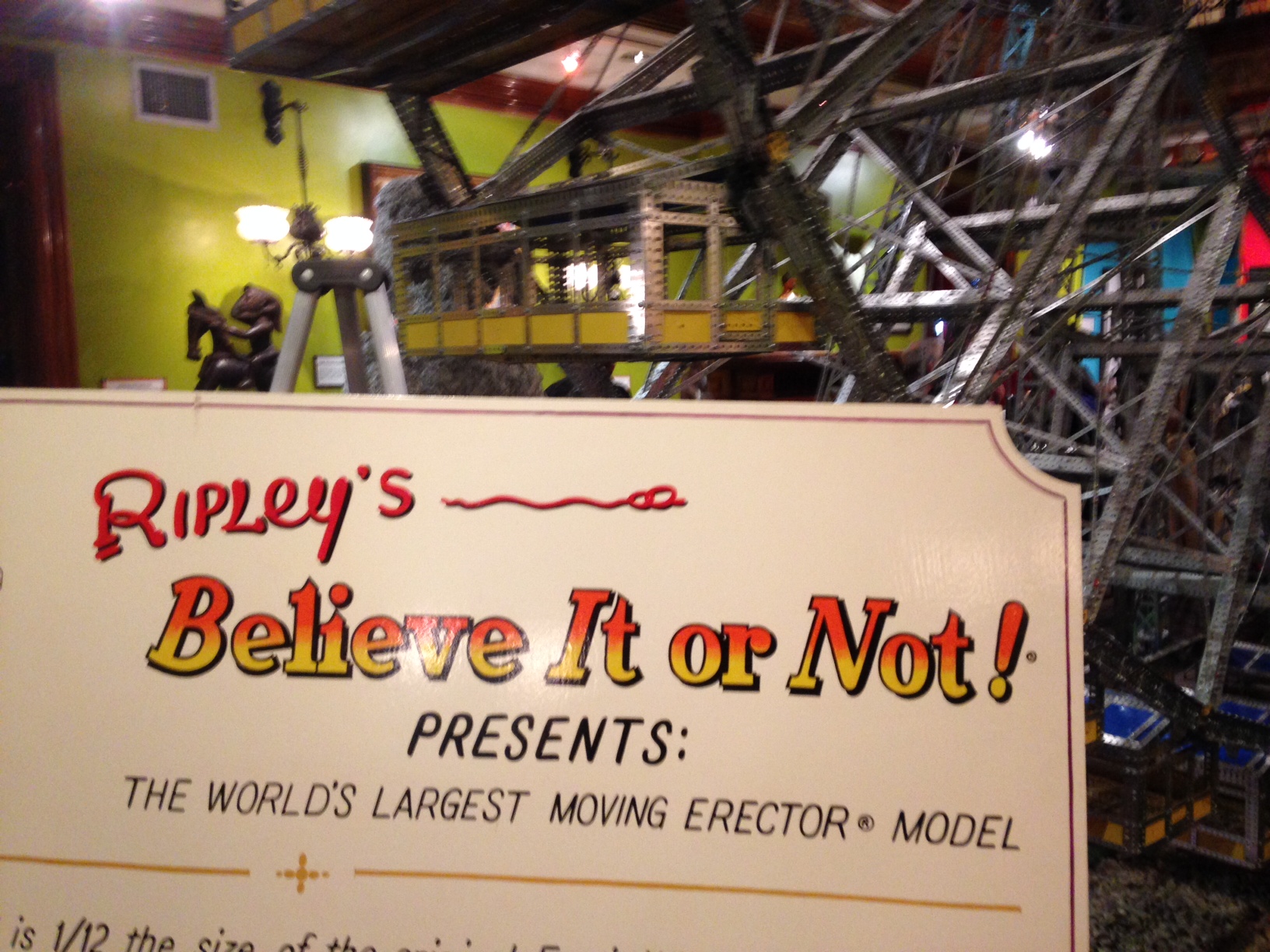
Ripley’s Believe It or Not is a franchise with various locations nation-wide, dealing in “bizarre events and items so strange and unusual, that readers might question the claims.” Some of the 20,000 photographs, 30,000 artifacts, and more than 100,000 cartoon panels in the collection are displayed here at The Oldest City location.
Some of the jaw-dropping oddities we saw:
Lord’s Prayer etched onto the head of a pin
This prayer also etched onto a grain of rice
Erector set parts made into the World’s Largest Ferris Wheel model
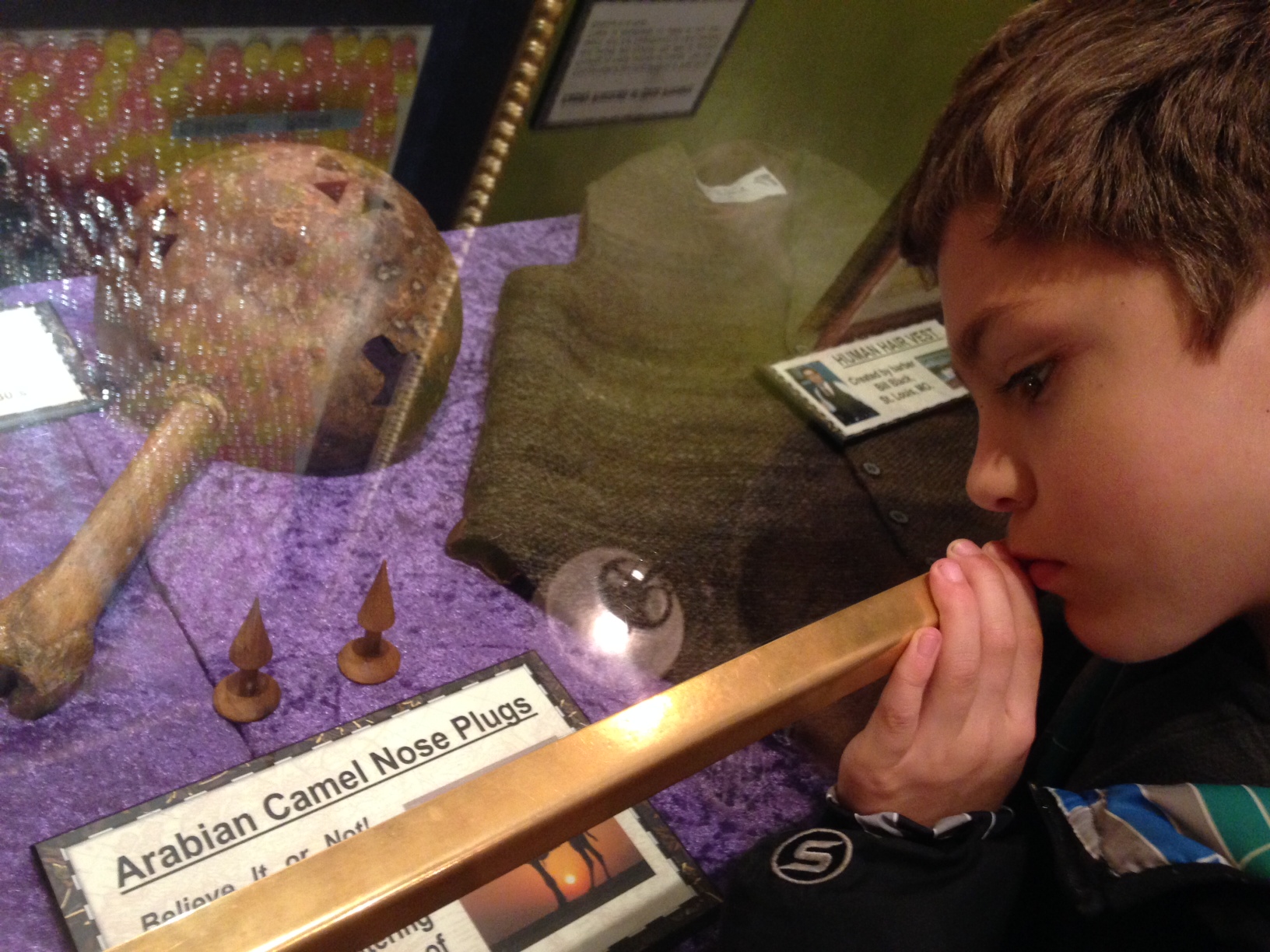
Arabian camel nose plugs
Replica of the Notre Dame Cathedral constructed with over 160,000 match sticks
Voodoo doll in an ancient basket
Mannequin of man weighing over a half ton
Model of Notre Dame Cathedral constructed of 160,000 match sticks
And this one took me back in time, Curtis and Ian looking at the Lord’s Prayer etched on a grain of rice through a microscope . . .
Seeing the back of Curtis’ head (on left) reminded me of our son Joel’s image at a similar age. So I flashed back in time, and then I was struck piercingly into flash forward motion with the thought that grandson Curtis will be in middle school in the fall. With poet Percy Bysshe Shelley, I lament “O World! O Life! O TIme! (Where has all the time gone? Not long ago he was just entering first grade!)
A few weeks ago, Shirley Hershey Showalter, who publishes weekly Magical Memoir Moments, posed an engaging prompt for writers. In the March 3, 2015 edition she took her readers on a visit to the Wheel of Time. Looking at a photo of her grandson Owen staring out the window watching his mother leave for work, Showalter imagines what his thoughts might be. She remembered a similar moment years ago when her own son, perhaps wistfully, watched her leave the house for her job. Then she poses two questions for her readers:
When was the last time something pierced your heart?
Did it ignite the Wheel of Time in you?
Contemplating the second question as I gazed at Curtis and Ian, I realized a ping of joy along as three thoughts came to mind all at once: We are blessed to have them, their whole life is ahead of them, and as the photo seems to suggest, they are facing forward to meet the future . . .
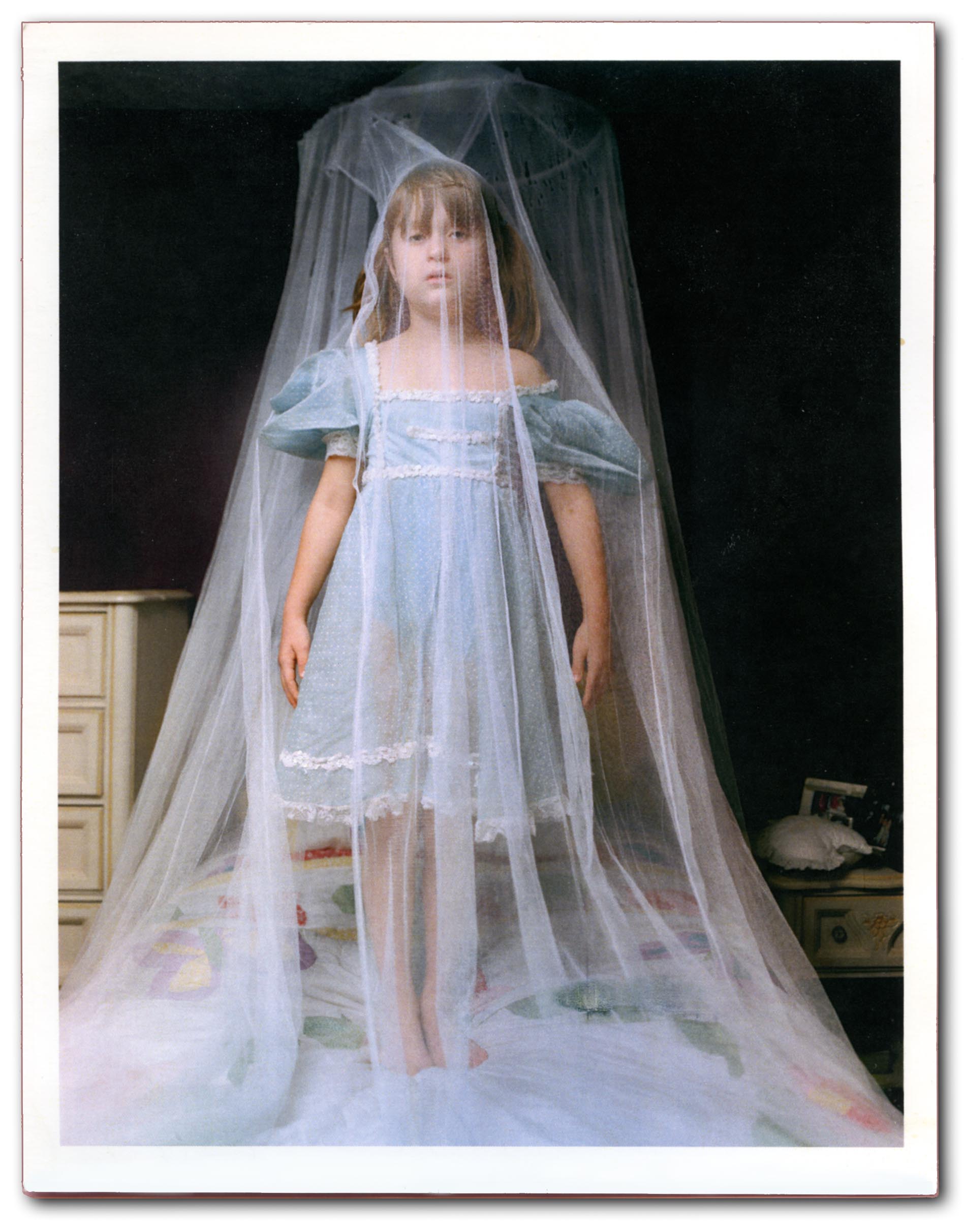
Photographer Angela Strassheim, in a recent exhibition at Jacksonville’s Museum of Contemporary Art, specializes in framing the lives of her nieces and nephews as they pass through early stages of their lives. Her collection illustrates the precious, fleeting nature of childhood and adolescence. One photograph that caught my eye was the “Girl in Blue Dress” which depicts a pixie princess frozen in a childhood phase that evaporates all too quickly. This large photo of Strassheim’s niece with dimensions of 75 x 60 inches, probably foreshadows the young girl becoming a married woman, draped as she is now in a canopy over her bed that seems to mimic a bridal veil.
Robert Ripley is right. Life is full of mystery and awe. Sometimes it’s un-unbelievable too!
Your thoughts are always welcome here. Do join the conversation . . .
Actor Tom Hanks in the movie Forrest Gump tries to strike up a conversation with a tired nurse seated beside him on a park bench. Holding a box of chocolates in his hand, Forrest offers her a treat, “My mother always said, “Life is like a box of chocolates. You never know what you’re gonna get.” You remember the scene. Here is a 38-second clip from the movie:
“Health by chocolate” is one of the phrases that popped up on the web when I researched the health benefits of eating chocolate, which may stem from the antioxidant flavonoids find in the cacao bean. Another website listed 9 benefits of eating chocolate. Rich and delicious dark chocolate especially (at least 70 % cacao, a disease-killing bullet) is “good for more than healing a broken heart” it touts.
Among the nine benefits included in this article were a healthy heart, possible weight loss (because it lessens one’s cravings for other sweet, salty, and fatty foods), stress reduction, and even higher intelligence in the short term because chocolate boosts blood flow to the brain.
The box of chocolates Forrest Gump was holding contains way more calories than this article suggests because the candies were probably filled with nougat, sweet cherries, caramel, and other taste-bud ticklers. But he’s right, unless the box lid is imprinted with the different flavors, you never know what you are going to get. Usually, though, the surprise is pleasant.
In the 2000 movie Choclat, Vianne Rocher, played by Juliette Binoche, tries to guess Roux’s (Johnny Depp’s) favorite chocolate confection. Vianne tries more than once to offer the treat that will get an “Aha” from him, including presenting him with one in a special white box. Later she succeeds unexpectedly as you can see here:
l
Receiving or giving a box of chocolates (or even savoring hot chocolate) is a welcome experience any time of year.
What is your relationship with chocolate? What is your favorite kind of chocolate?


























 Plain and Fancy