All Creatures Great and Small: The Power of Pets

I missed National Pet Day on April 11 by a few weeks. But if you own a dog like Scotty or a kitty cat named Sophie, every day of the year is pet day.

In 4th grade, I drew a cat and colored it charcoal gray. It appears I was as interested in making the wallpaper pretty as I was in drawing a green-eyed cat with its wee kitten.
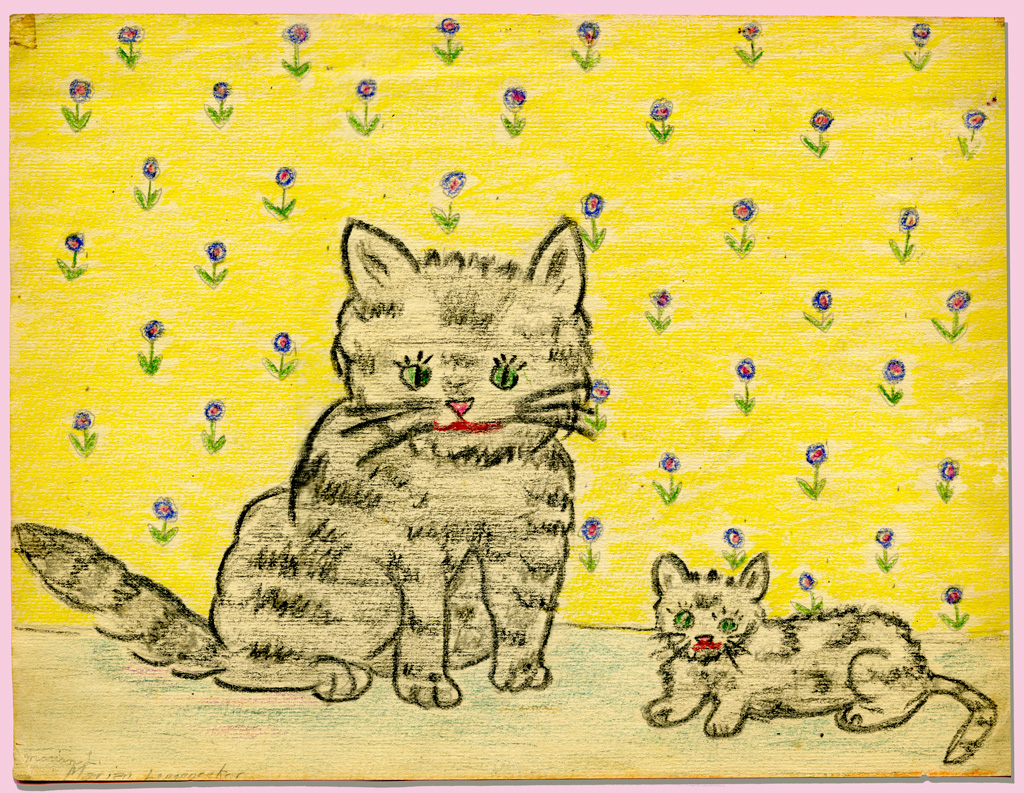
KittenArtMarian1947?

In first grade, my teacher Miss Longenecker introduced our class to reading via the phonics method with the drawing of a cat illustrating the hard “c” sound. She probably used the Hay & Wingo textbook entitled Reading with Phonics (Philadelphia: J. B. Lippincott, 1948).

 Hay & Wingo, Reading with Phonics, J. B. Lippincott, 1948
Julie Hay & Charles Wingo, Reading with Phonics, J. B. Lippincott, 1948

We never had a pet cat, probably because my mother was allergic to cat dander, but several memorable dogs cavorted through our childhood. Sporty, an Airedale Terrier mix leaped and frisked around Grandma’s ankles when I was very young.  Boots, a black and white Smooth Fox Terrier, flushed ground hogs from their holes.

My sister Jean remembers other animals too: Our dad raised Angora rabbits housed in wooden crates in the barn attic and another Smooth Fox Terrier named Minnie, as small as she sounds. Sister Jan says we used to dress her up with doll clothes and send her down over the hill to Grandma’s house.

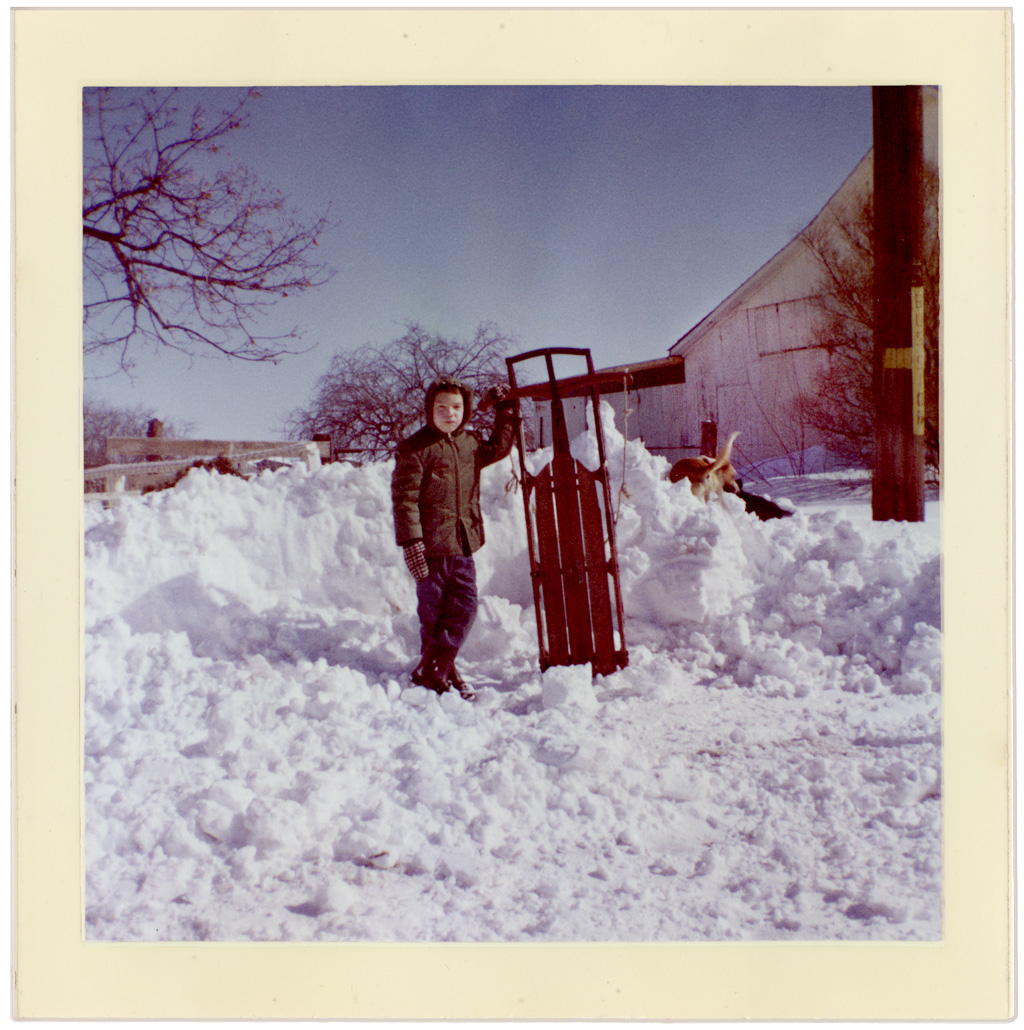
Our brother Mark’s dog, 3-legged Skippy, butterscotch and cream colored, lost one leg when a truck ran over him. Still, he skipped, ran far, and jumped high with just three legs. You’ll see part of his rear end and his tail in the second picture.

MarkDogMailbox


Brother Mark with sled and Skippy in the snow 1961
Brother Mark with sled and Skippy in the snow  1961


We all remember Ruthie’s little lamb that felt like mine when I wiggled my fingers digging deep into its wooly coat.

My Aunt Ruthie loved animals all her life, especially dogs. Her last four dogs were Schnauzers, known for their fierce loyalty and protective power. The pure-bred Schnauzuers were all named Fritzie – Fritizie I, II, III, and IV.

In this photo she was probably holding Fritzie III in her lap. The devotion you observe in this photo flowed both ways.

RuthieDogPiano

* * *

Like most children, our kids Crista and Joel wanted a dog. We shopped ads in the Dollar Saver for our dog back then and were taken in by the phrase “loves children.” That’s how we found Me-Too, a kid-loving-mailman-hating dog of questionable pedigree. Still, the children doted on her and adopted her into their play. Here the frame of their baby buggy became a carriage with Me-Too as the pony express.

WondaChairCristaJoel


Research

Not surprisingly, research shows that pets promote health, both physical and emotional.

Pets in the household can reduce everyday stress – lift one’s mood and provide physical contact. They provide an outlet for nurturing too: Pet owners have a living thing to care for. And finally, pets keep one active: walking the dog, feeding the cat.

Several of my writing friends admit that a pet dog or cat serves as muse: Kathy Pooler, Merril Smith, and Susan Weidener. Other authors have pets that appear on their blog posts from time to time: Laurie Buchanan, Janet Givens, and Elaine Mansfield. Lord David Prosser observes that his alarm cat Oscar wakens him from slumber every morning. And photographer Lady Fiona’s dogs enliven most of her fabulous photographs. Marylin Warner is training a puppy, but I don’t think she would call Scout her muse yet.

* See note below.


Books with animal characters

Books of my childhood:

  • Anne of Green Gables – Dog Monday
  • Little House on the Prairie, Laura Ingalls’ dogs – Jack, the brindle bulldog, and Bandit, the stray, appear in her books
  • Old Yeller by Fred Gipson

Literary works:

In The Odyssey, I recall Homer’s beloved Argos, who patiently waited for him at journey’s end. Maybe you remember this faithful dog too.

In Jane Austen’s Pride and Prejudice, cats romped in the Bennett household, at least according to author Pamela Jane.

Anton Chekhov wrote a short story entitled The Lady with the Dog, preserved here in statuary forever viewing the Black Sea in Yalta. When we visited in 2011, Crimea was still part of Ukraine.

CrimeaMarian2011


In the 1970s James Herriot books were all the rage both here in the States and internationally. Herriot, an English veterinarian, immortalized farm animals, pets, and their owners in his popular series set in the Yorkshire dales and moors. I read many of the titles: All Creatures Great and Small, All Things Bright and Beautiful, and The Lord God Made Them All.


What pets populated your home or the pages of books you loved? What items can you add to the list of benefits of owning a pet?

Leave a line or two here. You can also include endearing (or not) pet anecdotes.

Incidentally, if I inadvertently missed listing you as an author with a pet muse, please bark at me, so I can rectify the oversight ~ pronto.
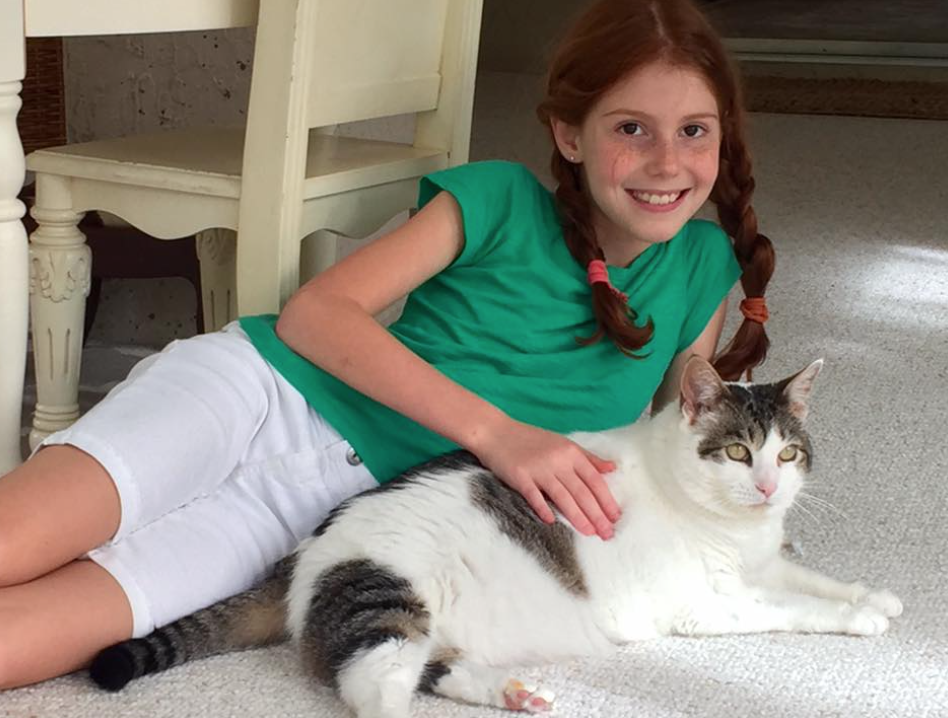
 

Daisy with Jenna in pigtails
Daisy with grand-daughter Jenna in pigtails


Coming next: Baby Beads and Wooden Blocks: Happy Mother’s Day!


Wanted: Forty More Winks

A Shock to Our Systems

Do you live where Daylight Saving Time has gone into effect recently? If so, today you may feel out of sync, sleep-deprived. The loss of even one hour of sleep pushes one’s biorhythms out of kilter.


Who’s to Blame: Daylight Saving Time

In the wee hours of Sunday clocks moved forward one hour, delaying sunrise and adding evening daylight. According to one source, a New Zealander proposed the modern idea of DST in 1895. Germany followed in 1916. Many other country since then have followed the spring ahead/fall behind routine, especially since the energy crisis of the 1970s.

The time change has been loved or hated ever since. My author friend Janet Givens provides a well-researched blog post on the topic. Her research explodes the myth that Daylight Saving Time is supported by farmers.


Sleep: A Cure

Medical journals including Psychology Today, often publish articles about sleep or the lack thereof. Such pieces also regularly appear in the table of contents of women’s magazine and AARP journals.

Literature is replete with references to sleep. In Shakespeare’s tragedy, Macbeth, who has recently murdered King Duncan, knows his sleep will be troubled or interrupted even as he ruefully ticks off its benefits:

“Sleep that knits up the raveled sleeve of care / The death of each day’s life, sore labour’s bath / Balm of hurt minds, great nature’s second course, Chief nourisher in life’s feast.” Act 2, Scene ii

  • Sleep repairs the unraveled parts of our lives, knits them up.
  • Sleep comes at the end of the day; it looks like a little death.
  • Sleep brings bodily relief from pain as do baths.
  • Sleep refreshes the mind.
  • Sleep is essential to life. We can’t do without it.

In Search of Forty Winks, Patricia Marx comments:

. . . party and then firing the cleanup committee. The New Yorker, February 8, 2016
 party and then firing the cleanup committee. (The New Yorker, February 8, 2016. pages 56. 57)


Ben Franklin and the Bible on Sleep

Early to bed and early to rise makes a man healthy, wealthy and wise.   ~ Benjamin Franklin

The sleep of a laboring man is sweet, whether he eat little or much: the abundance of the rich will not suffer him to sleep.     ~ Eccl. 5:1


Sleeping Child

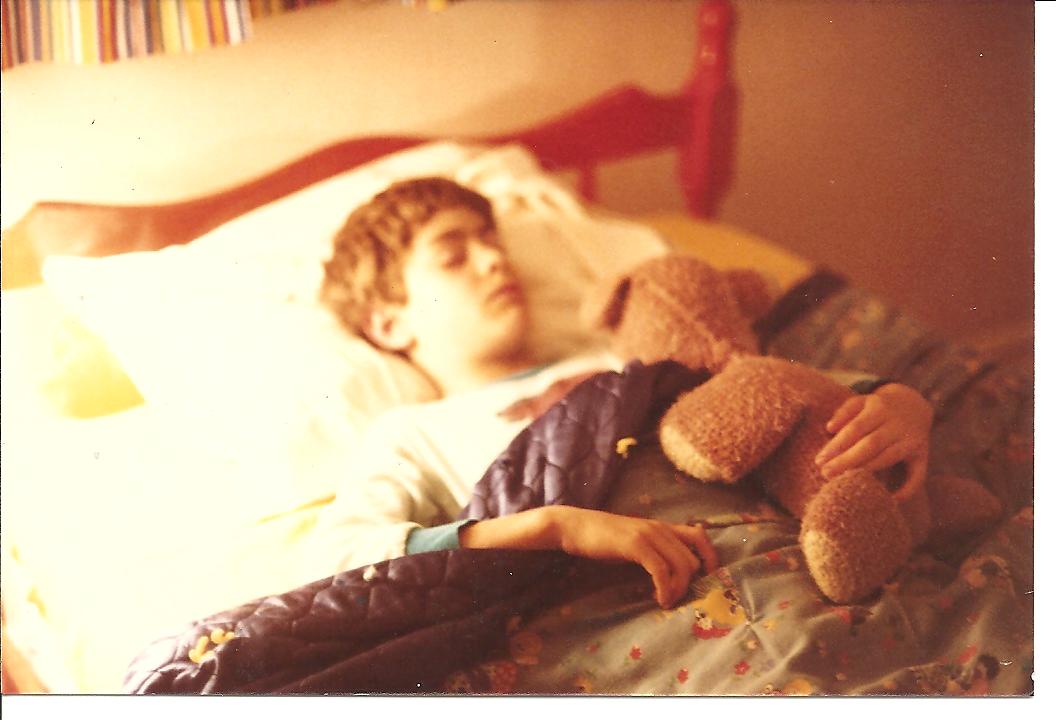
Joel sleeping with teddy bear, age 8
Joel sleeping with teddy bear, age 8 or 9

Our son Joel was fast asleep embracing his teddy bear knitted by his Great Aunt Ruthie. He may have been dreaming of riding his skate board or playing with match-box cars. As a nine-year-old, he was certainly not worrying about caring for children, the needs of a wife, mortgage payments, or at-work performance.

Wordsworth offers a philosophical perspective on sleep:

Ode: Intimations of Immortality, William Wordsworth Source: Pinterest


Here is the first stanza of a nursery rhyme Joel probably heard before he fell asleep:

Wee Willie Winkie runs through the town,

Up stairs and down stairs in his night-gown,

Tapping at the window, crying at the lock,

Are the children in their bed, for it’s past ten o’clock?


Comments about sleep, advice about getting more of it?  Your wisdom welcome here. All creatures need down time, even inanimate ones. Note that there is a sleep button on your computer, just above re-start.


Answer key to limericks published March 9, 2016 

1. lewd

2. dinner

3. divinity

4. weeds


Raise a Mug to the Irish!

Is there a drop of Irish blood in my veins? I doubt it. I grew up Mennonite in the Longenecker family in Pennsylvania Dutch country, a hot-bed of Swiss-German ancestry.

Still, the Irish-named Donegal Springs is a mere 3-mile, 5-minute drive from Rheems, Pennsylvania near my birthplace. In the adjoining Dauphin County are Londonderry Township. In Bucks County, a town named Dublin, sister city to the capital of the Republic of Ireland.

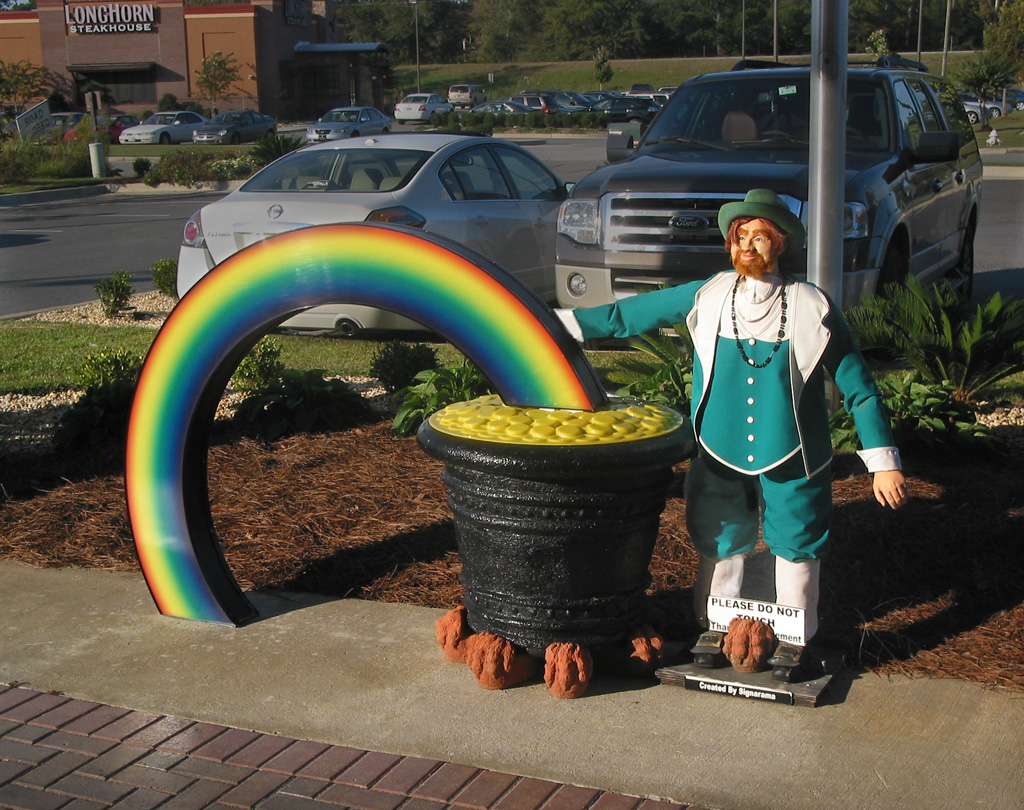
Photo courtesy of Artist Cliff Beaman Dublin, GA
Photo courtesy of Artist Cliff Beaman traveling through Dublin, GA

When we visited Ireland, we met a congenial gentleman named Buchanan, who remarked that he has immigrant relatives buried in the Donegal Presbyterian Church cemetery, a place he once visited.

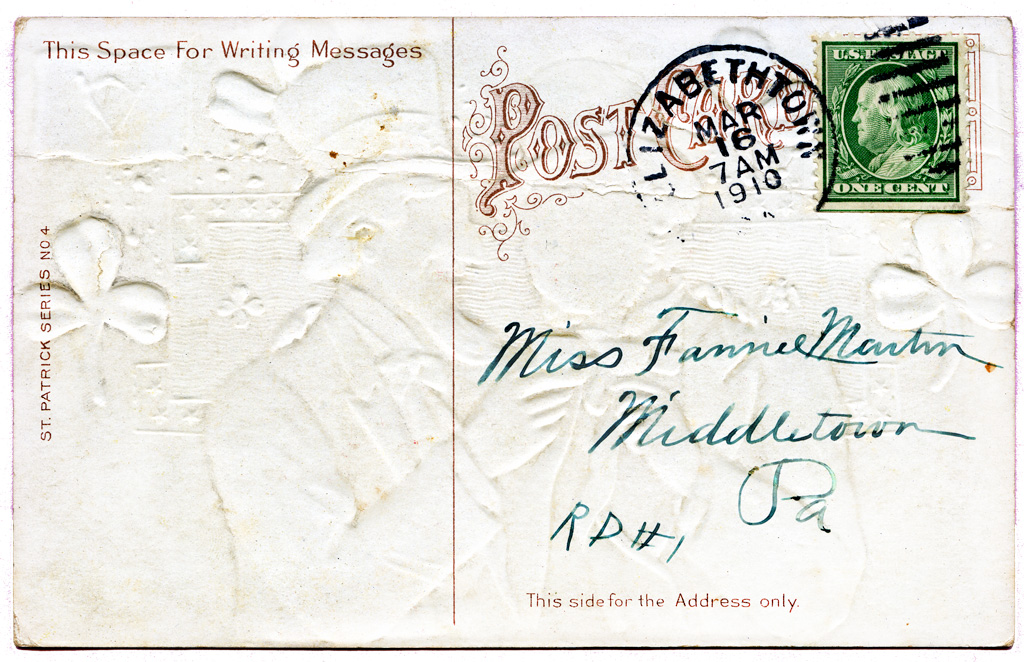
During my last trip to Pennsylvania, I discovered some vintage postcards stamped with penny postage, sent to Miss Fannie Martin, my Grandma Longenecker. Many of her postcards are embossed and saturated with color – no Photoshop filters needed.

In an era long before smartphones and text messages, postcards were valued. Instead of instant messages easily deleted and forgotten, these cards have become artifacts of my family history. The one below over one hundred years old is dated 1910.

StPat1912MUGfront

StPat1912MUGback

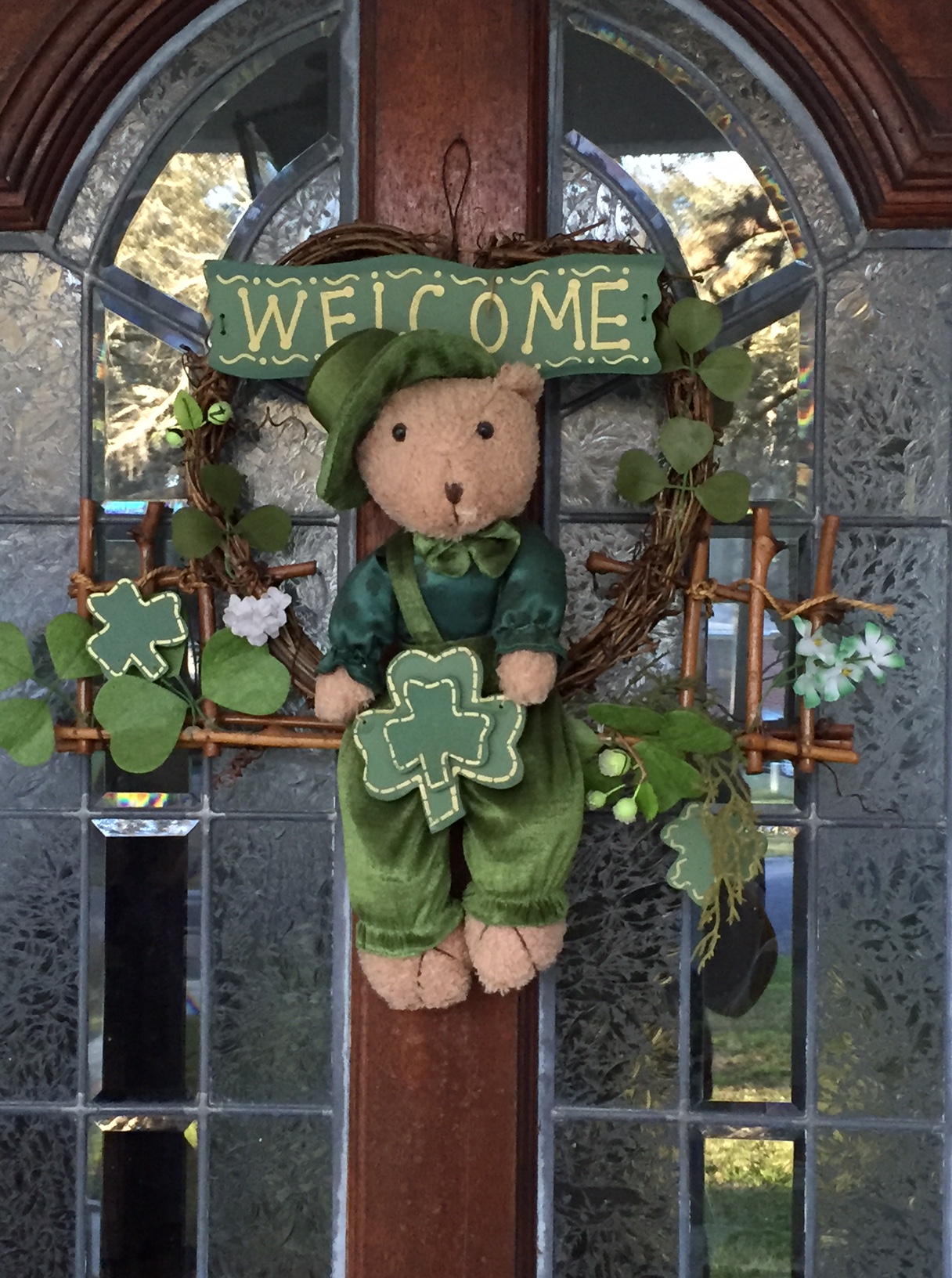
I live in a neighborhood where Irish names abound: Blarney Stone Court, Killarney Drive, Leprechaun Court, St. Patrick Lane. Names on residents’ mailboxes have included Dunleavy, O’Neill, and Kelly. We once had to fight a major retailer to retain charming shamrocks and moss-footed oaks in a wooded area adjoining our community. The hanging on our front door reflects the neighborhood and the season.

StPatBearDoor

St. Patrick’s Day this year falls on a Thursday, March 17. Until then, I wish you the luck of the Irish.

May the wind be always at your back and your pathways peaceful. If you are Jewish, Mazel Tov!

To enjoy these Irish limerick lines below add just the right word to complete the rhyme. Keep in mind the missing word must rhyme with the first and second lines. (Answer key in next week’s blog post.)

A bather whose clothing was strewed

By winds that left her quite nude

Saw a man come along

And unless we are wrong

You expected this line to be __________.

~ Anonymous


His sister named Lucy O’Finner,

Grew constantly thinner and thinner;

The reason was plain,

She slept in the rain,

And was never allowed any _________.

~ Lewis Carroll

There was an old fellow of Trinity

Who solved the square root of Infinity,

But it gave him such fidgets

To count up the digits,

He chucked Math and took up _________.

~ Anonymous

There was a young farmer of Leeds,

Who swallowed six packets of seeds.

It soon came to pass

He was covered with grass,

And he couldn’t sit down for the_______.

~ Anonymous


Edward Lear, Ogden Nash, and Lewis Carroll are among the best versifiers of this humorous form. If you want to cook up your own limerick, here is a link to the recipe with a pattern for the rhyme scheme.


Coming next: Wanted, Forty Winks


How to Teach a Piano Lesson

“Joel, I’m going to the Christian Light Press in E-Town for some birthday cards, do you want to go along?”

“Okay, Mommy, do you think they have lollipops?” queried my mischievous son.

“I don’t think bookstores have lollipops at the counter like doctor’s offices do, but maybe they have other fun things to look at,” I said, thinking he would enjoy an excursion into town while visiting his cousins in Pennsylvania.

Entering the store, I spied precious novelties tempting to touch, a fact that struck me with a fearsome shudder because I had an 8-year-old in tow.

“Now don’t touch anything. Just look. Do you see the sign on the display? It says ‘If you break it, you buy it!’”

“Uh huh,” he said racing to the music boxes and other curios.

I turned to the bank of colorful greeting cards not far away eyeing cards appropriate for Mother and sister Jean.

“Squeak-thunk,” was the next sound I heard across the aisle, close to where I saw the top of Joel’s thatch of brown wavy hair.

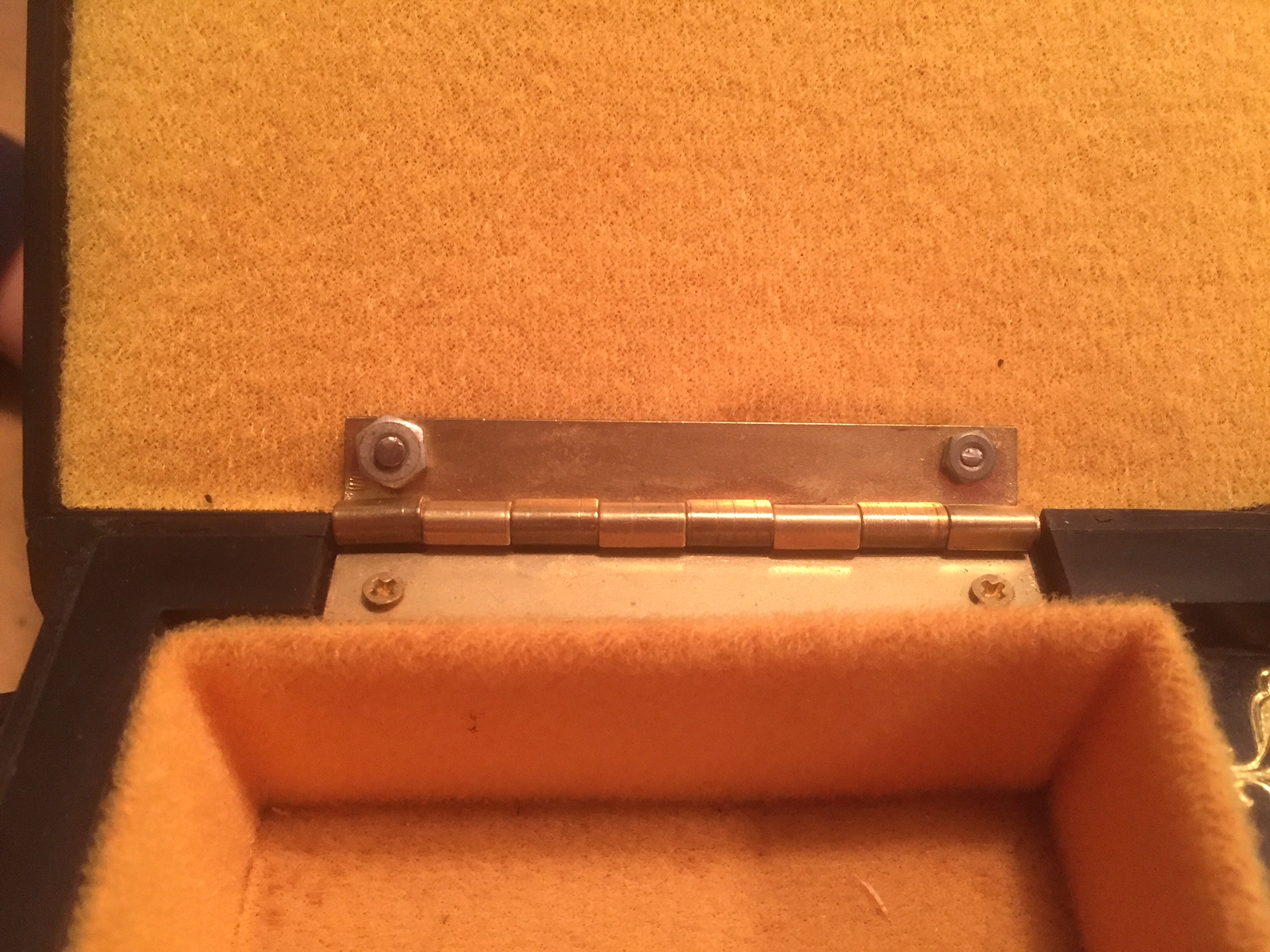
Cards in hand I strode over toward Joel and saw him holding a toy baby grand piano. As I looked closer, I noticed the hinge to the piano lid was halfway broken off. Turning the piano upside down to reveal a music box attached underneath, I noted a sticker. The price tag announced: $ 13.95. Please understand, we were a struggling young family in the 1970s, my husband and I both teachers, so the money registered on my mental calculator as a staggering figure.

Right there and then I had a double D attack: disappointment at my son’s disobedience and dread coursing from head to toe knowing we had to face the owner and admit to the breakage.

My feet felt like lead as I led Joel by the hand and I trudged down the aisle toward the clerk/owner who appeared to be glowering at us behind a tall metal cash register with raised keys and a bottom drawer that slammed shut.

I approached the counter speechless but managed to turn over the music box revealing the price tag. Swallowing slowly I formed words, “I guess we’ll need to pay for this. My son broke it accidentally.”

“Yes, you will. You see what the sign says.” I knew the warning only too well.

Opening my wallet hesitantly, I shelled out the dollars and cents, Joel standing by my side his head hanging, embarrassed and chastened.

* * *

Leap forward over thirty years, and son Joel now has his own son Ian, also age eight.

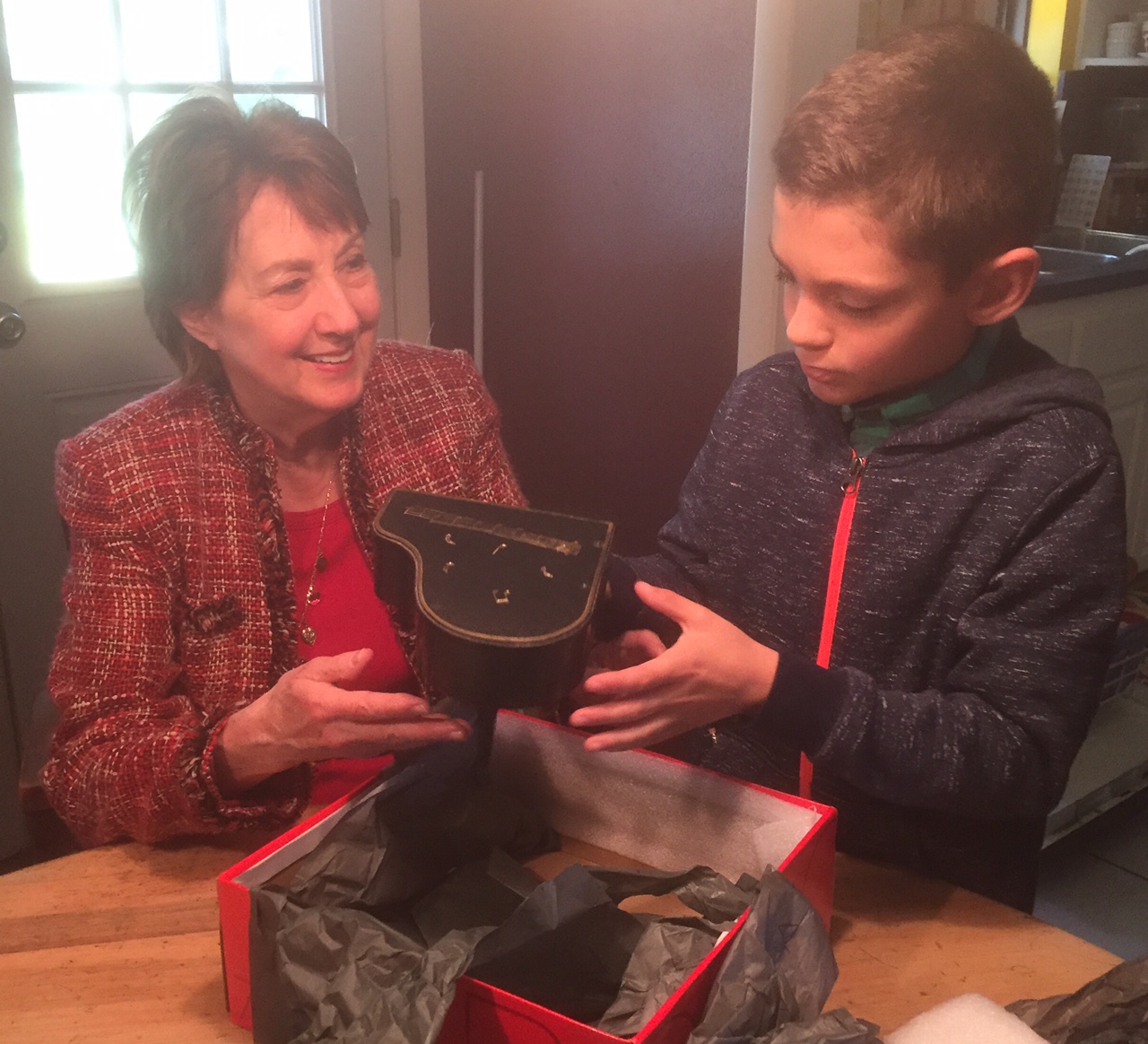
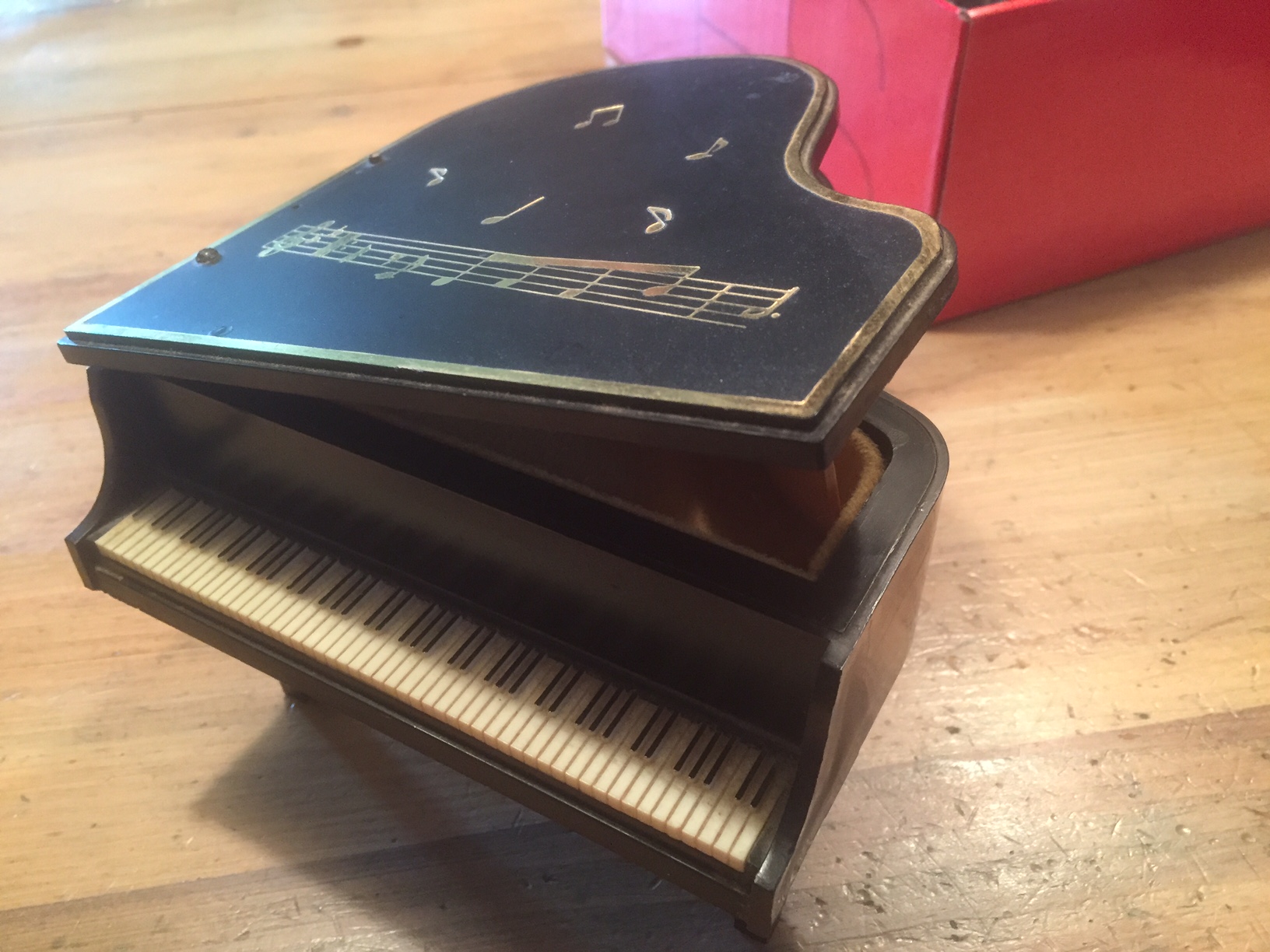
Several weeks ago I presented Ian with this same piano that has sat on my bookshelves for decades, occupying space between American poetry and art history books. Because we are downsizing, I have been passing along keepsakes to the next generation.

Joel was privy to my intention and approved my gifting the piano that plays the Lord’s Prayer as a tinkling, lullaby tune.

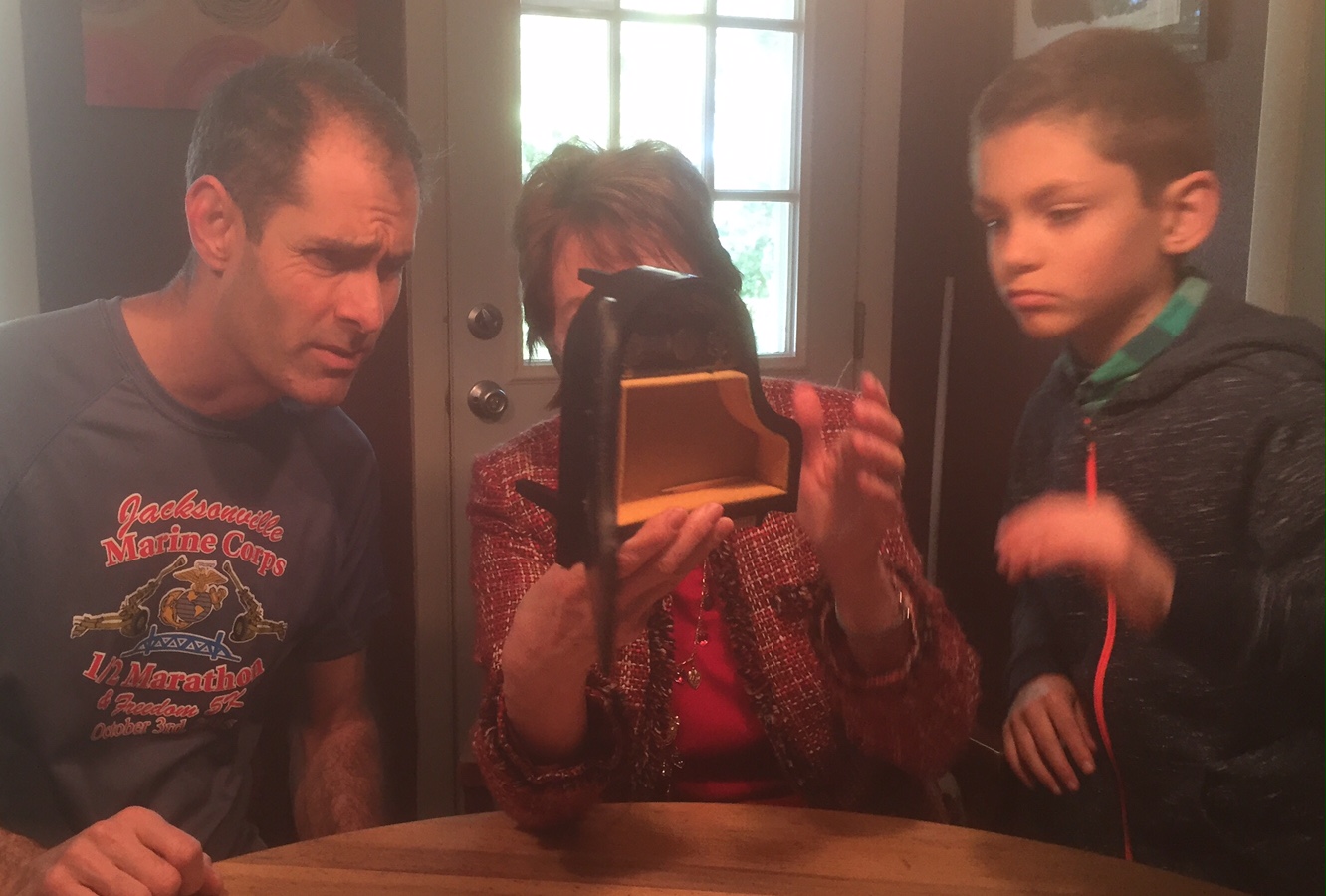
The presentation of the bequest began with a sturdy, red shoebox surrounded by tissue and foam padding. And then the unveiling . . .

IanOpeningPiano

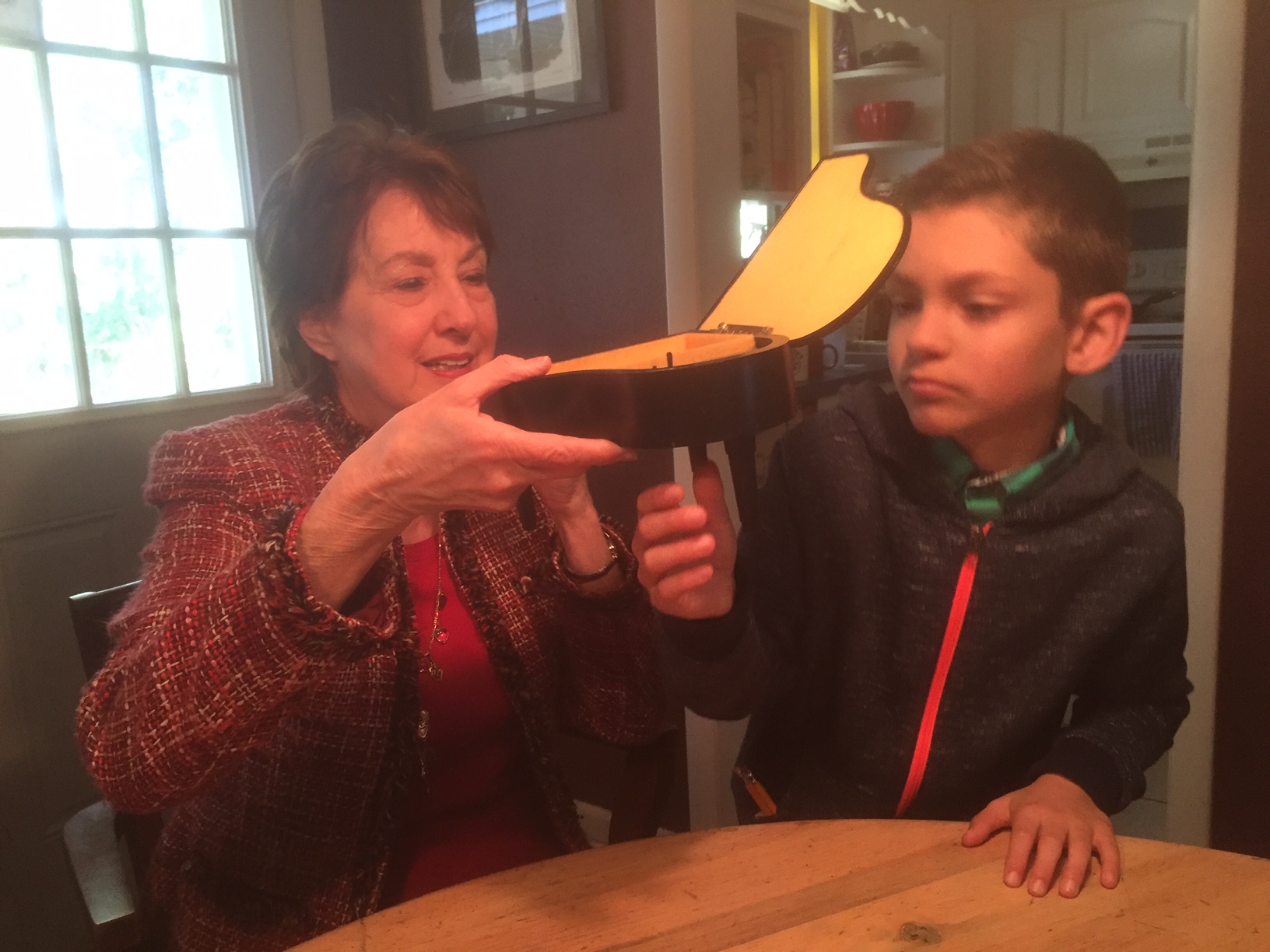
Turning the wind-up key, voilá – sweet music filled the air.

PianoTwist Key

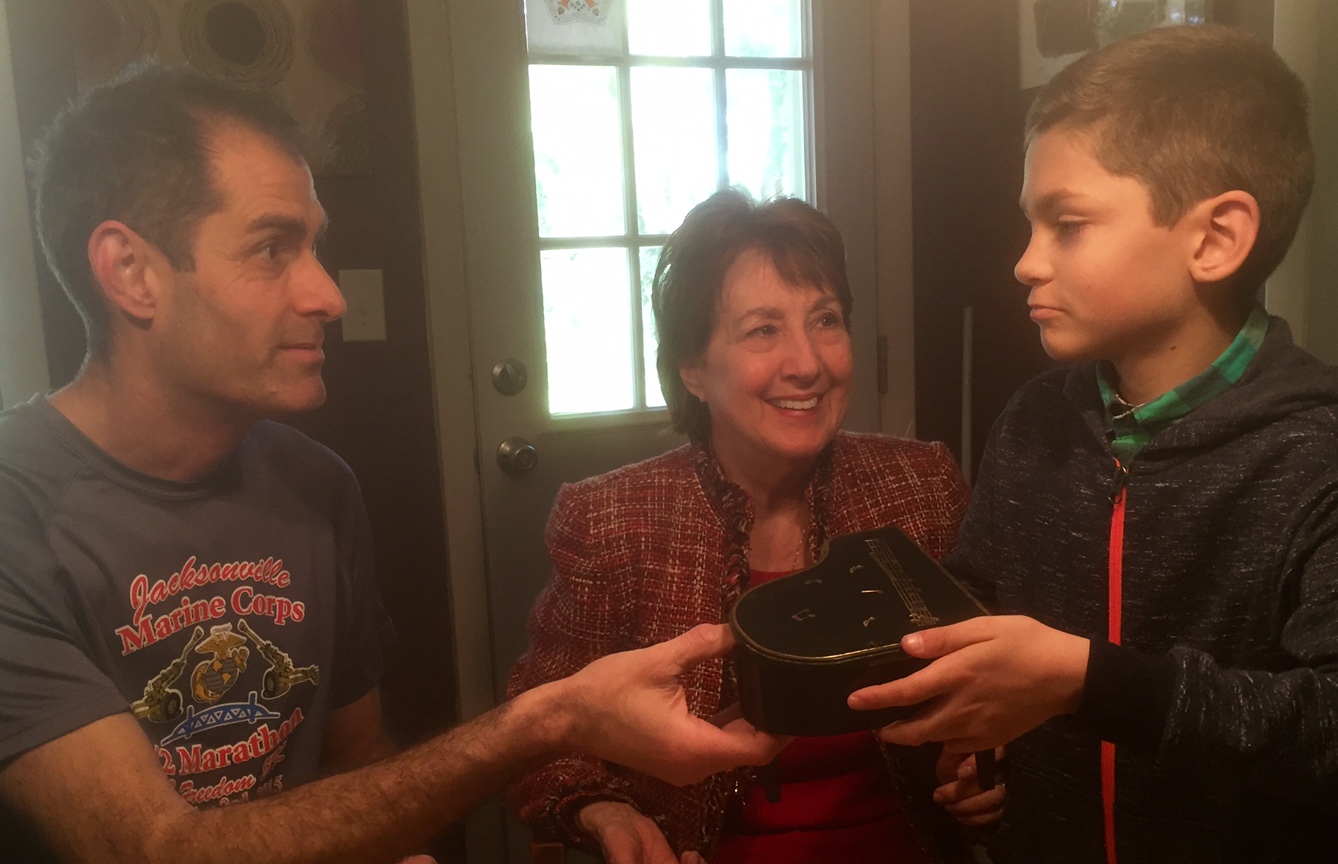
I announced, “When, he was your age, your dad broke off one of the legs on this toy piano.”

“Oh, no, not a leg, the hinge was broken off,” Joel corrected.

JoelPassingToIan

My memory had played tricks on me and the cause of the accident had morphed into something else.

Memory can be fuzzy sometimes. It’s not fixed as a photograph / locked in an album, / but it changes, it develops, mixed with time,” as Barbara Crooker wisely observes in her poem, Not a Spoon, a Key. Sometimes memory can even be wrong.

Squinting now at the underside, I see the replacement on the left, slightly larger screw and bolt than those on the other side. Lid held up with two toothpicks.

IngeFixed

ChristianLightPress13.95

And here it is, good as new!

PianoUpClose


Not a word was spoken about doing the right or wrong thing.

Words weren’t necessary.


Can you relate to my dilemma here?

Has your memory of family incidents every played tricks on you? Readers will enjoy your story and so will I.


Coming next: Raise a Mug to the Irish

My Day of CHANGE @ a Middle School

“Mom, would you like to volunteer for Challenge Day at Mandarin Middle School in a few weeks?” Joel asked.

“I probably would but I would need to know more about it,” I answered.

Then my son proceeded to tell me about an initiative at the school he helps sponsor, “Be the Change,” a movement to help students break down walls of isolation and loneliness and replace them with compassion, understanding and love.

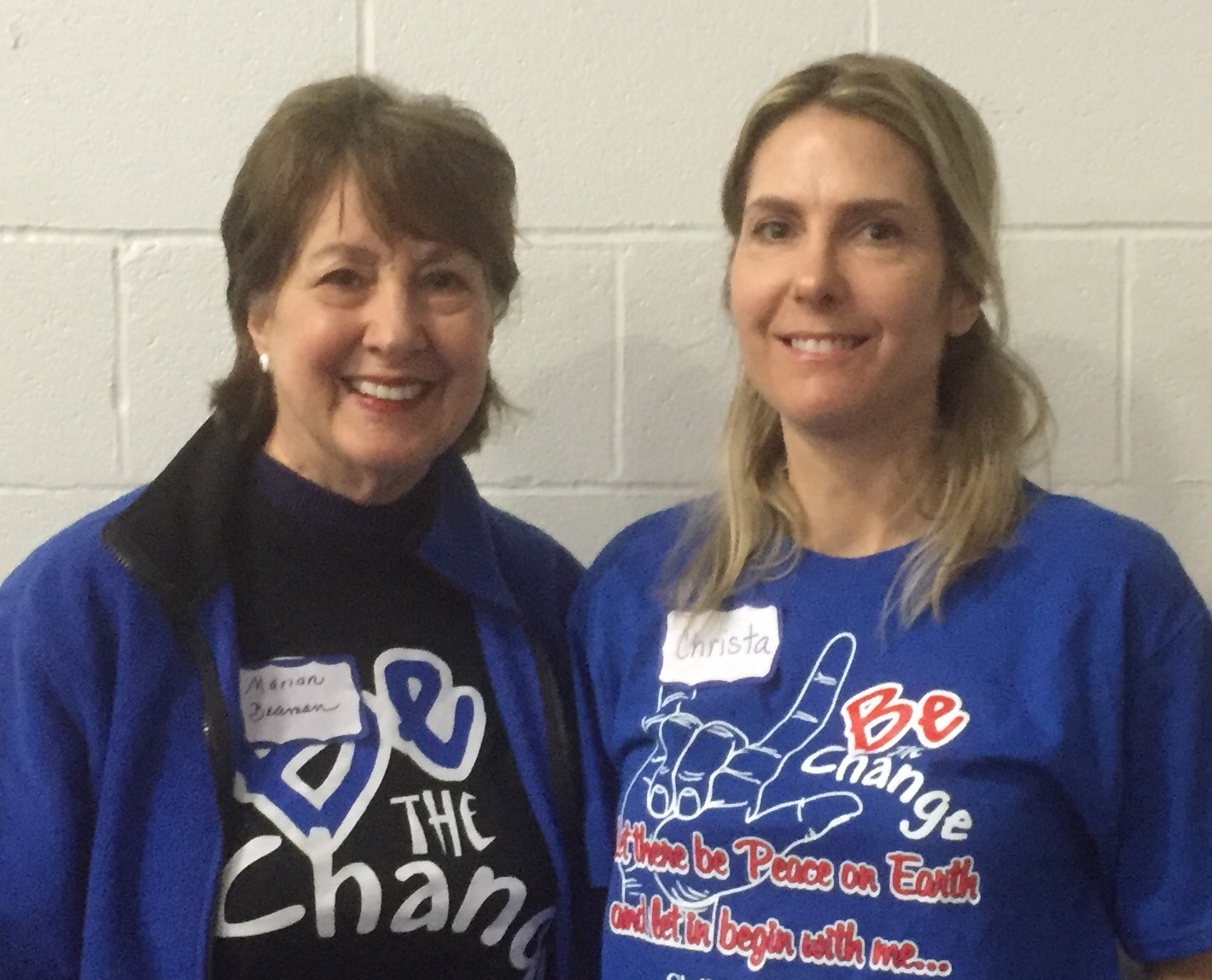
My day of change came on a Tuesday, when student ambassadors greeted me at the door and pointed me to the gym, where I found my daughter Crista, also a volunteer.

Challenge Day Ambassadors

CristaMeVol

Seventh and eighth grade students filed in under an arch of welcome, volunteers forming a path of entry with our bridge of arms. Later, we found out students thought doing this was hokey.

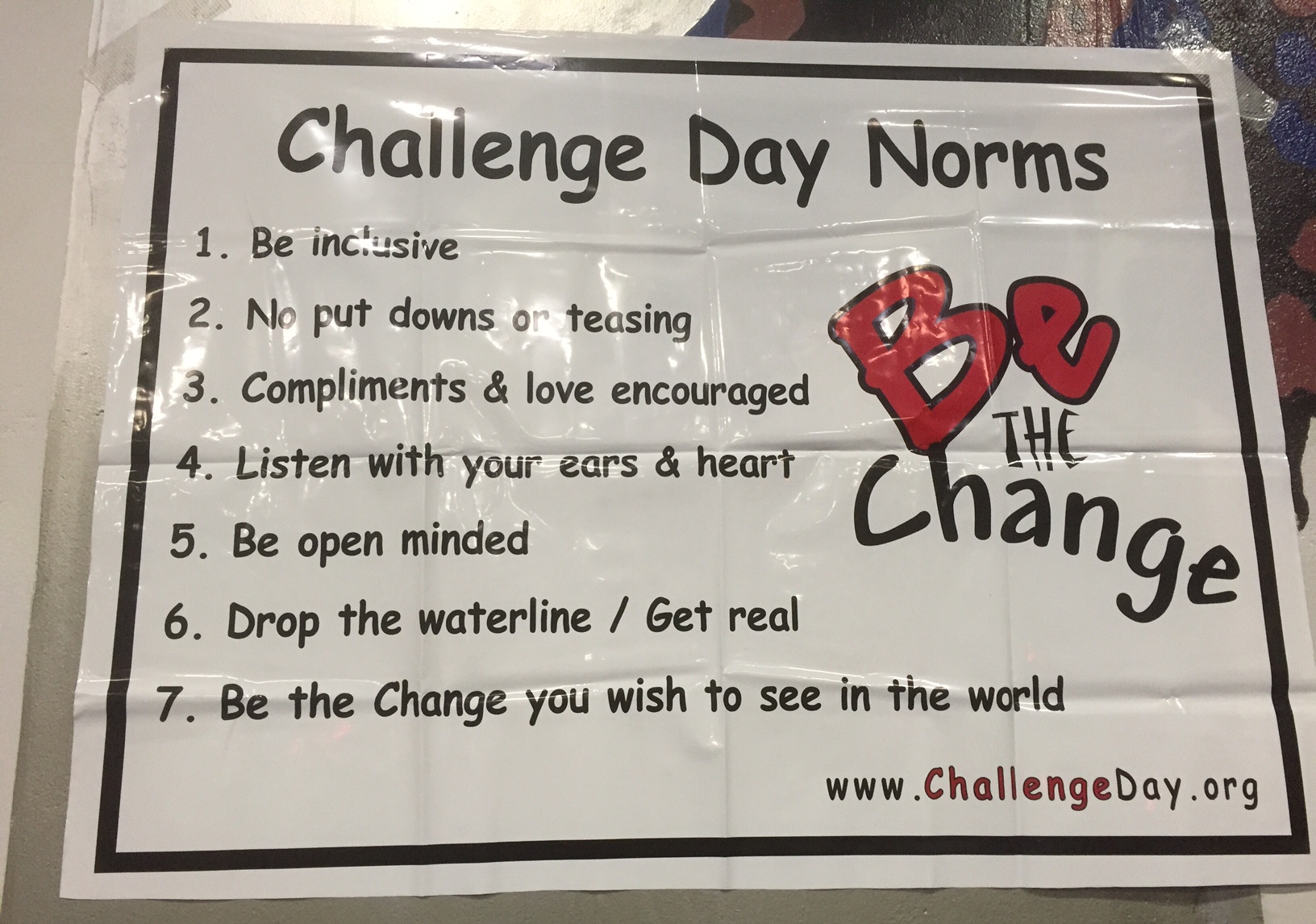
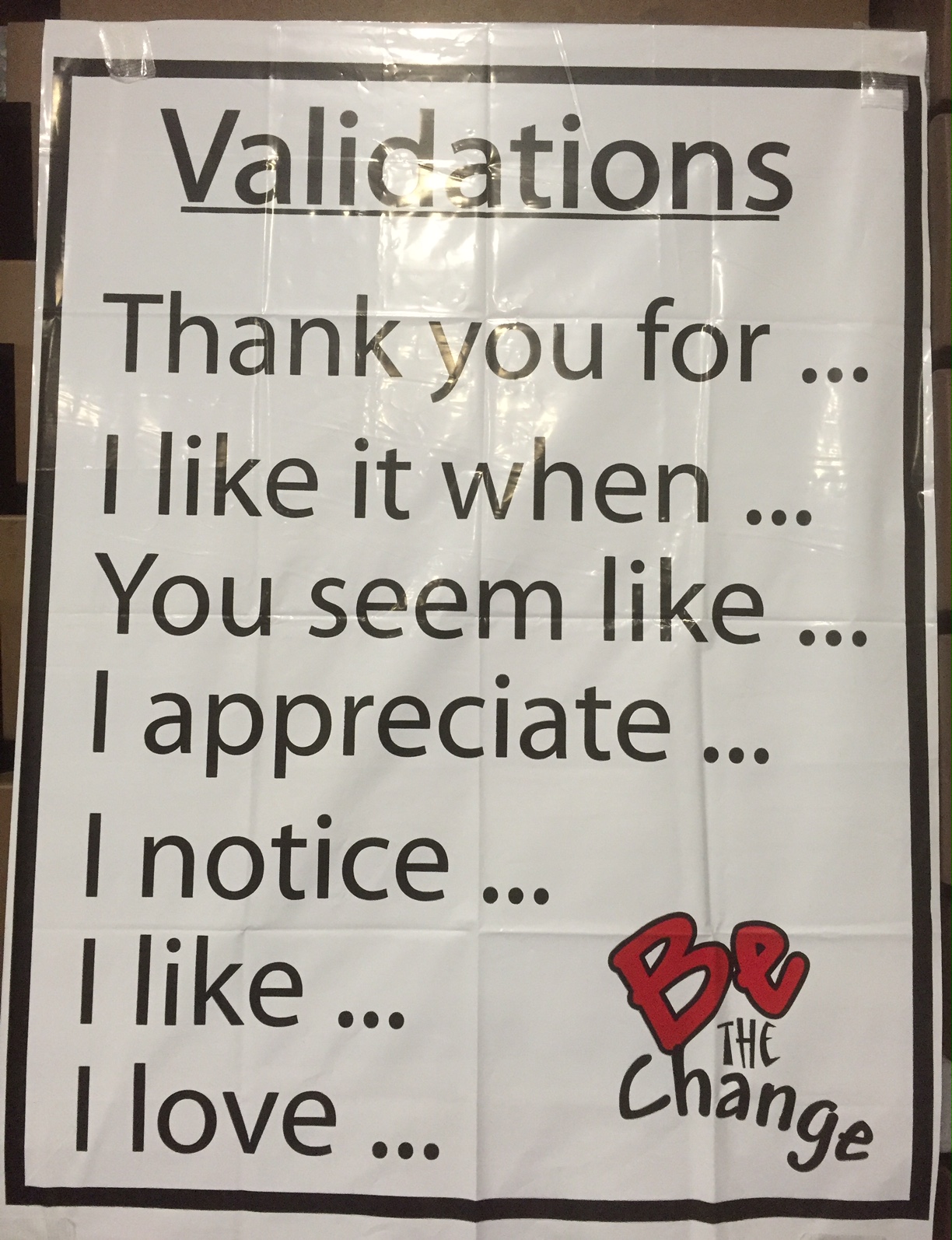
There were rules:

NormsChallenge

ChallengeValidations

The facilitators, Chris (a guy) and Trish began with games: “Find 10 people you never met before and give them a high five.” All the students were strangers to me, so that was easy. The day proceeded with other forms of friendly physical contact: fist bumps and eventually hugs.

“Now, with your partners, slap the ball to the other side,” students stabbed at a super-sized beach ball to earn points. Music and dance underscored many of the day’s activities: Soul Train, Wildest Dream, Where are You Now? Time of Our Lives . . . .

Then the facilitators turned more serious, referring to parallel lines of blue tape they had previously attached to the gym floor.

“Cross the line if . . .”

  • you have ever been hurt by what someone said about your skin color, religion, or how you dressed.
  • you have been hit, beaten or abused in another way by a parent or other authority figure in your life.
  • someone you know hurts the family because of alcohol or drugs.
  • you have lost someone you loved recently or a long time ago.

Emotion was palpable as students and volunteers alike crossed blue lines. Viewing their somber faces, I intuitively felt students’ dawning awareness of similarities in the lives of their friends and classmates. One of the facilitators shared her challenging life story of abuse and neglect. Students sat agape, eyes transfixed as her startling story unfolded.

Before lunchtime we were assigned to family groups of 4 or 5, two boys and two girls. With guidance, each was ready to share something heartfelt in my group.

  • My parents fight all the time and I think they might get divorced.
  • I don’t know who my dad is and my mother left. I live with my aunt and cousins.
  • My mom died last summer and then we had to put my dog to sleep.

Tears flowed. Each group leader doled out Kleenex tissues.

There was share time, with scenes similar to this photo clip from a Challenge Day video in Michigan, which appeared on Oprah’s website.

ChallengeDayVideoOprah

Most of the students who grabbed the microphone at Mandarin Middle confessed to prejudice or bullying and then publicly asked for forgiveness. More hugs and tears.

The day closed with students writing a thank you note to express gratitude to a special person in their lives. Most chose their mothers. One girl in my group wrote two notes!

* * *

Rich and Yvonne Dutra-St. John are co-founders of the innovative Challenge Day program and the Be the Change Movement. Rich is a former high school teacher and championship wrestling coach. Yvonne is a gifted speaker, educator, and program designer.

Mark Twain joked, “When a child turns twelve you should put him in a barrel, nail down the lid and feed him through a knothole.” I’m suspicious of the quote because I couldn’t find the attribution on http://www.bartleby.com, a website I trust. Yet, these lines survive in pop culture as does its sequel: “When he turns sixteen, seal up the knothole.”

The leadership at Mandarin Middle School, including my son, doesn’t believe this quip. And neither do I.


  • Have you heard of this program or one similar to it?
  • How have you made a change, major or minor, in your life?


Coming next: Are You Too Big for Your Pot?

Souper Meals with Sabah and Mom

“I have always relied on the kindness of strangers,” admits Blanche DuBois, an aging belle in Tennessee Williams’ classic play A Streetcar Named Desire. Blanche has had the props knocked from under her and has nowhere to turn except to her sister Stella, also living in reduced circumstances.

Sabah’s Story

In a far, far different context and definitely not because they have the slightest desire to do so, refugees from all over the world have been forced to rely on the kindness of strangers as they flee terrifying conditions in their homelands.

Such has been the case of Sabah Jabri, who with her husband and children left bomb-scarred Baghdad, Iraq in 2007 with just identification documents and the clothes on their backs and fled to Syria, ironically back then a peaceful respite from warfare.

Photo courtesy of Lancaster Online
Photo of Sabah and her soup courtesy of Lancaster Online

Sabah, an accountant, and her husband Alaa, a civil engineer, fled Baghdad when fighting between Sunni and Shiite militias made daily life unbearable. They ended up in Syria for a year, cared for by a family whose home – and whose soup – they shared, a dish they called “yakhni.”

Syrian2ChickenSoup

After a year in Syria, the United Nations High Commission for Refugees assigned the family to emigrate again to Ephrata in the heart of Pennsylvania Dutch County.

Currently, Sabah is manager of the Café at Ten Thousand Villages in Ephrata, where you can be sure this soup is on the menu. The article in Lancaster Online did not include the recipe (Of course not!) but the ingredients were listed: chunks of chicken breast, potatoes, carrots, onions and chickpeas in a hearty broth. Incidentally, Ten Thousand Villages in Ephrata offers fair trade items worldwide for sale.

More than sixty years ago, a visionary named Edna Ruth Byler worked through the Mennonite Central Committee to begin an enterprise which has mushroomed into Ten Thousand Villages.

. . . [She] believed that she could provide sustainable economic opportunities for artisans in developing countries by creating a viable marketplace for their products in North America. She began a grassroots campaign among her family and friends in the United States by selling handcrafted products out of the trunk of her car. Byler made a concerted effort to educate her community about the lives of artisans around the world.

Ten thousand Villages is the result, an undertaking that has grown well beyond the tiny house of its inception and offers for sale baskets, jewelry scarves, bags, kitchen & dining articles, toys and other items from artisans, particularly women, around the world.

Mom’s Soup

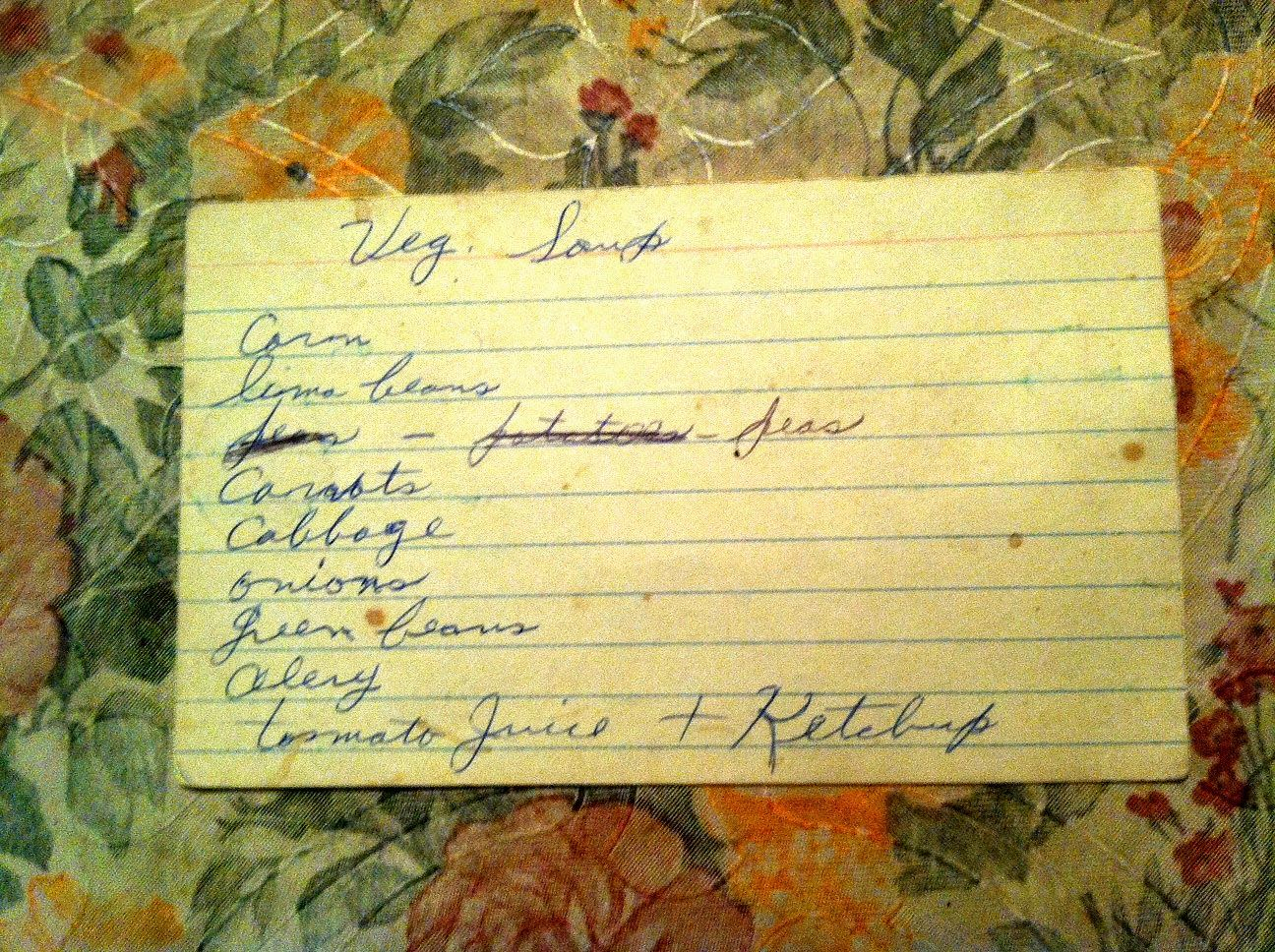
Mother also knew the nutritional heartiness of soup and often had vegetable soup waiting for us when we drove or flew up from Florida at Christmastime. Within five minutes of our arrival, one of us would fly into the kitchen and open the Frigidaire to see whether there was a ceramic pull-out drawer full of soup in the bottom left.

MomVegSoupRecipe2_layers_4x3_300


Chicken corn soup was also her specialty, with hard-boiled eggs and rivels, doughy droplets made from flour  . . .

Mom's Chicken Corn Soup without Rivels
Mom’s Chicken Corn Soup without Rivels


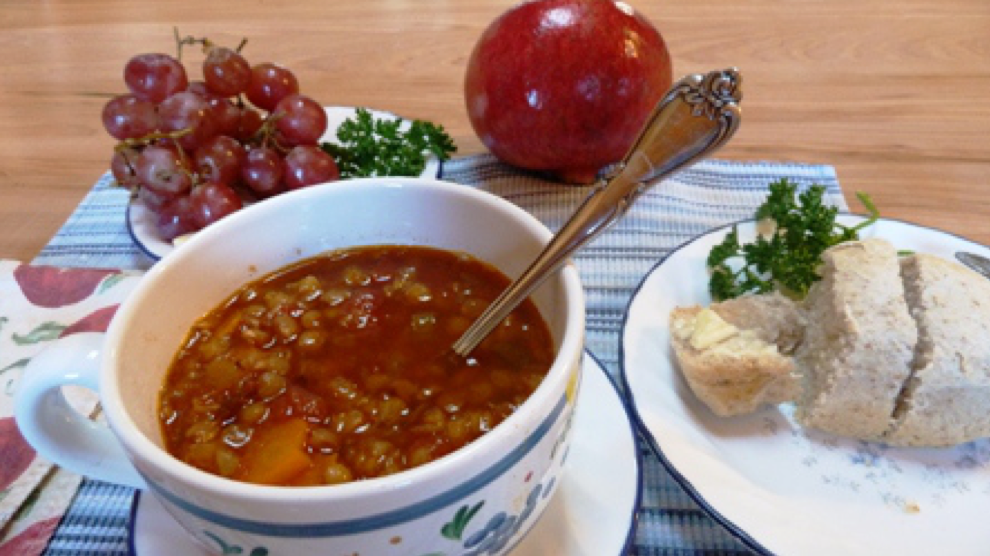
Author, editor, and cookbook writer Melodie Davis has recently featured savory Spanish lentil soup on her website where the recipe for the dish below appears.

SpanishLentilSoupMelodie


Quotes about Soup

Soup is a lot like a family. Each ingredient enhances the others; each batch has its own characteristics; and it needs time to simmer to reach full flavor.         ~ Marge Kennedy


Only the pure of heart can make good soup.                ~ Beethoven


And finally, Bennet Cerf defines good manners as “The noise you don’t make when you’re eating soup.”


How has soup enhanced your life? Do you think Beethoven is right in the quote attributed to him? Do you have a choice recipe to share?


Coming next: A Snow Bunny and a German Lullaby


Friends from Faraway and Long Ago: Kitsa and Lydia

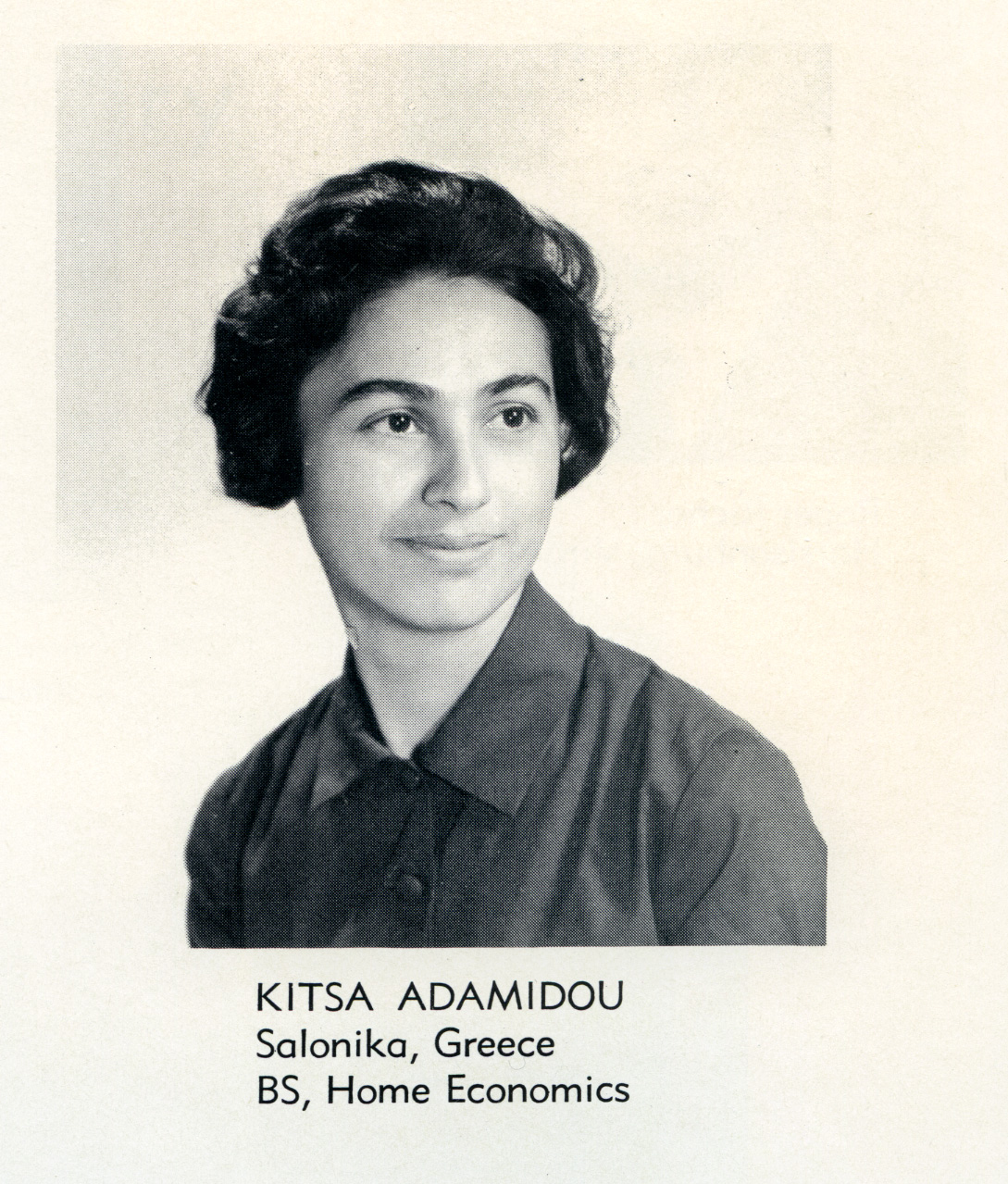
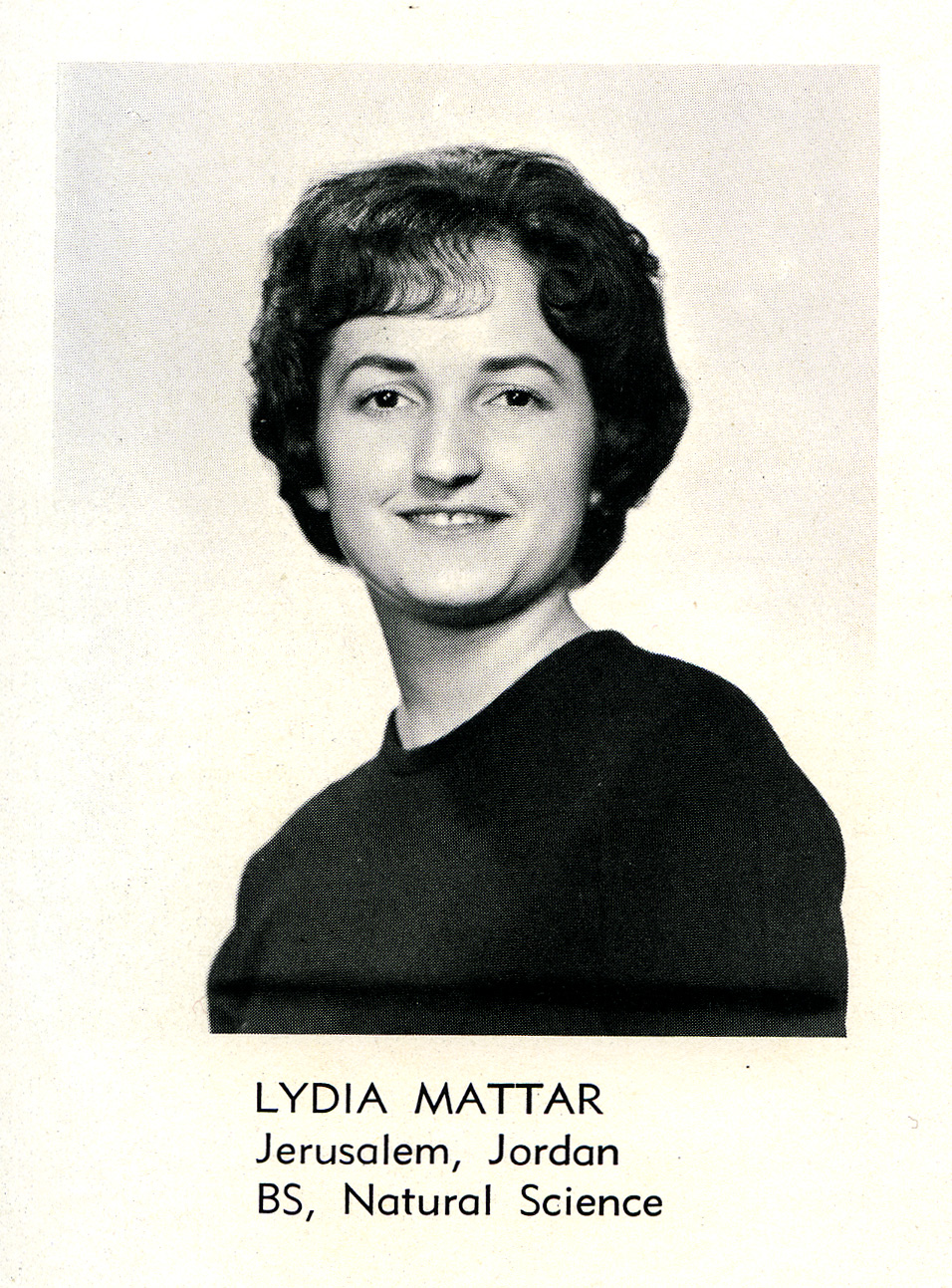
Kitsa and Lydia were among the very few women in my graduating class at Eastern Mennonite College who did not wear a prayer veiling atop their heads. Why? Because they were not Mennonite.

Lydia Mattar from Jerusalem, Jordan and Kitsa Adamidou from Salonika, Greece were international students and my good friends when I attended EMC. Their origins both have a biblical stamp: Kitsa’s hometown was originally known as Thessalonika, the name of two New Testaments books (Thessalonians I and II) and Kitsa’s father from Jerusalem was the Keeper of the Garden Tomb, the site of Jesus’ burial and resurrection. (Photos from 1963 Shenandoah yearbook)

KitsaYearbookPortrait

Always on the look-out for fun!
Kitsa, always on the look-out for fun!

And then Lydia . . .

LydiaYearbook Portrait

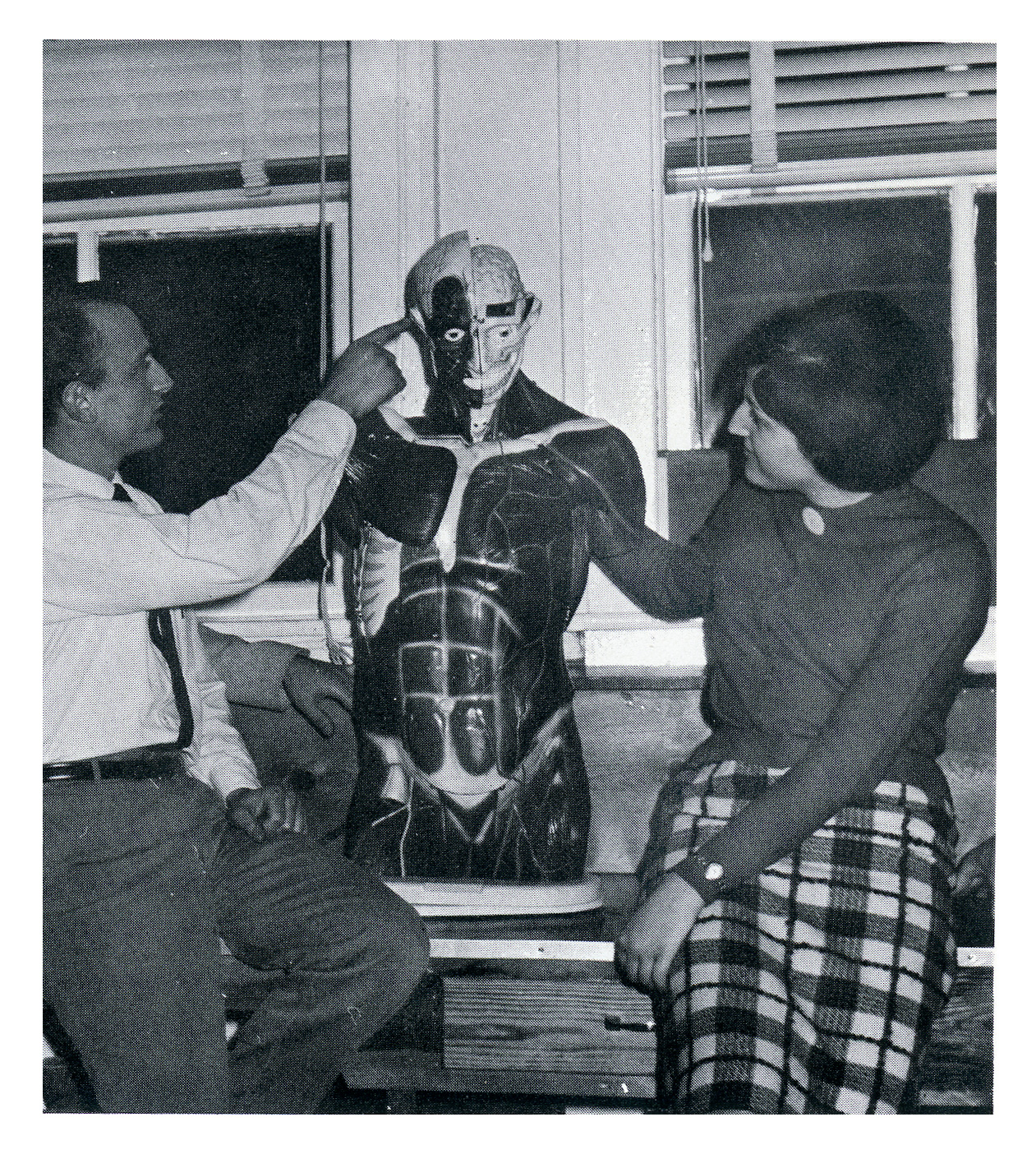
Lydia in Dr. Daniel Suter's Anatomy class
Lydia in Dr. Daniel Suter’s Anatomy class with lab assistant

I was drawn to Kitsa and Lydia during my freshman year because I have always been curious about other cultures. In fact, one year Lydia was my roommate. It appears this inclination has run deep in my DNA. Now as I hold in my hand one of my Grandma Fannie Longenecker’s letters from college I can sense her keen interest in my “foreign” friends and a deep longing to know them better.

In this letter dated December 1, 1960, she insists that she would like both girls to spend Christmas at her home. Born in 1892, Grandma Fannie Longenecker was 68 when she wrote these words to me:

Dear Marian – Guess you’ll be surprised to hear from me, I sure wanted to write before, just didn’t get at it – (Reason) older and slower . . . . Ruth was looking for a letter from you so be sure and bring Lydia & Kitsa along home over Christmas, and forget all about paint etc, two of you can stay here & we’ll have a good time that’s the thing that really matters, I think I’ll be Kitsa’s Grandma of America – Do you know what she needs or wants for Christmas? Forgot to say I’ll pay her way up & we really want them to come, so make it strong, times soon here!

Later in the letter, Grandma admonishes:

Be sure and get arrangements to come home early & if possible bring the girls along. I’ll pay Kitsa’s fare on arrival & find out what she would like for Christmas. This $ 5.00 spot is for you, maybe you need a little for odds and ends or transportation home. Tell us what you are hungry for, that you don’t get at school.

Mark tells me ‘Marian will soon come home’ and his face lights up, so we are all looking forward to that day. Hope your old toe is better.

Grandma’s interest in Kitsa persisted through most of my college years. In her letter of March 8, 1962, she referred to Kitsa and her roommate pictured on the front page of Christian Living magazine (February 1962).

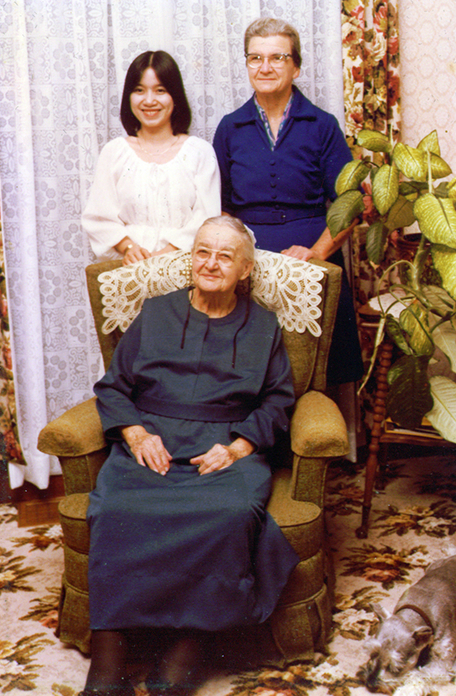
For over 25 years, my Grandma and Aunt Ruthie practiced peace and goodwill toward all, as they opened their home to refugee and immigrant families, beginning with Phuong (pictured below), a young woman who arrived by boat from Vietnam. Their home was a warm cushion absorbing the cultural shock of leaving home and family; it was a safe haven, welcoming refugees from a colláge of countries including Bosnia, Croatia, Serbia, Russia—anywhere there was political upheaval.

1979Grandma,Ruthie, Phuong_small

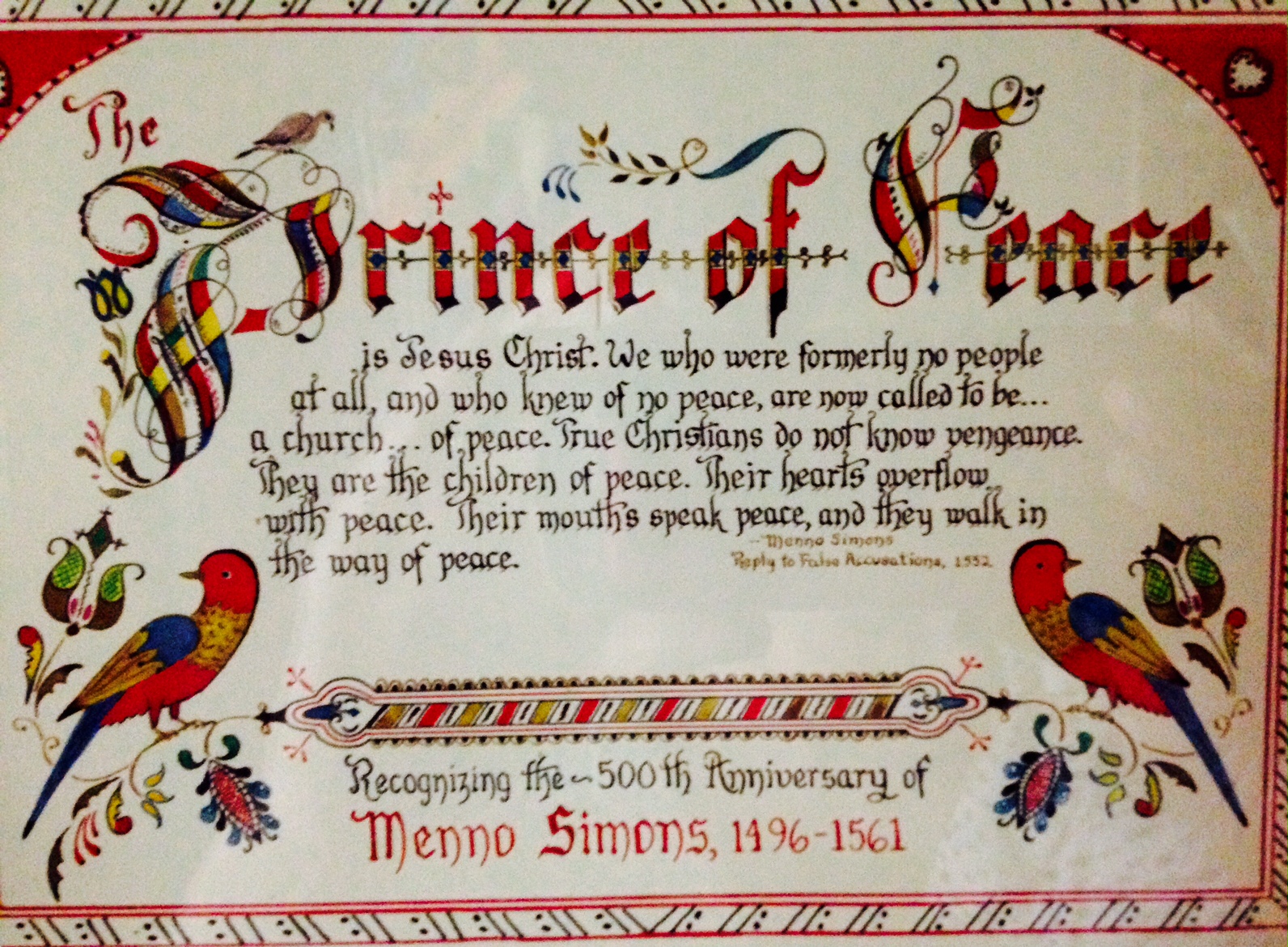
Although she graciously accepted the Salt of the Earth Award from Lutheran Social Services in the 1990s, Aunt Ruthie never bragged about her benevolence. From her perspective, she was merely sharing the love of Christ and fulfilling the statement of Menno Simons, founder of the Mennonite faith:

Framed print on the wall of Grandma and Aunt Ruthie's sitting room, 1996
Framed illustration on the wall of Grandma and Aunt Ruthie’s sitting room, 1996

In a noisy world where some speak of building tall walls and wish to spread terror and violence, I am thankful for my heritage including an education at an institution, now Eastern Mennonite University, where the language of peace is preached and modeled. In fact, it is now possible to earn both under-graduate and graduate degrees in justice and peace-building at the University.

EMUJusticPeaceQuote


Regrettably, the contact information I have currently for both Kitsa and Lydia has not yielded any results, so I don’t know what paths their lives have taken. But I do know that their lives, like mine, have been imprinted with the power of peace, a message this world could stand a good dose of in these troubled times.

Postcript:

Just this morning, December 11, 2015, I had a long phone conversation with Kitsa, her smooth, alto voice music to my ears. She now lives with her husband in North Carolina and is very active at St. Nicholas Greek Orthodox Church where she is head of the Hellenic Culture initiative. She also gives private Greek language lessons.


How have international friendships affected your life? Have you connected with long-lost friends recently?

Learning 101 with Ananda and Ben: Role Reversal

My Pilates instructor is a spring chicken, and my writing coach is young too, just thirty-nine years old, younger than either of our children. Still, They are teaching me.

Since childhood, we have been conditioned to think of our teachers as older than we are. Such a perspective probably was formed in elementary school when our teachers were the age of our mothers or fathers. And then in high school, if we’re honest, some of those 45-year-old faculty looked absolutely ancient to us. I imagine I was viewed as an older sister when at Lancaster Mennonite School I was a mere four years older than my senior students. As I aged in my teaching profession, in my students’ eyes I may have passed for a mother or aunt, and later, in my sixties, students at the college must have viewed me as a grandmother or great-aunt.

Now after more than forty years in education, I am well into an encore career as a writer. To support such a sedentary life-style, I need to get off my duff and twist and turn, bob and weave, flexing muscles that get very little use otherwise as I finger the back-lighted black keys of my laptop, warming a pillowed chair. Ananda at Bailey’s Gym helps me do that. On her Pilates mat in front of a class of middle-aged women, she is as flexible as a rubber band, inviting us into poses of bold bends that I can at best only approximate. Gentle and petite in nature, this native of Colombia helps me correct my efforts.

Ananda2

“Ma-ri-ann, eez this way . . . extend your left leg a lee-tle further.” And so, I adjust my appendages to comply with her instructions, but not without cringing a little. Yes, though Ananda is ever so easy-going and gracious, I do chafe at being singled out for wrong moves. After all, she called out my name. Everyone else heard that I messed up! Still, I know I will bring out my exercise mat next week and sit for another session with her gentle but precise guidance.

Then, there’s Benjamin, my writing coach. A poet, gardener, and memoir-writer, Ben Vogt is my writing teacher in an online course entitled All in the Family: Research and Write Your Family’s  History. He too is gentle, introspective, always affirming. But he is also incisive, biting into the scripts I send him with loud barks in return, always in caps: HOW BIG IS MEDIUM? YOU’VE GOT TO BE FAR MORE DETAILED AND DESCRIPTIVE FOR US . . .

BenVogtGardener

And on the next page, I see more yelling in loud crescendo as I notice I have missed the mark trying to describe what my Mennonite pastor was wearing: LET’S SEE THE WARDROBE WITH MORE DETAILS – NAME THE CLOTHING PARTS MORE, SHOW SHOW SHOW! To be fair, every once in a while I see that I have succeeded: “GREAT PARAGRAPH!” he shouts in all caps. He is thrilled when I use sensory detail (All five senses now!) to properly develop a scene instead of resorting to flabby adjectives. Then I’m both surprised – and pleased.

What is the point here? I am submitting to tutelage because I want to. I believe there is way more for me to learn. I’m not a finished product, and probably will never be, so I need more priming and polishing from folks expert in their fields. Why? Because I don’t have the insight to see how or where my efforts have gone awry. And, yes, these tutors can be younger, way younger, than I am.

Have you learn’d lessons only of those who admired you, and were tender with you, and stood aside for you?

Have you not learn’d great lessons from those who reject you, and brace themselves against you? or who treat you with contempt, or dispute the passage with you?

Walt Whitman Leaves of Grass

Of course, neither Ananda nor Ben have ever rejected me or treated me with the slightest bit of contempt, but each has sought to “dispute the passage with [me],” and though it is uncomfortable, even painful at times, I have benefited from these lessons. Indeed, I am learning lessons from them and others. Learning. Still.

Still learning.

Are you are lifelong learner? How or when have you learned from “teachers” of any age? Inquiring minds want to know . . .


Coming next: Faraway Friends: Kitsa & Lydia

Halloween Advice from my Good Witch of the North

MY STORY

Dorothy had the Good Witch of the North to give her “magical protection from fatal harm” on her journey to the land of Oz and back. Yet she followed an uneven path, using her brain, sometimes thinking with her heart, and slowly but surely developing courage.

I had my own Good Witch, Aunt Ruthie Longenecker from Pennsylvania, not Kansas. As a plain Mennonite, she never gave me glittering red shoes. I had to buy them on my own after I turned from plain to fancy. But she gave me plenty of golden advice, none more emotionally charged than the time she perceived I was veering off course at college and falling for a young man she imagined would be my downfall.

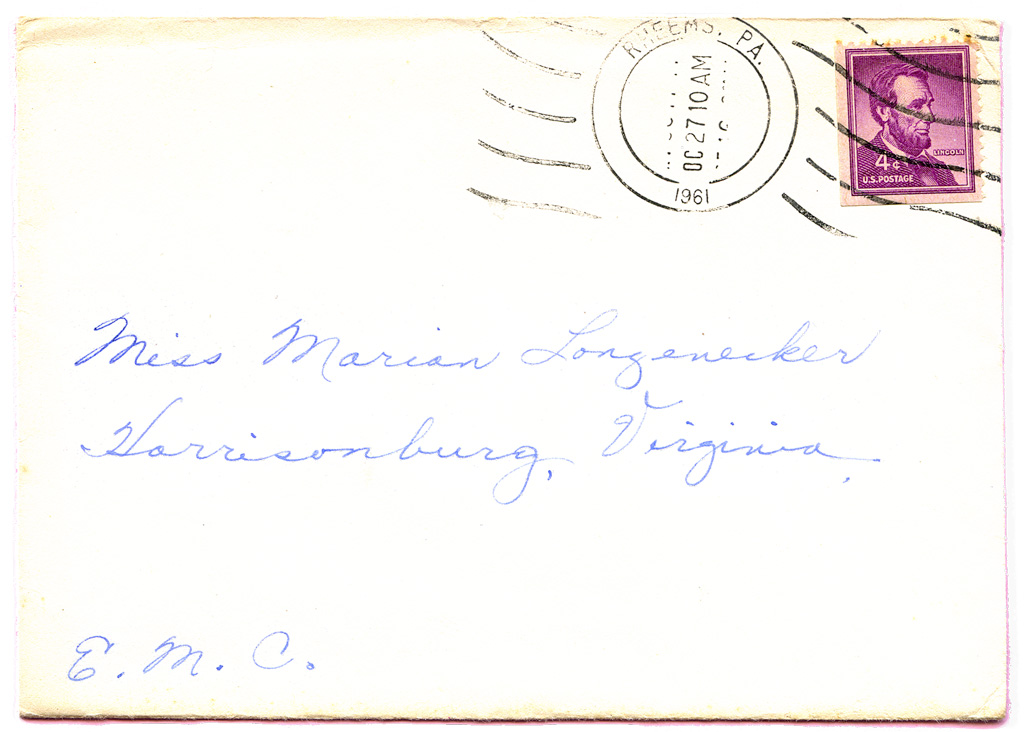
The advice arrived in a 4-cent envelope written in her flowing, left-handed cursive:

Envelope_note-to-Marian_layers

The Gibson greeting card is a cute pop-up.

HalloweenCardRuthie

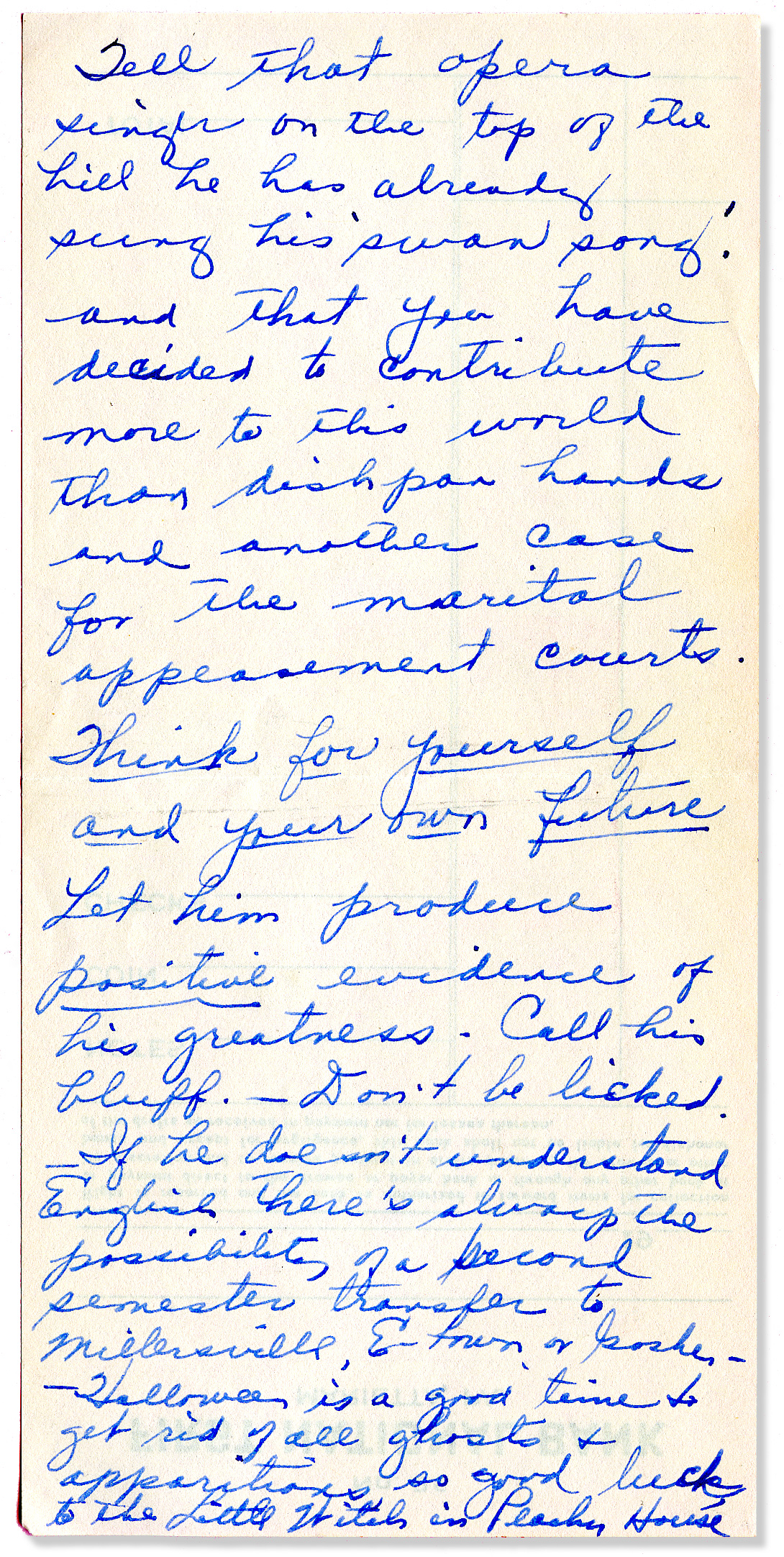
Enclosed with the card was a terse note written on the back of a deposit slip from the First National Bank of Marietta, a curious choice of stationery. (You can read this note or the text below it in print.)

RuthieNoteMarianHalloween

Here is her message in print form, directing me to forsake that boyfriend (aka “opera singer”) at the top of the hill:

Tell that opera singer on the top of the hill he has already sung his “swan song” and that you have decided to contribute more to this world than dishpan hands and another case for the marital appeasement courts. Think for yourself and your own future and let him produce positive evidence of his greatness. Call his bluff. – Don’t be licked. If he doesn’t understand English there’s always the possibility of a second semester transfer to Millersville, E-town or Goshen – Halloween is a good time to get rid of all ghosts and apparitions, so good luck to the Little Witch in Peachey House.


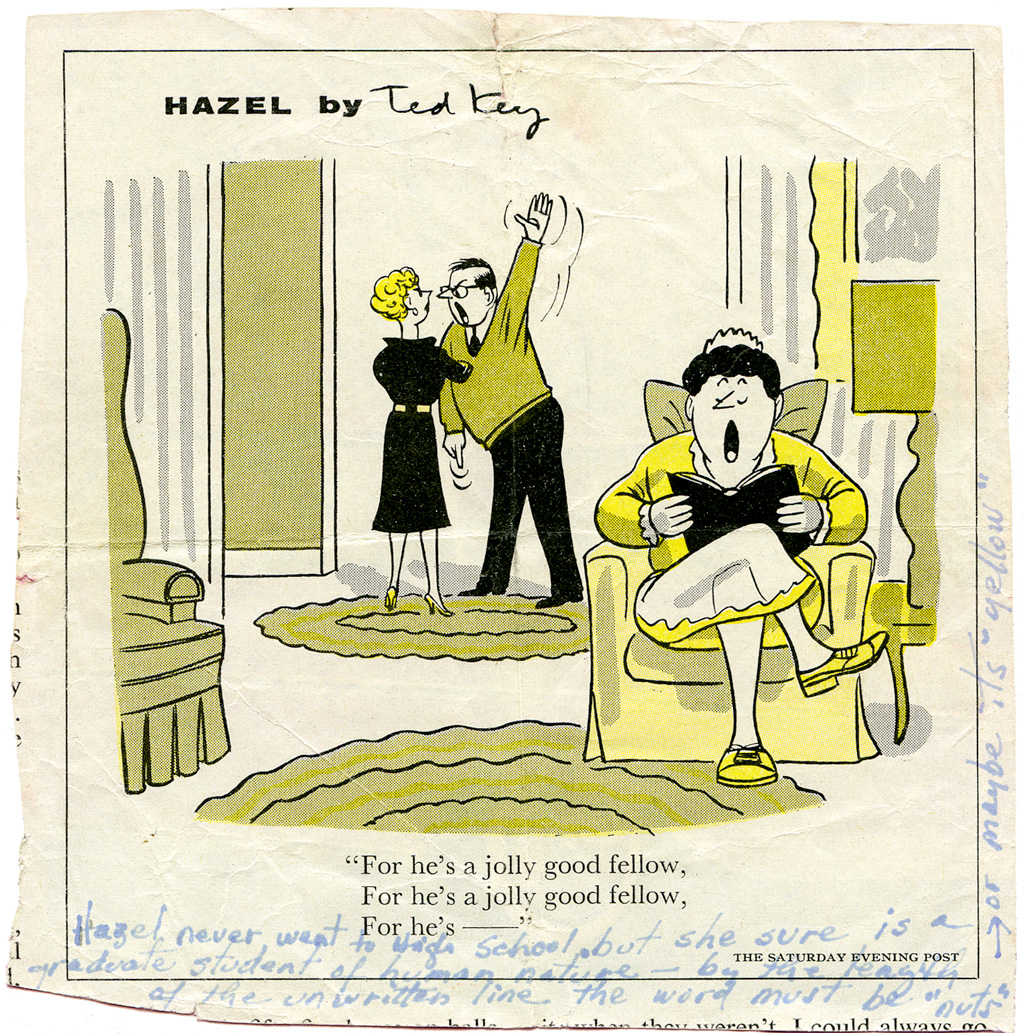
Added to this note was a “Hazel” cartoon clipping to reinforce her words:

Hazel-cartoon_Ruthies-note-to-Marian_layers

The ink jotting has become almost indecipherable over the years, but she notes:

Hazel never went to High School, but she sure is a graduate student of human nature – by the length of the unwritten line the word must be “nuts” – or maybe it’s “yellow.”

At the time (my sophomore year at Eastern Mennonite College), I was trying to keep my life on track academically despite romantic upsets and did not then realize the full force of Aunt Ruthie’s words or the depth of feeling behind then. Squinting back through the telescope of years as a much older adult, I do now.

MY REFLECTION:

In Aunt Ruthie’s day, women usually chose either the single life and a career or motherhood and maintaining a household. Hardly ever both.

I was beginning to see from the models emerging in the 1960s that one could answer the call of both vocations, professional and domestic. Choices did not have to be an either-or proposition, and they didn’t have to happen simultaneously either.


How about you?

Did you ever benefit from unsolicited advice?

What models of vocational choice made an impression on you growing up? How did these influence you?

Moments of Discovery # 7: The Story Behind the Hidden $ Bill

Dollar Discovery! On September 10, 2015 I opened an envelope dated April 30,1962 that Mother sent me in college. I had read her letter then, but did not open the Bossler Mennonite Church bulletin where she had tucked a dollar bill (series date 1957) until now. I wonder now whether she was testing to see if I had taken the time to open the bulletin she enclosed.

When I opened the bulletin commemorating Church College Day, a few weeks ago, out tumbled a “Silver Certificate” dollar bill backed by REAL money, not the “Federal Reserve” bills we carry around in our wallets nowadays.

Dollar

What was going on in the world in April 1962?

  • US district Judge J. Skelly Wright ordered the desegregation of elementary schools in New Orleans, LA.
  • John Kenneth Galbraith, then U.S. Ambassador to India, wrote a letter to President Kennedy proposing a negotiated peace between North Vietnam and South Vietnam.
  • At the Ealing Jazz Club in London, Brian Jones was introduced to Mick Jagger and Keith Richards. The three would become the heart of The Rolling Stones.
  • Walter Cronkite replaced Douglas Edwards as the anchorman for the CBS Evening News.
  • The Century 21 Exposition World’s Fair opened in Seattle, Washington on April 21, 1962

What was happening in the Longenecker house then?

MotherLetterMe1962

Here are unadulterated excerpts from Mother’s letter:

“Hello to all the gals at Peachey House. . . . “Did you get your book – – – I mean your ‘Books,’ The Post Master want to know when you got the book we send. Don’t for-get to tell us he want to see know how long it took to get to E. M. C.”

“. . . I called LaVon’s mother on Fri. the way it sounds Maybe you are taking her place. she is going to work for Dr. Walmer 5 weeks then she is going to be counsler at a few camps. She is sure you will like it. She said you even get off the fourth of July with Pay. she knows they pay over a $ a hour but she didn’t know right yet how much.” (Lavon Nolt (Kolb) is a school friend: We attended first grade → college together. Here Mother is discussing summer work for me.)

“. . . I started to tell you Janice [sister] and I were at the Mother & daughter banquet on Fri. eve. they really had a nice program. & plenty of food such as fruit cup, a very large slice of Ham loaf, baked potato, corn & peas, cold slaw, pickles & olives, celery & carotts, ice cream & cake Mints & nuts. Well, we were just stuffed.”

“. . . When you get your check get it cashed then you will have when you need.”

There are two references to money in this letter, three if you count the dollar bill I didn’t discover until now. I don’t remember what the check was intended for or the amount, but it was probably not enough for books or tuition. And seldom did Mother write a letter that didn’t mention a menu or food preparation.

I know now that she equated food with love. And she knew that money, even a little bit, would sweeten my passage through my college days too.

God bless the memory of my mother, who knew the value of a dollar . . .

2002RuthPotatoes_small. . . and the appeal of a home-cooked meal!

Did this post prod memories of happy surprises about money or food? Join the conversation here.