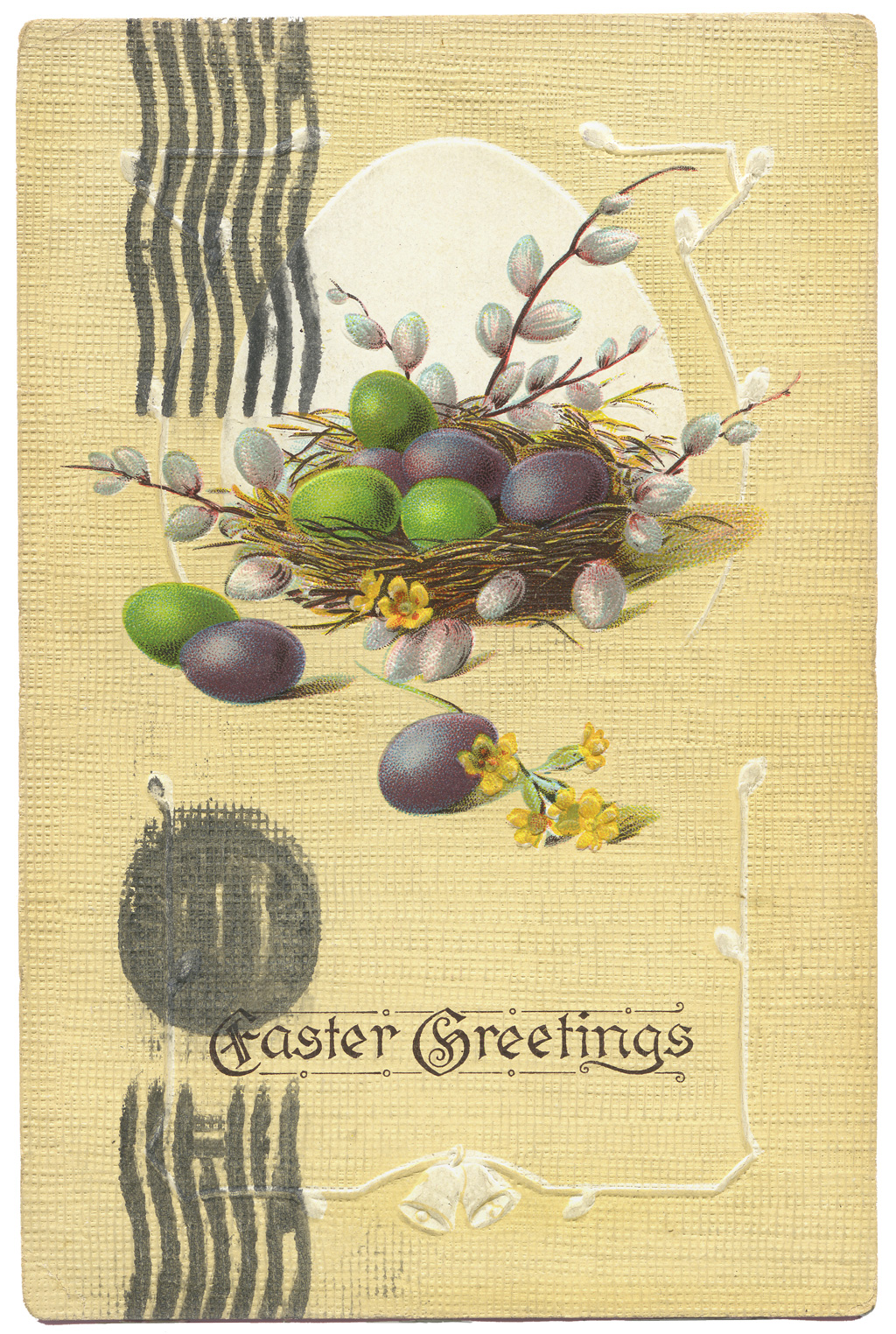
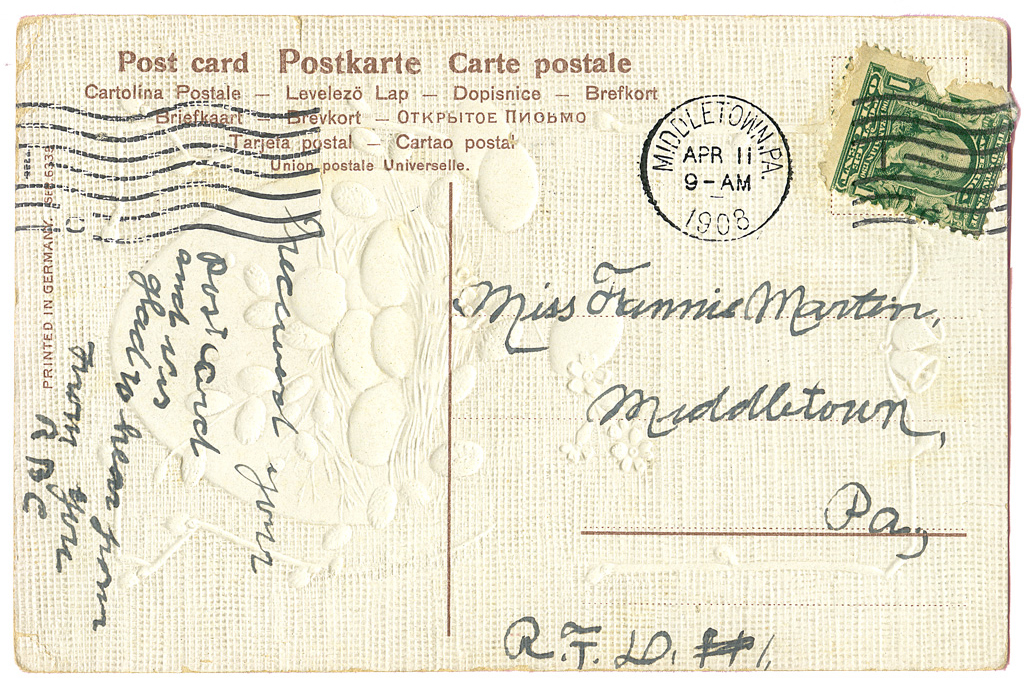
At Easter-tide I’m dipping once again into my Grandma Fannie Martin Longenecker’s stash of vintage post cards. Here is one dated April 1908 from “your RBC,” it says, with the postmark wrapped around the face of the card.
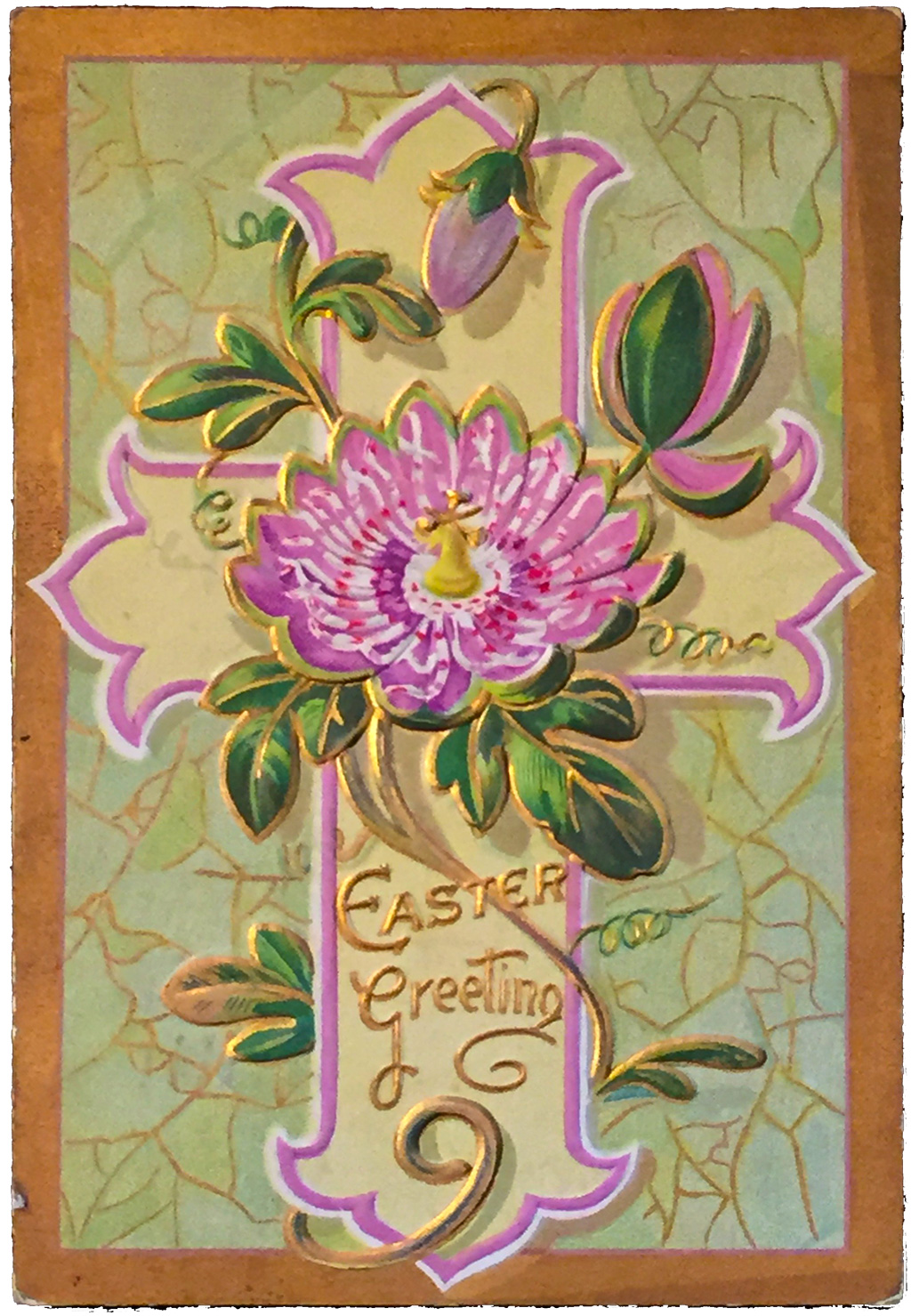
Another, from 1910, displays the marvelous passion flower adorning the cross.
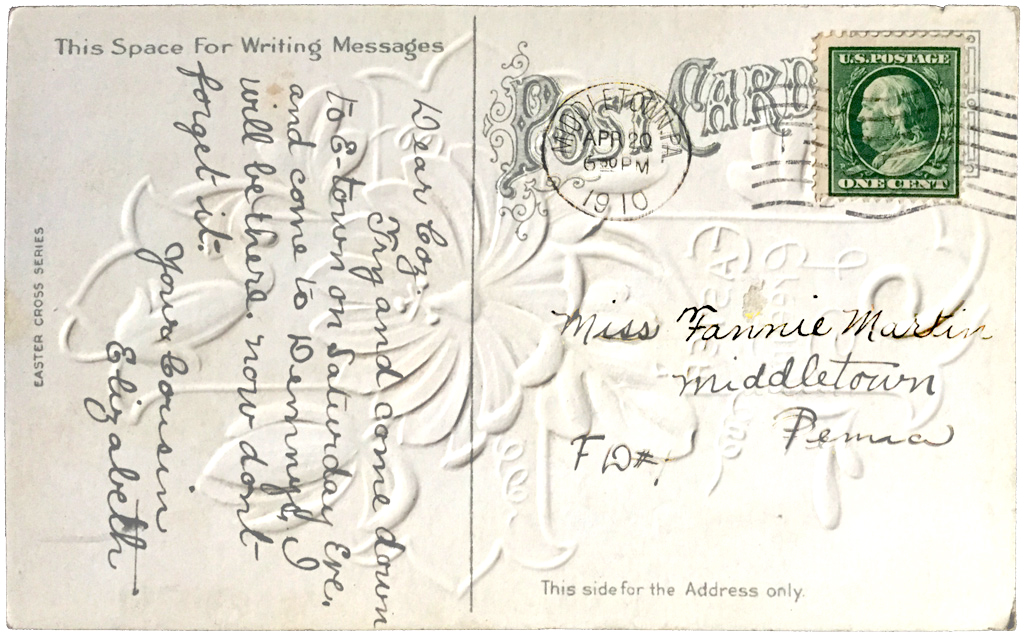
The message from Grandma’s cousin Elizabeth begins with “Dear Coz” and in black flowing fountain-pen ink cursive begs her for a visit: “Try and come down to E-Town on Sat. Eve and come to Demmys. I will be there now don’t forget it.”
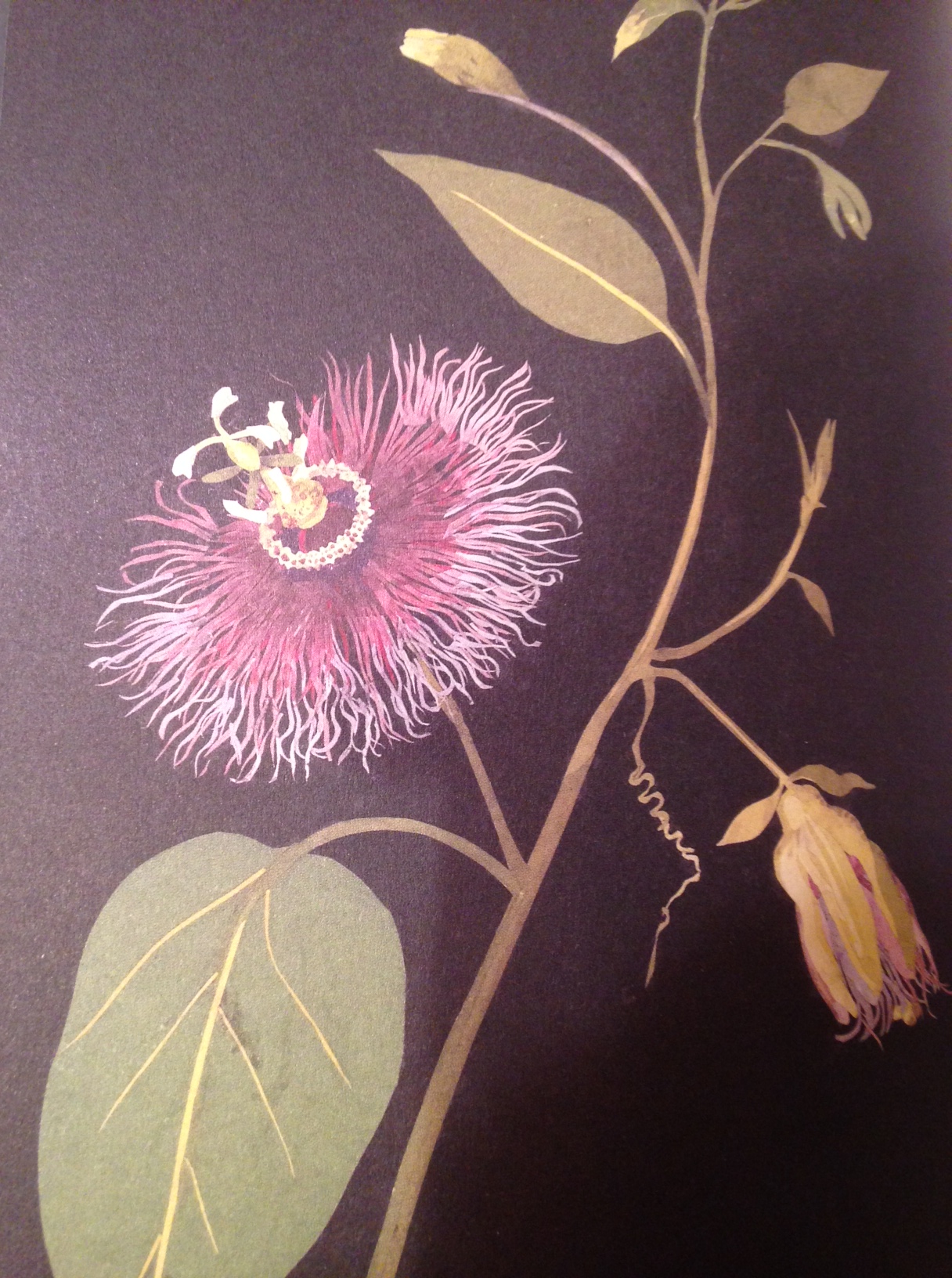
The passion flower which blooms in the spring has come to symbolize the suffering and death of Christ, hence the nickname “passion.” Mary Delany, herself a late-blooming artist, constructed a lovely flower with 230 petals with her scissors art.
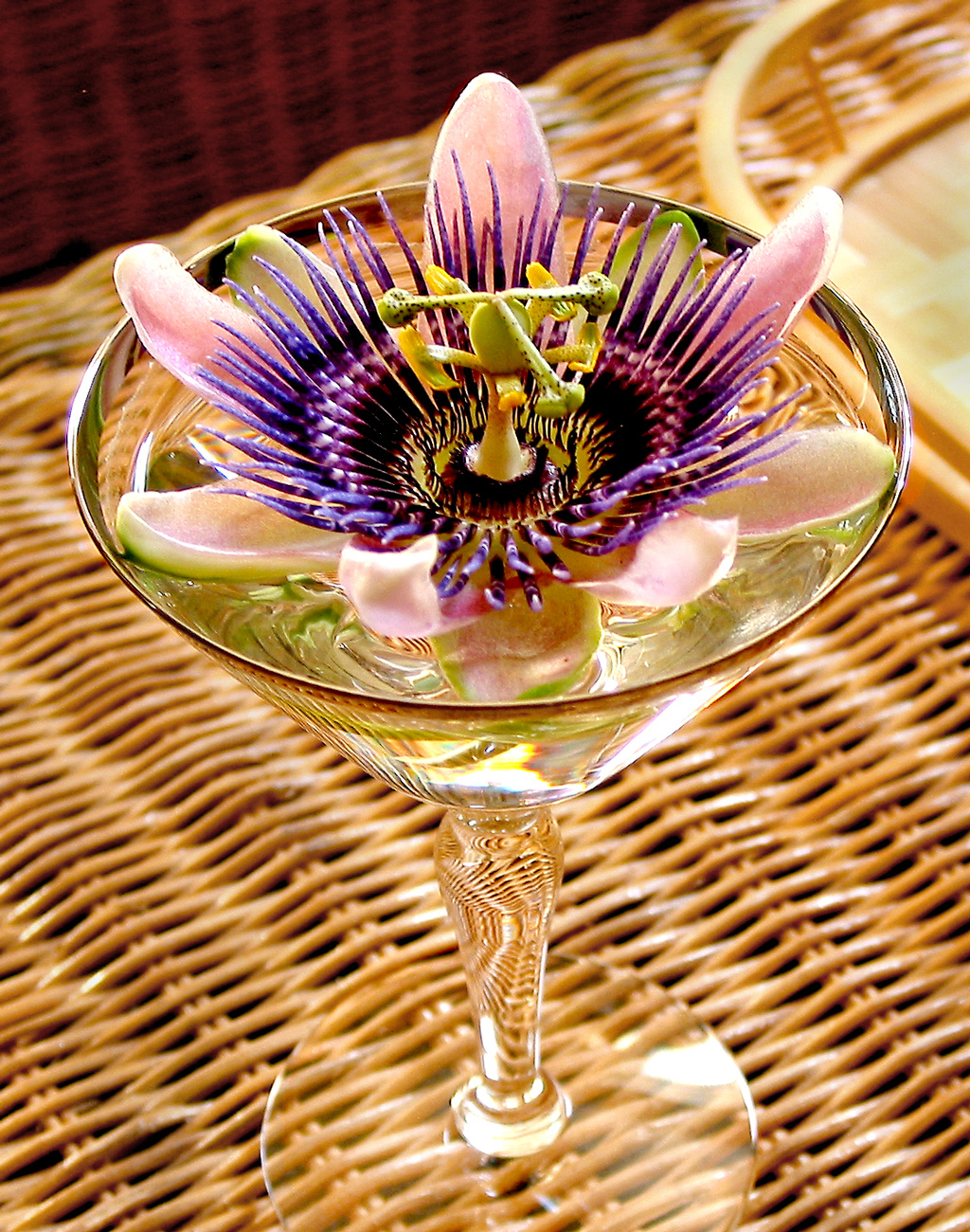
The bloom (Passiflora) grown in my garden illustrates the religious symbolism explained below.
One writer, a Franciscan sister, has expressed the meaning of the flower parts in this way.
In the 15th and 16th centuries, Spanish Christian missionaries adopted the unique physical structures of this plant, particularly the numbers of its various flower parts, as symbols of the last days of Jesus and especially his crucifixion:
* The pointed tips of the leaves were taken to represent the HolyLance. * The tendrils represent the whips used in the flagellation of Christ. * The ten petals and sepals represent the ten faithful apostles (less St. Peter the denier and Judas Iscariot the betrayer). * The flower’s radial filaments, which can number more than a hundred and vary from flower to flower, represent the crown of thorns. * The chalice-shaped ovary with its receptacle represents a hammer or the Holy Grail * The 3 stigmata represent the 3 nails and the 5 anthers below them the 5 wounds (four by the nails and one by the lance). * The blue [purple] and white colours of many species’ flowers represent Heaven and Purity.
This is the season of spring, Easter, and Passover. Happy Holy-day to you!
Coming next: Climbing the Swiss Alps: 7 Steps Toward a Narrative Arc
Is there a drop of Irish blood in my veins? I doubt it. I grew up Mennonite in the Longenecker family in Pennsylvania Dutch country, a hot-bed of Swiss-German ancestry.
Still, the Irish-named Donegal Springs is a mere 3-mile, 5-minute drive from Rheems, Pennsylvania near my birthplace. In the adjoining Dauphin County are Londonderry Township. In Bucks County, a town named Dublin, sister city to the capital of the Republic of Ireland.
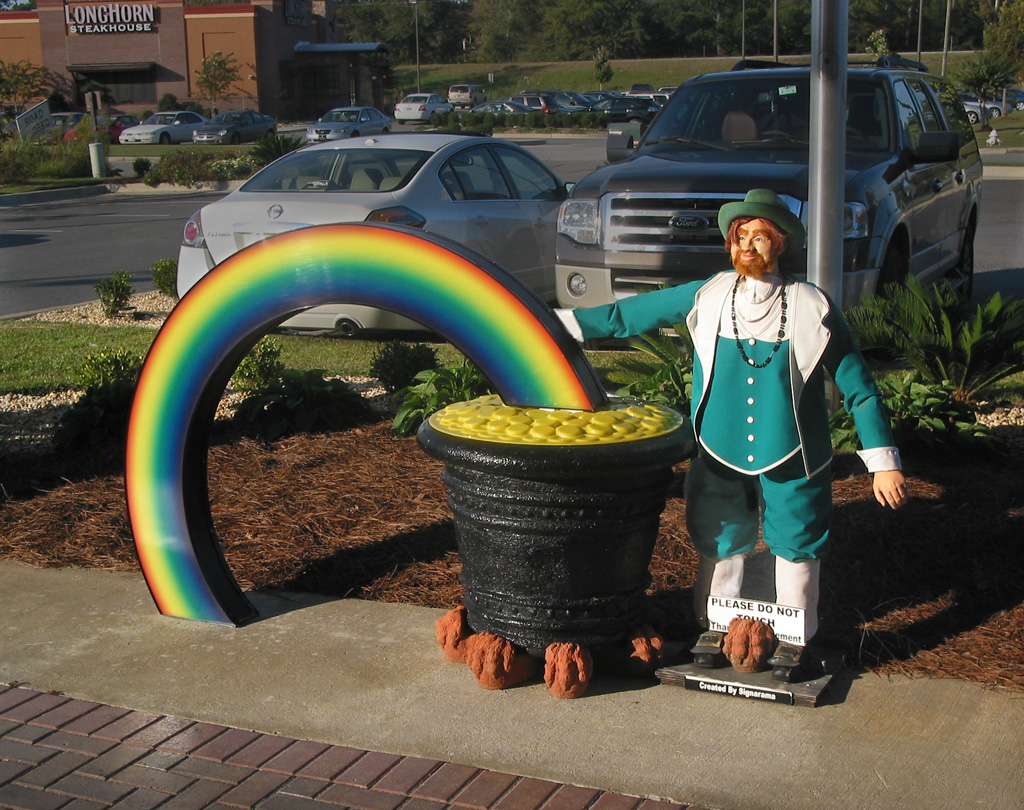
Photo courtesy of Artist Cliff Beaman traveling through Dublin, GA
When we visited Ireland, we met a congenial gentleman named Buchanan, who remarked that he has immigrant relatives buried in the Donegal Presbyterian Church cemetery, a place he once visited.
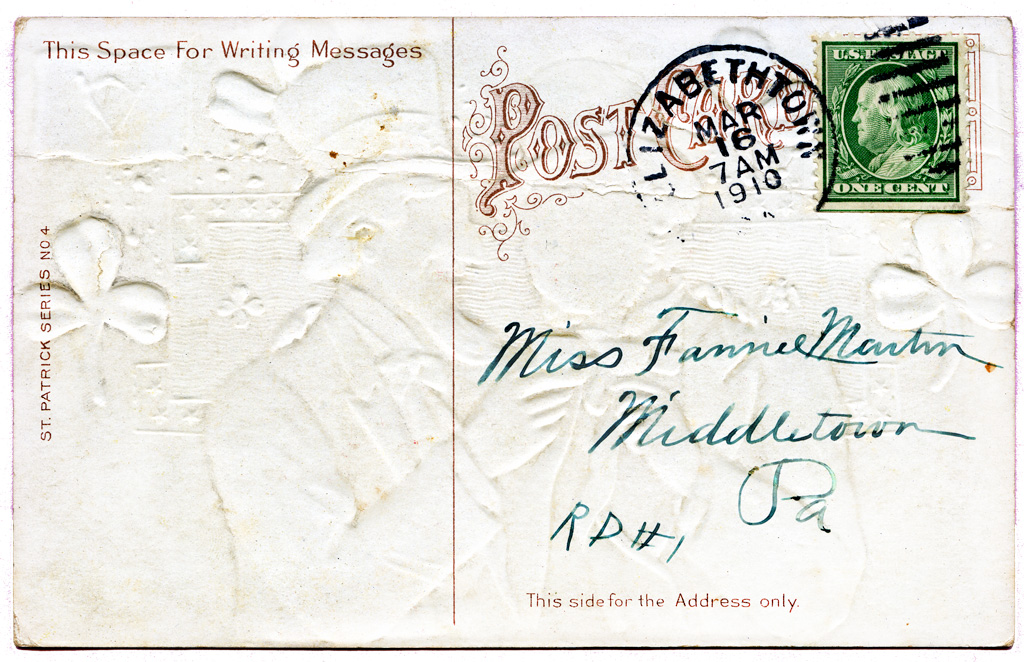
During my last trip to Pennsylvania, I discovered some vintage postcards stamped with penny postage, sent to Miss Fannie Martin, my Grandma Longenecker. Many of her postcards are embossed and saturated with color – no Photoshop filters needed.
In an era long before smartphones and text messages, postcards were valued. Instead of instant messages easily deleted and forgotten, these cards have become artifacts of my family history. The one below over one hundred years old is dated 1910.
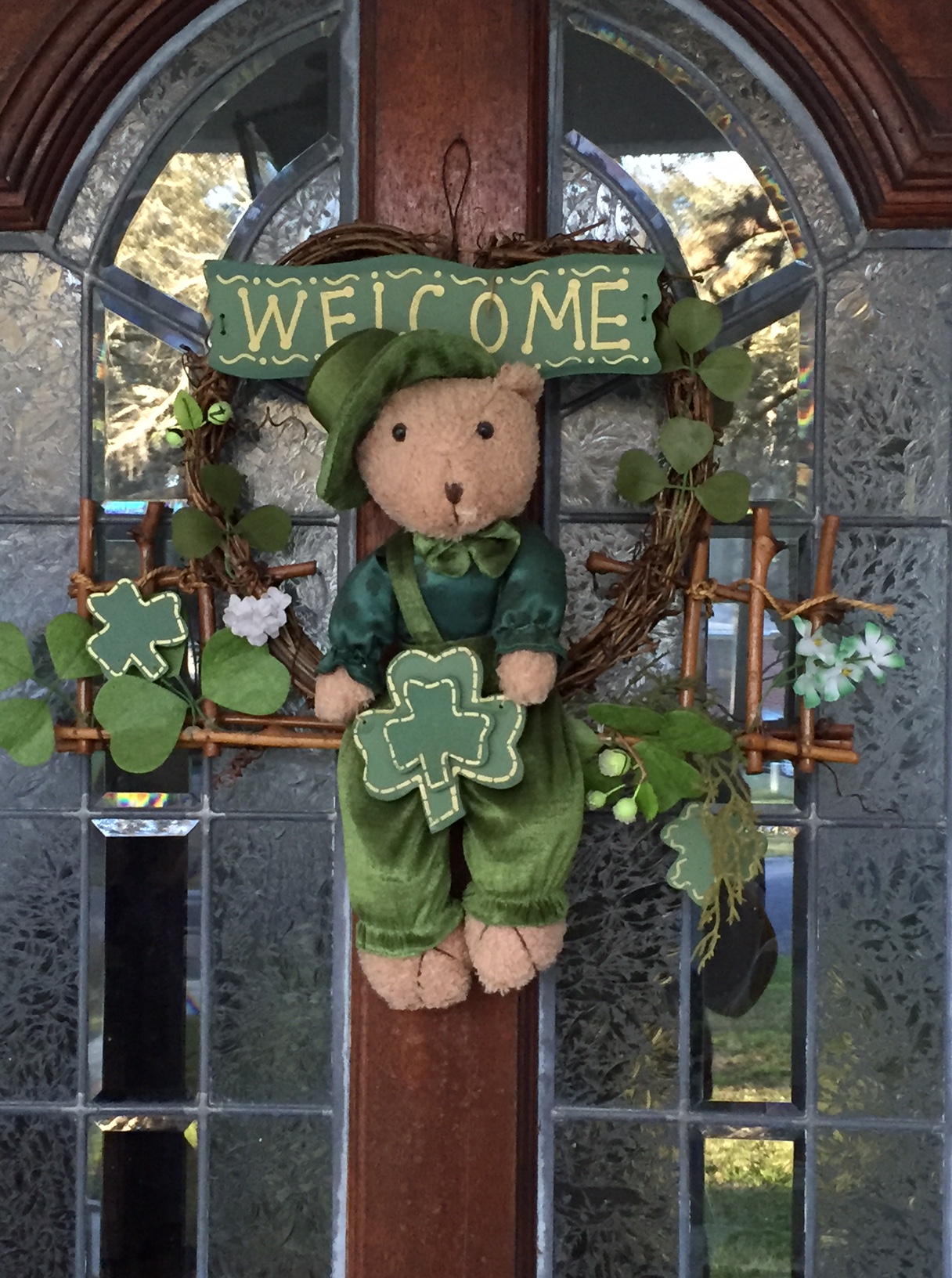
I live in a neighborhood where Irish names abound: Blarney Stone Court, Killarney Drive, Leprechaun Court, St. Patrick Lane. Names on residents’ mailboxes have included Dunleavy, O’Neill, and Kelly. We once had to fight a major retailer to retain charming shamrocks and moss-footed oaks in a wooded area adjoining our community. The hanging on our front door reflects the neighborhood and the season.
St. Patrick’s Day this year falls on a Thursday, March 17. Until then, I wish you the luck of the Irish.
May the wind be always at your back and your pathways peaceful. If you are Jewish, Mazel Tov!
To enjoy these Irish limerick lines below add just the right word to complete the rhyme. Keep in mind the missing word must rhyme with the first and second lines. (Answer key in next week’s blog post.)
Edward Lear, Ogden Nash, and Lewis Carroll are among the best versifiers of this humorous form. If you want to cook up your own limerick, here is a link to the recipe with a pattern for the rhyme scheme.
Today marks the end of February. In less than a month spring will have sprung, Still, you may be ready for spring now, not in three weeks. Here are the thoughts of Jane Kenyon, once New Hampshire’s poet laureate, anticipating the blooms of spring in her meditation “February Thinking of Spring”
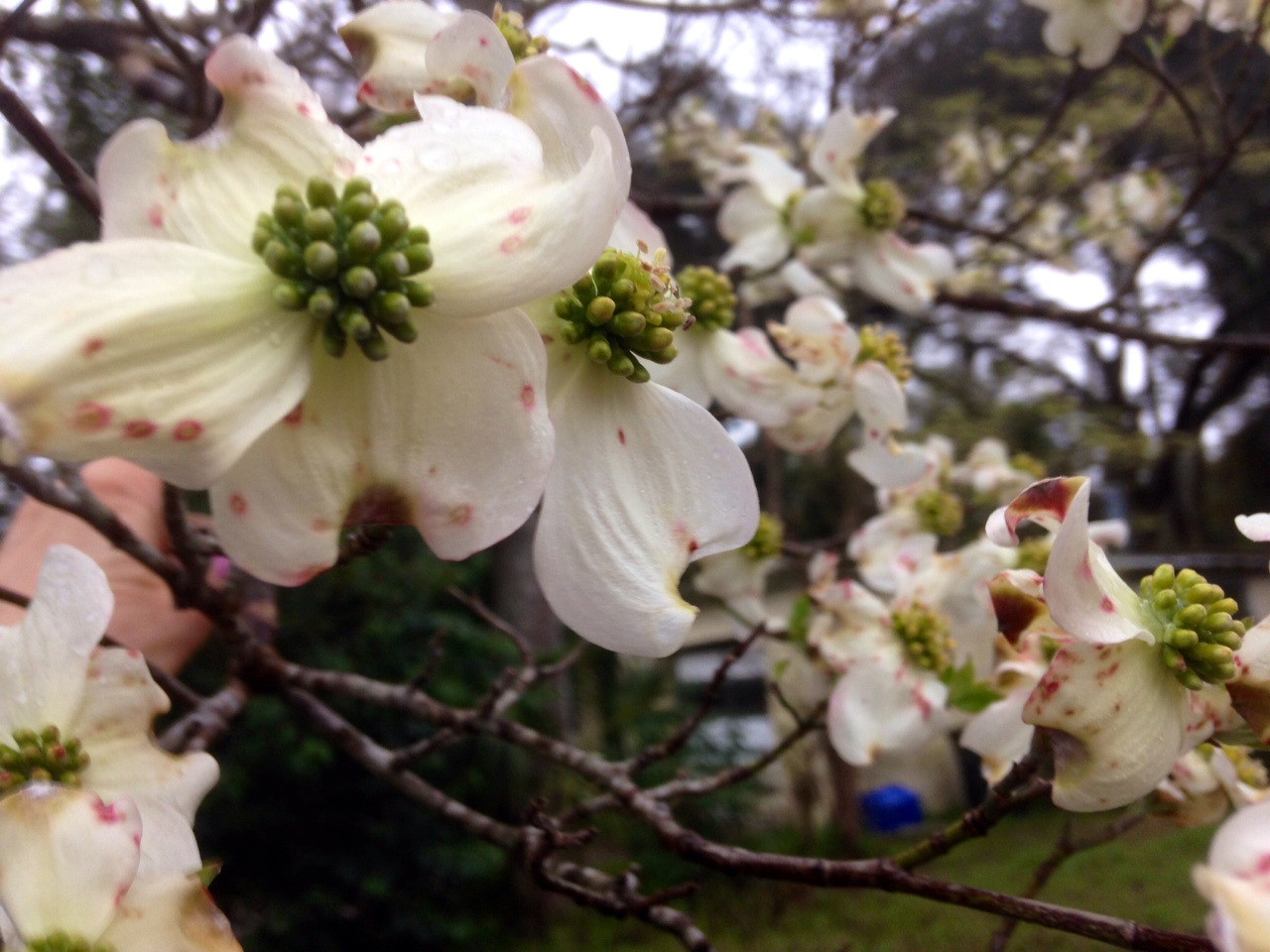
. . . or the appearance of blooms on dogwood
Before winter turned into spring, visits to the flower show in Philadelphia restored my Grandma Longenecker’s spirits. Or leafing through a Burpee Seed catalog.
In a letter to me during my sophomore year in college Grandma wrote about her May flowers that followed a harsh winter:
Lots of people have colds but daffodils are out “with their yellow frilled bonnets” (I have 5 kinds of them) were a joy to behold. Double tulips are at their best. Next the lilacs and valley lilies.
Yes, fickle February will soon melt into March madness. To herald the coming month, I shall make a poetic prediction. My good friend/muse Merril Smith has inspired me to try a new form, the shadorma, one of the many poetry challenges she has embraced on her website recently along with echo poems, triolets, and lantern shapes.
The shadorma must form 6 lines of 3-5-3-3-7-5 syllables and make sense.
Fickle month
Bye, February
St. Pat’s Day
Irish rule
Daylight Savings Time, Oh Dread
Celebrate: Easter!
Did you count the syllables? 🙂
What flowers populate your dreams of spring?
If you live in South Africa or Australia, your seasons are reversed so you may have a different vision. What in nature lifts your spirits right now?
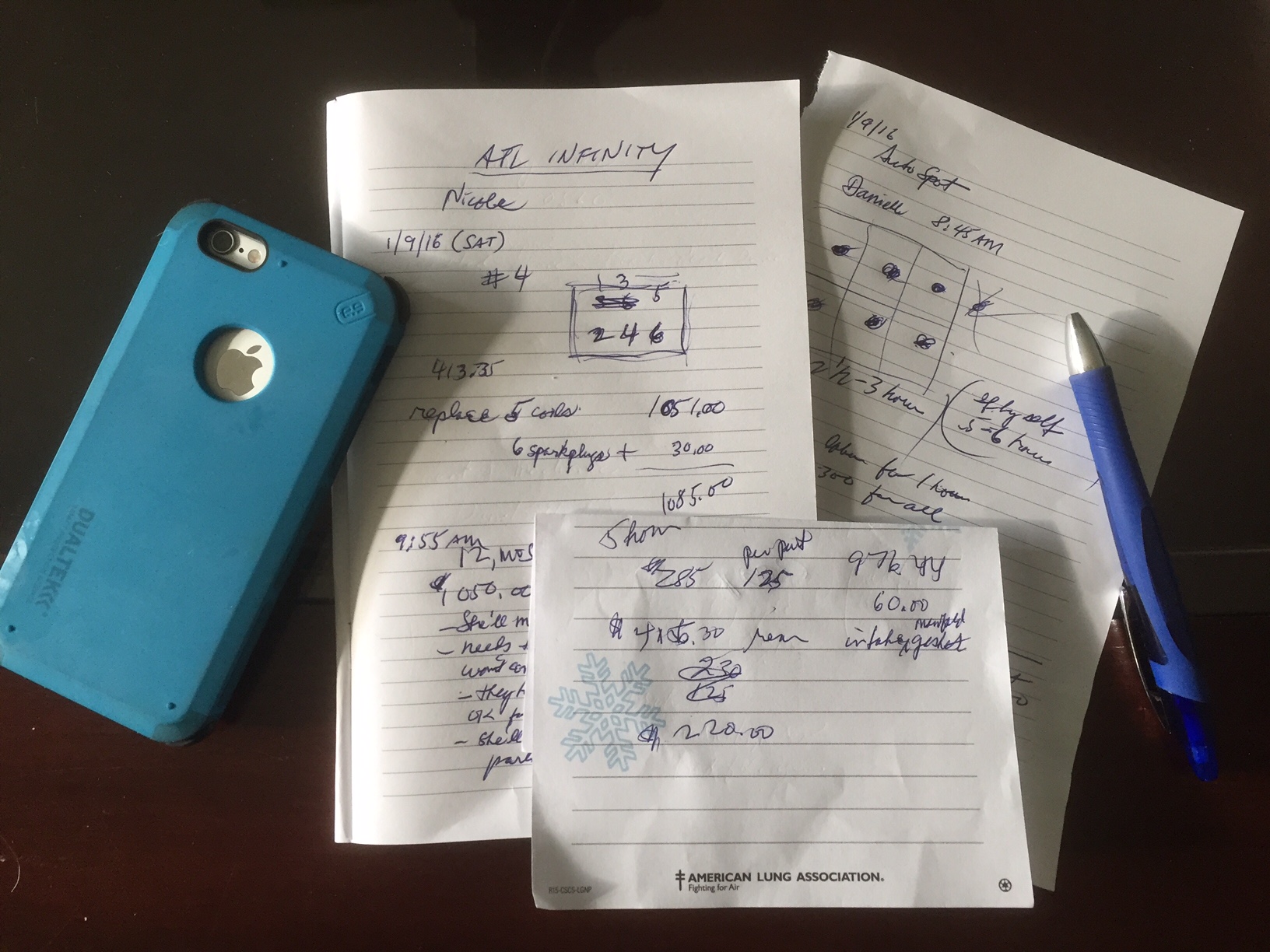
No driver wants to hear this coming from under her car hood, even if it is my aging Infiniti. When I reported these scary noises to my husband Cliff, he immediately went into Investigator Mode. His problem-solving scenario proceeded like this: visiting a neighbor who restores antique cars, checking with an auto shop we’ve used before, and then contacting the dealership, the most expensive option. He wrote down notes for each, notes with names, dates, schematics, and most importantly, dollar signs.
ComparisonShopperNotes
He handles plumbing problems at home or HVAC hang-ups the same thorough way. Whether buying a new lawnmower, computer equipment or making travel plans, my husband Cliff is a comparison shopper supreme.
Once upon a time, Cliff used this same methodical system to find suitable dates. During college he had a little black book in which he entered names of girls to date. After they passed the sensational-physical-attributes test, their names and interests were entered into this book. Some girls’ names were crossed off the list because they were too giggly, walked like a duck, or were unable to sing on key.
Cliff went into serious search mode to find a mate after an unofficial engagement fell apart. Then his college roommate suggested he meet his next-door neighbor, a teacher and a Mennonite, during Christmas vacation. We met on a blind date In December 1965. I say blind because the normal-looking Mennonites he had known from the West were very unlike the girl standing in front of him, plain with hair coiled up under a prayer cap – me.
Maybe because of the mystique of our differences or because we had similar interests, ours was a whirlwind romance sustained by letters for months after Cliff returned to post-graduate work and me to teaching. Then his letters dwindled, probably because of his hesitation about dating a girl like me from such a strange background.
He went into comparison shopping mode again as he began his first year teaching, dating a nurse from a fine family. Later, he said after he had come to his senses, “I couldn’t get you out of my mind. I thought I would miss something if I said goodbye to you forever.”
According to Cliff, two things I did sealed the deal for him.
I made him a monogrammed bath robe for Valentine’s which kept him from freezing on off-campus housing his last few months in college
I called various hospitals to try to figure out in which hospital he was a patient when he had pneumonia and was too sick to contact me.
Fortunately our friendship was rekindled when we both attended the August 1966 wedding of the couple who introduced us. Now it was Christmas 1966, and Cliff drove from Jacksonville Florida to pick me up in Charlotte, North Carolina where I was teaching. From there we headed to my hometown, in Elizabethtown, Pennsylvania in his white Plymouth Savoy.
Replica of Cliff’s 1963 Plymouth Savoy now offered on eBay, poster
There one snowy evening before Christmas Cliff said, “Let’s take a drive.” So we bundled up and headed out, crunching footprints in the new fallen snow. Fat flakes were falling from the sky even thicker as we slid into the car, the plastic seats crackling from the cold. Memories of the evening have become a movie in my mind.
“Where are we going?” I quizzed.
“Oh, I don’t know. We’ll just take a drive in this beautiful snow,” Cliff replied rather lamely.
As he tried hard to urge the heater to warm us up, we reminisced about our first dates the Christmas before. “Do you remember how deep the snow was when we went to see the Sound of Music?”
“Of course I do!” The car’s windshield wipers were swishing away mini-cotton balls of snow now.
In the back of his mind, Cliff wondered, “What will she say if I ask her to marry me?”
As we approached the archway between Rheems and Mount Joy, I exclaimed, “The road hasn’t been plowed any farther. We’re at a standstill!” We had come to a crossroads.
Then he said, “If you thought it was God’s will, would you marry me?”
Quickly I responded, “Of course I would.” But in an instant I recognized this as a marriage proposal encased in a tricky question, a snowy fleece.
“Well, then, will you marry me?”
With a “Yes,” the camera dissolved into hugs and kisses.
And yes, the little black book has been destroyed long ago.
Vintage Cut-out Card, Cliff Collection
Is there a comparison shopper in your family? Are you such a shopper?
You are invited to share your marriage proposal story here too.
[to] mimic in slow structures, stone by stone / The frolic architecture of the snow. – from Emerson, The Snow-Storm
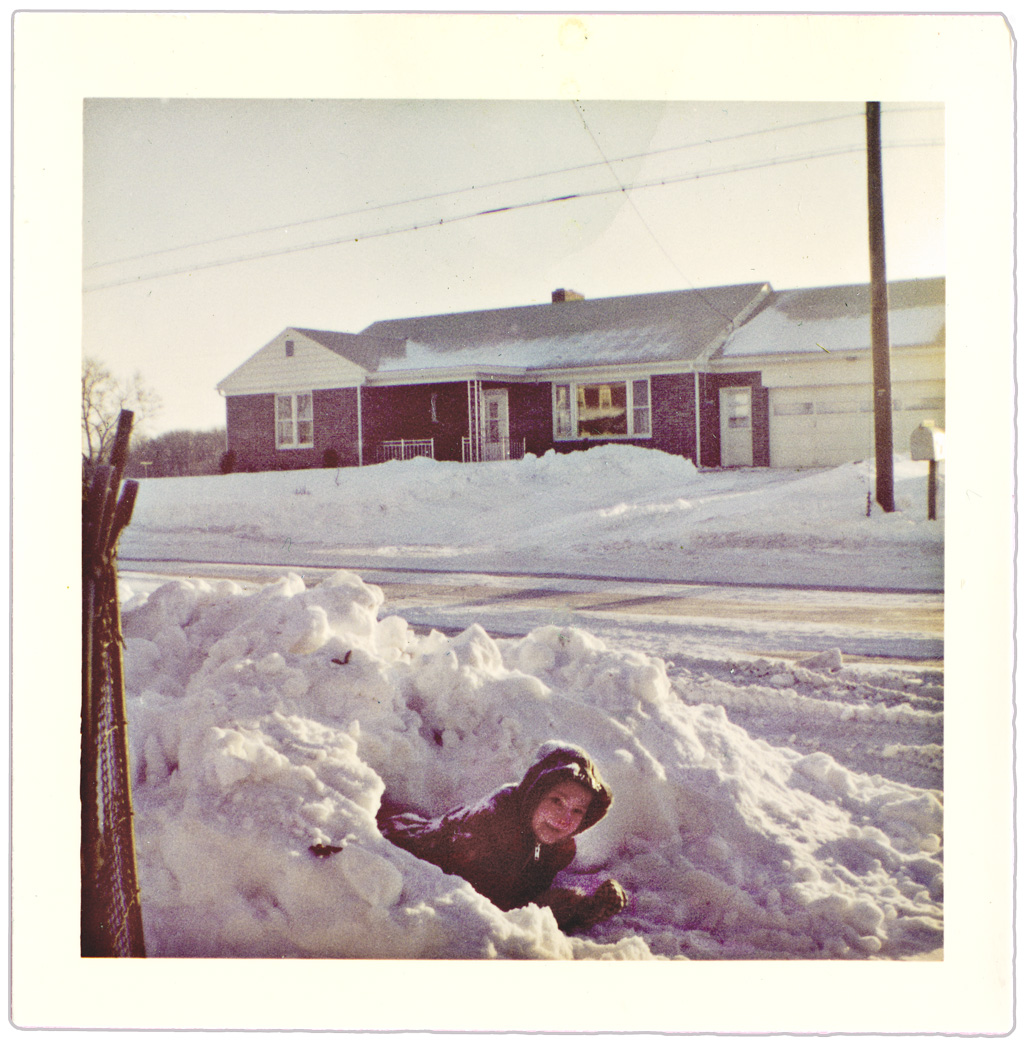
Snow-faced brother Mark Longenecker in “igloo” 1961
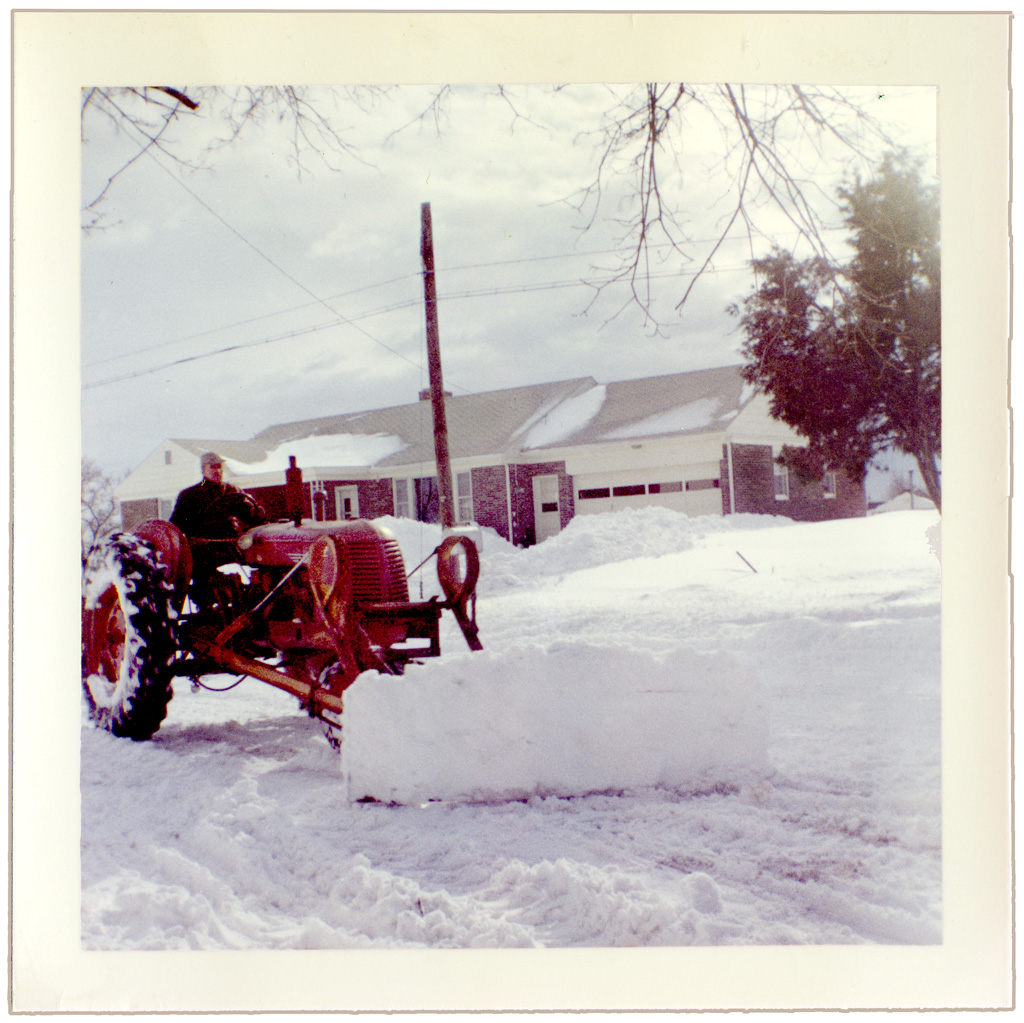
Snow Plow: Carving Out the Road Again
Ray Longenecker, my dad, plowing Anchor Road, 1961
A smooth white mound the brush pile showed, / A fenceless drift that once was road ~ from Whittier’s Snow Bound: A Winter Idyll
Snow in Childhood . . . Never Ends
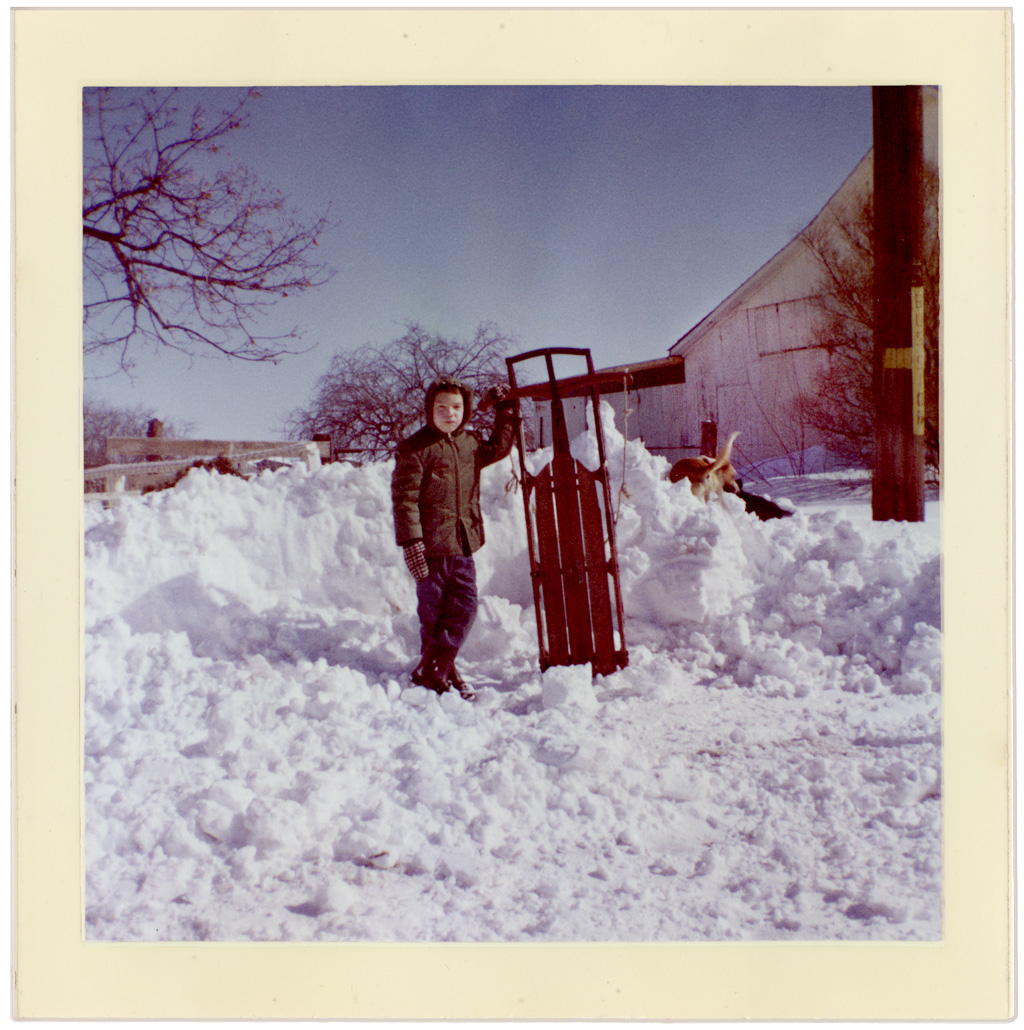
Brother Mark with sled and Skippy in the snow 1961
William Matthews in “Spring Snow” depicts a place where “childhood doesn’t end / but accumulates” and memories . . . disperse “in flecks, like dust, like flour, like snow.”
Snow provokes responses that reach right back to childhood. – Andy Goldsworthy
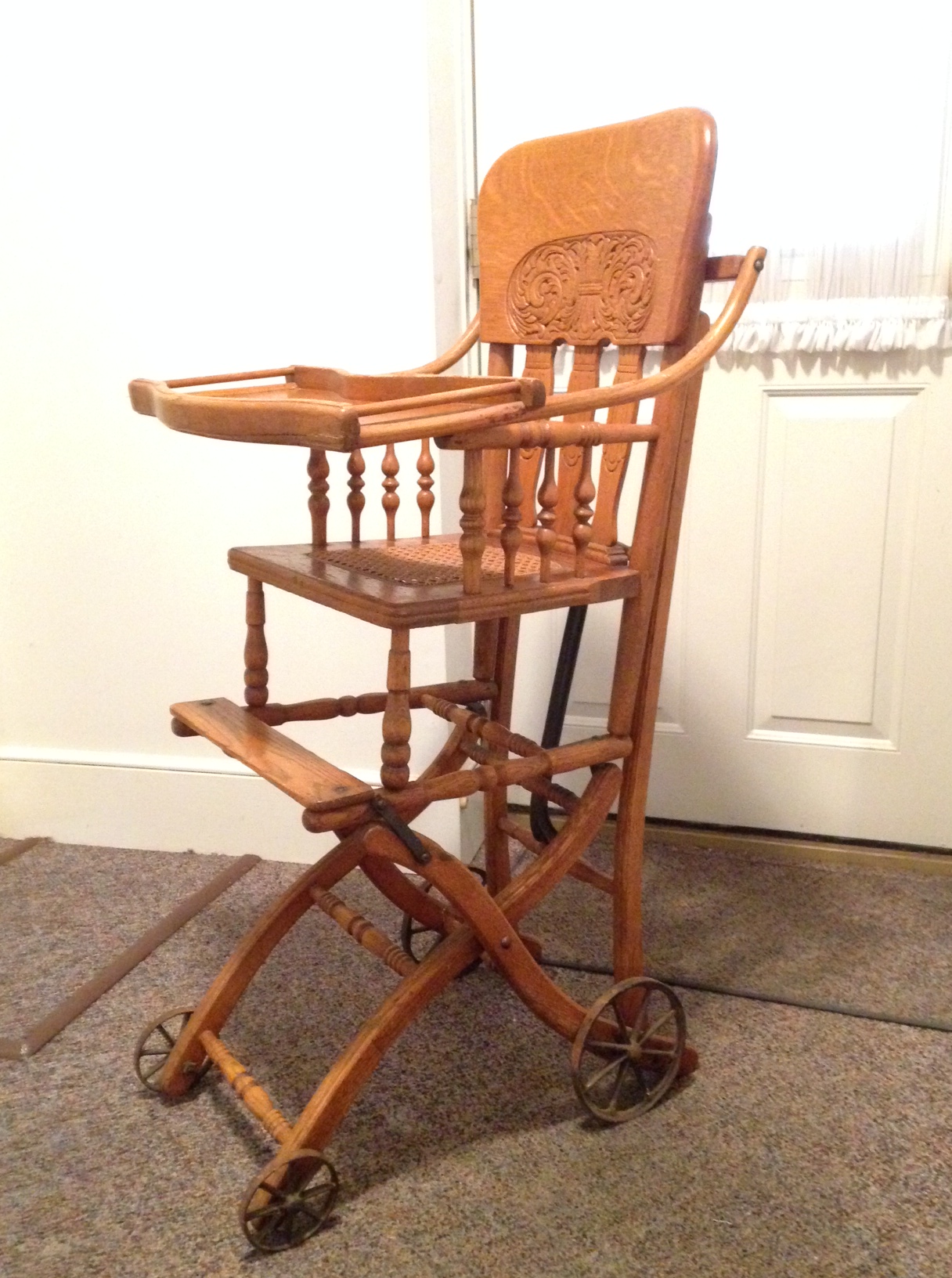
I still should be placed at the head of the table.
What am I?
You have probably already guessed the answer, a piece of furniture often passed down through the generations. Yet sorting through what is bequeathed us, we often handle family heirlooms whose origins are a riddle.
Some Artifacts
Our mother’s adjustable high chair, for example. It’s for sure from the Metzler/Landis side of the family, but we are not sure exactly where it came from. Did parents Abram and Sadie Metzler buy it new? Did the Landis grandparents present it as a gift because it was their very first grand-daughter? It looks well preserved, but its origin still a puzzle.
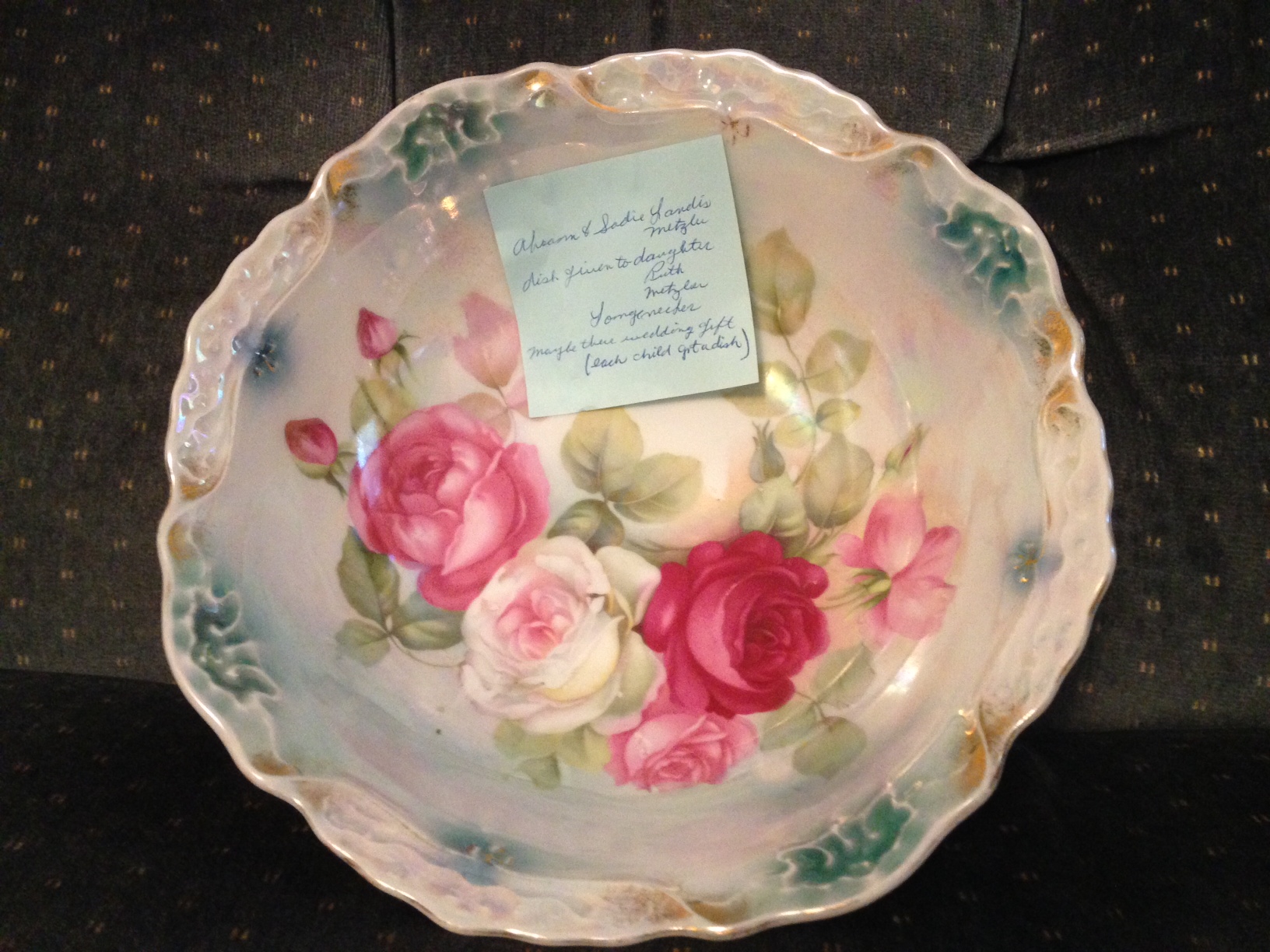
This gorgeous, glazed floral dish . . . of its vintage we are sure.
Dish given to my mother from her parents, Abram and Sadie Metzler on her wedding day
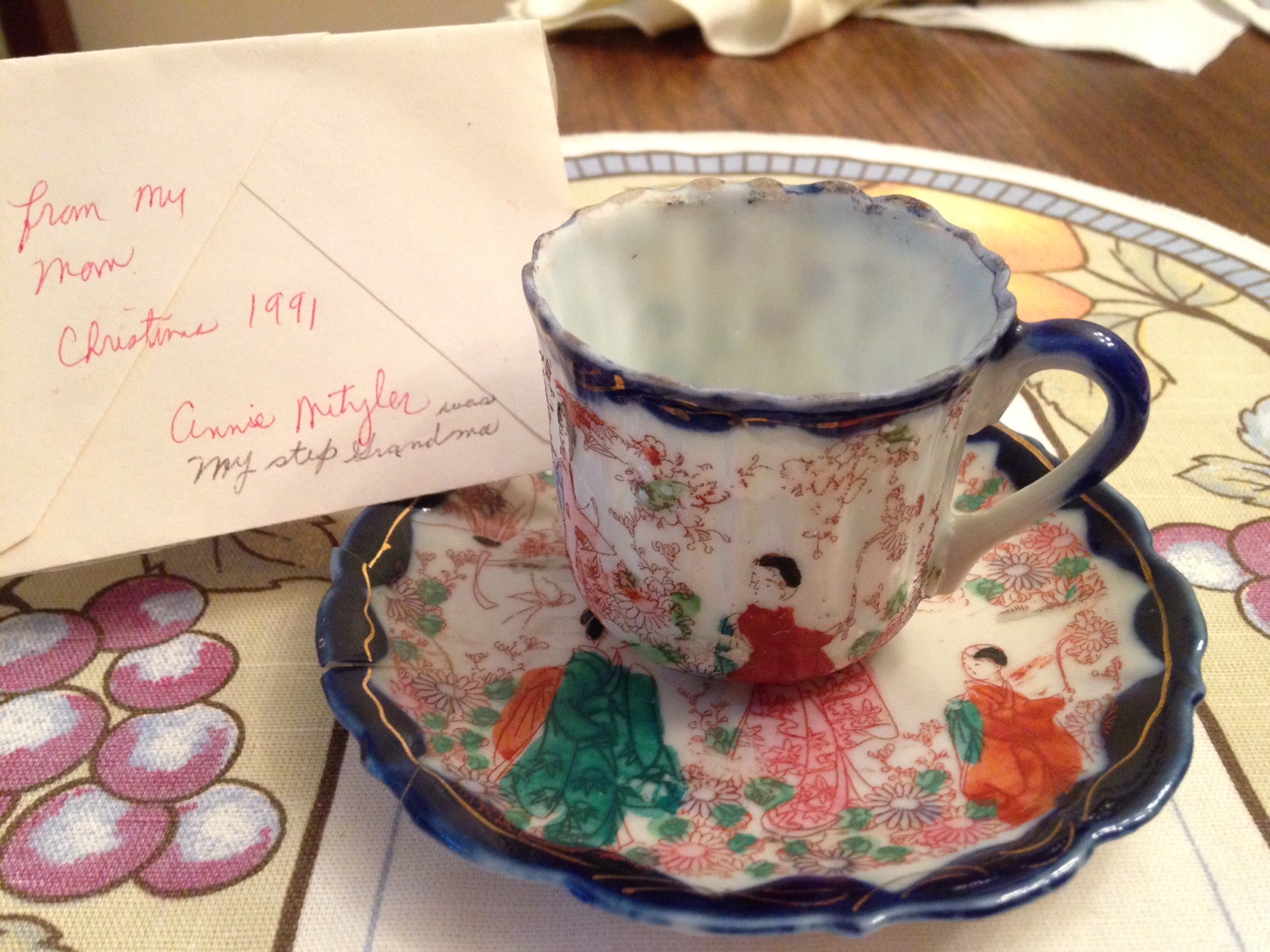
It’s no mystery where this Japanese teacup came from either. Mother, pretending to be me, wrote legibly in black that it’s from my maternal Grandma, Annie Metzler. It once survived an explosion in my curio cabinet. You can read about that here.
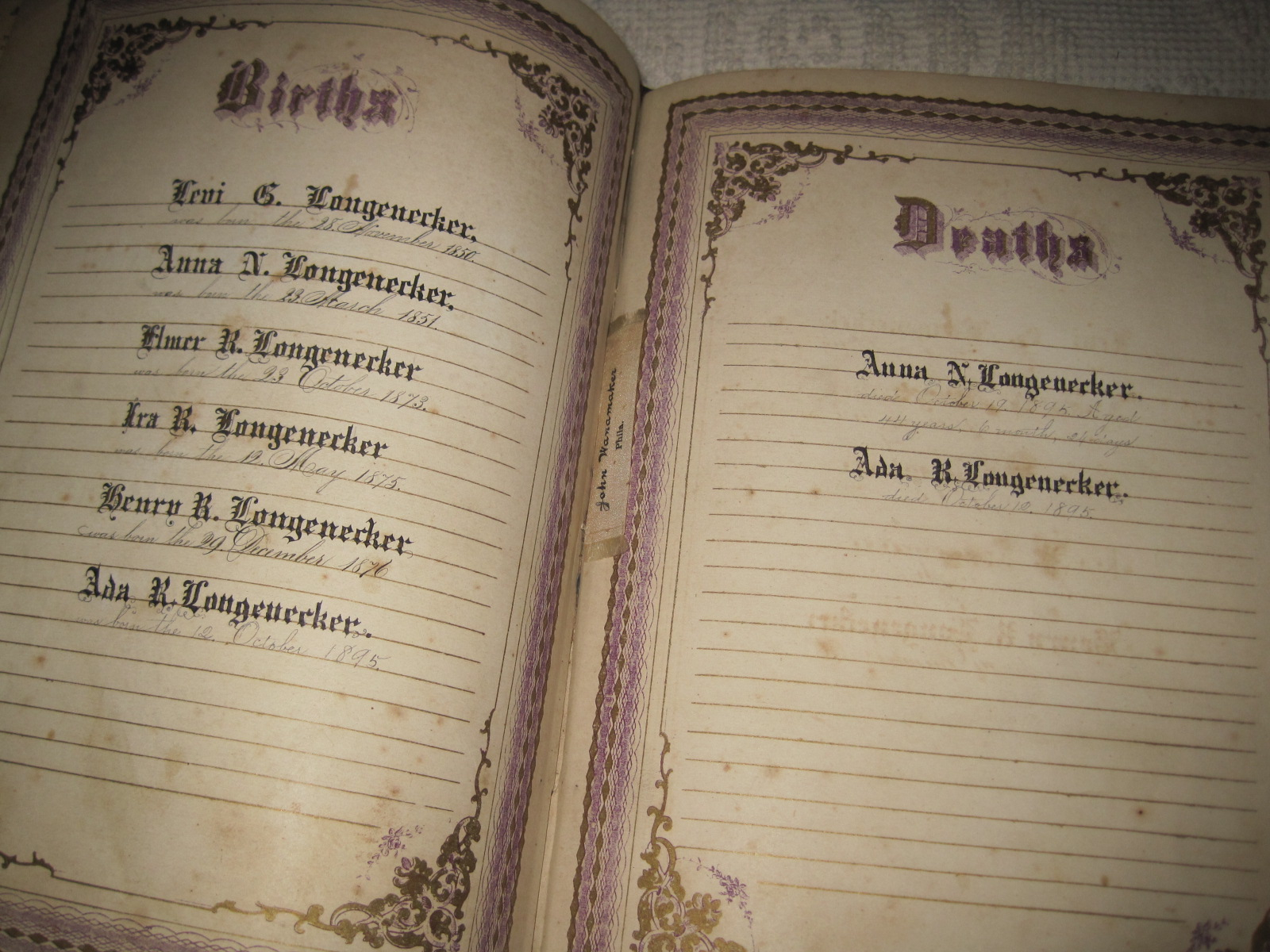
The German Bible has been in our family for centuries. The signatures signify it belongs in the Longenecker line. No mystery there.
Henry Risser Longenecker, my Grandfather, son of Levi Longenecker, listed in the family Bible.
A Special Chair
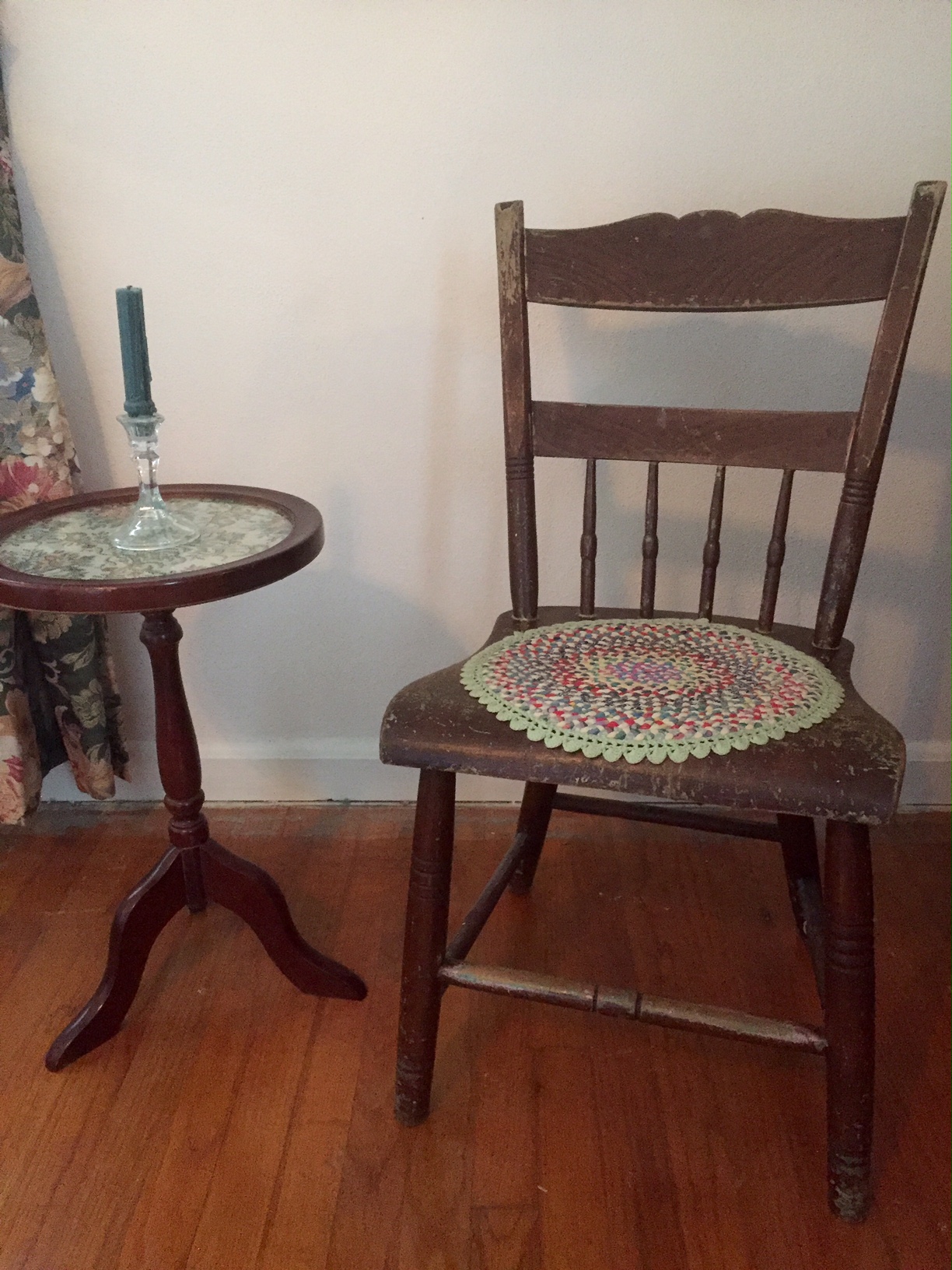
This chair below has sat in our bedroom for years. And it’s no enigma where it came from.
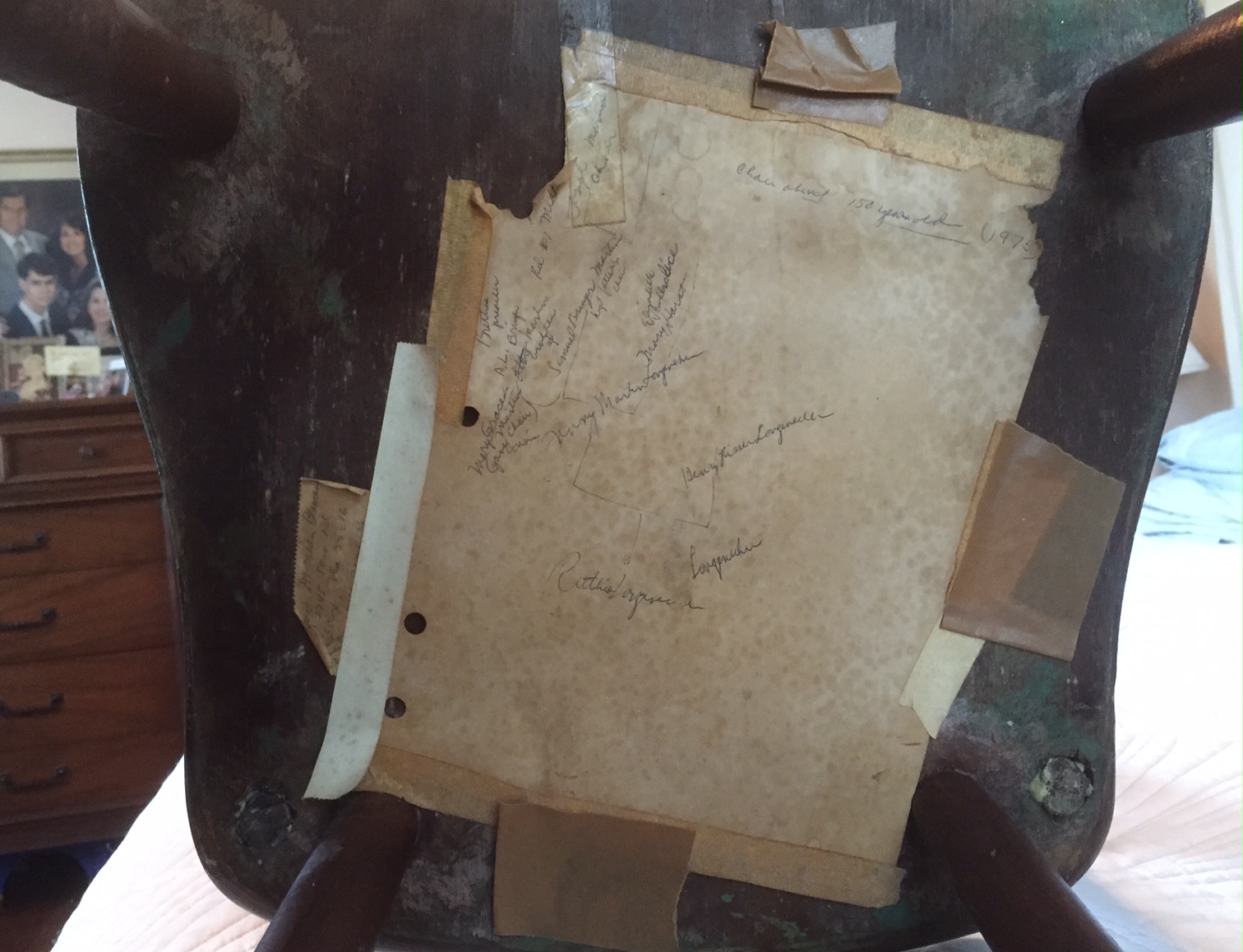
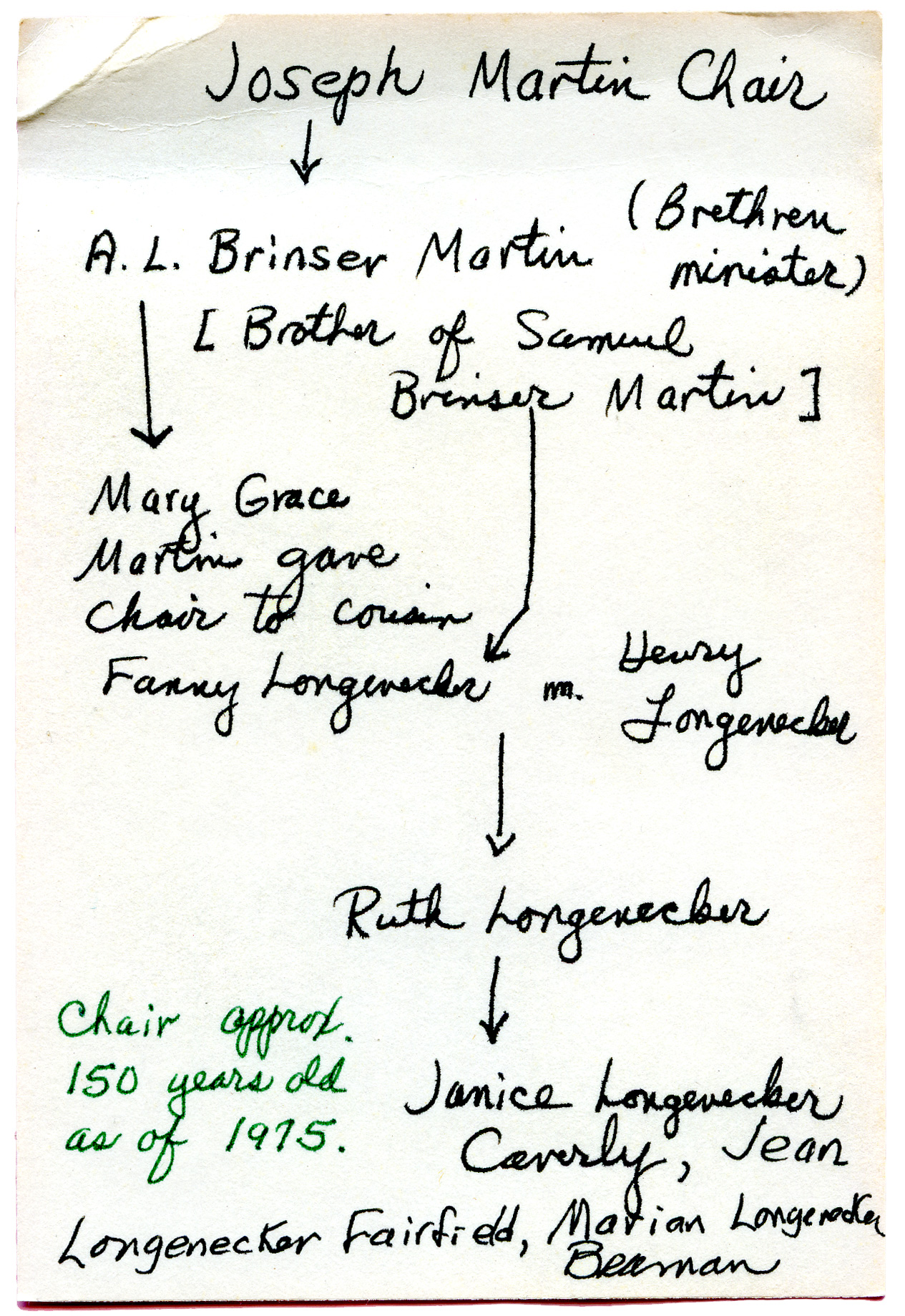
The provenance of the chair was taped to the bottom of this chair. Did I say chair? Yes, of course, this is the answer to the riddle above.
Since 1975, I have transcribed the names of generations of Martins and Longeneckers that have used this chair to host dinners. It’s called the Joseph Martin chair because it was handed down to us from Fannie Martin Longenecker, our grandmother.
Teacups, dishes, and chairs are inanimate. Unlike the personable “characters” in the Be Our Guest song from Beauty and the Beast, they come to life only when friends and family gather ‘round the table hospitably.
A Memorable Dinner
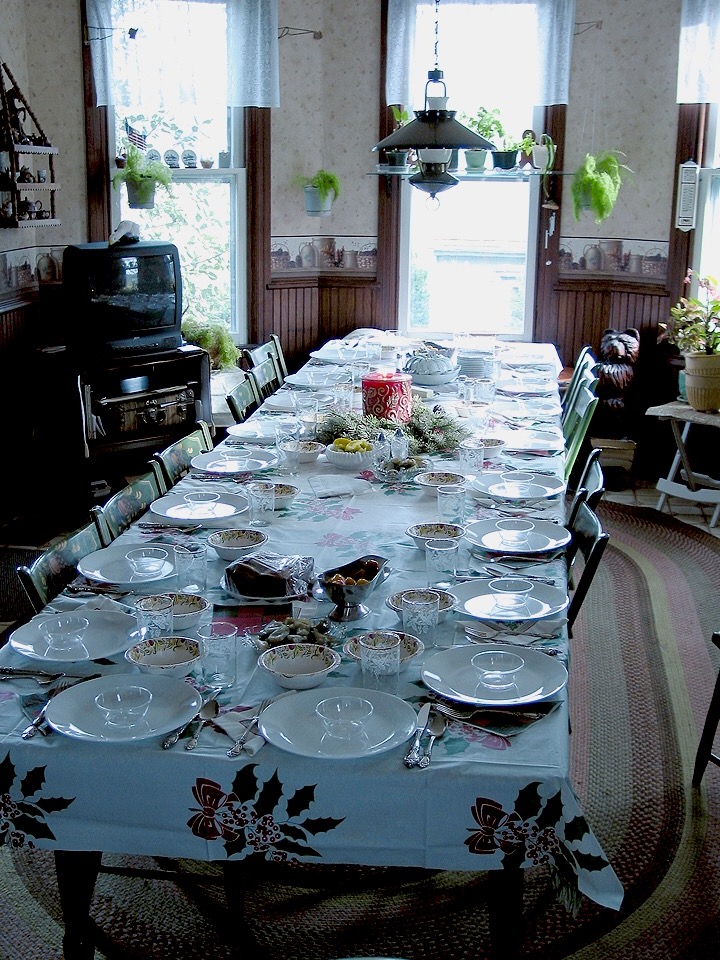
This photo was snapped just before bodies of all ages – the wiggly young, the pregnant great grand-daughters, the middle-aged, the elderly – gathered around the table at Grandma Longenecker’s house ready to dig in to Christmas dinner in 2004.
This was the last time Aunt Ruthie was able to host the dinner. She was 86 then. Of course she had lots of help, but this was the last time she sat as hostess at the head of the table, probably on an antique chair.
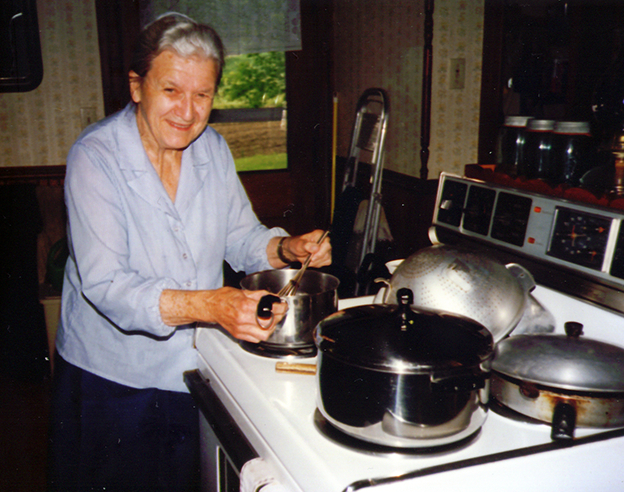
Aunt Ruthie (approx. age 75) busy in the kitchen, 1990s
* * *
What antiques do you regularly use at home? Have stored in the attic? Do you know a reliable website or service for valuing antiques?
Have you started a diet? Renewed your gym membership or decided to walk more? Maybe you have resolved to cut down on Facebook time this year . . .
Along with such New Year’s resolutions, some of my friends each year choose a guide word to help navigate the unknown paths of the next twelve months. Last year I began my own tradition with the word Advance. You can read about why I chose it here.
My Special Word
This year my word is Whole-hearted!
A few months ago I heard Brené Brown’s TEDx talk on expressing vulnerability. Though I’m generally not a fan of self-help books, her presentation piqued my interest enough to read The Gifts of Imperfection, her short book (130 pages) labeled “Your Guide to a Wholehearted Life.”
Credit: Goodreads
On the first page appears her definition for such a life:
“Wholehearted living . . . means cultivating the courage, compassion, and connection to wake up in the morning and think, No matter what gets done and how much is left undone, I am enough. It’s going to bed at night thinking, Yes, I am imperfect and vulnerable and sometimes afraid, but that doesn’t change the truth that I am also brave and worthy of love and belonging.”
Dr. Brene Brown, author/researcher/professor, has collected thousands of stories in the course of her qualitative study on authenticity and wholehearted living, which she describes as an act of faith that “requires believing without seeing.” (91)
This description sounds very much like my definition of faith, fueled by grace and joy, a faith I tasted first as a child hearing the blessed words of an old hymn at Bossler Mennonite Church: True-hearted, Whole-hearted, in which the men and women in the chorus belted out antiphonally: “Peal out the watchword, silence it never / Song of our Spirit, Rejoicing and Free . . . King of my life, my Savior will be.”
Quotes on Wholeheartedness
Maybe stories are just data with a soul. ~ Brené Brown
Never shy away from opportunity and wholehearted living. Never be fearful of putting yourself out there. The courageous may encounter many disappointments, experience profound disillusionment, gather many wounds; but cherish your scars for they are the proud emblems of a truly phenomenal life. The fearful, cautious, cynical and self-repressed do not live at all. And that is simply no way to be in this world.”
~ Anthon St. Maarten
Marianne could never love by halves; and her whole heart became, in time, as much devoted to her husband, as it had once been to Willoughby. ~ Jane Austen, Sense and Sensibility
And thou shalt love the Lord thy God with all thine heart, and with all thy soul, and with all thy might. Deuteronomy 6:5, King James Version
A Look in the Mirror
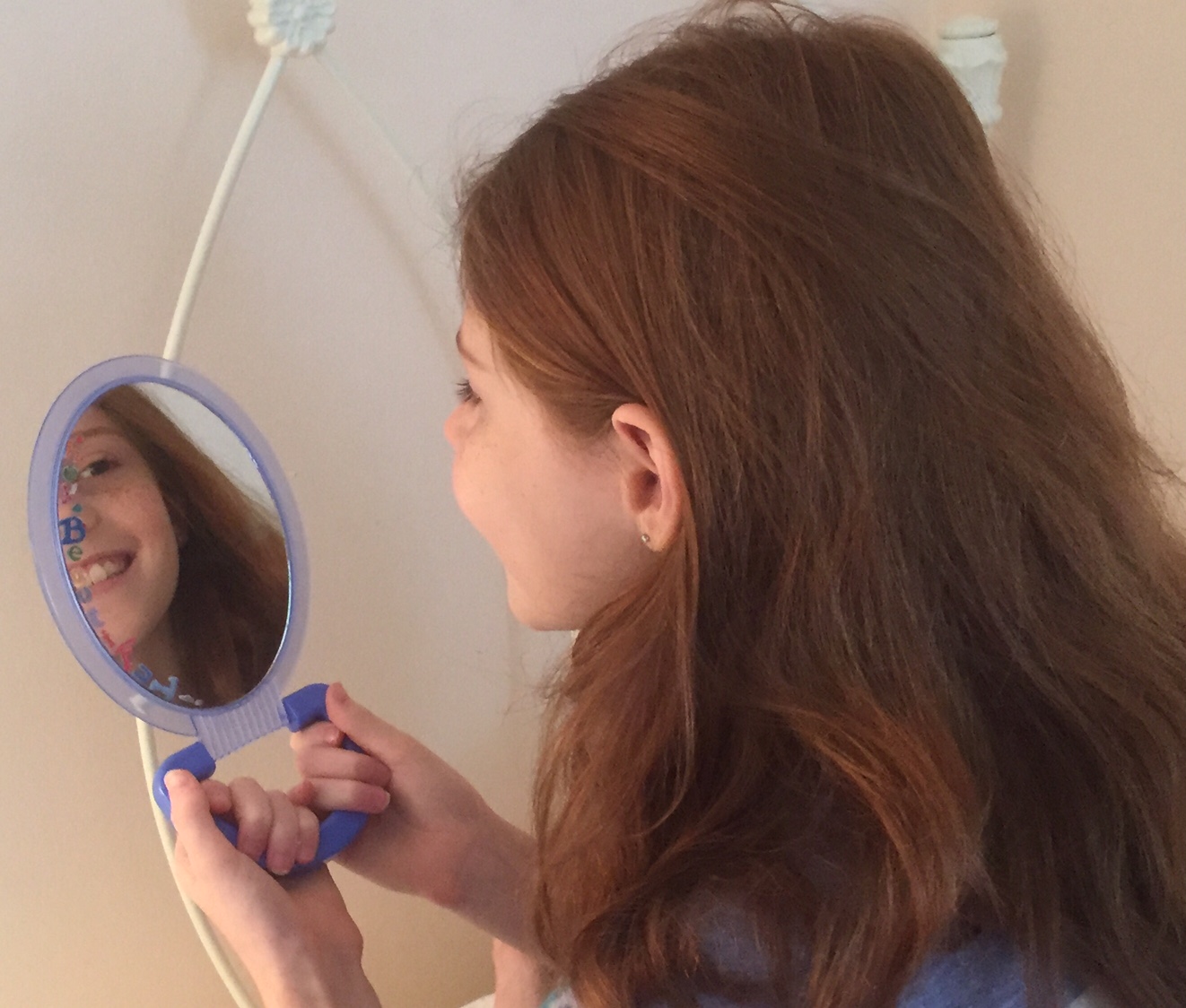
Last year, my good friend Sandra Cornelius gave me a mirror for my birthday. A survivor of many serious health challenges, Sandra took up the practice of placing mirrors in various rooms of her home during her recuperation, declaring with an inscription that she is beautiful even though she may have felt otherwise at the time.
With this object, granddaughter Jenna is learning the concept of self-acceptance, which is vastly different from pride or self-importance. Just as Aibileen, the maid, praised Elizabeth’s young daughter Mae in the novel The Help, Jenna is also hearing that she is kind, smart, and important.
In the month of January, named for the ancient Roman god Janus, we look two ways, with gratitude and perhaps a sense of relief for having survived 2015, and with anticipation and hope for the new year ahead.
Thank you for being my companion this year. I hope 2016 will be your best ever.
Happy New Year!
Have you made a resolution or chosen a special guide word for 2016? Looking back, what are you particularly thankful for this past year?
Coming next: Moments of Discovery, Keys to a Riddle
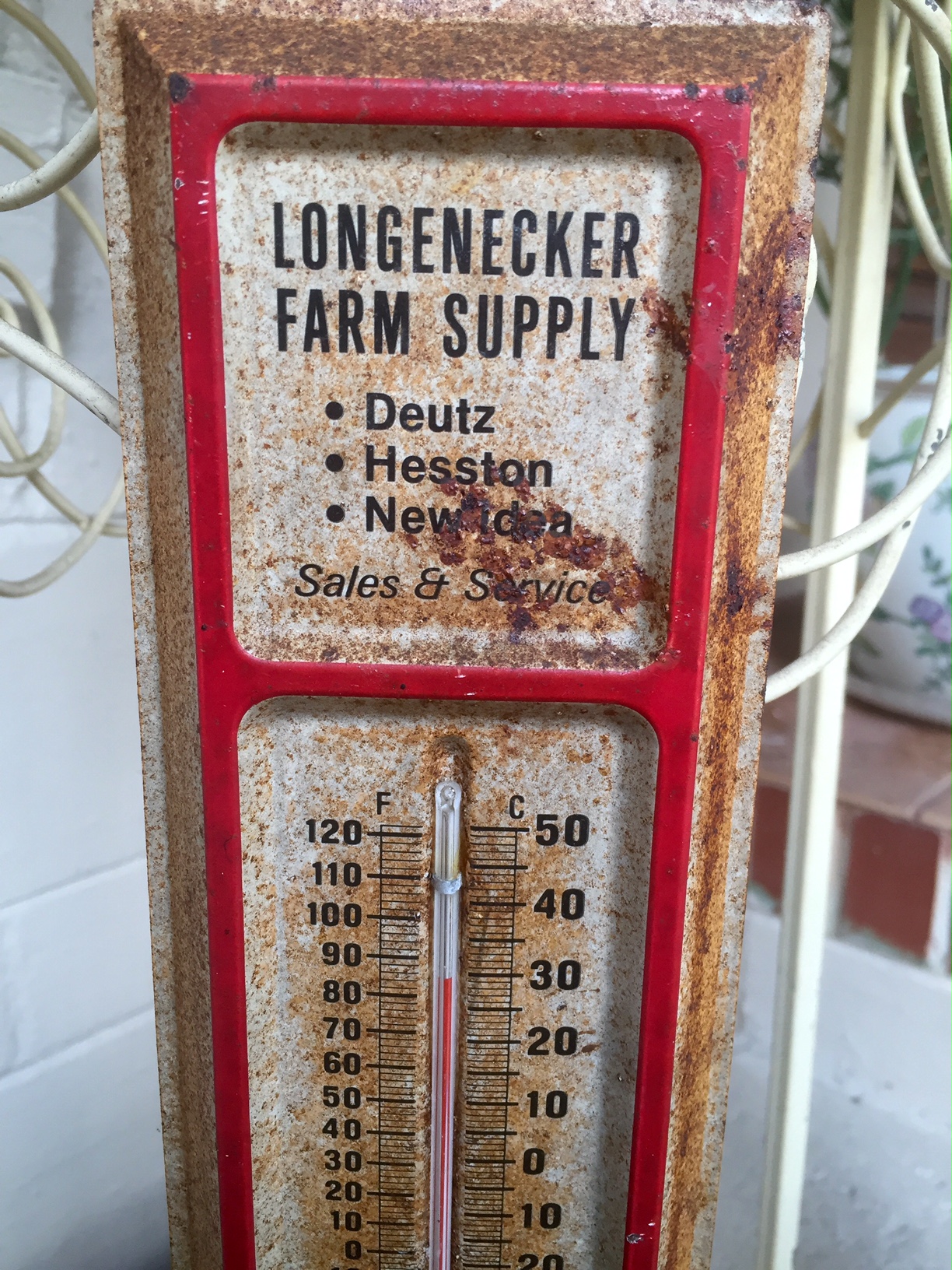
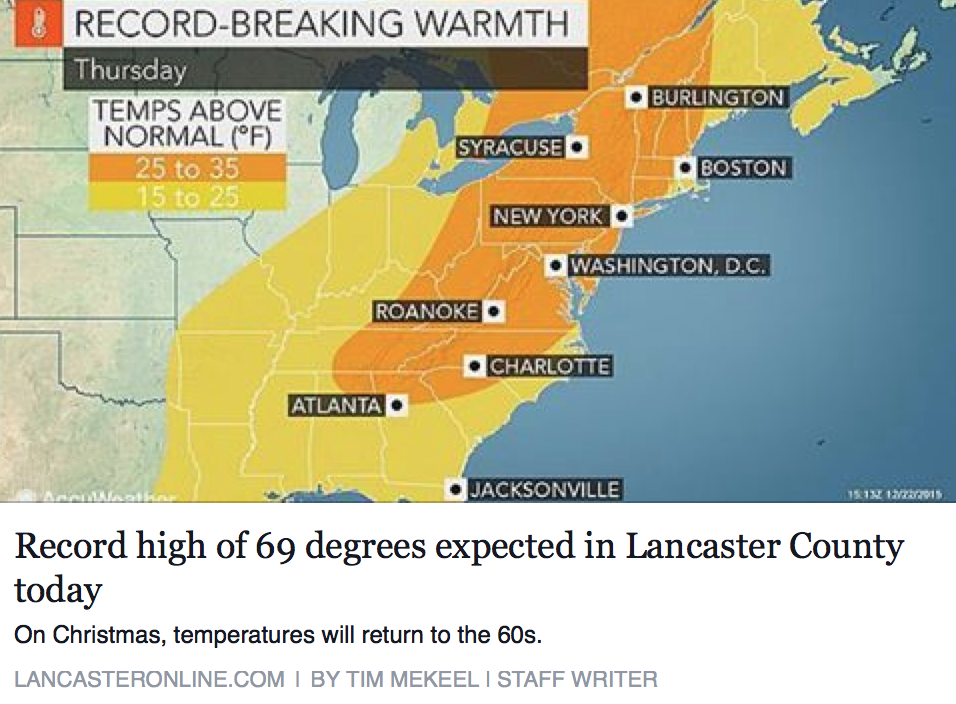
On Christmas Day 2015 in Jacksonville, Florida, the temperature stood at 85, at least twenty degrees above the normal daytime thermometer reading for this time of year.
Temperature on our porch Christmas Day 2015, Jacksonville, FL: 85 degrees
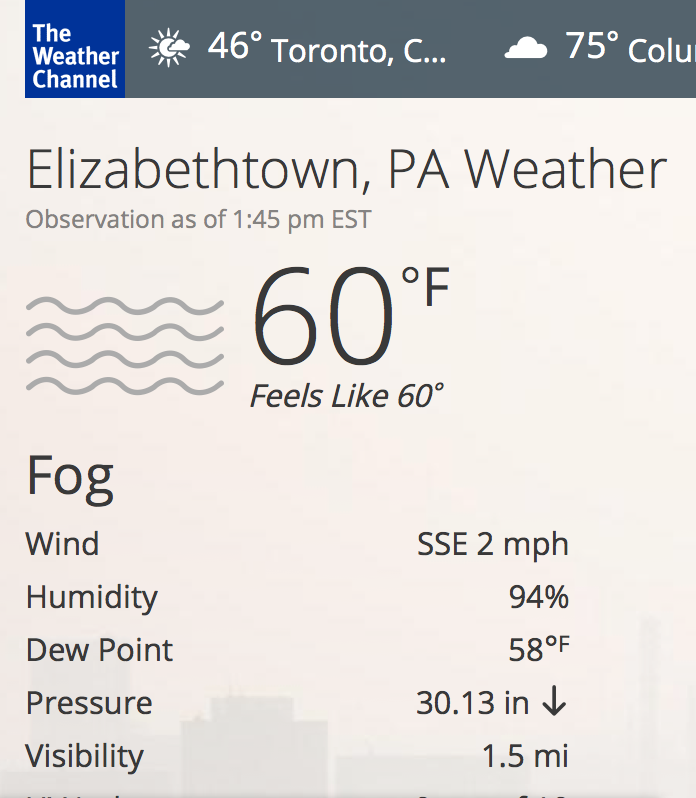
Over most of the USA, Christmas day was warmer than usual, the forecasters predicting a near record-breaking temperature of 62 degrees for Elizabethtown, Pennsylvania, once my hometown.
Years ago when our young family left Florida’s palm trees and beachy sand during the Christmas holiday, we hoped for Pennsylvania snow, praying for enough inches for sledding and making a snowman.
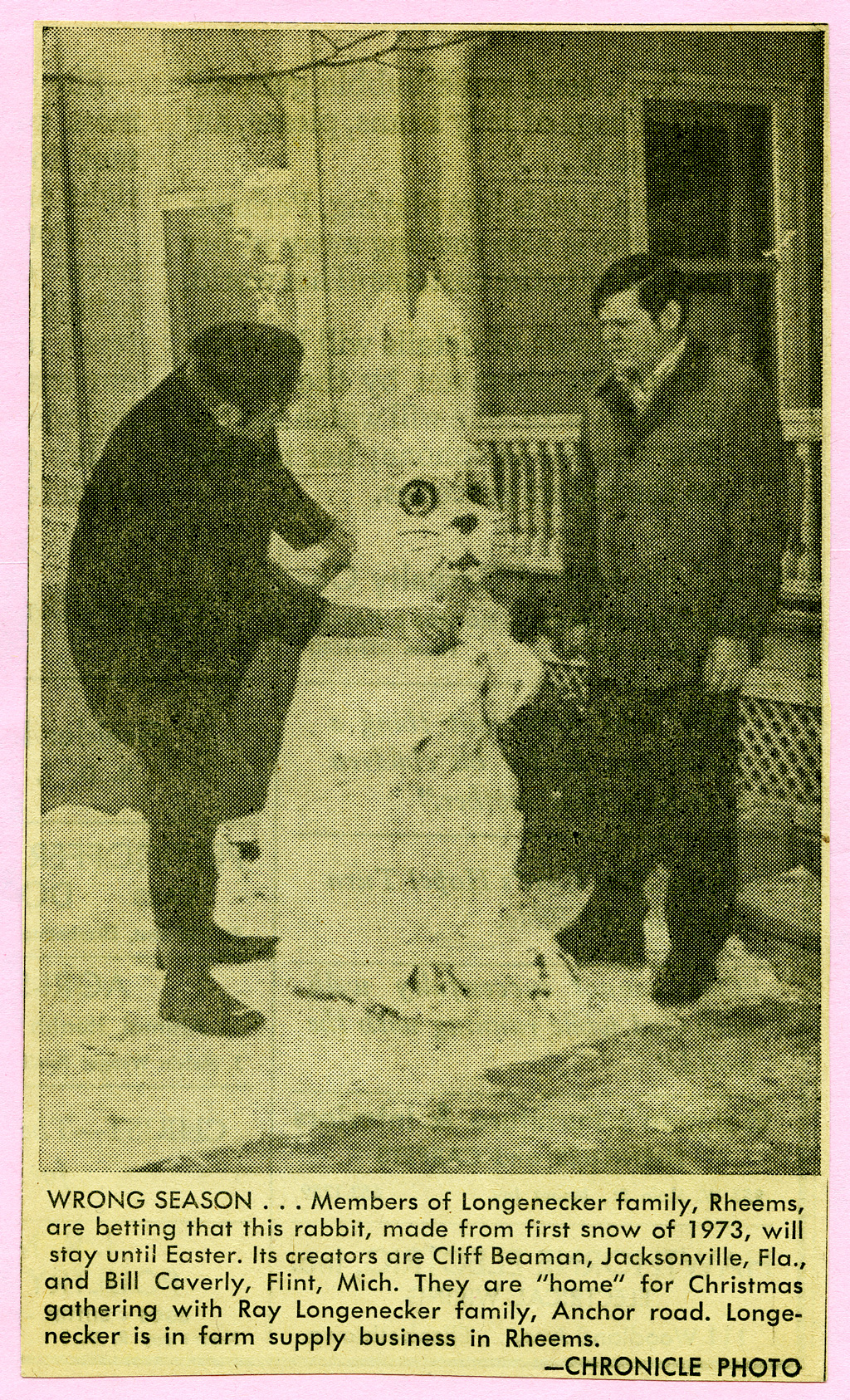
One Christmas (1973) my husband Cliff and brother-in-law Bill sculpted an Easter Bunny from snow, a photo that made it into the now defunct Elizabethtown Chronicle.
Snow slows everything down.
Snow descends from the skies in soothing swirls, no two flakes alike. The morning after a snowfall is quiet – traffic slows, the earth sits snug in silence, wrapped in beauty.
German Carols about snow are soothing too. Grandma Longenecker sang the first verse of Stille Nacht in German to us as tots, a carol of three stanzas we learned well enough to sing for Christmas programs at Rheems Elementary School. Now in my memory a warm spot remains where I hear Grandma’s voice singing the words to “Stile, Stile, Stile,” a lullaby that evokes the image of gently falling snow in the still of the night.
Whether the weather is dull or delightful, songs from the olden days can help carry us through.
Credit: Weather.com 12.26.15
How was your weather during this holiday week? Weather stories during a childhood Christmas or Hanukkah celebration may have popped into your mind too. There’s always more to the story when you join in.
Mother’s house on Anchor Road has been sold. We sold it last fall, just a year ago. After more than seventy years, the Longeneckers do not own this house.
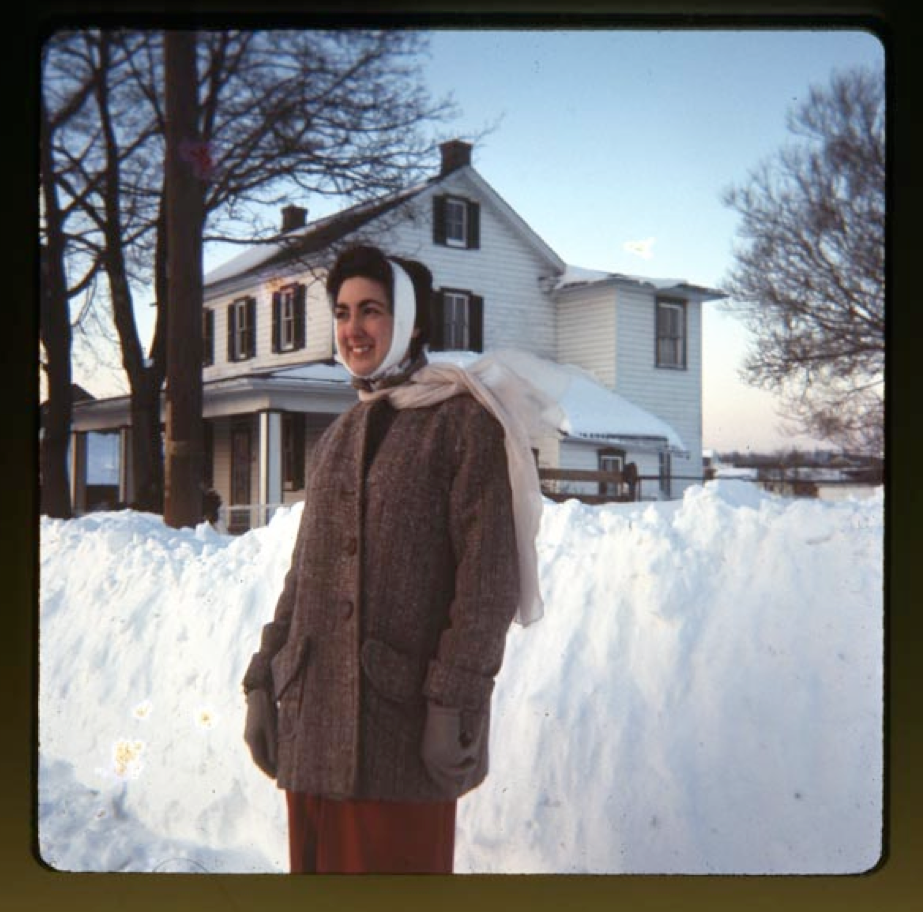
Blizzard of 1966 in front of the house on Anchor Road, Pennsylvania
But that doesn’t mean there are no memories or longings for home. The Welsh have a word for such a feeling, hiraeth
(n.) a homesickness for a home to which you cannot return, a home which maybe never was; the nostalgia, the yearning, the grief for the lost places of your past
* * *
So, memories and photographs remain.
Mother’s dining room buffet sat at the center of our house, yes at the heart of the first floor. On top of this piece of furniture you could even hear the heart beating where the clock ticked and chimed every fifteen minutes.
Mother’s hands must have removed the white crocheted doilies and dusted the buffet top with lemon Pledge and an oily rag many times. I don’t remember her doing it, but I do remember that I did every Friday.
Inside the buffet were treasures: the good china and table linens, her silverware arranged in a blond, wooden box in the middle to bottom drawers. With the crystal in her china closet, Mother had all the accoutrements to entertain friends or relatives with an elegant Sunday dinner every month or two.
At the top right of the buffet was a drawer that we opened/shut several times every single day. The partitioned drawer made of mahogany wood and lined on the bottom with maroon velveteen was always arranged the same.
* The keys to the buffet & china closet sat inside a shot glass, scored at the lip, an odd object in a plain, Mennonite household.
* Scotch tape, matches and stamps
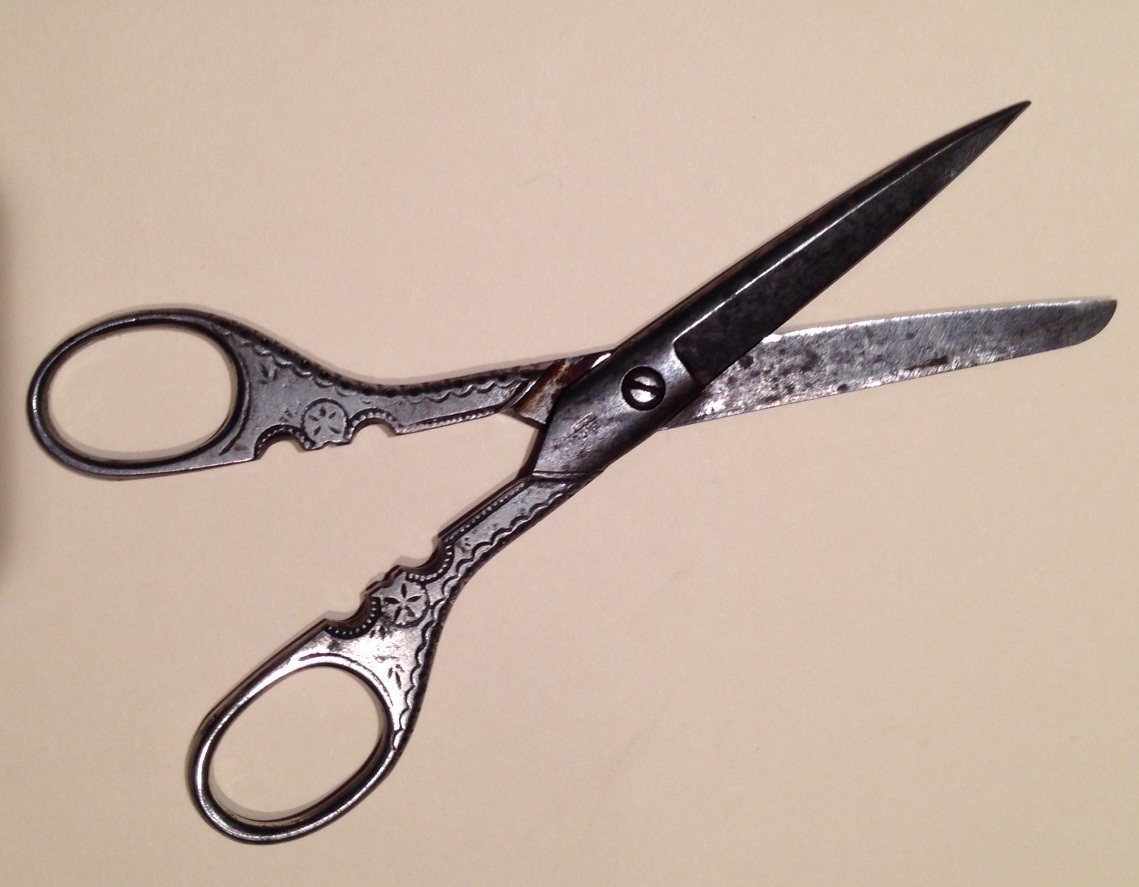
* Scissors
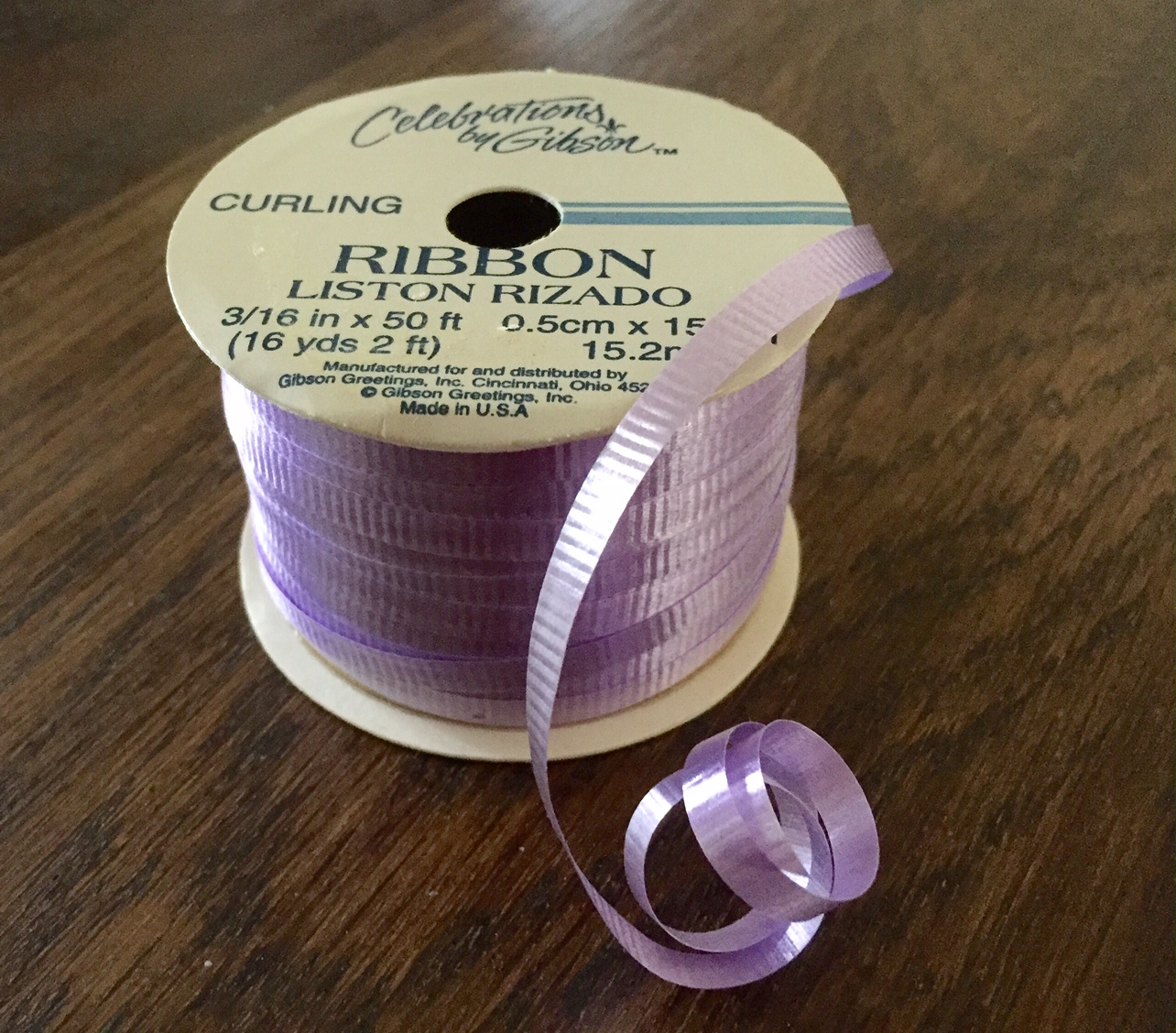
Mom had no scissors in a knife block. In fact, she had no knife block. The scissors in the dining room buffet was her all-purpose go-to, cutting fabric, gift wrap,or curling crinkly ribbon.
The scissors was rather fancy with engraved ornamentation with a provenance from England hinted at by the letters E-N-G and a faint letter L remaining. It is probably made of steel, but since it is so tarnished, perhaps silver.
Photo by Jean Longenecker Fairfield, now curator of Mother’s scissors
Mother drew the scissors’ blade along the length of crinkly ribbon, gathering several strands to make bows of blue, yellow, pink, or lavender for birthdays or a baby gift.
During this season of the year, the fluffy bows made of bunched up strands would all be brilliant red or forest green.
On the top left drawer of the buffet, Mom kept stationery, little notes to say thank you, send well wishes or remind the receiver of her strong faith.
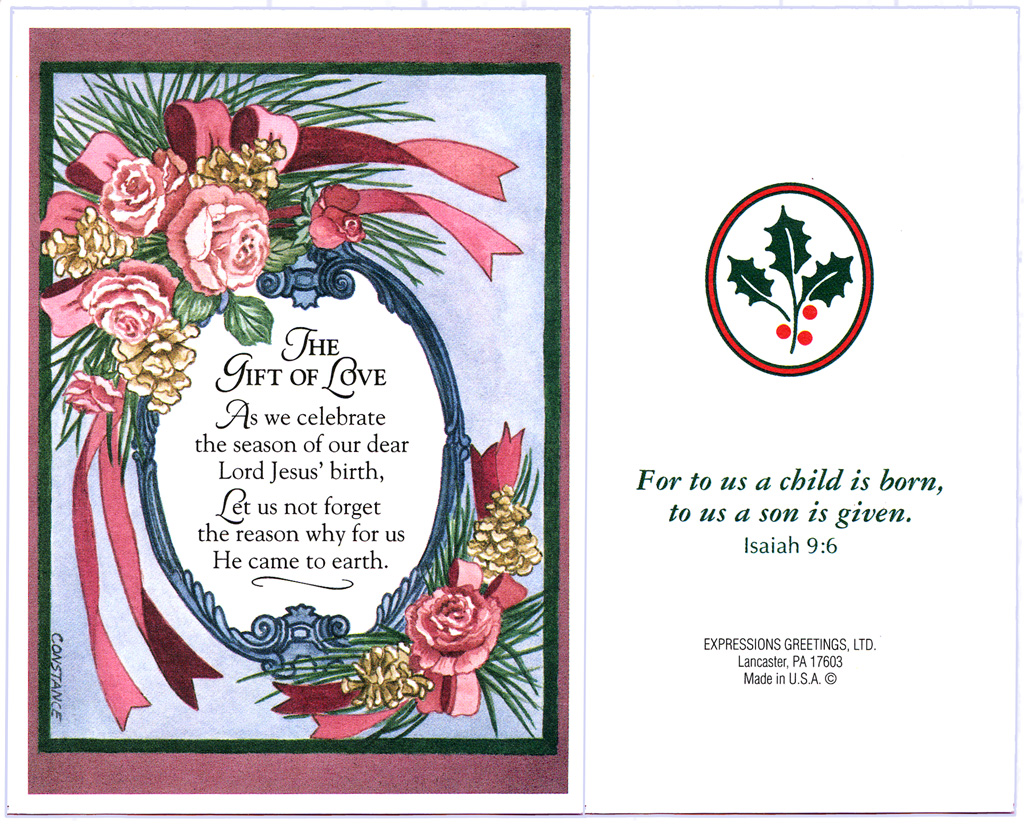
From her store of plenty, I pass on this Christmas wish to you, pictured here front and back
Peace on earth and good will toward men, women, and children everywhere.
Is there a special object or piece of furniture in your family you want to hold onto? One you plan to pass on to the next generation?
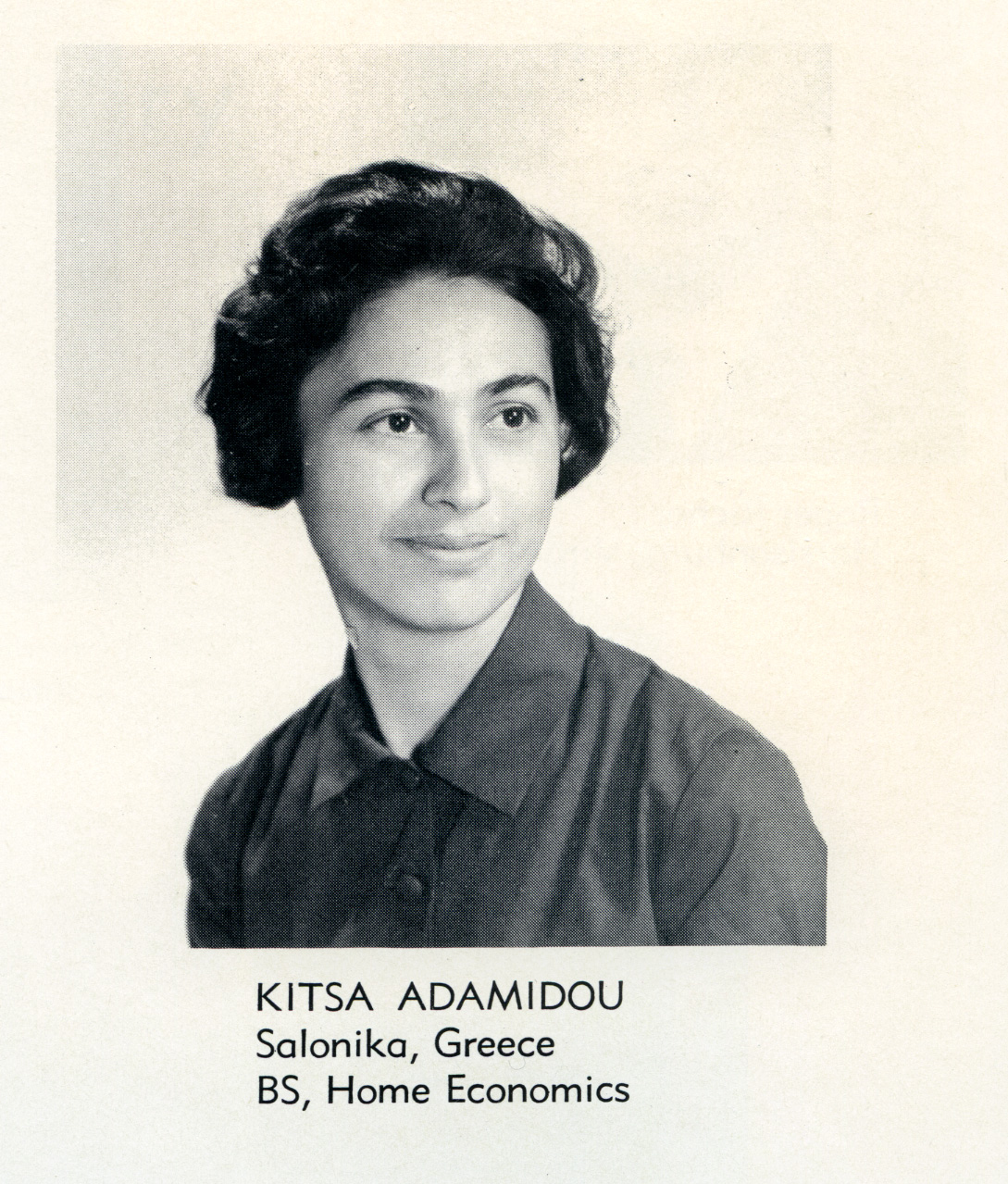
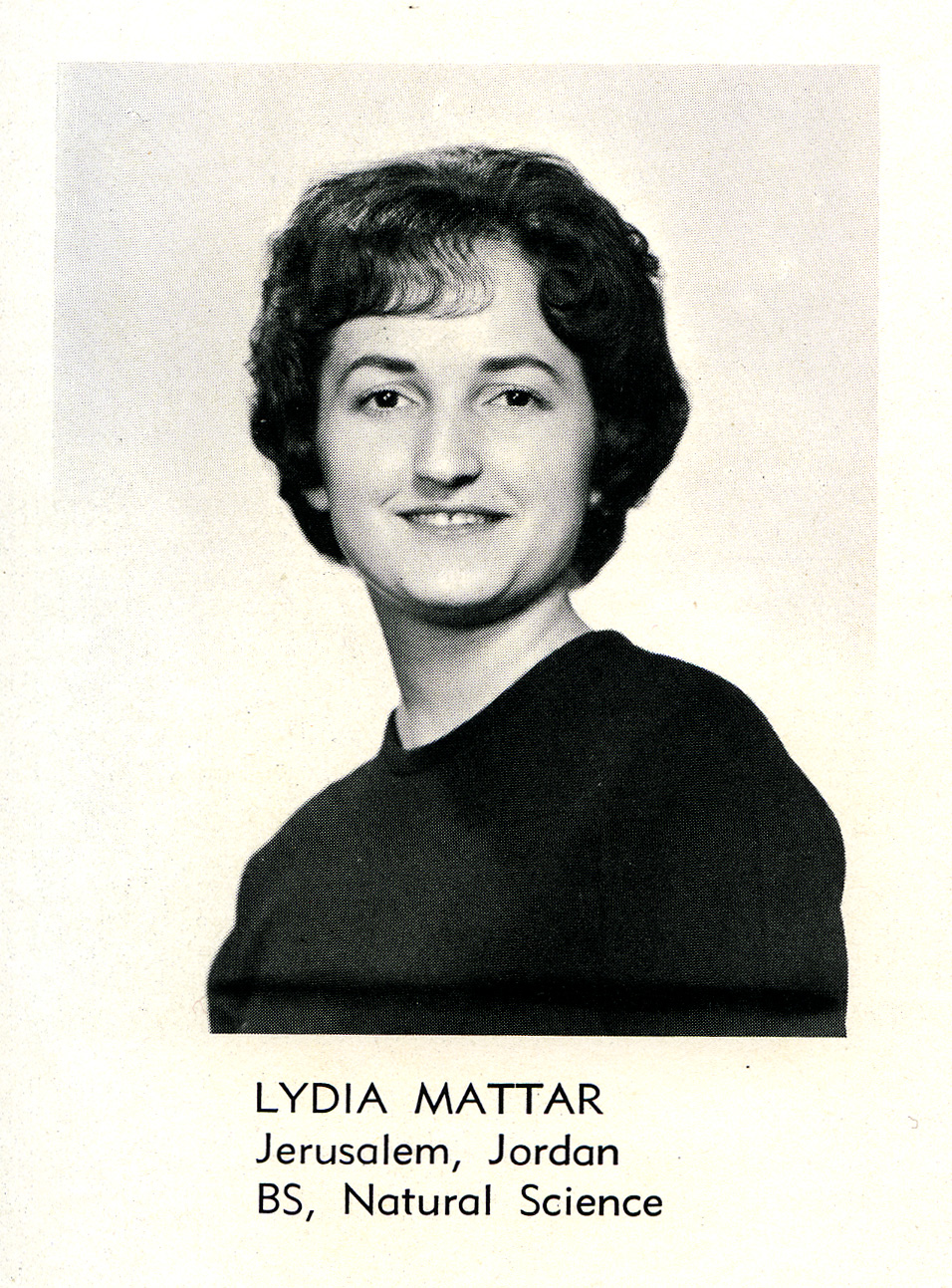
Kitsa and Lydia were among the very few women in my graduating class at Eastern Mennonite College who did not wear a prayer veiling atop their heads. Why? Because they were not Mennonite.
Lydia Mattar from Jerusalem, Jordan and Kitsa Adamidou from Salonika, Greece were international students and my good friends when I attended EMC. Their origins both have a biblical stamp: Kitsa’s hometown was originally known as Thessalonika, the name of two New Testaments books (Thessalonians I and II) and Kitsa’s father from Jerusalem was the Keeper of the Garden Tomb, the site of Jesus’ burial and resurrection. (Photos from 1963 Shenandoah yearbook)
Kitsa, always on the look-out for fun!
And then Lydia . . .
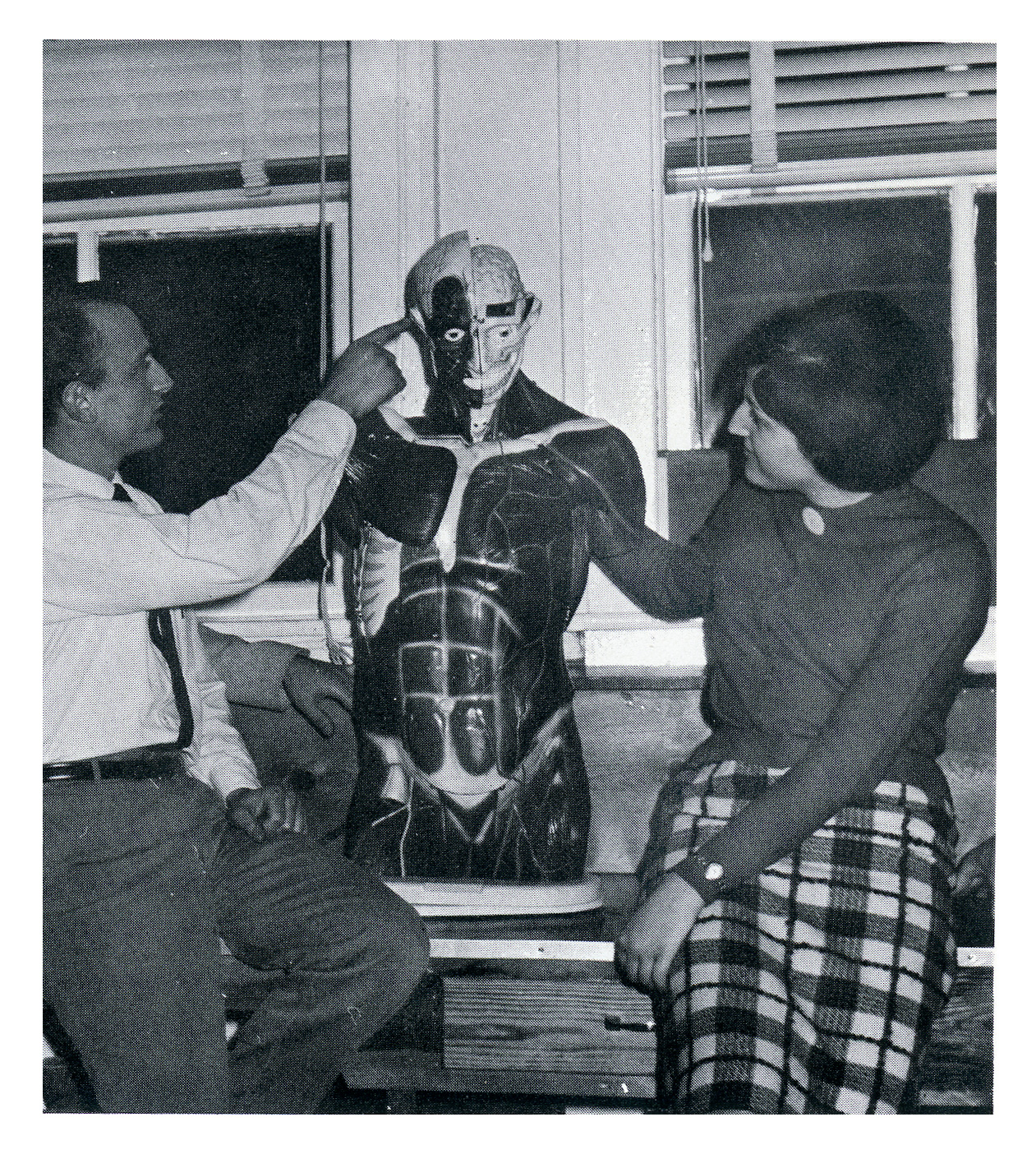
Lydia in Dr. Daniel Suter’s Anatomy class with lab assistant
I was drawn to Kitsa and Lydia during my freshman year because I have always been curious about other cultures. In fact, one year Lydia was my roommate. It appears this inclination has run deep in my DNA. Now as I hold in my hand one of my Grandma Fannie Longenecker’s letters from college I can sense her keen interest in my “foreign” friends and a deep longing to know them better.
In this letter dated December 1, 1960, she insists that she would like both girls to spend Christmas at her home. Born in 1892, Grandma Fannie Longenecker was 68 when she wrote these words to me:
Dear Marian – Guess you’ll be surprised to hear from me, I sure wanted to write before, just didn’t get at it – (Reason) older and slower . . . . Ruth was looking for a letter from you so be sure and bring Lydia & Kitsa along home over Christmas, and forget all about paint etc, two of you can stay here & we’ll have a good time that’s the thing that really matters, I think I’ll be Kitsa’s Grandma of America – Do you know what she needs or wants for Christmas? Forgot to say I’ll pay her way up & we really want them to come, so make it strong, times soon here!
Later in the letter, Grandma admonishes:
Be sure and get arrangements to come home early & if possible bring the girls along. I’ll pay Kitsa’s fare on arrival & find out what she would like for Christmas. This $ 5.00 spot is for you, maybe you need a little for odds and ends or transportation home. Tell us what you are hungry for, that you don’t get at school.
Mark tells me ‘Marian will soon come home’ and his face lights up, so we are all looking forward to that day. Hope your old toe is better.
Grandma’s interest in Kitsa persisted through most of my college years. In her letter of March 8, 1962, she referred to Kitsa and her roommate pictured on the front page of Christian Living magazine (February 1962).
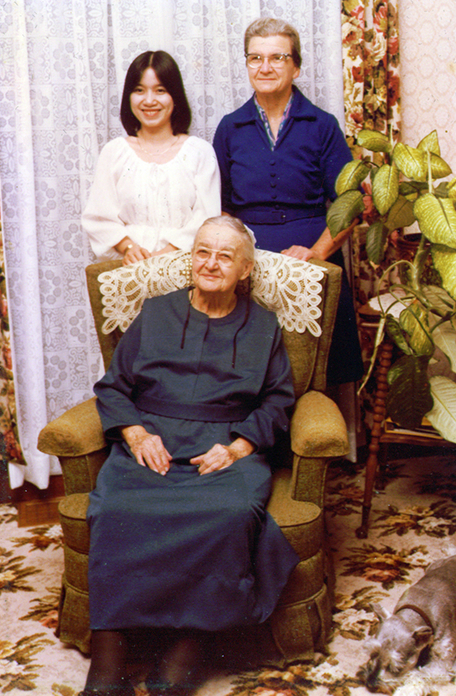
For over 25 years, my Grandma and Aunt Ruthie practiced peace and goodwill toward all, as they opened their home to refugee and immigrant families, beginning with Phuong (pictured below), a young woman who arrived by boat from Vietnam. Their home was a warm cushion absorbing the cultural shock of leaving home and family; it was a safe haven, welcoming refugees from a colláge of countries including Bosnia, Croatia, Serbia, Russia—anywhere there was political upheaval.
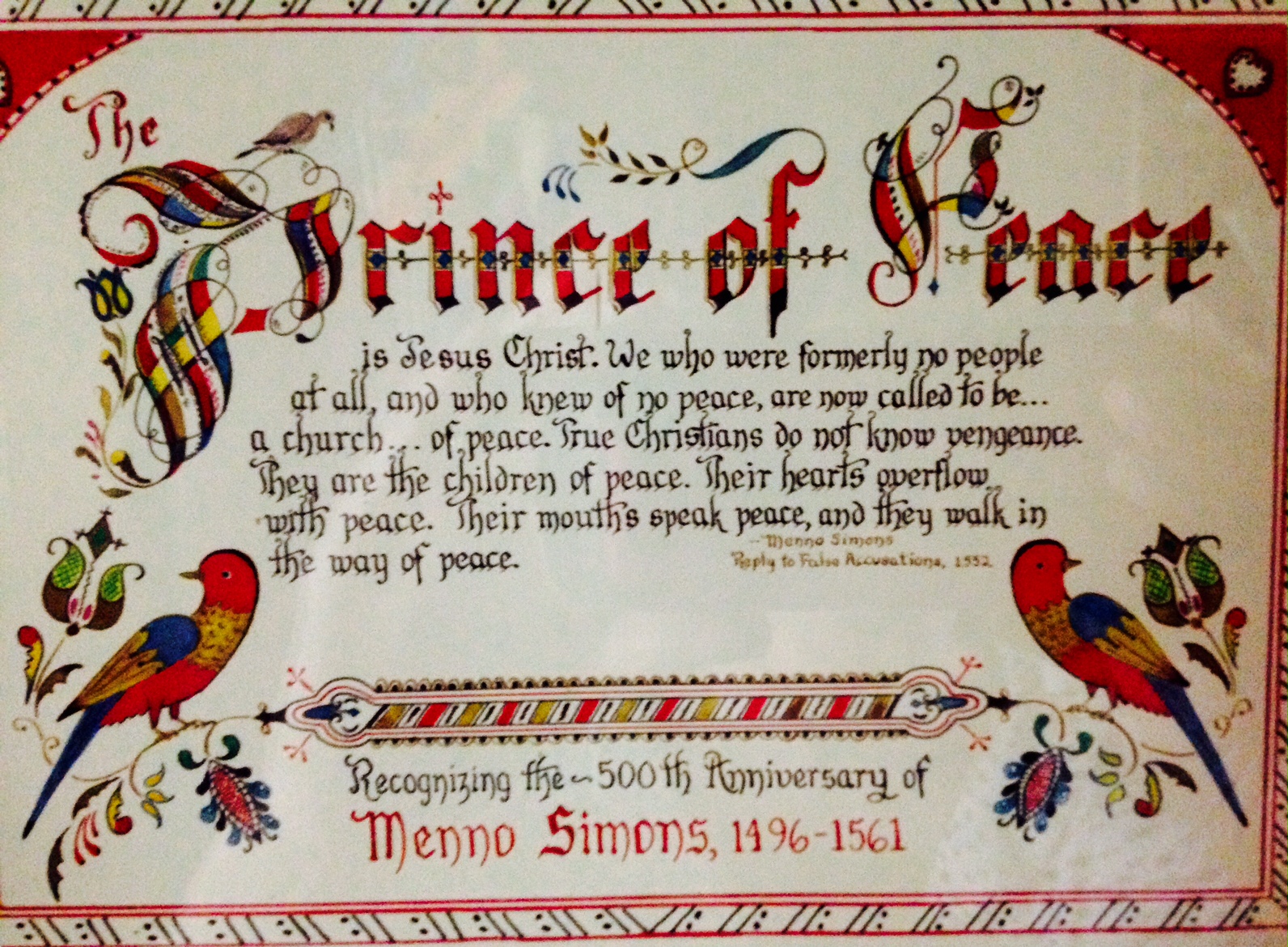
Although she graciously accepted the Salt of the Earth Award from Lutheran Social Services in the 1990s, Aunt Ruthie never bragged about her benevolence. From her perspective, she was merely sharing the love of Christ and fulfilling the statement of Menno Simons, founder of the Mennonite faith:
Framed illustration on the wall of Grandma and Aunt Ruthie’s sitting room, 1996
In a noisy world where some speak of building tall walls and wish to spread terror and violence, I am thankful for my heritage including an education at an institution, now Eastern Mennonite University, where the language of peace is preached and modeled. In fact, it is now possible to earn both under-graduate and graduate degrees in justice and peace-building at the University.
Regrettably, the contact information I have currently for both Kitsa and Lydia has not yielded any results, so I don’t know what paths their lives have taken. But I do know that their lives, like mine, have been imprinted with the power of peace, a message this world could stand a good dose of in these troubled times.
Postcript:
Just this morning, December 11, 2015, I had a long phone conversation with Kitsa, her smooth, alto voice music to my ears. She now lives with her husband in North Carolina and is very active at St. Nicholas Greek Orthodox Church where she is head of the Hellenic Culture initiative. She also gives private Greek language lessons.
How have international friendships affected your life? Have you connected with long-lost friends recently?










 Plain and Fancy