Every week, The New Yorker magazine features a Cartoon Caption Contest, inviting readers to submit a caption for consideration. After three finalists are chosen, readers vote for the winning caption. You can view my first attempt at a similiar contest here on this blog with family members on a Sunday outing.
When we sorted through our mother’s things after her passing, I found a large photo likely from the 1970s taken by Ken Smith Photographs from Camp Hill, Pennsylvania. The photographer snapped my Grandma Fannie Longenecker with bonnet and neck scarf and my dad, facing her away from the camera. Apparently they are in line at a breakfast buffet likely at a farm equipment convention. Others in the line are unknown. All seem intent on filling their plates, some more than others.
“What was going on here?” I ask. Everyone in the photograph registers a similar band-width on the emotional scale, except for the couple on the left.
This photo begs a caption.
* * *
What’s going on here?
Invent a caption.
Guess at the scarario.
Supply a two-line dialogue between the couple on the left.
Imagine the photographer’s motive.
Reminisce about an awkward moment you recall.
O, wad some Pow’r the giftie gie us / To see oursels as others’ see us! “To a Louse”
Robert Burns 1786
(On Seeing One on a Lady’s Bonnet at Church)
Coming next: Moments of Extreme Emotion: Where’s My Spyglass?
I played with pastel-colored beads and wooden blocks with ridges, babyhood toys. Mother kept these oblong & round beads and animal-themed alphabet blocks for her grandchildren and great-grands. These sturdy toys entertained children of mothers they nurtured in their ministry for New Life for Girls too.
All of Mother’s children and many of her grandchildren sat on this high chair and played with these wooden beads and blocks. We never played with plastic toys.These blocks have entertained my sister Jean’s grandchildren
To me, such simple toys bespeak innocence and the charm of a simpler life..
On this Mother’s Day 2016, these artifacts seem an apt metaphor for my mother’s contribution to our heritage.
Beads of Wisdom: Mom’s Mottos
“Outen the light,” meaning turn off the light switch to conserve energy.
“Ach, don’t talk so dumb,” spoken as a way to discourage silly talk.
“You get what you pay for.”
“Be sure your sin will find you out.”
(Someone) “turned up Jack,” meaning disappointed or didn’t pan out
“Be sure to add enough butter: Butter makes it better!”
“Tie your head shut,” admonishing us to wear a bandanna during cold or windy weather, illustrated here with a flash of memory:
I paid attention, of course, and rushed out wearing my blue wool coat and pink and white polka-dotted bandanna on my head, eager to help Grandma set the table. In cool weather, I always had my “head tied shut,” an expression Mother used to keep us from getting a cold, she thought. But looking back, I think having my head tied shut is a metaphor for keeping out the world and all the corruption that can come in through an unlocked door, even a passageway like my ears.
Blocks of Faith
Tied a nickel into the corner of a square, white hanky to teach me to give to God.
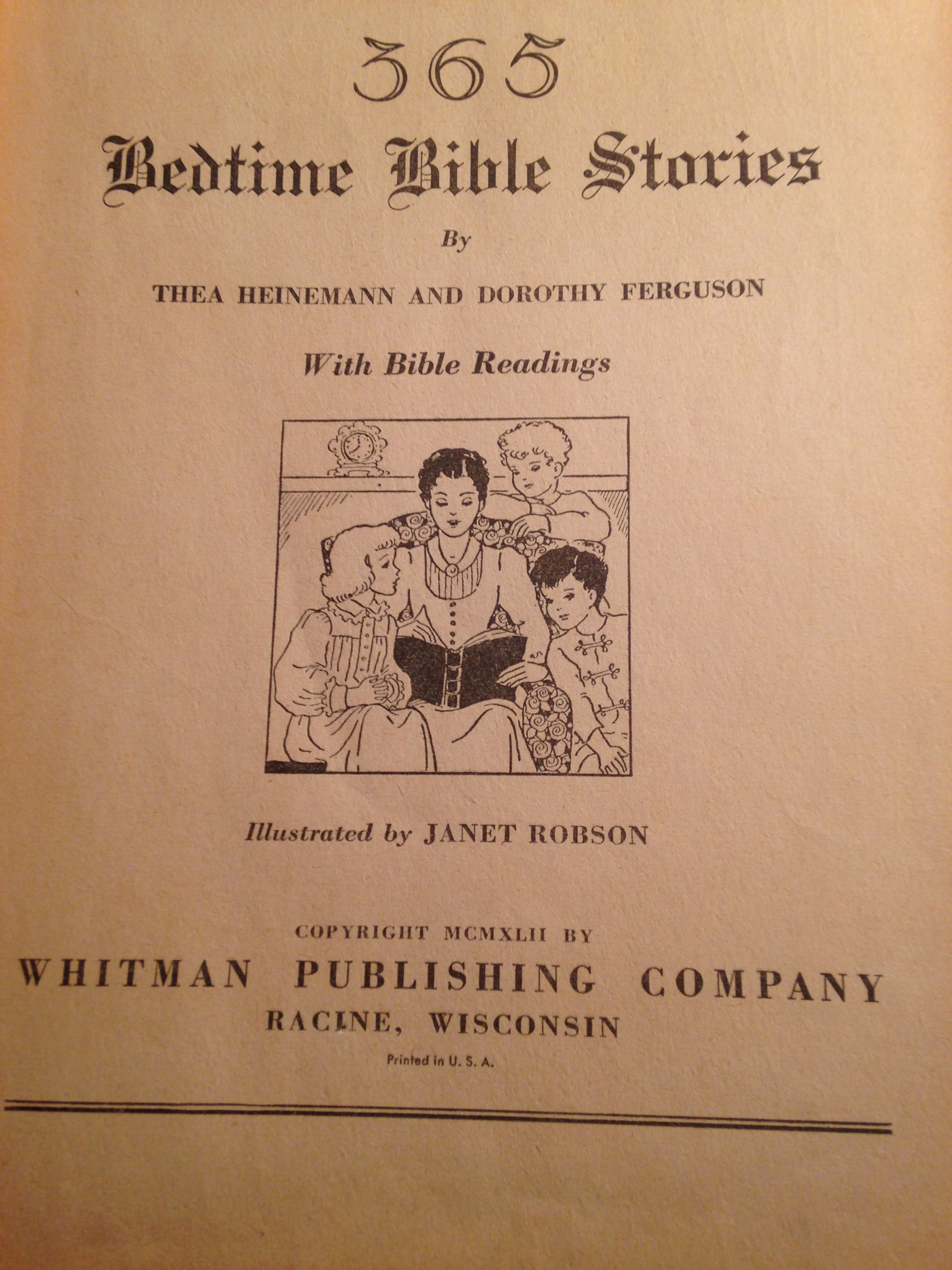
Read to me from a Bible Story Book, one story for every day of the year.
The date on the flyleaf, MCMXLII, can be translated as 1942. In the years following, my sisters Janice and Jean and my brother Mark must have heard these stories too.
3. Prayed with us at bedtime: “Now I lay me down to sleep, I pray the Lord my soul to keep . . . .”
4. Led us in prayers of gratitude before all our meals. Usually, the prayers were silent.
5. Uplifted arms, palms turned upward, her gesture of acceptance, “Whatever the Good Lord wants.”
My mother wasn’t perfect. Whose is? She had moments of impatience, she sometimes complained, yet she did the best she could. I choose to celebrate those attributes of a woman who all her life sought to please God.
An invitation to you: Add words of wisdom or silliness from any source, including your mother.
Coming next: Vintage Photo in Need of a Caption, Part II
I missed National Pet Day on April 11 by a few weeks. But if you own a dog like Scotty or a kitty cat named Sophie, every day of the year is pet day.
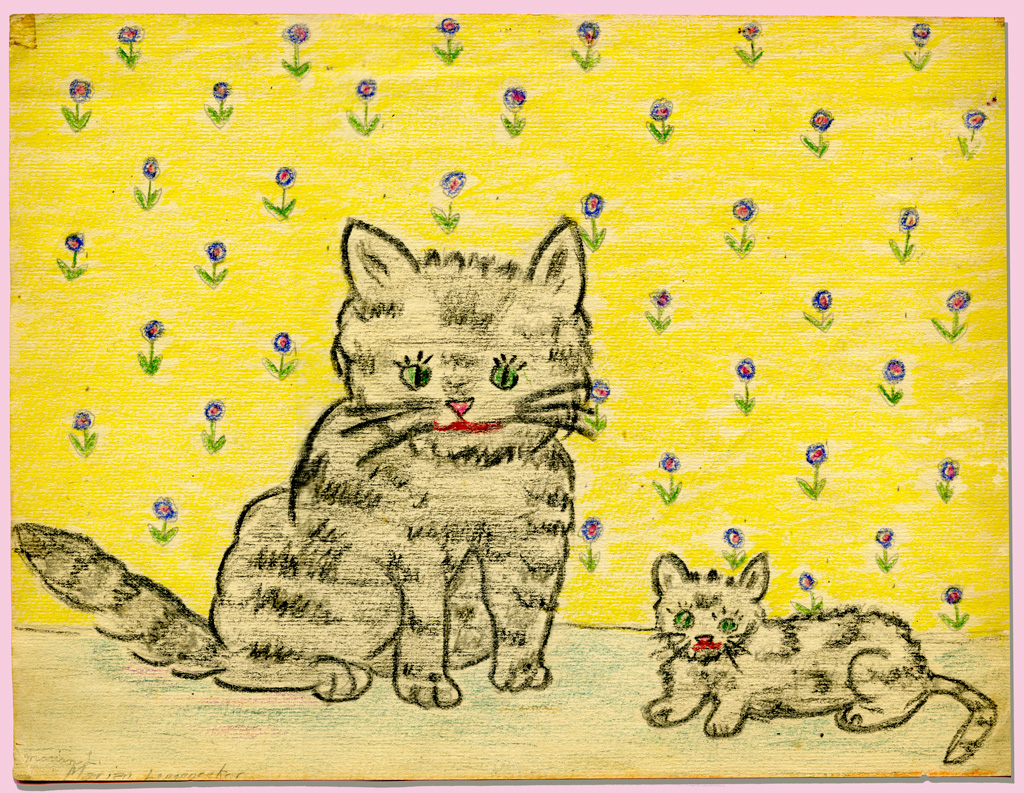
In 4th grade, I drew a cat and colored it charcoal gray. It appears I was as interested in making the wallpaper pretty as I was in drawing a green-eyed cat with its wee kitten.
In first grade, my teacher Miss Longenecker introduced our class to reading via the phonics method with the drawing of a cat illustrating the hard “c” sound. She probably used the Hay & Wingo textbook entitled Reading with Phonics (Philadelphia: J. B. Lippincott, 1948).
Julie Hay & Charles Wingo, Reading with Phonics, J. B. Lippincott, 1948
We never had a pet cat, probably because my mother was allergic to cat dander, but several memorable dogs cavorted through our childhood. Sporty, an Airedale Terrier mix leaped and frisked around Grandma’s ankles when I was very young. Boots, a black and white Smooth Fox Terrier, flushed ground hogs from their holes.
My sister Jean remembers other animals too: Our dad raised Angora rabbits housed in wooden crates in the barn attic and another Smooth Fox Terrier named Minnie, as small as she sounds. Sister Jan says we used to dress her up with doll clothes and send her down over the hill to Grandma’s house.
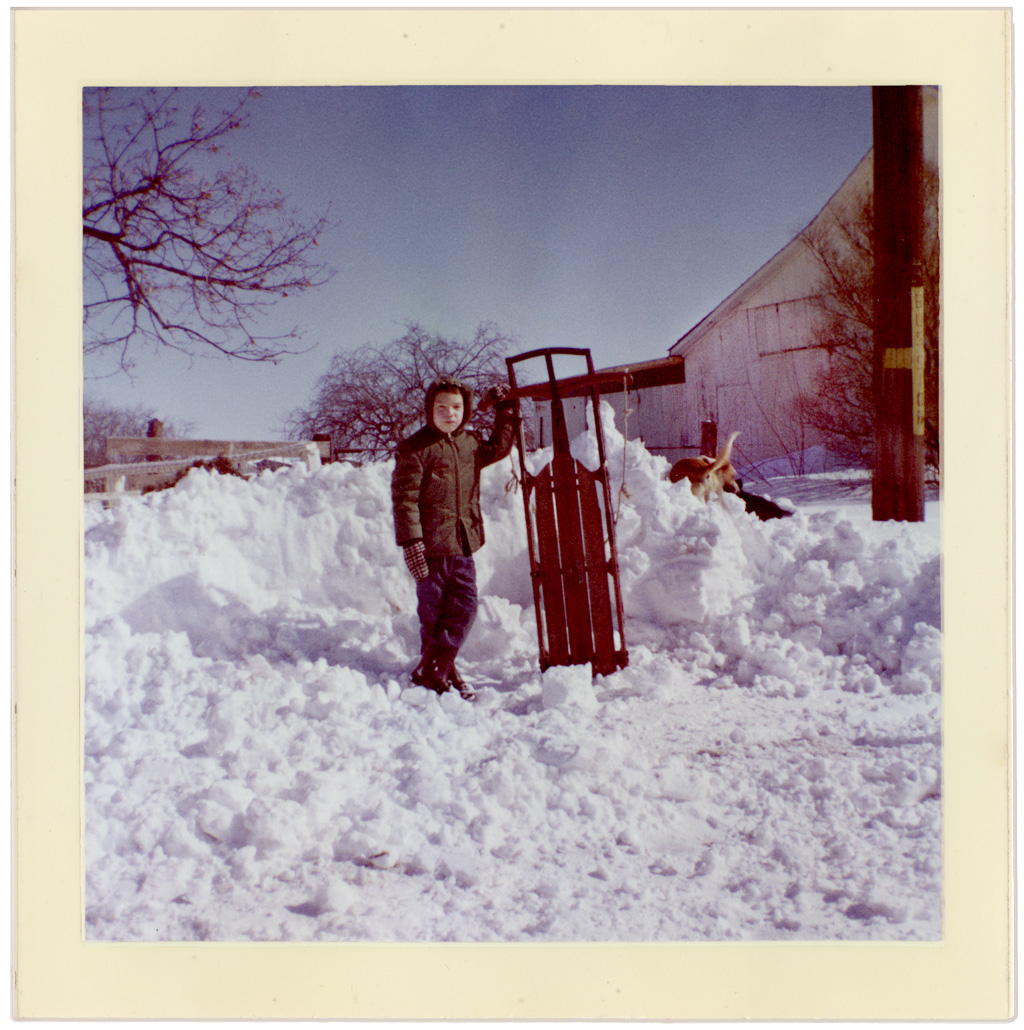
Our brother Mark’s dog, 3-legged Skippy, butterscotch and cream colored, lost one leg when a truck ran over him. Still, he skipped, ran far, and jumped high with just three legs. You’ll see part of his rear end and his tail in the second picture.
Brother Mark with sled and Skippy in the snow 1961
We all remember Ruthie’s little lamb that felt like mine when I wiggled my fingers digging deep into its wooly coat.
My Aunt Ruthie loved animals all her life, especially dogs. Her last four dogs were Schnauzers, known for their fierce loyalty and protective power. The pure-bred Schnauzuers were all named Fritzie – Fritizie I, II, III, and IV.
In this photo she was probably holding Fritzie III in her lap. The devotion you observe in this photo flowed both ways.
* * *
Like most children, our kids Crista and Joel wanted a dog. We shopped ads in the Dollar Saver for our dog back then and were taken in by the phrase “loves children.” That’s how we found Me-Too, a kid-loving-mailman-hating dog of questionable pedigree. Still, the children doted on her and adopted her into their play. Here the frame of their baby buggy became a carriage with Me-Too as the pony express.
Research
Not surprisingly, research shows that pets promote health, both physical and emotional.
Pets in the household can reduce everyday stress – lift one’s mood and provide physical contact. They provide an outlet for nurturing too: Pet owners have a living thing to care for. And finally, pets keep one active: walking the dog, feeding the cat.
Little House on the Prairie, Laura Ingalls’ dogs – Jack, the brindle bulldog, and Bandit, the stray, appear in her books
Old Yeller by Fred Gipson
Literary works:
In The Odyssey, I recall Homer’s beloved Argos, who patiently waited for him at journey’s end. Maybe you remember this faithful dog too.
In Jane Austen’s Pride and Prejudice, cats romped in the Bennett household, at least according to author Pamela Jane.
Anton Chekhov wrote a short story entitled The Lady with the Dog, preserved here in statuary forever viewing the Black Sea in Yalta. When we visited in 2011, Crimea was still part of Ukraine.
In the 1970s James Herriot books were all the rage both here in the States and internationally. Herriot, an English veterinarian, immortalized farm animals, pets, and their owners in his popular series set in the Yorkshire dales and moors. I read many of the titles: All Creatures Great and Small, All Things Bright and Beautiful, and The Lord God Made Them All.
What pets populated your home or the pages of books you loved? What items can you add to the list of benefits of owning a pet?
Leave a line or two here. You can also include endearing (or not) pet anecdotes.
* Incidentally, if I inadvertently missed listing you as an author with a pet muse, please bark at me, so I can rectify the oversight ~ pronto.
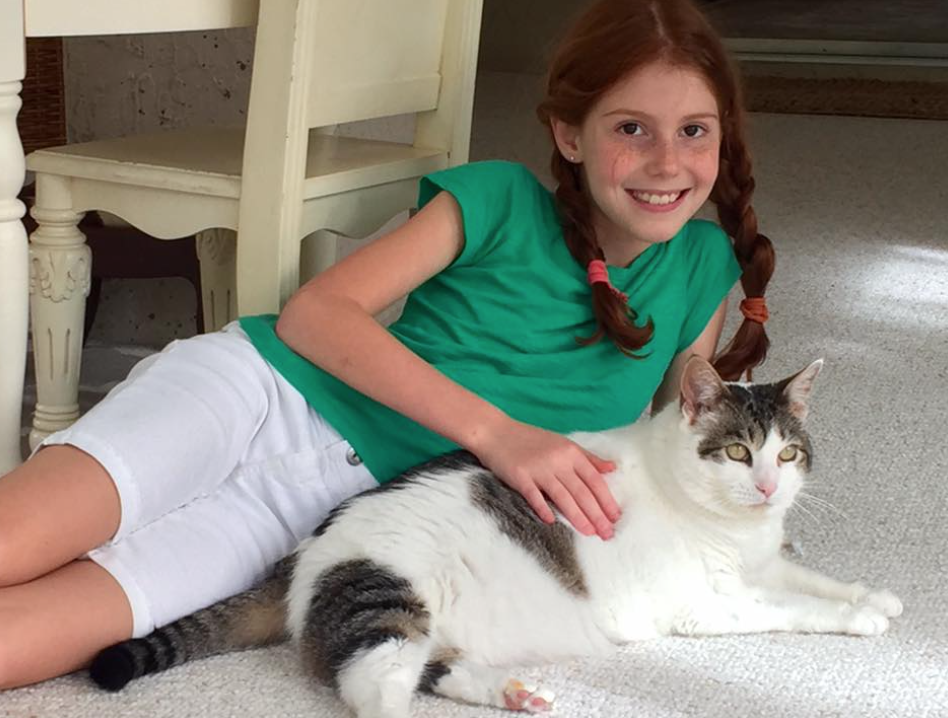
Daisy with grand-daughter Jenna in pigtails
Coming next: Baby Beads and Wooden Blocks: Happy Mother’s Day!
“It’s a spring cleaning ritual – but for your body,” touts reporter Jennifer Sheehan, extolling the merits of eating dandelion. “It cleans your blood and you get a lot of good vitamins from it,” another endorsement I read in Sheehan’s article from Lehigh Valley’s The Morning Call.
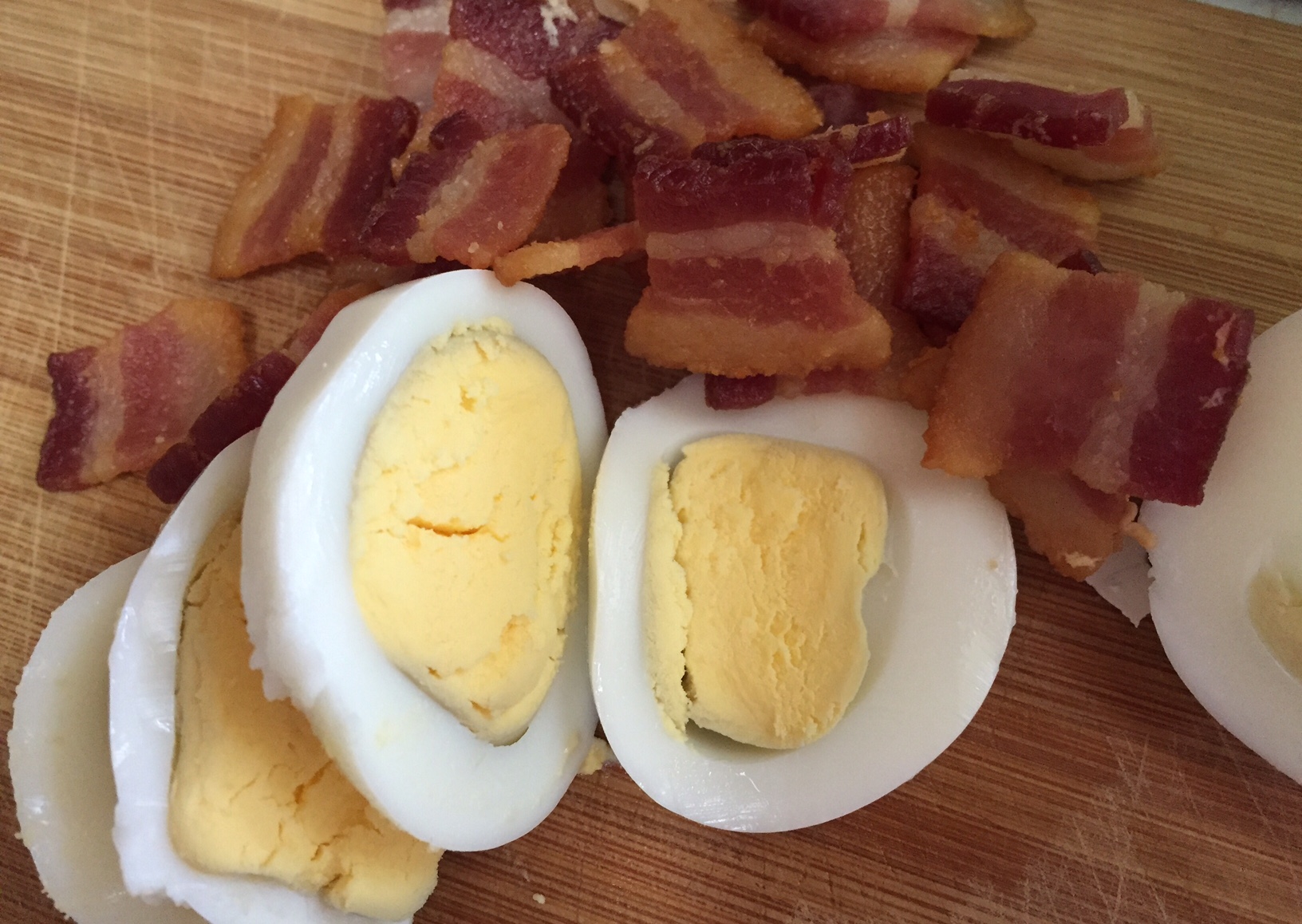
My mother would agree. Each spring about this time, she took her wooden-handled trowel and dug out dandelion plants fertilized by cow and horse manure in the meadow next door. “Dandelion has a lot of iron,” she said of the long, spiny leaves. “And it’s so good with hard-boiled eggs and bacon.”
Last week my sister Janice shared Mother’s recipe. I was pleasantly surprised because I didn’t know it was written down anywhere.
Add a little water till soft.
Add white sugar – a little vinegar
Fry bacon and hard boil two eggs
The recipe wouldn’t pass muster for cookbook publication, lacking as it does measurements and a logical order. But reading between the lines, I constructed her dish in a slightly different way.
First of all, I bought dandelion at a local farmer’s market. The label reads organic. The dandelion stalks pictured here look too perfect The dandelion strands of my childhood were more wiry, a deeper green. “Organic” was not a selling point back then.
I began by frying bacon and hard boiling eggs.
Instead of white sugar, I used brown.
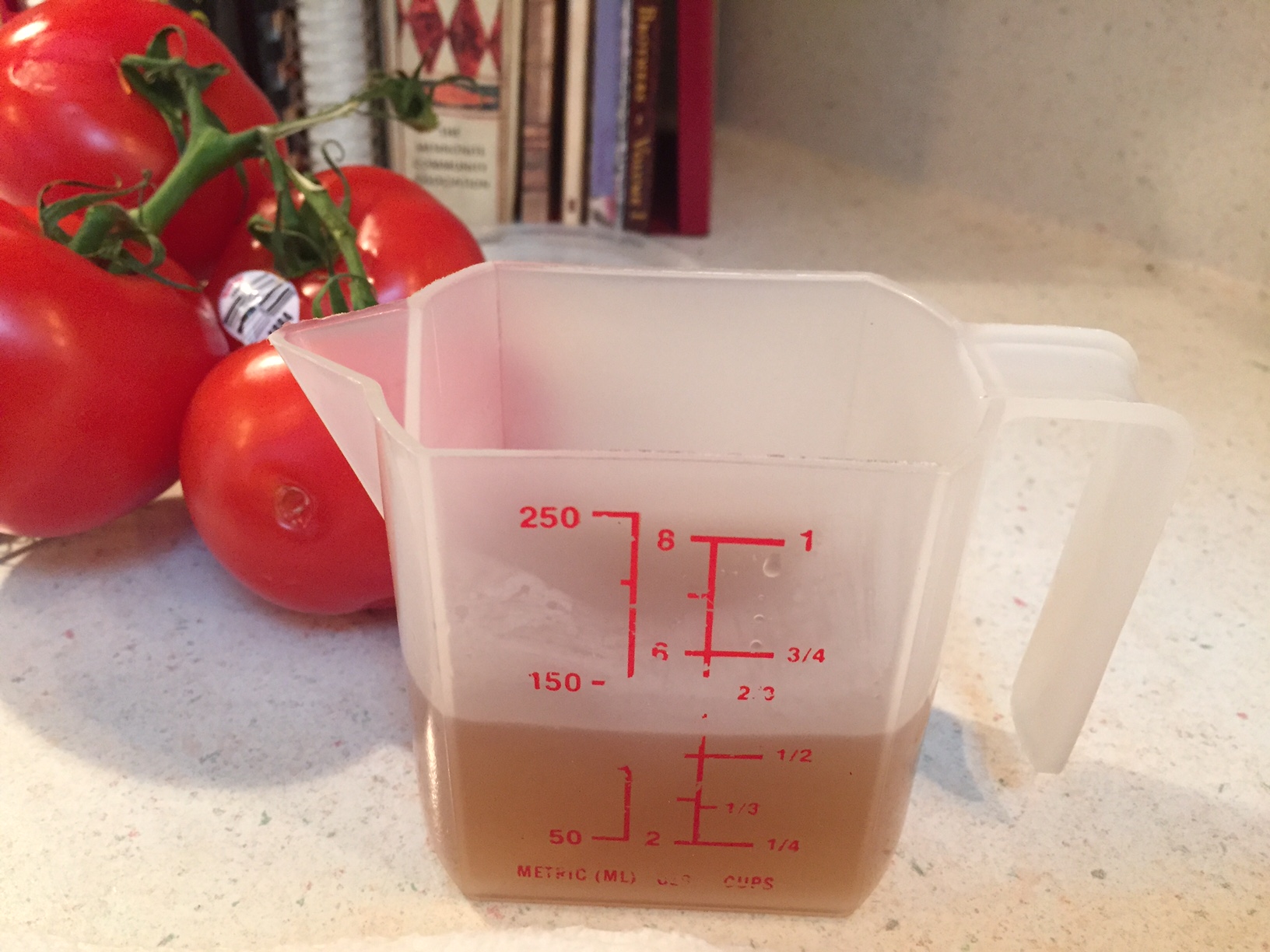
And I saved the broth from cooking the dandelion. “It’s good for what ails you,” I imagine Mother would say.
Finally, good enough to eat!
Continuing the discussion of dandelion in The Morning Call, Sheehan quotes Patrick Donmoyer, an expert on Pennsylvania Dutch folklore, who believes eating dandelion greens is symbolic. “Donmoyer, who lectures at the Pennsylvania German Heritage Center in Kutztown, reports that some people believed that the dandelion were special, holy even, gathered as they were during the week leading up to Easter.”
Christians observed Easter nearly a month ago, but beginning Friday evening, Jewish families observe Passover, enjoying the ritual of the Seder meal. Surely no bacon will be served, but the menu will feature eggs, symbolizing renewal, and bitter herbs, signifying the agony of Hebrew enslavement in Egypt.
My mother wore many hats both literally and figuratively. Most of her head coverings were prayer veilings worn every day. As a young woman, her coverings were large, decreasing in size as she got older and church rules had progressively relaxed.
Mother wore a sunbonnet in the tomato patch in Bainbridge, PA. As far as I could tell, Mennonite women in the 1940s and 1950s, paid no attention to Coppertone ads. (Remember billboards with that sneaky cocker spaniel pulling on a little girl’s swimsuit bottom, exposing her pale cheeks?) No one that I knew then wore sun tan lotion regularly, except maybe to the shore at Atlantic City or Ocean City. Country women, including my mother, wore bonnets in the garden and fields to protect their skin.
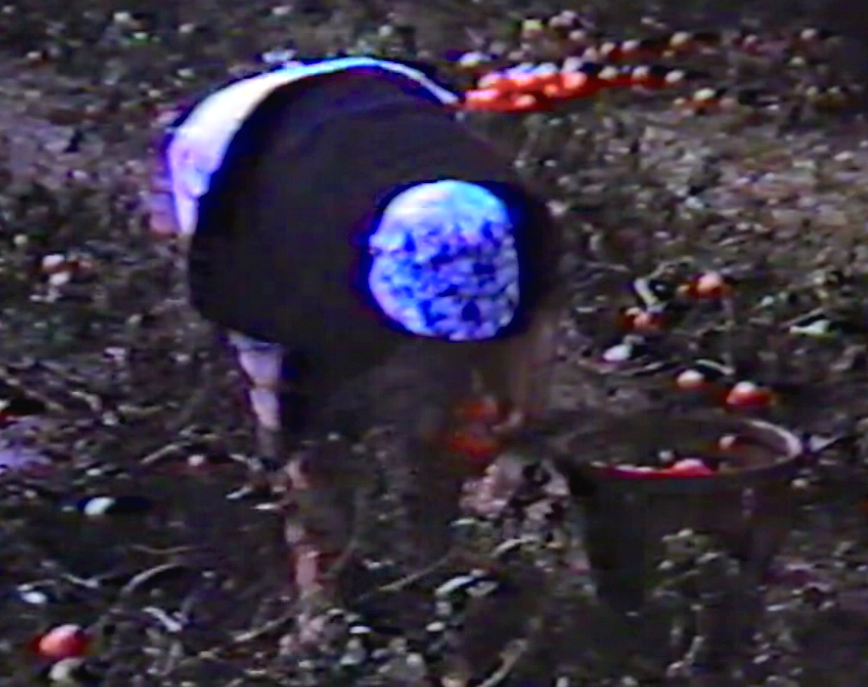
The details are fuzzy here because this photo is another movie “still” captured from Aunt Ruthie’s 16 mm camera (circa 1955).
I look at this image of Mother’s sunbonnet worn in the tomato patch with two lenses, viewing the blurry film now and remembering the scene vividly then as an eyewitness:
I’m looking at a film clip of Mother in rows of the tomato patch just now, humped-over body bending toward a flush tomato bush facing the camera, her blue and white speckled sunbonnet sewn with three tiers of matching ruffles, a row along the bill, a row at the crease, another row near the crown of the hat—come to think of it now, headgear much fancier than her everyday prayer cap.
Figuratively too, she wore many hats:
Sister
Wife
Mother
Friend
Gardener
Tomato Picker
Cook/preserver
PTA/Treasurer
Dresser of chickens
Sewing circle seamstress
Volunteer – MCC Gift and Thrift
Volunteer – Choice Books in Salunga, PA
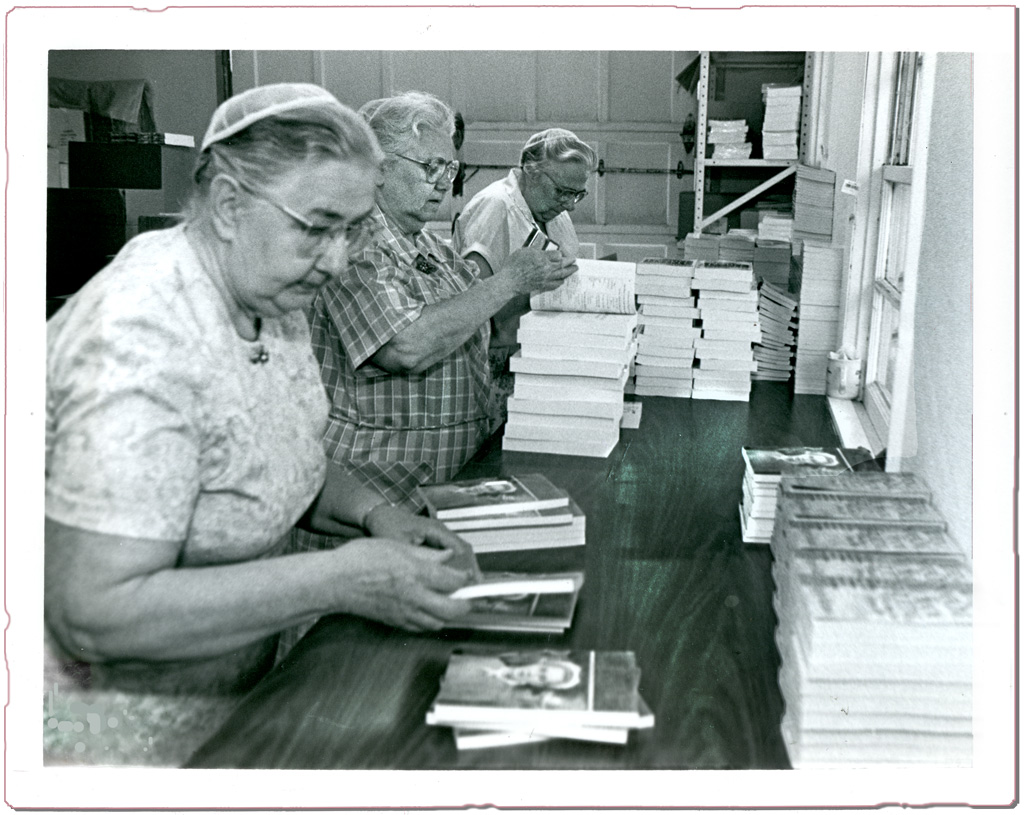
Mother particularly enjoyed her last volunteer job, stamping the Choice Books logo onto inspirational books for display on kiosks in stores around the country. During her “morning away,” she got to see her niece Dotty Metzler Martin often, met her friend Bertha, and ate lunch with other friends. She always sounded thrilled to describe this excursion when we talked on the phone Saturday mornings.
Even in her early nineties, she got excited about this bright spot in her life. I thought about her experience and examined my own passions when I read this verse from Psalm 39:3
My heart grew hot within me . . . and as I meditated, the fire burned. (NIV)
If someone asked Mother, “What lights your fire?” She would probably answer, “Serving others,” a motto she lived by.
The 16 x 22 inch poster created for her 90th birthday party and later, displayed on an easel at her memorial service, shows flash points of service, including her stint at Choice Books.
How would you answer these burning questions?
What lights your fire?
What burns “hot” within you?
“When God gives you an 11-by-17 mindset, you’ll never be happy living in a 3-by-5 mental framework.” Daily Devotional: The Word for You Today, April 10, 2016
Hearing from you lights my fire. Thank you for commenting here!
Coming next: All Creatures Great & Small: The Power of Pets
Little Mennonite girls could be fancy before they became plain. They could wear hats. Their mothers may have worn flat, black bonnets on top of their prayer veilings (coverings) at Easter, but they couldn’t wear hats with ribbons and flowers. At least not in Lancaster County, Pennsylvania in the 1950s.
My sisters and I are standing here in front of peony bushes wearing some cast-off hats Grandma Longenecker’s friend, Mame Goss, brought from a millinery shop in Middletown, Pennsylvania.
Marian, Jean, and Janice in front of the peony bushes
I recall this scene through the lens of memory:
I’m looking now at a snapshot my mother took of my sisters and me in these hats, the three of us holding hands in front of a peony bed. The magenta peonies are in bloom, so it must have been May. The double whites mingled among them have ruby flecks in their ruffled centers. My sister Janice, three years younger, is standing at one end, with blonde hair fluffed into curls, hands obediently at her side. Jeanie, a tiny tot of two or three, appears to be looking down at the grass, her burst of tulle brushing light brown hair. I’m staring straight at the camera, two thick braids trailing down my back. Our dresses are all bedecked with ruffles and bows, embroidery or smocking, dresses surely made by our plain Mennonite mother.
I wore my first adult hat ever, a pale blue clôche with a blue chiffon dress one spring when Cliff and I were dating.
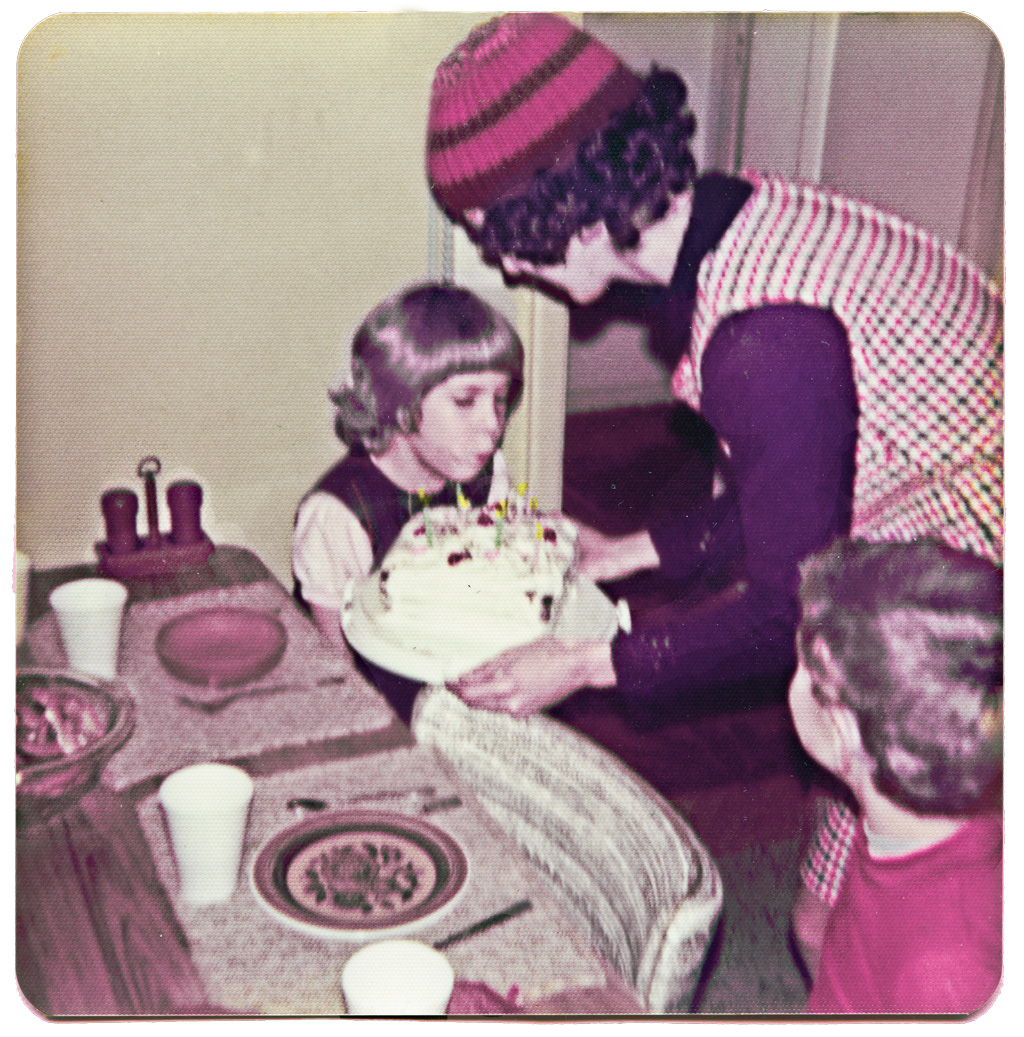
At Crista’s 5th birthday party I was wearing a knitted skull-tight cap, typical of the 1970s.
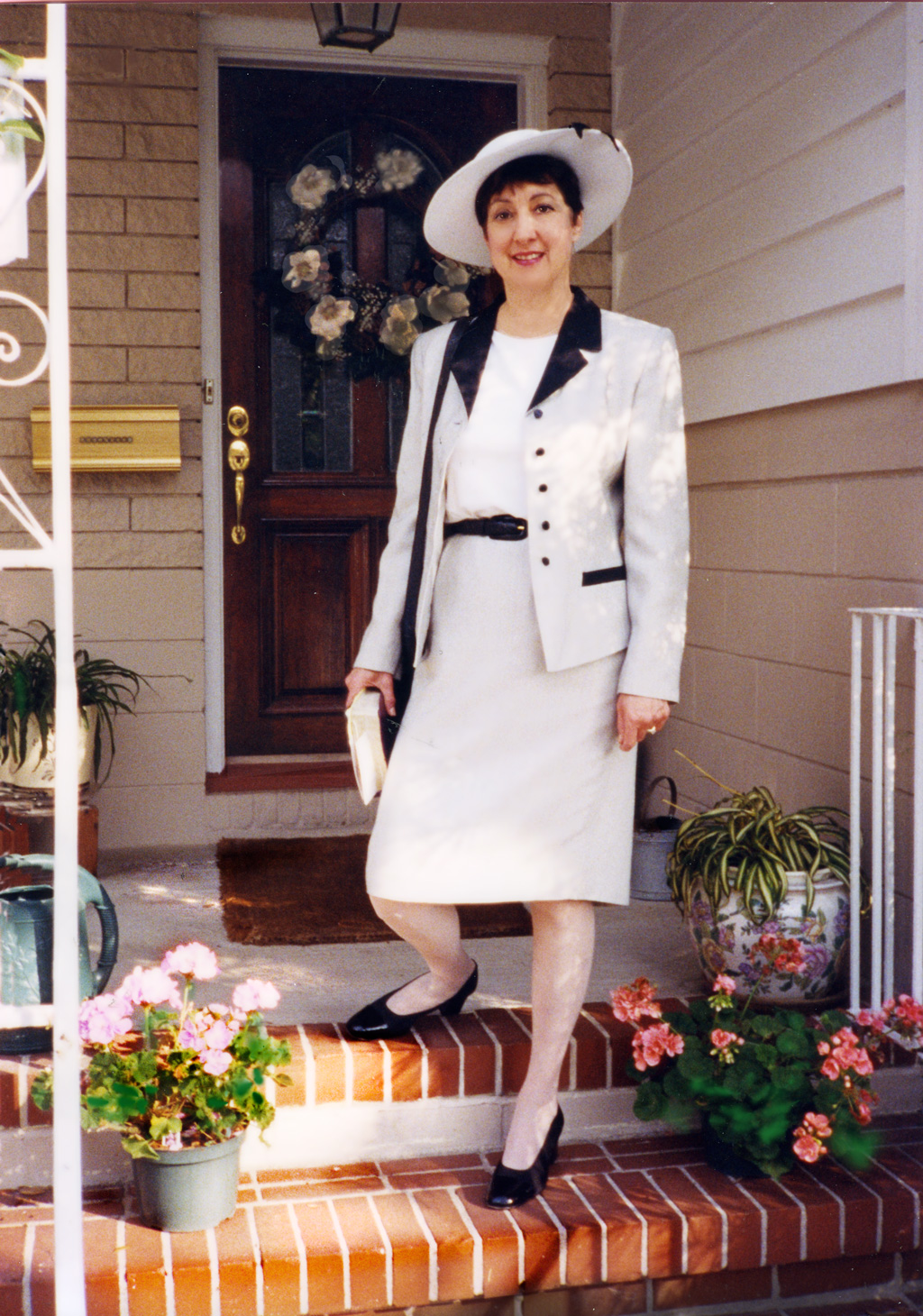
In the 1990s I bought a white hat trimmed in black ribbon and feathers, probably for Easter. I don’t wear hats anymore. I have already taken this one to Angel Aid, a charity for mothers and children.
My sister Jan and I wore British-style hats to Downton Abbey events sponsored by our PBS station in Jacksonville, Florida. Each of our hats adorned with feathers, a flower and seed pearls cost $ 5.00 at Roots’ Country Market near Manheim, PA. We didn’t tell anyone at the gala how much our gorgeous hats cost.
Sisters with friend Carolyn Stoner with her fascinator hat in black and green
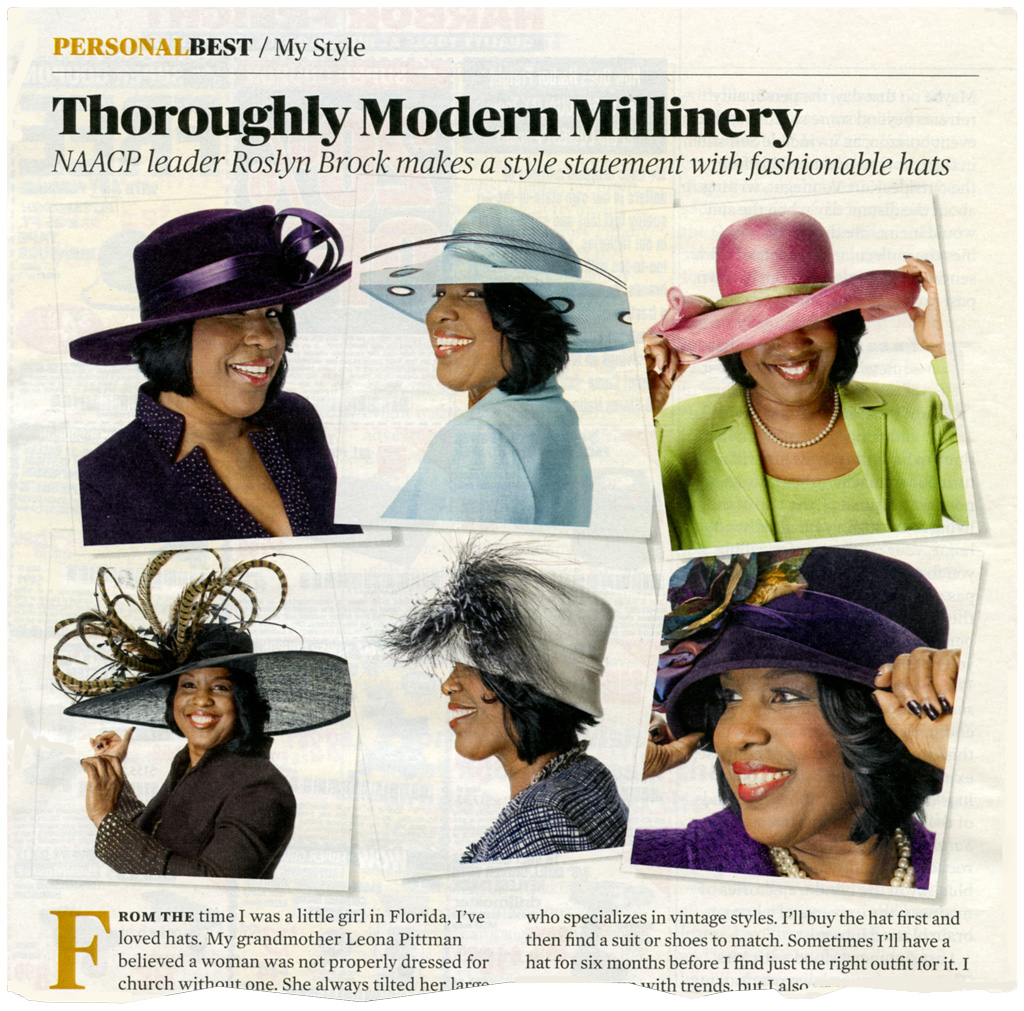
Hats have mostly gone out of fashion in recent decades, except among the trendy young. NAACP leader Roslyn Brock makes a style statement with her wardrobe of about 200 fashionable hats, expressing her love for her Grandmother Leona Pittman who “believed a woman was not properly dressed for church without one.” Brock emphasizes that
I’m following in the legacy of female civil rights leaders who completed their Sunday go-to-meeting clothes with fashionable hats.
Hats are the centerpiece of Roslyn’s wardrobe. She admits that she’ll buy the hat first and then find a matching suit or shoes. For Roslyn, who enjoys couture creations from Philip Treacy, Queen Elizabeth’s designer, wearing hats “keeps our history and culture alive.”
How a hat makes you feel is what a hat is all about. ~ Philip Treacy
In June it will be two years since my mother died unexpectedly. I still miss her terribly. Grief occasionally comes over me in waves. Now less often, with less severe impact. Still . . .
On my dresser I have kept three mementoes of Mother, one on top of the other: the two-quart Ball jar with bubbles in the glass, emblematic of her love of cooking and canning. And her last Mennonite black bonnet and white prayer covering veiling made of bobbinet fabric, a see-through, hexagonal mesh. Symbols of her constant faith and hope in God, each piece of headgear is less than half the size of those she wore in her youth.
Any hats in your history?
What did it look like? Where did you wear it? Do you still wear a hat? Comments are warmly welcomed. Don’t be shy.
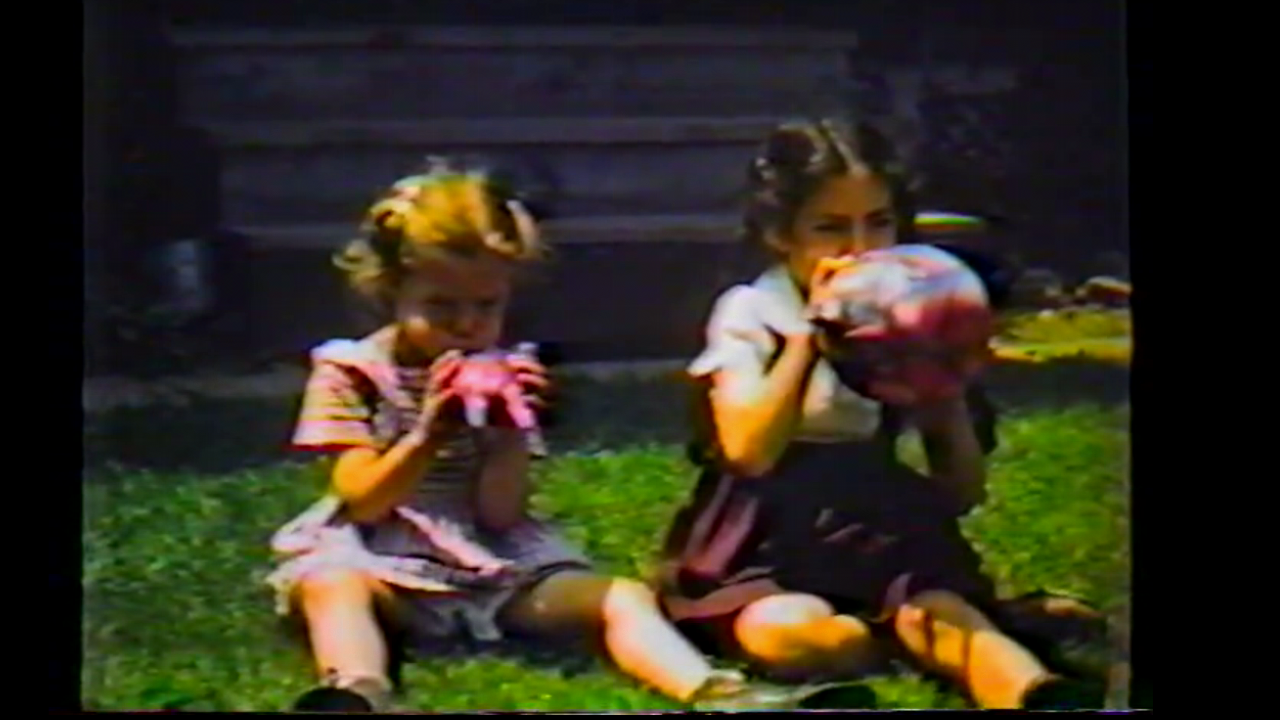
My sister Janice and I blew up balloons when we were little. Here is a stop-action snap from Aunt Ruthie Longenecker’s 16 millimeter movie film. The balloons were thick, rubbery and multicolored.
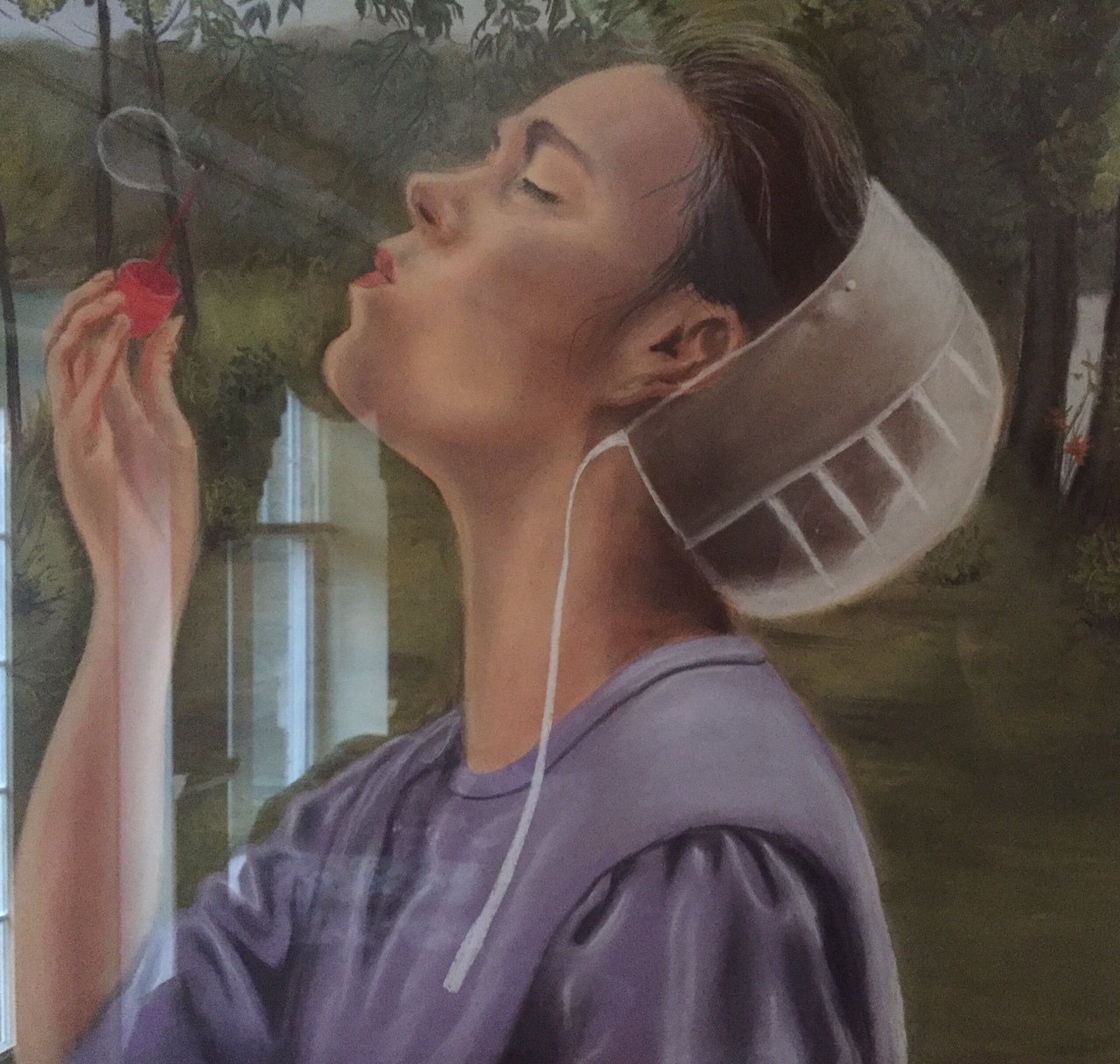
We also blew bubbles sitting on the porch swing or standing in the back yard. I don’t have pictures of those, but on one of the walls at Landis Homes, where Aunt Ruthie now lives, an Amish girl is forever blowing bubbles, possibly expressing her wishes and dreams.
Picture displayed in Manheim House, Landis Homes – Lititz, Pennsylvania
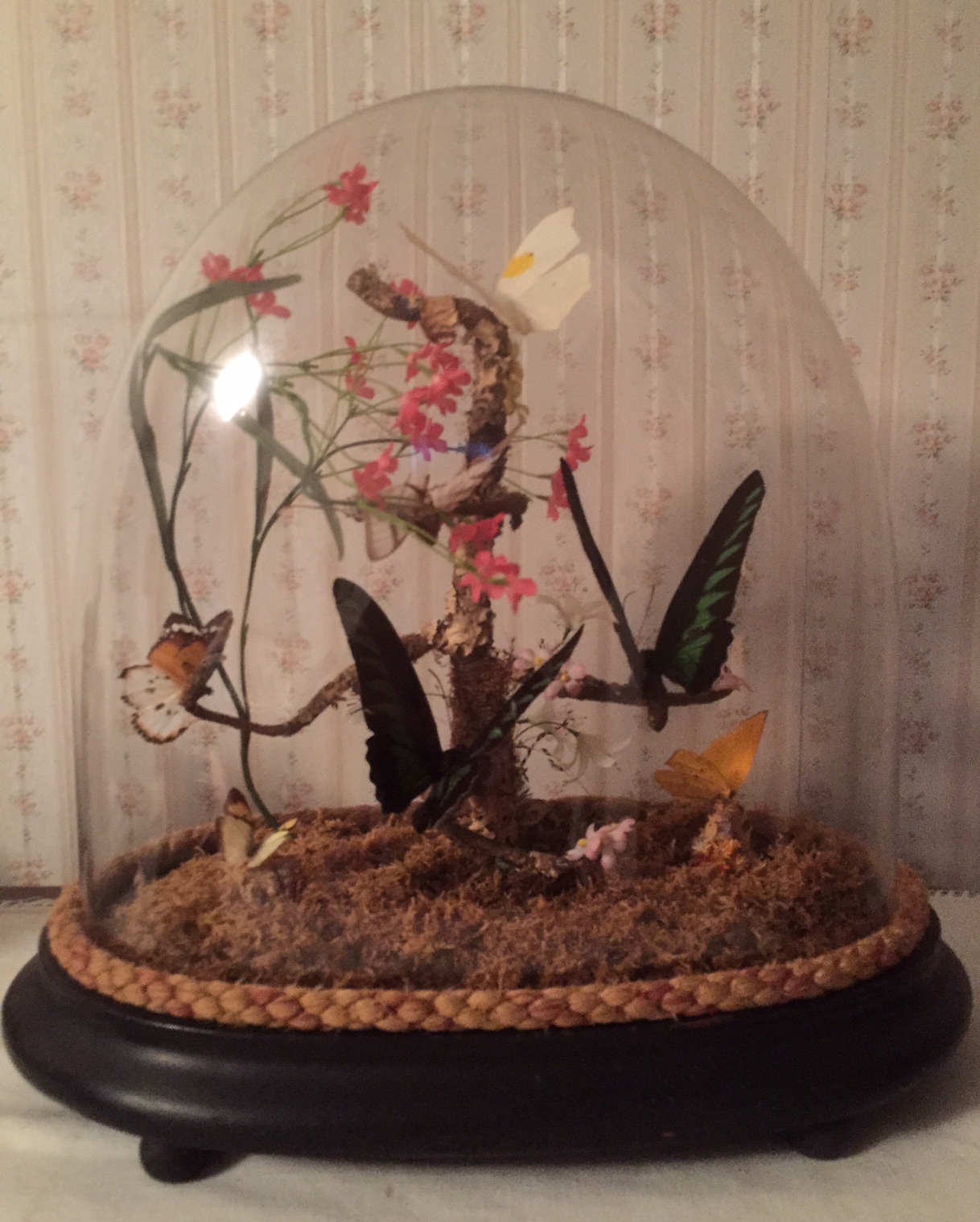
On top of a chest of drawers in Aunt Ruthie’s former bedroom sits a terrarium, a bubbly dome, covering butterflies in suspended animation on branches that rise above a blanket of lichen.
Terrariums, popular during Victorian times, usually contain live plants. Moss, ferns, and other flora thrive in the warm humid environment. During short winter days, weak slants of sunlight draw moisture to the top of the dome during the day, which circulates back down to the soil in the evening, creating a hermetic climate. You can read about the history of the terrarium here. The author features dish terrariums, pickle jar and wine glass terrariums, terrariums with waterfalls.
Grandma Fannie Longenecker had terrariums too, a miniature world of green we peered into when the ground was snow white in winter. Some of her glass containers were cookie-jar shaped, crowned with a knobby top. Others were rectangular and covered with a thin pane of glass.
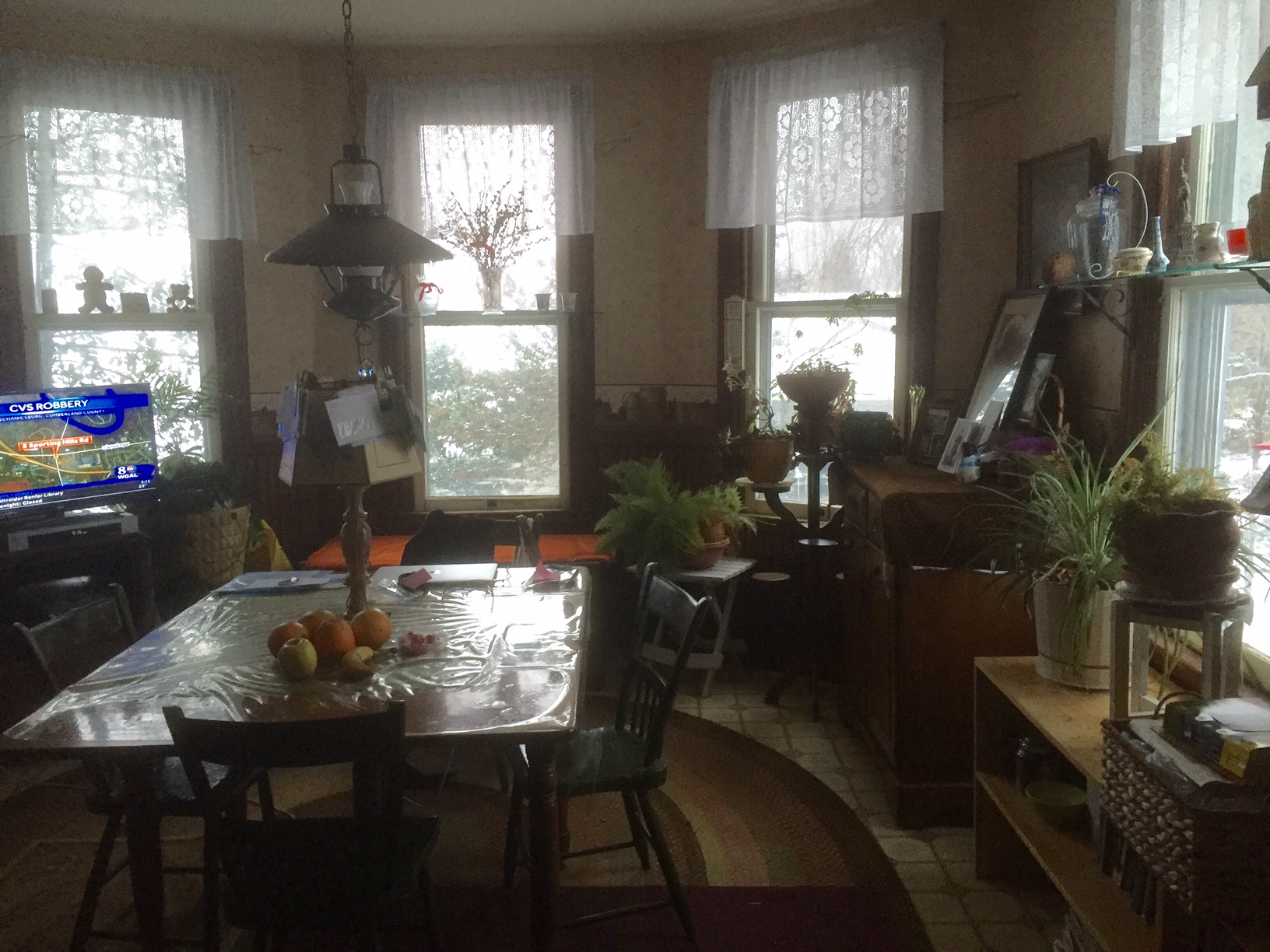
A few ferns, though not in terrariums, still grace the bay windows at Grandma’s house. She never had a TV.
Something else shiny and green I played with upstairs, a little-girl dresser. But now a grown-up girl gazes back at me when I angle the mirror just right.
For now we see only a reflection as in a mirror; then we shall see face to face. Now I know in part; then I shall know fully, even as I am fully known.
~ I Corinthians 13:12 NIV
Daughter Crista’s maidenhair fern under a cloche, bell-shaped
Your discovery this week may not have been a balloon, a dome, or a mirror. It may have been something else. Inquiring minds want to know!
Writers find real life images to compare what happens as they mold life events into stories:
To fabric (thread and weaving)
To clay (molding a lump into a recognizable form)
To construction (building a house from the foundation up)
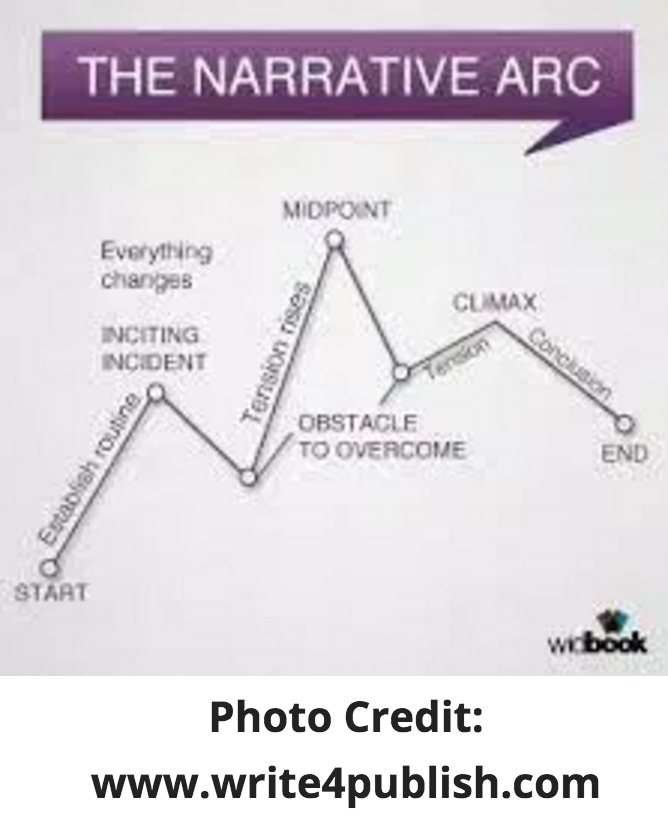
Finding the right shape for telling our story is a critical step in the memoir writing process. Writers call it the narrative arc.
Paging through a photo album of my trip to Switzerland, I have found another metaphor for structuring my memoir: Contours of the Swiss Alps
All photos: Cliff and Marian Beaman
Climbing the Alps fits with the theme and title of Journey of Memoir by Linda Joy Myers and Brooke Warner. “One of the most challenging aspects of writing a memoir, which of course is based on true and real events in your life, is to create a plot out of what happened.” (104)
I know my life story. I don’t have to make up events and characters. Through trial and error, I have decided that my theme is the quest for my true self as a sheltered Mennonite girl growing up in Lancaster County, Pennsylvania.
Still, I have to mold my tale into a story of transformation, one that will grip readers’ imagination and keep them turning the pages.
* * *
Aristotle affirms that every story needs a beginning, a middle, and an end: Act One, Act Two, Act Three.
Stories that intrigue have conflict too. For example, when you saw a play like Our Town or Macbeth, you were transported into another world through exposition, rising action (the story builds), a crisis, a climax, and finally a resolution.
Crisis at midpoint (all seems to be lost) Climax (major conflict narrator must resolve) Conclusion (epiphany – Ah, so that’s it!)
My 7 Steps . . .
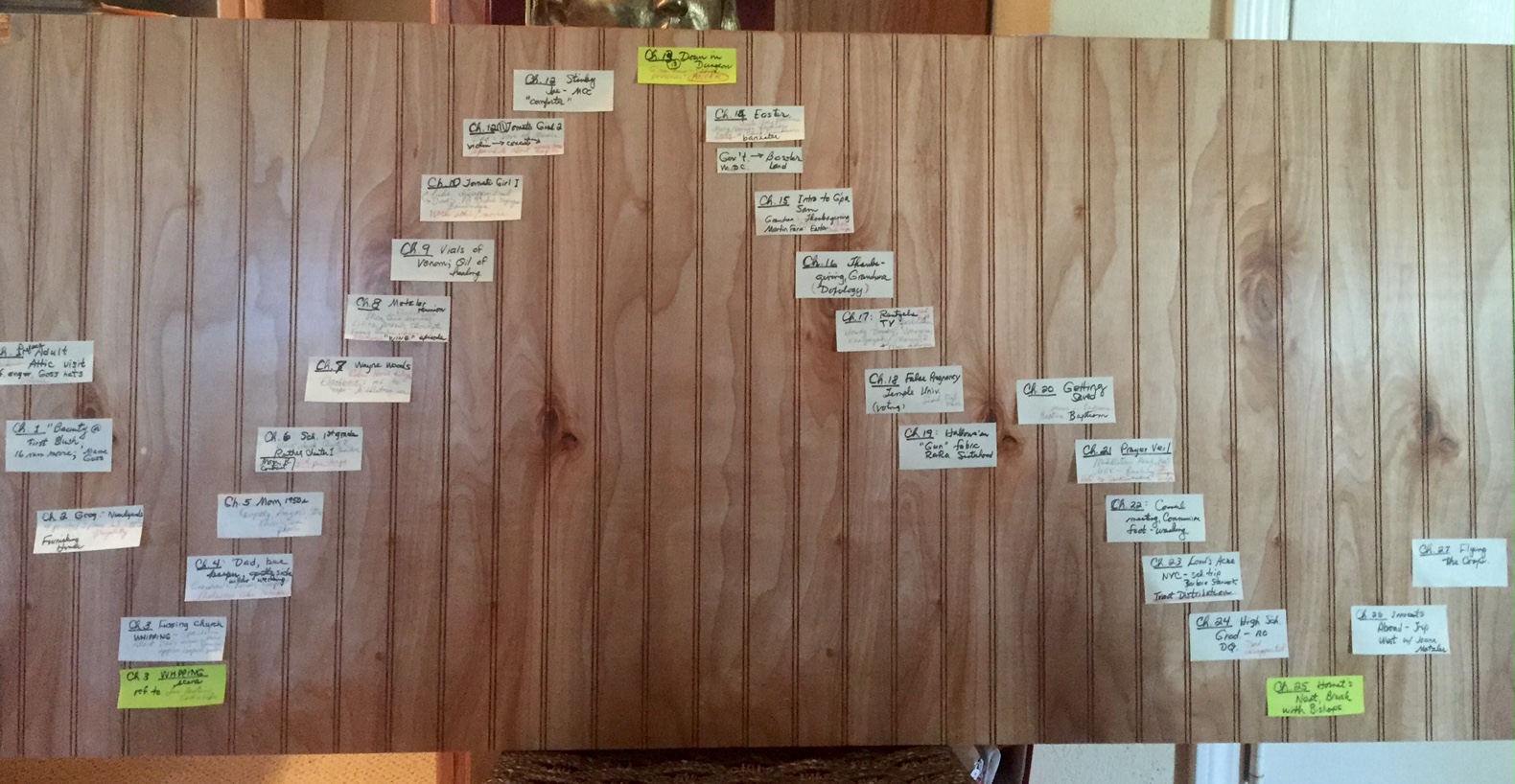
I created a timeline of vivid memories in my life. This is how I hoped to arrive at my turning points, moments of significant change. As I drew, I thought in terms of chronology. What is my first memory? What stands out in elementary school? What family events pop up? Who looms large as a mentor? Answers to these questions could become turning points, I believed.
Then I thought about scenes. On colored stickies I randomly wrote phrases that came to mind. For example: The phrase “Daddy yodeling” could turn into a scene about my sisters and me taking turns singing with Daddy at the piano, relating to the impact of music upon my formative years.
3. Next I gathered random scenes into a sensible order. Writers choose scenes based on how well they relate to their theme, the message of their memoir. For example, a theme can be traveling and what you learned on the journey, recovering from a challenging situation like an illness or abuse, or the struggles of becoming a chef. My own theme can be stated as a question: How can a girl from a sheltered and restrictive Mennonite culture find her place in an emerging new life?
A memoir is not an autobiography. I couldn’t include every detail of my entire life. I selected only those scenes that related to my theme. I write about this in a previous post.
Sometimes I felt stuck. Fatigue sets in on a long climb. Air is more rare as one moves into the higher altitudes (Alp-titude in Swiss terms). Sometimes I felt faint-hearted.
I constructed a narrative arc composed of scenes relating to my theme. A narrative arc can take several forms: curvy like a hill or jagged like the Swiss Alps.
The core of mine turned into an upside-down V-shape, rather like a peak in the Swiss Alps
The sticky notes make it possible for me to move ideas around easily. In fact, I’ve moved some notes into a different order since the photo was taken.
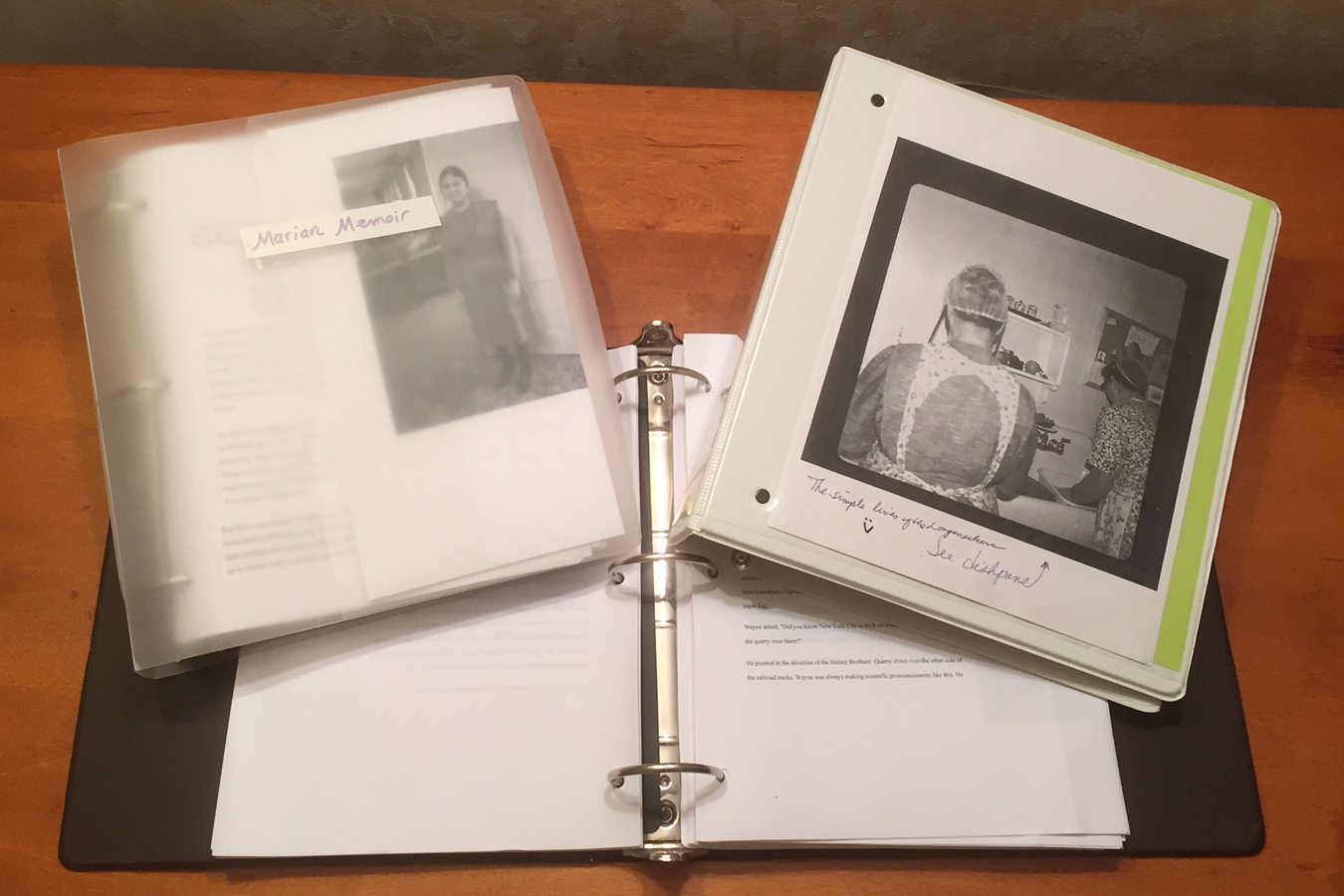
6. I’ve printed out copies of drafts. As I’ve progressed, I’ve stored manuscripts in labeled folders on my computer desktop. But I’ve also printed out copies of my drafts from my laptop because I find it helpful to touch the pages and make marginal notes in colored ink. Pages in the binders feel book-like, real.
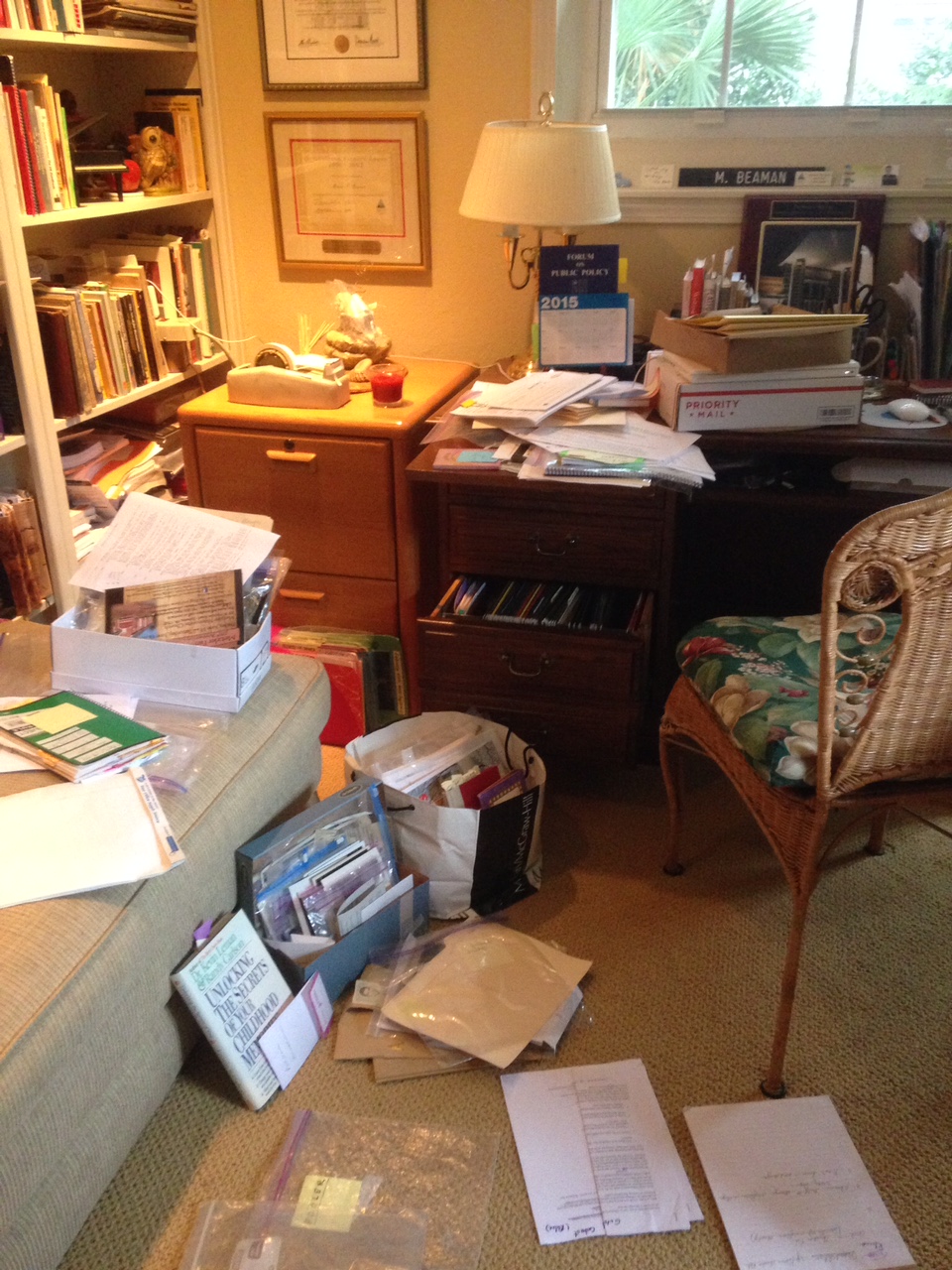
7. I try to overlook messiness in my work space. Generally, I’m a neatnik, but worries about order, except in my writing, distract from my creative process.
So, that’s where I am now!
I began with an impulse to tell my story which progressed from
Journals –> Blog posts –> Memoir Drafts
At the moment, I’m in the muddy middle, aiming to complete the journey across the Alpine-scape of memoir.
More to come . . .
How about you?
Have you made a similar journey with memoir? How would you chart your narrative arc?
Coming next: Moments of Discovery, a Bubble, a Dome, a Mirror
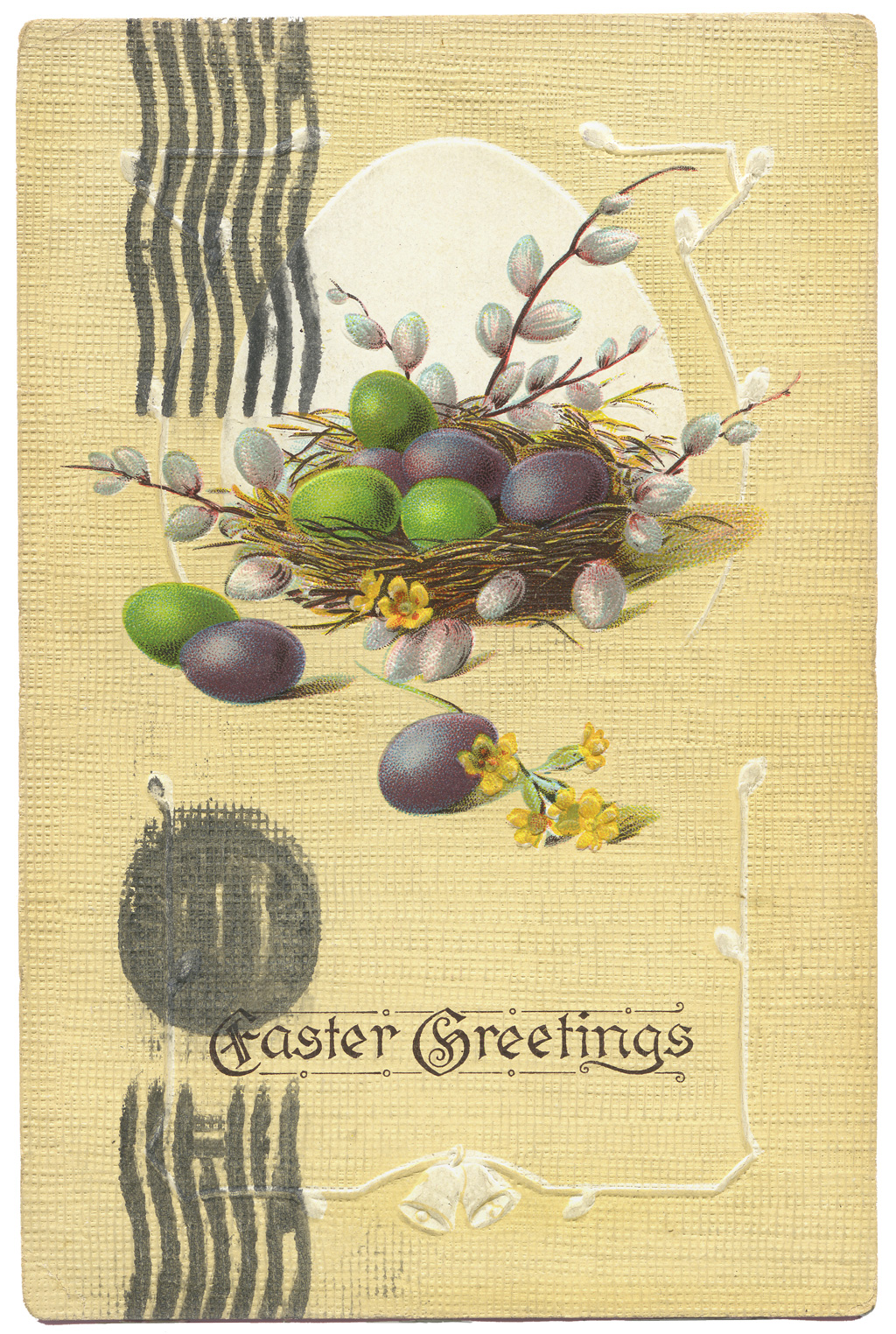
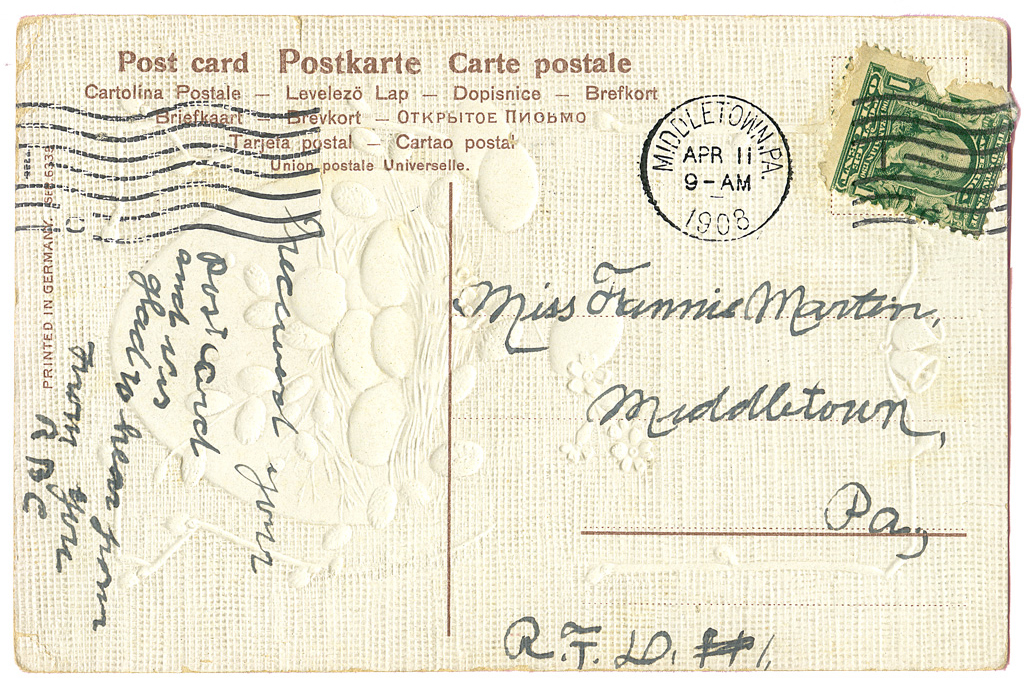
At Easter-tide I’m dipping once again into my Grandma Fannie Martin Longenecker’s stash of vintage post cards. Here is one dated April 1908 from “your RBC,” it says, with the postmark wrapped around the face of the card.
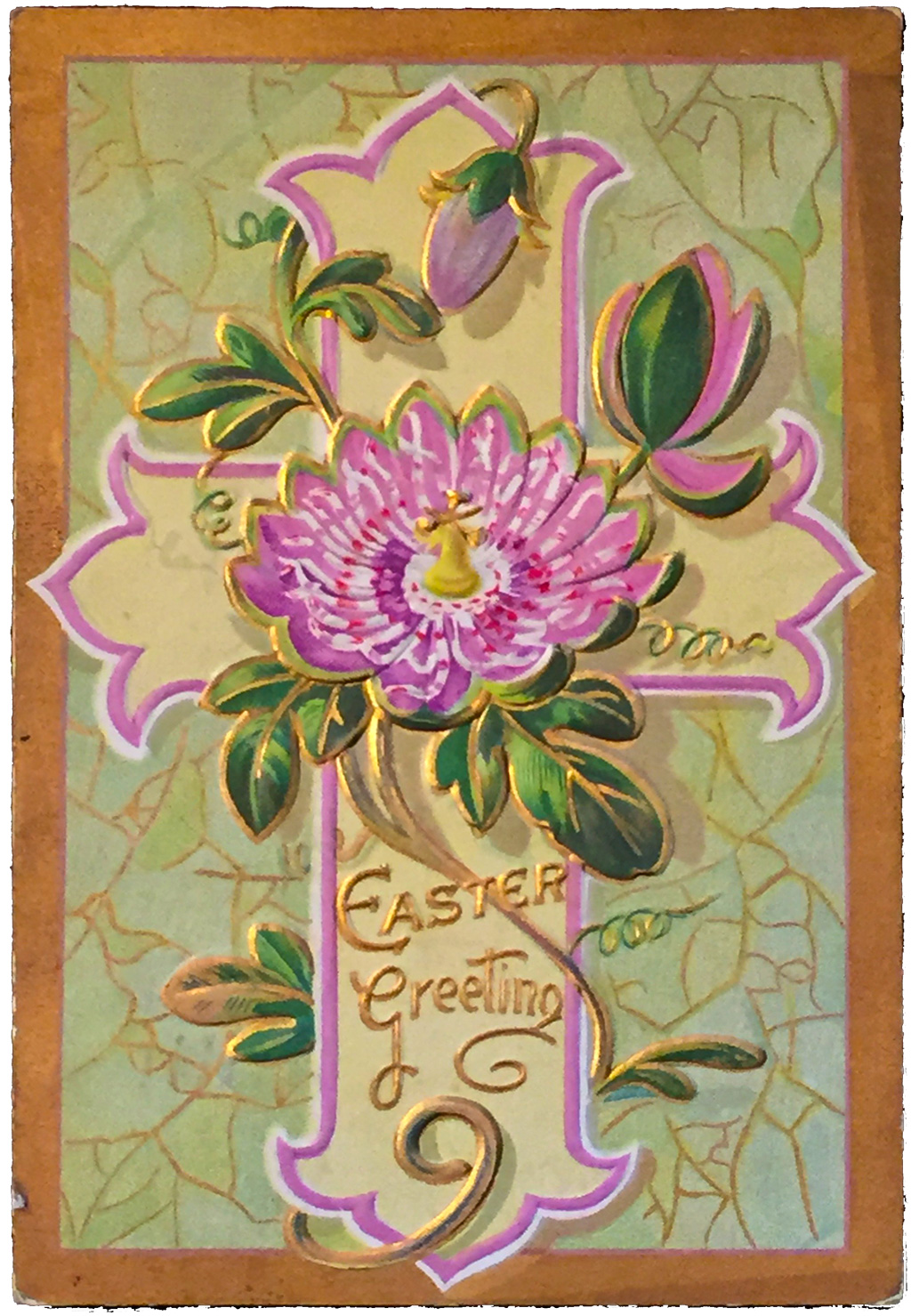
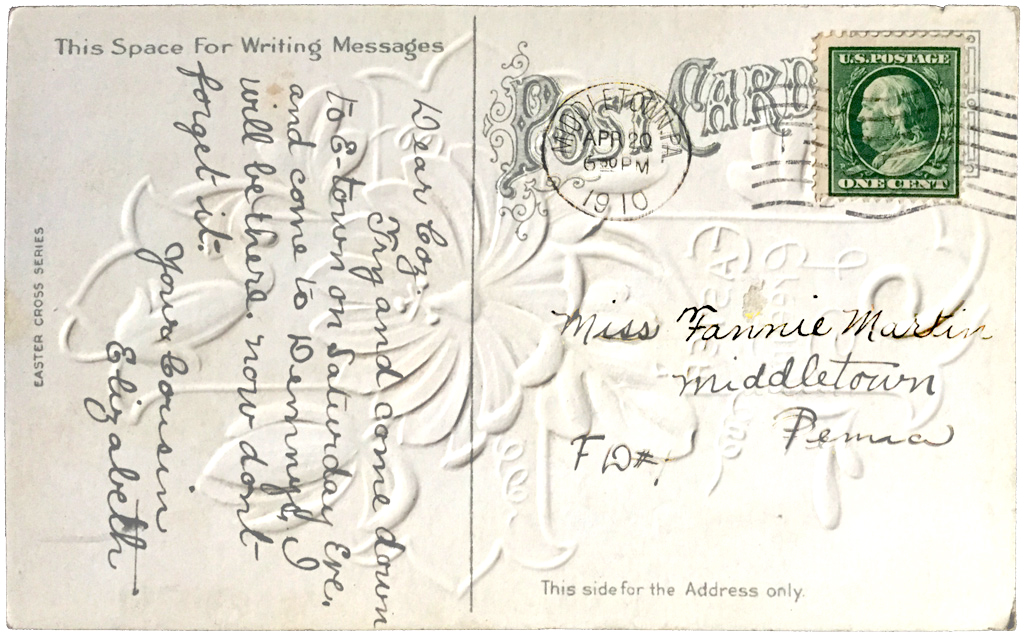
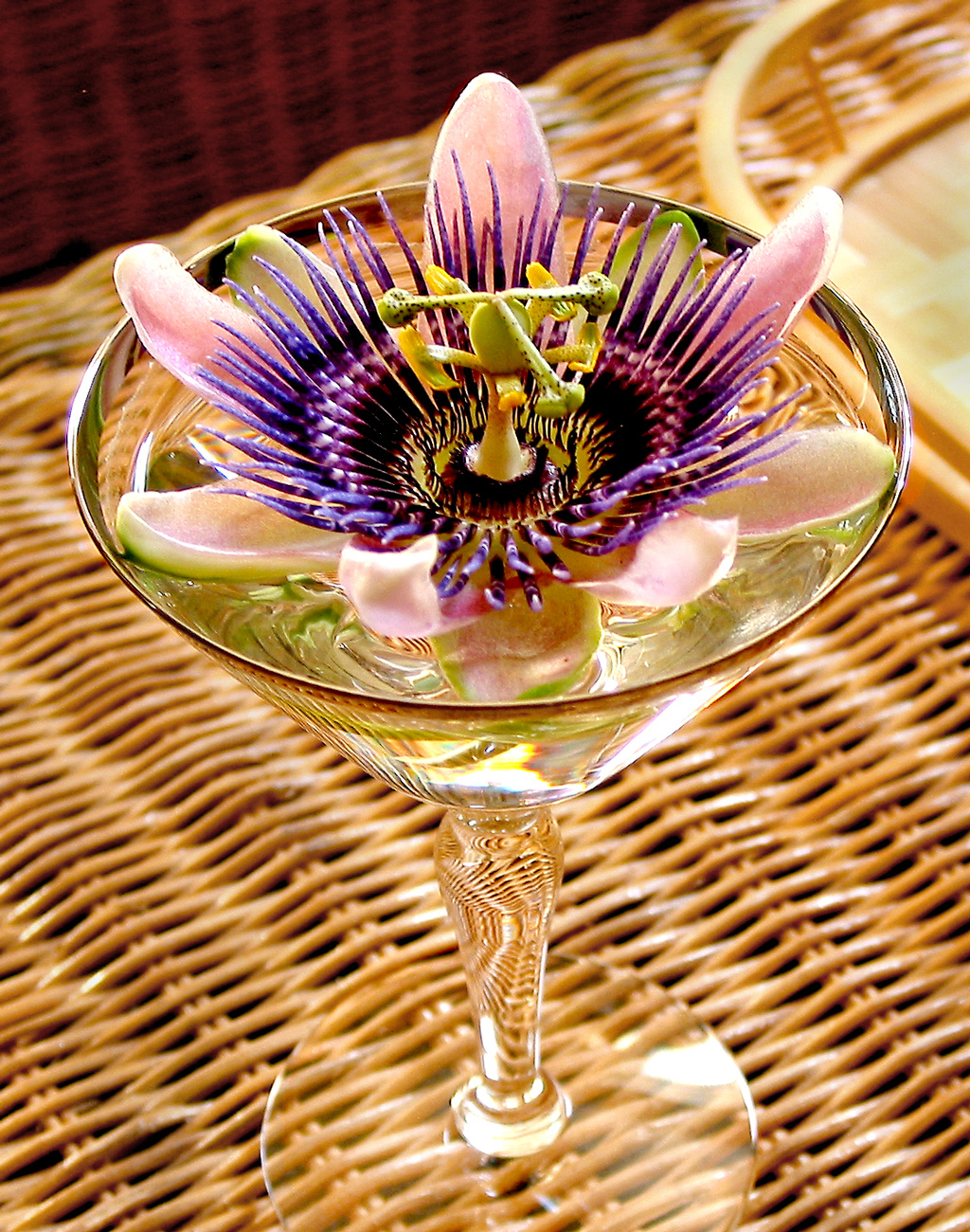
Another, from 1910, displays the marvelous passion flower adorning the cross.
The message from Grandma’s cousin Elizabeth begins with “Dear Coz” and in black flowing fountain-pen ink cursive begs her for a visit: “Try and come down to E-Town on Sat. Eve and come to Demmys. I will be there now don’t forget it.”
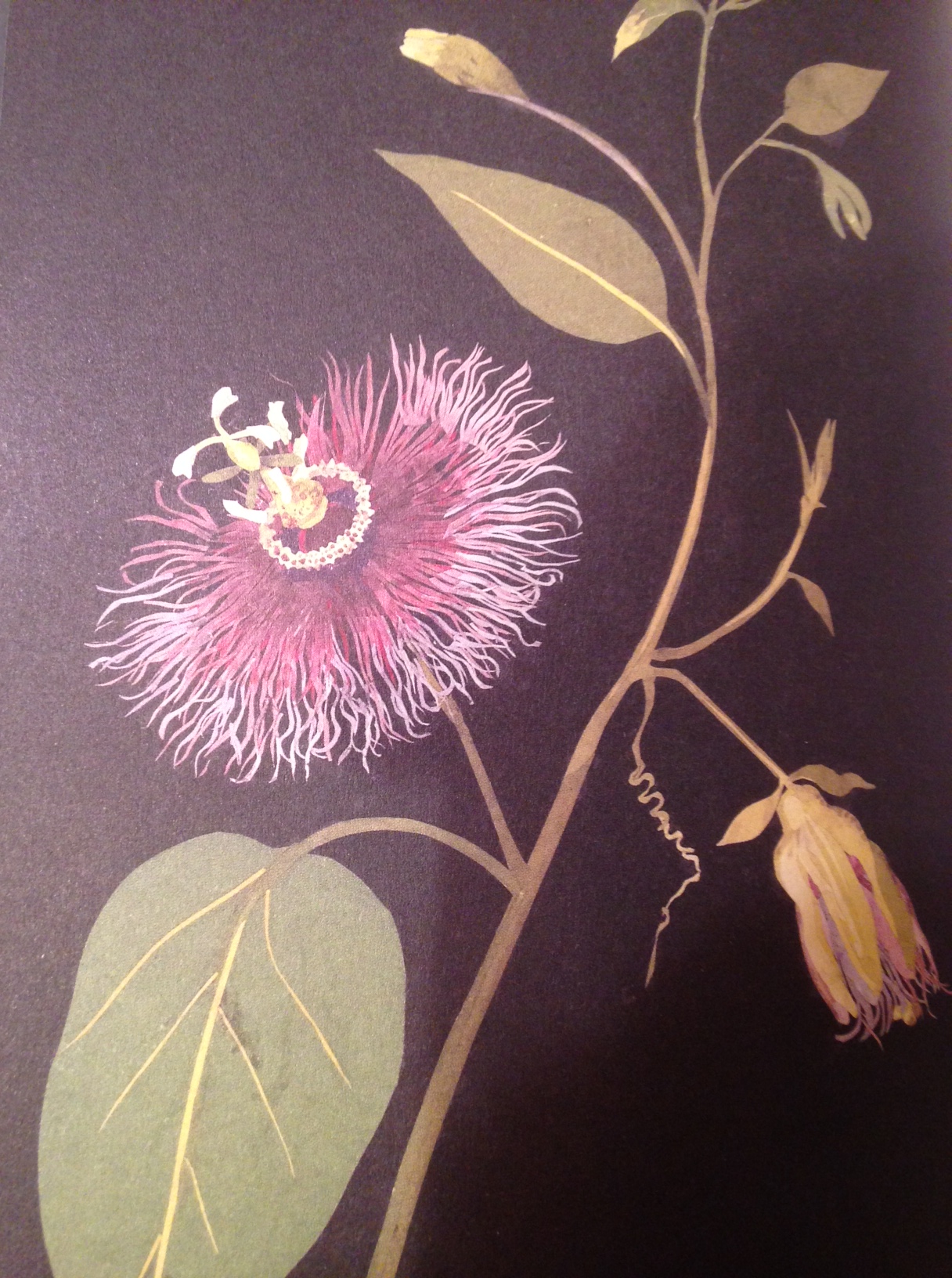
The passion flower which blooms in the spring has come to symbolize the suffering and death of Christ, hence the nickname “passion.” Mary Delany, herself a late-blooming artist, constructed a lovely flower with 230 petals with her scissors art.
The bloom (Passiflora) grown in my garden illustrates the religious symbolism explained below.
One writer, a Franciscan sister, has expressed the meaning of the flower parts in this way.
In the 15th and 16th centuries, Spanish Christian missionaries adopted the unique physical structures of this plant, particularly the numbers of its various flower parts, as symbols of the last days of Jesus and especially his crucifixion:
* The pointed tips of the leaves were taken to represent the HolyLance. * The tendrils represent the whips used in the flagellation of Christ. * The ten petals and sepals represent the ten faithful apostles (less St. Peter the denier and Judas Iscariot the betrayer). * The flower’s radial filaments, which can number more than a hundred and vary from flower to flower, represent the crown of thorns. * The chalice-shaped ovary with its receptacle represents a hammer or the Holy Grail * The 3 stigmata represent the 3 nails and the 5 anthers below them the 5 wounds (four by the nails and one by the lance). * The blue [purple] and white colours of many species’ flowers represent Heaven and Purity.
This is the season of spring, Easter, and Passover. Happy Holy-day to you!
Coming next: Climbing the Swiss Alps: 7 Steps Toward a Narrative Arc
Do you live where Daylight Saving Time has gone into effect recently? If so, today you may feel out of sync, sleep-deprived. The loss of even one hour of sleep pushes one’s biorhythms out of kilter.
Who’s to Blame: Daylight Saving Time
In the wee hours of Sunday clocks moved forward one hour, delaying sunrise and adding evening daylight. According to one source, a New Zealander proposed the modern idea of DST in 1895. Germany followed in 1916. Many other country since then have followed the spring ahead/fall behind routine, especially since the energy crisis of the 1970s.
The time change has been loved or hated ever since. My author friend Janet Givens provides a well-researched blog post on the topic. Her research explodes the myth that Daylight Saving Time is supported by farmers.
Sleep: A Cure
Medical journals including Psychology Today, often publish articles about sleep or the lack thereof. Such pieces also regularly appear in the table of contents of women’s magazine and AARP journals.
Literature is replete with references to sleep. In Shakespeare’s tragedy, Macbeth, who has recently murdered King Duncan, knows his sleep will be troubled or interrupted even as he ruefully ticks off its benefits:
“Sleep that knits up the raveled sleeve of care / The death of each day’s life, sore labour’s bath / Balm of hurt minds, great nature’s second course, Chief nourisher in life’s feast.” Act 2, Scene ii
Sleep repairs the unraveled parts of our lives, knits them up.
Sleep comes at the end of the day; it looks like a little death.
Sleep brings bodily relief from pain as do baths.
Sleep refreshes the mind.
Sleep is essential to life. We can’t do without it.
In Search of Forty Winks, Patricia Marx comments:
party and then firing the cleanup committee. (The New Yorker, February 8, 2016. pages 56. 57)
Ben Franklin and the Bible on Sleep
Early to bed and early to rise makes a man healthy, wealthy and wise. ~ Benjamin Franklin
The sleep of a laboring man is sweet, whether he eat little or much: the abundance of the rich will not suffer him to sleep. ~ Eccl. 5:1
Sleeping Child
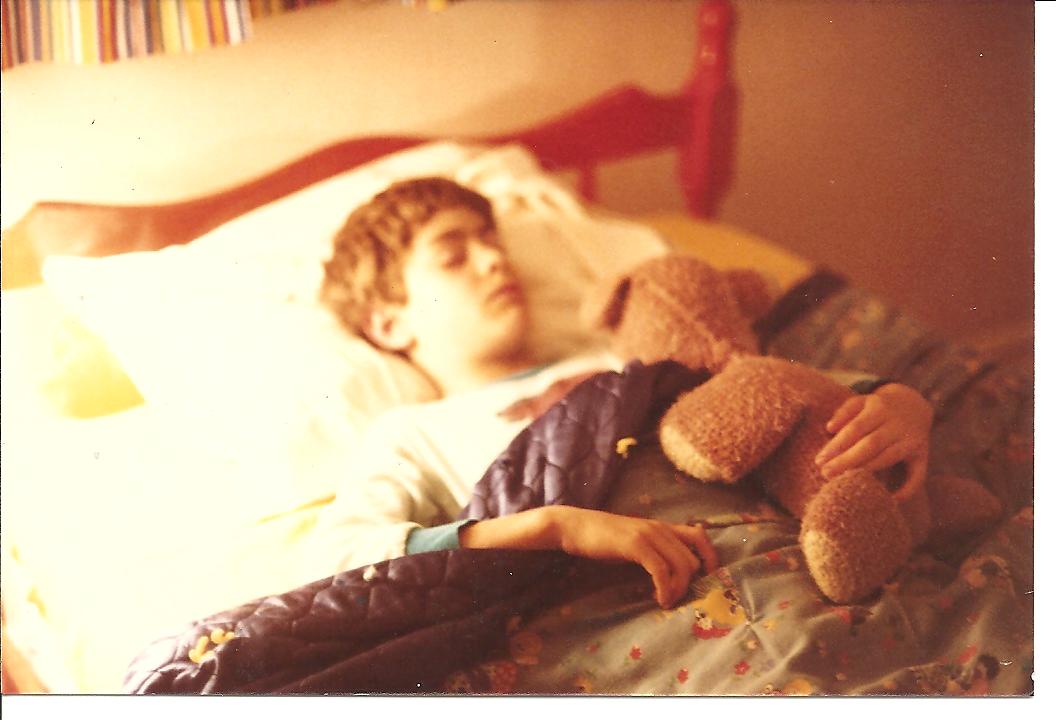
Joel sleeping with teddy bear, age 8 or 9
Our son Joel was fast asleep embracing his teddy bear knitted by his Great Aunt Ruthie. He may have been dreaming of riding his skate board or playing with match-box cars. As a nine-year-old, he was certainly not worrying about caring for children, the needs of a wife, mortgage payments, or at-work performance.
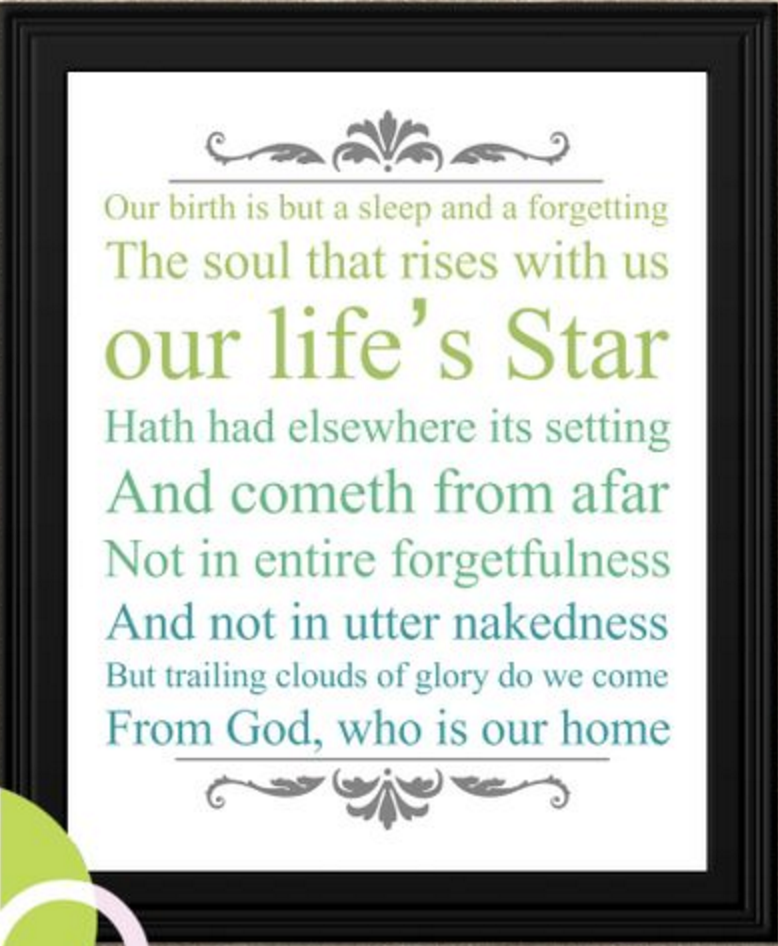
Wordsworth offers a philosophical perspective on sleep:
Ode: Intimations of Immortality, William Wordsworth Source: Pinterest
Here is the first stanza of a nursery rhyme Joel probably heard before he fell asleep:
Wee Willie Winkie runs through the town,
Up stairs and down stairs in his night-gown,
Tapping at the window, crying at the lock,
Are the children in their bed, for it’s past ten o’clock?
Comments about sleep, advice about getting more of it? Your wisdom welcome here. All creatures need down time, even inanimate ones. Note that there is a sleep button on your computer, just above re-start.






















 Plain and Fancy