Going Male: Amish Romance Novels

AmishBlacksmith

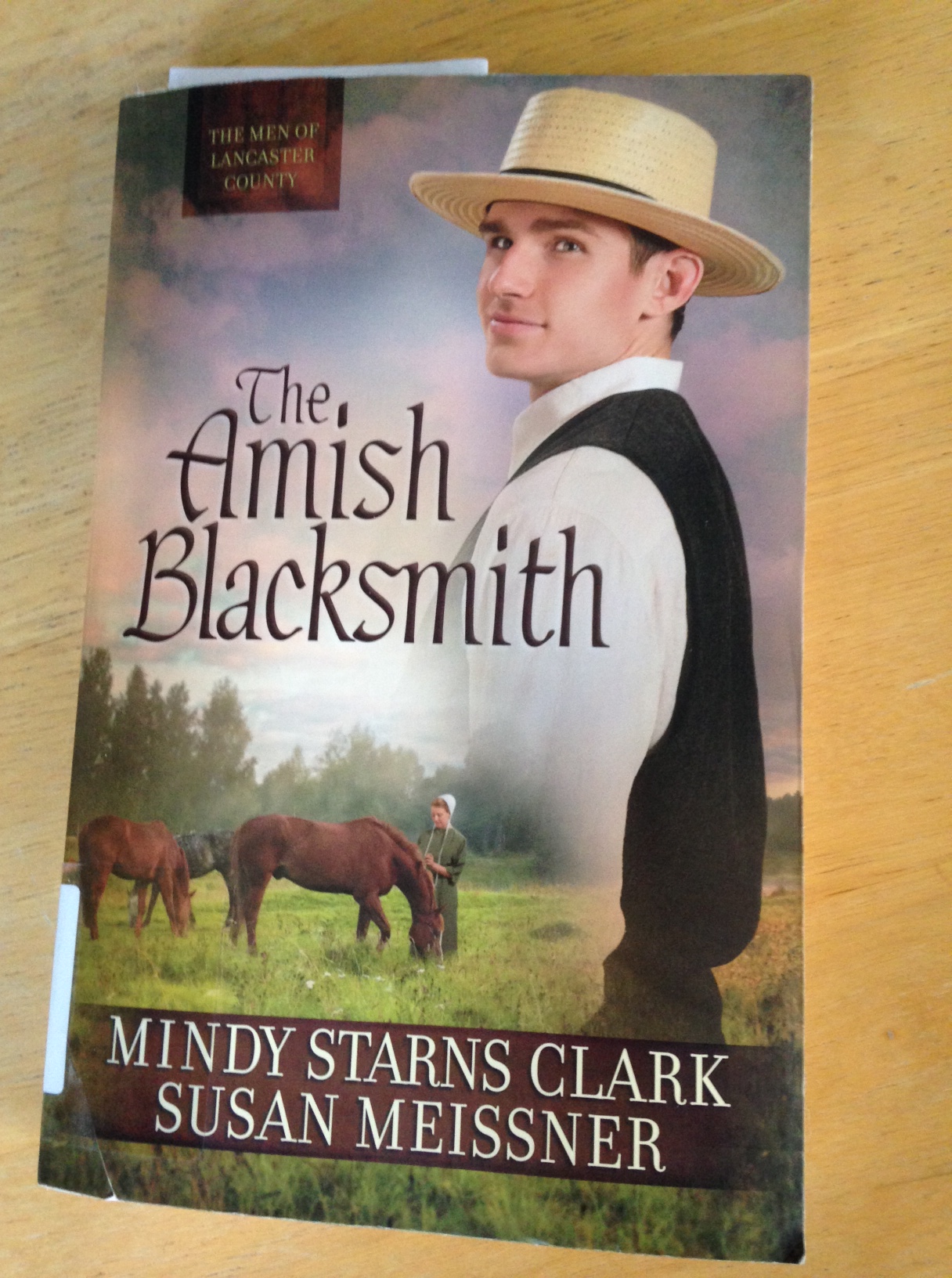
Cool Amish guys have replaced the dreamy looking girl with a huge covering and plain dress popular on the cover of some Amish romance novels. The images have done a flip. Now the young Amish-man with suspenders and broadfall pants and straw hat takes center stage.

Last week I finished reading my second Amish romance novel ever. These novels, usually with a female main character on the cover, are still wildly popular and stock shelves at Barnes & Noble and Amazon warehouses to the hilt.
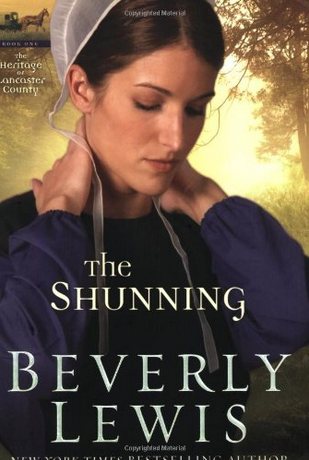
Cover image via Amazon

Truthfully, I have resisted reading these novels for two reasons:

  • The plots seem formulaic to me: there’s a lover’s triangle, often with an “Englischer” from the tempting world beyond the farm.
  • Also, I have lived an authentic Mennonite life, and some plot-lines and details about the characters seem barely plausible.

Still, I took the time to read The Amish Blacksmith, starring a handsome dude named Jake on the cover with a plain Amish girl, grooming a horse in the misty background. I was curious about two things: the new trend in Amish romance fiction with a male protagonist plus the high profile of the authors within this sub-genre: Mindy Starns Clark, who has published more than 20 books including the Christy Award-winning The Amish Midwife and co-author Susan Meissner, whose novel The Shape of Mercy was named as one of the 100 best novels of 2008 by Publisher’s Weekly.

With five novels in the Women of Lancaster County Series (Mindy Clark and Leslie Gould). Clark and Meissner have begun the Men of Lancaster County Series: The Amish Groom, The Amish Blacksmith and mostly recently, The Amish Clockmaker.

Here’s a thumb-nail of The Amish Blacksmith from Goodreads:

Apprenticed blacksmith Jake Miller is skeptical of Priscilla Kinsinger’s innate ability to soothe troubled horses, especially when he has own ideas on how to calm them. Six years earlier, Priscilla’s mother died in an awful accident at home, and Priscilla’s grief over losing her mother was so intense that she was sent to live with relatives in Ohio. She has just returned to Lancaster County.

Not that her homecoming matters to Jake, who is interested in courting lighthearted Amanda Shetler. But Jake’s boss is Priscilla’s uncle, and when the man asks Jake to help his niece reconnect with community life, he has no choice but to do just that. Surprisingly, he finds himself slowly drawn to the beautiful but emotionally wounded Priscilla.

Jake then determines to prove to her that it’s not her fault her mother died, but what he discovers will challenge everything they both believe about the depth of love and the breadth of forgiveness.

Though the pace of the book slowed toward the end, I found the book a satisfying read. It is certainly more pleasurable to gain equestrian knowledge via a novel than from an equine textbook. In fact, the authors give credit to the Riehl and Fisher families of Lancaster County for helpful on-the-farm visits and to Elam and Elias Stoltzfus, for sharing their knowledge in their own Amish blacksmith shop. I applaud the authors too for their extensive research on horsemanship, particularly horse-whispering. I felt myself being both educated and entertained as I read.

Interestingly, male readers admit to enjoying Amish romance novels too. Valerie Weaver-Zercher reports in her book Thrill of the Chaste that an elderly farmer, Glenn Swartzendruber read almost ninety Amish-themed novels during the last three years of his life. And “a physician with degrees from Harvard and the University of Pennsylvania shared that he enjoyed listening to the audio version of Beverly Lewis’s [Amish} novels.” (249)

Do you enjoy Amish romance novels? Tell us why or why not. Do you know any men who read them?

Coming next – 4 Months, 4 Gifts: A Tribute to My Dad
Purple Passages: Secrets of Grimke House, Charleston

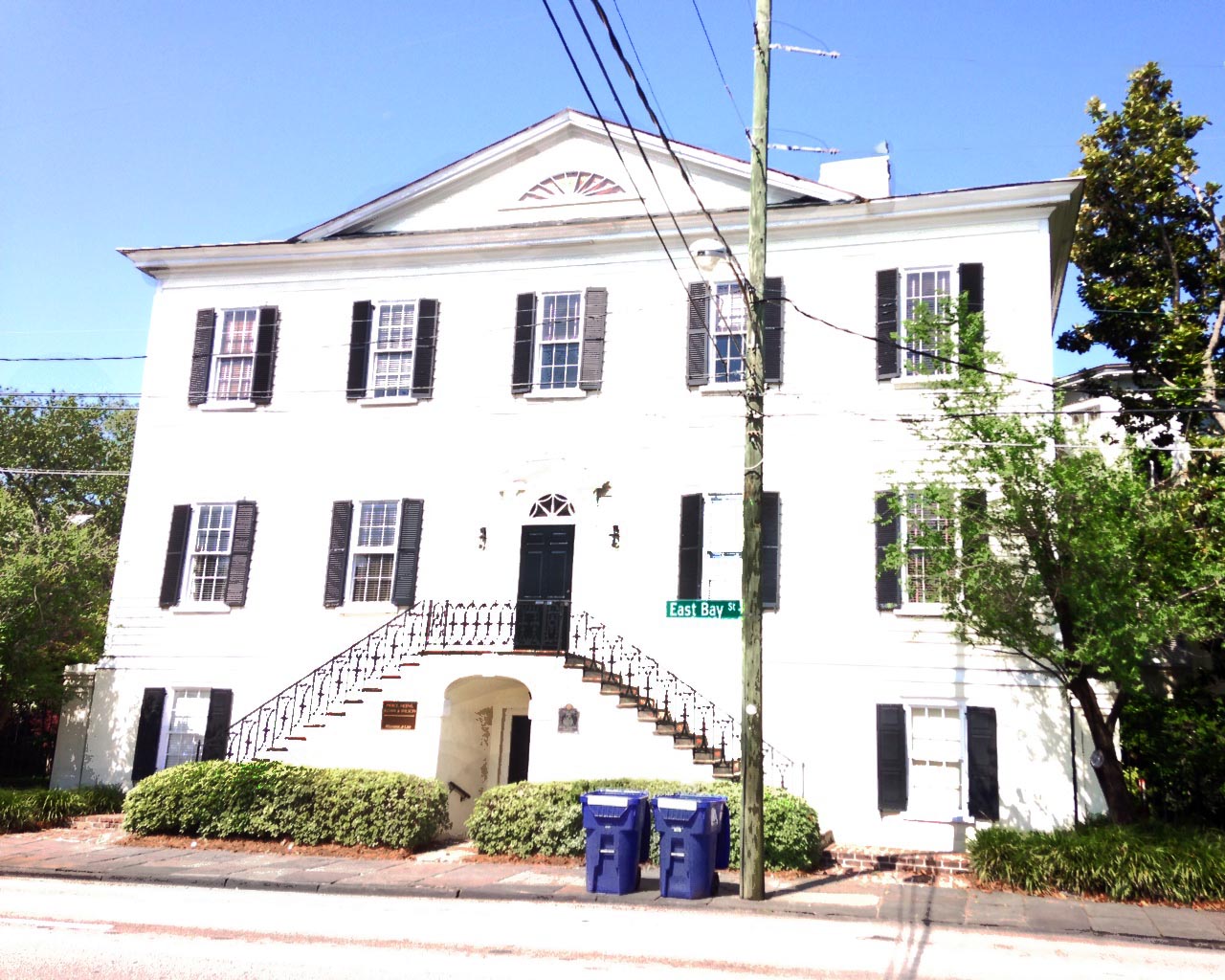
“Heidi, would you mind stopping by 329 East Bay Street before we leave town?”

We were on our way out of Charleston during our recent road trip, and my niece Heidi graciously agreed to stop her SUV long enough for me to catch a snapshot of the Grimké House basking in the bright morning sun. Its open arms-double staircase once welcomed visitors with a hospitable hug. (Until recently it housed attorneys’ offices, so you can draw your own conclusion about its more recent history!)

Grimke House_Charleston_mod

This house was made famous by Sue Monk Kidd’s book of historical fiction The Invention of Wings. Here is an excerpt from my review:

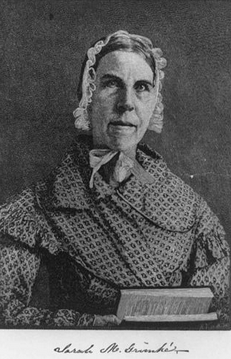
“ . . . the novelist creates parallel stories representing two strata of early nineteenth-century America, alternating chapters with the voices of two engaging characters: the aristocratic Sarah Grimké and the hand-maid (creative name for slave) assigned to her, Hetty Handful Grimké. Kidd’s sweeping novel is set in motion on Sarah’s eleventh birthday, when she is given ownership of ten-year-old Handful. Over the next thirty-five years, both strive for a life of their own ‘bucking the constraints of cultural attitudes toward women and slavery, which Sarah and her sister openly challenged.'”

All the purple passages quotes today are pulled from the pages of The Invention of Wings, Sue Monk Kidd’s historical fiction about the Grimké family:


The Weather

“I slipped through the back door into the soft gloom, into the terror and thrill of defiance. The sky had gone cobalt. Wind was coursing in hard from the harbor.” (50)

(We experienced a Charleston, SC storm downtown as we entered this city May 7, 2015)


Mosquitoes

Mother Mary had ordered “the mosquito netting out of storage and affixed above the beds in anticipation of the blood-sucking season, but having no such protection, the slaves were already scratching and clawing their skin. They rubbed themselves with lard and molasses to draw out the itch and trailed its eau de cologne through the house.” (56)

(Disparity between the races no longer noticeable in Charleston today, at least to tourists. )

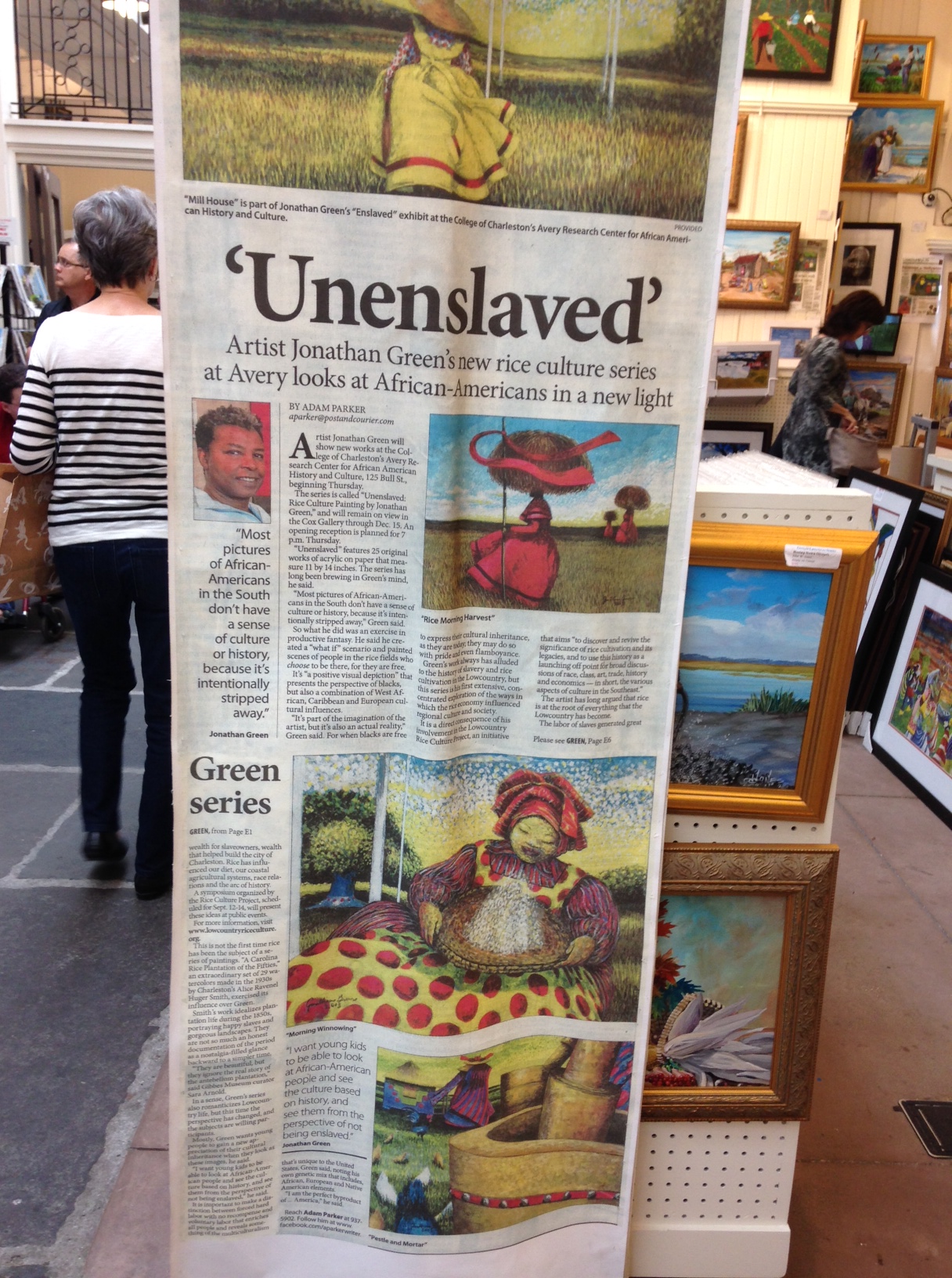
Wall-hanging on sale in Charleston on Market Street


Despair

“My breath clutched at my ribs like grabbing hands. I closed my eyes, tired of the sorry world.” (280)


Missing Someone

Sarah’s unrequited love: “Nina was speaking now, her face turned up to Theodore’s, and I thought suddenly, involuntarily of Israel and a tiny grief came over me. Every time it happened, it was like coming upon an empty room I didn’t know was there, and stepping in, I would be pierced by it, by the ghost of the one who once filled it up. I didn’t stumble into this place much anymore, but when I did, it hollowed out little pieces of my chest.” (281)


Yearning for a better world

[Lucretia] “leaned toward me. ‘Life is arranged against us, Sarah. And it’s brutally worse for Handful and her mother and sister. We’re all yearning for a wedge of sky, aren’t we? I suspect God plants these yearnings in us so we’ll at least try and change the course of things. We must try, that’s all.’” (275)


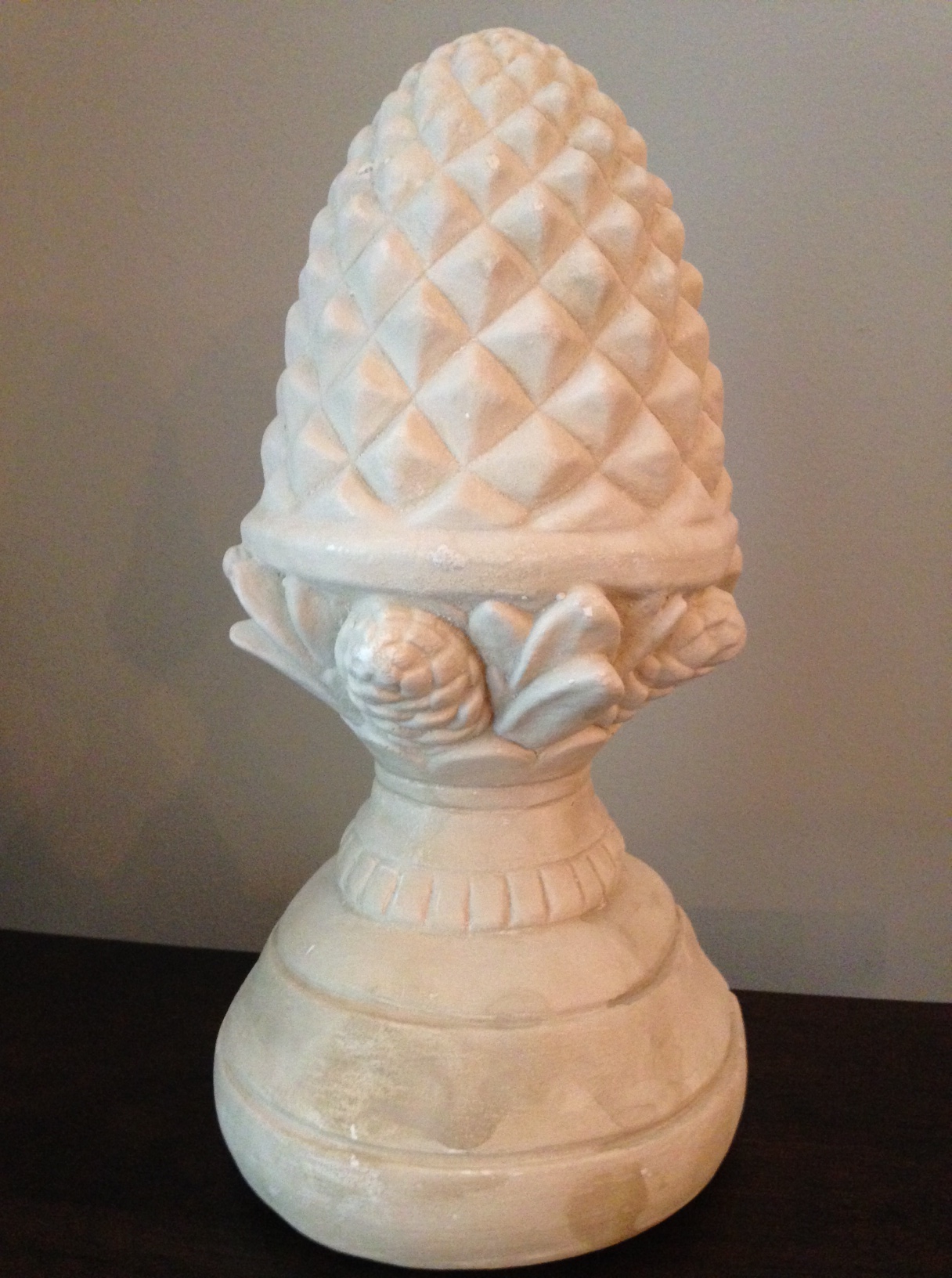
The Pineapple: the universal symbol of hospitality seen everywhere in Charleston's interiors and exteriors
The Pineapple: the international symbol of hospitality seen frequently in Charleston’s interiors and exteriors. Daughter Crista purchased a pair of these.

 We must try, that’s all!

Share your words: your thought, a quote or story adds to the conversation. It’s always nice to meet you here!

Coming next: Jenna’s Rainbow Cake: A Pot of Gold?

My Little Black Bookends Tell All

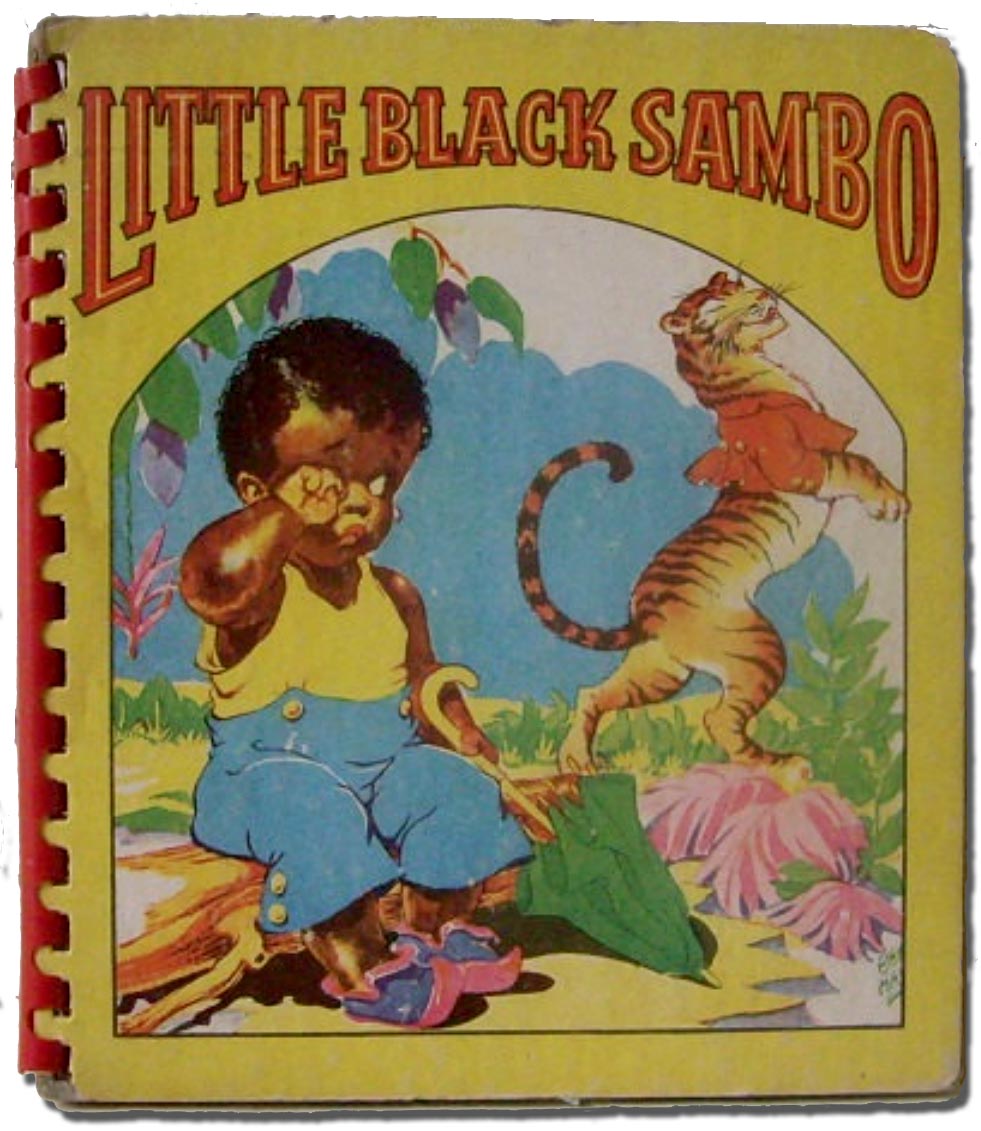
Growing up in rural Lancaster County in the 1950s, I had very little opportunity to meet people of other ethnic groups, but I did have a Little Black Sambo book that introduced me to a culture different from mine. So, I have not always been embarrassed by this book. Fascinated, yes, but embarrassed, no. The picture of the tiger running around an African palm tree as the tiger morphed into a golden round pool of butter mesmerized me as a child, butter that would become one of the ingredients of the pancake recipe. The next page shows Black Sambo’s mother Black Mumbo with her glossy brown arm stirring a mound of melted butter making pancakes. The picture made me hungry. And on the last page:

Little Black Sambo_pancake_web shot

And then they all sat down to supper. Black Mumbo ate twenty-seven pancakes, Black Jumbo ate fifty-five. But little Black Sambo ate a hundred and sixty-nine because he was so hungry!!! (Yes, there are three exclamation marks in the book I am holding.) 

Characters in folktales are typically overblown, with exaggerated details like Little Black Sambo’s super big eyes, through which he gazes at three heaping plates of pancakes with a pot of syrup dribbling all over the table. Obviously, he is ready to stuff his mouth with piles of pancakes.

But there are other tales in the book with the Little Black Sambo cover: The Little Red Hen, The Tale of Peter Rabbit, and The Country Mouse and The Town Mouse. Mr. McGregor and the kitchen maid in the “Mouse” story have white faces, but there is no reference to their whiteness. Their race is assumed as white and therefore not particularly notable.

Little Black Sambo_Cover_web shot

I paged through this book recently as we cleared out books in Mother’s house and marveled at the stereotypes about black people back then and was embarrassed by it: A black woman with a big butt and goofy name wearing a “maid” cap on her head, black people eating nothing but fried foods, everyone eating too much.

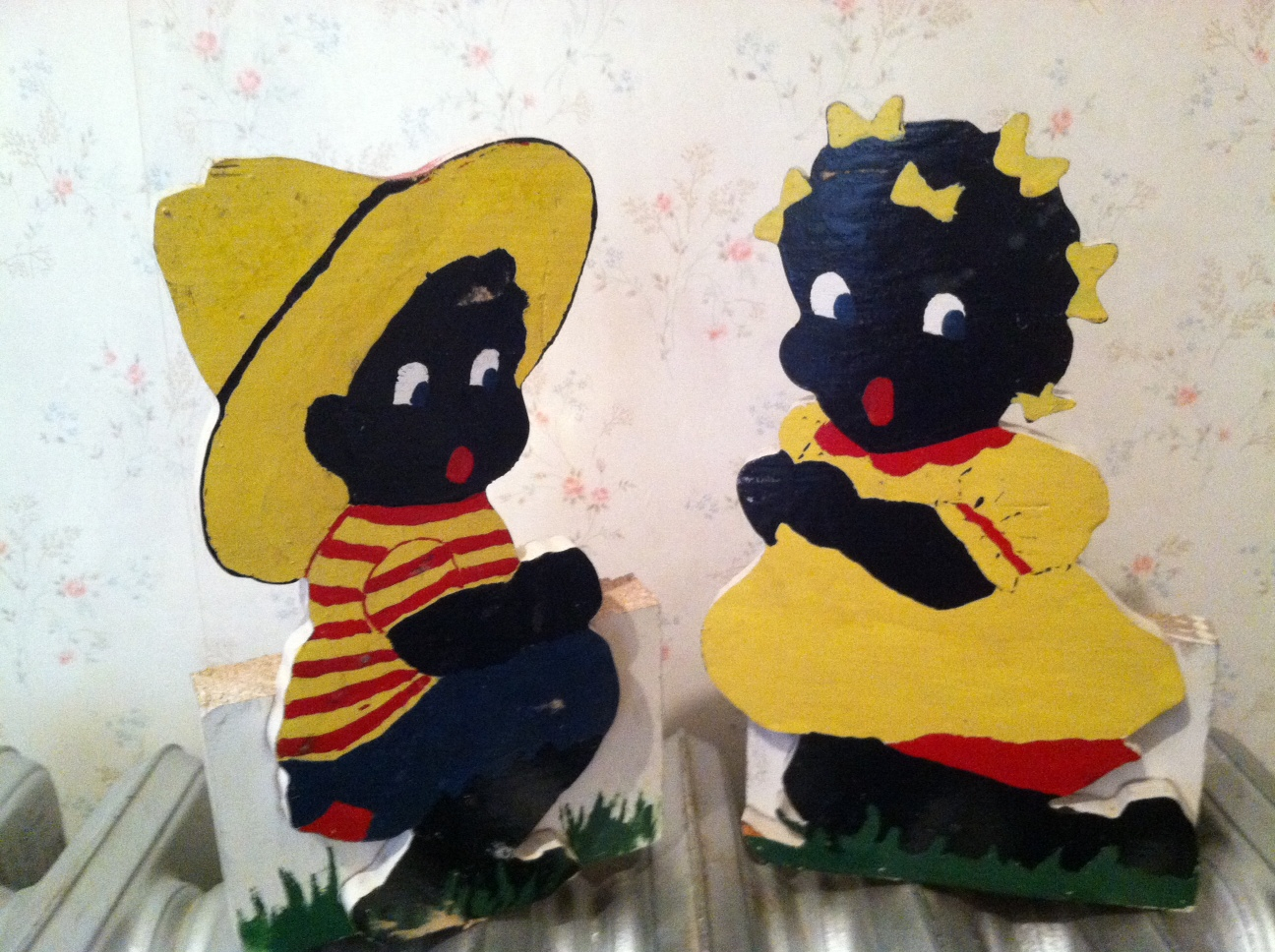
Another find un-earthed in our sifting through “Stuff” – a pair of book-ends I made in school that portrays black children as a novelty.

blackBookends

Interestingly, my niece Shakeeta, my brother Mark’s daughter, choose these as one of the few things she wanted as a remembrance from her Grandma Longenecker’s house. She hoists them up with a smile here:

KiKiBlackBookends

I guess it’s time I catch up with the times and adjust my ideas about black memorabilia. Singer Anita Pointer certainly has. In an article entitled “A Lesson in History,” (AARP Feb/March 2015) Anita, one of the Pointer Sisters, says she collects black memorabilia so she’ll never forget how her people were once depicted.

BlackMemorabiliaAARP

We grew up in Oakland, California, but when I was 10 we visited my  grandma in Arkansas. I couldn’t believe how people were living there. They had a white and a black part of town, and you stayed off the white side. At the department store, they had colored and white water fountains. I don’t want to ever forget that’s what it was like for us — and collecting black memorabilia is how I do that.   (66)

Like Whoopi Goldberg and Spike Lee, Anita collects black memorabilia as museum pieces including a “Mammy” cookie jar, and a 1970s John Henry whiskey decanter made by Jim Beam. When the prestigious house of Sotheby’s came to appraise her collection, it took a year to sort and categorize it. She comments, “The appraiser said that I could pretty much charge what I want because most of the pieces are one of a kind.”  In the end, Anita Pointer sees her collection of thousands of pieces as part of her personal history. She doesn’t apologize for any of it.

Of course, I’m hanging onto my Little Black Sambo book. It’s a part of my personal history.

Your comments welcome here!

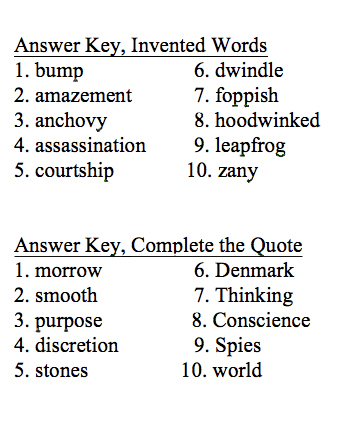
(Answers to Shakespeare puzzlers from April 22, 2015 post below.)

Answer Key2_mod

What’s Your Name Again?

My name is Marian. What’s yours?

A familiar greeting . . .

Names have always fascinated me. I’ve even written about names and naming in previous posts:  What’s in a Name? and The Name Game.

But what about name changing? Celebrities, like actors, musicians and other entertainers have changed their names as a way disguise their ancestry, make a statement or achieve a unique identity.

In mid-century, British-sounding names in the entertainment industry were thought to be more appealing to the public than Slavic, German or Jewish-sounding names. Thus . . .

Robert Allen Zimmerman →  Bob Dylan

Issur Danielovtich Demsky → Kirk Douglas

Helen Lydia Mironoff →  Helen Mirren

Entertainer Whoopi Goldberg apparently began life as Caryn Elaine Johnson.

Dancer Fred Astaire was once Frederick Austerlitz.

Actor Ben Kingsley’s birth certificate reads “Krishna Pandit Bhanji.”

Lady Gaga’s Italian heritage is revealed in her birth name, Stefani Joanne Angelina Germanotta and Jennifer Anniston’s Greek ancestry in Jennifer Anastassakis.

Vanilla Ice probably signed his grade school papers as Robert Van Winkle.

The suave designer Ralph Lauren was once Ralph Lifshitz!

My maiden name was Longenecker, which was changed to Beaman when I married. As a teacher, I would tell students how to spell my name using the 3-little-words approach: Be-a-man. Very rarely was my last name misspelled.

However, my first name (Marian) apparently is tricky to spell. It is often misspelled and in a number of puzzling variations. People with PhDs (not you of course!) and book authors (again, not you!) are the most frequent offenders. Yes, I’ve kept track of them – ha!

Names_variation of Marian_Envelop_8x5_300

Marion

Marianne

Mariam

Miriam

Marrian (on a name card at a dinner by a computer that stuttered)

Mariana

Marina

Miram

No wonder John Wayne is no longer MariOn Morrison!

TruckMariam


Can you add any other interesting name changes to the ones above? Maybe you have some examples of strange naming or spelling from your own family . . .

P.S. Even if you mangle the spelling of my name, we’ll still be friends. That’s a promise!  😉

What is a Name_Marian

Coming next: Purple Passages with the Bard of Avon

Button, Button, Who’s Got the Button?

Do you lose things? Misplace your glasses, keys, cellphone, or worse?

A few weeks ago I saw advertised a bit of wizardry called TrackR bravo, a coin-sized, wireless device that attaches to anything you want to track. The two wholesome-looking, geeky guys who invented it claim it can find lost items in seconds. However, it is still in production and won’t be available just yet.

Here is a bit of verse contributed by husband Cliff on the occasion of his un-earthing treasures long forgotten in drawers, filing cabinets, and notebooks. These lines dated January 2004 were inspired by his discovering a plastic container of leftover artichoke dip, with mold growing on top, tucked inside an enclosed green sandwich cooler bag, hanging quietly for a day or two on the back of a kitchen chair.

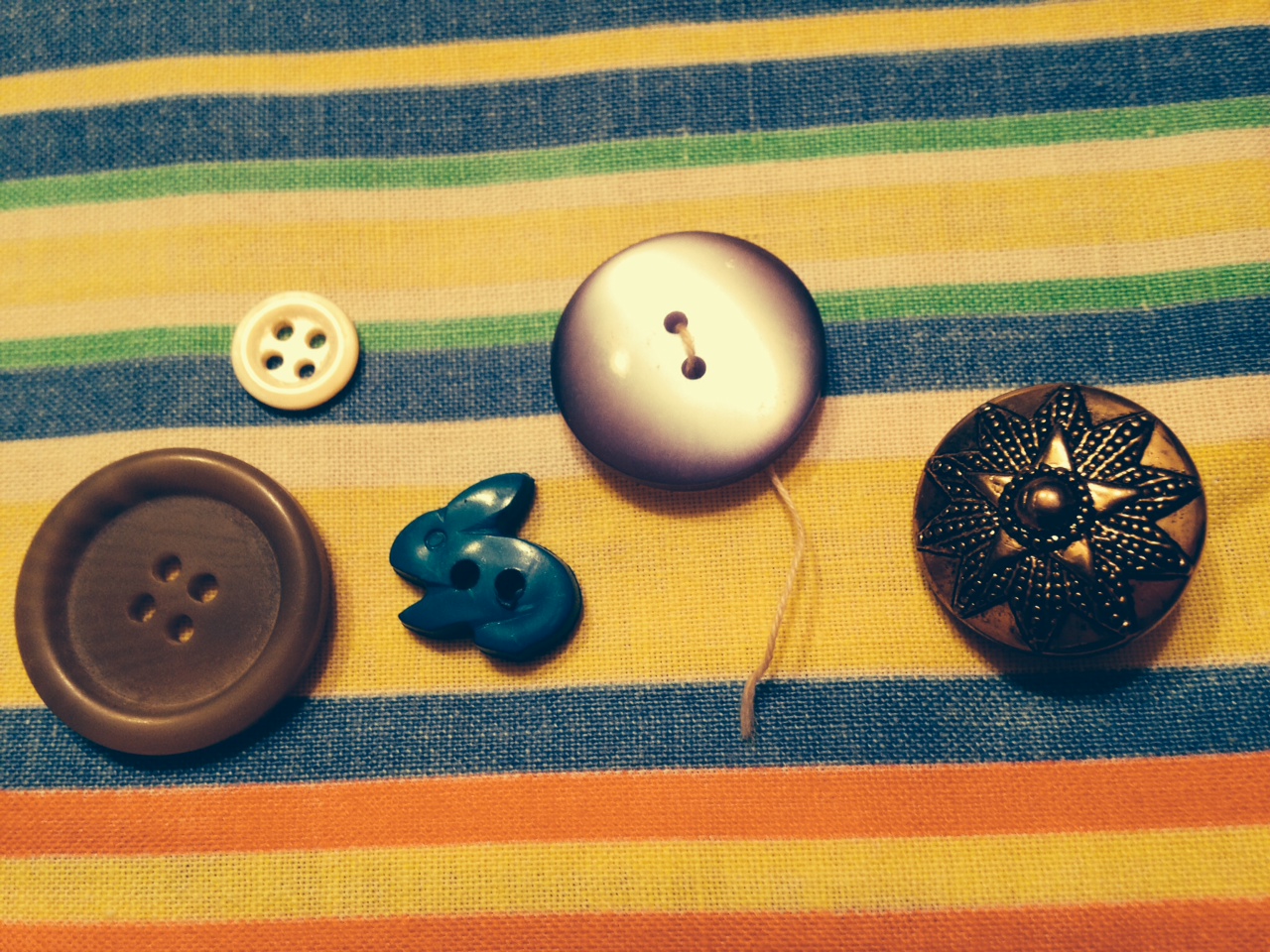
Button3

Button, Button. Who’s got the button?

Glasses, Glasses. Oh, where did I put those glasses?

Keys, keys. Why did some Martian leave them in my van door overnight?

Windows, windows. Why would windows be partway open, when I know I closed them tightly the night before?

Names, names. Why do people always change their names, when their faces remain the same?

Pens, pens. Why do they secretly skip to someplace else, when no one is watching?

Book, book. Why did that book hide itself beneath the bed again?

Folder, folder. Would someone please tell me how my folder mysteriously appeared somewhere else?

Cell phone, cell phone. Why isn’t that cell phone with me now when I know I just saw it a moment ago?

Date, date. Who changed my appointment for Wednesday on the calendar that I knew for certain was on Friday?

Remote, remote. Who snuck in while I was in the kitchen and hid my remote?

List, list. How can I get along without my “To Do” list? I’d swear I left it on the dresser, a window ledge, my hat box or . . .

Wander, wander. Why do I always have to go back to where I came from, to find out what I had forgotten?

Zipper, zipper. Who is it who, ghost-like, unzips the very pants I parade to work in?

Artichoke dip, artichoke dip. Now where did I leave that nice little dip? Why would it be inside the green cooler bag hanging on a kitchen chair, sporting a fuzzy growth of mold on top?

Brain, brain. Am I losing my mind? “Ding, Dong.” Is Alzheimer’s at my front door?

Remember, remember. Oh dear, what else have I forgotten to remember?

Oh well, I’ll now put on my shirt . . .  “Pop!” Button, button. Who’s got the button?

KeysGlasses

A side note:

The day after reading the poem to Marian at dinnertime she asked, “Have you seen the poem?”

I told her the last time I had seen it was on the kitchen table after reading it. “Did you put it in your hat box under the wicker coffee table?” I quizzed.

“Oh dear me, Button, Button Poem, Button, Button Poem. Who’s got the Button, Button Poem?”

You have stories of loss, recovery, and perhaps loss – again. Your anecdote fits right here!

Coming next: “What’s Your Name Again?”

Enchanted April: Renewal and Possibilities

Are you wishing for different weather just now?

Maybe a change in scenery is all you need to perk up. After a rough winter, the drowsy dreaminess of a warm, languid clime may sound very appealing.

If so, you have something in common with the middle-aged Lottie Wilkins and Rose Arbuthnot, both members of the same London ladies’ club, who become acquainted after reading a newspaper advertisement for a small, furnished medieval castle to be rented for the month of April on the balmy shores of the Mediterranean. They are seeking enchantment – and in April.

*  *  *

In February, I met Timeless Lady, a blogger who blends quirkiness and a strong, spiritual core in her posts. In a recent piece about the book/movie Enchanted April, she published the words in the newspaper ad that enticed these ladies to exchange London fog for idyllic Italy at a castle in Portofino, Italy no less. Here is The TImes newspaper ad that drew them in:

To Those Who Appreciate Wisteria and Sunshine. Small mediaeval Italian Castle on the shores of the Mediterranean to be Let furnished for the month of April. Necessary servants remain. Z, Box 1000, The Times.


Lottie Wilkins and Rose Arbuthnot, both wishing to escape the drab days of winter, also share a desire to leave the day-to-day drudgery of housekeeping and the struggles of marriage, Lottie to the klutzy Mellersh and Rose to her gawky Frederick. But there is the matter of money, so to share expenses they take on the elderly, crotchety Mrs. Fisher played by Joan Plowright, and the stunning, but aloof Lady Caroline Dester. As the wisteria and sunshine slowly work their magic, the characters are rejuvenated and re-discover hope and love.

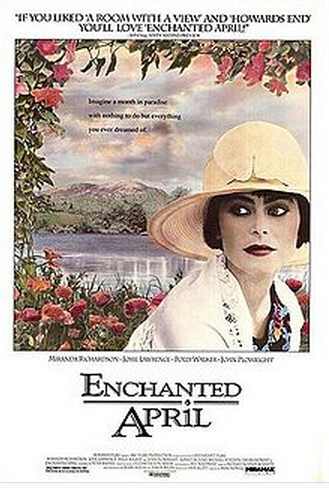
Film, 1992  Courtesy Wikipedia image
Film, 1992 Courtesy Wikipedia image featuring Lady Caroline Dester, who is sick of being grabbed by men!

In the early 1920s, just after World War I, author Elizabeth Von Arnim vacationed in the serenity of Portofino, Italy at Castello Brown, the same castle featured in the movie. Inspired by the magnificent medieval castle and the luscious gardens of San Salvatore, Von Arnim wrote “Enchanted April,” the book on which the movie is based.

I discovered a link to a free copy of the book via the Guttenberg Library, where you can search and find links to other books and stories you read as a child.

Want more Elizabeth Von Arnim? Click here for her Collected Works!

Cover image: courtesy Amazon Books

In case you haven’t seen the movie, or if you want to succumb once again to its captivating charms, here is the trailer from Miramax Films:

Quotes from Enchanted April

I want to just sit and not talk and not think . . . .  ~ Caroline

If you wish for something hard enough, it happens!  ~Lottie


Wisteria in patio garden
Patio garden wisteria


When you want to get away from it all, where do you escape?

What is on your bucket list – Where would you like to go right now, or sometime soon?


Coming next: Moments of Discovery # 6 ~ Food for Thought, Stirred with Imagination

A Robbery, Sad Friday, and a Clump of Daffodils

“I’ve been robbed!’ These are the only words artist/performer Cliff can utter as he walks toward his Dodge van, noticing that the air-vent window on the driver’s side has been pushed in at an odd angle. It’s about 4:30 a.m. Good Friday, April 1, 1994.

Rushing around the vehicle to open the side doors, he begins to take inventory of what’s missing: sound equipment including a stereo mixer, a professional-grade tape player, a recorder and at least 150 treasured CDs missing from cases. An envelope with cash – gone. All gone! He walks frantically around the parking lot of the Quality Inn he is leaving and spots a black suitcase, which the thieves have thrown into a ravine. Empty!

It was the end of a very productive month presenting 35 multi-media school assembly programs in Florida and Georgia. Cliff had driven to Nashville, Tennessee because his next shows would be in the Memphis area. He had been looking forward to boarding a 6:00 a.m. Delta flight to come home on Good Friday and spend Easter weekend with his family. This weekend, however, turned out to be a mixed blessing – The splendor of the resurrection service at church conflicted with the discordant thoughts about his recent loss: Lost equipment, lost musical discs, remembering malfunctioning hotel parking lights that had probably contributed to the thieves finding his van easy prey. And after all, it was Nashville, music city.

After returning to the Nashville airport after Easter to continue his itinerary, he takes stock. Though the robbery has felt like a violation, a form of rape actually, he could count his blessings: 1. His CD player vital to the music that accompanies his drawing was in a separate case, undisturbed and  2. He had copies of program music at his home base, Jacksonville.

Still reeling from the impact of the loss of inanimate “friends” that provided the musical score to his chalk drawing on a large easel, he must soldier on toward St. Louis, Missouri for next week’s shows. Behind the wheel again, he popped in a cassette tape, a musical companion on the long hauls between cities: soaring classical music and uplifting hymns, a distraction from the recent robbery. His itinerary takes him through Cape Girardeau, Missouri, where his journal notations begin:

The undulating ribbon of asphalt in Interstate 55, the hum of the van engine, rumbling of tires, and rushing air together with the music combined their forces to calm my mind . . . .  Now a spot of yellow caught my attention. Was it litter – or something else? The blurry image that I imagine are daffodils soon vanished from my side view mirror.


I keep driving but feel an urgency to turn around. The nest of daffodils keep calling me. “Come back. Don’t go another mile. You may miss a special moment in your life, a moment that can put a special gladness in your heart.

 Finally, he turns around at the next exit, heading south, as he wonders, “How far had I traveled since I had seen the flowers? I honestly had no idea, but I retraced my path even farther than I thought necessary to spot those daffodils again.” He gives up and heads north again. But feeling a tug even more insistent, he turns the van around one more time.

Passing over the exit I continued searching, almost holding my breath. My jaw set, my eyes straining for anything yellow.


I nervously looked at my watch. I could not believe that two hours had passed since first sighting those images of hope. Miles and time seem to merge together. My odometer indicated I had gone 120 miles since first turning back. What was I to do? It was getting late; I had to get to St. Louis soon.


And then ahead I saw it—a flash of golden yellow. My heart leaped with joy—It was there after all, several clumps of daffodils, but I saw two huddled together, spring-like beauties, raising their slender pastel green fingers, lifting golden heads to the heavens!

daffodilREAL2

The next challenge: Finding a container and extracting the two daffodils from the hard soil without a trowel or shovel.

With traffic whizzing by and like a mad man on a single mission, I quickly swung open the back and side doors of the van, and found a plastic one-gallon container of spring water. Out gurgled the water. Then, I rummaged through my tool bag until I found a razor blade to cut out the topside portion of the jug.

How to dig up the daffodils though?

Once again, I dashed back to the van and from deep within my jungle of sound and art equipment, boxes and bags, I pulled out an aluminum yardstick. With both hands on my innovative shovel, I vigorously dug down deep into the damp soil and rock encasing the two flowers. After leveraging the living plants into a plastic bag, I carefully placed them into the jug, watering the daffodils and even hiding them in bushes outside overnight for safe-keeping at hotel rest stops before the next trip home.

On this Saturday, April 9, 1994 my husband spent 2 ¼ hours driving an extra 125 miles to capture in real time this evidence of hope and then later spent more hours penning this story in a travelogue entitled “I Stopped Beside the Road Today.”

The robbers did their dirty deed in an unlighted parking lot and left no evidence of their identity behind. Yet, Cliff searched for beauty among the rubble and found it, proof of the hope it represents.

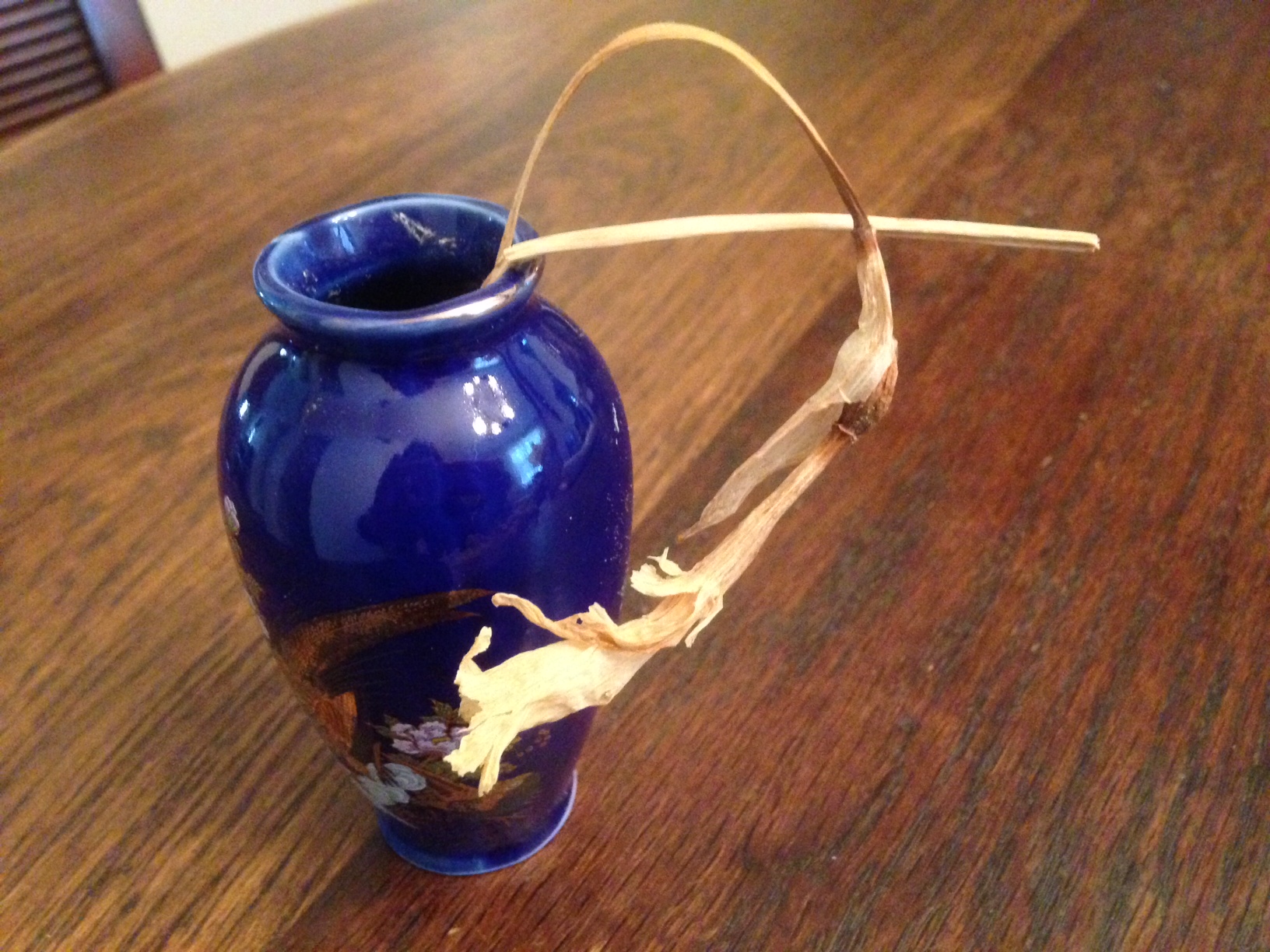
DaffodilDried

I have saved the dried-up daffodils, one headless, in a blue vase for 21 years.

And I can’t find it in me – at least not yet – to destroy these bedraggled tendrils – evidence of a Bad Friday turned Good!


Have you ever been robbed? Have you lost something so valuable you searched and searched? Here’s where to tell your story!

*  *  *

Links to Cliff Beaman, artist – http://americanartassemblies.com

YouTube video

*  *  *

Bonus: Tradition has it that the daffodil, the Lent Lily, will open on Ash Wednesday and die on Easter Day. In a poem entitled The Lent Lily, A. E. Housman writes of the daffodil as a yellow trumpet heralding the glories of spring.

Coming next: Our Easter in Ukraine

Grandmother Kayaks from Maine to Guatemala for the Children at the Dump

Grandmother Kayaks from Maine to Guatemala for the Children at the Dump

These were the words in my invitation to a reception promoting Project Safe Passage honoring Dr. Deb Walters’ efforts to raise funds via her Kayak trips.

KayakDebWaltersPIC

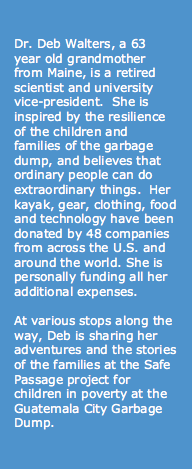
A stellar professional career behind her, this woman is paddling with passion in her mission to rescue children and families who live in the garbage dump of Guatemala City in Guatemala, providing them with literacy programs and medical help.

DebWaltersBio

Who is Deb Walters?

Dr. Deb has always been adventuresome, having made solo trips to the Arctic, kayaking around the Northwest Passage, and leading kayaking expeditions, which she began in 1981. Several years ago, she was among a group of Rotarians who went to Guatemala City, saw the need and decided to do something positive about it. She reports, laughingly of course, that when she embarked on her first journey one person came up to her and asked this question:

WhySafePassage

The Need & How The Safe Passage School Helps

Over 9 million people live in Guatemala City, Guatemala, and 10,000 of those people scavenge for food in the city garbage heap and for any items they can find to sell to survive. Safe Passage was organized in 1999 to rescue these people from their dire situation through literacy and medical help. Kayaking is Deb’s way of fund-raising for this organization. She has reached 92% of her goal to raise $ 150,000.00 to fund expanding the school to include grades 3 and 4.

  • Safe Passage Educational Center houses classrooms, a cafeteria, library and a medical clinic, serving nearly 2000 family in 2014.
  • Provides literacy: English speakers are 3 times more likely to get a job. Incomes of Safe Passage graduates are 5 times higher than that of the average resident of Guatemala City.
  • Provides teacher training for local public schools.

Deb’s Day in her Kayak, a Chesapeake 18 model

She says every day “feels like I’m jumping off a cliff!” Typically she paddles 2-8 hours daily, monitored by her husband Chris back home via a tracking device that reports her whereabouts every 10 minutes. He helped her assemble tents, suits, cooking ware, and other travel equipment.

The children of Safe Passage have donated yellow, rubber ducks “El Patito Amistoso” for her kayak, so she has companionship while she travels.

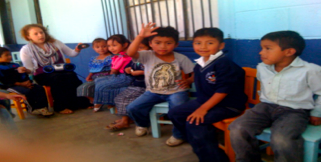
KIDSsagePassage

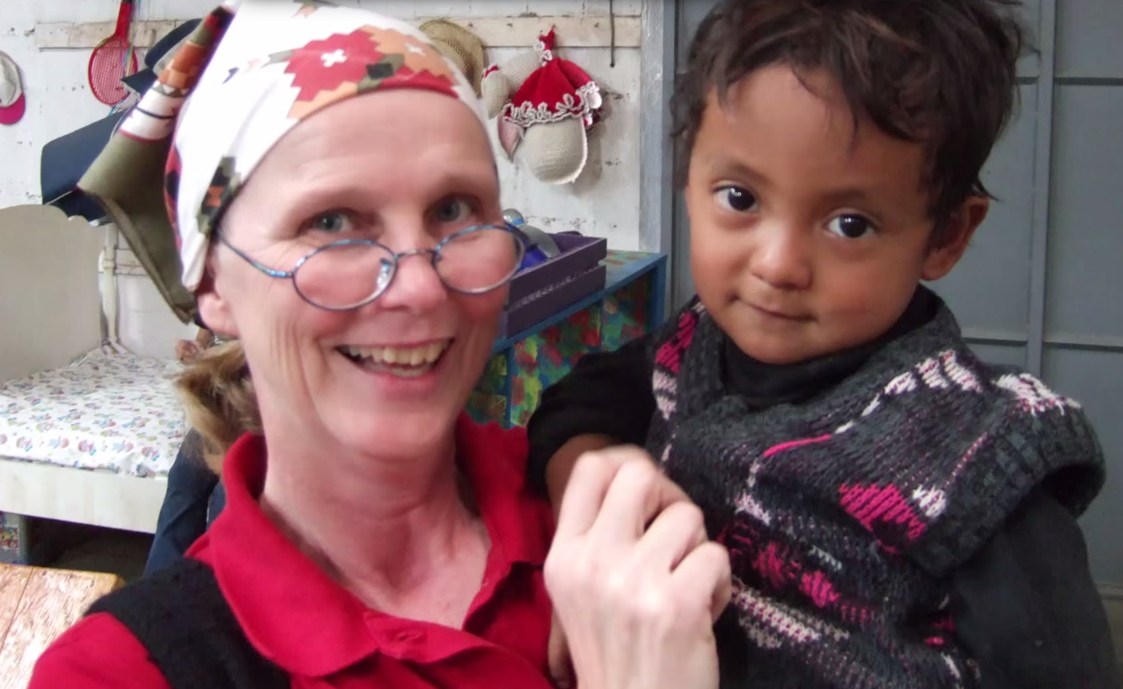
Dr. Deb and Guatemalan boy: Safepassage.org/kayak video

Hazards:

  • Drug cartels control some sections of the waterway. “If they see you, they shoot you.”
  • Deb has encountered sharks, alligators, and whales. When she encounters a marine animal, she “looks them in the eyes while she sings.” Once however, at night she and her kayak were flipped over by a manatee on the Inter-coastal Waterway in Florida.
  • Once she kayaked out of the U. S. security zone, and the Coast Guard came after her with guns a-blazing. She could have been fined $ 500.00 and served 3 years in prison. The officers relented, however, when they discovered her cause and escorted her to safety.

Interruption!

After completing 1057 miles from Maine to South Carolina, her most recent trip was temporarily stalled by intense shoulder pain alternating with numbness, and Deb had to stop four times in the early part of the trip for medical attention. Doctors discovered a herniated disk in her neck which was surgically repaired with a titanium piece which in an X-ray looks to her like the image of a “thumbs up”! She says, jokingly, “I’ve been screwed!”

She is hoping to resume this latest trip in October and complete the remaining miles to Guatemala City.

Success Stories

  • One 73-year-old woman in the garbage dump enrolled in Safe Passage so she could help her grandchildren do homework. She herself learned to read and now she is writing her Memoir!
  • Another woman named Miranda rescued from the dump exclaimed after her success: “If you believe you can do it, you can do it!”

Final Words from Deb:

“Like many people who embrace an adventure, I learned more from the people I met than they learned from me.”

After her presentation, Deb admitted: “Even though I’ve seen this video many times, I never see it without tears in my eyes.”

DebWaltersMe

Her blog: KayakForSafePassageKids.blogspot.com

The organization: SafePassage.org


Maybe your story is not as dramatic as Deb’s, but it has involved getting out of your comfort zone. We’d like to hear about it – or your response to Deb’s adventure.

Sue, Sarah, and Handful: Reviewing The Invention of Wings

Sue Monk Kidd, best known for her debut novel, The Secret Life of Bees, has published her third novel, the acclaimed The Invention of Wings (2014).

Courtesy, Riffle Books

My Review

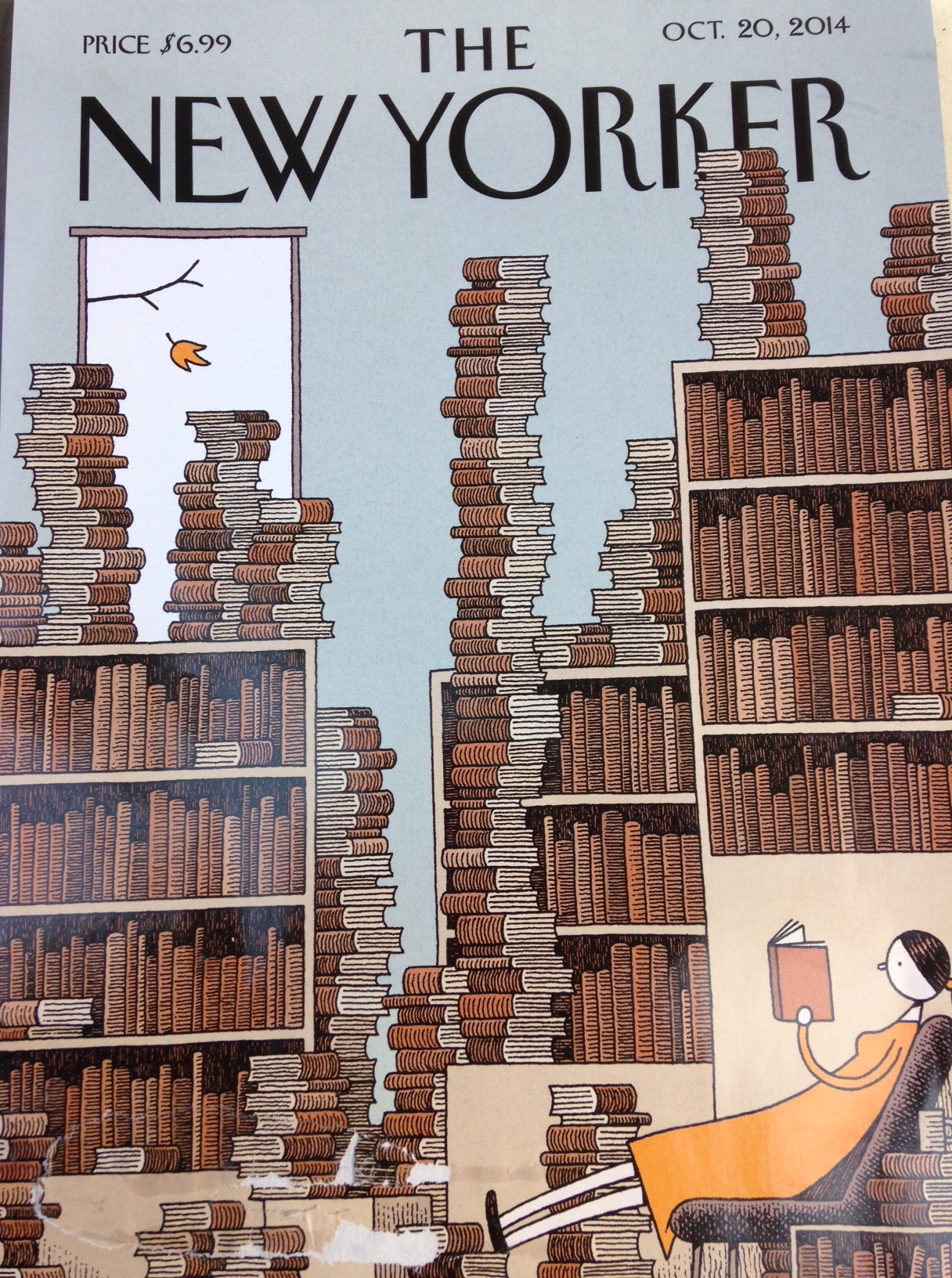
A full-page spread advertising Sue Monk Kidd’s latest work of historical fiction recently appeared in the New Yorker, which tells readers something about the stature of this work. Set in Charleston, SC, the novelist creates parallel stories representing two strata of early nineteenth-century America, alternating chapters with the voices of two engaging characters: the aristocratic Sarah Grimke and the hand-maid (creative name for slave) assigned to her, Hetty Handful Grimke. Kidd’s sweeping novel is set in motion on Sarah’s eleventh birthday, when she is given ownership of ten-year-old Handful. Over the next thirty-five years, both strive for a life of their own “forming a complex relationship marked by guilt, defiance, estrangement and the uneasy ways of love” as one reviewer characterizes it. Woven into the fabric of this novel is the alliance of the Grimke sisters, Sarah and Angelina, who advocate for the equality of slaves and the rights of women.

While the unfolding plot intertwines other historical figures, both factual and imagined, Kidd held my attention with her metaphors and other descriptions. I was particularly intrigued with the exquisite quilts Handful’s cunning mother Charlotte fabricated, often using the image of blackbird wings as a triangular motif in the design. In the acknowledgements section, the author mentions too her reference to the American black folktale, from which she drew inspiration about “people in Africa being able to fly and then losing their wings when captured into slavery.”

The two main characters in this book effectively invent their own wings, Sarah by tirelessly advocating for human rights and Handful by staging her own escape to freedom. Her often repeated refrain:

If you don’t know where you came from, you have to know where you’re going.

That's one determined woman
Sarah Grimke, one determined woman


Quilts

Have a look at some of handmaid Hetty’s exquisite quilts on this website. Possibly the best seamstress in Charleston, the quilting of Hetty and her mother Charlotte offered her freedom spiritually as she recorded her family’s history, and freedom physically too by enabling her to fashion a disguise that may have enabled her to escape.

Q & A with the Author

Website: Sue Monk Kidd

Sue Monk Kidd has created an intriguing story from mountains of research including historical dates and events, articles, letters, all inspired by viewing Judy Chicago’s The Dinner Party referred to in my last post.

See the intriguing Q & A with Sue Monk Kidd, who observed separate water fountains, black women sitting in the backseats of white women’s limousines, and the story of Rosa Parks in her own youth.

  • How could the author visualize Hetty so vividly?
  • How is Hetty or Sarah like Lily in The Secret Life of Bees?
  • How could Sue recreate the dialect of 19th-century Charleston on paper?

Your turn!

Sue Monk Kidd was published first in Guideposts and Readers’ Digest. Do you remember her writing from back then?

Can you relate to any of the characters in Sue Monk Kidd’s writings? 


BooksNYorkerCover

The Million Dollar Baby: Ian’s Miracle Birth

Since my mother’s death in July, I have written several posts of her home-going including A Grief Observed: Missing Mother and Crossing the Bar.

This time I’m focusing on a birth, our grandson Ian’s miraculous birth seven years ago this week. According to the doctor’s calculations, he was scheduled to arrive on January 9, his Grandpa Beaman’s birthday. Instead he made his appearance on his mother Sarah’s birthday, October 5.

All births are miraculous, really, the tiny embryo maturing into a marvelous baby with millions of synapses making connections within the brain, a sense of rhythm and an ability to breathe and suckle at the same time. One study mentioned that babies can pick out the gender of other babies even when they are cross-dressed, something adults cannot do.

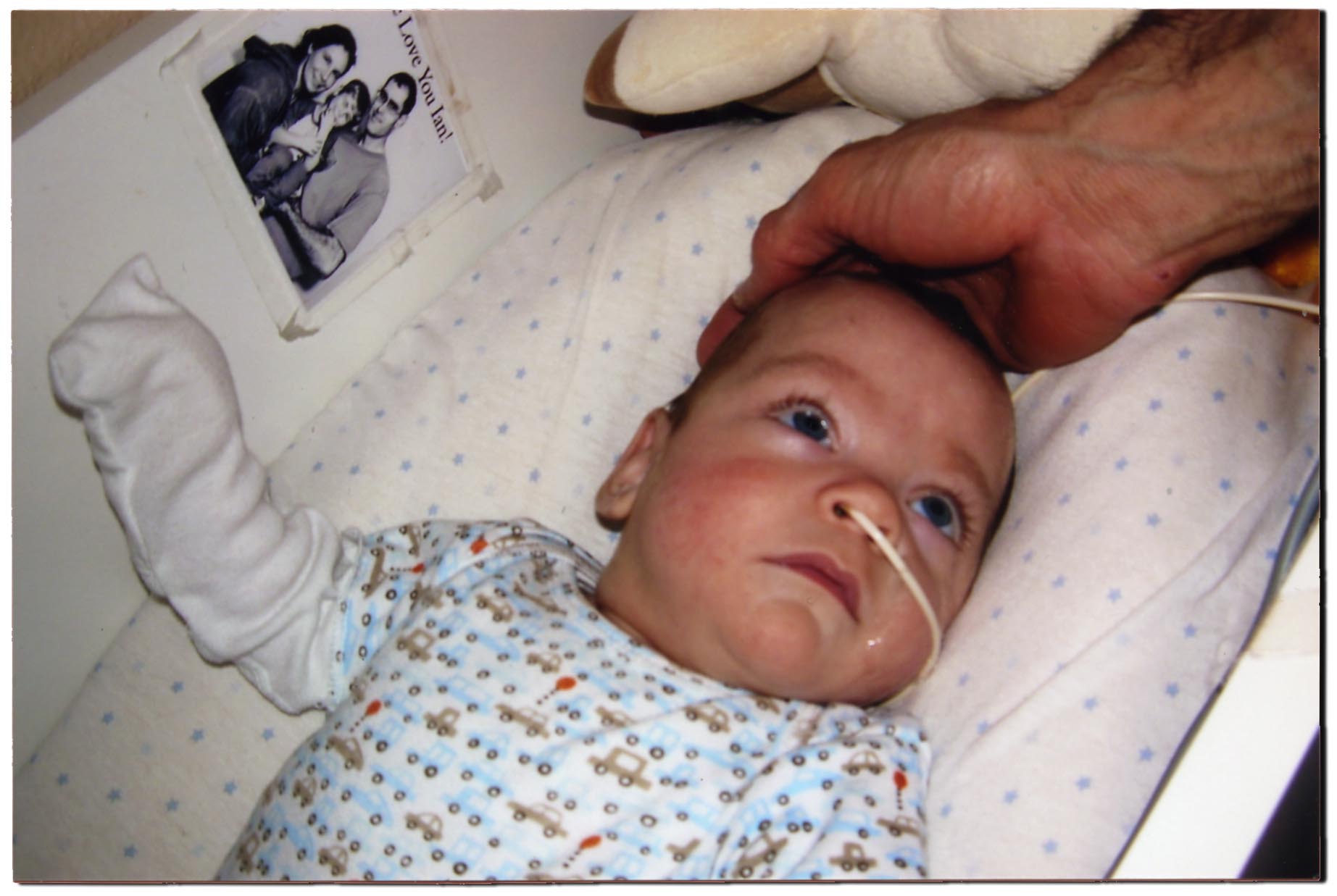
But Ian’s birth at 26 weeks gestation weighing a mere 2 pounds, 5 ounces meant many un-connected synapses and a severely undeveloped breathing apparatus. For weeks it was touch-and-go, and we weren’t certain that we would be bringing him home from the NIC Unit at Wolfson Children’s Hospital. Aside from the frightening awareness that Ian had a hole in his heart, we were introduced to a whole new vocabulary of problems: bradycardia, retinopathy, hip dysplasia. Translation: Slow, interrupted heartbeat requiring a nose cannula, undeveloped blood vessels in retina, and an immature hip ball and sock requiring a harness to hold legs in a frog-like fashion. Here is his photo-story:

Ian_02_NIC Unit_112707

Hello, world!
Hello, world!

My journal records that on November 29, 2007 Ian weighs 4 pounds, 3 ounces and is taking three bottles a day. He is also employing the services of a speech therapist and an occupational therapist along with physical therapy.

How would a speech therapist help a premature baby who can’t speak or an occupational therapist assist a child whose main job was trying to survive? Speech therapy facilitated the transition from tube feeding to bottle feeding and the occupational therapy improved the range of motion inhibited by hip dysplasia.

"Did you finally bring me home?" asks Ian.
“Did you finally bring me home?” asks Ian.

After a 14-week stay in the hospital, Ian is brought home. Glory, hallelujah! Though still on a breathing apparatus, he resumes a more normal life with his family, under the watchful eye of his brother.

"Ian, here's my advice," says Dr. Curtis.
“Ian, here’s my advice,” says Dr. Curtis.

Praise God – At age seven, Ian is now at the 98 percentile in height and weight for his age and is taking an advanced course of study in first grade at his school. There are delays in behavioral development though, possibly attributable to his prematurity. But who can be sure whether it’s prematurity or personality.

IanGrade1BrainsBrawn

*  *  *

I wrote a letter to each of my grand-children before their first birthday and sent it to their home address so it would have a post-mark. In Ian’s case, I waited until the one-year mark to write and send his letter. Call it a welcome-to-the-world, a blessing from Grandma/NaNa in writing. Here is a copy of the letter he received:

IanLetter1

IanLetter2

Ian has not opened this letter yet though he is able to read. In fact, none of the grand-children have opened and read their letters and I’m wondering at what age they should be read. It seems the opening and reading calls for some special occasion. What do you think? I welcome your suggestions!

For you created my inmost being;

you knit me together in my mother’s womb.

  I praise you because I am fearfully and wonderfully made;

your works are wonderful . . . .

Psalm 139: 13, 14   NIRV

Your advice on letter reading welcome. Other comments or suggestions from your own experience. You will always get a reply from me and maybe from other readers. Thank you!

“Every child is a story yet to be told.”   Sesame Street