Learning 101 with Ananda and Ben: Role Reversal

My Pilates instructor is a spring chicken, and my writing coach is young too, just thirty-nine years old, younger than either of our children. Still, They are teaching me.

Since childhood, we have been conditioned to think of our teachers as older than we are. Such a perspective probably was formed in elementary school when our teachers were the age of our mothers or fathers. And then in high school, if we’re honest, some of those 45-year-old faculty looked absolutely ancient to us. I imagine I was viewed as an older sister when at Lancaster Mennonite School I was a mere four years older than my senior students. As I aged in my teaching profession, in my students’ eyes I may have passed for a mother or aunt, and later, in my sixties, students at the college must have viewed me as a grandmother or great-aunt.

Now after more than forty years in education, I am well into an encore career as a writer. To support such a sedentary life-style, I need to get off my duff and twist and turn, bob and weave, flexing muscles that get very little use otherwise as I finger the back-lighted black keys of my laptop, warming a pillowed chair. Ananda at Bailey’s Gym helps me do that. On her Pilates mat in front of a class of middle-aged women, she is as flexible as a rubber band, inviting us into poses of bold bends that I can at best only approximate. Gentle and petite in nature, this native of Colombia helps me correct my efforts.

Ananda2

“Ma-ri-ann, eez this way . . . extend your left leg a lee-tle further.” And so, I adjust my appendages to comply with her instructions, but not without cringing a little. Yes, though Ananda is ever so easy-going and gracious, I do chafe at being singled out for wrong moves. After all, she called out my name. Everyone else heard that I messed up! Still, I know I will bring out my exercise mat next week and sit for another session with her gentle but precise guidance.

Then, there’s Benjamin, my writing coach. A poet, gardener, and memoir-writer, Ben Vogt is my writing teacher in an online course entitled All in the Family: Research and Write Your Family’s  History. He too is gentle, introspective, always affirming. But he is also incisive, biting into the scripts I send him with loud barks in return, always in caps: HOW BIG IS MEDIUM? YOU’VE GOT TO BE FAR MORE DETAILED AND DESCRIPTIVE FOR US . . .

BenVogtGardener

And on the next page, I see more yelling in loud crescendo as I notice I have missed the mark trying to describe what my Mennonite pastor was wearing: LET’S SEE THE WARDROBE WITH MORE DETAILS – NAME THE CLOTHING PARTS MORE, SHOW SHOW SHOW! To be fair, every once in a while I see that I have succeeded: “GREAT PARAGRAPH!” he shouts in all caps. He is thrilled when I use sensory detail (All five senses now!) to properly develop a scene instead of resorting to flabby adjectives. Then I’m both surprised – and pleased.

What is the point here? I am submitting to tutelage because I want to. I believe there is way more for me to learn. I’m not a finished product, and probably will never be, so I need more priming and polishing from folks expert in their fields. Why? Because I don’t have the insight to see how or where my efforts have gone awry. And, yes, these tutors can be younger, way younger, than I am.

Have you learn’d lessons only of those who admired you, and were tender with you, and stood aside for you?

Have you not learn’d great lessons from those who reject you, and brace themselves against you? or who treat you with contempt, or dispute the passage with you?

Walt Whitman Leaves of Grass

Of course, neither Ananda nor Ben have ever rejected me or treated me with the slightest bit of contempt, but each has sought to “dispute the passage with [me],” and though it is uncomfortable, even painful at times, I have benefited from these lessons. Indeed, I am learning lessons from them and others. Learning. Still.

Still learning.

Are you are lifelong learner? How or when have you learned from “teachers” of any age? Inquiring minds want to know . . .


Coming next: Faraway Friends: Kitsa & Lydia

Help! Vintage Photo Needs Caption

Every week, The New Yorker magazine features a Cartoon Caption Contest, inviting readers to submit a caption for consideration. After three finalists are chosen, readers vote for the winning caption.

Recently, in my cache of Kodak carousels I found a slide from the 1960s in dire need of a caption. Clearly, the season is autumn, and the family including Grandma Longenecker, my mother, brother Mark, and my dad are on a Sunday afternoon outing, judging by their dress. No one’s expression conveys a feeling of alarm over the possibility of Grandma’s imminent slide down the steep hill.

“What was going on here?” I ask. Everyone in the photograph registers a different band-width on the emotional scale, but most seem clueless about Grandma’s precarious position.

Help me solve the puzzle with a winning caption here.

LongeneckersMarkGmaDitch

Think free for all, not free fall!

* * *

If you would rather not submit a caption, you might speculate about what is going on here, who the photographer may have been, or offer a story about a memorable family outing you recall.

Pictures don’t lie, or do they?


Coming next: Signs & a Wonder in St. Mary’s, Georgia
Quiet Lives Matter: My Brother Mark

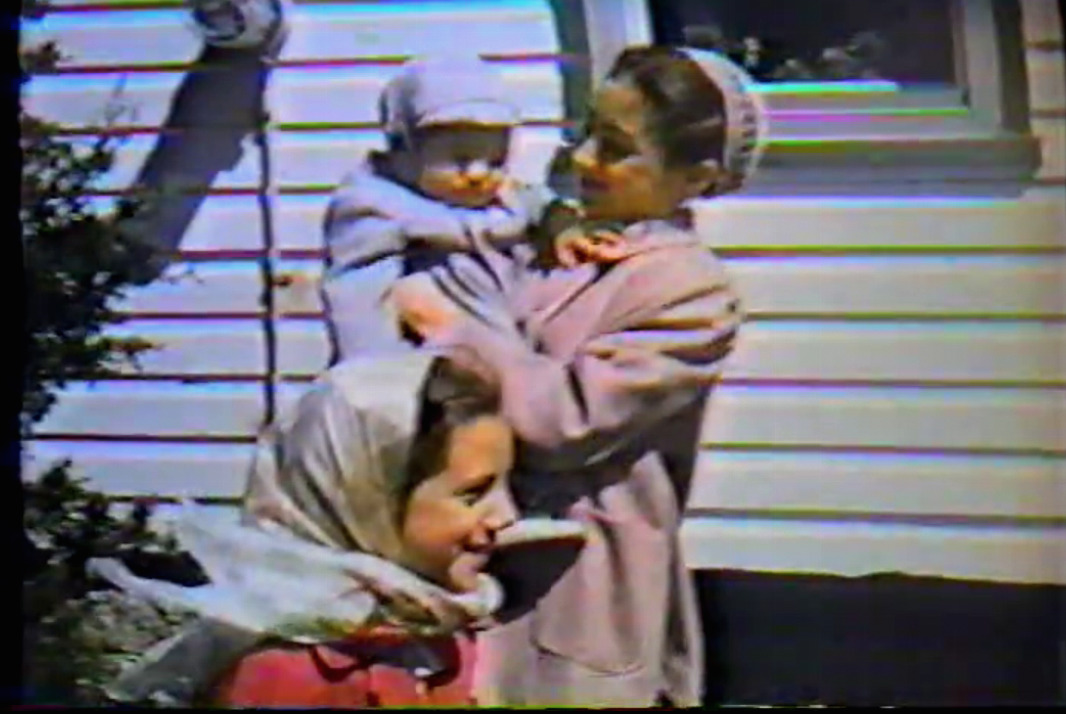
My brother Mark was my first baby. He was born when I was 12, and I soon became a mother to him. I even have a picture to prove it, a blurry movie still from one of Aunt Ruthie’s 16 millimeter camera shoots.
Holding brother Mark as my sister (age 7) Jean zooms on by
Holding brother Mark as my youngest sister Jean (age 7) happily zooms on by

I most certainly bottle fed him and changed his diapers. When he was a few months old, my sisters and I made up a little ditty often chanted repeatedly when we played with him:

De honey and de sweetie and de hon-ey boy

De hon, de hon, de hon-ey boy . . .

Practicing our Latin, we would refer to him as “Marcus -a -um” when he got a little older. Looking back, I wonder now how much the age difference and his being our longed-for brother played a role in such playfulness.

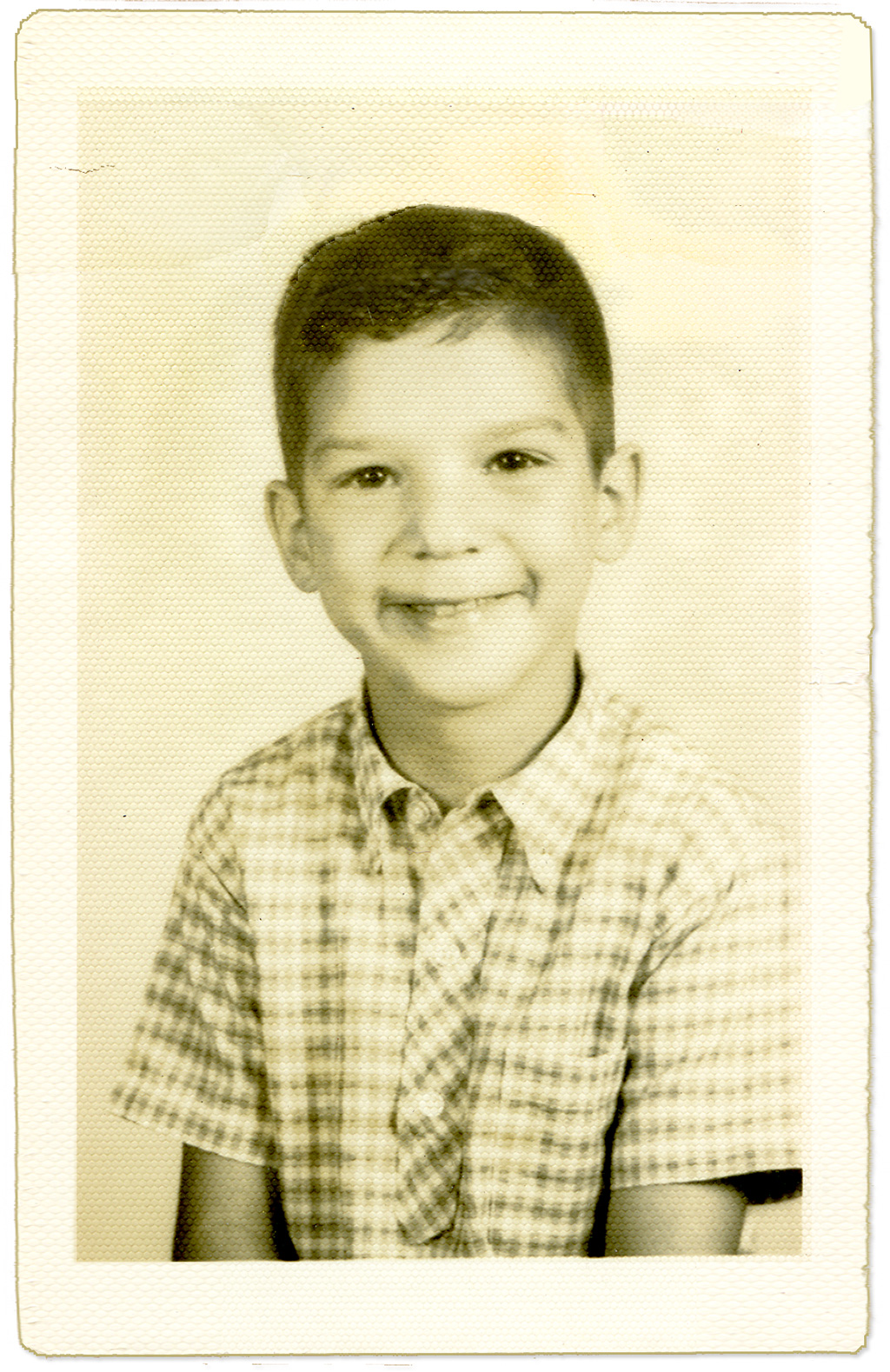
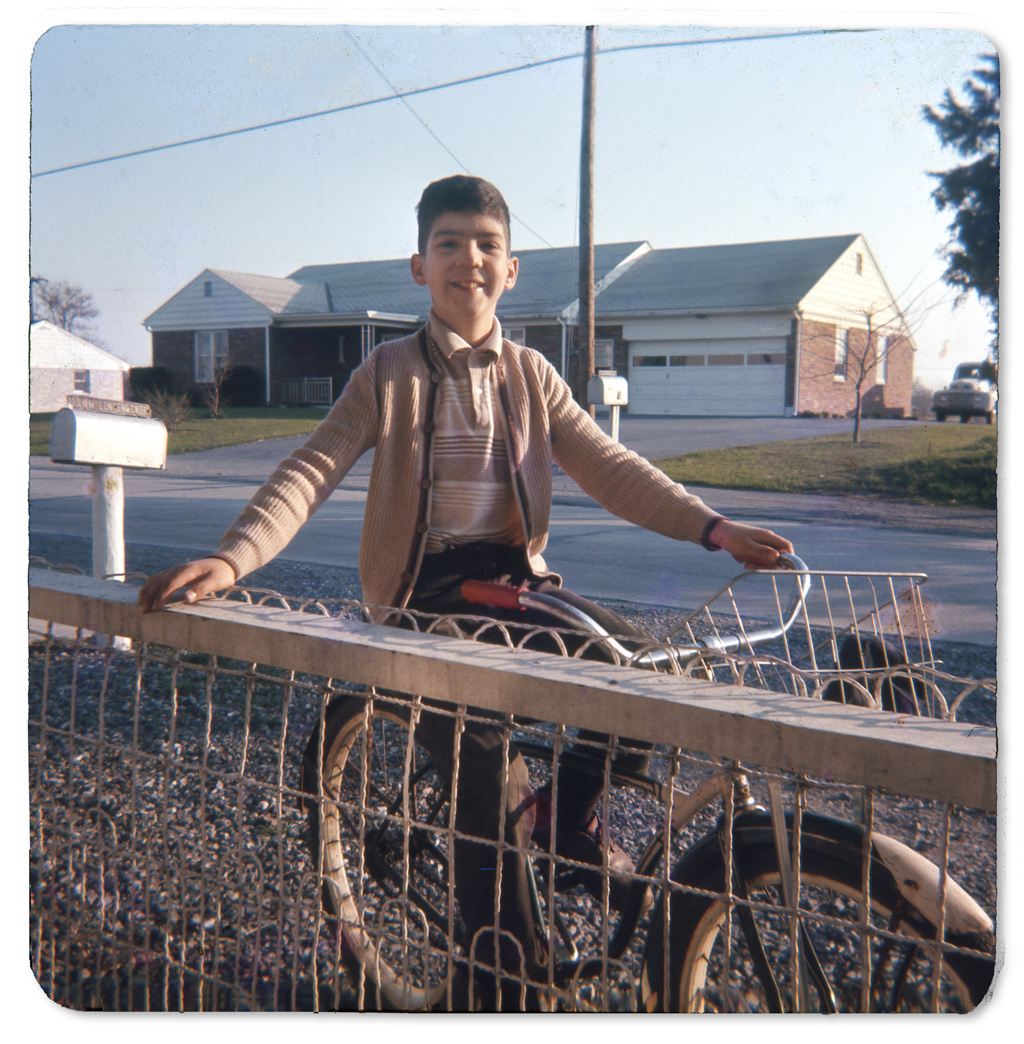
Mark passed through the usual boyhood stages, going to school at Rheems Elementary (here pictured at age 8) and learning to ride a bike.

Mark8yearsOld

MarkBikeFence

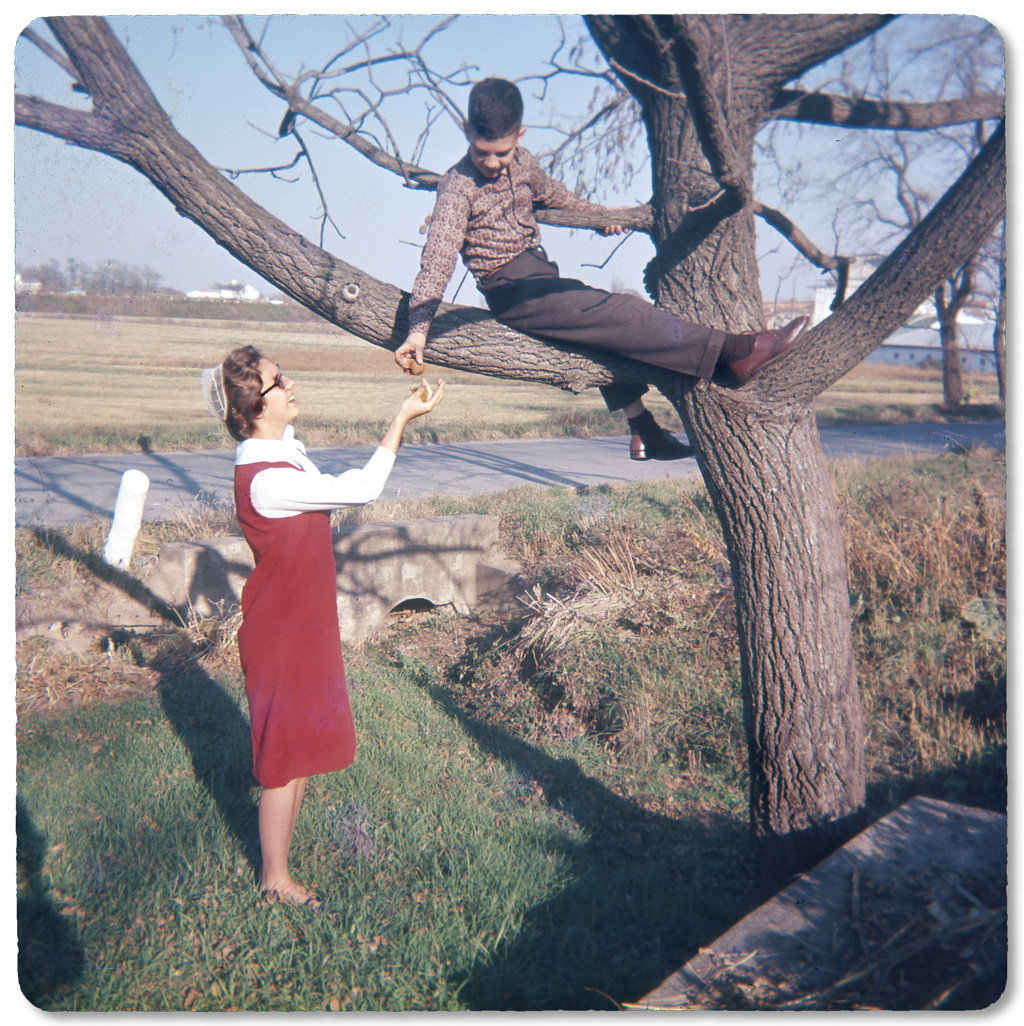
Like most boys this age, he climbed trees and played with his beloved dog, Skippy, butterscotch colored and 3-legged.

Mark handing walnuts to his sister Janice, 1964

MarkDogMailbox

In the doggy photo, Mark is already wearing shop overalls and shop shoes ready for work at Longenecker Farm Supply, our family business in Rheems, Pennsylvania.

Eventually, his work at the shop translated into industrial arts credit at Elizabethtown High School, where he earned a certificate of attendance.

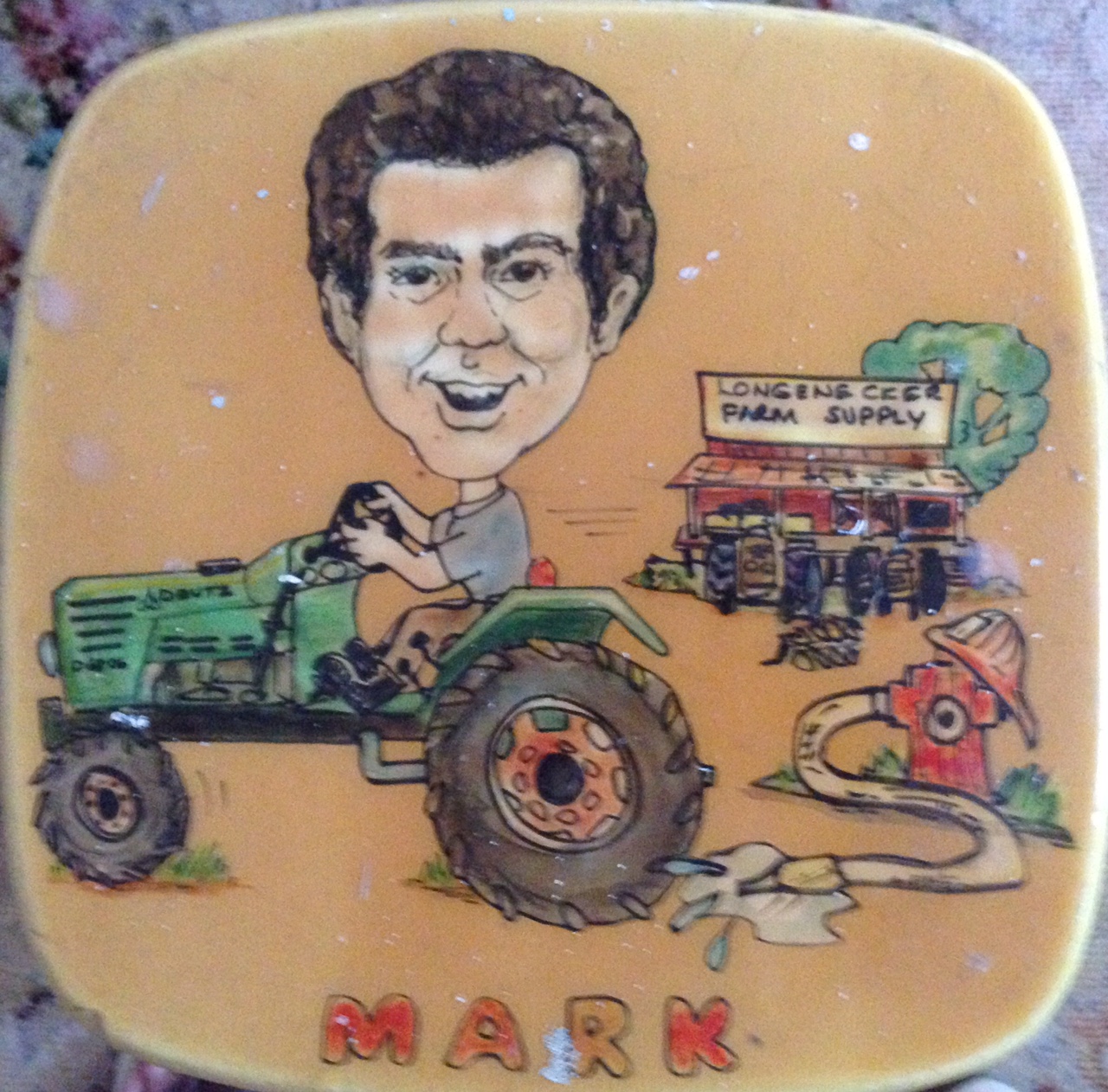
Here painted and sealed in polyurethane is a cartoon of Mark on a Deutz tractor which certified his skill at the wheel and gave a nod to his service with the Rheems Fire Department.

Stool art courtesy of Cliff-Toon Stools by Cliff Beaman, 1985
Stool art courtesy of Cliff-Toon Stools by Artist Cliff Beaman, 1985

Later, he worked at our dad’s shop full time, from where he was often sent out to fix machinery when farmers were stuck needing repairs in the field.

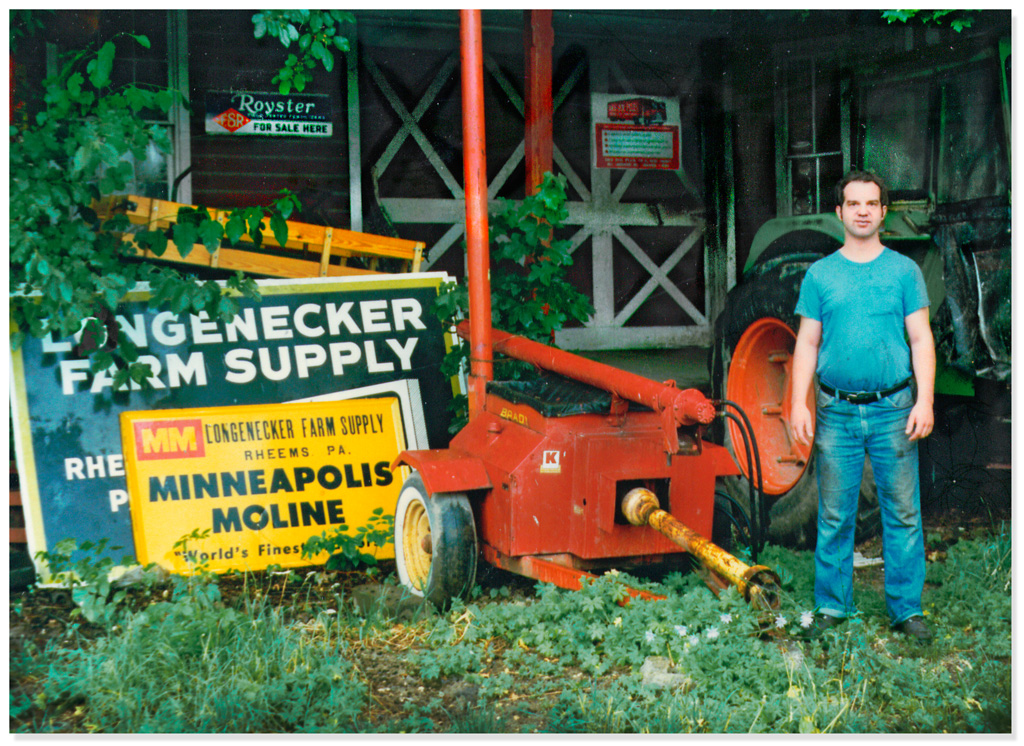
Mark in front of shop beside soybean extruder, 1984

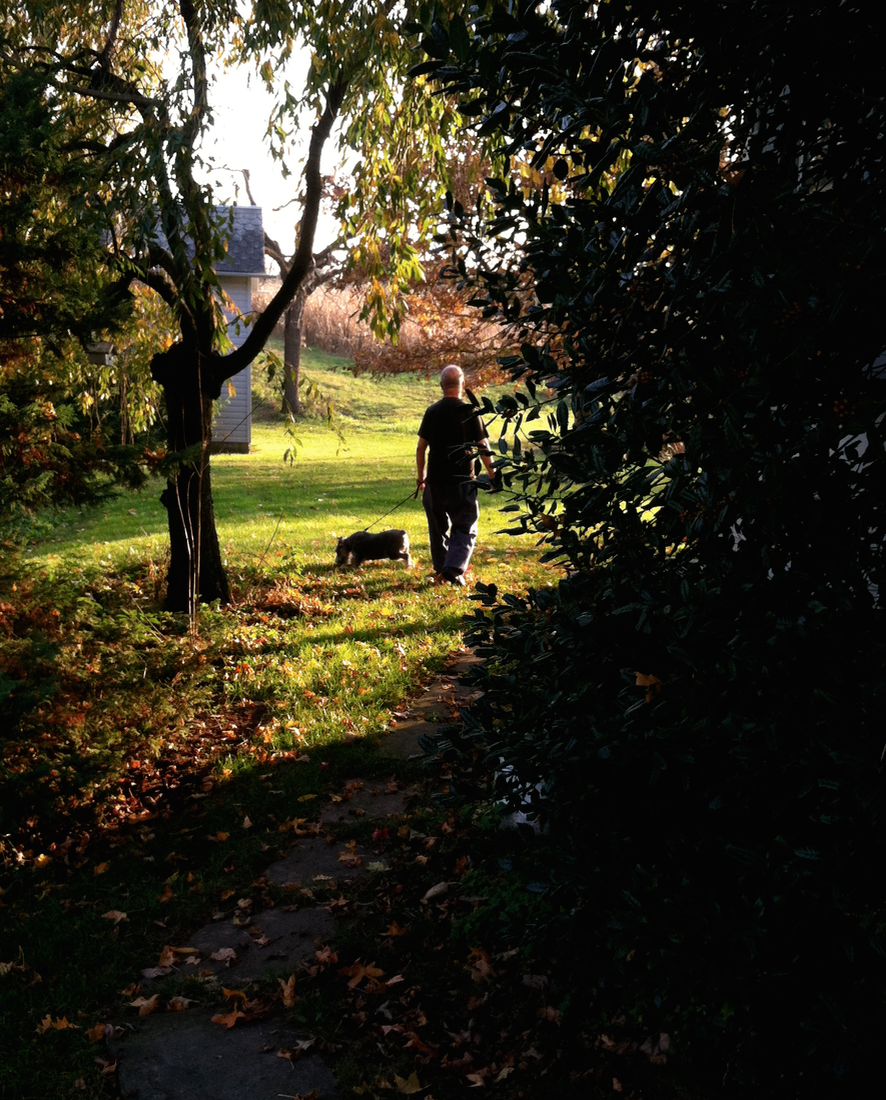
As family members aged, he kept the home-fires burning at the two houses on Anchor Road, first ministering to our Aunt Ruthie’s increasing needs as her memory loss progressed. Because of Mark’s care, Ruthie was able to stay in her own home at the bottom of the hill for four years longer than would have been feasible otherwise. He occasionally took her dog Fritzie IV for walks, a dog variously dubbed vicious, feisty or protective depending on whom you asked. Out of respect for Ruthie and her devotion to her Schnauzer, he took care of a dog he didn’t particularly like and certainly didn’t love.

MarkFritzieWoods

Simultaneously, he helped take our Mother Ruth to doctor and dentist appointments and often shopped for groceries, enabling our mother to stay in her own home at the top of the hill until she died last year at age 96.

When we realized we would be selling Mother’s house, Mark’s contacts from the shop along with his extended group of friends in the area enabled us to sell the property without a realtor’s assistance and accompanying fees.

Every Sunday now he takes Pearl Longenecker in her nineties to church at Bossler Mennonite Church.

Mark continues to live in Aunt Ruthie’s house with his daughter Shakeeta (Kiki) who moved in recently, caretakers of the Longenecker homestead we hold dear.

MarkKiKi

* * *

From my point of view, Mark does not suffer from the effects of striving, the bane of modern existence. It’s safe to say he has never slavishly checked off items on a to-do list or reached for the benchmarks of fame and fortune as many do. In other words, he hasn’t made a big splash in this world. But my brother Mark is a helper, living a quiet life that matters.

Stephen Post, Hidden Gifts of Helping

We eat because it keeps us alive, and we help others because it keeps us human.  (29)

And whosoever shall give to drink unto one of these little ones a cup of cold water . . . , verily I say unto you, he shall in no wise lose his reward.     Matthew 10:42   King James Version


Are there unsung heroes in your family or among your group of friends and acquaintances? Thank you for spicing up our conversation here with your story!

Coming next: Help! A Vintage Photo in Need of a Caption

Ray & Ruth: A Sparkling 40th Wedding Anniversary

True Love

This month would be the 75th wedding anniversary of my parents, Ray and Ruth Longenecker had they lived. True, they bickered from time to time, but I knew their love was deep and abiding. I rested in the assurance that they would never divorce. There were signs: Before Daddy left for work down at his shop after the noon meal, he often played a little game with Mom, chasing her around the house to get his hug and kiss, as she pretended wanting to escape him. Daddy dried dishes once a week, on a Sunday somewhat unusual for a culture with strict divisions of labor between husband and wife.

They celebrated their 25th anniversary with the attendants at their wedding, Howard and Pearl Longenecker, also married twenty-five years.

When their 40th came along, we had a big shindig in early November, a week after their actual anniversary date of October 26, 1940. My sister Jean sent out fancy invitations:

40thAnnivCardFront

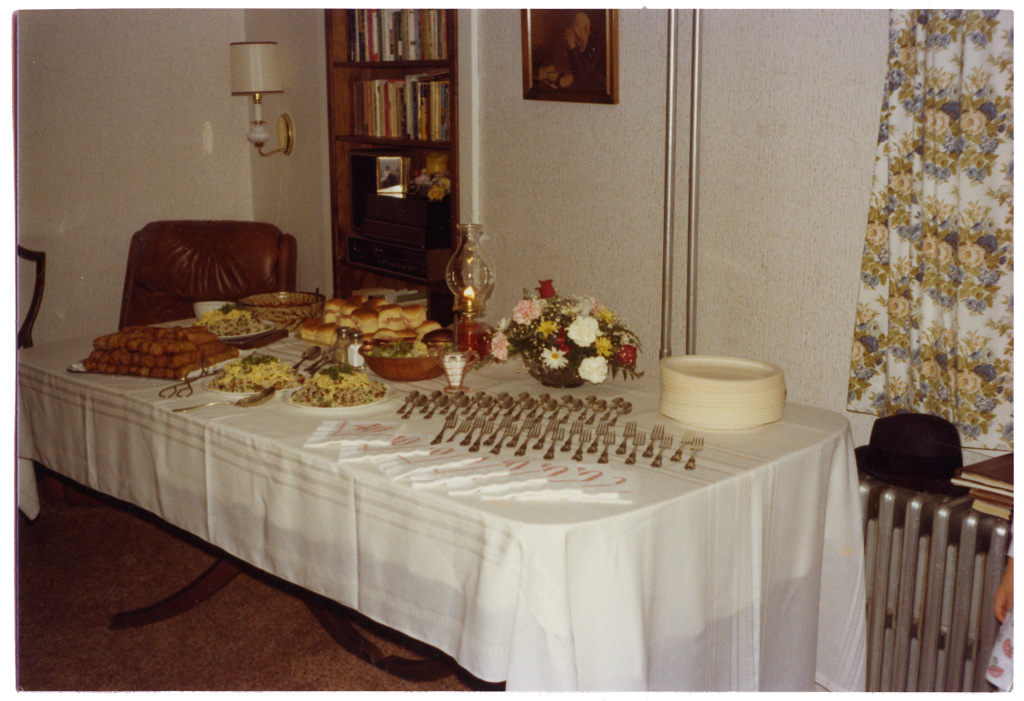
The table was set just so with the “tulip” design wedding silverware, a florist’s bouquet, and finger food with cake the grand finale.

40thAnnivTable

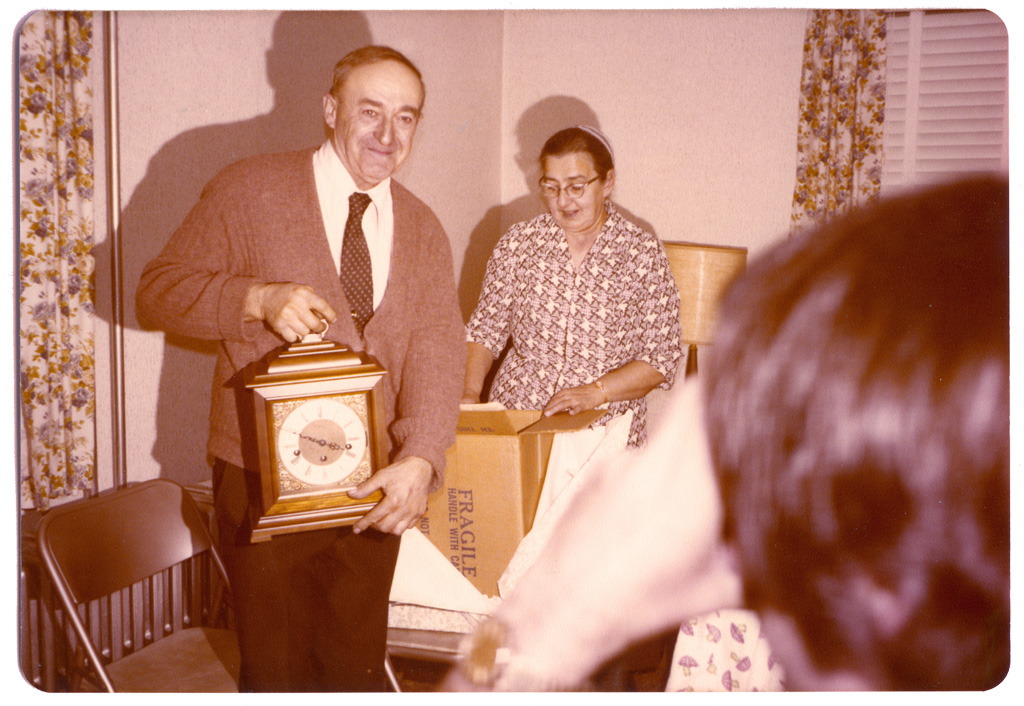
All four of us, my sisters and brother chipped in money to buy a chiming clock that sat for years on top of Mother’s buffet in the dining room, the ticking heart of the home. Our son Joel has inherited this clock.

40thAnnivClock

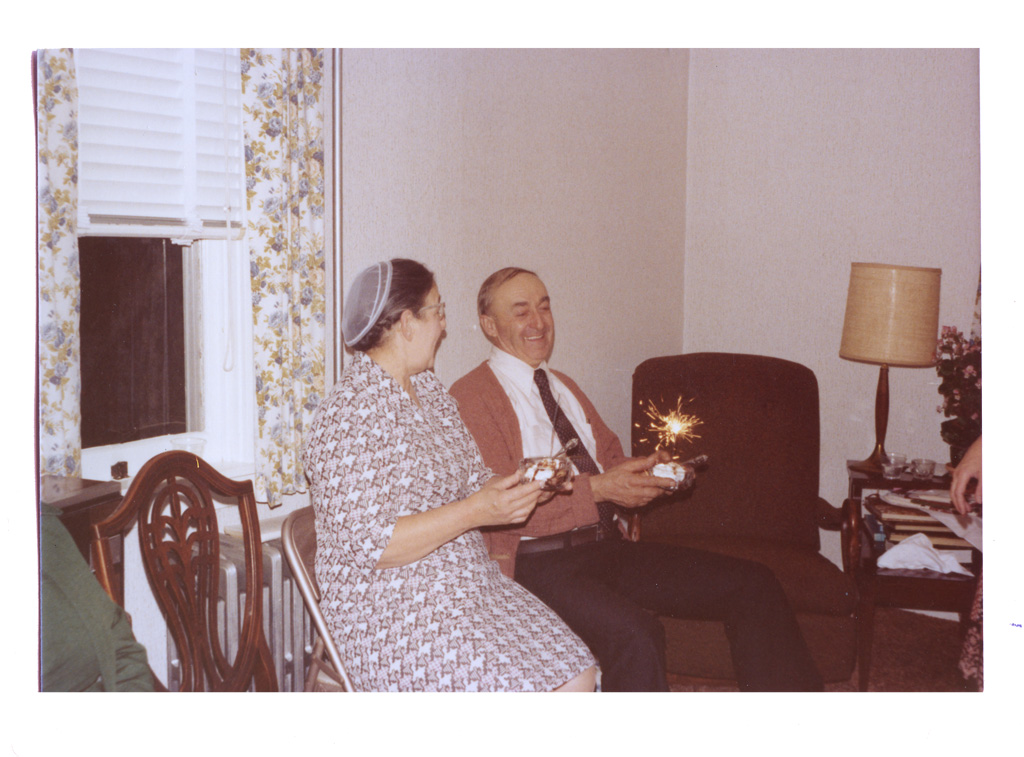
And there were sparklers – and smiling faces on this happy day when I heard Daddy say, “I could never have found a better wife!

40thAnnivCandle

How It All Began

October was a favored month for weddings, at least among Mennonite couples in the 1940s-1960s. Farmers had harvested their corn, wheat, and sweet potatoes. The sowing-hoeing-harvesting cycle was slowing down. The land was preparing to lie fallow for the winter. Thus, plain weddings were often celebrated amid the riotous colors of fall.

I was born in July — 9 months, almost to the day, from my parents’ honeymoon night the previous October. When I got older and could figure out such things, my mother simply said, “Nothing happened before we were married.” Because she said it, it must be true, I reasoned. In those days, abstinence was the professed norm for engaged couples, and a white dress almost certainly meant the bride was a virgin. A couple whose first child arrived too soon after the wedding date had to appear in front of the congregation and confess their sin of fornication before they could be restored to church fellowship. I saw it happen once.

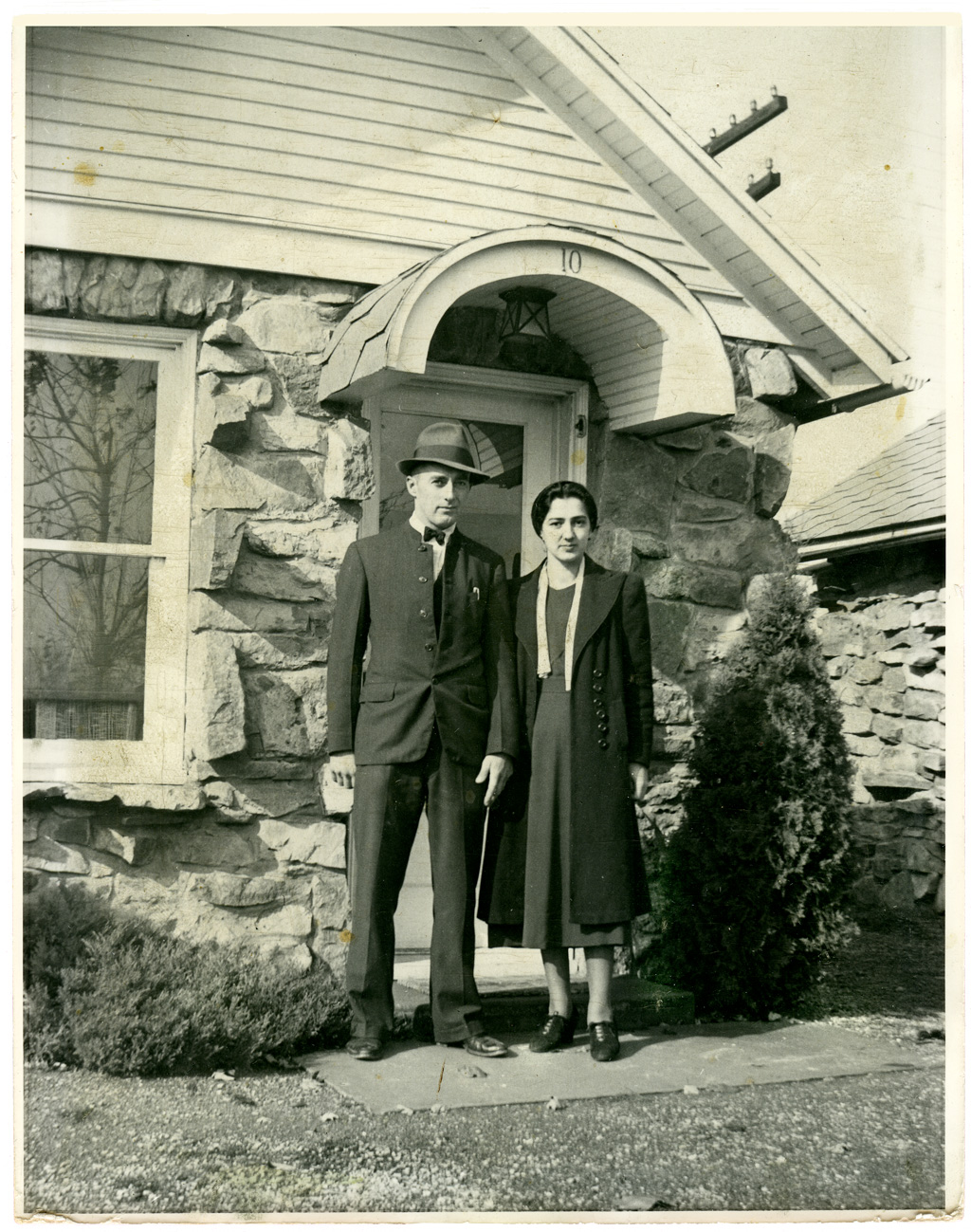
That was not the case for my parents, of course. I was born right on time, a honeymoon baby, possibly conceived right here within this idyllic, stone cottage.

HoneymoonNiagaraCottage

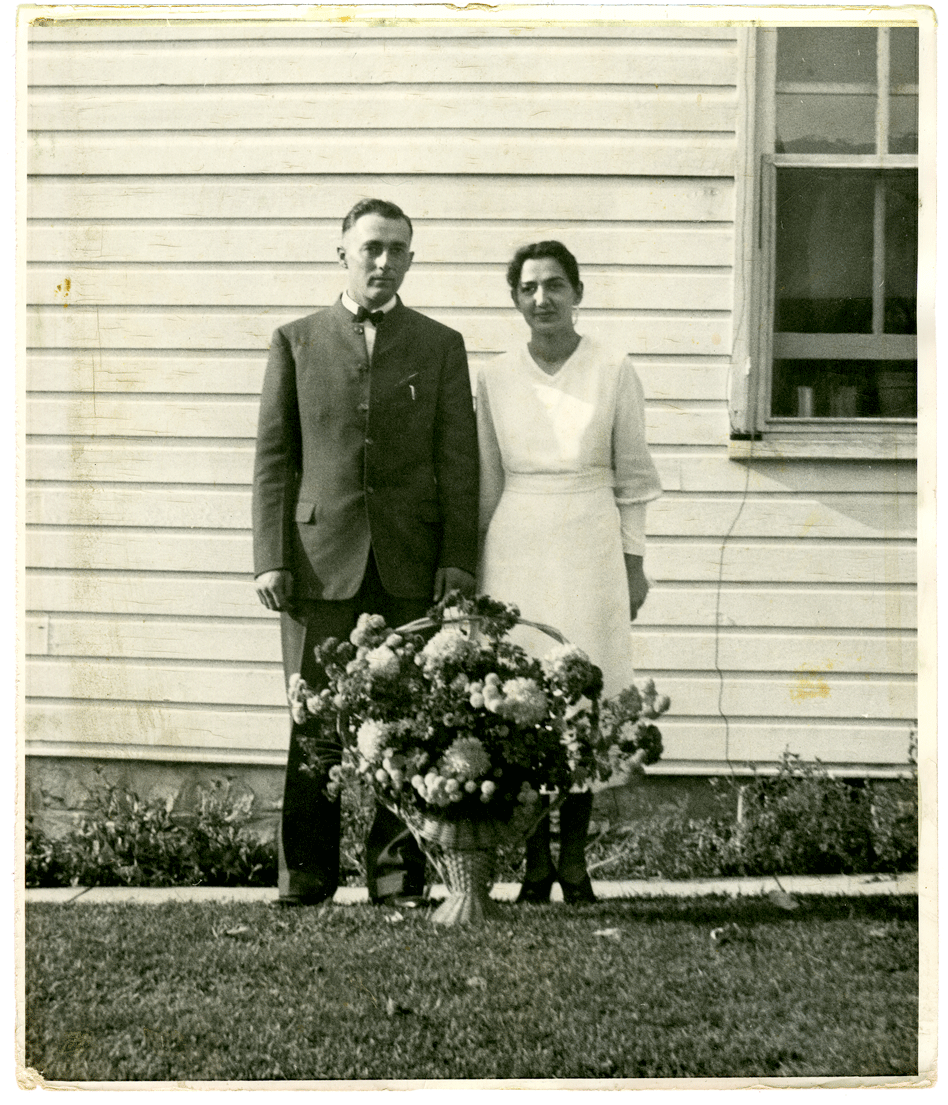
My parents were married by the bishop of Hernley’s Mennonite Church and then returned to the bride’s home on Charlotte Street in Manheim, Pennsylvania where these pictures were taken. My father was wearing a plain, Mennonite “frock” coat with bow-tie paired with a natty fedora hat on his honeymoon. My mother too sneaked in some fancy touches on her dress. Another, of course, a large, fancy bouquet on the lawn.

WeddingMomDadFlowers

And though Mother wore covering strings attached to her prayer veiling and her dress was plain with no collar or lace, tiny buttons covered in white crépe traced a vertical line on the snug cuff of her sleeves. They don’t show on the photograph, but as a child I remember seeing them all in a row, sewn on her dress then draped on a hanger and pushed to the back of her clothes closet. Were there five? Seven? I don’t know or remember, but in my mind’s eye I can see them attached there. And I thought they looked pretty!

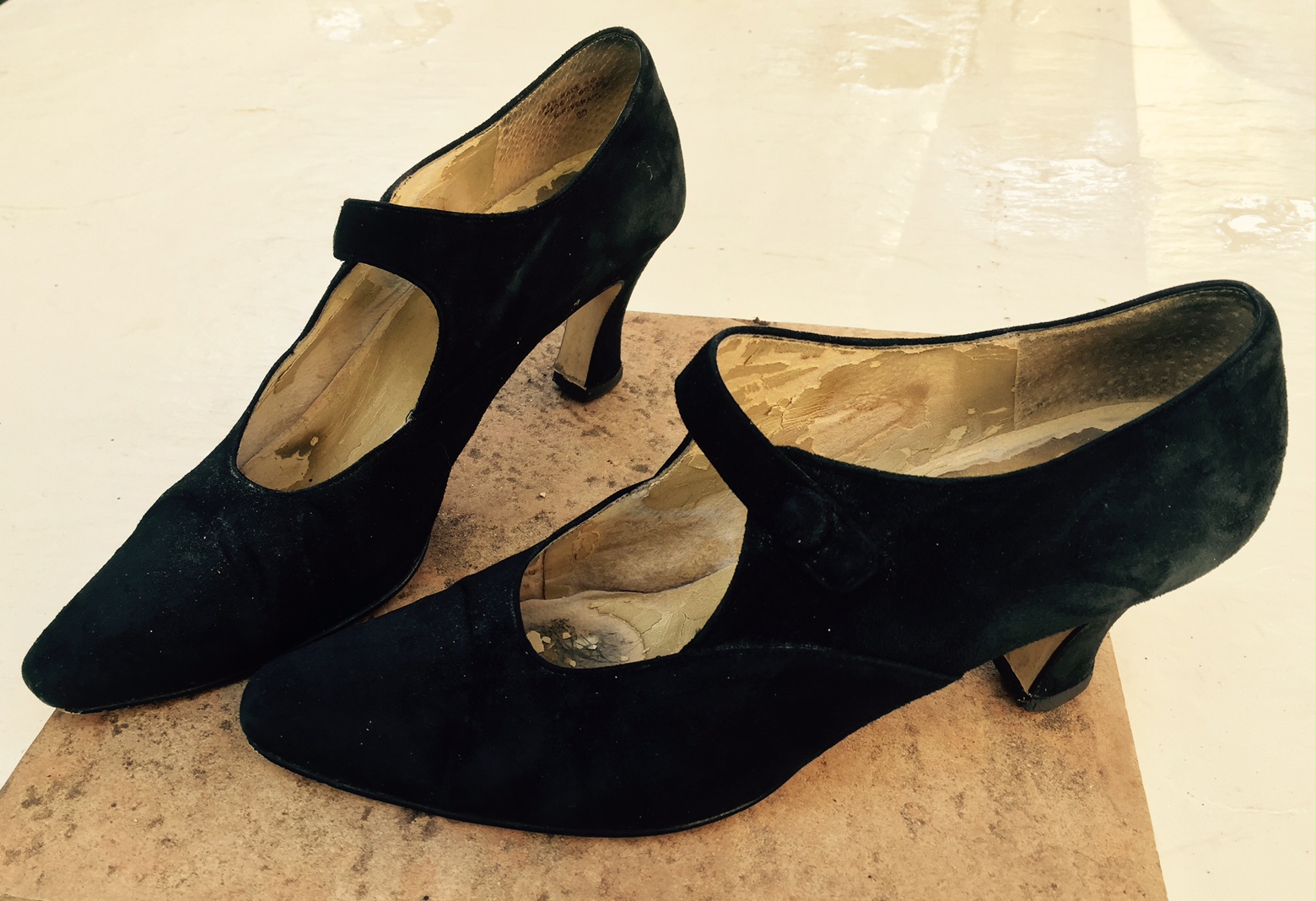
I liked her wedding shoes too, black suede with a vamp that reached almost to her ankle, very modish, I thought. When I saw Nine West with a similar vintage shoe and a button on the strap, I knew they had to be mine.

ShoesVintage9West

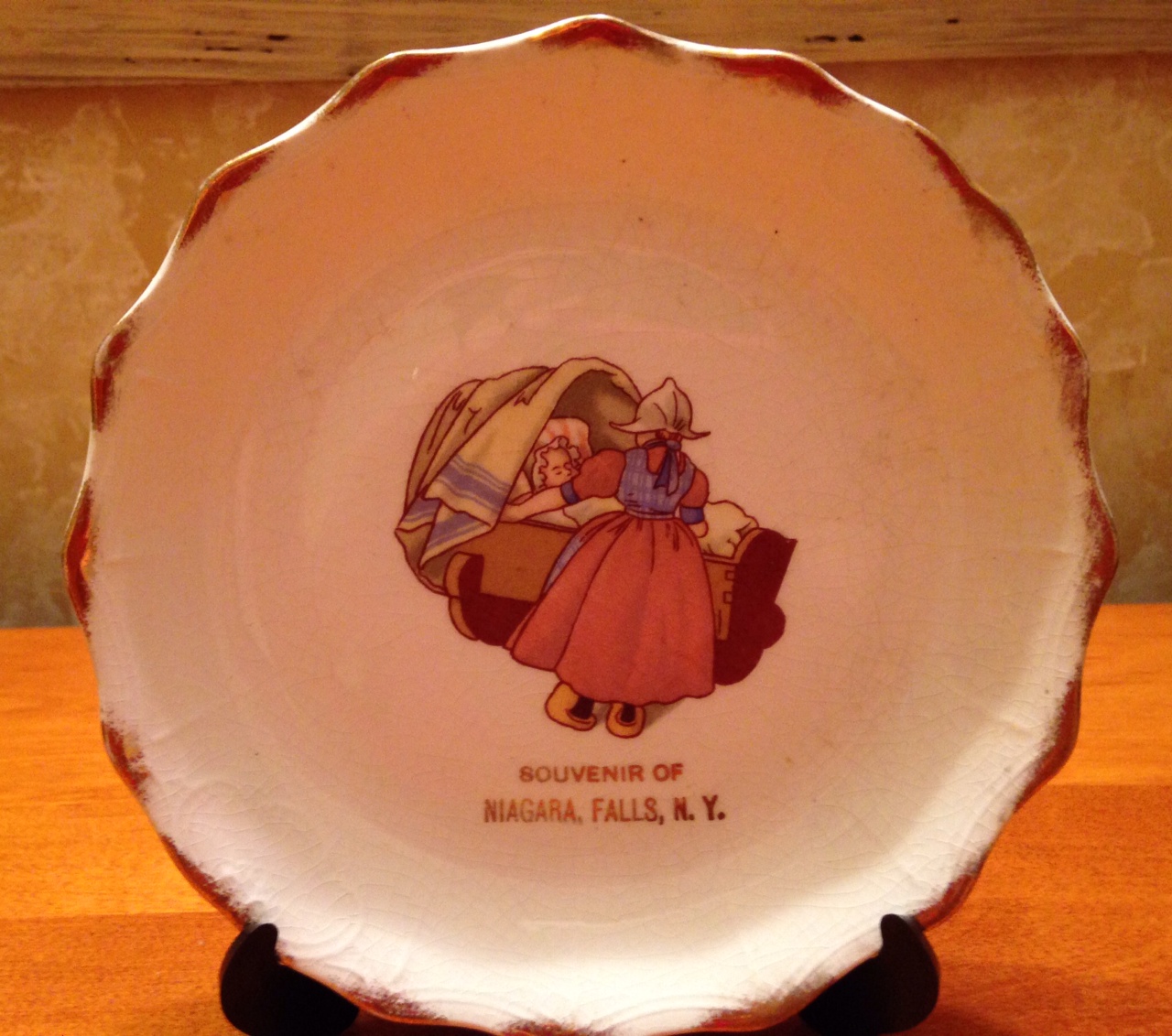
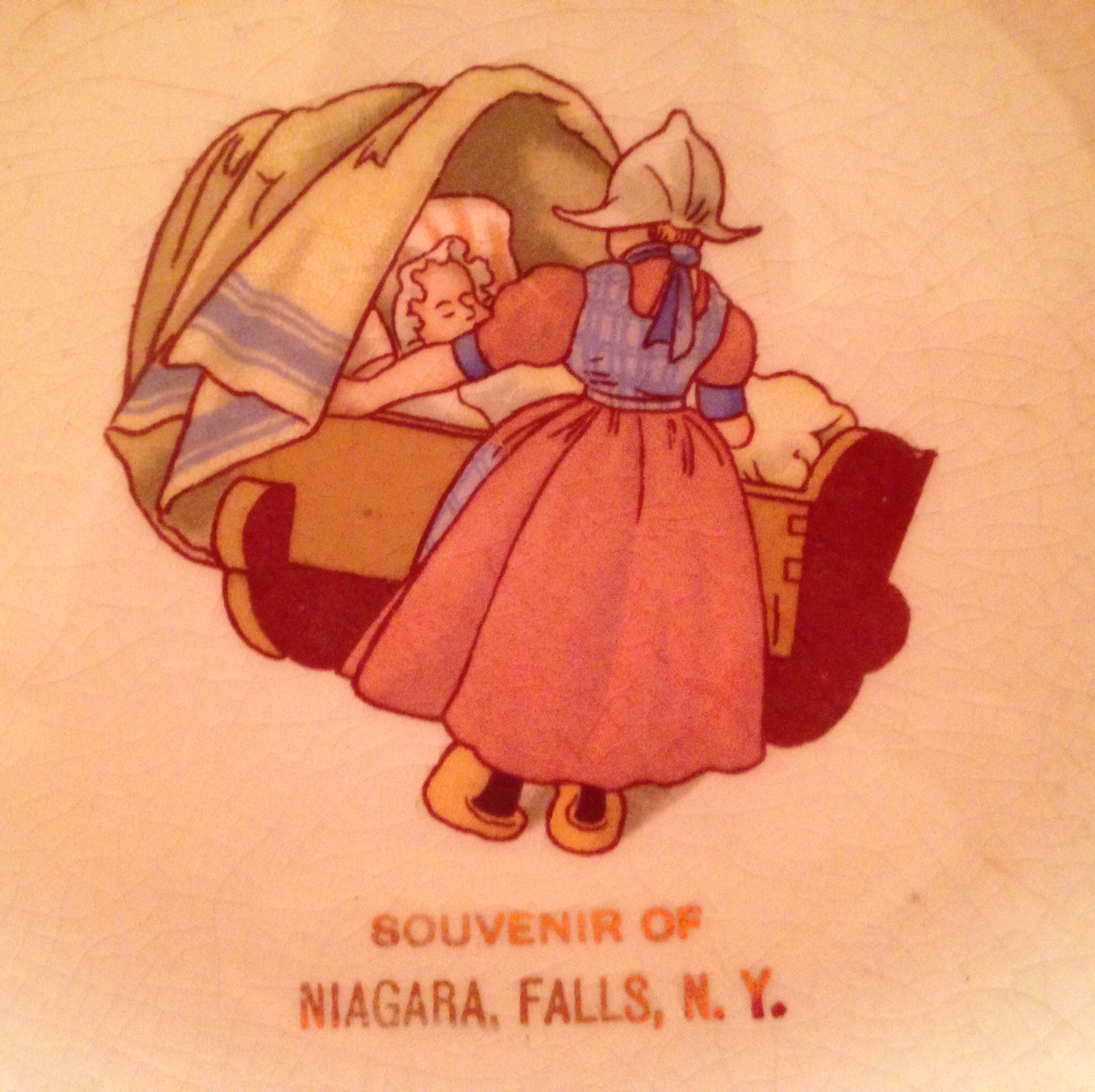
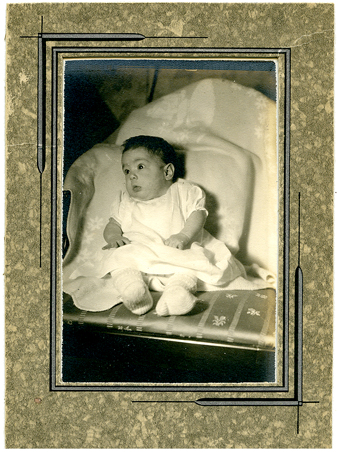
When we cleared out Mother’s house after her death, we discovered a saucer I had never seen before with a charming pink & blue imprint, a prophecy of things to come. They would have a baby, a girl, in fact three daughters and then a son.

NIagaraFallsSaucerNiagaraFallsSaucerDetail

Marian_as baby_5x5_72 19-05-17

Sparkling or not, what anniversaries (or other milestones) can you recall?

Coming next: Halloween Advice from My Good Witch of the North, Aunt Ruthie

Moments of Discovery # 7: The Story Behind the Hidden $ Bill

Dollar Discovery! On September 10, 2015 I opened an envelope dated April 30,1962 that Mother sent me in college. I had read her letter then, but did not open the Bossler Mennonite Church bulletin where she had tucked a dollar bill (series date 1957) until now. I wonder now whether she was testing to see if I had taken the time to open the bulletin she enclosed.

When I opened the bulletin commemorating Church College Day, a few weeks ago, out tumbled a “Silver Certificate” dollar bill backed by REAL money, not the “Federal Reserve” bills we carry around in our wallets nowadays.

Dollar

What was going on in the world in April 1962?

  • US district Judge J. Skelly Wright ordered the desegregation of elementary schools in New Orleans, LA.
  • John Kenneth Galbraith, then U.S. Ambassador to India, wrote a letter to President Kennedy proposing a negotiated peace between North Vietnam and South Vietnam.
  • At the Ealing Jazz Club in London, Brian Jones was introduced to Mick Jagger and Keith Richards. The three would become the heart of The Rolling Stones.
  • Walter Cronkite replaced Douglas Edwards as the anchorman for the CBS Evening News.
  • The Century 21 Exposition World’s Fair opened in Seattle, Washington on April 21, 1962

What was happening in the Longenecker house then?

MotherLetterMe1962

Here are unadulterated excerpts from Mother’s letter:

“Hello to all the gals at Peachey House. . . . “Did you get your book – – – I mean your ‘Books,’ The Post Master want to know when you got the book we send. Don’t for-get to tell us he want to see know how long it took to get to E. M. C.”

“. . . I called LaVon’s mother on Fri. the way it sounds Maybe you are taking her place. she is going to work for Dr. Walmer 5 weeks then she is going to be counsler at a few camps. She is sure you will like it. She said you even get off the fourth of July with Pay. she knows they pay over a $ a hour but she didn’t know right yet how much.” (Lavon Nolt (Kolb) is a school friend: We attended first grade → college together. Here Mother is discussing summer work for me.)

“. . . I started to tell you Janice [sister] and I were at the Mother & daughter banquet on Fri. eve. they really had a nice program. & plenty of food such as fruit cup, a very large slice of Ham loaf, baked potato, corn & peas, cold slaw, pickles & olives, celery & carotts, ice cream & cake Mints & nuts. Well, we were just stuffed.”

“. . . When you get your check get it cashed then you will have when you need.”

There are two references to money in this letter, three if you count the dollar bill I didn’t discover until now. I don’t remember what the check was intended for or the amount, but it was probably not enough for books or tuition. And seldom did Mother write a letter that didn’t mention a menu or food preparation.

I know now that she equated food with love. And she knew that money, even a little bit, would sweeten my passage through my college days too.

God bless the memory of my mother, who knew the value of a dollar . . .

2002RuthPotatoes_small. . . and the appeal of a home-cooked meal!

Did this post prod memories of happy surprises about money or food? Join the conversation here.


A Cloistered Life at Peachey House: A Prequel

The closest thing I ever came to living in a convent was my year in the dormitory at Lancaster Mennonite School. It was much like living in the dorm at my alma mater, Eastern Mennonite College, now a University, but only more awkward. “Awkward?” you ask. “In what way awkward?”

As beginning teachers Verna Mohler (Colliver) and I were squirreled away in the LMS girls’ dormitory. Because of our tiny salaries, living here represented a major cost savings, but being so close to students, we sacrificed privacy. You can read all about this experience in last week’s post.

Students and faculty alike dressed plainly at LMS, no jewelry or fancy dress allowed. Students were sequestered from the world in other ways too: no competitive sports teams, no band or orchestra, and no theatre department.

My prior life in college was similar but a tad looser. There were intramural sports at EMC but musical expression was limited to various choruses which sang a cappella in four-part harmony. A highlight of the year came each spring when the music department presented Alfred Robert Gaul’s oratorio The Holy City, its celestial strains ringing in the rafters. However, no band or orchestra existed there either. And certainly no theatre department. To be fair, students performed plays staged in the chapel as for example Thornton Wilder’s Our Town. Our graduating class donated to the college its first piano.

During my junior year at EMC when the college dormitory was filled to overflowing, eight women students were selected to live on the edge of campus in a home called Peachey House.

MarianPeachey1962

Verna Mohler and I lived with six others including Martha Maust, who wrote in Verna’s yearbook: ” What with mice sitting on the kitchen floor, a chicken in a book-bag, plus eight girls with plenty of vim, vigor, and yelling power you couldn’t expect anything but great times.” Then too we lived through the mighty snowstorm in the winter of 1961-62 that cut us off from the rest of the campus.

One of my fondest memories is playing the violin with Thelma Swartendruber (Chow) one of my roommates here in the Peachey House living room.

ThelmaMarianviolin1962

I had played my instrument at Elizabethtown High School, where I was the only Mennonite girl in the orchestra simply thrilled to wear a fancy dress for concerts. My violin case followed me to college. Sunday afternoons we played with others, sometimes even with a faculty member whom I later dated.

* * *

Mennonites have always had a love affair with music ~ hymn books, tuning forks, and four-part a cappella singing a staple of all worship services in this era.

Though the Lancaster Conference Mennonite Church did not allow instrumental music in the 1960s, many Mennonite families had a piano at home. We had one, a mahogany Marshall & Wendell upright with melodious richness, especially evident when I pushed down on the damper pedal for a gorgeous, sustained tone.

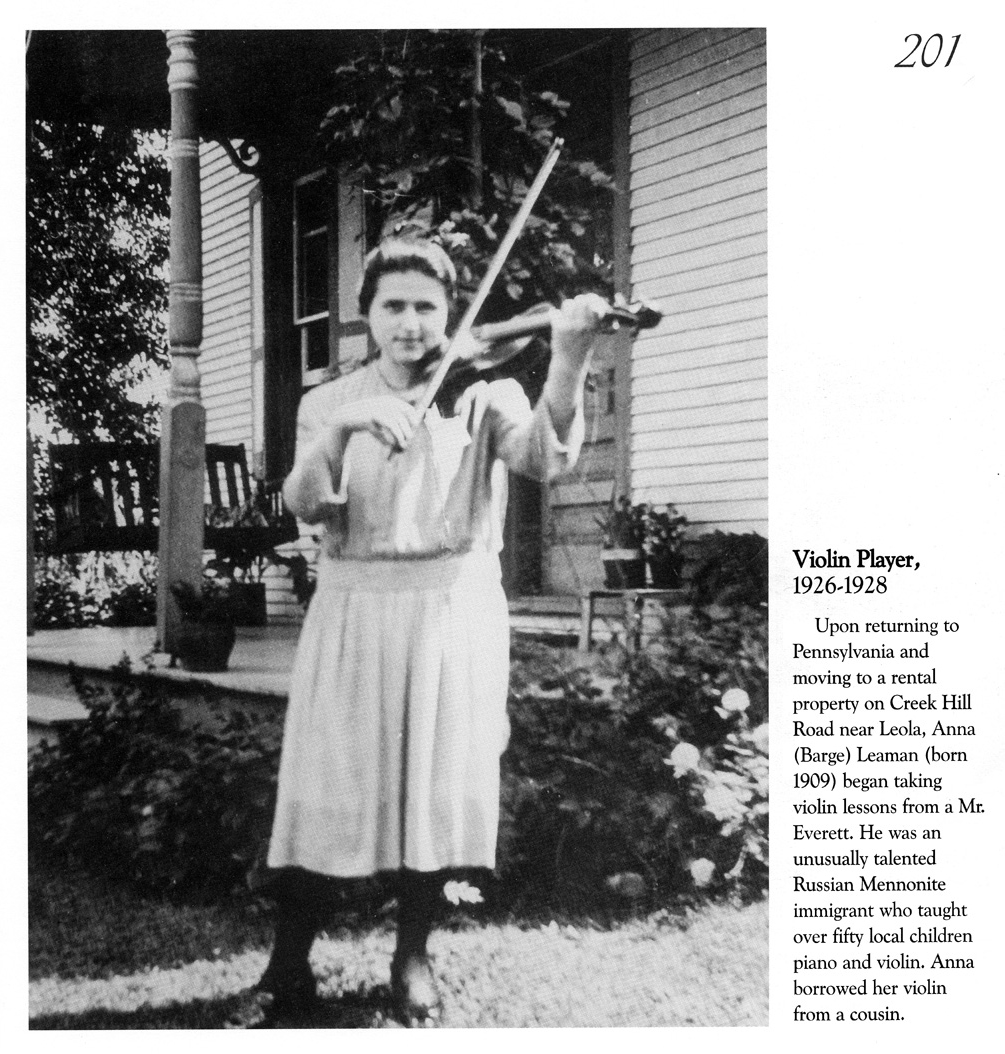
The photo below portrays a young Mennonite girl, Anna Leaman, with covering and caped dress circa 1926 playing the violin. Whether Anna was posing to please her parents or whether she loved playing the violin, it’s impossible to say. I do see a faint smile playing around her lips. Obviously she had been taking lessons and making music solo here.

Credit: Mennonite Women of Lancaster County, Joanne Hess Siegrist 1996

But rest assured, when she went to church on Sunday, no piano, organ or violin would drown out the blend of soprano, alto, tenor, and bass voices who worshipped in blessed harmony.


Did you play an instrument during school or college days? Do you still play it? Any anecdotes to add to the dorm life episodes here, or living with a roommate in an other arrangement?

Coming next: Moments of Discovery, The Story Behind the $ Bill

My Year in a Convent

Nuns live in convents. At least that was true in America in the1960s. Strictly speaking I was not an actual nun, a Catholic sister with a habit like Karen Leahy, who left her convent at Mount Maria to pursue a literary life and experience more freedom. (My review of her book The Summer of Yes here.)

As a student at Eastern Mennonite College, where my un-cut hair was piled neatly under a prayer cap, serving the church was held in high esteem. In fact, the idea of service was drummed in to me as a teaching intern. And so, when the dean of education at the college suggested I apply to Lancaster Mennonite School for my first teaching job, I jumped at the chance. I could serve God and pursue a career I already knew I loved.

I didn’t wear a wimple, scapular, or tunic either. But, as a Mennonite girl in the 1960s, I did wear a prayer veiling and caped dress. My prayer veiling served to acknowledge my obedience to church rules while a cape over my bodice muffled whatever feminine contours I may have had then. Like Karen Leahy, known as Sister Marie Cordé, my clothing announced my separation from the world before I uttered a word. It also assumed a higher set of expectations from me.

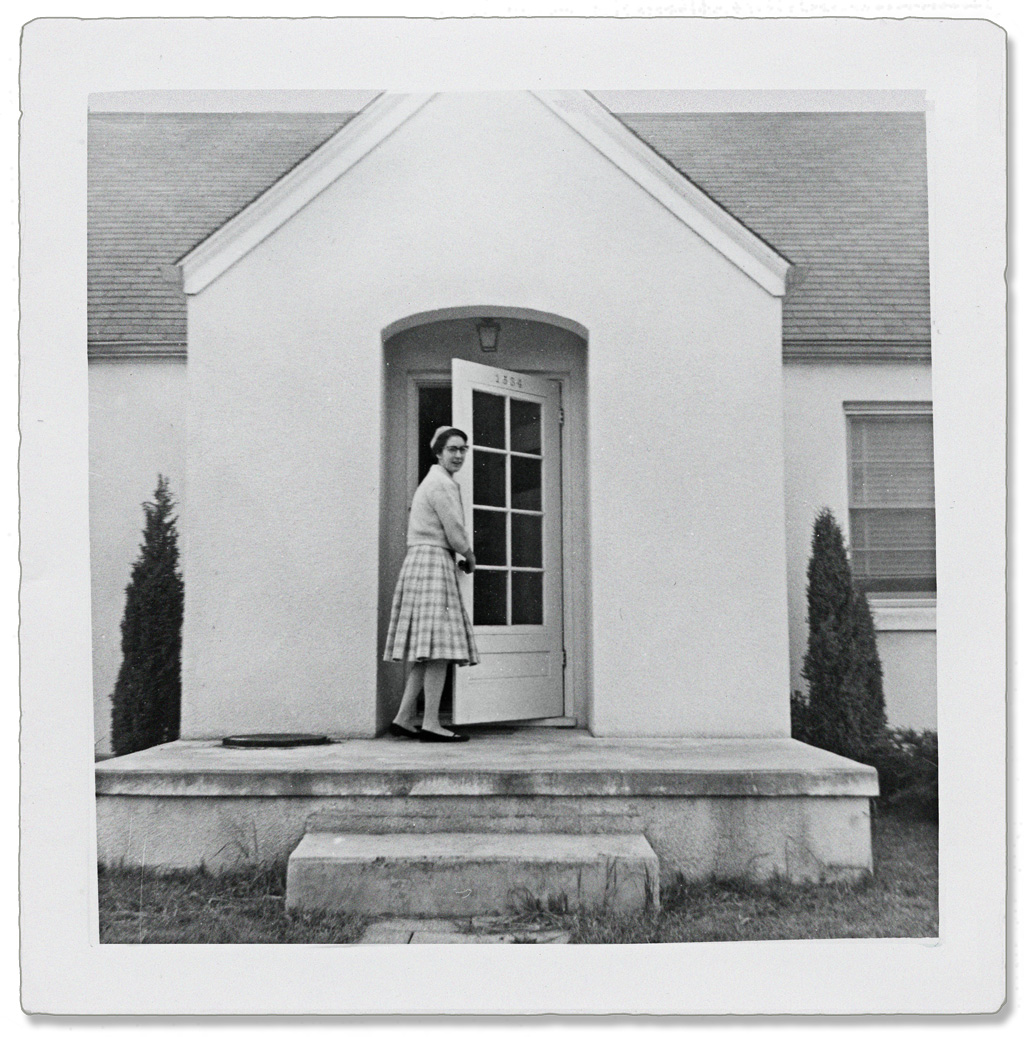
Even before I joined the faculty at Lancaster Mennonite School, I wore a prayer veiling and a caped dress, but not all the time. Just for church. But now as Sister Longenecker, a teacher at LMS, plain clothing was de rigeur, not optional.

And I could do so with one of my EMC classmates, Verna Mohler. She and I had shared dorm space at EMC. Now we would transplant ourselves into a similar arrangement as beginning teachers at LMS.

Laurel Wreath yearbook, 1965

Verna and I were side by side and plain. She taught American Literature, and I English Literature along with Penmanship and Spelling.

Yes, side by side in the yearbook, The Laurel Wreath, whose table of contents featured 5 divisions: Faculty, Students, Organizations, Activities, and Worship. There was no orchestra or band – no football or basketball teams then either. Certainly no theatre.

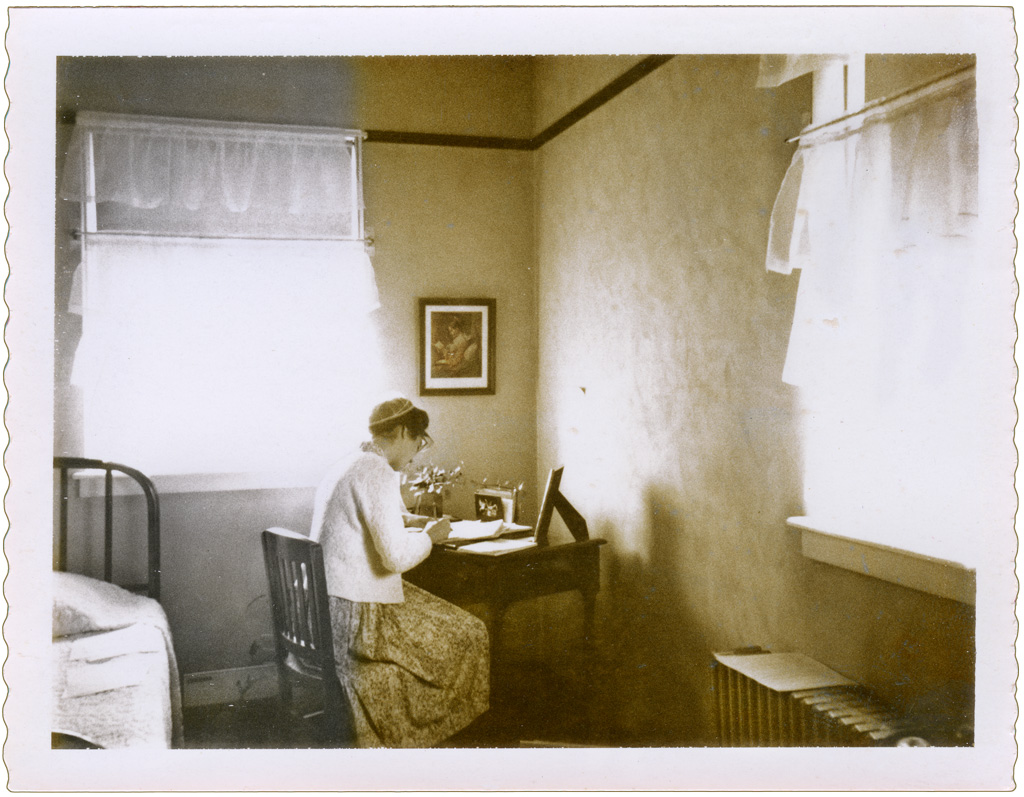
Filmy, white curtains filter pure, virginal light into this teacher's dorm room study
Filmy, white curtains filter pure, virginal light into this teacher’s dorm room study

During our first year of teaching we lived in adjoining rooms in the girls’ dormitory, an awkward situation because of the proximity of students. One evening before supper, I took off my cape and went to the dining hall with just a sweater over my dress. A perceptive student reported me to the Dean of Girls, who gently suggested I mend my ways and remain caped around students at all times.

Of course, our students were plain too . . .

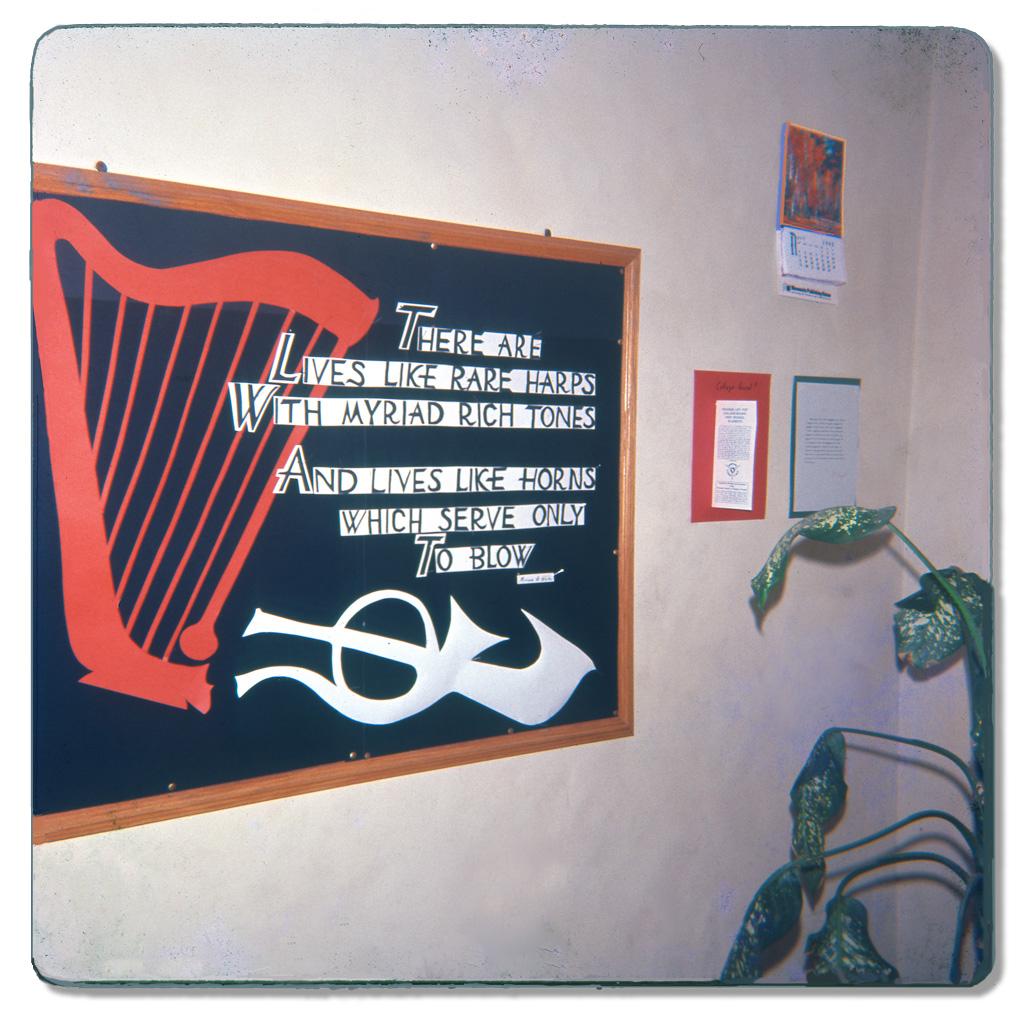
LMSclassStudentsBut my bulletin boards were fancy

Even then I liked quotations

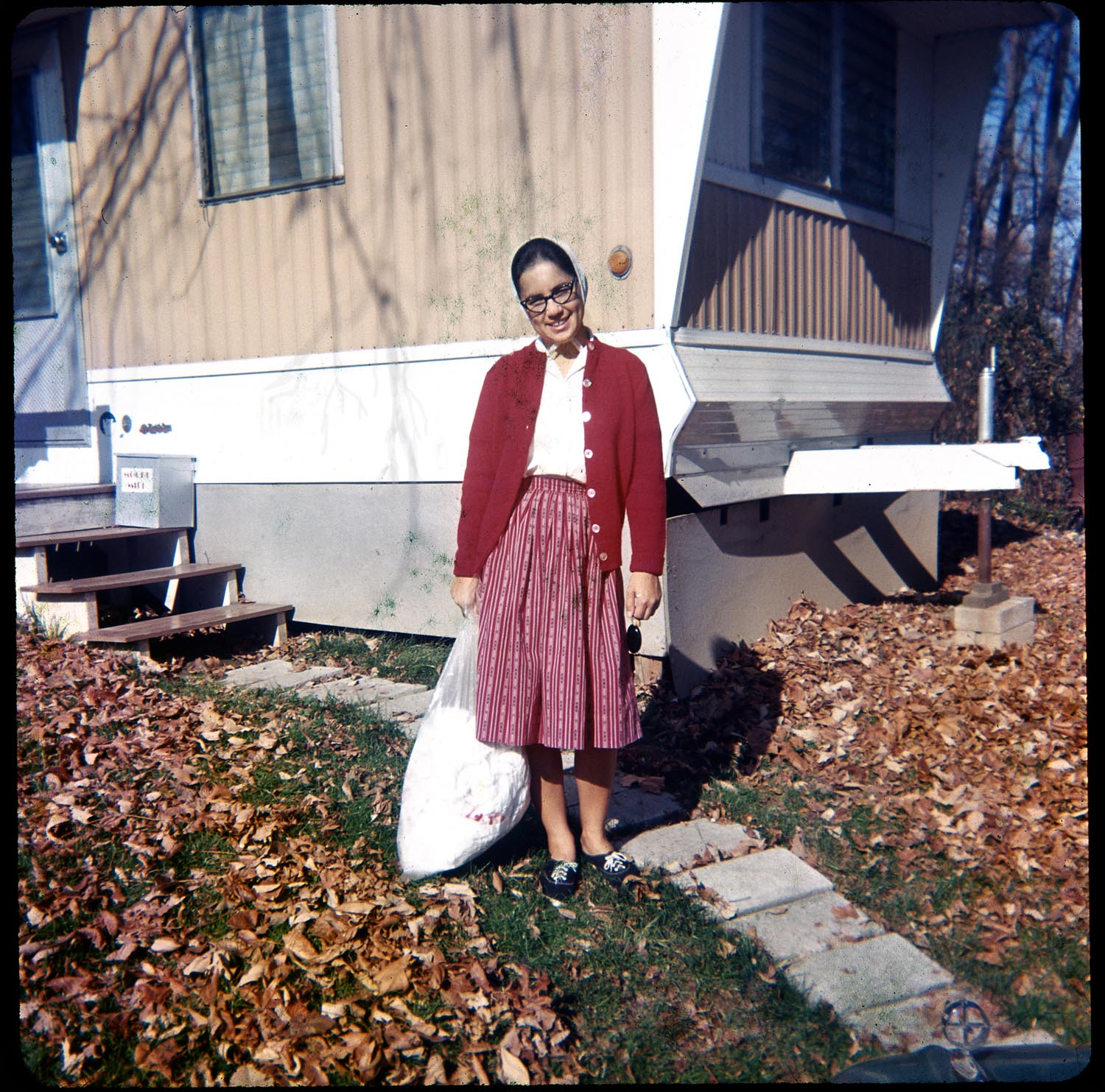
The second year Verna and I moved out of the girls’ dormitory and lived on the edge of campus in a mobile home, which we shared with June Sauder, the Home Economics teacher.

VernaTrailer

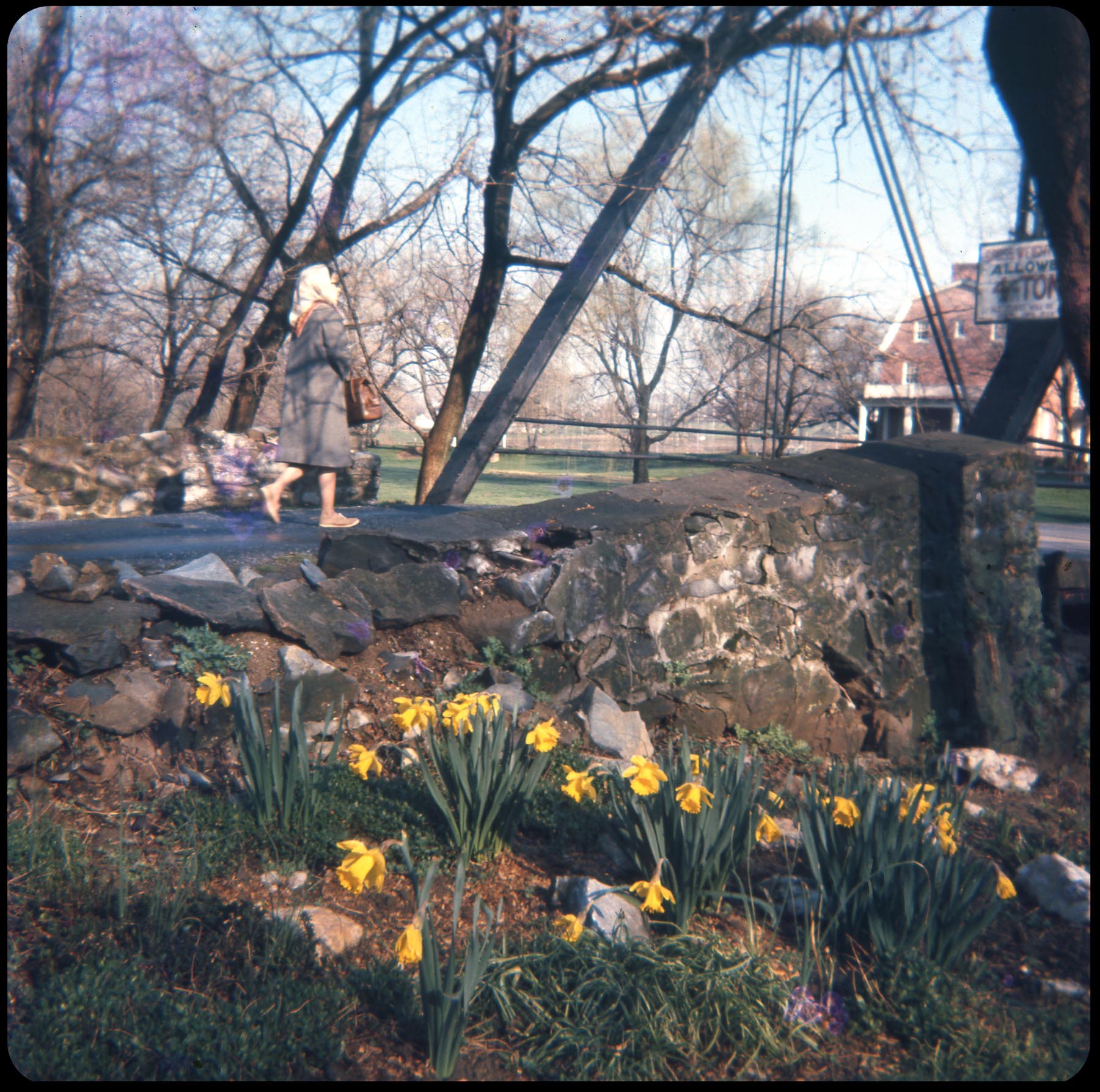
Our trailer was situated in a park-like setting on the other side of the Mill Stream, a bridge between us and campus buildings.

VernaDaffodilsHere again I flirted with danger. One of us rented a TV to see the shocking story of the Kennedy assassination unfold and subsequent funeral proceedings. A student noted the blue glow from our trailer window and reported us to the administration, an action for which we were reprimanded. However, words that we heard on the broadcasts became additions to our students’ vocabulary knowledge: cortege, caisson, requiem.

Sometimes after hours, we skipped wearing the prayer coverings, but always had our heads covered, even if it was with a filmy white bandanna.

CometVernaMarian

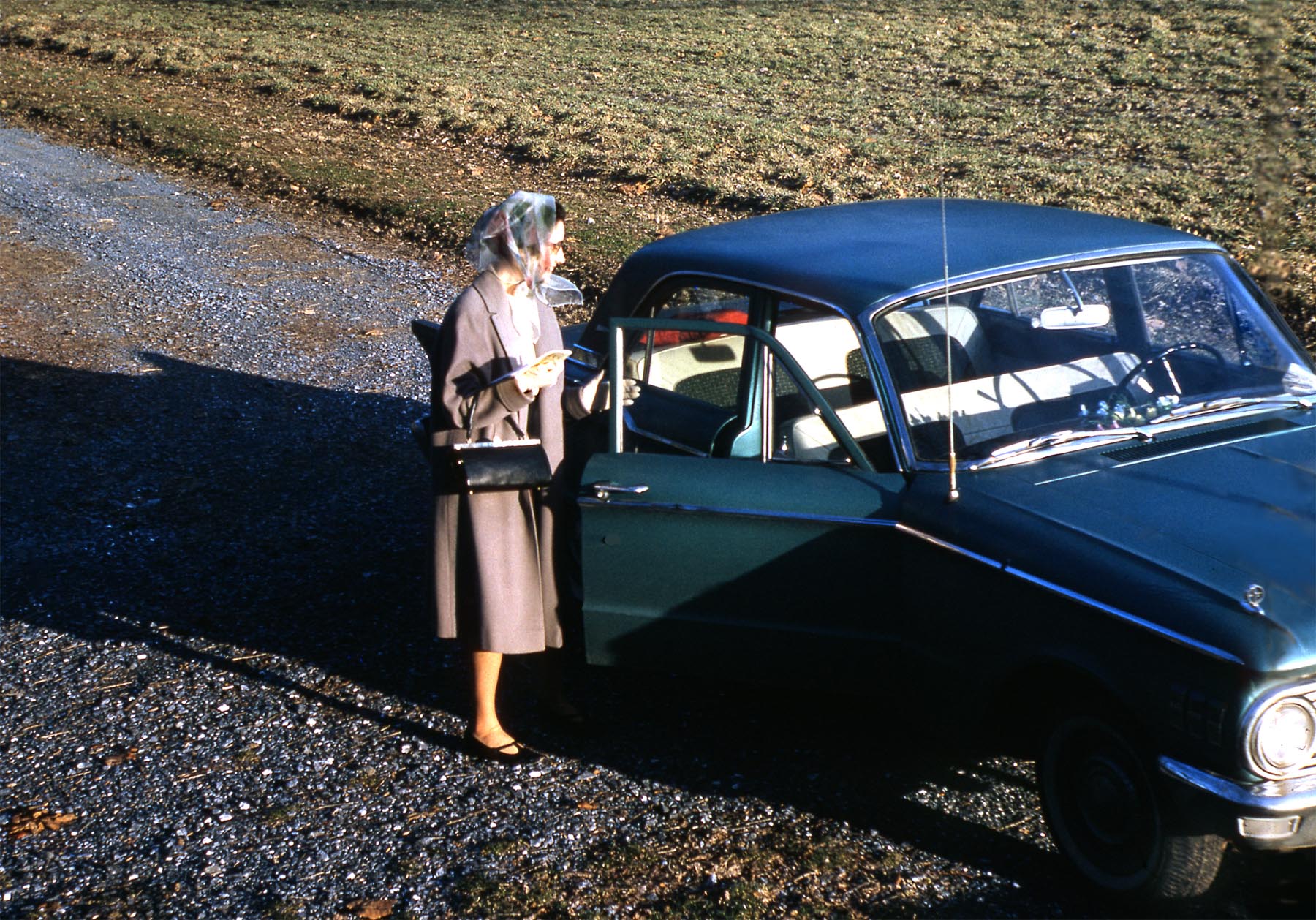
Verna’s Comet became our get-away car when June, Verna and I drove into Lancaster city with serviceable black purses to admire fancy red ones in a shop window, our expressions hopeful.

Our coverings are smaller when we go shopping in Lancaster
We wore smaller coverings and no capes when we went shopping in Lancaster

The Lancaster Mennonite School publication, Bridges, to which I still subscribe, has changed dramatically since Verna’s and my short tenure there. Student rosters now include names like Rodriguez, Rosenfeld, and Fukuhara along with the typical Lancaster County Mennonite names Weaver, Harnish, and Nissley.

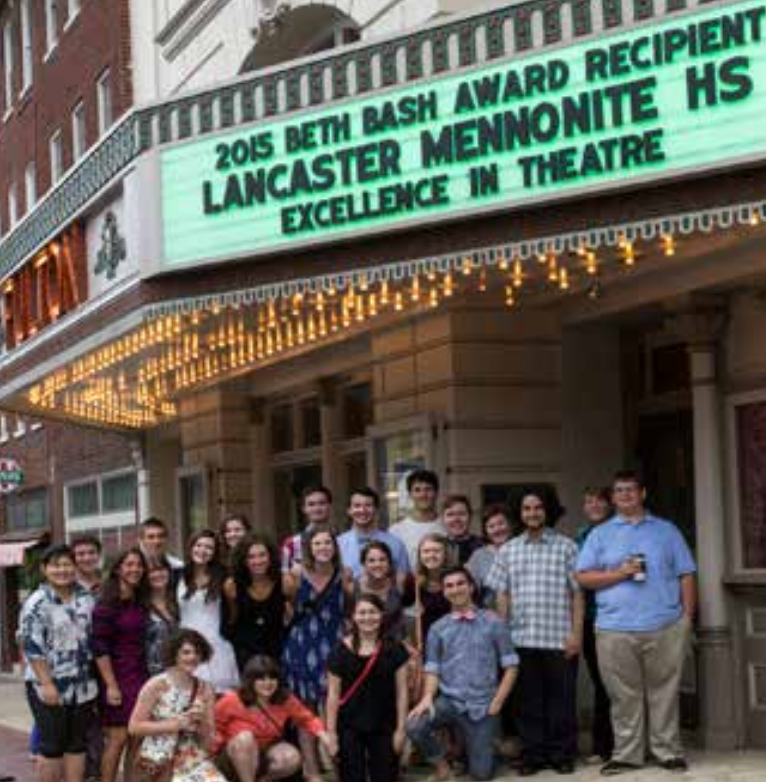
The LMS sports teams are going to the playoffs this year. Lancaster Mennonite and Lancaster Catholic are competing in an international ping-pong tournament. Most interesting of all, the name of Lancaster Mennonite High School appears on the Fulton Theatre marquee in downtown Lancaster displaying the 2015 Beth Bash Award for Excellence in the performance of Shakespeare’s The Tempest. Imagine!

TheatreLMS

A statement from their current principal J. Richard Thomas reveals the continuing strong spiritual mission of LMS:

As a school, we are building stronger wings and growing deeper roots one student at a time. Here students encounter a risen Christ who calls them to transformation, empowering them to be world changers. Our Graduate Profile states that our graduates will “practice global awareness, cultural sensitivity and humility, respect, an anti-racist lifestyle and compassionate living.”

With stronger wings and deeper roots, the graduates of the class of 2015 were commissioned to walk humbly with Jesus . . . and, in doing so, partnering with God in building a kingdom where individuals “from every tribe, language, people and nation” are gathered together around the Lamb.           Revelation 5:9

Is your life, like mine, dramatically different now from your childhood experience? Share your story here.

Coming next: Peachey House, a Prequel

Remembrances of Mother, A Year Later

This week our family remembers the fourth week of July 2014.

Last year Mother observed her 96th birthday on July 23. She died unexpectedly on July 28, five days later. This post will commemorate this milestone in two ways: cards sent to me along with images of Mom’s intimate space upstairs.

Two Cards

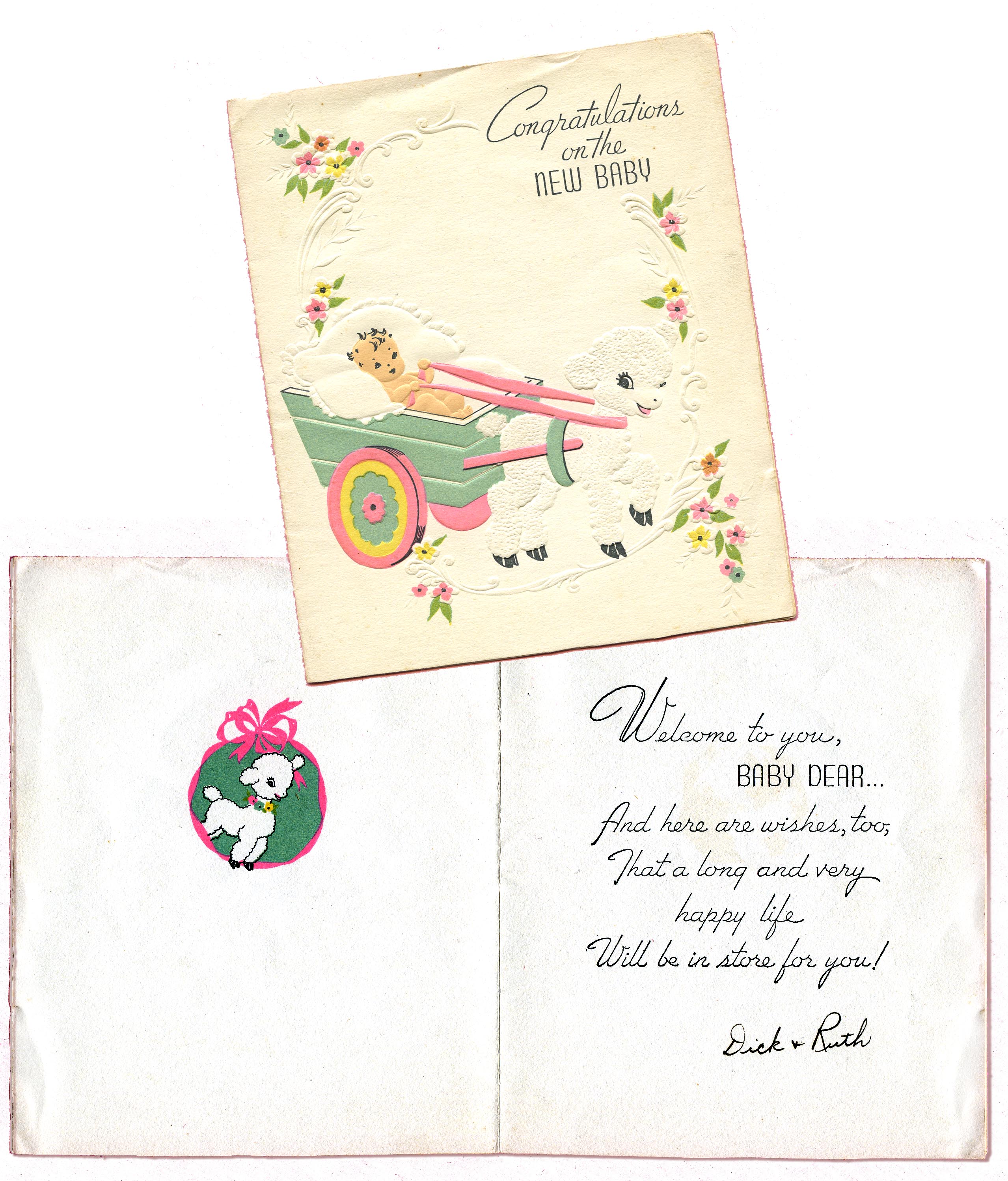
A vintage baby card, sent to my parents when I was born

1941_Marian_Baby Card_outside+inside

Card from Dick and Ruth Sauder. Richard was one of the Florida bunch that stayed in close contact even after his bachelor trip with Daddy. They wished me a long and happy life, bless their hearts!


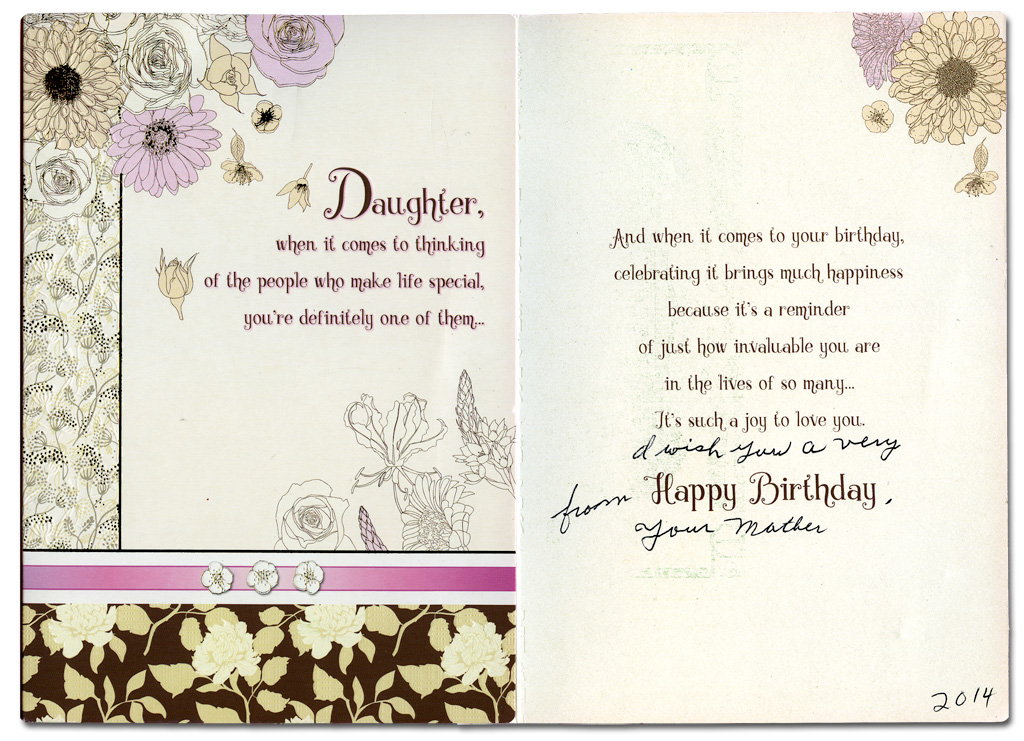
MomBirthdayCard2014

I was born the day after Mother’s birthday. Her last birthday card to me, 2014.


Some Images

At the top of the stairs to the left, there was a little room Mom called the hallway, which seems a misnomer because it was square rather than long and narrow as hallways usually are. It connected the upstairs landing to the family clothes’ closet whose door had a crystal knob. I always thought it was one of the prettiest things about the room because it showered rainbows on the walls when the sun shone in at a perfect slant.

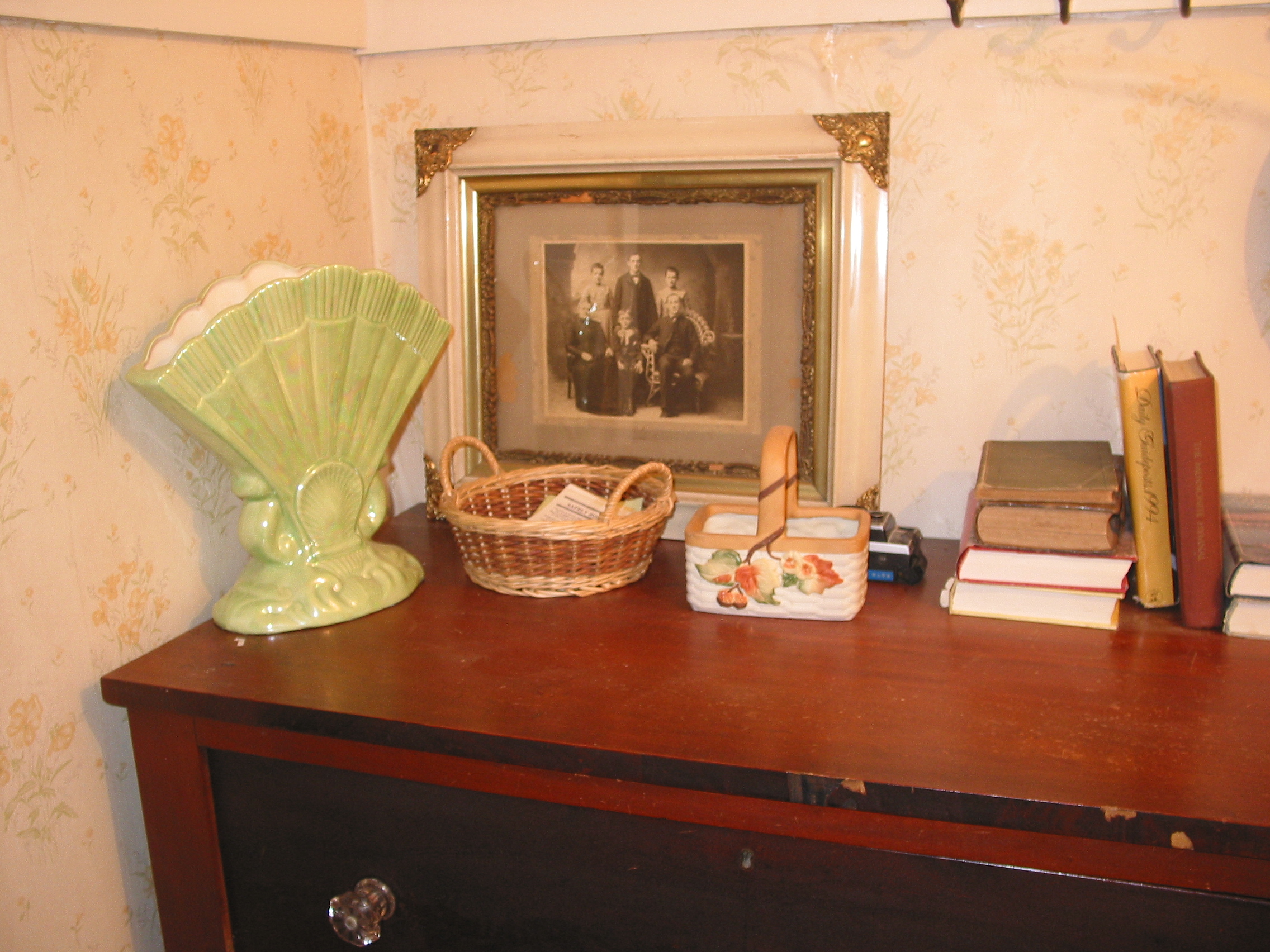
A dressing room of sorts, this small area was a repository for Mother’s own nostalgia: a framed family photograph, old books, the odd china piece on top of the Sheridan chest of drawers.

At right angles to the closet door stood this chest of drawers with a photo of my great-grandmother Sadie Landis’ family before she became a Metzler and a mother. And there’s that ceramic green vase. It’s perfect for displaying iris or gladiolus, but I didn’t grab it when we cleared out Mom’s house. How to take it on the plane? Where would I put it?

GreenFanVase


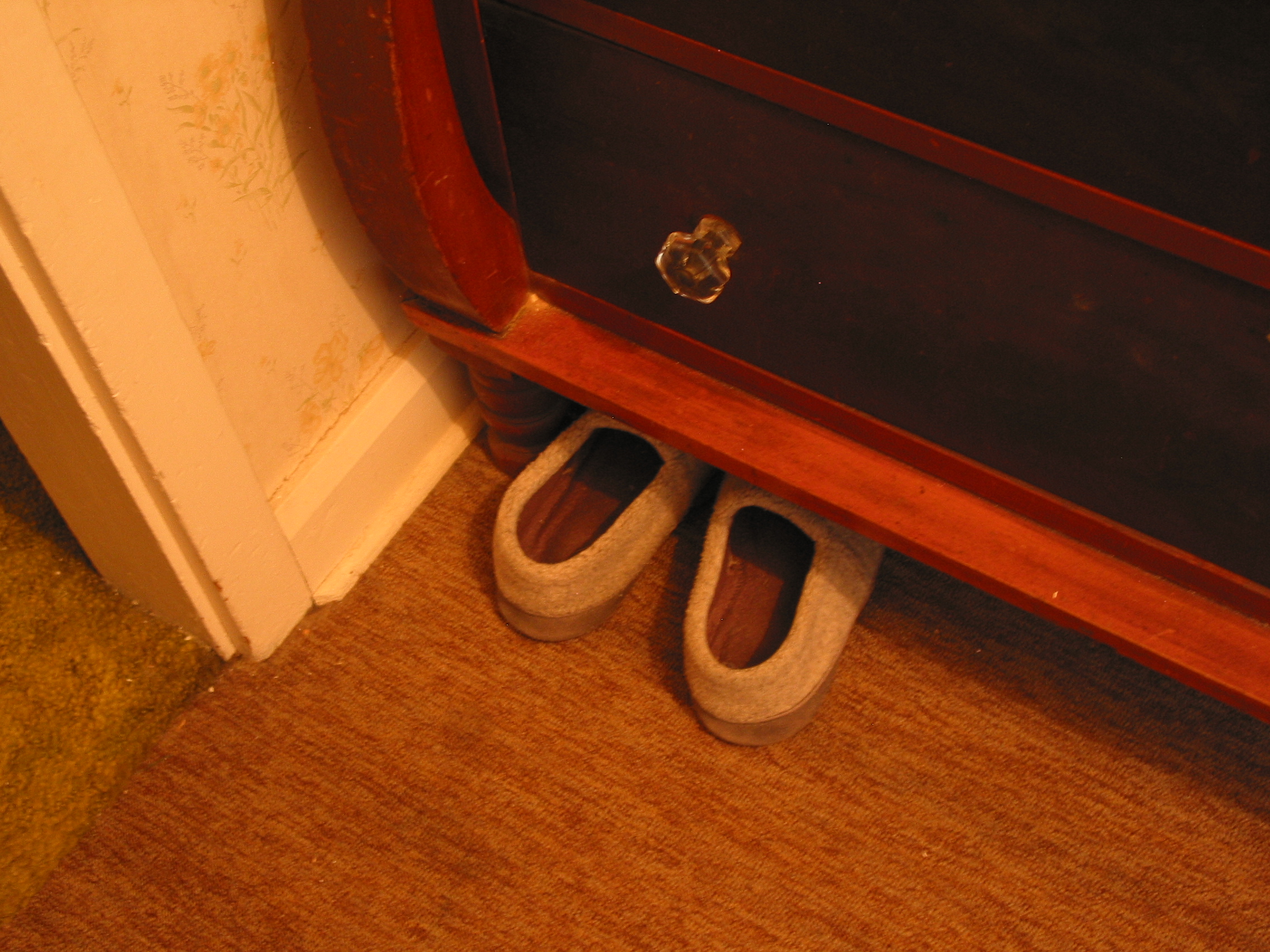
And under the chest, Mother’s slippers

SlippersMom

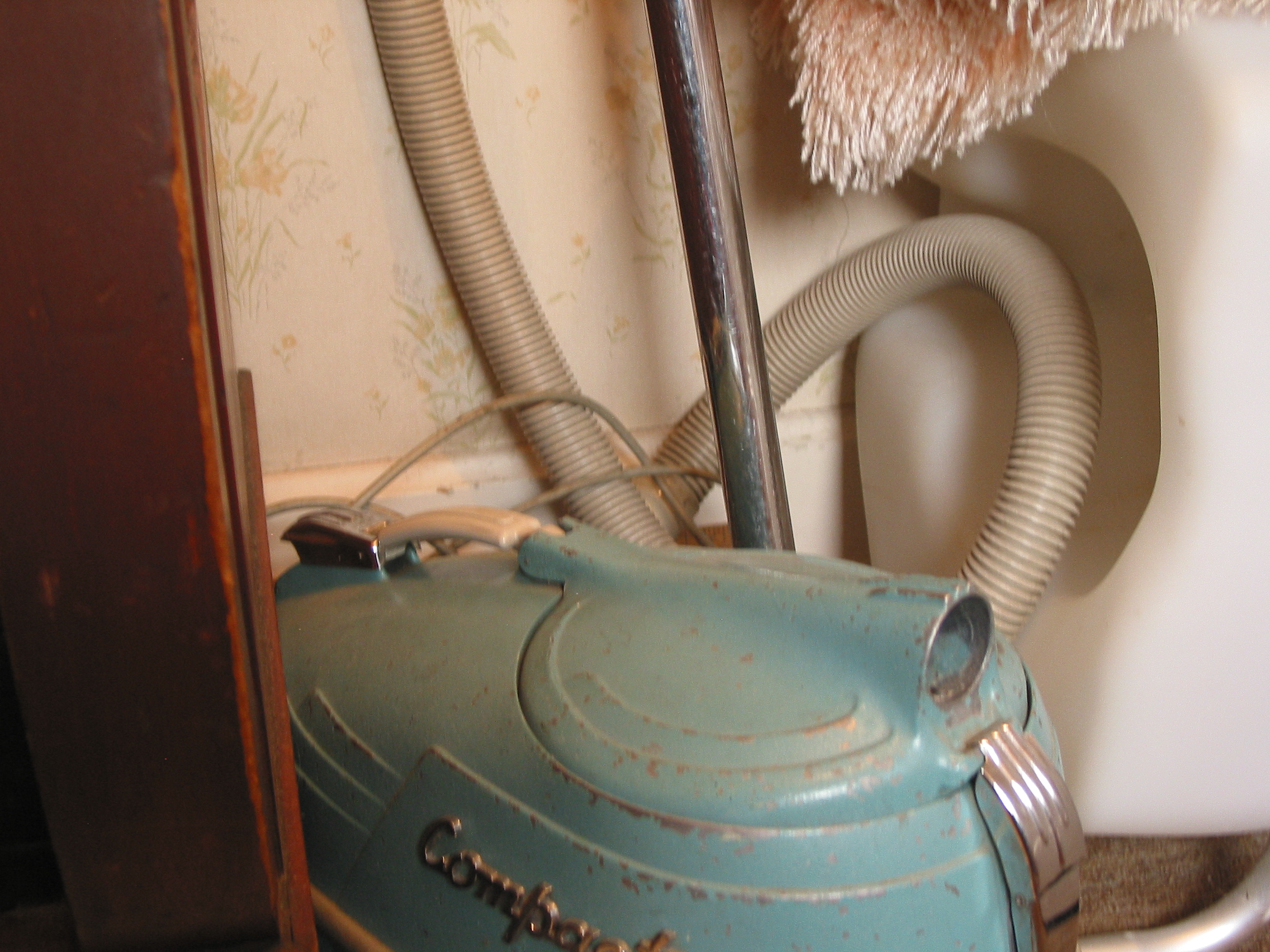
Beside the chest, her Compact vintage vacuum cleaner, a blue bullet of an animal easy to pull around the house even at her age. Her old Singer treadle sewing used to sit in the opposite corner under a window.

VacuumCleaner

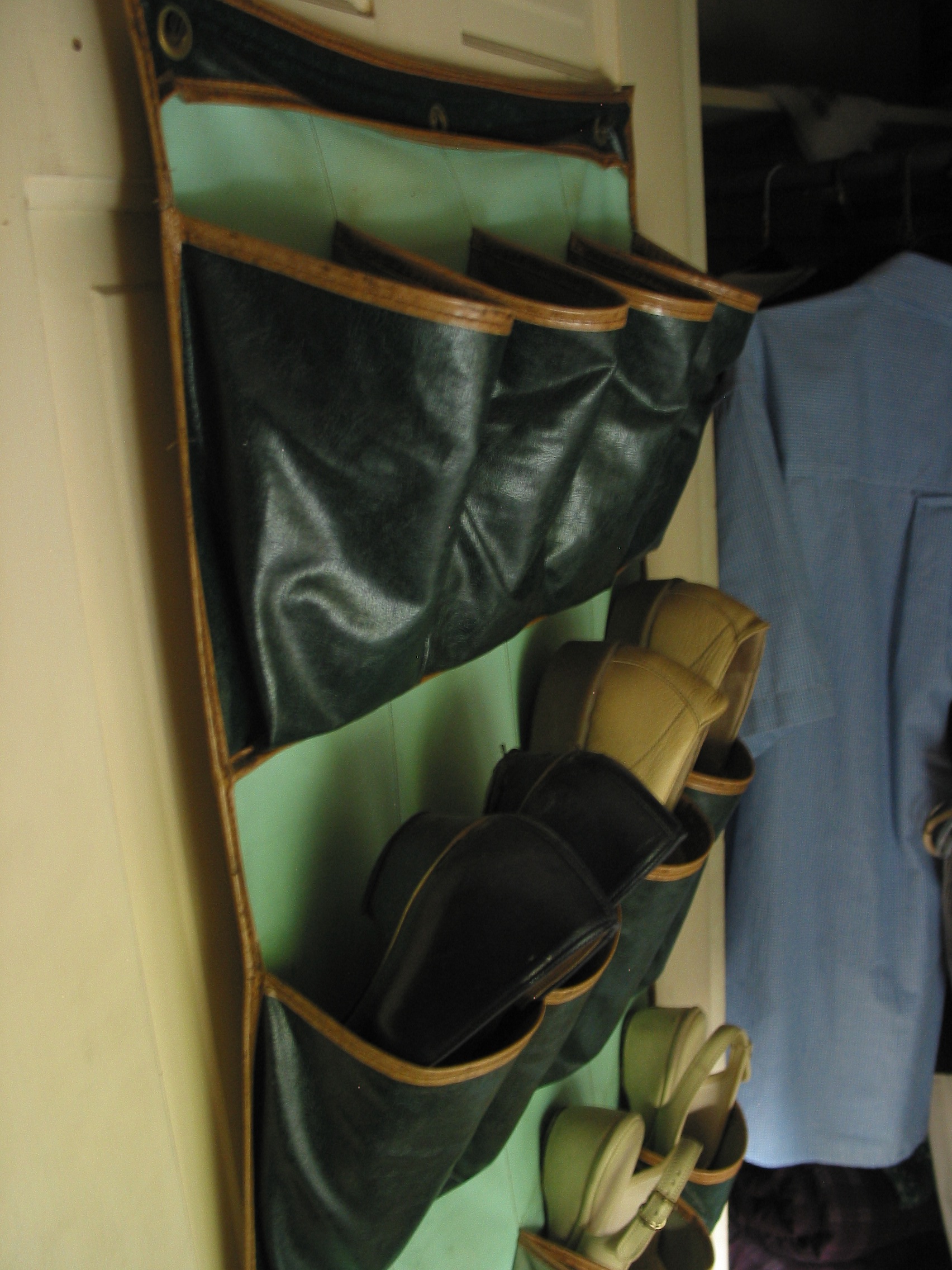
On the closet door what remained of her shoes

MomShoes

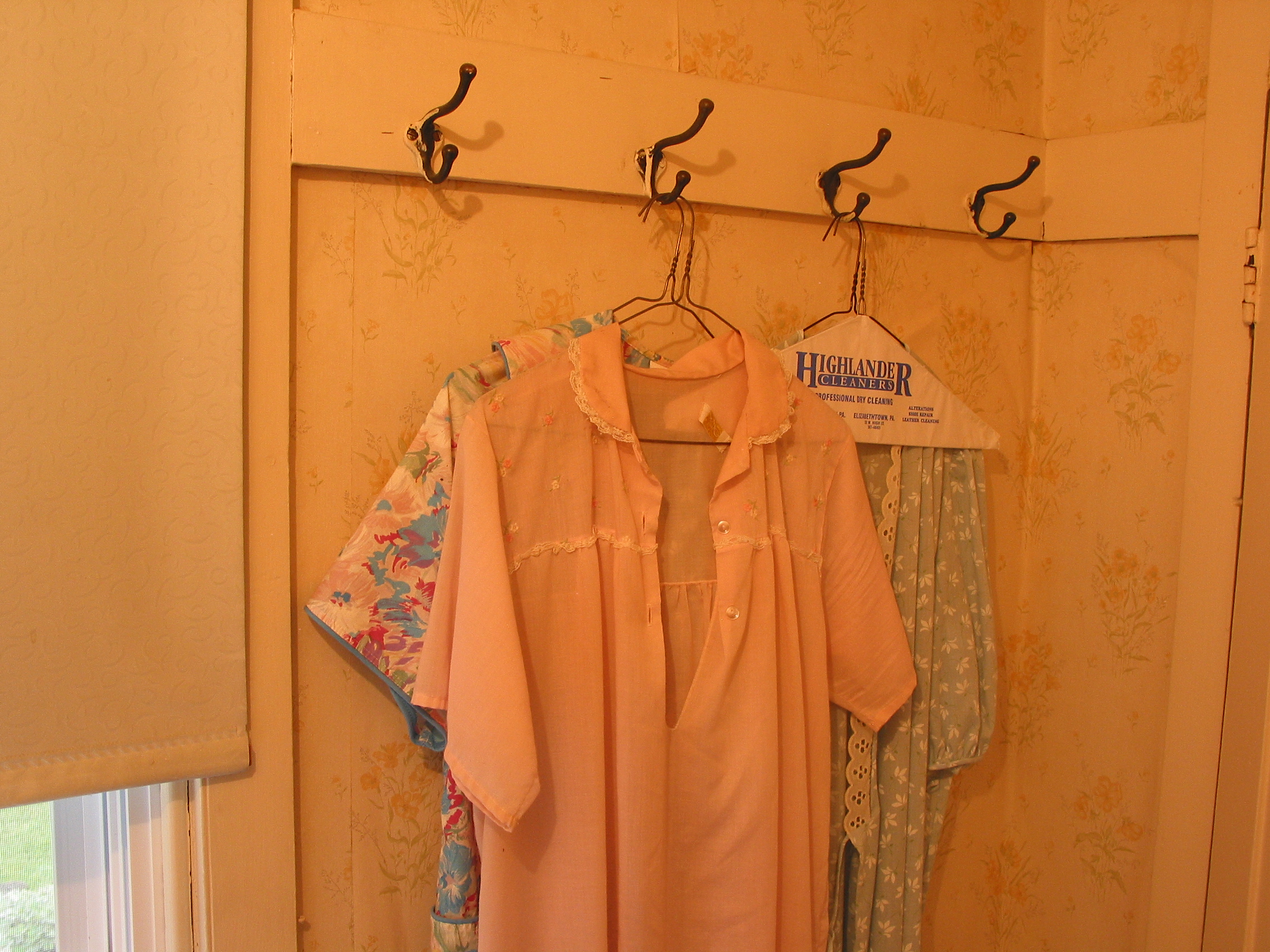
Then below hooks with nightgowns and robes. A girdle with stays used to stand stiffly in the corner below the lingerie to air out. Sometimes a few cleaning products were stored there too. . .

Mom'sNightgown

The house has been sold. These images exist only in memory now and in our e-files on my desktop. Powerful images – how they linger . . .

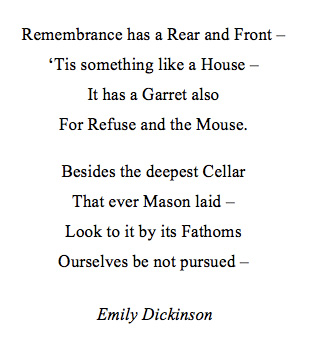
Web_EmilyDickinsonHouse

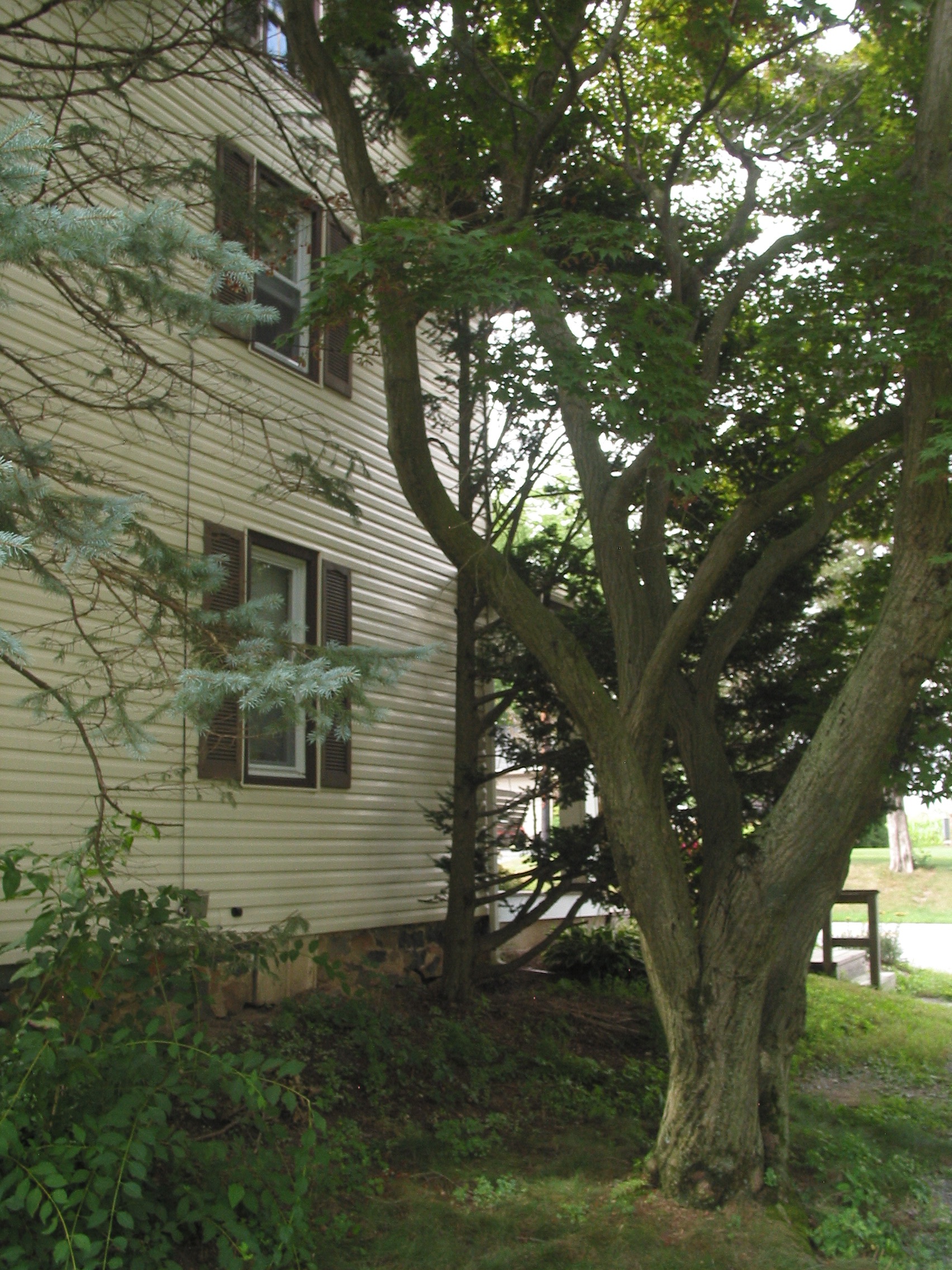
Remembrance also has a side, where other memories sneak in . . . .

HouseWindowTree

Is there a room in your childhood home that holds special memories? A secret niche you called your own?

Coming next: Do you Like to Color?

Oh, Beautiful – Amber Grain & Grainy Amber

LyricsAmericaBeautiful

Did you grow up country? Can you picture a Dad, brother, or uncle toiling under the torrid July sun in the wheat field?

If so, you know that farmers always wore hats with brims. The ruddy-faced farmers I knew in the fifties probably didn’t use Coppertone or any other sunscreen, but they always wore hats with bills, revealing a totally white forehead when the caps came off.

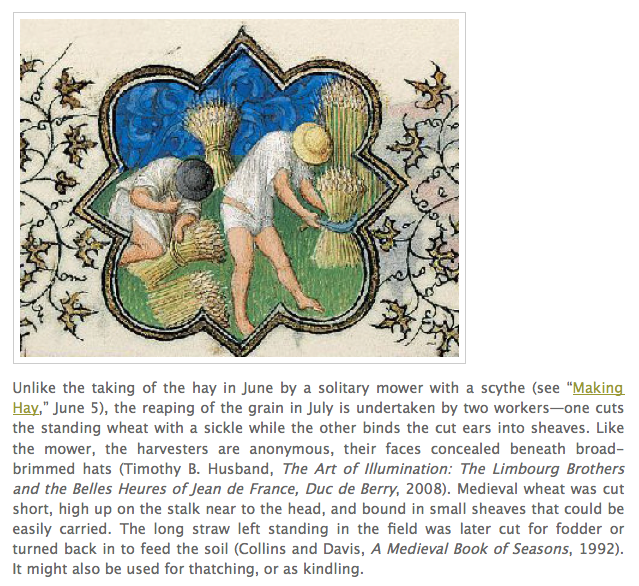
The medieval French farmers in the drawing below in what looks like undies and sandals shield their anonymous faces from the sun with straw hats.

Grain field in Medieval Times: Metropolitan Museum of Art
Grain field in Medieval Times: The Metropolitan Museum of Art

(You may be stifling a giggle at their odd attire right now!)

My dad farmed land in Lancaster County, Pennsylvania, so he was a farmer too, but he was known first as a farm implement dealer. As the owner of Longenecker Farm Supply, he sold farmers tractors, bailers, or combines for grain harvesting, and they called him often in a panic when their equipment broke down: In the middle of the field. At the worst possible time. When storm clouds loomed.

Howard Longenencker, one of Dad’s cousins, and Best Man at Mom and Dad’s wedding, is pictured here in a movie clip taking his new Minneapolis Moline harvesting machinery for a whirl around the field, enjoying every minute. Watch for his jubilant wave! I’ll call the clip “Grainy Amber” because it was filmed in the 1950s with much less sophisticated technology than available now.

Another relative, Esther Mae Longenecker Hiestand, has captured images of her family’s grain harvest in her 489-page book, all about the Longeneckers descended from the line of Ulrich Longenecker, who emigrated from Switzerland to America. She and her family collected over a dozen images of hay and wheat harvesting in her portrait of a Lancaster County family entitled Pitchforks and Pitchpipes (454 – 457).

* * *

So great a blessing was an abundant harvest that the warmth and productivity of the season was interpreted as an allegory of spiritual plenty. The ninth-century theologian Hrabanus Maurus writes that summer sun expresses the heat of God’s love, and that the season signifies the blessedness to come in Heaven (Medieval Book of Seasons, 1992.)

School children of all races and creeds sing lustily about the bounty of harvest in a patriotic song we hear often during the month of July:

Did you grow up country? Share your experience with summer harvesting of all kinds. Or add an impression, a quote. Whatever!

Up next: Purple Passages with Rainbow Colors

2 Tales from Roxann and Cheeno, Our Fresh Air Children

His yellow tag says: Cheeno Duncan –  Host Family: Ray & Ruth Longenecker

How would you feel if you were an 8 or 10-year-old from New York City and after a 3-hour train ride landed you in the farm pastures of Lancaster County, Pennsylvania, lush but unfamiliar? Cheeno and Roxanne Duncan were part of the Fresh Air program designed to give urban children summer vacations away from their hot tenement building apartments.

My parents, always alert for ways to serve God through their church, Bossler Mennonite, offered a home to two of these children in 2-3 consecutive years in the early 1960s. A side benefit would be playmates for my 10-year-old brother Mark, who was 7 years younger than his closest sibling, my sister Jean. And for the first time, the whole family would be brought in close contact with children of a skin color and culture different from our own.

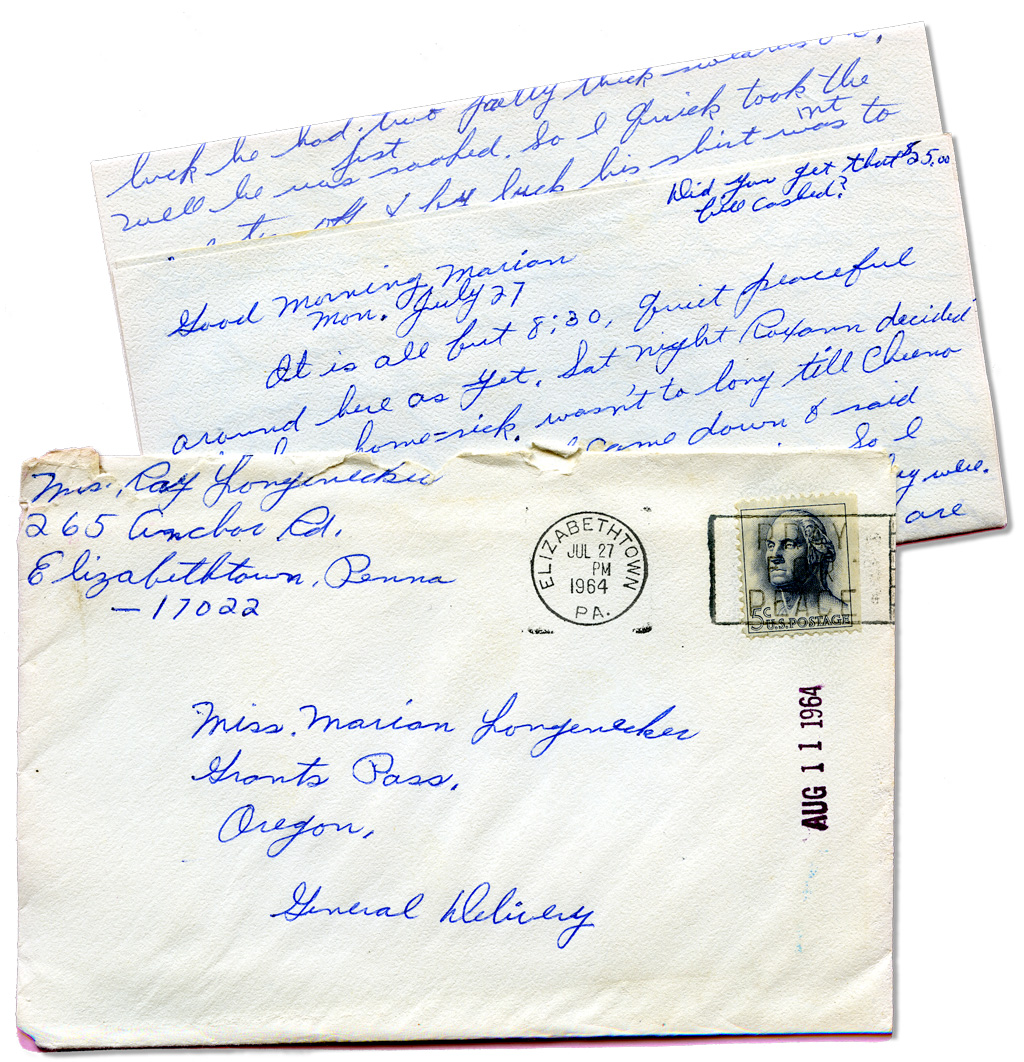
These two tales about Roxann and Cheeno come verbatim from letters my mother sent to me while I was enjoying a 5-week cross country road trip. One was addressed to Grants Pass, Oregon, delivered, and another addressed simply to Los Angeles, California, no street address, from where it was “returned to sender, unclaimed.”

LetterMomToMarianOR

TALE # 1   Crying

July 27, 1964   Written in my mother’s handwriting, unedited:

Good morning Marian   It is all but 8:30, quiet peaceful around here as yet. Sat. night Roxann decided she has homesick. Wasn’t to long till Cheeno saw her crying. Mark came down and said Mommie now they are both crying. So I went up into the bed room. There they were, two sets of tears. I asked Cheeno why are you crying. He said because she is crying. Then I said well now I will cry because you are crying. So I tried to start pretending [to cry]. Roxann had to laugh. It didn’t last to long. But they decided they would feel better if they slept in one bed. So I left them.


TALE # 2   Leaving

August 4, 1964

Dear Miss. Marian   Well we took the Duncans to the train station today. We were about 2 blocks away from the station Roxann said we don’t have our yellow tags on. I rushed in quickly and explained the situation. He said they must have tags on. But we can make some others. Well that was finally straightened out.

But oh horrors what could be next. Cheeno picks up his lunch bags and lets it fall to hard on the cement. There goes a broken jar with root beer all over the bag and the floor. I quickly got some Kleenex but not quiet enough. Ruthie [my Aunt] goes to the car and comes back with an old pair of her silk “panties” Oh she said we don’t even have paper to put them in. she had taken the broken jar and paper bag to the car already. There we were left holding some-thing we didn’t care to be seen with. Luckly we did see a trash can. Ruthie laughed and said if any body finds or see’s this they will think she just took off her ____??____

 * * *

The program, originating in 1877, is flourishing to this day. See more about the Fresh Air Fund here.

FreshAir Kids

There are many ways to experience independence and freedom. Here’s one example. You can think of some others as you reflect on this past holiday weekend. Hope you had a Happy Fourth!

Coming next: A Plate, a Parade, and a Song