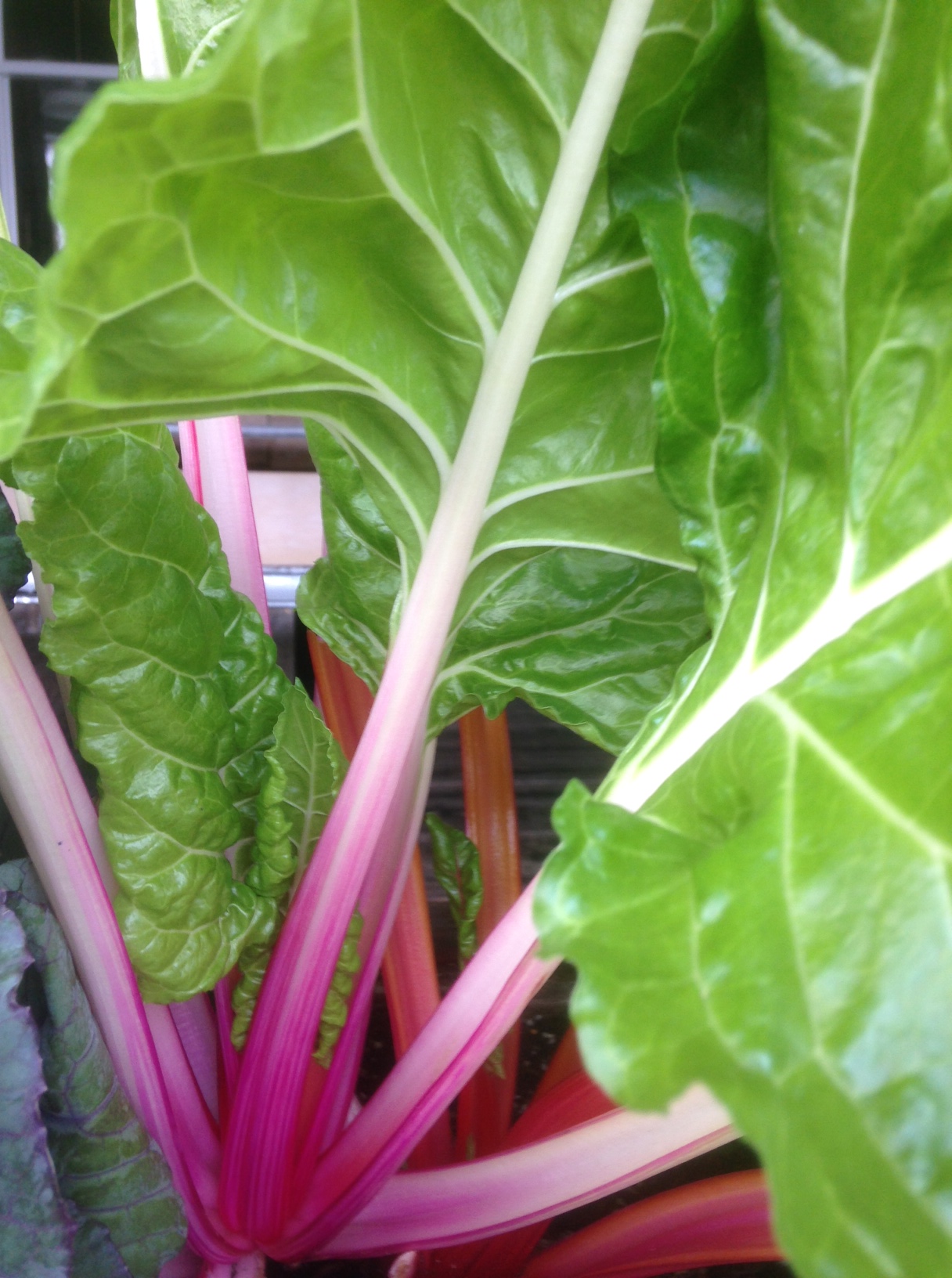
Rhubarb in Grandma’s Garden

Hot-house rhubarb spotted in shop window, Brunswick, GA  January 2015
Rhubarb plant spotted in front of shop window, Brunswick, GA
January 2015

Grandma and I in the Rhubarb Patch

It’s me, pigtails flapping in the May breezes, skipping beside Grandma toward the rhubarb patch. Behind Grandma’s house toward the woods a thick nest of rhubarb stalks stands sentinel over a ridge facing the twelve sweet cornfield rows. In her garden, the pinkish-red rhubarb spears get back-row status but I think they are pretty enough for her flower garden out front.

“You said you are stopped up – didn’t have any luck when you went to the bathroom.” Grandma with her sunbonnet and apron pulls off the biggest pinkish-red stalks, the green heart-shaped, crinkly leaves falling to the ground with one swath of her knife. “A dose of this will fix that.” She’s looking intently at the rhubarb but I know she’s talking to me.

I have eaten Grandma’s rhubarb sauce before, but I never thought of it as a laxative. “It has roughage in it. It’ll really clean you out.” She runs her rough hands along the spine of the stalk to show me the fibers.

“I see,” I say but right now I wonder if it tastes as good as it looks, so I bite into a stalk and find out too late that it has plenty of pucker power. “Eeee-ow. It tastes sour,” spitting the mouthful out on the ground.

“Goodness gracious, you have to boil it first in sugar water to make it taste good, don’t ya know!” She giggles at my ignorance and finishes pulling off more rhubarb stems with a twist of her wrist like separating a stalk of celery from the bunch. Then we head back toward her kitchen.

Making Rhubarb Sauce

The round, dented aluminum pot is simmering on the stove. With every passing minute the mixture of sugar water and rhubarb cut into 1/2-inch chunks is becoming more ruby red. At the last minute Grandma says, “ Just two shakes,” and I flick my wrist to shake the little can of cinnamon twice as swirls of steam half-scald my hand and wrist.

When it cools, it will taste both tart and sweet. That I know!

Rhubarb Pie from The Mennonite Community Cookbook, 2015
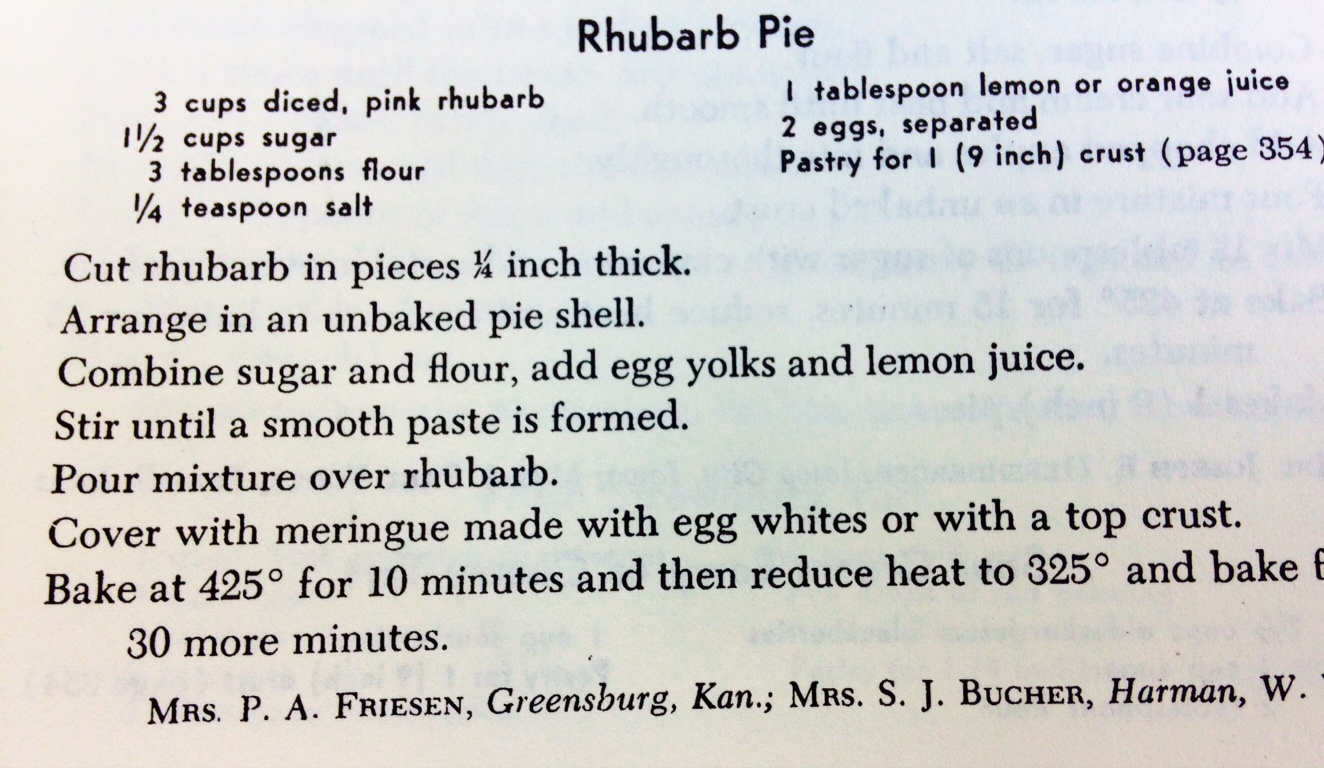
RhubarbPieRecipe

(Adding Strawberries to the rhubarb adds another layer of flavor.)

My Mother's Garden, an embroidered poem
My Mother’s Garden, an embroidered poem in Grandma’s bedroom

What You Might Not Know About Rhubarb

Yes, rhubarb has good cathartic (laxative!) powers, but according to Marion Owen, co-author of Chicken Soup for the Gardener’s Soul, rhubarb is out to save the planet too:

Rhubarb not only saves our plants from aphids, it may also save the planet. In the mid-1980’s, when a hole was discovered in the ozone layer, researchers found that CFC’s were one of the primary reasons for the ozone’s decline.

One of the most common forms of CFC’s is freon, which is used as a refrigerator coolant. Conventional methods for breaking down CFC’s were costly and dangerous. But in 1995, two Yale scientists discovered that oxalic acid, found in rhubarb, helped neutralize CFC’s. Rhubarb to the rescue!

Marion Owen from Kodiak, Alaska, also publishes a newsletter titled The UpBeet Gardener.
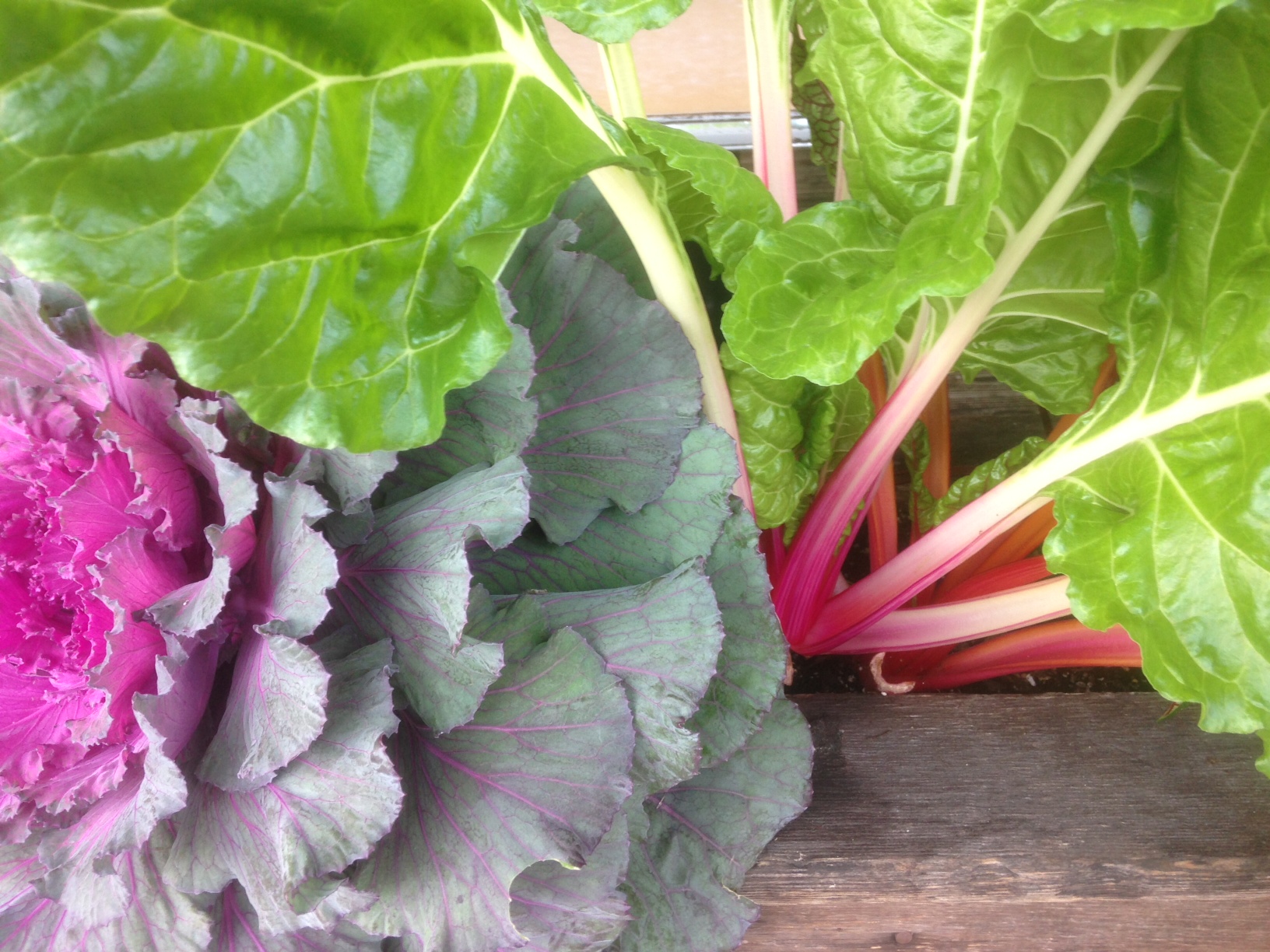
RhubarbCabbagePurple

Beets, rhubarb, memories of springtime in the garden – all are on the table for today’s conversation!

Coming next: Mennonite Girls Can Cook
Lincoln, Lilacs, and Grandma’s Outhouse

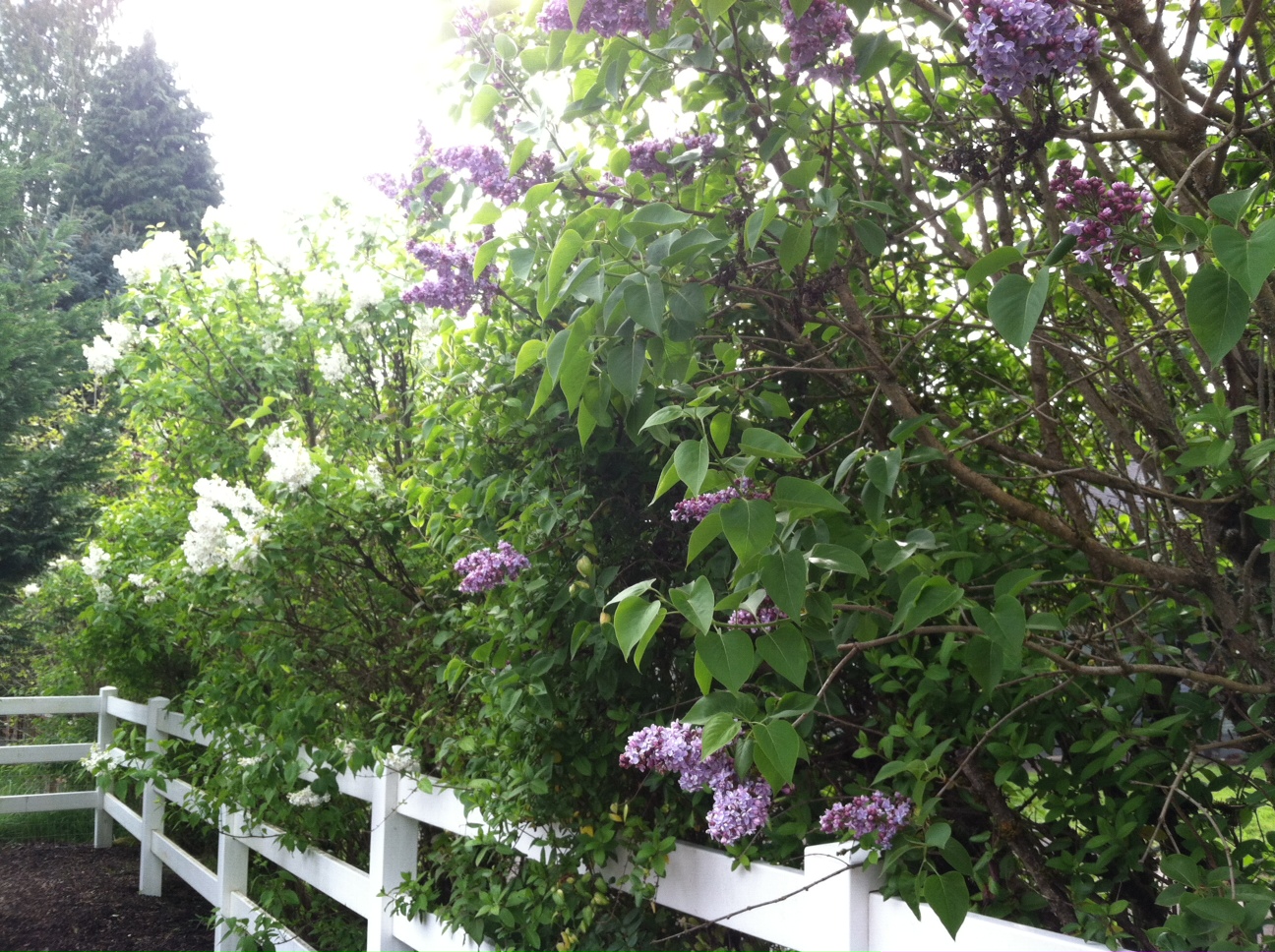
Lilacs in Washington State

Earlier this month, my husband Cliff and family laid to rest his father Lee Beaman in a tiny urn above the coffin of his mother in the cemetery adjoining the church. Across the street from the simple, white-plank Methodist Church near Ridgefield, WA, are lilac bushes in full bloom this April. If you live in the Pacific Northwest, here is a website you may want to check out: //lilacgardens.com/

Lilacs along McCardy Road, Bethel Methodist Church, Ridgefield, WA
Lilacs along Carty Road, near Bethel Methodist Church, Ridgefield, WA

Like floral fireworks, these blooms explode in vivid lavender, each blossom bursting in “bullet-shaped buds.” Poet Richard Wilbur seems to scrutinize the lilacs he describes by looking into not just at the hundreds of teeny buds arranged in each bursting bloom tighter than stick pins in a pincushion.

LilacsRWilburPIC

As poet Wilbur points out, each tiny lavender bud appears “quick and bursting,” not holding back its beauty – is open and free. Similarly, when friends and family eulogize the beloved, their remarks tend to be candid, “quick and bursting,” revealing true feelings, knowing this is probably the last time to express their sentiments publicly.

Lincoln and Lilacs

Another poet, Walt Whitman, connected grief to the springtime and lilacs as he expresses his deep attachment to Abraham Lincoln, whose death April 15, 1865, is commemorated in his famous poem When Lilacs Last By the Dooryard Bloom’d. Written in private, the poem is a public elegy to the President the people adored. The poet revered the President too and when the cortége passed by, Whitman placed a sprig of lilacs on the coffin:

“With delicate-color’d blossoms and heart-shaped leave of rich green, /A sprig with its flower I break.” (stanza 3)  Then admitting that “the lilac with mastering odor holds me,” Whitman will forever associate the fragrance of lilacs with his fallen hero (stanza 13).

Finally, referring to Lincoln as a “Powerful western fallen star” the poem closes with the lines

For the sweetest, wisest soul of all my days and lands—and this for his dear sake,

Lilac and star and bird twined with the chant of my soul,

There in the fragrant pines and the cedars dusk and dim.

Kathy Beaman holding lilac after Dad's memorial service
Kathy Beaman holding lilacs after Dad’s memorial service

Lilacs Bushes and Grandma’s Outhouse

Please permit me this odd segué!

I love lavender and purple – and I love lilacs and wisteria. Wisteria climbing joyfully on a trellis on Grandma’s verandah and lilacs some distance away. . .

Close to an oak tree that Grandma Longenecker’s grand-children planted in her honor after her death in 1980, was an outhouse (now long gone) surrounded by a clutch of lilac bushes. The lilacs around Grandma’s house served as a fragrant air freshener. Of course, there is nothing elegiac about an outhouse, a tallish, square white structure with a roof, equipped with a Sears & Roebuck catalog or better yet for the job – a phone book. The outhouse, dedicated to defecation, bears evidence that bodily functions continue, that you are still alive. Lilacs thrive there.

Long live the lilacs. Long live symbols of life, death, and rebirth!

* * *

. . .  and a bush nobody had noticed burst into glory and fragrance, and it was a purple lilac bush. Such a jumble of spring and summer was not to be believed in, except by those who dwelt in those gardens.

The Enchanted April, Elizabeth von Arnim

Now, your turn. What is your relationship to lilacs or other spring flowers? To commemorating the death of loved ones?


Carole Parkes and the Written Acts of Kindness Award

Thank you notes are usually written privately, but this one is a public thank you to Carole Parkes, a writer friend who just recently nominated me for the Written Acts of Kindness Award, an award given from one blogger to another to let them know their words bring inspiration.

WrittenActsofKindness Award

I take this as an opportunity to showcase Carole’s own accomplishments. Her work as a painter and photographer first caught my eye nearly a year ago, but I quickly noticed that she is a 21st century Renaissance Woman:

  • Author of a psychological thriller, Tissue of Lies
  • Short story writer
  • Painter in oils
  • Seamstress, who crafts men’s suits and ladies’ fashion jeans for Marks & Spencer
  • Photographer
  • “Occasional” poet, she says

Her husband calls her butterfly because she flits from one hobby to another. I don’t see that she has ever changed the oil on an 18-wheeler, but even that wouldn’t surprise me!

CaroleParkes

Here is a blurb from her “About” page

I was born in Liverpool, (England) in 1945, and have lived in my current house near Ormskirk, Lancashire for the past 39 years. I’ve been married for 49 years and have three sons, all now married with their own families.

I started writing in 1985 when I produced several short stories, a series of children’s books and my newly published book on Kindle “Tissue of Lies.” Between 1985 and 1989 I also encouraged my elderly mother to write her life story, whilst I started on my biography. Owing to my commitment to my elderly parents, I didn’t take my writing too seriously until after my parents aged 97 and 94, both passed away in 2012.

You are such an inspiration, Carole. Your words echo across the pond. Again, THANK YOU!

My Little Black Bookends Tell All

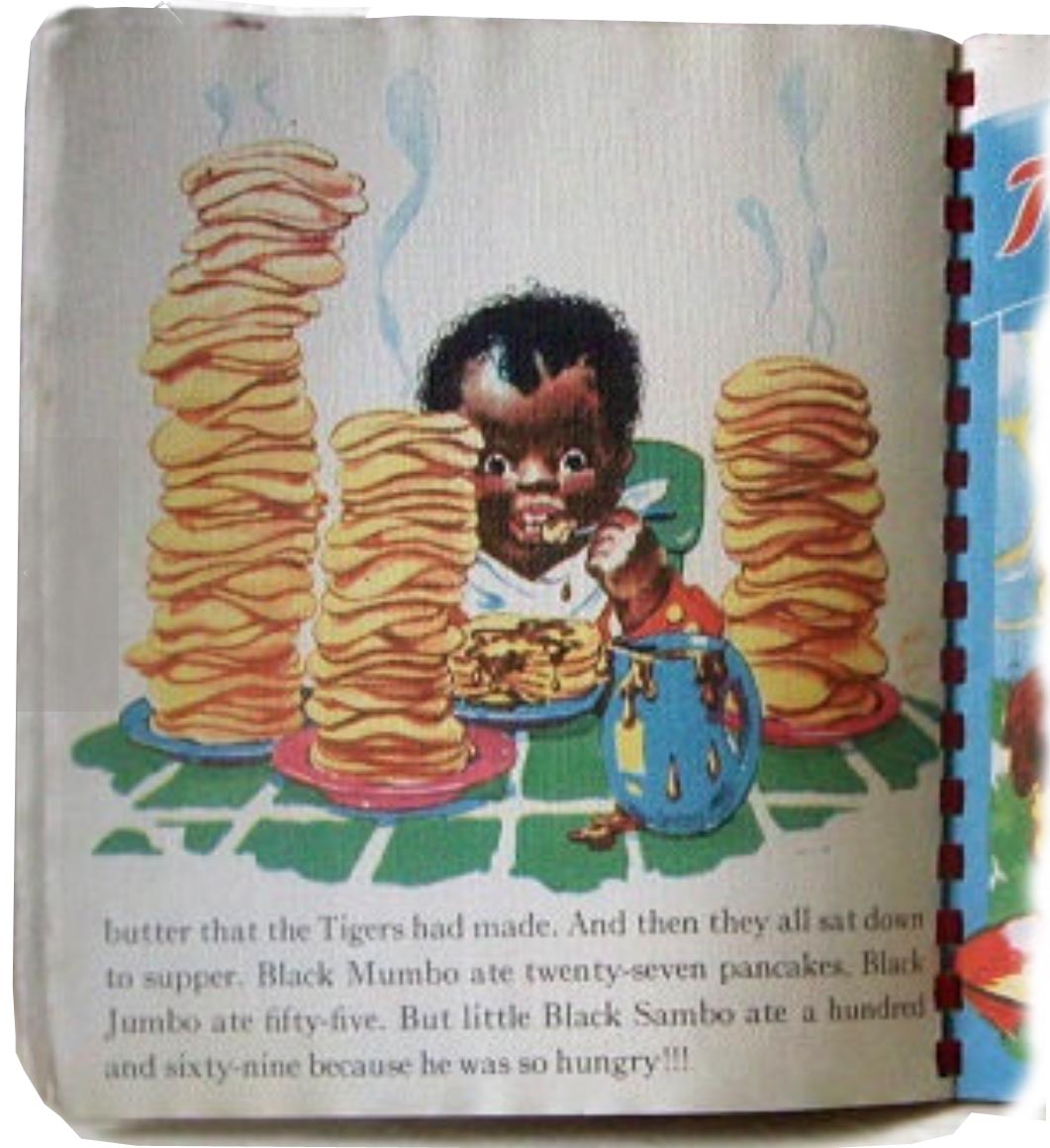
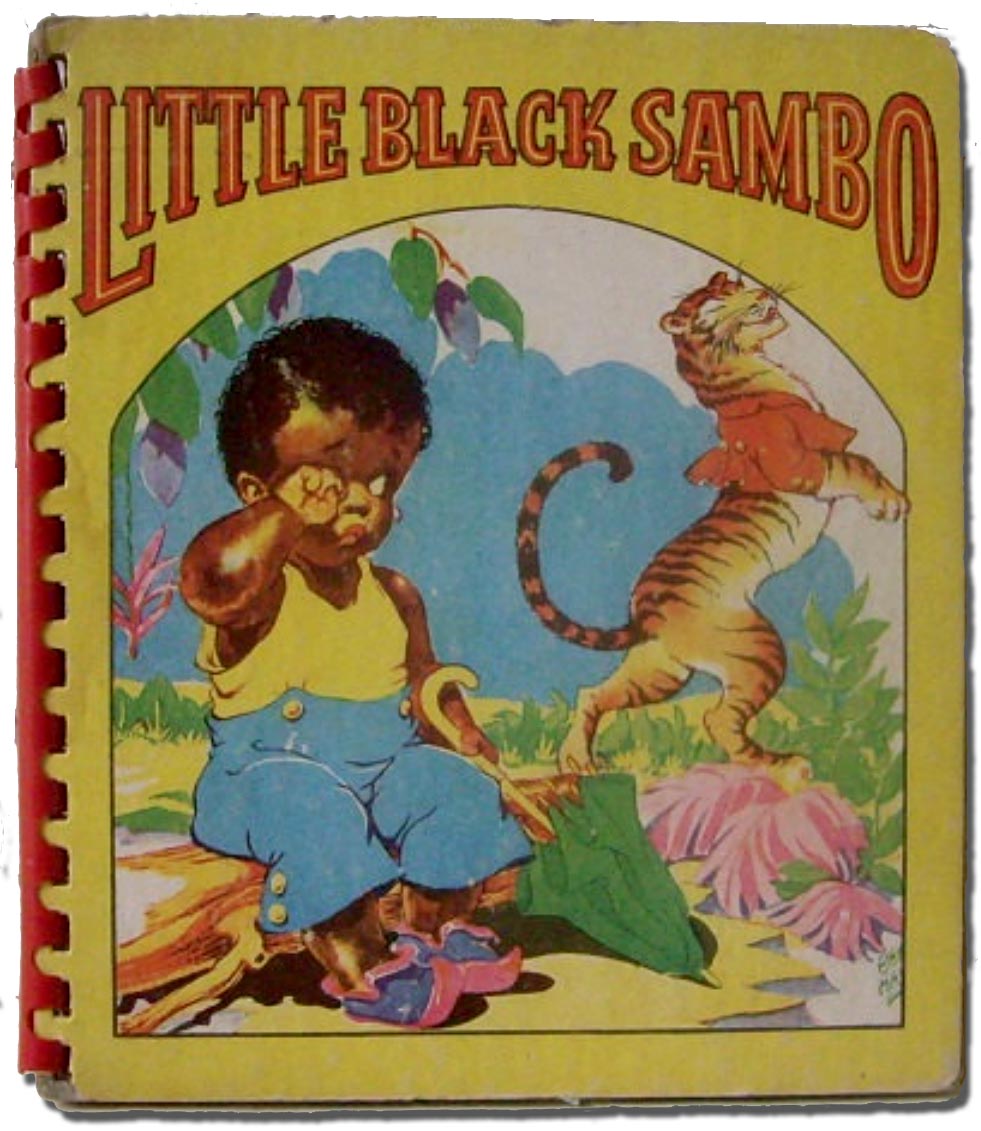
Growing up in rural Lancaster County in the 1950s, I had very little opportunity to meet people of other ethnic groups, but I did have a Little Black Sambo book that introduced me to a culture different from mine. So, I have not always been embarrassed by this book. Fascinated, yes, but embarrassed, no. The picture of the tiger running around an African palm tree as the tiger morphed into a golden round pool of butter mesmerized me as a child, butter that would become one of the ingredients of the pancake recipe. The next page shows Black Sambo’s mother Black Mumbo with her glossy brown arm stirring a mound of melted butter making pancakes. The picture made me hungry. And on the last page:

Little Black Sambo_pancake_web shot

And then they all sat down to supper. Black Mumbo ate twenty-seven pancakes, Black Jumbo ate fifty-five. But little Black Sambo ate a hundred and sixty-nine because he was so hungry!!! (Yes, there are three exclamation marks in the book I am holding.) 

Characters in folktales are typically overblown, with exaggerated details like Little Black Sambo’s super big eyes, through which he gazes at three heaping plates of pancakes with a pot of syrup dribbling all over the table. Obviously, he is ready to stuff his mouth with piles of pancakes.

But there are other tales in the book with the Little Black Sambo cover: The Little Red Hen, The Tale of Peter Rabbit, and The Country Mouse and The Town Mouse. Mr. McGregor and the kitchen maid in the “Mouse” story have white faces, but there is no reference to their whiteness. Their race is assumed as white and therefore not particularly notable.

Little Black Sambo_Cover_web shot

I paged through this book recently as we cleared out books in Mother’s house and marveled at the stereotypes about black people back then and was embarrassed by it: A black woman with a big butt and goofy name wearing a “maid” cap on her head, black people eating nothing but fried foods, everyone eating too much.

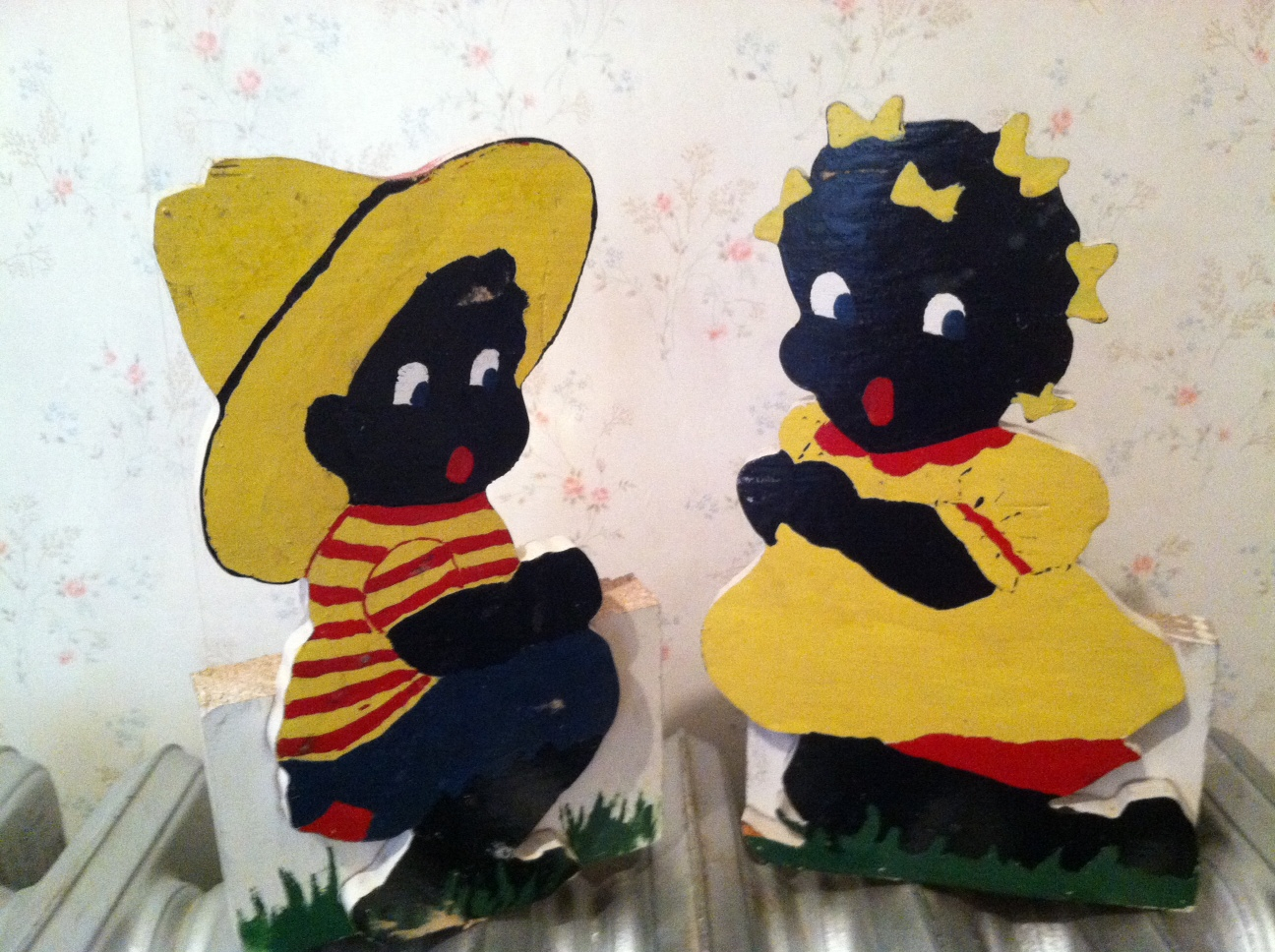
Another find un-earthed in our sifting through “Stuff” – a pair of book-ends I made in school that portrays black children as a novelty.

blackBookends

Interestingly, my niece Shakeeta, my brother Mark’s daughter, choose these as one of the few things she wanted as a remembrance from her Grandma Longenecker’s house. She hoists them up with a smile here:

KiKiBlackBookends

I guess it’s time I catch up with the times and adjust my ideas about black memorabilia. Singer Anita Pointer certainly has. In an article entitled “A Lesson in History,” (AARP Feb/March 2015) Anita, one of the Pointer Sisters, says she collects black memorabilia so she’ll never forget how her people were once depicted.

BlackMemorabiliaAARP

We grew up in Oakland, California, but when I was 10 we visited my  grandma in Arkansas. I couldn’t believe how people were living there. They had a white and a black part of town, and you stayed off the white side. At the department store, they had colored and white water fountains. I don’t want to ever forget that’s what it was like for us — and collecting black memorabilia is how I do that.   (66)

Like Whoopi Goldberg and Spike Lee, Anita collects black memorabilia as museum pieces including a “Mammy” cookie jar, and a 1970s John Henry whiskey decanter made by Jim Beam. When the prestigious house of Sotheby’s came to appraise her collection, it took a year to sort and categorize it. She comments, “The appraiser said that I could pretty much charge what I want because most of the pieces are one of a kind.”  In the end, Anita Pointer sees her collection of thousands of pieces as part of her personal history. She doesn’t apologize for any of it.

Of course, I’m hanging onto my Little Black Sambo book. It’s a part of my personal history.

Your comments welcome here!

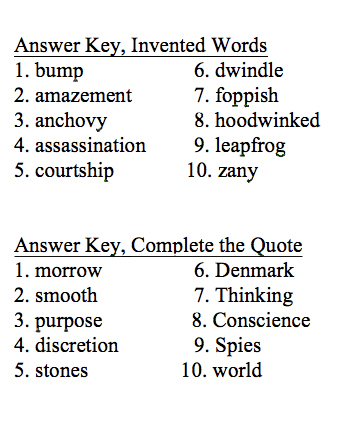
(Answers to Shakespeare puzzlers from April 22, 2015 post below.)

Answer Key2_mod

Purple Passages with the Bard of Avon

Spring cleaning!

I have thrown out (read that, recycled) piles of files during the past two weeks. One I kept, though, was a Shakespeare file.

FolderTeaching

I take my discovery of this file as an invitation to play teacher once more. Actually, another good reason is that tomorrow, April 23, is reputedly Shakespeare’ s birthday as well as his day of death (1564-1616), and he gets all the “Purple Passage” space for notable quotes today. But first a verse, and then a quiz. (Fret not, answers provided on next post, April 25)

ShakesBirthdayCrown

PUzzleVerse_mod

Reputedly, Shakespeare invented words by changing verbs to adjectives, adding syllables or even coining new words. Here is a short list. Add vowels only!

1. b__mp

2. __m__z__m__nt

3. __nch__vy

4. __ss__ss__n__t__ __n

5. c__ __rtsh__p

6. dw__ndl__

7. f__pp__sh

8. h__ __dw__nk__d

9. l__ __pfr__g

10. z__ny                (Okay, so this was easy!)


Shakespeare’s plays contain so many memorable lines that many familiar with them may not know their origin. I am sure you have heard some of these, which need to be completed with one word:

Good night, good night! parting is such sweet sorrow, That I shall say good night till it be _____________.        Romeo and Juliet

The course of true love never did run_________.     A Midsummer Night’s Dream

The devil can cite Scripture for his _________.   A Midsummer Night’s Dream

The better part of valour is __________.          King Henry IV, Part I

Sweet are the uses of adversity:

Which, like the toad, ugly and venomous,

Wears yet a precious jewel in his head;

And this our life, exempt from public haunt,

Finds tongues in trees, books in the running brooks, Sermons in ________, and good in every thing.         As You Like It

Something is rotten in the state of _________.          Hamlet

There is nothing either good or bad, but __________ makes it so.       Hamlet

The play’s the thing / Wherein I’ll catch the _________ of the king.        Hamlet

When sorrows come, they come not single _________,  But in battalions.      Hamlet

O brave new _________, / That has such people in ‘t!      The Tempest

Want more Shakespeare? Last April I write about Shakespeare’s birthday in my classroom. Find the other link here.

Add some coined words I’ve missed, another Shakespearean quote, or even a thought about April and spring-cleaning. I love words. Share some of yours here!

Coming next: My Little Black Bookends Tell All

What’s Your Name Again?

My name is Marian. What’s yours?

A familiar greeting . . .

Names have always fascinated me. I’ve even written about names and naming in previous posts:  What’s in a Name? and The Name Game.

But what about name changing? Celebrities, like actors, musicians and other entertainers have changed their names as a way disguise their ancestry, make a statement or achieve a unique identity.

In mid-century, British-sounding names in the entertainment industry were thought to be more appealing to the public than Slavic, German or Jewish-sounding names. Thus . . .

Robert Allen Zimmerman →  Bob Dylan

Issur Danielovtich Demsky → Kirk Douglas

Helen Lydia Mironoff →  Helen Mirren

Entertainer Whoopi Goldberg apparently began life as Caryn Elaine Johnson.

Dancer Fred Astaire was once Frederick Austerlitz.

Actor Ben Kingsley’s birth certificate reads “Krishna Pandit Bhanji.”

Lady Gaga’s Italian heritage is revealed in her birth name, Stefani Joanne Angelina Germanotta and Jennifer Anniston’s Greek ancestry in Jennifer Anastassakis.

Vanilla Ice probably signed his grade school papers as Robert Van Winkle.

The suave designer Ralph Lauren was once Ralph Lifshitz!

My maiden name was Longenecker, which was changed to Beaman when I married. As a teacher, I would tell students how to spell my name using the 3-little-words approach: Be-a-man. Very rarely was my last name misspelled.

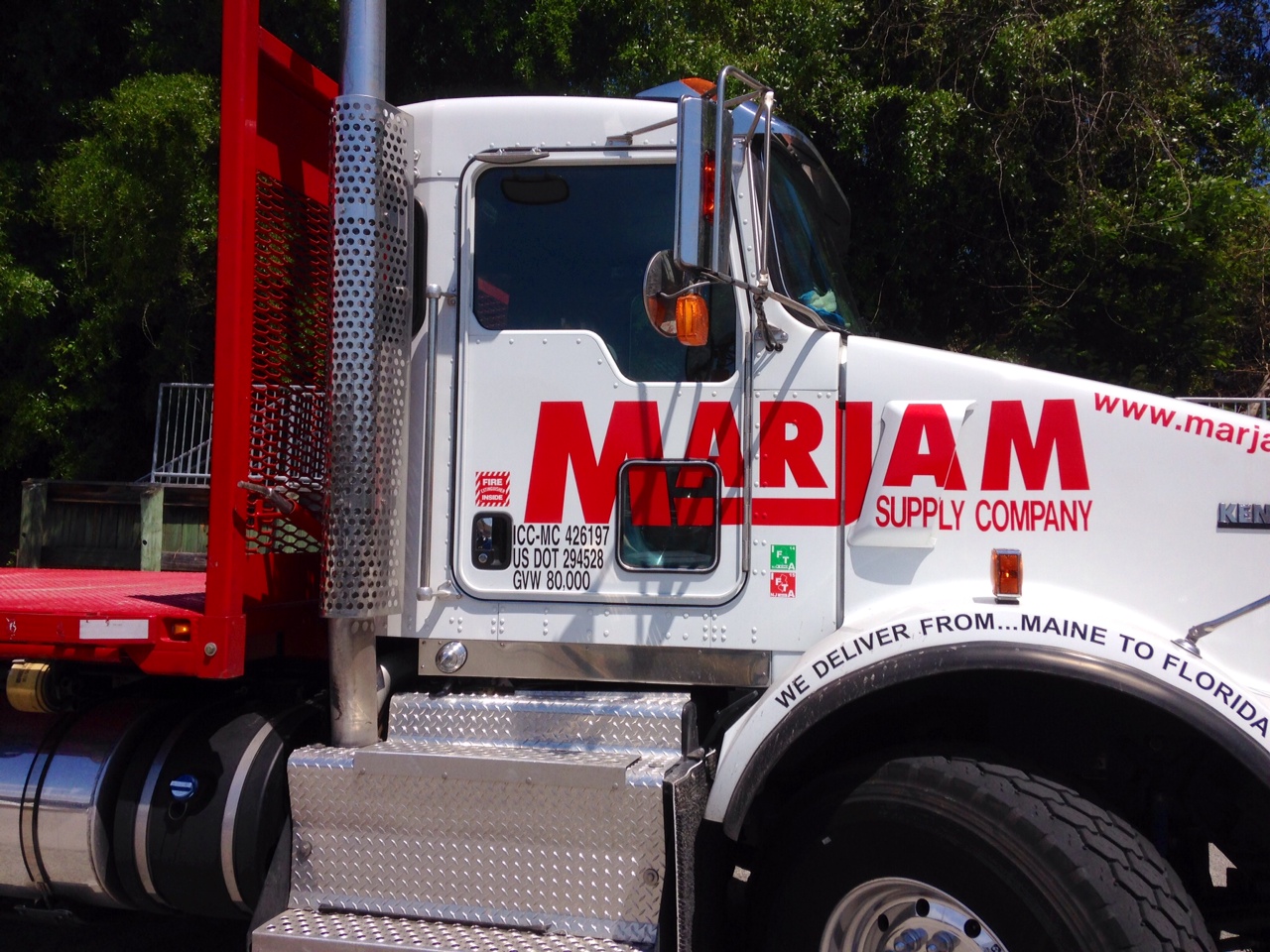
However, my first name (Marian) apparently is tricky to spell. It is often misspelled and in a number of puzzling variations. People with PhDs (not you of course!) and book authors (again, not you!) are the most frequent offenders. Yes, I’ve kept track of them – ha!

Names_variation of Marian_Envelop_8x5_300

Marion

Marianne

Mariam

Miriam

Marrian (on a name card at a dinner by a computer that stuttered)

Mariana

Marina

Miram

No wonder John Wayne is no longer MariOn Morrison!

TruckMariam


Can you add any other interesting name changes to the ones above? Maybe you have some examples of strange naming or spelling from your own family . . .

P.S. Even if you mangle the spelling of my name, we’ll still be friends. That’s a promise!  😉

What is a Name_Marian

Coming next: Purple Passages with the Bard of Avon

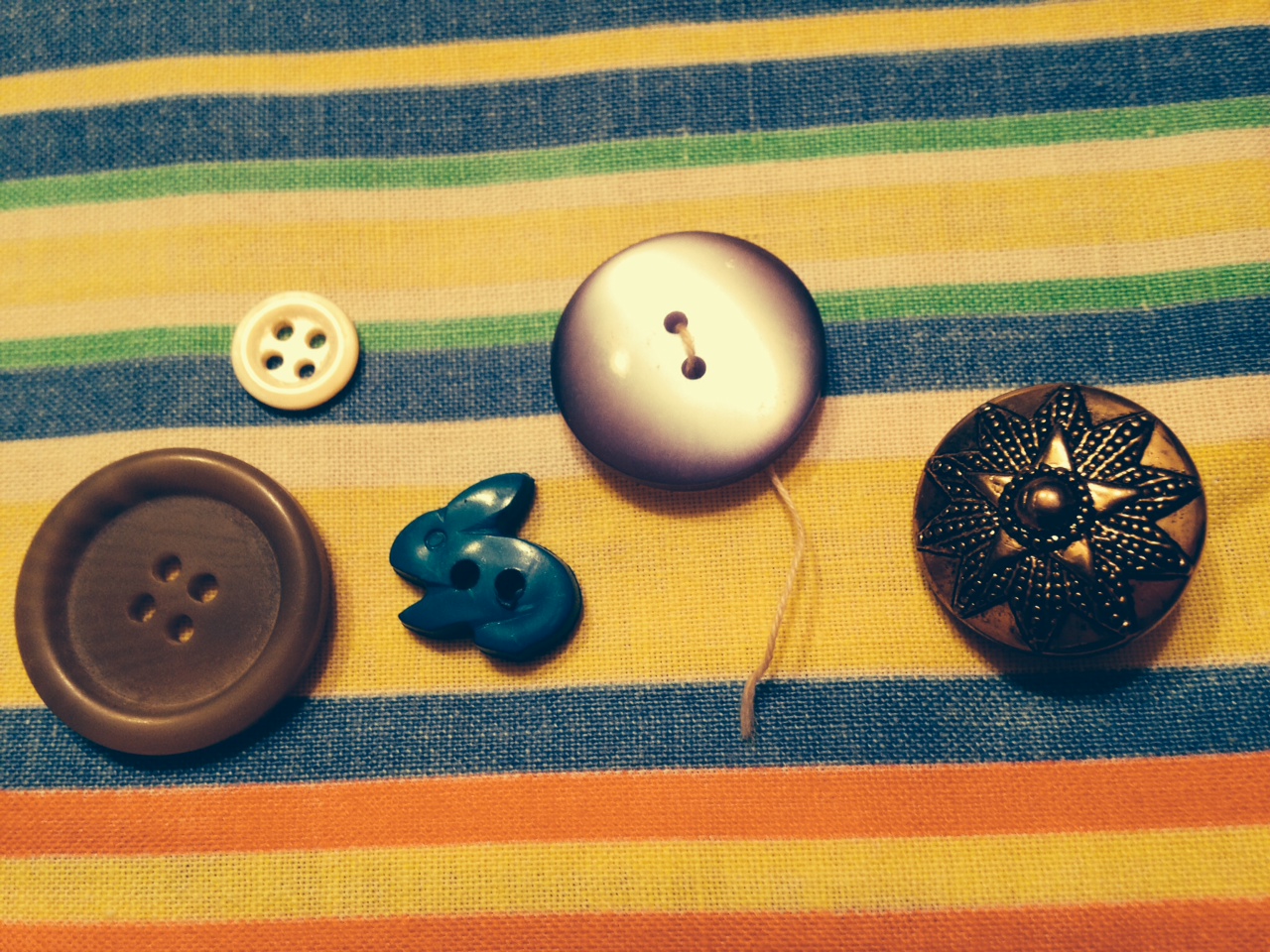
Button, Button, Who’s Got the Button?

Do you lose things? Misplace your glasses, keys, cellphone, or worse?

A few weeks ago I saw advertised a bit of wizardry called TrackR bravo, a coin-sized, wireless device that attaches to anything you want to track. The two wholesome-looking, geeky guys who invented it claim it can find lost items in seconds. However, it is still in production and won’t be available just yet.

Here is a bit of verse contributed by husband Cliff on the occasion of his un-earthing treasures long forgotten in drawers, filing cabinets, and notebooks. These lines dated January 2004 were inspired by his discovering a plastic container of leftover artichoke dip, with mold growing on top, tucked inside an enclosed green sandwich cooler bag, hanging quietly for a day or two on the back of a kitchen chair.

Button3

Button, Button. Who’s got the button?

Glasses, Glasses. Oh, where did I put those glasses?

Keys, keys. Why did some Martian leave them in my van door overnight?

Windows, windows. Why would windows be partway open, when I know I closed them tightly the night before?

Names, names. Why do people always change their names, when their faces remain the same?

Pens, pens. Why do they secretly skip to someplace else, when no one is watching?

Book, book. Why did that book hide itself beneath the bed again?

Folder, folder. Would someone please tell me how my folder mysteriously appeared somewhere else?

Cell phone, cell phone. Why isn’t that cell phone with me now when I know I just saw it a moment ago?

Date, date. Who changed my appointment for Wednesday on the calendar that I knew for certain was on Friday?

Remote, remote. Who snuck in while I was in the kitchen and hid my remote?

List, list. How can I get along without my “To Do” list? I’d swear I left it on the dresser, a window ledge, my hat box or . . .

Wander, wander. Why do I always have to go back to where I came from, to find out what I had forgotten?

Zipper, zipper. Who is it who, ghost-like, unzips the very pants I parade to work in?

Artichoke dip, artichoke dip. Now where did I leave that nice little dip? Why would it be inside the green cooler bag hanging on a kitchen chair, sporting a fuzzy growth of mold on top?

Brain, brain. Am I losing my mind? “Ding, Dong.” Is Alzheimer’s at my front door?

Remember, remember. Oh dear, what else have I forgotten to remember?

Oh well, I’ll now put on my shirt . . .  “Pop!” Button, button. Who’s got the button?

KeysGlasses

A side note:

The day after reading the poem to Marian at dinnertime she asked, “Have you seen the poem?”

I told her the last time I had seen it was on the kitchen table after reading it. “Did you put it in your hat box under the wicker coffee table?” I quizzed.

“Oh dear me, Button, Button Poem, Button, Button Poem. Who’s got the Button, Button Poem?”

You have stories of loss, recovery, and perhaps loss – again. Your anecdote fits right here!

Coming next: “What’s Your Name Again?”

Moments of Discovery # 6: Whip up Recipes, Stir in Imagination

Clearing out a house after death is a sacred act, yet no amount of holiness assigned to this task can dismiss the back-breaking, shoulder-aching, neck-craning job of sorting, recycling, and passing on to others the possessions of a loved one. Aside from clothing and furniture, Mother left behind the tools of her trade in the kitchen along with beloved books of our childhood, some of which are displayed here.

Prepare Food & Serve It

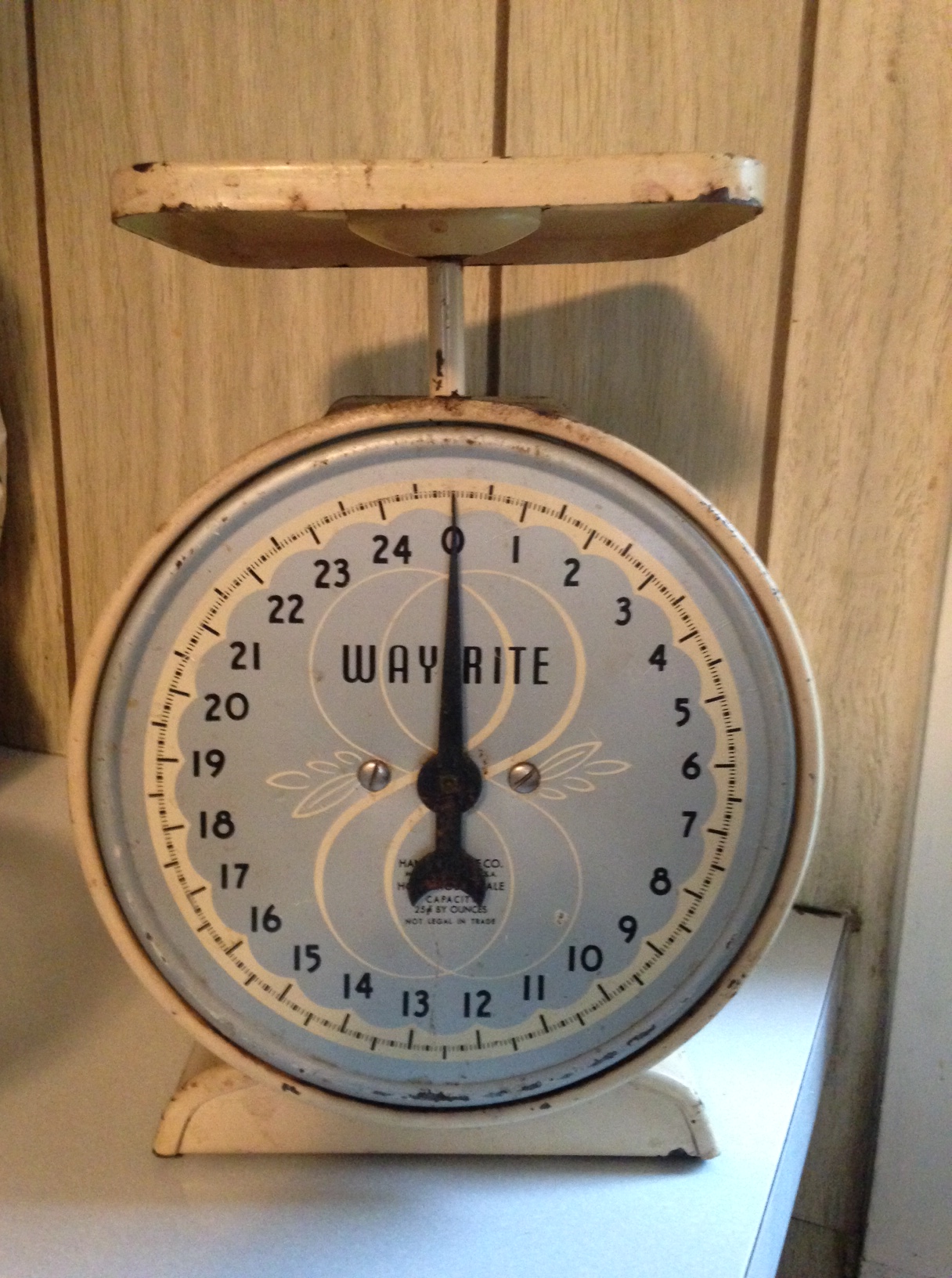
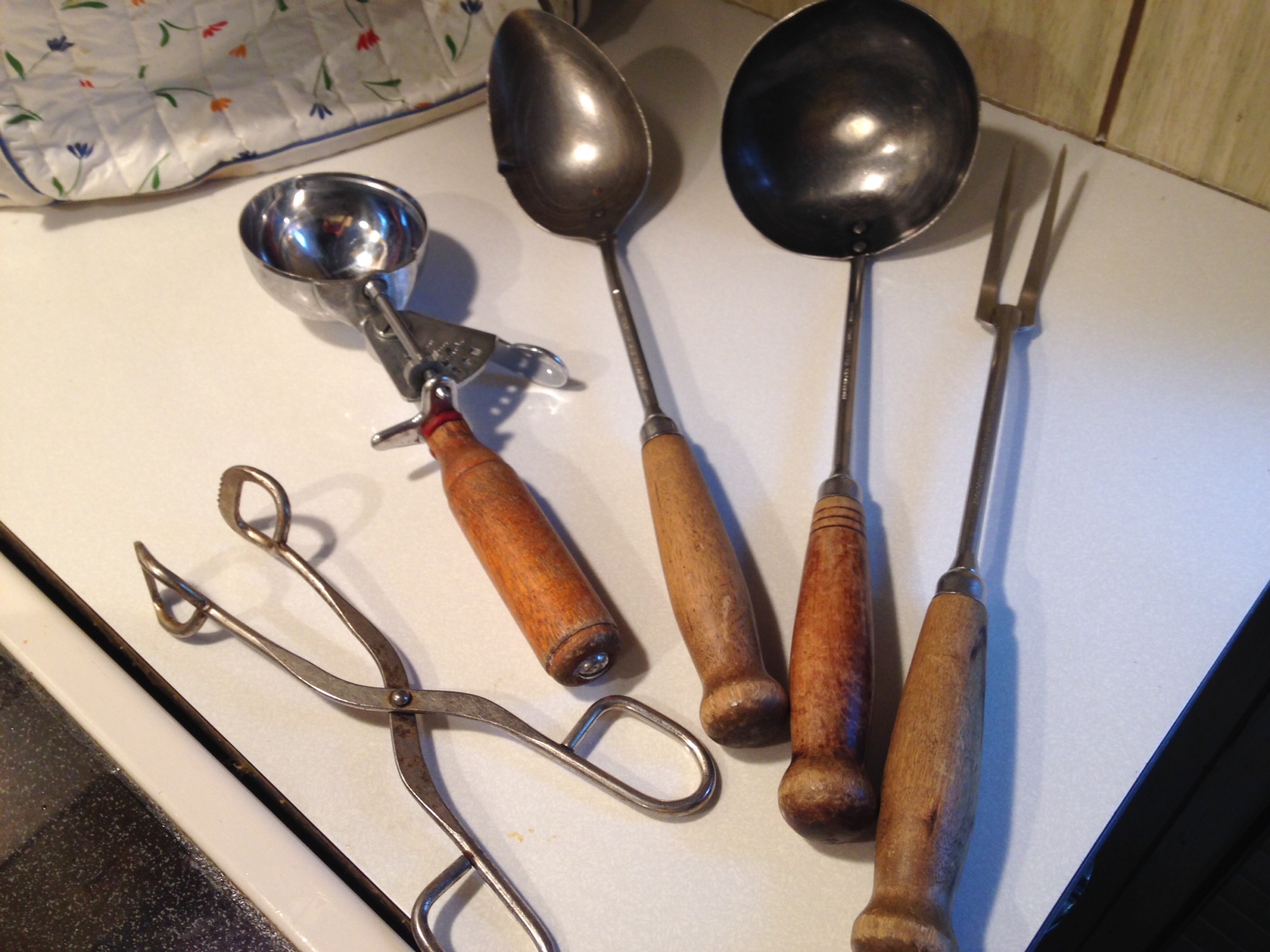
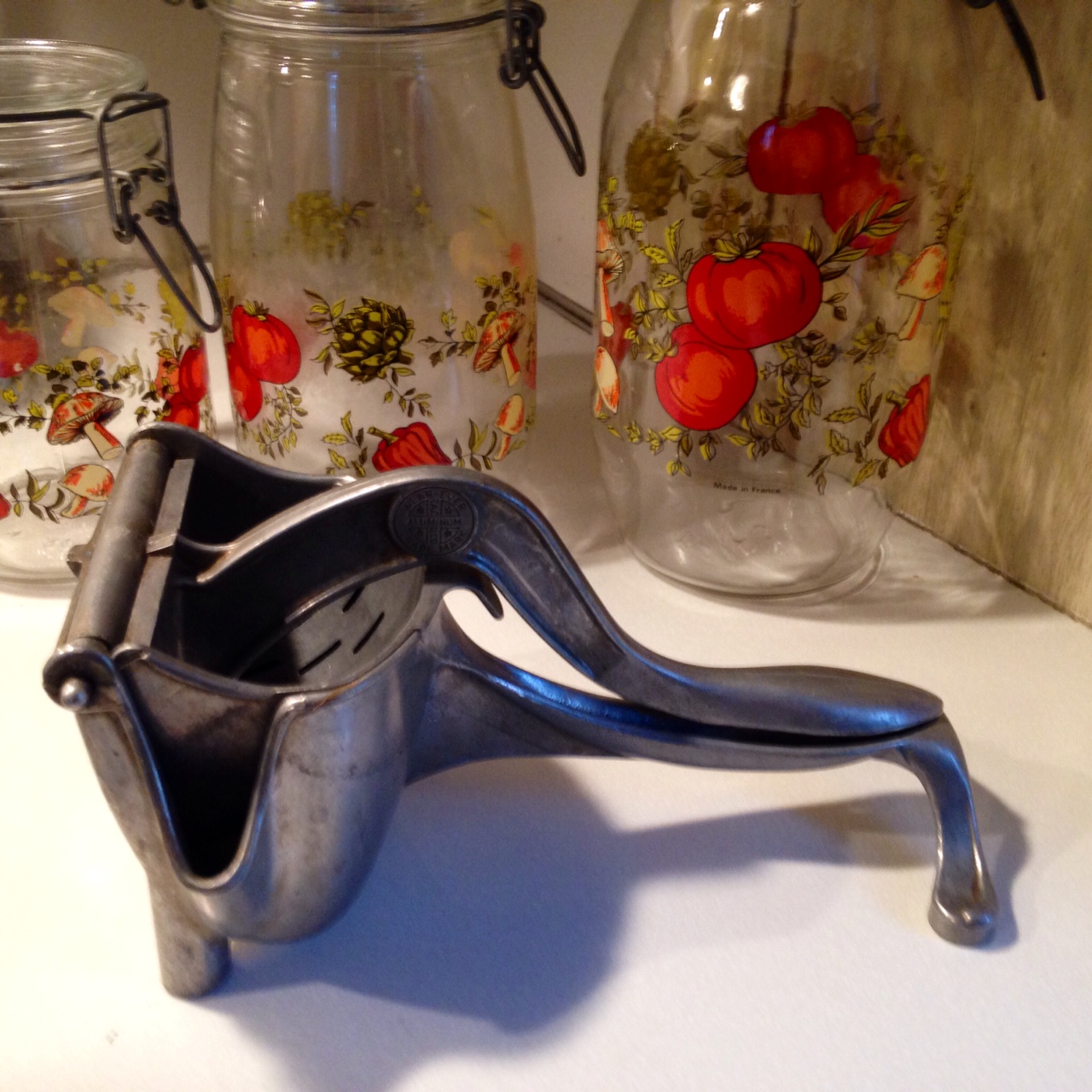
What remains: A scale on which all of our baby weights were noted and recorded (or ingredients for recipes measured), cooking utensils, ice cream dipper, and juicer, most of which have been passed on to grand-children.

Scale Mom

My best guess is that these were wedding gifts or first (and only) time purchases. I don’t remember another scale, a different set of utensils, a second ice cream dipper or juicer ever passing over the threshold of our home. The throw-away mentality of our current consumer society never made sense to Mother. “You buy good, and keep it – for a lifetime” was her philosophy! Yes, prepare food and serve it, and with love! Her fancy china set, sterling silver flatware, and crystal glasses and goblets all have found homes with her grand-children.

Kitchen Utensils Mom

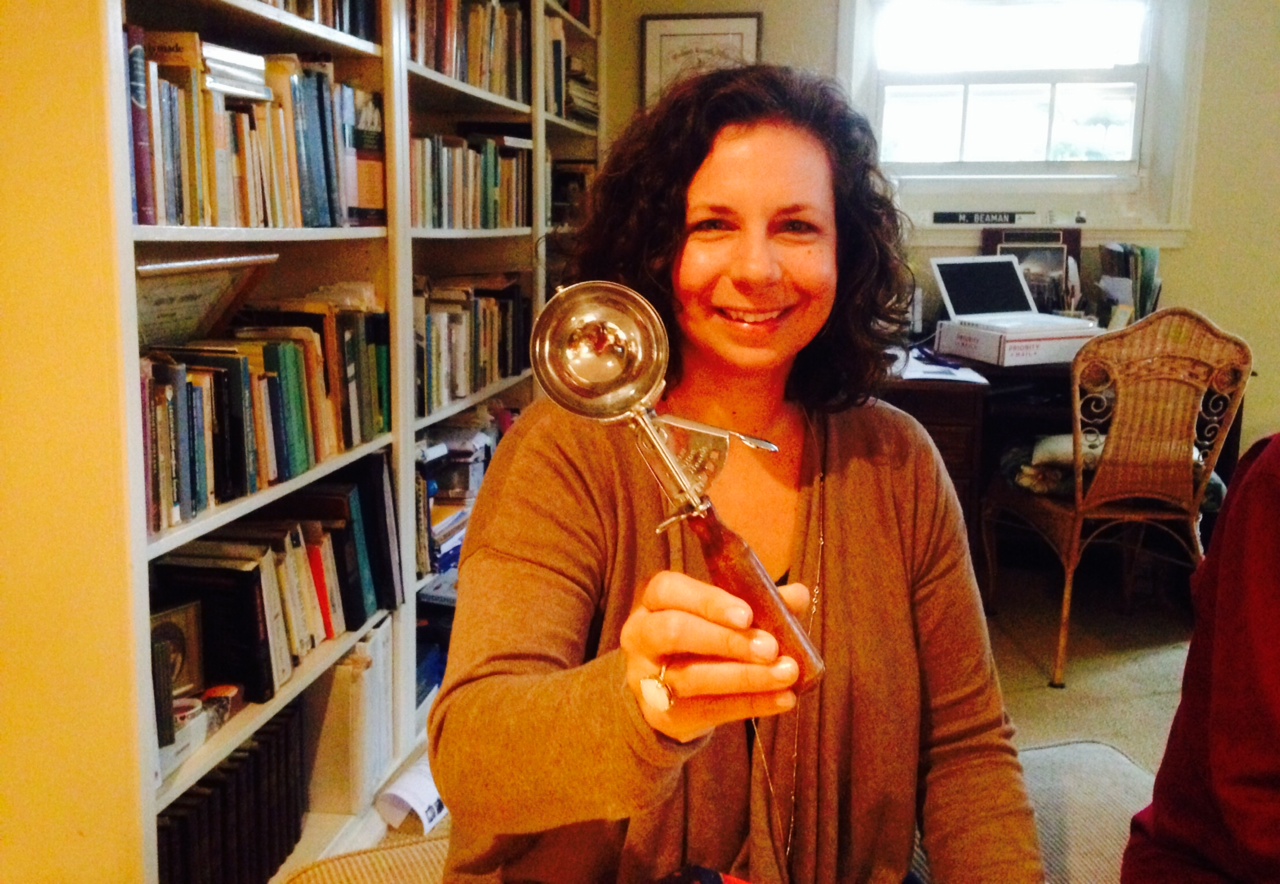
Daughter-in-law Sarah pleased with Grandma's ice cream scooper
Daughter-in-law Sarah pleased with Grandma’s ice cream scooper

Juicer Mom

Don’t Forget to Stir in Imagination

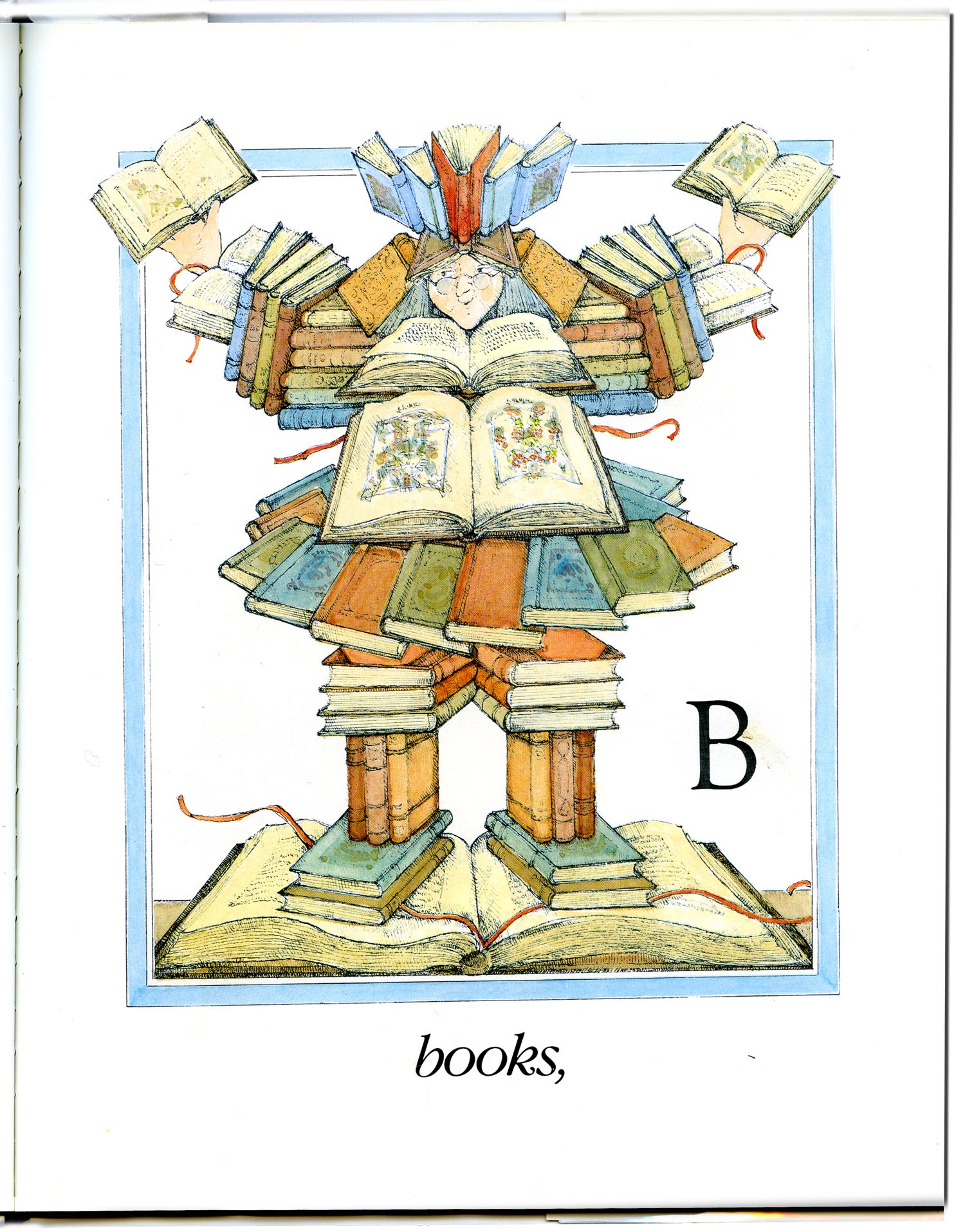
Page from Arnold and Ann Lobel's book
Illustration from On Market Street by Anita and Arnold Lobel

In previous Moments of Discovery, you may have seen other books from Mother’s bookcase or from the attic.

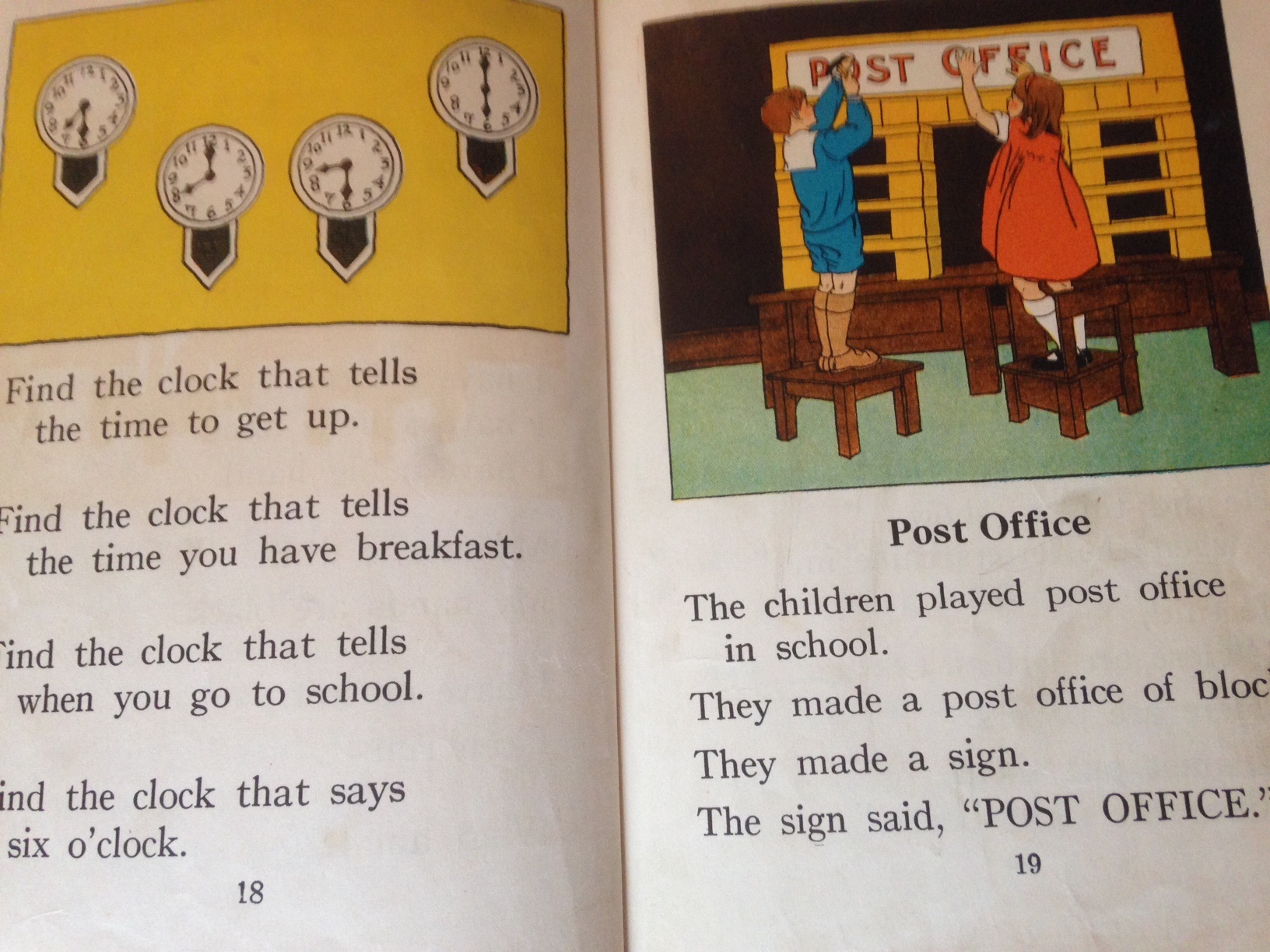
The book below, a reader, is certainly a keeper, recording media and methods that are becoming obsolete.

Pages from my text book
The Child-Story Reader, copyrights ranging from 1927-1936

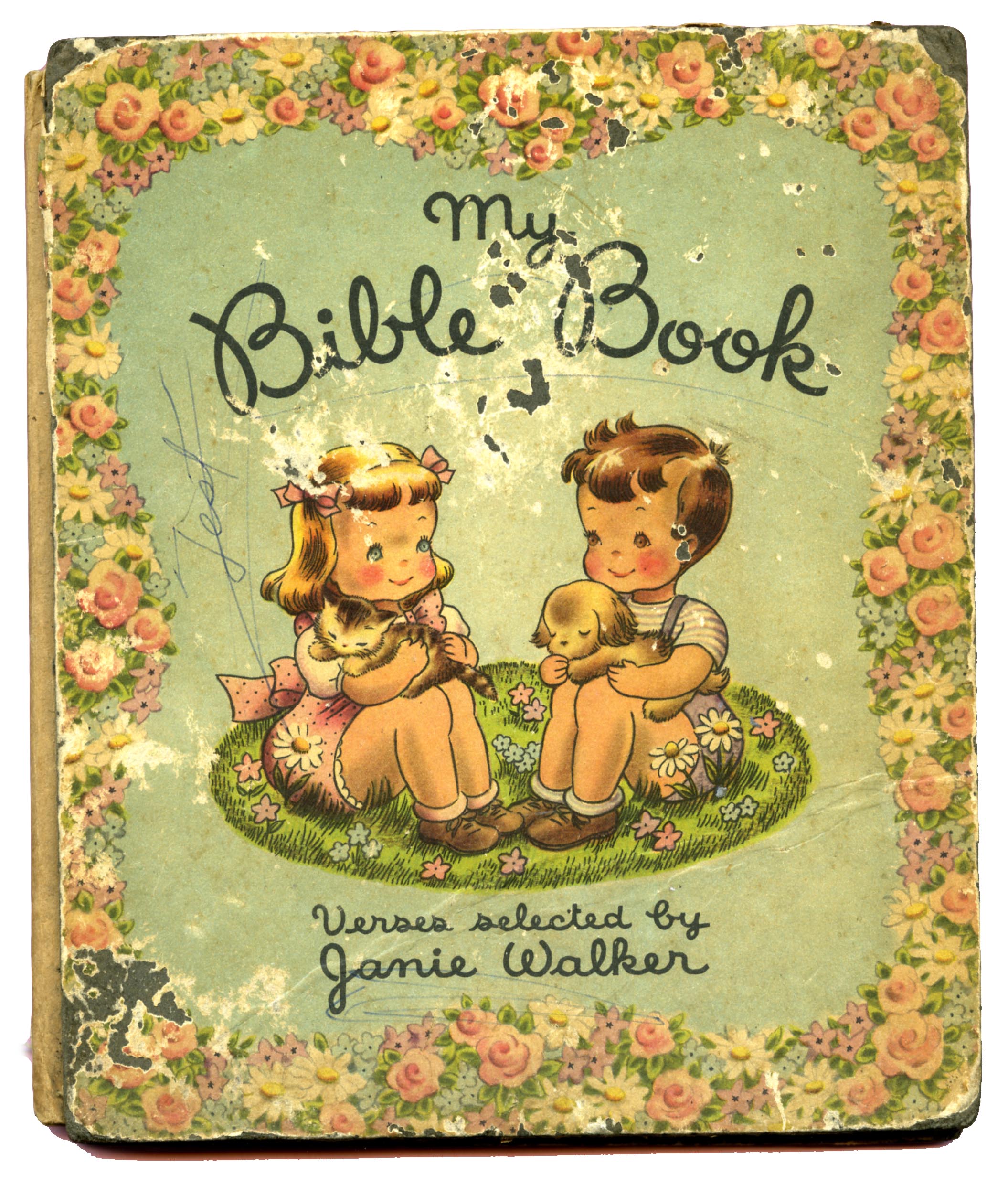
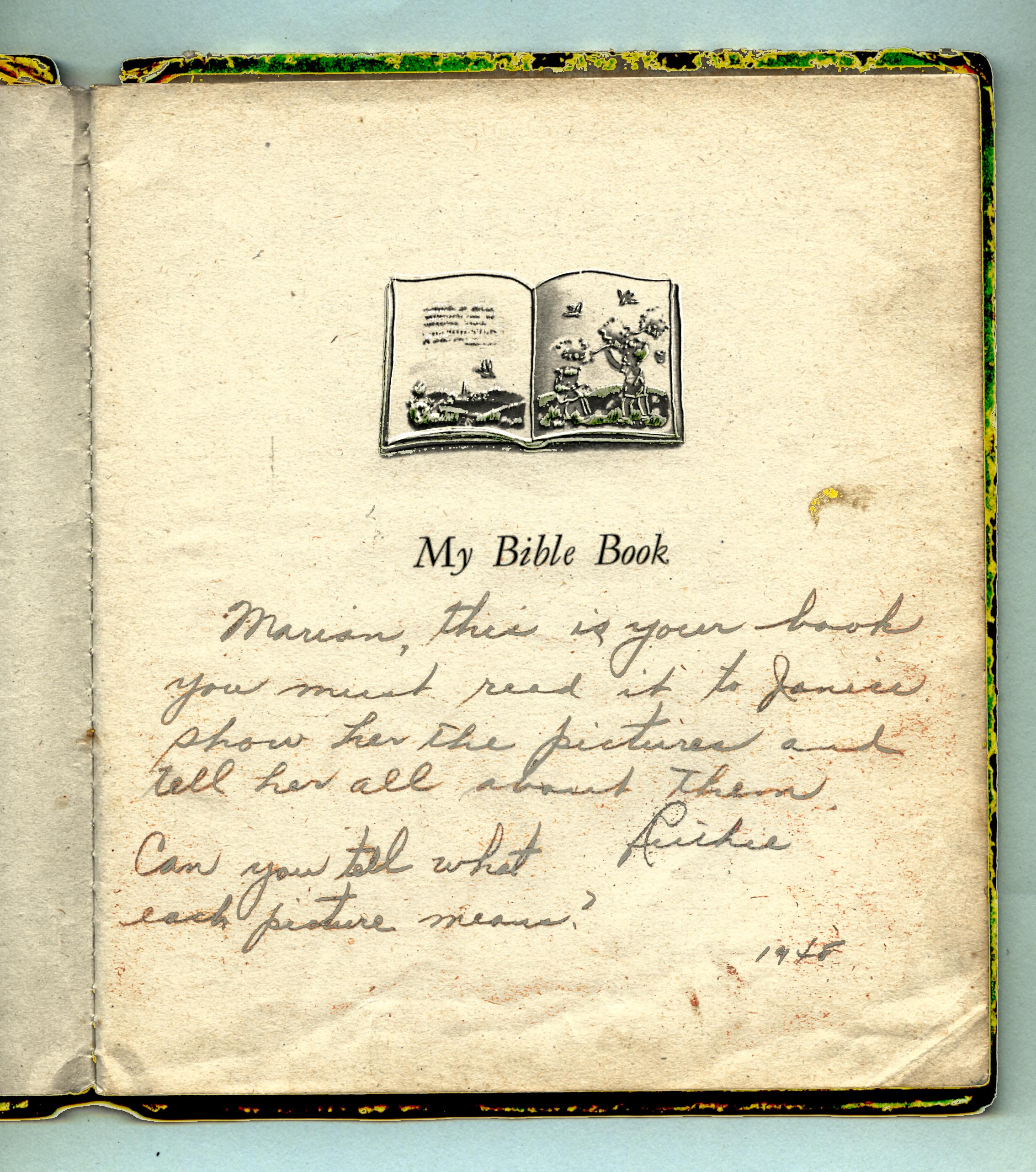
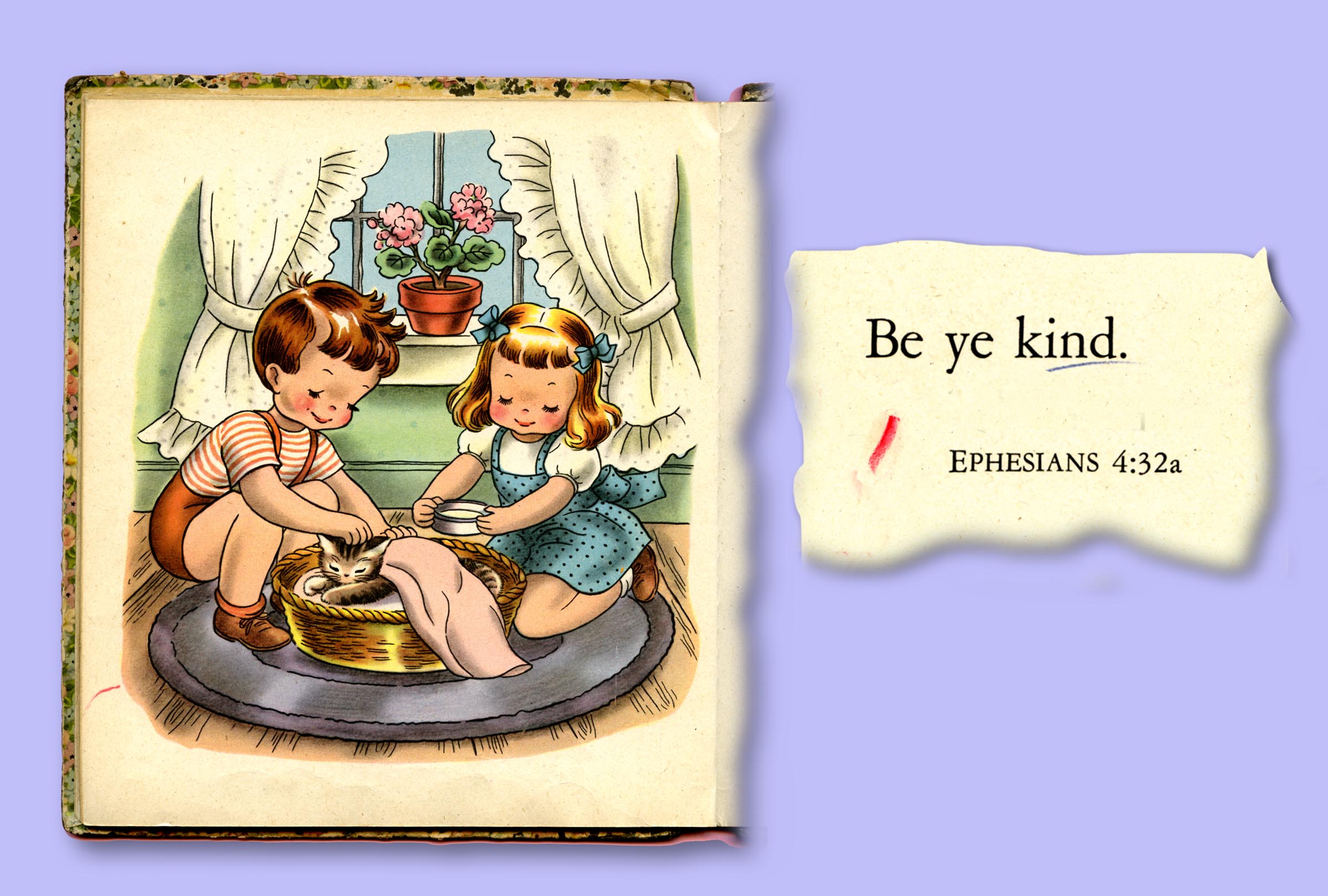
And one of my favorites is My Bible Book with verses selected by Janie Walker and pictures by Dean Bryant (Rand McNally and Company, 1946). These words and pictures have been imprinted on my childhood memory as I joined the red-haired boy and blonde-headed girl roaming around gardens and romping through meadows with their pets. It was a perfect world!

My Bible Book_front cover

Aunt Ruthie gave me this book with penciled instructions to read it to my sister Janice, show her the pictures and tell her all about them.

My Bible Book_pre Title page w note_light text_7x8_300

 Ever the teacher, she closes with her sweet lead-in question: “Can you tell what each picture means?” This is probably a Christmas gift or birthday present given to me in 1948.

Puppy dogs, a frog, a snowman, a kite, some birds, squirrels, a herd of cows, and a even a special kitty cat amuse the children as the pages turn with words of wisdom all quoted from scripture.

My Bible Book_Be ye kind_p25-26_8x5_300

Do you have old books in your treasury of keepsakes? Some special utensils for cooking or serving passed down to you from a generation or two ago? We’re all ears!

Coming next: Button, Button, Who’s Got the Button?

Enchanted April: Renewal and Possibilities

Are you wishing for different weather just now?

Maybe a change in scenery is all you need to perk up. After a rough winter, the drowsy dreaminess of a warm, languid clime may sound very appealing.

If so, you have something in common with the middle-aged Lottie Wilkins and Rose Arbuthnot, both members of the same London ladies’ club, who become acquainted after reading a newspaper advertisement for a small, furnished medieval castle to be rented for the month of April on the balmy shores of the Mediterranean. They are seeking enchantment – and in April.

*  *  *

In February, I met Timeless Lady, a blogger who blends quirkiness and a strong, spiritual core in her posts. In a recent piece about the book/movie Enchanted April, she published the words in the newspaper ad that enticed these ladies to exchange London fog for idyllic Italy at a castle in Portofino, Italy no less. Here is The TImes newspaper ad that drew them in:

To Those Who Appreciate Wisteria and Sunshine. Small mediaeval Italian Castle on the shores of the Mediterranean to be Let furnished for the month of April. Necessary servants remain. Z, Box 1000, The Times.


Lottie Wilkins and Rose Arbuthnot, both wishing to escape the drab days of winter, also share a desire to leave the day-to-day drudgery of housekeeping and the struggles of marriage, Lottie to the klutzy Mellersh and Rose to her gawky Frederick. But there is the matter of money, so to share expenses they take on the elderly, crotchety Mrs. Fisher played by Joan Plowright, and the stunning, but aloof Lady Caroline Dester. As the wisteria and sunshine slowly work their magic, the characters are rejuvenated and re-discover hope and love.

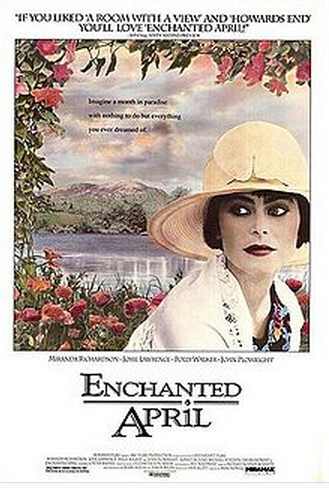
Film, 1992  Courtesy Wikipedia image
Film, 1992 Courtesy Wikipedia image featuring Lady Caroline Dester, who is sick of being grabbed by men!

In the early 1920s, just after World War I, author Elizabeth Von Arnim vacationed in the serenity of Portofino, Italy at Castello Brown, the same castle featured in the movie. Inspired by the magnificent medieval castle and the luscious gardens of San Salvatore, Von Arnim wrote “Enchanted April,” the book on which the movie is based.

I discovered a link to a free copy of the book via the Guttenberg Library, where you can search and find links to other books and stories you read as a child.

Want more Elizabeth Von Arnim? Click here for her Collected Works!

Cover image: courtesy Amazon Books

In case you haven’t seen the movie, or if you want to succumb once again to its captivating charms, here is the trailer from Miramax Films:

Quotes from Enchanted April

I want to just sit and not talk and not think . . . .  ~ Caroline

If you wish for something hard enough, it happens!  ~Lottie


Wisteria in patio garden
Patio garden wisteria


When you want to get away from it all, where do you escape?

What is on your bucket list – Where would you like to go right now, or sometime soon?


Coming next: Moments of Discovery # 6 ~ Food for Thought, Stirred with Imagination

Our Easter in Ukraine

Khristos voskres!

Christ is risen indeed!

These words spoken in Russian are the very first expression of Easter joy we hear on Sunday, April 24, 2011 as folks gather at Birth of Christ Church in Kiev, Ukraine, preparing for the worship hour.

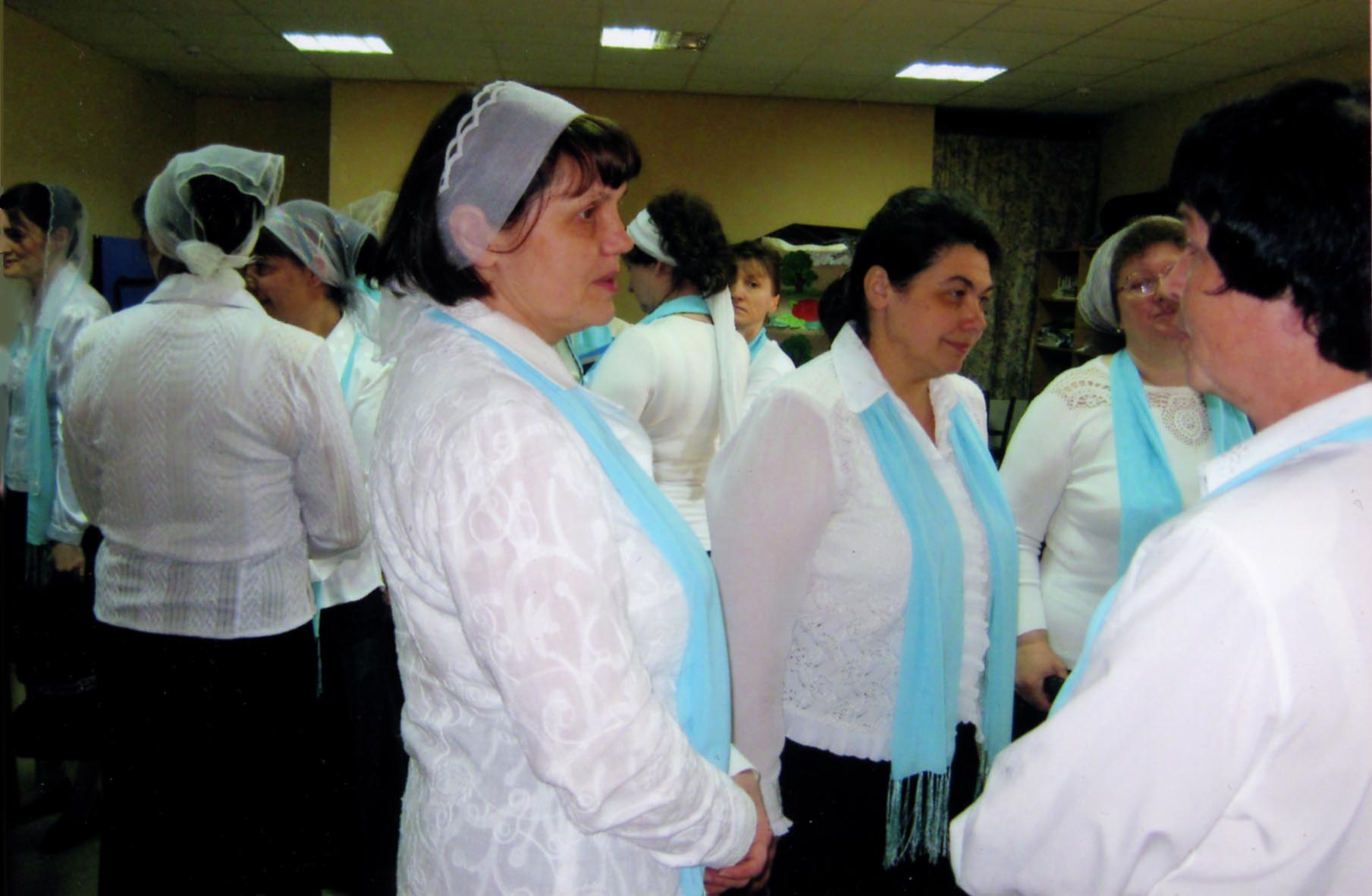
Here is the choir after rehearsal preparing to ascend the steps to the sanctuary for the Easter service.

Easter_UK_Birth of Christ Choir

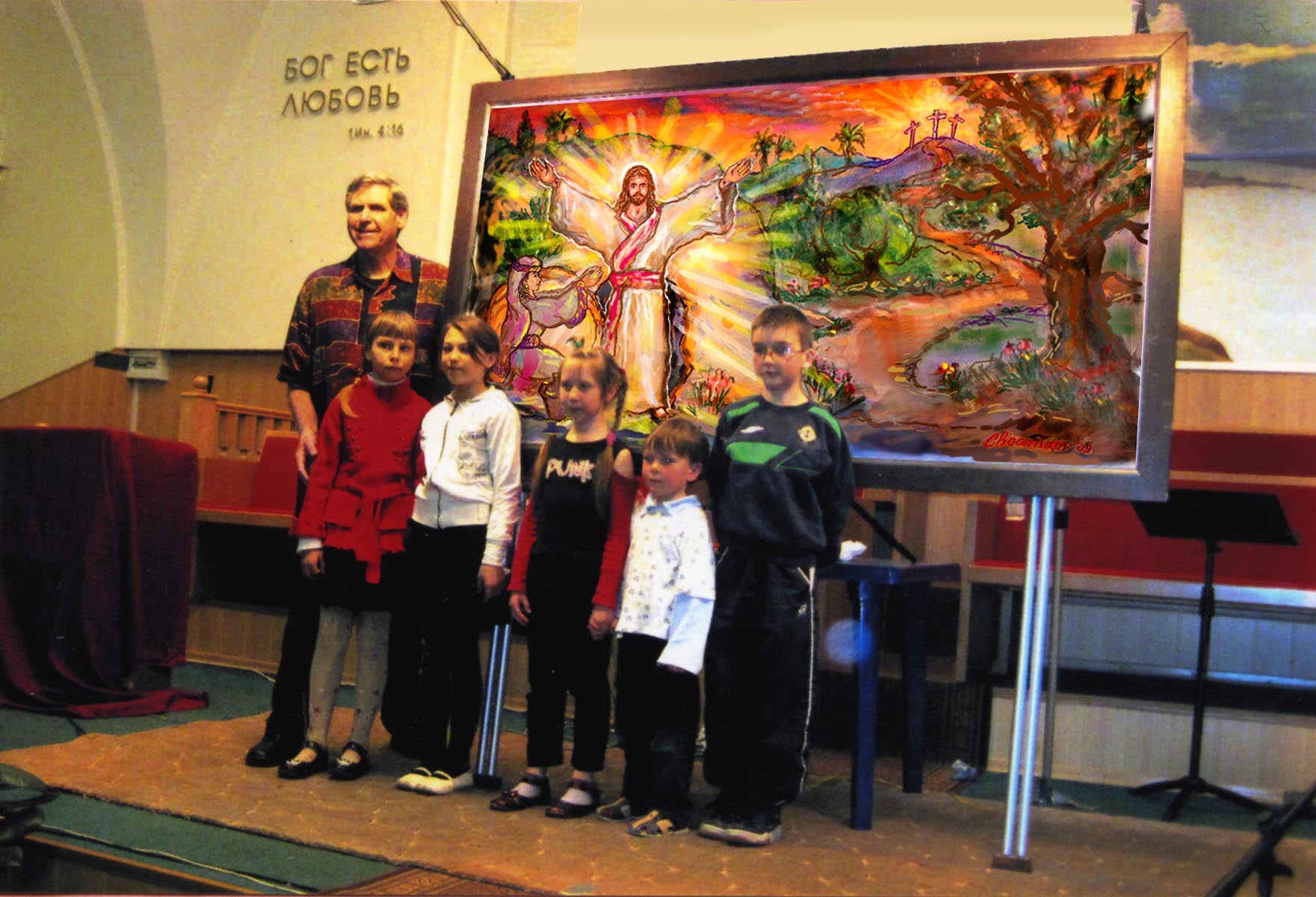
At the invitation of ABCLife, Kathy Gould’s ministry to children and families, husband Cliff and I spent two weeks in Kiev (April 8 – 28, 2011) and surrounding towns performing art and music shows in public schools and churches. His final program entitled “He is Risen” is presented here at Birth of Christ Church on Easter weekend.

After the exchange of greetings, we worship by singing songs of the resurrection and then thrill to the experience of seeing the “He is risen!” presentation accompanied by exultant music and special lighting effects.

Easter_Birth of Christ+new mural_6x4_300

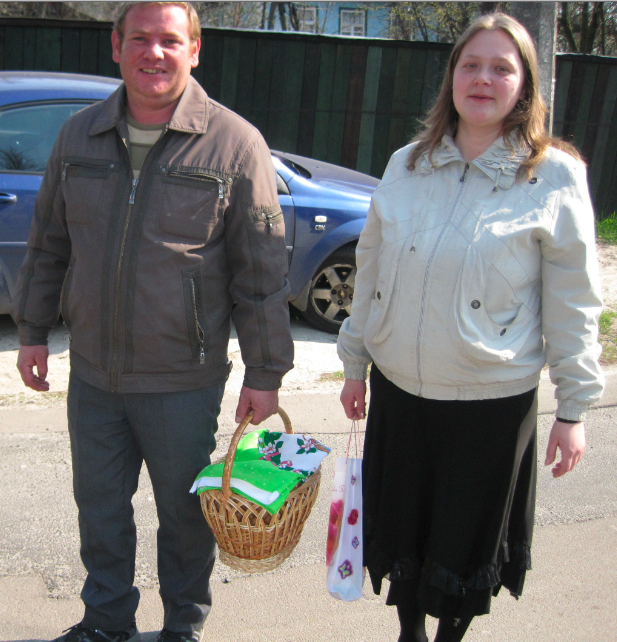
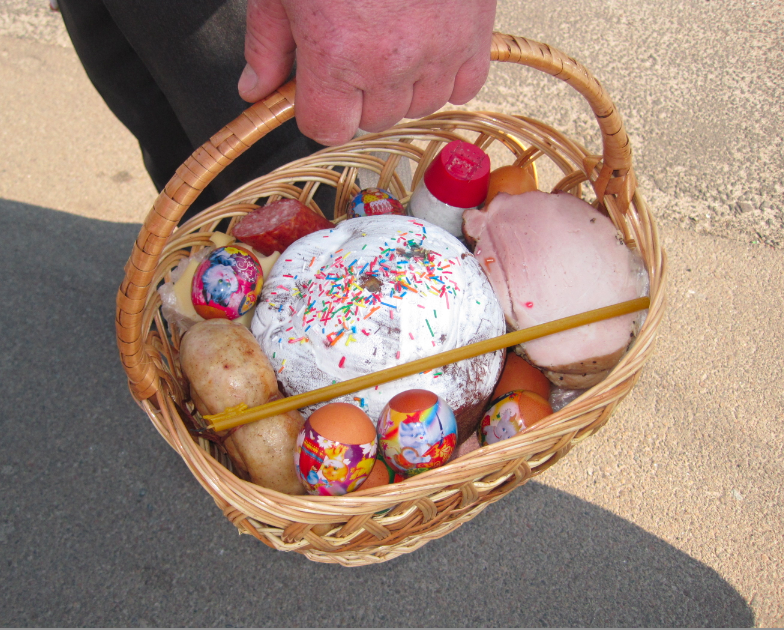
Before the service, early this Sunday morning, we see a couple, basket of Easter bread and eggs in hand, wending their way toward a Ukrainian Orthodox church farther down the road. Ukrainians walk every where possible as cars are very expensive here, and today the weather is cool and gorgeous. This couple graciously allow me to photograph their beautiful paschal offering.

UkraineEasterCoupleUkraineEasterBasket

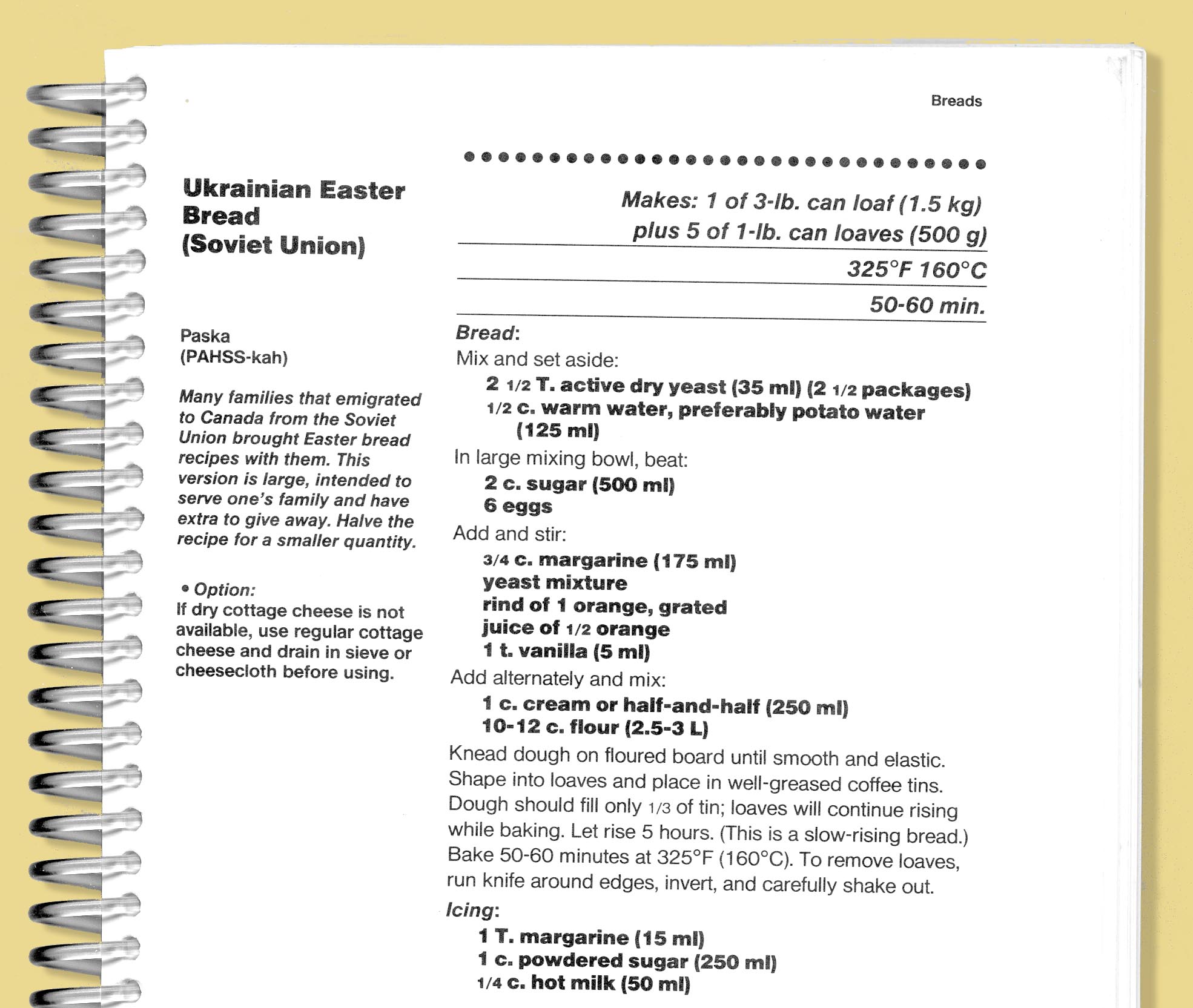
Their special bread is frosted and coated with sprinkles. Here is a recipe for Ukrainian Easter Bread (Paska) from Extending the Table, a World Community Cookbook published by MennoMedia in a revised edition. In my older edition from 1991, the recipe is found on page 65.

RecipeExtending the Table_recipe_p65

*  *  *

After completing 19 shows in a 12-day period, we are ready for a respite, which we enjoy in Crimea: the ornate Livadia Palace, site of the signing of the peace treaty between Roosevelt, Churchill, and Stalin; the Church of Foros with its onion domes, where celebrities marry. Then in a park in the city of Yalta, a statue of Pushkin, the celebrated Russian poet and one of Chekhov’s “Lady with Her Dog” virtually come to life along the promenade bordering the Black Sea.

Sadly, the door is barred to Crimea now, once the accessible southern-most region of Ukraine. Since our visit, President Vladimir Putin has wrested this lovely coastal land from Ukrainian hands.

Pray for the people of Ukraine!


Cliff’s YouTube connection

Coming next: Enchanted April, Renewal and Possibilities