This week our family remembers the fourth week of July 2014.
Last year Mother observed her 96th birthday on July 23. She died unexpectedly on July 28, five days later. This post will commemorate this milestone in two ways: cards sent to me along with images of Mom’s intimate space upstairs.
Two Cards
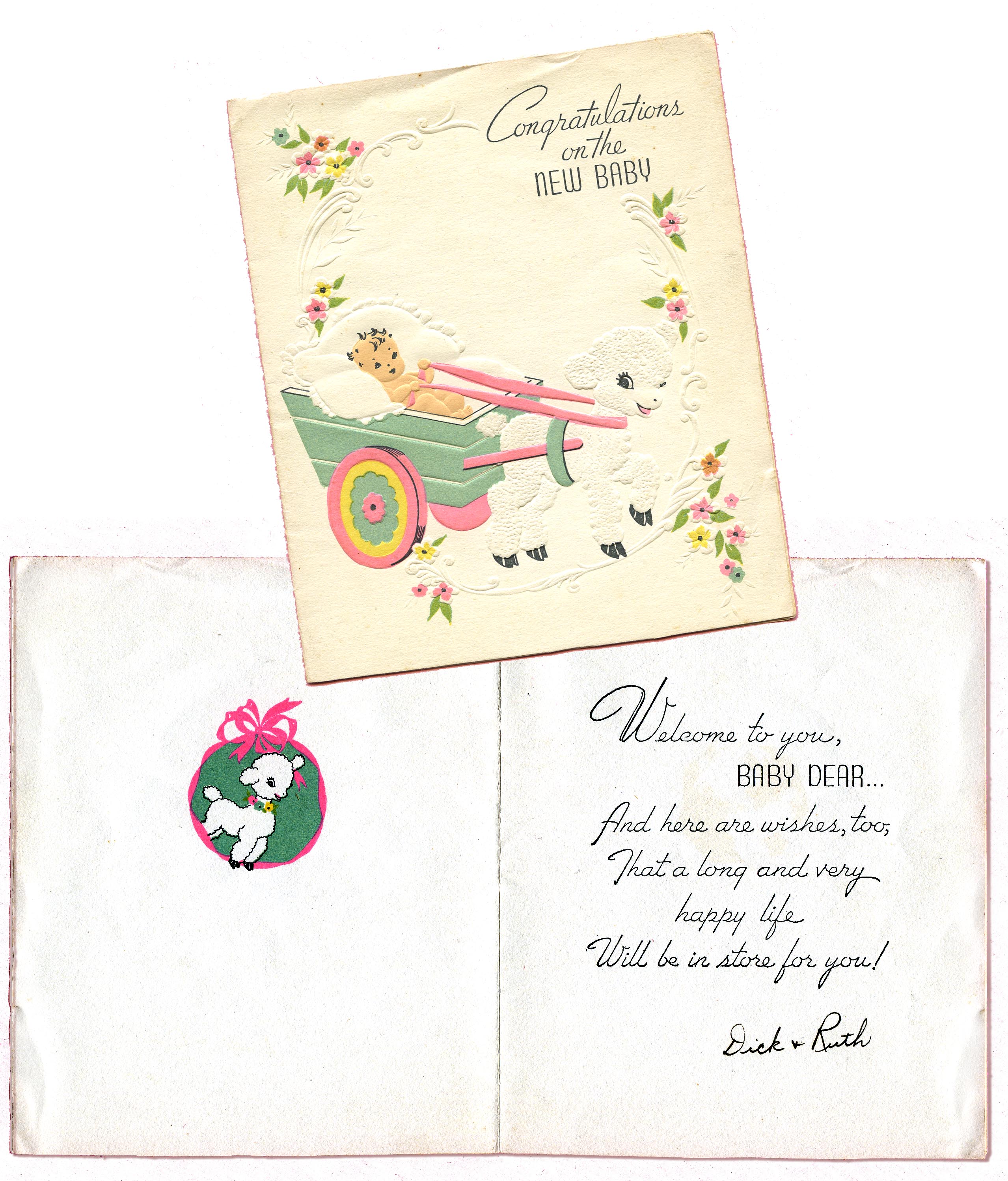
A vintage baby card, sent to my parents when I was born
Card from Dick and Ruth Sauder. Richard was one of the Florida bunch that stayed in close contact even after his bachelor trip with Daddy. They wished me a long and happy life, bless their hearts!
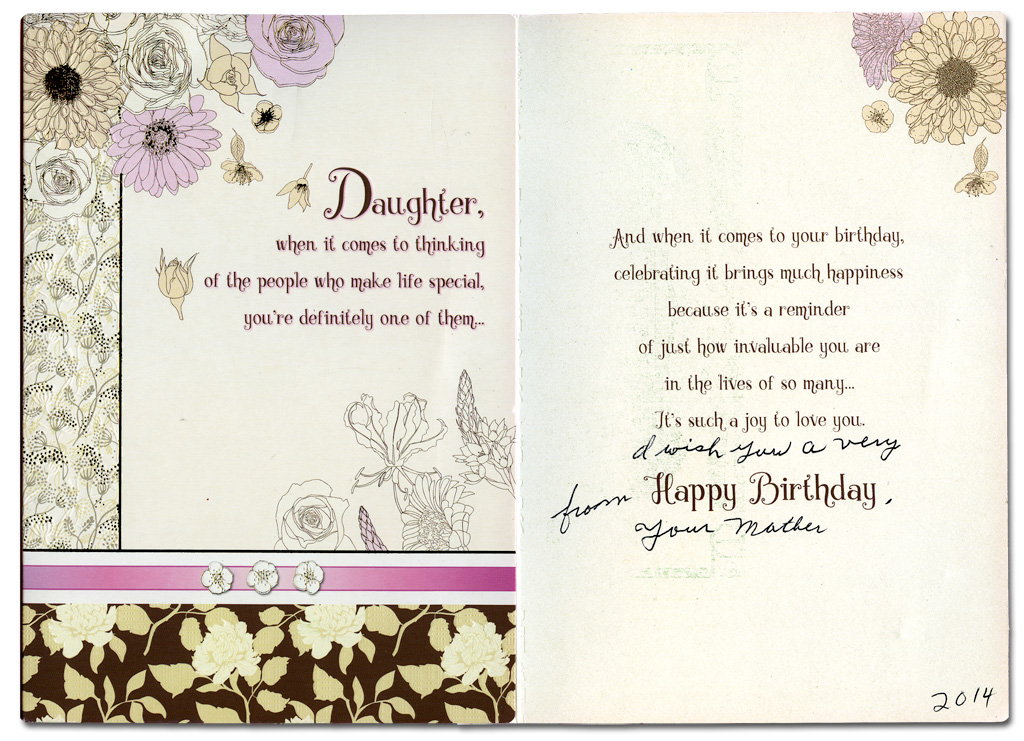
I was born the day after Mother’s birthday. Her last birthday card to me, 2014.
Some Images
At the top of the stairs to the left, there was a little room Mom called the hallway, which seems a misnomer because it was square rather than long and narrow as hallways usually are. It connected the upstairs landing to the family clothes’ closet whose door had a crystal knob. I always thought it was one of the prettiest things about the room because it showered rainbows on the walls when the sun shone in at a perfect slant.
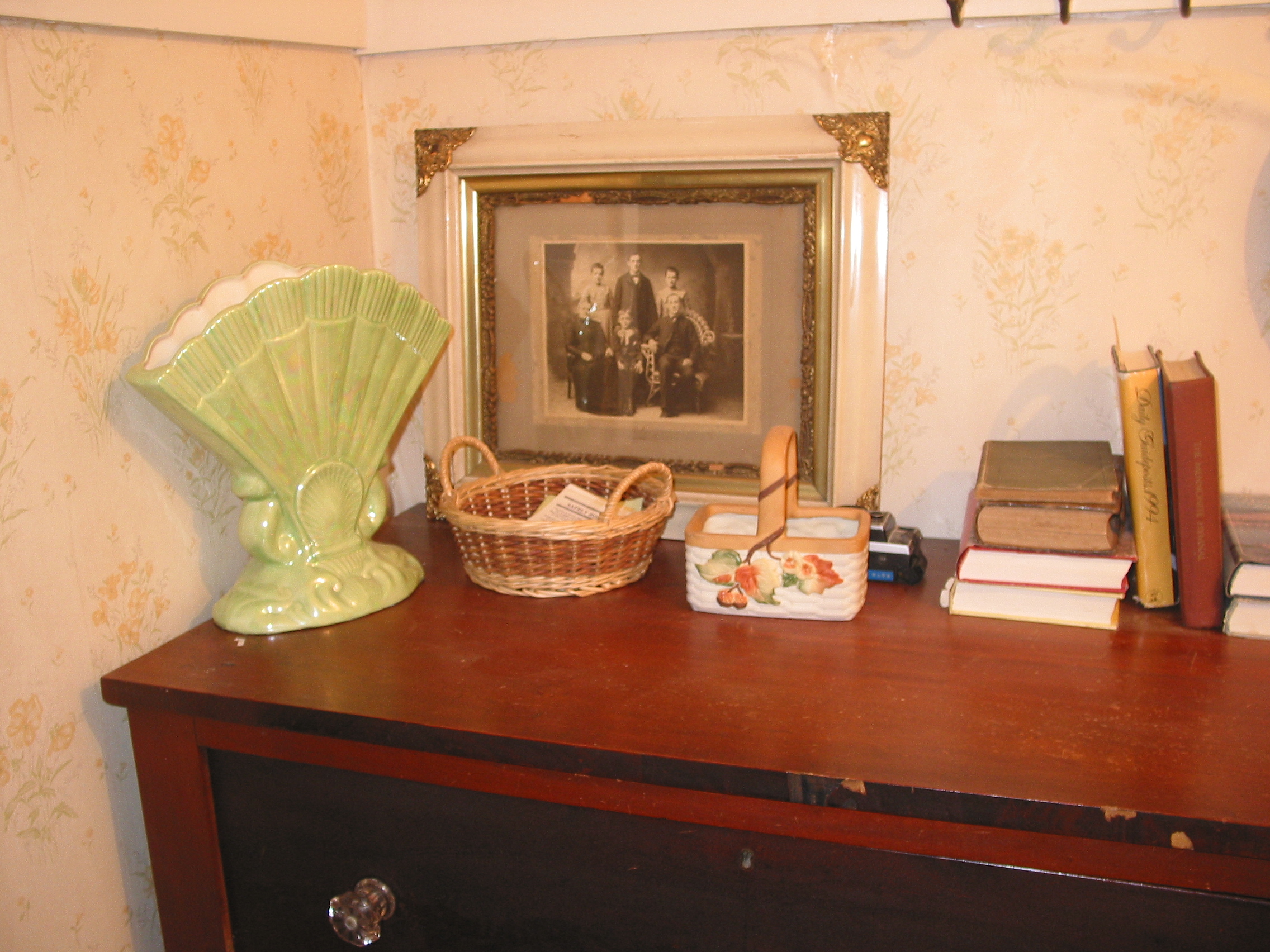
A dressing room of sorts, this small area was a repository for Mother’s own nostalgia: a framed family photograph, old books, the odd china piece on top of the Sheridan chest of drawers.
At right angles to the closet door stood this chest of drawers with a photo of my great-grandmother Sadie Landis’ family before she became a Metzler and a mother. And there’s that ceramic green vase. It’s perfect for displaying iris or gladiolus, but I didn’t grab it when we cleared out Mom’s house. How to take it on the plane? Where would I put it?
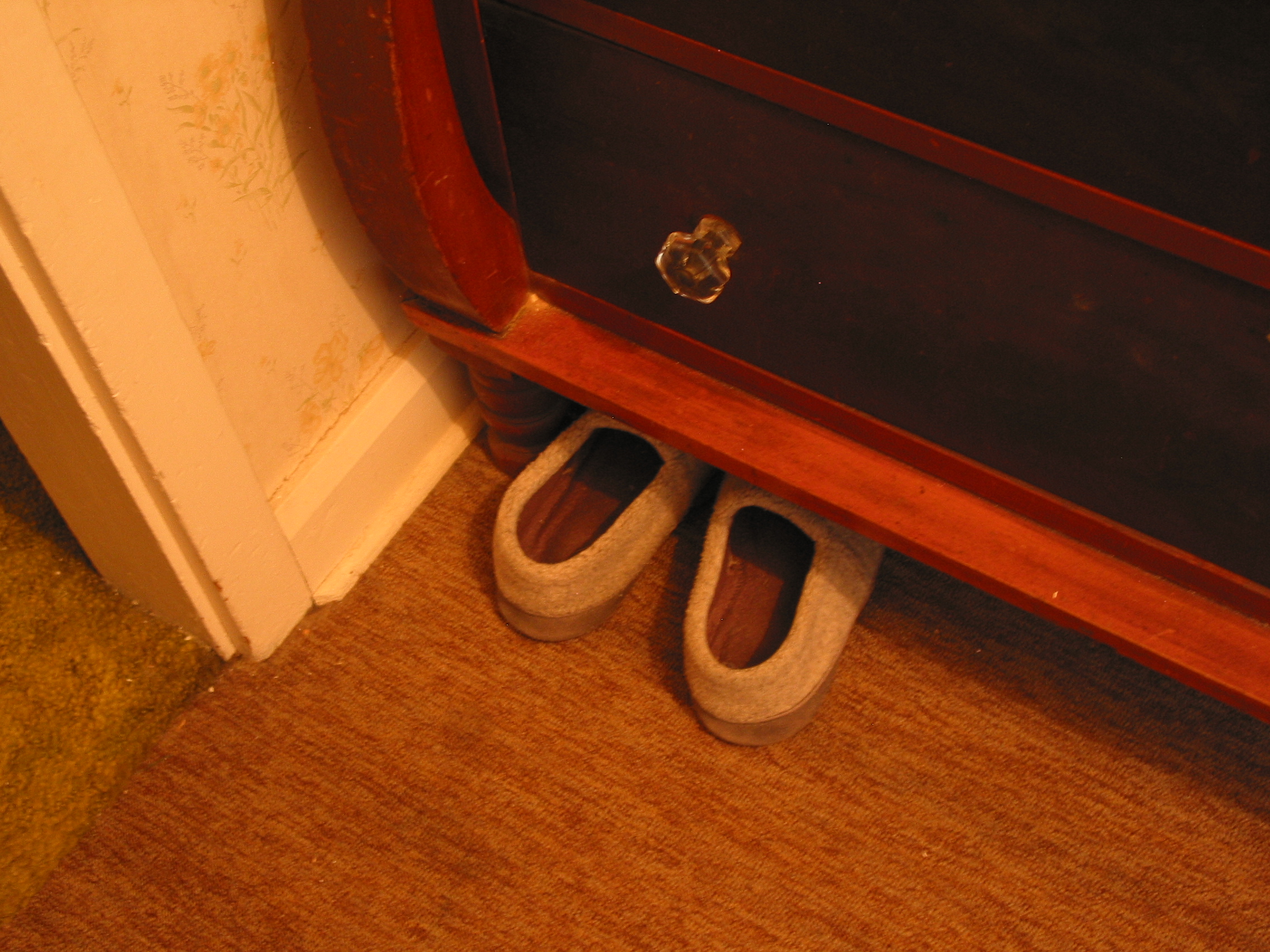
And under the chest, Mother’s slippers
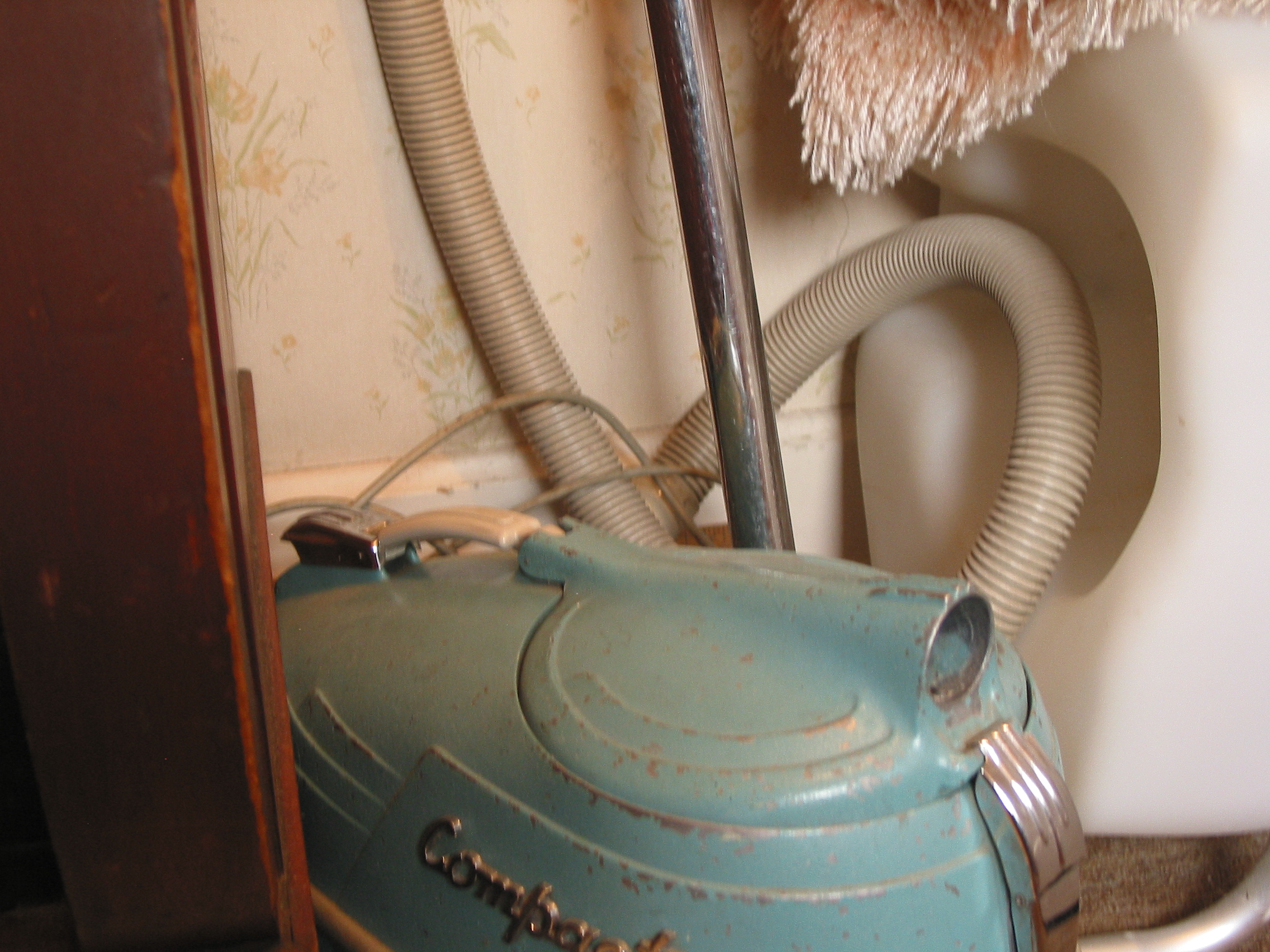
Beside the chest, her Compact vintage vacuum cleaner, a blue bullet of an animal easy to pull around the house even at her age. Her old Singer treadle sewing used to sit in the opposite corner under a window.
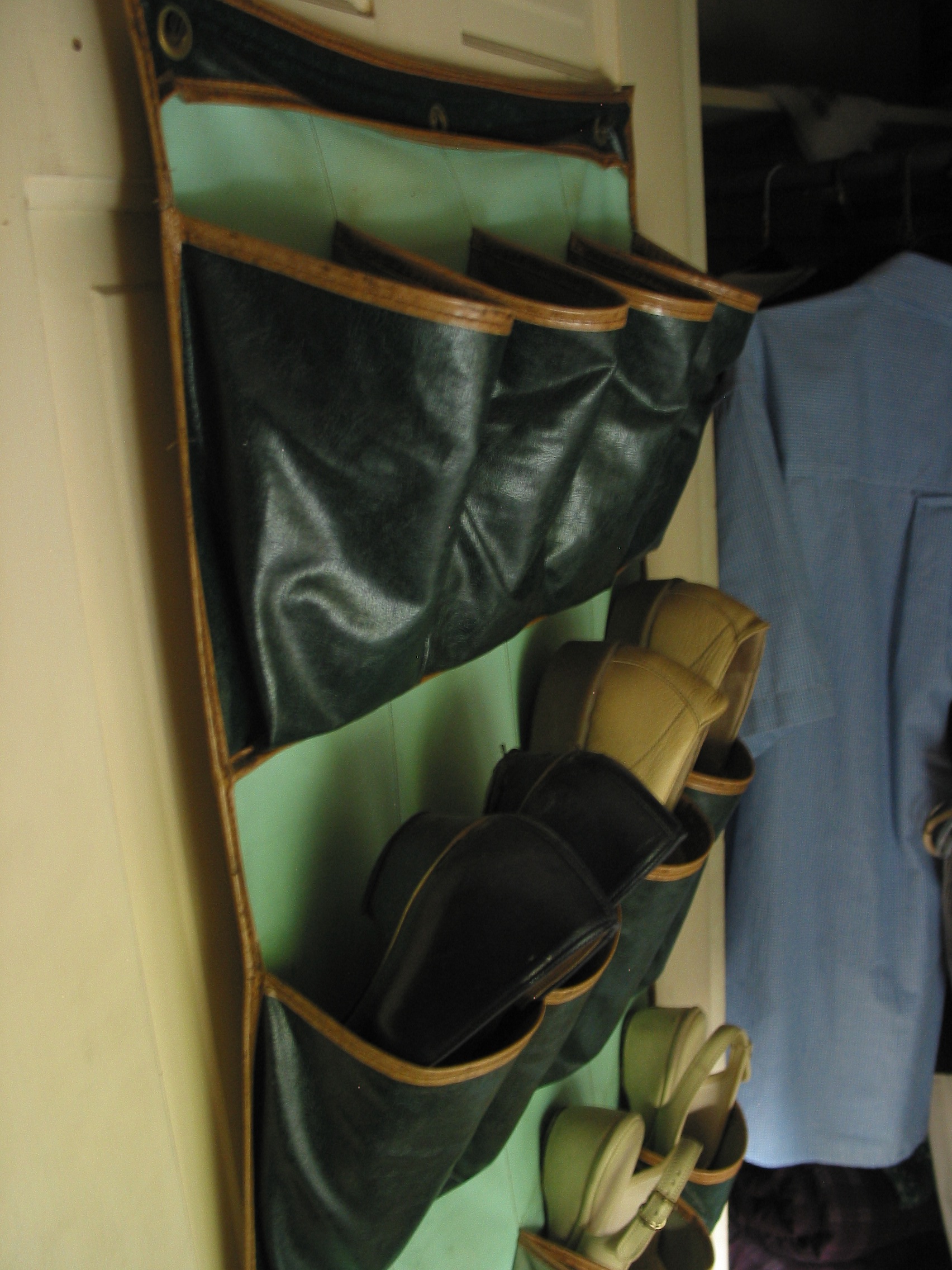
On the closet door what remained of her shoes
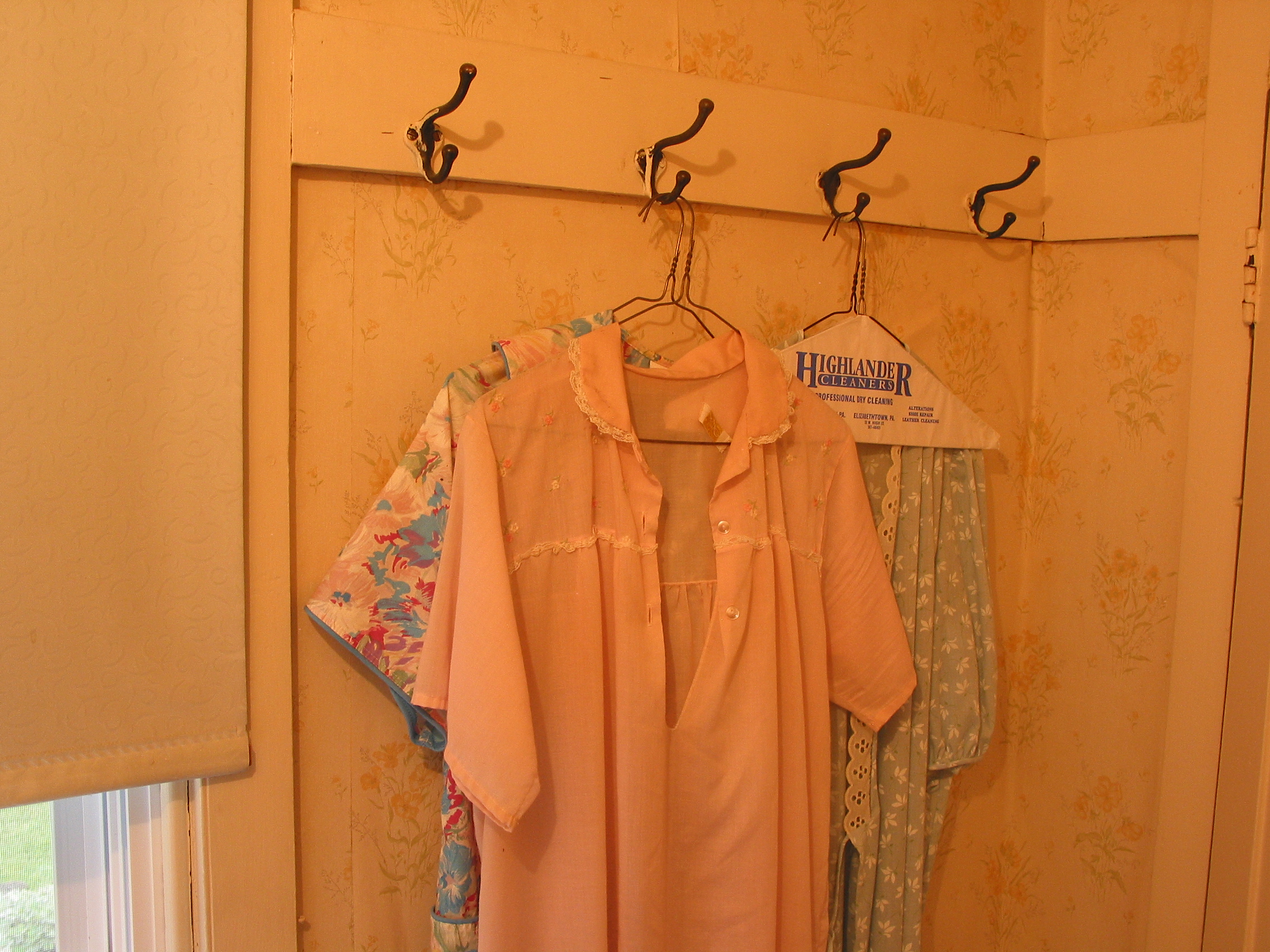
Then below hooks with nightgowns and robes. A girdle with stays used to stand stiffly in the corner below the lingerie to air out. Sometimes a few cleaning products were stored there too. . .
The house has been sold. These images exist only in memory now and in our e-files on my desktop. Powerful images – how they linger . . .
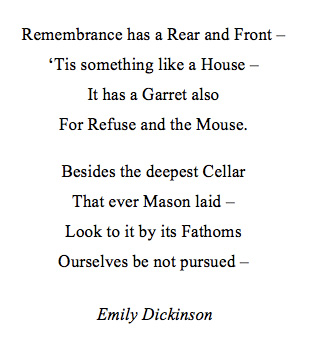
Remembrance also has a side, where other memories sneak in . . . .
Is there a room in your childhood home that holds special memories? A secret niche you called your own?
His yellow tag says: Cheeno Duncan – Host Family: Ray & Ruth Longenecker
How would you feel if you were an 8 or 10-year-old from New York City and after a 3-hour train ride landed you in the farm pastures of Lancaster County, Pennsylvania, lush but unfamiliar? Cheeno and Roxanne Duncan were part of the Fresh Air program designed to give urban children summer vacations away from their hot tenement building apartments.
My parents, always alert for ways to serve God through their church, Bossler Mennonite, offered a home to two of these children in 2-3 consecutive years in the early 1960s. A side benefit would be playmates for my 10-year-old brother Mark, who was 7 years younger than his closest sibling, my sister Jean. And for the first time, the whole family would be brought in close contact with children of a skin color and culture different from our own.
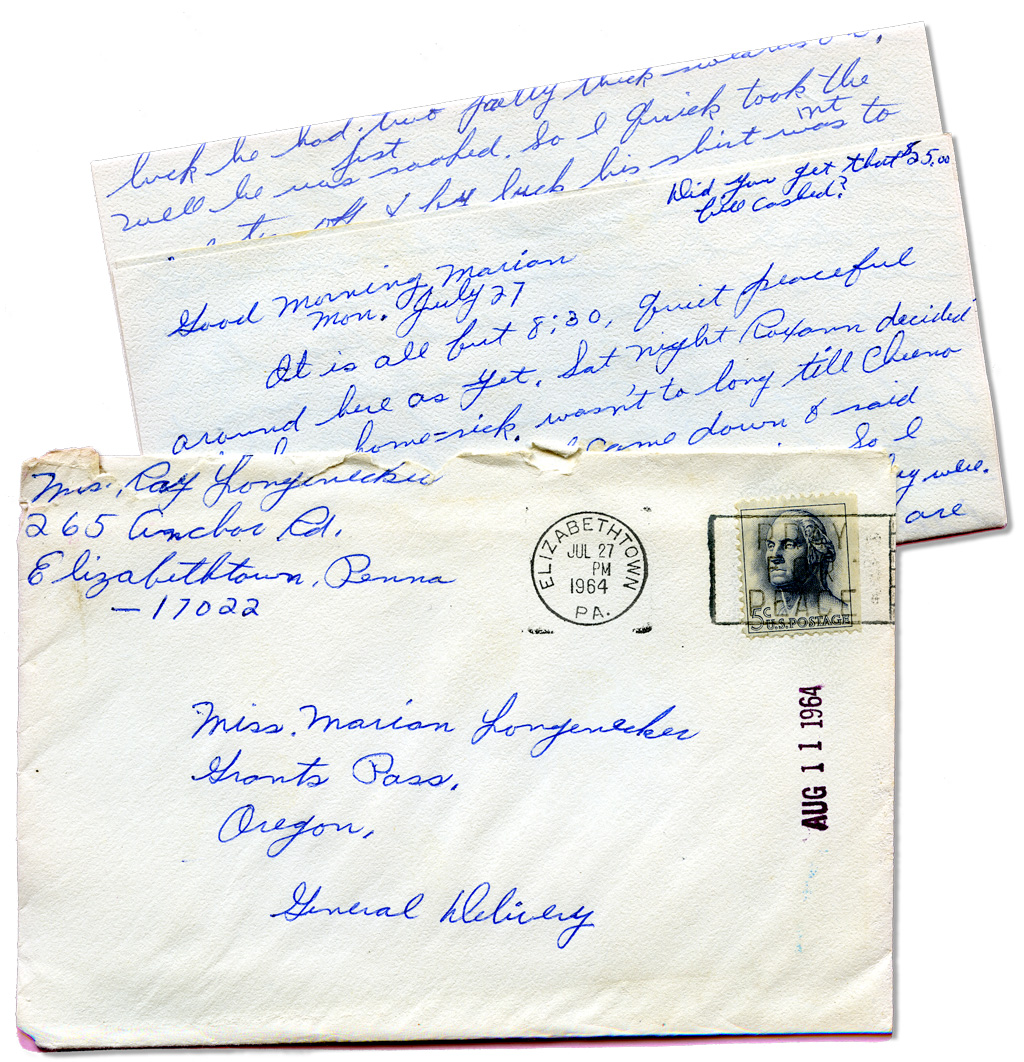
These two tales about Roxann and Cheeno come verbatim from letters my mother sent to me while I was enjoying a 5-week cross country road trip. One was addressed to Grants Pass, Oregon, delivered, and another addressed simply to Los Angeles, California, no street address, from where it was “returned to sender, unclaimed.”
TALE # 1 Crying
July 27, 1964 Written in my mother’s handwriting, unedited:
Good morning Marian It is all but 8:30, quiet peaceful around here as yet. Sat. night Roxann decided she has homesick. Wasn’t to long till Cheeno saw her crying. Mark came down and said Mommie now they are both crying. So I went up into the bed room. There they were, two sets of tears. I asked Cheeno why are you crying. He said because she is crying. Then I said well now I will cry because you are crying. So I tried to start pretending [to cry]. Roxann had to laugh. It didn’t last to long. But they decided they would feel better if they slept in one bed. So I left them.
TALE # 2 Leaving
August 4, 1964
Dear Miss. Marian Well we took the Duncans to the train station today. We were about 2 blocks away from the station Roxann said we don’t have our yellow tags on. I rushed in quickly and explained the situation. He said they must have tags on. But we can make some others. Well that was finally straightened out.
But oh horrors what could be next. Cheeno picks up his lunch bags and lets it fall to hard on the cement. There goes a broken jar with root beer all over the bag and the floor. I quickly got some Kleenex but not quiet enough. Ruthie [my Aunt] goes to the car and comes back with an old pair of her silk “panties” Oh she said we don’t even have paper to put them in. she had taken the broken jar and paper bag to the car already. There we were left holding some-thing we didn’t care to be seen with. Luckly we did see a trash can. Ruthie laughed and said if any body finds or see’s this they will think she just took off her ____??____
* * *
The program, originating in 1877, is flourishing to this day. See more about the Fresh Air Fund here.
There are many ways to experience independence and freedom. Here’s one example. You can think of some others as you reflect on this past holiday weekend. Hope you had a Happy Fourth!
The Marlboro man, pictured as a cool-guy cowboy in a fresh country setting, ruled cigarette advertising from 1954 -1999.
Credit: Google Images
Smoking then was considered glamorous and cool, a way to fit in with the crowd. One of our most popular presidents, Ronald Reagan, was formerly a cigarette model for Chesterfields, even advertising that he would give cases of the product to his friends for Christmas.
Credit: Google Images
As the Marlboro Man’s ads evolved, the Surgeon General’s warning of health hazards appeared on cigarette packs. Now of course, smoking is taboo in stores and restaurants, and smokers are often viewed as outcasts.
* * *
Mennonite farmers in Lancaster County during the 1950s and 1960s grew tobacco as a prime cash crop. But as Shirley Showalter points out in her memoir, growing tobacco was both a tradition and controversy among Lancaster Conference Mennonites. “After George Brunk’s tent revivals, many farmers plowed up or stopped planting tobacco,” she comments. My own Dad stopped planting tobacco then, substituting tomatoes and corn in our acreage in Bainbridge, Pennsylvania. Shirley divulges her dad’s decision about farming tobacco in her book BLUSH (173).
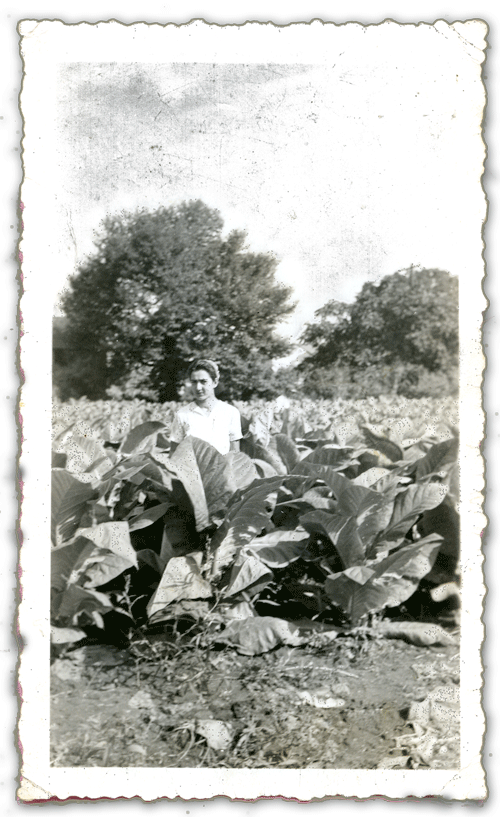
Here are some photos of young tobacco plants, Mother Ruth in the tobacco fields and then a snapshot of the drying process before the crop was sold to a tobacco company.
The issue of tobacco production and use appears in the Statement of Christian Doctrine and Rules and Discipline of the Lancaster Conference Mennonite Church (July 1968) but as an advisory to only ministers and their wives:
“Inasmuch as ordained brethren and their wives by their teaching and example exert strong influence within the brotherhood, it is required for the spiritual welfare of the church that they give evidence of willingness to subscribe to . . . the following standards of faith and life.
Listed as “f” in a range of a – h points is this directive but only to the ordained:“the non-use and non-production of tobacco.” (29) Apparently the issue of smoking and its health hazards posed a serious dilemma to the church with lay members who relied on tobacco growing as a way to pay the mortgage.
Many of my uncles smoked cigars when they were together. Even my dad would occasionally join in as a way to socialize.
* * *
I recently found a map of Yellowstone with a Conoco ad in the 1960s using the pleasures of smoking to promote their brand of gasoline:
* * *
A young boy named Jeremy learns about the dangers of smoking in an imaginative book entitled The Boy Who Grew Too Small.
Leave a comment below if you want to contact Author/Illustrator Cliff for more information about his book.
Other comments about this post – welcome here too!
This is my first Mother’s Day without my mother, Ruth Metzler Longenecker. To say I miss her is an understatement of the highest order. Technically, I could be considered an orphan with both my mother and father gone. However, with my own extended family and considering my age, I doubt that such a designation applies.
Is there a word for my status without a living mother or father at my age? I wonder.
Mother lived a full life with many happy moments and good health until a few days before her death on July 28, 2014. Over her lifetime, she had seen phenomenal changes in American culture, including technological ones as shown here:
Anna Catherine (Herr) Houser was speaking/listening on this candlestick phone in 1919 at the time Mother was a year old. Credit:Mennonite Women of Lancaster County, Joanne Hess Siegrist, 1996, page 89.
The last photo I snapped of Mother with her finger hovering over my iPhone captures the moment she looked up momentarily from “paging” through photos of her grand-children and great grand-children.
David Whyte, Crossing the Unknown Sea
The death of someone closest to us is always a form of salutation, a simultaneous Goodbye to their physical presence and a deep Hello to a more intimate imaginal relationship now beginning to form in their absence. (46)
A “deep Hello to a more intimate imaginal relationship”? We’ll see . . .
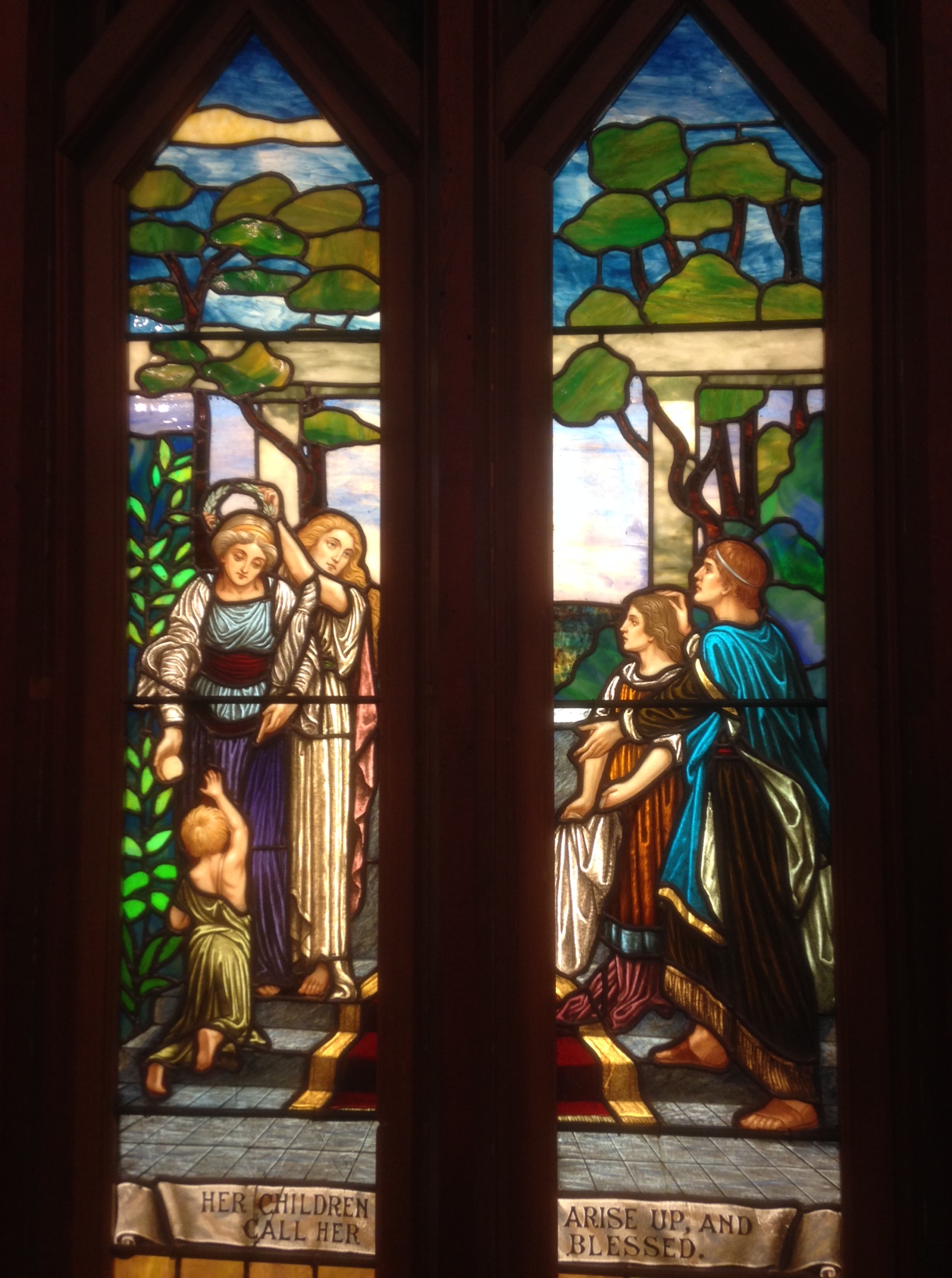
“Her children rise up and call her blessed.” Prov. 31:28 Christ Church Frederica, St. Simon’s Island – Tiffany glass
Have you experienced the death of your mother or grandmother? If a mother, is there a word for one’s status now, bereft of a mother and father? Your suggestions always appreciated here.
Coming next: The Longenecker Sisters’ Road Trip, Part 1
Growing up in rural Lancaster County in the 1950s, I had very little opportunity to meet people of other ethnic groups, but I did have a Little Black Sambo book that introduced me to a culture different from mine. So, I have not always been embarrassed by this book. Fascinated, yes, but embarrassed, no. The picture of the tiger running around an African palm tree as the tiger morphed into a golden round pool of butter mesmerized me as a child, butter that would become one of the ingredients of the pancake recipe. The next page shows Black Sambo’s mother Black Mumbo with her glossy brown arm stirring a mound of melted butter making pancakes. The picture made me hungry. And on the last page:
And then they all sat down to supper. Black Mumbo ate twenty-seven pancakes, Black Jumbo ate fifty-five. But little Black Sambo ate a hundred and sixty-nine because he was so hungry!!! (Yes, there are three exclamation marks in the book I am holding.)
Characters in folktales are typically overblown, with exaggerated details like Little Black Sambo’s super big eyes, through which he gazes at three heaping plates of pancakes with a pot of syrup dribbling all over the table. Obviously, he is ready to stuff his mouth with piles of pancakes.
But there are other tales in the book with the Little Black Sambo cover: The Little Red Hen, The Tale of Peter Rabbit, and The Country Mouse and The Town Mouse. Mr. McGregor and the kitchen maid in the “Mouse” story have white faces, but there is no reference to their whiteness. Their race is assumed as white and therefore not particularly notable.
I paged through this book recently as we cleared out books in Mother’s house and marveled at the stereotypes about black people back then and was embarrassed by it: A black woman with a big butt and goofy name wearing a “maid” cap on her head, black people eating nothing but fried foods, everyone eating too much.
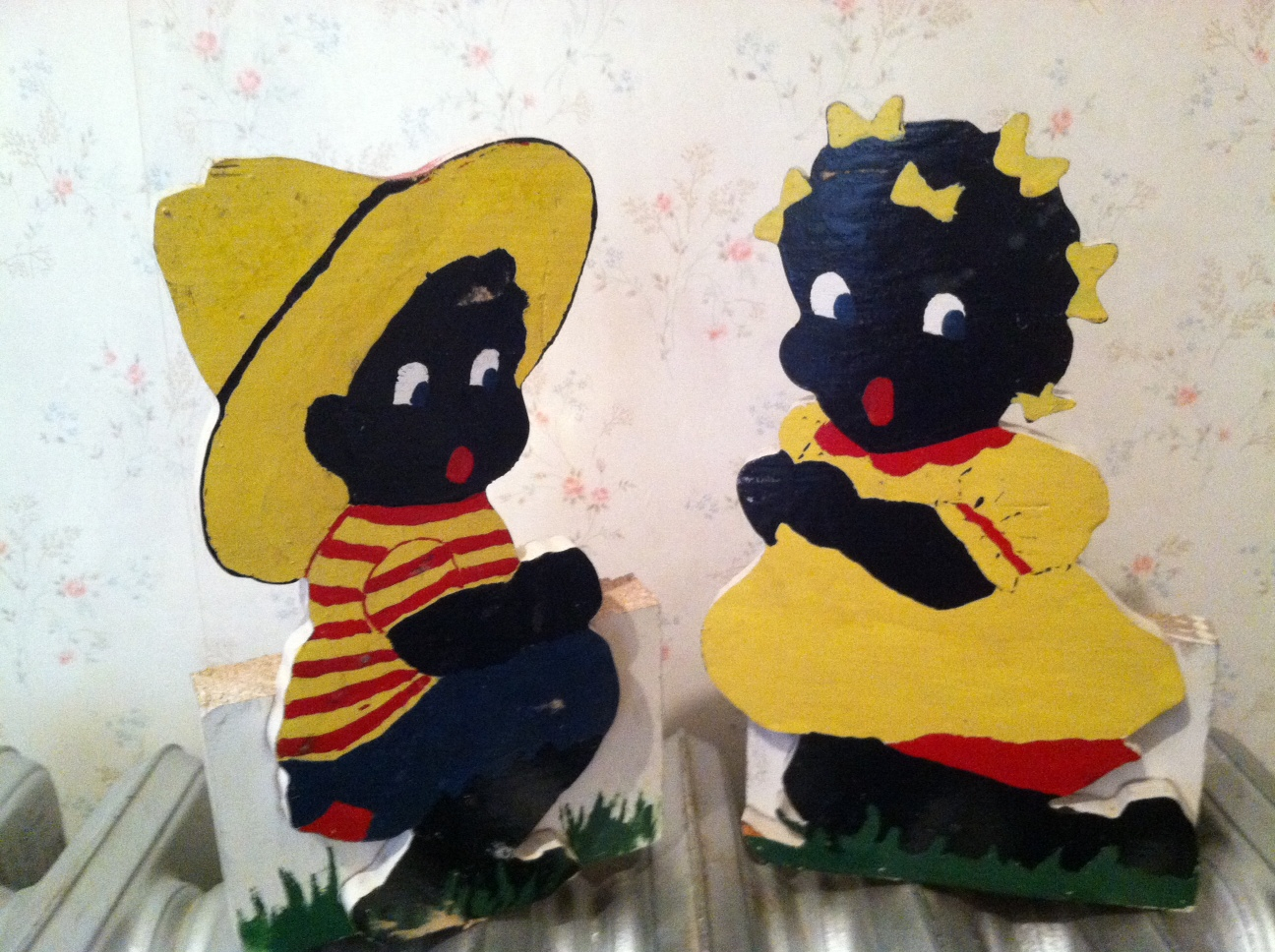
Another find un-earthed in our sifting through “Stuff” – a pair of book-ends I made in school that portrays black children as a novelty.
Interestingly, my niece Shakeeta, my brother Mark’s daughter, choose these as one of the few things she wanted as a remembrance from her Grandma Longenecker’s house. She hoists them up with a smile here:
I guess it’s time I catch up with the times and adjust my ideas about black memorabilia. Singer Anita Pointer certainly has. In an article entitled “A Lesson in History,” (AARP Feb/March 2015) Anita, one of the Pointer Sisters, says she collects black memorabilia so she’ll never forget how her people were once depicted.
We grew up in Oakland, California, but when I was 10 we visited my grandma in Arkansas. I couldn’t believe how people were living there. They had a white and a black part of town, and you stayed off the white side. At the department store, they had colored and white water fountains. I don’t want to ever forget that’s what it was like for us — and collecting black memorabilia is how I do that. (66)
Like Whoopi Goldberg and Spike Lee, Anita collects black memorabilia as museum pieces including a “Mammy” cookie jar, and a 1970s John Henry whiskey decanter made by Jim Beam. When the prestigious house of Sotheby’s came to appraise her collection, it took a year to sort and categorize it. She comments, “The appraiser said that I could pretty much charge what I want because most of the pieces are one of a kind.” In the end, Anita Pointer sees her collection of thousands of pieces as part of her personal history. She doesn’t apologize for any of it.
Of course, I’m hanging onto my Little Black Sambo book. It’s a part of my personal history.
Your comments welcome here!
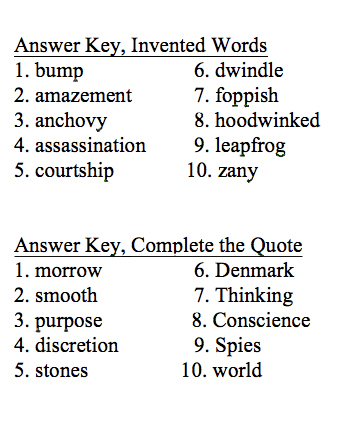
(Answers to Shakespeare puzzlers from April 22, 2015 post below.)
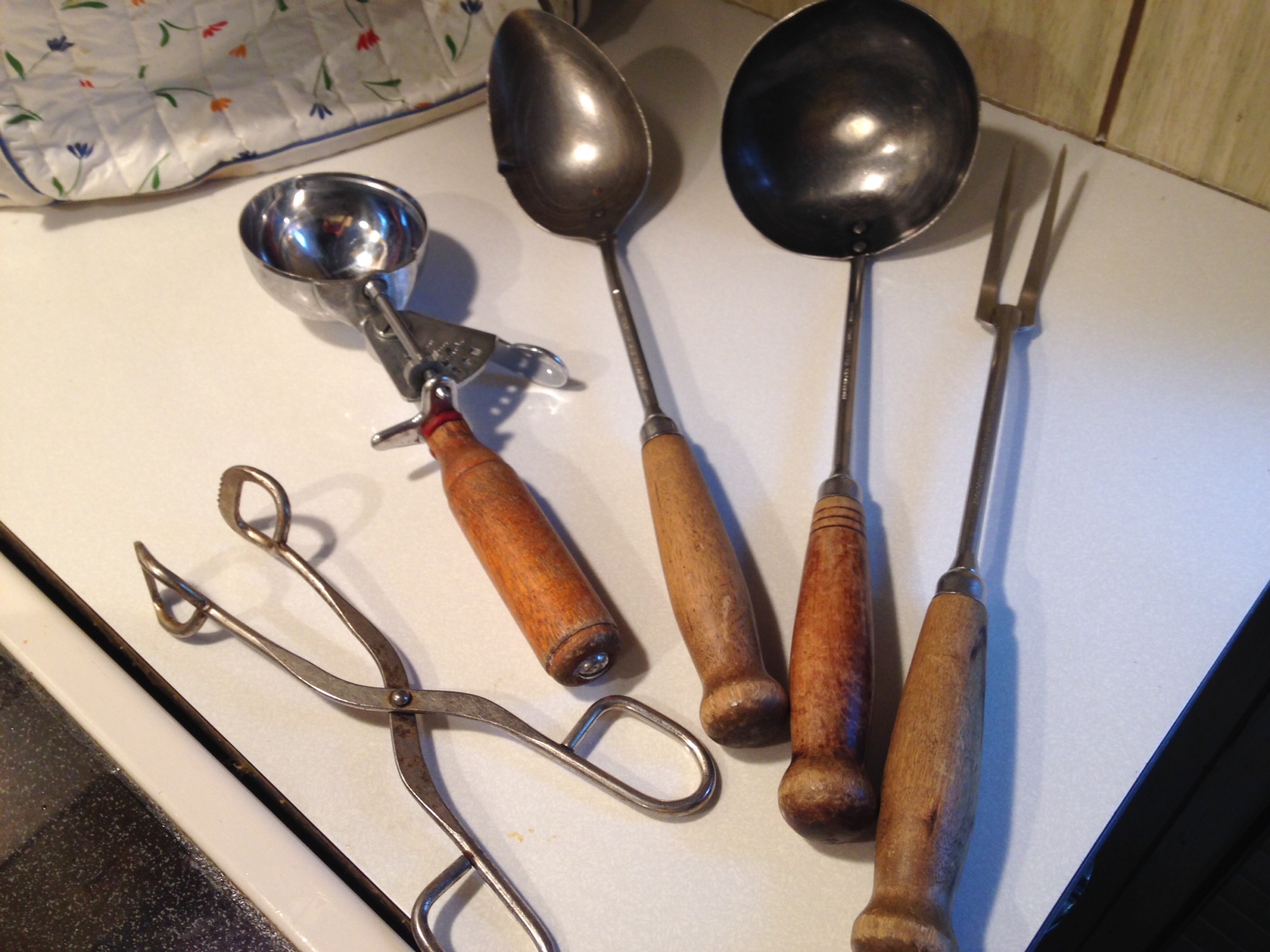
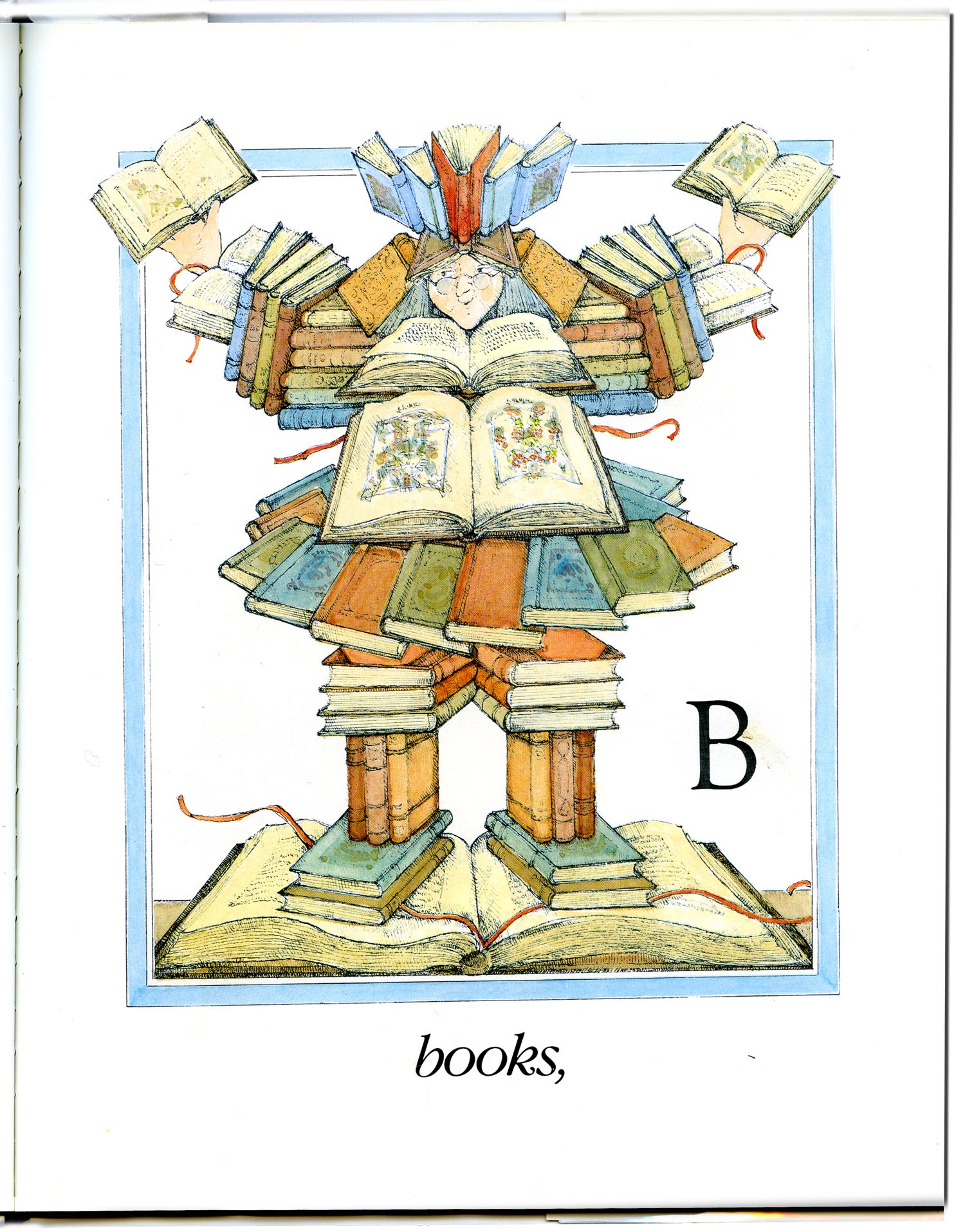
Clearing out a house after death is a sacred act, yet no amount of holiness assigned to this task can dismiss the back-breaking, shoulder-aching, neck-craning job of sorting, recycling, and passing on to others the possessions of a loved one. Aside from clothing and furniture, Mother left behind the tools of her trade in the kitchen along with beloved books of our childhood, some of which are displayed here.
Prepare Food & Serve It
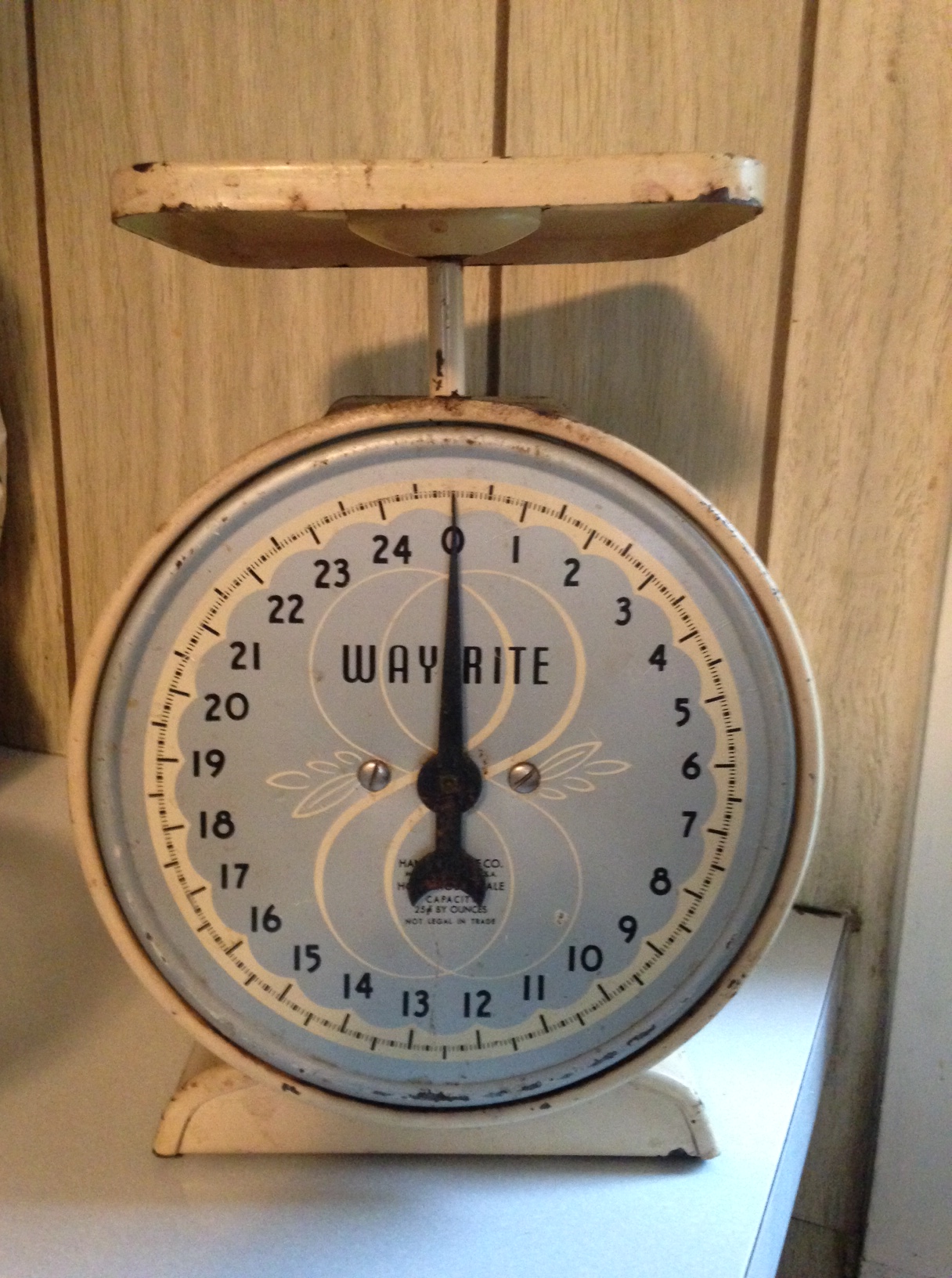
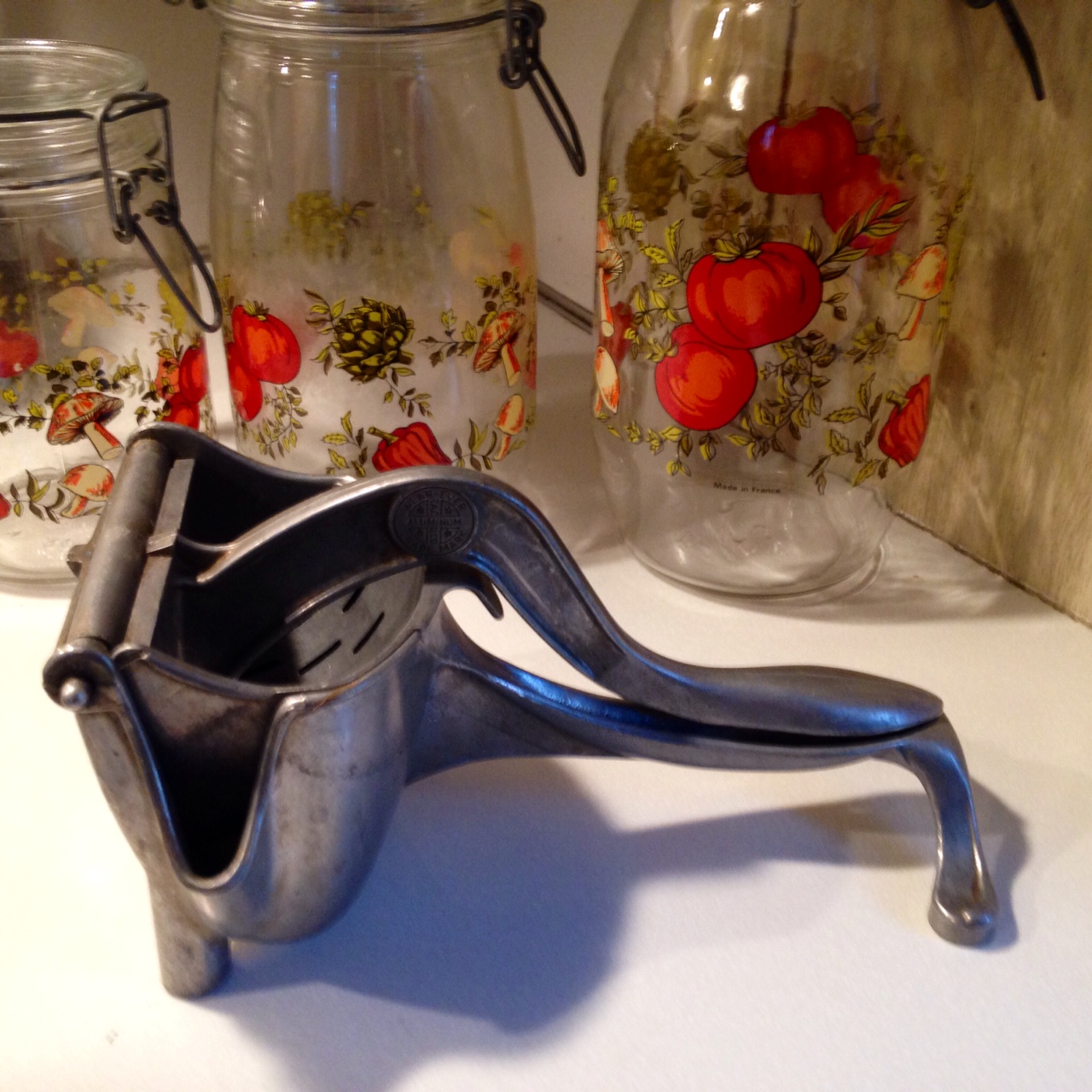
What remains: A scale on which all of our baby weights were noted and recorded (or ingredients for recipes measured), cooking utensils, ice cream dipper, and juicer, most of which have been passed on to grand-children.
My best guess is that these were wedding gifts or first (and only) time purchases. I don’t remember another scale, a different set of utensils, a second ice cream dipper or juicer ever passing over the threshold of our home. The throw-away mentality of our current consumer society never made sense to Mother. “You buy good, and keep it – for a lifetime” was her philosophy! Yes, prepare food and serve it, and with love! Her fancy china set, sterling silver flatware, and crystal glasses and goblets all have found homes with her grand-children.
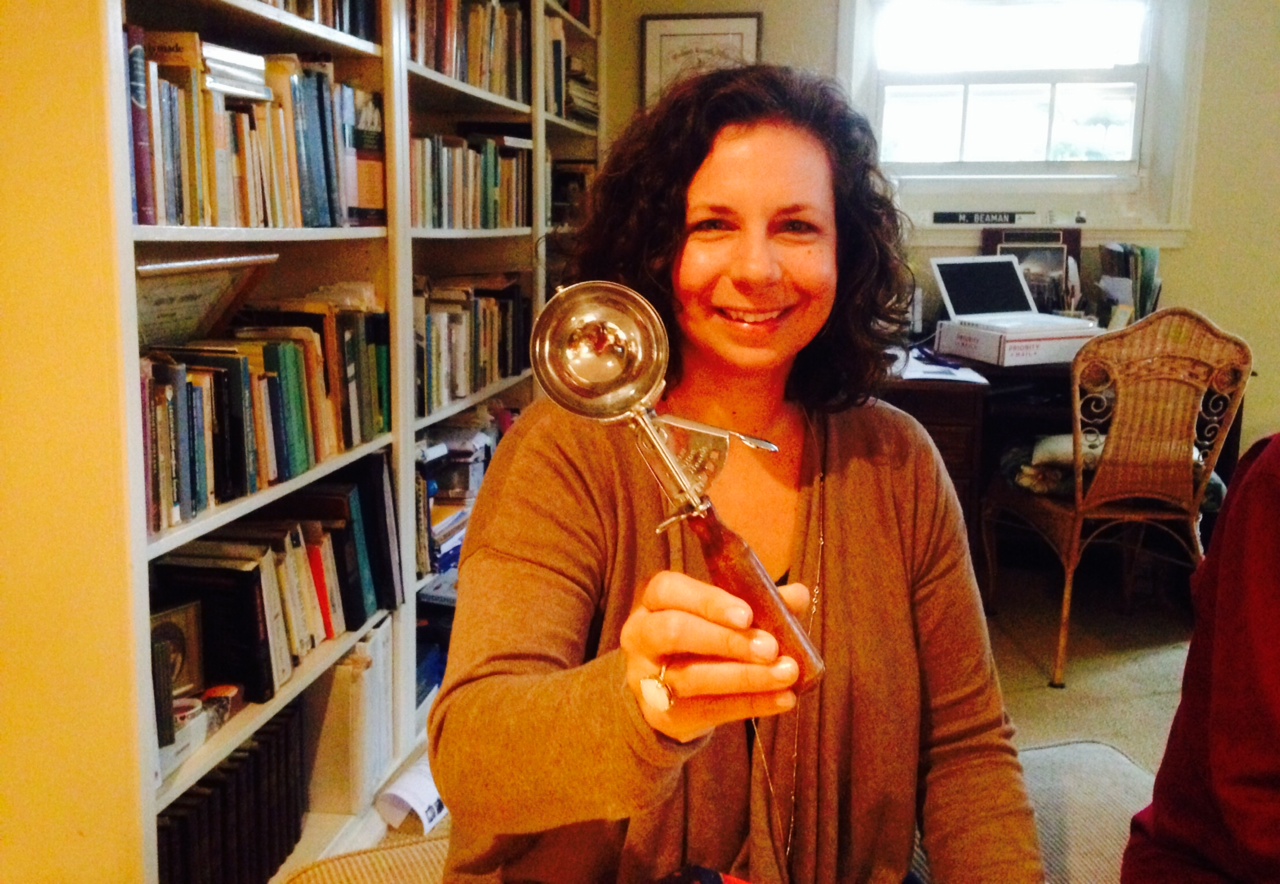
Daughter-in-law Sarah pleased with Grandma’s ice cream scooper
Don’t Forget to Stir in Imagination
Illustration from On Market Street by Anita and Arnold Lobel
In previous Moments of Discovery, you may have seen other books from Mother’s bookcase or from the attic.
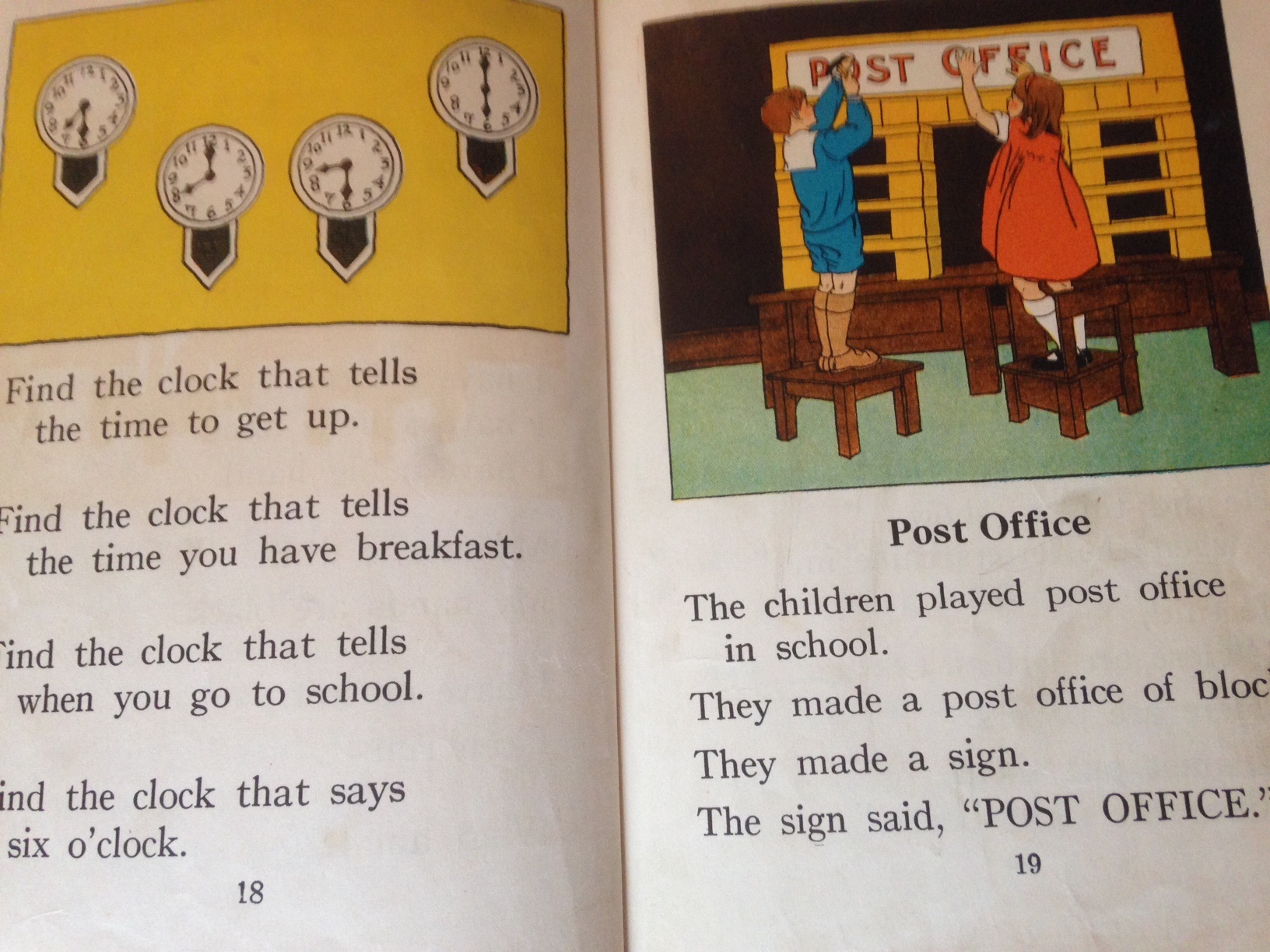
The book below, a reader, is certainly a keeper, recording media and methods that are becoming obsolete.
The Child-Story Reader, copyrights ranging from 1927-1936
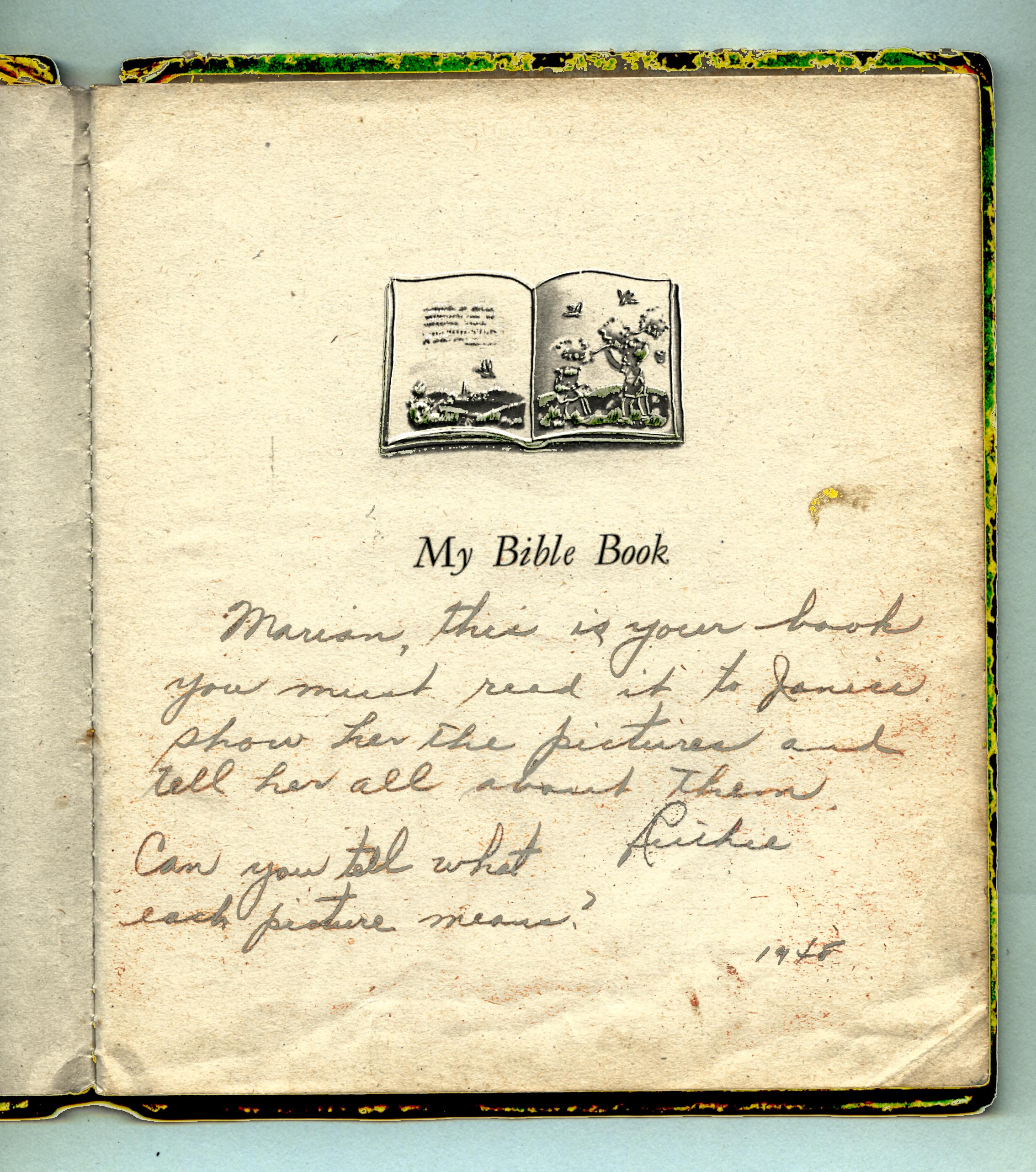
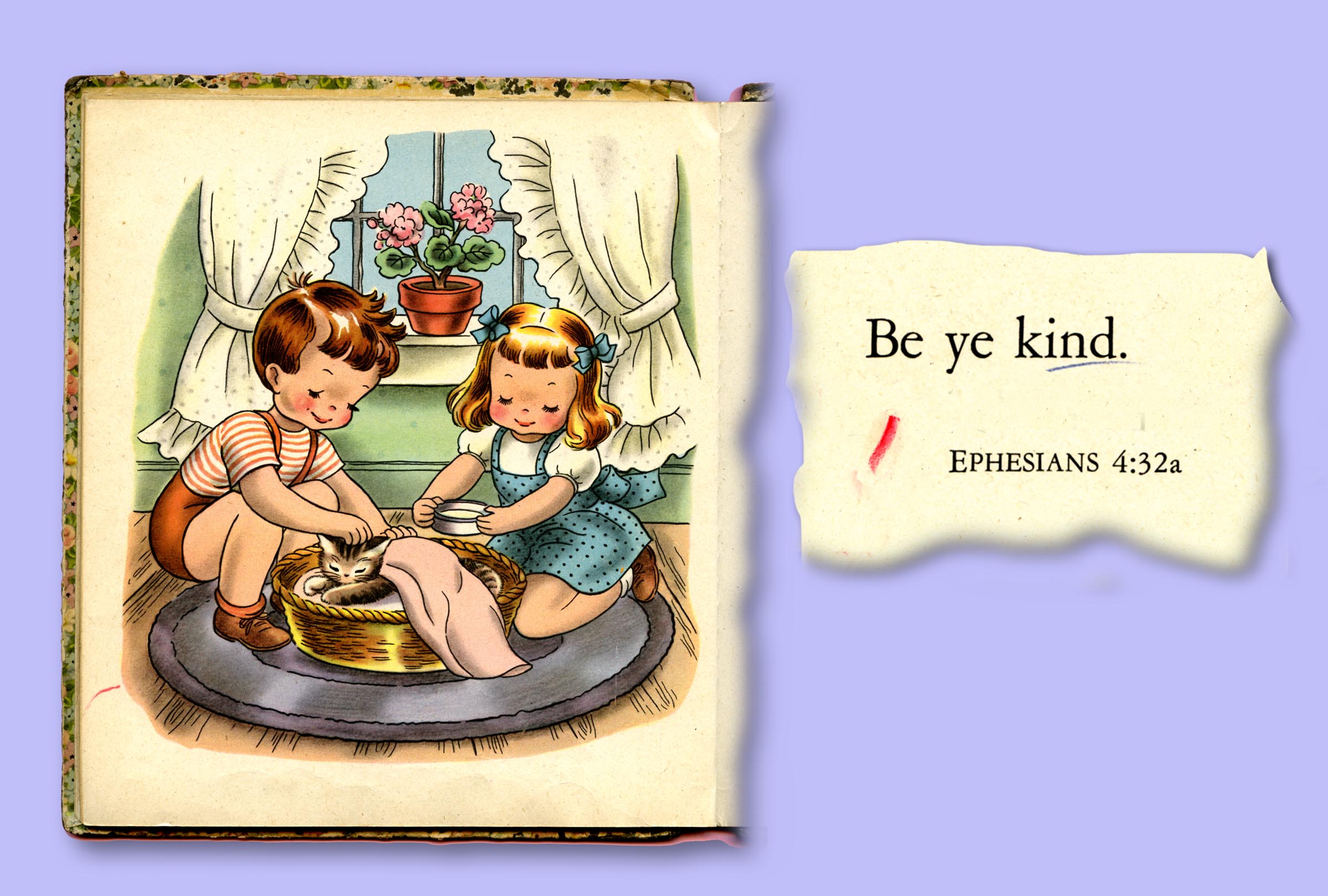
And one of my favorites is My Bible Book with verses selected by Janie Walker and pictures by Dean Bryant (Rand McNally and Company, 1946). These words and pictures have been imprinted on my childhood memory as I joined the red-haired boy and blonde-headed girl roaming around gardens and romping through meadows with their pets. It was a perfect world!
Aunt Ruthie gave me this book with penciled instructions to read it to my sister Janice, show her the pictures and tell her all about them.
Ever the teacher, she closes with her sweet lead-in question: “Can you tell what each picture means?” This is probably a Christmas gift or birthday present given to me in 1948.
Puppy dogs, a frog, a snowman, a kite, some birds, squirrels, a herd of cows, and a even a special kitty cat amuse the children as the pages turn with words of wisdom all quoted from scripture.
Do you have old books in your treasury of keepsakes? Some special utensils for cooking or serving passed down to you from a generation or two ago? We’re all ears!
Coming next: Button, Button, Who’s Got the Button?
I just talked to my brother Mark in Pennsylvania, and our 15-minute conversation was interspersed with his exclaiming . . .
“It’s sleeting.”
Then, a few minutes later, “It’s raining . . .”
And finally, “It’s sleeting again!”
It’s March and most people north of the Florida latitude are sick of winter. Suffering from S.A.D. (Seasonal Affective Disorder}, they are waiting to see the sun break through the winter blahs and unveil the crocuses and narcissus ready to pierce the soil.
Writer Linda Joan Smith had that feeling in mind when she said
Outside Snow’s dingy blanket may still muffle the stirrings of tulips and daffodils, and the pond may still be rimmed with ice. The reward of the garden must wait, but our gardening labors have begun. (“The Potting Shed,” The Traditional Home, March 2002)
Smith celebrates the potting shed, “the room that is as much a workshop to the gardener as the kitchen is to a cook.” She makes reference to the advice of John Claudius Loudon, who in his 1830s An Encyclopaedia of Gardening, recommends that proper potting shed must have light, air and warmth, including “a fireplace never omitted.” Smith’s article pictures two versions of the shed – an impressionistic one where there may not be precise order . . .
Illustration: James Staag, Traditional Home, March 2002
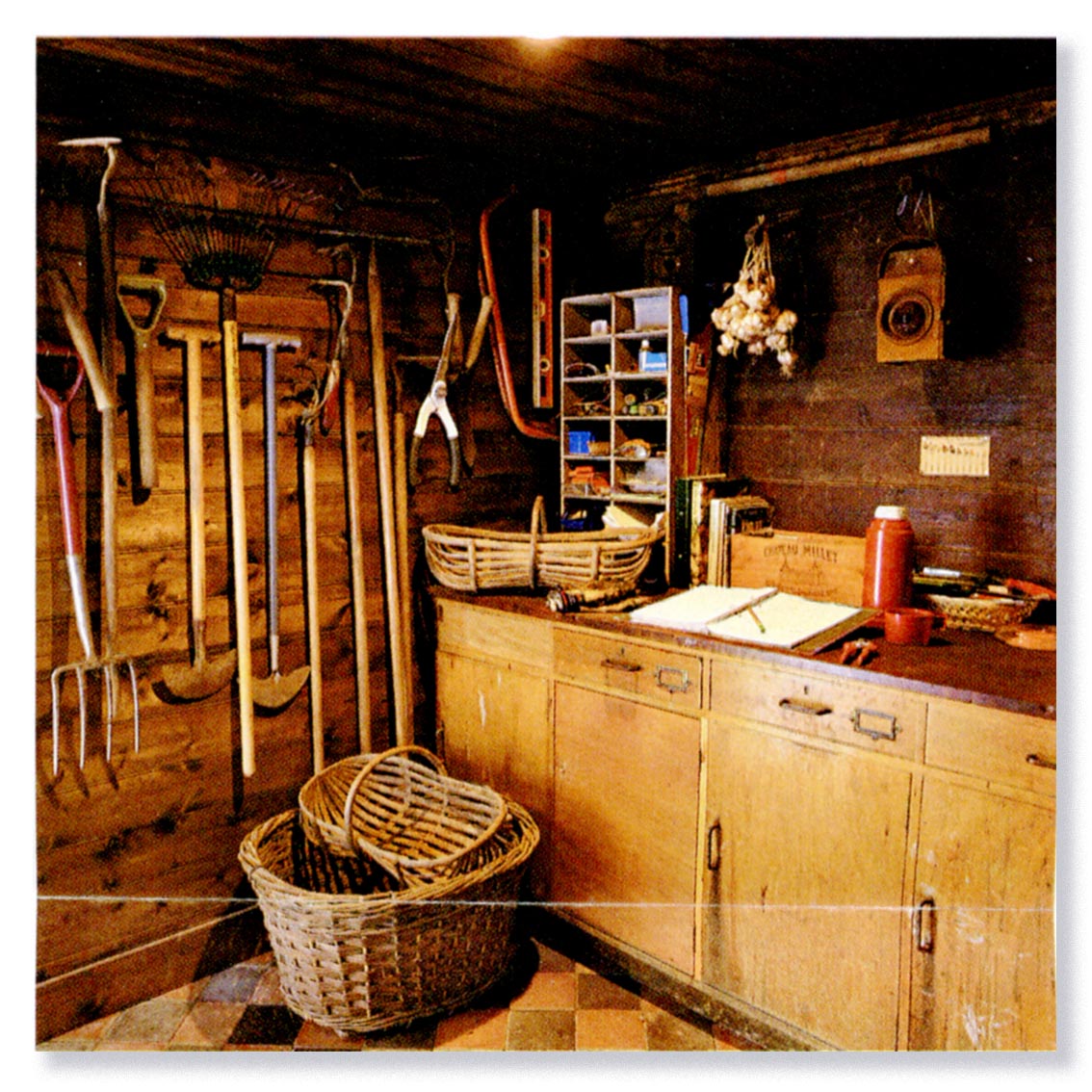
And one meticulously appointed where there is “a place for everything, and everything in its place,” (229) so says Mr. Barnes of Bicton Gardens writing in the1840s.
Photograph: Curtice Taylor, Traditional Home, March 2002
My blog friend Linda Hoye, who moved recently from the Pacific Northwest to Canada, is a gardener extraordinaire. In her blog A Slice of Simple Life she uses plastic gallon jugs for winter sowing:
Winter sowing is placing seeds outside, in the winter, in mini-greenhouses made from things like empty milk jugs. The plastic jugs protect the seeds from harsh weather while allowing the cold to toughen them up during the cold weather. When it gets warm enough inside of the little greenhouses the seeds germinate and become viable outdoor plants sooner than those started indoors because there’s no need to harden off the plants.
When you check out her post, you can see her mini-greenhouse project complete with a photo of the jugs in a tub.
Did I mention that Linda is innovative? Yes, indeed. She gives a blow by blow pictorial account of preparing a worm hotel – indoors. Knowing that worms aerate the soil, she nurtures them as help-mates in the growing process. Even she says, “Eww!” as she mingles coir mix, pumice and finely chopped veggie scraps topped with a damp newspaper before she moves the operation to the garage. Soon she will prayerfully tuck seeds, tiny flecks of hope, into dampened soil. Obviously, Linda has faith that “to plant a garden is to believe in tomorrow” (Audrey Hepburn).
And gardener Hoye believes in whimsy too, as her creation of a fairy garden illustrates, anticipating spring in a post entitled “Spring is in the Air.“
Some Gardening Quotes:
“Outside there is water music as packs of snowflakes melt into water drops, merge into rivulets, trickle into puddles, then subside into pools and streams. The garden is mud, but no matter. Soon it will drain and dry in the strengthening sun.” ~ “The Potting Shed,” The Traditional Home (March 2002)
“In the spring, at the end of the day, you should smell like dirt.“~ Margaret Atwood in Bluebeard’s Egg (1986)
In March 1985 my farmer parents, Mother and Daddy Longenecker, left wintry Pennsylvania and visited Florida where they couldn’t wait to get their hands into the soil. Soil that nourishes citrus trees, azaleas, and camellias is not necessarily good for hardy Lancaster County plantings. Daddy took one look at the sandy soil in my sister Jan’s huge back yard and ordered a load of chicken manure. After working it into the ground, he and Mother scored straight rows for planting.
Mother Ruth Longenecker sowing seeds in Florida
Do you have gardening tricks or stories about gardening to share? Here’s your chance!
illustration from On Market Street by Anita & Arnold Lobel
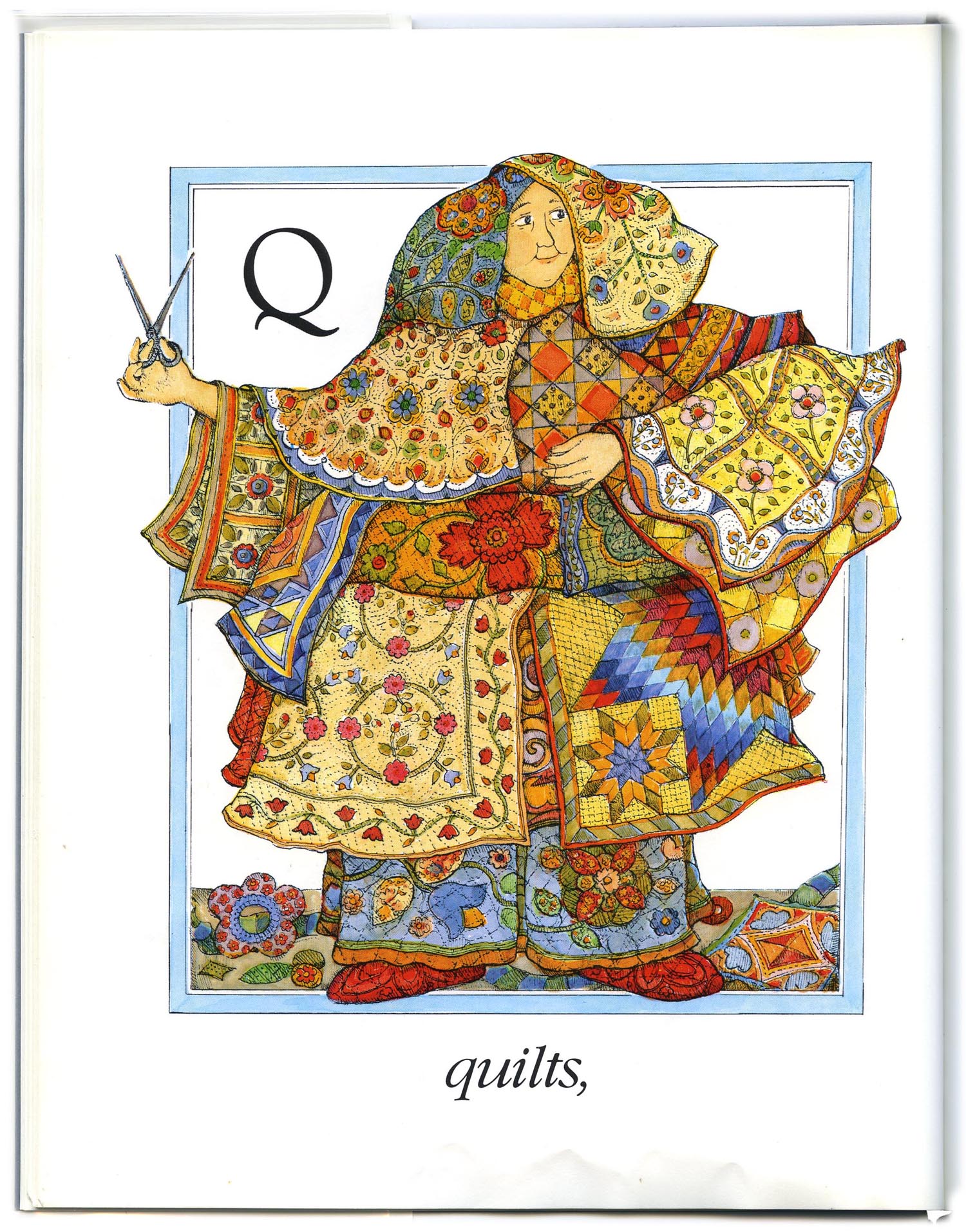
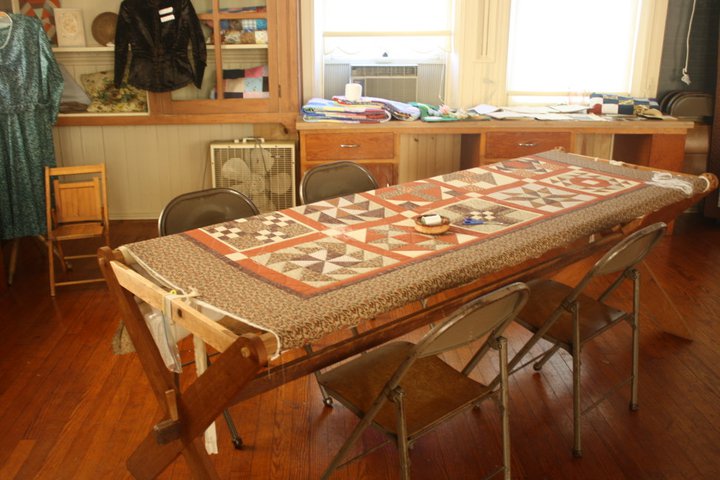
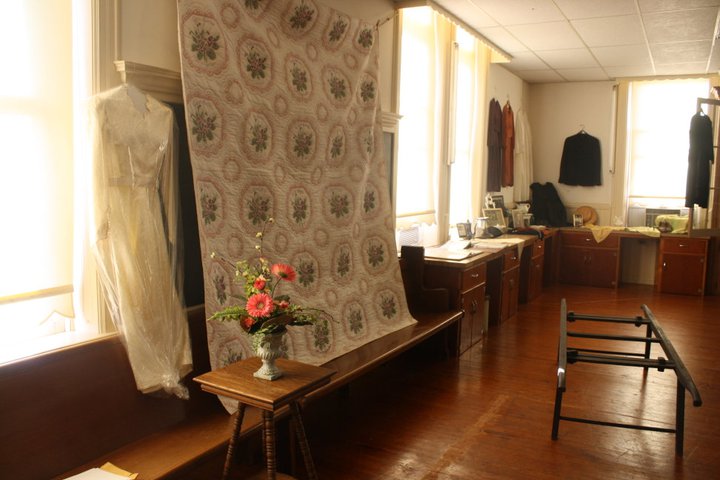
Bossler Mennonite Church was the hub of the Longenecker family’s spiritual life and the school beside it, Washington School, the place where the Women’s Sewing Circle fabricated comforters, baby clothing, blankets and quilts to help clothe the needy of the world. Some of these gorgeous quilts are displayed on a previous blog post. You can see and read about them here.
Quilts exhibited at the bicentennial of Bossler Mennonite Church
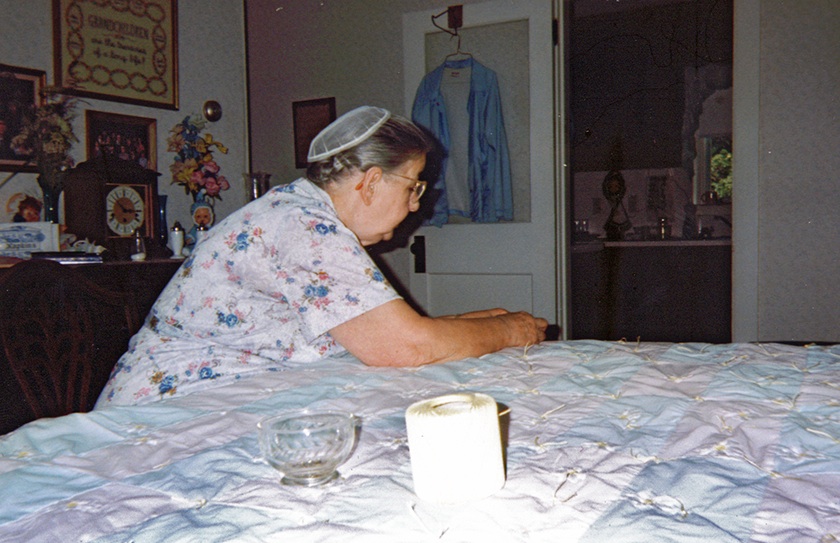
Even more than quilting I think Mother loved knotting comforters. For her, it was easier to see progress knotting a comforter. She liked the warm fluffy texture, and she could work on it by herself at home.
Last fall, on one of our trips to the attic cleaning out the house after her sudden death, we opened the yellowish, grain-painted blanket chest with turned feet where we knew we would find some of Mother’s prized quilts.
Can you identify the design above? I need help with the name of this pattern please!
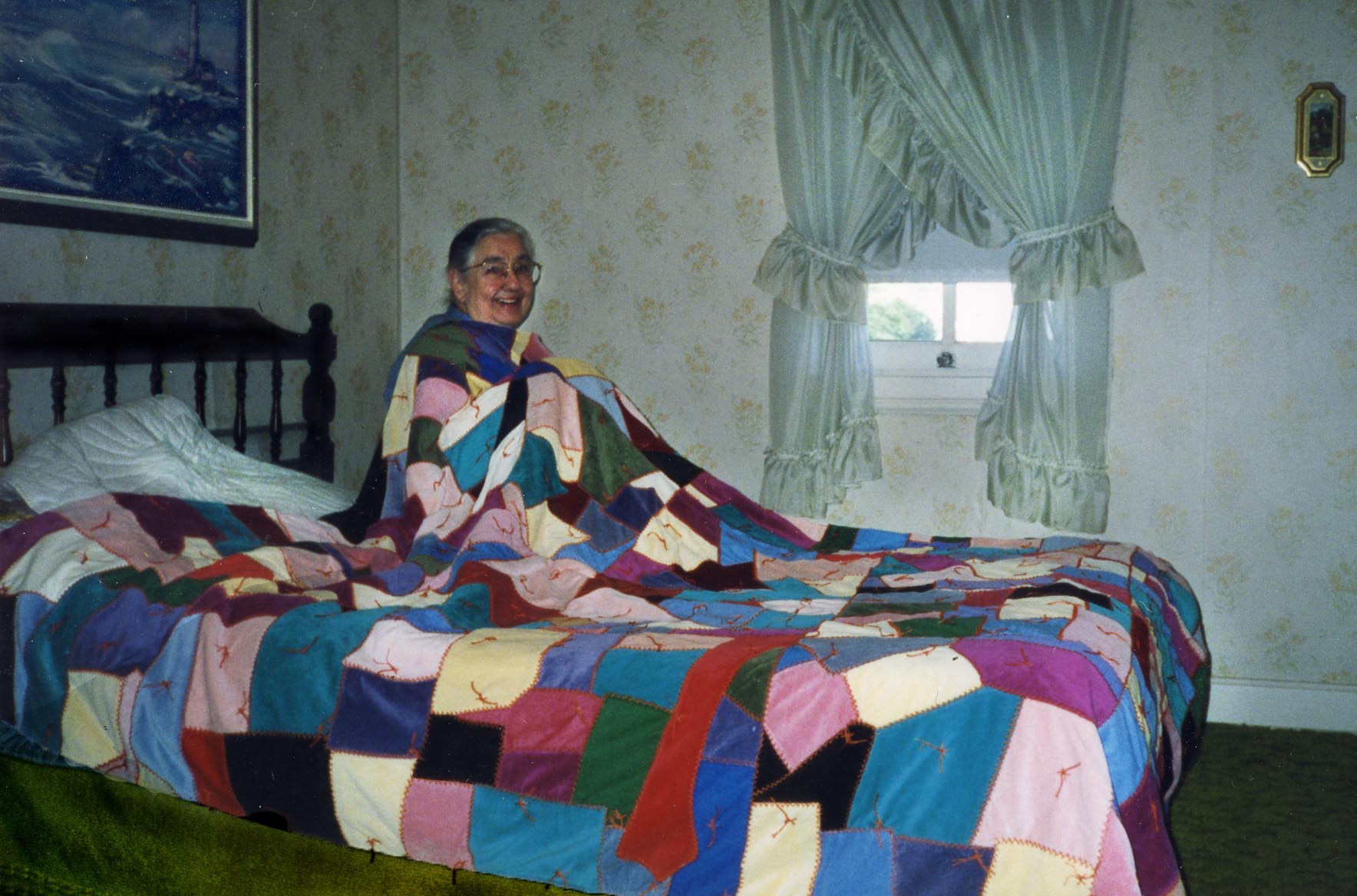
Crazy Quilt design, 1999. Each of Mother’s grand-children received a quilt. This one now belongs to our son, Joel Beaman.
Joanne Hess Siegrist, one of my former students at Lancaster Mennonite School, has published a story in photographs from 1855-1935 entitled Mennonite Women of Lancaster County. In this pictorial overview of Mennonite life from this era, Joanne, who can trace her family back eleven generations, depicts the many facets of Mennonite women’s lives in chapters like these: The Tone of Their Lives, Motherhood and Children, Farm Life and Work, Faith and Family Outings.
Here is an excerpt from her chapter entitled “Quilting and the Arts”
At the beginning of the twentieth century, Mennonite women of Lancaster County spent many hours doing elaborate, colorful needlework. Young women worked especially on their dowries.
With a frugality that was part of their spirituality, these women often created handwork out of remnants and half-used materials. They crocheted exquisite lace tablecloths from the cord strings used to tie feed bags. They made hooked rugs using the unworn sections of old winter coats. They designed quilts with fabric from colorful feed bags found in the barn. . . .
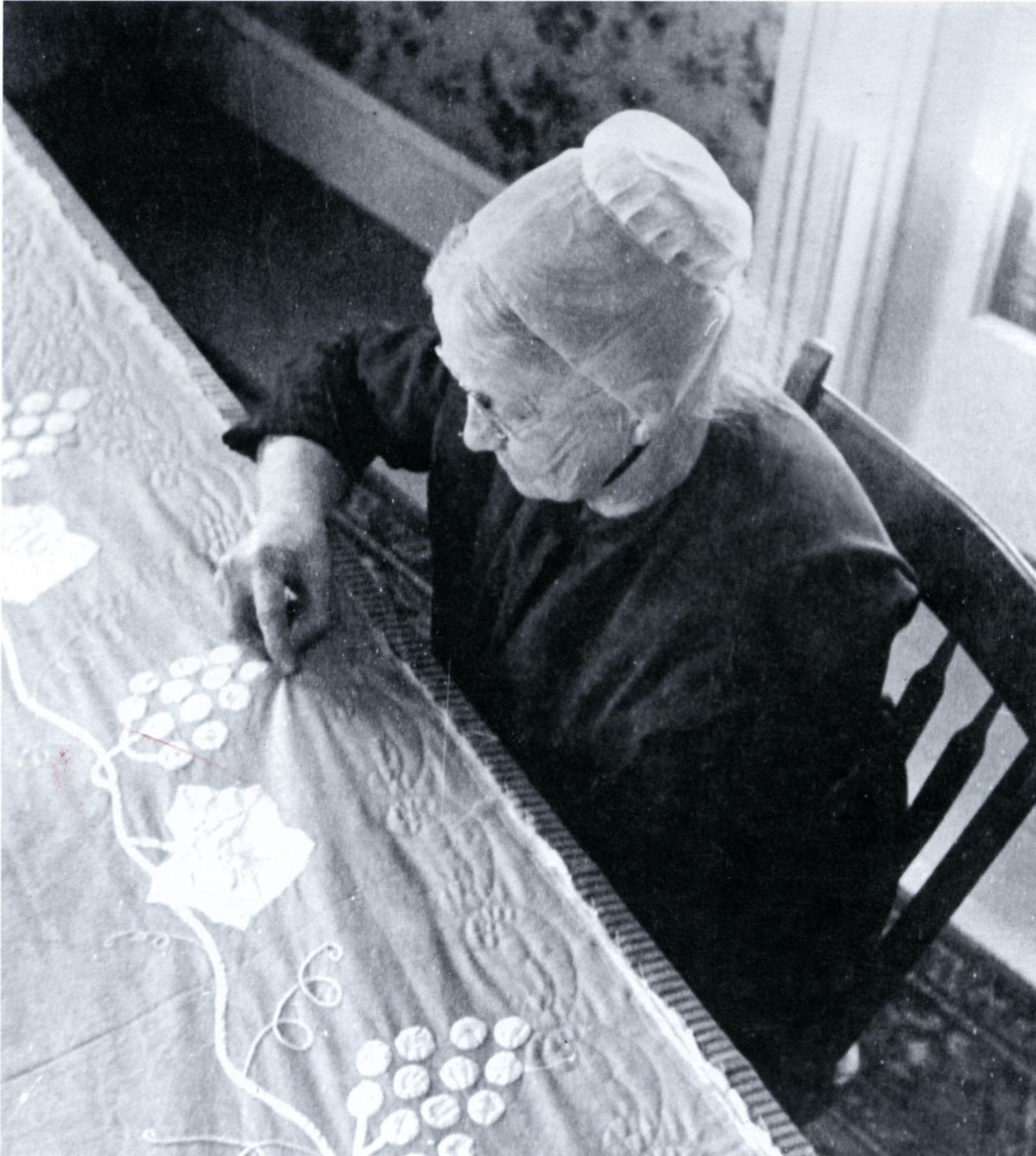
In a photo dated 1948, Joanne showcases Anna Huber Good as she adds tiny stitches to a Grape Vine appliqué quilt. Author Siegrist adds, “Anna quilted all her life; in fact, after rearing eight children, she became even more intent on quilting. Anna got up at 4:00 a.m. and quilted until 6 a.m. Then she made a large breakfast for her husband Daniel and sent him off to his market work. After doing a few cleanup chores, Anna returned to quilting. She quilted all day long until about 9:00 p.m., stopping only for meals.”
Anna’s retirement years were even more productive, making “forty-two quilts for her children.” Amazingly, she charged only 15 cents per yard of quilting thread if she quilted for people outside her family.
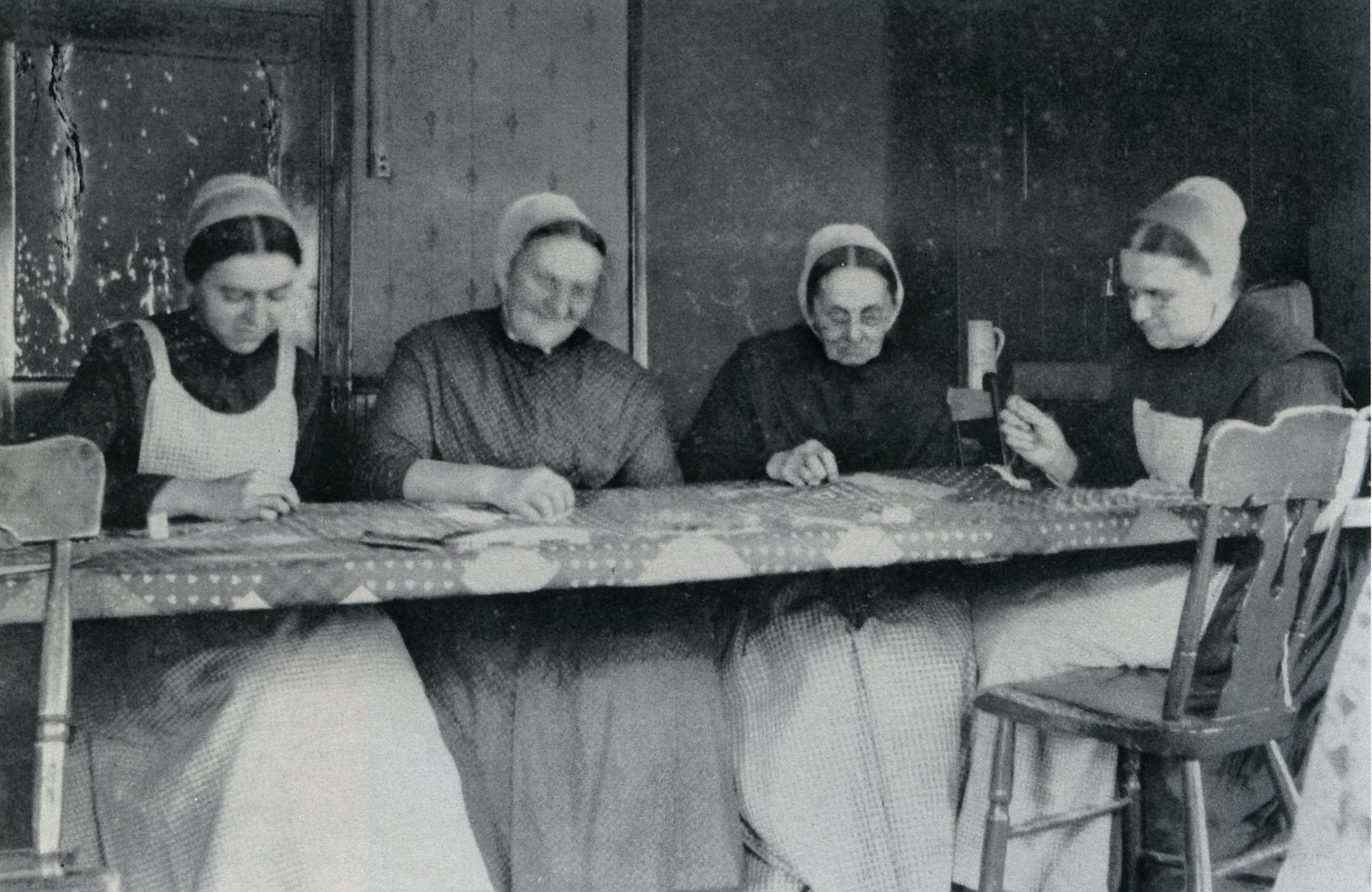
Here are four friends quilting in the dining room of Enos and Annie Lefever’s home (1915). Their intent expressions (uh-oh, I see one smiling!) and nimble fingers are caught on camera by Annie’s son Harry, whose photography did not interfere with his membership at Mellinger’s Mennonite Church (Mennonite Women of Lancaster County,194). Just a mere ten years earlier, Mennonite farmer, John Kreider Miller, lost his church membership for running a photography studio (The Lancaster Intelligencer Journal, Friday, May 10, 1996). Photographs, apparently, at the turn of the twentieth century, spoke of pride, a cardinal sin in the Mennonite system of values. (Mennonite Women of Lancaster County, Siegrist)
Amish and Mennonite hand-made quilts are now marketed as a luxury item and often used as decorative wall hangings. There are numerous websites advertising such handiwork for thousands of dollars.
Until recently, the Quilt Museum at the People’s Place in Intercourse, PA exhibited cleverly crafted quilts from all over the United States.
The Mennonite Central Committee, providing aid to the world’s forgotten and neglected, often sponsors quilt sales and auctions beyond Lancaster County borders. Here is a link to one in Ohio.
January 28, 2014 – It is six months to the day since Mother passed away. I feel melancholy now. Maybe the cold weather has something to do with it, but more and more I miss the warmth of our Saturday morning long-distance phone calls and sitting around her dining room table, the tingly warmth of homemade vegetable soup in my belly.
Elaine Mansfield too has experienced loss – of her mother and of her husband both in a 13-month time span. She eloquently records the loss of her husband in a memoir entitled Leaning into Love: A Spiritual Journey through Grief (October 2014)
Elaine and I definitely differ in our world view and philosophy of life, hers based on Jungian psychology and meditation, and mine with a distinctively Christian perspective. Yet pain is pain, and we share the intimate, human experience of grief.
Here is our conversation about Elaine’s unique journey:
MB:How did your mother’s passing in 2007 affect you and Vic?
EM: My mom had Alzheimer’s Disease for twelve years. Her body was curled in a fetal position and her eyes were closed. She had been unresponsive for years. She died quietly during a lull in Vic’s cancer treatment, so grieving for my mother merged with anticipatory grief for Vic.
MB:Why did you write Leaning into Love: A Spiritual Journey Through Grief?
EM: At first, I wrote to digest and understand what had happened. When times are rough, I pay attention to life’s lessons. Writing was my way of doing that. During Vic’s illness, I kept journals so I could remember every detail during an emotional time. Five years after his death, my experiences became a book to help others deal with love and loss. I also hoped to create an engaging memoir that would interest any reader.
MB:What is the main theme of your book?
EM: The book is about a strong marriage and the initiation of losing a trusted partner: dissolution of the old order, then a period of confusion and despair, then a slow return to new life and possibility.
MB:In the book you promise your dying husband of 42 years, “I’ll find a way to be all right.” What lies behind this statement?
EM: Vic and I shared every joy, sorrow, and dream. We’d had an intimate relationship since I met him when I was 21. He was concerned about leaving me and concerned about my grief. Even while I did all I could to help him live, I felt determined to find a way to make life work after his death. He was relieved when I said so. Of course, I had no idea how challenging that would be.
MB: Just like in your blog posts, you use poetic language in your book to describe bereavement and your slow recovery. For example, you describe a group of dolphins as “luminous revelations leaping from the great unconscious sea.” What other descriptive lines from the book are you especially proud of?
EM: “Our first kisses taste of tears and the knowledge that our time together is finite.”
“Mostly he sleeps, but when he’s awake, he whispers words of sweet gratitude.”
“Despite my better judgment, hope floats in, ethereal and transient as a feather.”
MB: What will readers learn from the book? What is the take-away?
EM:Everyone loses things they love—people, jobs, homes, health, dreams. It’s natural to grieve and long for what we cherish. I’ve learned that facing our losses and sorrows makes us more realistic and open-hearted human beings. We understand what matters in life and see that everyone suffers. In this way, sorrow leads us to kindness.
MB: Your book attracts readers who have dealt with or are now dealing with loss. What is your best advice to them?
EM: Experiment and find what comforts you: solitude, friends, nature, music, therapy. The smallest rituals helped me. I left flowers at the gravesite and said prayers there. Writing brought me daily comfort.
Watch for small signs of joy and hope. A bird chirping. The first spring flower. A child’s laughter. Grief is part of life. Give yourself time to feel what you feel. Open to grief and let it open your heart to love.
After a career as a health counselor and writer, Elaine’s work has focused on bereavement and loss since her husband’s death in 2008. Elaine facilitates bereavement support groups at Hospicare and Palliative Care Services in Ithaca, NY and writes for the Hospicare newsletter and website. She also writes a weekly blog about the adventures and lessons of life and loss, leads workshops, and lectures on bereavement topics. Her articles have been published in The Healing Muse, Open to Hope, Shambhala Sunspace, KirstyTV, Caring.com, Alzheimers.net, GriefHealing, and elephantjournal.
About Leaning into Love:
“Reading this beautiful memoir of love and loss and triumph felt to me like a sacred journey into the very heart and soul of the courageous woman who writes it.” Marty Tousley of Grief Healing.
“Not only a touching and courageous memoir about love, illness, death and grief, Elaine Mansfield’s Leaning into Love is a manual for healing that offers us the emotional and spiritual tools needed to grow and even flourish through Life’s deepest crises.” Dale Borglum, Living/Dying Project
My secret joys (and struggles) show up in my gratitude books. You can see some of them here. But my list this week has sprung from my 9-day trip to Pennsylvania to visit family and take care of Mother’s house in mid-November 2014.
In her devotional book One Thousand Gifts, Ann Voskamp begins with a chapter entitled Surprising Grace in which she discusses how she and her Farmer Husband “give thanks even when things look like a failure.” Or when one experiences loss.
This year Mother died, we’ve had to sell her beloved house and its contents, I’ve struggled with a motley crew of personal challenges, and still I give thanks:
Health – I have an odd muscular neck pain (yes, pain in my neck!) yet I went up and down 3 flights of stairs from attic to cellar dozens of times, no problem.
My sisters and brother – We sorted, boxed, laughed, cried, disagreed, but ultimately met the challenge on time.
My Aunt Cecilia – She’ll be 100 years old in March, still going strong. We found Aunt Ceci cheerfully playing the Tumbling Blocks game on the computer beside her. “It keeps my mind sharp!” she laughs. A Mennonite preacher’s wife, Aunt Cecilia Metzler raised a family of five children on a Lancaster County farm.
My Aunt Ruthie – The photo is fuzzy here, just like her memory. But after she viewed some of the movies she filmed in her 20s and 30s that appear on other blog posts (here and here) she smiles, “ These pictures really make my mind come alive.”
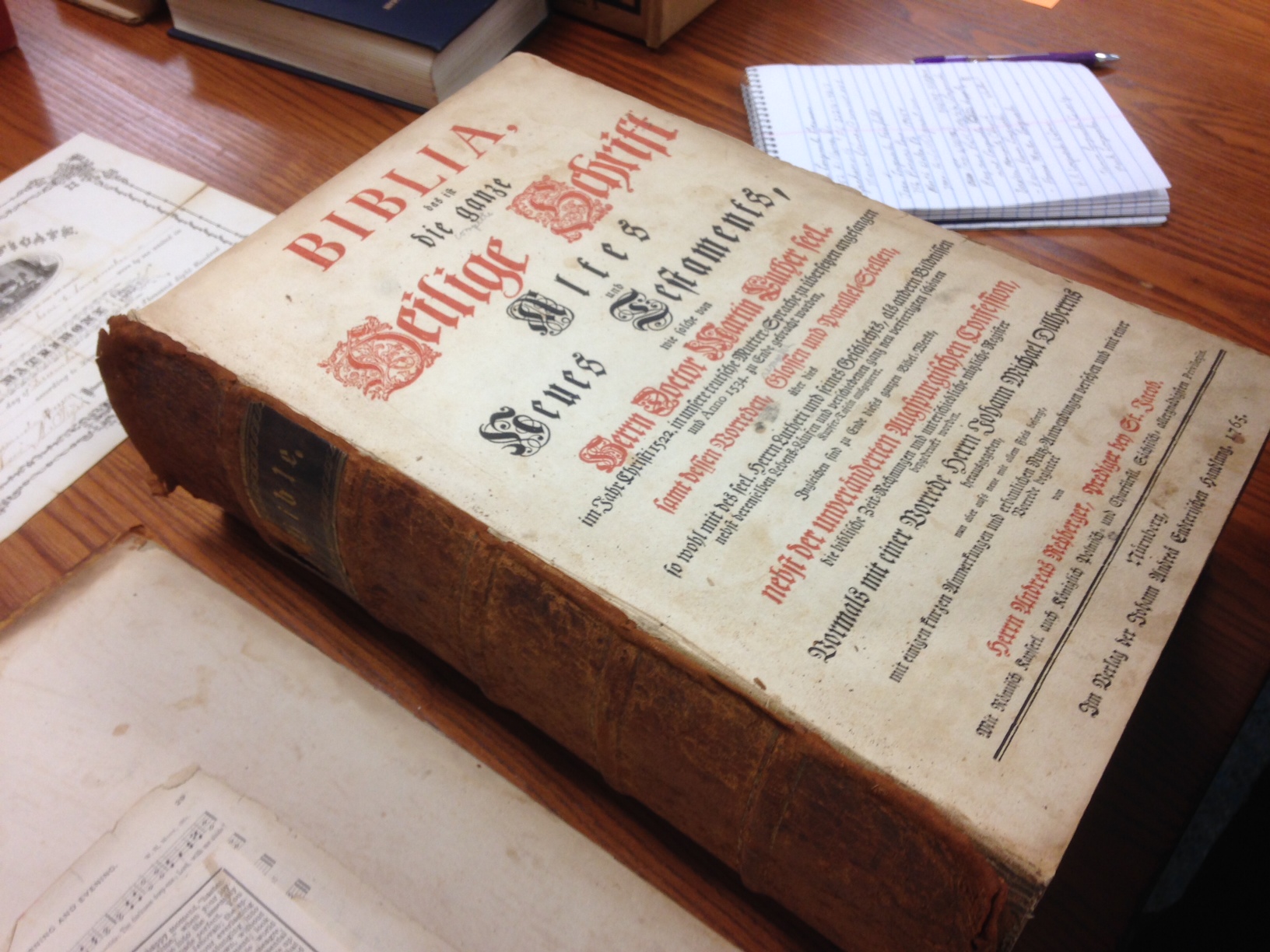
An heritage with spiritual depth – When my ancestors arrived in The New World, they brought with them the Holy Scriptures. This one, the Nuremberg Bible, is dated 1765.
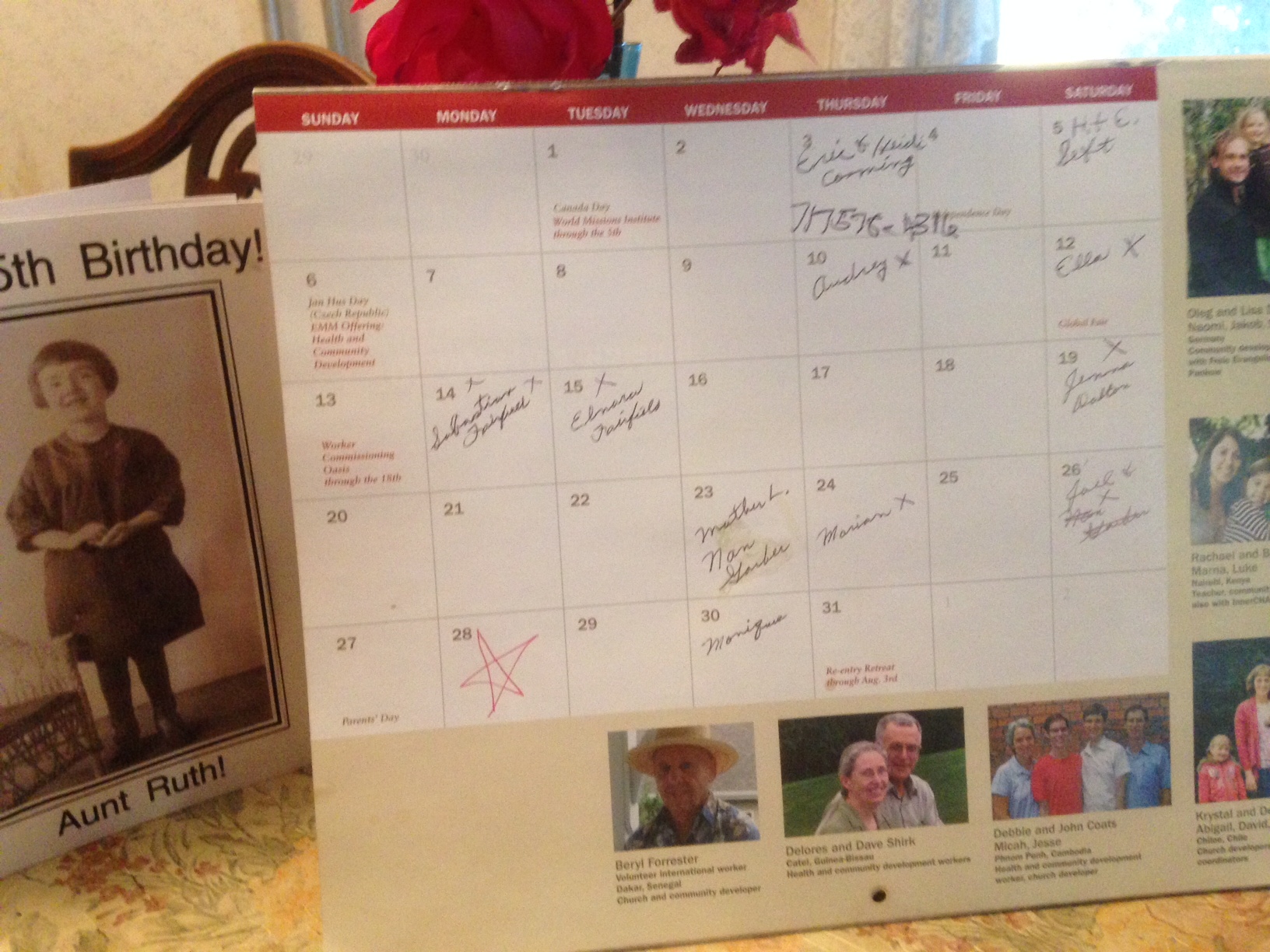
The memory of my Mother – When Mother died, she still had a current driver’s license, paid all of her bills by check, and kept appointments on her calendar. She sent birthday cards to all her children, grand-children, and great grand-children, represented by names penned into the blocks. She died on the 28th of July, a date we marked with a red asterisk.
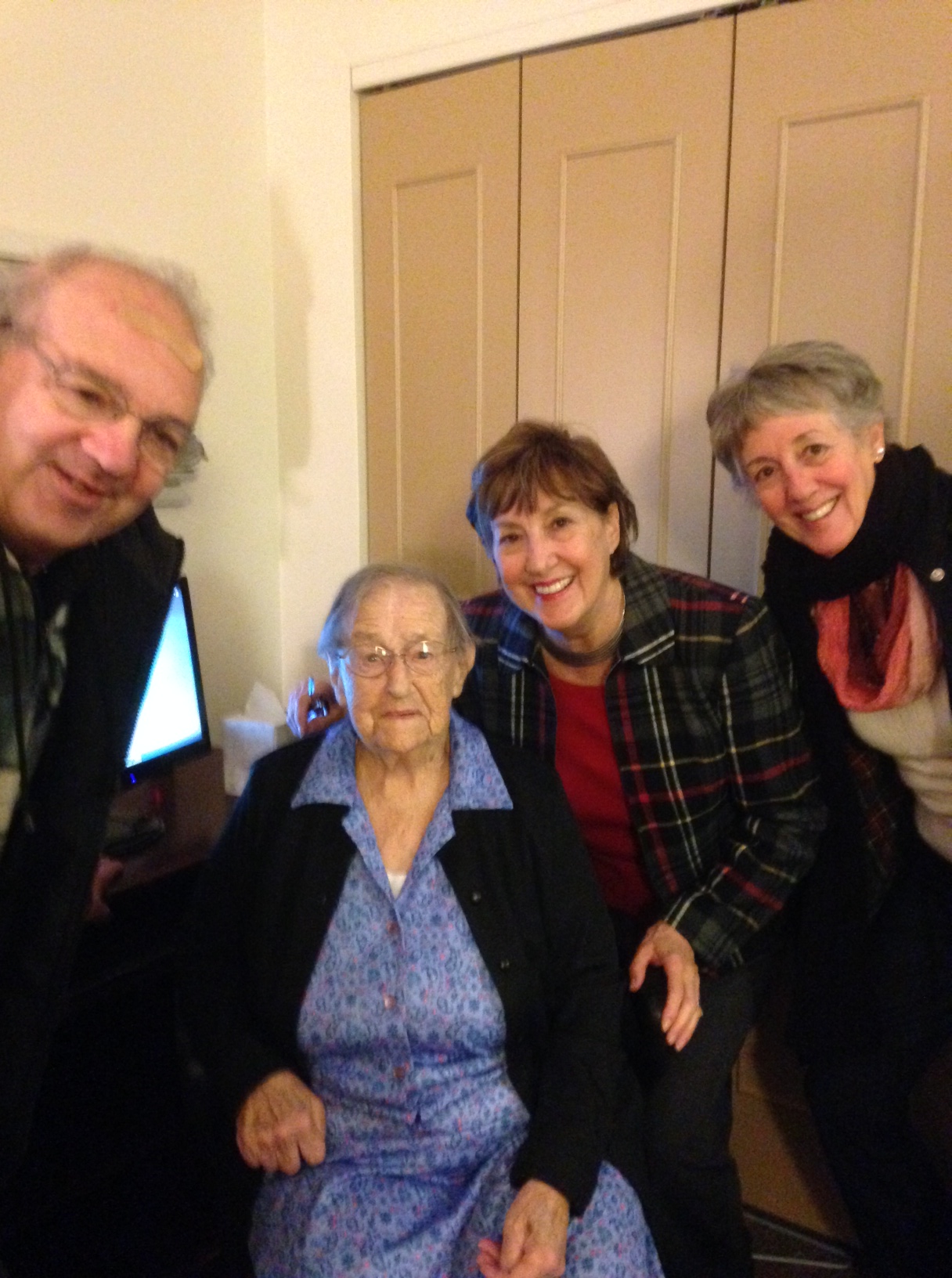
My family – This photo is six years old, taken when baby Ian no longer needed a breathing apparatus. Just so you know: our daughter Crista is blonde, Joel, dark-haired. With the older boys now 11 years old, we are due for an update!
Ann Voskamp continues by quoting the first reference in Scripture containing the word thanksgiving, mingling peace and gratitude:
And this is the law of the sacrifice of peace offerings that one may offer to the LORD. If he offers it for a thanksgiving, then he shall offer with the thanksgiving sacrifice unleavened loaves mixed with oil, unleavened wafers smeared with oil, and loaves of fine flour well mixed with oil. With the sacrifice of his peace offerings for thanksgiving he shall bring his offering with loaves of leavened bread.
Leviticus 7:11 – 13 ESV
My conclusion: Gratitude brings peace and ultimately joy.
Writer Voskamp concludes: ” . . . standing straight into wind is how to fly on His wings of grace.”
Finally, a song I remember from childhood from that seems appropriate for the season:
What are you grateful for? Join me in naming your blessings.
















 Plain and Fancy